Tuning Rashba spin-orbit coupling at LaAlO3/SrTiO3 interfaces by band filling
Chunhai Yin, Patrick Seiler, Lucas M. K. Tang, Inge Leermakers, Nikita, Lebedev, Uli Zeitler, and Jan Aarts

TL;DR
This study demonstrates that the Rashba spin-orbit coupling at LaAlO3/SrTiO3 interfaces can be effectively tuned via back-gating, with maximum effects near the Lifshitz transition, relevant for spintronic applications.
Contribution
It provides experimental evidence linking the Rashba effect to band filling and Lifshitz transition, clarifying gate dependence discrepancies in previous studies.
Findings
Maximum spin-orbit coupling occurs near the Lifshitz point.
Multiple Lifshitz transitions observed with gate tuning.
Strong evidence for a single spin winding at the Fermi surface.
Abstract
The electric-field tunable Rashba spin-orbit coupling at the LaAlO3/SrTiO3 interface shows potential applications in spintronic devices. However, different gate dependence of the coupling strength has been reported in experiments. On the theoretical side, it has been predicted that the largest Rashba effect appears at the crossing point of the and bands. In this work, we study the tuneability of the Rashba effect in LaAlO3/SrTiO3 by means of back-gating. The Lifshitz transition was crossed multiple times by tuning the gate voltage so that the Fermi energy is tuned to approach or depart from the band crossing. By analyzing the weak antilocalization behavior in the magnetoresistance, we find that the maximum spin-orbit coupling effect occurs when the Fermi energy is near the Lifshitz point. Moreover, we find strong evidence for a single spin winding at the Fermi…
Click any figure to enlarge with its caption.
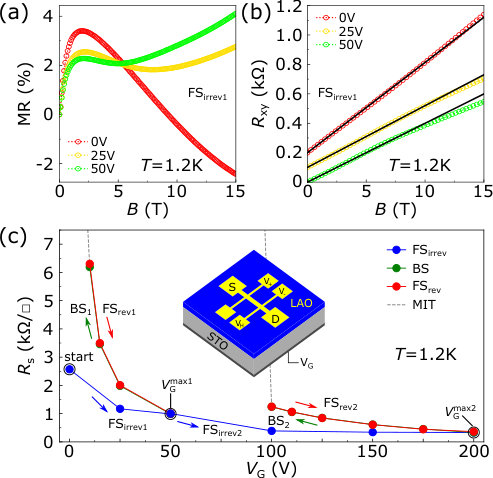 Figure 1
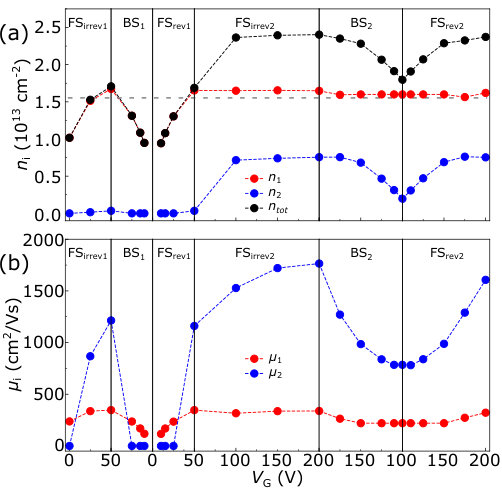 Figure 2
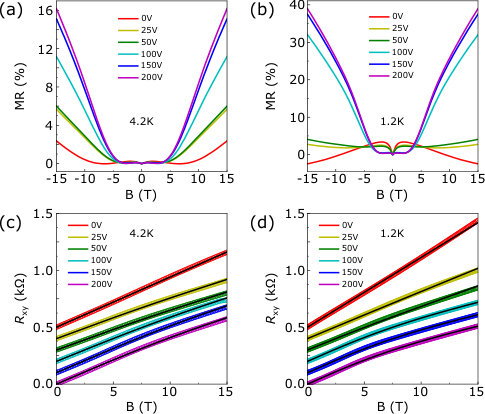 Figure 3
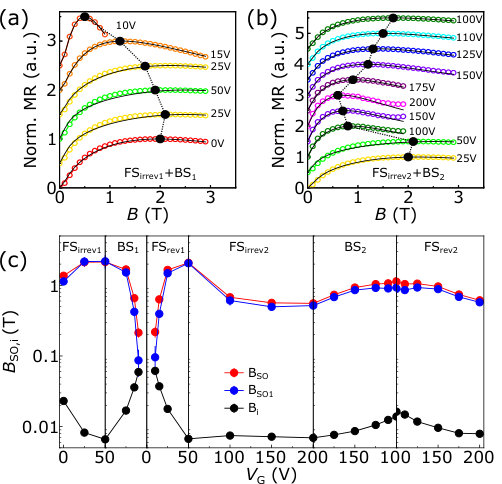 Figure 3
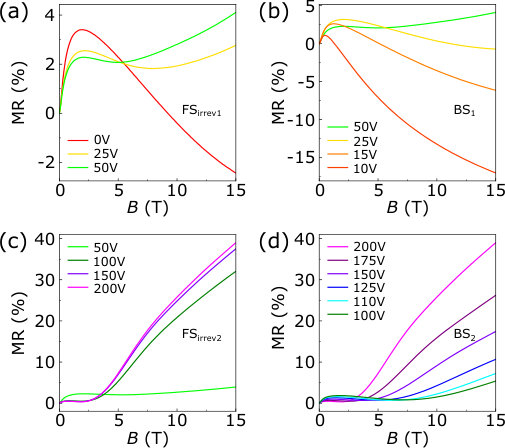 Figure 5
Peer Reviews
No public reviews on file for this paper yet. If you reviewed it on a platform where reviews are public (OpenReview, ICLR, NeurIPS, ICML), you can paste yours below so the community can read it here.
Videos
No videos yet. Explain this paper in a talk, walkthrough, or lecture? Add one.
Tuning Rashba spin-orbit coupling at \ceLaAlO3/\ceSrTiO3 interfaces by band filling
Chunhai Yin1, Patrick Seiler2, Lucas M. K. Tang3, Inge Leermakers3, Nikita Lebedev1, Uli Zeitler3, and Jan Aarts1
1Huygens-Kamerlingh Onnes Laboratory, Leiden University, P.O. Box 9504, 2300 RA Leiden, The Netherlands
2Center for Electronic Correlations and Magnetism, EP VI, Insitute of Physics, University of Augsburg, 86135 Augsburg, Germany
3High Field Magnet Laboratory (HFML-EMFL), Radboud University, Toernooiveld 7, 6525 ED Nijmegen, The Netherlands
Abstract
The electric-field tunable Rashba spin-orbit coupling at the \ceLaAlO3/\ceSrTiO3 interface shows potential applications in spintronic devices. However, different gate dependence of the coupling strength has been reported in experiments. On the theoretical side, it has been predicted that the largest Rashba effect appears at the crossing point of the and bands. In this work, we study the tunability of the Rashba effect in \ceLaAlO3/\ceSrTiO3 by means of back-gating. The Lifshitz transition was crossed multiple times by tuning the gate voltage so that the Fermi energy is tuned to approach or depart from the band crossing. By analyzing the weak antilocalization behavior in the magnetoresistance, we find that the maximum spin-orbit coupling effect occurs when the Fermi energy is near the Lifshitz point. Moreover, we find strong evidence for a single spin winding at the Fermi surface.
Complex oxide heterostructures provide an interesting platform for novel physics since their physical properties are determined by correlated electrons Hwang et al. (2012). The most famous example is the discovery of a high mobility two-dimensional electron system (2DES) at the interface between \ceLaAlO3 (LAO) and \ceSrTiO3 (STO) Ohtomo and Hwang (2004). Intriguing properties, such as superconductivity Reyren et al. (2007), signatures of magnetism Brinkman et al. (2007); Lee et al. (2013) and even their coexistence Li et al. (2011); Bert et al. (2011), have been reported.
At the LAO/STO interface, the 2DES is confined in an asymmetric quantum well (QW) in STO. The intrinsic structure inversion asymmetry introduces an electric field which gives rise to a Rashba spin-orbit (SO) coupling Bychkov and Rashba (1984). Additionally, due to the large dielectric constant of the STO substrate at cryogenic temperatures Neville et al. (1972), the coupling constant can be tuned with the STO as back gate Shalom et al. (2010); Caviglia et al. (2010); Liang et al. (2015). This could give rise to applications in spintronics, such as spin field-effect transistors Datta and Das (1990). However, the reported results are inconsistent. Upon increasing the back-gate voltage (), the SO coupling strength was found to decrease Shalom et al. (2010), increase Caviglia et al. (2010), or show a maximum Liang et al. (2015). A clear understanding of the SO coupling dependence on is necessary for more advanced experiments.
For a free electron gas the Rashba spin splitting is proportional to the symmetry breaking electric field. However the Rashba effect in solids like semiconductor and oxide heterostructures has a more complicated origin Winkler (2003). Theoretical studies have shown that multi-band effects play an essential role in the SO coupling in LAO/STO Zhong et al. (2013); Khalsa et al. (2013). At the LAO/STO (001) interface, the band structure is formed by the \ceTi bands. At the -point, the band lies below the bands in energy Santander-Syro et al. (2011). Applying across the STO substrate changes the carrier density and therefore the Fermi energy (). A Lifshitz transition occurs when is tuned across the bottom of the bands Joshua et al. (2012). The largest SO coupling effect was predicted at the crossing point of the and bands Zhong et al. (2013); Khalsa et al. (2013). The SO coupling theory was experimentally confirmed later by angle-resolved photoemission spectroscopy (ARPES) measurements King et al. (2014).
So far, few experiments actually track the evolution of SO coupling when is driven to approach or depart from the Lifshitz point. In this work, we study the Rashba effect in back-gated LAO/STO. By carefully monitoring the sign of the magnetoresistance (MR) in high magnetic field and the linearity of the Hall resistance, was tuned back and forth so that the Lifshitz transition was crossed multiple times. The SO coupling characteristic magnetic fields were extracted by fitting the weak antilocalization (WAL) behavior in the MR. We find that the maximum SO coupling effect occurs when is near the Lifshitz point. We also find a single spin winding at the Fermi surface.
We use a Hall bar device with a width of and length of , as depicted in the inset of Fig. 1(c). First, a sputtered amorphous AlOx hard mask in form of a negative Hall bar geometry (thickness \sim$$15\text{\,}\mathrm{nm}) was fabricated on a \ceTiO2-terminated STO (001) substrate by photolithography. Then, 15 unit cells of LAO film were deposited at in an Ar pressure of by off-axis sputtering Yin et al. (2019a). Finally, the sample was annealed at in of oxygen for . The back-gate electrode was formed by uniformly applying a thin layer of silver paint (Ted Pella, Inc.) on the back of the substrate. The detailed device fabrication procedure is described in Ref. Yin et al. (2019b). Magnetotransport measurements were performed in a cryostat with a base temperature of and a magnetic field of . The longitudinal resistance () and transverse resistance () were measured simultaneously using standard lock-in technique ( and ). The maximum applied was and the leakage current was less than during the measurement.
The device was first cooled down to with grounded. In the original state ( = ), the observed maximum in MR (Fig 1(a)) in low magnetic field is a sign of WAL. The negative MR in high magnetic field as well as the approximately linear () (Fig 1(b)) indicate that the presence of only one type of carriers. Next, was increased to add electrons to the QW and two characteristic Lifshitz transition features appeared at . They are the emergence of positive MR in high magnetic field and the change of linearity of () Joshua et al. (2012); Smink et al. (2017). was further increased to () to drive slightly above the Lifshitz point, resulting in larger positive MR and more downward bending of () in high magnetic field.
Then was decreased to remove electrons from the QW in order to go back through the Lifshitz transition from the high-density direction. It has been shown that, due to the effect of electron trapping in STO, the sheet resistance () always follows an irreversible route when is first swept forward and then backward Yin et al. (2019b); Bell et al. (2009); Liu et al. (2015). Fig. 1(c) shows as a function of . It can be seen that increases above the virgin curve when is swept backward. The backward sweep finally leads to a metal-insulator transition (MIT), whose onset was defined from the phase shift of the lock-in amplifier increasing above . Sweeping forward again results in a reversible decrease of which overlaps with the previous backward sweep and the system is fully recovered when is reapplied to . We therefore classify sweeps into three regimes, namely irreversible forward sweep (FSirrev), backward sweep (BS) and reversible forward sweep (FSrev). was then increased to () to drive well above the Lifshitz point. Similar reversible behavior is observed in BS2 and FSrev2. Back-gate tuning of MR in various regimes is shown in Fig. 2. Note for instance now the positive MR at reverts to the single-band negative MR at in the backward sweep regime BS1.
Fig. 3(a) and 3(b) present the dependence of the carrier densities and mobilities. The values are extracted by fitting the magnetotransport data with a two-band model Biscaras et al. (2012); tex :
[TABLE]
with the constraint , where and are the carrier densities of the low mobility carriers (LMC) and high mobility carriers (HMC), respectively, and and are the corresponding mobilities. For a reliable convergence and are set to 0 in the one-band transport regime. The total carrier density () is the sum of and . As shown in Fig. 3(a), the critical carrier density () corresponding to the Lifshitz transition is , which is close to earlier reported results Joshua et al. (2012). The evolution of the carrier densities indicates that approaches the Lifshitz point in regimes FSirrev1, FSrev1 and BS2 and departs from the Lifshitz point in regimes BS1, FSirrev2 and FSrev2. In Fig. 3(b), it can be seen that almost stays unaffected above the Lifshitz transition whereas can be considerably changed by , reaching \sim$$1800\text{\,}\mathrm{c}\mathrm{m}^{2}\mathrm{/}\mathrm{V}\mathrm{s} at . It should be mentioned that there is a small upturn in which cannot be captured by the two-band model (for more details see Ref. tex ). A similar feature has also been reported by other groups Joshua et al. (2012); Seiler et al. (2018), but its origin is still under debate. There are attempts to relate it to an unconventional anomalous Hall effect (AHE) Ruhman et al. (2014) or hole transport Seiler et al. (2018), but we cannot get convincing fits using these models. In any case, we emphasize that the extraction of the parameters is not affected strongly by this feature.
In low-dimensional systems, the conductivity shows signatures of quantum interference between time-reversed closed-loop electron trajectory pairs. In the presence of SO coupling the pairs interfere destructively, leading to a positive MR in low magnetic field which is known as the WAL Bergmann (1984). For a system with Rashba-type of SO coupling, the spin relaxation is described by the D’yakonov-Perel’ (DP) mechanism D’yakonov and Perel’ (1971). The model for analyzing the WAL was established by Iordanskii, Lyanda-Geller and Pikus (ILP) Iordanskii et al. (1994). In this model, both the single and triple spin winding contributions at the Fermi surface have been taken into account. It should be noted that the ILP model is an effective single-band model, which means that above the Lifshitz point the fitted characteristic magnetic field for SO coupling is an effective field for both the and bands. A model that considers multi-band effects is not available yet. The WAL correction to the magnetoconductivity is given by Iordanskii et al. (1994); Seiler et al. (2018):
[TABLE]
[TABLE]
where is the digamma function, . The fitting parameters are the characteristic magnetic fields for the inelastic scattering , and for the spin-orbit coupling ( = 1 or 3 for single or triple spin winding), where is diffusion constant, and are relaxation times, and is spin splitting coefficient.
Fig. 4(a) and 4(b) depict WAL fits in the two FSirrev and BS regimes. The solid black circles represent the local maxima of the MR curves. In principle, the SO coupling strength can be roughly estimated by the magnetic field () where the local maximum appears Liang et al. (2015). It can be clearly seen that increases as approaches the Lifshitz point (regimes FSirrev1 and BS2), while decreases as departs from the Lifshitz point (regimes BS1 and FSirrev2). The fitted values for the characteristic magnetic fields are plotted in Fig. 4(c), where is the sum of and . In most cases is much smaller than , indicating a single spin winding at the Fermi surface. The maximum SO coupling strength occurs near the Lifshitz point, agreeing with the evolution of . Driving either above or below the Lifshitz point would lead to a decrease of the SO coupling strength. increases when the carrier density is lowered, which is due to more accessible phonons contributing to the scattering process, and vice versa.
If is 0 and only is present, the ILP formula could be reduced to a simpler model developed by Hikami, Larkin and Nagaoka (HLN) Hikami et al. (1980), in which the spin relaxation is described by the Elliot-Yafet (EY) mechanism Elliott (1954); Yafet (1963). However, the HLN model yields inaccurate fits to our data, which is different from earlier reported results Nakamura et al. (2012); Liang et al. (2015), where a triple spin winding has been found.
Our results manifest the nontrivial SO coupling mechanism at the LAO/STO interface predicted by theoretical works Zhong et al. (2013); Khalsa et al. (2013). Applying an external electric field can tune the SO coupling, but its direct contribution is rather small. According to the Rashba theory for a free electron system, a typical electric field in experiments, e. g. , only yields a spin splitting of Zhong et al. (2013), which is much smaller than the measured values that are of the order of meV Caviglia et al. (2010). Instead the electric field-effect is indirect. It is the tuning of carrier densities and therefore band filling that significantly influence the SO coupling.
In summary, we have performed magnetotransport experiments to study the Rashba SO couping effect in back-gated LAO/STO. By tuning the gate voltage, the Fermi energy has been driven to approach or depart from the Lifshitz point multiple times. We have done WAL analysis using the ILP model, which reveals a single spin winding at the Fermi surface. We have found that the maximum SO coupling occurs when the Fermi energy is near the Lifshitz point. Driving the Fermi energy above or below the Lifshitz point would result in a decrease of the coupling strength. Our findings provide valuable insights to the investigation and design of oxide-based spintronic devices.
We thank Thilo Kopp, Daniel Braak, Andrea Caviglia, Nicandro Bovenzi, Sander Smink, Aymen Ben Hamida and Prateek Kumar for useful discussions. This work is supported by the Netherlands Organisation for Scientific Research (NWO) through the DESCO program. We acknowledge the support of HFML-RU/NWO, member of the European Magnetic Field Laboratory (EMFL). P. S. is supported by the DFG through the TRR 80. C. Y. is supported by China Scholarship Council (CSC) with grant No. 201508110214.
The reference list from the paper itself. Each links out to its DOI / PubMed record.
- 1Hwang et al. (2012) H. Y. Hwang, Y. Iwasa, M. Kawasaki, B. Keimer, N. Nagaosa, and Y. Tokura, Nature Materials 11 , 103 (2012) . · doi ↗
- 2Ohtomo and Hwang (2004) A. Ohtomo and H. Y. Hwang, Nature 427 , 423 (2004) . · doi ↗
- 3Reyren et al. (2007) N. Reyren, S. Thiel, A. D. Caviglia, L. F. Kourkoutis, G. Hammerl, C. Richter, C. W. Schneider, T. Kopp, A.-S. Ruetschi, D. Jaccard, M. Gabay, D. A. Muller, J.-M. Triscone, and J. Mannhart, Science 317 , 1196 (2007) . · doi ↗
- 4Brinkman et al. (2007) A. Brinkman, M. Huijben, M. V. Zalk, J. Huijben, U. Zeitler, J. C. Maan, W. G. V. D. Wiel, G. Rijnders, D. H. A. Blank, and H. Hilgenkamp, Nature Materials 6 , 493 (2007) . · doi ↗
- 5Lee et al. (2013) J.-S. Lee, Y. W. Xie, H. K. Sato, C. Bell, Y. Hikita, H. Y. Hwang, and C.-C. Kao, Nature Materials 12 , 703 (2013) . · doi ↗
- 6Li et al. (2011) L. Li, C. Richter, J. Mannhart, and R. C. Ashoori, Nature Physics 7 , 762 (2011) . · doi ↗
- 7Bert et al. (2011) J. A. Bert, B. Kalisky, C. Bell, M. Kim, Y. Hikita, H. Y. Hwang, and K. A. Moler, Nature Physics 7 , 767 (2011) . · doi ↗
- 8Bychkov and Rashba (1984) Y. A. Bychkov and E. I. Rashba, JETP Letters 39 , 78 (1984).