Floquet-engineering counterdiabatic protocols in quantum many-body systems
Pieter W. Claeys, Mohit Pandey, Dries Sels, Anatoli Polkovnikov

TL;DR
This paper develops a systematic method to construct approximate counterdiabatic protocols for many-body quantum systems using Floquet engineering, enabling high-fidelity adiabatic-like evolution with practical control schemes.
Contribution
It introduces a nested commutator series for approximate gauge potentials and demonstrates how Floquet techniques can realize these protocols in many-body systems.
Findings
Protocols significantly suppress dissipation
Fidelity of quantum evolution is greatly increased
Method is applicable to both few- and many-body systems
Abstract
Counterdiabatic (CD) driving presents a way of generating adiabatic dynamics at arbitrary pace, where excitations due to non-adiabaticity are exactly compensated by adding an auxiliary driving term to the Hamiltonian. While this CD term is theoretically known and given by the adiabatic gauge potential, obtaining and implementing this potential in many-body systems is a formidable task, requiring knowledge of the spectral properties of the instantaneous Hamiltonians and control of highly nonlocal multibody interactions. We show how an approximate gauge potential can be systematically built up as a series of nested commutators, remaining well-defined in the thermodynamic limit. Furthermore, the resulting CD driving protocols can be realized up to arbitrary order without leaving the available control space using tools from periodically-driven (Floquet) systems. This is illustrated on few-…
Click any figure to enlarge with its caption.
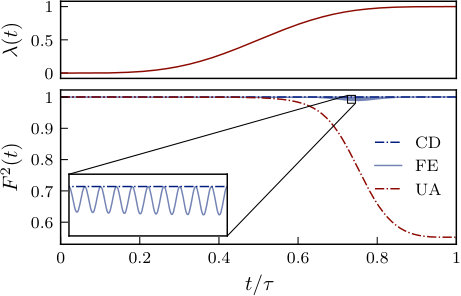 Figure 2
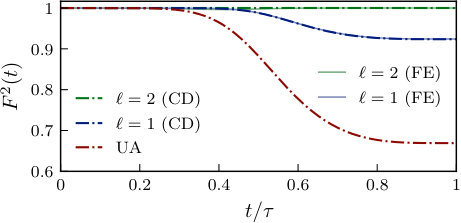 Figure 3
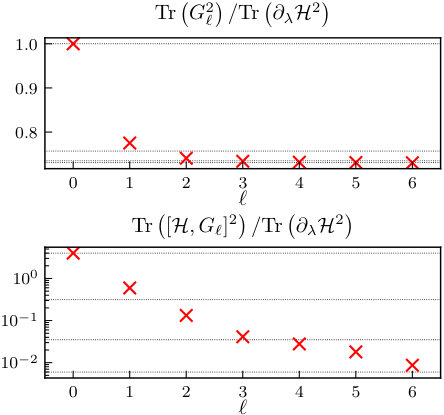 Figure 3
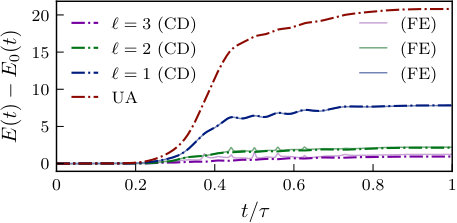 Figure 4
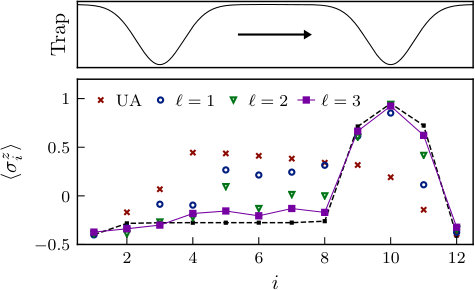 Figure 5
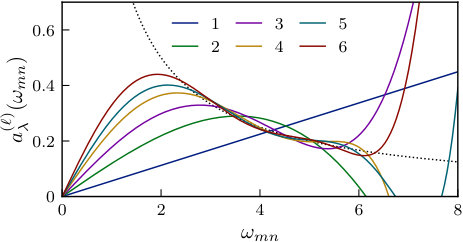 Figure 6
Peer Reviews
No public reviews on file for this paper yet. If you reviewed it on a platform where reviews are public (OpenReview, ICLR, NeurIPS, ICML), you can paste yours below so the community can read it here.
Videos
No videos yet. Explain this paper in a talk, walkthrough, or lecture? Add one.
Floquet-engineering counterdiabatic protocols in quantum many-body systems
Pieter W. Claeys
Department of Physics, Boston University, 590 Commonwealth Ave., Boston, MA 02215, USA
Mohit Pandey
Department of Physics, Boston University, 590 Commonwealth Ave., Boston, MA 02215, USA
Dries Sels
Department of Physics, Harvard University, 17 Oxford St., Cambridge, MA 02138, USA
Theory of quantum and complex systems, Universiteit Antwerpen, B-2610 Antwerpen, Belgium
Anatoli Polkovnikov
Department of Physics, Boston University, 590 Commonwealth Ave., Boston, MA 02215, USA
Abstract
Counterdiabatic (CD) driving presents a way of generating adiabatic dynamics at arbitrary pace, where excitations due to non-adiabaticity are exactly compensated by adding an auxiliary driving term to the Hamiltonian. While this CD term is theoretically known and given by the adiabatic gauge potential, obtaining and implementing this potential in many-body systems is a formidable task, requiring knowledge of the spectral properties of the instantaneous Hamiltonians and control of highly nonlocal multibody interactions. We show how an approximate gauge potential can be systematically built up as a series of nested commutators, remaining well-defined in the thermodynamic limit. Furthermore, the resulting CD driving protocols can be realized up to arbitrary order without leaving the available control space using tools from periodically-driven (Floquet) systems. This is illustrated on few- and many-body quantum systems, where the resulting Floquet protocols significantly suppress dissipation and provide a drastic increase in fidelity.
Introduction. – Adiabaticity presents one of the fundamental tools in physics, ranging from heat engines in thermodynamics to quantum state preparation and quantum computation Nielsen and Chuang (2000); Chandra et al. (2010); Vinjanampathy and Anders (2016); Bohn et al. (2017). However, true adiabatic control can only be obtained using slow driving and asymptotically long time scales. While faster driving leads to diabatic excitations and resulting dissipative losses, the inevitable presence of decoherence and noise in realistic quantum systems limits the available timescales, preventing true adiabaticity. Various methods have been proposed in order to achieve so-called “Shortcuts to Adiabaticity” both theoretically del Campo (2013); Torrontegui et al. (2013); del Campo and Kim (2019) and experimentally Bason et al. (2012); Zhang et al. (2013); An et al. (2016); Du et al. (2016); Zhou et al. (2017); Wang et al. (2019); Kölbl et al. (2019), mimicking adiabatic dynamics without the requirement of slow driving.
One way of circumventing this loss of fidelity at finite driving rates is through counterdiabatic (CD) or transitionless driving – a velocity-dependent term is added to the control Hamiltonian, exactly compensating the diabatic contributions to the Hamiltonian in the moving frame Demirplak and Rice (2003, 2005); Berry (2009); Kolodrubetz et al. (2017). This term is known as the adiabatic gauge potential (or gauge connection), encoding the geometry of eigenstates when varying a control parameter Kolodrubetz et al. (2017). However, while this potential may be exactly obtained in few-body systems, its construction in general requires diagonalization of the Hamiltonian in the full Hilbert space, prohibiting its use in general many-body systems. Furthermore, the resulting operator tends to involve highly nontrivial and nonlocal couplings not present in the control Hamiltonian, preventing its actual implementation (except in some limiting cases) Deffner et al. (2014); Zwick et al. (2014); Hatomura and Mori (2018); del Campo et al. (2012); Saberi et al. (2014); del Campo and Sengupta (2015); Okuyama and Takahashi (2016); Diao et al. (2018).
In few-body systems, restricting driving to couplings within the control Hamiltonian led to the development of fast-forward (FF) protocols, where CD driving is effectively realized in a time-dependent rotating frame Masuda and Nakamura (2009); Torrontegui et al. (2012); Bukov et al. (2019). However, there exists no general way of constructing these protocols for complex systems. One specific class of FF protocols is those where CD driving is realized through Floquet-engineering: high-frequency oscillations are added to the control so that the resulting Floquet Hamiltonian mimics the CD Hamiltonian. In few-body systems, this has already been used for high-fidelity quantum state manipulation both theoretically in closed Ribeiro et al. (2017); Petiziol et al. (2018, 2019) and open systems Villazon et al. (2019), and experimentally in a noisy qubit Boyers et al. (2018).
In this work, we propose a method of (i) finding an efficient and controlled approximation to the gauge potential, remaining well-defined in many-body systems, which can then (ii) be systematically realized through Floquet-engineering by resonantly oscillating the instantaneous Hamiltonian with the driving term. Effectively, we propose a general strategy for designing fast adiabatic protocols, applicable both in small quantum systems to achieve high fidelity for state preparation and in large systems, quantum or classical, to suppress dissipative losses. This is then illustrated on few- and many-body systems.
Methods. – Consider a control Hamiltonian dependent on a single control parameter . Our goal is to transport a stationary state or distribution, at an initial value of the control parameter , to one corresponding to a final value . In the standard approach, this is done by adiabatically changing from to , which is often impractical because of the necessary access to long timescales. The key idea of CD driving is to vary the parameter at a finite rate while simultaneously compensating the diabatic excitations by explicitly adding an auxiliary term as
[TABLE]
Adiabatic control at arbitrary driving rates and for arbitrary initial states is realized provided the adiabatic gauge potential Kolodrubetz et al. (2017) satisfies
[TABLE]
where and are the eigenstates and the energy spectrum of the instantaneous Hamiltonian, . The CD term then exactly compensates non-adiabatic transitions between eigenstates.
The expression (2) already highlights the issues with many-body CD driving: since the gauge potential is defined in the eigenbasis of the instantaneous Hamiltonian, it requires exact diagonalization. Furthermore, for increasing system sizes the denominator can become exponentially small, leading to divergent matrix elements and an ill-defined gauge potential in the thermodynamic limit Jarzynski (1995); Kolodrubetz et al. (2017). Physically, at least in chaotic systems, the exact gauge potential also cannot be local because no local operator is expected to be able to distinguish general many-body states with arbitrary small energy difference D’Alessio et al. (2016). Considering a system with a gapped ground state, Lieb-Robinson bounds can however be used to obtain a quasi-local operator reproducing the action of the exact gauge potential on this ground state, since no such divergences occur in this case Bachmann et al. (2017).
In the following, we propose a general approximate gauge potential defined as
[TABLE]
fully determined by a set of coefficients , where determines the order of the expansion. It can be shown that the exact gauge potential can be represented in this form in the limit Note (1). Instead we consider a small finite value of and treat the expansion coefficients as variational parameters, which can be obtained by minimizing the action
[TABLE]
The exact gauge potential is known to follow from the variational minimization of an action Sels and Polkovnikov (2017). However, it is not a priori clear what (local) operators should be included in the variational basis. The total number of possible operators increases exponentially with their support, limiting the brute-force minimization to highly local operators with restricted support. Furthermore, it is far from guaranteed that such operators will be experimentally realizable. The main finding of the present work is that the proposed ansatz tackles both problems simultaneously. (i) The number of variational coefficients can be kept small while still returning an accurate approximation to the exact gauge potential. As such, Eq. (3) can be seen as a variational ansatz including only the most important contributions with the maximum range of operators set by . (ii) In addition, this gauge potential can be engineered with a simple Floquet protocol. Essentially, this realization is possible because the high-frequency expansion of the Floquet Hamiltonian shares the commutator structure of Eq. (3). This expansion exhibits the symmetries of the exact solution at each order, and as additional bonus we point out that this ansatz has a well-defined classical limit, where even the local-operator basis becomes infinite-dimensional. In classical systems, the commutators in Eq. (3) only need to be replaced by Poisson brackets.
Since the action is simply the Hilbert-Schmidt norm of , the variational method has the clear advantage that the action can be calculated without explicitly constructing the operator matrix in the full Hilbert space. There are various ways of motivating Eq. (3) (see Supplementary Material 111Supplementary Material. for more details): it can be seen as an expansion in the Krylov subspace generated by the action of , or by noting that such commutators appear through the Baker-Campbell-Hausdorff expansion in the definition of a (properly regularized) gauge potential, or by simply noting that its matrix elements share the general structure of those of the exact gauge potential. Namely, evaluating Eq. (3) in the eigenbasis of returns
[TABLE]
This can be compared to the exact expression (2), containing a state-dependent factor and a prefactor only dependent on the excitation frequency . The variational optimization can then be seen as approximating the exact prefactor by a power-series prefactor for the range of relevant excitation frequencies set by .
While such an approximation is generally impossible due to the divergence of near and the divergence of the power series for , the approximation does not need to hold in these limits. First, for large the matrix elements of local operators typically decay exponentially with D’Alessio et al. (2016), leading to a negligible contribution to the gauge potential. Second, there are physical motivations for allowing transitions for small . When speeding up adiabatic driving in the presence of an energy gap , only transitions with need to be suppressed in order to achieve unit fidelity, and in more general gapless regimes corresponding to e.g. excited states the resulting excitations will be confined to a narrow energy shell, the width of which decreases with the order of the expansion.
We illustrate how this expansion works in Fig. 1, for a non-integrable Ising chain with
[TABLE]
where no exact gauge potential can be obtained in the thermodynamic limit. It is clear that the variational optimization returns a gauge potential optimized for a relevant window of excitation frequencies, where the approximation necessarily improves with increasing .
The resulting gauge potential can immediately be used to reliably speed up adiabatic protocols by considering a driving protocol . While this presents a guaranteed improvement in fidelity, it also requires access to interaction terms not necessarily available within the protocol, where the only interactions that are generally present are those of and . Remarkably, this CD Hamiltonian can also be realized as an effective Floquet Hamiltonian by simply oscillating these two terms at high frequency. Consider
[TABLE]
with the Fourier coefficients of the additional drive and a reference frequency, both of which will be determined later. Floquet theory then allows for the definition of a time-independent Floquet Hamiltonian reproducing time evolution over a single driving cycle (with )
[TABLE]
The limit where the driving term scales with the frequency is known to give rise to non-trivial Floquet Hamiltonians in various scenarios Goldman and Dalibard (2014); Goldman et al. (2015); Bukov et al. (2015), perhaps most importantly in dynamical decoupling Mentink (2017); Claassen et al. (2017). In the same way that Floquet driving can be used to reduce interactions within a Hamiltonian, this can also be used to reduce excitations within the current protocol.
More specifically, the proposed series expansion for the adiabatic gauge potential can be implemented in the infinite-frequency limit , realizing (stroboscopic) CD driving. This Floquet Hamiltonian can be obtained from the Magnus expansion, presenting a series expansion of in powers of the inverse-frequency. Essentially, the limit combined with the scaling of with guarantees that only commutators of the form survive in the Magnus expansion, which can then be found as Note (1), with
[TABLE]
where are Bessel functions of the first kind. Again, this reproduces the correct structure of the gauge potential, where the frequency-dependent prefactor is now expressed in terms of . For small , , which can be used to stroboscopically engineer the CD term by choosing the Fourier harmonics in such a way that the Floquet prefactor reproduces the power series (Floquet-engineering counterdiabatic protocols in quantum many-body systems) in the relevant range of excitation frequencies. In first approximation, this can be done by restricting time-evolution to harmonics and setting
[TABLE]
Analytic expressions can easily be obtained for matching the harmonics to the coefficients in the gauge potential up to arbitrary order and, if necessary, higher-order harmonics can be added in order to compensate the corrections order by order Note (1).
As an illustration, considering the expansion for a series with two harmonics leads to
[TABLE]
Then choosing and , the Floquet Hamiltonian following from the driving (Floquet-engineering counterdiabatic protocols in quantum many-body systems) can be matched to the Eqs. (1) and (3), returning
[TABLE]
This protocol approximately reproduces the CD evolution at stroboscopic times . Note that, while this protocol does not introduce new interactions in the Hamiltonian, the additional cost is that it requires oscillations of both and rather than just .
Applications. – This procedure can now be applied on various systems with increasing complexity. In all examples, we will consider a specific driving protocol with
[TABLE]
ramping from to in such a way that and vanish at the beginning and end of the protocol. then behaves as an annealing parameter, and as first measure for the effectiveness of the protocol we will initialize the system in the ground state for and calculate the fidelity of the time-evolved state w.r.t. the instantaneous ground state .
First consider a two-qubit system, for which all calculations can be performed analytically Note (1),
[TABLE]
The first-order expansion leads to
[TABLE]
Remarkably, this already returns the exact adiabatic gauge potential as presented in Ref. Petiziol et al. (2018). This can be understood either by noting that , such that the higher-order commutators do not introduce new operators in the expansion, , and the variational approach can be seen as a resummation of all higher-order terms exactly determining the prefactor. Second, this system behaves as a two-level system since any instantaneous Hamiltonian only couples and , leading to a single excitation frequency which can be exactly cancelled by a single commutator.
The resulting CD driving can be realized up to using a single harmonic as
[TABLE]
The results are illustrated in Fig. 2, where the duration of the protocol has been chosen in such a way that is too small for the unassisted (UA) protocol to accurately prepare the final Bell state . Exact CD driving returns unit fidelity by definition, which can be well approximated (with a final error of the order ) using the proposed Floquet-engineered (FE) protocol.
Next, consider a two-qubit system behaving as a three-level system,
[TABLE]
where the total spin-0 state decouples from the rest of the Hilbert space. Transitionless protocols in three-level systems have been a recent subject of interest Martínez-Garaot et al. (2014); Song et al. (2016), since the exact gauge potential can no longer be trivially obtained. As shown in Fig. 3, the fidelity for the unassisted protocol is , increasing to for , before reaching approximate unit fidelity (up to an error ) for . Again, for the variational approach returns the exact gauge potential, without any reference to exact diagonalization, since only two excitation frequencies are present in the system. The FE protocol accurately reproduces the CD protocol.
Magnetic trap. – Moving to many-body systems, we consider the non-integrable Ising chain. Rather than simply changing the magnetic field uniformly, we will consider a more involved protocol where a local Gaussian magnetic trap is moved across the chain, similar to the ‘optical tweezers’ problem Sørensen et al. (2016). In this problem, a set of initially localized spins are to be moved across the model while minimizing dissipation. The full Hamiltonian is given by
[TABLE]
with . Tuning from [math] to then drags the center of the trap with strength and width from site to .
Rather than the fidelity, we now consider the absorbed energy as a measure for the dissipation in the system, as shown in Fig. 4(a) for . It is clear that, for the given protocol duration, the UA protocol fails in reproducing the final state. This is then remedied by including the CD terms with , reducing the dissipation and absorbed energy by a factor 20 222This corresponds to an increase in the final fidelity from to . The Floquet-engineered drive succeeds in reproducing the CD results, with only minor deviations at intermediate times when becomes extremal. The improved performance can also be observed in the final spin profile of (Fig. 4(b)), where the CD driving is crucial in reproducing the exact result. While the proposed method seems to work particularly well for this type of model, as also observed in the optical case Sels (2018), this is representative for more general many-body systems.
Finally, note that in this calculation it was not the derivation of the gauge potential and the Floquet drive that was the bottleneck, but rather the time evolution as validation of the protocol. The former remain applicable for arbitrary large system sizes and should similarly lead to significant suppression of energy losses.
Conclusion and outlook. – In this work, it was argued that the adiabatic gauge potential can be efficiently constructed as a series of variationally-optimized nested commutators. This expansion can be constructed without having to resort to exact diagonalization and remains well-defined in many-body systems. Due to the similarity between this series and the Magnus expansion in periodically-driven systems, this expansion is easily realized through Floquet-engineering, such that the resulting approximate counterdiabatic/transitionless driving protocol can be realized via Floquet driving without introducing additional terms in the Hamiltonian. As illustrated on two-qubit systems and a non-integrable Ising chain, a small number of terms can already result in a drastic increase in fidelity in few- and many-body systems. This presents the usual trade-off in fast-forward protocols, where an increase in fidelity can be obtained provided precise control over the driving and access to large interaction strengths is available Demirplak and Rice (2008); Funo et al. (2017); Zheng et al. (2016).
Future applications and extensions are plenty. First, while all current simulations were performed on spin systems, the method can immediately be extended towards bosonic or fermionic models. Second, while the presented expansion of the gauge potential is particularly convenient for CD driving (where only a single state is involved), the exact gauge potential contains extensive information about the geometry of all quantum states, adiabatic deformations, integrability and its violations, approximate conservation laws and many other properties, which can also be extracted from the current approximation. These methods should also allow for the construction of approximately-conserved operators, and the similarity of the proposed expansion to the Magnus expansion allows for the realization of integrable gauge potentials in analogy with integrable Floquet Hamiltonians Gritsev and Polkovnikov (2017).
Acknowledgments
P.W.C. gratefully acknowledges a Francqui Foundation Fellowship from the Belgian American Educational Foundation and support from Boston University’s Condensed Matter Theory Visitors program. M.P acknowledges support from Banco Santander Boston University-National University of Singapore grant. D.S. acknowledges support from the FWO as postdoctoral fellow of the Research Foundation-Flanders. A.P was supported by NSF DMR-1813499 and AFOSR FA9550-16-1-0334. Calculations were performed using QuSpin Weinberg and Bukov (2017, 2018), and we acknowledge Jonathan Wurtz for providing code for the variational optimization of adiabatic gauge potentials. This work benefited from discussions with Anatoly Dymarsky and Tamiro Villazon.
The reference list from the paper itself. Each links out to its DOI / PubMed record.
- 1Nielsen and Chuang (2000) M. A. Nielsen and I. L. Chuang, “Quantum computation and quantum information,” (2000).
- 2Chandra et al. (2010) A. K. Chandra, A. Das, and B. K. Chakrabarti, Quantum quenching, annealing and computation , Vol. 802 (Springer Science & Business Media, 2010).
- 3Vinjanampathy and Anders (2016) S. Vinjanampathy and J. Anders, Contemp. Phys. 57 , 545 (2016) . · doi ↗
- 4Bohn et al. (2017) J. L. Bohn, A. M. Rey, and J. Ye, Science 357 , 1002 (2017) . · doi ↗
- 5del Campo (2013) A. del Campo, Phys. Rev. Lett. 111 , 100502 (2013) . · doi ↗
- 6Torrontegui et al. (2013) E. Torrontegui, S. Ibáñez, S. Martínez-Garaot, M. Modugno, A. del Campo, D. Guéry-Odelin, A. Ruschhaupt, X. Chen, and J. G. Muga, in Advances In Atomic, Molecular, and Optical Physics , Vol. 62, edited by E. Arimondo, P. R. Berman, and C. C. Lin (Academic Press, 2013) pp. 117–169. · doi ↗
- 7del Campo and Kim (2019) A. del Campo and K. Kim, ar Xiv:1902.06283 (2019) .
- 8Bason et al. (2012) M. G. Bason, M. Viteau, N. Malossi, P. Huillery, E. Arimondo, D. Ciampini, R. Fazio, V. Giovannetti, R. Mannella, and O. Morsch, Nat. Phys. 8 , 147 (2012) . · doi ↗