Second layer crystalline phase of helium films on graphite
Saverio Moroni, Massimo Boninsegni

TL;DR
This study uses a variational approach to examine the possibility of a second layer crystalline phase of helium on graphite, finding no evidence for such a phase in either He-4 or He-3, contrary to some experimental claims.
Contribution
It provides a systematic theoretical analysis showing the absence of a second layer commensurate crystalline phase for both helium isotopes on graphite.
Findings
No second layer commensurate crystalline phase for He-4.
He-3 forms an incommensurate crystal, not a commensurate one.
Results align with recent calculations and challenge some experimental interpretations.
Abstract
We investigate theoretically the existence at low temperature of a commensurate (4/7) crystalline phase of a layer of either He isotope on top of a He-4 layer adsorbed on graphite. We make use of a recently developed, systematically improvable variational approach which allows us to treat both isotopes on an equal footing. We confirm that no commensurate crystalline second layer of He-4 forms, in agreement with all recent calculations. Interestingly and more significantly, we find that even for He-3 there is no evidence of such a phase, as the system freezes into an {\it incommensurate} crystal at a coverage lower than that (4/7) at which a commensurate one has been predicted, and for which experimental claims have been made. Implications on the interpretation of recent experiments with helium on graphite are discussed.
Click any figure to enlarge with its caption.
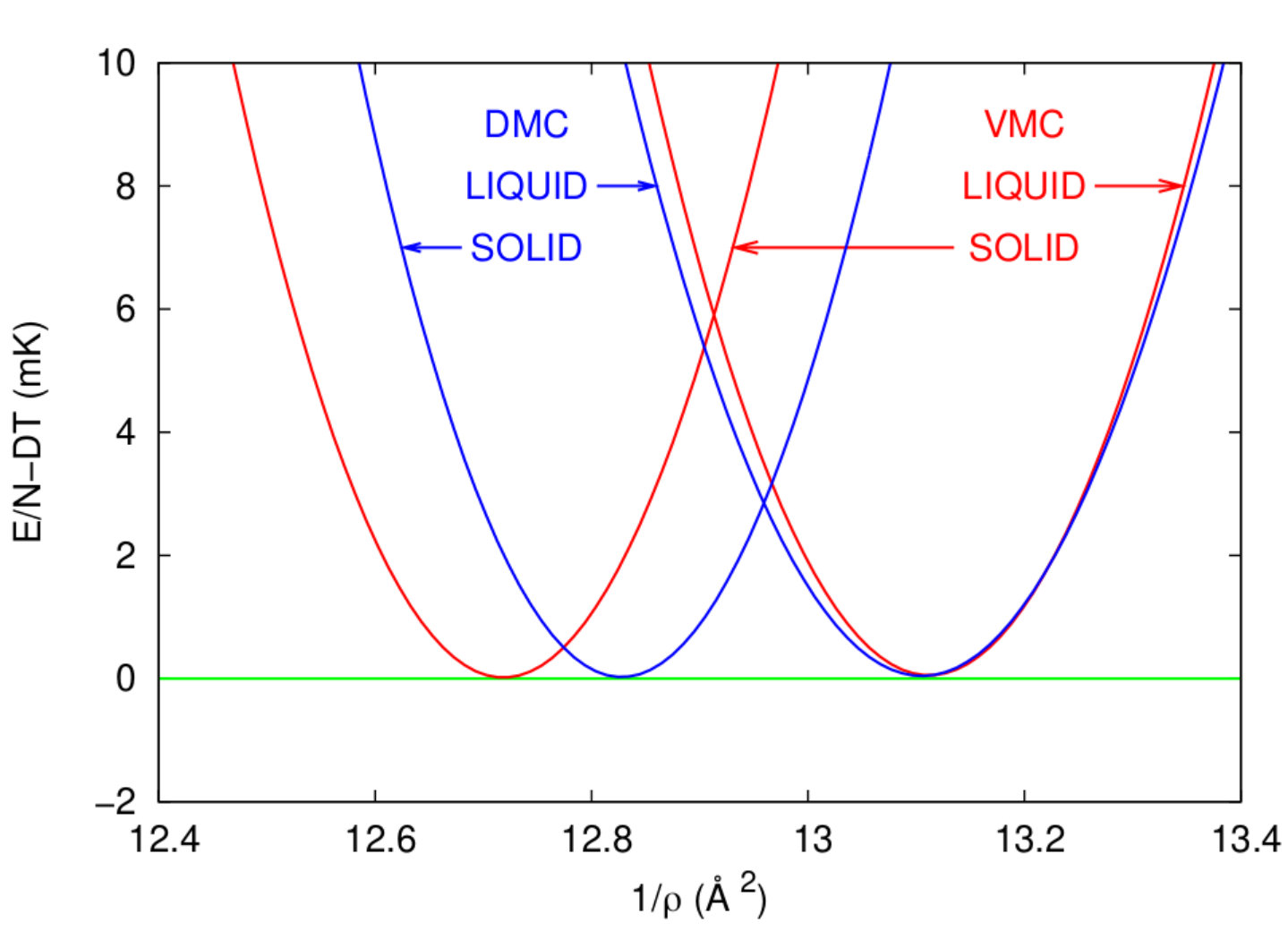 Figure 1
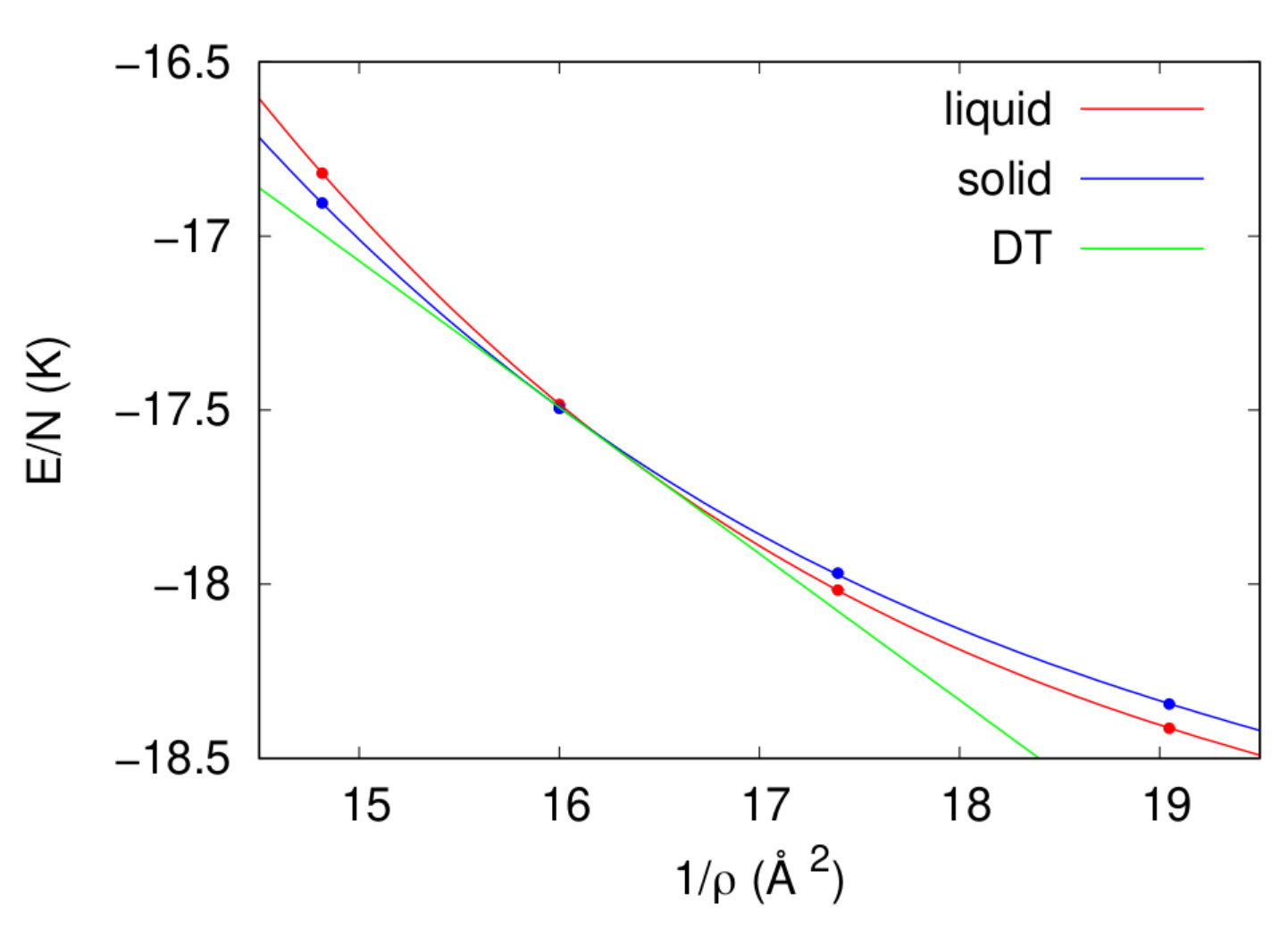 Figure 2
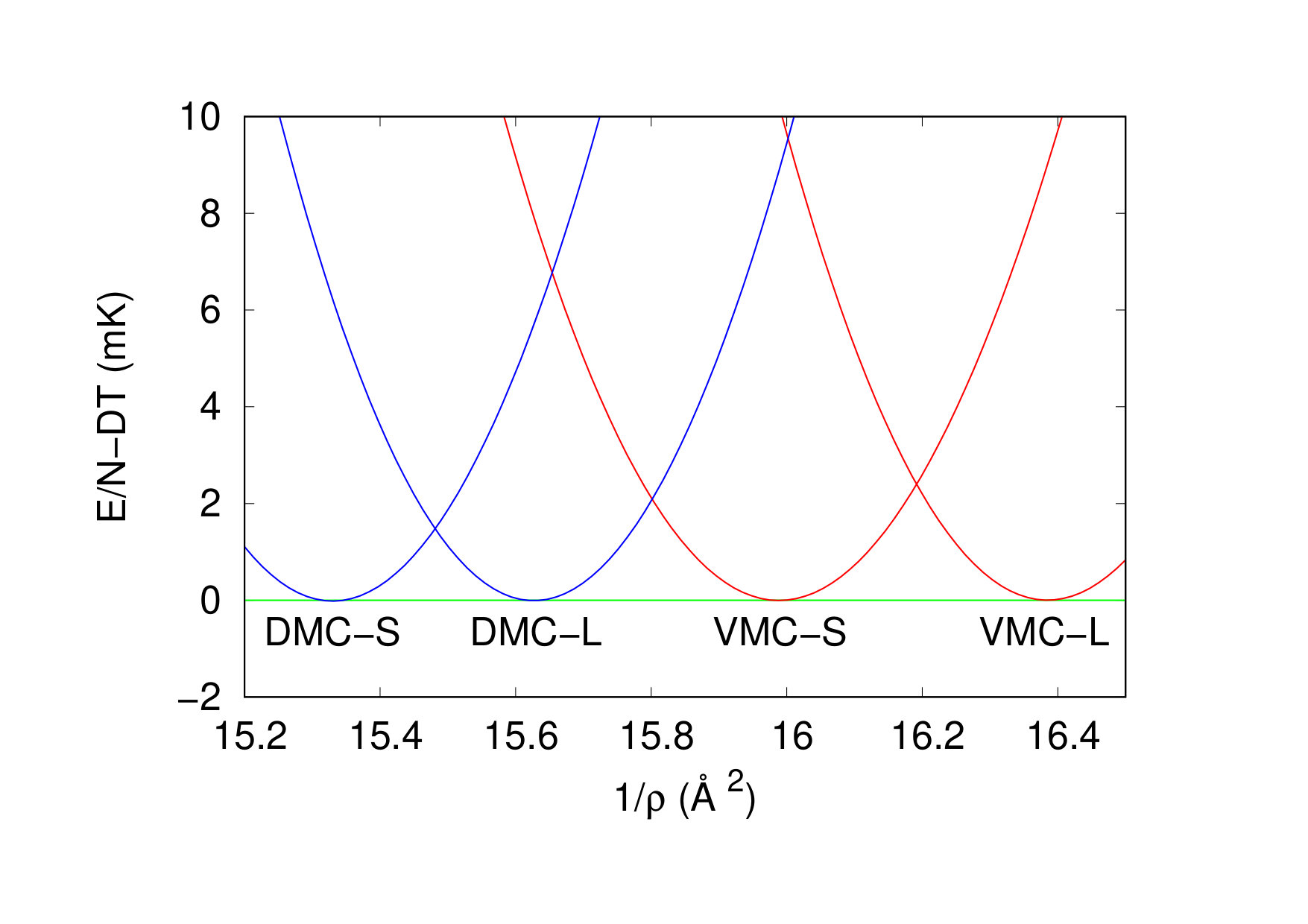 Figure 3
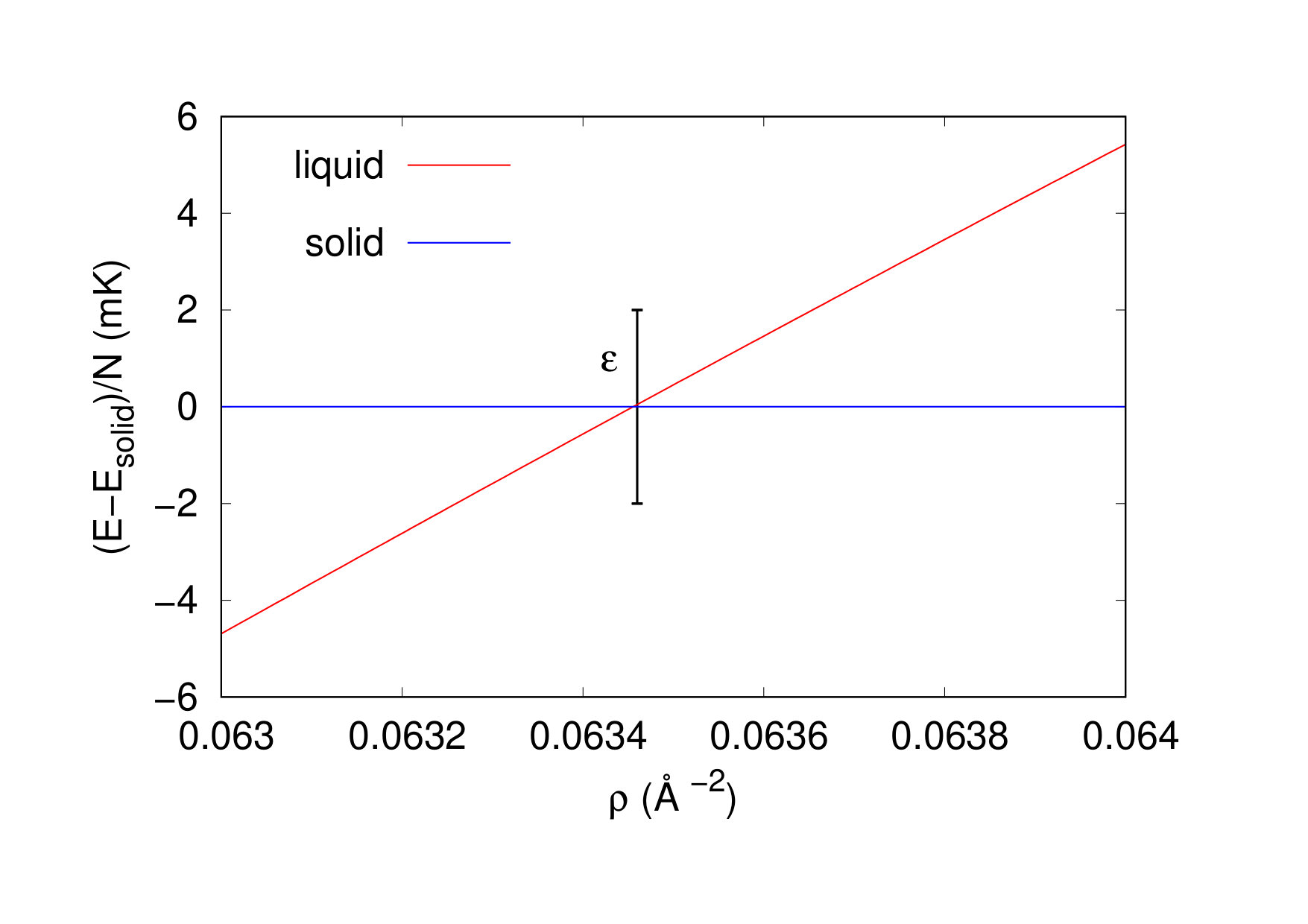 Figure 4
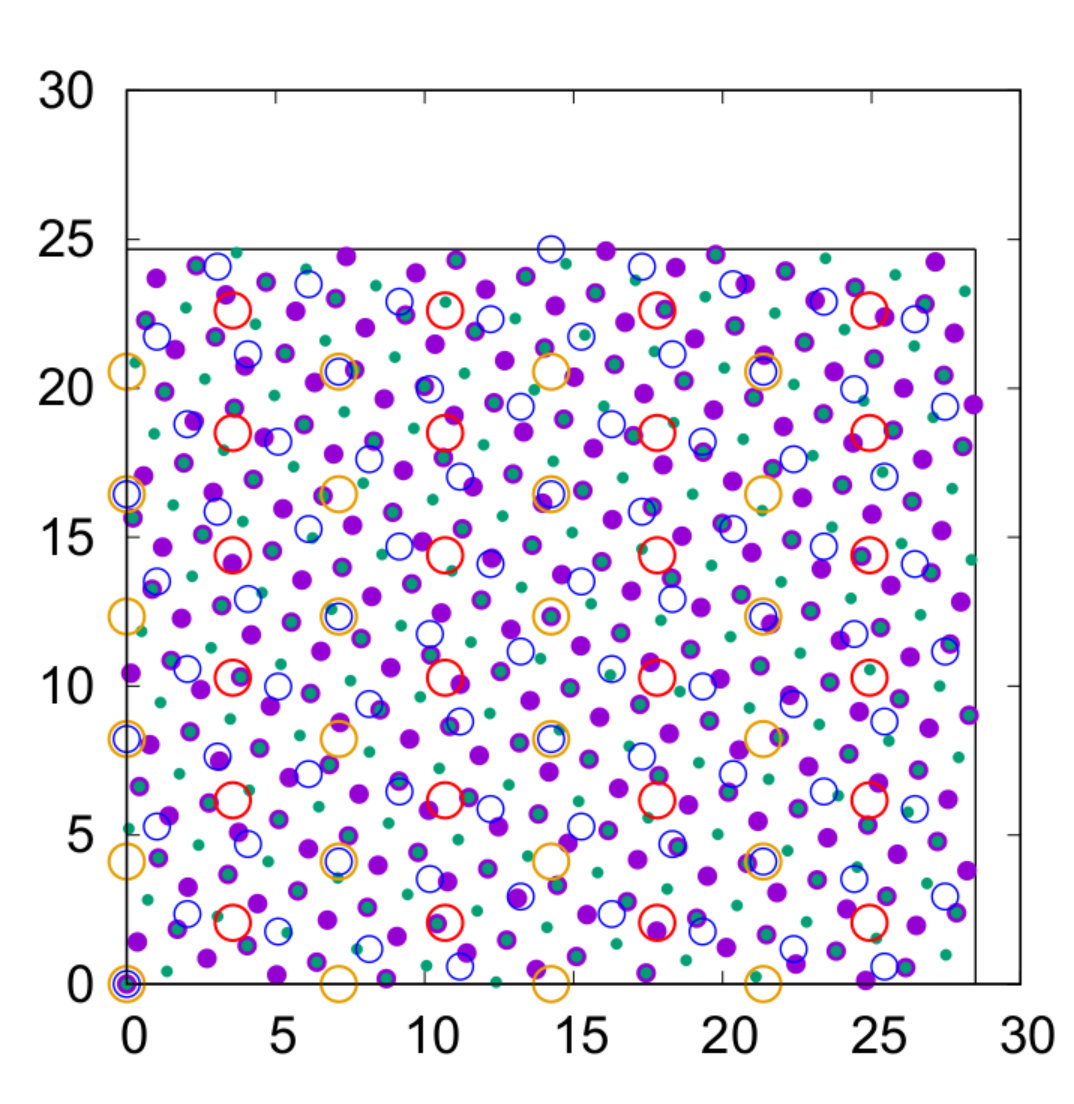 Figure 5
| WF | VMC | DMC |
|---|---|---|
| corrugated | ||
| 4He, | ||
| 4He, | ||
| 3He, | ||
| 3He, | ||
| smooth | ||
| 4He, | ||
| 4He, | ||
| 3He, | ||
| 3He, | ||
| VMC | DMC | |
|---|---|---|
| corrugated | ||
| 4He | -0.1220.024 | -0.1880.031 |
| 3He | 0.2510.017 | 0.1280.026 |
| smooth | ||
| 4He | -0.1230.011 | -0.1970.026 |
| 3He | 0.2640.011 | 0.1480.019 |
| effective | ||
| 4He | -0.1540.002 | -0.1790.003 |
| 3He | 0.2330.002 | 0.0960.002 |
Peer Reviews
No public reviews on file for this paper yet. If you reviewed it on a platform where reviews are public (OpenReview, ICLR, NeurIPS, ICML), you can paste yours below so the community can read it here.
Videos
No videos yet. Explain this paper in a talk, walkthrough, or lecture? Add one.
Second layer crystalline phase of helium films on graphite
Saverio Moroni
CNR-IOM Democritos, Istituto Officina dei Materiali, and Scuola Internazionale Superiore di Studi Avanzati, Via Bonomea 265, I-34136 Trieste, Italy
Massimo Boninsegni
Department of Physics, University of Alberta, Edmonton, Alberta, T6G 2E1, Canada
Abstract
We investigate theoretically the existence at low temperature of a commensurate (4/7) crystalline phase of a layer of either He isotope on top of a 4He layer adsorbed on graphite. We make use of a recently developed, systematically improvable variational approach which allows us to treat both isotopes on an equal footing. We confirm that no commensurate crystalline second layer of 4He forms, in agreement with all recent calculations. Interestingly and more significantly, we find that even for 3He there is no evidence of such a phase, as the system freezes into an incommensurate crystal at a coverage lower than that (4/7) at which a commensurate one has been predicted, and for which experimental claims have been made. Implications on the interpretation of recent experiments with helium on graphite are discussed.
I Introduction
The low temperature phase diagram of helium on graphite continues to intrigue both experimenters and theorists alike. Although the subject is now a few decades old bretz ; hering ; polanco ; carneiro ; ecke ; lauter ; freimuth ; lauter2 ; greywall ; greywall2 , and despite a considerable amount of investigation, some intriguing aspects have not yet been fully elucidated, and remain highly debated. A chief example is the existence of a commensurate crystalline phase (henceforth referred to as 4/7) in the second layer of 4He, with a partial registry with respect to the first layer. Such a phase, occurring at coverages intermediate between the low-density superfluid and the high density incommensurate crystal, was first proposed by Greywall and Busch greywall ; greywall2 , based on heat capacity measurements. Crowell and Reppy crowell ; crowell2 in turn suggested that a “supersolid” phase note , simultaneously displaying crystalline order and dissipation-less flow of 4He atoms, may exist at or near such a registered phase.
To our knowledge, no direct, unambiguous experimental confirmation of the 4/7 phase of 4He on graphite has yet been provided. Furthermore, the most recent and reliable theoretical studies, namely first principle computer simulations based on state-of-the-art Quantum Monte Carlo (QMC) methods and realistic microscopic atom-atom and atom-surface potentials corboz ; ahn , have failed to confirm its existence, showing instead that the system remains in the superfluid phase at low temperature, at commensurate coverage. Nonetheless, the presence of such a phase still constitutes a working assumption in recent experimental studies of helium films adsorbed on graphite, where the contention of possible “supersolid” behavior, defined as coexistence of two different types of order in a single homogeneous phase, has been reiterated fukuyama ; saunders .
Assuming a two-dimensional (2D) first layer density between 0.118 and 0.122 Å*-2* lauter2 ; fukuyama , one ends up with a 2D density for the 4/7 upper layer close to 0.07 Å*-2*, i.e., very close to the estimated freezing density of 4He in two dimensions gordillo . However, the fluid phase of an adsorbed layer can be stable at significantly higher density than in strictly two dimensions, as atomic motion in the transverse direction (mostly quantum mechanical in character at low temperature) acts to soften effectively the repulsive core of the interatomic potential, ultimately responsible for solidification(see, for instance, Ref. toigo, ). Indeed, first principle simulations yield evidence of second layer freezing at a density Å*-2*, in the low temperature (i.e., ) limit corboz . In any case, clearly caution should be exercised, as the physical proximity of all these putative phases means that the resolution of small energy differences is likely required, in order to map out the phase diagram correctly.
No controversy exists as to whether the second layer is crystalline at 4/7 commensurate coverage, if it is made of atoms of the lighter (3He) isotope (the first layer still of 4He atoms); indeed, in this case the experimental evidence is fairly robust (see, for instance, Ref. fukuyama2 ). This is not entirely surprising, however, as 3He is well known to freeze at lower density than 4He, in spite of its lighter mass; in particular, theoretical studies motta and experimental evidence bauerle concur in assigning a 2D freezing density to 3He Å*-2*. In this case as well, one may expect an adsorbed layer to freeze at higher density, and interesting questions arise, namely a) if an intermediate, registered phase can intervene between the fluid and the incommensurate crystal, and b) how one can unambiguously identify a commensurate phase, if it occurs inside a range of coverage in which an incommensurate one is thermodynamically stable.
Clearly, a cogent test of a reliable theoretical approach to the investigation of this system consists of reproducing the observed behavior of a second layer of either helium isotope, offering useful insight as to why they might display different physics. The application of QMC techniques to Fermi system is, of course, hampered by the well-known sign problem; however, given the crucial role likely played by quantum statistics role , it is necessary that its effect be included as accurately as possible.
In this paper, we describe results of a theoretical study of the thermodynamic stability of a commensurate 4/7 crystalline phase of the second layer of helium on graphite at temperature = 0. We assume a first layer of 4He, whereas for the second layer we consider both helium isotopes. We used the accepted, standard model of a helium film adsorbed on graphite, based on realistic microscopic potentials to describe the interaction among helium atoms, as well as between the helium atoms and the graphite substrate.
Our calculations make use of a recently developed variational approach ruggeri , based on an iterative backflow renormalization, which has been shown to yield quantitatively very accurate ground state estimates for superfluid 4He (virtually exact in this case), and for 3He of quality at least comparable to that afforded by the most sophisticated fixed-node Diffusion Monte Carlo (DMC) calculations. The advantage of this methodology is that it allows us to treat both helium isotopes on an equal footing, as a variational calculation (which we carry out by means of standard Metropolis Monte Carlo) is not affected by a sign problem and therefore no ad hoc remedy is required to circumvent it (e.g., the well-known fixed node approximation), which inevitably degrades the relative accuracy of the fermion calculation with respect to the boson one. And, although a variational calculation is intrinsically approximate, the iterative scheme adopted here allows us a) to improve significantly over a standard trial wave function, in practice removing most of the variational bias, b) to gain important information on the physical effects that are missing in the initial ansatz. As a check of the physical predictions obtained using the variational approach we also carried out selected, targeted DMC calculations, which consistently confirmed the VMC results.
Our results show that no 4/7 commensurate crystalline phase of 4He exist, in agreement with previous calculations. Indeed, the ground state arising from the variational optimization shows no evidence of ordered atomic localization. On the contrary, 3He forms a triangular crystal, consistently with experimental observation; however, we find no evidence of “pinning” of 3He atoms at specific adsorption sites, i.e., the crystalline ground state is found to be actually incommensurate with the underlying 4He layer. In other words, the physics of this layer is essentially that of the purely 2D system, i.e., it is not significantly affected by the underlying graphite substrate nor the 4He layer.
The remainder of this manuscript is organized as follows: in sec. II we describe the model Hamiltonian; in sec. III we offer a brief description of the methodology adopted in this work, and illustrate our results in sec. IV.
II Model
The system is modeled as an ensemble of pointlike particles, of which are 3He atoms (half of either value of the spin projection), are 4He atoms. Both species obey the appropriate quantum statistics, namely Fermi (Bose) for 3He (4He). When two layers of 4He are considered, and , while for the case of a 3He layer on top of a 4He one, it is . The numerical results presented here are obtained with a number of particles =132, the first layer consisting of a triangular solid of 84 4He atoms with areal density Å*-2*. Correspondingly, the density of the top layer is Å*-2*.
The system is enclosed in a simulation cell shaped as a cuboid, with periodic boundary conditions in all directions (but the length of the cell in the direction can be considered infinite for all practical purposes). The graphite substrate occupies the region.
The quantum-mechanical many-body Hamiltonian reads as follows:
[TABLE]
The first and third sums run over all particles of either species, with , KÅ2, and is the potential describing the interaction of a helium atom (of either species) with the graphite substrate, to which we come back below. The second sum runs over all pairs of particles, and is the accepted Aziz pair potential aziz , which describes the interaction between two helium atoms of either species. Such a potential ha been shown to afford a rather accurate description of the energetic and superfluid properties of 4He.
For the He-graphite interaction we consider two versions of the Carlos–Cole potential: the smooth, laterally averaged one cc , or the corrugated anisotropic 6-12 potential cc2 . The latter is tabulated for planar coordinates within the unit cell of graphite as a function of the distance from the surface, using 12 layers of carbon atoms within an in-plane cutoff of 55 Å (43416 atoms). In the simulation the potential is calculated by cubic interpolation of the tabulated values. We ignore corrections for further C atoms. Even though they could be added perturbatively, they are very weakly dependent on , and virtually identical in the liquid and crystalline phases. As mentioned above, the system is periodic in and , with simulation cell sides Å and Å. The cell (Figure 1) accommodates 268 sites of a slightly strained hexagonal lattice for graphite (the areal density of graphite is maintained at its unstrained value corresponding to lattice parameters Å and Å). The anisotropic 6-12 potential includes this strain.
Because we are also interested in the equation of state of an incommensurate crystalline top layer, we have also utilized in this study a simplified version of (1), in which only the atoms in the top layer are explicitly included; they are assumed to move on a flat substrate, in the presence of a single–particle 1D potential () which effectively accounts for both the Graphite substrate and the first 4He adlayer. We determine as that whose ground–state wave function is , being the density profile of He atoms in the second layer, computed using the full Hamiltonian (1) with the corrugated potential. It has been shown ruggeri2 that the structural properties of 3He on a smooth substrate, computed with such an effective potential, are quantitatively very similar to those on a corrugated substrate constituted by a solid layer of 4He, in turn adsorbed on (smooth or corrugated) graphite. The advantage of this description, besides the computational speed-up arising from the reduction of the number of atoms that are explicitly modeled, is that on the effective smooth substrate the density of a crystalline top layer can be varied continuously, in contrast to the case of an explicit solid 4He layer with fixed density, where the density is restricted by the condition that the simulation cell accommodate both crystals.
III methodology
In this section we offer a description of the variational calculation, mostly focusing on the different wave functions utilized to describe the two phases of interest, namely crystalline and fluid. For a more thorough illustration of the approach, including technical details of its numerical implementation, we refer the reader to Ref. ruggeri, . We have utilized different trial wave functions for the system with liquid/solid 4He/3He in the second layer, , , and , featuring a varying number of backflow iterations, until the result of interest (the stability of a given phase in our case) was deemedrobust against further iteration. All wave functions contain a common factor (optimized independently for each case)
[TABLE]
where are the coordinates of the He atoms; are the components of ; and take the value for the first layer and for the second layer; are the in–plane components of the lattice sites of layer ; are the in–plane components of the centers of the hexagons on the graphite surface; are the coordinates of the –th iteration of backflow, given by , with ; the radial functions , , , and are suitable combinations of McMillan–like pseudopotentials and/or locally piecewise–quintic Hermite interpolating functions natoli , while the Nosanow factors are gaussian functions; the function is non–zero only for the corrugated graphite potential. The wave function has an extra pair pseudopotential to include a dependence on the th iteration of backflow coordinates , i.e.,
[TABLE]
On the other hand, has an extra Nosanow term in the in–plane components of to describe a solid second layer, i.e.,
[TABLE]
The wave function for the fluid phase of 3He has an extra Slater determinant of plane waves in the in–plane components of (with twisted boundary conditions), namely
[TABLE]
whereas the crystalline wave function has an extra Slater determinant of Gaussian orbitals in the in–plane components of , centered at the lattice sites of the second layer, i.e.,
[TABLE]
Note that backflow coordinates are used only for atoms in the second layer.
The calculation of the ground state expectation values with the optimized wave function (corresponding to the th backflow iteration) is carried out using a standard Metropolis Monte Carlo procedure, which of course does not suffer from any fermion “sign” instability.
We now briefly discuss the correction of the energy estimates that we have implemented in order to account for the finite size of the simulated system. We assume that the finite size effect on the kinetic energy is only present for a fermion liquid (not for a bose liquid or a solid of either statistics), due to the discreteness of the –space shells which enter the Slater determinant of plane waves. This is eliminated (actually, strongly reduced) using twist–averaged boundary conditions lin . The finite size effect on the potential energy is estimated on a small subset of configurations along the simulation as the difference between the potential calculated with the minimum image convention and the potential calculated with a large number of images. The finite size correction turns out to be nearly identical for the liquid and the solid phase of either He isotope.
IV results
IV.1 Stable phases at 4/7 coverage
Table 1 shows the energy per He atom , where is the total energy of the system, yielded by the different variational wave functions for the two phases, namely liquid () and solid (). The last column reports results obtained by means of DMC simulations, carried out by projecting out of the corresponding trial wave functions; the fixed-node approximation was used for those involving 3He. These results were obtained using the full Hamiltonian (1), with either the corrugated anisotropic He-graphite potential or the laterally averaged, smooth one.
The first observation is that the quality of the wave function is significantly better for the laterally averaged He-graphite potential, for which the difference between VMC and DMC results is 0.65 K, than for the corrugated potential, where the difference is 1.5 K, which amounts to roughly 1.8% of the total energy. This may stem from the inadequacy of the part of the wave function describing correlations between first–layer atoms and graphite hexagons, which is expressed through the two-dimensional, in-plane correlation function . Possibly, a more accurate ansatz would be based on a fully three-dimensional function .
On the other hand, the comparison between VMC and DMC estimates shows the same trend in both calculations; specifically, in no case is the prediction of relative strength of one phase with respect to the other made at the VMC level, reversed or even significantly quantitatively altered by DMC. Indeed, as shown in Table 2 the quantity , namely the energy difference per second layer atom between liquid and solid phases, is virtually unchanged (within statistical uncertainties) if either model of He-graphite interaction is used, for both isotopes and within either VMC or DMC. Moreover, is consistently negative for 4He and positive for 3He. This remains true even if the calculation is based on the simplified version of model (1) described above, making use of the effective potential .
All of this allows one to make a rather robust statement regarding the physical character of the ground state of the system in the case of an upper layer of either helium isotope. Specifically, the ground state of the second layer at coverage is a (translationally invariant) superfluid in the case of 4He, and a crystal for 3He. As noted above, the value of the energy difference is essentially independent of the corrugation of the He–graphite potential, a fact that, while not particularly surprising for the case of 4He, for which the thermodynamic equilibrium phase is a superfluid, is quite significant for the case of 3He, as it points to the equilibrium crystalline phase to be incommensurate, and thus scarcely affected by substrate corrugation.
Now, the fact that the energy per particle obtained using the wave function describing one phase (A) is lower than that for another phase (B), at a particular density , is by itself no definitive proof that A is the true equilibrium phase at that density; for, it is in principle possible, in the case of a first-order phase transition, that fall within the region of coexistence of phases A and B. As we show below, this is not the case for the second layer density , which corresponds to 4/7 commensurate coverage; indeed, does not fall within the liquid-crystal coexistence region, for a second layer of either helium isotope, as the calculations of the equation of state of the second layer show.
IV.2 Equation of state of the second layer
We now discuss in detail the equation of state (EOS) for both a 3He and a 4He upper layer. We compute the EOS by making use of the effective potential described above, representing both the graphite substrate and the first 4He adlayer. As explained above, the advantage of this approach is that the density of the crystalline top layer can be varied continuously, in contrast to the case of an explicit solid 4He layer with fixed density, where the density is restricted by the condition that the simulation cell accommodate both crystals. We first present the results, and then discuss the expected accuracy of the approach.
IV.2.1 3He upper layer
The EOS of a liquid and solid 3He upper layer, computed by VMC, are shown in Fig. 2, together with the double tangent (DT) curve, .
The parameters and of the DT are determined by the condition that the difference with the DT vanish quadratically for both the liquid and the solid EOS, as shown in Fig. 3. The region of coexistence of fluid and crystal, computed by VMC, is given by the range of values of area per particle 15.99–16.38 Å2, or, equivalently, 0.061–0.062 Å*-2* in density. In order to assess the quantitative accuracy of the VMC prediction, we performed fixed-node DMC simulations based on the optimized wave functions for both phases; as shown in Fig. 3, the coexistence region is shifted to the area per particle interval 15.33–15.63 Å2, corresponding to the 0.064–0.065 Å*-2* density range. Thus, our best estimate of the value of the melting density is Å*-2*, still significantly lower than , i.e., the density of the registered phase, equal to 0.0683 Å*-2*. Altogether, the agreement between VMC and DMC results is quantitatively excellent.
The uncertainty on the melting density can be estimated through the energy difference between liquid and solid (Fig. 4), together with the typical size of the statistical error of the data of Fig. 2. The statistical uncertainty on the melting density is less than 0.001Å*-2*, which is significantly smaller than the difference between the density of the 4/7 registered phase and . Figure 3 also shows that the liquid–solid energy difference spans a range 10 mK across the coexistence region, much smaller than the liquid–solid differences of 200 mK listed in Table 2. Therefore the lower–energy phase at is definitely outside the coexistence region.
The results yielded by the model based on the effective potential suggest that freezing occurs to an incommensurate solid. Obviously, we need to assess the extent to which the description based on is quantitatively representative of the model (1), which explicitly includes the 4He atoms of the first layer. As mentioned above, the use of such an effective potential has been shown in previous work to be quantitatively reliable, and is not expected to alter significantly the predictions at which we have arrived using the effective potential. Specifically, one should note that the liquid–solid energy difference computed with the effective potential at density is slightly smaller in magnitude (by mK) than that computed with the explicit inclusion of the underlying 4He adlayer atoms, which has the effect of strengthening (albeit by a relatively small amount) the crystalline phase (no significant difference arises from the use of either the corrugated or the smooth helium-graphite interaction). Consequently, we may expect the melting density to be shifted to a slightly lower value if the full Hamiltonian (1) is used, a fortiori validating our physical conclusion that the commensurate coverage falls well within the region of stability of the incommensurate crystal. It is worth noting that our estimated freezing density is quantitatively consistent with the highest density for which Bauerle et al. were able to measure the spin susceptibility of a submonolayer liquid 3He film adsorbed on a graphite substrate preplated by a monolayer of 4He bauerle .
We conclude by discussing the possibility that the crystalline phase of the 3He layer of density may be still registered with the underlying 4He layer, even though the density is inside the region in which the incommensurate crystal is energetically favored, at least according to our calculations based on the effective potential. This would be reflected by the “pinning” of the 3He atoms at specific lattice locations, with a significant energy cost associated to, e.g., rigid relative translations or rotations of the upper layer with respect to the underlying one.
In order to obtain a quantitative estimate of such pinning energy, we first considered two parallel, commensurate triangular lattices (first and second layers) spaced 3 Å apart in the -direction, and computed the change in classical energy per He atom associated to a rigid relative translation in the -plane of one of the two lattices. The maximum energy change is in the range of few mK. We then carried out a DMC simulation of solid 3He over solid 4He, and found the change in the energy per particle between the highest– and the lowest–energy classical configurations of the lattices to be reduced to few tens of mK, which is approximately ten times less than the typical statistical uncertainty of this calculation. Such small values of the pinning energy do not, in our view, lend any quantitative support to the contention of an equilibrium crystalline phase of the upper 3He layer registered with the underlying 4He layer.
IV.2.2 4He upper layer
The same calculation has been carried out for a 4He second layer; figure 5 shows results analogous to those of Fig. 3. In this case, the coexistence region yielded by VMC is the density interval 0.076 – 0.079 Å*-2*, which, as shown in Fig. 4, is only slightly modified by subsequent DMC simulations, specifically shrinking to 0.076 – 0.078 Å*-2*. The freezing density is well above , and is in excellent agreement with that estimate yielded by the finite temperature simulations of Ref. corboz, , explicitly including the 4He atoms of the first adlayer. This result gives us additional confidence in the use of the effective potential, as well as in the predictive power of the VMC methodology utilized here; it also supports the conclusion that no 4/7 crystalline phase exists, in agreement with the near totality of all numerical studies.
V Conclusions
We have carried out a theoretical investigation of the possible existence of a 4/7 commensurate crystalline phase of the second layer of helium adsorbed on graphite. We considered both the case in which the upper layer comprises the same type of atoms as the first layer, namely 4He, as well as that in which the upper layer is formed by atoms of the lighter 3He isotope. We made use of a technique recently developed, aimed at studying the ground state of either Fermi or Bose systems by means of a variational (Monte Carlo) approach that affords high accuracy by iterative improvement of the wave function, and allows one to treat both isotopes of an equal footing.
The results obtained in this work constitute an additional piece of theoretical evidence against the existence of a commensurate crystalline phase in the second layer of 4He adsorbed on graphite. This is in agreement with the findings of essentially all the most recent theoretical calculations, based on first principle numerical simulations. It is worth restating that no direct experimental evidence of any registered crystalline phase of the second layer of 4He exists; rather, its presence has been proposed as a way to account for observed specific heat anomalies, for which, however, a different interpretation might have to be sought. Alternatively, the accepted microscopic theoretical model of 4He on graphite, which successfully accounts for most of the phenomenology, may have to be considerably revised (in ways that are not clear to us), should new and conclusive experimental evidence of a commensurate (4/7 or otherwise) phase arise. It has been suggested, however, that a 4/7 commensurate phase may also occur as a result of the first 4He layer forming a commensurate, rather than incommensurate crystalline phase as is commonly assumed ahn .
Our study also shows that no commensurate phase exists if the second layer is formed by atoms of the lighter 3He isotope, a fermion, which undergoes crystallization into an incommensurate phase at coverages significantly lower than that of the putative 4/7 phase. The more general conclusion of this work is that the physics of the second layer of helium on graphite, of either isotope, is largely independent of both the underlying 4He layer as well as of the graphite substrate; rather, it provides a close realization of the physics of 3He and 4He in two dimensions.
Acknowledgments
This work was supported in part by the Natural Sciences and Engineering Research Council of Canada (NSERC). MB wishes to acknowledge the hospitality of the International Centre for Theoretical Physics in Trieste, Italy, where this research was carried out.
The reference list from the paper itself. Each links out to its DOI / PubMed record.
- 1(1) M. Bretz, J. G. Dash, D. C. Hickernell, E. O. Mc Lean, and O. E. Vilches, Phys. Rev. A 8 , 1589 (1973).
- 2(2) S. V. Hering, S. W. Van Sciver, and O. E. Vilches, J. Low Temp. Phys. 25 , 793 (1976).
- 3(3) S. E. Polanco and M. Bretz, Phys. Rev. B 17 , 151 (1978).
- 4(4) K. Carneiro, L. Passell, W. Thomlinson, and H. Taub, Phys. Rev. B 24 , 1170 (1981).
- 5(5) R. E. Ecke and J. G. Dash, Phys. Rev. B 28 , 3738 (1983).
- 6(6) H. J. Lauter, H. P. Schildberg, H. Godfrin, H. Wiechert, and R. Haensel, Can. J. Phys. 65 , 1435 (1987).
- 7(7) H. Freimuth, H. Wiechert, H. P. Schildberg, and H. J. Lauter, Phys. Rev. B 42 , 587 (1990).
- 8(8) J. Lauter, H. Godfrin, V. L. P. Frank, and P. Leiderer, in Phase Transitions in Surface Films 2 , edited by E. Taub, G. Torzo, H. J. Lauter, and S. C. Fain (Plenum, New York, 1991).