Some Results on the Additivity and Multiplication Order Preserving Properties of Stochastic Orders
Mohsen Soltanifar

TL;DR
This paper investigates how stochastic orders behave under addition and multiplication, proving that the usual stochastic order is preserved in these operations and exploring similar properties for other stochastic orders.
Contribution
It establishes the additivity and multiplicativity of the usual stochastic order and examines these properties for nine other univariate stochastic orders, providing counterexamples.
Findings
Usual stochastic order is additive and multiplicative.
Counterexamples for nine other stochastic orders.
Open problems remain for some stochastic orders.
Abstract
In this paper, we consider the problem of order preservation under addition and multiplication operators over the vector space of univariate real-valued random variables. Consistent with the case of usual order over the real numbers-as constant random variables, we prove that the usual stochastic order is both additive and multiplicative. We additionally discuss the situation for nine extra univariate stochastic orders presenting counterexamples in some cases. The problem remains unsolved for other univariate stochastic orders.
Click any figure to enlarge with its caption.
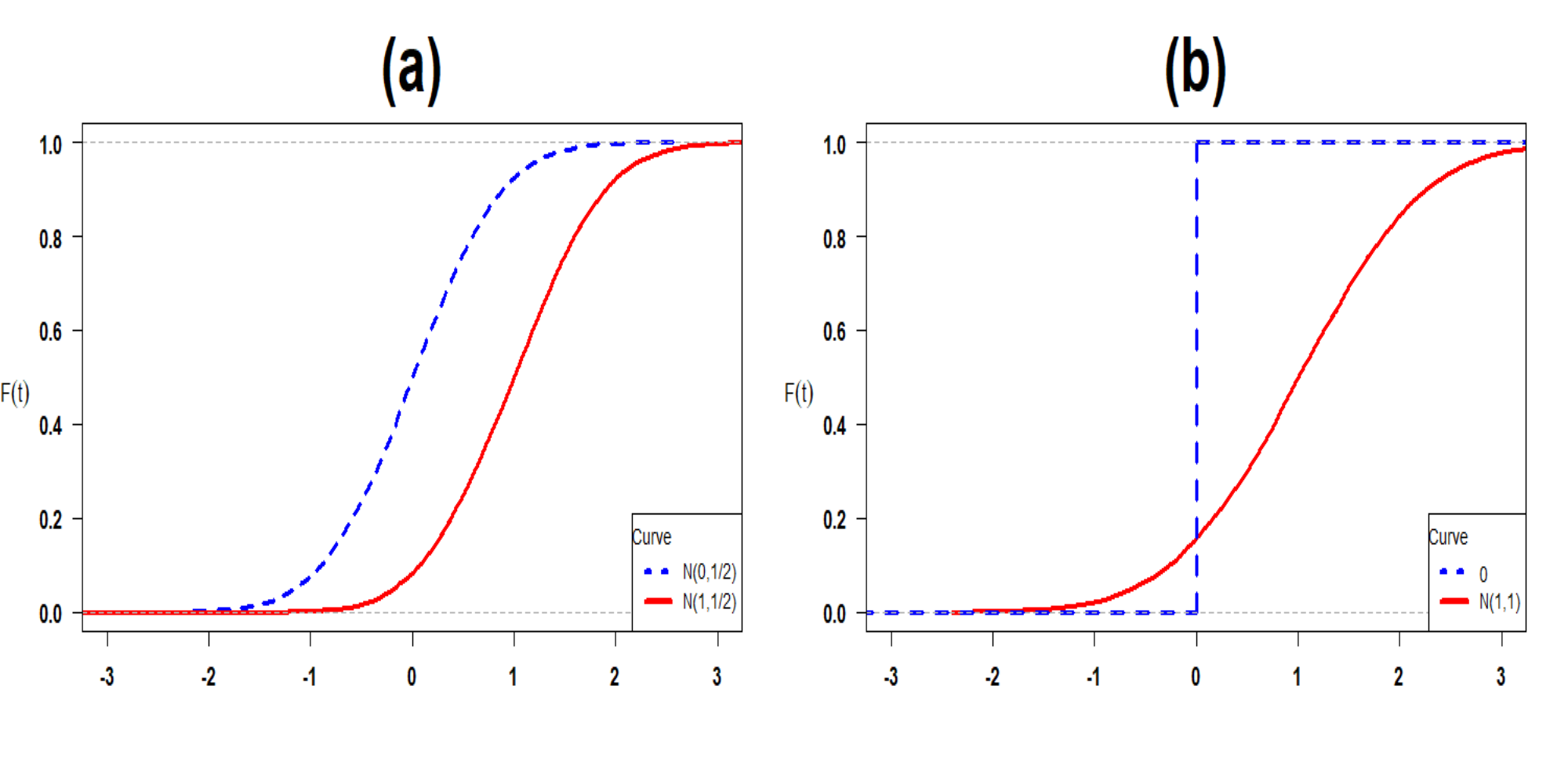 Figure 1
Peer Reviews
No public reviews on file for this paper yet. If you reviewed it on a platform where reviews are public (OpenReview, ICLR, NeurIPS, ICML), you can paste yours below so the community can read it here.
Videos
No videos yet. Explain this paper in a talk, walkthrough, or lecture? Add one.
Taxonomy
TopicsAdvanced Algebra and Logic · Rough Sets and Fuzzy Logic · Multi-Criteria Decision Making
Some Results On the Primary Order Preserving Properties of Stochastic Orders
Mohsen Soltanifar
Abstract
In this paper, we consider the problem of order preservation under addition and multiplication operators over the vector space of univariate real-valued random variables. Consistent with the case of usual order over the real numbers-as constant random variables, we prove that the usual stochastic order is both additive and multiplicative. We additionally discuss the situation for nine extra univariate stochastic orders presenting counterexamples in some cases. The problem remains unsolved for other univariate stochastic orders.
keywords:
Inequalities, Stochastic orders
MSC:
60E05, 60E15
††journal: Journal
\affiliation
[inst1]organization=Analytics Division,addressline=College of Professional Studies, city=Northeastern University, postcode=Vancouver, state=BC, country=Canada \affiliation[inst2]organization=Real World Analytics,addressline=Cytel Canada Health Inc, city=Vancouver, state=BC, country=Canada \affiliation[inst3]organization=Biostatistics Division,addressline=Dalla Lana School of Public Health, city=University of Toronto, postcode=Toronto, state=ON, country=Canada
1 Introduction
In their 1934 book on inequalities, Hardy, Littlewood and Polya introduced the concept of majorization as one of the fundamental building blocks of stochastic orders. Later in 1955, Lehmann introduced the concept of stochastic orders on real valued random variables, [1]. Since then, inspired by their application in many fields there has been a growing literature on these orders specially from 1994. They have been playing a key role in comparison of different probability models in wide range of research areas such as survival analysis, reliability, queuing theory, biology and actuarial science. They serve as an informative comparison criteria between different distributions much more effective than low informative distributional point comparisons of means, medians, variance and IQRs. In almost all cases, they have the same fundamental properties of usual order in real numbers including reflexivity, anti-symmetry, transitivity.
This paper deals with exploring another aspect of stochastic orders including order preserving additive and multiplicative properties. Our investigation originates from natural existence of earlier fundamental properties in both the set of real numbers equipped with usual order and the set of real-valued random variables equipped with one of stochastic orders. Given existence of the mentioned order preserving properties on the set of real numbers equipped with the usual order, there was a missing investigation on their parallel existential conditions for the case of the set of real-valued random variables equipped with a stochastic order.
This paper is divided into four sections: preliminaries, order preserving properties of usual stochastic order; and, order preserving properties of four other stochastic orders. In the first section, we provide the required definitions and established results for the next two sections. Then in the second section, we establish order preserving additive and multiplicative properties for the usual stochastic order. Furthermore, in the third section we discuss these properties for nine extra univariate stochastic orders including the the moment, the Laplace transform, the increasing convex, the starshaped, the moment generating function, the convolution, the hazard rate, the likelihood ratio and the mean residual life order. We conclude the work with a discussion on the current results.
2 Preliminaries
The reader who has studied the concepts of order and stochastic order is well acquainted with the following definitions and results. For an essential account of the mentioned concepts, see [2, 3, 4]. We begin with some definitions:
Definition 2.1**.**
Let and be ordered sets. A map is said to be order preserving whenever in implies in
When are real valued vector spaces, and for fixed the maps and are order preserving, it is said that the order has additivity and multiplication properties.
It is trivial that for the case equipped with its usual order , the order has additivity and multiplication properties. From now onward, throughout this paper it is assumed that is the set of all real valued random variables. For the orders related to this we begin with one of the most well-known ones:
Definition 2.2**.**
Let and be two real-valued random variables with associated Cumulative Distribution Function (CDF)s , and , respectively. is said to be less or equal than in the usual stochastic order denoted by , if
The following example [5] has key applications in the next section:
Example 2.3**.**
Let be two normally distributed random variables. Then, a necessary and sufficient condition for is that and
The other orders of interest in this work are introduced in the following definition:
Definition 2.4**.**
*Let and be two real-valued random variables with associated CDFs , Laplace transforms moment generating function and mean residual life functions respectively. Then, is said to be less or equal than in the:
(i) moment order, denoted by , if for we have:
(ii) Laplace transformation order, denoted by , if with assumption we have:
(iii) increasing convex order denoted by if :: for all increasing convex functions
(iv) starshaped order denoted by if :: for all starshaped functions
(v) moment generating function denoted by , if with assumption we have:
(vi) convolution order, denoted by ,if for some non-negative independent random variable of
(vii) hazard rate order, denoted by if for the hazard function we have:
(viii) likelihood ratio order, denoted by if the likelihood ratio function is decreasing for all
(ix) mean residual life order, denoted by if for the mean residual function we have: for all *
It has been mentioned in the literature that usual stochastic order is reflexive, anti-symmetric and transitive [3]. Regarding order preserving maps on we have [4]:
Theorem 2.5**.**
If and is any increasing function, then where refers to , or
In particular, for constant random variable , and are order preserving and hence the usual stochastic order is additive and multiplicative in this special case. However, the case in general is still unknown.
An straightforward verification shows that considering the subset of all constant real-valued random variables of equipped with one of above four stochastic orders, the order has both of mentioned order preserving properties. This is a parallel result to the case of real numbers equipped with the usual order . The following lemma will be useful in the proof of the upcoming theorems in the next section, [3, 4].
Lemma 2.6**.**
*Let be two real valued random variables with associated CDFs , and Laplace transforms respectively. Then:
(i) if and only if: for all
(ii) if and only if: for all
(iii) if and only if for we have:
(iv) if and only if:
(v) with given finite means if and only if is decreasing.*
We conclude this section with a remark on the independency of involved random variables:
Remark 2.7**.**
Considering any pair of real numbers as constant random variables and , it is trivial that any constant random variable is independent from each of them. Hence, it is natural to maintain this independency assumption for inferential results for the case of non-constant random variables.
3 Order Preserving Properties of Usual Stochastic Order
This section deals with general properties of usual stochastic order. Throughout this section and the next one, we assume the given random variable is independent from and . The first three properties has been established as mentioned above. We discuss the later two properties and present an evidence of the necessity of the independence condition mentioned in Remark 2.7.
Theorem 3.8**.**
The usual stochastic order is (i) additive; and, (ii) multiplicative.
Proof. This is a direct consequence from [4] Theorem 1.A.3(b) with and consideration of two bi-variate increasing functions (for additivity) and (for multiplication).
An immediate application of the Theorem 3.8 is in the area of computational psychology for comparing reaction times between participants. Here, for the case of the well-known Ex-Gaussian(ExG) distribution [6] defined by we may characterize which experimental participant is faster than the other in terms of the fitted distributional parameters:
Example 3.9**.**
Let be two reaction times Ex-Gaussian distributions. Then, by an application of Example 2.3, two applications of Theorem 3.8, and considering the transitivity of the usual stochastic order, a sufficient condition for is , and
Counterexample 3.10**.**
The assumption of independence is necessary for the usual stochastic order additivity. As a counterexample, let be two independent normal random variables. Then, by Example 2.3 for we have: On the other hand, take , consider and Consequently: Figure 1 (a) presents this case.
Counterexample 3.11**.**
The assumption of independence is necessary for the usual stochastic order multiplication. As a counterexample, let be two independent lognormal random variables with (this is a consequence from Example 2.3 for and Theorem 2.5 for ). Consider dependent random variable (this is a consequence of strict Jensen’s inequality). If then by Theorem 2.5 (for ) we have a contradiction. Hence,
Counterexample 3.12**.**
The assumption of positivity of random variable is necessary for the usual stochastic order multiplication. As a counterexample, let and Then, for all Take and then, (this is a consequence from Example 2.3 for ). But, given , we have Figure 1 (b) presents this case.
4 Order Preserving Properties of Other Stochastic Orders
As we mentioned, there are other types of stochastic orders in the literature of particular interest. In this section we deal with the similar problem of determining their main properties as the case of usual stochastic order for the moment, the Laplace transform, the increasing convex, the starshaped, the moment generating function, the convolution, the hazard rate, the likelihood ratio and the mean residual life order. First of all, for the case of reflexivity, anti-symmetry and transitivity, it is easy to show that all of these orders are preserving these properties. Next, we deal with the additivity and multiplication as follows:
Theorem 4.13**.**
Consider the moment order, the Laplace transformation order, the increasing convex order, the starshaped order, the moment generating function order, and the convolution. Then: (i) All six orders are additive; (ii) The first five orders are multiplicative as well.
Proof. To prove(i), First, for the moment order, the proof is straightforward application of binomial identity, and the independence condition. Indeed, let and . Then, for any independent we have:
[TABLE]
Thus,
Second, for the Laplace transformation, the proof is straightforward from of the Laplace transformation multiplication of sum of independent random variables. Indeed, let and be independent. Then we have:
[TABLE]
implying
Third, for the increasing convex order, let and be independent from Then by Lemma 2.6 and two times application of Fubini’s theorem it follows that:
[TABLE]
Now, by another application of Lemma 2.6 it follows that
Fourth, the starshaped order, let and be independent from Then by Lemma 2.6 and two times application of Fubini’s theorem it follows that:
[TABLE]
Again, by another application of Lemma 2.6 it follows that
Fifth, this is direct consequence from the additivity for Laplace transformation order and Lemma 2.6.
Finally, we consider the convolution order. Let and be independent from Then, by the later condition it follows:
[TABLE]
Now, two applications of Lemma 2.6 and former condition implies
To prove (ii), first of all, for the moment order the proof is trivial from independence condition. Second, for the Laplace transformation order, let and be independent from Then, we have:
[TABLE]
Hence, .
Third, and fourth, for the increasing convex order and the starshaped order, the proof is similar to the presented proof for the additivity case above with replaced by respectively.
Finally, for the moment generating function order, the proof is similar to the proof of additivity presented above.
Remark 4.14**.**
In Theorem 4.13 the case of additivity and multipliciation for the increasing convex order can be proved similarly to the case usual order presented in the proof of 3.8 using Theorem 4.A.15- [4] with respectively.
Establishing preservation results for the orders mentioned in Theorem 4.13, we now discuss the cases in which the additivity and multiplicity are not preserved. We begin with the case for convolution order:
Counterexample 4.15**.**
The convolution order is not multiplicative. As the counterexample, let and be independent from Since for all and for all by an application of Lemma 2.6, However, a simple conditioning on yields for all But, changes signs from to Consequently, by another application of Lemma 2.6, it follows that
Although, for the hazard rate order an special case of additive property has been established (whenever is IFR i.e., is increasing), [4] (Lemma 1.B.3), the general case does not hold as the following counterexample explains:
Counterexample 4.16**.**
The hazard rate order is not additive. As the counterexample, let and be independent from Then, as it follows that However, given that (See Appendix B), it follows that: Figure 1 (c) presents this case.
Next, for the case of multiplicity of the hazard rate order the special case for the IFR random variable can be proved similarly to the case of additivity. However, this order does not preserve the multiplicity as the following counterexample shows:
Counterexample 4.17**.**
The hazard rate order is not multiplicative. As a counterexample, let and where and are defined as in counterexample 4.16. Then, (using Theorem 2.5 for ). However, if then (using Theorem 2.5 for ), yielding a contradiction. Hence,
Furthermore, for the likelihood ratio order an special case of additive property has been established (whenever all have logconcave densities), [4] (Theorem.1.C.9), the general case does not hold as the following counterexample explains:
Counterexample 4.18**.**
The likelihood ratio order is not additive. As the counterexample, let and be independent from Then, it is trivial that However, given that given that for we have (See Appendix C) it follows that it follows that: Figure 1 (d) presents this case.
Next, using the same idea of exponentiating and back and forth usage of Theorem 2.5 described in Counterexample 4.17, it is easily proved that the likelihood ratio order is not multiplicative either.
We conclude this section with the case of mean residual life order. Here, similar to the hazard rate order an special case of additive property has been established (whenever is IFR), [3] (Theorem.2.4.22), the general case does not hold as the following counterexample explains it:
Counterexample 4.19**.**
The mean residual life order is not additive. As the counterexample, let and be independent from Then, by [3](Example.2.4.16, page 55) it follows that However, given that given that for we have (See Appendix D) it follows that it follows that: Figure 1 (e) presents this case.
Finally, and a variation of counterexample 4.19 presented in the following counterexample establish the case for multiplication:
Counterexample 4.20**.**
The mean residual life order is not multiplicative. As the counterexample, let and be independent from Then, However, given that given that for we have (See Appendix E) it follows that it follows that: Figure 1 (f) presents this case.
5 Discussion
5.1 Summary
This work presented an introductory report on fundamental order preserving properties of addition and multiplication for the case of real-valued univariate random variables. It generalized the case from the usual order on the real numbers to the usual stochastic order maintaining the assumptions of independence of involved random variables and and the positivity of the random variable However, investigation over other types of univariate stochastic orders showed that preservation of these fundamental properties varied by the type of considered order. Table 1 summarizes the main results in both sections 3 and 4:
5.2 Limitations
The limitations of this work are clear. First, there are other types of univariate stochastic orders that this study did not cover their preservation properties. Some of them included the harmonic mean residual life order, Lorenz order, dilation order, dispersive order, execessive wealth order, peakedness order, pth order, star order, superadditive order, factorial moment order, and total time on test order,[3, 4]. Second, the case for the multivatiate random variables is still unknown. Third, we saw limited applications of the preservation of the orders (as in the case of usual stochastic order) and it is plausible to investigate them furthermore. Finally, while we investigated the preservation of the properties for given stochastic order, it is plausible to identify a necessary (and sufficient) condition for a given stochastic order for preservation of this fundamental properties.
5.3 Conclusion
This work has presented partial solution to the problem of order preservation under summation and multiplication for the case of univariate real-valued random variables. It showed that depending to the order under consideration preservation status of these fundamental properties varies clearing the way for more investigation in the future.
[TABLE]
**Appendix
**
Appendix A Plots for Counterexamples
R software code [7] for computing the counterexamples presented in the work:
Appendix B: hazard rate order (additivity) {spverbatim} #Step(1): Call Libraries in R myRpackages¡-c(”distr”,”flexsurv”,”distrEx”) lapply(myRpackages, require, character.only = TRUE) #Step(2): Compute the hazard of sum of loglogistic(shape = a, scale = b) and exponential(rate=c) distributions h_sum=function(a,b,c,t) U¡- AbscontDistribution(d = function (t) dllogis(t, shape = a, scale = b, log = FALSE), withStand = TRUE); V¡- Exp(rate=c); W¡- U+V; hazard_t= (d(W)(t))/(1-p(W)(t)); return(hazard_t) #Step(3): Compute Counterexamples: h_sum(3,1,2.5,5) #¿[1] 0.6887492 h_sum(3,1,1.5,5) #¿[1] 0.8289720
[TABLE]
*Appendix C: likelihood ratio order (additivity) ** {spverbatim} #Step(1): Call Libraries in R myRpackages¡-c(”distr”,”flexsurv”,”distrEx”) lapply(myRpackages, require, character.only = TRUE) #Step(2): Call the random variables X=N(0,1), Y=N(1,1), Z=Cauchy(location=0, scale=1) distroptions(”DefaultNrFFTGridPointsExponent” = 10) X¡- Norm(0,1) Y¡- Norm(1,1) Z¡- AbscontDistribution(d = function (t) 1/(pi(1+t^2)), withStand = TRUE) #Step(3): Compute the density of random variables X+Z, and Y+Z and the ratio function XsumZ ¡- convpow(X+Z,1) YsumZ ¡- convpow(Y+Z,1) f_XsumZ=function(t) d(XsumZ)(t) f_YsumZ=function(t) d(YsumZ)(t) f_ratio=function(t)f_XsumZ(t)/f_YsumZ(t) #Step(4): Compute Counterexamples: f_ratio(1) #[1] 0.7996384 f_ratio(3) #[1] 0.4814513 f_ratio(7) #[1] 0.7214805
[TABLE]
**Appendix D: mean residual life order (additivity) ** {spverbatim} #Step(1): Call Libraries in R myRpackages¡-c(”distr”,”flexsurv”,”distrEx”,”survival”) lapply(myRpackages, require, character.only = TRUE) #Step(2): Call the random variables X=N(0,1), Y=N(1,2), Z=logNormal(meanlog=0.25, sdlog=1) distroptions(”DefaultNrFFTGridPointsExponent” = 10) X¡- Norm(0,1) Y¡- Norm(1,2) Z¡-Lnorm(meanlog=0.25,sdlog=1) #Step(3): Compute the the ratio function g g_ratio¡-function(t,u) S_XsumZ¡- function(x) 1-p((X+Z))(x); Answer1¡-integrate(S_XsumZ, lower = t, upper = u)value; Answer=as.numeric(Answer1)/as.numeric(Answer2); return(as.numeric(Answer))
#Step(4): Compute Counterexamples: g_ratio(1,Inf) #[1] 0.5973625 g_ratio(3,Inf) #[1] 0.5301898 g_ratio(5,Inf) #[1] 0.5913812
[TABLE]
**Appendix E: mean residual life order (multiplication) ** {spverbatim} #Step(1): Call Libraries in R myRpackages¡-c(”distr”,”flexsurv”,”distrEx”,”survival”) lapply(myRpackages, require, character.only = TRUE) #Step(2): Call the random variables X=N(0,1), Y=N(1,2), Z=logNormal(meanlog=0.25, sdlog=1) distroptions(”DefaultNrFFTGridPointsExponent” = 10) X¡- Norm(0,1) Y¡- Norm(1,2) Z0¡-Lnorm(meanlog=0.25,sdlog=1) #Step(3): Compute the the ratio function g g_ratio¡-function(t,u) S_XmulZ¡- function(x) 1-p((X*exp(Z0)))(x); Answer3¡-integrate(S_XmulZ, lower = t, upper = u)value; Answer=as.numeric(Answer3)/as.numeric(Answer4); return(as.numeric(Answer))
#Step(4): Compute Counterexamples: g_ratio(-10,1000) #[1] 0.5632457 g_ratio(2,1000) #[1] 0.5092787 g_ratio(30,1000) #[1] 0.5181358
The reference list from the paper itself. Each links out to its DOI / PubMed record.
- 1[1] Mosler, K., Scarsini, M., Dyckerhoff, R., & Holz, H. (1993). Stochastic Orders and Applications: A Classified Bibliography (Lecture Notes in Economics and Mathematical Systems, 401) (1st ed.). Springer.
- 2[2] Davey, B.A. ,& Priestly, H.A. (2002). Introduction to Lattices and Orders(2ed) . Camridge University Press, pp.2,23.
- 3[3] Belzunce, F.; Martinez-Riquelme, C., & Mulero, J. (2016). An Introduction to Stochastic Orders . Elsevier Ltd, pp.29-30, 50, 55, 58, 63.
- 4[4] Shaked, M., & Shantikumar, J. G. (2010). Stochastic Orders . Springer, pp.5-6,18, 71, 189.
- 5[5] Müller, A.(2001). Stochastic Ordering of Multivariate Normal Distributions. Annals of the Institute of Statistical Mathematics 53, 567–575.
- 6[6] Heatcote, A. (1996). RTSYS: A DOS Application for the Analysis of Reaction Times Data. Behav. Res. Methods Instrum. Comput. 28, 427–445.
- 7[7] R Core Team. (2022). R: A language and environment for statistical computing (R version 4.2.0). R Foundation for Statistical Computing, Vienna, Austria.