
TL;DR
This paper investigates a two-species symbiotic contact process on $Z^d$, revealing that the phase transition is continuous in all dimensions despite mean-field predictions of discontinuity for certain parameters.
Contribution
It demonstrates that the symbiotic contact process exhibits a continuous phase transition in any dimension, challenging mean-field predictions of discontinuity for some parameter ranges.
Findings
Critical birth rate $\lambda_c(\mu)$ scales as $\sqrt{\mu}$ for small $\mu$
Phase transition remains continuous in all dimensions
Contrasts mean-field predictions of discontinuity for $\mu<1/2$
Abstract
We consider a contact process on with two species that interact in a symbiotic manner. Each site can either be vacant or occupied by individuals of species and/or . Multiple occupancy by the same species at a single site is prohibited. The name symbiotic comes from the fact that if only one species is present at a site then that particle dies with rate 1 but if both species are present then the death rate is reduced to for each particle at that site. We show the critical birth rate for weak survival is of order as . Mean-field calculations predict that when there is a discontinuous transition as is varied. In contrast, we show that, in any dimension, the phase transition is continuous. To be fair to physicists the paper that introduced the model, the authors say that the symbiotic contact process is…
Click any figure to enlarge with its caption.
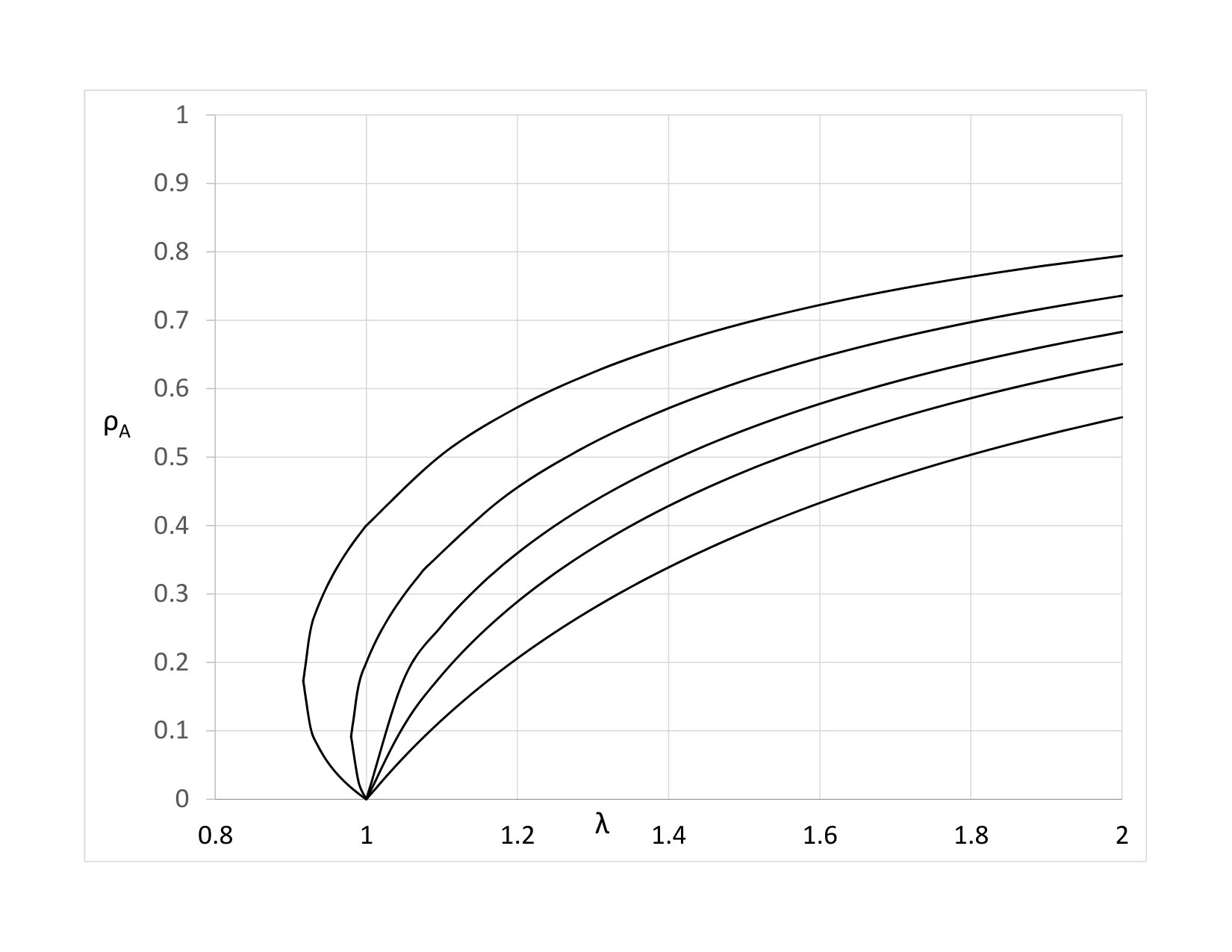 Figure 1
Peer Reviews
No public reviews on file for this paper yet. If you reviewed it on a platform where reviews are public (OpenReview, ICLR, NeurIPS, ICML), you can paste yours below so the community can read it here.
Videos
No videos yet. Explain this paper in a talk, walkthrough, or lecture? Add one.
\SHORTTITLE
The Symbiotic Contact Process \TITLEThe Symbiotic Contact Process††thanks: Partially supported by DMS grants DMS 1505215 and 1809967 from the Probability Program. \AUTHORSRick Durrett111Dept. of Math, Duke University, Box 90320, Durham NC 27708-0320 \[email protected] and Dong Yao222Dept. of Math, Duke University, Box 90320, Durham NC 27708-0320 \[email protected] \KEYWORDSsymbiotic contact process ; block construction \AMSSUBJ60K35 \SUBMITTEDApril 4, 2019 \ACCEPTEDDecember 13, 2020 \VOLUME0 \YEAR2012 \PAPERNUM0 \DOIvVOL-PID \ABSTRACT We consider a contact process on with two species that interact in a symbiotic manner. Each site can either be vacant or occupied by individuals of species and/or . Multiple occupancy by the same species at a single site is prohibited. The name symbiotic comes from the fact that if only one species is present at a site then that particle dies with rate 1 but if both species are present then the death rate is reduced to for each particle at that site. We show the critical birth rate for weak survival is of order as . Mean-field calculations predict that when there is a discontinuous transition as is varied. In contrast, we show that, in any dimension, the phase transition is continuous. To be fair to the physicists that introduced the model, [27], the authors say that the symbiotic contact process is in the directed percolation universality class and hence has a continuous transition. However, a 2018 paper, [30], asserts that the transition is discontinuous above the upper critical dimension, which is 4 for oriented percolation.
1 Introduction
In the ordinary contact process the state at time is a function . 1’s are particles and 0’s are empty sites. Particles die at rate 1, and are born at vacant sites at rate where is the number of nearest neighbors in state 1. A number of contact processes with two types of particles have been investigated. Neuhauser [26] considered the competing contact process . 0’s again are vacant sites but now 1’s and 2’s are two types of particles. Each type of particle dies at rate 1, while particles of type are born at vacant sites at rate where is the \xyzfraction of nearest neighbors in state , . She showed that there was no coexistence if . When there is no coexistence in but there is when , behavior reminiscent \xyzof the voter model.
Durrett and Swindle [17] studied a contact process in which 0’s are vacant sites, 1’s are bushes and 2’s are trees. 1’s and 2’s die at rate 1. Particles of type give birth at rate , and send their offspring to a randomly chosen nearest neighbor. If the site is vacant then it becomes type . A 2 landing on a 1 changes the site to state 2, but a 1 landing on a 2 does nothing. In contrast to Neuhauser’s model, coexistence is possible. More work on this system can be found in [16].
Krone [22] studied a contact process with states 0, 1, and 2. Again 0’s are vacant sites, but now 1’s are young particles that cannot reproduce, while 2’s are mature particles that can. Particles of type die at rate . Transitions from 1 to 2 occur at a constant rate . Vacant sites change to state 1 at rate . Krone proved the existence of a phase transition and established some qualitative results about the phase diagram. He left a number of open problems, most of which were solved by Foxall [18].
\xyz
Lanchier and Zhang [23] studied the stacked contact process, which was then generalized by Foxall and Lanchier [19]. In the (generalized) stacked contact process the state space at each site is . 0 stands for empty site. 1 means there is a host but there is no symbiont associated to the host. 2 means there are both a host and an associated symbiont. 0 becomes 1 at rate and becomes 2 at rate . 2 and 1 becomes 0 at rate 1. The symbiont is called a pathogen if and a mutualist if . 1 becomes 2 at rate and 2 becomes 1 at rate . The authors showed in [19] that in the case where , and only the host can survive locally but not the symbiont, no matter how large is. Here is the critical value of contact process in . This is in contrast with the mean field prediction which says there is coexistence of host and symbiont if and is large enough.
de Olivera, dos Santos, and Dickman [27] introduced the symbiotic contact process . Here ’s and ’s are different species of particles. As in the contact process there can be at most one individual of a given type at a site, but in this process there can be one and one \xyz at a site. If only one type is present then the system reduces to a contact process in which particles die at rate 1, and vacant sites become occupied at rate where is \xyzthe fraction of neighbors in state . Presence of the other type does not affect the birth rates, but the death rates of particles at doubly occupied sites is reduced to due to the symbiotic interaction between the two species.
To describe the system formally, \xyzfor any site we write the state of as where is the number of individuals of species at the site and is the number of individuals of species . Letting (resp. ) be the fraction of neighbors that have an particle (resp. a particle), \xyzand the transition rates are as follows
[TABLE]
1.1 Mean-field calculations
Often the first step in understanding the behavior of an interacting particle is to look at the predictions of mean-field theory in which we pretend that adjacent sites are independent. Let , , and be the probabilities a site is in state , , , and . By considering the possible transitions we see that
[TABLE]
See (1) in [27]. We are only interested in solutions with . (2) implies that in equilibrium we must have
[TABLE]
Solving gives \beqp_AB = λp2μ- λp.
\eeqNoting that and rewriting (1) \beq0 = λ(1-3p-p_AB)(p+p_AB) + μp_AB - p
\eeqCombining equations (1.1) and (1.1) we arrive at a quadratic equation for with coefficients that are quadratic polynomials in and . Solving, see Section 2, leads to the conclusions
- •
For , grows continuously from zero at .
- •
When there is a discontinuity at .
1.2 Bounds on the critical value
\xyz
Before defining critical value, we introduce a graphical representation for the symbiotic contact process (SCP). For each ordered pair of neighboring sites we let be a Poisson process with rate . When the Poisson clock associated to rings, we draw an arrow from to to indicate a possible infection events from to , i.e., if there is an or at at this time and there is no or at then the state at will change from 0 to or from to . Simirly we introduce the Poisson processes to indicate the possible infection events of species . In what follows, we will frequently use the term ‘arrow’ to refer to possible infection events.
\xyz
Throughout the paper we will suppose . To represent the death events, we use Poisson processes with rate to denote death events that kills species at site no matter whether is present at at that time or not. We also introduce Poisson processes with rate to denote the death events that kill species at site only if is not present at . Similarly we also introduce two Poisson processes and to produce death events for species . All the Poisson processes in the construction are independent.
Let be the number of sites that have an , and let be the number of sites that have a . Let \beqΩ_∞= { A_t ¿ 0 and B_t ¿ 0 for all t}
\eeqbe the event that the process survives. \xyzUsing the graphical representation we can construct a coupling between SCP with and by introducing new Poisson processes with rate that produce additional infections in the second process but not in the first. It is easy to see that if happens in the first process then it also happens in the second. Let be the probability of survival when we start with one at the origin and all other sites vacant. It follows from the coupling that is an nondecreasing function of for fixed . Hence we can define the critical value \beqλc(μ) = inf{ λ: P_AB,0( Ω∞) ¿ 0 }.
\eeqIf we set then the ’s and ’s are independent contact process. Using the graphical construction again we see that if then where is the critical value for survival of ordinary contact process on . To do this we build the process with using death Poisson processes and that are a superposition of and and and respectively.
The next result shows that symbiosis can have a great effect on the survival of the system. The upper bound uses a block construction which sacrifices accuracy to keep the renormalized sites independent, so it is very crude. As in the case of the ordinary contact process one can project into by mapping in order to extend the result to .
Theorem 1.1**.**
For any , the critical value satisfies
[TABLE]
\xyz
The values of and are summarized in the following table.
[TABLE]
\mn\xyz
To explain the division into cases, recall in so if .
1.3 The phase transition is continuous
We use a block construction for the basic contact process that is similar to the one originally developed by Bezuidenhout and Grimmett [6]. We follow the approach in Section 1.2 of Liggett [24]. For positive number , let and . The constant is given in (11). We set to make formulas easier to write. Let denote the symbiotic contact process (SCP) starting from all sites in occupied by and no births are allowed outside of . Sometimes we omit the superscript . The space-time box is . \xyz, and will be chosen in the proof of Theorem 1.2. In the argument in Liggett one produces occupied translates of on the top and sides of the space-time box. We will instead make copies near the top and near the sides in regions that we call slabs. The top slab is
[TABLE]
We will have side slabs. They are
[TABLE]
where ranges from 1 to .
The union of the side slabs is an “annulus” with (outer) sides
[TABLE]
and inner sides
[TABLE]
Theorem 1.2**.**
Suppose and that the SCP starting from a single at the \xyzorigin survives with positive probability and . For any , there are choices of (only depending on ), , s.t.
[TABLE]
and for any
[TABLE]
By symmetry the last result holds for .
This is the analog of Theorem 2.12 in Liggett [24]. Once this is done one can repeat the comparison with oriented percolation described on pages 51–55 in [24] to show that the SCP dies out at the critical value. The restriction to in Theorem 1.2 is needed because our proof uses the fact that the system with only one type of particle is subcritical. It is natural to
Conjecture 1.3**.**
If then
The bounds on the critical value given in Theorem 1.1 imply that for small . Strict monotonicity results for critical values have been proved for percolation, the Ising model, and other related systems. For early results see Chapter 10 of Kesten’s book on percolation [21]. Given a pair of lattices, and , Menshikov [25] gave conditions that guaranteed that the site percolation critical values . His results were later generalized in [1] by Aizenman and Grimmett, who showed that the critical value for an infinite entangled set of open bonds in is smaller than that the critical value for an infinite connected component of open bonds. They also showed for ferromagnetic spin systems that the critical temperature was a strictly increasing function of the interaction strengths. For more results in this direction see Bezuidenhout, Grimmett, and Kesten [7], or Balister, Bollobás and Riordan [4]. Results for the Ising and Potts models are proved by reducing to dependent percolation using the Fortuin-Kasteleyn representation. In the analysis of percolation one uses that there is only one fluid moving through the graph, so we do not think these methods can be used to prove Conjecture 1.3, which involves two types of fluids spreading through a graphical representation.
In the case of the ordinary contact process, , a second corollary of Theorem 1.2 is the complete convergence theorem. That is if then
[TABLE]
Here is convergence in distribution, the point mass on the all 0’s configuration and is the limit starting from all sites occupied. The SCP is attractive so the limit starting from all exists, but SCP process is not additive in the sense of Harris [20], so there is no dual process, which is a key ingredient in the contact process proof. \xyzTherefore one can not duduce complete convergence for SCP process from Theorem 1.2. (It is not clear to the authors whether complete convergence holds or not.)
The absence of an additive dual creates another open problem. \xyzWe say is nontrivial if it puts positive mass on configurations with infinitely many ’s and infinitely many ’s. Using the graphical representation for the SCP introduced in Section 1.2 one can show if is nontrivial for some , then must also be nontrivial for any . Hence for fixed we can define another critical value.
[TABLE]
Using the graphical representation one can show that
[TABLE]
where has been defined in (1.2). It is the probability that SCP starting from a sgingle site survives. This implies that . Toom’s model shows that these two critical values are not equal in general. In this model the state of the system is . As in the contact process occupied sites (1’s) become vacant (0) at rate 1. However now a vacant site at becomes occupied at rate \xyzonly if both and are occupied. For Toom’s model finite configuration cannot escape from a box that contains it, \xyz since if initially for some rectangle , then all with can’t get infected since either or is not in . Since we have a death rate 1 for all occupied sites, there must be a finite time when all sites of becomes empty. The process then dies out. It follows that . Toom [31] proved that . See Bramson and Gray [8] for another approach. For some rigorous results about this model see [12].
It would be interesting if the SCP was another example in which the two critical values are different, but we have no reason to believe they should be, so we
Conjecture 1.4**.**
**
1.4 Symbiotic contact process with diffusion
The question we address here is “What happens if, in additions to the birth and death events, we also let particles move according to the simple exclusion process?” This question was considered by de Olivera and Dickman [28]. To be precise, we view the symbiotic contact process as taking place on with ’s living on level 0 and ’s living on level 1. Particles jump to each neighbor on the same level at rate , subject to the exclusion rule: if the chosen neighbor is already occupied then nothing happens. We refer to this process as the symbiotic contact process with diffusion (SCPD) and denote it by .
In [28] simulations showed that for moderate diffusion rates, the process exhibits discontinuous phase transition but the transition becomes continuous again once gets small enough. They conjecture the critical value for for small is 1 regardless of the value of . Theorem 1.5 supports their conjecture.
Consider the SCPD starting from all sites occupied by . By attractiveness has a weak limit as that we denote by . Here, we are interested in the limit of as . To do this using the methods of Durrett and Neuhauser [15] it is convenient to implement the simple exclusion dynamics using the stirring process: for each pair of neighbors and on a given level we exchange the values at and on that level at rate . Following the approach in [15] the first step is to show convergence of a “dual process” to a branching Brownian motion and then derive a partial differential equation for the evolution of the local densities of , and , which we denote by , , . We also set and . As , and that satisfy:
[TABLE]
If we use the initial condition then by symmetry we can replace by in equation (5) to get
[TABLE]
The reaction term on the right-hand side is when or . If the reaction term is on so the limit is . When , we have , so the root at 0 is unstable. Results of Aronson and Weinberger [2, 3] imply that (7) has a traveling wave solution and that starting from any initial condition that is not identically 0, is close to on a linearly growing set.
The fast stirring makes the states on the and lattice independent so the equilibrium density of ’s is
[TABLE]
Subtracting this from the limit of the we find that the limiting density of ’s and ”s are given by
[TABLE]
Combining the PDE result with a block construction one can establish the existence of a nontrivial stationary distribution when using the methods in [15]. However, if we use Theorem 1.4 in [9] instead we get the stronger result:
Theorem 1.5**.**
Fix any (0,1]. (i) If , then for small , is nontrivial, and in any stationary distribution that assigns mass 1 to configurations with infinitely many ’s and ’s the densities of ’s, ’s, and ’s are close to , and .
(ii) If then for small we have .
\xyz
The proof of Theorem 1.5 is described in Section 7. All of the steps are in [15] or [9], but for the convenience of the reader, we will give an outline of the argument and indicate where detailed proofs can be found. It may surprise the reader to hear that the proof of the second result is much more difficult than the first. In part (i) if we can prove that the densities are close to the proposed values then we can conclude there is a non-trivial stationary distribution. However, in part (ii) we have to show that the density is 0, not just close to 0.
1.5 Outline of the paper
The remainder of the paper is devoted to proofs. The mean-field calculations are carried out in Section 2. The bounds on the critical values are proved in Section 3. The proof of Theorem 1.2 fills Sections 4 to 6. We will now state the two lemmas that are the key to its proof. However, first we need more notations.
\xyz
Given a finite space-time rectangular solid , the number of ’s in , , is the size of the largest set of space time points in so that (i) if then and (ii) if then either or and . Since the size of such a collection is bounded above by the cardinality of a set that has a point at each every 1 unit of time, a maximal set exists. Similarly we can define
For some , whose specific values are to be determined, let
[TABLE]
\xyz
We omit the dependence of various events on parameters other than and to make notation simpler. Recall we start the SCP from occupied by . Also, there is a parameter involved in the definition of the block construction in Section 1.3. In the next two lemmas is a constant introduced in equation (9) and (10). Let be the event that the SCP dies out.
Lemma 1.6**.**
For any with
[TABLE]
we have
[TABLE]
Lemma 1.7**.**
For any sequence , one can choose that satisfies
[TABLE]
These Lemmas are similar to steps in Liggett’s proof. For example, Lemma 1.6 is analogous to his Proposition 2.8. However, here we need a large number of sites occupied by ’s in , but the argument in [24] only gives us a large number of sites occupied by ’s or ’s. Intuitively since the SCP with only one type contact is subcritical an isolated will soon die. So if the SCP is to survive with high probability there must be many ’s . To translate this idea into a proof, we show \xyzin Section 5 that an on the inner side is unlikely to have a descendant on the outer side unless it encounters a along the way (and hence produces an ).
Lemma 1.6 is proved in Section 4 and Lemma 1.7 in Section 5. These two results are combined in Section 6 to prove Theorem 1.2. All of this material is independent of the calculations in Sections 2 and 3.
\clearp
2 Mean-field calculations
Using (1.1) we get
[TABLE]
Multiplying by we have
[TABLE]
Dividing by we arrive at the quadratic equation
[TABLE]
or after some algebra
[TABLE]
Using the quadratic formula the solutions are
[TABLE]
Note that in the last step we removed the minus sign out front by changing to in the denominator. If the second term under the square root vanishes and the numerator is . If the plus root is 0 and the minus root is so and there will be one positive root. If then the plus root is and the minus root is 0.
To further investigate the case note that inside the square root
[TABLE]
Cancelling the second and fourth terms gives
[TABLE]
so the roots can be written as
[TABLE]
which agrees with (5) in [28].
If the roots are complex. When and ,
[TABLE]
since . Combining this with the previous observation, we see that there are two roots when . The larger root and the root at 0 are stable so we have bistability for the ODEs (1) and (2) in this region. (\xyzAn ODE is bistable if it has two attracting fixed points.)
\clearp
3 Proof of critical vaule bounds
3.1 Upper bound on
We first consider the case dimension . Once we show in we can prove the result in by restricting the process to a line and it follows that . We use a block construction. is said to be wet if one of the sites in is in state at time , where is to be specified later. Let . \xyzIf is even we only allow to be even integers and if is odd we only allow to be odd integers. Note that these blocks are disjoint. So if we only use arrows with both ends in the box to spread the occupancy, the events associated with these boxes are independent.
In order to compare with oriented site percolation on , we need an upper bound on the critical value. A simple contour argument, see e.g., Section 4 in [13], shows that when sites are open with probability there is positive probability of percolation. Using a result of Balister, Bollobás, and Stacy [4] gives an upper bound . \xyzReturning to the SCP, we can show
Lemma 3.1**.**
Suppose and . If is wet then and will be wet with probability .
We first compute for the process with . Without loss of generality suppose and and that the is at 0. The state of site 1 will go from
[TABLE]
Let be the number of transitions before we arrive at . Since this is the \xyzfirst time the third transition occurs before the second one, it is clear that has a geometric distribution with success probability , that is,
[TABLE]
The time for a transition is exponential with rate . The time for is exponential with rate . The means are and respectively. As , the second will be much smaller than the first. The total waiting time is . The following well-known result shows each sum has an exponential distribution. We include its simple proof for completeness.
Lemma 3.2**.**
If is geometric with success probability , i.e., , and are an independent i.i.d. sequence with an exponential distribution with rate then is exponential with rate .
Proof 3.3**.**
* so conditioning on the value of *
[TABLE]
which is the Laplace transform of an exponential with rate proving the desired result.
Let and . Using Lemma 3.2 we see that has an exponential distribution with rate
[TABLE]
has an exponential distribution with rate
[TABLE]
Let be a constant to be chosen later and let
[TABLE]
If we let the time to produce an at then by Lemma 3.2 we have \beq¶(S^1_-1 ¿ T) ≤¶(T^1_AB¿c\ET_1^AB)+ ¶(T^2_AB¿c\ET_2^AB) ≤2e^-c
\eeqIf we let the time to produce an at and be the additional time to produce an at 2 then \beq¶(S^1_1+S^1_2¿ T) ≤2 ¶( S^1_1 ≥T/2 ) ≤4e^-c/2
\eeq
To return to the situation where we note that the probability there is no -death on during is . If we take then the probability of a -death in the box is . Thus, \xyzto prove Lemma 3.1 we want to pick and so that \beq2e^-c + 4e^-c/2 + 1 - e^-4b ¡ 1-0.726=0.274
\eeqTo do this we first decide to take so that , . This means we need . This holds if we take . Thus we have survival if
[TABLE]
Hence by monotonicity of the survival probability we will have survival if
[TABLE]
and which holds if . If , then we can simply bound by , the critical value for ordinary contact process on .
3.2 Lower bound on
For some define . Here , and are the number of sites in states , , and at time . The idea is to show for certain values of , it’s possible to choose the so that is a supermartingale. Since , it converges to a finite limit, which must be identically 0 since has values in a discrete set of values. This then implies both species have to die out with probability 1. Changes in results from the following
- •
An becomes or . This decreases by and the total rate is .
- •
or or gives birth creating a new . This increases by and the total rate is (note an or can become an at rate at most ).
- •
An gives birth so that a new or is created. This increases by and the total rate is
- •
An or dies. This decreases by and the total rate is .
- •
An or creates a new or . This increases by . The total rate is
Based on the items in the previous list, we can conclude that if .
[TABLE]
To get a supermartingale we fix and and pick so that
[TABLE]
For this to hold we need
[TABLE]
For this to be possible we need . Rearranging we want . Using the quadratic equation we find that a exists if and only if
[TABLE]
This implies that .
3.3 Improved lower bound in
\xyz
Consider the symbiotic biased voter model (SBVM) starting with ’s at all integers . To be precise, the birth rates for ’s and ’s remains the same, however, in this model only the rightmost or is allowed to die. Let be the right most and the right most . Each extreme particle dies at rate if the state there is or at rate 1 if the site is singly occupied. For example, in the realization drawn in Figure 4, he at dies at rate 1, while the at dies at rate .
\xyz
Let . The existence of an edge speed
[TABLE]
can be proved using the subadditive ergodic theorem. Using arguments in [10] for the one-dimensional contact process (see also [11] for the case of oriented percolation) we can also show that if we define
[TABLE]
then the probability of survival for SBVM, starting from origin occupied by and other sites vacant, is 0 for . One can construct the SBVM on the same graphical representation of SCP by ignoring deaths that do not effect the right-most and . It follows from the coupling and the results quoted above that if then the SCP dies out. From this it follows that , the critical value for survival from a finite set defined in Section 1.3.
If then the right-most and the right most give birth at rate . Let . If and then the at dies at rate 1, and the at dies at rate . Let be the Q-matrix for .
- •
If then due to birth of an or death of a ; \hbr due to death of an or birth of a .
- •
If then due to a birth or death of an or a .
To compute the stationary distribution set . If
[TABLE]
so we have \beqπ(n) = c ( λ+2μ**λ+2 )^n-1
\eeqTo compute we note that \beqπ(0)(λ+ 2μ) = c (1+λ2)
\eeqUsing (3.3) and (3.3) then summing we have
[TABLE]
From this and our bullet list of flip rates, it follows that in equilibrium
[TABLE]
To find when this is positive we set
[TABLE]
A little algebra converts this into
[TABLE]
so for the SBVM the critical value . As remarked \xyzabove this is a lower bound on for SCP.
\clearp
4 Proof of Lemma 1.6
At several points in the proof we will use Harris’ result on “positive correlations.” See Theorem B17 on page 9 of [24]. If is an attractive particle system starting from a deterministic initial condition and is the distribution at time then for any increasing functions and \beq∫f g dμ≥∫f dμ⋅∫g dμ \eeqIn most of our applications and will be indicator functions.
We begin our investigation by recalling some facts about the subcritical -dimensional contact process. Let be the total birth rate from an occupied site and let the death rate be 1. We suppose that in the initial condition only the origin is occupied and denote the process by . Combining Theorems 2.34 and 2.48 of [24] shows that if then there exists some so that
[TABLE]
for all . By increasing the value of if necessary we also have
[TABLE]
where is the boundary of the ball of radius in centered at 0. Here means for and .
Let be chosen so that
[TABLE]
The reason we choose an that satisfies \xyzthe above will become clear in the proof of Lemma 5.1.
Recall that . Define to be the event that there are fewer than arrows with one side occupied by or or escaping from the side of space time box, i.e., . Define to be the event that there are fewer than sites \xyzin state or or on the top, .
Lemma 4.1**.**
Let and be fixed. For any such that and we have
[TABLE]
Proof 4.2**.**
\xyz
To begin we consider equation (12). Observe that for any or reaching the outer boundary , that particle must have an ancestor on the inner boundary s.t. the infection path from the ancestor to the descendant completely lies in the side slab . There are two possibilities for this infection path. Either it meets a particle of the other species during the journey or not. We say the descendants of an travel alone if they never share a site with a individual. \xyzAn individual on has probability of less than to reach if they travel alone and the infection path stays in the side slab. Note that due to their definitions and are bounded by . Since we assume
[TABLE]
by union bound the probability that there exists one or on that make it to by traveling alone in the side slab is bounded by , which goes to 0 as by assumption. Since is fixed finite number on the event the number of particles in the side slab that do not travel alone in the side slab is at most with high probability. Combining the two types of possibilities for spreading (traveling alone or not) we see the number of offspring that can reach the sides is also at most with high probability. This proves (12). The proof of (13) is similar.
Proof 4.3** (Proof of Lemma 1.6).**
For any given , by Lemma 4.1 we can pick large enough s.t.,
[TABLE]
Each individual dies at rate at least , so the probability for it to die in 1 unit of time is at least . The probability that this individual does not produce a new particle within 1 unit of time is at least . Using positive correlations, we see that on the event , there is always probability
[TABLE]
that all the births escaping from the side are killed and all the sites occupied at top slice recover before giving any birth. If we denote by the sigma algebra generated by the Poisson process in the space-time box , then on we have
[TABLE]
\xyz
Levy’s 0-1 law (see e.g. [14, Theorem 5.5.8]) implies that
[TABLE]
which implies on the event we have . It follows from this and the fact that for any ,
[TABLE]
Lemma 1.6 follows because can be taken arbitrarily small.
\clearp
5 Proof of Lemma 1.7
In this section, our goal is to prove
\mn
Lemma 1.7 For any sequence , one can choose that satisfies
[TABLE]
so that for large
\mn
Let and let . The first step is to show
Lemma 5.1**.**
\xyz
Let be any sequence going to . Set and define
[TABLE]
then
[TABLE]
and \beq lim_j→∞* t_j(κ(λ))^aL_jL_j^d-1=0. \eeq*
To prove this we use the following proposition:
Proposition 5.2**.**
For any and any possible configuration , there are two possibilities
- •
Scenario 1.* \xyz There is no in and for any with an at and a at we have . In this case there are constants so that*
[TABLE]
- •
Scenario 2.* There are with with an or at and a or at . If we let and we let where then \beq ¶__W(L_j) ξ_t (_W(L_j)ξ** has an AB in **)¿c_3^L_j *\eeq
Proof 5.3** (Proof of Proposition 1).**
In scenario 1, equation (10) implies that a single particle has probability at most to ever reach some point outside . Using a union bound, we see that with probability at least none of the particles in the box will move for a distance greater than . Conditioned on the event that none of the ’s and ’s meet, they will die out before time with a probability of at least by equation (9). Using union bound again we get equation (16).
In Scenario 2, the result comes from the fact that for any and with distance less than , the probability that they will meet to form an within time of is
[TABLE]
To prove this, let be a path with length and note that to get from occupied at time to occupied at time : the particle at has to survive for time 1, give birth onto and the newborn particle needs to survive until time . If the is already in then we are done. Otherwise we let this produce an in within time with probability at least
[TABLE]
To see this, for any point in there is a path of length at most connecting this point to some other point in . \xyzThis time the events along the path that result in spreading the infection are:
(i) The at has to survive for time 1 (with probability ).
(ii) During this time unit there has to be a birth of an and a at which occurs with probability ).
(iii) The first born particle has to survive until the second birth occurs which occurs with probability ).
Then we repeat this process for the newly formed until we reach the final point of the path. Using positive correlations we prove (• ‣ 5.2) with since .
Proof 5.4** (Proof of Lemma 5.1).**
We divide into intervals of length . Denote by the resulting division points for By Proposition 5.2, on the event if we look at the restricted process at times we need to stay in scenario 2 otherwise the restricted process will die with high probability. On the other hand, falling into scenario 2 implies that we will have a chance of at least to get an in . If is large enough so that
[TABLE]
then with high probability the number of in will grow to To see this, recall that for any collection of independent Bernoulli random variables using Chebyshev’s inequality with the fact that we have
[TABLE]
If we choose equation (17) is satisfied since , which implies
[TABLE]
This proves (15). Since it is clear from the definition of that (5.1) holds.
Proof 5.5** (Proof of Lemma 1.7).**
It is clear that and is an decreasing function of . We need to find that satisfies . By comparison with Richardson’s model, see [29], it follows that the SCP spreads at most linearly. Hence if then . This implies that if we have
[TABLE]
then it must be true that
Lemma 5.1 gives us, see (5.1) and (15), a sequence of that satisfies and . Since is decreasing in we have proved the existence of with the properties desired in Lemma 1.7.
\clearp
6 Proof of Theorem 1.2
Using Lemma 1.6, positive correlations, and Lemma 1.7 we see that if is large
[TABLE]
Rearranging we have \beq¶( AB(H_L,T) ¿ M) ≥1 - 2 ¶(Ω_0)
\eeqFor the moment we will restrict to and drop the superscript from the notation for the slabs. To bound the other probability we use Lemma 1.7, monotonicity, positive correlations, and symmetry to conclude
[TABLE]
which gives
[TABLE]
The same calculation \xyzgives for the SCP on : \beq¶( AB(S^i,+_T,L) ¿ N/2), ¶( AB(S^i,-_T,L) ¿ N/2) ≥1 - ¶(Ω_0)^1/4d
\eeq
It remains to show if we have many ’s then with high probability at some time we will have an box of length that is filled with . Denote by the event that for some and some , and . Let be the constant in Theorem 1.2 and let . Note that by the ergodic theorem we know that as , so if we pick large enough then . Having chosen the value of , we will show
Lemma 6.1**.**
* for large enough.*
Assume Lemma 6.1 for the moment, it follows from Lemma 1.7
[TABLE]
Equation (3) can be shown similarly by using (6) in place of (6).
Proof 6.2** (Proof of Lemma 6.1.).**
Following the proof of (5.6) in [5], we will use an algorithm that will stop if we find consecutive ’s. It is designed so that each time we choose an site, the probability that this chosen point fails to generates ’s within next one unit of time is less than which is a number only depends on . Also whether or not we can get ’s is independent of information obtained before. This proves that as long as the algorithm allows us enough choices on .
Let be the first time that an appears in and let the coordinate of this first point by . Let be the sigma-algebra generated by the Poisson processes in up to time . Given , the probability that this chosen point fails to generates an interval of ’s in using only Poisson arrivals in is less than . If we do get AB’s then the algorithm stops otherwise we continue.
At the next step we try to find the first , so that we have an at in . When we ignore points with . If we let be the sigma-algebra generated by the Poisson processes in up to time . If , we need to add information about the Poisson processes in . In either case, given , there is a probability of less than that we cannot find consecutive ’s by using the Poisson process in .
We continue the search until we either get consecutive ’s or we come to time . The probability of failure when running this algorithm for steps is . This will be if
[TABLE]
Recall that we count two space time points and as different only if . Hence at each step of the algorithm we ignore at most points. It follows that if
[TABLE]
then we can run the algorithm for at least steps if needed, which implies the probability of failure is . This completes the proof of Lemma 7 and hence completes the proofof Theorem 2.
\clearp
7 Proof of Theorem 1.5
The first step is define the dual process. For this we need to construct the process using Poisson processes. For each ordered pair of neighboring sites and level we have a rate Poisson process , which cause births from to . For each unordered pair of neighbors and level we have a rate Poisson process , the values at to . For each site and level we have a rate Poisson process , that always causes death of a particle at on level , and a rate Poisson process , that causes death of a particle at on level if there is no particle at on level .
The first three Poisson processes are part of an additive process but the last one is not, so the dual process that works backwards from on level at time is what [15] call the influence set. The state at at time can be computed if we know the states of the sites in at time . When a particle in hits an arrival in one of our Poisson processes the following changes occur.
- •
. We draw an arrow from to indicate a potential birth and add a particle at . If there is already a particle at the two particle coalesce to one.
- •
. We draw an arrow from and an arrow from to indicate that the values will be exchanged. We move the particle at to . if there is a particle at it moves to
- •
. We kill the particle at and write a next to it.
- •
. We write a at and draw an arrow from to indicate that if is occupied the particle at is saved from death. We leave in the dual and add a particle at .
For more details about the construction of the dual see Section 2 in [15]. In that section it is shown that the correlations of particle movements caused by stirring neighboring particles tend to 0 as , so the dual converges to a branching Brownian motion. In Sections 2d and 2e of [15], the convergence of the dual to branching Brownian motion is used to conclude that the and converge to limits and that satisfy (5) and (6). This is also proved in Chapter 2 of [9]. However the fact that we have stirring instead of random walks makes things simpler: we do not have to trim the dual to remove particles that exist for only a very short amount of time.
The results of Aronson and Weinberger [2, 3] imply that when Lemma 3.2 in [15] holds and consequently there is a nontrivial stationary distribution. Essentially the same proof is carried out in Chapter 6 of [9], but in that reference \xyza more careful comparison with percolation is used to guarantee that the densities are close to the values that emerge from the mean-field ordinary differential equation.
To prove result (ii) we have to use a comparison with oriented percolation to show that holes (regions that are ) grow linearly so the system dies out. In doing this we have to deal with the fact that our block event that produces dead regions sometimes fails. \xyzTo guarantee that the configuration is even in that case, we use another percolation argument to show that the failed block events are surrounded by a connected dead region so it is impossible for there to be particles in the region with the failed block construction. This argument is done in Sections 4 and 5 of [15] for the quadratic contact process, and in greater generality in Chapter 7 of [9].
The reference list from the paper itself. Each links out to its DOI / PubMed record.
- 1[1] Aizenman M. and Grimmett G. (1991) Strict monotonicity for critical points in percolation and ferromagnetic models Journal of Statistical Physics 63, 817-835
- 2[2] Aronson, D.G. and Weinberger, H.F. (1975) Nonlinear diffusion in population genetics, combustion, and nerve pulse propagation. Pages 5–49 in Partial Differential Equations and Related Topics. Springer Lecture Notes in Math 446, Springer, New York.
- 3[3] Aronson, D.G. and Weinberger, J.F. (1978) Multidimensional nonlinear diffusion arising in population genetics. Adv. in Math. 30, 33-76
- 4[4] Balister, P., Bollobás, B., and Stacey, A. (1993) Upper bounds for the critical value of oriented percolation in two dimensions. Proc. Roy. Soc. London, A. 440, 201–220
- 5[5] Beizuidenhout, C., and Gray, L. (1994) Critical attractive spin systems, Annals of Applied Probability. 22, 1160–1194
- 6[6] Bezuidenhout, C., and Grimmett, G. (1990) The critical contact process dies out. The Annals of Probability. 18, 1462–1482
- 7[7] Bezuidenhout, C., Grimmett, G., and Kesten, H. (1993) Strict inequality for critical values of Potts models and random-cluster processes. Commun. Math. Phys. 158, 1–16
- 8[8] Bramson, M., and Gray, L. (1991) A useful renormalization argument. Pages 113–152 in Random walks, Brownian motion, and interacting particle systems. 1 Birkh auser Boston, Boston, MA