Haldane and Dimer phases in a frustrated spin chain: an exact groundstate and associated topological phase transition
Shaon Sahoo, Dayasindhu Dey, Sudip Kumar Saha, and Manoranjan Kumar

TL;DR
This paper explores the phase diagram of a frustrated Heisenberg spin chain with alternating interactions, revealing topological distinctions between phases and identifying an exact ground state under specific conditions.
Contribution
It provides an exact ground state solution and characterizes topological phase transitions in a frustrated spin chain with variable spin magnitude.
Findings
Identification of Haldane and Dimer phases as topologically distinct.
Existence of an exact dimer ground state along a specific line in parameter space.
Discovery of a spiral phase for spins greater than 1/2.
Abstract
A Heisenberg spin- chain with alternating ferromagnetic () and antiferromagnetic () nearest-neighbor (NN) interactions, exhibits the Dimer and spin- Haldane phases in the limits and respectively. These two phases are understood to be topologically equivalent. Induction of the frustration through the next nearest-neighbor ferromagnetic interaction () produces a very rich quantum phase diagram. With frustration, the whole phase diagram is divided into a ferromagnetic (FM) and a nonmagnetic (NM) phase. For , the full NM phase is seen to be of Haldane-Dimer type, but for , a spiral phase comes between the FM and the Haldane-Dimer phases. The study of a suitably defined string-order parameter and spin-gap at the phase boundary indicates that the Haldane-Dimer and spiral phases have…
Click any figure to enlarge with its caption.
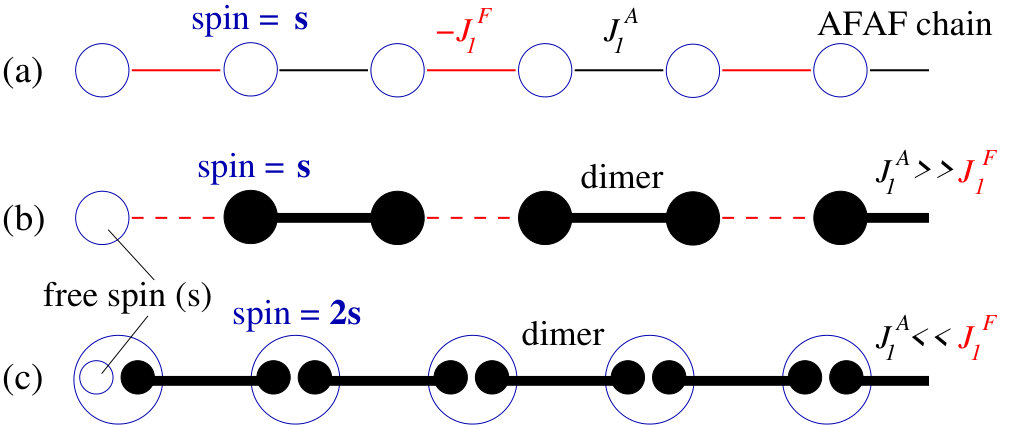 Figure 1
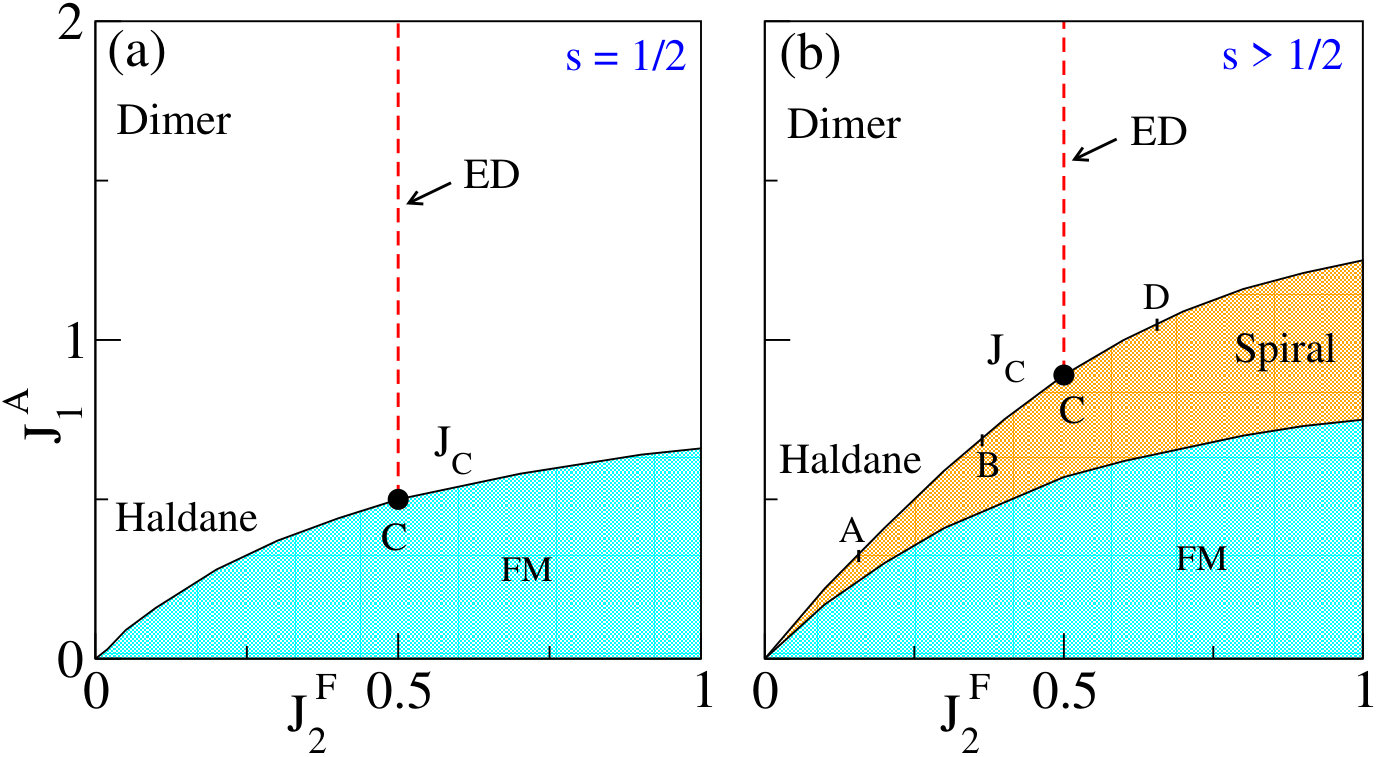 Figure 2
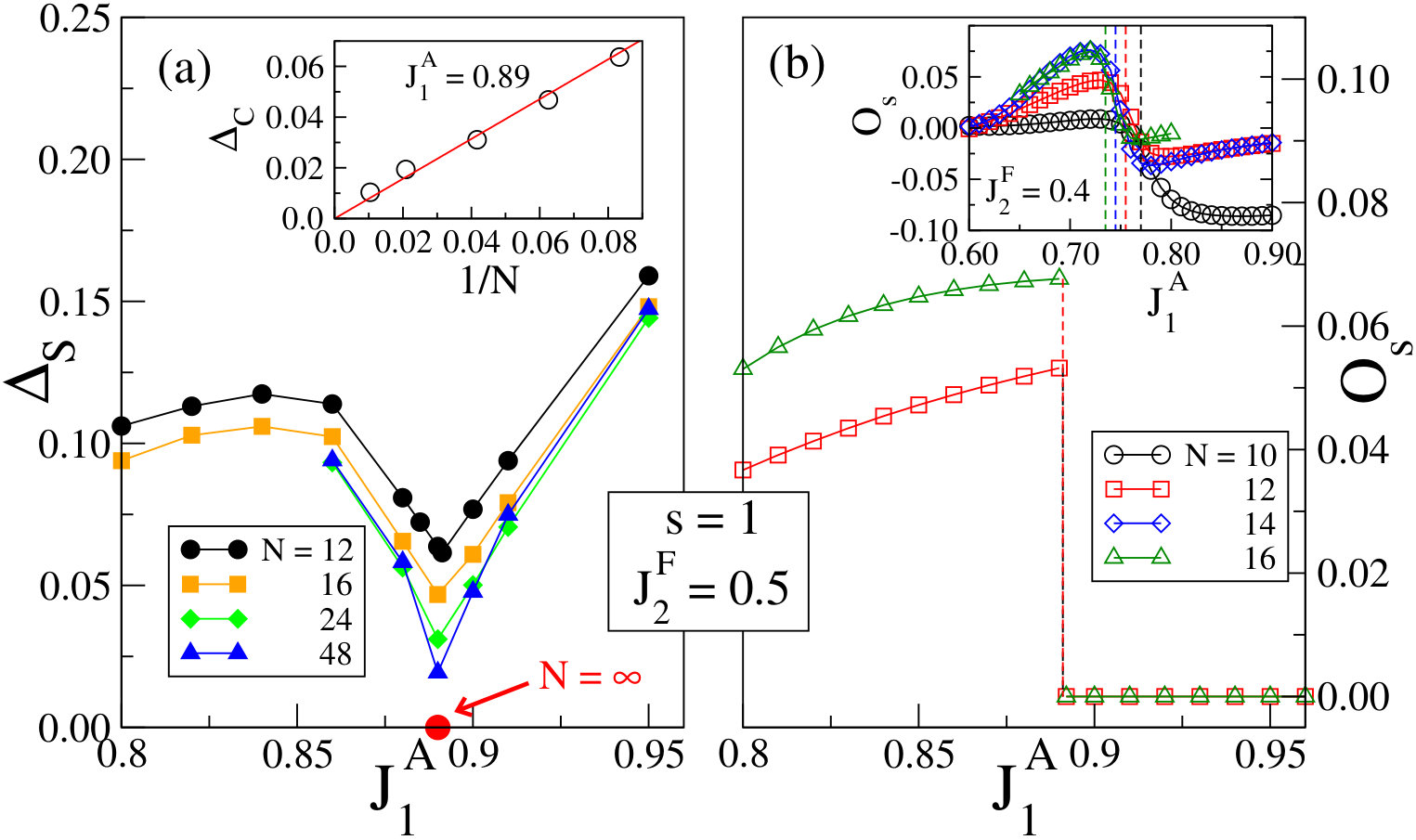 Figure 3
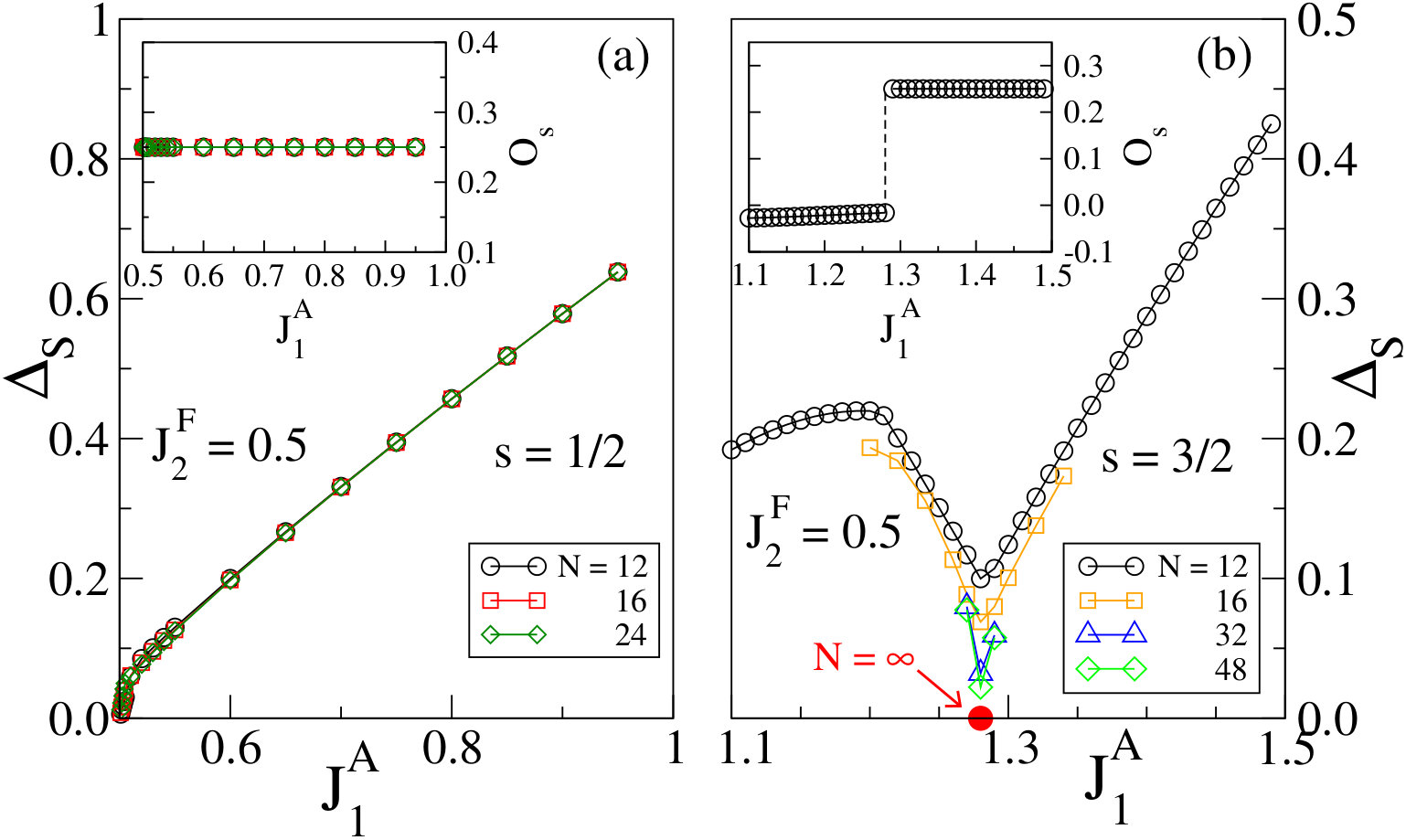 Figure 4
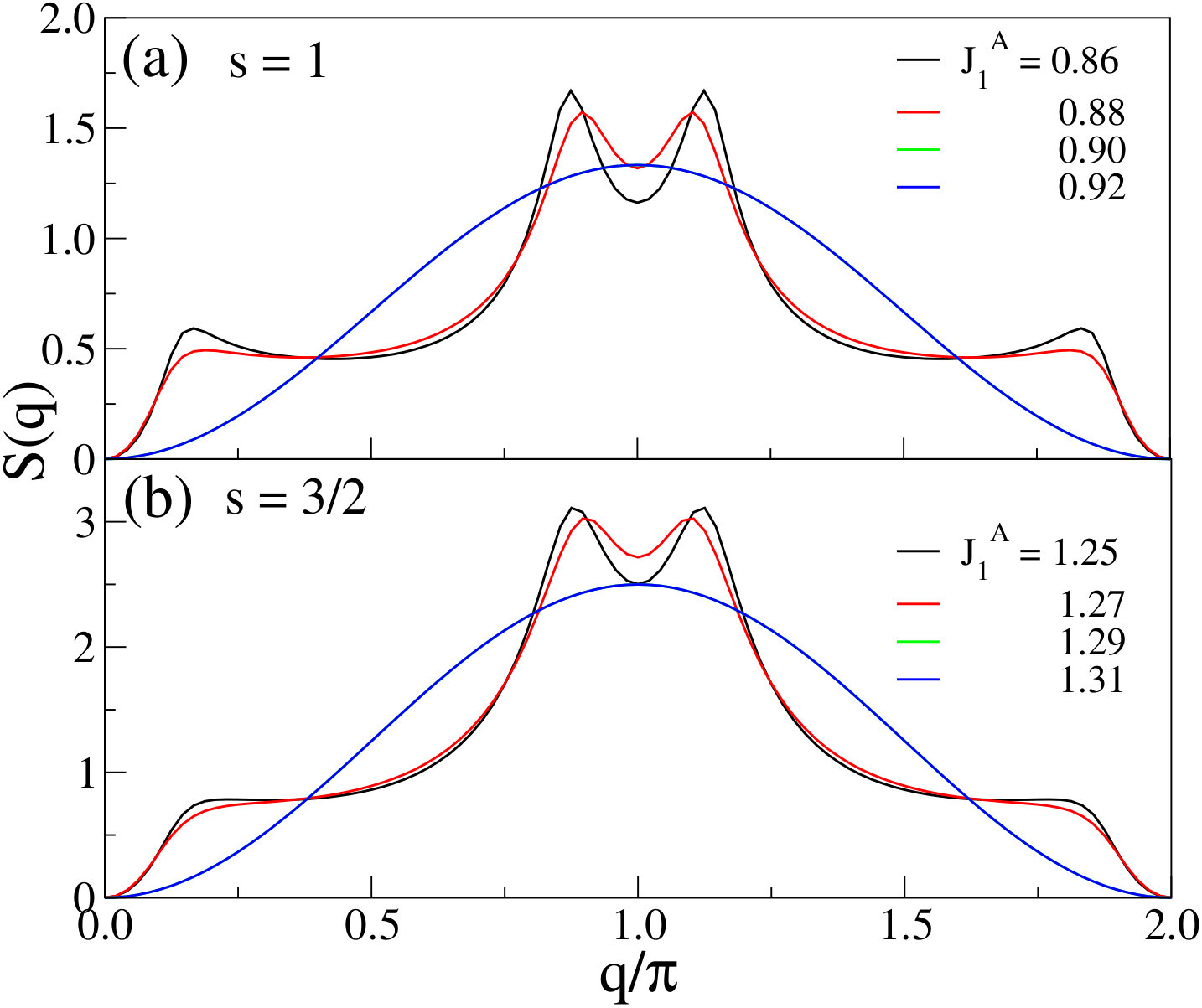 Figure 5
Peer Reviews
No public reviews on file for this paper yet. If you reviewed it on a platform where reviews are public (OpenReview, ICLR, NeurIPS, ICML), you can paste yours below so the community can read it here.
Videos
No videos yet. Explain this paper in a talk, walkthrough, or lecture? Add one.
Haldane and Dimer phases in a frustrated spin chain: an exact groundstate and associated topological phase transition
Shaon Sahoo1,2,
Dayasindhu Dey1
Sudip Kumar Saha1
Manoranjan Kumar1,
1 S. N. Bose National Centre for Basic Sciences, Block JD, Sector III, Salt Lake, Kolkata 700106, India
2 Department of Physics, Indian Institute of Technology Tirupati, Tirupati 517506, India
Abstract
A Heisenberg spin- chain with alternating ferromagnetic () and antiferromagnetic () nearest-neighbor (NN) interactions, exhibits the Dimer and spin- Haldane phases in the limits and respectively. These two phases are understood to be topologically equivalent. Induction of the frustration through the next nearest-neighbor ferromagnetic interaction () produces a very rich quantum phase diagram. With frustration, the whole phase diagram is divided into a ferromagnetic (FM) and a nonmagnetic (NM) phase. For , the full NM phase is seen to be of Haldane-Dimer type, but for , a spiral phase comes between the FM and the Haldane-Dimer phases. The study of a suitably defined string-order parameter and spin-gap at the phase boundary indicates that the Haldane-Dimer and spiral phases have different topological characters. We also find that, along the line in the NM phase, an NN dimer state is the exact groundstate, provided where for applied magnetic field . Without magnetic field, the position of is on the FM-NM phase boundary when , but for , the location of is on the phase separation line between the Haldane-Dimer and spiral phases.
I Introduction
In condensed matter physics a phase of a system can be identified by defining a suitable order parameter. However, it was later found that the phases can not always be characterized by the broken symmetry approach prescribed by Landau; here different phases are distinguished according to their topological characters chiu16 ; wen17 . There are many systems where topology plays a vital role in characterizing their phases chiu16 ; wen17 . For example, the antiferromagnetic Heisenberg spin chain can have gapped or gapless groundstate depending on whether site spins are integer or half-integer, as was first conjectured by Haldane haldane83 . The change in the spectrum of these systems can be explained by the topological terms in the field theoretical description of the spin chain chiu16 ; haldane83 ; affleck89 . Later it was shown that the Haldane phase in the odd and even integer spin () belong to different topological classes; while odd- Haldane phase is topologically nontrivial and protected by symmetries, even- Haldane phase is not protected and can be adiabatically transformed to a trivial site-factorizable phase pollmann12 . It is also worth noting here that, there are topological phase transitions where the symmetry breaking takes place simultaneouly (e.g. fujita14 ).
Frustrated spin chain models, like ‘’ model, have been extensively studies and they show zoo of quantum phases ckm ; harada ; ramasesha95 ; white_affleck96 ; mkumar1_10 ; mkumar2_10 ; aslam15 ; aslam16 . In this paper we study a frustrated quantum spin chain model, called here AFAF model, which has become a playground for studying and understanding the intricacies of the Haldane phase and its associated gap hida92a ; hida92b ; hida92c ; hida94 . The AFAF model has Alternating Ferromagnetic () and AntiFerromagnetic () nearest-neighbor (NN) exchange interactions. In this model the neighboring spin- objects -connected by ferromagnetic interactions- couple to form an effective spin-2 the Haldane chain in the limit hida92a ; hida92b ; hida92c ; hida94 ; sahoo14 . This particular model got more prominence after it was realized experimentally in some materials, e.g., hagi97 , mana97 , koda99 , and stone07 .
The main insight gained from studying the AFAF model is the topological equivalence of the the NN dimer phase (in limit) and the Haldane gapped phase (in limit). Hida first showed that the Haldane gapped phase is adiabatically connected to the NN dimer state hida92a by studying the string-order parameter suggested by den Nijs and Rommelse as function of nijs89 . Kohmoto et al. supported this result by showing that the model has broken hidden symmetry in both the phases kohmoto92 ; yamanaka93 .
In this paper we study the rich phase diagram of the AFAF spin model with frustration which is induced by the next nearest-neighbor (NNN) ferromagnetic interaction (). With the frustration, the phase diagram shows two main phases -ferromagnetic (FM) and nonmagnetic (NM). For , the whole NM phase is seen to be of gapped Haldane-Dimer type, but for , we also obtain a spiral phase. The study of appropriately defined string-order parameter and spin-gap at phase boundary show us that the Haldane-Dimer and the spiral phases are topologically different. We also show here that, an NN dimer state is the exact groundstate of spin model along line, provided where for applied magnetic field . While the position of is on the FM-NM boundary for , but for , it is seen to be on the phase separation line between the topologically distinct Haldane-Dimer phase and spiral phases.
This paper is arranged as follows. In the next section (Sec. II), we explain our spin model. In Sec. III, we briefly discuss equivalence of Dimer and Haldane phases for spin- AFAF model. Next in Sec. IV, we discuss the phase diagram of the frustrated AFAF model -the discussion includes an exact dimer groundstate and the corresponding string-order parameter, and a spiral phase for . In Sec. V, we discuss a phase transition line (for ) which separates the Haldane-Dimer phase from a topologically different spiral phase. We then conclude our paper in Sec. VI.
II Frustrated AFAF model
The following Hamiltonian describes the Frustrated spin- AFAF chain of size :
[TABLE]
with . Here ’s are site spin operators with spin value , () is the NN ferromagnetic (antiferromagnetic) exchange constant and is the ferromagnetic NNN exchange constant. The external magnetic field () is applied along the -direction. To make sure that the system reduces to an open spin- Haldane chain of even number of sites in the limit , we only consider here, unless mentioned otherwise, the chain geometry where the first and the last bonds are ferromagnetic in nature, and (mod 4).
III Equivalence of Dimer and Haldane phases
In the limit , the groundstate of the Hamiltonian in Eq. 1 with is a product of NN dimers (here a dimer is the singlet between two spin- objects). On the other hand, the model shows a spin- Haldane phase in the limit .
For , the Dimer and Haldane phases are known to be adiabatically connected and topologically equivalent hida92a ; kohmoto92 ; yamanaka93 . But this equivalence result is expected to be valid even for . This can be understood in the following way. Since different topological states can be distinguished by their groundstate degeneracies wen90 ; wen17 , we will now calculate this quantity in two opposite limits. We first note that, in the dimer limit (), there exist two free spin- objects at the two edges of the chain (see FIG. 2b); this gives rise to the -fold groundstate degeneracy. In the Haldane limit (), we get a spin- open chain of length . The groundstate of this Haldane chain is actually topologically equivalent to the valance bond solid (VBS) state. The VBS state for spin- system can be obtained in the following way: each site spin can be considered as symmetric combination of two spin- objects aklt87 . Now singlets can be formed between two spin- objects from two neighboring sites (see FIG. 2c). This leaves two free spin- objects at the two edges of the chain pollmann12 ; jiang10 . This shows that, in the Haldane limit too, the groundstate degeneracy will be . The same value of the groundstate degeneracy in two opposite limits indicates that, the Dimer and Haldane phases are topologically equivalent for all .
It may be mentioned here that, for the odd-spin Haldane phase, 4-fold degeneracy is genuine (as long as the time-reversal symmetry is maintained) and the rest of the degeneracy can be lifted by perturbations. On the other hand, for the even-spin Haldane phase, full degeneracy is accidental and can be lifted by perturbations pollmann12 . The preceding discussion is valid in both the cases in the sense that it only shows the equivalence of the Haldane phase and the Dimer phase, irrespective of whether those phases are topological trivial or not.
IV Extended phase diagram with frustration
To better understand the behavior of the Haldane and Dimer phases under the frustration, and to investigate other possible quantum phases, we now study the AFAF model with frustration induced by the NNN ferromagnetic interactions (). In this section, we first show that an NN dimer state is the exact groundstate of the Hamiltonian in Eq. 1 along a special line in the parameter space. Then we exactly calculate a suitably defined string-order parameter and show that how our spin system behaves differently for integer or half-integer spin . In the next two sub-sections, we respectively discuss a spiral phase () and a ferromagnetic phase that appear in the phase diagram for .
IV.1 Exact ground state
We begin by showing that, when (we set as normalization), an NN dimer state is an exact eigenstate of the Hamiltonian in Eq. 1. This dimer state is then proved to be the exact groundstate when is larger than a critical value. Along the special line in the parameter space, we rewrite the Hamiltonian in the following form (assume periodic boundary condition):
[TABLE]
Let be the singlet state between spins at sites and . We then have the following relations: , for all and (. Using these relations, it is easy to verify that the state is an eigenstate of the Hamiltonian with the eigen energy , i.e.,
[TABLE]
Using the Rayleigh-Ritz variational principle, it is possible to prove that this is a groundstate of the system when is greater than a critical value ( with ). In the following we show that .
Suppose that the total Hamiltonian of a system is written as the sum of terms, i.e., . Using the Rayleigh-Ritz variational principle, it can be shown that if a state is simultaneously a groundstate of each of ’s, then it will also be a groundstate of the total Hamiltonian. To use this theorem for our purpose, we decompose in Eq. 2 as , where
[TABLE]
Here each part, represented by either or , corresponds to a block of three spins. All these block Hamiltonians are essentially equivalent and have the same eigenvalues. Let us denote the Hamiltonian for this three-spin block as ; considering the first triangle, we have . In an earlier work sahoo14 , it was shown by explicitly forming and diagonalizing (with ) that, the NN dimer state is the groundstate of for when and for when . Numerically value is found to be 0.5 and 0.9 respectively for and . We now extend this result for general spin , in addition, this time we also consider the presence of (weak) magnetic field .
First we rewrite in the following way:
[TABLE]
The first two terms in Eq. 6 compete with each other and determine the nature of the groundstate in spin block. For example, if , all three spins will try to form maximum possible total spin and minimize the energy of . On the other hand, if , there will be a singlet formation between 2nd and 3rd spins to minimize the value of the 2nd term in the expression of . Therefore, in the large limit and in the presence of a weak magnetic field, the lowest energy of a three-spin block would be . For such singlet state of three-spin blocks, the total energy for the whole system would be which have the value same as the eigen energy of the NN dimer state in Eq. 3. Therefore, following the theorem stated earlier, will be the groundstate of the total system in the large limit.
Now we try to estimate the critical value of , denoted here by , above which is guaranteed to be the groundstate. In the phase diagram FIG. 1, the corresponding point is marked by , and marks a line along which is an exact groundstate. For the estimation of , we first note the following tendency of a spin block. Let us first start with a large value of for which a singlet is formed to minimize the energy of a three-spin block. Now as we reduce the value of , the three-spin block will try to minimize its energy by increasing the absolute value of the 1st term and lowering the value of the 2nd term (see Eq. 6). At the transition point, the singlet between the 2nd and the 3rd site would break and a triplet would be formed. In addition, the three spins together will form a spin to maximize the absolute value of the 1st term. Correspondingly, the energy of the spin block would be . The NN dimer state will be the groundstate of the Hamiltonian in Eq. 2 as long as , i.e., when . This gives us the upper bound of the critical value , above which is guaranteed to be the groundstate; so we have .
To understand the character the point , we note for that, this point lies in the ferromagnetic-nonmagnetic transition line. For , this point lies inside the nonmagnetic region and the spin gap ( = singlet-triplet gap) at this point is found to be zero within our numerical accuracy (more details on the ferromagnetic and nonmagnetic phases are given later). The relevant results on the spin gap for and can be found in FIGs. 3a and 4b respectively. As the gap is expected to be zero at point , we call this point a critical point.
It is interesting to note here that, the NN dimer state is the exact groundstate of the spin model in two different limits of the extended phase diagram – along the line with , and when with . The study of the spin-gap, string-order parameter and the entanglement spectrum for and 1 indicates that the dimer phases in those two limits are adiabatically connected and one does not encounter a quantum phase transition while going from one exact dimer groundstate to the other sahoo14 . We expect this to be true for all values of . The adiabatic connectivity explains the continuity of the upper part of the phase diagrams in FIG. 1.
IV.2 The string-order for dimer state
The topological equivalence between the Dimer and the Haldane phases, as discussed in Sec. III, allows us to gain more insight into the nature of the Haldane phase by studying the topological character of the exact NN dimer groundstate. Here we first analytically calculate the string-order parameter () for the exact dimer state. For our AFAF spin model, the string-order parameter is defined as: , where
[TABLE]
with . We define in such a way that, both and form a spin- object in the Haldane limit . Soon we will find that this defination of produces result which is consistent with the earlier result that the odd and even spin Haldane phases are topologically nontrivial and trivial respectively.
The singlet (dimer) state between two spin- objects is given by ; here basis denotes a state where -component of the first (second) spin is (). The dimer groundstate of the spin- system can now be written as: , where denotes the singlet state between sites and . While evaluating , we will assume that . Since , it is evident that, for the dimer groundstate . We also note that, due to the special form of the groundstate, = = = 0. With this information, can now be written in the following form: , where and . We note that the values of and are the same, and equal to . Therefore we can write,
[TABLE]
where = 1 or 1/2 depending on whether is integer or half-integer respectively. After doing some algebra, we find from Eq. 8 that, = 0 or 1/4 when is integer or half-integer. This simply shows that, the value of for the NN dimer state is 0 or 1/4 depending upon whether is integer or half-integer.
The odd spin Haldane phase is a Symmetry Protected Topological or SPT phase gu09 , on the other hand, the even spin Haldane phase is a trivial phase pollmann12 . Since the spin- Haldane phase is topologically equivalent to the Dimer phase of spin- AFAF model, we infer from the above result that the string-order parameter, as defined in Eq. 7, accurately identifies for our spin model whether a phase has topological character or not. We therefore use this suitably defined string-order parameter (as well as the spin-gap) to study different topological phases and associated topological phase transitions for our spin model (see Sec. V).
IV.3 Ferromagnetic phase
The extended phase diagram of the frustrated AFAF model, as shown in FIG. 1, consists of a ferromagnetic region (FM) and nonmagnetic region (NM). The FM region in the diagram enlarges as the ferromagnetic NNN interaction () increases in strength. A classical analysis hida13 ; sahoo14 , as well as a spin-wave analysis sahoo14 , finds that the phase boundary between them is determined by (setting ). The numerical studies for small spin ( = 1/2 and 1) show good agreement with this result sahoo14 .
For and for a given , the system goes from ferromagnetic to nonmagnetic spiral phase with increasing . This phase transition can be explained in terms of the broken symmetry approach of Landau, and for the AFAF model, this particular phase transition has beed studied hida13 ; sahoo14 .
IV.4 Spiral phase for
We already discussed that, our system is in Dimer phase along line as long as . To know the nature of the phase for , we do the structure factor analysis across the point for both and 3/2. We calculate the structure factor, , in the following way: , where is the correlation between the -components of spins at sites and , and is the distance between two sites (). Here is the total number of spins in the system; for calculation of , we consider here an open chain with -th site as the reference. By convention the range of the wave vector is taken as: . The value corresponding to the maximum of gives us the information about the “spin orientation” in a particular quantum phase (for us is always positive). We see from FIG. 5 that, for both and 3/2, is close to but less than when ( is the value corresponding to the maximum of ). This implies that we have a spiral phase below the point in the phase diagram FIG. 1. For , shows a broad peak at -this finding is consistent with our result that in the said parameter regime we have a Dimer phase which has short range correlation. After checking for some representative points in the phase diagram, we find that this spiral phase exists in the whole region between the “ABCD” line and the ferromagnetic phase. The said “ABCD” line lies inside the NM phase and it separates the spiral phase from the Haldane-Dimer phase. The character of the “ABCD” line is discussed in the next section.
It may be mentioned here that this spiral phase does not appear for , for which the point falls in the FM-NM boundary. With increasing value of (), the location of the point is expected to go up (here we may remember that the calculated upper bound of is without magnetic field). Our numerical results for and 3/2 support this expectation. So we conjecture here that this spiral phase exists for all . Next we will see that this particular spiral phase is topologically different than the Haldane-Dimer phase.
V Topological phase boundary
For , a spiral phase appears between the ferromagnetic (FM) and the Haldane-Dimer (HD) phases. The point lies on the phase boundary between the FM and HD phases (FIG. 1b). To understand the nature of the phase boundary, we study the string-order parameter and the spin-gap across the boundary.
As discussed earlier, the string-order parameter , as defined in Eq. 7, accurately identifies for our spin model whether a phase has topological character or not. We inferred this from the fact that, is nonzero for the half-odd integer dimer state (which is topologically equivalent to an SPT phase) and is zero for the integer dimer state (which is equivalent to even spin trivial Haldane phase).
To characterize the nature of the phase bounday (“ABCD” line as appear in FIG. 1b), we first note that the system goes gapless at point ; this is verified for and 3/2 within our numerical accuracy. The relevant results on the spin gap for and can be found in FIGs. 3a and 4b respectively.
We next study the string-order parameter () across the point along the line in the phase diagram. Above the point , where the NN dimer state is the groundstate, = 0 or 1/4 depending of whether is an integer or half-integer (see earlier discussion). Below this point takes some other nonzero value (calculated numerically for and 3/2). We see a sudden change in at the point . The relevant results for and 3/2 can be seen in FIGs. 3b and 4b respectively. This sudden change in indicates that, the system goes through a first order topological phase transition at point . But it may not be usual one, since the spin-gap at the point vanishes, which generally indicates a second order quantum phase transition. In fact, the transition point can also be viewed as the symmetry breaking phase transition point as it seperates a dimer and a spiral phase. This type of concurrence of topological and symmetry breaking phase transitions is not new as mentioned in the introduction of this paper. It is also worth noting that, both for integer and half integer spin cases, the point appears to be a topological phase transition point although only for half integer case the Dimer phase is an SPT phase. A more extensive study is needed to have better understanding on this issue.
A topological phase transition point can not be an isolated point inside the phase diagram, as otherwise a particular phase can be shown to have two different topological characters. We therefore expect, for our frustrated AFAF spin model, the point to lie on a topological phase transition line which spreads across the phase diagram. To confirm that the line (“ABCD” in FIG. 1b) is actually a topological phase transition line, we study across some representative points along the line. For example, when , we find that the change in across the line becomes sharper with the increasing system size (see inset of FIG. 3b). This suggests that the “ABCD” is a topological phase transition line which separates the Haldane-Dimer phase from the spiral phase.
VI Concluding remarks
In this paper we study the topological aspect of AFAF model for general spins. In two opposite limits of , this model gives two phases - the spin- Haldane and Dimer, where latter one results from singlet formation between two neighboring spin- objects. To have broader understanding of the physics of the model, we study it with frustration which is induced by the NNN ferromagnetic interactions (). For the frustrated AFAF model, the NN dimer state is shown to be the exact groundstate provided and . We also show that the frustrated spin model for and behave differently: while in the first case the phase diagram consists of a ferromagnetic and a nonmagnetic (Haldane-Dimer) phase, in the later case, the model additionally shows a nonmagnetic gapped spiral phase which comes between the Haldane-Dimer and ferromagnetic phases.
The study of a suitably defined string-order parameter and spin-gap at the phase boundary indicate that the boundary seperating the Haldane-Dimer and spiral phases is a topological phase transition line both for integer and half-integer spins although only half-integer Dimer phase has nontrivial topology. The spiral phase for both types of spins appears to have nontrivial topological order. Interestingly, our studies indicate that the phase boundary line can also be viewd as the second order symmetry breaking phase transition line. A more detailed study on the spin model is needed in future to gain better understanding on this issue.
The present work sheds some light upon the intricacies related to the Haldane physics and opens a new avenue to investigate the many body topological phases. The AFAF model has already been realized in many systems, and this work may excite the experimentalists to design new compounds and study topological phase transitions.
Acknowledgments
SS and DD thank SNBNCBS for supporting them under EVLP. MK thanks the Department of Science and Technology, India and SKS thanks DST-INSPIRE for financial support.
APPENDIX: NUMERICAL METHODS
We have used the density matrix renormalization group (DMRG) method, which is a powerful numerical technique for studying 1D and quasi-1D systems white92 ; white93 . In this technique the truncation of the irrelevant degrees of freedom is done systematically. For the calculations in this article, we employ periodic boundary condition (PBC) and for that we use a recently developed efficient DMRG algorithm for systems with PBC dey16 . In this algorithm we start with a superblock that consists of eight sites: two sites in the left and the right block, and two new sites at both the ends of both the blocks. The left and right blocks increase by four sites as two new sites are added at both the ends of each block. In this way we avoid the long bond between the old blocks. Here, we have kept up to eigenvalues of the density matrix to keep the largest truncation error below .
The spin gap is defined as the difference between the singlet groundstate and the triplet first excited state:
[TABLE]
where is the lowest energy in the total sector i.e., the lowest triplet energy and is the lowest energy in the total sector i.e., the singlet groundstate energy for a ring of spins. Calculation of using DMRG is straight forward as our algorithm uses symmetry to conserve the total .
The string order parameter, , used in this work is defined in Eq. 7. In our calculations, we consider FM interaction between the new sites at the both ends of the left or right block. The left block is numbered from to whereas, , , , are the new sites.
References
- (1) Chiu C.-K., Teo J. C. Y., Schnyder A. P., and Ryu S., Rev. Mod. Phys. 88, 035005 (2016).
- (2) Wen X.-G., Rev. Mod. Phys. 89, 041004 (2017).
- (3) Haldane F. D. M., Phys. Lett. 93A, 464 (1983); Phys. Rev. Lett. 50, 1153 (1983).
- (4) Affleck I., J. Phys.: Conds. Matter, 1, 3047 (1989).
- (5) Pollmann F., Berg E., Turner A. M., and Oshikawa M., Phys. Rev. B 85, 075125 (2012).
- (6) Fujita K., Kim C. K., Lee I., Lee J., Hamidian M. H., Firmo I. A., Mukhopadhyay S., Eisaki H., Uchida S., Lawler M. J., Kim E.-A., Davis J. C., Science 344, 612 (2014).
- (7) Majumdar C. K. and Ghosh D. K., J. Math. Phys. 10, 1399 (1969).
- (8) Tonegawa T. and Harada I., J. Phys. Soc. Japan. 56, 2153 (1987).
- (9) Chitra R., Pati S. K., Krishnamurthy H. R., Sen D., and Ramasesha S , Phys. Rev. B 52, 6581 (1995).
- (10) White S. R. and Affleck I. , Phys. Rev. B 54, 9862 (1996).
- (11) Kumar M., Ramasesha S., and Soos Z. G. , Phys. Rev. B 81, 054413 (2010).
- (12) Kumar M., Soos Z. G., Sen D., and Ramasesha S., Phys. Rev. B 81, 104406 (2010).
- (13) Kumar M., Parvej A., and Soos Z. G. , J. Phys.: Condens. Matter 27, 316001 (2015).
- (14) Soos Z. G., Parvej A., and Kumar M., J. Phys.: Condens. Matter 28, 175603 (2016).
- (15) Hida K., Phys. Rev. B 45, 2207 (1992).
- (16) Hida K., Phys. Rev. B 46, 8268 (1992).
- (17) Hida K. and S. Takada, J. Phys. Soc. Jpn. 61, 1879 (1992).
- (18) Hida K., J. Phys. Soc. Jpn. 63, 2514 (1994).
- (19) Hagiwara M., Narumi Y., Kindo K., Kobayashi T. C., Yamakage H., Amaya K., and Schumauch G., J. Phys. Soc. Jpn. 66, 1792 (1997).
- (20) Manaka H., Yamada I., and Yamaguchi K., J. Phys. Soc. Jpn. 66, 564 (1997).
- (21) Kodama K., Harashina H., Sasaki H., Kato M., Sato M., Kakurai K., and Nishi M., J. Phys. Soc. Jpn. 68, 237 (1999).
- (22) Stone M. B., Tian W., Lumsden M. D., Granroth G. E., Mandrus D., Chung J. H., Harrison N., and Nagler S. E., Phys. Rev. Lett. 99, 087204 (2007).
- (23) Nijs M. den and Rommelse K., Phys. Rev. B 40, 4709 (1989).
- (24) Kohmoto M. and Tasaki H., Phys. Rev. B 46 3486 (1992).
- (25) Yamanaka M., Hatsugai Y. and Kohmoto M., Phys. Rev. B 48 9555 (1993).
- (26) Wen X.-G. and Niu Q., Phys. Rev. B 41, 9377 (1990).
- (27) Affleck I., Kennedy T., Lieb E. H., and Tasaki H., Phys. Rev. Lett. 59, 799 (1987); Commun. Math. Phys. 115, 477 (1988).
- (28) Jiang H.-C., Rachel S., Weng Z.-Y., Zhang S.-C., and Wang Z. Phys. Rev. B 82, 220403(R), 2010.
- (29) Hida K., Takano K., and Suzuki H., J. Phys. Soc. Jpn. 82, 064703 (2013).
- (30) Sahoo S., Goli V.M.L.D.P., Ramasesha S., and Sen D., J. Phys.: Condens. Matter 26, 276002 (2014).
- (31) Gu Z.-C. and Wen X.-G., Phys. Rev. B 80, 155131 (2009).
- (32) White S. R., Phys. Rev. Lett. 69, 2863 (1992).
- (33) White S. R., Phys. Rev. B 48, 10345 (1993).
- (34) Dey D., Maiti D., and Kumar M., Pap. Phys. 8, 080006 (2016).
The reference list from the paper itself. Each links out to its DOI / PubMed record.
- 1(1) Chiu C.-K., Teo J. C. Y., Schnyder A. P., and Ryu S., Rev. Mod. Phys. 88 , 035005 (2016).
- 2(2) Wen X.-G., Rev. Mod. Phys. 89 , 041004 (2017).
- 3(3) Haldane F. D. M., Phys. Lett. 93A , 464 (1983); Phys. Rev. Lett. 50 , 1153 (1983).
- 4(4) Affleck I., J. Phys.: Conds. Matter, 1 , 3047 (1989).
- 5(5) Pollmann F., Berg E., Turner A. M., and Oshikawa M., Phys. Rev. B 85 , 075125 (2012).
- 6(6) Fujita K., Kim C. K., Lee I., Lee J., Hamidian M. H., Firmo I. A., Mukhopadhyay S., Eisaki H., Uchida S., Lawler M. J., Kim E.-A., Davis J. C., Science 344 , 612 (2014).
- 7(7) Majumdar C. K. and Ghosh D. K., J. Math. Phys. 10 , 1399 (1969).
- 8(8) Tonegawa T. and Harada I., J. Phys. Soc. Japan. 56 , 2153 (1987).