Some Constructions of the Golden Ratio in an Arbitrary Triangle
Quang Hung Tran

TL;DR
This paper presents novel geometric constructions of the golden ratio within any triangle utilizing symmedians and the nine-point circle, expanding the methods for ratio-based geometric properties.
Contribution
It introduces new constructions of the golden ratio in arbitrary triangles using symmedians and the nine-point circle, which were not previously documented.
Findings
New geometric constructions of the golden ratio in triangles
Use of symmedians and nine-point circle in ratio constructions
Generalization to any arbitrary triangle
Abstract
We establish some new constructions of the golden ratio in an arbitrary triangle using symmedians and nine-point circle.
Click any figure to enlarge with its caption.
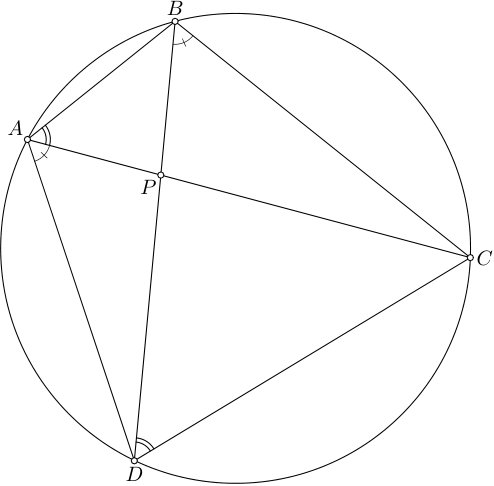 Figure 1
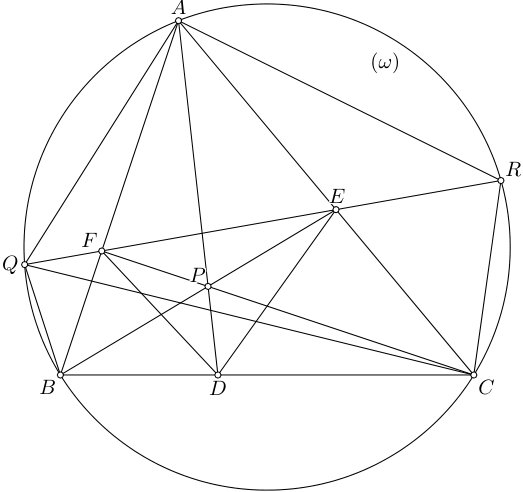 Figure 2
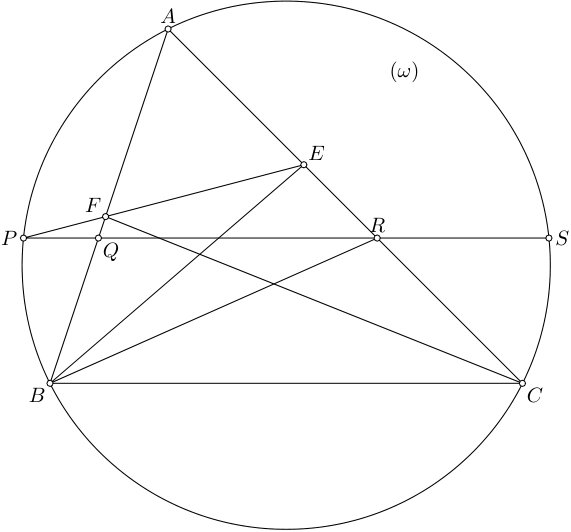 Figure 3
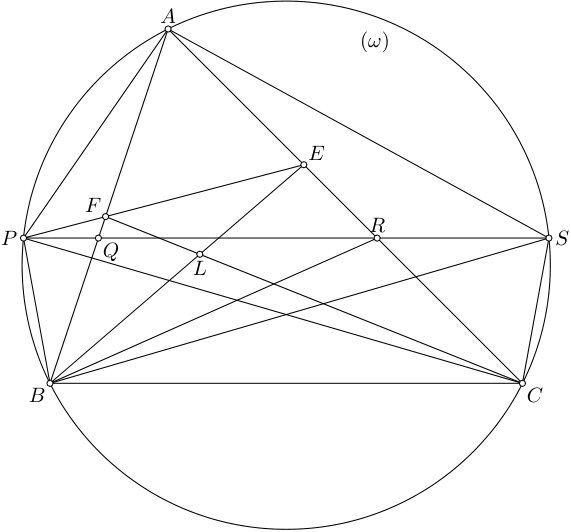 Figure 4
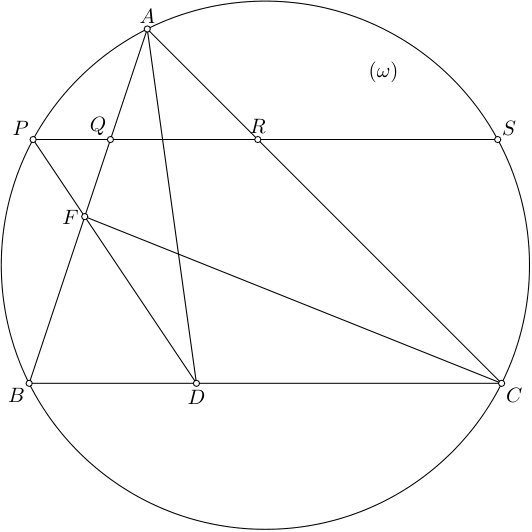 Figure 5
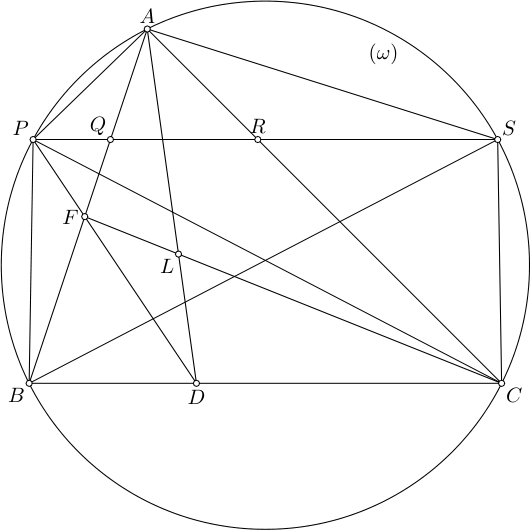 Figure 6
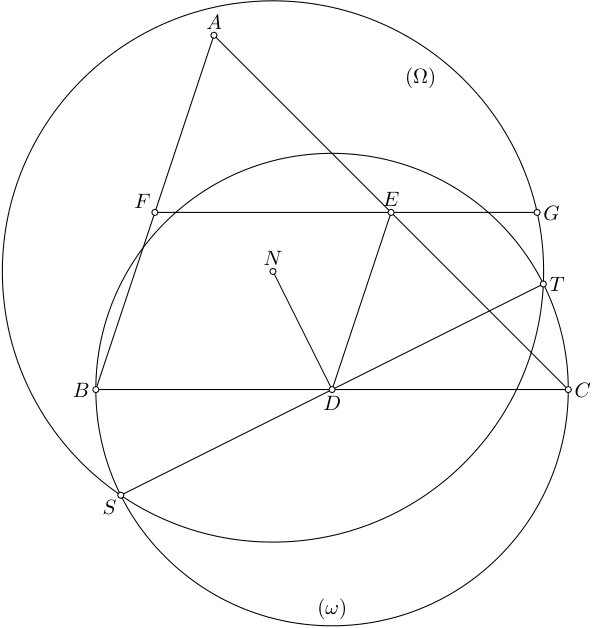 Figure 7
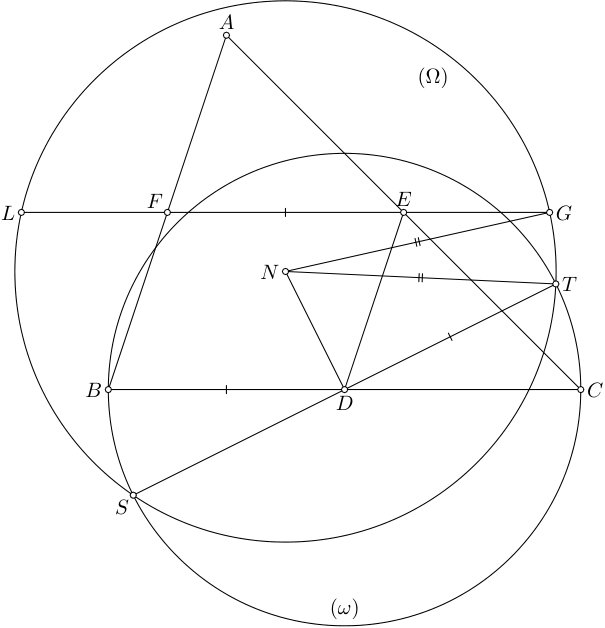 Figure 8
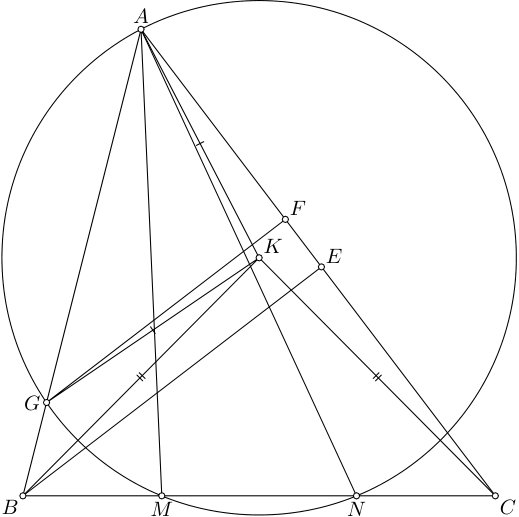 Figure 9
Peer Reviews
No public reviews on file for this paper yet. If you reviewed it on a platform where reviews are public (OpenReview, ICLR, NeurIPS, ICML), you can paste yours below so the community can read it here.
Videos
No videos yet. Explain this paper in a talk, walkthrough, or lecture? Add one.
Taxonomy
TopicsAdvanced Mathematical Theories and Applications · Mathematics and Applications · Advanced Mathematical Theories
Some Constructions of the Golden Ratio in an Arbitrary Triangle
Tran Quang Hung
High school for Gifted students, Hanoi University of Science, Hanoi National University, Hanoi, Vietnam.
(Date: March 17, 2024)
Abstract.
We establish some new constructions of the golden ratio in an arbitrary triangle using symmedians and nine-point circle.
Key words and phrases:
Golden Ratio, triangle geometry, symmedians, nine-point circle.
2010 Mathematics Subject Classification:
51M04, 51N20
1. Introduction
The golden ratio often appear in regular polygons [3, 4, 7, 9, 10] and less in the isosceles triangle [2, 11]. The author introduced a construction of the golden ratio in an arbitrary triangle with two symmedians in [12]. Continuing with this idea, we shall introduce some new other constructions of the golden ratio in an arbitrary triangle with symmedians and nine-point circle. Some constructions can be considered as the generalization of classical construction of George Odom in [6].
2. The lemmas
We recall the lemmas with proofs from [12].
Lemma 1**.**
Given a convex cyclic quadrilateral . Two diagonals and interesect at . Then
[TABLE]
Proof.
From the equality of the corresponding angles in the cyclic quadrilateral, we have the similar triangles and . From this, we get the ratios
[TABLE]
and
[TABLE]
[TABLE]
The proof is complete. ∎
Lemma 2** (Ptolemy’s theorem [1]).**
For a cyclic quadrilateral, the sum of the products of the two pairs of opposite sides equals the product of the diagonals.
This is the famous theorem of plane geometry that can be found in [1].
Using the concept of homogeneous barycentric coordinates [8], we give and prove the following lemma.
Lemma 3**.**
Let be a triangle inscribed in a circle . is a point inside triangle . has homogeneous barycentric coordinates . is a cevian triangle of . Ray meets at . Then
[TABLE]
Proof.
If has homogeneous barycentric coordinates , we get that the barycentric coordinates of , are and respectively. Thus we have the ratio
[TABLE]
Let the ray meet second time at . From Lemma 1, we have
[TABLE]
[TABLE]
Thus
[TABLE]
Similarly, we have the identity
[TABLE]
Thus
[TABLE]
Using (5), (6), and Lemma 2, we consider the expression
[TABLE]
Therefore,
[TABLE]
This completes the proof of Lemma 3. ∎
3. Constructions and proofs
Construction 1**.**
Given a triangle with the circumcircle .
- i)
Constructing the symmedians and .
- ii)
Ray meets at .
- iii)
The parallel line from to meets and at and respectively and meets again at .
Proposition 1**.**
* divides into the golden ratio.*
Proof.
It follows from and that
[TABLE]
and
[TABLE]
Therefore,
[TABLE]
Because ,
[TABLE]
Also by , we have is an isosceles trapezoid. Hence,
[TABLE]
From (7), (8) and (9), we deduce
[TABLE]
Note that, by Lemma 2,
[TABLE]
From (10) and (11), we infer that
[TABLE]
Let meet at , then has barycentric coordinates , see [8]. Apply Lemma 3 for triangle with and ray meet at , we obtain
[TABLE]
This is equivalent to
[TABLE]
[TABLE]
This means
[TABLE]
[TABLE]
This is enough to show that the ratio
[TABLE]
which is such the golden ratio. This completes our proof. ∎
Remark**.**
This construction can be considered as the generalization of the construction [2] and [6]. If is isosceles at , we obtain the construction in [2]. If is equilateral, we obtain the construction of George Odom in [6].
Construction 2**.**
Given a triangle with the circumcircle .
- i)
Constructing the symmedians and .
- ii)
Ray meets at .
- iii)
The parallel line from to meets and at and respectively and meets again at .
Proposition 2**.**
* divides into the golden ratio.*
Proof.
The proof is similar to the proof of Proposition 1
[TABLE]
or
[TABLE]
Let the symmedians and meet at , then , see [1]. Apply Lemma 2 for triangle with and ray meet at , we have
[TABLE]
This is equivalent to
[TABLE]
Note that, Lemma 2 then
[TABLE]
[TABLE]
This means
[TABLE]
From (15) and (19), we deduce that
[TABLE]
this is enough for deriving equality
[TABLE]
which is such the golden ratio. This completes our proof. ∎
Construction 3**.**
Given a triangle with the nine-point center . , , and are the midpoints of , , and , respectively. Consider the circle with diameter .
- i)
The perpendicular line from to meets circle at and .
- ii)
Consider the circle with center passing through and .
- iii)
Ray meets circle at .
Proposition 3**.**
* divides into the golden ratio.*
Proof.
We shall show that
[TABLE]
Because is the nine-point center of triangle thus must be the circumcenter of triangle . Also, is a parallelogram, so .
Let meet again at . By symmetry and the intersecting chords theorem,
[TABLE]
This proves that divides in the golden ratio. Similarly divides into the golden ratio. We complete the proof. ∎
Remark**.**
This construction also can be considered as another generalization of the classical construction of George Odom in [6]. If is an equilateral triangle, we obtain the construction in [6].
Construction 4**.**
Given a triangle .
- i)
Consider the symmedian .
- ii)
Let be a point on segment such that .
- iii)
The parallel line from to meets at .
- iv)
The perpendicular bisectors of and meet at .
- v)
The circle with center passing though meets at .
Proposition 4**.**
* divides into the golden ratio.*
Proof.
Because is symmedian of , we conclude that . or in other words
[TABLE]
lies on perpendicular bisector of , circle passes through , we have
[TABLE]
[TABLE]
Because lies on perpendicular bisector of , so and we deduce that
[TABLE]
[TABLE]
this is equivalent to
[TABLE]
or
[TABLE]
or
[TABLE]
which is such the golden ratio. This completes our proof. ∎
Remark**.**
This construction can be considered as generalization of the construction of Dao Thanh Oai in [3]. If is equilateral triangle or right isosceles, we obtain the construction in [3].
Acknowledgement**.**
The author is grateful Alexander Skutin for his proofreading and his suggestion of the nice projective viewpoint for the proofs of Proposition 1 and Proposition 2.
The reference list from the paper itself. Each links out to its DOI / PubMed record.
- 1[1] E.W. Weisstein, Ptolemy’s Theorem , from Math World–A Wolfram Web Resource , http://mathworld.wolfram.com/Ptolemys Theorem.html .
- 2[2] T.O. Dao, Q.D. Ngo, and P. Yiu, Golden sections in an isosceles triangle and its circumcircle , Global Journal of Advanced Research on Classical and Modern Geometries, 5 (2016) 93–97.
- 3[3] T.O. Dao, Some golden sections in the equilateral and right isosceles triangles , Forum Geom., 16 (2016) 269–272.
- 4[4] D. Paunic and P. Yiu, Regular polygons and the golden section , Forum Geom., 16 (2016) 273–281.
- 5[5] K. Hofstetter, A simple construction of the golden section , Forum Geom., 2 (2002) 65–66.
- 6[6] G. Odom and J. van de Craats, Elementary Problem 3007 , Amer. Math. Monthly, 90 (1983) 482; solution, 93 (1986) 572.
- 7[7] M. Pietsch, The golden ratio and regular polygons , Forum Geom., 17 (2017) 17–19.
- 8[8] P. Yiu, Introduction to the Geometry of the Triangle , Florida Atlantic University Lecture Notes, 2001; with corrections, 2013, available at http://math.fau.edu/Yiu/Geometry.html .