Off-diagonal cumulants of net-charge, net-proton and net-kaon multiplicity distributions in Au+Au collisions at $\sqrt{s_{NN}}$ = 7.7-200 GeV from STAR
Arghya Chatterjee

TL;DR
This paper reports on STAR measurements of second-order off-diagonal cumulants of net-charge, net-proton, and net-kaon multiplicity distributions in Au+Au collisions across a range of energies, providing insights into QCD matter properties.
Contribution
It presents the first experimental measurements of off-diagonal cumulants in heavy-ion collisions and compares them with theoretical models to constrain the QCD phase diagram.
Findings
Measured cumulant ratios show agreement with HRG and UrQMD models.
Results help constrain freeze-out parameters in the QCD phase diagram.
Data across energies reveal trends in conserved charge fluctuations.
Abstract
Fluctuations of conserved quantities such as net-baryon, net-charge, and net-strangeness numbers have generated considerable interest in the study of the thermodynamic properties of the hot and dense QCD matter. Theoretical calculations suggest that the off-diagonal cumulants of conserved charges along with the diagonal cumulants can help better constrain the freeze-out parameters and, therefore, help to map the QCD phase diagram. In this proceeding, we briefly outline the recent STAR measurements on the second-order off-diagonal cumulants of net-charge, net-proton, and net-kaon multiplicity distributions in Au+Au collisions from the RHIC BES-I program in the energy range of = 7.7-200 GeV. The measured cumulant ratios are compared to the predictions from both thermal (HRG) and non-thermal (UrQMD) models.
Click any figure to enlarge with its caption.
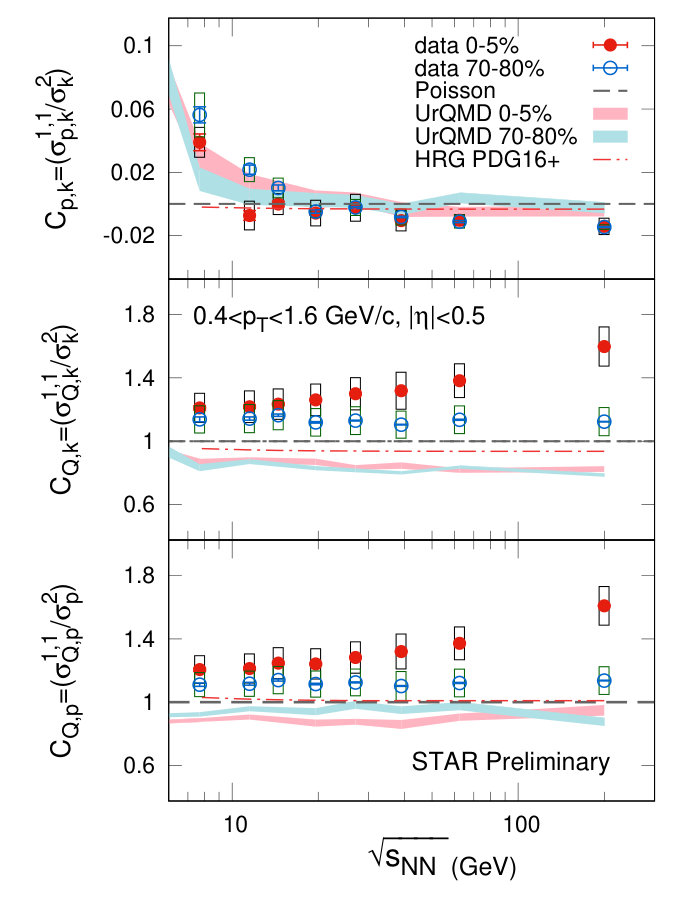 Figure 1
 Figure 2
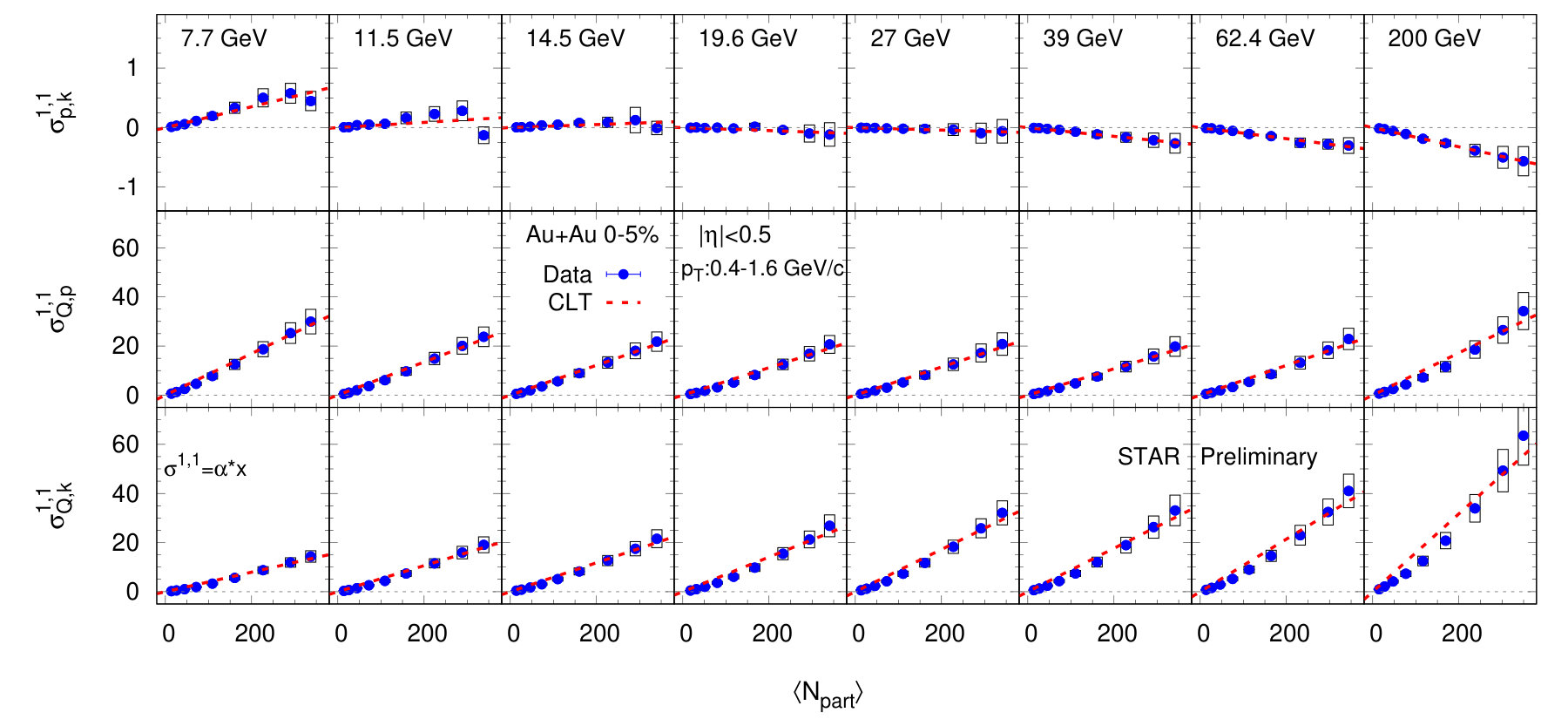 Figure 3
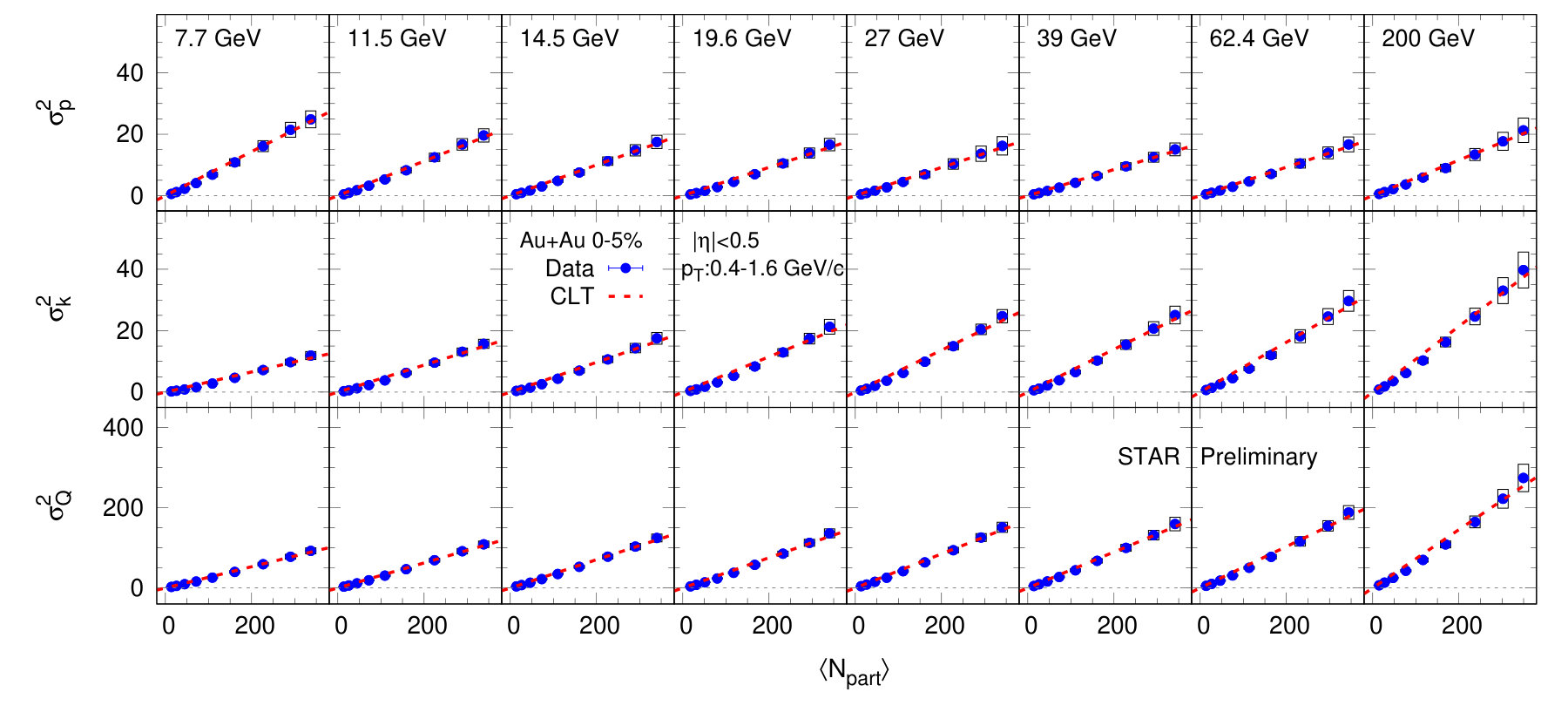 Figure 4
| (GeV) | Year | Events () |
| 7.7 | 2010 | 1.5 |
| 11.5 | 2010 | 2.5 |
| 14.5 | 2014 | 12.7 |
| 19.6 | 2011 | 15.6 |
| 27 | 2011 | 25.2 |
| 39 | 2010 | 62.3 |
| 62.4 | 2010 | 31 |
| 200 | 2011 | 74 |
Peer Reviews
No public reviews on file for this paper yet. If you reviewed it on a platform where reviews are public (OpenReview, ICLR, NeurIPS, ICML), you can paste yours below so the community can read it here.
Videos
No videos yet. Explain this paper in a talk, walkthrough, or lecture? Add one.
Off-diagonal cumulants of net-charge, net-proton and net-kaon multiplicity distributions in Au+Au collisions at = 7.7-200 GeV from STAR
(for the STAR collaboration)
Variable Energy Cyclotron Centre, HBNI, Kolkata-700064, India
Abstract:
Fluctuations of conserved quantities such as net-baryon, net-charge, and net-strangeness numbers have generated considerable interest in the study of the thermodynamic properties of the hot and dense QCD matter. Theoretical calculations suggest that the off-diagonal cumulants of conserved charges along with the diagonal cumulants can help better constrain the freeze-out parameters and, therefore, help to map the QCD phase diagram. In this proceeding, we briefly outline the recent STAR measurements [1] on the second-order off-diagonal cumulants of net-charge, net-proton, and net-kaon multiplicity distributions in Au+Au collisions from the RHIC BES-I program in the energy range of = 7.7-200 GeV. The measured cumulant ratios are compared to the predictions from both thermal (HRG) and non-thermal (UrQMD) models.
1 Introduction
The major goal of relativistic heavy-ion collision experiment is to study the formation of a new form matter, called the Quark-Gluon Plasma (QGP). Over the last two decades, a number of possible evidences for the QGP phase has been established experimentally. Currently a large community of physicists are exploring the QCD phase structure and trying to find a possible signature of the QCD critical point. One of the most community used method to explore phase diagram is to study the event-by-event fluctuations of conserved charges, such as net electric charge (Q), net baryon number (B) and net strangeness number (S) in the heavy-ion collisions over a wide range of energy [2, 3]. It is proposed that the higher-order cumulants of the net-multiplicity distributions are related to the higher order thermodynamic susceptibilities of corresponding conserved charges in QCD and expected to diverge near the critical point [2, 4]. Over the past few years, STAR and PHENIX experiments at RHIC published results on the diagonal cumulants () of net-electric charge [5, 6], net-proton (, an experimental proxy for net-baryon) [7, 8] and net-kaon (, an experimental proxy for net-strangeness) [9] multiplicity distributions. Similarly, off-diagonal cumulants () of Q, p and k are related to the mixed susceptibilities that carry the correlation between different conserved charges [1]. Lattice QCD and hadron resonance gas model (HRG) calculations show that normalized baryon-strange correlations, that can be expressed as off-diagonal to diagonal cumulant (), are expected to be sensitive to the onset of deconfinement [10]. Another importance of studying off-diagonal cumulants is that it can also be used to constrain the freeze-out parameters in the QCD phase diagram. Different theoretical calculations demonstrate that the -order off-diagonal cumulants show a significant sensitivity to the difference between HRG and lattice calculations [11, 12].
In this report, we present the measurements of -order diagonal and off-diagonal cumulants of net charge, net proton and net kaon multiplicity distributions in Au+Au collisions ranging in center of mass energy from = 7.7 to 200 GeV, with data taken during the first phase of RHIC Beam Energy Scan (BES-I).
2 Observables
The susceptibilities of the conserved charges of a system in thermal and chemical equilibrium (for a grand-canonical ensemble) can be computed from the partial derivatives of the dimensionless pressure with respect to the chemical potentials:
[TABLE]
where and are the system pressure and temperature, respectively, and are the order of derivative. , and are the electric charge, baryon and strangeness chemical potentials, respectively. The is obtained from the logarithm of the QCD partition function:
[TABLE]
These susceptibilities can be related to the cumulants () of the event-by-event distribution of the associated conserved charges by [3, 13, 14]:
[TABLE]
Due to the limitation in detecting all baryons and strange hadrons experimentally, net proton () and net kaon () are considered as proxies for the net baryon and net strangeness, respectively. In this report, we present the measurement of second-order () diagonal and off-diagonal cumulants of net charge, net proton and net kaon multiplicity distributions, can be expressed as:
[TABLE]
where and can be , or , and . Finally, we construct the off-diagonal to diagonal cumulant ratios (, and ) motivated by Ref. [10], which also cancel the volume dependence.
3 Experimental details
Second-order cumulants of net charge, net proton and net kaon multiplicity distributions for Au+Au collisions at = 7.7, 11.5, 14.5, 19.6, 27, 39, 62.4 and 200 GeV have been studied in the STAR experiment. The minimum-bias (MB) events are analyzed with the requirement that the position of the primary vertex along -direction () was reconstructed within cm of the center of the STAR detector and within 2 cm on the transverse plane of the beam axis. The number of events analyzed at each energy after applying all event selections criteria is listed in Table 1 .
All charged tracks used in this analysis are required to be within the pseudorapidity range , and the transverse momentum range GeV/. To reduce the contamination from the secondary charged particles, only primary tracks are selected within a distance of closest approach (DCA) to the primary vertex of less than 1 cm. The main detectors used in this analysis are the Time Projection Chamber (TPC) and the Time of Flight (TOF). The particle identification (PID) is done with a common acceptance: GeV/ and . Within this range, the purities of and identification is estimated to be 98-99%. The collision centrality for this analysis is defined using uncorrected charged particle multiplicity measured within a pseudorapidity range of in the TPC detector. This way we exclude the particles from the analysis region to determine the centrality in order to suppress autocorrelation effects [15]. We present the results for nine centrality bins, 0-5% (most central), 10-20%, … , 70-80% (most peripheral) as a function of average number of participating nucleons () estimated using a Monte Carlo Glauber model [16]. The cumulants and their ratios were calculated as a function of the reference multiplicity and then averaged over the centrality bins to suppress the volume fluctuations over wide centrality bins [17, 18]. We use embedding Monte Carlo simulation techniques to obtain the efficiencies and an algebra based on binomial detector response to efficiency correction [19, 20, 21]. The statistical uncertainty estimation is based on the numerical error propagation method of multivariate cumulants [22]. The systematic uncertainties are estimated by varying different track quality cuts, tracking efficiency and conditions for particle identification.
4 Results
The centrality dependence of efficiency corrected second-order diagonal cumulants of net proton, net kaon and net charge (top to bottom) for 0-5% most central Au + Au collisions at = 7.7, 11.5, 14.5, 19.6, 27, 39, 62.4 and 200 GeV are shown as a function of in Fig. 1 . We find a linearly increasing trend as expected from a scaling, predicted by the central limit theorem. In a given centrality, the width of net-proton distribution decreases as a function of beam energy in the range = 7.7-39 GeV and then increases at top RHIC energies [8]. This is because of baryon transport that has a strong beam energy dependence.
Figure 2 shows the efficiency corrected second-order off-diagonal cumulants of net-charge, net-proton, net-kaon multiplicity distributions for Au+Au collisions at eight colliding energies. The off-diagonal cumulants between net-chargenet-kaon () and that of net-chargenet-proton () increase with centrality. On the contrary, there is a growing anti-correlation behaviour observed between net-proton and net-kaon () with centrality at 19.6 GeV.
Figure 3 shows the off-diagonal to diagonal cumulant ratios , and (top to bottom) as a function of beam energy for most central (0-5%) and peripheral (70-80%) collisions. These cumulant ratios are designed to eliminate the effect of system volume. An excess correlation is observed in and in 0-5% most central in comparison to the peripheral collisions. The values of and are observed to increase with beam energy, and this increasing trend cannot be explained by the HRG and UrQMD model calculations. It is observed that the normalized - correlation () is positive at the lowest BES energy and negative at higher energies. For 0-5% top central bins, changes sign around 19.6 GeV.
5 Summary
The second-order diagonal and off-diagonal cumulants of net proton, net kaon, and net charge multiplicity distributions in Au+Au collisions from the RHIC BES-I program in the energy range of = 7.7-200 GeV are presented. Significant excess correlation is observed in and in central in comparison with peripheral events. Both HRG and UrQMD model underpredict the data and cannot describe the increasing with beam energy trends of and . The value of in 0-5% central collision is found to be negative at = 200 GeV and positive at = 7.7 GeV. The measurements of the full second-order cumulant matrix elements of net- multiplicity distributions as a function of centrality and beam energy will improve the estimation of freeze-out parameters by theoretical calculations and that help to map the QCD phase diagram. For more details of this analysis we refer the readers to Ref. [1].
The reference list from the paper itself. Each links out to its DOI / PubMed record.
- 1[1] STAR collaboration, Collision energy dependence of second-order off-diagonal and diagonal cumulants of net-charge, net-proton and net-kaon multiplicity distributions in Au+Au collisions , 1903.05370 .
- 2[2] M. A. Stephanov, Non-Gaussian fluctuations near the QCD critical point , Phys. Rev. Lett. 102 (2009) 032301 . · doi ↗
- 3[3] S. Jeon and V. Koch, Event by event fluctuations , hep-ph/0304012 .
- 4[4] X. Luo, Exploring the QCD Phase Structure with Beam Energy Scan in Heavy-ion Collisions , Nucl. Phys. A 956 (2016) 75 . · doi ↗
- 5[5] STAR collaboration, Beam energy dependence of moments of the net-charge multiplicity distributions in Au+Au collisions at RHIC , Phys. Rev. Lett. 113 (2014) 092301 . · doi ↗
- 6[6] PHENIX collaboration, Measurement of higher cumulants of net-charge multiplicity distributions in Au + + Au collisions at s N N = 7.7 − 200 subscript 𝑠 𝑁 𝑁 7.7 200 \sqrt{s_{{}_{NN}}}=7.7-200 Ge V , Phys. Rev. C 93 (2016) 011901 . · doi ↗
- 7[7] STAR collaboration, Higher Moments of Net-proton Multiplicity Distributions at RHIC , Phys. Rev. Lett. 105 (2010) 022302 . · doi ↗
- 8[8] STAR collaboration, Energy Dependence of Moments of Net-proton Multiplicity Distributions at RHIC , Phys. Rev. Lett. 112 (2014) 032302 . · doi ↗