Spin reorientation of the Fe moments in Eu$_{0.5}$Ca$_{0.5}$Fe$_{2}$As$_{2}$: Evidence for a strong interplay of Eu and Fe magnetism
W. T. Jin, M. Meven, A. P. Sazonov, S. Demirdis, Y. Su, Y. Xiao, Z., Bukowski, S. Nandi, Th. Br\"uckel

TL;DR
This study reveals a strong interaction between Eu and Fe magnetic moments in Eu$_{0.5}$Ca$_{0.5}$Fe$_{2}$As$_{2}$, showing a spin reorientation of Fe moments linked to Eu magnetic ordering, using neutron diffraction techniques.
Contribution
First detailed investigation of magnetic structure and spin reorientation in Eu$_{0.5}$Ca$_{0.5}$Fe$_{2}$As$_{2}$ highlighting Eu-Fe magnetic interplay.
Findings
Eu sublattice remains long-range ordered below 10 K.
Fe moments exhibit a spin-density-wave transition at 192 K.
Fe moments reorient into a canted AFM structure at 2.5 K.
Abstract
Using complementary polarized and unpolarized single-crystal neutron diffraction, we have investigated the temperature-dependent magnetic structures of EuCaFeAs. Upon 50 \% dilution of the Eu sites with isovalent Ca, the Eu sublattice is found to be still long-range ordered below = 10 K, in the A-typed antiferromagnetic (AFM) structure. The moment size of Eu spins is estimated to be as large as 6.74(4) at 2.5 K. The Fe sublattice undergoes a spin-density-wave transition at = 192(2) K and displays an in-plane AFM structure above . However, at 2.5 K, the Fe moments are found to be ordered in a canted AFM structure with a canting angle of 14(4){\deg} out of the plane. The spin reorientation of Fe below the AFM ordering temperature of Eu provides a direct evidence…
Click any figure to enlarge with its caption.
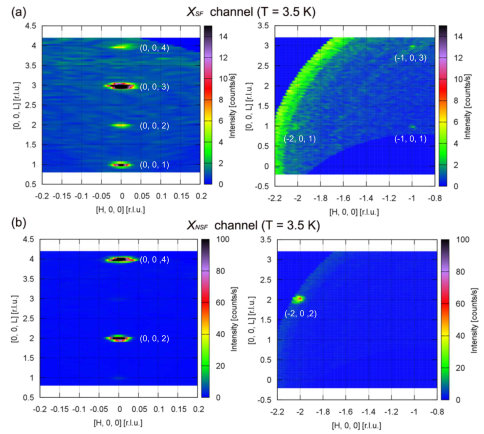 Figure 1
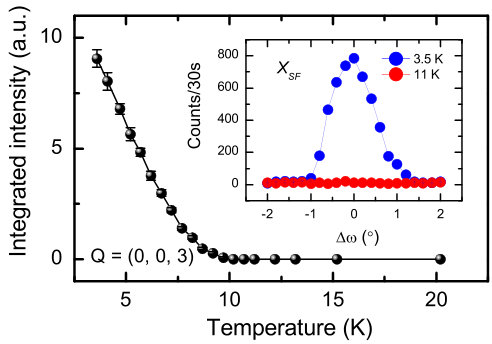 Figure 2
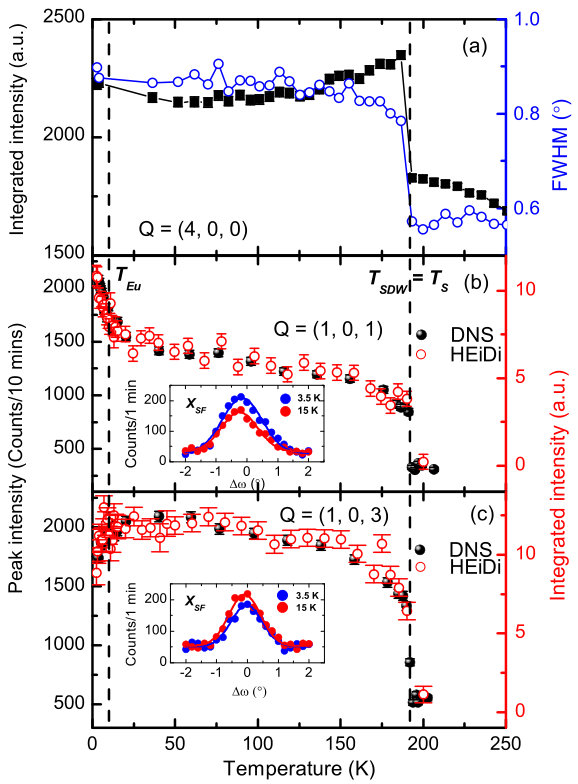 Figure 3
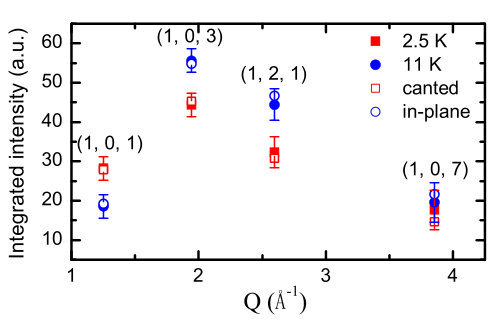 Figure 4
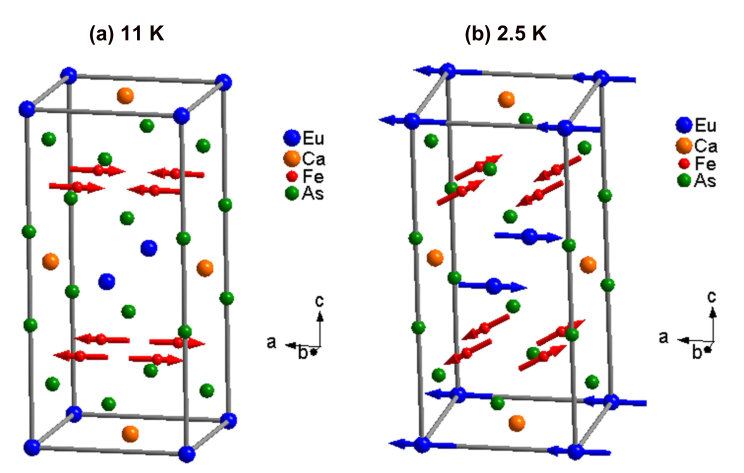 Figure 5
| 2.5 K nuclear | 2.5 K Eu magnetic | 11 K nuclear | ||
| Eu/Ca | (Å2) | 0.6(1) | 0.6(1) | |
| () | 6.74(4) | |||
| Fe | (Å2) | 0.68(4) | 0.66(2) | |
| As | 0.3646(2) | 0.3646(2) | ||
| (Å2) | 0.73(5) | 0.70(3) | ||
| 6.75 | 14.3 | 6.75 | ||
| 6.14 | 8.49 | 4.51 | ||
| 3.60 | 10.9 | 3.57 | ||
| 4.89 | 2.31 | 9.43 | ||
Peer Reviews
No public reviews on file for this paper yet. If you reviewed it on a platform where reviews are public (OpenReview, ICLR, NeurIPS, ICML), you can paste yours below so the community can read it here.
Videos
No videos yet. Explain this paper in a talk, walkthrough, or lecture? Add one.
Spin reorientation of the Fe moments in Eu0.5Ca0.5Fe2As2: Evidence for a strong interplay of Eu and Fe magnetism
W. T. Jin
Jülich Centre for Neutron Science JCNS at Heinz Maier-Leibnitz Zentrum (MLZ), Forschungszentrum Jülich GmbH, Lichtenbergstraße 1, D-85747 Garching, Germany
M. Meven
RWTH Aachen University, Institut für Kristallographie, D-52056 Aachen, Germany
Jülich Centre for Neutron Science JCNS at Heinz Maier-Leibnitz Zentrum (MLZ), Forschungszentrum Jülich GmbH, Lichtenbergstraße 1, D-85747 Garching, Germany
A. P. Sazonov
RWTH Aachen University, Institut für Kristallographie, D-52056 Aachen, Germany
Jülich Centre for Neutron Science JCNS at Heinz Maier-Leibnitz Zentrum (MLZ), Forschungszentrum Jülich GmbH, Lichtenbergstraße 1, D-85747 Garching, Germany
S. Demirdis
Jülich Centre for Neutron Science JCNS at Heinz Maier-Leibnitz Zentrum (MLZ), Forschungszentrum Jülich GmbH, Lichtenbergstraße 1, D-85747 Garching, Germany
Y. Su
Jülich Centre for Neutron Science JCNS at Heinz Maier-Leibnitz Zentrum (MLZ), Forschungszentrum Jülich GmbH, Lichtenbergstraße 1, D-85747 Garching, Germany
Y. Xiao
School of Advanced Materials, Peking University Shenzhen Graduate School, Shenzhen 518055, China
Z. Bukowski
Institute of Low Temperature and Structure Research, Polish Academy of Sciences, 50-422 Wroclaw, Poland
S. Nandi
Department of Physics, Indian Institute of Technology, Kanpur 208016, India
Jülich Centre for Neutron Science JCNS and Peter Grünberg Institut PGI, JARA-FIT, Forschungszentrum Jülich GmbH, D-52425 Jülich, Germany
Th. Brückel
Jülich Centre for Neutron Science JCNS and Peter Grünberg Institut PGI, JARA-FIT, Forschungszentrum Jülich GmbH, D-52425 Jülich, Germany
Jülich Centre for Neutron Science JCNS at Heinz Maier-Leibnitz Zentrum (MLZ), Forschungszentrum Jülich GmbH, Lichtenbergstraße 1, D-85747 Garching, Germany
Abstract
Using complementary polarized and unpolarized single-crystal neutron diffraction, we have investigated the temperature-dependent magnetic structures of Eu0.5Ca0.5Fe2As2. Upon 50 % dilution of the Eu sites with isovalent Ca2+, the Eu sublattice is found to be still long-range ordered below = 10 K, in the A-typed antiferromagnetic (AFM) structure. The moment size of Eu2+ spins is estimated to be as large as 6.74(4) at 2.5 K. The Fe sublattice undergoes a spin-density-wave transition at = 192(2) K and displays an in-plane AFM structure above . However, at 2.5 K, the Fe2+ moments are found to be ordered in a canted AFM structure with a canting angle of 14(4)° out of the plane. The spin reorientation of Fe below the AFM ordering temperature of Eu provides a direct evidence of a strong interplay between the two magnetic sublattices in Eu0.5Ca0.5Fe2As2.
I Introduction
The discovery of superconductivity (SC) with the critical temperature = 26 K in fluorine-doped LaFeAsO in 2008 has opened up an “iron age of superconductivity”.Kamihara_08 Shortly after that, above 50K was achieved in FeAsO1-xFx (“1111” system, = Ce, Sm, Pr, Nd, and Gd) with being a rare-earth element.ChenXH_08 ; ChenGF_08 ; RenZA_08 ; WangC_08 SC with up to 38 K was also realized by various chemical substitutions in the ternary “122” compounds Fe2As2 with being an alkaline-earth-metal element (Ca, Ba, Sr) or the rare-earth element Eu.Rotter_08 ; Sefat_08 ; Zapf_17 It was well confirmed that the SC in the iron pnictides emerges upon the suppression of the static long-range spin-density-wave (SDW) order of Fe by means of chemical doping or applying external pressure.Johnston_10 ; Dai_15 Although SC is compatible with the localized moments of the rare-earth ions in either “1111” or “122” system,Ryan_09 ; Ren_09 ; Jeevan_11 ; Guguchia_13 how the magnetism of Fe and rare-earth element interact with each other is still not well elucidated.
In-depth experimental studies performed on quaterary “1111” FeAsO system have provided compelling evidences that there is a strong coupling of Fe and magnetism for = Ce, Sm, Pr, and Nd, respectively.Maeter_09 ; ZhangQ_13 ; Nandi_11 ; Stockert_12 ; Tian_10 However, for ternary EuFe2As2 compounds, it is quite controversial regarding the strength of the interplay of Fe and Eu magnetism.Xiao_09 ; Herrero-Martin_09 ; Jeevan_08_parent ; Pogrebna_15 ; Ahmed_10 ; Guguchia_11 ; Blachowski_11 ; Jin_16 As a special member of the “122” system, EuFe2As2 has drawn tremendous attention, due to the strong spin-charge-lattice coupling and doping- or pressure-induced coexistence of SC and strong ferromagnetism.Xiao_10 ; Xiao_12 ; Jin_13 ; Nandi_14 ; Nandi_14_neutron ; Jin_15 ; Jin_PhaseDiagram ; Jin_Pressure In a purely ionic picture, the -state (orbital moment = 0) Eu2+ rare-earth ion has a 47 electronic configuration and a total electron spin = 7/2, corresponding to a theoretical total effective magnetic moment of = \mathit{g}$$\sqrt{S(S+1)} = 7.94 (with the Landé factor = 2).Marchand_78 The non-superconducting parent compound EuFe2As2 undergoes a structural phase transition from a tetragonal to an orthorhombic phase at 190 K, concomitant with a SDW ordering of the itinerant Fe moments. In addition, the localized Eu2+ spins order below 19 K in the A-type antiferromagnetic (AFM) structure (ferromagnetic layers stacked antiferromagnetically along the axis).Jiang_09_NJP
According to previous neutron and non-resonant x-ray magnetic scattering experiments,Xiao_09 ; Herrero-Martin_09 the coupling between the Eu and Fe sublattices in EuFe2As2 was found to be negligible, which was further supported by density-functional electronic structure calculations.Jeevan_08_parent Also, a direct optical pump-probe showed a slow response of the Eu2+ spins to the optical excitation of the itinerant carriers on the FeAs layers, suggesting a weak coupling between the two sublattices.Pogrebna_15 In contrast, magnetic Compton scattering on EuFe2(As0.73P0.27)2 indicated that the magnetism of Fe gets enhanced when the Eu magnetic order sets in.Ahmed_10 In addition, nuclear magnetic resonance (NMR) and Mössbauer spectroscopy measurements revealed a strong coupling between the localized Eu2+ moments and the conduction electrons on the FeAs layers in Co-doped EuFe2As2.Guguchia_11 ; Blachowski_11 Recently, by performing x-ray resonant magnetic scattering (XRMS) measurement on underdoped Eu(Fe0.94Ir0.06)2As2, we have observed the magnetic polarization of the Ir 5 band induced by the AFM ordering of Eu, indicating a strong interplay between the two sublattices.Jin_16 Undoubtedly, detailed knowledge about the evolution of magnetic structures of both Eu and Fe with the temperature will be crucial for understanding these observations.
Isovalent substitution of Eu with Ca offers an ideal platform for studying the delicate interplay between the two magnetic sublattices. On the one hand, under ambient pressure, Ca doping into the Eu site does not perturb the SDW order in the FeAs layers visibly and never leads to SC. On the other hand, dilution of the Eu sublattice with nonmagnetic Ca2+ ions suppresses its AFM ordering temperature () gradually.Mitsuda_11 ; Tran_18 ; Harnagea_18 A recent SR study on Eu0.5Ca0.5Fe2As2 suggests a long-range magnetically ordered Eu sublattice.Tran_18 However, it was proposed based on macroscopic measurements that substitution of 50 % Eu ions might lead to a short-range ordered nature of Eu magnetism.Jeevan_08 In order to determine the ground-state magnetic structure of Eu0.5Ca0.5Fe2As2 and check the interplay between two sublattices, we have performed the temperature-dependent polarized and unpolarized neutron diffraction studies on the Eu0.5Ca0.5Fe2As2 single crystal. The Eu2+ moments are found to be long-range ordered below = 10 K, in the A-typed AFM structure. A spin-reorientation of the Fe2+ moments is clearly observed around , providing a direct evidence of a strong coupling between the Fe and Eu magnetism.
II Experimental Details
Single crystals of Eu1-xCaxFe2As2 ( = 0.5 nominally) were grown using the Sn flux method.Tran_18 No incorporation of Sn into the crystals was evidenced according to the energy-dispersive x-ray spectroscopy (EDX) characterization. The concentration of Ca was determined to be 52(4) % by nuclear structure refinement of the neutron diffraction data, as presented below. A 88 mg platelike single crystal with dimensions 4 × 3 × 0.6 mm3 was selected for unpolarized and polarized neutron diffraction measurements, which were performed on the hot-neutron four-circle diffractometer HEiDi and and diffuse scattering cold-neutron spectrometer DNS, respectively, at Heinz Maier-Leibnitz Zentrum (MLZ), Garching (Germany).Meven_15 ; Su_15 For measurements at both beamlines, the single-crystal sample was mounted on a thin aluminum plate with tiny amount of GE varnish and put inside a standard closed-cycle cryostat. At HEiDi, a Ge (3 1 1) monochromator was chosen to produce a monochromatic neutron beam with the wavelength of 1.17 Å, and an Er filter was used to minimize the /2 contamination. At DNS, the wavelength of the incident neutrons is 4.2 Å. The [0, 1, 0] direction of the crystal was aligned perpendicular to the horizontal scattering plane, so that the (, 0, ) reciprocal plane can be mapped out by rotating the sample. Throughout this paper, the orthorhombic notation (space group ) will be used for convenience. Single crystals from the same batches were characterized by macroscopic measurements including the resistivity, heat capacity, and dc magnetic susceptibility, using a Quantum Design physical property measurement system (PPMS) and Quantum Design magnetic property measurement system (MPMS).
III Experimental Results
Macroscopic properties of Eu0.5Ca0.5Fe2As2 single crystal was shown in Fig. S1 and S2 in the Supplementary Materials. Two magnetic transitions corresponding to the SDW ordering of the Fe sublattice and AFM ordering of the Eu2+ moments are identified around 190 K and 10 K, respectively.
To clarify the ground-state magnetic structure of Eu0.5Ca0.5Fe2As2, polarized neutron diffraction at 3.5 K was firstly performed at DNS. Fig. 1(a) and 1(b) show the reciprocal-space contour maps of the (, 0, ) plane, measured with the neutron polarization parallel to the scattering vector ( polarization). The magnetic and nuclear scattering were separated into the spin-flip (SF, Fig. 1(a)) and non-spin-flip (NSF, Fig. 1(b)) channels, respectively.Scharpf_93 The appearance of (0, 0, 1), (0 ,0 ,3) and (-2, 0, 1) reflections in the channel clearly indicates that the Eu2+ moments are antiferromagnetically ordered at 3.5 K, with a propagation vector of = (0, 0, 1), similar to the undoped parent compound EuFe2As2.Xiao_09 Since magnetic neutron scattering is sensitive to the moment component perpendicular to , the Eu moments cannot be pointing along the c-axis. Due to imperfection of the polarization analysis, the strong nuclear reflections (0, 0, 2) and (0, 0, 4) observed in the channel also leaked into the channel. No intensity is observed at (-2, 0, 0) within the experimental resolution, excluding the possibility of a canted-AFM structure of Eu with a net ferromagnetic component along the axis.Jin_PhaseDiagram In addition, magnetic reflections at (-1, 0, 1) and (-1, 0, 3) show up in the channel, arising from the SDW ordering of the Fe moments with the propagation vector of = (1, 0, 1).Xiao_09
As shown in the inset of Fig. 2, the (0, 0, 3) magnetic reflection due to the AFM ordering of Eu disappears completely at 11 K in the channel. The temperature dependence of its integrated intensity from the rocking scan is plotted in Fig. 2, indicating an ordering temperature of = 10.0(5) K, well consistent with that from the macroscopic measurements. The temperature dependence of the integrated intensity, which is proportional to the square of the order parameter, shows a very unusual behaviour. Starting with a negative curvature around , it continues nearly linearly down to the lowest temperature reached in this experiment. Neither typical critical behaviour, nor tendency to saturation can be seen. As discussed below, we attribute this unusual temperature dependence to the interaction between the Eu and Fe sublattices.
The peak intensities of the (1, 0, 1) and (1, 0, 3) reflections in the channel, both arising from the SDW ordering of Fe, were monitored at DNS and plotted using dark spheres in Fig. 3(b) and 3(c), respectively, as a function of the temperature. The onset temperature of the SDW ordering can be estimated to be = 192(2) K, consistent with that the high-temperature anomaly shown in the resistivity and specific heat data. Interestingly, both order parameters display a kink at the AFM ordering temperature of Eu ( = 10 K). Below , the peak intensity of (1 0 1) reflection increases steadily , while (1 0 3) weakens visibly with decreasing temperature. As shown in the insets of Fig. 3(b) and 3(c), rocking scans of the (1, 0, 1) and (1, 0, 3) reflections in the channel indeed show opposite temperature-dependent tendencies. The temperature dependencies of the integrated intensity of both reflections were also measured at the four-circle neutron diffractometer HEiDi. The same behaviors were observed as shown using the open circles in Fig. 3(b) and 3(c), further confirming the different responses of (1, 0, 1) and (1, 0, 3) reflections to the AFM ordering of the Eu2+ moments and suggesting a possible spin-reorientation of the Fe sublattice below . Fig. 3(a) also shows the temperature dependencies of the integrated intensity and full width at half maximum (FWHM) of the (4, 0, 0) nuclear reflection measured at HEiDi. The sudden jump of the intensity and broadening of the peak width indicates the occurrence of a structural phase transition in Eu0.5Ca0.5Fe2As2 from a tetragonal (space group ) to an orthorhombic (space group ) phase at = 191(2) K, coincident with the SDW ordering of Fe at , due to the change of extinction conditions of strong nuclear Bragg reflections caused by the emergent orthorhombic domains.
To better understand the interplay of the magnetism between Eu and Fe sublattices in Eu0.5Ca0.5Fe2As2, the integrated intensities of 357 nuclear reflections and 254 magnetic reflections from Eu were collected at HEiDi at the base temperature (2.5 K). In addition, 246 nuclear reflections were collected above (11 K). The obtained data sets at both temperatures were normalized to the monitor and corrected by the Lorentz factor. After the absorption correction procedure using the DATAP program taking into account the dimensions of the crystal,Coppens_65 equivalent reflections were merged into the unique ones based on the orthorhombic symmetry. The nuclear structures at 2.5 K and 11 K were refined using FULLPROF.Rodriguez-Carvajal_93 As shown in Table 1, the nuclear structure does not show a visible difference below and above . At 2.5 K, the magnetic reflections from Eu can be well fitted using the A-type AFM structure as confirmed for the parent compound EuFe2As2,Xiao_09 with the Eu2+ moment as large as 6.74(4) aligned along the orthorhombic axis. Although the Eu sites are diluted with isovalent Ca2+ of almost 50 %, the Eu2+ spins are found to be long-range ordered still. This is in good agreement with a recent SR study on the same compound,Tran_18 and in stark contrast to the short-range magnetic ordering of Eu proposed for hole-doped Eu0.5K0.5Fe2As2 based on macroscopic measurements.Jeevan_08
Furthermore, motivated by the intriguing responses of the magnetic order parameters of Fe in Eu0.5Ca0.5Fe2As2 at , the integrated intensities of a few strong magnetic reflections from the Fe sublattice were collected at HEiDi by performing rocking scans, corrected by the Lorentz factor as well as the absorption effect. Fig.4 shows the integrated intensities of four magnetic reflections with relatively small statistical errors, i.e., (1, 0, 1), (1, 0, 3), (1, 2, 1) and (1, 0, 7). The intensities of them at 11 K can be very well fitted with an in-plane AFM structure of the Fe2+ moment (see Fig. 5(a)), with the moment size of = 1.10(5) along the orthorhombic axis as calculated using FULLPROF. Both the moment direction and moment size here are quite similar to those observed for the parent compound EuFe2As2 in the ground state.Xiao_09 However, the intensities at 2.5 K clearly deviates from those predicted by the in-plane AFM structure. As neutron diffraction only probes the magnetic moment perpendicular to the scattering vector , the redistribution of the magnetic scattering intensities signifies a spin reorientation of the Fe2+ moments.Wasser_15 With a canted AFM structure which allows the Fe2+ moments to rotate in the plane (see Fig. 5(b)), the intensities at 2.5 K can be well explained with the moment size = 0.85(5) and = 0.22(5) . All the details about the model refinements of the magnetic structure of Fe were included in the Supplementary Materials.
The magnetic structures of Eu0.5Ca0.5Fe2As2 at 11 K and 2.5 K are illustrated in Fig. 5(a) and 5(b), respectively. As concluded above, at 11 K (slightly above ), the Eu sublattice is not magnetically ordered yet while the Fe sublattice displays an in-plane AFM structure. With further decreasing temperature, the Eu2+ moments start to order, while the Fe2+ moments tend to rotate towards the axis within the plane, as reflected by the opposite temperature-dependent tendencies of its magnetic order parameters shown in Fig. 3. At the reachable base temperature (2,5 K) at HEiDi, the Eu2+ spins are found to align along the axis in the A-type AFM structure similar to the undoped parent compound, while the Fe2+ moments are ordered in a canted AFM structure with a canting angle of 14(4)° out of the plane. In other words, the spin reorientation of the Fe2+ moments occurs in coincidence with the AFM ordering of Eu, suggesting a strong interplay between the two magnetic sublattices in Eu0.5Ca0.5Fe2As2.
IV Discussion and Conclusion
We note that the magnetic order parameter of the Eu sublattice in Fig. 2 does not saturate down to 3.5 K. However, refinements using the magnetic reflections from Eu yield the moment size of 6.74(4) , well consistent with a full moment of = = 7 expected for the Eu2+ spins with = 7/2. This means that the Eu sublattice is fully magnetically ordered at 3.5 K. Thus, the unusual temperature dependence in Fig. 2 is very likely to arise from the change of the strength of Eu-Fe magnetic interaction concomitant with the spin reorientation of the Fe2+ spins moments. As well documented, the coupling between two AFM sublattices may arise from quantum fluctuations via the so-called “order-by-disorder” mechanism.Brueckel_88 ; Brueckel_92 ; Brueckel_95 ; Gukasov_88 The strong Eu-Fe coupling in Eu0.5Ca0.5Fe2As2, therefore, might be due to the longitudinal fluctuations of the Eu2+ spins, which lead to a considerable change in the magnetic anisotropy energy and result in the spin reorientation of the Fe2+ moments. For the EuFe2As2 system, to the best of our knowledge, our observation here provides the first experimental evidence of spin reorientation of Fe below the Eu magnetic ordering temperature. Eu0.5Ca0.5Fe2As2, therefore, exhibits a strong Eu-Fe interplay undoubtly. However, this is not contradictory with the weak Eu-Fe coupling in the parent compound EuFe2As2,Xiao_09 ; Herrero-Martin_09 ; Jeevan_08_parent since it was found that the strength of interplay between 3 and 4 electrons can be tunable by chemical doping.Shang_13 Compared with undoped EuFe2As2, the out-of-plane lattice constant shrinks considerably by ~ 1 % upon 50 % Ca substitution. As a result, the neareast Eu-Fe distance reduces by 0.7% from 3.591 Å (in EuFe2As2) to 3.567 Å (in Eu0.5Ca0.5Fe2As2), favoring a stronger Eu-Fe spin interaction. Further theoretical studies on Eu0.5Ca0.5Fe2As2 will be very helpful for understanding its intriguing magnetic properties and strong Eu-Fe interplay in it.
In conclusion, using complementary polarized and unpolarized single-crystal neutron diffraction, we have investigated the temperature-dependent magnetic structures of Eu0.5Ca0.5Fe2As2. Upon 50 % dilution of the Eu sites with isovalent Ca2+, the Eu sublattice is found to be still long-range ordered below = 10 K, in the A-typed AFM structure. The moment size of Eu2+ spins is estimated to be as large as 6.74(4) at 2.5 K. The Fe sublattice undergoes a SDW transition at = 192(2) K and displays an in-plane AFM structure above . However, at 2.5 K, the Fe2+ moments are found to be ordered in a canted AFM structure with a canting angle of 14(4)° out of the plane. The spin reorientation of Fe below the AFM ordering temperature of Eu provides a direct evidence of a strong interplay between the two magnetic sublattices in Eu0.5Ca0.5Fe2As2.
Acknowledgements.
W. T. J. would like to acknowledge S. Mayr for the assistance with the orientation of the crystal. This work is based on experiments performed at the HEiDi and DNS instrument operated by Jülich Centre for Neutron Science (JCNS) at the Heinz Maier-Leibnitz Zentrum (MLZ), Garching, Germany. Z. B. acknowledges financial support from National Science Center, Poland Grant 2017/25/B/ST3/02868.
The reference list from the paper itself. Each links out to its DOI / PubMed record.
- 1(1) Y. Kamihara, T. Watanabe, M. Hirano, and H. Hosono, J. Am. Chem. Soc. 130 , 3296 (2008).
- 2(2) X. H. Chen, T. Wu, G. Wu, R. H. Liu, H. Chen, and D. F. Fang, Nature 453 , 761 (2008).
- 3(3) G. F. Chen, Z. Li, D.Wu, G. Li,W. Z. Hu, J. Dong, P. Zheng, J. L. Luo, and N. L. Wang, Phys. Rev. Lett. 100 , 247002 (2008).
- 4(4) Z.-A. Ren, G.-C. Che, X.-L. Dong, J. Yang, W. Lu, W. Yi, X. -L. Shen, Z.-C. Li, L.-L. Sun, F. Zhou, et al., Europhys. Lett. 83 , 17002 (2008).
- 5(5) C. Wang, L. Li, S. Chi, Z. Zhu, Z. Ren, Y. Li, Y. Wang, X. Lin, Y. Luo, S. Jiang, et al., Europhys. Lett. 83 , 67006 (2008).
- 6(6) M. Rotter, M. Tegel, and D. Johrendt, Phys. Rev. Lett. 101 , 107006 (2008).
- 7(7) A. S. Sefat, R. Jin, M. A. Mc Guire, B. C. Sales, D. J. Singh, and D. Mandrus, Phys. Rev. Lett. 101 , 117004 (2008).
- 8(8) S. Zapf and M. Dressel, Rep. Prog. Phys. 80 , 016501 (2017).