
TL;DR
This paper introduces a method to construct Fano threefolds with specific properties from cracked polytopes using Laurent inversion, and explores classification problems related to these polytopes.
Contribution
It develops a new construction technique for Fano threefolds from cracked polytopes and classifies possible unimodular polytope pieces in three dimensions.
Findings
Constructed new examples of Fano threefolds with high Picard rank.
Classified unimodular polytopes that can appear as parts of cracked polytopes.
Extended understanding of the combinatorial structure of cracked polytopes.
Abstract
We construct Fano threefolds with very ample anti-canonical bundle and Picard rank greater than one from cracked polytopes - polytopes whose intersection with a complete fan forms a set of unimodular polytopes - using Laurent inversion; a method developed jointly with Coates-Kasprzyk. We also give constructions of rank one Fano threefolds from cracked polytopes, following work of Christophersen-Ilten and Galkin. We explore the problem of classifying polytopes cracked along a given fan in three dimensions, and classify the unimodular polytopes which can occur as 'pieces' of a cracked polytope.
Click any figure to enlarge with its caption.
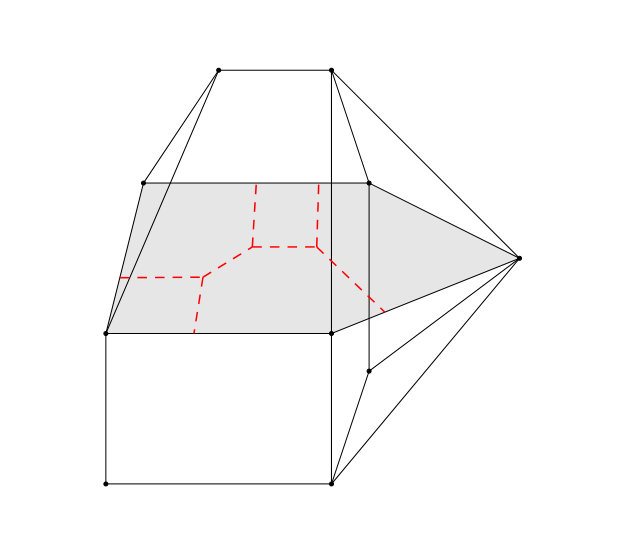 Figure 1
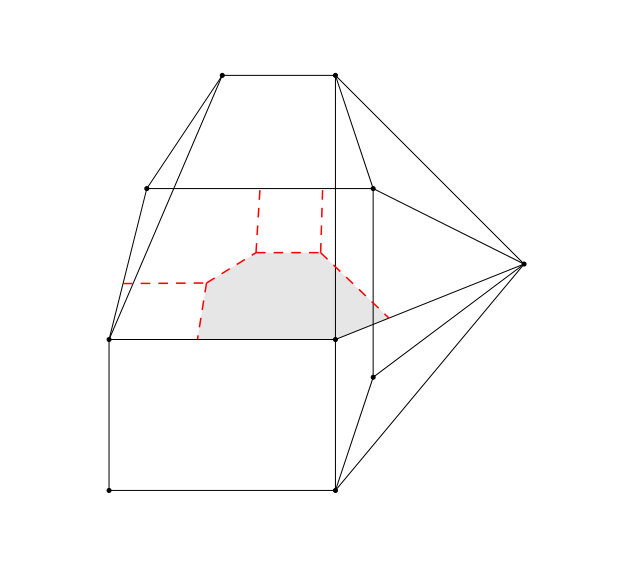 Figure 2
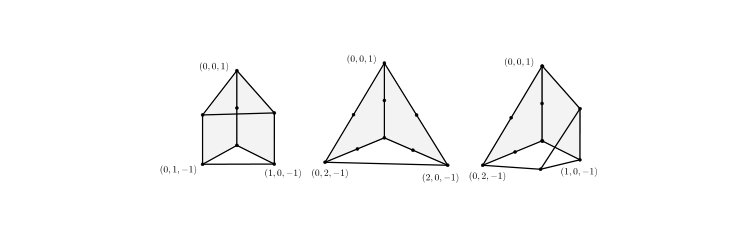 Figure 3
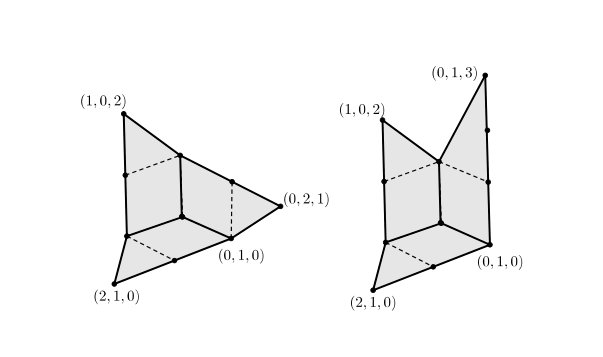 Figure 4
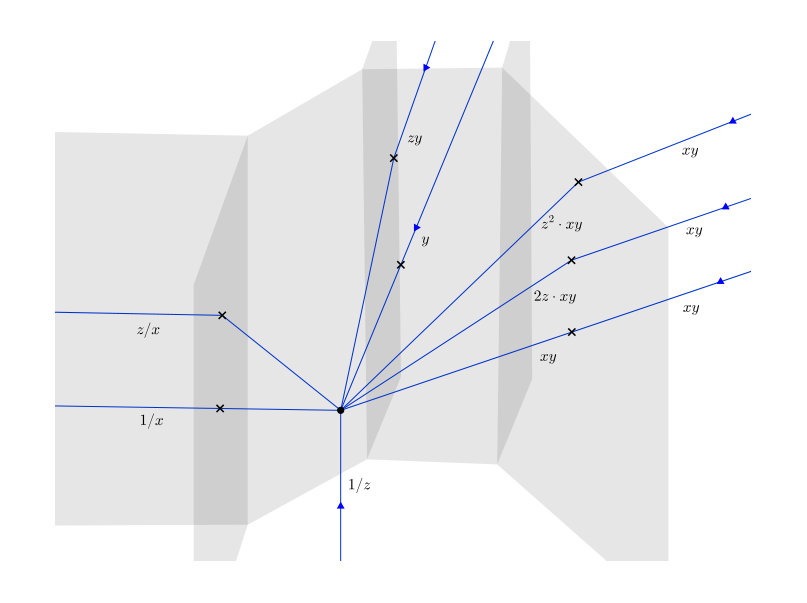 Figure 5
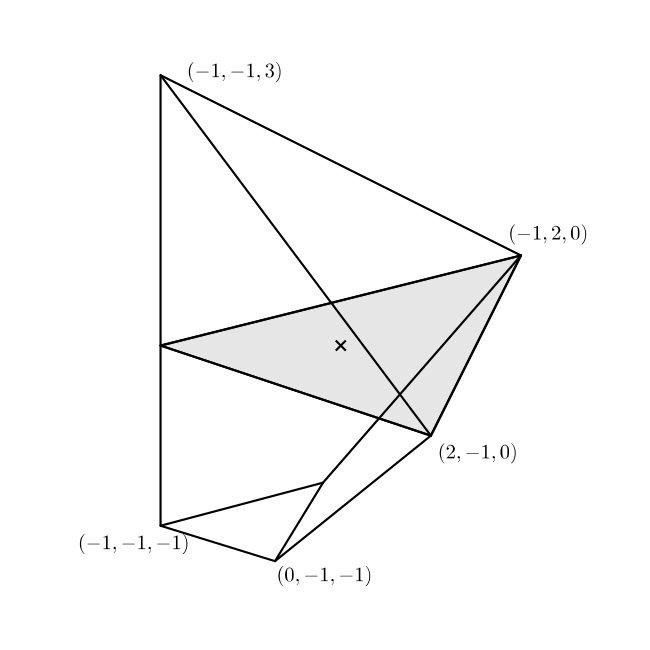 Figure 6
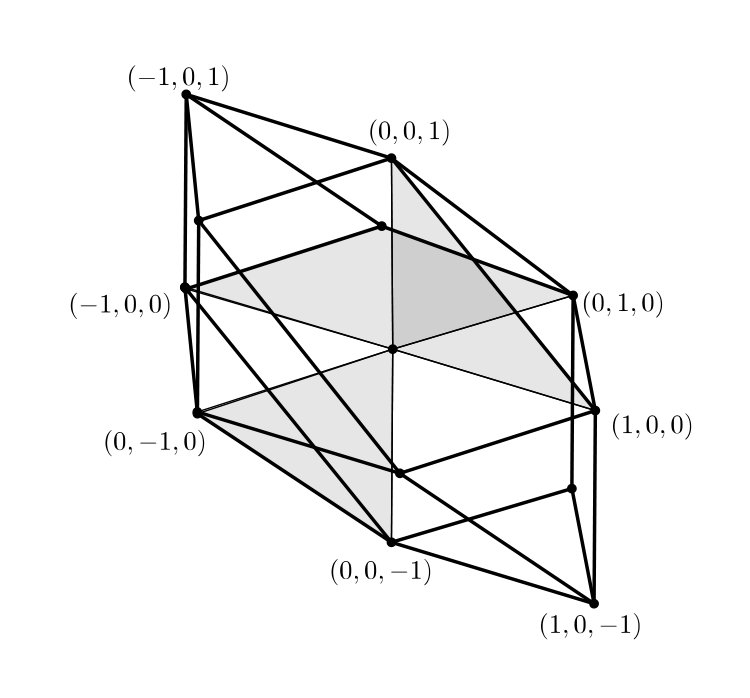 Figure 7
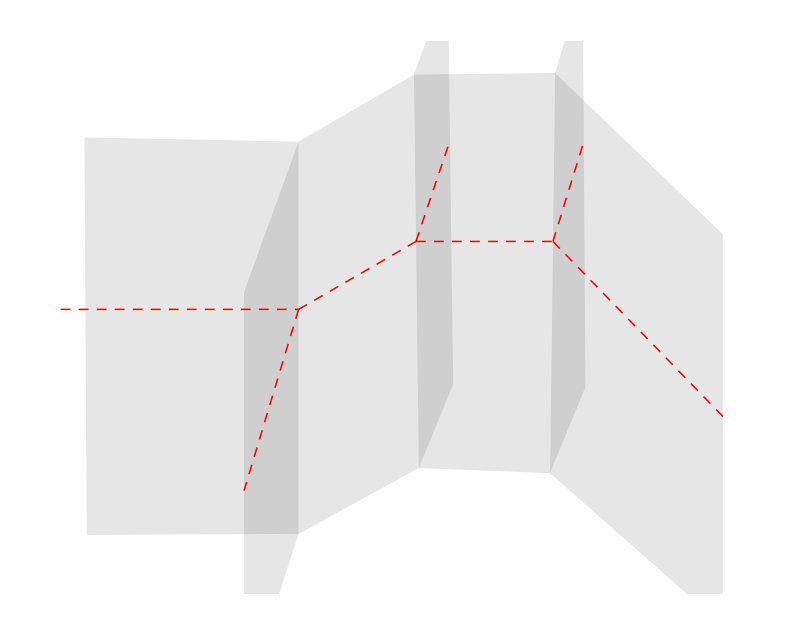 Figure 8
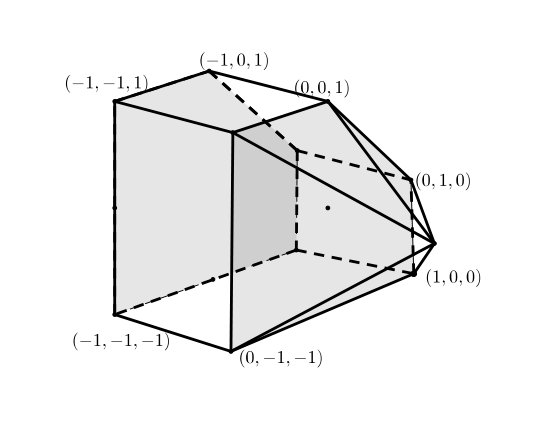 Figure 9
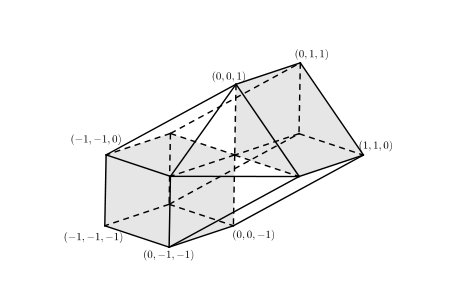 Figure 10
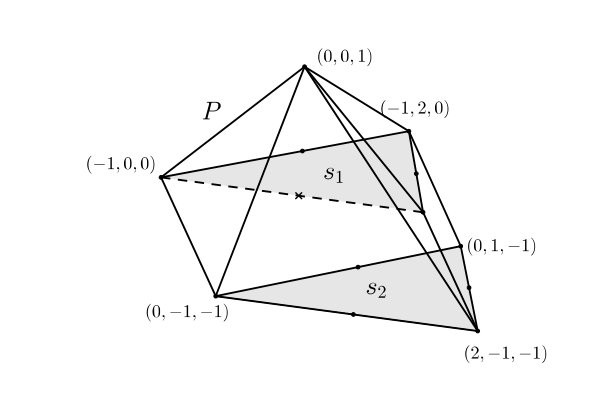 Figure 11
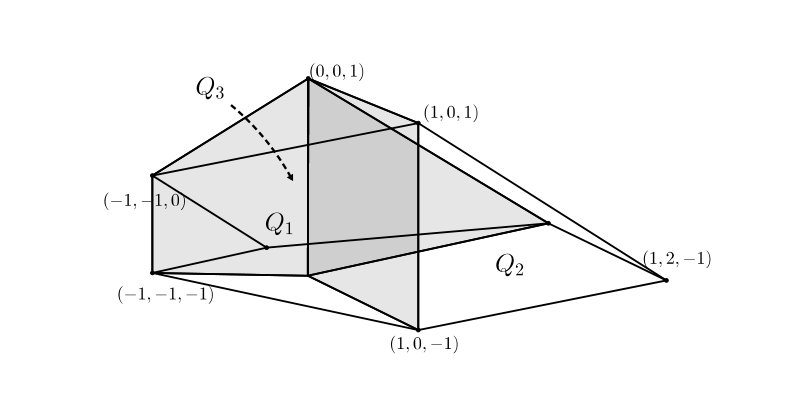 Figure 12
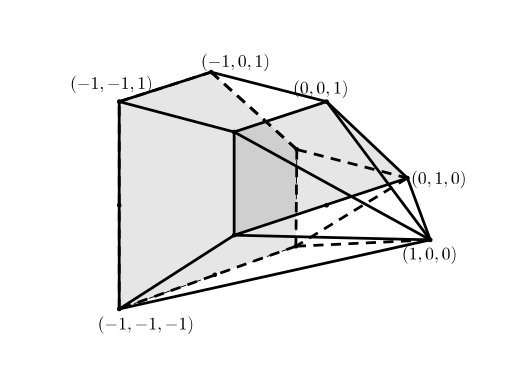 Figure 13
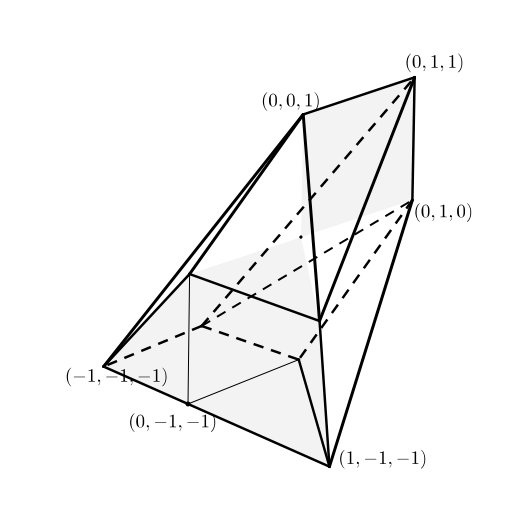 Figure 14
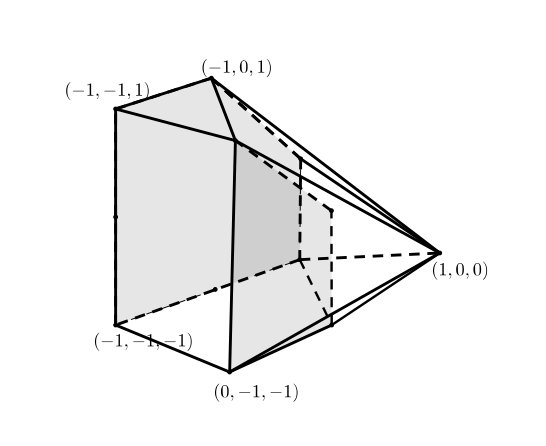 Figure 15
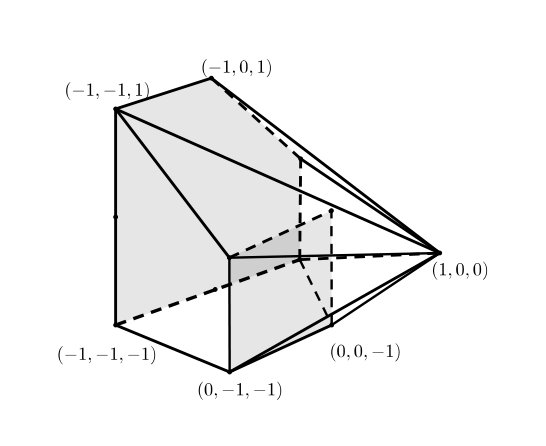 Figure 16
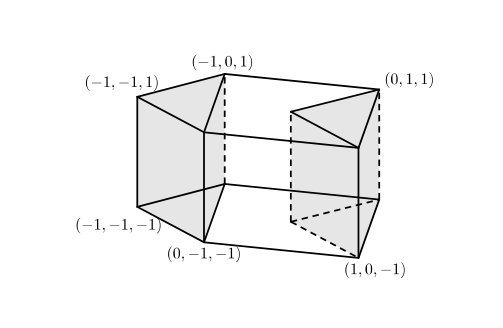 Figure 17
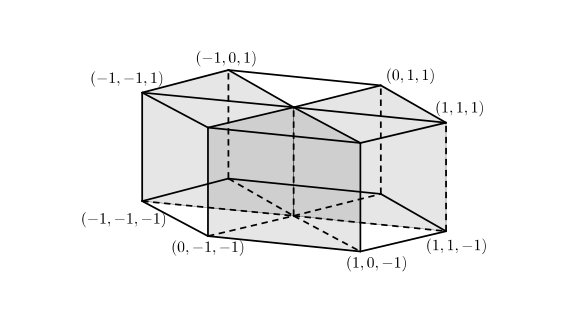 Figure 18
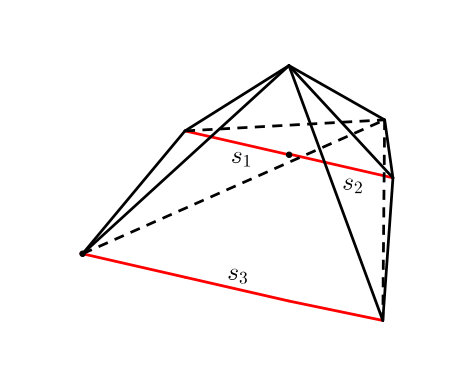 Figure 19
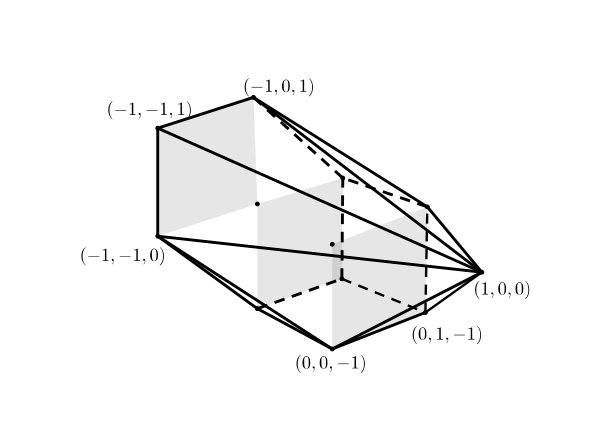 Figure 20
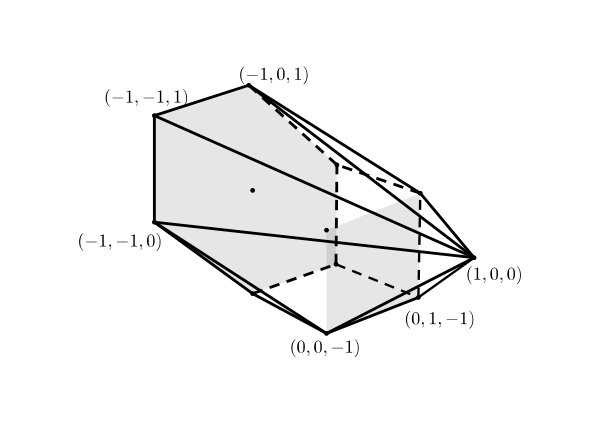 Figure 21
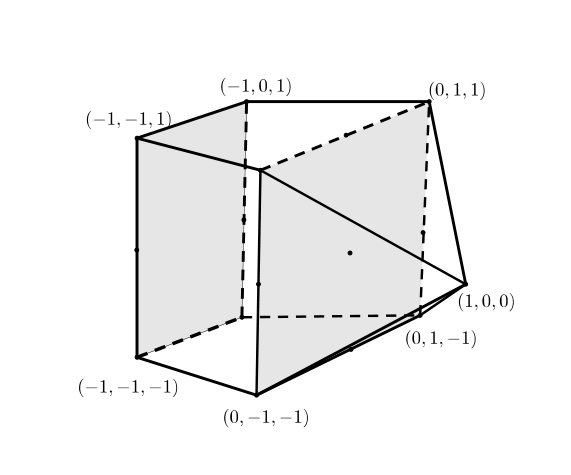 Figure 22
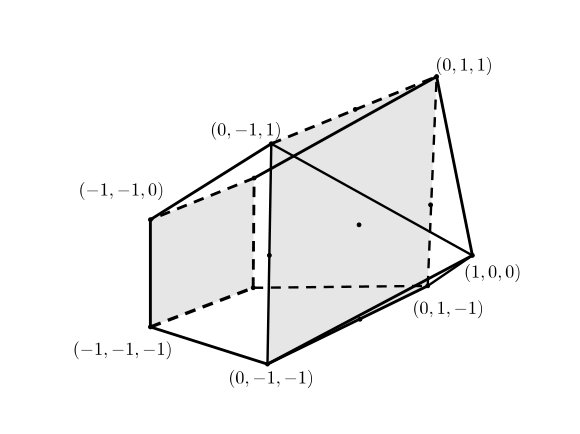 Figure 23
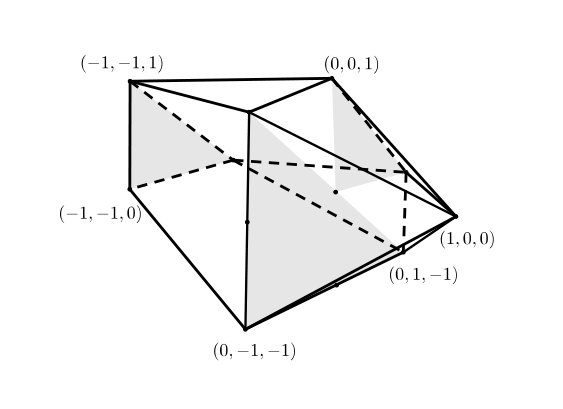 Figure 24
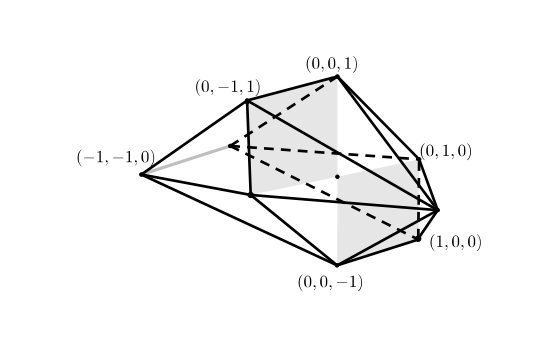 Figure 25
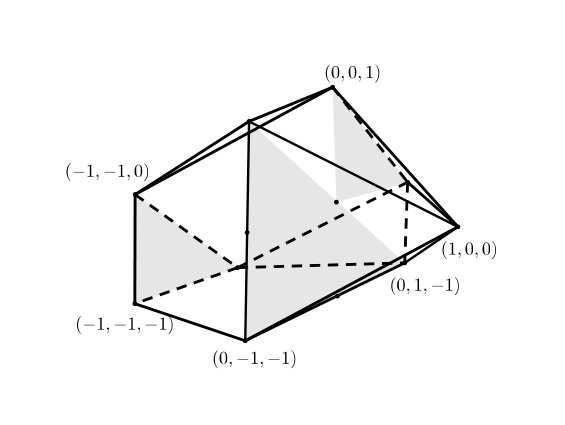 Figure 26
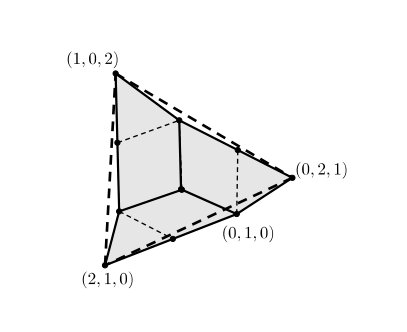 Figure 27
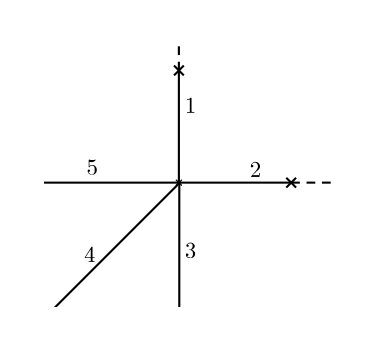 Figure 28
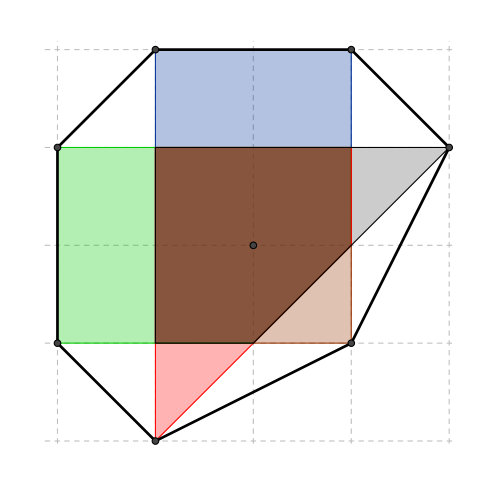 Figure 29
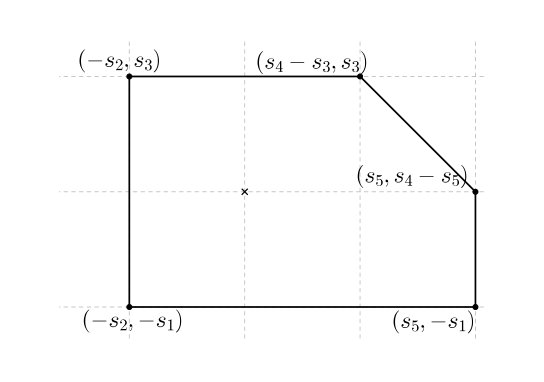 Figure 30
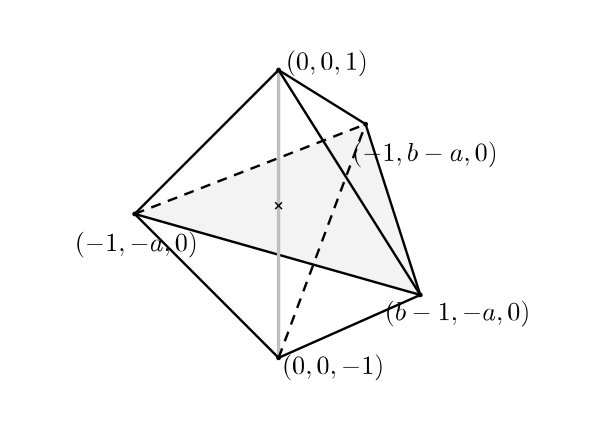 Figure 31
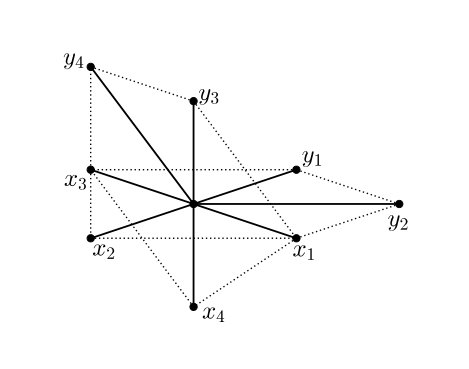 Figure 32
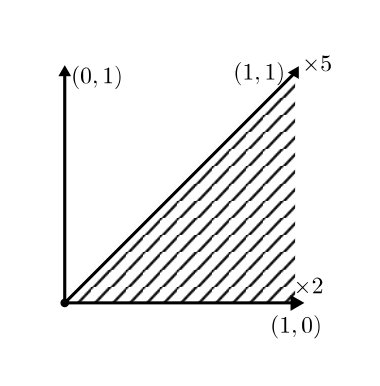 Figure 33
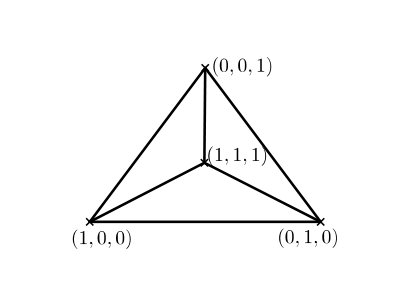 Figure 34
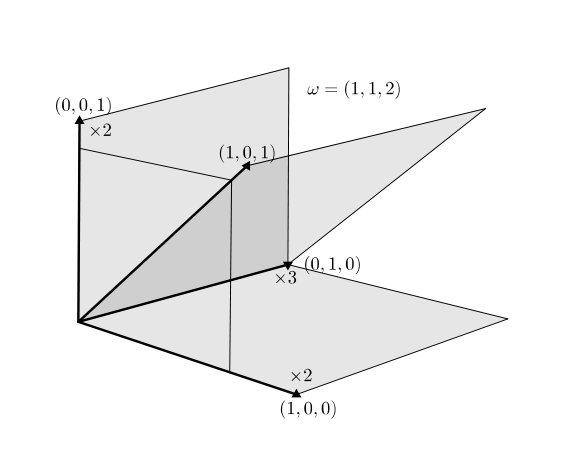 Figure 35
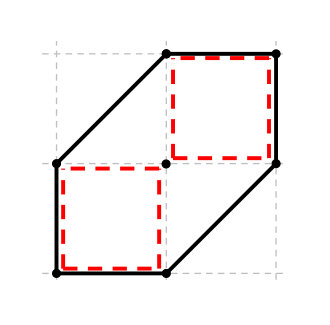 Figure 36
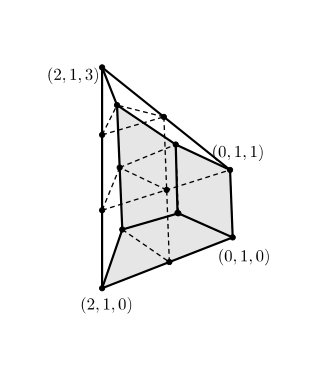 Figure 37
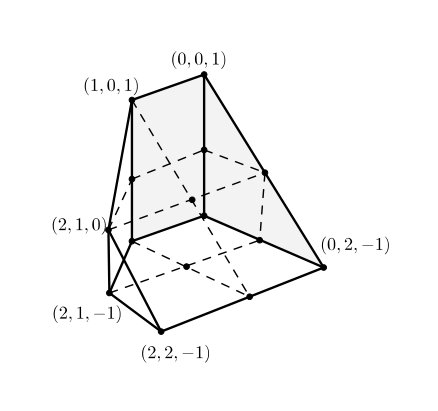 Figure 38
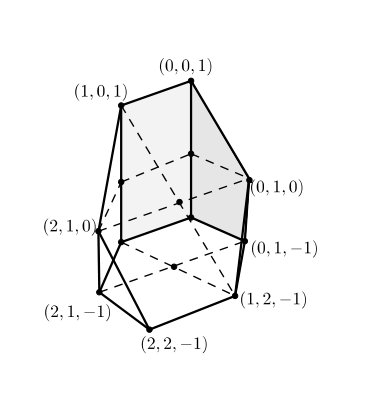 Figure 39
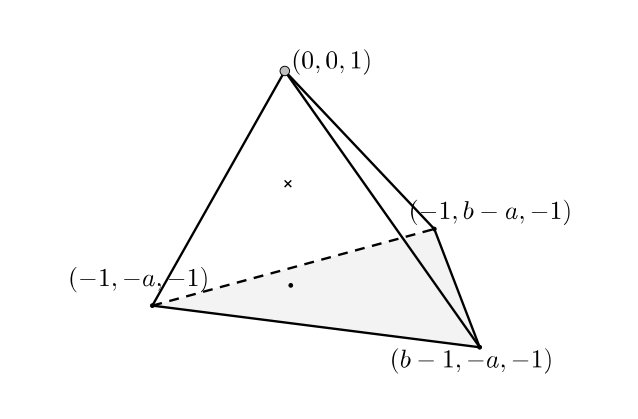 Figure 40
| PALP ID | Fano | PALP ID | Fano | PALP ID | Fano |
|---|---|---|---|---|---|
| 2–31 | 3–14 | ||||
| 2–29 | 3–23 | ||||
| 2–30 | 3–26 | 3–24 | |||
| - | 3–25 | 3–20 | |||
| - | 3–19 | 3–18 | |||
| 3–27 | 3–22 | 3–21 | |||
| 2–29 | 3–23 | 4–10 | |||
| 3–31 | 3–24 | 4–8 | |||
| 2–31 | 3–24 | 4–9 | |||
| 2–32 | 3–20 | 4–8 | |||
| 2–32 | 3–28 | 3–9 | |||
| 2–34 | 2–29 | 3–18 | |||
| 2–28 | 3–14 | 3–9 | |||
| 2–31 | 2–29 | 4–9 | |||
| 3–28 | 3–23 | 3–9 | |||
| 2–28 | 4–10 | 3–9 | |||
| 3–19 | 4–12 | 3–18 | |||
| - | 3–21 | 3–20 | |||
| - | 3–14 | 5–2 | |||
| 4–13 | 4–12 | 4–6 | |||
| - | 4–11 | 4–6 | |||
| 4–11 | - | 4–5 | |||
| 3–18 | - | 4–5 | |||
| 3–22 | 5–2 | 4–3 | |||
| - | 5–3 | 4–5 | |||
| - | 4–5 | 4–3 | |||
| 4–9 | - | 4–3 | |||
| 2–28 |
Peer Reviews
No public reviews on file for this paper yet. If you reviewed it on a platform where reviews are public (OpenReview, ICLR, NeurIPS, ICML), you can paste yours below so the community can read it here.
Videos
No videos yet. Explain this paper in a talk, walkthrough, or lecture? Add one.
From Cracked Polytopes to Fano Threefolds
Thomas Prince
Mathematical Institute
University of Oxford
Woodstock Road
Oxford
OX2 6GG
UK
Abstract.
We construct Fano threefolds with very ample anti-canonical bundle and Picard rank greater than one from cracked polytopes – polytopes whose intersection with a complete fan forms a set of unimodular polytopes – using Laurent inversion; a method developed jointly with Coates–Kasprzyk. We also give constructions of rank one Fano threefolds from cracked polytopes, following work of Christophersen–Ilten and Galkin. We explore the problem of classifying polytopes cracked along a given fan in three dimensions, and classify the unimodular polytopes which can occur as ‘pieces’ of a cracked polytope.
Key words and phrases:
Fano manifolds, toric degenerations.
2000 Mathematics Subject Classification:
14J45 (Primary), 14M25 (Secondary)
1. Introduction
We explain how to construct an extensible database of Fano manifolds in each dimension. In particular, we develop a combinatorial framework, based on the notion of cracked polytopes introduced in [34]. We show that this framework is flexible enough to obtain every Fano threefold with very ample and , famously classified by Mori–Mukai [27, 26, 24, 25, 28]. We show how one may extend these constructions to the rank one case – adapting work of Christophersen–Ilten [8, 7] – and to cases for which is not very ample.
To implement our method we first fix a unimodular rational fan of dimension containing rays. The ray map of sends the th element of the standard basis of to the primitive generator of the th ray. The transpose of this map is an embedding of lattices and, tensoring with , defines an embedding of affine spaces. The fan also determines an embedded degeneration of to a union of toric strata of . The co-ordinate ring of the central fibre of this degeneration is given by a Stanley–Reisner ring associated to the fan. Our prototypical example is the fan for , which determines the embedded degeneration obtained as . Given such a fan , our general procedure consists of two steps.
- (i)
Intersecting the fan with a lattice polytope , we describe how the embedding of determined by may be compactified to an embedding of the toric variety in a non-singular toric variety . This is based on [34] and joint work [13] with Coates and Kasprzyk. 2. (ii)
The embedding of affine spaces determined by admits various possible deformations, and we explicitly construct embedded deformations in by homogenizing the co-ordinate rings of such families.
In this article the fans we consider are simple enough that we can deform the corresponding embeddings explicitly. However, in §6 we outline a potentially sweeping generalisation using the work of Gross–Hacking–Keel [19] and Gross–Hacking–Siebert [20]. In particular, the authors construct mirror families to log Calabi–Yau varieties which deform the embeddings of the affine spaces and vertex varieties described above. In work in progress with Barrott and Kasprzyk we determine precisely when these families admit a fibrewise compactification in in the two-dimensional setting.
The connection between mirror log Calabi–Yau families and Fano threefolds is also currently being investigated by Corti–Hacking–Petracci in [14]. When fully established such work would guarantee the existence of a smooth Fano associated to each (mirror) Minkowski polynomial (see [11, 1]). In that context the current work would form a bridge between these (log) deformation theoretic constructions and the constructions of Mori–Mukai; providing explicit toric degenerations – embedded in a toric ambient space – from which birational descriptions can deduced from the structure of the ambient space.
The current work fits into another program of research, directed toward a novel approach to Fano classification. In [11] Coates–Corti–Galkin–Kasprzyk identify (a number of) mirror Laurent polynomials for each family of Fano threefolds. These constructions rely on the computation of the quantum period (part of the small -function) of each Fano threefold, which in turn relies on the existence of good models of these Fano varieties; either as toric complete intersections, or via representation theoretic constructions. We make heavy use of these constructions, noting that these constructions are usually compatible with Laurent inversion. We note that the connection between toric degenerations and mirror symmetry is further explored by Ilten–Lewis–Przyjalkowski [22].
Fixing a complete fan – which we refer to as the shape – we say a polytope is cracked along if its intersection with each maximal cone of is unimodular, see Definition 2.1. In [13] we show that embeddings of into toric varieties, compactifying the embedding of affine varieties described above, are described by scaffoldings. Moreover, in [34] we show that embeddings of into non-singular toric ambient spaces correspond to the combinatorial condition that the scaffolding is full, see Definition 2.7 and Theorem 2.8.
Theorem 1.1**.**
Every smooth Fano threefold with a very ample anti-canonical bundle and can be obtained by smoothing a Gorenstein toric Fano variety. In particular these can be constructed as deformations of toric embeddings provided by Laurent inversion, applied to a cracked polytope together with a full scaffolding . Moreover, we may assume that the shape of the scaffolding appears in Table 1.
We recall that the ideal of in the homogeneous co-ordinate ring of the toric ambient space is determined by the choice of shape : for example, if is a product of projective spaces, a full scaffolding with this shape realises as a toric complete intersection.
Extending the list of shapes given in Table 1 to include the varieties for defined in §3, we obtain members of every family of Fano threefolds with very ample anti-canonical bundle from a cracked polytope and full scaffolding. We consider the Fano threefolds for which is not very ample in §4.2.
We suggest that four-dimensional cracked polytopes form classes of polytopes from which it is natural to algorithmically construct Fano fourfolds. We note, by way of example, that each of the families of Fano fourfolds which appear in [9] can be constructed from a polytope cracked along the fan of a product of projective spaces via a full scaffolding.
Acknowledgements
We thank Tom Coates and Alexander Kasprzyk for our many conversations about Laurent inversion. The author is supported by a Fellowship by Examination at Magdalen College, Oxford.
Conventions
Throughout this article will refer to an -dimensional lattice, and will refer to the dual lattice. Given a ring we write and . For brevity we let denote the set for each . We work over the field of complex numbers throughout this article. Given a reflexive polytope , we assume throughout that is the toric variety associated to the fan of cones over faces of . Cracked polytopes will always be contained in ; in particular if is a polytope cracked along a fan , is a fan in . Given a variety , and an identification , we write for the line bundle of (multi) degree .
2. Cracked polytopes and Laurent Inversion
The method Laurent inversion – introduced in [13] – was developed to construct models of Fano manifolds embedded in toric varieties. To describe this method we first fix a splitting of . We fix a Fano polytope and a smooth toric variety (the shape), such that is the character lattice of the dense torus in . The central definition in the Laurent inversion construction is that of scaffolding. Loosely, a scaffolding is a collection of polytopes associated to nef divisors on whose convex hull is equal to . From a scaffolding we construct a polytope which projects to . The toric variety embeds into the toric variety associated to the normal fan of . Moreover, the corresponding ideal in the homogeneous co-ordinate ring of is determined by . We then test explicit deformations of the equations cutting out in to attempt to construct an embedded smoothing.
For general choices of , the variety may be highly singular: for example need not be -Gorenstein. In [34] we explore the (restrictive) conditions on which ensure that is non-singular, and introduce the following notion.
Definition 2.1** ([34, Definition ]).**
Fix a convex polyhedron containing the origin in its interior, and a unimodular fan . We say is cracked along if every tangent cone of is unimodular for every maximal cone of .
Remark 2.2**.**
Let be a polytope cracked along a fan . We do not assume that the minimal cone of the fan is not necessarily zero dimensional; these are sometimes called generalised fans. The shape is the toric variety associated to the quotient of by its minimal cone. Slightly abusing terminology, we also say that is cracked along the fan .
It follows from [34, Proposition ] that any cracked polytope is reflexive. In three dimensions the converse holds, in the sense that any reflexive polytope is cracked along some complete unimodular fan. Indeed, consider the fan defined by taking the cone over every face of a maximal triangulation of the boundary of ; the polytopes obtained by intersecting maximal cones of with are all standard simplices. Some examples of cracked polytopes are displayed in Figure 1. The polytope shown in the left-hand image of Figure 1 is cracked along the product of with the fan determined by ; while the polytope shown in the right-hand image is cracked along the fan determined by .
Definition 2.3** ([13, Definition ]).**
Fix a smooth projective toric variety with character lattice . A scaffolding of a polytope is a set of pairs – where is a nef divisor on and is an element of – such that
[TABLE]
We refer to as the shape of the scaffolding, and elements as struts. We also assume that there is a unique such that for every vertex .
Scaffolding a polytope determines an embedding of into an ambient space . This is the main result of [13]; see also the treatment given in [34, §].
Definition 2.4** ([13, Definition ]).**
Given a scaffolding of we define a toric variety , associated to the normal fan of the polytope , itself defined by the inequalities
[TABLE]
where denotes the standard basis of .
We let denote the ray map of the fan determined by , and set for each . We also define a map of lattices,
[TABLE]
Theorem 2.5** ([13, Theorem ]).**
A scaffolding of a polytope determines a toric variety and an embedding . This map is induced by the map on the corresponding lattices of one-parameter subgroups.
Remark 2.6**.**
We can provide an explicit generating set for the ideal of in the homogeneous co-ordinate ring of using the map . In particular, a hyperplane containing the image of defines a function on the set of ray generators of . then satisfies the equation
[TABLE]
where products are taken over the ray generators of , and is the homogeneous co-ordinate on corresponding to the ray generated by .
Recall that each facet of is dual to a vertex of , contained in a cone of . Taking is minimal among such cones, corresponds to a non-singular toric stratum of the toric variety . It is shown in [34, Proposition ] that the facet of is a Cayley sum , where is a set of nef divisors on , and . We call a face of vertical if it is contained in a factor of some facet and some .
Definition 2.7** ([34, Definition ]).**
Given a Fano polytope cracked along a fan in we say a scaffolding of with shape is full if every vertical face of is contained in a polytope for a unique element .
We show in [34] that full scaffoldings on cracked polytopes give rise to embeddings where is smooth in a neighbourhood of .
Theorem 2.8** ([34, Theorem ]).**
Fix a polytope , and a rational fan in such that the toric variety is smooth and projective. Given a scaffolding of with shape , we have that the target of the corresponding embedding is smooth in a neighbourhood of the image of if and only if is cracked along and is full.
2.1. Torus quotients
Every -dimensional toric variety (over ) may be described as the quotient of a Zariski open set of affine space by a complex torus . Recalling that, if is determined by a fan in whose rays generators form a spanning set of , we have an exact sequence
[TABLE]
where for each . The character lattice of fits into the dual sequence,
[TABLE]
Moreover we recall that if is smooth there is a canonical identification , while if is -factorial there is a canonical identification of . The map is called the weight data for the toric variety. Recall that the possible fans in , with rays generated by a subset of , and such that the associated toric variety is projective, are indexed by the cones of a fan contained in the effective cone . This fan is called the secondary fan or GKZ decomposition.
Fixing a maximal cone (or chamber) in the secondary fan, the corresponding toric variety can be described as the torus quotient
[TABLE]
where , the weights of the torus action are given by , and the is the irrelevant locus. Choosing a point (or stability condition) in the interior of , the irrelevant locus is defined by setting
[TABLE]
where for each standard basis vector , . Some of the constructions described in §4 make use of stability conditions contained in a codimension one cone (or wall) in the secondary fan.
We can use the GIT presentation of a toric variety to streamline the construction of the variety from a scaffolding . To do this we first assume that, that there is a basis , such that . If this condition holds the cone generated by
[TABLE]
where the vectors form the standard basis in the based lattice , defines a smooth torus invariant point in . We assume for the remainder of this section that every scaffolding satisfies this condition. We next explain how to form a weight matrix and stability condition which determine the variety directly from the scaffolding . This construction follows [13, Algorithm ].
Construction 2.9**.**
Given a scaffolding with shape of a polytope , index the elements of by , and let denote the th element of . It follows from our assumptions on that the ray matrix of is in echelon form
[TABLE]
where indexes the elements of the form , for a basis , and . Thus , the transpose of the kernel matrix, is given by
[TABLE]
The variety is defined using the a polarising torus invariant divisor given by the sum of all rays corresponding to elements of . The (multi) degree of this divisor is given by the sum of the first columns of . That is, the stability condition used to define is given by the sum of with the columns of the matrix
If is a product of projective spaces, there is a partition of the columns of containing the vectors . In particular, the standard basis in partitions into sets , such that consists of divisors pulled back from the standard projection to the th projective space factor. For each the degree of the line bundle cutting out in is given by the sum of the columns in . In particular, there is a distinguished binomial in , where is the sum of standard basis vectors in corresponding to the columns of , and is the unique lift of to : the subspace of corresponding to the first columns of . It is shown in [13], see also [34, §], that is the vanishing locus of these binomials.
Example 2.10**.**
Fix a -dimensional reflexive polytope , and let be a crepant resolution of the toric variety determined by the normal fan of . In particular, and . Let , where is the toric boundary of . Hence , and the corresponding weight matrix is equal to , where columns. The stability condition is equal to , and hence . This is nothing but the anti-canonical embedding of into projective space.
Example 2.11**.**
In [13, Example ] we consider two distinct scaffoldings for the polygon associated with the toric del Pezzo surface of degree six. One of these is illustrated in Figure 2. The scaffolding illustrated in Figure 2 has shape and – letting denote the pullback of along the th projection for each and – we define
[TABLE]
Applying Construction 2.9 to we obtain the weight matrix
[TABLE]
and stability condition . This is a GIT presentation of the toric variety . The variety is the vanishing locus of the binomials and , where and denote homogeneous co-ordinates on the factors.
3. Rank one Fano threefolds
Toric degenerations of rank one Fano manifolds have been obtained by Ilten and Christophersen [8, 7], using the deformation theory of Stanley–Reisner rings developed by Altmann–Christophersen [3, 2]. Using these results – and the work of Galkin [17] on small toric degenerations – we obtain cracked polytopes corresponding to each of the rank one Fano threefolds with very ample anti-canonical bundle. In particular, we describe degenerations of these Fano threefolds to the toric varieties . We remark that, since the toric degenerations in this case occur in the anti-canonical embedding, the use of cracked polytopes in this context is rather trivial; see Example 2.10.
To specify the toric varieties for which appear in Table 2, we set , and let denote the torus invariant divisors of for each .
- •
is the blow up of in a toric invariant line .
- •
is the blow up of in the strict transform (and pre-image) of .
- •
is the blow up of in the strict transform of the line .
- •
is the blow up of in the strict transform of the line .
The fans determined these varieties define triangulations of the sphere via radial projection. The sequence of blow up maps described induces the starring operations on these triangulations described in [8]. We define the variety to be a crepant resolution of the toric variety determined by the normal fan of the reflexive polytope with ID . Similarly, we define the variety to be a crepant resolution of the toric variety determined by the normal fan of the (self-dual) reflexive polytope with ID .
The Fano variety is toric, while , and are well known to be toric complete intersections. These admit toric degenerations to the varieties defined by the equations given in Table 2. To describe the scaffolding associated to each of these Fano threefolds, let be the dimension of the shape variety , set and . Letting denote the standard basis of , we define
[TABLE]
where is the toric boundary of , and . This scaffolding is illustrated in the case in Figure 24 (setting and ).
3.1. Pfaffian equations and
The Fano threefold is a linear section of the Grassmannian . We make heavy use of the fact that the ideal of the image of the Plücker embedding
[TABLE]
is generated by Pffafians of a skew-symmetric matrix; entries of which are the Plücker co-ordinates of . Hyperplane sections can then be obtained by replacing entries with linear combinations of a subset of the Plücker co-ordinates. For example, can be described as the Pfaffians of the matrix
[TABLE]
for a fixed value of . Varying defines a flat family, the central fibre of which is the projective cone over a toric variety with two ordinary double points, obtained from by moving the four points at which is blown up to two pairs of infinitely close points, and contracting the pair of resulting curves. Setting recovers five equations generating the ideal of a toric variety in . This toric variety is isomorphic to , where denotes the toric variety with ID . The embedding is the embedding of determined by the scaffolding , where and (recalling that ) is the toric boundary of .
3.2. Higher genus Fano threefolds
The varieties for are linear sections of the Mukai varieties [29]. Toric degenerations of these are related – by work of Ilten–Christophersen [8] – to the convex deltahedra in the cases , while varieties in the family admit a toric degeneration to a variety with ordinary double point singularities, see [17].
Given a Fano toric variety , let its dual be toric variety associated to the normal fan of the convex hull of the ray generators of the fan determined by .
Proposition 3.1**.**
The toric varieties admit toric degenerations to the Fano toric varieties dual to for each .
Proof.
If we recover the triangulations of used in [8] to construct degenerations of Fano threefolds by removing the origin from and radially projecting the fan determined by . The result then follows immediately from [8, Proposition ]. In the case we observe that contains only ordinary double point singularities, and hence admits a smoothing. It is shown in [17] that the general fibre of this smoothing is a member of the family . ∎
In the cases we can provide an explicit description of the toric degeneration.
- (i)
: varieties in this family can be described by the Pfaffians of a skew-symmetric matrix, and one quadric equation. We can form a toric degeneration following §3.1. 2. (ii)
: varieties in this family can be described via a system of Pfaffian equations, and we refer to the treatment of 2–21 in §4 for a description of a toric degeneration using the same shape variety. 3. (iii)
: varieties in this family can be described as the vanishing of the Pfaffians of a skew matrix. An explicit toric degeneration is given by the Pfaffians of the matrix (1) below.
The vanishing Pfaffians of the matrix
[TABLE]
define a toric degeneration of , a general linear section of , where are homogeneous co-ordinates on and , , and are general linear forms on . The scaffolding in each case is equal to the singleton set , where is the toric boundary of .
3.3. The quartic hypersurface in
Recall that the toric variety defined by a full scaffolding of a cracked polytope is non-singular in a neighbourhood of the image of . This excludes certain constructions of Fano manifolds as hypersurfaces as weighted projective spaces. In particular, consider the scaffolding (with shape ) of the polytope with ID illustrated in Figure 24, setting . We have that , , and ; where . Computing the corresponding weight matrix we find
[TABLE]
Thus is the vanishing locus of a section of in . Notice that is not cracked along the fan of . To obtain a construction from a cracked polytope we first embed into via the linear system defined by sections of . Sections of define the integral points of a polytope in given by the convex hull of the points given by the columns of the matrix
[TABLE]
The quartic equation defines a projection of this polytope to the reflexive polytope with ID . This polytope is self-dual, and we take the scaffolding of with shape given by a crepant resolution of , covering with a single strut. This scaffolding corresponds to the anti-canonical embedding of into , which is the intersection of the image of the Veronese embedding of with a (binomial) quadric. Deforming this quadric deforms to a general quartic hypersurface in .
4. Constructions of Fano manifolds
There are Fano threefolds with very ample anti-canonical bundle. In the previous section we described constructions from cracked polytopes of the of these which have Picard rank one. We now explain constructions in the remaining cases. In particular, for each of these Fano threefolds , we exhibit a fan and polytope cracked along such that – for some full scaffolding of with shape – the toric variety admits an embedded smoothing in to .
Examples from ‘Quantum periods for -dimensional Fano manifolds’
Explicit constructions of Fano threefolds are provided in [11]. The authors use these constructions to compute (part of) the -function of each Fano threefold using either the Quantum Lefschetz principle, or the Abelian-non Abelian correspondence. In particular, each Fano threefold is exhibited either as a complete intersection in a weak Fano toric variety, or as the degeneracy locus of a map of homogeneous vector bundles.
Proposition 4.1**.**
Fix a Fano threefold , such that the model of in [11] describes as the vanishing locus of a section of a split vector bundle on a toric variety . In addition, we insist that the divisor
[TABLE]
is ample. There is a reflexive polytope , shape variety , and full scaffolding of such that , and admits an embedded smoothing to in .
Proof.
Tables 3, 4, and 5 list binomial equations cutting out toric varieties to which Fano varieties in the various families satisfying our hypotheses degenerate. The leading monomial in each case is square-free and defines a subset of the columns of the weight matrix listed in [11] for each . In every case the sets are pairwise disjoint, and disjoint from a subset of columns which define a basis of . Reversing Construction 2.9, we can obtain a scaffolding from the weight matrices given in [11] and the binomial expressions listed in Tables 3, 4, and 5. The rank one complete intersection cases are listed in Table 2.
It follows from [34, Theorem ], and smoothness of , that the polytope is cracked along the fan determined by , and is full. ∎
Example 4.2**.**
Consider a Fano threefold in the family 2–18. is a double cover of , branched in a divisor with bidegree . The construction in [11] describes this Fano threefold as a hypersurface in the projectivisation of a rank split vector bundle on .
Consider the scaffolding with shape illustrated in the left hand image in Figure 3. That is, , , and , where for homogeneous co-ordinates on . This scaffolding exhibits as the hypersurface given by the vanishing locus of the binomial , in the toric variety with weight matrix
[TABLE]
such that the class is ample. Note that the weight matrix – up to a permutation of the columns – and stability condition are identical to those appearing in [11, p.]. Thus the general member of the linear system is a Fano threefold in the family 2–18.
Of the Fano threefolds with very ample anti-canonical divisor and , of the constructions given in [11] coincide with constructions from full scaffoldings on cracked polytopes. We summarise these constructions in Tables 3, 4, and 5. The column Equations in each table describes a generating set for the ideal in the homogeneous co-ordinate ring of the ambient variety described in [11]. The first monomial of each binomial is always square-free, and may be used to identify columns of the weight matrix defined by . If is a product of projective spaces the co-ordinates are not named in [11], and we name these for the first projective space factor , for the second, etc.
We now provide constructions from cracked polytopes of the Fano threefolds whose construction in [11] is not directly related to a full scaffolding of a cracked polytope. In six cases (2–14, 2–17, 2–20, 2–21, 2–22, 2–26) the corresponding construction in [11] does not describe the Fano threefold as a toric complete intersection. In the remaining nine cases (2–8, 3–1, 3–4, 3–5, 3–14, 3–16, 4–2, 4–6, 5–1) the construction given in [11] expresses the Fano threefold as the vanishing locus of a section of split vector bundle on a toric variety , such that is nef but not ample. In the latter case the embedding cannot come from a scaffolding , since Construction 2.9 uses to polarise the ambient space.
Remark 4.3**.**
The construction given in [11, p.] expresses varieties in the family 3–2 using a hypersurface for which is not ample. However, in the remarks on the construction given on [11, p.], the authors describe a second construction using a toric variety . This toric variety does coincide with a toric ambient space obtained from a full scaffolding of a cracked polytope.
Remark 4.4**.**
Note that the numbering for the rank Fano threefolds replicates that in [11], which differs from the original list of Mori–Mukai by the insertion of the family 4–2 which was omitted from the original classification (some lists instead append this family as 4–13).
Rank , number
Varieties in the family are either,
- (i)
the double cover of (the blow-up of at a point) with branch locus a member of such that is non-singular, where is the exceptional divisor of the blow-up , or; 2. (ii)
the specialisation of (i) where is reduced but singular.
We make use of the construction given in [11], which embeds Fano threefolds in the family 2–8 as hypersurfaces of bi-degree in the toric variety , defined by the weight matrix
[TABLE]
and a choice of stability condition in the chamber . The coincidence of these two constructions is proved in [11, p].
Consider the scaffolding of the reflexive polytope with PALP ID , with shape . Here we take to be the blow up of at three of its torus invariant points, and is the toric boundary of .
This scaffolding corresponds to the anti-canonical embedding , see Example 2.10. To exhibit an explicit smoothing in this embedding we consider another scaffolding of – with shape – shown in Figure 4. Note that is not cracked along the fan determined by . The scaffolding defines an embedding where is the toric variety defined by weight matrix
[TABLE]
and stability condition – note that is contained in a wall. The toric variety is the vanishing locus of a section of .
Lemma 4.5**.**
The vanishing locus of a general section of is a Fano threefold 2–8.
Proof.
General sections of do not vanish at the torus invariant point defined by the vanishing of all co-ordinates except . There is a projection from this point to the toric variety , the toric variety defined by the same weight matrix as , but stability condition . The wall spanned by is a flipping wall, and the birational transformation induced by crossing this wall is given by (the cone on) a Pachner move in the fan determined by . The intermediate variety has the non- factorial point given by the vanishing of all homogeneous co-ordinates (labelled as for ) except . The image of the vanishing locus of a general section of in misses this singularity. Hence the resolution of induced by moving the stability condition from into the chamber restricts to an isomorphism of , and the result follows from [11, p.]. ∎
Consider the embedding . Composing with the embedding , the pull-back of the line bundle is the anti-canonical class on by adjunction. Moreover is the intersection of with a quadric and a hyperplane in . In particular, restricting to this hyperplane, we obtain the anti-canonical embedding of in . Restricting to members of a general pencil of hyperplanes – and intersecting with a general pencil of quadrics – we see that deforms in to a variety in the family 2–8.
Rank , number
This example is the first of a sequence of examples – along with , , and – to make use of polytopes cracked along the fan of . The corresponding embeddings are defined using the five Pfaffians of a matrix of polynomials in the homogeneous co-ordinate ring of a toric variety. Varieties in the family are the blow up of (a three dimensional linear section of ) in an elliptic curve which is the intersection of two hyperplane sections.
Consider the polytope with PALP ID together with the scaffolding with shape displayed in Figure 5. We have that , , and , where is the toric boundary of .
The variety is determined by the weight matrix
[TABLE]
and stability condition . The variety is consequently the blow up of in a codimension linear subspace. The ideal of in is obtained by homogenizing the Pfaffians of the skew-symmetric matrix
[TABLE]
Consider the contraction , and observe that the intersection of the image of with the centre is a cycle of five -curves. Replacing the two [math] entries with general linear forms this cycle of -curves becomes a (codimension ) non-singular curve of genus one; blowing up produces a flat family deforming to a Fano threefold in the family .
Rank number
Varieties in the family are the blow up of a quadric threefold in an elliptic curve of degree . We consider the polytope with PALP ID , together with the scaffolding shown in Figure 7 using the shape variety .
The scaffolding determines the toric variety . Letting and denote homogeneous co-ordinates on the respective projective space factors, is the vanishing locus of the binomial , and the five Pfaffians of the skew-symmetric matrix
[TABLE]
where and are general linear equations in . One of these five Pfaffians describes the threefold in , while the other equations have bidegree . It is shown in [11, p.] that varieties in the family 2–17 may be obtained as the vanishing loci of general sections of the bundle
[TABLE]
on the variety . The Grassmannian is a quadric fourfold, while sections of the line bundle define hyperplane sections in . Moreover, the binomial defines a section of the bundle obtained by pulling back to the product of a hyperplane section in with . We claim that the remaining four Pfaffian equations define a section of the pull-back of to this hyperplane section. Representing a point in as the row-space of a matrix
[TABLE]
a section of the bundle is determined by a vector , and this section vanishes precisely when lies in the row space of . This happens when the maximal minors of the matrix
[TABLE]
vanish. Writing the minors of (the Plücker co-ordinates) as we have that sections of are defined by four equations of degree in the variables and constants . Replacing each with the homogeneous co-ordinate we recover the remaining Pfaffian equations found above, up to a linear relation eliminating . That is, admits an embedded flat deformation to a variety in the family 2–17.
Rank number
Varieties in the family are the blow up of (a three dimensional linear section of ) in a twisted cubic. Consider the polytope with PALP ID together with the scaffolding with shape displayed in Figure 8.
The corresponding toric variety is isomorphic to . Moreover, the variety is the blow up of the vanishing locus of the five Pfaffians of
[TABLE]
where are homogeneous co-ordinates on , in the locus . Note that the ideal defines a (degenerate) twisted cubic. Replacing the two zero entries in the above matrix with general homogeneous elements of degree one we obtain a flat deformation of to the blow up of in a twisted cubic.
Rank number
Varieties in the family are the blow up of a quadric threefold in a rational curve of degree . These are shown in [11, p.] to be zero loci of sections of the vector bundle
[TABLE]
on . Consider the polytope with PALP ID , with the scaffolding shown in Figure 10. This scaffolding has shape , the shape used in the construction of Fano threefolds in the family . The ambient space defined by this scaffolding is isomorphic to with co-ordinates and respectively. The equations cutting out in can be read off as relations between labelled lattice points in Figure 9. In particular if , where and are lattice points labelled with variables and for each , points in satisfy the equation . There are nine such binomial equations, which can be written as the Pfaffians of the following pair of matrices (setting ),
[TABLE]
Note that these matrices share the Pfaffian , which defines a toric degeneration of a quadric threefold.
Following the treatment of the variety 2–17, we observe that each set of five Pfaffian equations defines a section of (the pullback to a hyperplane section of) . Thus the general member of the family given by the set of Pfaffian equations is isomorphic to a Fano threefold in the family 2–21.
Rank number
Varieties in the family are the blow up of in a conic. Consider the polytope with PALP ID , and the scaffolding with shape displayed in Figure 11. The variety is the blow up of in a plane; the toric variety determined by the weight matrix
[TABLE]
and stability condition . is cut out by the five Pfaffians of
[TABLE]
where is a generic polynomial of bi-degree , and . The ambient variety is obtained from with co-ordinates by blowing up the plane . The Pfaffian equations defining pull back to the single equation on this locus. Hence, for general values of , the equations define the blow up of (cut out by Pfaffian equations in ) in a non-degenerate conic.
Rank number
Varieties in the family are the blow up of in a line. Consider the polytope with PALP ID and scaffolding with shape displayed in Figure 12. The variety is the blow up of in the line with homogeneous co-ordinates . Consider the one-parameter family
[TABLE]
where and are general linear forms with no terms in or . Varying , this family contains the line with co-ordinates and for all values of . Blowing up this line we obtain a flat family embedded in with central fibre , and general fibre a Fano threefold in the family .
Rank number
Varieties in the family are double covers of branched along a divisor of tri-degree . Our treatment of this family is similar to that of 2–8. Consider the Fano polygon with PALP ID , illustrated in Figure 13. We give the ‘anti-canonical’ scaffolding; covering with the polyhedron of sections of the toric boundary on the shape variety . This scaffolding reproduces the anti-canonical embedding , see Example 2.10. We exhibit an explicit smoothing by factoring the anti-canonical embedding through a map to a toric variety obtained from a non-full scaffolding of . Figure 13 shows a scaffolding of with shape . The scaffolding consists of three elements, and defines the toric variety with weight matrix
[TABLE]
and stability condition . The hypersurface is the vanishing locus of the binomial , a section of the line bundle with tri-degree – and – a section of the line bundle tri-degree . Note that the variety is not -factorial along the line on which . General linear sections though this non-isolated singularity are isomorphic to the affine cone over , polarised by the line bundle of tri-degree .
Consider a general section of , and its vanishing locus . Projecting away from the point at which all co-ordinates except vanish, is an isomorphism onto its image in a toric variety . The variety which appears in the construction in [11, p.57] is obtained from the variety by a making one of the three possible small resolutions of the singularity . Since the variety does not intersect the singular locus of this resolution restricts to an isomorphism of . The rest of the example follows our treatment of the family 2–8: the complete linear system determined by defines an embedding and varying a quadric section in the anti-canonical embedding of smooths .
Rank number
Fano threefolds in this family are obtained by blowing up the fibre of the projection map , where is a double cover of branched in a divisor of bidegree . In [11, p.] it is shown that varieties in this family may be obtained as hypersurfaces of tri-degree contained in the toric variety defined by the weight matrix
[TABLE]
together with a stability condition in the chamber . We compare these toric hypersurfaces to the threefolds obtained by scaffolding the polytope with PALP ID shown in Figure 14. This scaffolding has shape , and hence defines a codimension toric complete intersection in the toric variety with weights:
[TABLE]
and stability condition . Let be the vanishing locus of a general section of the vector bundle . Note that the line bundle is not nef on . We define a Segre type map , setting
[TABLE]
It is easily verified that this map is homogeneous, and that is given by the matrix . Hence the stability condition , is mapped into the wall spanned by and . Let be the toric variety defined by weight matrix and stability condition .
Lemma 4.6**.**
* is a small resolution a non-isolated singularity of which is disjoint from the divisor .*
Proof.
There is a morphism expressing as a bundle over , with co-ordinates . Similarly, and admit projections to the with co-ordinates . Each of these projections commute with the inclusion . Given a point , the intersection is isomorphic to the projective closure of the (affine) ODP singularity in with co-ordinates . The (smooth) variety is obtained by making one of the two possible small resolutions of this line of conifold singularities. Note however that, for any fibre of , the divisor is disjoint from the singular locus of . Since , the locus is disjoint from the singular locus of . ∎
Note that is a hypersurface in the class , cut out by . Moreover, we have that ; hence, by Lemma 4.6, any hypersurface cut out by a member of the linear system on is the vanishing locus of a section of on .
Rank number
It was shown in [11, p.] that varieties in the family 3–5 are codimension complete intersections in the toric variety , determined by the weight matrix
[TABLE]
and a stability condition in the chamber . Varieties in the family 3–5 are obtained as zero loci of sections of the bundle . The secondary fan for is illustrated in Figure 16. Consider the scaffolding of the polytope with PALP ID shown in Figure 15. The variety is determined by the weight matrix
[TABLE]
and stability condition . The toric variety is cut out of by a pair of binomial sections of . Observe that the linear system is not nef on , and has base locus . We claim that is obtained from by blowing up . It is clear that the weight matrix defining is the same as the defining the toric variety . Moreover, the map defined by setting
[TABLE]
has pull-back defined by the matrix
[TABLE]
Hence, considering the ample class , , it remains to analyse the effect of crossing the wall in the secondary fan of generated by and . We observe that moving the stability condition into this wall contracts the divisor (defining the ray generated by ) to the locus .
We claim that vanishing loci of general sections of are smooth. If so, the blow-up of the base locus is an isomorphism on general sections, as the restriction of the base locus to a general fibre is a Cartier divisor. Smoothness follows directly from the Jacobian condition. Indeed, sections of are of the form
[TABLE]
where and are homogeneous polynomials of degree in . Taking two such sections the corresponding Jacobian matrix, evaluated at and – without loss of generality – , has the form ; a block matrix consisting of a zero block and a matrix of linear forms in . Since the locus in where a matrix drops rank has codimension , any projective line in this space which misses determines a matrix which does not drop rank.
Rank number
We consider the reflexive polytope with PALP ID , together with the scaffolding with shape shown in Figure 17. This scaffolding expresses as a hypersurface of tri-degree in the toric variety with weight matrix
[TABLE]
and stability condition . Note that is not -factorial at the point . However, since the monomial defines a section of – and this does not vanish along – a general hypersurface with tri-degree misses this locus. Moving to induces a resolution of this singularity which restricts to an isomorphism of , and recovers the ambient space considered in [11, p.]. Hence, by the argument given in [11, p.], the hypersurface is isomorphic to a Fano variety in the family 3–14.
Remark 4.7**.**
We could also construct varieties in this family using the scaffolding obtained by combining the two struts containing the origin in into a single line segment of length two. This produces an embedding , where is given by the weight matrix
[TABLE]
and stability condition . is the vanishing locus of the binomial .
Rank number
Varieties in this family are obtained by blowing up with centre the strict transform of a twisted cubic passing through the centre of the blow-up .
We can recover the construction used in [11, p.] using a scaffolding of a reflexive polytope. Indeed, consider the polytope with PALP ID , together with the scaffolding displayed in Figure 18 with shape . Note that this scaffolding is not full, and is not cracked along the fan defined by . The toric variety is determined by the weight matrix
[TABLE]
together with the stability condition . The toric variety is defined by the vanishing of a pair of binomial sections of . A stability condition which lies in the cone spanned by determines the toric variety used in [11] to construct Fano varieties in 3–16. However lies in the wall spanned by a pair of these vectors. Moving into the chamber used in [11] resolves the singular locus . However general sections of do not vanish along this point, and hence the intersection of two general divisors of tri-degree are isomorphic to varieties in the family 3–16.
In order to provide a construction using a cracked polytope, we consider the scaffolding of with shape , also shown in Figure 18.
The scaffolding defines the weight matrix
[TABLE]
and stability condition . Let denote the toric variety determined by the weight matrix
[TABLE]
and stability condition . Note that general sections of define subvarieties of isomorphic to . There is a map – analogous to the Segre embedding map – sending
[TABLE]
We have that , while . Hence the ample line bundle pulls-back to . This class is not ample on and the image of the induced morphism factors through the contraction . Indeed, we have the commutative diagram of embeddings
[TABLE]
We can deform in by moving the section of cutting out . In other words, we obtain varieties in the family 3–16 in in codimension by embedding and moving the sections used to cut out .
Rank , number
Varieties in this family are obtained from by blowing up a curve of tri-degree .
We consider the polytope with PALP ID , together with the scaffolding shown in Figure 19, with shape . This scaffolding describes as a hypersurface of tri-degree in the toric variety determined by the weight matrix
[TABLE]
and stability condition . The variety is the projectivisation of the bundle on . Note that the line bundle is not nef, and that its base locus is section of the projection defined by . Blowing up this base locus we obtain the variety considered in [11, p.]. To check smoothness of general hypersurfaces in this linear system, note that general sections of have the form
[TABLE]
where and are polynomials of bidegree in , while , are linear polynomials in . Restricting the Jacobian to the locus , we see that the locus is singular precisely when . However this locus is empty for general choices of and .
Since the restriction of the base locus of this linear system to a smooth member is a Cartier divisor in , its blow up is an isomorphism. Hence such hypersurfaces are members of the family 4–2, and is the central fibre of a toric degeneration in this family.
Rank number
Varieties in the family are obtained by blowing up in curves of bidegree and respectively. Consider the polytope with PALP ID , together with the scaffolding with shape illustrated in Figure 20.
The toric variety is defined by the weight matrix
[TABLE]
and stability condition . The secondary fan of is illustrated in Figure 21.
The variety is isomorphic to ; and the two chambers in the secondary fan correspond to isomorphic varieties – despite the presence of a non-trivial flopping locus. The projection corresponds to projecting out the variables for all . The toric variety is cut out of by the binomial equations
[TABLE]
These are sections of the line bundles and , with weights and respectively. Note that is nef while is not.
Let be the vanishing locus of a general section of . The section has the general form , where and have bi-degree in and respectively; while has bi-degree . Similarly has the general form , where and have bi-degree .
Fibres of the restriction of to are given by the kernel of the matrix
[TABLE]
That is, is a graph away from the locus at which this matrix has rank . This locus in has two connected components, one given by , a curve of bidegree , and the other by , a curve of degree . Thus the morphism exhibits as a Fano threefold in the family .
Rank number
Varieties in this family are obtained by first blowing up a quadric in a conic – obtaining a variety in the family 2–29 – and blowing up in three exceptional lines. Consider the scaffolding of the polytope with PALP ID with shape , illustrated in Figure 22.
That is, we consider general hypersurfaces of tri-degree in the toric variety defined by the weight matrix
[TABLE]
and stability condition . The variety admits a map to (with co-ordinates ), giving the structure of a fibre bundle. The variety also admits a morphism to , whose fibres are surfaces of bi-degree in . Projecting to we see that any such smooth fibre is the blow up of in four (general) points; that is, isomorphic to the del Pezzo surface .
Hypersurfaces of tri-degree have general form
[TABLE]
where and are homogeneous polynomials of degree for each . Let denote the vanishing locus of this polynomial. Note that contains the surface . Fixing a point , the fibre of the projection is obtained by blowing up the intersection points of the conics and in (with homogeneous co-ordinates ). First consider the case . Choosing a general , we find two distinct reduced points , in ; these are independent of the choice of . The other two solutions depend on , and lie in the line . Note that we may choose co-ordinates such that is defined by .
Hence we can construct four surfaces, each isomorphic to , contained in : two surfaces – and – swept out by , the surface swept out by over , and the base locus . Each of these surfaces restrict to exceptional curves in the fibres. Note that fibres of are not all smooth – there are two singular fibres – but they are smooth in a neighbourhood of . Hence – applying a relative version of Castelnuovo’s criterion – we can have a morphism which contracts the disjoint surfaces , , and to sections of the induced morphism . The smooth fibres of are isomorphic to , while singular fibres have a single nodal singularity; these are isomorphic to . The surface is the strict transform of a surface , which intersects every fibre in a smooth section of .
Letting denote the Picard rank of , we have that . Since – and hence – has degree , we can conclude from the classification of Fano -folds that if , is in the family 5–1. This is easily seen from the Leray spectral sequence
[TABLE]
indeed – since for all fibres of – we have . However since the surface defines a non-trivial class in for every fibre .
Remark 4.8**.**
Comparing our construction with that made by Mori–Mukai [24], they first consider the blow up of a quadric threefold in a conic. Restricting the projection this blow-up defines , a quadric surface bundle over with two singular fibres (with singularities are disjoint from the exceptional locus). Note that the exceptional locus distinguishes a conic in each fibre of . To obtain varieties in 5–1 we then blow-up in three exceptional lines. These lines are sections of the map defined by a triple of points on the distinguished conic in each fibre. That is, the surface is the strict transform of the exceptional locus obtained by the blow-up of the quadric threefold; while , are obtained by blowing up exceptional lines.
4.1. Products
The remaining non-toric Fano threefolds with very ample are products of non-toric del Pezzo surfaces with . That is, for . We can easily construct toric degenerations of these from degenerations of for each . Fix a reflexive polygon such that is cracked along the fan of a shape variety , together with a scaffolding of with shape . We can produce a scaffolding of with shape by setting where is the toric boundary of , and is the th projection from . The example of , together with a scaffolding with shape is illustrated in Figure 23, setting and . We thus produce toric degenerations embedded in the following spaces.
- (i)
, 2. (ii)
, 3. (iii)
.
4.2. not very ample
There are families of Fano threefolds for which is not very ample. These fall into three distinct groups. We first consider the varieties
- (i)
, a sextic in ; and, 2. (ii)
, a sextic in .
Writing for homogeneous co-ordinates of degree , and , for those of degree and respectively, degenerates to the toric hypersurface ; while degenerates to the toric variety . These toric varieties correspond to scaffoldings of non-reflexive toric varieties with shape and respectively. The scaffolding used to construct is illustrated in Figure 24 in the case . The details of these constructions follow those described in §3.3.
The second group consists of the following three families of Picard rank Fano threefolds.
- (i)
2–1, the blow up of is an elliptic curve formed by intersecting two members of . 2. (ii)
2–2, a double cover of branched along a divisor of bidegree . 3. (iii)
2–3, the blow up of is an elliptic curve formed by intersecting two members of .
In each case a toric complete intersection construction is given in [11], and each construction admits a toric degeneration to an embedding described by Laurent inversion. The corresponding scaffoldings have shapes , , and respectively. Letting be homogeneous co-ordinates on , and be co-ordinates on , varieties in the family degenerate to the toric variety given by the binomial equations
[TABLE]
in . Varieties in the family 2–3 degenerate to the toric variety given by the binomial equations
[TABLE]
where are homogeneous co-ordinates on . Finally, varieties in the family 2–2 degenerate to the hypersurface in the variety described in [11, p.25].
Finally, we have the following two families of products
- (i)
, recalling that is a quartic in ; and, 2. (ii)
, recalling that is a sextic in .
Let and denote the polygons associated to the toric varieties given by the binomials and respectively. and are triangles and the corresponding scaffolding (with shape ) covers each of these with a single strut. Hence we can scaffold with a pair of struts – following the constructions made in §4.1 – embedding and . These scaffoldings are illustrated in Figure 23, setting and respectively.
5. Classifying cracked -topes
We consider the combinatorial problem of classifying cracked polytopes, and present an algorithm to obtain such a classification in three dimensions.
5.1. One dimensional shape variety
We refer to polytopes cracked along the fan of as cracked in half, since their intersection with a pair of half spaces form unimodular polytopes. This class of polytopes is explored in greater detail – and in the four dimensional setting – in [12].
Since polytopes cracked in half are reflexive [34, Proposition ], we can proceed from the classification of reflexive -topes. Given a reflexive polytope , we define to be the vector space spanned by the vertices such that the tangent cone to at is not unimodular. If is cracked along these must lie in a proper linear subspace of . Moreover, by [34, Proposition ], no facet of contains an interior point. We use Magma to search for reflexive polytopes meeting both these conditions, and obtain a list of reflexive -topes. In cases is two-dimensional, and hence unique determines the direction of the line segments used to scaffold . The remaining polytopes contain a square facet and admit two possible full scaffoldings.
Testing which of these polytopes are cracked in half, we find there are three dimensional polytopes cracked along the fan of and we list these reflexive polytopes in Table 6. These polytopes are specified by their index in the Kreuzer–Skarke list of reflexive -topes. Note that, as elsewhere, we index this list from zero. The column Fano indicates the families Fano threefolds for which there is a mirror Minkowski (as defined in [10, 11]) polynomial such that is isomorphic to the reflexive polytope with the indicated ID. Note that in each case there is at most one such family of Fano threefolds. Applying Laurent inversion to a full scaffolding on with shape , we obtain as a Fano hypersurface. We expect to recover by passing to a general hypersurface, although we have only partial results in this direction.
Proposition 5.1** ([32]).**
For each in Table 6 with no associated Fano threefold, is not smoothable.
Proof.
The list of reflexive -topes with no associated Fano in Table 6 is a subset of the list of non-smoothable Fano threefolds which appears in work of Petracci [32, p.]. ∎
Proposition 5.2** ([17]).**
For each polytope indexed in Table 6 such that each torus invariant point of is either a smooth point, or an ordinary double point, smooths to the indicated Fano manifold.
Proof.
By Namikawa’s results [30] all such toric varieties admit a smoothing. The invariants of the smoothed varieties were computed by Galkin in [17]. ∎
Assuming the toric Fano varieties associated to the reflexive polyhedra listed in Table 6 all smooth as indicated, there are non-toric Fano threefolds obtained from polytopes cracked along the fan of ; these are:
[TABLE]
5.2. Classification algorithm
We present the general form of an algorithm which we can use to classify three dimensional polytopes cracked along a given two dimensional fan . Fixing a choice of , and letting denote the corresponding fan, we first divide cases among possible wrapping polyhedra.
Definition 5.3**.**
Given a polytope cracked along a fan , let denote the tangent cone to at a point . The wrapping polyhedron of is the intersection of cones as varies over the primitive ray generators of .
Note that the set of primitive ray generators is empty in the case , and need not be a subset of the vertex set of for any choice of shape .
Lemma 5.4**.**
Fix a shape variety determined by a fan in and a ray . Let denote the codimension one torus invariant subvariety of determined by . There is a canonical inclusion, with bounded image, from the set wrapping polyhedra of reflexive polytopes cracked along to the set of lattice points in the cone
[TABLE]
Proof.
Fix a splitting , and let denote the fan in determined by . The tangent cone at to a wrapping polyhedron for determines – and is determined by – a piecewise linear function which is linear on each cone of , sends , and sends the cones of into their corresponding cones in . The connected component of the complement of the image of which contains the origin must be a convex set. Such maps are in bijection with points in , for some . Hence the set of possible wrapping polyhedra is contained in the cone required.
To show this region is bounded, first note that each ray of corresponds to a cone in of dimension ; generated by and some . Since must be in the same connected component as the origin of , the co-ordinate of , regarded as an element of , corresponding to is bounded. Each pair , where and defines a linear inequality satisfied by any tuple of piecewise linear maps which define a wrapping polyhedron. The intersection of these half spaces with defines a polytope, , which contains the image of each wrapping polyhedron. ∎
Recall that a polytope is called hollow if it contains no lattice points in its interior.
Definition 5.5**.**
Let be a unimodular hollow polytope in . We call a (reflexive) piece if and, for any facet of with primitive inner normal vector , either , or .
The set of reflexive pieces has an obvious iterative structure: faces of reflexive pieces which contain the origin are themselves reflexive pieces. Thus the classification of reflexive pieces of dimension makes use of the classification in dimensions . If is a -tope there are four cases, depending on the minimal dimension of the face of containing the origin. In particular either
- (i)
is a reflexive polytope; 2. (ii)
the origin is the unique interior point of a facet of ; 3. (iii)
the origin is the unique relative interior lattice point of an edge of , or; 4. (iv)
the origin is a vertex of , and every edge of containing has lattice length .
Note that this generalises both the notion of reflexive polytope (the first case) and the notion of top [6] (the second case).
Assuming that the minimal face of containing the origin has dimension , we say that a piece has type . Given a smooth cone with minimal face of dimension , we call a reflexive piece contained in a two-dimensional face of a panel if has dimension . Fixing a function from two-dimensional faces of to panels contained in , we can consider the set of pieces of type such that every polygon in the image of is a facet of . Let denote this set of pieces. Given an element , let denote the set of functions from the collection of two dimensional cones of to panels contained in which are contained in the wrapping polyhedron defined by , and have one dimensional intersection with the boundary of this polyhedron.
Algorithm 5.6**.**
Fix a complete fan in such that the dimension of the minimal cone of is at most one.
- (i)
Compute the integral points in the polytope . 2. (ii)
Exploit symmetries of to obtain a minimal subset of , containing a representative of every isomorphism class of cracked polytope in . 3. (iii)
Compute the set for each point , and iterate over this set of functions. 4. (iv)
For each , , and maximal cone , let be the restriction of to the two dimensional faces of . There is a finite subset of such that, for each polytope in this subset, for all inner normal vectors to facets of which do not contain the origin, and vertices of polygons in the image of (note that this image is a strict superset of ). 5. (v)
For each function from the set of maximal cones in to such that the image of is contained in , test whether the union of the polytopes in the image is itself a convex reflexive and cracked polytope.
5.3. Classifying Pieces
In order to implement Algorithm 5.6 in dimension we require a database of pieces in dimension . We now treat the classification of pieces in dimension . Note that the classification in dimension divides into cases depending on the dimension of the minimal face containing . The cases and form known classes: indeed, if , the corresponding pieces are polar dual to smooth polytopes, which have a well-known classification up to dimension by Øbro [31]. If the definition of reflexive piece coincides precisely with the notion of a top [6, 16] which is also a unimodular polytope; we call such polytopes unimodular tops.
In dimension one there are two possible cases, depending on the dimension of the minimal face of containing the origin:
- •
If , is a line segment of length two.
- •
If , .
It is well-known that hollow polytopes in dimension two are either Cayley polytopes or equal to up to integral affine linear transformations. Hence we have three cases for pieces in , depending on the dimension of the minimal face of containing the origin:
- •
If , is a reflexive polytope, of which five are unimodular.
- •
If , or a quadrilateral isomorphic to
[TABLE]
for some .
- •
If , is isomorphic to
[TABLE]
for some .
In dimension three we have four possible cases depending on . In the case , is a unimodular reflexive polytope, of which there are . If , is a unimodular top. We do not describe the classification of unimodular tops in dimension , as the algorithm given in §5.1 to treat the case does not rely on this classification. Moreover, this classification is contained in that of all three dimensional tops made by Bouchard–Skarke [5].
Assume next that ; that is, assume that the origin lies in an edge of the piece . Fixing a vertex , and making a change of co-ordinates, we can assume that the edges incident to are parallel to the co-ordinate lines, has direction , and . Since is itself a reflexive piece of dimension one, is a vertex of . Let and denote the facets of containing the origin. For each , contains an edge incident to with direction vectors and respectively, such that, by the unimodularity of , . Assume without loss of generality that . Since is a reflexive piece for each , if we have that
[TABLE]
while if we have that additional possibility that . Let , and, fixing a value of , define the Cayley polytopes and to be the convex hulls of the points given by the columns of the matrices
[TABLE]
and
[TABLE]
respectively.
Lemma 5.7**.**
Let , be a collection of -dimensional lattice polytopes in . If is a unimodular polytope, there is a non-singular projective toric variety such that is the polyhedron of sections of an ample divisor on for all .
Proof.
Since is a face of for any , we assume without loss of generality that . Since is unimodular, its normal fan defines a non-singular projective toric variety . We claim that for some ample divisor on .
Note that . Moreover, each vertex of is contained in edges of and edges of . Hence, fixing a facet of different from and , is equal to a facet of . contains edges of incident to .
The normal fan of consequently contains a ray for each facet of (or ), as well as rays , dual to and respectively. Moreover, each vertex of is dual to a maximal cone, generated by and rays corresponding to facets of containing . Since the same applies to vertices of , the toric variety associated to the normal fan of has the structure of a fibre bundle over , in particular the fibres over [math] and are isomorphic. ∎
Lemma 5.8**.**
If , then is isomorphic to for some and .
Proof.
The point cannot lie in the interior of , and hence there is a such that , but for any point . In particular, writing , and recalling that that , we have that . Similarly, , , and . Hence, if , and , but no such points satisfy . If , we have the solutions , , or . These all define the Cayley sum of a pair of quadrilaterals, as is not a panel of by the assumption that for each . Since the panels of are Cayley polytopes (the sum of two line segments) – and is unimodular – is the Cayley sum of a pair of polyhedra of sections of ample divisors on a (fixed) Hirzebruch surface by Lemma 5.7. Such a polytope is isomorphic to for some , , and .
In the case the bounds for each , together with the inequalities and , ensure that there are no further cases. ∎
Note that and . Note also that whenever , , although these polytopes are not equal. The remaining cases are and . In the latter case is a sub-polytope of , and hence there are three possible polytopes, illustrated in Figure 25. In the case , we introduce another infinite class of polytopes. Fixing a value of define the ‘wedge’ polytope to be the convex hull of the points given by the columns of the following matrix,
[TABLE]
See Figure 5.3 for an illustration of such a polytope. We also define
[TABLE]
for each . There are additional cases which appear for small values of ; in particular we define the polytopes to be the convex hull of the points given by the columns of the following matrix,
[TABLE]
and for each .
Lemma 5.9**.**
If , then is isomorphic to one of
- (i)
, for some , 2. (ii)
, for some , 3. (iii)
* for ,* 4. (iv)
; or, 5. (v)
* for some .*
Proof.
Since the polytope is contained in the half-space . Moreover is assumed to be contained in the positive orthant; that is,
[TABLE]
We claim such pieces are determined by the facet . Indeed, fixing this polygon it is easy to verify that
[TABLE]
The possible polygons are also easily classified. Choose co-ordinates on such that the origin and are vertices of . If both and are Cayley polytopes, and for some . Otherwise is a (possibly degenerate) hexagon with vertices given by the columns of
[TABLE]
where . Fix a value of . By convexity and unimodularity of at , we have that ; unless ; which gives the additional cases and . If , and for some or for some . Otherwise and we have that (note as is vertex of ) by unimodularity of at the point . In these cases for some or . Note that and are not unimodular. Moreover, for , while is not unimodular if . ∎
We summarise the above calculations in the following proposition.
Proposition 5.10**.**
If is a -dimensional piece and the origin is contained in the relative interior of an edge of , then belongs to one of the infinite families , one of the three exceptional cases shown in Figure 25, or one of the polytopes listed in Lemma 5.9.
Finally, assume that . For each and , we define the Cayley polytopes to be the intersection of with the half-space .
Proposition 5.11**.**
If is a -dimensional piece and the origin is a vertex of , then belongs to the infinite family . The polytope is a reflexive piece if and only if one of the following hold.
- (i)
, , , and . 2. (ii)
, , and . 3. (iii)
, , and . 4. (iv)
, .
Note that the only polytope which appears in the fourth case is the standard simplex.
Proof.
The vertex set of a piece contains the origin, and – in a suitable co-ordinate system – each of the three standard basis vectors. The polygon is a two dimensional reflexive piece, which were classified above.
Thus we may assume that each polygon is either a standard triangle or a Cayley sum of line segments. These polygons may be oriented relative to each other in two distinct ways, illustrated in Figure 27. We show that the first case does not include any piece which is not a special case of the second. Polytopes in the first case contain vertices , , and . Note that we can assume that . If for any , the lattice point is in the interior of the convex hull of the vertices of , and hence . However, as is contained in the half space , is a sub-polytope of the convex hull of the vertices shown in Figure 28. Note that every vertex of this polytope is contained in a panel, and hence . Since is not unimodular it does not contribute to the list of pieces.
In the second case illustrated in Figure 29, we observe that is a Cayley polytope. Indeed, assuming that contains the vertices , , and , is the Cayley sum of the facets contained in and , where . These are both -dimensional if and ; and in this case it follows from Lemma 5.7 that is of the form for some and . The classification of the remaining possible pieces follows from a case-by-case analysis. The case is trivial. If , is contained in the product of a standard simplex and a ray, and equal to some . If and we note that the polytopes are not unimodular, while is a Cayley polytope , such that is a standard simplex. is a dilate of a standard simplex by Lemma 5.7, and hence . ∎
6. Connection to the Gross–Siebert program
The results and computations of this article fit into a larger program of research, directed toward a novel method of Fano classification. In particular, the authors of [11] construct a database of polytopes which support a mirror (Minkowski) Laurent polynomial to a given Fano threefold, see www.fanosearch.net. It is conjectured that this database describes precisely the toric varieties (associated to Minkowski polytopes) which smooth to a given Fano threefold.
In this article we have constructed degenerations proving part of this conjecture: every toric variety we obtain by degenerating a Fano threefold appears in the database generated in [11]. As discussed in the introduction, the Gross–Siebert program suggests a general approach to relate toric degeneration and mirror Laurent polynomials. Loosely, we first degenerate the toric variety , associated to the Newton polytope of a Minkowski polynomial, to a union of toric varieties. Using methods from tropical and log geometry we can then (attempt to) generate both the smoothing of to a Fano threefold and the Laurent polynomial mirror.
More specifically, we expect that our families are fibrewise compactifications of families mirror to certain log Calabi–Yau varieties, which may themselves be constructed from a scaffolding. The two dimensional version of this program is current work in progress with Barrott and Kasprzyk, and we now outline the main features of the construction. As remarked in the introduction, if this program were complete in dimension three, the current work would relate the constructions of Mori–Mukai and the toric degenerations obtained via families mirror to a given log Calabi–Yau variety.
6.1. Compactifying families of log Calabi–Yau varieties
Fix a scaffolding of a Fano polytope with shape determined by the fan . Assume, for simplicity, that , and hence . The induced inclusion fits into the commutative diagram
[TABLE]
where the horizontal and vertical arrows are closed and open embeddings respectively. Using standard methods, we can degenerate into a union of copies of , determined by the cones of the (unimodular) fan . Moreover, there is a canonical embedding of this degeneration into . We propose to consider the extension of this degeneration over the base of a family of log Calabi–Yau varieties considered by Gross–Hacking–Keel (in two dimensions) [19], and by Gross–Hacking–Siebert [20] in higher dimensions.
Assume for now that , and is a full scaffolding of . Let denote the shape variety of , the toric variety associated to . We construct a log Calabi–Yau variety by blowing up points on the toric boundary of , and propose that the mirror family – constructed in [19] – fits into the following commutative diagram, where is projective and flat, and is an open subscheme of :
[TABLE]
We construct the variety using a notion of mutability for the scaffolding . We recall from [1] that a mutation of a polygon is determined by a weight vector , and a factor . We refer to [1] for the full definition of polytope mutation, but recall that a polytope admits a mutation with respect to if and only if each
[TABLE]
contains a translate of the polytope whenever . Fixing a convention for the orientation of , a mutation in two dimensions is determined by the weight vector .
Definition 6.1**.**
Given a pair , we say that admits a mutation in if the polytope admits this mutation for each element .
Fix a scaffolding with shape , where is a product of projective spaces. We recall from [13] that there is a standard choice of Laurent polynomials , such that , where . Thus there is a standard choice of Laurent polynomial
[TABLE]
such that . If is mutable, the Laurent polynomial admits an algebraic mutation [1] (also called a symplectomorphism of cluster type [23]). Hence we expect that defines a global function on the variety defined (in the dimensional case) as follows.
Construction 6.2**.**
Let denote the ray generator of the ray of . Given a scaffolding of , suppose that admits a mutation with weight vector and factor of lattice length . Let be the complement of the strict transform of the toric boundary of under the blow-up of with distinct reduced centres on the boundary divisor of corresponding to each ray .
The following conjecture is the main result of [4].
Conjecture 6.3**.**
The mirror family to the log Calabi–Yau constructed in [19] fits into the commutative diagram (2).
Conjecture 6.3 offers a systematic way of constructing the deformations we build by hand throughout this article. The situation in higher dimensions is the subject of current and exciting research. We particularly refer here to ongoing work of Corti–Hacking–Petracci [14], which may be interpreted as an extension of Conjecture 6.3 to higher dimensions, in which the map is the anti-canonical embedding of the Gorenstein toric Fano variety .
6.2. Example: cluster variety
We consider a particular case of the mirror family to a log Calabi–Yau in some detail. Let be the toric variety , obtained by blowing up in a single torus invariant point. Let be the blow up of a (non-special) point on each of the pair of torus invariant curves in such that . Let be the complement of the strict transform of the toric boundary of in . It is well known, see for example [18], that is the cluster variety associated to an quiver. The mirror family, described by [19] using -functions, is a family over , for a choice of ground field . Specialising the parameters corresponding to to , we obtain the parameter family defined by the Pfaffians of the matrix
[TABLE]
where denote the theta functions corresponding to the five rays shown in Figure 30. The parameters and correspond to the curve classes of the exceptional locus of the contraction . We associate an integral affine manifold (with singularities) to , illustrated in Figure 30. The singular locus consists of a pair of focus-focus singularities. There is a monodromy operator conjugate to associated to each focus-focus singularity such that the subspace invariant under each operator is parallel to the ray containing the corresponding singular point.
Fix a Fano polygon together with a scaffolding which has shape . An example of such a scaffolding is shown in Figure 32. Given an element , let denote the th co-ordinate of , using the ordering of the basis elements shown in Figure 30. Recalling that the scaffolding defines a toric embedding , let be the homogeneous coordinate corresponding to the th basis element in for each .
The scaffolding determines an embedding of of codimension . Moreover, explicitly computing the ideal of this toric embedding, the image of in is given by the Pfaffians of the matrix
[TABLE]
Note that each of the exponents of entries in the matrix appearing in (4) is non-negative as, writing , is nef for any . In fact the nef cone of is defined by the inequalities , , and . This can easily deduced from Figure 31, which illustrates a general polygon with shape .
The variety fits into the two-parameter family defined by the Pfaffians of the matrix
[TABLE]
if and only if the exponents and are non-negative for each . However, this is immediately equivalent to the mutability with respect to the weight vectors and . Hence, mutability of the scaffolding is precisely the condition required for the mirror family to admit a compactification in .
For example, consider the polygon , with scaffolding shown in Figure 32. This is evidently a mutable scaffolding, and indeed a general fibre of the family has equations is identical to those used to construct the log del Pezzo surface in [15].
6.3. The Gross–Siebert algorithm
As well as the approach exploiting the results [19, 20] detailed above, we may attempt to make direct use of the Gross–Siebert algorithm, introduced in [21]. The existence of this algorithm entails a powerful smoothing result, namely that any locally rigid, positive, pre-polarized tori log Calabi–Yau space arises from a formal degeneration of log Calabi–Yau pairs. Moreover, the extension of these families to families over an analytic base with canonical co-ordinates is known (at least in the Calabi–Yau context) and we refer to the article [35] of Ruddat–Siebert – and current work in progress of these authors – for further details.
Therefore, if we can adapt our constructions to define such a toric log Calabi–Yau space we can define a smoothing using constructions in logarithmic geometry. The technical difficulties here are two-fold.
- (i)
Local rigidity is a strong condition, and is restrictive even in three-dimensions. 2. (ii)
Construction of a locally rigid toric log Calabi–Yau involves refining the triangulation of , and we lose a reasonable ambient space for the resulting formal degeneration.
In [21] the authors explain how toric log Calabi–Yau spaces may be constructed from certain integral affine manifolds, together with additional discrete data (such as a polyhedral decomposition). Local rigidity is related to the notion of simplicity of the singularities of an integral affine manifold associated to a toric log Calabi–Yau space. In three dimensions, an integral affine manifold with simple singularities is a topological manifold with an integral affine structure in the complement of a trivalent graph , together with conditions on the monodromy of the integral affine structure around edges of .
In our context is the polytope , dual to , and we note that an integral affine manifold with simple singularities corresponding to each family of Fano threefolds was constructed in the author’s earlier work [33]. Constructing a polyhedral decomposition and polarization compatible with these integral affine manifolds allows us to describe a locally rigid toric log Calabi–Yau space. Indeed, adapting the constructions in [33], we expect that the Gross–Siebert algorithm can be used to construct all families of Fano -folds in this way. We note that the deformations of log Calabi–Yau spaces are still the subject of active research, and we hope that very recent work of Filip–Felton–Ruddat will allow us to overcome some of the technical difficulties presented by the requirement of local rigidity in the Gross–Siebert algorithm.
The reference list from the paper itself. Each links out to its DOI / PubMed record.
- 1[1] Mohammad Akhtar, Tom Coates, Sergey Galkin, and Alexander M. Kasprzyk. Minkowski polynomials and mutations. SIGMA Symmetry Integrability Geom. Methods Appl. , 8:Paper 094, 17, 2012.
- 2[2] Klaus Altmann and Jan Arthur Christophersen. Cotangent cohomology of Stanley-Reisner rings. Manuscripta Math. , 115(3):361–378, 2004.
- 3[3] Klaus Altmann and Jan Arthur Christophersen. Deforming Stanley-Reisner schemes. Math. Ann. , 348(3):513–537, 2010.
- 4[4] Lawrence Barrott, Alexander Kasprzyk, and Thomas Prince. Deforming toric log del Pezzo surfaces in toric varieties. In Progress.
- 5[5] Vincent Bouchard and Harald Skarke. Affine Kac-Moody algebras, CHL strings and the classification of tops. Adv. Theor. Math. Phys. , 7(2):205–232, 2003.
- 6[6] Philip Candelas and Anamaría Font. Duality between the webs of heterotic and type II vacua. Nuclear Phys. B , 511(1-2):295–325, 1998.
- 7[7] Jan Arthur Christophersen and Nathan Ilten. Hilbert schemes and toric degenerations for low degree Fano threefolds. J. Reine Angew. Math. , 717:77–100, 2016.
- 8[8] Jan Arthur Christophersen and Nathan Owen Ilten. Degenerations to unobstructed Fano Stanley-Reisner schemes. Math. Z. , 278(1-2):131–148, 2014.