Bs mixing observables and Vtd/Vts from sum rules
Daniel King, Alexander Lenz, Thomas Rauh

TL;DR
This paper refines the theoretical calculations of B meson mixing parameters and CKM matrix ratios using sum rules, achieving results consistent with experimental data and lattice QCD, and providing more precise determinations.
Contribution
It introduces a detailed sum rule analysis including strange-quark mass effects for B mixing, leading to more precise ratios of decay constants and CKM elements.
Findings
Ratio of Bag parameters: 0.987^{+0.007}_{-0.009}
Ratio of decay constants: 1.2014^{+0.0065}_{-0.0072}
CKM ratio |V_{td}/V_{ts}|: 0.2045^{+0.0012}_{-0.0013}
Abstract
We consider the effects of a non-vanishing strange-quark mass in the determination of the full basis of dimension six matrix elements for mixing, in particular we get for the ratio of the Bag parameter in the and system: . Combining these results with the most recent lattice values for the ratio of decay constants we obtain the most precise determination of the ratio in agreement with recent lattice determinations. We find and to be consistent with experiments at below one sigma. Assuming the validity of the SM, our calculation can be used to directly determine the…
Click any figure to enlarge with its caption.
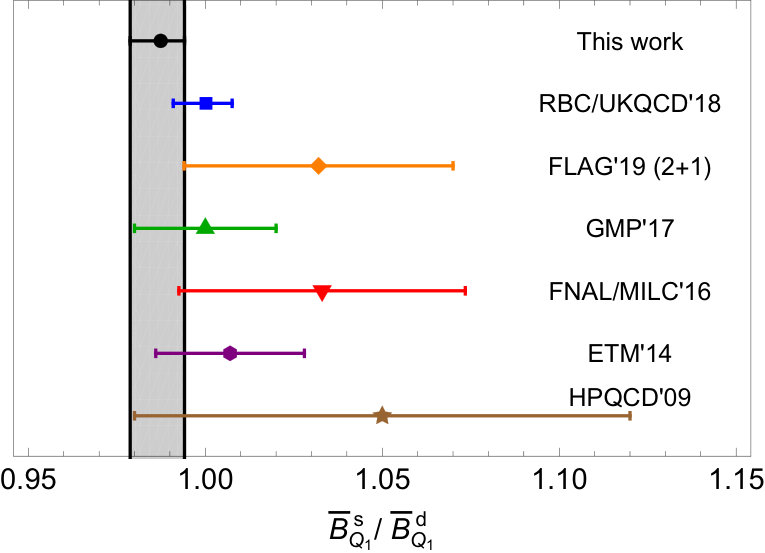 Figure 1
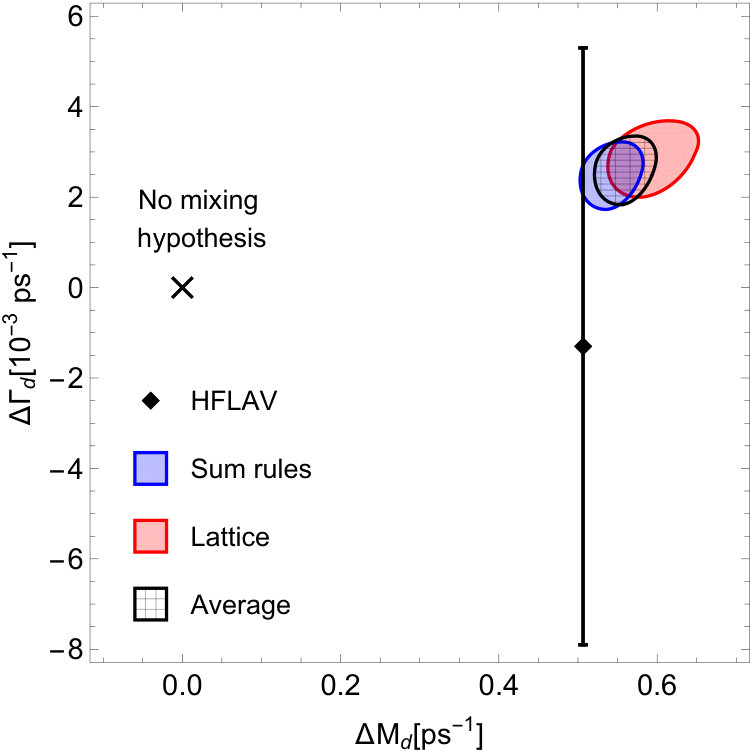 Figure 2
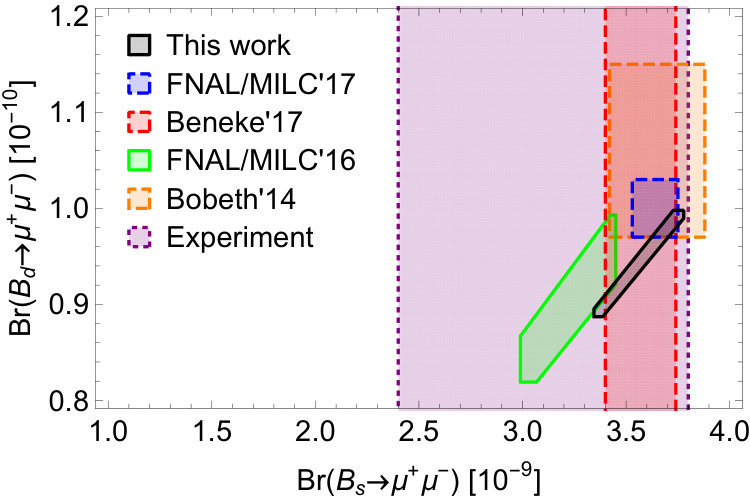 Figure 3
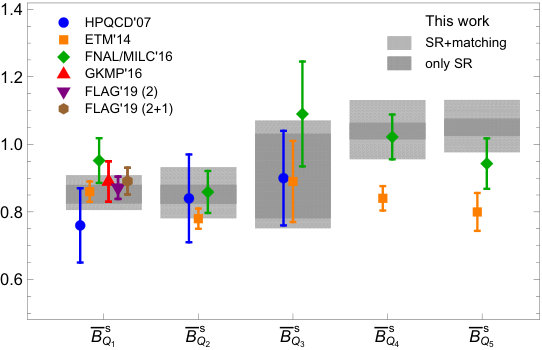 Figure 4
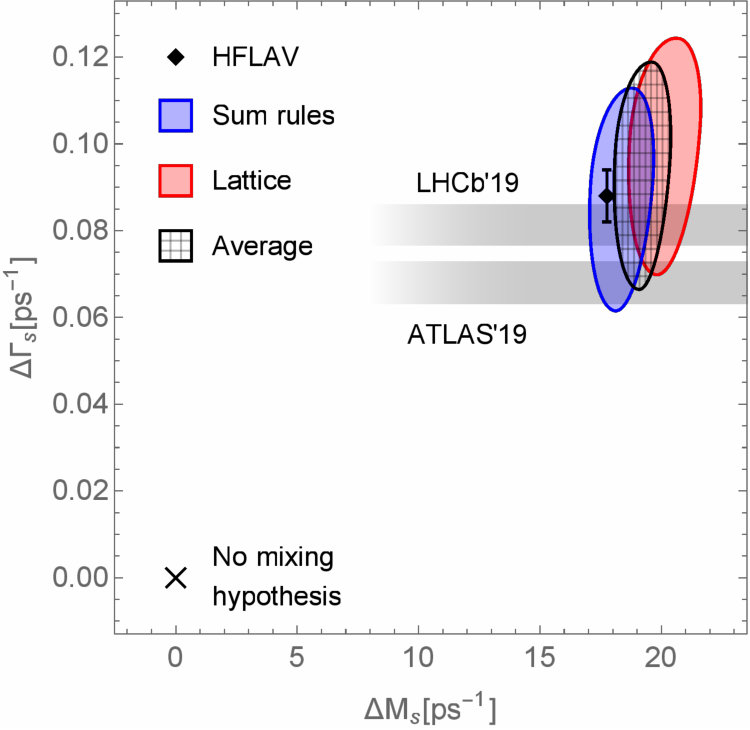 Figure 5
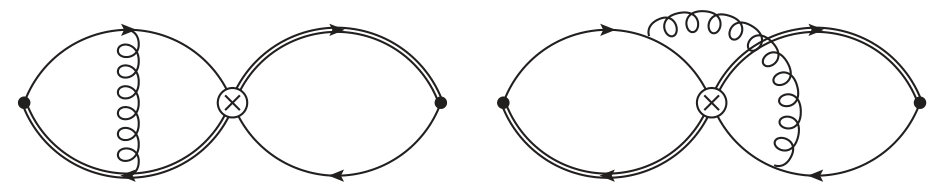 Figure 6
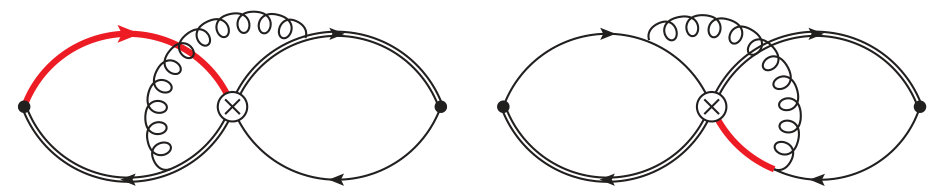 Figure 7
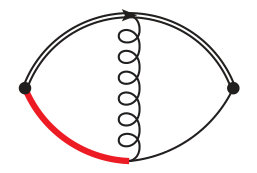 Figure 8
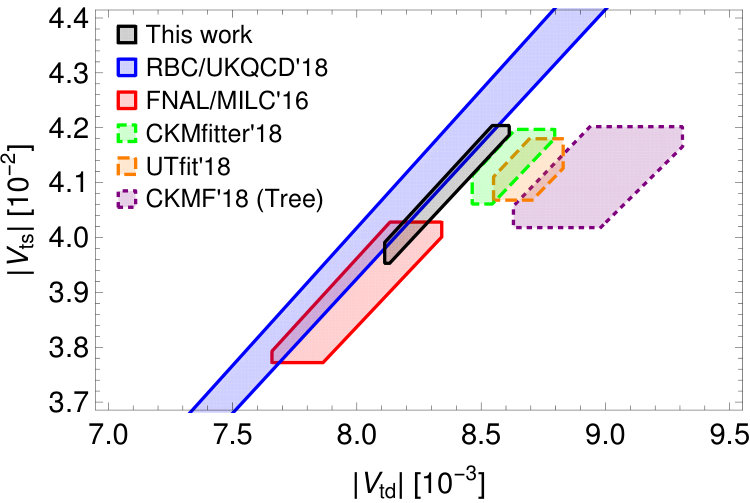 Figure 9
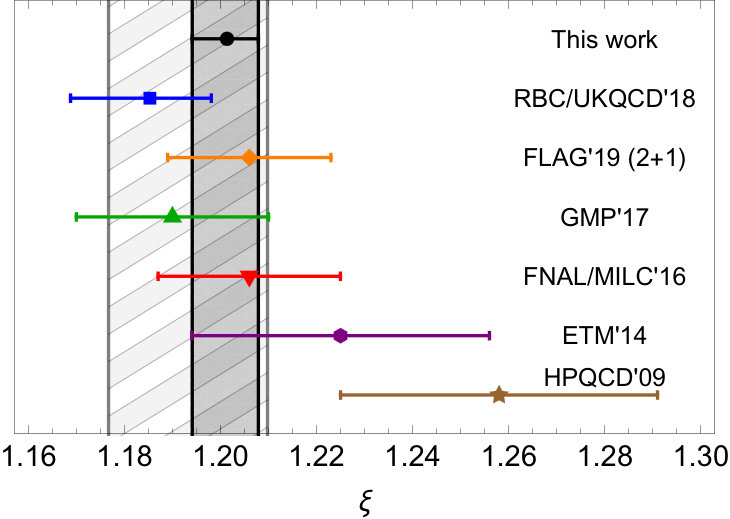 Figure 10
| intrinsic SR | condensates | |||||||
| intrinsic SR | condensates | |||||||
| [ps-1] | [ps-1] | [ps-1] | [ps-1] | |
| CKM |
Peer Reviews
No public reviews on file for this paper yet. If you reviewed it on a platform where reviews are public (OpenReview, ICLR, NeurIPS, ICML), you can paste yours below so the community can read it here.
Videos
No videos yet. Explain this paper in a talk, walkthrough, or lecture? Add one.
IPPP/19/20
** mixing observables and from sum rules**
Daniel King*(a), Alexander Lenz(a)* and Thomas Rauh*(a,b)*
* IPPP, Department of Physics, University of Durham,
DH1 3LE, United Kingdom
Albert Einstein Center for Fundamental Physics,
Institute for Theoretical Physics, University of Bern,
Sidlerstrasse 5, CH-3012 Bern, Switzerland *
**Abstract
**
We consider the effects of a non-vanishing strange-quark mass in the determination of the full basis of dimension six matrix elements for mixing, in particular we get for the ratio of the Bag parameter in the and system: . Combining these results with the most recent lattice values for the ratio of decay constants we obtain the most precise determination of the ratio in agreement with recent lattice determinations. We find and to be consistent with experiments at below one sigma. Assuming the validity of the SM, our calculation can be used to directly determine the ratio of CKM elements , which is compatible with the results from the CKM fitting groups, but again more precise.
1 Introduction
Mixing of mesons is experimentally well studied [1] and the mass difference is known with a high precision [2] (based on the individual measurements [3, 4, 5, 6, 7]):
[TABLE]
The corresponding theory expression for reads
[TABLE]
with the CKM element and the Inami-Lim function [8] describing the result of the 1-loop box diagrams in the standard model (SM). Perturbative 2-loop QCD corrections are compressed in the factor [9]. Since this observable is loop-suppressed in the SM, it is expected to be very sensitive to BSM effects. The bag parameter and the decay constant quantify the hadronic contribution to -mixing; the uncertainties of their numerical values make up the biggest uncertainty by far in the SM prediction of the mass difference. These parameters have been determined by lattice simulations [10, 11, 12] and for the case of mesons with HQET sum rules [13, 14, 15, 16]. There is also a recent lattice determination of the SU(3) breaking ratios [17].
Taking the most recent lattice average from the Flavour Lattice Averaging Group (FLAG) [18], which is more or less equivalent to the result in [12], one gets [19] a SM prediction for the mass difference, which is larger than the measurement:
[TABLE]
Such a value has dramatic consequences for some of the BSM models that are currently investigated in order to explain the flavour anomalies. In particular the parameter space of certain models is almost completely excluded [19].
In this work we extend the analysis of [15] with effects of a finite strange-quark mass, thus getting for the first time a HQET sum rule prediction for the mixing Bag parameter of mesons. Lattice simulations typically achieve a much higher precision than sum rule calculations, but in our case a sum rule for can be written down. Since the value of the Bag parameter is close to 1, even a moderate precision of the sum rule of the order of 20 for , turns into a precision of the order of for the whole Bag parameter, which is highly competitive. Thus our determination constitutes an independent cross-check of the large lattice value found in [12]. In combination with a precise lattice determination of the decay constant our result for the Bag parameter can also be used for a direct determination of from the measured mass difference . Taking instead a ratio of the mass differences in the and the system one can get a clean handle on . Taking further a ratio of and the rare branching ratio the decay constant and the CKM dependence cancel and the Bag parameter will be the only relevant input parameter.
Our paper is organised as follows: in Section 2 we set up the sum rule for the Bag parameter and determine the corrections, in Section 3 we present a numerical study of the sum rules and we perform a phenomenological analysis. Finally, we conclude in Section 4.
2 Sum rules in HQET
2.1 Operator basis and definition of bag parameters
In this work we use the full dimension-six operator basis required for a calculation of in the SM111The operator corresponds to the SM contribution to . and BSM theories and for a SM prediction of . The QCD operators involved are
[TABLE]
while our HQET basis is defined as
[TABLE]
where is the HQET bottom/anti-bottom field and we use the notation
[TABLE]
The matching condition is given by
[TABLE]
for which the NLO HQET-QCD matching coefficients were presented in [15]. We also use the same basis of evanescent operators. As mentioned in [15], the HQET evanescent operators are defined up to 3 constants with in order to gauge the scheme dependence. We also note that in all of the following we work within the NDR scheme in dimensional regularisation with .
The QCD bag parameters are defined through [20]
[TABLE]
with the coefficients given by
[TABLE]
where denotes the meson mass, corresponds to quark pole masses and the meson decay constant is defined by
[TABLE]
The barred terms in the far right expression of (2.5) indicate that the quark masses used there are in the scheme. For the reasons discussed in [15] we prefer to use the pole masses for our analysis and then convert to this form at the end. Similarly, the HQET bag parameters are defined through
[TABLE]
with the coefficients given by
[TABLE]
and where the matrix elements are taken between non-relativistically normalised states with
[TABLE]
The HQET decay constant , appearing in (2.8) is defined by
[TABLE]
which is then related to the QCD decay constant through
[TABLE]
with [21]
[TABLE]
From our sum rule analysis we determine the HQET bag parameters . Using (2.4), (2.5), (2.8), and (2.12) we arrive at the relation
[TABLE]
which allows us to then match the values of onto their QCD counterparts.
2.2 Finite effects in the HQET decay constant
To illustrate our strategy for the treatment of finite effects we first consider the Borel sum rule for the HQET decay constant which has been derived in [22, 23, 24]. In the system it takes the form
[TABLE]
where is the discontinuity of the two-point correlator
[TABLE]
with and the interpolating current . The leading perturbative part of the discontinuity is given by
[TABLE]
In the remainder of this subsection we consider the finite-energy (FESR) version of the sum rule (2.15) which is given by the limit to be able to present compact analytic results. We obtain
[TABLE]
In the last step we have expanded the result in the small ratio . The appearance of a term in the expansion indicates that energies of the order contribute at order . These logarithms can be absorbed into the quark condensate [22, 25]. In the following we show how the terms up to order can be determined without knowing the full dependence of the discontinuity (2.17). This will be essential for the determination of the effects in the Bag parameters where the calculation of the full dependence is very challenging (3 loops and 3 scales). We first split the integration at an arbitrary scale with . Above we may expand the integrand in , yielding the identity
[TABLE]
where indicates that the expression in square brackets must be Taylor expanded in . The dependence on the scale has to cancel in the expanded result. We can therefore take the limit after expanding the result according to the scaling . We note that the contribution from the integration of the full integrand between and does not vanish for , because the limit has to be taken after the expansion in and the two operations do not commute. It is however clear from dimensional analysis that this contribution must be polynomial in starting at since the exponential can be Taylor expanded. This demonstrates that it is sufficient to compute the discontinuity (2.17) as an expansion in if we restrict the analysis to the linear and quadratic terms which is clearly sufficient due to the small expansion parameter. In the FESR limit considered above we find222Here the limit and the Taylor expansion commute, because the integrand is polynomial in .
[TABLE]
The difference between (2.18) and (2.20) is indeed of order and is compensated by the contribution from the first term on the right-hand side of (2.19).
At NLO we therefore only compute the expanded result by using the method of regions [26, 27]. The light degrees of freedom can be either hard with momentum or soft with momentum whereas the heavy quark field is always hard. Up to and including the order there are however only contributions from diagrams where all lines are hard. An example diagram involving a soft line is shown in Figure 1.
The integral measure scales as and the soft light-quark propagator scales as , yielding an overall scaling of . Diagrams where only the gluon is soft are scaleless and vanish in dimensional regularization. Contributions where both loop momenta are soft are of the order . Therefore, we only need to consider the fully hard momentum region where the integrand can be naively Taylor expanded in . We obtain
[TABLE]
in agreement with [22].
2.3 Finite effects in the Bag parameters
The sum rule for the Bag parameters is based on the three-point correlator
[TABLE]
where and the interpolating currents for the and mesons read
[TABLE]
The accuracy of the sum rule approach crucially depends on the observation that the contributions to the correlator can be split into factorizable and non-factorizable ones, examples of which are given in Figure 2.22.
The full set of factorizable contributions amounts to which allows us to formulate a sum rule for the deviation based only on the non-factorizable contributions [28, 29, 13, 15]
[TABLE]
where the second equation makes use of (2.15). The quantity is the non-factorizable part of the double discontinuity
[TABLE]
In [15] we derived a simple analytical result for the HQET bag parameters by comparing (2.24) to the square of the sum rule for the decay constant (2.15) with an appropriately chosen weight function
[TABLE]
The generalization of this approach to the corrections is straightforward. Expanding the double discontinuity in , we obtain
[TABLE]
where and . With this parametrization, the symmetry of the three-point correlator under exchange of and manifests as a symmetry under of the . The result for the deviation of the Bag parameters from the VSA reads
[TABLE]
where . We find that the result only depends on the value of the double discontinuity at . Thus, the knowledge of the -expanded double discontinuity is sufficient to determine the effects for the Bag parameters in mixing. However, the use of this weight function approach relies on the expanded version of the sum rule (2.15) for the decay constant. As discussed in the previous subsection, this approach gives an incorrect result at the order and the result (2.29) is therefore limited to the quadratic order in .
2.4 Non-zero corrections to the non-factorizable part
We compute the -expanded result for the leading non-factorizable part of the three-point correlators using the expansion by regions [26, 27]. As in the case of the two-point correlator, contributions involving soft propagators like the ones shown in Figure 3 first contribute at order .
Thus, we only have to consider the fully hard momentum region where all loop momenta admit the scaling and the loop integrands can be naively Taylor expanded in . We have performed two independent calculations. The amplitudes are either generated using QGRAF [30] with further processing in Mathematica or with a manual approach. The Dirac algebra is performed either with TRACER [31] or a private implementation. We employ FIRE [32] to generate IBP relations [33] between the loop integrals and to reduce them to a set of Master integrals with the Laporta algorithm [34]. The required master integrals have been computed to all orders in in [35]. We have expanded them up to the required order in using HypExp [36]. For completeness we state the results for previously presented in [15]
[TABLE]
with
[TABLE]
For the linear terms we obtain
[TABLE]
with
[TABLE]
Last but not least, our results for the quadratic terms are
[TABLE]
3 Results and phenomenology
We determine the Bag parameters in Section 3.1, give our predictions for the mixing observables in Section 3.2 and use the results to determine the CKM elements and in Section 3.3 and the top-quark mass in Section 3.4. We then present an alternative prediction of the branching ratios from the ratios in Section 3.5. Our analysis strategy closely follows the one we used in [15] in the limit and we only comment on where they differ due to the non-zero strange mass while referring to [15] for more details.
3.1 Bag parameters
We determine the HQET Bag parameters at the scale GeV using the weight function approach (2.29). The strange-quark mass scheme in (2.29) is undetermined since any scheme change would only affect the expressions at higher orders which are not taken into account. We use the value in the scheme at the scale which is determined from the central value of the average MeV [37]. To account for the uncertainties related to the scheme choice and the truncation of the expansion in we increase the parametric uncertainty and use MeV. To the perturbative part we add the condensate contributions [38, 39]. The lattice simulation [40] shows that light and strange quark condensates agree within uncertainties and their result for the strange-quark condensate has since been confirmed with a different method [41]. With the factorization hypothesis the same holds for the quark-gluon condensate. We therefore assume the condensate corrections to be the same in the and systems. We obtain
[TABLE]
where we have indicated the orders in with subscripts and find good convergence of the expansion. The differences in the leading terms with respect to the results for mixing obtained in [15] arise because the logarithms are replaced by which we do not expand in .
The results (3.1) are then evolved to the matching scale where they are converted to QCD Bag parameters using (2.14). We do not consider the effects of a non-zero strange-quark mass in the QCD-HQET matching. The matching corrections are of the order and therefore subleading compared to the linear terms and even the quadratic terms in the sum rule. We do not include this uncertainty as a separate contribution in our error analysis since it is covered by the conservative variation of the input value for . Lastly, we convert the QCD Bag parameters to the usual convention which we denoted as in (2.5). We find
[TABLE]
where we have included the uncertainty from variation of in the sum rule (SR) error and M denotes the uncertainty from the QCD-HQET matching. We compare our results to other determinations from lattice simulations [10, 11, 12] and sum rules [13] and the FLAG averages [18] in Figure 4 and find very good agreement overall with similar uncertainties. We observe that the FNAL/MILC’16 value for is larger than all the other results – with respect to our value the difference corresponds to 1.1 sigma. We note that FNAL/MILC’16 determined the combination and extracted the Bag parameter using the 2016 PDG average for the decay constant. They are currently working on a direct determination and, since their recent result [42] for is larger than the PDG value used in [12], we expect the Bag parameter to go down. On the other hand our Bag parameters for are in good agreement with FNAL/MILC’16, while there is a tension of more than two sigmas with respect to the results of ETM’14. Similar tensions have been observed in the Kaon system [43] where it was conjectured that a difference in intermediate renormalization schemes might be responsible.
We also consider the ratios of the Bag parameters in the and system where a large part of the uncertainties cancel
[TABLE]
The leading terms in the -expansion differ from unity because we do not expand the logarithms in . Compared to the absolute Bag parameters we reduce the intrinsic sum rule error to 0.005, the condensate error to 0.002 and the uncertainty due to power corrections to 0.002 since the respective uncertainties cancel to a large extend in the ratios. However, we enhance the intrinsic sum rule and condensate error estimates for the operator by a factor of five since the sum rule uncertainties for this operator are enhanced by large ratios of color factors as discussed in [15]. A detailed overview of the uncertainties is given in Appendix A. The ratios (3.3) are in excellent agreement with the parametric estimates from [14, 15] with the exception of where this uncertainty should have been enhanced like the other sum rule uncertainties listed above to account for the large color factors in the QCD-HQET matching relation (2.14) for the Bag parameter.
Taking the FLAG [18]333The average is dominated by the HPQCD’17 [44] and FNAL/MILC’17 [42] results. value with for the ratio of the decay constants of and we obtain the most precise result to date for the ratio
[TABLE]
where the ratio of decay constants and Bag parameters contributes equally to the error budget. A comparison with previous results is shown in Figure 5. There we also show how the result changes when the FLAG average is used for the ratio of the decay constants. Unfortunately FNAL/MILC and ETM do not provide values for for so we cannot easily compare our results for these ratios.
3.2 mixing observables
In this section we present the results of our mixing analysis. We consider the mass differences and , the decay rate differences and , and the ratio , of which the latter benefits from a reduced uncertainty due to the cancellation of CKM factors and hadronic effects. For the bottom-quark mass we studied the , PS [46], 1S [47] and the kinetic [48] mass schemes and found good agreement (see [15] for a more detailed discussion) - below we just quote the result in the PS scheme. We choose as our CKM parameter inputs the results of CKMfitter2018[49] and collect these along with our other numerical inputs in Appendix A. For the non-perturbative input we use our SR determination of the Bag parameters (Eq.(3.2) and Eq. (3.3)) together with the lattice decay constants () from [18] (dominated by HPQCD’17 [44] and FNAL/MILC’17 [42]).
Comparing our findings for we see an excellent agreement with the experimental measurement [2]:
[TABLE]
We note that the update to our CKM input gives rise to an increase in from the value presented in [15], despite the inclusion of -corrections which reduce the size of our hadronic input. Using instead the non-perturbative input purely from lattice determinations (FLAG 2019 [18], which is almost identical to the result in [12]), we get a considerably higher SM prediction for : , being about 1.5 standard deviations above the experiment. Due to updated CKM inputs this number is slightly larger than the one quoted in Eq.(1.3). Averaging the SR and the lattice results, we get a further reduction of the uncertainties: .
We also find perfect agreement between our result for and experiment [2]:
[TABLE]
Recent measurements [50, 51] that are not yet contained in the average [2] yield significantly smaller values for which are however still in the one-sigma range of our prediction. The theoretical prediction for the decay rate difference includes NLO QCD [52, 53, 54, 55] and [56, 57] corrections. The latter depend on matrix elements of dimension-seven operators which are currently only known in the vacuum saturation approximation, which results in uncertainties of approximately 25-30%. The sizable scale uncertainty can be reduced with a NNLO computation of the HQE matching coefficients - first steps towards this have recently been performed in [58]. Using instead the non-perturbative input from lattice [18], we again get higher values . Due to the larger uncertainties this prediction overlaps at 1 sigma with experiment. Combining the the sum rule result with the lattice result we get . Here the accuracy of the average does not improve, because the uncertainty is dominated by the unknown matrix elements of dimension seven operators and scale variation.
Due to new CKM inputs (compared to the analysis in [15]), we are also updating our results for mixing observables444The corresponding lattice result reads (about 1.4 sigma above experiment) and the average over SR and lattice is .:
[TABLE]
and555The corresponding lattice result reads and the average over SR and lattice is .:
[TABLE]
where at present only an experimental upper bound on is available. The SM value of the mass difference agrees with experiment at the 1 sigma level. Fig. 6 (left panel) shows the comparison of the measurements of and with the corresponding theory predictions: in blue the 1 sigma region of our sum rule values, in the red the purely lattice results and in black the average of both. The right panel shows the same comparison for the system. All in all the sum rule values agree well with experiment, while the pure lattice results show a 1.5 sigma deviation for the mass differences - leading to very strong bounds on BSM models that try to explain the flavour anomalies.
Finally, for the ratio of the mass differences we also find our results to be consistent (within about 1.3 standard deviations) with the measured value:
[TABLE]
Due to our new value for we get a theoretical precision of about for the ratio of mass differences in the and systems, which poses severe constraints on BSM models, that modify neutral meson mixing. The uncertainty is now dominated by the CKM factors. Using lattice inputs one gets a slightly less precise value , which can be combined with the sum rule result to obtain
3.3 Determination of the CKM elements and
We also can use the measured values of the mass differences, together with our bag parameter, the lattice results for the decay constant ( from [18, 44, 42]) and the value of the CKM element (from [49]) to determine and
[TABLE]
These direct determinations overlap with the determinations based on CKM unitarity [49] (see [59] for similar results) but they are a little less precise:
[TABLE]
We note that the results of the full CKM fit include data on mixing and are therefore not completely independent. Thus, it is also interesting to compare to the results of the fit where only tree-level processes are considered. A discrepancy here would be a hint towards new physics in loop processes. The CKMfitter results are
[TABLE]
While there is good agreement for the value of differs from our result by about 1.4 sigma. The value of the ratio can be determined more precisely based on the exact relation
[TABLE]
Using our value of from Eq. (3.4) we can present here the most precise determination of :
[TABLE]
which is compatible with the values obtained by the FNAL/MILC [12] and RBC-UKQCD [17] collaborations
[TABLE]
These values are all somewhat smaller than the expectation from CKM unitarity taken from CKMfitter [49] and UTfit [59]
[TABLE]
Compared to the CKMfitter result
[TABLE]
from the fit to tree-level processes our value (3.14) is smaller by about 2.3 standard deviations. Thus, an improved determination of and from tree-level processes might provide an interesting hint towards new physics in the system. Similar considerations have recently led to claims about an emerging anomaly [60].
An overview of the various results is presented in Figure 7, where the overlap of the one-sigma regions for , and is indicated by the shaded regions. Our results provide an important input for future CKM unitarity fits and can be used to extract the angle in the unitarity triangle from the linear dependency between and the CKM angle observed in [61].
3.4 Determination of the top-quark mass
The parametric error from the top-quark mass currently dominates the uncertainty in the determination of the stability or meta-stability of the electroweak vacuum [62]. Direct measurements quote very precise values GeV for the top quark mass [37], but these results correspond to so-called Monte-Carlo (MC) masses and not the top-quark pole mass. One therefore needs to account for additional uncertainties from the scheme conversion [63] when these values are used for phenomenological predictions. Alternatively one can determine the top-quark mass by fitting observables like the total top-pair production cross section which can be predicted in terms of the top-quark mass in a well-defined scheme like . Similarly, we can use the mass differences for a theoretically clean determination of . Using the CKMfitter values for and as input we obtain
[TABLE]
Combining both results we find
[TABLE]
where we have averaged over the hadronic and scale uncertainties, which are correlated, and treated the parametric uncertainties, which are dominated either by or , as independent. This is in good agreement with the PDG average [37]
[TABLE]
of mass determinations from cross section measurements with our uncertainty being about 50% larger. A very precise measurement of the top-quark PS or mass with a total uncertainty of about 50 MeV is possible at a future lepton collider running at the top threshold [64, 65, 66].
3.5
The branching ratio is strongly suppressed in the SM and theoretically clean. Thus, it provides a very sensitive probe for new physics. At present it has been computed at NNLO QCD plus NLO EW [67] and the dominant uncertainties are parametric, stemming from the decay constant and the CKM parameters. Both uncertainties cancel out of the ratio [68]
[TABLE]
which in turn receives its dominant uncertainty from the Bag parameter . Using our result (3.3) and including the power-enhanced QED corrections determined in [69] we predict the branching ratio by multiplying (3.21) with the measured mass differences
[TABLE]
where the uncertainties for the branching ratios are completely dominated by the error from . The result for is in good agreement with the current experimental average [2]
[TABLE]
while the latest measurements only provide upper bounds at 95% confidence level for
[TABLE]
We compare our prediction (3.22) to the direct predictions from [67, 69, 42] which depend on the decay constants and CKM elements , the prediction [12] from the ratios and the experimental average (3.23) in Figure 8. The shaded regions correspond to the overlap of the one-sigma regions for , and where they were provided. We find good consistency among the various predictions with similar uncertainties for both approaches and good agreement with experiment whose uncertainty currently exceeds the theoretical one by a factor of about 3-4 in .
For completeness we provide our predictions for the branching ratios to electrons
[TABLE]
and tau leptons
[TABLE]
4 Conclusions
We have presented in this paper a HQET sum rule determination of the five Bag parameters describing -mixing in the SM and beyond. For that we had to determine and corrections to the three-point correlator at the 3-loop level. In particular we obtain the most precise values for the ratios of Bag parameters in the and system. Combing this result with the most recent lattice results for [18, 44, 42] we obtain the world’s most precise value for the ratio
[TABLE]
which represents a reduction of the uncertainty by more than a factor of two compared to the latest lattice results [12, 17]. Our results enable a rich phenomenology: we get updated SM predictions for the mixing observables and , which are in agreement with the experimental values. In particular we do not confirm the large values for obtained with the non-perturbative values from FNAL/MILC [12], which led to severe bounds on BSM models. If and are used as inputs, we can precisely determine the CKM elements and and we obtain the world’s most precise determination of the ratio . Using all CKM elements as inputs we get constraints on the values of the top quark mass which are compatible with direct collider determinations. Finally our results lead also to precise SM predictions for the branching ratios of the rare decays .
In future a still higher precision of our HEQT sum rule results can be obtained by the calculation of the HQET-QCD matching at NNLO (first steps in that direction have been performed in [16]). Another line of improvement could be the determination of -corrections to the HQET limit. The computation of corrections to the Bag parameters of four-quark operators would enable an update of the predictions for the lifetime ratios [15] and [73]. Finally a cross-check of our HQET sum results for mixing and lifetimes with modern lattice techniques would be very desirable.
Acknowledgements
We thank Sébastien Descotes-Genon for providing us with the result (3.17), Oliver Witzel for interesting discussions and Andrzej Buras, Aleksei Rusov and Tobias Tsang for comments on the manuscript. This work was supported by the STFC through the IPPP grant and a Postgraduate Studentship.
Appendix A Inputs and detailed overview of uncertainties
The reference list from the paper itself. Each links out to its DOI / PubMed record.
- 1[1] M. Artuso, G. Borissov and A. Lenz, CP violation in the B s 0 superscript subscript 𝐵 𝑠 0 B_{s}^{0} system , Rev. Mod. Phys. 88 (2016) no.4, 045002 [ar Xiv:1511.09466 [hep-ph]].
- 2[2] online update at http://www.slac.stanford.edu/xorg/hfag of Y. Amhis et al. [HFLAV Collaboration], Averages of b 𝑏 b -hadron, c 𝑐 c -hadron, and τ 𝜏 \tau -lepton properties as of summer 2016 , Eur. Phys. J. C 77 (2017) no.12, 895 [ar Xiv:1612.07233 [hep-ex]].
- 3[3] A. Abulencia et al. [CDF Collaboration], Observation of B s 0 − B ¯ s 0 subscript superscript 𝐵 0 𝑠 subscript superscript ¯ 𝐵 0 𝑠 B^{0}_{s}-\bar{B}^{0}_{s} Oscillations , Phys. Rev. Lett. 97 (2006) 242003 [hep-ex/0609040].
- 4[4] R. Aaij et al. [LH Cb Collaboration], Measurement of the B s 0 − B ¯ s 0 subscript superscript 𝐵 0 𝑠 subscript superscript ¯ 𝐵 0 𝑠 B^{0}_{s}-\bar{B}^{0}_{s} oscillation frequency Δ m s Δ subscript 𝑚 𝑠 \Delta m_{s} in B s 0 → D s − ( 3 ) π → subscript superscript 𝐵 0 𝑠 superscript subscript 𝐷 𝑠 3 𝜋 B^{0}_{s}\to D_{s}^{-}(3)\pi decays , Phys. Lett. B 709 (2012) 177 [ar Xiv:1112.4311 [hep-ex]].
- 5[5] R. Aaij et al. [LH Cb Collaboration], Precision measurement of the B s 0 subscript superscript 𝐵 0 𝑠 B^{0}_{s} - B ¯ s 0 subscript superscript ¯ 𝐵 0 𝑠 \bar{B}^{0}_{s} oscillation frequency with the decay B s 0 → D s − π + → subscript superscript 𝐵 0 𝑠 subscript superscript 𝐷 𝑠 superscript 𝜋 B^{0}_{s}\rightarrow D^{-}_{s}\pi^{+} , New J. Phys. 15 (2013) 053021 [ar Xiv:1304.4741 [hep-ex]].
- 6[6] R. Aaij et al. [LH Cb Collaboration], Observation of B s 0 subscript superscript 𝐵 0 𝑠 B^{0}_{s} - B ¯ s 0 subscript superscript ¯ 𝐵 0 𝑠 \bar{B}^{0}_{s} mixing and measurement of mixing frequencies using semileptonic B decays , Eur. Phys. J. C 73 (2013) no.12, 2655 [ar Xiv:1308.1302 [hep-ex]].
- 7[7] R. Aaij et al. [LH Cb Collaboration], Precision measurement of C P 𝐶 𝑃 CP violation in B s 0 → J / ψ K + K − → superscript subscript 𝐵 𝑠 0 𝐽 𝜓 superscript 𝐾 superscript 𝐾 B_{s}^{0}\to J/\psi K^{+}K^{-} decays , Phys. Rev. Lett. 114 (2015) no.4, 041801 [ar Xiv:1411.3104 [hep-ex]].
- 8[8] T. Inami and C. S. Lim, Effects of Superheavy Quarks and Leptons in Low-Energy Weak Processes K L → μ μ ¯ → subscript 𝐾 𝐿 𝜇 ¯ 𝜇 K_{L}\to\mu\bar{\mu} , K + → π + ν ν ¯ → superscript 𝐾 superscript 𝜋 𝜈 ¯ 𝜈 K^{+}\to\pi^{+}\nu\bar{\nu} and K 0 ↔ K ¯ 0 ↔ superscript 𝐾 0 superscript ¯ 𝐾 0 K^{0}\leftrightarrow\bar{K}^{0} , Prog. Theor. Phys. 65 (1981) 297, Erratum: [Prog. Theor. Phys. 65 (1981) 1772].