Extragalactic Proper Motions: Gravitational Waves and Cosmology
Jeremy Darling, Alexandra Truebenbach, and Jennie Paine

TL;DR
This paper reviews how extragalactic proper motions can be used to study cosmological phenomena, including gravitational waves and the universe's expansion, highlighting current measurements and future observational needs.
Contribution
It provides a comprehensive overview of the effects, their signatures, and the observational strategies to detect or constrain extragalactic proper motions related to cosmology.
Findings
Current measurements of proper motions are approaching the sensitivity needed to detect cosmological signals.
Proper motions can reveal gravitational waves, large-scale structure, and Hubble expansion anisotropies.
Predicted proper motion amplitudes are around 0.1 microarcseconds per year.
Abstract
Extragalactic proper motions can reveal a variety of cosmological and local phenomena over a range of angular scales. These include observer-induced proper motions, such as the secular aberration drift caused by the solar acceleration about the Galactic Center and secular extragalactic parallax resulting from our motion with respect to the cosmic microwave background rest frame. Cosmological effects include the isotropy of the Hubble expansion, transverse peculiar velocities induced by large scale structure, the real-time evolution of the baryon acoustic oscillation, and long-period gravitational waves that deflect light rays, producing an apparent quadrupolar proper motion pattern on the sky. We review these effects, their imprints on global correlated extragalactic proper motions, their expected amplitudes, the current best measurements (if any), and predictions for Gaia. Finally, we…
Click any figure to enlarge with its caption.
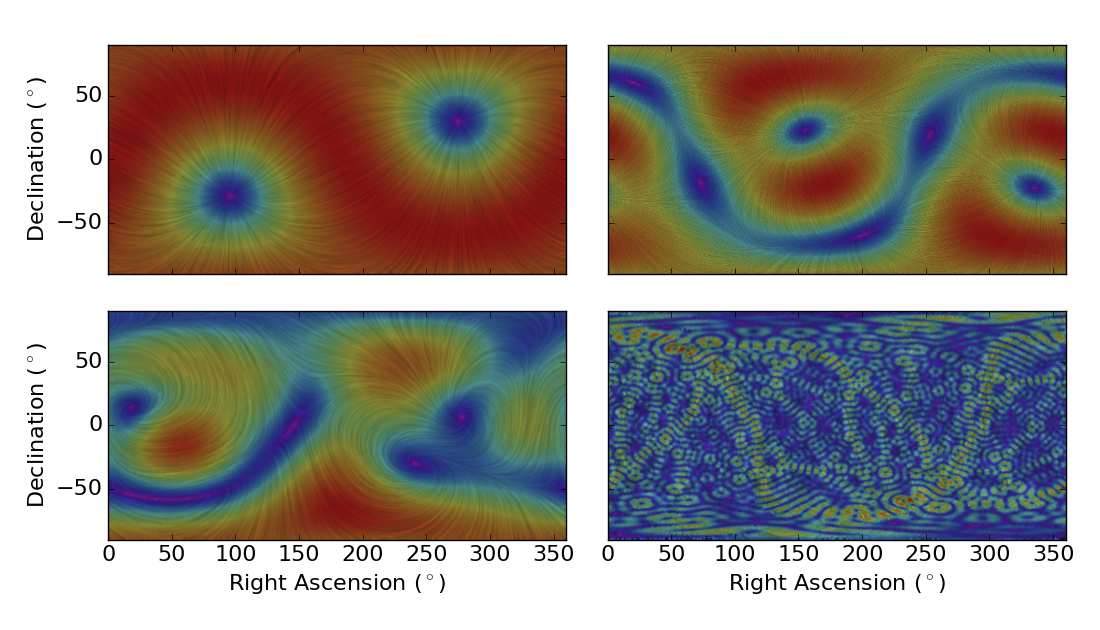 Figure 1
| Effect | Mode | Amplitude | Recent Measurement | Ref | Gaia | ngVLA or | Prev. Work | |
|---|---|---|---|---|---|---|---|---|
| Space Astrometry | ||||||||
| (arcsec yr-1) | (arcsec yr-1) | (Predicted) | (Predicted) | |||||
| Secular Aberration Drift | 1 | E | 5 | 1 | 10 | 50 | 2,3,4,5 | |
| Secular Parallax | 1 | E | 78 Mpc-1 | … | … | 10 | 10 (1) | 6 |
| Rotation | 1 | B | Unknown | 7 | as yr-1 | as yr-1 (2) | 2,5,7 | |
| Anisotropic Expansion | 2 | E | Unknown | % | 8 | % | % | 8,9,10,11 |
| Gravitational Waves | E+B | Unknown | 7 | 1,7,12,13,14,15,16 | ||||
| Large Scale Structure | E | to +5 | 17 | 10 | 20 (3) | 17,18,19,20 | ||
| BAO Evolution | 40 | E | at | … | … | 4 | 10 (4) | … |
Peer Reviews
No public reviews on file for this paper yet. If you reviewed it on a platform where reviews are public (OpenReview, ICLR, NeurIPS, ICML), you can paste yours below so the community can read it here.
Videos
No videos yet. Explain this paper in a talk, walkthrough, or lecture? Add one.
Astro2020 Science White Paper
Extragalactic Proper Motions: Gravitational Waves and Cosmology
Thematic Areas: Planetary Systems Star and Planet Formation Formation and Evolution of Compact Objects Cosmology and Fundamental Physics Stars and Stellar Evolution Resolved Stellar Populations and their Environments Galaxy Evolution Multi-Messenger Astronomy and Astrophysics
Principal Author:
Name: Jeremy Darling111The authors acknowledge support from the NSF grant AST-1411605 and the NASA grant 14-ATP14-0086. Institution: University of Colorado Email: [email protected] Phone: 303 492 4881
Co-authors: Alexandra Truebenbach & Jennie Paine (University of Colorado)
Abstract: Extragalactic proper motions can reveal a variety of cosmological and local phenomena over a range of angular scales. These include observer-induced proper motions, such as the secular aberration drift caused by the solar acceleration about the Galactic Center and secular extragalactic parallax resulting from our motion with respect to the cosmic microwave background rest frame. Cosmological effects include the isotropy of the Hubble expansion, transverse peculiar velocities induced by large scale structure, the real-time evolution of the baryon acoustic oscillation, and long-period gravitational waves that deflect light rays, producing an apparent quadrupolar proper motion pattern on the sky. We review these effects, their imprints on global correlated extragalactic proper motions, their expected amplitudes, the current best measurements (if any), and predictions for Gaia. Finally, we describe key ground- and space-based observational requirements to measure or constrain these proper motion signals down to amplitudes of 0.1 as yr*-1*, or 0.7% of .222Portions of this science white paper were adapted from Darling et al. (2018b) with permission from the publisher.
1 Background
The universe is dynamic, as we know from the Hubble expansion, but astronomers treat extragalactic objects as fixed in the sky with fixed redshifts. If measured with enough precision, however, nothing is constant: all objects will change their redshifts and angular positions at a rate of order yr*-1*. The secular redshift drift caused by a non-constant expansion (Sandage, 1962) is of order 0.3 cm s*-1* yr*-1* at and may be measured by optical telescopes using the Ly forest or by radio telescopes using HI 21 cm or molecular absorption lines (Loeb, 1998; Darling, 2012). Proper motions of extragalactic objects are caused by peculiar motions induced by large scale structure (Darling, 2013; Darling & Truebenbach, 2018; Truebenbach & Darling, 2018), by primordial gravitational waves (e.g., Pyne et al., 1996; Gwinn et al., 1997; Book & Flanagan, 2011; Darling et al., 2018), by the recession of cosmic rulers such as the baryon acoustic oscillation, or by anisotropic expansion (Fontanini et al., 2009; Quercellini et al., 2009; Titov, 2009; Darling, 2014).
Observer-induced proper motions are also possible: these include the secular aberration drift caused by acceleration of the solar system barycenter about the Galactic Center (e.g., Bastian, 1995; Eubanks et al., 1995) and secular extragalactic parallax caused by motion with respect to the cosmic microwave background (CMB; Ding & Croft, 2009).
Proper motions depict a discretely sampled vector field on the celestial sphere. It is therefore natural to describe proper motions using vector spherical harmonics (VSH), the vector extension of the scalar spherical harmonics used to describe signals such as the CMB temperature pattern, the geoid, or equipotentials (Mignard & Klioner, 2012). VSH are characterized by their degree and order , and resemble electromagnetic fields. They can therefore be separated into curl-free (E-mode) and divergenceless (B-mode) vector fields that are typically connected to distinct physical phenomena. The general method for characterizing a correlated proper motion field is to fit VSH to the observed proper motions and to calculate the power in each mode.
2 Expected (and Possible) Signals
Table 1 summarizes the expected and possible global extragalactic proper motion signals. This summary is likely to be incomplete. Here we provide a brief description of each physical or observer-induced effect, and Section 3 discusses the key observational requirements for detecting or constraining these phenomena.
2.1 Secular Aberration Drift
Aberration of light is caused by the finite speed of light and the motion of the observer with respect to a light source. The resulting deflection of light scales as . If the observer accelerates, then the aberration exhibits a secular drift, and objects appear to stream in the direction of the acceleration vector. The solar system barycenter accelerates at roughly 0.7 cm s*-1* yr*-1* as the Sun orbits the Galactic Center, resulting in an apparent 5 arcsec yr*-1* E-mode dipole converging on the Galactic Center (Figure 1). This has been detected in the proper motions of radio sources, first by Titov et al. (2011), using a priori knowledge of the expected effect, and recently without priors by Truebenbach & Darling (2017). Titov & Krásná (2018) have further developed the VLBI-specific methodology for extracting this signal.
2.2 Secular Parallax
The CMB shows a temperature dipole of 3.4 mK due to the motion of the solar system barycenter with respect to the CMB rest frame (e.g., Hinshaw et al., 2009). This amounts to a relative motion of km s*-1* or 78 AU yr*-1*. This motion will induce a maximum secular parallax of 78 arcsec yr*-1* Mpc*-1*: nearby galaxies in directions perpendicular to the CMB poles will show a reflex motion opposite our motion when compared to distant galaxies. Precise proper motion measurements of galaxies within 50 Mpc will allow a statistical detection of the distance-dependent E-mode dipole caused by secular parallax. When referenced to this average dipole, it will be possible to detect the peculiar motions of individual galaxies as well as their geometric distances. Secular parallax may provide a distance ladder-free method for measuring distances in the local universe (and thus ).
2.3 Rotation
As rotating observers, we use quasars to define a fixed, non-rotating reference frame in order to measure and monitor the rotation of the Earth (e.g., McCarthy & Petit, 2004). We have no means to detect non-terrestrial rotation that has an axis close to polar, but it is possible to detect or constrain rotation about axes that are not aligned with the polar axis. While the question of a rotating universe can be nettlesome to contemplate and violates our assumption of cosmological isotropy, one can nonetheless make precise, sub-arcsec yr*-1* measurements of the effect because it would manifest as a B-mode dipole in the proper motion vector field.
2.4 Anisotropic Expansion
In an isotropically expanding universe, objects move radially away from every observer (modulo small peculiar motions due to local density perturbations; see Section 2.6), so there will be no global correlated proper motions caused by isotropic Hubble expansion. However, anisotropic expansion would cause objects to stream across the sky toward the directions of fastest expansion and away from directions of slowest expansion (Figure 1). Assuming triaxial anisotropy, one can show that the resulting celestial proper motion pattern is completely described by an E-mode quadrupole (Darling, 2014). Fitting a curl-free quadrupole to a proper motion field can therefore measure or constrain the (an)isotropy of the Hubble expansion without a priori knowledge of . We can express the Hubble constant in terms of an angular rate, arcsec yr*-1*, which means that a 10% anisotropy would produce a quadrupole amplitude of 1.5 arcsec yr*-1*.
2.5 Gravitational Waves
Stochastic gravitational waves deflect light rays in a quadrupolar (and higher ) pattern with equal power in the E- and B-modes (Figure 1; Pyne et al., 1996; Gwinn et al., 1997; Book & Flanagan, 2011). Proper motion observations are sensitive to gravitational wave frequencies Hz Hz ( to 0.3 yr*-1*), which overlap the pulsar timing and CMB polarization regimes, but uniquely span about seven orders of magnitude between the two methods (Darling et al., 2018). The cosmic energy density of gravitational waves can be related to the proper motion quadrupolar power or variance as
[TABLE]
(Gwinn et al., 1997; Book & Flanagan, 2011; Darling et al., 2018). Measuring or constraining the proper motion quadrupole power can therefore detect or place limits on primordial gravitational waves in a unique portion of the gravitational wave spectrum.
2.6 Large Scale Structure
The mass density distribution of large-scale structure reflects the mass power spectrum, the shape and evolution of which relies on cosmological parameters. The transverse peculiar motions of extragalactic objects can be used to measure the density perturbations from large-scale structure without a reliance on precise distance measurements. While line-of-sight velocity studies use distances to differentiate Hubble expansion from peculiar velocity, peculiar motions across the line-of-sight are separable from Hubble expansion because no proper motion will occur in a homogeneous expansion (Nusser et al., 2012; Darling, 2013). Thus, one can employ a two-dimensional transverse velocity correlation function to connect proper motions to large scale structure (Truebenbach & Darling, 2018). This same measure is straightforward to connect to the theoretical matter power spectrum (Darling & Truebenbach, 2018; Hall, 2018). Proper motions can thus test the shape of the mass power spectrum without a dependence on precise distance measurements or reliance on a cosmological distance ladder.
2.7 Baryon Acoustic Oscillation Evolution
The baryon acoustic oscillation (BAO) is a “standard ruler” arising from pre-CMB density fluctuations, which can be observed as an overdensity of galaxies on the scale of 150 Mpc, comoving (Eisenstein et al., 2005). At redshift , the BAO scale subtends , which is equivalent to VSH degree . Taking the time derivative, we obtain an expression for proper motion on these scales:
[TABLE]
The BAO evolution will therefore manifest as a convergent E-mode signal around (Figure 1). To first order, the BAO scale depends on the expansion rate and the angular diameter distance at the observed redshift, but the rate of change of this standard ruler is dominated by its recession (“receding objects appear to shrink”) and depends to first order on . Detection of this effect relies critically on the sky density of sources, which must adequately sample angular scales smaller than .
[FIGURE:]
3 Key Observational Requirements
Both ground- and space-based astrometric observatories can detect or constrain all of these phenomena and improve upon the expected Gaia measurements. Table 1 lists the various proper motion signals, their VSH modes, the expected amplitude of the signal (if known), a recent measurement (if any), and predictions for Gaia, a long-baseline next-generation Very Large Array (ngVLA), and a new space astrometry mission.
Key observational requirements include all-sky coverage (for low- modes), large extragalactic samples with reasonable per-object astrometric precision (10–100 as), and modest time baselines (5–10 yr). These requirements can be met with (1) a ground-based long-baseline radio facility with Very Long Baseline Array (VLBA) resolution and ten times the collecting area ( m dishes) or (2) a space-based visible light astrometric mission with astrometric uncertainties a factor of 3 lower than Gaia in each coordinate at any given magnitude. The long-baseline radio program would monitor 10,000 objects over 10 years with VLBA-level astrometric precision: as yr*-1* per object. This sample would be roughly ten times larger than current VLBA geodetic monitoring samples. The optical space-based facility would observe the AGN in the current Gaia sample. If the astrometry signal-to-noise could be improved by a factor of 3 compared to Gaia444This could be achieved through a combination of a slightly larger telescope, more efficient optics, and a longer mission lifetime. Proper motion uncertainties scale with time as . * then the median extragalactic per-source proper motion uncertainty will be as yr-1*.
Either of the above programs would enable detection of global correlated signals of 0.1 as yr*-1*, which is 0.7% of , and we would expect to detect most of the phenomena described in Section 2. Gravitational waves, anisotropy, and rotation would likely be (new) upper limits. A ground-based radio program may not perform as well as a space-based facility for measurements requiring fine angular sampling (e.g., BAO evolution) or dense volumetric sampling (the secular parallax). This is due to the overall physical paucity of compact radio sources compared to optical sources across the sky and in the very nearby universe.
New ground- or space-based astrometric observatories will provide exquisite precision on the Solar motion in the Galaxy and place the strongest constraints to date on the isotropy of the Hubble expansion in the epoch of dark energy and on the primordial gravitational wave background over roughly 10 decades in frequency. We will detect transverse peculiar motion, extragalactic parallax, and real-time recession of the BAO.
The reference list from the paper itself. Each links out to its DOI / PubMed record.
- 1Bastian (1995) Bastian, U. 1995, in ESA Special Publication, Vol. 379, Future Possibilities for Astrometry in Space, ed. M. A. C. Perryman & F. van Leeuwen, 99
- 2Bengaly (2016) Bengaly, C. A. P., Jr. 2016, JCAP, 4, 036
- 3Book & Flanagan (2011) Book, L. G. & Flanagan, É. É. 2011, Phys. Rev. D, 83, 024024
- 4Bower et al. (2015) Bower, G. C., Demorest, P., Braatz, J., et al. 2015, Ar Xiv e-prints, ar Xiv:1510.06432
- 5Braginsky et al. (1990) Braginsky, V. B., Kardashev, N. S., Polnarev, A. G., & Novikov, I. D. 1990, Nuovo Cimento B, 105, 1141
- 6Chang & Lin (2015) Chang, Z., & Lin, H.-N. 2015, MNRAS, 446, 2952
- 7Darling (2012) Darling, J. 2012, Ap J, 761, L 26
- 8Darling (2013) Darling, J. 2013, Ap J, 777, L 21