The Bolza curve and some orbifold ball quotient surfaces
Vincent Koziarz, Carlos Rito, Xavier Roulleau

TL;DR
This paper investigates orbifold ball quotient surfaces derived from Abelian surfaces related to the Bolza genus 2 curve, identifying their geometric structures and symmetries through explicit equations and configurations.
Contribution
It identifies the orbifold surfaces as birational transformations of quotients of Abelian surfaces, computes their mirror equations, and constructs explicit configurations of plane curves and conics.
Findings
Identification of $X$ as $ ext{P}(1,3,8)$
Explicit equations for the mirror $M$
Construction of orbifold surfaces from conic arrangements
Abstract
We study Deraux's non arithmetic orbifold ball quotient surfaces obtained as birational transformations of a quotient of a particular Abelian surface . Using the fact that is the Jacobian of the Bolza genus curve, we identify as the weighted projective plane . We compute the equation of the mirror of the orbifold ball quotient and by taking the quotient by an involution, we obtain an orbifold ball quotient surface with mirror birational to an interesting configuration of plane curves of degrees and . We also exhibit an arrangement of four conics in the plane which provides the above-mentioned ball quotient orbifold surfaces.
Click any figure to enlarge with its caption.
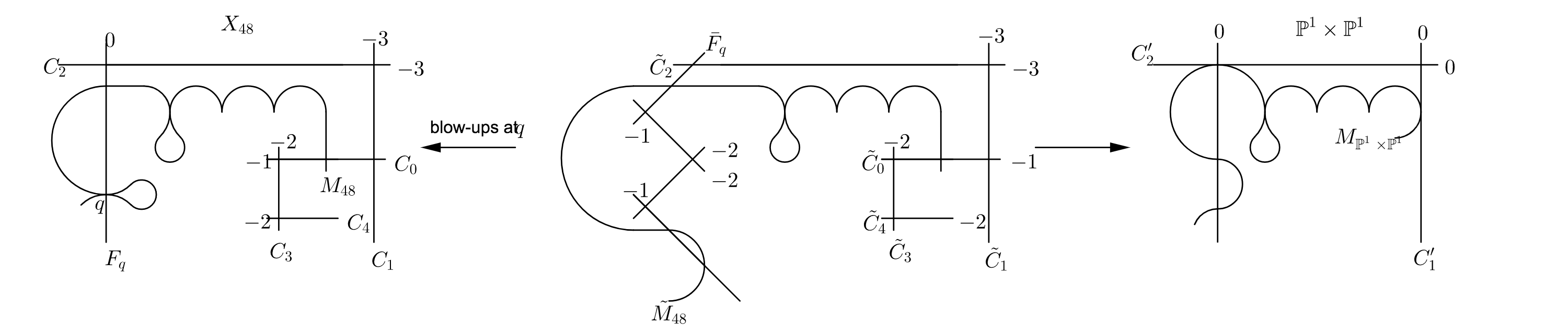 Figure 1
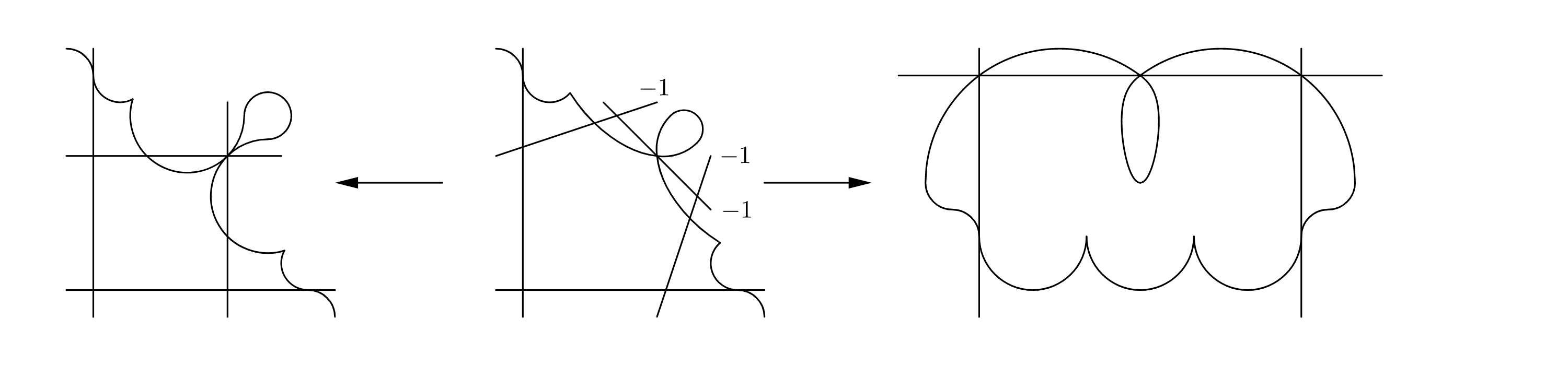 Figure 2
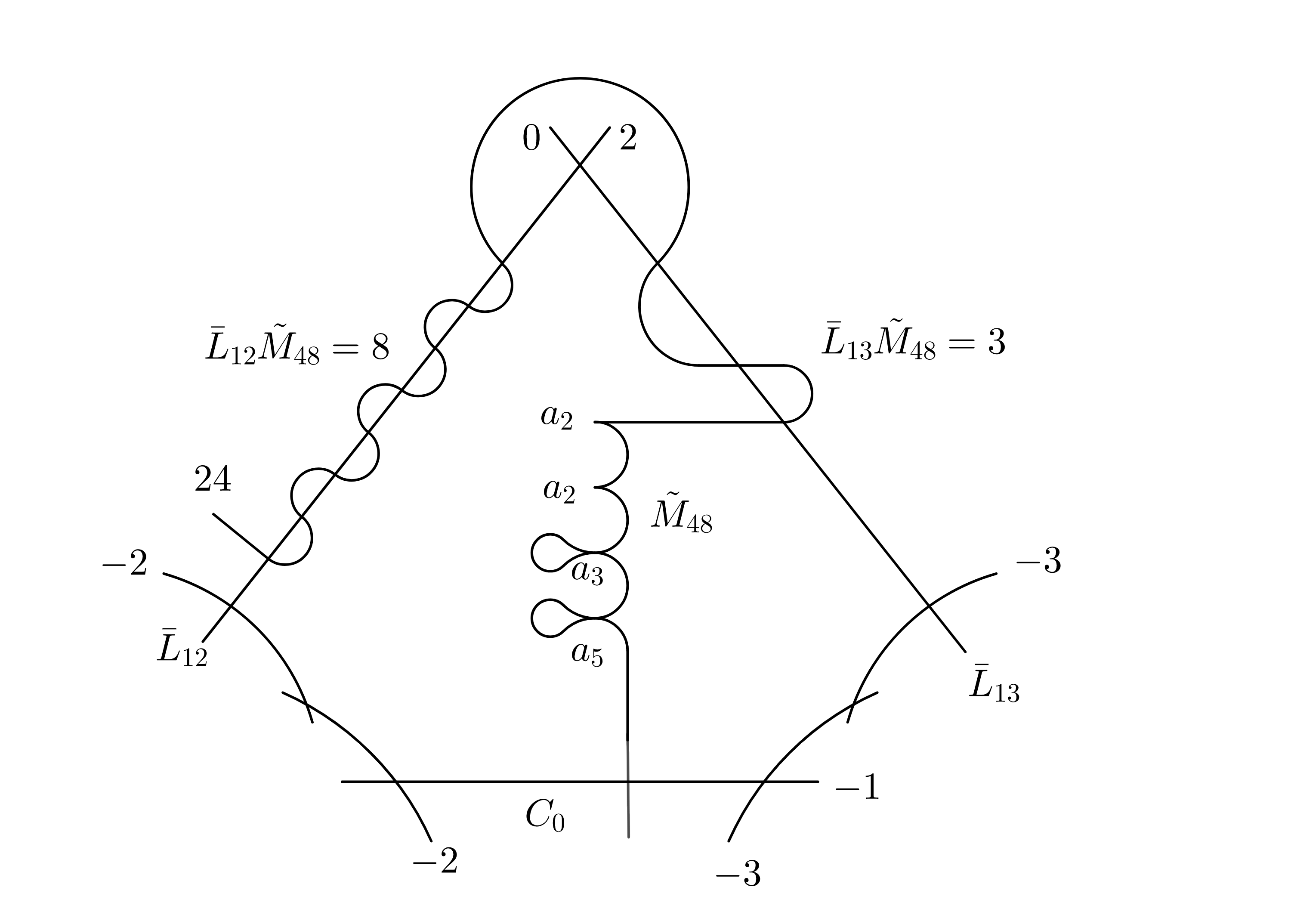 Figure 3
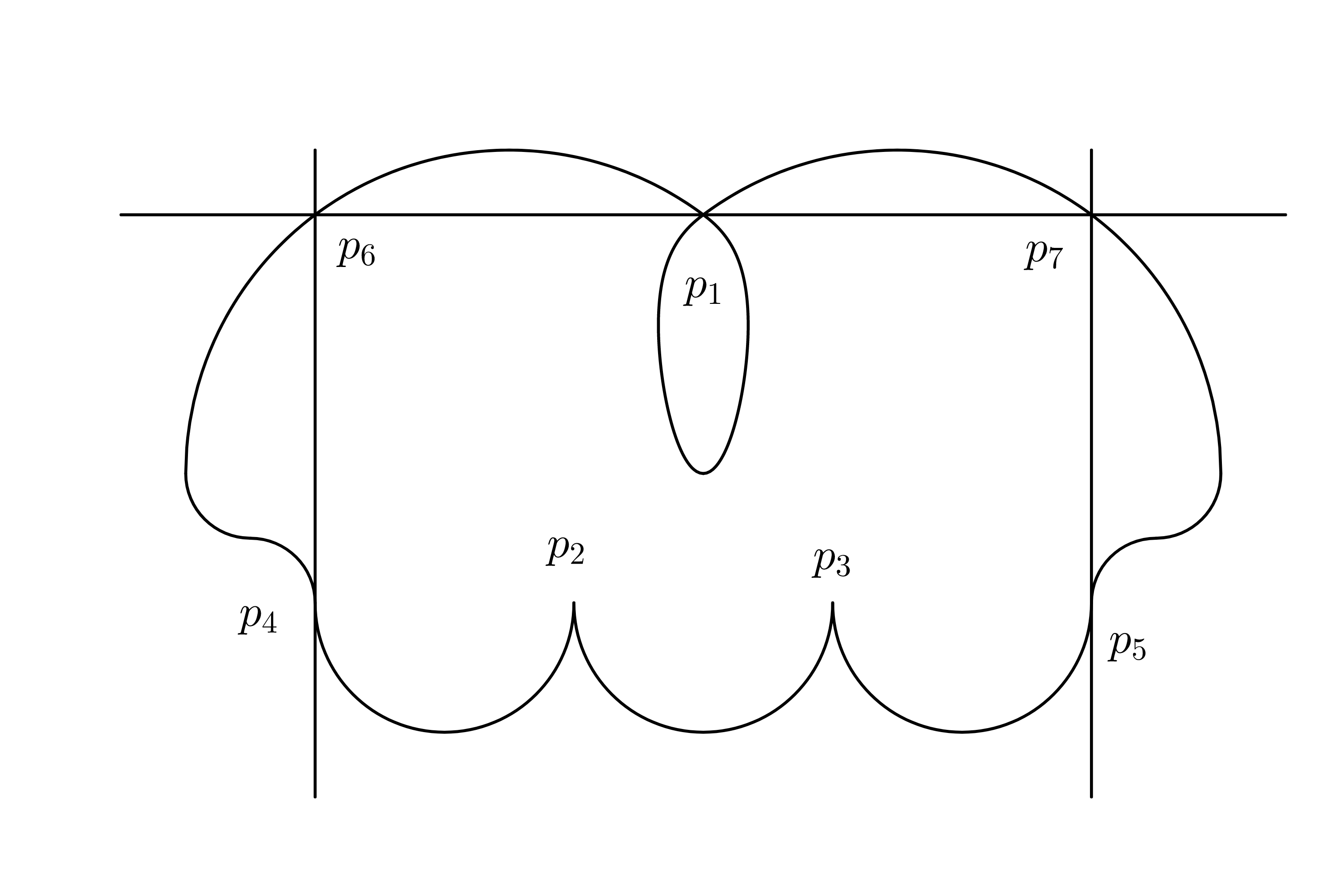 Figure 4
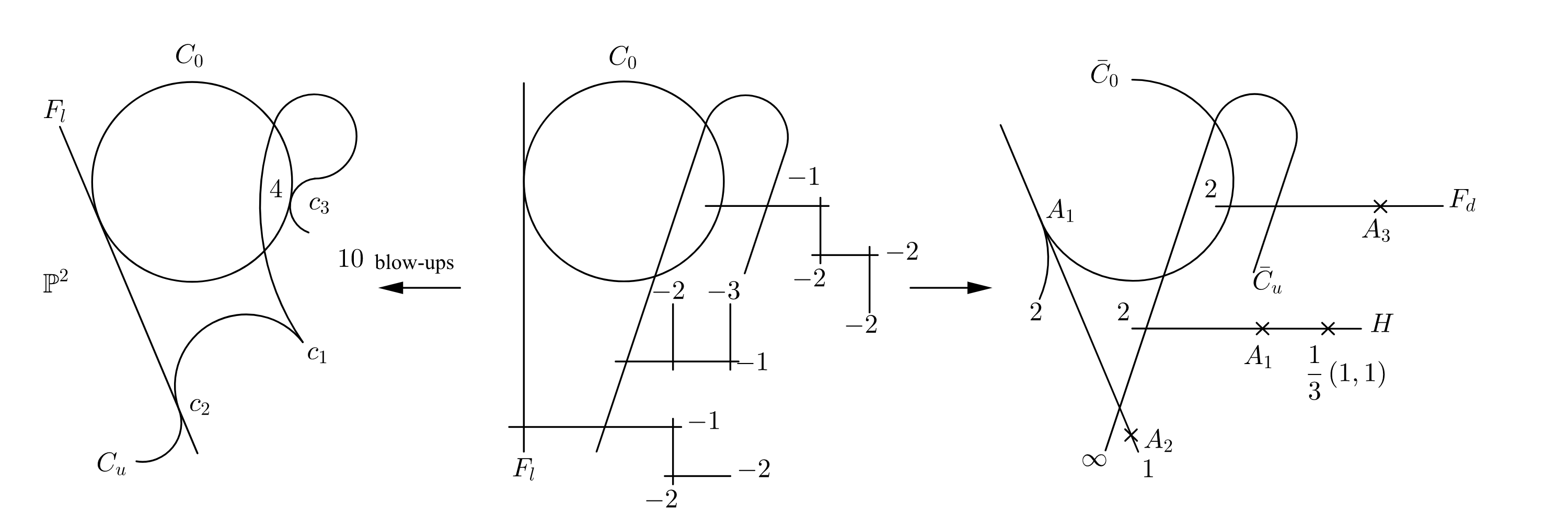 Figure 5
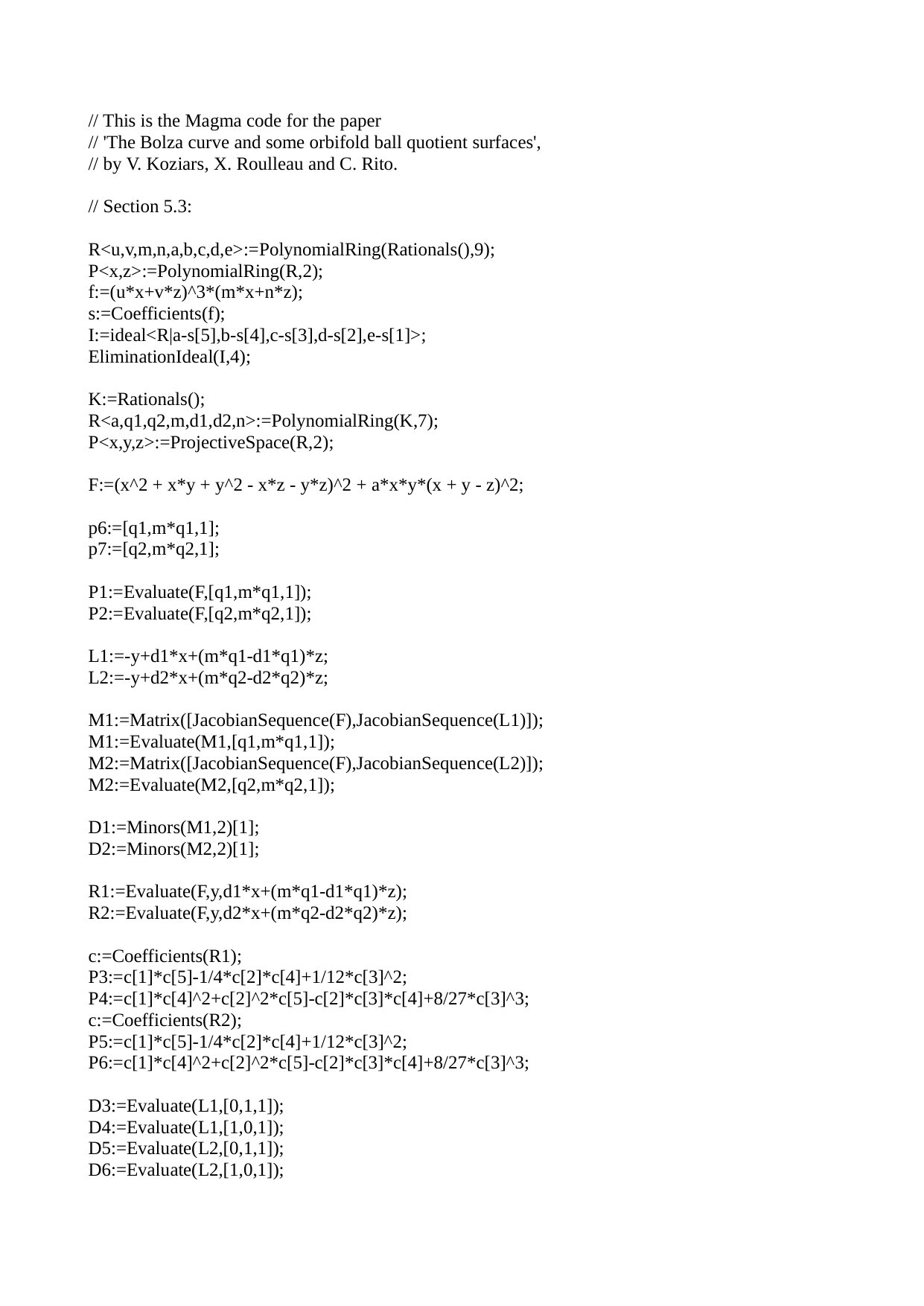 Figure 6
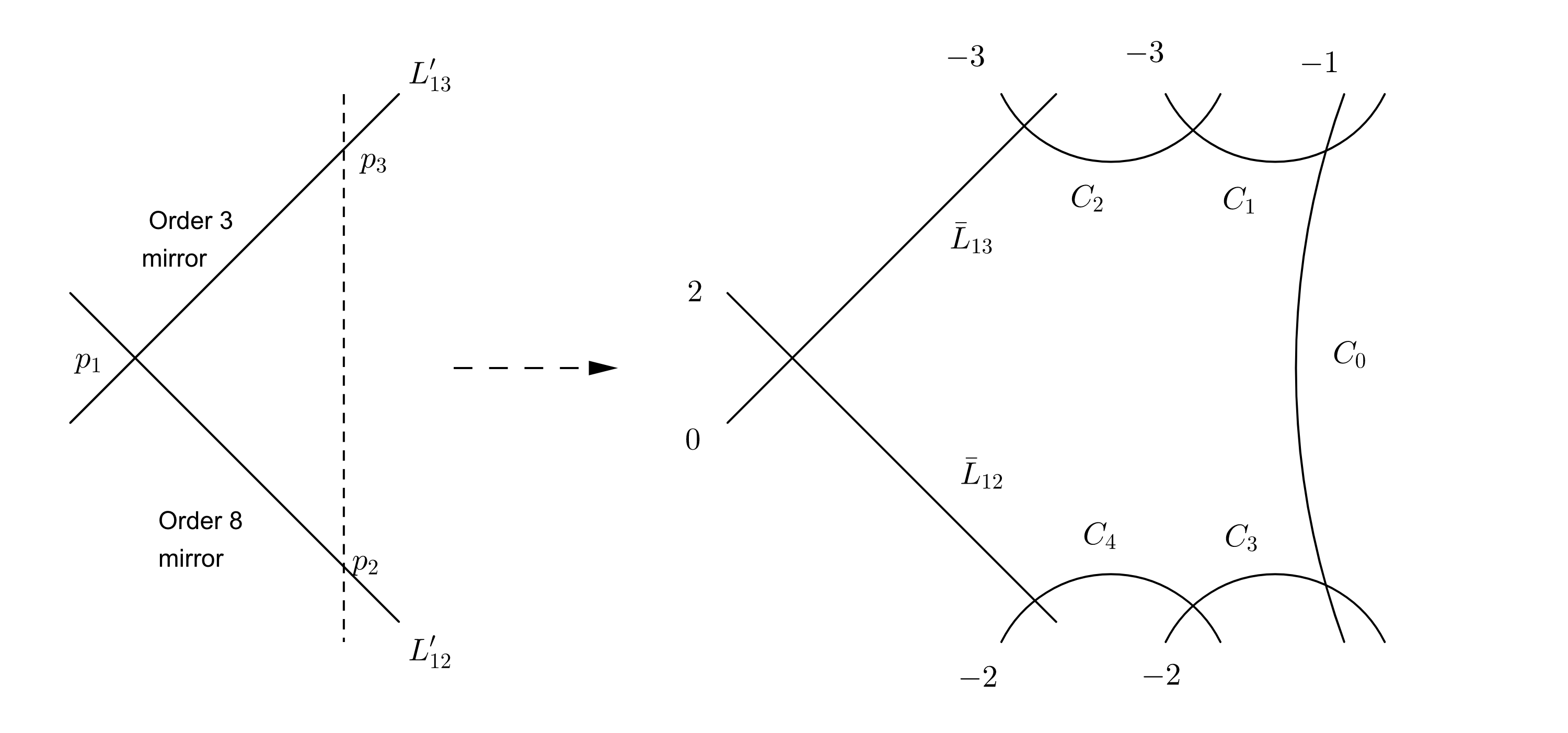 Figure 7
Peer Reviews
No public reviews on file for this paper yet. If you reviewed it on a platform where reviews are public (OpenReview, ICLR, NeurIPS, ICML), you can paste yours below so the community can read it here.
Videos
No videos yet. Explain this paper in a talk, walkthrough, or lecture? Add one.
The Bolza curve and some orbifold ball quotient surfaces
Vincent Koziarz, Carlos Rito, Xavier Roulleau
Abstract.
We study Deraux’s non-arithmetic orbifold ball quotient surfaces obtained as birational transformations of a quotient of a particular Abelian surface . Using the fact that is the Jacobian of the Bolza genus curve, we identify as the weighted projective plane . We compute the equation of the mirror of the orbifold ball quotient and by taking the quotient by an involution, we obtain an orbifold ball quotient surface with mirror birational to an interesting configuration of plane curves of degrees and . We also exhibit an arrangement of four conics in the plane which provides the above-mentioned ball quotient orbifold surfaces.
MSC: 22E40 (14L30 20H15 14J26)
Key words: Ball quotient surfaces, Lattices in , Orbifolds
1. Introduction.
Chern numbers of smooth complex surfaces of general type satisfy the Bogomolov-Miyaoka-Yau inequality . Surfaces for which the equality is reached are ball quotient surfaces: there exists a cocompact torsion-free lattice in the automorphism group of the ball such that . This description of ball quotient surfaces by uniformisation is of transcendental nature, and in fact among ball-quotient surfaces, very few are constructed geometrically (e.g. by taking cyclic covers of known surfaces or by explicit equations of an embedding in a projective space).
Among lattices in , only commensurability classes are known to be non-arithmetic. The first examples of such lattices were given by Mostow and Deligne-Mostow (see [22] and [10]), and recently Deraux, Parker and Paupert [12, 13] constructed some more, sometimes related to an earlier work of Couwenberg, Heckman and Looijenga [9].
Being rare and difficult to produce, these examples are particularly interesting and one would like a geometric description of them. To do so, Deraux [14] studies the quotient of the Abelian surface , where is the elliptic curve , by an order automorphism group isomorphic to that we will denote by . The ramification locus of the quotient map is the union of elliptic curves and two orbits of isolated fixed points. The images of these two orbits are singularities of type and , respectively.
Then Deraux proves that (on some birational transforms) the 1-dimensional branch locus of the quotient map and the two singularities are the support of four ball-quotient orbifold structures, three of these corresponding to non-arithmetic lattices in . Knowing the branch locus is therefore important for these ball-quotient orbifolds, since it gives an explicit geometric description of the uniformisation maps from the ball to the surface.
Deraux also remarks in [14] that the invariants of and its singularities are the same as for the weighted projective plane and, in analogy with cases in [11] and [15] where weighted projective planes appear in the context of ball-quotient surfaces, he asks whether the two surfaces are isomorphic.
In fact, the quotient can also be seen as a quotient where is an affine crystallographic complex reflection group. The Chevalley Theorem assert that if is a finite reflection group acting on a space then the quotient is a weighted projective space. Using theta functions, Bernstein and Schwarzman [2] observed that for many examples of affine crystallographic complex reflection groups acting on a space , the quotient is a also weighted projective space. Kaneko, Tokunaga and Yoshida [20] worked out some other cases, and it is believed that this analog of the Chevalley Theorem always happens (see [2], [16, p. 17]), although no general method is known (see also the presentation of the problem given by Deraux in [14], where more details can be found).
In this paper we prove that indeed:
Theorem A**.**
The surface is isomorphic to
We obtain this result by exploiting the fact that is the Jacobian of a smooth genus curve , a curve which was first studied by Bolza [5]. The automorphism group of the curve induces the action of on the Jacobian . The main idea to obtain Theorem A is to understand the image of the curve in by the quotient map and to prove that its strict transform in the minimal resolution is a -curve.
We then construct birational transformations of to and obtain the equations of the images of the branch curve in these surfaces (and also ). In particular:
Theorem B**.**
In the projective plane, the mirror is the quartic curve
[TABLE]
This curve has two smooth flex points and singular set (where an singularity has local equation ). The line through the two residual points of the flex lines contains the node (by flex line we mean the tangent line to a flex point).
The curve with the two flex lines gives rise to the four orbifold ball-quotient surfaces (previously described by Deraux [14]) on suitable birational transformations of the plane. We prove that the configuration of curves described in Theorem B is unique up to projective equivalence.
In [18], Hirzebruch constructed ball quotient surfaces using arrangements of lines and performing Kummer coverings. It is a well-known question whether one can construct other ball quotient surfaces using higher degree curves, the next case being arrangements of conics.
Let be the Cremona transformation of the plane centered at the three singularities of . The image by of the curves described in Theorem B is a special arrangement of four plane conics. We remark that by performing birational transforms of and by taking the images of the conics, one can obtain the orbifold ball-quotients of [14]. To our knowledge that gives the first example of orbifold ball quotients obtained from a configuration of conics (ball quotient orbifolds obtained from a configuration of a conic and three tangent lines are studied in [19] and [28]). However we do not know whether one can obtain ball quotient surfaces by performing Kummer coverings branched at these conics.
When preparing this paper, we observed that the mirror and one related orbifold ball quotient surface among the four might be invariant by an order automorphism. Using the equation we have obtained for , we prove that this is actually the case: there is an involution on with fixed point set a -curve such that the quotient surface is , moreover the image of is a conic and the image of is the unique cuspidal cubic curve . In the last section we obtain and describe the following result:
Theorem C**.**
There is an orbifold ball-quotient structure on a surface birational to such that the strict transforms on of have weights respectively.
The paper is structured as follows:
In section 2, we recall some results of Deraux on the quotient surface and introduce some notation. In section 3, we study properties of the surface . In section 4, we introduce the Bolza curve and prove that is isomorphic to . Section 5 is devoted to the equation of the mirror . Moreover we describe the four conics configuration. Section 6 deals with Theorem C.
Some of the proofs in sections 5 and 6 use the computational algebra system Magma, version V2.24-5. A text file containing only the Magma code that appear below is available as an auxiliary file on arXiv and at [25].
Along this paper we use intersection theory on normal surfaces as defined by Mumford in [23, Section 2].
Acknowledgements The last author thanks Martin Deraux for discussions on the problem of proving the isomorphism of with
The second author was supported by FCT (Portugal) under the project PTDC/ MAT-GEO/2823 /2014, the fellowship SFRH/BPD/111131/2015 and by CMUP (UID/MAT/00144/ 2019), which is funded by FCT with national (MCTES) and European structural funds through the programs FEDER, under the partnership agreement PT2020.
2. Quotient of by and image of the mirrors
2.1. Properties of and image of the mirrors
In this section, we collect some facts from [14] about the action of the automorphism subgroup on the Abelian surface
[TABLE]
There exists a group of order acting on which is isomorphic to (see [14, Section 3.1] for generators). The action of on has no global fixed points (in particular some elements have a non-trivial translation part).
The group contains order reflections, i.e. their linear parts acting on the tangent space are complex order reflections. The fix point set of a reflection being usually called a mirror, we similarly call the fixed point set of a reflection of a mirror. The mirror of such a is an elliptic curve on . The group acts transitively on the set of the mirrors whose list can be found in [14, Table 1].
We denote by the union of the mirrors in and by the image of in the quotient surface . The curve is also called the mirror of .
Except the points on , there are two orbits of points in with non-trivial isotropy, one with isotropy group of order 3 at each point, the other with isotropy group of order 8, see [14, Proposition 4.4]. Correspondingly, the quotient has two singular points, which are the images of the two special orbits.
Proposition 1**.**
*The surface is rational and its singularities are of type .
The minimal resolution of the surface has invariants and .*
Proof.
Let us compute the invariants of . Let be the quotient map. One has
[TABLE]
moreover, according to [14, §4], each mirror , satisfies , therefore and
[TABLE]
We observe that , thus by (2.1), one gets
The singularities of the quotient surface are computed in [14, Table 2]. Let be the two -curves above the singularity ; they are such that . Since the singularity of type is an singularity, we obtain:
[TABLE]
and .
Let be a reflection in and let be the Klein group of order generated by and the involution . One can check that the quotient surface is rational. Being dominated by the rational surface , the surface is also rational. Thus the second Chern number is by Noether’s formula. ∎
The mirror (the image of by the quotient map) does not contain singularities of , moreover:
Lemma 2**.**
The pull-back of the mirror by the resolution map has self-intersection . Its singular set is
[TABLE]
where denotes a singularity with local equation .
Proof.
The singularities of are the same as the singularities of since is in the smooth locus of . For the computation of the singularities of , we refer to [14, Table 3], and for the self-intersection of (which is the same as the one of ) to [14, §6.2].
∎
3. The weighted projective space .
Since we aim to prove that the quotient surface is isomorphic to , one first has to study that weighted projective space: this is the goal of this (technical) section. The reader might at first browse through the main results and notation and proceed to the next section.
3.1. The surface and its minimal resolution
The weighted projective space is the quotient of by the group generated by
[TABLE]
where and is a primitive root of unity. The fixed point set of the order element is
[TABLE]
For with let be the line through and . The fixed point set of an order element (e.g. ) is and the line . The fixed point set of an order element (e.g. ) and its non-trivial powers is and the line . Let be the quotient map: is ramified with order over and with order over . The surface has two singularities, images of and , which are respectively a cusp and a singularity of type . We denote by the minimal desingularization map. The singularity of type is resolved by two rational curves with , , and the singularity is resolved by two rational curves with , , (see e.g. [1, Chapter III]).
Lemma 3**.**
The invariants of the resolution are
[TABLE]
Proof.
We have:
[TABLE]
therefore since , we obtain and
[TABLE]
We have
[TABLE]
where the are rational numbers. The divisor must satisfy the adjunction formula i.e. one must have for . That gives:
[TABLE]
and therefore . For the Euler number, one may use the formula in [26, Lemma 3]:
[TABLE]
Thus . Since is dominated by the surface is rational, so that . ∎
3.2. The branch curves in and their pullback in the resolution
Let be the image of the line on and let be the strict transform of in .
Proposition 4**.**
We have:
[TABLE]
Proof.
On one has . Recall that the resolution map is . Let such that
[TABLE]
then for . Let such that . One gets that
[TABLE]
We have , thus
[TABLE]
Since , we get
[TABLE]
which is in , with . One computes that
[TABLE]
Since , the only possibility is
[TABLE]
which gives the intersection numbers with .
For the curve , one has and . Let . Then one similarly computes that
[TABLE]
and
[TABLE]
Therefore and since , the only solution is , thus and .
For the curve , which does not go through the singularity, one has
[TABLE]
and . Let . Then
[TABLE]
Therefore and the only solution is , thus . ∎
3.3. From to the Hirzebruch surface and back
By contracting the -curve and then the other -curves appearing from the configuration one gets a rational surface with
[TABLE]
containing (depending on the choice of the -curves we contract) a curve which either is a -curve or a -curve. Thus that surface is one of the Hirzebruch surfaces or . Conversely one can reverse the process and obtain the surface by performing a sequence of blow-ups and blow-downs. This process is unique: this follows from the fact that the automorphism group of a Hirzebruch surface has two orbits, which are the unique -curve and its open complement (see e.g. [4]). In the sequel, only the connection between and will be used.
4. The Bolza genus curve in and its image by the quotient
map
In this section we prove that is isomorphic to .
Let us consider the genus curve whose affine model is
[TABLE]
It was proved by Bolza [5] that the automorphism group of is and is the unique genus curve with such an automorphism group.
The automorphisms of are generated by the hyperelliptic involution and the lift of the automorphism group of that preserves the set of branch points of the canonical map (i.e. the set of points which are fixed by ). Note that actually, any map of degree 2 from to is the composition of this map with an automorphism of . This is a consequence of the two following facts: on the one hand the 6 ramification points (by the Riemann-Hurwitz formula) of such a map are Weierstrass points, and on the other hand the genus 2 curve has exactly 6 Weierstrass points.
By the universal property of the Abel-Jacobi map, the group acts naturally on the Jacobian variety of , the action on and being equivariant.
There is only one Abelian surface with an action of , which is , where as above (see Fujiki [17] or [3]). We identify with . There are up to conjugation only two possible actions of on (see [24]):
a) The action of which is described in sub-section 2.1; it has no global fixed points;
b) The one obtained by forgetting the translation part of that action. That second action globally fixes the [math] point in .
Let be the embedding of sending the point at infinity of the affine model (4.1) to [math]; we identify with its image.
Note that the morphism , is onto since and are both two-dimensional. Actually, this map has generic degree 2 and contracts the diagonal. Indeed, assume that i.e. . If then (and conversely) because there is no degree 1 map from to . In the same way, iff . In the remaining cases, there exists a function of degree 2 from to whose zeroes are and and poles are and . But by the remark above, we must have and . Conversely, by the same argument, it is clear that for all and in , .
This also implies that the points of the type with and being distinct Weierstrass points are exactly the 2-torsion points of . Indeed, since there are 6 Weierstrass points on , we have 15 points of that type in satisfying i.e. they are 2-torsion points.
The induced linear action b) is given by for which is a fixed point.
If we fix the base point then for each , . The induced action of on is then given by . This is indeed the only action of on commuting with .
Lemma 5**.**
The action of on inducing the action of on the curve has no global fixed points.
Proof.
The fixed points on for the action of the hyperelliptic involution are its points of 2-torsion (and 0). Indeed, since is fixed by and, as a consequence of the discussion above, if then either or i.e. and we saw that this implies that and are Weierstrass points.
But for any pair of distinct Weierstrass points, it is easy to find (lifting an automorphism of ) such that but . ∎
For , let be the curve . The previous result does not depend on the choice of the embedding : indeed the group of automorphisms acting on and preserving is conjugated by the translation to the group of automorphisms acting on and preserving .
We denote by the order group acting on and inducing the automorphism group of the curve by restriction. As a consequence of Lemma 5, we get:
Corollary 6**.**
There exists an isomorphism between and . That isomorphism is induced by an automorphism of the surface such that .
By [6, Theorem (0.3)], the embedding is such that the torsion points of contained in are torsion points of order , torsion points of order and the origin, moreover the -coordinates of the torsion points on satisfy
[TABLE]
Proposition 7**.**
*(a) These torsion points of are not in the mirror of any of the complex reflections of ;
(b) Each of these points has a non-trivial stabilizer.*
Proof.
Let us prove part .
The hyperelliptic involution is given by . By [7], the rational map
[TABLE]
defines a non-hyperelliptic involution on . The -coordinates of the fixed point set of are . These coordinates are not among the -coordinates of the torsion points in . Let be the automorphism of induced by . The fixed point set of is a smooth genus curve (a mirror) and we have just proved that contains no torsion points of . By transitivity of the group on its set of non-hyperelliptic involutions, one gets that no mirror contains any of the torsion points.
Let us prove part .
The six -torsion points are the Weierstrass points of the curve , they are fixed by the hyperelliptic involution (whose action on has only fixed points).
The transformation
[TABLE]
defines an order automorphism of , which acts symplectically on and one computes that it fixes a torsion point on with such that , i.e. it is an order torsion point. This torsion point is an isolated fixed point for each non-trivial element of its stabilizer (since by part (a), it is not on a mirror).
Recall that by [14, Table 2], there are exactly two orbits of points of respective orders and with non-trivial stabilizer under which are isolated fixed points of the non-trivial elements of their stabilizer (by a direct computation one can check that these two orbits are points of order and points of order ). Since is conjugate to , the other -torsion points on are also isolated fixed points for each non-trivial element of their stabilizer. ∎
Since one can change the embedding by composing with the automorphism such that , let us identify with .
By sub-section 2.1 (or [14]), the images of the torsion points of on the quotient surface give the singularities and .
Let be the mirror of one of the complex reflections in .
Lemma 8**.**
One has .
Proof.
The intersection number is the number of fixed points of the involution with mirror restricted to . Since fixes exactly one holomorphic form, the quotient of by is an elliptic curve, thus by the Hurwitz formula . ∎
Let be the image of in . One has:
Proposition 9**.**
The strict transform of by the resolution is a -curve and we have .
Proof.
One has
[TABLE]
Let be the quotient map; it is ramified with order on the union of the mirrors. One has , thus
[TABLE]
The curve contains the singularities and (image respectively of the -torsion points and the -torsion points of ). We are then left with the same combinatorial situation as in the computation of in Proposition 4, thus we conclude that .
The two intersection points of and in Lemma 8 are permuted by the hyperelliptic involution of thus , which implies . ∎
We obtain:
Theorem 10**.**
The surface is isomorphic to .
Proof.
Let us denote the resolution map by . Let be the resolution curves of the singularity , and be the resolution of . Let be an isolated fixed point of an automorphism of order or . The tangent space is stable by the action of . Since the local setup is the same, we can reason as in Proposition 4 and we obtain that the curve is such that
[TABLE]
Contracting the curves , one gets a rational surface with a -curve and with invariants . This is therefore the Hirzebruch surface . From section 3, we know that reversing the contraction process one gets the weighted projective plane (contracting the curves , one would have obtained the Hirzebruch surface ). ∎
Remark 11*.*
Now we identify with and we use the notation in section 3. In particular is the minimal resolution of , the curves are exceptional divisors of the resolution map and is a -curve in .
Let us observe that the divisor satisfies
[TABLE]
thus , moreover , and . This implies that the curves and are fibers of the same fibration onto and is a section of that fibration.
The curves are exceptional divisors or strict transform of generators of the Néron-Severi group of a minimal rational surface. Thus the Néron-Severi group of the rational surface is generated by these curves. Knowing the intersection of curves with these curves (see Propositions 4 and 9) it is easy to obtain their classes in the Néron-Severi group, in particular one gets that
5. A model of the mirror
5.1. A birational map from to
; images of the mirror
5.1.1. A rational map .
As above, we identify with ; we use the notation of sections 3 and 4.
Take a point in the Hirzebruch surface that is not in the negative section. By blowing-up at and then by blowing-down the strict transform of the fiber through we get the Hirzebruch surface This process is called an elementary transformation.
Recall from sections 3 and 4 that there is a map that contracts the curves to a smooth point.
Performing any sequence of three elementary transformations as above, we get a map . This can be seen as a birational transform that, by blowing-up three times at a point not contained in the negative section, takes the fibre through to a chain of curves with self intersections then followed by the contraction of the chain (which contains the strict transform of ). For our purpose, we choose the three points to blow-up in a specific way, see subsection 5.1.2.
Consider
[TABLE]
We observe that given any two points not in a common fiber, the map can be chosen such that the inverse is not defined at and
5.1.2. Image of the mirror in .
Let us describe how to choose such that the image of the mirror curve is a -curve with singularities and two special fibers tangent to it with multiplicity
The map factors through a morphism Consider the point Since then is a curve which is smooth at and its intersection number with the curve at is . The curve is a fiber of
Then we choose to be the -singularity of . The fiber through cuts at with multiplicity or . Suppose that the multiplicity is . Then by taking the blow-up at that point and computing the strict transform of the curves and , one can check that . But by Remark 11. Therefore the fiber through cuts at with multiplicity , and at another point.
Remark 12*.*
An analogous reasoning gives that the fiber through the -singularity has the same property: it is transverse to the tangent of the -singularity.
The three successive blow-ups above are chosen such that they resolve the singularity . The three blow-downs we described create a multiplicity tangent point between (the image of in ) and the curve (the image of ), thus . Moreover (see figure 5.1).
The mirror does not cut the curves and . The transforms of these curves in are fibers such that cuts at one point only, with multiplicity . In particular, the class of in the Néron-Severi group of is . The singularities of are .
5.1.3. From to and back
Let us recall that the blowup of at a point, followed by the blow-down of the strict transform of the two fibers through that point, gives a birational map
We choose to blow-up the point at the -singularity , so that the strict transform of has a node above . The two fibers of passing through cut in two other points respectively (see Remark 12; the result is preserved through the birational process). The fibers are contracted into points in by the rational map , the images of by that map are on the image of the exceptional divisor, which is a line through the node. This implies that the strict transform of is a plane quartic curve . The process in illustrated in Figure 5.2.
The total transform of in is the union of with . This quartic has the following properties which follow from its description and the choice of the transformation from to :
Proposition 13**.**
The singular set of the quartic curve is and the nodal point is contained in the line . The curve contains two flex points such that each corresponding tangent line meets the quartic at a second point that is contained in the line
5.2. The yoga between the mirrors and
Using the previous description the reader can follow the transformations between the surfaces and the plane. The link between Deraux’s ball quotient orbifolds described in [14, Theorem 5] and the quartic is as follows:
The singularities of correspond respectively to singularities of , so that in order to get the curves in [14, Figure 1] one has to blow-up and contract at these points as it is done in [14]. In order to obtain the curve in [14, Figure 1], one has to blow-up the two flexes three times in order to separate and the flex lines. One obtain two chains of curves. Contracting one of the two chains one gets an -singularity. The curve is the image by the contraction map of the remaining -curve of the chain. The resolution of the singularity on corresponds to the two -curves on the other chain of curves. After taking the blow-up at the residual intersection of the quartic and the flex lines and after separating the flex lines and the mirror , one gets two -curves intersecting transversally at one point. In that way the resolution of the singularity on by two -curves corresponds to the two flex lines.
5.3. A particular quartic curve in
The aim of this sub-section is to prove the following result:
Theorem 14**.**
Up to projective equivalence, there is a unique quartic curve in with distinct points such that:
- (1)
* has a node at and ordinary cusps at ;* 2. (2)
the points are flex points of ; 3. (3)
the tangent lines to at contain respectively; 4. (4)
the line through contains
We can assume that
[TABLE]
Then the equation of is
[TABLE]
and the points and are, respectively,
[TABLE]
Corollary 15**.**
The mirror described on sub-section 5.1.3 satisfies the hypothesis of Theorem 14, thus is projectively equivalent to the quartic .
In order to prove 14, let us first give a criterion for the existence of roots of multiplicity at least on homogeneous quartic polynomials on two variables. We use the computational algebra system Magma; see [25] for a copy-paste ready version of the Magma code.
Lemma 16**.**
The polynomial
[TABLE]
has a root of multiplicity at least if and only if
[TABLE]
Proof.
The computation below is self-explanatory.
R<u,v,m,n,a,b,c,d,e>:=PolynomialRing(Rationals(),9); P<x,z>:=PolynomialRing(R,2); f:=(ux+vz)^3*(mx+nz); s:=Coefficients(f); I:=ideal<R|a-s[5],b-s[4],c-s[3],d-s[2],e-s[1]>; EliminationIdeal(I,4);
∎
Let us now prove Theorem 14:
Proof.
We have already chosen points in . Instead of choosing a fourth point for having a projective base, one can fix two infinitely near points over and . Indeed the projective transformations that fix points are of the form
[TABLE]
and these transformations act transitively on the lines through and . Thus up to projective equivalence, we can fix the tangent cones (which are double lines) of the curve at the cusps Let us choose for these cones the lines with equations and , respectively.
The linear system of quartic curves in is dimensional. The imposition of a node and two ordinary cusps (with given tangent cones) corresponds to conditions, thus we get a pencil of curves. We compute that this pencil is generated by the following quartics:
[TABLE]
Notice that, at the points the first generator is of multiplicity and the second generator is of multiplicity , thus a generic element in the pencil has a cusp singularity at
Let us compute the quartic curves satisfying condition (1) to (4) of Theorem 14. The method is to define a scheme by imposing the vanishing of certain polynomials and the non-vanishing of another ones which is achieved by using an auxiliary parameter and imposing
K:=Rationals(); R<a,q1,q2,m,d1,d2,n>:=PolynomialRing(K,7); P<x,y,z>:=ProjectiveSpace(R,2);
The defining polynomial of depending on one parameter:
F:=(x^2 + xy + y^2 - xz - yz)^2 + axy(x + y - z)^2;
The points are in a line hence they are of the form
p6:=[q1,mq1,1]; p7:=[q2,mq2,1];
and we must have the vanishing of
P1:=Evaluate(F,[q1,mq1,1]); P2:=Evaluate(F,[q2,mq2,1]);
The defining polynomials of lines through that points are:
L1:=-y+d1x+(mq1-d1q1)z; L2:=-y+d2x+(mq2-d2*q2)*z;
We need to impose that these lines are not tangent to at thus the following matrices must be of rank
M1:=Matrix([JacobianSequence(F),JacobianSequence(L1)]); M1:=Evaluate(M1,[q1,mq1,1]); M2:=Matrix([JacobianSequence(F),JacobianSequence(L2)]); M2:=Evaluate(M2,[q2,mq2,1]);
The matrix is of rank if one of its minors is non-zero. Here we make a choice for these minors, but in order to cover all cases the computations must be repeated for all other choices.
D1:=Minors(M1,2)[1]; D2:=Minors(M2,2)[1];
Now we intersect the quartic with the lines
R1:=Evaluate(F,y,d1x+(mq1-d1q1)z); R2:=Evaluate(F,y,d2x+(mq2-d2*q2)*z);
and we use Lemma 16 to impose that these lines are tangent to at flex points of :
c:=Coefficients(R1); P3:=c[1]c[5]-1/4c[2]c[4]+1/12c[3]^2; P4:=c[1]c[4]^2+c[2]^2c[5]-c[2]*c[3]c[4]+8/27c[3]^3; c:=Coefficients(R2); P5:=c[1]c[5]-1/4c[2]c[4]+1/12c[3]^2; P6:=c[1]c[4]^2+c[2]^2c[5]-c[2]*c[3]c[4]+8/27c[3]^3;
We note that the lines cannot contain the points
D3:=Evaluate(L1,[0,1,1]); D4:=Evaluate(L1,[1,0,1]); D5:=Evaluate(L2,[0,1,1]); D6:=Evaluate(L2,[1,0,1]);
Also the line cannot contain the point
D7:=(m-d1)*(m-d2);
And it is clear that the following must be non-zero:
D8:=aq1q2*(q1-q2);
Finally we define a scheme with all these conditions.
A:=AffineSpace(R); S:=Scheme(A,[P1,P2,P3,P4,P5,P6,1+nD1D2D3D4D5D6D7D8]);
We compute (that takes a few hours):
PrimeComponents(S);
and get the unique solution ∎
From the equation of the quartic , one can compute a degree equation for the mirror , which is:
(31072410r+44060139)x^24+(599304420r-4660302600)x^21y+(-106415505000r+18054913500)x^18 y^2+(796474485000r+3638808225000)x^15y^3+(-27123660r-18697014)x^16z+(34521715125000 r-31210968093750)x^12y^4+(107726220r+2948918400)x^13yz+(-257483985484500r- 516632817969000)x^9y^5+(42798843000r-32351244300)x^10y^2z+(-1747212737190000r +3228789525752500)x^6y^6+(-407331396000r-935091495000)x^7y^3z+(-655139025450000r+ 10855982580975000)x^3y^7+(7724970r-2222037)x^8z^2+(-3383703150000r+9052448883750) x^4y^4z+(1544666220033750r+11942493993804375)y^8+(-102498120r-465161400)x^5yz^2+ (-319463676000r+12613760073000)xy^5z+(-2705586000r+7086771600)x^2y^2z^2+(-712080r +1186268)*z^3=0
where .
5.4. A configuration of four plane conics related to the orbifold ball quotient
In this subsection we describe the configuration of conics which we announced in the introduction.
Let us consider a conic tangent to two lines of a triangle in , and going through two points of the remaining line. Performing a Cremona transformation at the three vertices of the triangle one obtains a quartic curve in with singularities . Conversely, starting with such a quartic, its image by the Cremona transform at the three singularities is a conic with three lines having the above configuration.
Thus we consider the Cremona transform at the three singularities of the quartic . Let be respectively the images of , the line through the node and the two residual points of the flex lines, and the two flex lines. Using Magma, we see that these are conics meeting in points, as follows:
[TABLE]
Here two in the column of mean that the two curves meet with multiplicity at point . The other intersections are transverse. We see that the various ball-quotient orbifolds that Deraux described in [14] may be obtained from a configuration of conics by performing birational transformations.
6. One further quotient by an involution
6.1. The quotient morphism , image of the mirror as the cuspidal cubic
Consider the plane quartic curve from Theorem 14. Here we show the existence of a birational map
[TABLE]
and an involution on that preserves and fixes the diagonal of pointwise. Moreover, we have and the images of are curves of degrees respectively. The curve has a cusp singularity and intersects at three points, with intersection multiplicities The map is the inverse of the birational transform described in sub-section 5.1.3, whose indeterminacy is at the singularity of
K:=Rationals(); R<r>:=PolynomialRing(K); K<r>:=ext<K|r^2+2>; P2<x,y,z>:=ProjectiveSpace(K,2); Q:=Curve(P2,(x^2+xy+y^2-xz-yz)^2-8xy(x+y-z)^2); p6:=P2![2r,-2r,1]; p7:=P2![-2r,2r,1];
We compute the linear system of conics through the cuspidal points and take the corresponding map to
L:=LinearSystem(LinearSystem(P2,2),[p6,p7]); P3<a,b,c,d>:=ProjectiveSpace(K,3); rho:=map<P2->P3|Sections(L)>;
The image of is a quadric surface ().
Q2:=rho(P2);Q2; C:=rho(Q);C;
There is an involution preserving both and the curve
sigma:=map<P3->P3|[d,b,c,a]>; C:=rho(Q);C; sigma(Q2) eq Q2; sigma(C) eq C;
We compute the corresponding map to the quotient. The image of is a cubic curve, and the image of the diagonal is a conic.
psi:=map<P3->P2|[a+d,b,c]>; Cu:=psi(C); Co:=psi(Scheme(rho(P2),[a-d])); Co:=Curve(P2,DefiningEquations(Co));
The curve has a cusp singularity:
pts:=SingularPoints(Cu); ResolutionGraph(Cu,pts[1]);
The intersections of and
Degree(ReducedSubscheme(Co meet Cu)) eq 3; pt:=Points(Co meet Cu)[1]; IntersectionNumber(Co,Cu,pt) eq 4;
Let be the fibers that intersect each at a unique point with multiplicity .These fibers are exchanged by the involution and are sent to a line which cuts the cubic curve at a unique point: this is a flex line. That line also cuts the conic at a unique point.
Conversely, let us start from the data of a conic and a cuspidal cubic intersecting as above, with the flex line (at the smooth flex point) of the cubic tangent to the conic. One can take the double cover of the plane branched over , which is . The pull-back of is then a curve satisfying the properties of Theorem 14, thus the configuration we described is unique in , up to projective automorphisms.
6.2. An orbifold ball-quotient structure from
Let be the unique plane cuspidal curve and let be its cuspidal point. Let be the flex line through the unique smooth flex point of . By the previous subsection, one has the following result:
Proposition 17**.**
*There exists a unique conic such that the following holds:
i) is tangent to ;
ii) cuts at points () with intersection multiplicities , respectively.*
In this subsection we prove that there is a natural birational transformation such that together with the strict transform of the curves and one gets an orbifold ball quotient surface. For definitions and results on orbifold theory, we use [8, 11] and [29].
Let us blow-up over points and then contract some divisors as follows (for a pictural description see figure 6.1):
We blow up over three times, the first blow-up resolves the cusp of and the exceptional divisor intersects the strict transform of tangentially, the second blow-up is at that point of tangency and the third blow-up separates the strict transforms of the first exceptional divisor and the curve . One obtains in that way a chain of , and -curves. We then contract the and -curves obtaining in that way singularities and . The image of the -curve by that contraction map is denoted by . As an orbifold we put multiplicity on .
We blow up over (the flex point) three times in order that the strict transform of the curves and get separated over . We obtain in that way a chain of ), , -curves. We then contract the two -curves and obtain an -singularity. The strict transform of the line is a -curve, which we also contract, obtaining in that way an -singularity. The contracted curve being tangent to , the image has a cusp at the singularity .
We moreover blow up over four times, in order that the strict transform of the curves and get separated over . We obtain in that way a chain of ), , , -curves. We then contract the three -curves and obtain an -singularity. The image of the -curve by the contraction map is a curve denoted by , we give the weight to that curve.
Let us denote by the resulting surface. For a curve on , we denote by its strict transform on . Let be the orbifold with same subjacent topological space, with divisorial part:
[TABLE]
The singular points of are
[TABLE]
and they have an isotropy of order respectively, for . The computation of the isotropy is immediate, except for the first point (that we shall denote by ), which is also a cusp on the curve (which has weight ). Let be the the semidihedral group of order , generated by the matrices
[TABLE]
where is a primitive th root of unity. The order elements generate an order reflection group . The quotient of by has a singularity and one computes that the image of the mirrors of is a curve with a cusp at the singularity of . The isotropy group of the point in the orbifold is therefore the semidihedral group of order . The following proposition is an application of the main result of [21]:
Proposition 18**.**
The Chern numbers of the orbifold satisfy
[TABLE]
in particular is an orbifold ball quotient.
Proof.
Let us compute the orbifold second Chern number of . We have (see e.g. [27]):
[TABLE]
where is the union of the singular points of with the singular points of the round-up divisor , and where moreover is the isotropy order of the point , so that for example for on , and the unique point in and has . Since we have blown-up over points and we have contracted rational curves, we get
[TABLE]
We obtain
[TABLE]
thus .
Let us compute . One has
[TABLE]
so that
[TABLE]
Let be the surface above which resolves and is a blow-up of . Since is obtained by blow-ups of one has . Moreover, since all singularities but one are , one has where is the -curve on which is contracted to the singularity on . Since we obtain
[TABLE]
The curve is a smooth curve of genus [math] on the smooth locus of . The blow-up at the -singularity of the cuspidal cubic decreases the self-intersection by , the remaining blow-ups decrease the self-intersection by . Since one has such blow-ups, one gets
[TABLE]
and therefore . Let be the strict transform on of a curve on or . We have
[TABLE]
Since then is equal to . Since moreover we get thus . We have
[TABLE]
Let be the chain of three -curves above the singularity in , so that . One computes that
[TABLE]
(it is easy to check that ). Then
[TABLE]
gives . One has
[TABLE]
Let be respectively the and curves intersecting . Since , one has
[TABLE]
thus
[TABLE]
and . Moreover
[TABLE]
We compute therefore
[TABLE]
thus . ∎
Remark 19*.*
In [14], Deraux obtains different orbifold ball-quotient structures on surfaces birational to . Among these, only the fourth one, , is invariant by the involution , the obstruction being the divisor in [14] which creates an asymetry, unless it has weight . The orbifold we just described can be seen as the quotient of by the involution .
The reference list from the paper itself. Each links out to its DOI / PubMed record.
- 1[1] Barth W., Hulek K., Peters C., Van de Ven A., Compact Complex Surfaces, Erg. der Math. und ihr. Gren. 3. Folge, Springer-Verlag, Berlin, 2004. xii+436 pp.
- 2[2] Bernstein J., Schwarzman O., Chevalley’s theorem for the complex crystallographic groups. J. Nonlinear Math. Phys., 13(1-4), (2006), 323–351.
- 3[3] Birkenhake C., Lange H., Complex Abelian Varieties, Sec. ed. Grund. der Math. Wiss., 302, Springer-Verlag, Berlin, 2004. xii+635 pp.
- 4[4] Blanc J., Finite subgroups of the Cremona group of the plane, Groups Geom. Dyn. 3 (2009), no. 2, 215–266.
- 5[5] Bolza O., On Binary Sextics with Linear Transformations into Themselves, American Journal of Mathematics, 10 (1), (1887), 47–70,
- 6[6] Boxall J., Grant D., Examples of torsion points on genus two curves, Trans. A.M.S, Volume 352, Number 10, 4533–4555.
- 7[7] Cardona G., Gonzàlez J., Lario J.C., Rio A., On curves of genus 2 2 2 with Jacobian of G L 2 𝐺 subscript 𝐿 2 GL_{2} -type, Manuscripta Math. 98, (1999), 37–54.
- 8[8] Campana F., Claudon B., Abelianity conjecture for special compact Kähler 3-folds, Proc. Edinb. Math. Soc. (2) 57 (2014), no. 1, 55–78.