Measurement of exclusive Upsilon photoproduction in pPb collisions at $\sqrt{s_{NN}} = 5.02$ TeV with the CMS
Kousik Naskar

TL;DR
This paper reports the measurement of exclusive Upsilon meson photoproduction in ultraperipheral pPb collisions at 5.02 TeV, providing new data on cross-sections and their dependence on energy, transverse momentum, and rapidity.
Contribution
It presents the first measurement of Upsilon photoproduction cross-sections in pPb collisions at this energy, with detailed differential data and comparisons to theoretical models.
Findings
Measured differential cross-sections as functions of $p_T^2$ and rapidity.
Extracted Upsilon(1S) photoproduction cross-section across a range of $W_{\gamma p}$.
Results agree with some theoretical predictions and extend previous measurements.
Abstract
The exclusive photoproduction of (1S), (2S) and (3S) mesons is studied in their leptonic () decay modes, in ultraperipheral pPb collisions at TeV. The data was recorded by the CMS experiment corresponding to an integrated luminosity of nb. The differential cross-section for (n) states (n=1,2,3), has been measured as a function of transverse momentum squared , and rapidity . The (1S) photoproduction cross-section is extracted in the region as a function of the photon-proton centre-of-mass energies , in the range GeV. The measurements are compared to theoretical predictions and to previous measurements.
Click any figure to enlarge with its caption.
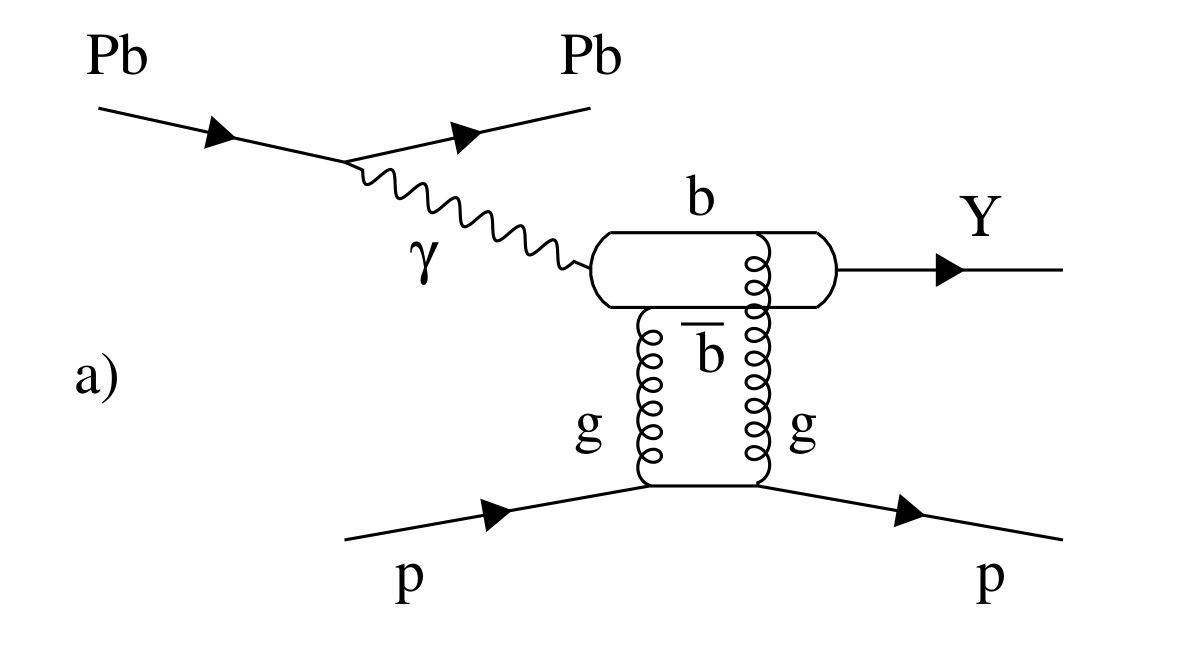 Figure 1
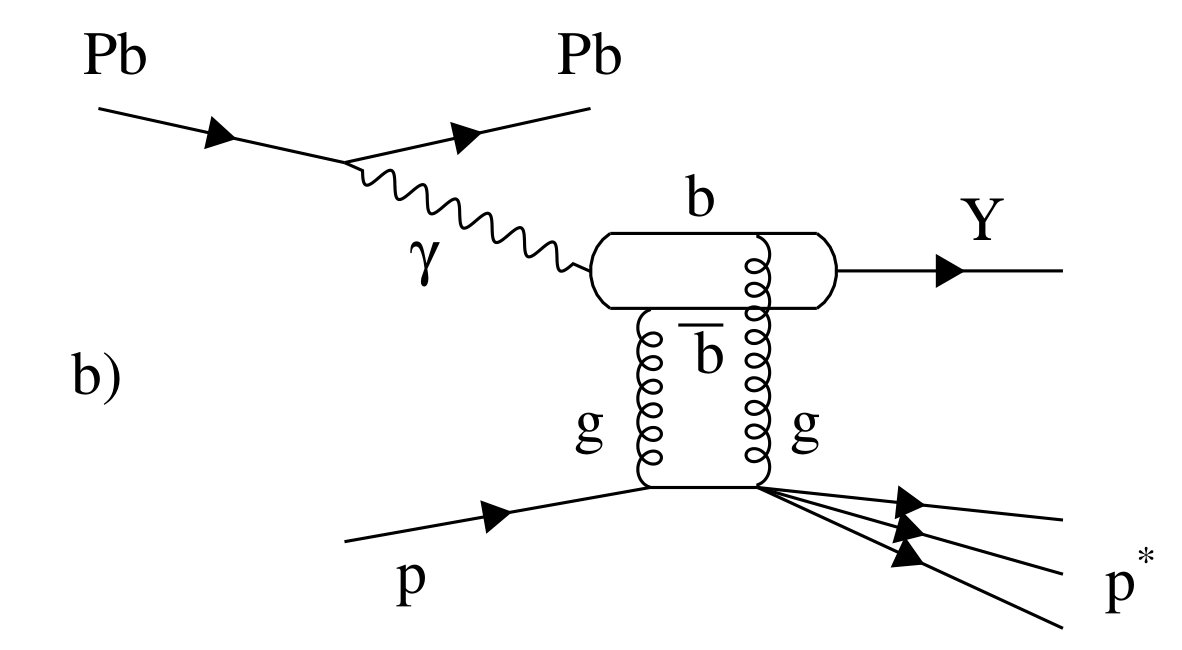 Figure 1
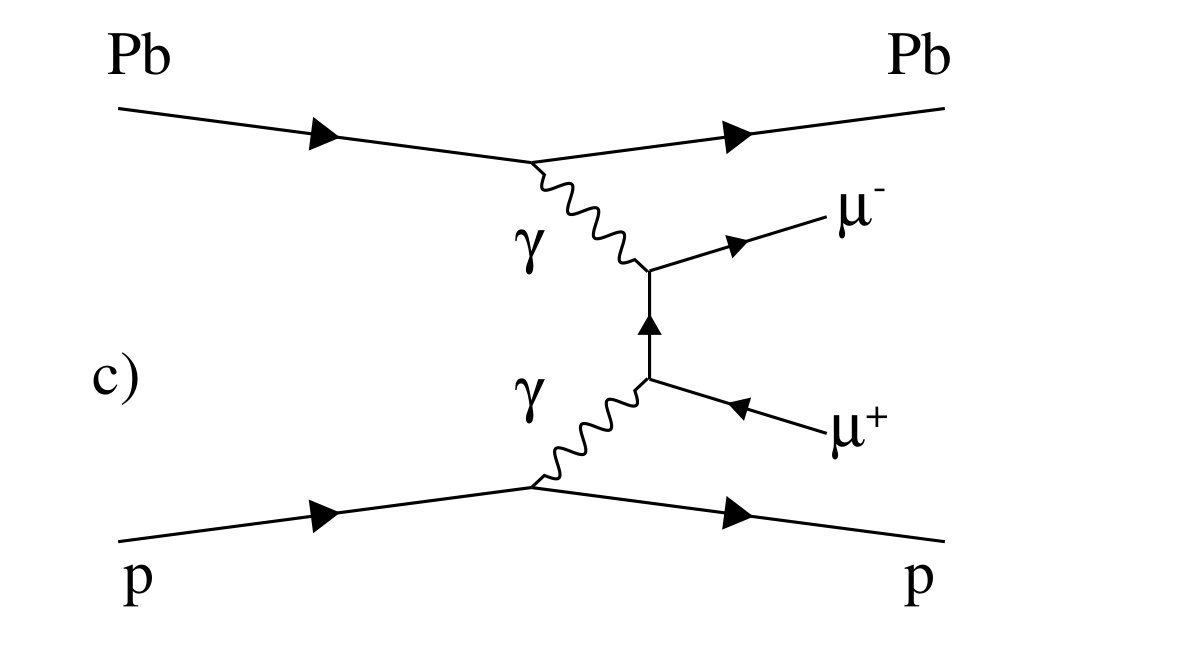 Figure 1
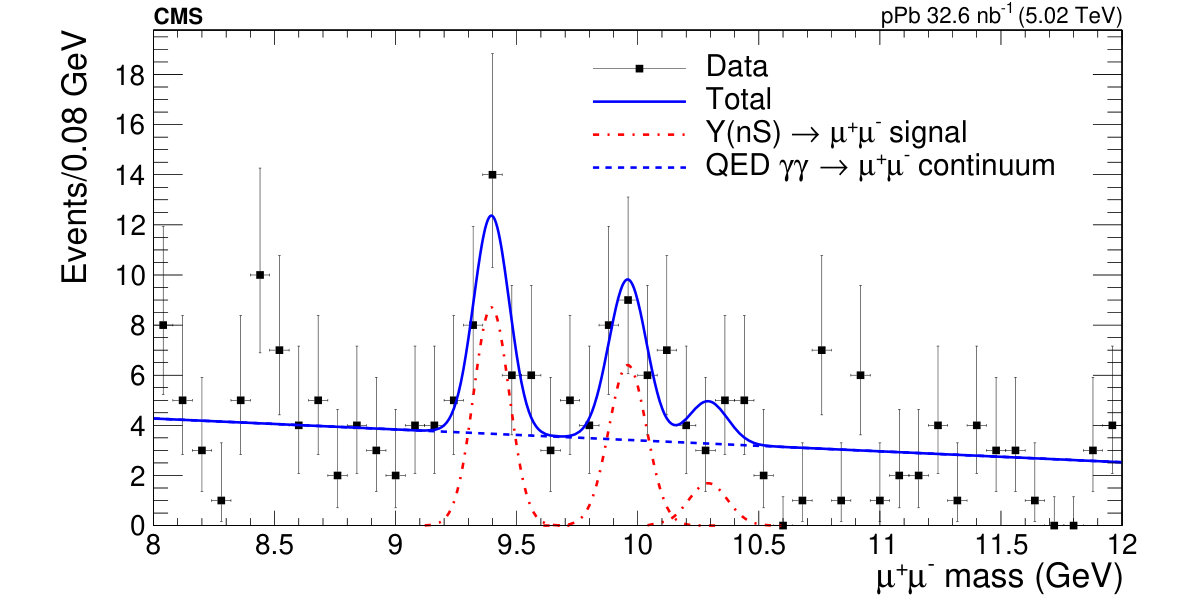 Figure 2
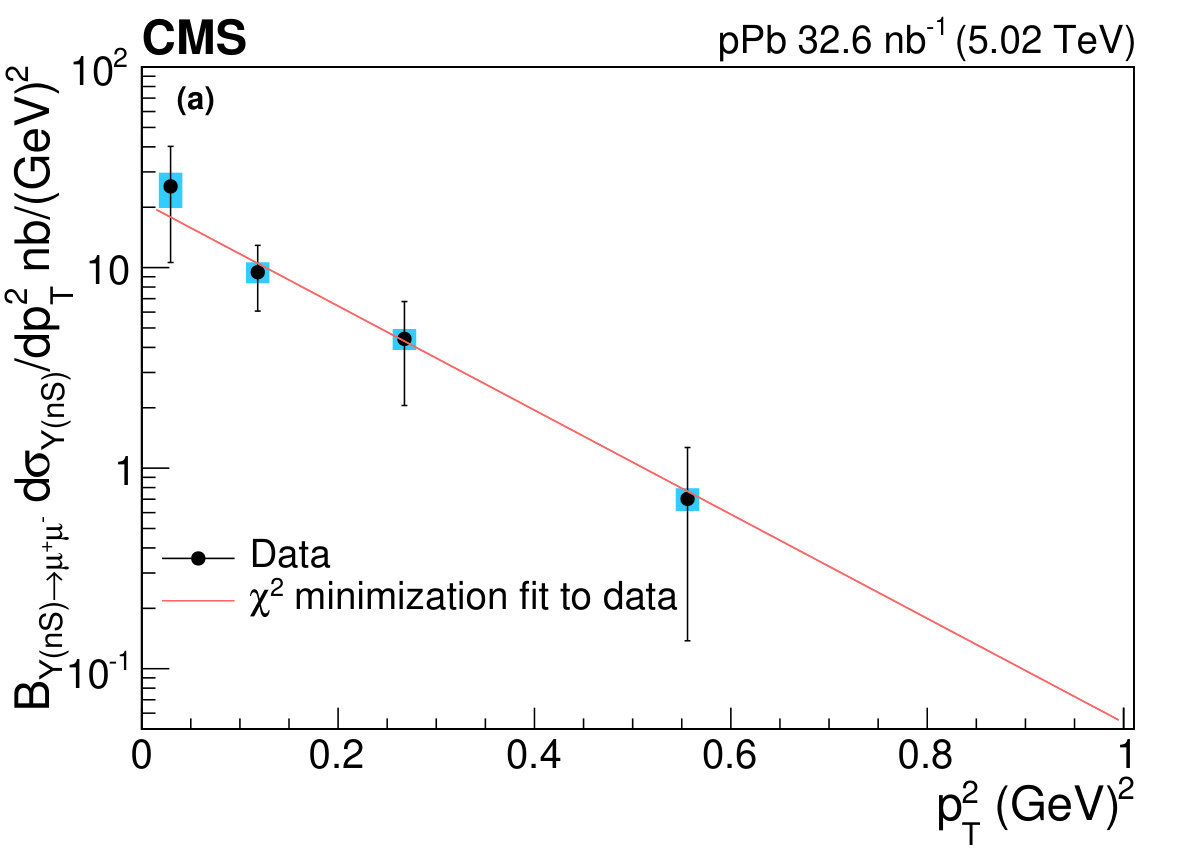 Figure 4
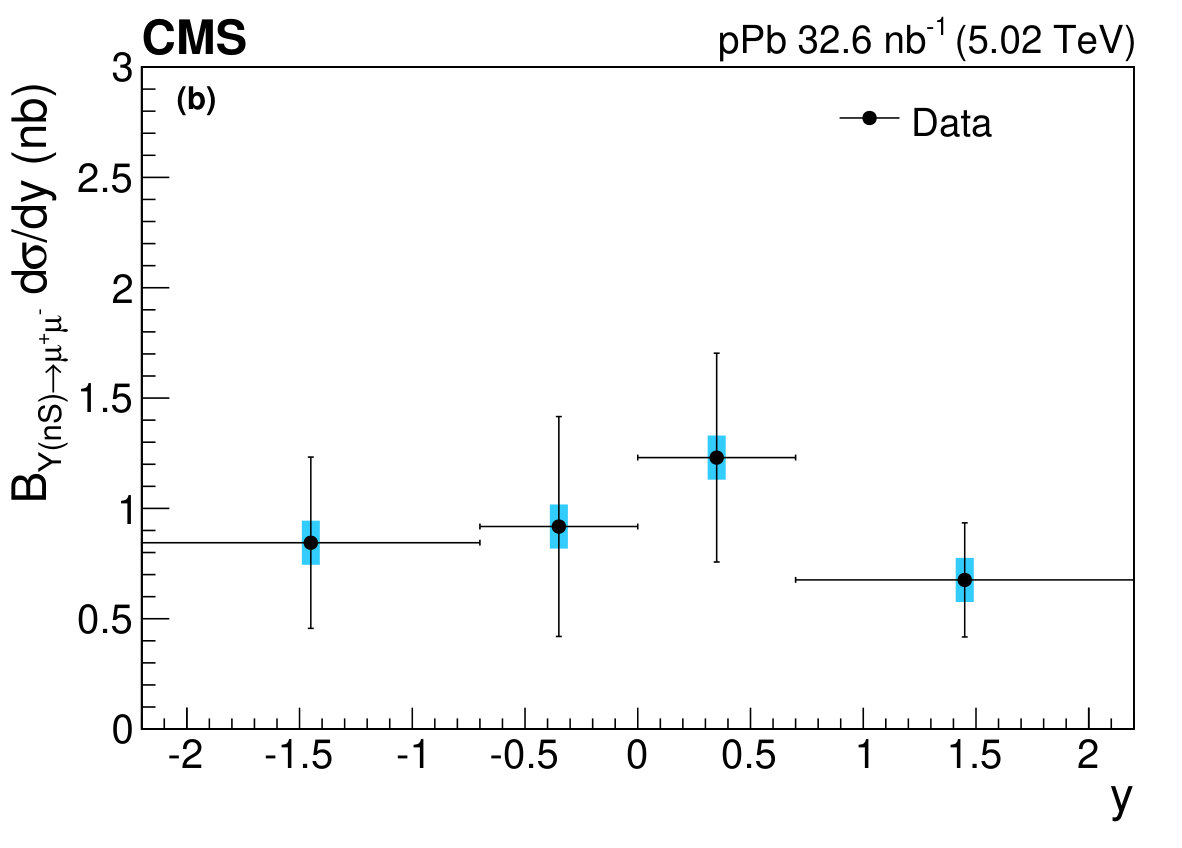 Figure 4
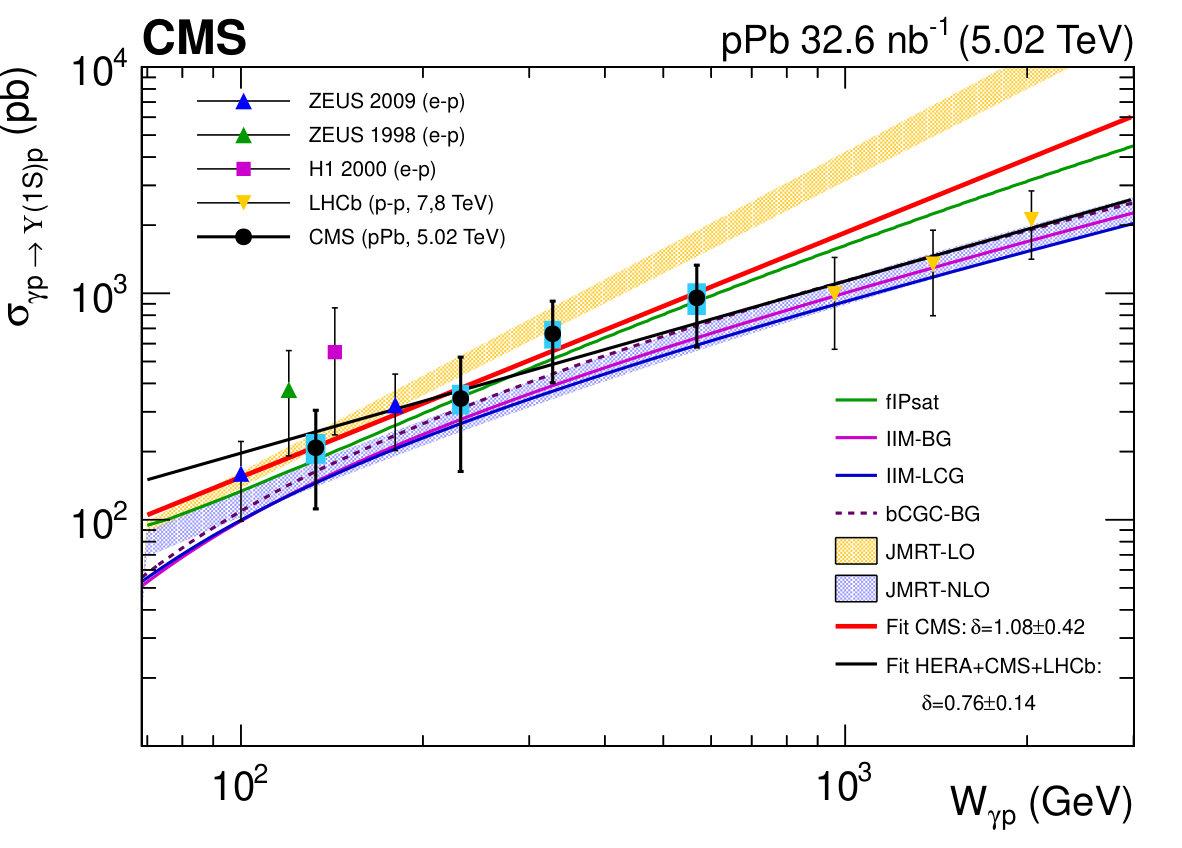 Figure 6
 Figure 8
Peer Reviews
No public reviews on file for this paper yet. If you reviewed it on a platform where reviews are public (OpenReview, ICLR, NeurIPS, ICML), you can paste yours below so the community can read it here.
Videos
No videos yet. Explain this paper in a talk, walkthrough, or lecture? Add one.
Taxonomy
TopicsHigh-Energy Particle Collisions Research · Particle physics theoretical and experimental studies · Quantum Chromodynamics and Particle Interactions
Measurement of exclusive Upsilon photoproduction in pPb collisions at TeV with the CMS
IIT Bombay
Mumbai, India
Abstract:
The exclusive photoproduction of (1S), (2S) and (3S) mesons is studied in their leptonic () decay modes, in ultraperipheral pPb collisions at TeV. The data was recorded by the CMS experiment corresponding to an integrated luminosity of nb*-1*. The differential cross-section for (n) states (n=1,2,3), has been measured as a function of transverse momentum squared , and rapidity . The (1S) photoproduction cross-section is extracted in the region as a function of the photon-proton centre-of-mass energies , in the range GeV. The measurements are compared to theoretical predictions and to previous measurements.
1 Introduction
Photonuclear interactions at very high energy can be studied in ultraperipheral collisions (UPCs) at LHC, where protons/ions interact at large impact parameter and therefore hadronic interactions are strongly suppressed. The recent results of exclusive photoproduction of and J/ in UPCs with CMS [1], ALICE [2] and LHCb [3], reveal the importance of these measurements to probe the gluon distributions in nucleons and in nuclei at small Bjorken , where is the fraction of target momentum carried by the gluon. The exclusive photoproduction of vector mesons, where a vector meson but no other particles are produced in the event, occurs through or interactions (Fig. 1a). They can be visualised in leading-order perturbative QCD in terms of the exchange of two gluons with no net colour transfer. Photoproduction is strongly enhanced in heavy ions as the photon flux grows as . As the cross-section of photoproduction of (nS) is proportional to the square of the gluon density, it is potentially possible to probe the gluon density at small Bjorken , which is kinematically related to the photon-proton centre-of-mass energy (). If the photoproduction is followed by the proton breakup, the process is called ”semi-exclusive” (Fig. 1b). The exchanged photon can also interact with a photon radiated from the other proton/ion producing an exclusive dimuon state, which as a QED process constitutes the main background for this analysis (Fig. 1c).
2 Detector and simulation
The CMS detector [4] is a general-purpose detector, having a superconducting solenoid of m internal diameter, providing a magnetic field of T. The components of the CMS detector are a silicon pixel which sits around the LHC beampipe and strip tracker (), a lead tungstate crystal (PbWO4) electromagnetic calorimeter with rapidity coverage , and a brass and scintillator hadron calorimeter over the range , each composed of a barrel and two endcap section. Each muon station consists of several layers of aluminum drift tubes in the barrel region and cathode strip chambers in the endcap region, complemented by resistive plate chambers. The muon detectors are arranged in concentric cylinders around the beam line in the barrel region, and in disks perpendicular to the beam line in the endcaps (). In the forward region there are several dedicated calorimeters (CASTOR, ZDC) and the TOTEM tracking detector.
We have used the STARLIGHT(v3.07) [5] Monte Carlo (MC) event generator to simulate exclusive (nS) photoproduction events (Fig. 1a) and the exclusive QED background (Fig. 1c). All simulated events are passed through the GEANT4-based [6] detector simulation and the event reconstruction chain of CMS.
3 Event selection
The UPC dimuon events are reconstructed at the trigger level using the High Level Trigger (HLT) algorithm, requiring at least one muon, but not more than six, tracks in the event. We have also applied the following offline muon selection criteria for the exclusive events.
- •
Exclusivity cut: Exclusive events are selected by requiring two opposite-charge muons with a single vertex and no additional charged particles () with track GeV.
No activities in Hadronic Forward (HF) calorimeters are allowed. This is achieved by requiring leading tower energy in HF GeV, determined from detector noise distribution studies [1].
- •
Single muon cut: To have good muon efficiency we have selected (single , ) .
- •
Kinematic cuts: ( GeV, ). A minimum dimuon cut is applied to have good signal to background ratio. Also, a maximum dimuon cut is applied to suppress background from inclusive and proton dissociative background.
Fig. 2 shows the invariant mass distribution of pairs in the range between and GeV that satisfy the selection criteria described above.
4 Experimental results
The and -differential cross-sections multiplied by dimuon branching fraction for exclusive (nS) photoproduction are extracted using the following equations
[TABLE]
where is the background-subtracted, and acceptance-corrected number of signal events in the GeV mass region corresponding to the three states combined in each and bin, is the integrated luminosity, and are the widths of the and bins, and is the dimuon branching fraction. The distributions are corrected for detector resolution effects using unfolding. The differential cross-sections (multiplied by the dimuon branching fraction) (nS) photoproduction, and , measured in the range , are shown in Fig. 3.
The differential cross-section of exclusive (nS), is fitted by the function (Fig. 3a). The value of the exponential slope parameter (stat) (syst) GeV*-2* is extracted using a -fit minimization method. It is in good agreement with the value (stat) GeV*-2*, measured by the ZEUS experiment [7].
The differential (1S) photoproduction cross-section is then extracted via
[TABLE]
where is ratio of (1S) to events, is the feed-down contribution to the (1S) from (where or ) decay. The feed-down contribution from states is neglected because it is a double-pomeron exchange processes. Finally the exclusive (1S) photoproduction cross-section is measured as a function of using the relation
[TABLE]
in four different rapidity bins which is shown in Fig. 4. The photon flux is evaluated from the STARLIGHT MC simulation.
The exclusive (1S) photoproduction cross-section is measured in the range GeV, corresponds to parton fractional momenta in the proton . This cross-section shows a power law dependence on and the parameter (CMS) is extracted from fitting. It is consistent with the value obtained by ZEUS [8].
5 Summary
We reported the first measurement of the exclusive photoproduction of (1S,2S,3S) mesons in the decay mode for pPb collisions at TeV. The differential cross-section and the exclusive (1S) photoproduction cross sections as a function of the photon-proton centre-of-mass energy , have been measured. The present measurement provides new insight on the low- gluon distribution in the proton.
The reference list from the paper itself. Each links out to its DOI / PubMed record.
- 1[1] CMS Collaboration, Measurement of exclusive Υ Υ \Upsilon photoproduction from protons in p Pb collisions at s N N subscript 𝑠 𝑁 𝑁 \sqrt{s_{NN}} = 5.02 Te V , [ ar Xiv:1809.11080 ].
- 2[2] ALICE Collaboration, Exclusive J/ ψ 𝜓 \psi photoproduction off protons in ultraperipheral p Pb collisions at s N N subscript 𝑠 𝑁 𝑁 \sqrt{s_{NN}} = 5.02 Te V , Phys. Rev. Lett. 113 (2014) 232504.
- 3[3] LH Cb Collaboration, Measurement of the exclusive Υ Υ \Upsilon production cross section in pp collisions at s = 7 𝑠 7 \sqrt{s}=7 Te V and 8 8 8 Te V , JHEP 1509 , 084 (2015).
- 4[4] CMS Collaboration, The CMS experiment at the CERN LHC , JINST 3 (2008) S 08004.
- 5[5] S. R. Klein and J. Nystrand, Photoproduction of quarkonium in proton-proton and nucleus-nucleus collisions , Phys. Rev. Lett. 92 (2004) 142003, [ doi:10.1103/Phys Rev Lett.92.142003 ].
- 6[6] GEANT 4 Collaboration, GEANT 4-a simulation toolkit , Nucl. Instrum. Meth. A 506 (2003) 250.
- 7[7] ZEUS Collaboration, Measurement of the t dependence in exclusive photoproduction of Υ ( 1 S ) Υ 1 𝑆 \Upsilon(1S) mesons at HERA , Phys. Lett. B 708 (2012) 14, [ doi:10.1016/j.physletb.2012.01.009 ].
- 8[8] ZEUS Collaboration, Exclusive photoproduction of Υ Υ \Upsilon mesons at HERA , Phys. Lett. B 680 (2009) 4.