Search for a low-mass $\tau^-\tau^+$ resonance in association with a bottom quark in proton-proton collisions at $\sqrt{s} =$ 13 TeV
CMS Collaboration

TL;DR
This study searches for low-mass tau-tau resonances produced with bottom quarks in proton-proton collisions at 13 TeV, setting upper limits on production cross sections for specific models, with results consistent with the standard model.
Contribution
First search for low-mass tau-tau resonances with bottom quarks at 13 TeV, providing new upper limits on cross sections for two theoretical models.
Findings
No significant excess observed over the standard model.
Set upper limits on cross sections for pseudoscalar Higgs boson decays.
Set upper limits on cross sections for bottom-like quark decays.
Abstract
A general search is presented for a low-mass resonance produced in association with a bottom quark. The search is based on proton-proton collision data at a center-of-mass energy of 13 TeV collected by the CMS experiment at the LHC, corresponding to an integrated luminosity of 35.9 fb. The data are consistent with the standard model expectation. Upper limits at 95% confidence level on the cross section times branching fraction are determined for two signal models: a light pseudoscalar Higgs boson decaying to a pair of leptons produced in association with bottom quarks, and a low-mass boson X decaying to a -lepton pair that is produced in the decay of a bottom-like quark B such that B bX. Masses between 25 and 70 GeV are probed for the light pseudoscalar boson with upper limits ranging from 250 to 44 pb. Upper limits from 20 to 0.3 pb are set on B…
Click any figure to enlarge with its caption.
 Figure 1
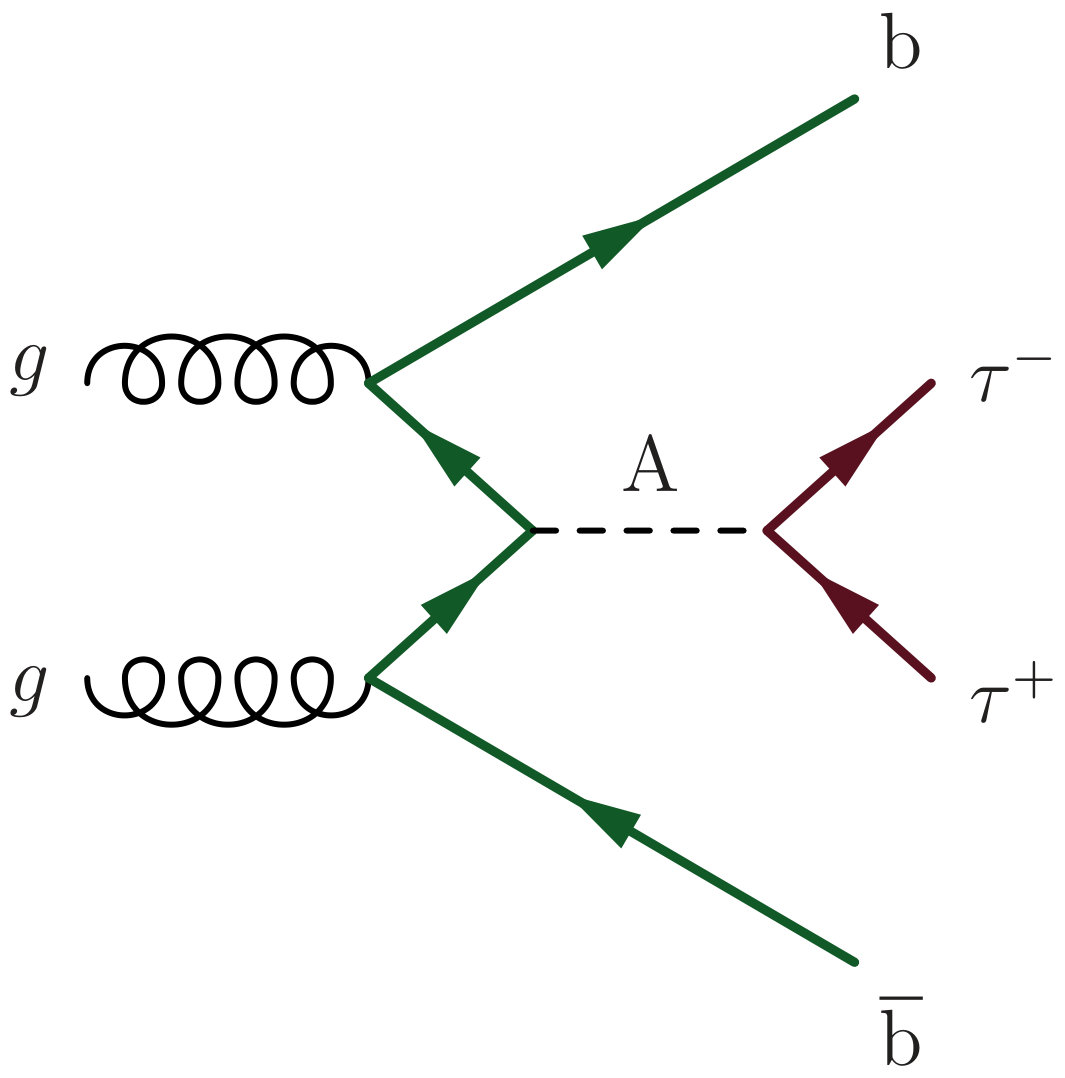 Figure 1
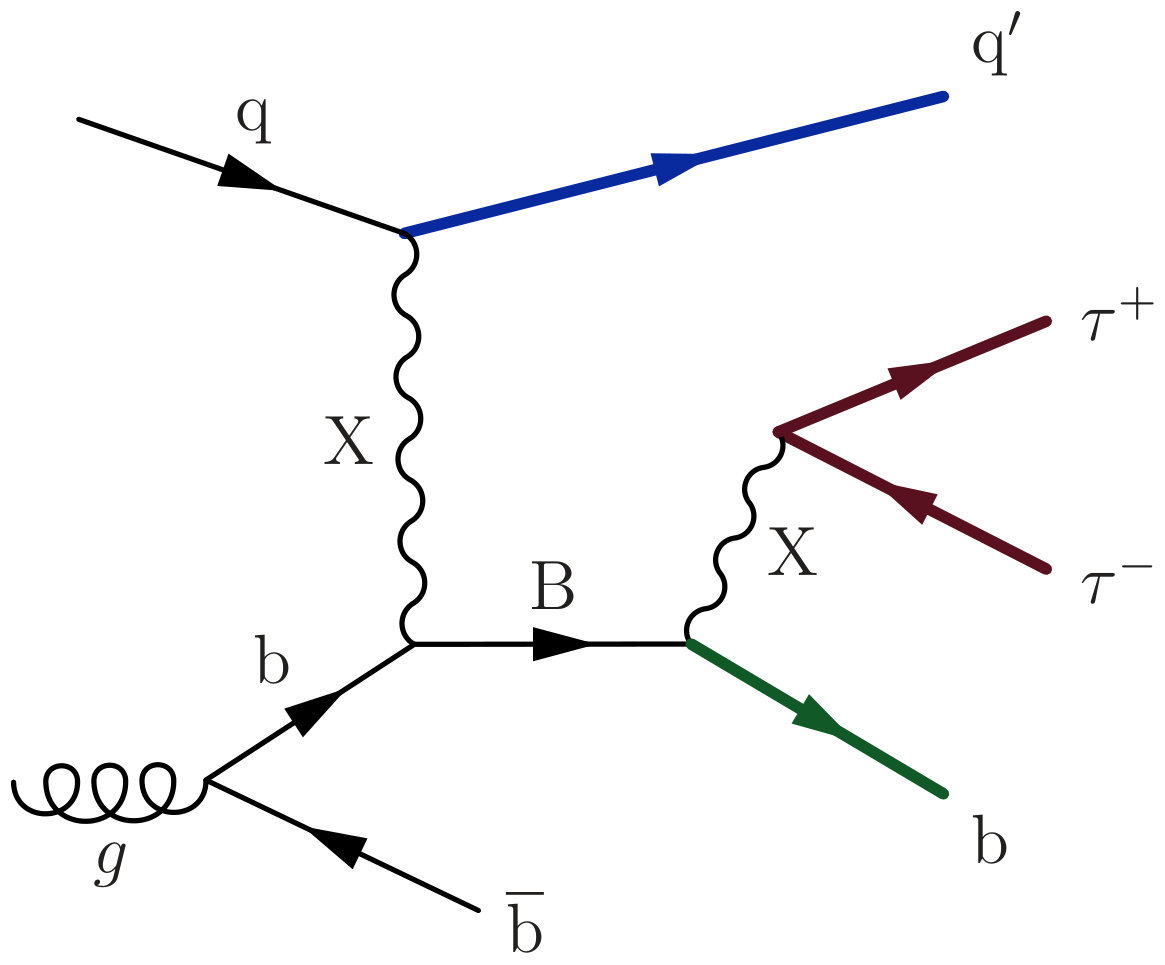 Figure 1
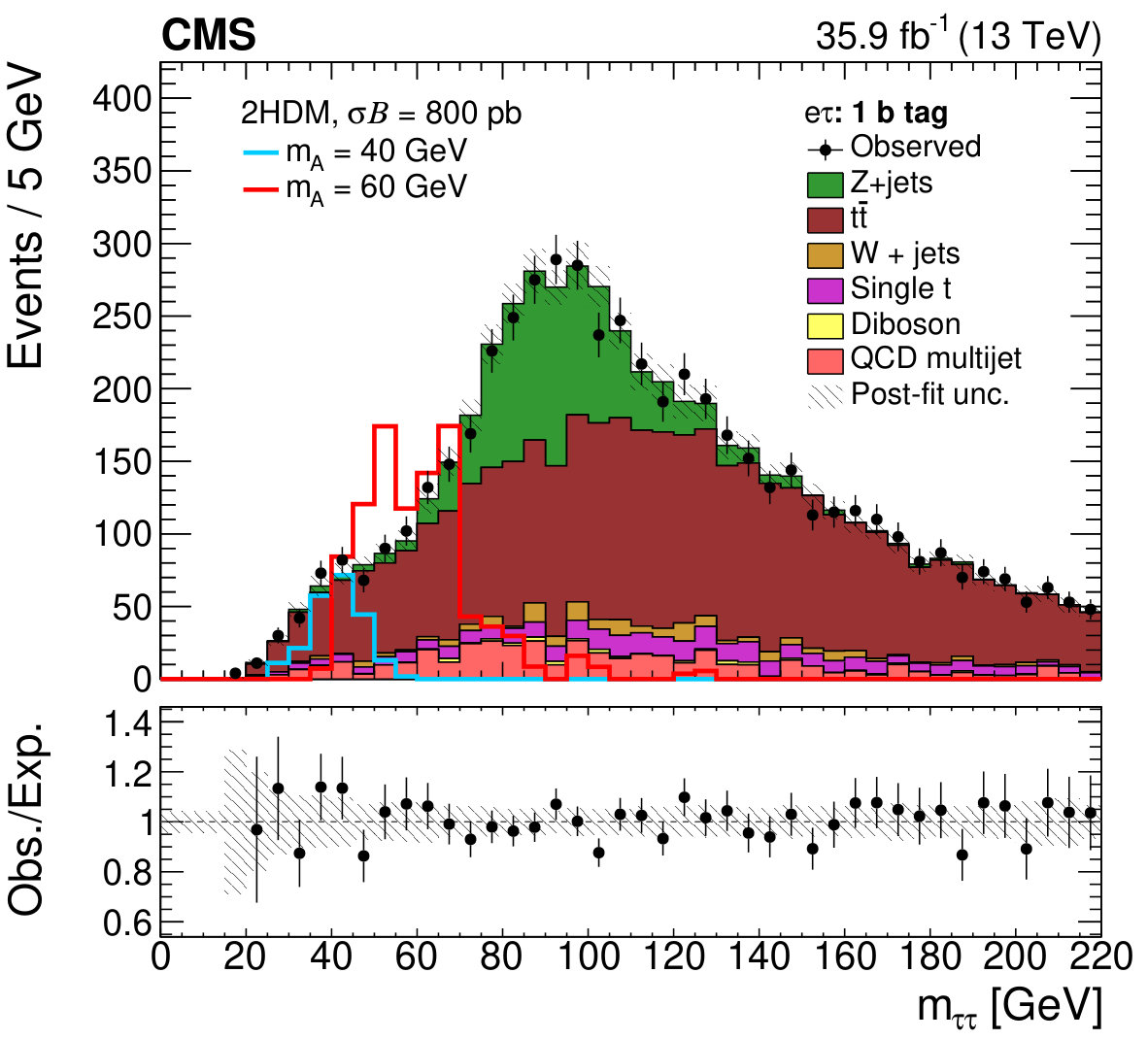 Figure 2
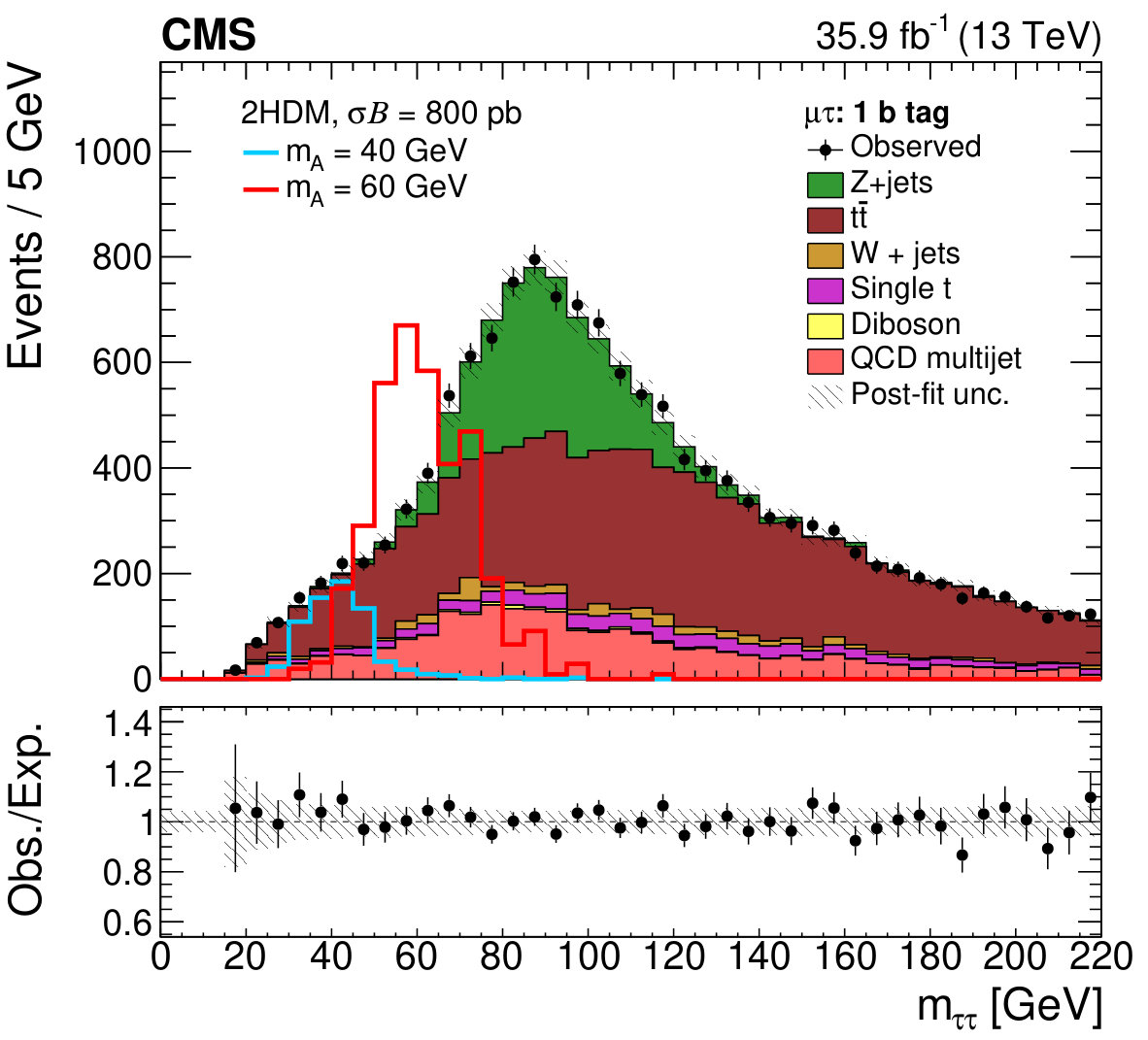 Figure 2
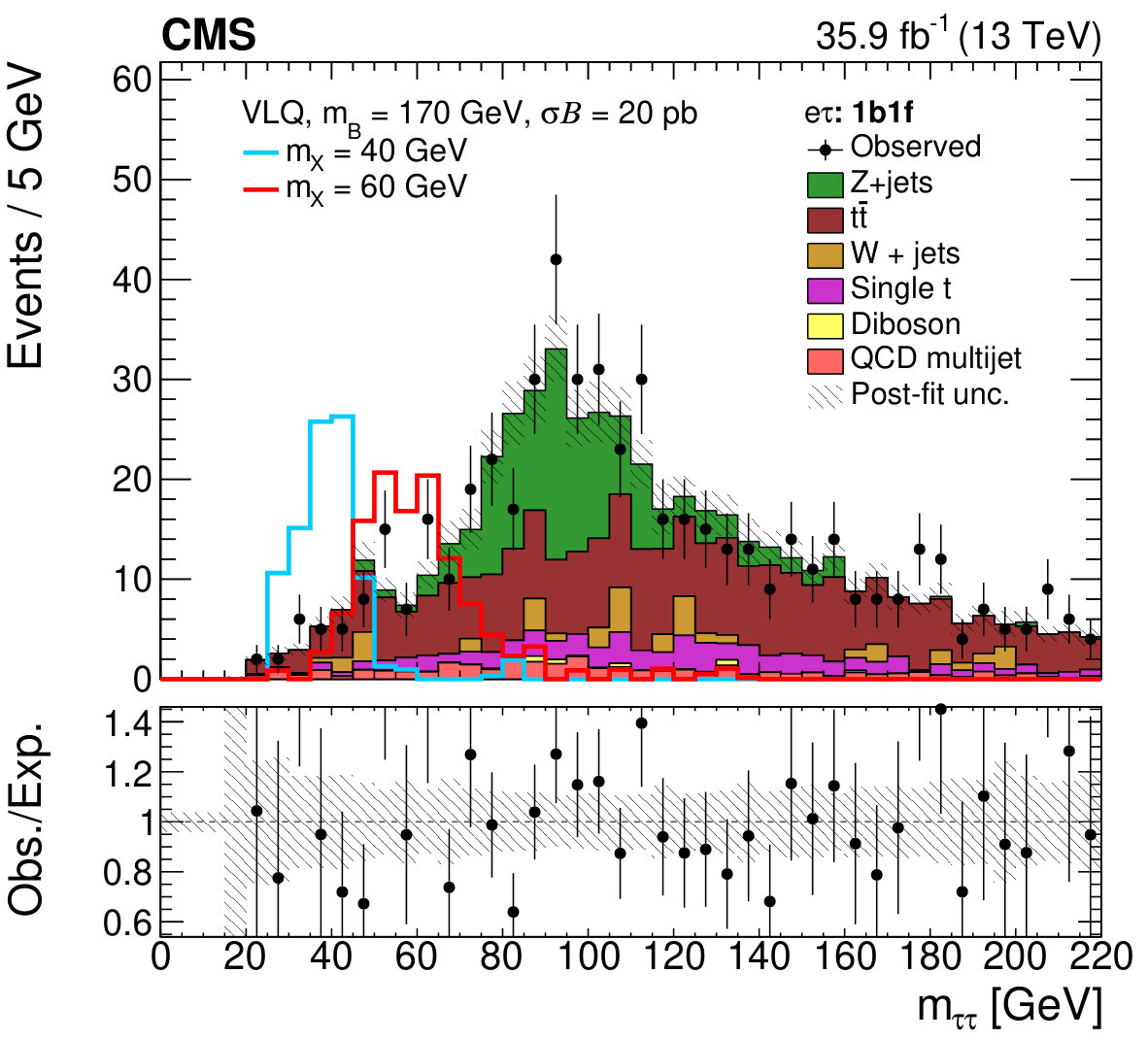 Figure 3
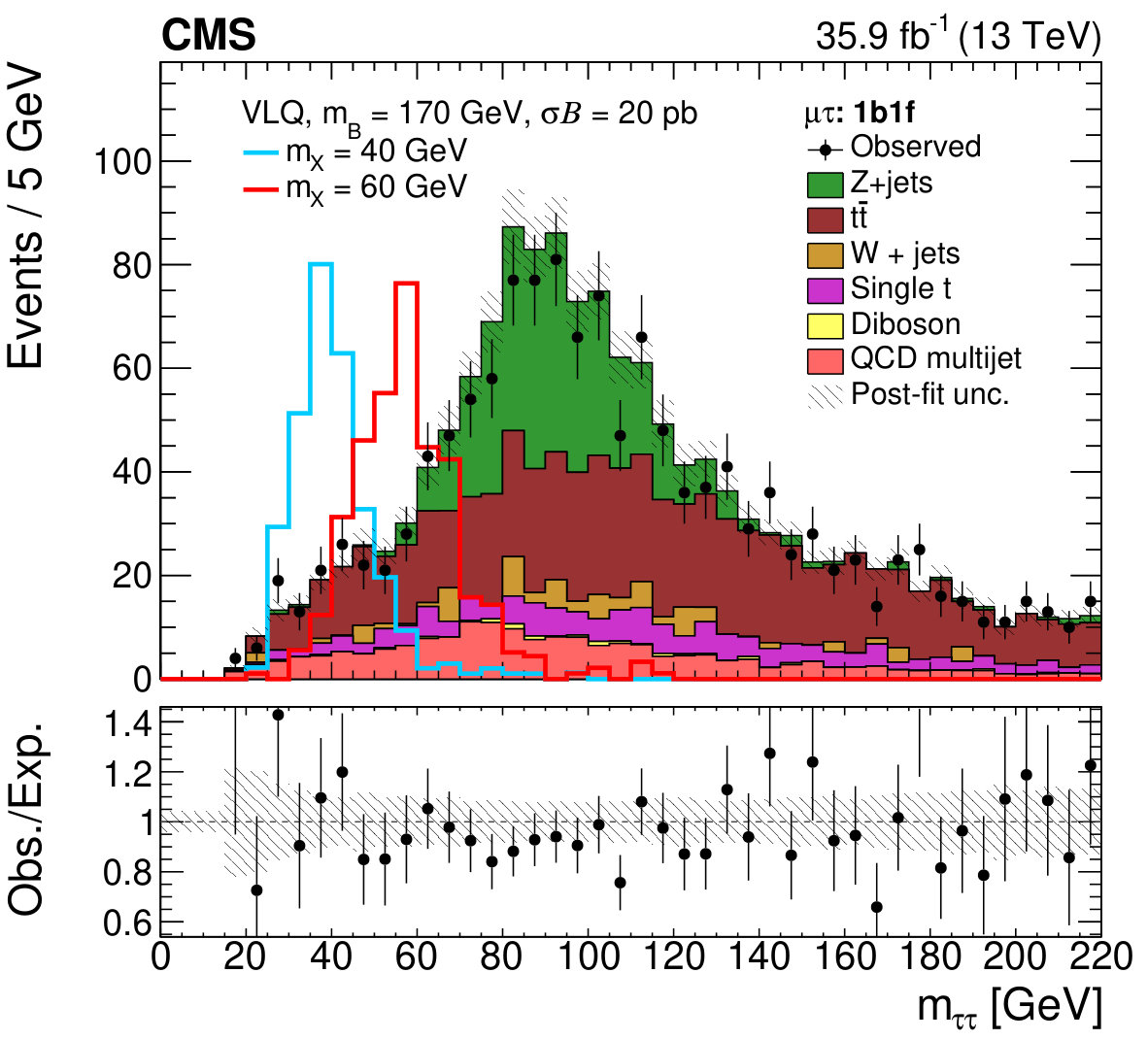 Figure 3
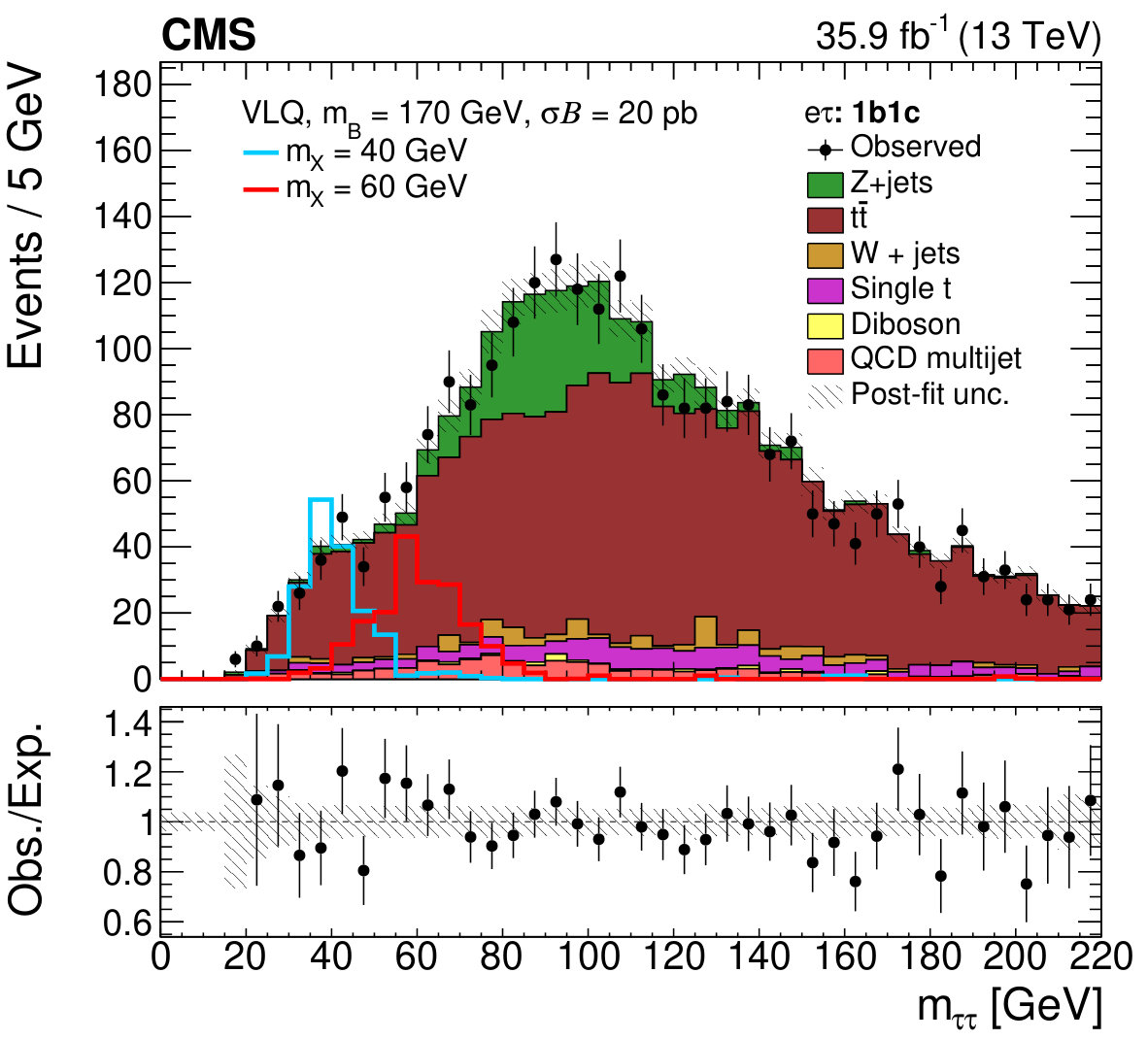 Figure 3
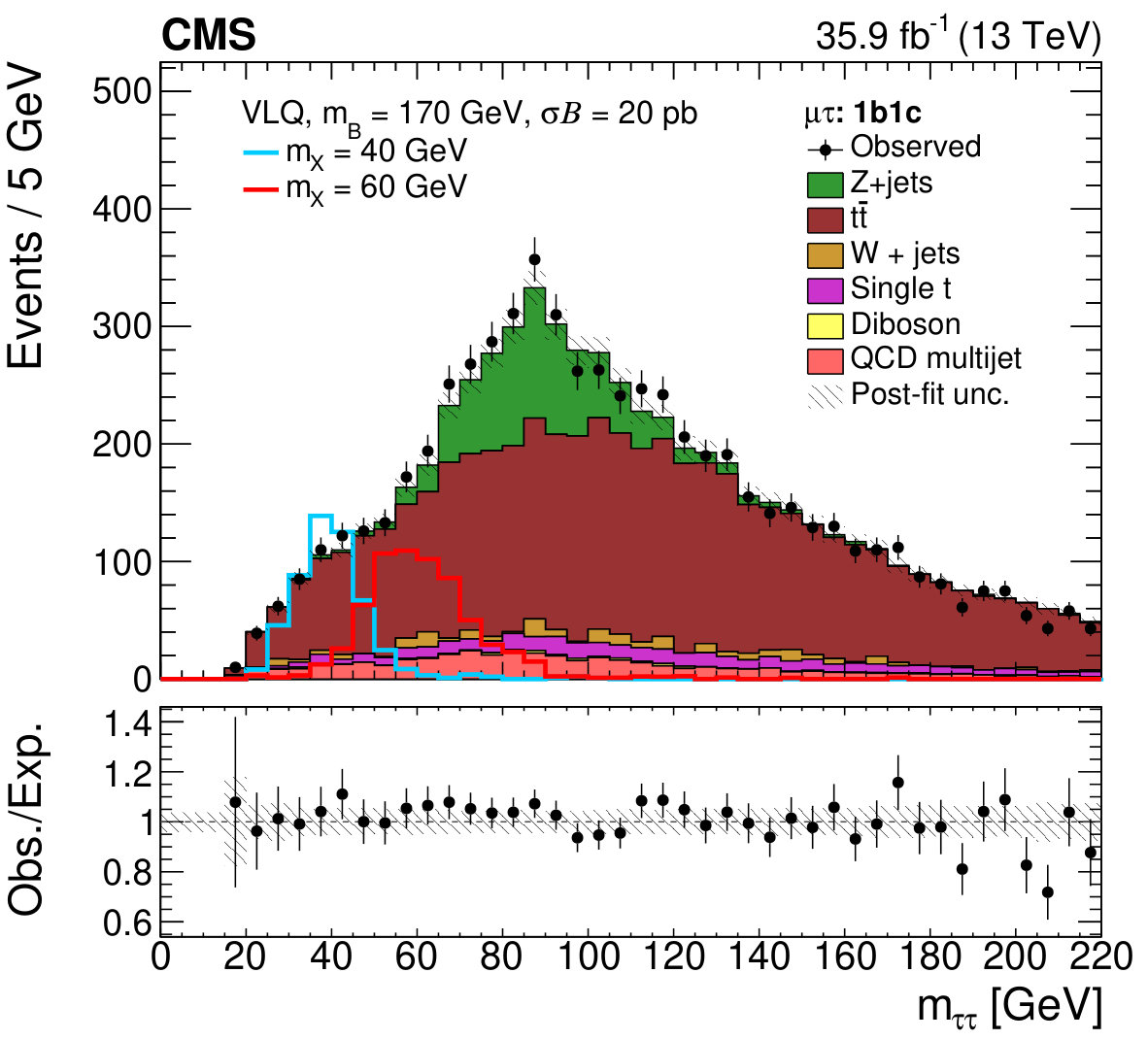 Figure 3
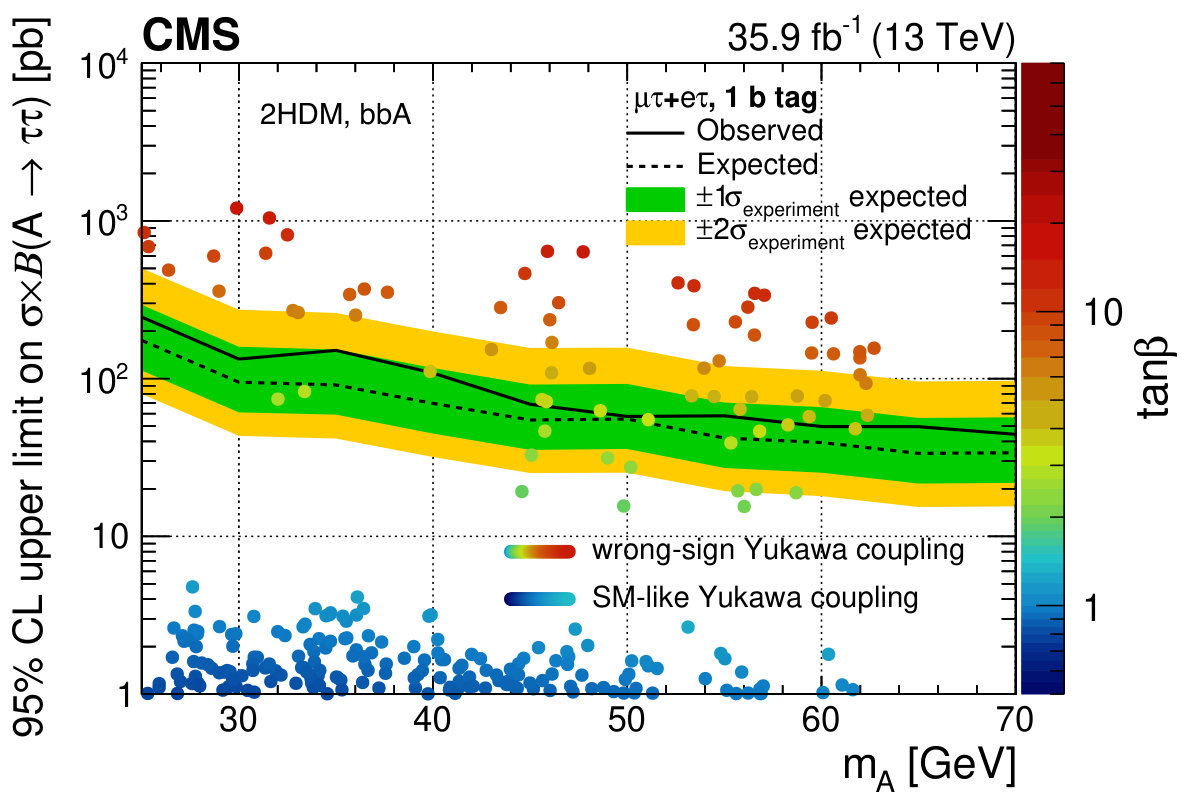 Figure 4
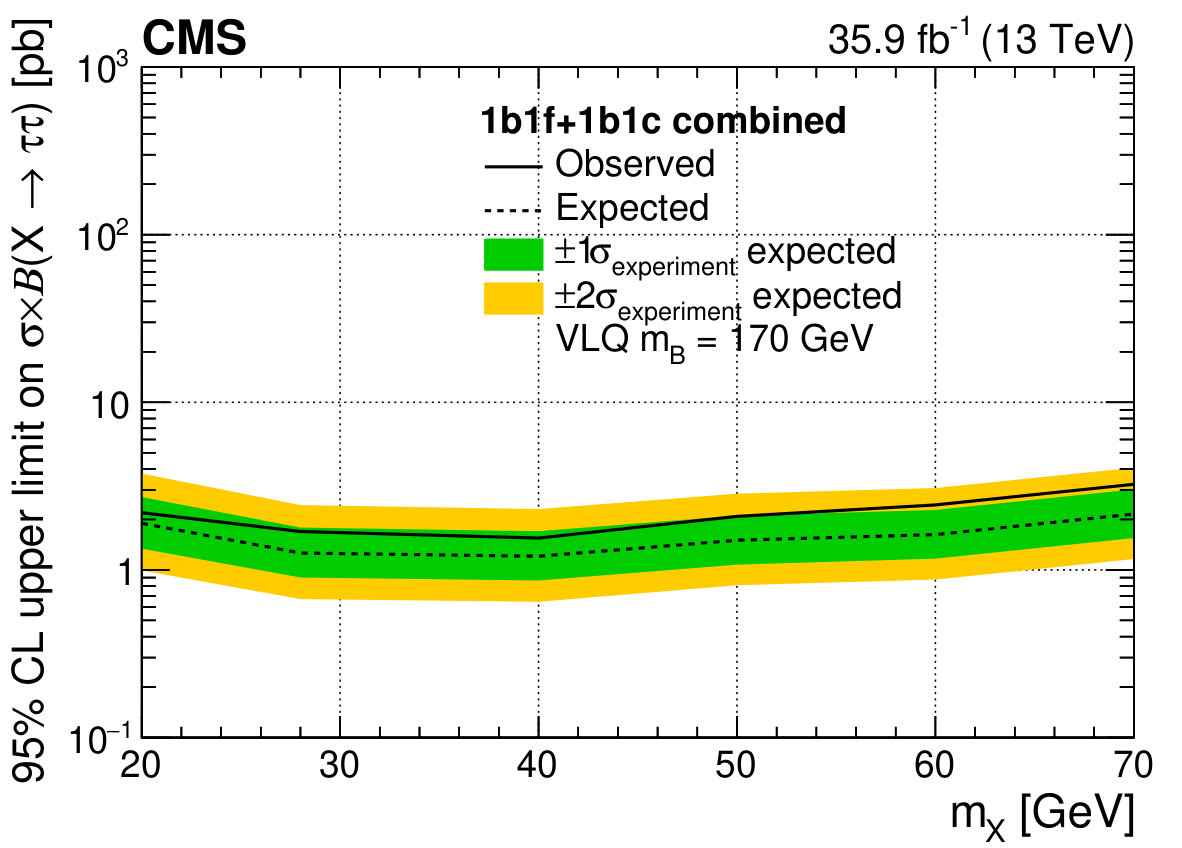 Figure 5
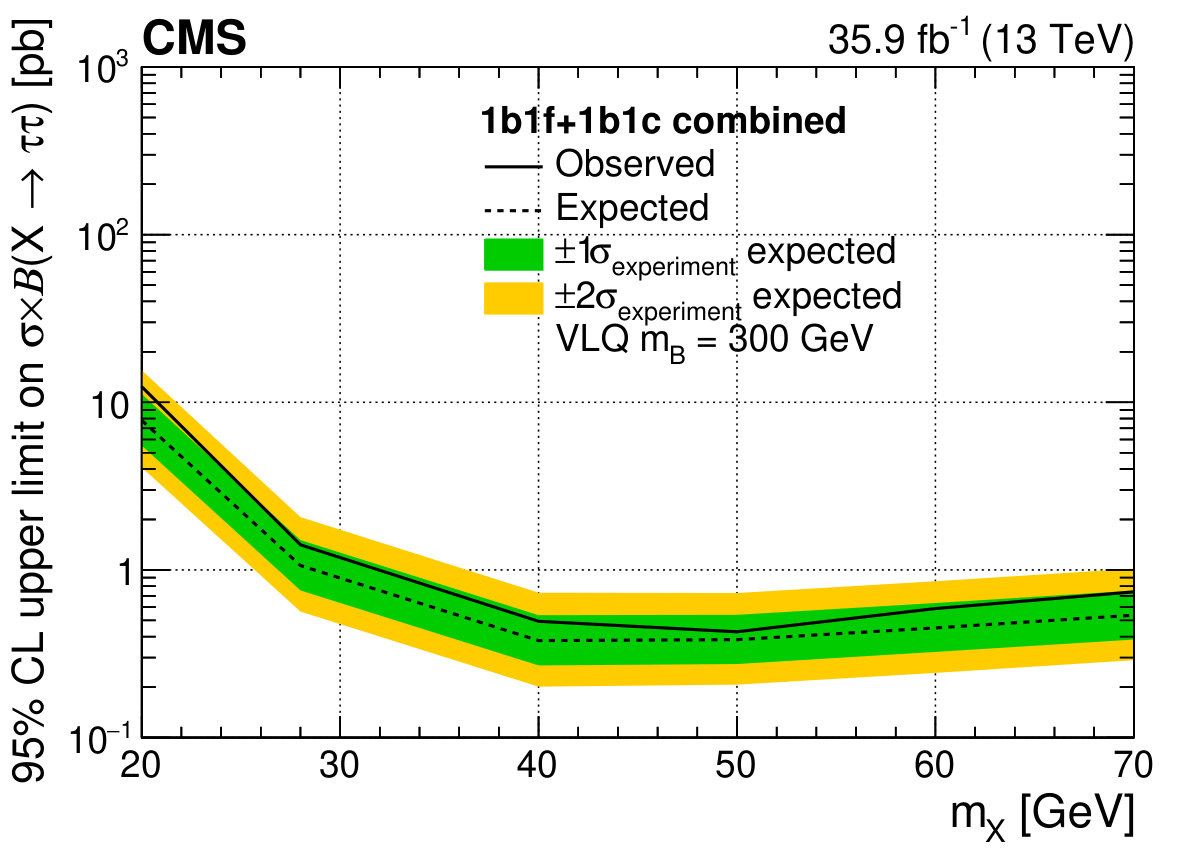 Figure 5
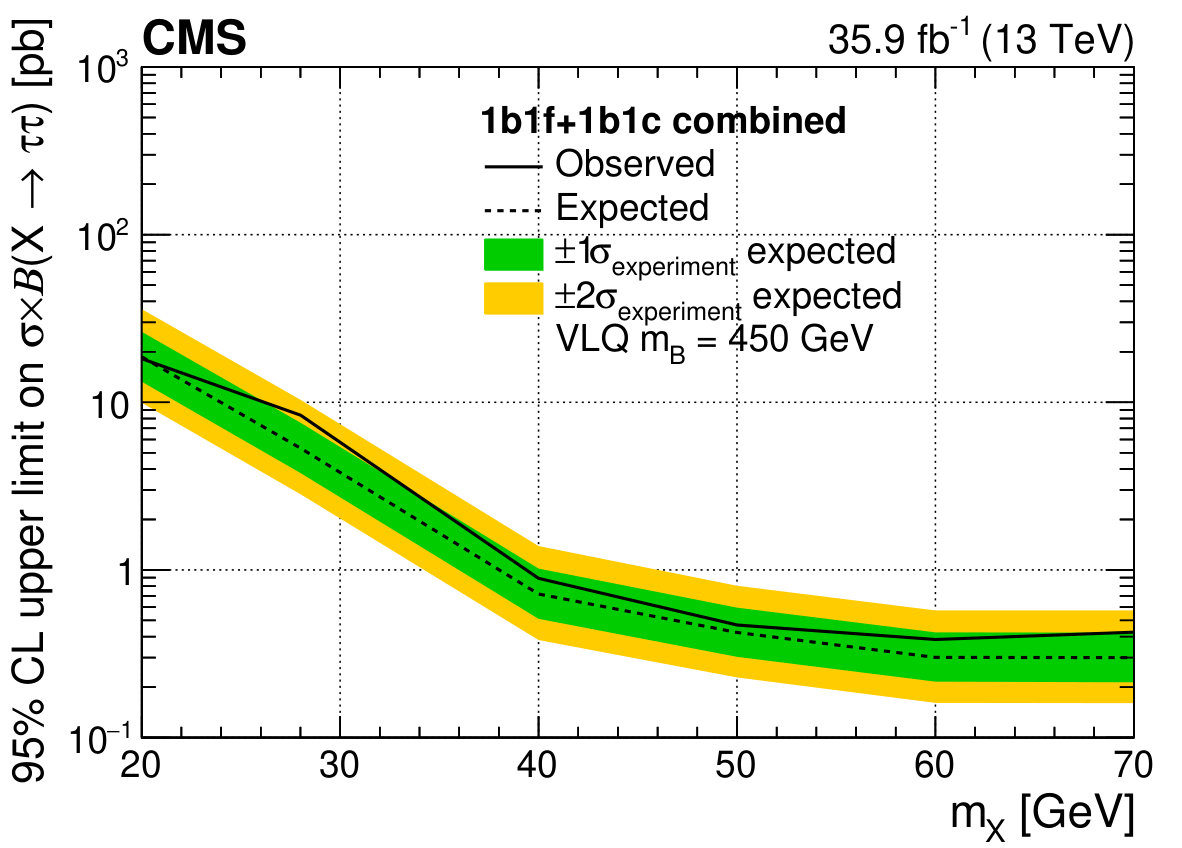 Figure 5
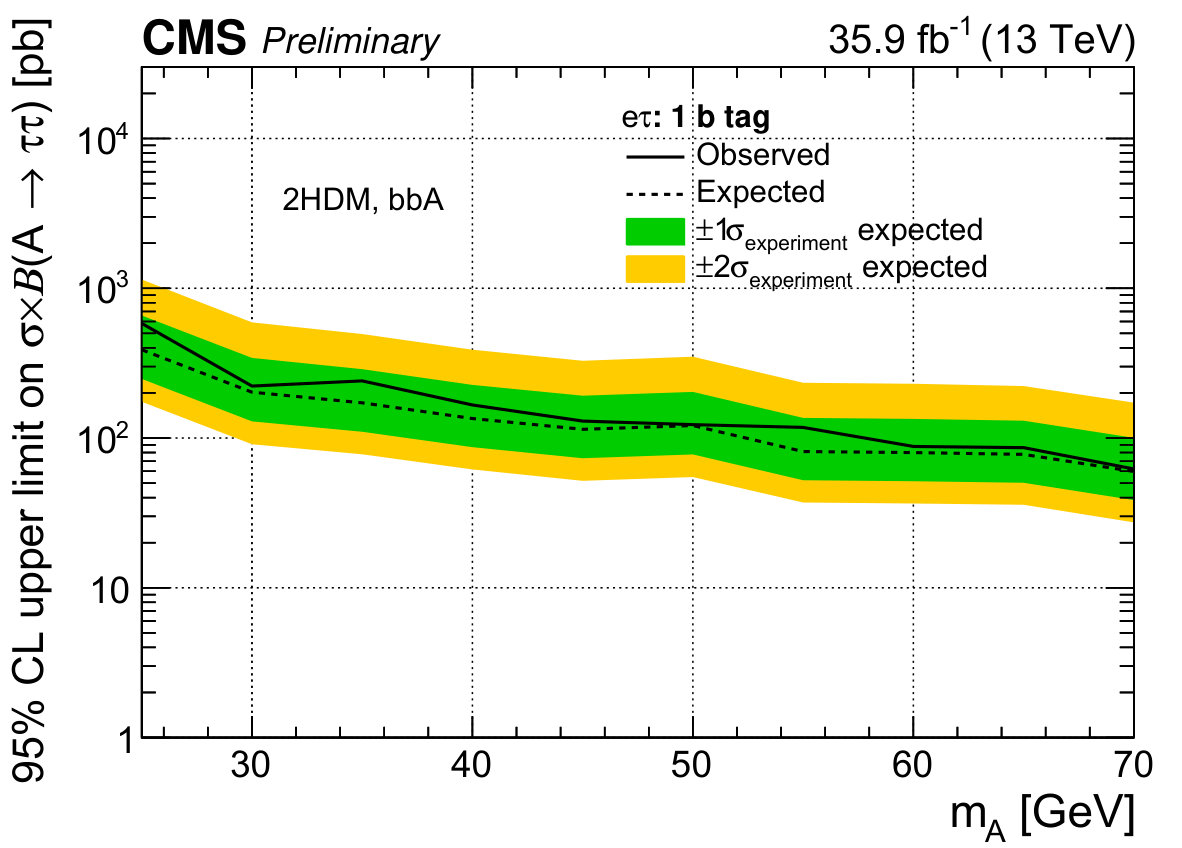 Figure 6
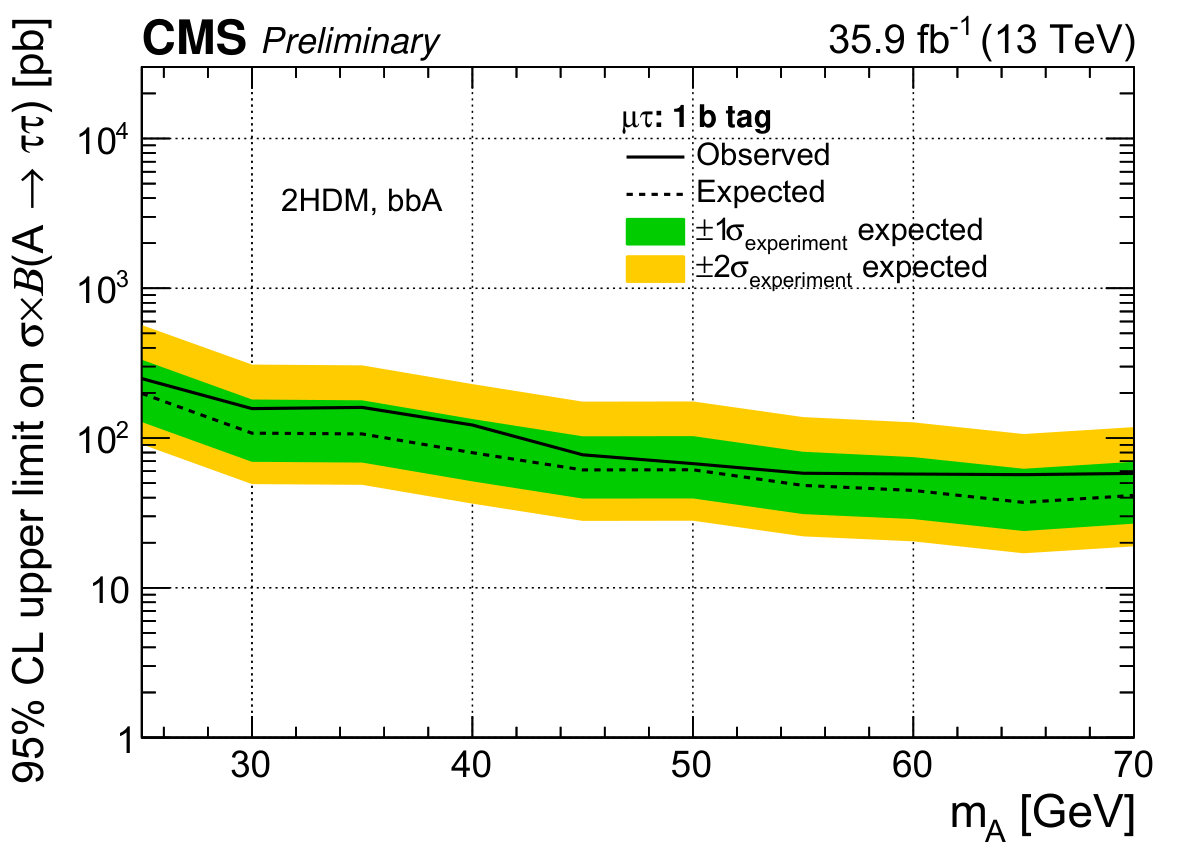 Figure 6
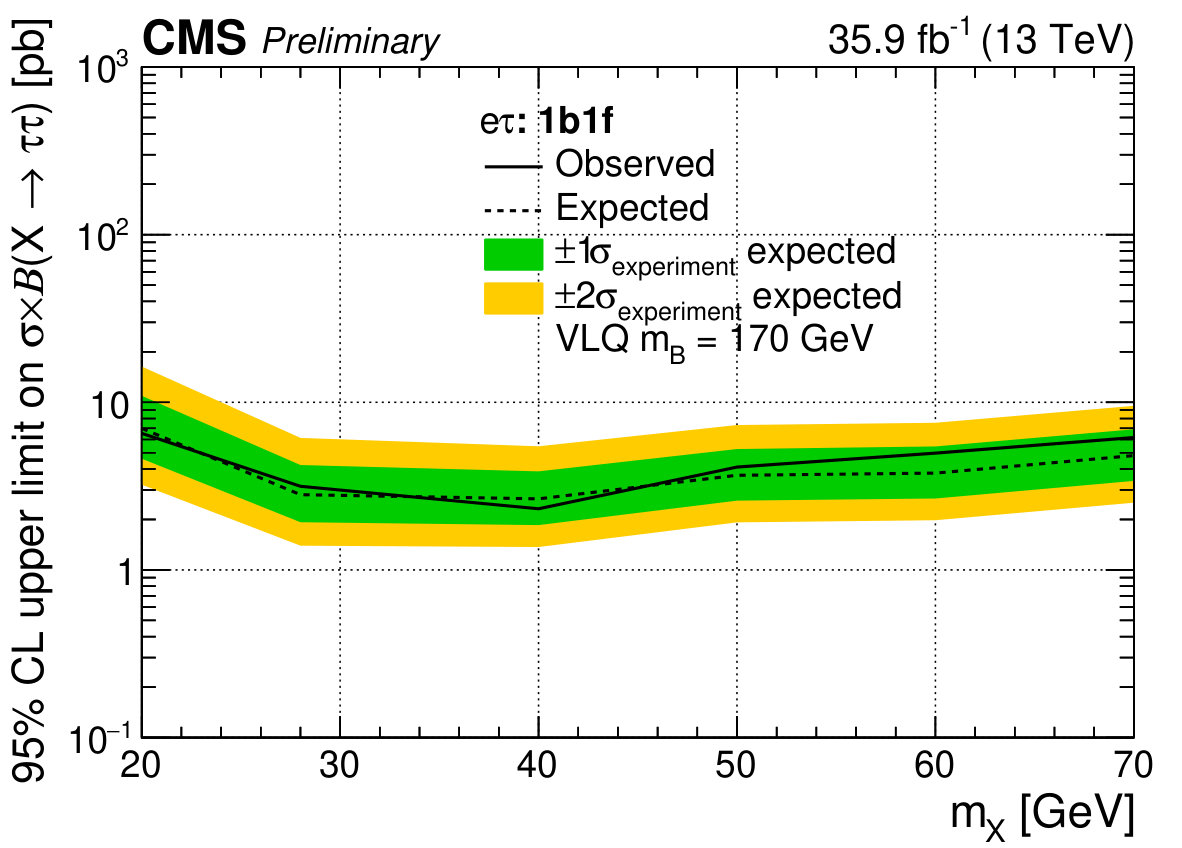 Figure 7
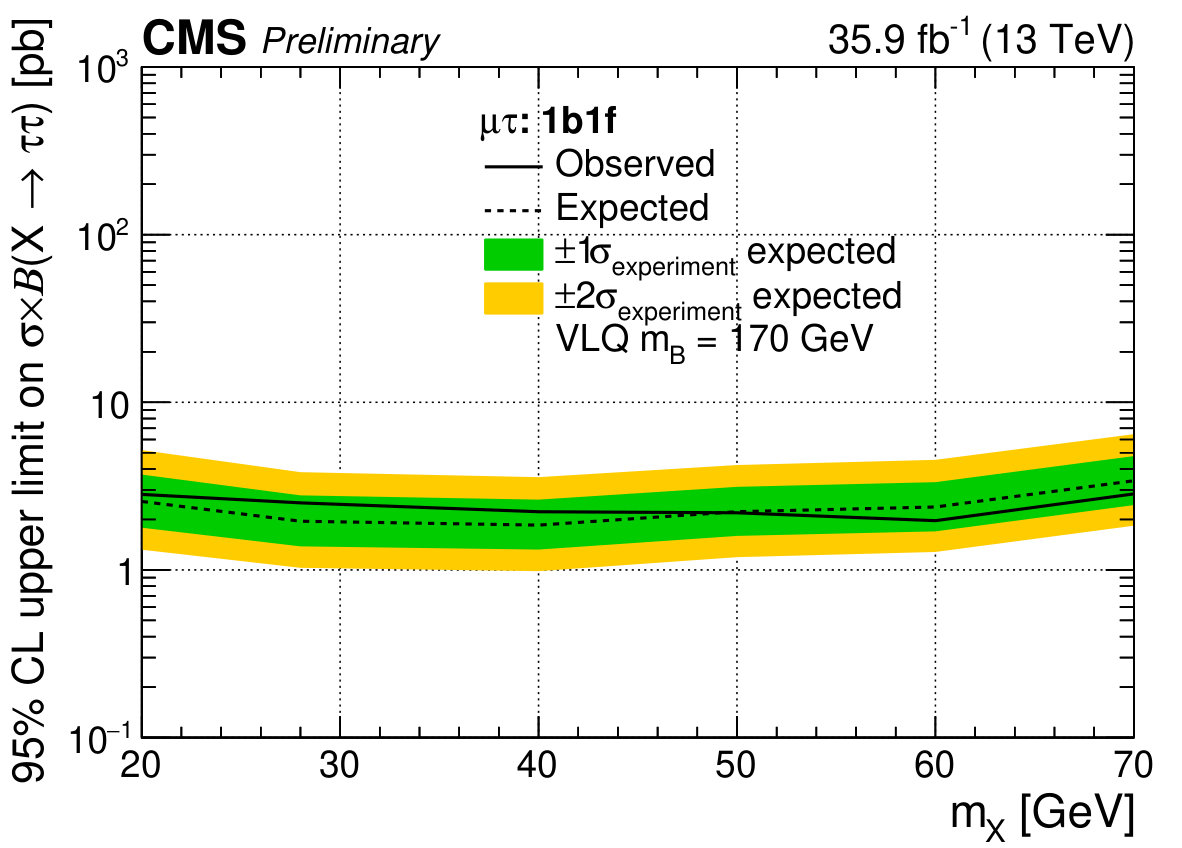 Figure 7
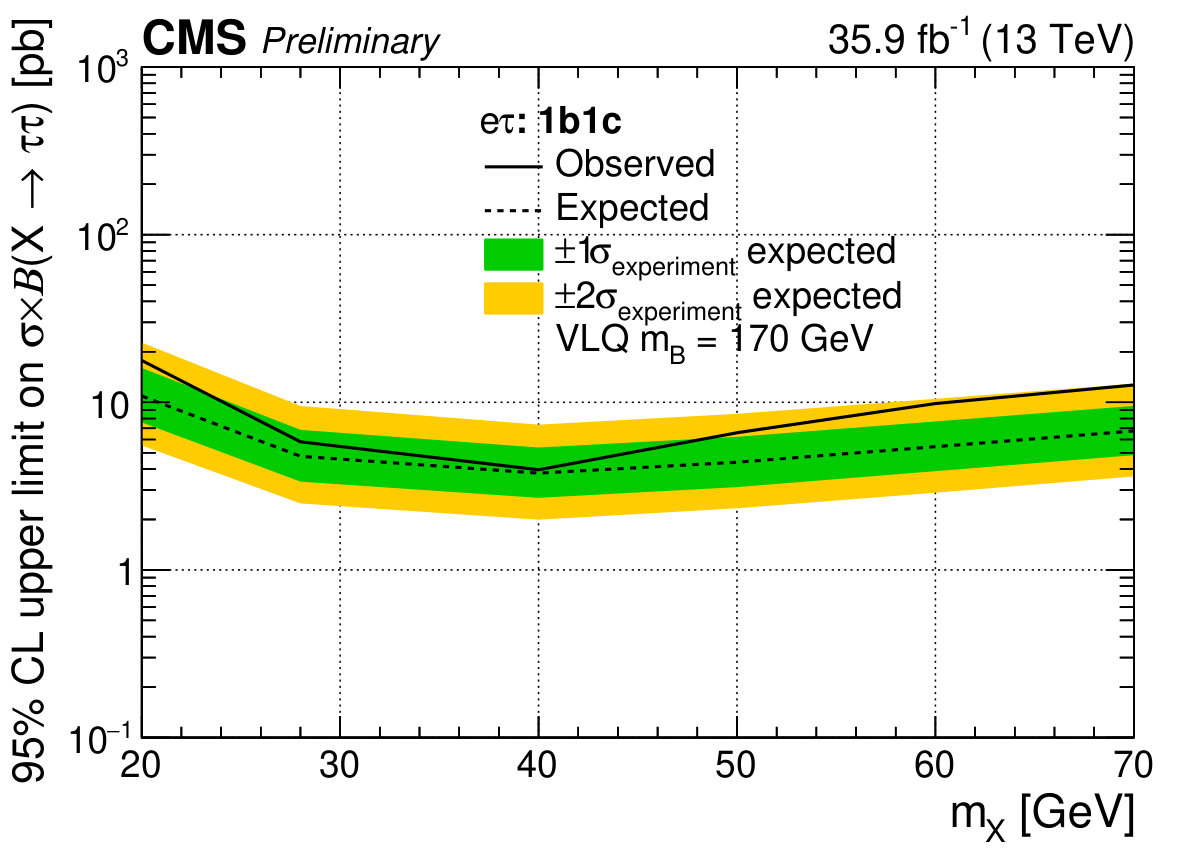 Figure 7
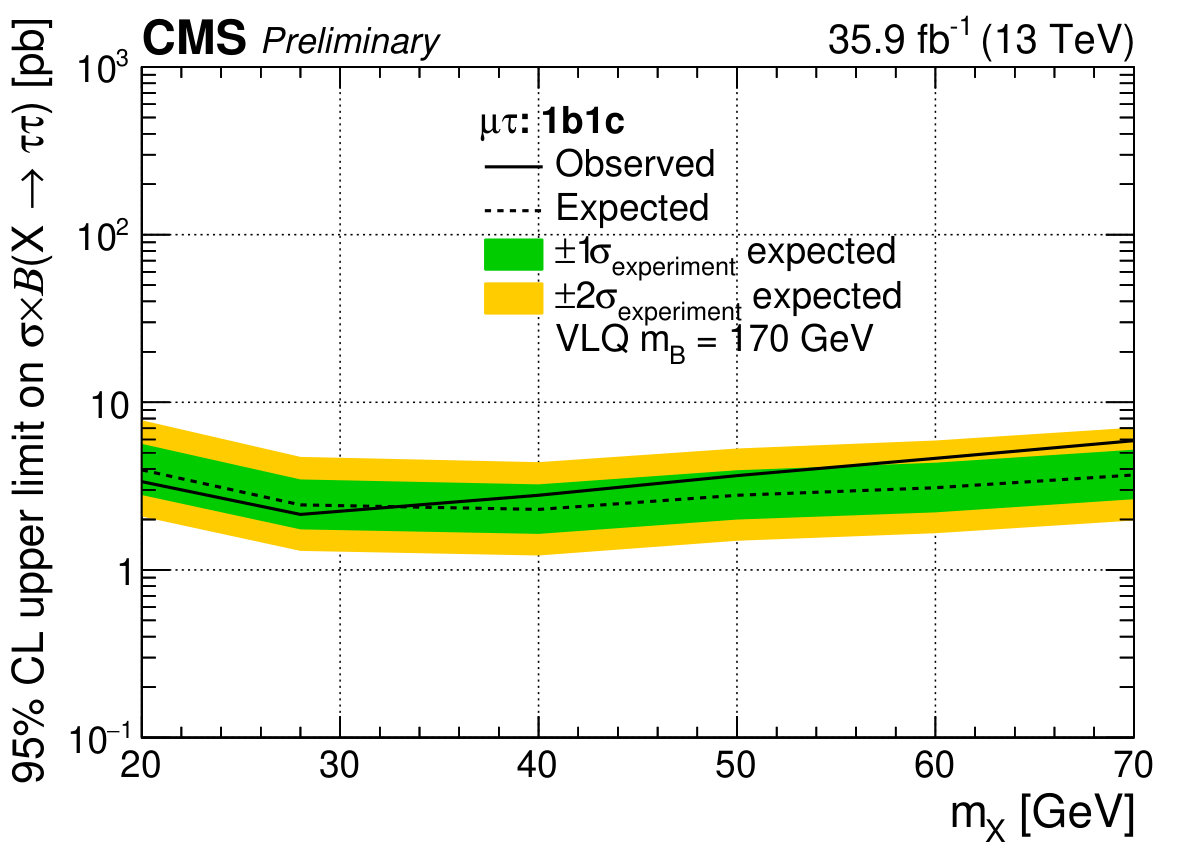 Figure 7
 Figure 20
 Figure 21
Peer Reviews
No public reviews on file for this paper yet. If you reviewed it on a platform where reviews are public (OpenReview, ICLR, NeurIPS, ICML), you can paste yours below so the community can read it here.
Videos
No videos yet. Explain this paper in a talk, walkthrough, or lecture? Add one.
\cmsNoteHeader
HIG-17-014
\RCS
\RCS \RCS
\cmsNoteHeaderHIG-17-014
Search for a low-mass resonance in association with a bottom quark in proton-proton collisions at
Abstract
A general search is presented for a low-mass resonance produced in association with a bottom quark. The search is based on proton-proton collision data at a center-of-mass energy of 13\TeVcollected by the CMS experiment at the LHC, corresponding to an integrated luminosity of . The data are consistent with the standard model expectation. Upper limits at 95% confidence level on the cross section times branching fraction are determined for two signal models: a light pseudoscalar Higgs boson decaying to a pair of leptons produced in association with bottom quarks, and a low-mass boson decaying to a \Pgt-lepton pair that is produced in the decay of a bottom-like quark such that . Masses between 25 and 70\GeVare probed for the light pseudoscalar boson with upper limits ranging from 250 to 44\unitpb. Upper limits from 20 to 0.3\unitpb are set on B masses between 170 and 450\GeVfor boson masses between 20 and 70\GeV.
0.1 Introduction
The observation of a Higgs boson by the ATLAS and the CMS Collaborations [1, 2, 3] represents a major step towards the understanding of the mechanism for electroweak symmetry breaking [4, 5, 6]. All measurements within the Higgs boson sector have so far been in general agreement with the predictions of the standard model (SM) [7, 8]. However, the SM cannot address several crucial issues, such as the hierarchy problem, the origin of the matter-antimatter asymmetry in the universe, and the nature of dark matter [9, 10, 11, 12]. Theories beyond the SM have been proposed to address these open questions. Many of these predict the existence of more than one Higgs boson, or new resonances that preferentially decay to a pair of third-generation fermions, including \Pgt leptons.
In this analysis, a search for several scenarios of low-mass resonances that decay to a pair of \Pgt leptons of opposite charge is performed. In particular, we define multiple signal regions that are optimized based on two benchmark models that have final states with different kinematic properties. We consider a mass range between 20 and 70\GeV, as we are bounded below by our kinematic requirements, and above 70\GeVby the background of the \cPZ boson mass peak.
The first model describes a low-mass pseudoscalar Higgs boson A, produced in association with two bottom quarks (), and decaying to a \Pgt-lepton pair. This is one of the preferred scenarios in the Two-Higgs-Doublet Models (2HDMs) [13, 14, 15, 16, 17]. Searches for signatures of or A pair production containing \Pgt leptons in the final state have been performed using pp collision data at a center-of-mass energy of 8\TeVcollected by CMS [18, 19] and ATLAS [20], as well as with data at 13\TeVby CMS [21, 22]. Other searches by CMS and ATLAS for low-mass bosons exploit final states containing muons and b quarks [23, 24, 25], but also electrons [26, 27] or photons [28]. For this model, we choose events with a \Pgt-lepton pair and a central jet that is consistent with the decay of a \cPqb hadron (“\cPqb-tagged jet”). A Feynman diagram of this signal process at leading order (LO) is shown in Fig. 1 (left panel).
The second model describes a low-mass boson X decaying to a \Pgt-lepton pair in a process where the boson is created through the decay of a vector-like quark (VLQ) [29, 30, 31, 32]. In the scenario considered here, a heavy bottom-like quark is produced in a -channel process in association with a light quark, where an boson acts as the propagator. It then decays via , so that the final state topology is . The is typically scattered in the forward direction, and two categories of event selection are optimized to target this signature. Both categories require a jet consistent with the decay of a \cPqb hadron, with one category requiring an additional central jet with pseudorapidity , and one category requiring an additional forward jet with . With this selection, the analysis provides new sensitivity to vector-like quarks by targeting previously unexplored decays of heavy bottom-like quarks. The Feynman diagram of this signal process that is dominant at LO is also shown in Fig. 1 (right panel).
A number of other scenarios beyond the SM produce signatures similar to the two models considered. For example, Hidden Valley models [33, 34] predict a spin-one resonance decaying to lepton pairs; dark-force models [35] include the decay of a top quark to a bottom quark and two GeV-scale bosons, and , that decay to leptons [36, 37]; and new flavor changing neutral current interactions of the top quark, in which a new light boson is produced in association with a single top quark and decays to lepton pairs [38]. Although these new physics scenarios are not considered in this analysis, the results can be applied to most of these cases in the kinematic regions explored in this work.
A previous analysis of proton-proton () collision data taken at a center-of-mass energy of 8\TeV, exploring a similar final state focusing on dimuon resonances, has observed excesses at an invariant mass of 28\GeVthat correspond to local significances of 4.2 and 2.9 standard deviations in the two event categories defined by the analysis [39]. Reference [39] also reports an analysis of data with a center-of-mass energy of 13\TeV, and finds both a standard deviation excess and a 1.4 standard deviation deficit in the same two event categories, respectively. If there were a new heavy particle that had Yukawa-like couplings proportional to mass, the rate would be enhanced in the final state considered in this work, and would provide additional information on the couplings of such a new particle. Therefore, the results of this analysis are compared to those of Ref. [39].
This analysis is based on collision data delivered by the LHC at CERN at a center-of-mass energy of 13\TeV. The data set corresponds to an integrated luminosity of , collected by the CMS detector during 2016. Only the semileptonic final states and are considered, where one of the \Pgt leptons decays into light leptons (electron or muon), and the other decays hadronically, denoted as .
0.2 The CMS detector
The central feature of the CMS apparatus is a superconducting solenoid of 6\unitm internal diameter, providing a magnetic field of 3.8\unitT. Within the solenoid volume, there are a silicon pixel and strip tracker, a lead tungstate crystal electromagnetic calorimeter (ECAL), and a brass and scintillator hadron calorimeter, each composed of a barrel and two endcap sections. Forward calorimeters extend the pseudorapidity coverage provided by the barrel and endcap detectors from to . Muons are measured in gas-ionization detectors embedded in the steel flux-return yoke outside the solenoid.
Events of interest are selected using a two-tiered trigger system [40]. The first level, composed of custom hardware processors, uses information from the calorimeters and muon detectors to select events at a rate of around 100\unitkHz within a time interval of less than 4\mus. The second level, known as the high-level trigger, consists of a farm of processors running a version of the full event reconstruction software optimized for fast processing, and reduces the event rate to about 1\unitkHz before data storage.
A more detailed description of the CMS detector, together with a definition of the coordinate system used and the relevant kinematic variables, can be found in Ref. [41].
0.3 Simulated samples
Samples of simulated events are used to devise selection criteria, and estimate and validate background predictions. The main sources of background are the pair production of top quarks (), single top quark production, and boson production in association with jets, denoted as “” and “”, diboson (, , ) production, and quantum chromodynamics (QCD) production of multijet events. The and processes are simulated using the \MGvATNLO [42] generator (2.2.2 and 2.3.3) at LO precision with the MLM jet matching and merging scheme [43]. The same generator is also used for diboson production simulated at next-to-leading order (NLO) precision with the FxFx jet matching and merging scheme [44], whereas \POWHEG [45, 46, 47] 2.0 and 1.0 are used for and single top quark production at NLO precision, respectively [48, 49, 50, 51]. The , , and single top processes are normalized using cross sections computed at next-to-next-to-leading order (NNLO) in perturbative QCD [52, 53, 54].
The samples are produced with the \PYTHIA8.212 [55] generator with the pseudoscalar mass () ranging from 25 to 70\GeV.
The signals are generated with \MGvATNLO, using the same production mechanism as for producing single top quarks in the -channel. The \cPqb quark that initiates the process is predominantly produced in gluon splittings, and is modeled by the four-flavor scheme (4FS), such that the \cPqb quark is not contained in the proton parton distribution functions. A previous comparison with data has shown that the absolute value of the transverse momentum () and distributions of the top quark in simulated -channel events is better modeled in the 4FS than in the five-flavor scheme [56]. Several samples with different values of , ranging from 20 to 70\GeV, are generated. Mass values of 170, 300, and 450\GeVare considered for the particle.
The event generators are interfaced with \PYTHIAto model the parton showering and fragmentation, as well as the decay of the \Pgt leptons. The \PYTHIAparameters affecting the description of the underlying event are set to the CUETP8M1 tune [57]. The NNPDF3.0 parton distribution functions [58] with the order matching that of the matrix element calculations are used with all generators. Generated events are processed through a simulation of the CMS detector based on \GEANTfour [59], and are reconstructed with the same algorithms used for data. The simulated samples include additional interactions per bunch crossing, referred to as “pileup”. The effect of pileup is taken into account by generating concurrent total inelastic collision events with \PYTHIA. The simulated events are weighted such that the distribution of the number of pileup interactions matches that in data, with an average of approximately 23 interactions per bunch crossing [60].
0.4 Event and object reconstruction
The reconstruction of observed and simulated events relies on the particle-flow (PF) algorithm [61], which combines information from the CMS subdetectors to reconstruct and identify the particles emerging from the collisions: charged and neutral hadrons, photons, muons, and electrons. This section describes how these PF objects are combined to reconstruct other physics objects such as jets, candidates, or missing transverse momentum (). The primary interaction vertex of an event is taken to be the reconstructed vertex with the largest value of summed physics-object .
After being reconstructed by the PF algorithm, electrons are identified with a multivariate analysis (MVA) [62] discriminant that combines several quantities describing the track quality, the shape of the energy deposits in the ECAL, and the compatibility of the measurements from the tracker and the ECAL [63]. Selected electrons must pass a discriminant requirement that rejects electrons coming from photon conversions. Muons are identified with requirements on the quality of the track reconstruction and on the number of measurements in the tracker and the muon system [64]. To reject nonprompt or misidentified leptons, a relative lepton isolation () is defined as follows:
[TABLE]
In this expression, is the scalar \ptsum of the charged hadrons originating from the primary vertex, and located in a cone of size (0.4) centered on the electron (muon) direction, where , is the difference in pseudorapidity, and is the difference in azimuthal angle in radians. The sum represents the same quantity for neutral hadrons and photons. The contribution of pileup photons and neutral hadrons is estimated from the scalar \ptsum of charged hadrons originating from pileup vertices, . This sum is multiplied by a factor of , which corresponds approximately to the ratio of neutral- to charged-hadron production in the hadronization process of inelastic pp collisions, as estimated from simulation. In this analysis, () is used as the isolation requirement for the electron (muon).
Jets are reconstructed from PF candidates using the anti-\ktclustering algorithm with a distance parameter of 0.4, implemented in the \FASTJETlibrary [65, 66, 67]. Charged PF candidates not associated with the primary vertex of the interaction are not considered when reconstructing jets. An offset correction is applied to jet energies to take into account the contribution from additional interactions within the same or nearby bunch crossings [68]. The energy of a jet is calibrated based on simulation and data through correction factors [68]. Further identification requirements are applied to distinguish genuine jets from those arising from pileup [69], and additional selection criteria on the energy fractions and multiplicity of charged and neutral particles are applied to each event to remove spurious jet-like features originating from isolated noise patterns in certain HCAL regions [70]. In this analysis, jets are required to have and , and must be separated from the selected leptons by . Jets originating from the hadronization of bottom quarks are identified using the combined secondary vertex algorithm [71], which exploits observables related to the long lifetime and large mass of \cPqb hadrons. The chosen \cPqb-tagging working point corresponds to an identification efficiency of approximately 60% with a misidentification rate of approximately 1% for jets originating from light quarks or gluons, and about 13% for jets originating from charm quarks.
The candidates are reconstructed with the hadron-plus-strips algorithm [72], which is seeded with anti-\ktjets. This algorithm reconstructs candidates based on the number of charged hadrons and on the number of strips of ECAL crystals with energy deposits in the one-prong, one-prong + , and three-prong decay modes. An MVA-based discriminant, including the isolation and lifetime information, is used to reduce the incidence of jets being misidentified as candidates. The typical working point of this MVA-based isolation discriminant, as used in this analysis, has an efficiency of about 60% for a genuine , with about a 0.1% misidentification rate for quark and gluon jets. Electrons and muons misidentified as candidates are suppressed using dedicated criteria based on the consistency between the measurements in the tracker, calorimeters, and muon system.
The vector is defined as the negative vectorial sum of the of all PF candidates [73, 74] originating from the primary vertex. The is adjusted for the effect of jet energy corrections. Recoil corrections are applied to account for the mismodeling of in simulated events of the and processes. The corrections are performed on the variable that is defined as the vectorial difference between the measured and the total of neutrinos originating from the decay of the or boson. On average, this reduces the obtained from simulation by a few GeV.
0.5 Event selection
The search is performed in events containing or (collectively ) candidates, produced in association with a \cPqb-tagged jet.
In order to select the () final states of the \Pgt-lepton pair, the trigger requirements are at least one isolated electron (muon) with (22)\GeV, or the combination of at least one isolated electron (muon) with (19)\GeVand one candidate with . In addition to the trigger requirements, a common “baseline selection” is applied, requiring the events to be consistent with the signature. Additional event selections to target the and signatures are described in the following sections.
0.5.1 Baseline selection
The channel requires one electron candidate with , , and relative isolation (defined in Section 0.4) less than 0.10. The electron should be within a longitudinal distance of and a radial distance of with respect to the primary vertex. One \tauhcandidate is required to have , , and to pass the working point of the MVA-based isolation, as detailed in Section 0.4. The selected electron and should have an opening angle of and have opposite-sign (OS) electric charges. If multiple candidates are found, the one with the best MVA-based isolation is selected.
Similarly, events are selected by requiring one muon candidate with and . The relative isolation is taken to be less than . The same and requirements as those imposed on electron candidates are applied to muons. The -candidate selection is the same as for events.
For both the and channels, events with additional isolated electrons (or muons) with and (2.1) that pass the same and requirements, but a looser identification requirement, are discarded to reduce , \ttbarproduction, and diboson backgrounds, as well as to keep orthogonality between the and channels.
0.5.2 Additional selection for the search
Signal events of the process are characterized by a \Pgt-lepton pair and two bottom quarks. In order to increase the signal purity, candidate events are required to have at least one \cPqb-tagged jet with and . To further remove background, events are required to have a transverse mass () less than 40\GeV, where is defined as
[TABLE]
in which is the \PTof the lepton and is the azimuthal angle between the lepton direction and the \ptvecmissvector, which here is assumed to be due to the momenta of undetected neutrinos.
In addition, events are required to satisfy , where is the component of the along the bisector of the \ptvecof the lepton and , while is the sum of the parallel components of the lepton and -candidate \ptvec [75]. This variable quantifies the compatibility of events with the topology wherein the direction of neutrinos from the \Pgt-lepton decays are aligned with the direction of the visible \Pgt-lepton decay products. This requirement is optimized to remove a substantial amount of \ttbaras well as events.
0.5.3 Additional selection for the search
The final-state bottom quark from tends to be more centrally produced with a hard spectrum, whereas the final-state light quark tends to be more forwardly scattered. This motivates two mutually exclusive categories of events. The first category requires one forward jet and one \cPqb-tagged jet, and is labeled as “1b1f”. Namely,
- •
one \cPqb-tagged jet with and ;
- •
at least one forward jet with and ;
- •
no other jets with and .
The second category, labeled as “1b1c”, has only two central jets:
- •
one \cPqb-tagged jet with , ;
- •
exactly one other central jet with and ;
- •
no forward jets with and .
In order to further reduce the dominant background, an additional requirement of is applied to events in both categories. This selection helps to reduce the background by a factor of five in 1b1f, and by a factor of two in the 1b1c category, while maintaining a signal acceptance of 91 and 98%, respectively. Of all selected data events, 18% fall into 1b1f, and 82% into 1b1c.
After applying the event selection, an excess of events over the SM backgrounds is searched for using the distribution of the invariant mass of the \Pgt-lepton pair, constructed using the SVfit mass algorithm [76, 77]. This algorithm approximates the invariant mass of the system by exploiting information on the four-vectors of the lepton and , combined with the -components of \ptvecmissand its covariance matrix. For better energy resolution, the decay modes (one-prong, one-prong + , and three-prong) are treated separately. Although the visible mass of the lepton and system, defined as the invariant mass of the sum of four-vector from the visible particles, can be also used as a discriminant, the SVfit mass is preferred since its peak position locates the resonance mass, while performing equally well in terms of the expected sensitivity. Considering that the typical resolution of the distribution is 10–15% [76, 77], a bin width of 5\GeVis chosen. The maximum likelihood fit method [78] is performed for the signal extraction, as detailed in Section 0.8.
0.6 Background estimation
The dominant background in all search channels and categories comes from production because of the presence of genuine electrons, muons, leptons, and bottom quark jets from decays. At lower masses, the QCD multijet background also becomes relevant, while around 90\GeV, there is a considerable contribution. Additional small backgrounds are , diboson, and single top quark events.
For the search, simulated events are used to model backgrounds, both for the normalization and the shape of the SVfit mass distribution. The normalization of the background is checked by defining a control region with a high purity and little signal contamination by requiring and . All other selection requirements stay the same. The data and simulation show close agreement within statistical uncertainty. Therefore, simulated events are used to predict the yield of background processes in the signal region without scaling, as well as the associated uncertainties in the cross section.
For the search, on the other hand, additional requirements on the jet multiplicity can cause mismodeling of the background. A control region is defined with the same jet category selections as described in Section 0.5.3, as well as and requirements. The data-to-simulation scale factors for the events are then calculated such that the simulated number of events agrees with data in these sidebands. In the () channel, the scale factor is found to be 0.82 (0.85) for the 1b1f category, and 1.02 (0.97) for the 1b1c category. The statistical uncertainties in these scale factors are up to 6% and considered as nuisance parameters in the combined fit.
The QCD multijet background, in which one jet is misidentified as a candidate and another as a lepton, is small and is estimated using a control region where the lepton and the candidate have same-sign (SS) electric charges. In this control region, the QCD multijet yield is obtained by subtracting from the data the contribution from the , , , and other SM background processes, as determined from simulation. The expected contribution of the QCD multijet background in the OS signal region is then derived by rescaling the yield obtained in the SS control region by a factor of 1.1, which is measured using a high-purity QCD multijet sample obtained by inverting the lepton isolation requirement. The QCD multijet background estimation results in up to 20% rate uncertainties, accounting for the statistical precision in the region where the extrapolation factor from the SS to OS region is measured. This uncertainty also covers potential dependencies of the OS/SS extrapolation factors on the invariant mass.
For the background, the shape is modeled on the basis of simulated events, while its normalization is determined from data using a sideband with . The simulation is normalized such that the overall yield of the simulated events, including the QCD contribution estimated above, matches the data yield in the sideband with after the baseline selection but before any jet selection. The scale factor necessary for the simulated events is found to be 0.95. The uncertainties in the event yields estimated from data are as large as 5%. This uncertainty accounts for the statistical limitation of data in the high- sideband, the statistical limitation of the simulated sample, the systematic uncertainties of other processes in the same region, and the extrapolation from high- to low- regions.
Minor backgrounds, such as diboson and single top quark processes, are estimated from simulation.
0.7 Systematic uncertainties
A binned maximum likelihood fit of the observed distribution is used to search for a possible signal over the expected background. The range from 0 to 350\GeVis used, such that the backgrounds can be constrained by data in the high mass sideband, where the signal is not expected.
Systematic uncertainties may affect the normalization or the shape of the distribution of the signal and background processes. These uncertainties are represented by nuisance parameters in the fit, as described below, and summarized in Table 0.7.2. We note that systematic uncertainties play a small role in this analysis, as the measurement is ultimately limited by the size of the data sample.
0.7.1 Normalization uncertainties
The uncertainty in the integrated luminosity amounts to 2.5% [60] and affects the normalization of the signal and background processes that are based on simulation. Uncertainties in the electron or muon identification and trigger efficiency amount to 2% each [79]. The identification and trigger efficiency have been measured using the “tag-and-probe” technique [72] and an overall rate uncertainty of 10% is assigned. For events where electrons or muons are misidentified as candidates, predominantly events in the channel and events in the channel, a rate uncertainties of 12 and 25% [80], respectively, are applied, as determined by a tag-and-probe method. The acceptance uncertainty because of the \cPqb tagging efficiency (mistag rate) has been determined to be 3 (5)%. The momentum scale uncertainty in [73, 74] affects the event yields due to selection requirements on the variable and is estimated to be up to . The uncertainties in the event yields estimated from data can be as large as , as detailed in Section 0.6. The QCD multijet background estimation is found to have rate uncertainties up to . The normalization uncertainty on the yield is estimated using a dedicated control region in events with two candidates and at least one \cPqb-tagged jet. A 20% uncertainty is assigned to the normalization on the basis of the expected fluctuations in the total number of data events in this control region. For the background, an uncertainty of 6% in the cross section is computed for the 1 \cPqb tag category [53], while in the 1b1f and 1b1c categories, a 6% uncertainty is determined from a control region, as previously described. The uncertainties in the cross section for the diboson and single top quark processes are and , respectively.
Finally, theoretical uncertainties in the cross section calculation due to NNLO corrections for A masses below 50\GeVincrease significantly, as is shown in Fig. 263 of Ref. [81]. Therefore, a conservatively estimated uncertainty of 50% is assigned to the signal yield.
0.7.2 Shape uncertainties
The stability of the shape and the normalization of the distribution are tested with respect to the uncertainties in the and jet energy scales for the signal and background processes. The uncertainty is estimated by varying the and jet energies within their respective uncertainties and recomputing after the final selection. The uncertainty in the energy scale amounts to 3% [72], and the uncertainties in the jet energy scale are up to 4%, depending on the jet and [68]. However, the variation of the distribution due to the jet energy scale is found to be negligible, and therefore, only normalization uncertainties of 4% are considered. Similarly, for events where a jet, muon, or electron is misidentified as a candidate, a shape uncertainty is derived by varying the reconstructed of the candidate by 3%, and recomputing after the final selection. The variations due to the electron and muon momentum scales are found to be negligible.
Finally, uncertainties related to the limited number of simulated events are taken into account. They are considered for all bins of the distributions that are used to extract the results. They are uncorrelated across the different samples and across the bins of a single distribution.
0.8 Results
Figure 2 (3) shows the SVfit mass distributions in the and channel for the () search. Two signal contributions from a pseudoscalar (an boson) are overlaid assuming a mass of 40 or 60\GeV, normalized to an arbitrary cross section times branching fraction. The uncertainty bands on the histograms of simulated events represent the sum in quadrature of statistical and systematic uncertainties, taking the full covariance matrix of all nuisance parameters into account. However, uncertainties related to simulated events play a small role as the measurement is ultimately limited by the size of the data sample.
The data are consistent with the background-only hypothesis of the SM, therefore, we set an upper limit on the cross section by using the asymptotic modified-frequentist criterion [82, 83, 84, 78]. Figure 4 shows the observed and expected upper limits, at 95% confidence level, on the cross section of production times branching fraction of as a function of the pseudoscalar mass, . Representative 2HDMs with varied sets of the and parameters are also shown for two types of Yukawa couplings to the down-type fermions: one which is SM-like, and one in which the Yukawa coupling is negative and referred to as “wrong-sign” [85]. We consider a range of 0.6 to 2.0 (1.6 to 37) for the SM-like (wrong-sign) Yukawa coupling scenario with . The cross sections for the wrong-sign Yukawa couplings are up to several orders of magnitude larger and have larger . Most of the cross sections for these models with are excluded by the current data. For signal events with an ranging from 30 to 70\GeVand decaying to a pair of \Pgt leptons, the efficiency to pass the final selection criteria of the 1 \cPqb tag category of the final state, including detector acceptance, selection efficiency, and branching fraction of , ranges from 0.002 to 0.022%. Figure 5 shows the same for the process in the VLQ model, but as a function of the boson mass , for masses of 170, 300, and 450\GeV. For both searches, the sensitivity is lower in the low-mass region because of the soft spectrum of the candidate yielding a lower signal detection efficiency. In addition, as the boson mass decreases, the trajectories of the two \Pgt leptons are in close vicinity and start to spoil each other’s isolation requirement. For the search, the 1b1f category drives the sensitivity, as can be inferred from Fig. 3. For signal events in which , with an mass ranging from 30 to 70\GeVand decaying to a pair of \Pgt leptons, the efficiency to pass the final selection criteria of the 1b1f category of the final state ranges from 0.03 to 0.06%. These values range from 0.02 to 0.10% for the same final state of the 1b1c category.
We proceed to make a comparison with Ref. [39], that is based on the same data set as this paper, and defines two similar signal event categories, but with a dimuon pair in the final state instead of a \Pgt-lepton pair. Upper limits are set at 95% confidence level on the fiducial cross section for the production of a 28\GeVparticle decaying to two muons. Because the analysis does not consider a signal model that specifies the kinematic acceptance, it defines the fiducial cross section as
[TABLE]
where is the number of signal events extracted from the fit to the dimuon mass spectrum, is the integrated luminosity, and is the reconstruction efficiency, which takes into account the muon trigger, identification and isolation, as well as the \cPqb-tagging efficiency. To compare these results to the present analysis with a \Pgt-lepton pair in the final state, we consider only the most sensitive final state, . The reconstruction efficiency for this final state is estimated to be . This includes the muon trigger, identification and isolation, as well as the identification and \cPqb tagging efficiency. Taking into account , the upper limit on the fiducial cross section is 0.029 (0.057)\unitpb for 1b1f (1b1c), while for the dimuon search, the upper limit is 0.0037 (0.0032)\unitpb for similar event categories. As expected, this analysis is less sensitive than the dimuon search to a hypothetical signal that decays equally to all flavors of leptons. However, if there were a Yukawa-type enhancement between the signal and the \Pgt leptons, then the constraints on the signal production cross section by this analysis would improve by a factor of .
0.9 Summary
This paper presents a general search for a low-mass resonance produced in association with a bottom quark. After defining the signal region by the presence of an electron or muon consistent with the decay of a \Pgt lepton, a hadronically decaying \Pgt lepton, and a jet originating from a bottom quark, an excess over standard model background is searched for in the reconstructed invariant mass distribution of the inferred system. The data are consistent with the standard model background. We set upper limits at 95% confidence level on the cross section times branching fraction for two signal models: a light pseudoscalar Higgs boson decaying to a pair of \Pgt leptons produced in association with a bottom quark, and a low-mass boson decaying to a \Pgt-lepton pair that is produced in the decay of a bottom-like quark as . For both scenarios, boson masses between 20 and 70\GeVare probed. Upper limits at 95% confidence level ranging from 250 to 44\unitpb are set on the light pseudoscalar, and from 20 to 0.3\unitpb on masses between 170 and 450\GeV. This is the first search for an resonance in this final state using the center-of-mass energy of 13\TeV. Since many extensions of the standard model have similar event kinematics as this analysis, these results could also be applied to put constraints on other low-mass resonances. If there were a Yukawa-type enhancement between the signal and the \Pgt leptons, then the constraints on the signal production cross section by this analysis would improve by a factor of .
The optimized selection of this analysis targets previously unexplored decays of heavy bottom-like quarks, providing new sensitivity to vector-like quarks.
Acknowledgements.
We congratulate our colleagues in the CERN accelerator departments for the excellent performance of the LHC and thank the technical and administrative staffs at CERN and at other CMS institutes for their contributions to the success of the CMS effort. In addition, we gratefully acknowledge the computing centres and personnel of the Worldwide LHC Computing Grid for delivering so effectively the computing infrastructure essential to our analyses. Finally, we acknowledge the enduring support for the construction and operation of the LHC and the CMS detector provided by the following funding agencies: BMBWF and FWF (Austria); FNRS and FWO (Belgium); CNPq, CAPES, FAPERJ, FAPERGS, and FAPESP (Brazil); MES (Bulgaria); CERN; CAS, MoST, and NSFC (China); COLCIENCIAS (Colombia); MSES and CSF (Croatia); RPF (Cyprus); SENESCYT (Ecuador); MoER, ERC IUT, PUT and ERDF (Estonia); Academy of Finland, MEC, and HIP (Finland); CEA and CNRS/IN2P3 (France); BMBF, DFG, and HGF (Germany); GSRT (Greece); NKFIA (Hungary); DAE and DST (India); IPM (Iran); SFI (Ireland); INFN (Italy); MSIP and NRF (Republic of Korea); MES (Latvia); LAS (Lithuania); MOE and UM (Malaysia); BUAP, CINVESTAV, CONACYT, LNS, SEP, and UASLP-FAI (Mexico); MOS (Montenegro); MBIE (New Zealand); PAEC (Pakistan); MSHE and NSC (Poland); FCT (Portugal); JINR (Dubna); MON, RosAtom, RAS, RFBR, and NRC KI (Russia); MESTD (Serbia); SEIDI, CPAN, PCTI, and FEDER (Spain); MOSTR (Sri Lanka); Swiss Funding Agencies (Switzerland); MST (Taipei); ThEPCenter, IPST, STAR, and NSTDA (Thailand); TUBITAK and TAEK (Turkey); NASU and SFFR (Ukraine); STFC (United Kingdom); DOE and NSF (USA). Individuals have received support from the Marie-Curie program and the European Research Council and Horizon 2020 Grant, contract Nos. 675440 and 765710 (European Union); the Leventis Foundation; the A.P. Sloan Foundation; the Alexander von Humboldt Foundation; the Belgian Federal Science Policy Office; the Fonds pour la Formation à la Recherche dans l’Industrie et dans l’Agriculture (FRIA-Belgium); the Agentschap voor Innovatie door Wetenschap en Technologie (IWT-Belgium); the F.R.S.-FNRS and FWO (Belgium) under the “Excellence of Science – EOS” – be.h project n. 30820817; the Beijing Municipal Science & Technology Commission, No. Z181100004218003; the Ministry of Education, Youth and Sports (MEYS) of the Czech Republic; the Lendület (“Momentum”) Program and the János Bolyai Research Scholarship of the Hungarian Academy of Sciences, the New National Excellence Program ÚNKP, the NKFIA research grants 123842, 123959, 124845, 124850, 125105, 128713, 128786, and 129058 (Hungary); the Council of Science and Industrial Research, India; the HOMING PLUS program of the Foundation for Polish Science, cofinanced from European Union, Regional Development Fund, the Mobility Plus program of the Ministry of Science and Higher Education, the National Science Center (Poland), contracts Harmonia 2014/14/M/ST2/00428, Opus 2014/13/B/ST2/02543, 2014/15/B/ST2/03998, and 2015/19/B/ST2/02861, Sonata-bis 2012/07/E/ST2/01406; the National Priorities Research Program by Qatar National Research Fund; the Programa Estatal de Fomento de la Investigación Científica y Técnica de Excelencia María de Maeztu, grant MDM-2015-0509 and the Programa Severo Ochoa del Principado de Asturias; the Thalis and Aristeia programs cofinanced by EU-ESF and the Greek NSRF; the Rachadapisek Sompot Fund for Postdoctoral Fellowship, Chulalongkorn University and the Chulalongkorn Academic into Its 2nd Century Project Advancement Project (Thailand); the Welch Foundation, contract C-1845; and the Weston Havens Foundation (USA).
.10 Supplementary material
.11 The CMS Collaboration
\cmsinstskip
**Yerevan Physics Institute, Yerevan, Armenia
** A.M. Sirunyan, A. Tumasyan \cmsinstskip**Institut für Hochenergiephysik, Wien, Austria
** W. Adam, F. Ambrogi, E. Asilar, T. Bergauer, J. Brandstetter, M. Dragicevic, J. Erö, A. Escalante Del Valle, M. Flechl, R. Frühwirth\cmsAuthorMark1, V.M. Ghete, J. Hrubec, M. Jeitler\cmsAuthorMark1, N. Krammer, I. Krätschmer, D. Liko, T. Madlener, I. Mikulec, N. Rad, H. Rohringer, J. Schieck\cmsAuthorMark1, R. Schöfbeck, M. Spanring, D. Spitzbart, W. Waltenberger, J. Wittmann, C.-E. Wulz\cmsAuthorMark1, M. Zarucki \cmsinstskip**Institute for Nuclear Problems, Minsk, Belarus
** V. Chekhovsky, V. Mossolov, J. Suarez Gonzalez \cmsinstskip**Universiteit Antwerpen, Antwerpen, Belgium
** E.A. De Wolf, D. Di Croce, X. Janssen, J. Lauwers, A. Lelek, M. Pieters, H. Van Haevermaet, P. Van Mechelen, N. Van Remortel \cmsinstskip**Vrije Universiteit Brussel, Brussel, Belgium
** S. Abu Zeid, F. Blekman, J. D’Hondt, J. De Clercq, K. Deroover, G. Flouris, D. Lontkovskyi, S. Lowette, I. Marchesini, S. Moortgat, L. Moreels, Q. Python, K. Skovpen, S. Tavernier, W. Van Doninck, P. Van Mulders, I. Van Parijs \cmsinstskip**Université Libre de Bruxelles, Bruxelles, Belgium
** D. Beghin, B. Bilin, H. Brun, B. Clerbaux, G. De Lentdecker, H. Delannoy, B. Dorney, G. Fasanella, L. Favart, A. Grebenyuk, A.K. Kalsi, J. Luetic, N. Postiau, E. Starling, L. Thomas, C. Vander Velde, P. Vanlaer, D. Vannerom, Q. Wang \cmsinstskip**Ghent University, Ghent, Belgium
** T. Cornelis, D. Dobur, A. Fagot, M. Gul, I. Khvastunov\cmsAuthorMark2, C. Roskas, D. Trocino, M. Tytgat, W. Verbeke, B. Vermassen, M. Vit, N. Zaganidis \cmsinstskip**Université Catholique de Louvain, Louvain-la-Neuve, Belgium
** H. Bakhshiansohi, O. Bondu, G. Bruno, C. Caputo, P. David, C. Delaere, M. Delcourt, A. Giammanco, G. Krintiras, V. Lemaitre, A. Magitteri, K. Piotrzkowski, A. Saggio, M. Vidal Marono, P. Vischia, J. Zobec \cmsinstskip**Centro Brasileiro de Pesquisas Fisicas, Rio de Janeiro, Brazil
** F.L. Alves, G.A. Alves, G. Correia Silva, C. Hensel, A. Moraes, M.E. Pol, P. Rebello Teles \cmsinstskip**Universidade do Estado do Rio de Janeiro, Rio de Janeiro, Brazil
** E. Belchior Batista Das Chagas, W. Carvalho, J. Chinellato\cmsAuthorMark3, E. Coelho, E.M. Da Costa, G.G. Da Silveira\cmsAuthorMark4, D. De Jesus Damiao, C. De Oliveira Martins, S. Fonseca De Souza, H. Malbouisson, D. Matos Figueiredo, M. Melo De Almeida, C. Mora Herrera, L. Mundim, H. Nogima, W.L. Prado Da Silva, L.J. Sanchez Rosas, A. Santoro, A. Sznajder, M. Thiel, E.J. Tonelli Manganote\cmsAuthorMark3, F. Torres Da Silva De Araujo, A. Vilela Pereira \cmsinstskip**Universidade Estadual Paulista a, Universidade Federal do ABC b, São Paulo, Brazil
** S. Ahujaa, C.A. Bernardesa, L. Calligarisa, T.R. Fernandez Perez Tomeia, E.M. Gregoresb, P.G. Mercadanteb, S.F. Novaesa, SandraS. Padulaa \cmsinstskip**Institute for Nuclear Research and Nuclear Energy, Bulgarian Academy of Sciences, Sofia, Bulgaria
** A. Aleksandrov, R. Hadjiiska, P. Iaydjiev, A. Marinov, M. Misheva, M. Rodozov, M. Shopova, G. Sultanov \cmsinstskip**University of Sofia, Sofia, Bulgaria
** A. Dimitrov, L. Litov, B. Pavlov, P. Petkov \cmsinstskip**Beihang University, Beijing, China
** W. Fang\cmsAuthorMark5, X. Gao\cmsAuthorMark5, L. Yuan \cmsinstskip**Institute of High Energy Physics, Beijing, China
** M. Ahmad, J.G. Bian, G.M. Chen, H.S. Chen, M. Chen, Y. Chen, C.H. Jiang, D. Leggat, H. Liao, Z. Liu, S.M. Shaheen\cmsAuthorMark6, A. Spiezia, J. Tao, E. Yazgan, H. Zhang, S. Zhang\cmsAuthorMark6, J. Zhao \cmsinstskip**State Key Laboratory of Nuclear Physics and Technology, Peking University, Beijing, China
** Y. Ban, G. Chen, A. Levin, J. Li, L. Li, Q. Li, Y. Mao, S.J. Qian, D. Wang \cmsinstskip**Tsinghua University, Beijing, China
** Y. Wang \cmsinstskip**Universidad de Los Andes, Bogota, Colombia
** C. Avila, A. Cabrera, C.A. Carrillo Montoya, L.F. Chaparro Sierra, C. Florez, C.F. González Hernández, M.A. Segura Delgado \cmsinstskip**University of Split, Faculty of Electrical Engineering, Mechanical Engineering and Naval Architecture, Split, Croatia
** N. Godinovic, D. Lelas, I. Puljak, T. Sculac \cmsinstskip**University of Split, Faculty of Science, Split, Croatia
** Z. Antunovic, M. Kovac \cmsinstskip**Institute Rudjer Boskovic, Zagreb, Croatia
** V. Brigljevic, D. Ferencek, K. Kadija, B. Mesic, M. Roguljic, A. Starodumov\cmsAuthorMark7, T. Susa \cmsinstskip**University of Cyprus, Nicosia, Cyprus
** M.W. Ather, A. Attikis, M. Kolosova, G. Mavromanolakis, J. Mousa, C. Nicolaou, F. Ptochos, P.A. Razis, H. Rykaczewski \cmsinstskip**Charles University, Prague, Czech Republic
** M. Finger\cmsAuthorMark8, M. Finger Jr.\cmsAuthorMark8 \cmsinstskip**Escuela Politecnica Nacional, Quito, Ecuador
** E. Ayala \cmsinstskip**Universidad San Francisco de Quito, Quito, Ecuador
** E. Carrera Jarrin \cmsinstskip**Academy of Scientific Research and Technology of the Arab Republic of Egypt, Egyptian Network of High Energy Physics, Cairo, Egypt
** A.A. Abdelalim\cmsAuthorMark9*,*\cmsAuthorMark10, S. Elgammal\cmsAuthorMark11, S. Khalil\cmsAuthorMark10 \cmsinstskip**National Institute of Chemical Physics and Biophysics, Tallinn, Estonia
** S. Bhowmik, A. Carvalho Antunes De Oliveira, R.K. Dewanjee, K. Ehataht, M. Kadastik, M. Raidal, C. Veelken \cmsinstskip**Department of Physics, University of Helsinki, Helsinki, Finland
** P. Eerola, H. Kirschenmann, J. Pekkanen, M. Voutilainen \cmsinstskip**Helsinki Institute of Physics, Helsinki, Finland
** J. Havukainen, J.K. Heikkilä, T. Järvinen, V. Karimäki, R. Kinnunen, T. Lampén, K. Lassila-Perini, S. Laurila, S. Lehti, T. Lindén, P. Luukka, T. Mäenpää, H. Siikonen, E. Tuominen, J. Tuominiemi \cmsinstskip**Lappeenranta University of Technology, Lappeenranta, Finland
** T. Tuuva \cmsinstskip**IRFU, CEA, Université Paris-Saclay, Gif-sur-Yvette, France
** M. Besancon, F. Couderc, M. Dejardin, D. Denegri, J.L. Faure, F. Ferri, S. Ganjour, A. Givernaud, P. Gras, G. Hamel de Monchenault, P. Jarry, C. Leloup, E. Locci, J. Malcles, G. Negro, J. Rander, A. Rosowsky, M.Ö. Sahin, M. Titov \cmsinstskip**Laboratoire Leprince-Ringuet, Ecole polytechnique, CNRS/IN2P3, Université Paris-Saclay, Palaiseau, France
** A. Abdulsalam\cmsAuthorMark12, C. Amendola, I. Antropov, F. Beaudette, P. Busson, C. Charlot, R. Granier de Cassagnac, I. Kucher, A. Lobanov, J. Martin Blanco, C. Martin Perez, M. Nguyen, C. Ochando, G. Ortona, P. Paganini, J. Rembser, R. Salerno, J.B. Sauvan, Y. Sirois, A.G. Stahl Leiton, A. Zabi, A. Zghiche \cmsinstskip**Université de Strasbourg, CNRS, IPHC UMR 7178, Strasbourg, France
** J.-L. Agram\cmsAuthorMark13, J. Andrea, D. Bloch, G. Bourgatte, J.-M. Brom, E.C. Chabert, V. Cherepanov, C. Collard, E. Conte\cmsAuthorMark13, J.-C. Fontaine\cmsAuthorMark13, D. Gelé, U. Goerlach, M. Jansová, A.-C. Le Bihan, N. Tonon, P. Van Hove \cmsinstskip**Centre de Calcul de l’Institut National de Physique Nucleaire et de Physique des Particules, CNRS/IN2P3, Villeurbanne, France
** S. Gadrat \cmsinstskip**Université de Lyon, Université Claude Bernard Lyon 1, CNRS-IN2P3, Institut de Physique Nucléaire de Lyon, Villeurbanne, France
** S. Beauceron, C. Bernet, G. Boudoul, N. Chanon, R. Chierici, D. Contardo, P. Depasse, H. El Mamouni, J. Fay, L. Finco, S. Gascon, M. Gouzevitch, G. Grenier, B. Ille, F. Lagarde, I.B. Laktineh, H. Lattaud, M. Lethuillier, L. Mirabito, S. Perries, A. Popov\cmsAuthorMark14, V. Sordini, G. Touquet, M. Vander Donckt, S. Viret \cmsinstskip**Georgian Technical University, Tbilisi, Georgia
** T. Toriashvili\cmsAuthorMark15 \cmsinstskip**Tbilisi State University, Tbilisi, Georgia
** Z. Tsamalaidze\cmsAuthorMark8 \cmsinstskip**RWTH Aachen University, I. Physikalisches Institut, Aachen, Germany
** C. Autermann, L. Feld, M.K. Kiesel, K. Klein, M. Lipinski, M. Preuten, M.P. Rauch, C. Schomakers, J. Schulz, M. Teroerde, B. Wittmer \cmsinstskip**RWTH Aachen University, III. Physikalisches Institut A, Aachen, Germany
** A. Albert, M. Erdmann, S. Erdweg, T. Esch, R. Fischer, S. Ghosh, T. Hebbeker, C. Heidemann, K. Hoepfner, H. Keller, L. Mastrolorenzo, M. Merschmeyer, A. Meyer, P. Millet, S. Mukherjee, T. Pook, A. Pozdnyakov, M. Radziej, H. Reithler, M. Rieger, A. Schmidt, D. Teyssier, S. Thüer \cmsinstskip**RWTH Aachen University, III. Physikalisches Institut B, Aachen, Germany
** G. Flügge, O. Hlushchenko, T. Kress, T. Müller, A. Nehrkorn, A. Nowack, C. Pistone, O. Pooth, D. Roy, H. Sert, A. Stahl\cmsAuthorMark16 \cmsinstskip**Deutsches Elektronen-Synchrotron, Hamburg, Germany
** M. Aldaya Martin, T. Arndt, C. Asawatangtrakuldee, I. Babounikau, K. Beernaert, O. Behnke, U. Behrens, A. Bermúdez Martínez, D. Bertsche, A.A. Bin Anuar, K. Borras\cmsAuthorMark17, V. Botta, A. Campbell, P. Connor, C. Contreras-Campana, V. Danilov, A. De Wit, M.M. Defranchis, C. Diez Pardos, D. Domínguez Damiani, G. Eckerlin, T. Eichhorn, A. Elwood, E. Eren, E. Gallo\cmsAuthorMark18, A. Geiser, J.M. Grados Luyando, A. Grohsjean, M. Guthoff, M. Haranko, A. Harb, H. Jung, M. Kasemann, J. Keaveney, C. Kleinwort, J. Knolle, D. Krücker, W. Lange, T. Lenz, J. Leonard, K. Lipka, W. Lohmann\cmsAuthorMark19, R. Mankel, I.-A. Melzer-Pellmann, A.B. Meyer, M. Meyer, M. Missiroli, G. Mittag, J. Mnich, V. Myronenko, S.K. Pflitsch, D. Pitzl, A. Raspereza, A. Saibel, M. Savitskyi, P. Saxena, P. Schütze, C. Schwanenberger, R. Shevchenko, A. Singh, H. Tholen, O. Turkot, A. Vagnerini, M. Van De Klundert, G.P. Van Onsem, R. Walsh, Y. Wen, K. Wichmann, C. Wissing, O. Zenaiev \cmsinstskip**University of Hamburg, Hamburg, Germany
** R. Aggleton, S. Bein, L. Benato, A. Benecke, T. Dreyer, A. Ebrahimi, E. Garutti, D. Gonzalez, P. Gunnellini, J. Haller, A. Hinzmann, A. Karavdina, G. Kasieczka, R. Klanner, R. Kogler, N. Kovalchuk, S. Kurz, V. Kutzner, J. Lange, D. Marconi, J. Multhaup, M. Niedziela, C.E.N. Niemeyer, D. Nowatschin, A. Perieanu, A. Reimers, O. Rieger, C. Scharf, P. Schleper, S. Schumann, J. Schwandt, J. Sonneveld, H. Stadie, G. Steinbrück, F.M. Stober, M. Stöver, B. Vormwald, I. Zoi \cmsinstskip**Karlsruher Institut fuer Technologie, Karlsruhe, Germany
** M. Akbiyik, C. Barth, M. Baselga, S. Baur, E. Butz, R. Caspart, T. Chwalek, F. Colombo, W. De Boer, A. Dierlamm, K. El Morabit, N. Faltermann, B. Freund, M. Giffels, M.A. Harrendorf, F. Hartmann\cmsAuthorMark16, S.M. Heindl, U. Husemann, I. Katkov\cmsAuthorMark14, S. Kudella, S. Mitra, M.U. Mozer, Th. Müller, M. Musich, M. Plagge, G. Quast, K. Rabbertz, M. Schröder, I. Shvetsov, H.J. Simonis, R. Ulrich, S. Wayand, M. Weber, T. Weiler, C. Wöhrmann, R. Wolf \cmsinstskip**Institute of Nuclear and Particle Physics (INPP), NCSR Demokritos, Aghia Paraskevi, Greece
** G. Anagnostou, G. Daskalakis, T. Geralis, A. Kyriakis, D. Loukas, G. Paspalaki \cmsinstskip**National and Kapodistrian University of Athens, Athens, Greece
** A. Agapitos, G. Karathanasis, P. Kontaxakis, A. Panagiotou, I. Papavergou, N. Saoulidou, K. Vellidis \cmsinstskip**National Technical University of Athens, Athens, Greece
** K. Kousouris, I. Papakrivopoulos, G. Tsipolitis \cmsinstskip**University of Ioánnina, Ioánnina, Greece
** I. Evangelou, C. Foudas, P. Gianneios, P. Katsoulis, P. Kokkas, S. Mallios, N. Manthos, I. Papadopoulos, E. Paradas, J. Strologas, F.A. Triantis, D. Tsitsonis \cmsinstskip**MTA-ELTE Lendület CMS Particle and Nuclear Physics Group, Eötvös Loránd University, Budapest, Hungary
** M. Bartók\cmsAuthorMark20, M. Csanad, N. Filipovic, P. Major, M.I. Nagy, G. Pasztor, O. Surányi, G.I. Veres \cmsinstskip**Wigner Research Centre for Physics, Budapest, Hungary
** G. Bencze, C. Hajdu, D. Horvath\cmsAuthorMark21, Á. Hunyadi, F. Sikler, T.Á. Vámi, V. Veszpremi, G. Vesztergombi \cmsinstskip**Institute of Nuclear Research ATOMKI, Debrecen, Hungary
** N. Beni, S. Czellar, J. Karancsi\cmsAuthorMark20, A. Makovec, J. Molnar, Z. Szillasi \cmsinstskip**Institute of Physics, University of Debrecen, Debrecen, Hungary
** P. Raics, Z.L. Trocsanyi, B. Ujvari \cmsinstskip**Indian Institute of Science (IISc), Bangalore, India
** S. Choudhury, J.R. Komaragiri, P.C. Tiwari \cmsinstskip**National Institute of Science Education and Research, HBNI, Bhubaneswar, India
** S. Bahinipati\cmsAuthorMark23, C. Kar, P. Mal, K. Mandal, A. Nayak\cmsAuthorMark24, S. Roy Chowdhury, D.K. Sahoo\cmsAuthorMark23, S.K. Swain \cmsinstskip**Panjab University, Chandigarh, India
** S. Bansal, S.B. Beri, V. Bhatnagar, S. Chauhan, R. Chawla, N. Dhingra, R. Gupta, A. Kaur, M. Kaur, S. Kaur, P. Kumari, M. Lohan, M. Meena, A. Mehta, K. Sandeep, S. Sharma, J.B. Singh, A.K. Virdi, G. Walia \cmsinstskip**University of Delhi, Delhi, India
** A. Bhardwaj, B.C. Choudhary, R.B. Garg, M. Gola, S. Keshri, Ashok Kumar, S. Malhotra, M. Naimuddin, P. Priyanka, K. Ranjan, Aashaq Shah, R. Sharma \cmsinstskip**Saha Institute of Nuclear Physics, HBNI, Kolkata, India
** R. Bhardwaj\cmsAuthorMark25, M. Bharti\cmsAuthorMark25, R. Bhattacharya, S. Bhattacharya, U. Bhawandeep\cmsAuthorMark25, D. Bhowmik, S. Dey, S. Dutt\cmsAuthorMark25, S. Dutta, S. Ghosh, M. Maity\cmsAuthorMark26, K. Mondal, S. Nandan, A. Purohit, P.K. Rout, A. Roy, G. Saha, S. Sarkar, T. Sarkar\cmsAuthorMark26, M. Sharan, B. Singh\cmsAuthorMark25, S. Thakur\cmsAuthorMark25 \cmsinstskip**Indian Institute of Technology Madras, Madras, India
** P.K. Behera, A. Muhammad \cmsinstskip**Bhabha Atomic Research Centre, Mumbai, India
** R. Chudasama, D. Dutta, V. Jha, V. Kumar, D.K. Mishra, P.K. Netrakanti, L.M. Pant, P. Shukla, P. Suggisetti \cmsinstskip**Tata Institute of Fundamental Research-A, Mumbai, India
** T. Aziz, M.A. Bhat, S. Dugad, G.B. Mohanty, N. Sur, RavindraKumar Verma \cmsinstskip**Tata Institute of Fundamental Research-B, Mumbai, India
** S. Banerjee, S. Bhattacharya, S. Chatterjee, P. Das, M. Guchait, Sa. Jain, S. Karmakar, S. Kumar, G. Majumder, K. Mazumdar, N. Sahoo \cmsinstskip**Indian Institute of Science Education and Research (IISER), Pune, India
** S. Chauhan, S. Dube, V. Hegde, A. Kapoor, K. Kothekar, S. Pandey, A. Rane, A. Rastogi, S. Sharma \cmsinstskip**Institute for Research in Fundamental Sciences (IPM), Tehran, Iran
** S. Chenarani\cmsAuthorMark27, E. Eskandari Tadavani, S.M. Etesami\cmsAuthorMark27, M. Khakzad, M. Mohammadi Najafabadi, M. Naseri, F. Rezaei Hosseinabadi, B. Safarzadeh\cmsAuthorMark28, M. Zeinali \cmsinstskip**University College Dublin, Dublin, Ireland
** M. Felcini, M. Grunewald \cmsinstskip**INFN Sezione di Bari a, Università di Bari b, Politecnico di Bari c, Bari, Italy
** M. Abbresciaa**,b, C. Calabriaa**,b, A. Colaleoa, D. Creanzaa**,c, L. Cristellaa**,b, N. De Filippisa**,c, M. De Palmaa**,b, A. Di Florioa**,b, F. Erricoa**,b, L. Fiorea, A. Gelmia**,b, G. Iasellia**,c, M. Incea**,b, S. Lezkia**,b, G. Maggia**,c, M. Maggia, G. Minielloa**,b, S. Mya**,b, S. Nuzzoa**,b, A. Pompilia**,b, G. Pugliesea**,c, R. Radognaa, A. Ranieria, G. Selvaggia**,b, A. Sharmaa, L. Silvestrisa, R. Vendittia, P. Verwilligena \cmsinstskip**INFN Sezione di Bologna a, Università di Bologna b, Bologna, Italy
** G. Abbiendia, C. Battilanaa**,b, D. Bonacorsia**,b, L. Borgonovia**,b, S. Braibant-Giacomellia**,b, R. Campaninia**,b, P. Capiluppia**,b, A. Castroa**,b, F.R. Cavalloa, S.S. Chhibraa**,b, G. Codispotia**,b, M. Cuffiania**,b, G.M. Dallavallea, F. Fabbria, A. Fanfania**,b, E. Fontanesi, P. Giacomellia, C. Grandia, L. Guiduccia**,b, F. Iemmia**,b, S. Lo Meoa**,\cmsAuthorMark29, S. Marcellinia, G. Masettia, A. Montanaria, F.L. Navarriaa**,b, A. Perrottaa, F. Primaveraa**,b, A.M. Rossia**,b, T. Rovellia**,b, G.P. Sirolia**,b, N. Tosia \cmsinstskip**INFN Sezione di Catania a, Università di Catania b, Catania, Italy
** S. Albergoa**,b, A. Di Mattiaa, R. Potenza*a**,b, A. Tricomia**,b, C. Tuvea**,*b \cmsinstskip**INFN Sezione di Firenze a, Università di Firenze b, Firenze, Italy
** G. Barbaglia, K. Chatterjeea**,b, V. Ciullia**,b, C. Civininia, R. D’Alessandroa**,b, E. Focardia**,b, G. Latino, P. Lenzia**,b, M. Meschinia, S. Paolettia, L. Russoa**,\cmsAuthorMark30, G. Sguazzonia, D. Stroma, L. Viliania \cmsinstskip**INFN Laboratori Nazionali di Frascati, Frascati, Italy
** L. Benussi, S. Bianco, F. Fabbri, D. Piccolo \cmsinstskip**INFN Sezione di Genova a, Università di Genova b, Genova, Italy
** F. Ferroa, L. Panizzia,b, R. Mulargiaa**,b, E. Robuttia, S. Tosi*a**,*b \cmsinstskip**INFN Sezione di Milano-Bicocca a, Università di Milano-Bicocca b, Milano, Italy
** A. Benagliaa, A. Beschib, F. Brivioa**,b, V. Cirioloa**,b,\cmsAuthorMark16, S. Di Guidaa**,b,\cmsAuthorMark16, M.E. Dinardoa**,b, S. Fiorendia**,b, S. Gennaia, A. Ghezzia**,b, P. Govonia**,b, M. Malbertia**,b, S. Malvezzia, D. Menascea, F. Monti, L. Moronia, M. Paganonia**,b, D. Pedrinia, S. Ragazzi*a**,b, T. Tabarelli de Fatisa**,b, D. Zuoloa**,*b \cmsinstskip**INFN Sezione di Napoli a, Università di Napoli ’Federico II’ b, Napoli, Italy, Università della Basilicata c, Potenza, Italy, Università G. Marconi d, Roma, Italy
** S. Buontempoa, N. Cavalloa**,c, A. De Iorioa**,b, A. Di Crescenzoa**,b, F. Fabozzia**,c, F. Fiengaa, G. Galatia, A.O.M. Iorioa**,b, L. Listaa, S. Meolaa**,d,\cmsAuthorMark16, P. Paoluccia**,\cmsAuthorMark16, C. Sciacca*a**,b, E. Voevodinaa**,*b \cmsinstskip**INFN Sezione di Padova a, Università di Padova b, Padova, Italy, Università di Trento c, Trento, Italy
** P. Azzia, N. Bacchettaa, D. Biselloa**,b, A. Bolettia**,b, A. Bragagnolo, R. Carlina**,b, P. Checchiaa, M. Dall’Ossoa**,b, P. De Castro Manzanoa, T. Dorigoa, U. Dossellia, F. Gasparinia**,b, U. Gasparinia**,b, A. Gozzelinoa, S.Y. Hoh, S. Lacapraraa, P. Lujan, M. Margonia**,b, A.T. Meneguzzoa**,b, J. Pazzinia**,b, M. Presillab, P. Ronchesea**,b, R. Rossina**,b, F. Simonettoa**,b, A. Tiko, E. Torassaa, M. Tosi*a**,b, M. Zanettia**,b, P. Zottoa**,b, G. Zumerlea**,*b \cmsinstskip**INFN Sezione di Pavia a, Università di Pavia b, Pavia, Italy
** A. Braghieria, A. Magnania, P. Montagnaa**,b, S.P. Rattia**,b, V. Rea, M. Ressegottia**,b, C. Riccardia**,b, P. Salvinia, I. Vai*a**,b, P. Vituloa**,*b \cmsinstskip**INFN Sezione di Perugia a, Università di Perugia b, Perugia, Italy
** M. Biasinia**,b, G.M. Bileia, C. Cecchia**,b, D. Ciangottinia**,b, L. Fanòa**,b, P. Laricciaa**,b, R. Leonardia**,b, E. Manonia, G. Mantovania**,b, V. Mariania**,b, M. Menichellia, A. Rossia**,b, A. Santocchiaa**,b, D. Spigaa \cmsinstskip**INFN Sezione di Pisa a, Università di Pisa b, Scuola Normale Superiore di Pisa c, Pisa, Italy
** K. Androsova, P. Azzurria, G. Bagliesia, L. Bianchinia, T. Boccalia, L. Borrello, R. Castaldia, M.A. Cioccia**,b, R. Dell’Orsoa, G. Fedia, F. Fioria**,c, L. Gianninia**,c, A. Giassia, M.T. Grippoa, F. Ligabuea**,c, E. Mancaa**,c, G. Mandorlia**,c, A. Messineoa**,b, F. Pallaa, A. Rizzia**,b, G. Rolandi\cmsAuthorMark31, P. Spagnoloa, R. Tenchinia, G. Tonellia**,b, A. Venturia, P.G. Verdinia \cmsinstskip**INFN Sezione di Roma a, Sapienza Università di Roma b, Rome, Italy
** L. Baronea**,b, F. Cavallaria, M. Cipriania**,b, D. Del Rea**,b, E. Di Marcoa**,b, M. Diemoza, S. Gellia**,b, E. Longoa**,b, B. Marzocchia**,b, P. Meridiania, G. Organtinia**,b, F. Pandolfia, R. Paramattia**,b, F. Preiatoa**,b, S. Rahatloua**,b, C. Rovellia, F. Santanastasio*a**,*b \cmsinstskip**INFN Sezione di Torino a, Università di Torino b, Torino, Italy, Università del Piemonte Orientale c, Novara, Italy
** N. Amapanea**,b, R. Arcidiaconoa**,c, S. Argiroa**,b, M. Arneodoa**,c, N. Bartosika, R. Bellana**,b, C. Biinoa, A. Cappatia**,b, N. Cartigliaa, F. Cennaa**,b, S. Comettia, M. Costaa**,b, R. Covarellia**,b, N. Demariaa, B. Kiania**,b, C. Mariottia, S. Masellia, E. Migliorea**,b, V. Monacoa**,b, E. Monteila**,b, M. Montenoa, M.M. Obertinoa**,b, L. Pachera**,b, N. Pastronea, M. Pelliccionia, G.L. Pinna Angionia**,b, A. Romeroa**,b, M. Ruspaa**,c, R. Sacchia**,b, R. Salvaticoa**,b, K. Shchelinaa**,b, V. Solaa, A. Solanoa**,b, D. Soldia**,b, A. Staianoa \cmsinstskip**INFN Sezione di Trieste a, Università di Trieste b, Trieste, Italy
** S. Belfortea, V. Candelisea**,b, M. Casarsaa, F. Cossuttia, A. Da Rolda**,b, G. Della Riccaa**,b, F. Vazzolera**,b, A. Zanettia \cmsinstskip**Kyungpook National University, Daegu, Korea
** D.H. Kim, G.N. Kim, M.S. Kim, J. Lee, S.W. Lee, C.S. Moon, Y.D. Oh, S.I. Pak, S. Sekmen, D.C. Son, Y.C. Yang \cmsinstskip**Chonnam National University, Institute for Universe and Elementary Particles, Kwangju, Korea
** H. Kim, D.H. Moon, G. Oh \cmsinstskip**Hanyang University, Seoul, Korea
** B. Francois, J. Goh\cmsAuthorMark32, T.J. Kim \cmsinstskip**Korea University, Seoul, Korea
** S. Cho, S. Choi, Y. Go, D. Gyun, S. Ha, B. Hong, Y. Jo, K. Lee, K.S. Lee, S. Lee, J. Lim, S.K. Park, Y. Roh \cmsinstskip**Sejong University, Seoul, Korea
** H.S. Kim \cmsinstskip**Seoul National University, Seoul, Korea
** J. Almond, J. Kim, J.S. Kim, H. Lee, K. Lee, S. Lee, K. Nam, S.B. Oh, B.C. Radburn-Smith, S.h. Seo, U.K. Yang, H.D. Yoo, G.B. Yu \cmsinstskip**University of Seoul, Seoul, Korea
** D. Jeon, H. Kim, J.H. Kim, J.S.H. Lee, I.C. Park \cmsinstskip**Sungkyunkwan University, Suwon, Korea
** Y. Choi, C. Hwang, J. Lee, I. Yu \cmsinstskip**Riga Technical University, Riga, Latvia
** V. Veckalns\cmsAuthorMark33 \cmsinstskip**Vilnius University, Vilnius, Lithuania
** V. Dudenas, A. Juodagalvis, J. Vaitkus \cmsinstskip**National Centre for Particle Physics, Universiti Malaya, Kuala Lumpur, Malaysia
** Z.A. Ibrahim, M.A.B. Md Ali\cmsAuthorMark34, F. Mohamad Idris\cmsAuthorMark35, W.A.T. Wan Abdullah, M.N. Yusli, Z. Zolkapli \cmsinstskip**Universidad de Sonora (UNISON), Hermosillo, Mexico
** J.F. Benitez, A. Castaneda Hernandez, J.A. Murillo Quijada \cmsinstskip**Centro de Investigacion y de Estudios Avanzados del IPN, Mexico City, Mexico
** H. Castilla-Valdez, E. De La Cruz-Burelo, M.C. Duran-Osuna, I. Heredia-De La Cruz\cmsAuthorMark36, R. Lopez-Fernandez, J. Mejia Guisao, R.I. Rabadan-Trejo, M. Ramirez-Garcia, G. Ramirez-Sanchez, R. Reyes-Almanza, A. Sanchez-Hernandez \cmsinstskip**Universidad Iberoamericana, Mexico City, Mexico
** S. Carrillo Moreno, C. Oropeza Barrera, F. Vazquez Valencia \cmsinstskip**Benemerita Universidad Autonoma de Puebla, Puebla, Mexico
** J. Eysermans, I. Pedraza, H.A. Salazar Ibarguen, C. Uribe Estrada \cmsinstskip**Universidad Autónoma de San Luis Potosí, San Luis Potosí, Mexico
** A. Morelos Pineda \cmsinstskip**University of Auckland, Auckland, New Zealand
** D. Krofcheck \cmsinstskip**University of Canterbury, Christchurch, New Zealand
** S. Bheesette, P.H. Butler \cmsinstskip**National Centre for Physics, Quaid-I-Azam University, Islamabad, Pakistan
** A. Ahmad, M. Ahmad, M.I. Asghar, Q. Hassan, H.R. Hoorani, W.A. Khan, M.A. Shah, M. Shoaib, M. Waqas \cmsinstskip**National Centre for Nuclear Research, Swierk, Poland
** H. Bialkowska, M. Bluj, B. Boimska, T. Frueboes, M. Górski, M. Kazana, M. Szleper, P. Traczyk, P. Zalewski \cmsinstskip**Institute of Experimental Physics, Faculty of Physics, University of Warsaw, Warsaw, Poland
** K. Bunkowski, A. Byszuk\cmsAuthorMark37, K. Doroba, A. Kalinowski, M. Konecki, J. Krolikowski, M. Misiura, M. Olszewski, A. Pyskir, M. Walczak \cmsinstskip**Laboratório de Instrumentação e Física Experimental de Partículas, Lisboa, Portugal
** M. Araujo, P. Bargassa, C. Beirão Da Cruz E Silva, A. Di Francesco, P. Faccioli, B. Galinhas, M. Gallinaro, J. Hollar, N. Leonardo, J. Seixas, G. Strong, O. Toldaiev, J. Varela \cmsinstskip**Joint Institute for Nuclear Research, Dubna, Russia
** S. Afanasiev, P. Bunin, M. Gavrilenko, I. Golutvin, I. Gorbunov, A. Kamenev, V. Karjavine, A. Lanev, A. Malakhov, V. Matveev\cmsAuthorMark38*,*\cmsAuthorMark39, P. Moisenz, V. Palichik, V. Perelygin, S. Shmatov, S. Shulha, N. Skatchkov, V. Smirnov, N. Voytishin, A. Zarubin \cmsinstskip**Petersburg Nuclear Physics Institute, Gatchina (St. Petersburg), Russia
** V. Golovtsov, Y. Ivanov, V. Kim\cmsAuthorMark40, E. Kuznetsova\cmsAuthorMark41, P. Levchenko, V. Murzin, V. Oreshkin, I. Smirnov, D. Sosnov, V. Sulimov, L. Uvarov, S. Vavilov, A. Vorobyev \cmsinstskip**Institute for Nuclear Research, Moscow, Russia
** Yu. Andreev, A. Dermenev, S. Gninenko, N. Golubev, A. Karneyeu, M. Kirsanov, N. Krasnikov, A. Pashenkov, A. Shabanov, D. Tlisov, A. Toropin \cmsinstskip**Institute for Theoretical and Experimental Physics, Moscow, Russia
** V. Epshteyn, V. Gavrilov, N. Lychkovskaya, V. Popov, I. Pozdnyakov, G. Safronov, A. Spiridonov, A. Stepennov, V. Stolin, M. Toms, E. Vlasov, A. Zhokin \cmsinstskip**Moscow Institute of Physics and Technology, Moscow, Russia
** T. Aushev \cmsinstskip**National Research Nuclear University ’Moscow Engineering Physics Institute’ (MEPhI), Moscow, Russia
** M. Chadeeva\cmsAuthorMark42, D. Philippov, E. Popova, V. Rusinov \cmsinstskip**P.N. Lebedev Physical Institute, Moscow, Russia
** V. Andreev, M. Azarkin, I. Dremin\cmsAuthorMark39, M. Kirakosyan, A. Terkulov \cmsinstskip**Skobeltsyn Institute of Nuclear Physics, Lomonosov Moscow State University, Moscow, Russia
** A. Baskakov, A. Belyaev, E. Boos, V. Bunichev, M. Dubinin\cmsAuthorMark43, L. Dudko, A. Ershov, V. Klyukhin, O. Kodolova, I. Lokhtin, S. Obraztsov, S. Petrushanko, V. Savrin \cmsinstskip**Novosibirsk State University (NSU), Novosibirsk, Russia
** A. Barnyakov\cmsAuthorMark44, V. Blinov\cmsAuthorMark44, T. Dimova\cmsAuthorMark44, L. Kardapoltsev\cmsAuthorMark44, Y. Skovpen\cmsAuthorMark44 \cmsinstskip**Institute for High Energy Physics of National Research Centre ’Kurchatov Institute’, Protvino, Russia
** I. Azhgirey, I. Bayshev, S. Bitioukov, V. Kachanov, A. Kalinin, D. Konstantinov, P. Mandrik, V. Petrov, R. Ryutin, S. Slabospitskii, A. Sobol, S. Troshin, N. Tyurin, A. Uzunian, A. Volkov \cmsinstskip**National Research Tomsk Polytechnic University, Tomsk, Russia
** A. Babaev, S. Baidali, V. Okhotnikov \cmsinstskip**University of Belgrade: Faculty of Physics and VINCA Institute of Nuclear Sciences
** P. Adzic\cmsAuthorMark45, P. Cirkovic, D. Devetak, M. Dordevic, P. Milenovic\cmsAuthorMark46, J. Milosevic \cmsinstskip**Centro de Investigaciones Energéticas Medioambientales y Tecnológicas (CIEMAT), Madrid, Spain
** J. Alcaraz Maestre, A. Álvarez Fernández, I. Bachiller, M. Barrio Luna, J.A. Brochero Cifuentes, M. Cerrada, N. Colino, B. De La Cruz, A. Delgado Peris, C. Fernandez Bedoya, J.P. Fernández Ramos, J. Flix, M.C. Fouz, O. Gonzalez Lopez, S. Goy Lopez, J.M. Hernandez, M.I. Josa, D. Moran, A. Pérez-Calero Yzquierdo, J. Puerta Pelayo, I. Redondo, L. Romero, S. Sánchez Navas, M.S. Soares, A. Triossi \cmsinstskip**Universidad Autónoma de Madrid, Madrid, Spain
** C. Albajar, J.F. de Trocóniz, Y. Jiang \cmsinstskip**Universidad de Oviedo, Oviedo, Spain
** J. Cuevas, C. Erice, J. Fernandez Menendez, S. Folgueras, I. Gonzalez Caballero, J.R. González Fernández, E. Palencia Cortezon, V. Rodríguez Bouza, S. Sanchez Cruz, J.M. Vizan Garcia \cmsinstskip**Instituto de Física de Cantabria (IFCA), CSIC-Universidad de Cantabria, Santander, Spain
** I.J. Cabrillo, A. Calderon, B. Chazin Quero, J. Duarte Campderros, M. Fernandez, P.J. Fernández Manteca, A. García Alonso, J. Garcia-Ferrero, G. Gomez, A. Lopez Virto, J. Marco, C. Martinez Rivero, P. Martinez Ruiz del Arbol, F. Matorras, J. Piedra Gomez, C. Prieels, T. Rodrigo, A. Ruiz-Jimeno, L. Scodellaro, N. Trevisani, I. Vila, R. Vilar Cortabitarte \cmsinstskip**University of Ruhuna, Department of Physics, Matara, Sri Lanka
** N. Wickramage \cmsinstskip**CERN, European Organization for Nuclear Research, Geneva, Switzerland
** D. Abbaneo, B. Akgun, E. Auffray, G. Auzinger, P. Baillon, A.H. Ball, D. Barney, J. Bendavid, M. Bianco, A. Bocci, C. Botta, E. Brondolin, T. Camporesi, M. Cepeda, G. Cerminara, E. Chapon, Y. Chen, G. Cucciati, D. d’Enterria, A. Dabrowski, N. Daci, V. Daponte, A. David, A. De Roeck, N. Deelen, M. Dobson, M. Dünser, N. Dupont, A. Elliott-Peisert, F. Fallavollita\cmsAuthorMark47, D. Fasanella, G. Franzoni, J. Fulcher, W. Funk, D. Gigi, A. Gilbert, K. Gill, F. Glege, M. Gruchala, M. Guilbaud, D. Gulhan, J. Hegeman, C. Heidegger, Y. Iiyama, V. Innocente, G.M. Innocenti, A. Jafari, P. Janot, O. Karacheban\cmsAuthorMark19, J. Kieseler, A. Kornmayer, M. Krammer\cmsAuthorMark1, C. Lange, P. Lecoq, C. Lourenço, L. Malgeri, M. Mannelli, A. Massironi, F. Meijers, J.A. Merlin, S. Mersi, E. Meschi, F. Moortgat, M. Mulders, J. Ngadiuba, S. Nourbakhsh, S. Orfanelli, L. Orsini, F. Pantaleo\cmsAuthorMark16, L. Pape, E. Perez, M. Peruzzi, A. Petrilli, G. Petrucciani, A. Pfeiffer, M. Pierini, F.M. Pitters, D. Rabady, A. Racz, M. Rovere, H. Sakulin, C. Schäfer, C. Schwick, M. Selvaggi, A. Sharma, P. Silva, P. Sphicas\cmsAuthorMark48, A. Stakia, J. Steggemann, D. Treille, A. Tsirou, A. Vartak, M. Verzetti, W.D. Zeuner \cmsinstskip**Paul Scherrer Institut, Villigen, Switzerland
** L. Caminada\cmsAuthorMark49, K. Deiters, W. Erdmann, R. Horisberger, Q. Ingram, H.C. Kaestli, D. Kotlinski, U. Langenegger, T. Rohe, S.A. Wiederkehr \cmsinstskip**ETH Zurich - Institute for Particle Physics and Astrophysics (IPA), Zurich, Switzerland
** M. Backhaus, L. Bäni, P. Berger, N. Chernyavskaya, G. Dissertori, M. Dittmar, M. Donegà, C. Dorfer, T.A. Gómez Espinosa, C. Grab, D. Hits, T. Klijnsma, W. Lustermann, R.A. Manzoni, M. Marionneau, M.T. Meinhard, F. Micheli, P. Musella, F. Nessi-Tedaldi, F. Pauss, G. Perrin, L. Perrozzi, S. Pigazzini, M. Reichmann, C. Reissel, D. Ruini, D.A. Sanz Becerra, M. Schönenberger, L. Shchutska, V.R. Tavolaro, K. Theofilatos, M.L. Vesterbacka Olsson, R. Wallny, D.H. Zhu \cmsinstskip**Universität Zürich, Zurich, Switzerland
** T.K. Aarrestad, C. Amsler\cmsAuthorMark50, D. Brzhechko, M.F. Canelli, A. De Cosa, R. Del Burgo, S. Donato, C. Galloni, T. Hreus, B. Kilminster, S. Leontsinis, V.M. Mikuni, I. Neutelings, G. Rauco, P. Robmann, D. Salerno, K. Schweiger, C. Seitz, Y. Takahashi, S. Wertz, A. Zucchetta \cmsinstskip**National Central University, Chung-Li, Taiwan
** T.H. Doan, R. Khurana, C.M. Kuo, W. Lin, S.S. Yu \cmsinstskip**National Taiwan University (NTU), Taipei, Taiwan
** P. Chang, Y. Chao, K.F. Chen, P.H. Chen, W.-S. Hou, Y.F. Liu, R.-S. Lu, E. Paganis, A. Psallidas, A. Steen \cmsinstskip**Chulalongkorn University, Faculty of Science, Department of Physics, Bangkok, Thailand
** B. Asavapibhop, N. Srimanobhas, N. Suwonjandee \cmsinstskip**Çukurova University, Physics Department, Science and Art Faculty, Adana, Turkey
** A. Bat, F. Boran, S. Cerci\cmsAuthorMark51, S. Damarseckin, Z.S. Demiroglu, F. Dolek, C. Dozen, I. Dumanoglu, G. Gokbulut, Y. Guler, E. Gurpinar, I. Hos\cmsAuthorMark52, C. Isik, E.E. Kangal\cmsAuthorMark53, O. Kara, A. Kayis Topaksu, U. Kiminsu, M. Oglakci, G. Onengut, K. Ozdemir\cmsAuthorMark54, S. Ozturk\cmsAuthorMark55, D. Sunar Cerci\cmsAuthorMark51, B. Tali\cmsAuthorMark51, U.G. Tok, S. Turkcapar, I.S. Zorbakir, C. Zorbilmez \cmsinstskip**Middle East Technical University, Physics Department, Ankara, Turkey
** B. Isildak\cmsAuthorMark56, G. Karapinar\cmsAuthorMark57, M. Yalvac, M. Zeyrek \cmsinstskip**Bogazici University, Istanbul, Turkey
** I.O. Atakisi, E. Gülmez, M. Kaya\cmsAuthorMark58, O. Kaya\cmsAuthorMark59, Ö. Özçelik, S. Ozkorucuklu\cmsAuthorMark60, S. Tekten, E.A. Yetkin\cmsAuthorMark61 \cmsinstskip**Istanbul Technical University, Istanbul, Turkey
** M.N. Agaras, A. Cakir, K. Cankocak, Y. Komurcu, S. Sen\cmsAuthorMark62 \cmsinstskip**Institute for Scintillation Materials of National Academy of Science of Ukraine, Kharkov, Ukraine
** B. Grynyov \cmsinstskip**National Scientific Center, Kharkov Institute of Physics and Technology, Kharkov, Ukraine
** L. Levchuk \cmsinstskip**University of Bristol, Bristol, United Kingdom
** F. Ball, J.J. Brooke, D. Burns, E. Clement, D. Cussans, O. Davignon, H. Flacher, J. Goldstein, G.P. Heath, H.F. Heath, L. Kreczko, D.M. Newbold\cmsAuthorMark63, S. Paramesvaran, B. Penning, T. Sakuma, D. Smith, V.J. Smith, J. Taylor, A. Titterton \cmsinstskip**Rutherford Appleton Laboratory, Didcot, United Kingdom
** K.W. Bell, A. Belyaev\cmsAuthorMark64, C. Brew, R.M. Brown, D. Cieri, D.J.A. Cockerill, J.A. Coughlan, K. Harder, S. Harper, J. Linacre, K. Manolopoulos, E. Olaiya, D. Petyt, T. Reis, T. Schuh, C.H. Shepherd-Themistocleous, A. Thea, I.R. Tomalin, T. Williams, W.J. Womersley \cmsinstskip**Imperial College, London, United Kingdom
** R. Bainbridge, P. Bloch, J. Borg, S. Breeze, O. Buchmuller, A. Bundock, D. Colling, P. Dauncey, G. Davies, M. Della Negra, R. Di Maria, P. Everaerts, G. Hall, G. Iles, T. James, M. Komm, C. Laner, L. Lyons, A.-M. Magnan, S. Malik, A. Martelli, J. Nash\cmsAuthorMark65, A. Nikitenko\cmsAuthorMark7, V. Palladino, M. Pesaresi, D.M. Raymond, A. Richards, A. Rose, E. Scott, C. Seez, A. Shtipliyski, G. Singh, M. Stoye, T. Strebler, S. Summers, A. Tapper, K. Uchida, T. Virdee\cmsAuthorMark16, N. Wardle, D. Winterbottom, J. Wright, S.C. Zenz \cmsinstskip**Brunel University, Uxbridge, United Kingdom
** J.E. Cole, P.R. Hobson, A. Khan, P. Kyberd, C.K. Mackay, A. Morton, I.D. Reid, L. Teodorescu, S. Zahid \cmsinstskip**Baylor University, Waco, USA
** K. Call, J. Dittmann, K. Hatakeyama, H. Liu, C. Madrid, B. McMaster, N. Pastika, C. Smith \cmsinstskip**Catholic University of America, Washington, DC, USA
** R. Bartek, A. Dominguez \cmsinstskip**The University of Alabama, Tuscaloosa, USA
** A. Buccilli, O. Charaf, S.I. Cooper, C. Henderson, P. Rumerio, C. West \cmsinstskip**Boston University, Boston, USA
** D. Arcaro, T. Bose, Z. Demiragli, D. Gastler, S. Girgis, D. Pinna, C. Richardson, J. Rohlf, D. Sperka, I. Suarez, L. Sulak, D. Zou \cmsinstskip**Brown University, Providence, USA
** G. Benelli, B. Burkle, X. Coubez, D. Cutts, M. Hadley, J. Hakala, U. Heintz, J.M. Hogan\cmsAuthorMark66, K.H.M. Kwok, E. Laird, G. Landsberg, J. Lee, Z. Mao, M. Narain, S. Sagir\cmsAuthorMark67, R. Syarif, E. Usai, D. Yu \cmsinstskip**University of California, Davis, Davis, USA
** R. Band, C. Brainerd, R. Breedon, D. Burns, M. Calderon De La Barca Sanchez, M. Chertok, J. Conway, R. Conway, P.T. Cox, R. Erbacher, C. Flores, G. Funk, J. Gunion, W. Ko, O. Kukral, R. Lander, M. Mulhearn, D. Pellett, J. Pilot, S. Shalhout, M. Shi, D. Stolp, D. Taylor, K. Tos, M. Tripathi, Z. Wang, F. Zhang \cmsinstskip**University of California, Los Angeles, USA
** M. Bachtis, C. Bravo, R. Cousins, A. Dasgupta, S. Erhan, A. Florent, J. Hauser, M. Ignatenko, N. Mccoll, S. Regnard, D. Saltzberg, C. Schnaible, V. Valuev \cmsinstskip**University of California, Riverside, Riverside, USA
** E. Bouvier, K. Burt, R. Clare, J.W. Gary, S.M.A. Ghiasi Shirazi, G. Hanson, G. Karapostoli, E. Kennedy, F. Lacroix, O.R. Long, M. Olmedo Negrete, M.I. Paneva, W. Si, L. Wang, H. Wei, S. Wimpenny, B.R. Yates \cmsinstskip**University of California, San Diego, La Jolla, USA
** J.G. Branson, P. Chang, S. Cittolin, M. Derdzinski, R. Gerosa, D. Gilbert, B. Hashemi, A. Holzner, D. Klein, G. Kole, V. Krutelyov, J. Letts, M. Masciovecchio, S. May, D. Olivito, S. Padhi, M. Pieri, V. Sharma, M. Tadel, J. Wood, F. Würthwein, A. Yagil, G. Zevi Della Porta \cmsinstskip**University of California, Santa Barbara - Department of Physics, Santa Barbara, USA
** N. Amin, R. Bhandari, C. Campagnari, M. Citron, V. Dutta, M. Franco Sevilla, L. Gouskos, R. Heller, J. Incandela, H. Mei, A. Ovcharova, H. Qu, J. Richman, D. Stuart, S. Wang, J. Yoo \cmsinstskip**California Institute of Technology, Pasadena, USA
** D. Anderson, A. Bornheim, J.M. Lawhorn, N. Lu, H.B. Newman, T.Q. Nguyen, J. Pata, M. Spiropulu, J.R. Vlimant, R. Wilkinson, S. Xie, Z. Zhang, R.Y. Zhu \cmsinstskip**Carnegie Mellon University, Pittsburgh, USA
** M.B. Andrews, T. Ferguson, T. Mudholkar, M. Paulini, M. Sun, I. Vorobiev, M. Weinberg \cmsinstskip**University of Colorado Boulder, Boulder, USA
** J.P. Cumalat, W.T. Ford, F. Jensen, A. Johnson, E. MacDonald, T. Mulholland, R. Patel, A. Perloff, K. Stenson, K.A. Ulmer, S.R. Wagner \cmsinstskip**Cornell University, Ithaca, USA
** J. Alexander, J. Chaves, Y. Cheng, J. Chu, A. Datta, K. Mcdermott, N. Mirman, J.R. Patterson, D. Quach, A. Rinkevicius, A. Ryd, L. Skinnari, L. Soffi, S.M. Tan, Z. Tao, J. Thom, J. Tucker, P. Wittich, M. Zientek \cmsinstskip**Fermi National Accelerator Laboratory, Batavia, USA
** S. Abdullin, M. Albrow, M. Alyari, G. Apollinari, A. Apresyan, A. Apyan, S. Banerjee, L.A.T. Bauerdick, A. Beretvas, J. Berryhill, P.C. Bhat, K. Burkett, J.N. Butler, A. Canepa, G.B. Cerati, H.W.K. Cheung, F. Chlebana, M. Cremonesi, J. Duarte, V.D. Elvira, J. Freeman, Z. Gecse, E. Gottschalk, L. Gray, D. Green, S. Grünendahl, O. Gutsche, J. Hanlon, R.M. Harris, S. Hasegawa, J. Hirschauer, Z. Hu, B. Jayatilaka, S. Jindariani, M. Johnson, U. Joshi, B. Klima, M.J. Kortelainen, B. Kreis, S. Lammel, D. Lincoln, R. Lipton, M. Liu, T. Liu, J. Lykken, K. Maeshima, J.M. Marraffino, D. Mason, P. McBride, P. Merkel, S. Mrenna, S. Nahn, V. O’Dell, K. Pedro, C. Pena, O. Prokofyev, G. Rakness, F. Ravera, A. Reinsvold, L. Ristori, A. Savoy-Navarro\cmsAuthorMark68, B. Schneider, E. Sexton-Kennedy, A. Soha, W.J. Spalding, L. Spiegel, S. Stoynev, J. Strait, N. Strobbe, L. Taylor, S. Tkaczyk, N.V. Tran, L. Uplegger, E.W. Vaandering, C. Vernieri, M. Verzocchi, R. Vidal, M. Wang, H.A. Weber \cmsinstskip**University of Florida, Gainesville, USA
** D. Acosta, P. Avery, P. Bortignon, D. Bourilkov, A. Brinkerhoff, L. Cadamuro, A. Carnes, D. Curry, R.D. Field, S.V. Gleyzer, B.M. Joshi, J. Konigsberg, A. Korytov, K.H. Lo, P. Ma, K. Matchev, N. Menendez, G. Mitselmakher, D. Rosenzweig, K. Shi, J. Wang, S. Wang, X. Zuo \cmsinstskip**Florida International University, Miami, USA
** Y.R. Joshi, S. Linn \cmsinstskip**Florida State University, Tallahassee, USA
** A. Ackert, T. Adams, A. Askew, S. Hagopian, V. Hagopian, K.F. Johnson, T. Kolberg, G. Martinez, T. Perry, H. Prosper, A. Saha, C. Schiber, R. Yohay \cmsinstskip**Florida Institute of Technology, Melbourne, USA
** M.M. Baarmand, V. Bhopatkar, S. Colafranceschi, M. Hohlmann, D. Noonan, M. Rahmani, T. Roy, M. Saunders, F. Yumiceva \cmsinstskip**University of Illinois at Chicago (UIC), Chicago, USA
** M.R. Adams, L. Apanasevich, D. Berry, R.R. Betts, R. Cavanaugh, X. Chen, S. Dittmer, O. Evdokimov, C.E. Gerber, D.A. Hangal, D.J. Hofman, K. Jung, J. Kamin, C. Mills, M.B. Tonjes, N. Varelas, H. Wang, X. Wang, Z. Wu, J. Zhang \cmsinstskip**The University of Iowa, Iowa City, USA
** M. Alhusseini, B. Bilki\cmsAuthorMark69, W. Clarida, K. Dilsiz\cmsAuthorMark70, S. Durgut, R.P. Gandrajula, M. Haytmyradov, V. Khristenko, J.-P. Merlo, A. Mestvirishvili, A. Moeller, J. Nachtman, H. Ogul\cmsAuthorMark71, Y. Onel, F. Ozok\cmsAuthorMark72, A. Penzo, C. Snyder, E. Tiras, J. Wetzel \cmsinstskip**Johns Hopkins University, Baltimore, USA
** B. Blumenfeld, A. Cocoros, N. Eminizer, D. Fehling, L. Feng, A.V. Gritsan, W.T. Hung, P. Maksimovic, J. Roskes, U. Sarica, M. Swartz, M. Xiao \cmsinstskip**The University of Kansas, Lawrence, USA
** A. Al-bataineh, P. Baringer, A. Bean, S. Boren, J. Bowen, A. Bylinkin, J. Castle, S. Khalil, A. Kropivnitskaya, D. Majumder, W. Mcbrayer, M. Murray, C. Rogan, S. Sanders, E. Schmitz, J.D. Tapia Takaki, Q. Wang \cmsinstskip**Kansas State University, Manhattan, USA
** S. Duric, A. Ivanov, K. Kaadze, D. Kim, Y. Maravin, D.R. Mendis, T. Mitchell, A. Modak, A. Mohammadi \cmsinstskip**Lawrence Livermore National Laboratory, Livermore, USA
** F. Rebassoo, D. Wright \cmsinstskip**University of Maryland, College Park, USA
** A. Baden, O. Baron, A. Belloni, S.C. Eno, Y. Feng, C. Ferraioli, N.J. Hadley, S. Jabeen, G.Y. Jeng, R.G. Kellogg, J. Kunkle, A.C. Mignerey, S. Nabili, F. Ricci-Tam, M. Seidel, Y.H. Shin, A. Skuja, S.C. Tonwar, K. Wong \cmsinstskip**Massachusetts Institute of Technology, Cambridge, USA
** D. Abercrombie, B. Allen, V. Azzolini, A. Baty, R. Bi, S. Brandt, W. Busza, I.A. Cali, M. D’Alfonso, G. Gomez Ceballos, M. Goncharov, P. Harris, D. Hsu, M. Hu, M. Klute, D. Kovalskyi, Y.-J. Lee, P.D. Luckey, B. Maier, A.C. Marini, C. Mcginn, C. Mironov, S. Narayanan, X. Niu, C. Paus, D. Rankin, C. Roland, G. Roland, Z. Shi, G.S.F. Stephans, K. Sumorok, K. Tatar, D. Velicanu, J. Wang, T.W. Wang, B. Wyslouch \cmsinstskip**University of Minnesota, Minneapolis, USA
** A.C. Benvenuti, R.M. Chatterjee, A. Evans, P. Hansen, J. Hiltbrand, Sh. Jain, S. Kalafut, M. Krohn, Y. Kubota, Z. Lesko, J. Mans, R. Rusack, M.A. Wadud \cmsinstskip**University of Mississippi, Oxford, USA
** J.G. Acosta, S. Oliveros \cmsinstskip**University of Nebraska-Lincoln, Lincoln, USA
** E. Avdeeva, K. Bloom, D.R. Claes, C. Fangmeier, F. Golf, R. Gonzalez Suarez, R. Kamalieddin, I. Kravchenko, J. Monroy, J.E. Siado, G.R. Snow, B. Stieger \cmsinstskip**State University of New York at Buffalo, Buffalo, USA
** A. Godshalk, C. Harrington, I. Iashvili, A. Kharchilava, C. Mclean, D. Nguyen, A. Parker, S. Rappoccio, B. Roozbahani \cmsinstskip**Northeastern University, Boston, USA
** G. Alverson, E. Barberis, C. Freer, Y. Haddad, A. Hortiangtham, G. Madigan, D.M. Morse, T. Orimoto, A. Tishelman-charny, T. Wamorkar, B. Wang, A. Wisecarver, D. Wood \cmsinstskip**Northwestern University, Evanston, USA
** S. Bhattacharya, J. Bueghly, T. Gunter, K.A. Hahn, N. Odell, M.H. Schmitt, K. Sung, M. Trovato, M. Velasco \cmsinstskip**University of Notre Dame, Notre Dame, USA
** R. Bucci, N. Dev, R. Goldouzian, M. Hildreth, K. Hurtado Anampa, C. Jessop, D.J. Karmgard, K. Lannon, W. Li, N. Loukas, N. Marinelli, F. Meng, C. Mueller, Y. Musienko\cmsAuthorMark38, M. Planer, R. Ruchti, P. Siddireddy, G. Smith, S. Taroni, M. Wayne, A. Wightman, M. Wolf, A. Woodard \cmsinstskip**The Ohio State University, Columbus, USA
** J. Alimena, L. Antonelli, B. Bylsma, L.S. Durkin, S. Flowers, B. Francis, C. Hill, W. Ji, A. Lefeld, T.Y. Ling, W. Luo, B.L. Winer \cmsinstskip**Princeton University, Princeton, USA
** S. Cooperstein, G. Dezoort, P. Elmer, J. Hardenbrook, N. Haubrich, S. Higginbotham, A. Kalogeropoulos, S. Kwan, D. Lange, M.T. Lucchini, J. Luo, D. Marlow, K. Mei, I. Ojalvo, J. Olsen, C. Palmer, P. Piroué, J. Salfeld-Nebgen, D. Stickland, C. Tully \cmsinstskip**University of Puerto Rico, Mayaguez, USA
** S. Malik, S. Norberg \cmsinstskip**Purdue University, West Lafayette, USA
** A. Barker, V.E. Barnes, S. Das, L. Gutay, M. Jones, A.W. Jung, A. Khatiwada, B. Mahakud, D.H. Miller, N. Neumeister, C.C. Peng, S. Piperov, H. Qiu, J.F. Schulte, J. Sun, F. Wang, R. Xiao, W. Xie \cmsinstskip**Purdue University Northwest, Hammond, USA
** T. Cheng, J. Dolen, N. Parashar \cmsinstskip**Rice University, Houston, USA
** Z. Chen, K.M. Ecklund, S. Freed, F.J.M. Geurts, M. Kilpatrick, Arun Kumar, W. Li, B.P. Padley, R. Redjimi, J. Roberts, J. Rorie, W. Shi, Z. Tu, A. Zhang \cmsinstskip**University of Rochester, Rochester, USA
** A. Bodek, P. de Barbaro, R. Demina, Y.t. Duh, J.L. Dulemba, C. Fallon, T. Ferbel, M. Galanti, A. Garcia-Bellido, J. Han, O. Hindrichs, A. Khukhunaishvili, E. Ranken, P. Tan, R. Taus \cmsinstskip**Rutgers, The State University of New Jersey, Piscataway, USA
** B. Chiarito, J.P. Chou, Y. Gershtein, E. Halkiadakis, A. Hart, M. Heindl, E. Hughes, S. Kaplan, R. Kunnawalkam Elayavalli, S. Kyriacou, I. Laflotte, A. Lath, R. Montalvo, K. Nash, M. Osherson, H. Saka, S. Salur, S. Schnetzer, D. Sheffield, S. Somalwar, R. Stone, S. Thomas, P. Thomassen \cmsinstskip**University of Tennessee, Knoxville, USA
** H. Acharya, A.G. Delannoy, J. Heideman, G. Riley, S. Spanier \cmsinstskip**Texas A&M University, College Station, USA
** O. Bouhali\cmsAuthorMark73, A. Celik, M. Dalchenko, M. De Mattia, A. Delgado, S. Dildick, R. Eusebi, J. Gilmore, T. Huang, T. Kamon\cmsAuthorMark74, S. Luo, D. Marley, R. Mueller, D. Overton, L. Perniè, D. Rathjens, A. Safonov \cmsinstskip**Texas Tech University, Lubbock, USA
** N. Akchurin, J. Damgov, F. De Guio, P.R. Dudero, S. Kunori, K. Lamichhane, S.W. Lee, T. Mengke, S. Muthumuni, T. Peltola, S. Undleeb, I. Volobouev, Z. Wang, A. Whitbeck \cmsinstskip**Vanderbilt University, Nashville, USA
** S. Greene, A. Gurrola, R. Janjam, W. Johns, C. Maguire, A. Melo, H. Ni, K. Padeken, F. Romeo, P. Sheldon, S. Tuo, J. Velkovska, M. Verweij, Q. Xu \cmsinstskip**University of Virginia, Charlottesville, USA
** M.W. Arenton, P. Barria, B. Cox, R. Hirosky, M. Joyce, A. Ledovskoy, H. Li, C. Neu, Y. Wang, E. Wolfe, F. Xia \cmsinstskip**Wayne State University, Detroit, USA
** R. Harr, P.E. Karchin, N. Poudyal, J. Sturdy, P. Thapa, S. Zaleski \cmsinstskip**University of Wisconsin - Madison, Madison, WI, USA
** J. Buchanan, C. Caillol, D. Carlsmith, S. Dasu, I. De Bruyn, L. Dodd, B. Gomber\cmsAuthorMark75, M. Grothe, M. Herndon, A. Hervé, U. Hussain, P. Klabbers, A. Lanaro, K. Long, R. Loveless, T. Ruggles, A. Savin, V. Sharma, N. Smith, W.H. Smith, N. Woods \cmsinstskip†: Deceased
1: Also at Vienna University of Technology, Vienna, Austria
2: Also at IRFU, CEA, Université Paris-Saclay, Gif-sur-Yvette, France
3: Also at Universidade Estadual de Campinas, Campinas, Brazil
4: Also at Federal University of Rio Grande do Sul, Porto Alegre, Brazil
5: Also at Université Libre de Bruxelles, Bruxelles, Belgium
6: Also at University of Chinese Academy of Sciences, Beijing, China
7: Also at Institute for Theoretical and Experimental Physics, Moscow, Russia
8: Also at Joint Institute for Nuclear Research, Dubna, Russia
9: Also at Helwan University, Cairo, Egypt
10: Now at Zewail City of Science and Technology, Zewail, Egypt
11: Now at British University in Egypt, Cairo, Egypt
12: Also at Department of Physics, King Abdulaziz University, Jeddah, Saudi Arabia
13: Also at Université de Haute Alsace, Mulhouse, France
14: Also at Skobeltsyn Institute of Nuclear Physics, Lomonosov Moscow State University, Moscow, Russia
15: Also at Tbilisi State University, Tbilisi, Georgia
16: Also at CERN, European Organization for Nuclear Research, Geneva, Switzerland
17: Also at RWTH Aachen University, III. Physikalisches Institut A, Aachen, Germany
18: Also at University of Hamburg, Hamburg, Germany
19: Also at Brandenburg University of Technology, Cottbus, Germany
20: Also at Institute of Physics, University of Debrecen, Debrecen, Hungary
21: Also at Institute of Nuclear Research ATOMKI, Debrecen, Hungary
22: Also at MTA-ELTE Lendület CMS Particle and Nuclear Physics Group, Eötvös Loránd University, Budapest, Hungary
23: Also at Indian Institute of Technology Bhubaneswar, Bhubaneswar, India
24: Also at Institute of Physics, Bhubaneswar, India
25: Also at Shoolini University, Solan, India
26: Also at University of Visva-Bharati, Santiniketan, India
27: Also at Isfahan University of Technology, Isfahan, Iran
28: Also at Plasma Physics Research Center, Science and Research Branch, Islamic Azad University, Tehran, Iran
29: Also at ITALIAN NATIONAL AGENCY FOR NEW TECHNOLOGIES, ENERGY AND SUSTAINABLE ECONOMIC DEVELOPMENT, Bologna, Italy
30: Also at Università degli Studi di Siena, Siena, Italy
31: Also at Scuola Normale e Sezione dell’INFN, Pisa, Italy
32: Also at Kyung Hee University, Department of Physics, Seoul, Korea
33: Also at Riga Technical University, Riga, Latvia
34: Also at International Islamic University of Malaysia, Kuala Lumpur, Malaysia
35: Also at Malaysian Nuclear Agency, MOSTI, Kajang, Malaysia
36: Also at Consejo Nacional de Ciencia y Tecnología, Mexico City, Mexico
37: Also at Warsaw University of Technology, Institute of Electronic Systems, Warsaw, Poland
38: Also at Institute for Nuclear Research, Moscow, Russia
39: Now at National Research Nuclear University ’Moscow Engineering Physics Institute’ (MEPhI), Moscow, Russia
40: Also at St. Petersburg State Polytechnical University, St. Petersburg, Russia
41: Also at University of Florida, Gainesville, USA
42: Also at P.N. Lebedev Physical Institute, Moscow, Russia
43: Also at California Institute of Technology, Pasadena, USA
44: Also at Budker Institute of Nuclear Physics, Novosibirsk, Russia
45: Also at Faculty of Physics, University of Belgrade, Belgrade, Serbia
46: Also at University of Belgrade, Belgrade, Serbia
47: Also at INFN Sezione di Pavia a, Università di Pavia b, Pavia, Italy
48: Also at National and Kapodistrian University of Athens, Athens, Greece
49: Also at Universität Zürich, Zurich, Switzerland
50: Also at Stefan Meyer Institute for Subatomic Physics (SMI), Vienna, Austria
51: Also at Adiyaman University, Adiyaman, Turkey
52: Also at Istanbul Aydin University, Istanbul, Turkey
53: Also at Mersin University, Mersin, Turkey
54: Also at Piri Reis University, Istanbul, Turkey
55: Also at Gaziosmanpasa University, Tokat, Turkey
56: Also at Ozyegin University, Istanbul, Turkey
57: Also at Izmir Institute of Technology, Izmir, Turkey
58: Also at Marmara University, Istanbul, Turkey
59: Also at Kafkas University, Kars, Turkey
60: Also at Istanbul University, Istanbul, Turkey
61: Also at Istanbul Bilgi University, Istanbul, Turkey
62: Also at Hacettepe University, Ankara, Turkey
63: Also at Rutherford Appleton Laboratory, Didcot, United Kingdom
64: Also at School of Physics and Astronomy, University of Southampton, Southampton, United Kingdom
65: Also at Monash University, Faculty of Science, Clayton, Australia
66: Also at Bethel University, St. Paul, USA
67: Also at Karamanoğlu Mehmetbey University, Karaman, Turkey
68: Also at Purdue University, West Lafayette, USA
69: Also at Beykent University, Istanbul, Turkey
70: Also at Bingol University, Bingol, Turkey
71: Also at Sinop University, Sinop, Turkey
72: Also at Mimar Sinan University, Istanbul, Istanbul, Turkey
73: Also at Texas A&M University at Qatar, Doha, Qatar
74: Also at Kyungpook National University, Daegu, Korea
75: Also at University of Hyderabad, Hyderabad, India
The reference list from the paper itself. Each links out to its DOI / PubMed record.
- 1[1] ATLAS Collaboration, “Observation of a new particle in the search for the Standard Model Higgs boson with the ATLAS detector at the LHC”, Phys. Lett. B 716 (2012) 1, 10.1016/j.physletb.2012.08.020 , ar Xiv:1207.7214 . · doi ↗
- 2[2] CMS Collaboration, “Observation of a new boson at a mass of 125 Ge V with the CMS experiment at the LHC”, Phys. Lett. B 716 (2012) 30, 10.1016/j.physletb.2012.08.021 , ar Xiv:1207.7235 . · doi ↗
- 3[3] CMS Collaboration, “Observation of a new boson with mass near 125 Ge V in pp collisions at s 𝑠 \sqrt{s} = 7 and 8 Te V”, JHEP 06 (2013) 081, 10.1007/JHEP 06(2013)081 , ar Xiv:1303.4571 . · doi ↗
- 4[4] S. Weinberg, “A model of leptons”, Phys. Rev. Lett. 19 (1967) 1264, 10.1103/Phys Rev Lett.19.1264 . · doi ↗
- 5[5] F. Englert and R. Brout, “Broken symmetry and the mass of gauge vector mesons”, Phys. Rev. Lett. 13 (1964) 321, 10.1103/Phys Rev Lett.13.321 . · doi ↗
- 6[6] P. W. Higgs, “Broken symmetries and the masses of gauge bosons”, Phys. Rev. Lett. 13 (1964) 508, 10.1103/Phys Rev Lett.13.508 . · doi ↗
- 7[7] ATLAS Collaboration, “Measurement of the Higgs boson mass from the H → γ γ → H 𝛾 𝛾 \mathrm{H}\rightarrow\gamma\gamma and H → ZZ ∗ → 4 ℓ → H superscript ZZ → 4 ℓ \mathrm{H}\rightarrow\mathrm{Z}\mathrm{Z}^{*}\rightarrow 4\ell channels in pp collisions at center-of-mass energies 7 and 8 \Te V with the ATLAS detector”, Phys. Rev. D 90 (2014) 052004, 10.1103/Phys Rev D.90.052004 , ar Xiv:1406.3827 . · doi ↗
- 8[8] CMS Collaboration, “Precise determination of the mass of the Higgs boson and tests of compatibility of its couplings with the standard model predictions using proton collisions at 7 and 8 \Te V ”, Eur. Phys. J. C 75 (2015) 212, 10.1140/epjc/s 10052-015-3351-7 , ar Xiv:1412.8662 . · doi ↗