Octahedralizing 3-colorable 3-polytopes
Giulia Codenotti, Lorenzo Venturello

TL;DR
This paper proves that every 3-colorable 3-polytope can be subdivided into a cross-polytopal complex without adding new boundary vertices, advancing understanding of polytope subdivisions.
Contribution
It establishes that all 3-colorable 3-polytopes can be octahedralized without boundary vertex addition, a new result in polytope subdivision theory.
Findings
Positive answer for dimension 3
Octahedralization without boundary vertices
Advances in polytope subdivision understanding
Abstract
We investigate the question of whether any -colorable simplicial -polytope can be octahedralized, i.e., it can be subdivided to a -dimensional geometric cross-polytopal complex. We give a positive answer in dimension , with the additional property that the octahedralization introduces no new vertices on the boundary of the polytope.
Click any figure to enlarge with its caption.
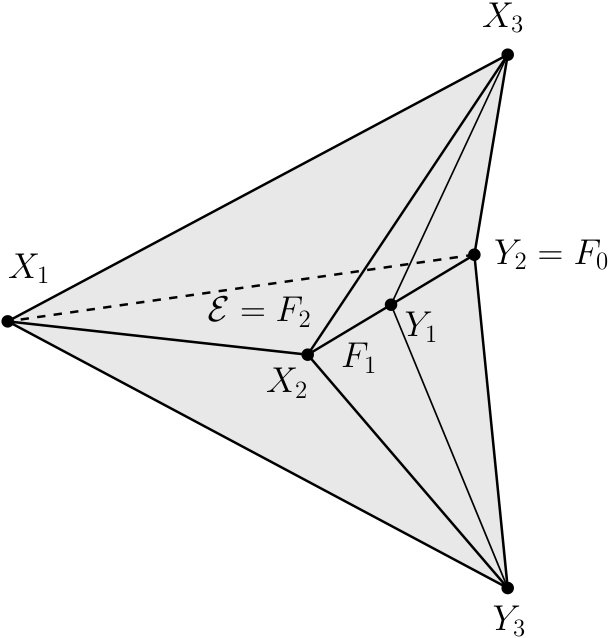 Figure 1
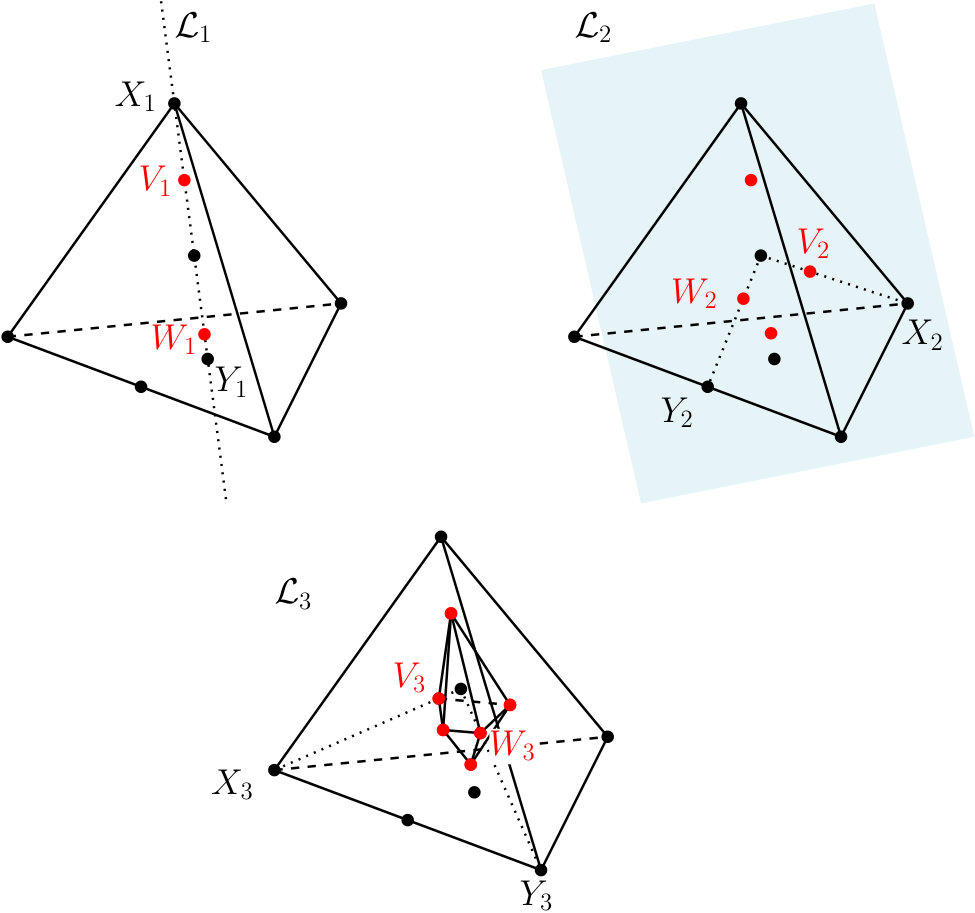 Figure 2
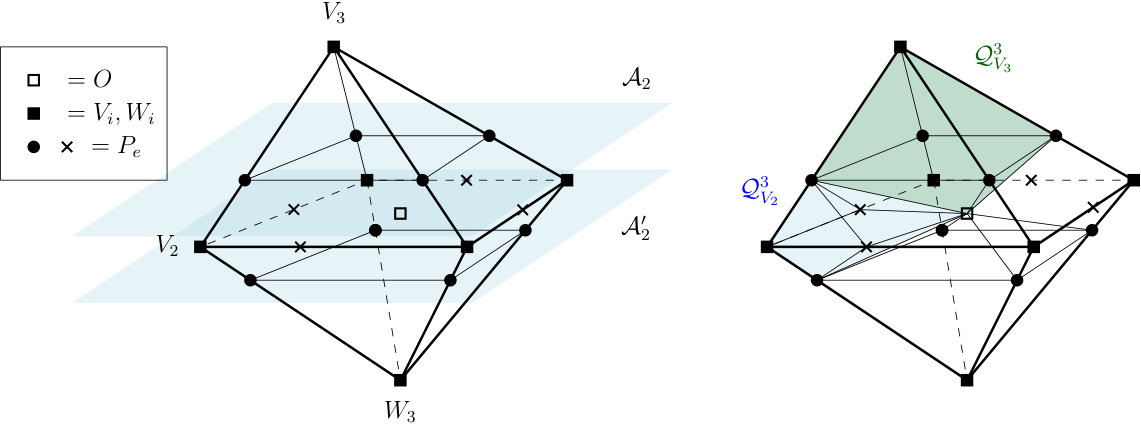 Figure 3
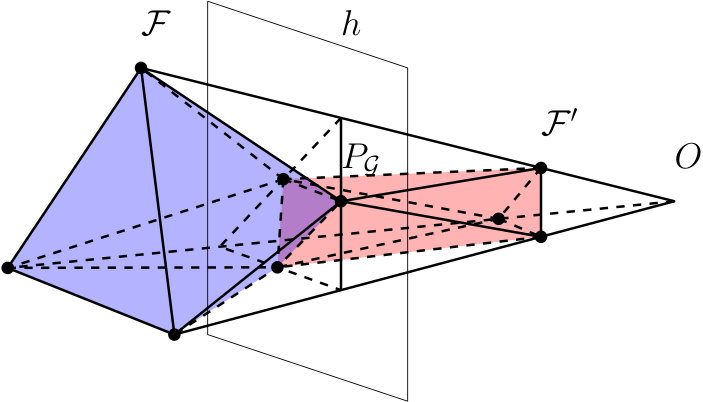 Figure 4
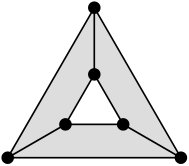 Figure 5
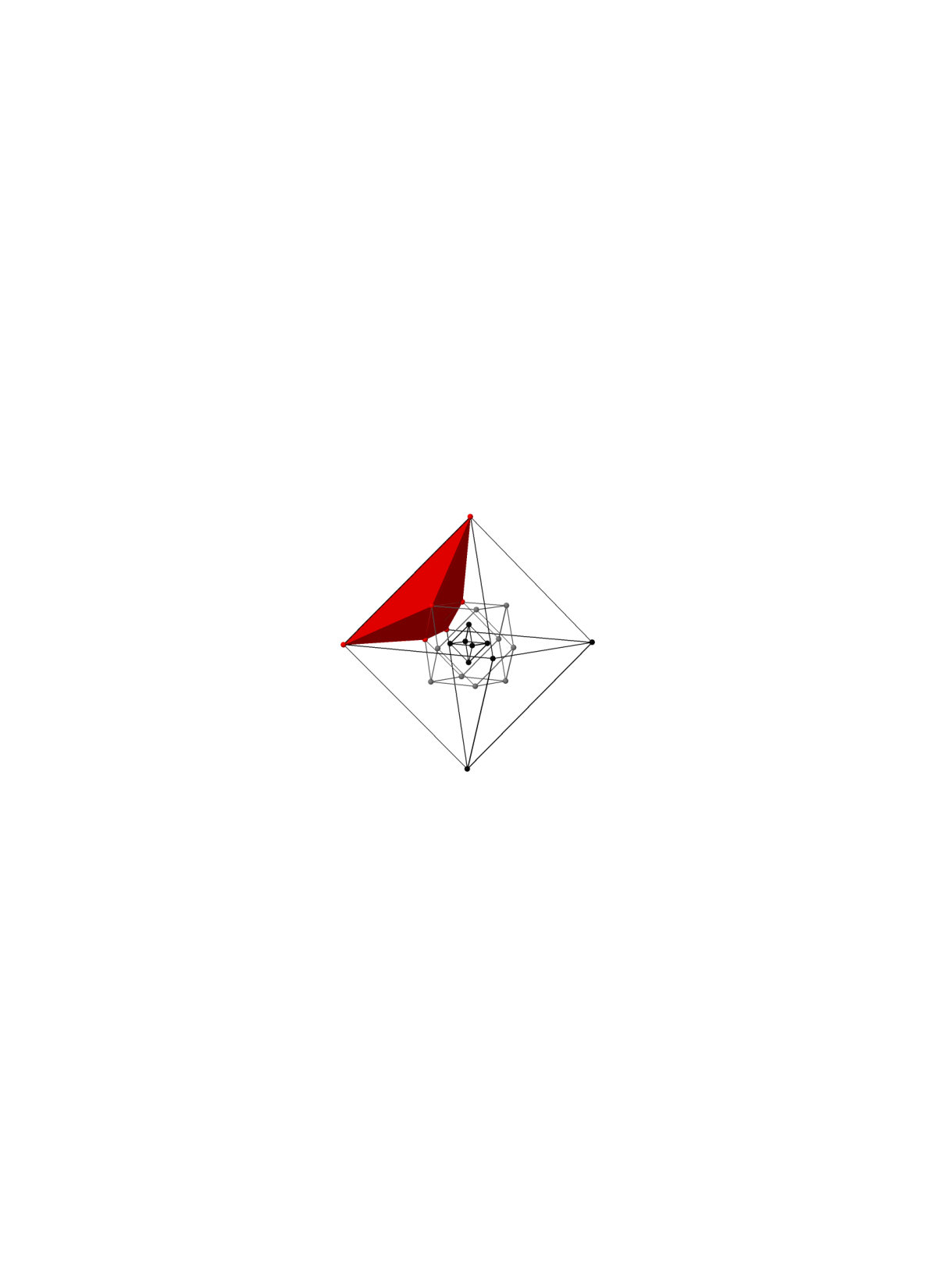 Figure 6
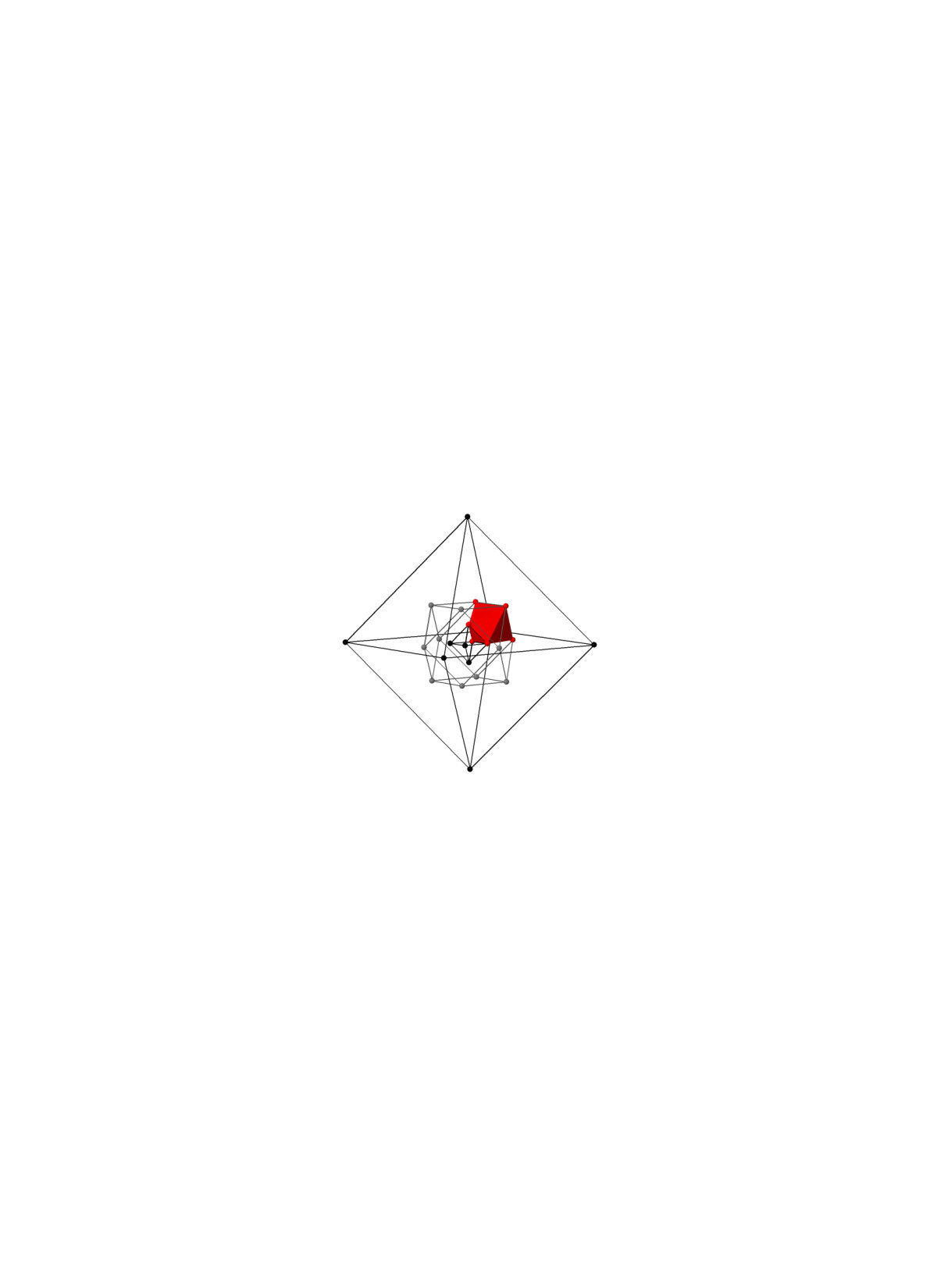 Figure 7
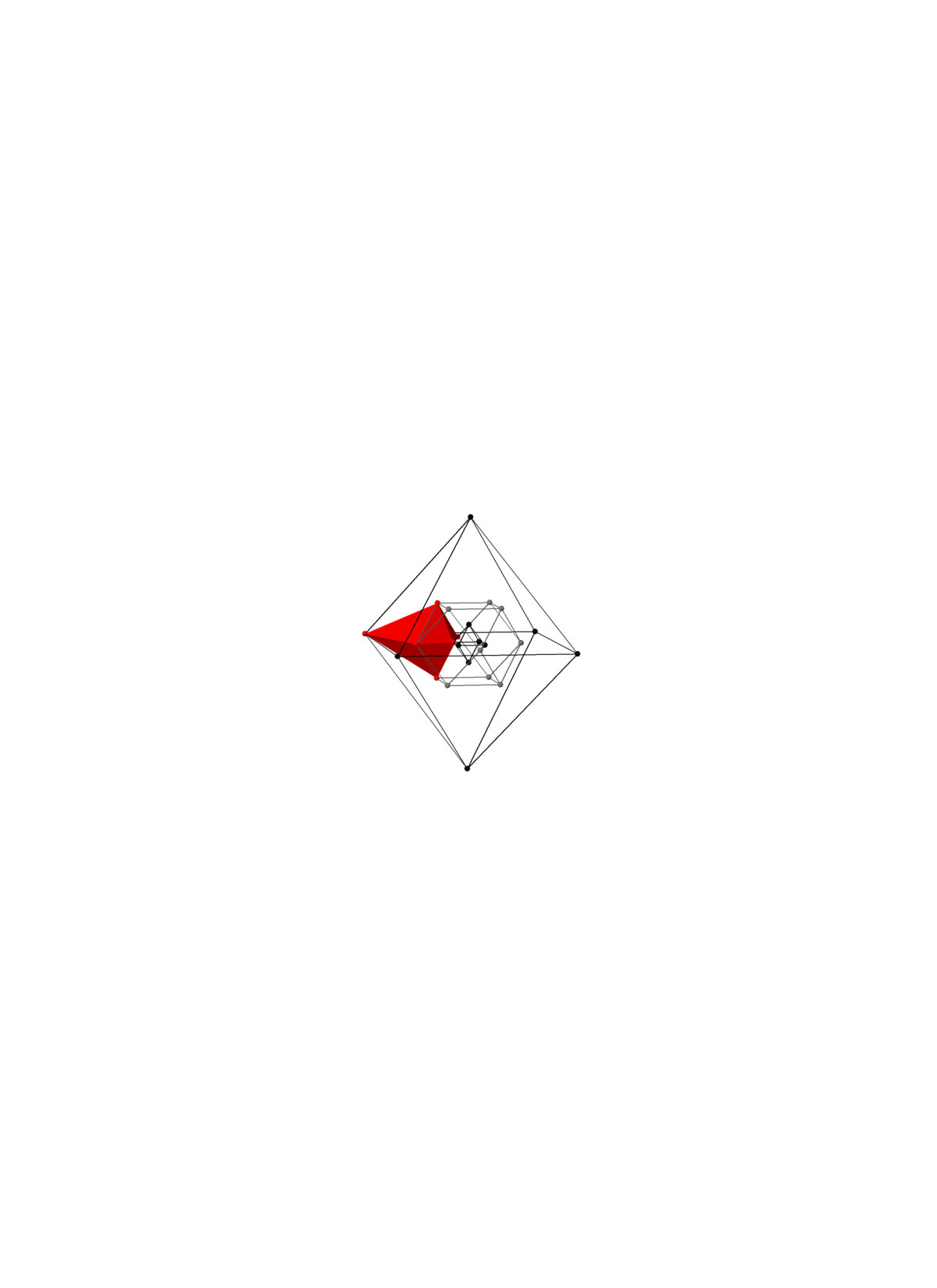 Figure 8
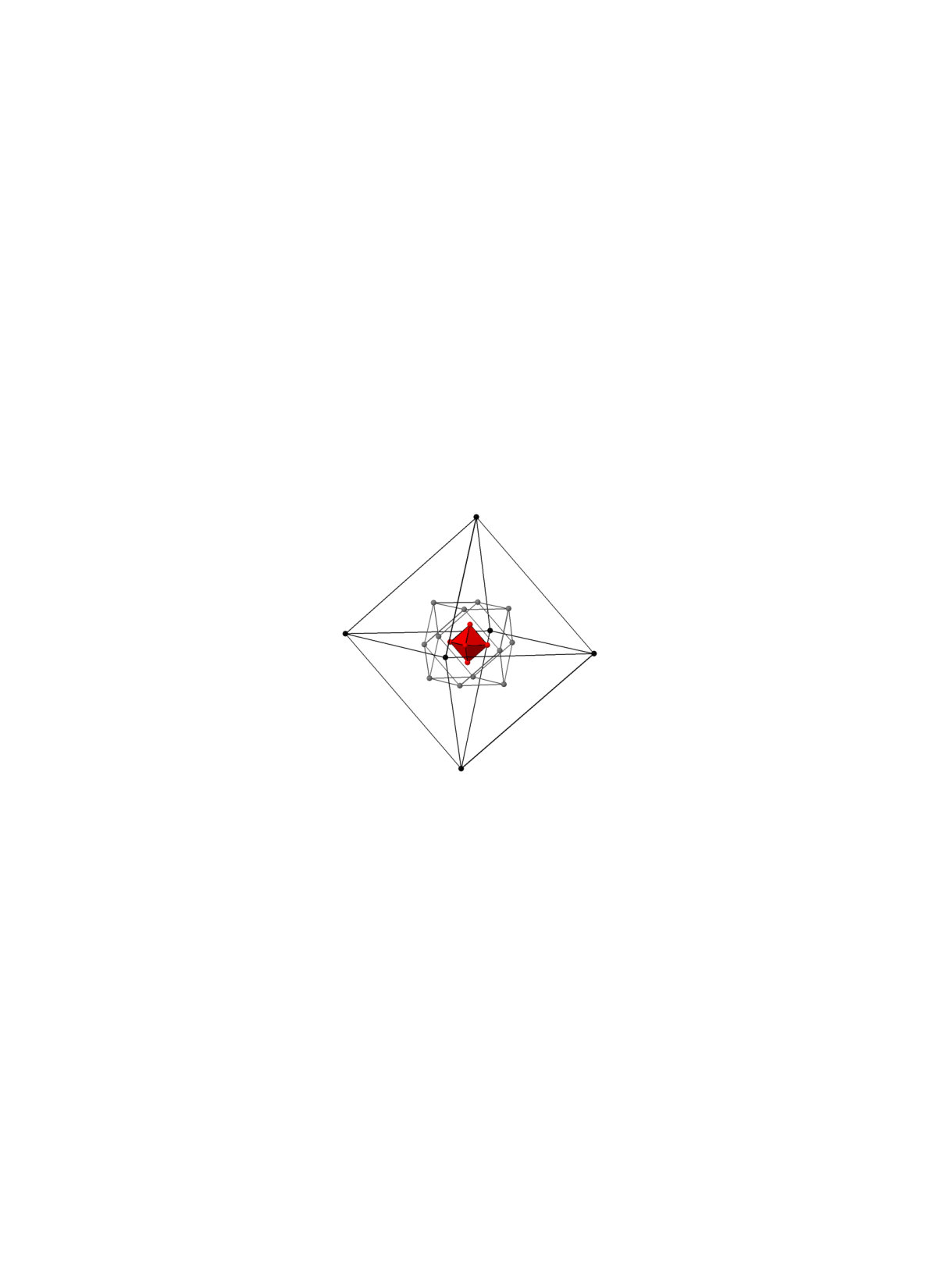 Figure 9
Peer Reviews
No public reviews on file for this paper yet. If you reviewed it on a platform where reviews are public (OpenReview, ICLR, NeurIPS, ICML), you can paste yours below so the community can read it here.
Videos
No videos yet. Explain this paper in a talk, walkthrough, or lecture? Add one.
Octahedralizing -colorable -polytopes
Giulia Codenotti
Institut für Mathematik, Freie Universit, Arnimallee, 14195 Berlin, GERMANY
and
Lorenzo Venturello
Universität Osnabrück, Fakultät für Mathematik, Albrechtstraße 28a, 49076 Osnabrück, GERMANY
Abstract.
We investigate the question of whether any -colorable simplicial -polytope can be octahedralized, i.e., can be subdivided to a -dimensional geometric cross-polytopal complex. We give a positive answer in dimension , with the additional property that the octahedralization introduces no new vertices on the boundary of the polytope.
Key words and phrases:
Cross-polytopal complex, cross-polytope, polytopal subdivisions, 3-colorable 3-polytopes
2010 Mathematics Subject Classification:
52B10, 52B12
The first author was supported by the Einstein Foundation Berlin. The second author was supported by the German Research Council DFG GRK-1916.
1. Introduction and preliminaries
The study of triangulations is a central theme in discrete geometry and beyond. In words, a triangulation of a polytope is a decomposition as a union of simplices which intersect properly along common faces, and it is not hard to see that any polytope can be triangulated (see [DLRS10] for more about triangulations). In this paper we consider a different decomposition for simplicial -polytopes which are balanced, i.e., their graph is -colorable, in the classical graph theoretic sense. Clearly since the graph of any -simplex is the complete graph on vertices, is the minimum chromatic number that the graph of any simplicial -polytope can have. Balanced simplicial complexes were introduced by Stanley [Sta79] and recently they have gained attention from the point of view of face enumeration [KN16, JKM18, JKMNS18, Ven19]. For results of a more topological flavour regarding balancedness and colorings we refer to [Fis77, IJ03, IKN17, JKV18]. Under many perspectives it appears that, when dealing with balanced complexes, the cross-polytope, which is easily seen to be balanced, plays the fundamental role played by the simplex in the setting of arbitrary complexes. The starting point of this paper is a lemma in [IKN17], where the authors describe a procedure to systematically convert a balanced simplicial complex into a (combinatorial) cross-polytopal complex; that is to say, a pure regular CW-complex in which the boundary of each maximal cell is combinatorially isomorphic to the boundary complex of a cross-polytope. We investigate a geometric version of this statement, which asks for the existence of a geometric cross-polytopal complex decomposing (in ”octahedralizing”) balanced -polytopes. We proceed now with some basic definitions (see [Zie95] for basics on polytopes).
The regular -dimensional cross-polytope is the polytope , where is the canonical basis of . We say that two -polytopes are combinatorially equivalent (and we denote it by ) if their face lattices are isomorphic. For the rest of this paper we will call -dimensional cross-polytope any convex polytope combinatorially isomorphic to the regular cross-polytope. A polytope is -colorable if its graph is -colorable in the classical graph-theoretic sense, i.e., if there exists a map such that whenever and are the vertices of an edge. Note that if is a simplicial -polytope then the graph of a facet is the complete graph on vertices, and so a simplicial -polytope cannot be -colorable for any . In the literature, a -colorable simplicial -polytope, or more generally a -colorable -dimensional simplicial complex, is often called balanced.
A (geometric) polytopal complex in is a collection of polytopes in such that
- •
if , then is a (possibly empty) face of both and ;
- •
if is a face of , and , then .
Elements of a polytopal complex are called cells. We denote by the number of -dimensional cells of the complex and a complex is called pure if all maximal cells have the same dimension. If all cells are simplices, the complex is called a simplicial complex. We are interested in a different specialization of polytopal complexes:
Definition 1.1**.**
A (geometric) cross-polytopal complex in is a pure polytopal complex where all maximal cells are cross-polytopes. We call the support of the complex the set and we say that is a cross-polytopal subdivision of .
Moreover, we denote with the boundary of , that is the simplicial complex generated by -dimensional cells that belong to a unique maximal cell of . A cross-polytopal subdivision of a simplicial polytope such that is called proper. Somehow informally, we can use the word octahedralization to refer to cross-polytopal subdivisions of -polytopes.
With these definitions, we can precisely formulate the question at the heart of this paper:
Question 1.2**.**
Does every balanced -polytope have a proper cross-polytopal subdivision?
The balanced property in 1.2 is necessary, as the following proposition shows.
Proposition 1.3**.**
Let be a -dimensional (combinatorial) cross-polytopal complex whose support is PL-homeomorphic to a -ball. Then the -skeleton of , i.e., the simplicial complex , is a balanced -dimensional simplicial complex.
Proof.
Let be the combinatorial -ball (i.e., a simplicial complex PL-homeomorphic to the -simplex) obtained by (stellar) subdividing all -cells of introducing a point , for each -cell . The interior -faces of can be subdivided in two sets:
- •
The faces containing one of the vertices ;
- •
The -faces of .
For each -faces we consider the link of in , i.e.,
[TABLE]
The link of a -face containing one of the vertices is a -sphere contained in the corresponding cross-polytopal cell, and therefore it is a -cycle. Let be any -face not containing any and assume that lies in the cross-polytopal cells . Then the link of is the -cycle given by the vertices connected with the only pair of antipodal vertices of not intersecting . By [Jos02, Corollary 11] we know that a triangulation of a ball in which all links of interior -faces are even polygons is balanced. In particular is a -colorable simplicial -ball and the (unique up to permutation of the images) coloring assigns to the vertices the same color, say . Since it is elementary to check that the ’s are the only vertices colored with , the claim follows. ∎
In particular, since full dimensional subcomplexes of balanced simplicial complexes are balanced, we have that is a balanced -sphere.
Remark 1.4**.**
To be precise, [Jos02, Corollary 11] shows that a simply connected combinatorial -manifold without boundary in which all links of -faces are even polygons is balanced. The arguments in the proof of [Jos02, Theorem 8] can be extended to manifolds with boundary. Alternatively, one can consider the combinatorial -sphere obtained coning over the boundary of in the proof of Proposition 1.3, and then argue with [Jos02, Corollary 11].
Observe that if is not simply connected, Proposition 1.3 does not hold, as it can be seen in the example in Figure 1.
The structure of the paper is as follows. After outlining in Section 2 a general strategy to study 1.2 in arbitrary dimension, Sections 3 and 4 are devoted to answering it, positively, in dimension .
Let us recall some notation in dimension : the regular -dimensional cross-polytope is called regular octahedron, and we thus denote by octahedron any -polytope which is combinatorially equivalent to the -dimensional cross-polytope. A tetrahedron is a -dimensional simplex. A summary of our results in dimension is:
Theorem 1.5**.**
Let be a balanced -polytope. Then there exists a proper cross-polytopal subdivision of . In particular, there is one such subdivision with .
If we admit subdivisions which are not proper, then we can prove the following.
Theorem 1.6**.**
Any tetrahedron has a (non-proper) cross-polytopal subdivision such that and .
2. A strategy for octahedralizations via bipyramids
The following lemma, which employs an idea discussed in [IKN17, Lemma 3.6], shows a first attempt to reduce 1.2 to the problem of decomposing certain generalized bipyramids into cross-polytopes. These bipyramids arise from a natural matching on the -simplices of a triangulation of a balanced simplicial -polytope induced by the coloring.
Lemma 2.1**.**
Let be a balanced -polytope. Then can be triangulated in a way such that:
- •
The -simplices in the triangulation can be partitioned in pairs sharing a facet; this facet is a -simplex, which we call the equatorial simplex;
- •
For each equatorial simplex , there exists a flag of faces of , with , such that: if any is contained in another pair of -simplices then it is contained in their equatorial simplex.
Proof.
Let be any triangulation of whose graph is -colorable, and whose boundary coincides with the boundary of . The simplest example of such a triangulation is the one whose cells are the cones over every facet of from a fixed interior point. We color the vertices of . Since is -colorable, we can assume that all the vertices of color are in the interior. Hence no -simplices whose vertices are colored with colors are on the boundary of . Each such -simplex is therefore a facet of exactly two -simplices of , which we take as our pairs. The -simplices colored with are thus the equatorial simplices, and indeed each simplex of contains exactly one such simplex. Finally, each equatorial simplex has a unique -face colored using colors in , for . The flag so defined satisfies the second condition. ∎
Remark 2.2**.**
Observe that Lemma 2.1 shows that every balanced -dimensional simplicial polytope has an even number of facets for every , even when is even. More generally, this is true for every balanced -dimensional pseudomanifold, i.e., a simplicial complex with the property that every -dimensional face is contained exactly in facets. This fact can be deduced by other means.
It is important to note that Lemma 2.1 guarantees that we can pair up the -simplices of our triangulation, but the union of the two simplices is not in general convex. In other words the dual graph of a balanced polytope, which is a bipartite graph (see e.g., [Jos02, Proposition 6]), admits a perfect matching. The lemma thus shows that finding a balanced subdivision of the following class of objects is enough to positively answer 1.2:
Definition 2.3**.**
A generalized bipyramid is the union of two -simplices and which intersect along a -simplex , called the equatorial simplex, which is a face of both. Observe that need not be a convex polytope. We fix a distinguished flag of faces of , . This data is part of the definition of a generalized bipyramid.
We want to think of the generalized bipyramid as a degenerate cross-polytope, obtained by deforming an embedded codimension cross-polytope into a simplex. Figure 2 depicts the case , where the -cycle is transformed into a -cycle and the two remaining vertices are perturbed. To make this precise, we consider the following triangulation of :
[TABLE]
where is the stellar subdivision of as simplicial complex at a face , that is, the simplicial complex obtained from replacing all the faces containing (called the star at ) with those given by the union of the barycenter of with every face of the boundary of its star. In words, to obtain we iteratively stellar subdivide at the faces in decreasing dimension. See Figure 2 for a three dimensional example.
Notation 2.4**.**
Here and for the rest of this article, we denote the vertices of as follows: for we let be the vertex of the not in and be the barycenter of , and we denote with and the vertices not in the equatorial simplex . In what follows, we will assume the boundary of all generalized bipyramid to be subdivided as above, and with a slight abuse of notation will refer to the vertices of as vertices of the bipyramid .
Remark 2.5**.**
It is easy to see that the triangulation thus obtained is a simplicial complex isomorphic to the boundary of the -cross-polytope, with the pairs as opposite vertices. This is what allows us to think of as a degenerate cross-polytope.
The affine dependence between the points is described in the following lemma.
Lemma 2.6**.**
The points lie in a -dimensional linear space , for , with ; further, and lie in opposite halfspaces defined by the hyperplane in .
Proof.
Since is the barycenter of the equatorial simplex the points , and are aligned. We denote this linear space with . For every the point is the barycenter of the simplex with vertices , which implies that lies on the line through and and therefore has , for every . Moreover, for , lies on the segment : indeed, holds by definition of barycenter. Since and do not lie on , they must lie on either side. ∎
3. The Schlegel diagram of the 24-cell
The starting point of our decomposition is a regular convex -polytope called the 24-cell, which can be realized as the convex hull of all vectors in with exactly two zero entries and two entries in . Its boundary consists of 24 octahedral cells and therefore its Schlegel diagram provides a subdivision of the regular octahedron into 23 octahedra. This subdivision can be described as follows. Consider the regular cuboctahedron . Placing a scaled copy of inside a regular octahedron (the subscript stands for ”outer”), we observe that each square face of the cuboctahedron lies on a plane orthogonal to a line through antipodal points in the octahedron. Next, we add a second scaled regular octahedron (the ”inner” octahedron) inside the cuboctahedron, again with the same center, and whose faces lie pairwise on planes parallel to the faces of the outer octahedron.
In this configuration to each of the 6 square faces of correspond a vertex of and a vertex of , and to each of the 8 triangular faces of corresponds a -face of and a -face of . This correspondence naturally gives rise to a cross-polytopal decomposition of the outer octahedron in 23 octahedra, which we divide in 4 types, illustrated in Figure 3:
- •
Type 1: Octahedra obtained as the convex hull of a triangular face of and a face in . There are 8 octahedra of type 1.
- •
Type 2: Octahedra obtained as the convex hull of a triangular face of and a face in . There are 8 octahedra of type 2.
- •
Type 3: Octahedra obtained as the convex hull of a square face of and the two corresponding vertices of and . There are 6 octahedra of type 3.
- •
Type 4: The inner octahedron .
4. The subdivision
This section is devoted to proving the following proposition, which allows us to prove Theorem 1.5.
Proposition 4.1**.**
Let be a -dimensional generalized bipyramid. There exists a (non-proper) geometric cross-polytopal sudivision of such that . In particular there is one such with .
To prove this, we will construct a subdivision mimicking the one outlined for the regular octahedron in Section 3. We first give an outline of the proof strategy. The lemmas we prove hold in any dimension, and so we state and prove them in that level of generality. Let be a generalized bipyramid with the origin as the barycenter of the equatorial simplex and let be its vertices, or more precisely the vertices of the triangulation of its boundary (see Definition 2.3).
- •
In Lemma 4.3, we construct a convex -dimensional cross-polytope with vertices , where vertex (resp. ) lies on the segment joining and the vertex of ( resp.). For any the polytope is a -dimensional cross-polytopes contained in . In the proof of Theorem 1.5, will play the role of the octahedron of type 4.
- •
Next, we show that we can choose a point in the interior of each edge of so that, for any vertex or of , the polytopes and are -dimensional cross-polytopes. This is proved in Lemma 4.4.
- •
In Lemma 4.5, we consider a modification of and , namely and , and show that these are also -dimensional cross-polytopes. In the -dimensional setting, these octahedra correspond to type 3 octahedra.
- •
Finally, in Lemma 4.6 we construct the octahedra of type 1 and 2: we show that, if is any -face of , and and the corresponding -faces of and , for any choice of points , each on a -face of , the polytopes and are -dimensional cross-polytope.
To conclude the proof of Theorem 1.5, we observe that, in dimension , the octahedra described above fit together to decompose the bipyramid.
We begin with a series of lemmas. The first, though immediate, will be useful throughout the proof, since it presents a general fact on the combinatorial structure of the cross-polytope.
Lemma 4.2**.**
Let be a simplicial -polytope on vertices partitioned in pairs, such that each pair is not an edge of . Then is combinatorially isomorphic to a -dimensional cross-polytope.
Proof.
We want to show that any set of vertices containing exactly one vertex of every pair (good set) is a facet. Certainly any facet of must contain exactly one vertex of every pair. Let be a facet and any vertex of . The ridge is in exactly two facets, and there are only two good sets containing , and , where is paired with . Thus must also be a facet. In this way we can iteratively obtain that any good set is a facet. ∎
We can now begin to prove the lemmas necessary for the proof that were outlined above.
Lemma 4.3**.**
Let be a generalized bipyramid with vertices and let be the barycenter of its equatorial simplex. There exist a configuration of points , with on the segment and on the segment , such that is a -dimensional cross-polytope.
Proof.
We place pairs of points on the segments and for and show that at each step their convex hull is a cross-polytope of increasing dimension. First we choose any two points and on the segments and . Remember from Lemma 2.6 that lie in a -dimensional linear space , with and on either side of . By continuity, there exists an open ball such that, for any choice of points and on the intersection between the segments and and , the segment intersects the segment in the interior. Hence is a quadrilateral (indeed a -dimensional cross-polytope) whose interior contains . Iteratively, assume is an -dimensional cross-polytope. Since it contains in the interior and separates (in ) and , there exists a ball in such that for any choice of points and on and the segment intersects the polytope in the interior, and hence that is a -dimensional cross-polytope. ∎
We let be the cross-polytope constructed in Lemma 4.3.
Lemma 4.4**.**
For every edge of , we can choose a point in the interior of such that, for any vertex , of , and are convex -dimensional cross-polytopes.
Proof.
It follows from the proof of Lemma 4.3 that the points lie on a -dimensional linear space , and each separates and in .
The proof of this statement is by induction: we choose points on edges contained in but not in , and prove by induction on that for any is a -dimensional cross-polytope (analogously ). Since , this will prove the lemma.
For , the statement above is trivially true, since and are the segments with endpoints the origin and , respectively.
Now suppose . By inductive hypothesis, we have picked points on all edges contained in . We now want to choose points on the new edges in , that is, we must pick points on the edges connecting and . To do so, we choose -dimensional affine spaces and , translations of the linear space , respectively towards and , such that they intersect in its interior; we let the points be the intersection of the edges with these affine spaces. We want to show that and can be chosen so that is a -dimesional cross-polytope for all . We split this statement into the following two claims:
Claim 1: and are -dimensional cross-polytopes for any choice of and .
Claim 2: For , and are -dimesional cross-polytopes if and are chosen sufficiently close to .
Proof of Claim 1. It suffices to observe that is a translation and dilation of , and hence a -dimensional cross-polytope. Since for any choice of the segment intersects the interior of , Lemma 4.2 guarantees that is a -dimensional cross-polytope. In the same way we can prove the claim for .
Proof of Claim 2. By construction we have , which by inductive hypothesis is a -dimensional cross-polytope. has two new vertices and , which are the points of intersection of and respectively with the edges and . By Lemma 4.2, it is sufficient to show is that if we choose and sufficiently close to , the segment will intersect the interior of . This is true by a continuity argument, since intersects the interior of , and when the affine spaces coincide with , we have . In the same way we can prove the claim for .
∎
Figure 5 offers a partial visualization of Lemma 4.4. In the following lemma we construct the cross-polytopes of type 3.
Lemma 4.5**.**
For any configuration of points as in Lemma 4.4, and are -dimensional cross-polytope for any .
Proof.
Since and the origin are aligned, as long as we choose small enough, the intersection of with the segment is the same as its intersection with the segment with endpoints and . Since is a -dimensional cross-polytope, by lemma 4.2 is a cross-polytope. ∎
Next we construct the cross-polytopes of type 1 and 2. We call a truncation of a simplex w.r.t. a vertex a polytope obtained intersecting with the halfspace defined by an hyperplane separating from the other vertices, which does not contain .
Lemma 4.6**.**
Let be a truncation of a -simplex . Denote by the facet opposite the truncated vertex, and the new facet introduced by the truncation. For any hyperplane which separates and and for any choice of points , one in the interior of each facet of the -simplex , and are -dimensional cross-polytopes.
Proof.
For we denote with the chosen point on the -face of which corresponds to . Consider . Clearly and are facets, since lies in one of the halfspace defined by the supporting hyperplane of .
For any vertex of , the segment with intersects the interior of , because it joins with a point in the interior of . Moreover is also contained in one of the halfspaces defined by . Therefore is not a face of for any -face , which implies that is a -cross-polytope by Lemma 4.2. The proof for is analogous. ∎
Figure 6 shows the cross-polytopes (blue) and (red) in the -dimensional case.
We can finally put together the pieces to prove Proposition 4.1:
Proof of Proposition 4.1.
We assume that the barycenter of the equatorial simplex of is the origin . We proceed as the outline at the beginning of this section. First, Lemma 4.3 allows us to construct an octahedron whose vertices lie on the segments and , . Lemma 4.5 and Lemma 4.6 guarantee the existence of a choice of points on the edges of and of a number such that the polytopes
- •
(type 1, 8 polytopes),
- •
(type 2, 8 polytopes),
- •
and (type 3, 6 polytopes),
are octahedra, for any facets and of and respectively. The statement follows letting to be the cross-polytopal complex generated by these 22 octahedra, together with . Indeed all of the octahedra lie inside of and it is immediate to check that the intersection of two octahedra in is a face of both. Moreover, since every -dimensional face of which is not on the boundary of lies in exactly two octahedra, we have that . ∎
We are now ready to prove Theorem 1.5. Recall that for a simplicial -polytope Euler relation and a double counting argument show that the number of edges and -faces are uniquely determined by the number of vertices. In particular we have that .
Proof of Theorem 1.5.
For any triangulation of with the conditions of Lemma 2.1, the -simplices in the triangulation can be pairwise matched in many generalized bipyramids. It is important to observe that the second condition in Lemma 2.1 ensures that we can consider the barycenters of one of the edge for each equatioral simplex, so that for each bipyramid exactly one edge on the equator is subdivided. By Proposition 4.1 there exists a geometric cross-polytopal subdivision on octahedra for each of the generalized bipyramids. The union of these many geometric cross-polytopal complexes gives a proper cross-polytopal subdivision of with octahedra. ∎
Remark 4.7**.**
In Section 2, we reduced the problem of finding an octahedralization of a balanced -polytope to that of the generalized bipyramid. However, we can apply verbatim the same construction described in Section 4 directly to a simplex. Indeed, if is a simplex, and a flag of faces in its boundary, then is a subdivision of that is combinatorially isomorphic to the boundary of a -dimensional cross-polytope. All the results in Section 4 carry over. Decomposing a balanced -polytope in this way would produce a cross-polytopal decomposition with many octahedra, that is twice as many as the strategy using bipyramids yields.
Theorem 1.6 follows directly from this remark.
5. Concluding questions
This paper leaves 1.2 open in the case . The reason is that we are not aware of the existence of a polytope with ’many’ cross-polytopal facets in dimensions higher than , in analogy with the -cell in dimension , whose Schlegel diagram would be a starting point of our construction.
Indeed, in dimensions higher than , before embarking on the geometrical question, one might want to understand whether the following, combinatorial statement holds. Recall that a pure CW-complex is strongly regular if the intersection of two cells is a single (possibly empty) cell. A -dimensional strongly regular cross-polytopal complex is therefore a pure, strongly regular -dimensional CW-complex in which all maximal cells are combinatorially isomorphic to .
Question 5.1**.**
Is any boundary of a balanced -polytope realizable as the boundary of a -dimensional strongly regular cross-polytopal complex homeomorphic to a -ball, for ?
Due to convexity, polytopal complexes are strongly regular CW-complexes, and so Theorem 1.5 provides a positive answer in the three dimensional case. A negative answer to this question would of course imply a negative answer to 1.2.
For there are combinatorial -spheres (i.e., simplicial complexes PL-homeomorphic to the boundary of a -simplex) which cannot be realized as the boundary of a polytope. It is not always easy to check whether a sphere has this property or not. Therefore we can generalize 5.1 to the following one, which is interesting in its own right and may be easier to answer.
Question 5.2**.**
Is any balanced combinatorial -sphere realizable as the boundary of a -dimensional strongly regular cross-polytopal complex homeomorphic to a -ball, for ?
A negative answer to this question would not however necessarily give an obstruction to 1.2. As mentioned in the introduction, [IKN17, Theorem 3.1] answers this question positively for balanced combinatorial (even simplicial) spheres without the assumption of strong regularity. In a sense, strongly regular cross-polytopal complexes are an intermediate step between the complexes considered in [IKN17] and geometric cross-polytopal complexes.
Acknowledgement
We would like to thank Martina Juhnke-Kubitzke for suggesting the problem to us and for insightful discussions and comments on the manuscript. Many thanks to Francisco Santos for interesting discussions and comments on the manuscript, and in particular pointing out the decomposition of the octahedron as the Schlegel diagram of the -cell. We thank Eran Nevo for carefully listening to our presentation and suggesting the simplification of Remark 4.7, which allows us to give Theorem 1.6 in its final form. A thank you also to Hannah Sjöberg for pointing out Lemma 4.2.
The reference list from the paper itself. Each links out to its DOI / PubMed record.
- 1[DLRS 10] J. A. De Loera, J. Rambau, and F. Santos. Triangulations: Structures for Algorithms and Applications . Springer Publishing Company, Incorporated, 1st edition, 2010.
- 2[Fis 77] S. Fisk. Geometric coloring theory. Advances in Math. , 24(3):298–340, 1977.
- 3[IJ 03] I. Izemestiev and M. Joswig. Branched coverings, triangulations, and 3-manifolds. Adv. Geom. , 3(2):191–225, 2003.
- 4[IKN 17] I. Izmestiev, S. Klee, and I. Novik. Simplicial moves on balanced complexes. Adv. Math. , 320:82–114, 2017.
- 5[JKM 18] M. Juhnke-Kubitzke and S. Murai. Balanced generalized lower bound inequality for simplicial polytopes. Selecta Math. (N.S.) , 24(2):1677–1689, 2018.
- 6[JKMNS 18] M. Juhnke-Kubitzke, S. Murai, I. Novik, and C. Sawaske. A generalized lower bound theorem for balanced manifolds. Math. Z. , 289(3-4):921–942, 2018.
- 7[JKV 18] M. Juhnke-Kubitzke and L. Venturello. Balanced shellings and moves on balanced manifolds. Ar Xiv e-prints , April 2018. https://arxiv.org/abs/1804.06270 .
- 8[Jos 02] M. Joswig. Projectivities in simplicial complexes and colorings of simple polytopes. Math. Z. , 240(2):243–259, 2002.