$\alpha$ scattering cross sections on $^{12}$C with microscopic coupled-channel calculation
Yoshiko Kanada-En'yo, Kazuyuki Ogata

TL;DR
This study uses microscopic coupled-channel calculations with detailed nuclear models to accurately predict alpha scattering cross sections on carbon-12 across various energies, providing insights into nuclear excitations.
Contribution
It introduces a microscopic approach combining antisymmetrized molecular dynamics and generator coordinate methods to calculate alpha-12C scattering without adjustable parameters.
Findings
Successfully reproduces experimental cross sections at multiple energies.
Provides detailed analysis of isoscalar monopole and dipole excitations.
Demonstrates the effectiveness of microscopic potentials in scattering calculations.
Abstract
elastic and inelastic scattering on C is investigated with the coupled-channel calculation using microscopic -C potentials, which are derived by folding the Melbourne -matrix interaction with the matter and transition densities of C. These densities are obtained by a microscopic structure model of the antisymmetrized molecular dynamics combined with and without the generator coordinate method. The calculation reproduces satisfactorily well the observed elastic and inelastic cross sections at incident energies of ~MeV, 172.5~MeV, 240~MeV, and 386~MeV with no adjustable parameter. Isoscalar monopole and dipole excitations to the , , and states in the scattering are discussed.
Click any figure to enlarge with its caption.
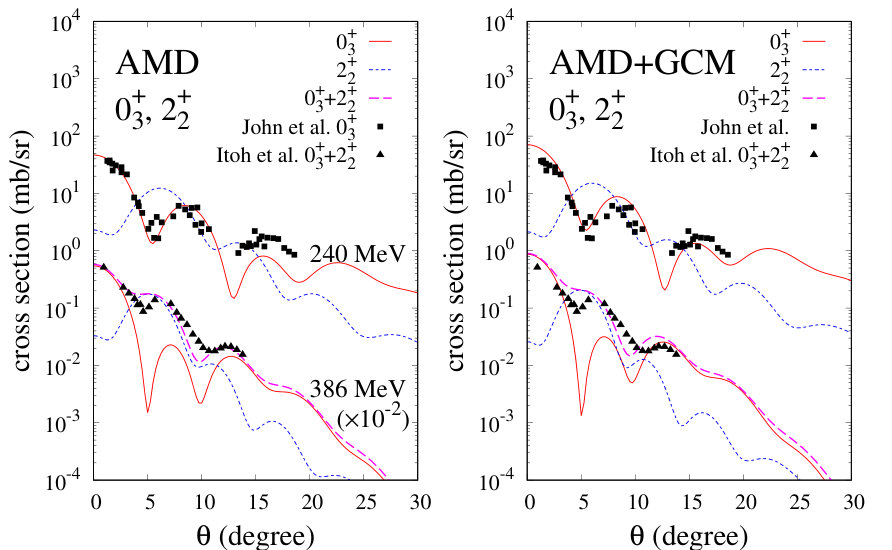 Figure 1
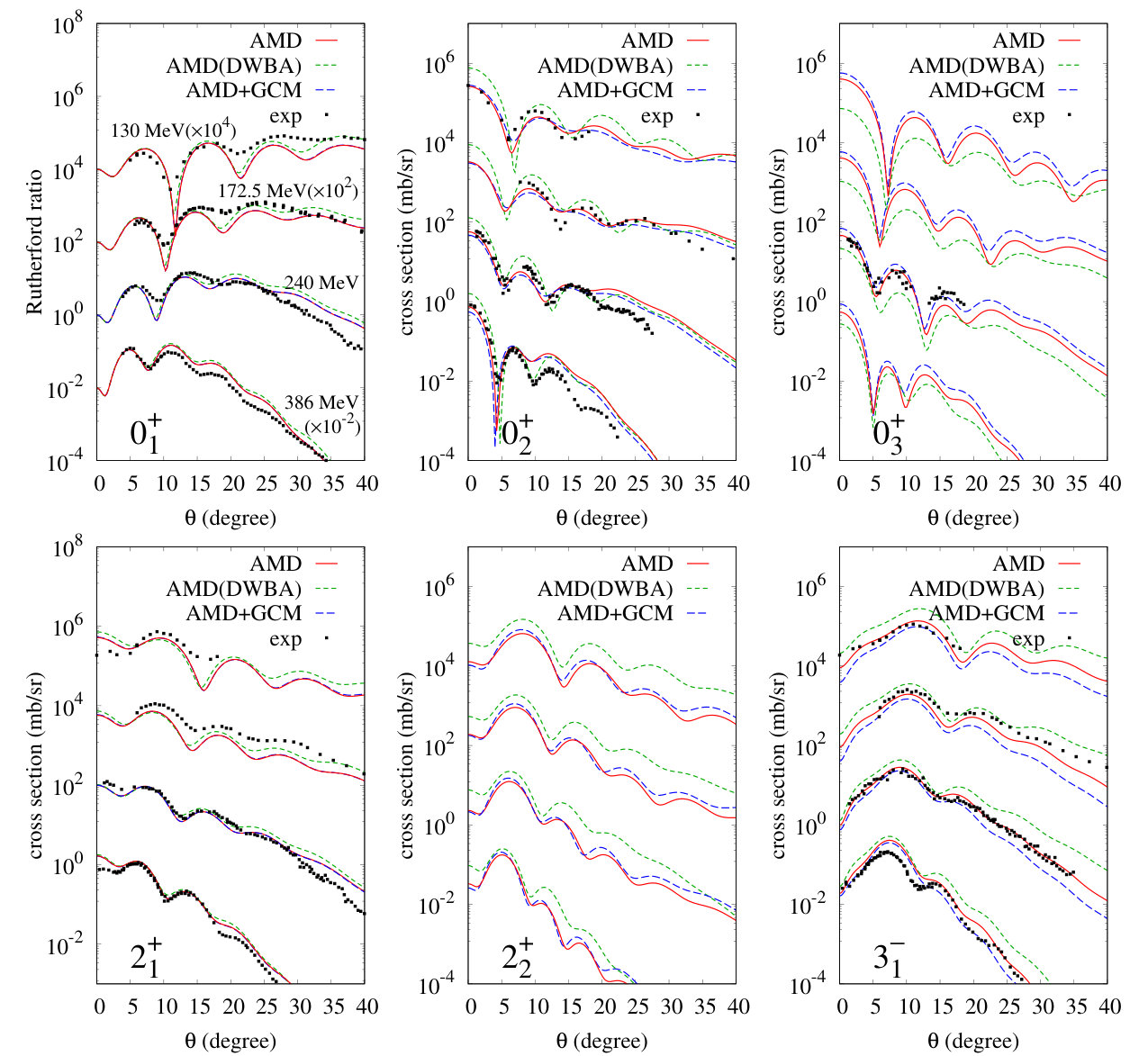 Figure 1
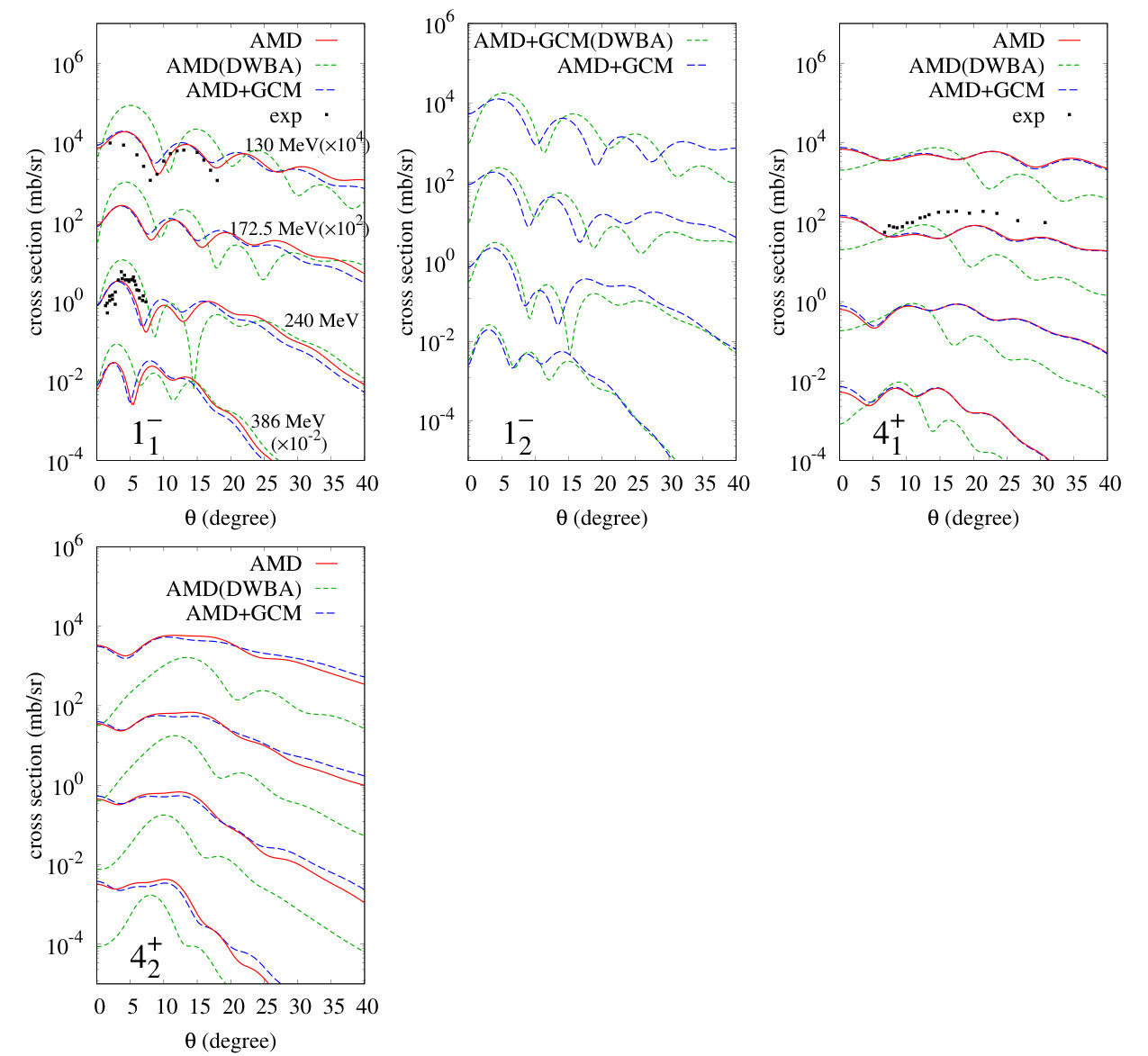 Figure 2
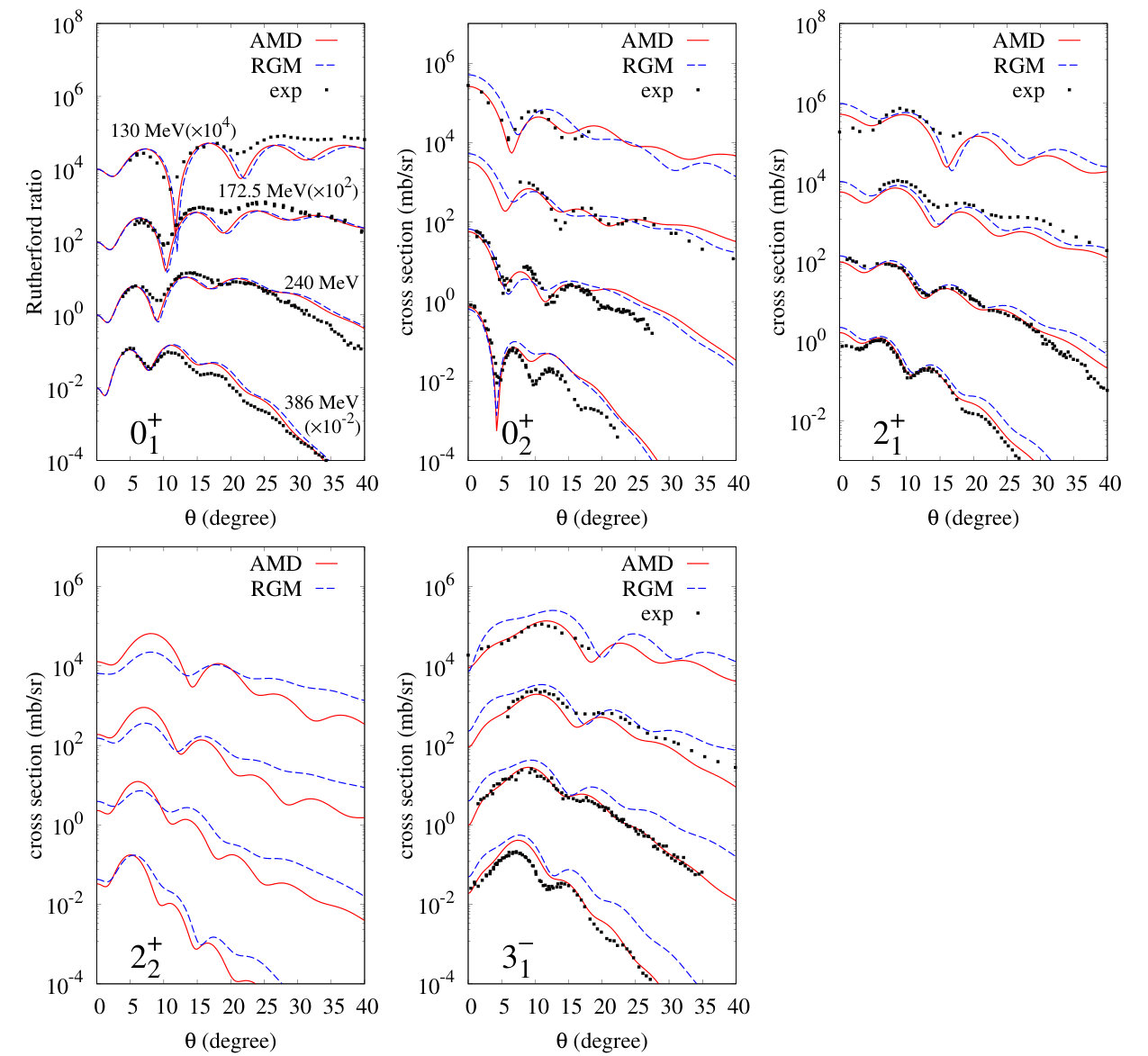 Figure 4
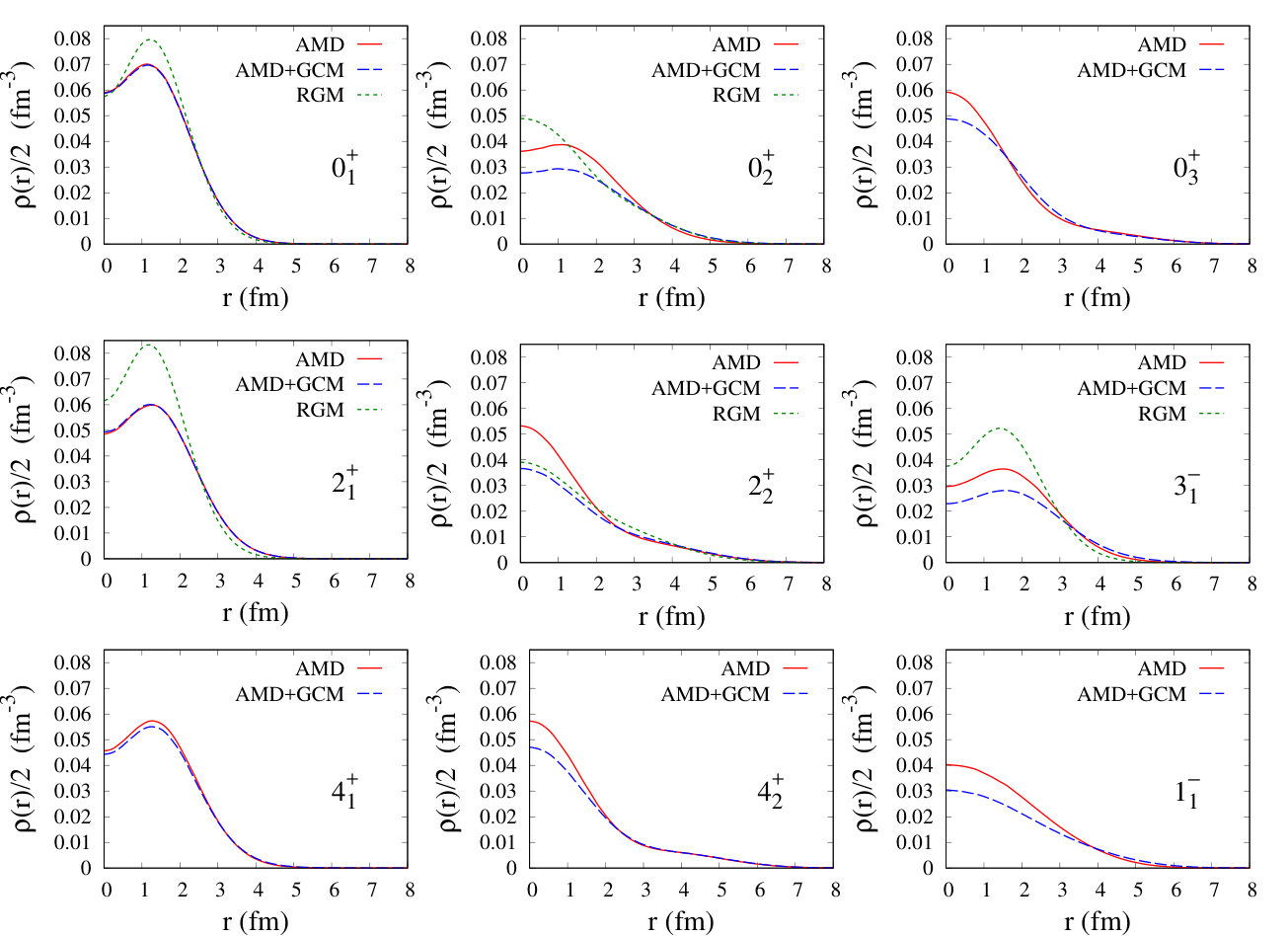 Figure 5
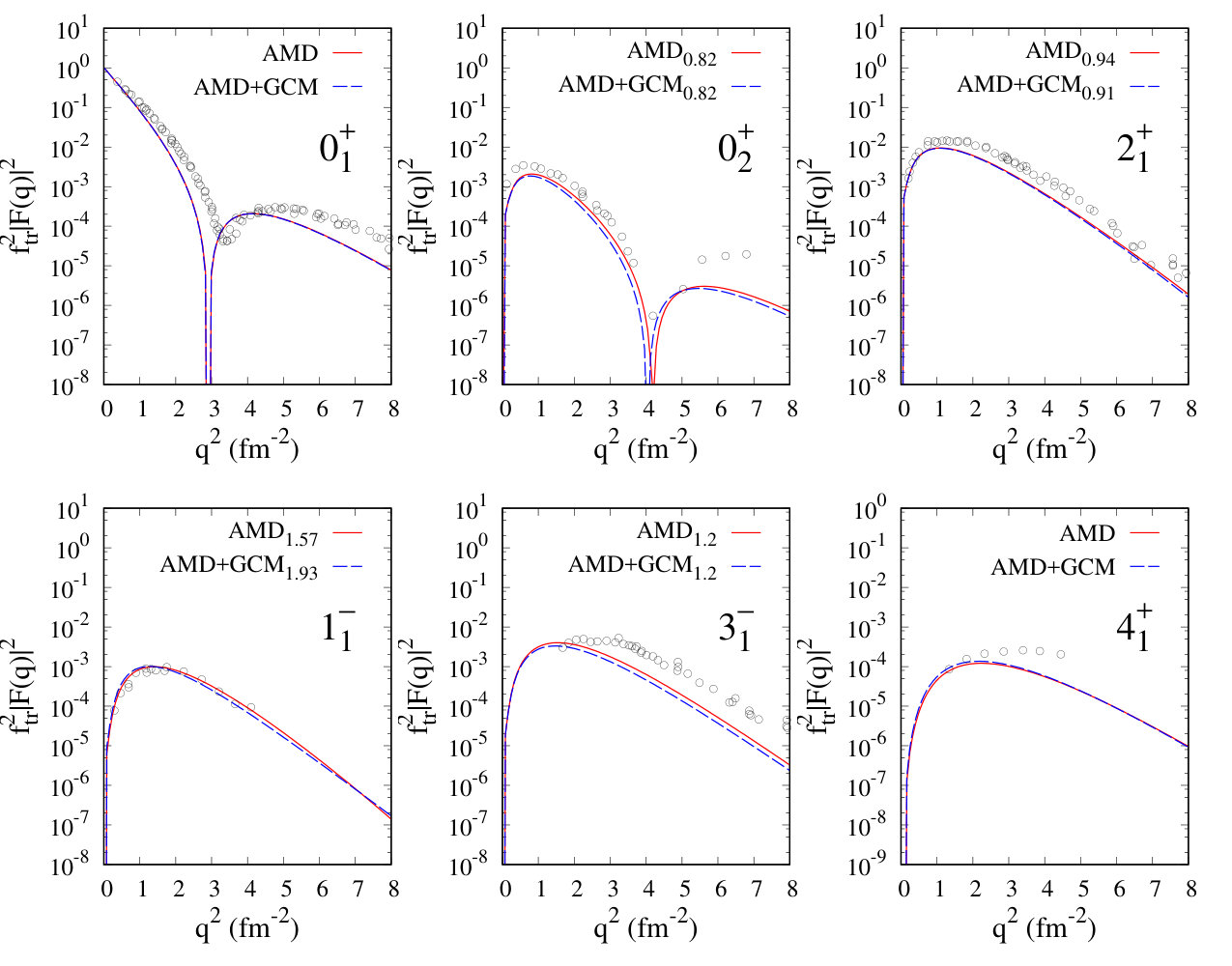 Figure 6
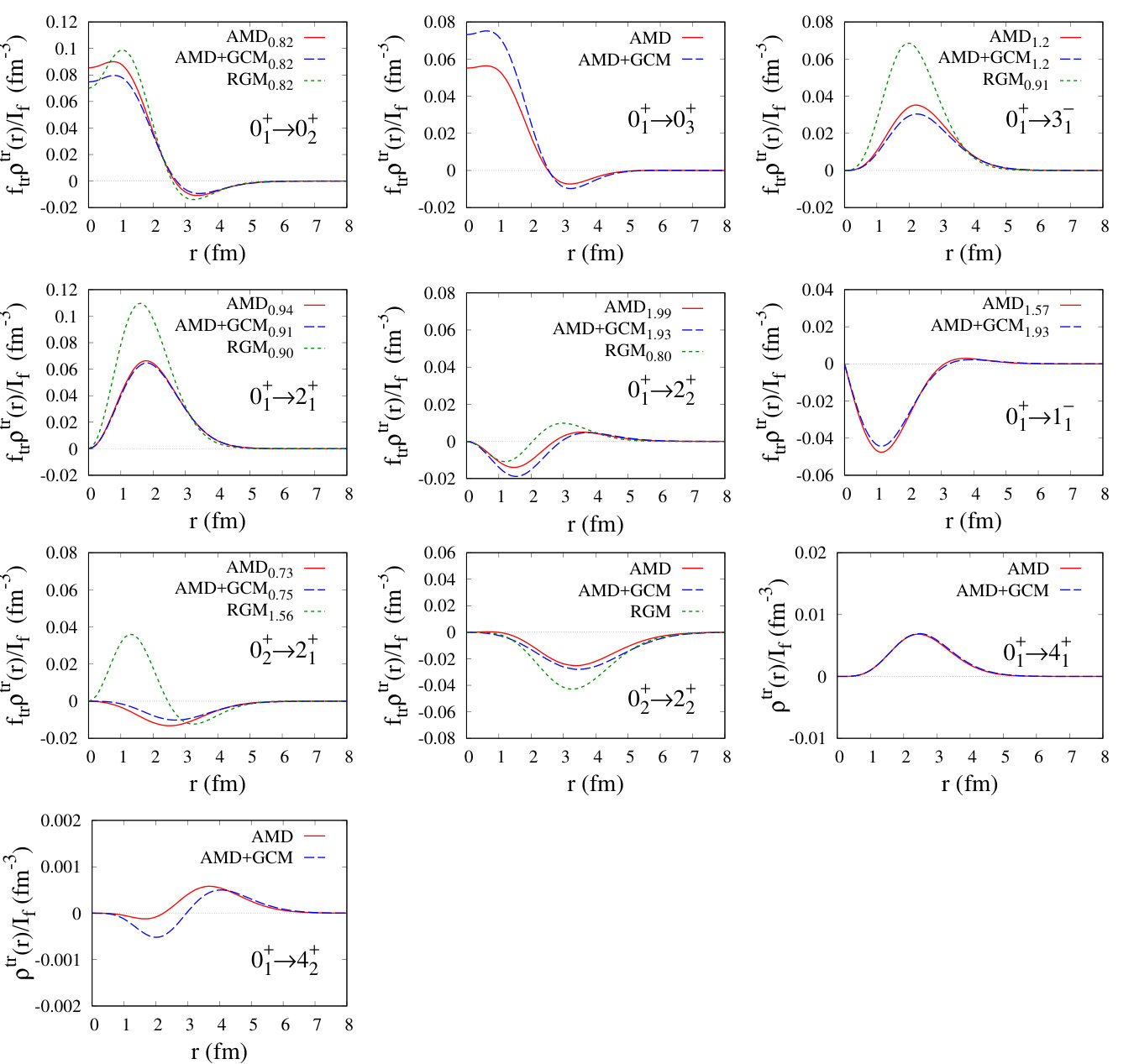 Figure 7
| exp | AMD | AMD+GCM | RGM | |||||
|---|---|---|---|---|---|---|---|---|
| 0.0 | 2.33 | 0.0 | 2.53 | 0.0 | 2.54 | 0.0 | 2.40 | |
| 7.65 | 8.1 | 3.27 | 7.3 | 3.62 | 7.74 | 3.47 | ||
| 10.3 | 10.7 | 3.98 | 10.0 | 3.92 | ||||
| 10.84 | 12.6 | 3.42 | 10.7 | 3.87 | ||||
| 4.44 | 4.5 | 2.66 | 4.2 | 2.67 | 2.77 | 2.38 | ||
| 9.87 | 10.6 | 3.99 | 9.5 | 4.09 | 9.38 | 3.85 | ||
| 9.64 | 10.8 | 3.13 | 9.3 | 3.49 | 8.14 | 2.77 | ||
| 13.3 | 10.9 | 2.71 | 10.5 | 2.79 | ||||
| 14.08 | 12.6 | 4.16 | 11.6 | 4.22 | ||||
| exp | AMD | AMD+GCM | RGM | |||||
| (error) | ||||||||
| 7.59 | 8.53 | 0.94 | 9.09 | 0.91 | 9.31 | 0.90 | ||
| 29.2 | 43.5 | 0.82 | 43.3 | 0.82 | 43.8 | 0.82 | ||
| 13.5 | 25.1 | 0.73 | 24.1 | 0.75 | 5.6 | 1.56 | ||
| 1.57a | 0.39 | 1.99 | 0.49 | 1.93 | 2.48 | 0.80 | ||
| 40.7 | 1 | 79.0 | 1 | |||||
| 5.2 | 1 | 10.0 | 1 | |||||
| 2.6 | 1.57b | 2.4 | 1.93b | 5.7 | 1 | |||
| 1.5 | 1 | |||||||
| 103 | 71 | 1.20 | 71 | 1.20 | 125 | 0.91 | ||
| 733 | 1 | 995 | 1 | 655 | 1 | |||
| 428 | 1 | 1210 | 1 | 228 | 1 | |||
| 102 | 1 | 182 | 1 | 212 | 1 | |||
| 309 | 1 | 223 | 1 | |||||
| () | 130 MeV | 172 MeV | 240 MeV | 386 |
| (0.00) | Adachi:2018pql | Kiss1987 ,Wiktor1981 | John:2003ke | Itoh:2011zz |
| (2.44) | Adachi:2018pql | Kiss1987 | John:2003ke | Itoh:2011zz |
| (7.65) | Adachi:2018pql | Kiss1987 | John:2003ke | Itoh:2011zz ,Adachi:2018pql |
| (10.3a) | John:2003ke | Itoh:2011zz b | ||
| (9.84) | Itoh:2011zz b | |||
| (9.64) | Adachi:2018pql | Kiss1987 | John:2003ke | Itoh:2011zz ,Adachi:2018pql |
| Adachi:2018pql | John:2003ke | |||
| (14.0) | Kiss1987 |
Peer Reviews
No public reviews on file for this paper yet. If you reviewed it on a platform where reviews are public (OpenReview, ICLR, NeurIPS, ICML), you can paste yours below so the community can read it here.
Videos
No videos yet. Explain this paper in a talk, walkthrough, or lecture? Add one.
scattering cross sections on 12C with microscopic coupled-channel calculation
Yoshiko Kanada-En’yo
Department of Physics, Kyoto University, Kyoto 606-8502, Japan
Kazuyuki Ogata
Research Center for Nuclear Physics (RCNP), Osaka University, Ibaraki 567-0047, Japan
Department of Physics, Osaka City University, Osaka 558-8585, Japan
Nambu Yoichiro Institute of Theoretical and Experimental Physics (NITEP), Osaka City University, Osaka 558-8585, Japan
Abstract
elastic and inelastic scattering on 12C is investigated with the coupled-channel calculation using microscopic -12C potentials, which are derived by folding the Melbourne -matrix interaction with the matter and transition densities of 12C. These densities are obtained by a microscopic structure model of the antisymmetrized molecular dynamics combined with and without the generator coordinate method. The calculation reproduces satisfactorily well the observed elastic and inelastic cross sections at incident energies of MeV, 172.5 MeV, 240 MeV, and 386 MeV with no adjustable parameter. Isoscalar monopole and dipole excitations to the , , and states in the scattering are discussed.
††preprint: KUNS-2754, NITEP 11
I Introduction
Cluster structure is one of the essential aspects of nuclear systems. A variety of well developed cluster structures have been discovered in excited states of stable light nuclei and also unstable nuclei. In the past two decades, new types of multi- cluster states have been theoretically suggested in light nuclei, and experimental searching for new cluster states has been intensively performed (see Refs. Horiuchi:2012 ; Freer:2014qoa ; Funaki:2015uya ; Freer:2017gip and references therein).
In the study of the nuclear clustering, cluster states in 12C have been attracting a great interest for a long time Fujiwara80 ; Freer:2014qoa ; Freer:2017gip . -cluster models suggested various cluster states near and above the threshold energy Funaki:2015uya ; kamimura-RGM1 ; uegaki1 ; uegaki3 ; Kamimura:1981oxj ; Descouvemont:1987zzb ; Tohsaki:2001an ; Funaki:2003af ; Fedotov:2004nz ; Kurokawa:2004ejb ; Kurokawa:2005ax ; Filikhin:2005nc ; Funaki:2005pa ; Funaki:2006gt ; Arai:2006bt ; ohtsubo13 ; Ishikawa:2014mza ; Funaki:2014tda . such as the state with a cluster gas feature of weakly interacting three particles, and higher and states in the excitation energy MeV region. Properties and band structure of those cluster states are one of the main issues to be clarified. In spite of the success of -cluster models in describing many excited states with cluster structures, the cluster models fail to describe properties of low-lying states of 12C such as the excitation energy and -decay transitions from 12B because the -cluster breaking is omitted in the models. Microscopic calculations of 12C with the antisymmetrized molecular dynamics (AMD) KanadaEnyo:1995tb ; KanadaEnyo:1995ir ; KanadaEn'yo:2012bj and Fermionic molecular dynamics Feldmeier:1994he ; Neff:2002nu beyond the -cluster models have been applied to 12C and shown that the -cluster breaking plays an important role not only in the low-lying states but also in transitions and spectra of cluster states KanadaEn'yo:1998rf ; Kanada-Enyo:2006rjf ; Neff:2003ib ; Chernykh:2007zz . Furthermore, ab initio calculations are being developing for structure study of 12C Epelbaum:2012qn ; Dreyfuss:2012us ; Carlson:2014vla .
On the experimental side, the inelastic scattering has been proved to be a powerful tool for study of cluster states, because cluster states can be strongly populated by that process. For instance, the at 9.84 MeV of 12C has been recently discovered with the multipole defomposition analysis (MDA) in the 12C reaction experiments Itoh:2011zz ; Freer:2012se . The inelastic scattering has been used also for study of isoscalar monopole and dipole excitations in a wide energy range. In the MDA analysis of the 12C reaction, the significant strengths have been observed in the low-energy region below the energy region of the giant resonances John:2003ke , and theoretically described by the decoupling of the low-lying cluster modes from the compressive collective vibration modes of the giant resonances Kanada-Enyo:2015vwc ; Kanada-Enyo:2017fps .
In order to extract structure information of the excited states, elastic and inelastic cross sections have been analyzed with reaction models Itoh:2011zz ; John:2003ke ; Ohkubo:2004fu ; Takashina:2006pc ; Khoa:2007as ; Takashina:2008zz ; Ito:2018opr ; Adachi:2018pql . To describe these cross sections, many attempts of the coupled-channel (CC) calculations have been performed with the optical potentials obtained using microscopic -cluster models of 12C such as the resonating group method (RGM) Kamimura:1981oxj and the condensation model Funaki:2006gt . However, many of them encountered the overshooting problem of the cross sections, the so-called “missing monopole strength” Khoa:2007as . To circumvent this problem, phenomenological manipulation of the optical potentials have been done, for instance, an introduction of state-dependent normalization factors for the imaginary part of the potentials and the use of density-independent effective interactions instead of the density-dependent ones.
Recently, the -matrix folding model has been developed for study of hadron scattering reactions, and the Melbourne interaction Amos:2000 is found to successfully describe the nucleon-nucleus and -nucleus scattering cross sections for various nuclei and in a wide range of incident energies. For the scattering on 12C, the microscopic CC calculation with the Melbourne -matrix interaction has been performed by Minomo and Ogata using the RGM transition density and succeeded to reproduce the cross sections as well as the elastic cross sections Minomo:2016hgc . One of the advantages is that there is no adjustable parameter in the -matrix folding model because the density- and energy-dependences of the real and imaginary parts of the effective interaction were determined fundamentally from the -matrix theory. It turns out that this approach of the -matrix folding model can be a promising tool to investigate cluster states of general nuclei by means of the scattering if reliable transition densities are provided by structure model calculations.
In this paper, we adopt the -matrix folding model with the Melbourne interaction and calculate the cross sections of the scattering to the , , , , and states of 12C. The -nucleus CC potentials are derived by folding the matter and transition densities of 12C obtained by a microscopic structure model of the AMD combined with and without the -cluster generator coordinate method (GCM). The calculated elastic and inelastic cross sections are compared with the observed data at incident energies of MeV, 172.5 MeV, 240 MeV, and 386=MeVItoh:2011zz ; John:2003ke ; Adachi:2018pql ; Wiktor1981 ; Kiss1987 . The transitions to the and states and also the isoscalar (IS) dipole transitions to the state are focused. In the comparison of the present CC calculation with the DWBA calculation, we discuss the CC effect to the elastic and inelastic cross sections. The result obtained with the RGM density is also shown in comparison with the present result with the AMD density.
The paper is organized as follows. Sections II and III describe the formulations of the structure and reaction calculations, respectively. The structure properties of 12C are shown in Sec. IV and the scattering cross sections are discussed in Sec. V. Finally, a summary is given in Sec. VI. The matter and transition densities of 12C are shown in appendix A, and definitions of the transition operators, strengths, and form factors are given in appendix B.
II Structure calculation of 12C with AMD+VAP with and without -cluster GCM
The ground and excited states of 12C are calculated with the variation after projection (VAP) in the AMD framework, in which the variation is performed for the spin-parity projected AMD wave function as done in Refs. KanadaEn'yo:1998rf ; Kanada-Enyo:2006rjf . In addition, we combine the AMD+VAP with the -cluste GCM. The AMD+VAP and -cluster wave functions adopted in the present calculation are the same as those used in Ref. Kanada-Enyo:2015vwc . For details of the calculation procedures and wave functions of 12C, the reader is referred to those references.
In the AMD method, a basis wave function is given by a Slater determinant,
[TABLE]
where is the antisymmetrizer, and is the th single-particle wave function written by a product of spatial, spin, and isospin wave functions,
[TABLE]
Here and are the spatial and spin functions, respectively, and is the isospin function fixed to be proton or neutron. The width parameter fm*-2* is used to minimize the ground state energy of 12C. The parameters indicate Gaussian centroids and spin orientations, which are treated as variational parameters. In order to obtain the AMD wave function for the lowest state, the VAP is done as
[TABLE]
where is the spin-parity projection operator. For the second and third states, the VAP is done for the component orthogonal to the lower states. One of the advantages of the AMD is that the model is free from a priori assumption of clusters because Gaussian centroids and spin orientations of all single-particle wave functions are independently treated, but it is able to describe the cluster formation as well as the cluster breaking. However, in general, the AMD calculation with a limited number of basis wave functions is not necessarily enough for a detailed description of large amplitude inter-cluster motion in developed cluster states.
In order to improve this problem of the AMD, we explicitly include the -cluster wave functions with the GCM. We express various -cluster configurations with the Brink-Bloch cluster wave functions Brink66 and superpose them with the AMD+VAP wave functions. In what follows, we call the AMD+VAP calculation without the -cluster GCM just the “AMD”, and that with the -cluster GCM “AMD+GCM”. In the former calculation, we superpose 23 configurations of the AMD wave functions adopted in Ref. Kanada-Enyo:2006rjf . In the latter, 150 configurations of the -cluster are included with the AMD wave functions as done in Ref. Kanada-Enyo:2015vwc .
As inputs from the structure calculations to the microscopic CC calculation of the scattering, the matter and transition densities of 12C are calculated using the AMD and AMD+GCM wave functions. The transition strengths and form factors are also calculated and compared with experimental data determined by the -decay lifetimes and electron scattering. The definitions of the densities, strengths, and form factors are given in Appendixes A and B.
III microscopic coupled-channel calculation with -matrix folding model
The CC potentials are microscopically derived by folding the -matrix effective interaction with the target and projectile densities. We use the Melbourne -matrix interaction Amos:2000 , which has been successfully used in describing the -nucleus scattering Minomo:2016hgc ; Egashira:2014zda . The -nucleus potential is calculated with an extended nucleon-nucleus folding (NAF) model. In this model, first, the nucleon-nucleus CC potentials are obtained by the single folding model using the transition densities of the target nucleus, and then these potentials are folded with the 4He one-body density. For the 4He density, we employ the one-range Gaussian density given by Eq. (24) of Ref. Satchler:1979ni . The validity of the NAF model for the elastic scattering is discussed through the comparison with the so-called target density approximation (TDA) in Ref. Egashira:2014zda . The NAF model is found to well simulate the TDA model and reasonably describe the elastic scattering on 58Ni and 208Pb in a wide range of incident energies of –200 MeV/u.
It is concluded in Ref. Egashira:2014zda that the TDA model has a clear theoretical foundation in view of the multiple scattering theory and is superior to the conventional frozen density approximation (FDA) in describing the elastic scattering. Later, the TDA model has successfully been applied to the 3He elastic scattering Toyokawa:2015fva on 58Ni and 208Pb, and to the inelastic scattering on 12C Minomo:2016hgc . The NAF model adopted in this study will be interpreted as a practical alternative to the TDA model. Nevertheless, there remain some model uncertainties in the reaction calculation, at backward angles in particular.
In the default CC calculation of the elastic and inelastic scattering, we adopt the nine states, , , , , and , of the target 12C nucleus, with the matter and transition densities obtained with the AMD and AMD+GCM calculations, which are scaled so as to reproduce the observed transition strengths to reduce possible ambiguity from the structure calculations. For the excitation energies of 12C, we use the experimental values listed in Table 1. In the calculation of the cross sections with the AMD+GCM, we adopt 13 states including four states, (12.0 MeV), (15.44 MeV), , and , additionally to the above-mentioned nine states. For the and states, which are theoretically predicted in the AMD+GCM calculation, we choose the excitation energies MeV and MeV, respectively.
For comparison, we also perform the CC calculation with the RGM density of 12C taken from Ref. Kamimura:1981oxj , which have been used in reaction calculations of the scattering on 12C Ohkubo:2004fu ; Takashina:2006pc ; Khoa:2007as ; Ito:2018opr ; Minomo:2016hgc . In the CC calculation with the RGM density, we adopt five states, the , , and , of 12C. We do not include the state of the RGM calculation because it does not correspond to the physical state observed around 10 MeV.
IV Structure properties of 12C
In this section, we show structure properties such as radii, transition strengths, and form factors of the ground and excited states of 12C obtained with the AMD and AMD+GCM calculations. For comparison, we also show the RGM result of the -cluster model from Ref. Kamimura:1981oxj . Note that, in these structure calculations, there are differences not only in the model wave functions but also in the effective nuclear interactions. The MV1 central interaction TOHSAKI with the Majorana parameter and the G3RS LS1 ; LS2 spin-orbit interactions with the strength parameters MeV are used in the AMD and AMD+GCM calculations, whereas the Volkov No.2 central interaction Volkov:1965zz with is used in the RGM calculation.
IV.1 Energy spectra and radii of 12C
In Table 1, excitation energies and root-mean-square (rms) proton radii of the ground and excited states of 12C obtained with the structure model calculations of the AMD, AMD+GCM, and RGM are listed together with the experimental data. The AMD and AMD+GCM calculations well reproduce the energy spectra except for those of the states, which are somewhat underestimated. Compared to the RGM, the better reproduction of the excitation energy is obtained in these two calculations because of the -cluster breaking effect. For the nuclear size of the excited states, three calculations show a trend similar to each other. Namely, relatively small sizes are obtained for the and states in the ground band, whereas much larger sizes than the ground state are obtained for the developed cluster states such as , , , , and states. Quantitatively, the AMD+GCM tends to give slightly larger sizes for the developed cluster states than the AMD because of the large amplitude cluster motion. Compared with the two calculations, the RGM shows almost consistent sizes for the and states, but a much smaller size for the state than other two calculations. In the density profile, one can see qualitatively similar behavior in the three calculations, but quantitatively, some differences are found in the central and tail parts of the density. Comparison of the density between three calculations is given in Fig. 6 of Appendix A. These differences in the nuclear size and density can be regarded as model ambiguity from structure calculations.
IV.2 Transition strengths and scaling factors of 12C
The transition strengths of 12C obtained with the AMD, AMD+GCM, and RGM calculations are listed in Table 2 together with the experimental data. The calculated transition strengths are in reasonable agreement with the experimental data though the agreement is not perfect. In order to reduce ambiguity from the structure model calculation, we introduce the scaling factor (square root of the ratio of the experimental value to the theoretical one) and scale the calculated transition densities as to fit the experimental transition strengths for the use of the scattering calculation. The value of for each transition is shown in Table 2. For the transition, we determine the scaling factor by adjusting the calculated charge form factors to the experimental data measure by the electron scattering Torizuka1969 . For other transitions with no data of the transition strengths, we set and use the calculated transition densities without the scaling, but the model ambiguity remains. For instance, for the transition, the predicted value of the AMD+GCM is twice as large as that of the AMD. Also in the transitions of and , which are important for the band assignment of these cluster states near the threshold energy, there are significant differences in the predicted strengths between the AMD, AMD+GCM, and RGM calculations. Even though the transition strengths are adjusted to the experimental data with the scaling factor, some differences can be seen in detailed behavior of the calculated transition densities between the AMD (or AMD+GCM) and RGM. In Appendix A, we compare the scaled transition densities between three calculations.
In Fig. 1, the theoretical form factors for electron elastic and inelastic scattering of the AMD and AMD+GCM are shown compared with the experimental data. The calculated squared form factors after the scaling with the factor reasonably agree with the experimental data.
V scattering cross sections
The cross sections of the 12C reaction at incident energies of MeV, 172.5 MeV, 240 MeV, and 386 MeV are calculated by the CC calculation with the -matrix folding potentials using the the theoretical transition densities scaled by the factor . The cross sections obtained with the AMD, AMD+GCM, and RGM densities are discussed in comparison with experimental data. The cross sections obtained by the DWBA calculation are also shown to discuss the CC effect.
V.1 Cross sections with the AMD and AMD+GCM
In Figs. 2 and 3, the calculated cross sections with the AMD (solid lines) and AMD+GCM (dashed lines) are shown together with experimental data. The cross sections obtained by the DWBA calculation with the AMD are also shown by the dotted lines.
The obtained cross sections are qualitatively similar to each other between the AMD and AMD+GCM. These calculations reasonably reproduce the cross sections for The elastic scattering and the inelastic scattering to the , , , and states. It should be stressed again that the present microscopic CC calculation with the -matrix folding potentials contains no adjustable parameter except for the scaling factor to fit the data of the electric transition strengths, . It indicates the applicability of the present model for the scattering on 12C in this energy region of –400 MeV.
In the cross sections, one can see that the amplitudes of the first and second peaks are reproduced well, and there is no overshooting problem of the cross sections for this state as in Ref. Minomo:2016hgc . In the inelastic cross sections, two calculations of the AMD and AMD+GCM show a slight difference in the absolute amplitude: the AMD+GCM shows about 1.5 times larger cross sections than the AMD because of the larger strength for the direct transition , but both reasonably describe the experimental cross sections taken at MeV John:2003ke . It should be remarked that the data corresponding to the broad resonance around 10.3 MeV, and it can contain two states as reported recently Itoh:2011zz .
For the cross sections, there is no difference between the AMD and AMD+GCM. Both reproduce the cross sections with comparable quality to the elastic scattering. As for the cross sections, the AMD and AMD+GCM show a quantitative difference in the absolute amplitude even though the transition strength is adjusted to the experimental value in both cases. The AMD+GCM gives somewhat smaller cross sections than the AMD. A possible reason for this is the larger radius of the state in the AMD+GCM, which may cause stronger absorption than in the AMD.
For the cross sections, the AMD and AMD+GCM results are consistent with each other, and both are in reasonable agreement with the experimental data at MeV. Because the scaled transition density can reproduce both the electric scattering and scattering data, we can estimate the IS dipole transition strength as –9 fm6.
The state is the newly discovered state by inelastic scattering and -decay experiments Freer:2014qoa ; Itoh:2011zz ; Freer:2012se . The predicted cross sections of the state are much smaller than the state consistently with the weak transition from the , a small , because this state is the cluster state and has the strong transitions not to the ground state but to the and states. In Fig. 4, we compare the incoherent sum of the and cross sections at 386 MeV compared with the experimental sum of the MeV and (9.93 MeV) reported in Ref. Itoh:2011zz . The and cross sections at 240 MeV are also shown together with the experimental cross sections. In the calculation, the and cross sections describe respectively the first and second peaks, and both contribute to the third peak of the summed cross sections. This result is similar to the experimental MDA analysis Itoh:2011zz and the theoretical calculation of Ref. Ito:2018opr , where the optical potentials have been phenomenologically tuned to reproduce the experimental cross sections. In the reproduction of the experimental data, the AMD result seems to be favored rather than the AMD+GCM, though quality of the reproduction is not satisfactory to conclude it.
For the , and states, there are no available data and the calculated cross sections are theoretical predictions. As discussed in Ref. Kanada-Enyo:2017fps , the predicted is a toroidal dipole state and contributes to the isoscalar dipole strengths in the low-energy region below the giant dipole resonance. In the scattering experiment at 240 MeV John:2003ke , the significant isoscalar dipole strength around 15 MeV has been observed in the MDA, and it is a candidate for the predicted toroidal state of the .
V.2 Coupled-channel effects
Let us discuss the CC effect in comparison with the DWBA calculation shown in Figs. 2 and 3.
For the and cross sections, the results are almost consistent between the DWBA and CC calculations, and only a slight difference can be seen at large scattering angles. For other states, the CC effect is significant, in particular, at low incident energies, and still remains even at MeV. In the , , and cross sections, the absolute amplitudes are reduced by the CC effect. Compared with the DWBA calculation, the peak positions are almost unchanged but dips are somewhat smeared in the CC calculation for the and . The CC effect on the cross sections is dominantly contributed by the transitions with the and and transition with the . The CC effect on the cross sections turn out to be through the transition with the and the transition with the ,
For the cross sections, the CC effect gives an opposite contribution, namely, it enhances the cross sections. Consequently, the calculated cross sections are the same order as the cross sections even though the monopole transition strength to the is about one order smaller than the strength to the . This result indicates that the cross sections do not scale with the monopole transition strengths contrary to the naive expectation of the linear scaling, which is often assumed in the experimental determination of isoscalar transition strengths with the DWBA analysis of the inelastic scattering.
Further significant CC effects are found in the , , and cross sections. For these states, not only the absolute amplitude but also the diffraction pattern of the cross sections are affected. For the cross sections, the absolute values are reduced and the first and second peak positions are shifted to the forward angle by the CC effect, which is essential to describe the experimental cross sections at 130 MeV. The dominant contribution to the cross sections is the coupling with the state through the strong transition. Compared with the case, the CC effect in the cross sections is not so large. The present calculation predicts almost the same amplitude of the cross sections as the cross sections even though the isoscalar dipole transition strength is weaker in the than in the as shown in Table 2.
For the and states, the cross sections are strongly influenced by the channel coupling. For the cross sections, the present CC calculation reproduces the absolute amplitude but does not describe the diffraction pattern of the experimental cross sections.
V.3 Cross sections with the RGM
Figure 5 shows the cross sections obtained with the RGM together with the AMD result as well as the experimental data. Some differences can be seen in the inelastic cross sections between the RGM and AMD. The RGM shows larger cross sections for the than the AMD, and tends to overestimate the experimental data. The absorption may be too weak in the RGM because of the smaller radius of the state than the AMD result. For the cross sections, the peak and dip structures are smeared by the stronger CC effect in the RGM result, and the reproduction of the experimental data becomes somewhat worse than the AMD. Also in the cross sections, the strong CC effect smears the diffraction pattering in the RGM result.
VI Summary
The elastic and inelastic scattering on 12C was investigated by the microscopic CC calculation with the -matrix folding model. The -nucleus CC potentials are derived by folding the Melbourne -matrix interaction with the transition densities calculated with the microscopic structure models of the AMD and AMD+GCM.
The present calculation reasonably reproduces the differential cross sections of the scattering at incident energies of MeV, 172.5 MeV, 240 MeV, and 386 MeV with no adjustable parameter except for the scaling factor to fit the data of the electric transition strengths, . The calculation successfully describes the absolute amplitude of the cross sections and does not encounter the overshooting problem of the cross sections, the so-called missing monopole strength. This result is consistent with the preceding work by Minomo and Ogata Minomo:2016hgc using the RGM transition densities. Moreover, the present calculation reproduces the cross sections and also describes the sum of the and cross sections. In comparison with the DWBA calculation, the CC effect on the inelastic scattering cross sections except for the cross sections is found to be significant, in particular, at low incident energies, and still remains even at MeV.
It was found that the absolute values of the inelastic cross sections do not necessarily scale linearly with the transition strength, because it is sensitively influenced by the coupling with other channels and also by the radius of the excited state. This may be a characteristic aspect of the scattering on 12C, in which cluster states near the threshold energy have larger radii than the states in the ground band states and there exist strong transitions between each other. It indicates that reliable microscopic calculation of scattering is needed to extract quantitative information on the transition strengths from the inelastic scattering. It should be remarked that such calculation may reveal also properties of the coupling between excited states that cannot be studied if the DWBA picture holds. The inelastic cross sections contain rich information on the excited states of 12C through the CC effect. The present model has been proved to be applicable to the elastic and inelastic scattering for cluster states and can be a powerful tool for investigation of not only the isoscalar monopole and dipole transitions but also transitions between excited states for general stable and unstable nuclei.
Nevertheless, there still remain problems in an accurate reproduction of the cross sections. There is no ambiguity for the known transitions because the theoretical transition densities are scaled to fit existing data of the transition strengths. However, for unknown transitions, in particular, transitions between excited states, model ambiguity remains in the structure calculations. Another unknown factor is the nuclear size of the excited states. Further reliable structure calculations are needed to reduce the ambiguity from these factors. Also in the reaction part, further improvements can be considered. For example, treatments of the density dependences of the -matrix effective interactions and a possible contribution of the three-nucleon force effect should be tested more carefully for better reproduction of the scattering cross sections, those at backward angles in particular.
Acknowledgements.
The computational calculations of this work were performed by using the supercomputer in the Yukawa Institute for theoretical physics, Kyoto University. This work was supported in part by Grants-in-Aid of the Japan Society for the Promotion of Science (Grant Nos. JP26400270, JP18K03617, and JP16K05352).
Appendix A Matter and transition densities
The density operator of nuclear matter is
[TABLE]
The transition density for the transition is given as , and its th moment is obtained from the multipole decomposition,
[TABLE]
where and ( and ) are the spin quantum numbers of the initial (final ) state. It should be remarked that the transition density defined here is related to the transition density used by Kamimura in Ref. Kamimura:1981oxj as
[TABLE]
The matter density of the state is related to the diagonal component of the transition density as
[TABLE]
The volume integral of the matter density equals to the mass number as
[TABLE]
The matter and transition densities obtained with the AMD, AMD+GCM, and RGM calculations are shown in Figs. 6 and 7, respectively.
Appendix B Definitions of transition operators, strengths, and form factors
For the rank , the isosalar transition operator is give as
[TABLE]
and the matrix element is related to the transition density as
[TABLE]
In the preset calculation, the electric transitions are calculated by assuming the mirror symmetry because the symmetry breaking in the initial and final states are negligibly small. The transition strength is given as
[TABLE]
where the factor of comes from the mirror symmetry assumption. For the case, the transition operator, matrix elements, and strengths are given as
[TABLE]
The th multipole component of the so-called longitudinal form factor is related to the Fourier-Bessel transform of the transition charge density by
[TABLE]
where is calculated by taking into account the proton charge radius.
The reference list from the paper itself. Each links out to its DOI / PubMed record.
- 1(1) H. Horiuchi, K. Ikeda, and K. Katō, Prog. Theor. Phys. Suppl. 192 , 1 (2012).
- 2(2) Y. Funaki, H. Horiuchi and A. Tohsaki, Prog. Part. Nucl. Phys. 82 , 78 (2015).
- 3(3) M. Freer and H. O. U. Fynbo, Prog. Part. Nucl. Phys. 78 , 1 (2014).
- 4(4) M. Freer, H. Horiuchi, Y. Kanada-En’yo, D. Lee and U. G. Meißner, Rev. Mod. Phys. 90 , 035004 (2018).
- 5(5) Y. Fujiwara et al. , Prog. Theor. Phys. Suppl. 68 , 29 (1980).
- 6(6) Y. Fukushima and M. Kamimura, Proc. Int. Conf. on Nuclear Structure, Tokyo, 1977, edited by T. Marumori J. Phys. Soc. Jpn. 44 , 225 (1978).
- 7(7) E. Uegaki, S. Okabe, Y. Abe and H. Tanaka, Prog. Theor. Phys. 57 , 1262 (1977).
- 8(8) E. Uegaki, Y. Abe, S. Okabe and H. Tanaka, Prog. Theor. Phys. 62 , 1621 (1979).