On Star 5-Colorings of Sparse Graphs
Ilkyoo Choi111Ilkyoo Choi was supported by the Basic Science Research Program through the National Research Foundation of Korea (NRF) funded by the Ministry of Education (NRF-2018R1D1A1B07043049), and also by the Hankuk University of Foreign Studies Research Fund.
Department of Mathematics
Hankuk University of Foreign Studies
Yongin, Republic of Korea
[email protected]
Boram Park222Boram Park work supported by Basic Science Research Program through the National Research Foundation of Korea (NRF) funded by the Ministry of Science, ICT and Future Planning (NRF-2018R1C1B6003577).
Department of Mathematics
Ajou University
Suwon, Republic of Korea
[email protected]
Abstract
A star k-coloring of a graph G is a proper (vertex) k-coloring of G such that the vertices on a path of length three receive at least three colors.
Given a graph G, its star chromatic number, denoted χs(G), is the minimum integer k for which G admits a star k-coloring.
Studying star coloring of sparse graphs is an active area of research, especially in terms of the maximum average degree of a graph; the maximum average degree, denoted mad(G), of a graph G is max{∣V(H)∣2∣E(H)∣:H⊂G}.
It is known that for a graph G,
if mad(G)<38, then χs(G)≤6 [18], and
if mad(G)<718 and its girth is at least 6, then χs(G)≤5 [7].
We improve both results by showing that for a graph G, if mad(G)≤38, then χs(G)≤5.
As an immediate corollary, we obtain that a planar graph with girth at least 8 has a star 5-coloring, improving the best known girth condition for a planar graph to have a star 5-coloring [18, 21].
1 Introduction
All graphs in this paper are simple.
Given a graph G, a proper k-coloring of G is a partition of its vertex set V(G) into k parts such that there is no edge with both endpoints in the same part.
In other words, each color class induces an empty graph.
As a generalization of proper coloring, Grünbaum [14] introduced the notion of acyclic coloring, which is a proper coloring satisfying the additional constraint that the vertices on a cycle (of any length) receive at least three colors.
In other words, the union of two color classes induces an acyclic graph.
One of the most interesting results regarding acyclic coloring is the result by Borodin [4], which states that every planar graph admits an acyclic coloring with five colors.
This resolved a conjecture in the initial paper [14] of Grünbaum where he showed that five colors is necessary to acyclically color certain planar graphs; Kostochka and Mel\cprimenikov [17] even constructed a bipartite planar graph requiring five colors when acyclically colored.
In contrast, the famous Four Color Theorem [2, 3] states that every planar graph has a proper 4-coloring.
In [14], Grünbaum also raised the question of proper coloring with the additional constraint that the vertices on a path of length three receive at least three colors.
In other words, the union of two color classes induces a star forest.
Although Grünbaum gave no specific name for this type of coloring, this coloring is now known as star coloring, ever since the term was first coined by Albertson et al. [1].
To be precise, a star k-coloring of a graph G is a proper k-coloring of G where the vertices on a path of length three receive at least three colors.
The star chromatic number of a graph G, denoted χs(G), is the minimum k for which G admits a star k-coloring.
Since a star forest is also an acyclic graph, star coloring is a strengthening of acyclic coloring.
Acyclic coloring and star coloring have been an active area of research, and we direct the readers to a thorough survey by Borodin [5] for the rich literature.
There is also an edge-coloring analogue for star coloring; for recent progress on star edge-coloring subcubic graphs, see [12, 15, 19, 20].
In this paper, we are interested in star colorings of sparse graphs, where sparsity is measured in terms of the maximum average degree.
The maximum average degree of a graph G, denoted mad(G), is the maximum of the average degrees of all its subgraphs, that is, mad(G)=max{∣V(H)∣2∣E(H)∣:H⊂G}.
Since a planar graph G with girth at least g satisfies mad(G)<g−22g, a result regarding graphs with bounded maximum average degree implies that planar graphs with certain girth conditions can reach the same conclusion, see [11].
Grünbaum proved that planar graphs are star 2304-colorable in [14] back in 1973, and after 45 years the best result so far is by Albertson et al. [1] where they showed that all planar graphs are star 20-colorable.
They also constructed a planar graph that requires at least ten colors to be star colored, and for a given girth g, they constructed a planar graph with girth g that requires at least four colors to be star colored.
Moreover, they investigated the star chromatic number for planar graphs with certain girth constraints, where they proved that a planar graph G with girth at least 5 and 7 satisfies χs(G)≤16 and χs(G)≤9, respectively, improving upon some bounds in [13].
Timmons [21] and Kündgen and Timmons [18] continued the study as they obtained results that imply a planar graph is star 4-, 5-, 6-, 7-, 8-colorable if its girth is at least 14, 9, 8, 7, 6, respectively.
Sufficient conditions on girth to guarantee that a planar graph is star 4-colorable have received much attention due to its relation to the Four Color Theorem [2, 3].
In particular, Bu et al. [7] improved the girth constraint to 13, and Brandt et al. [6] has the current best bound showing that a planar graph with girth at least 10 has a star 4-coloring.
Lower bounds on the girth constraints have also been investigated.
In particular, a planar graph with girth 7 and 5 that requires 5 and 6 colors to be star colored has been constructed in [21] and [18], respectively.
See Table 1 for a summary of lower and upper bounds on the star chromatic number of a planar graph with a given girth constraint.
Various results above are also true for the maximum average degree setting [6, 18, 21] and the list version setting [7, 8, 10, 18].
Researchers have also investigated star coloring for bipartite planar graphs [16] and subcubic graphs [9, 10].
In particular, we explicitly state the following two theorems:
Theorem 1.1** ([7]).**
For a graph G,
if mad(G)<718 and its girth is at least 6, then G is star 5-colorable.
Theorem 1.2** ([18]).**
For a graph G,
if mad(G)<38, then G is star 6-colorable.
Our main theorem improves both aforementioned theorems.
Note that Theorems 1.1 and 1.2 imply that a planar graph with girth at least 8 and 9 has a star coloring with 6 and 5 colors, respectively.
Likewise, as a direct consequence of our main result, we improve the best known girth condition for a planar graph to be star 5-colorable.
We now present our main result and its direct consequence:
Theorem 1.3**.**
For a graph G,
if mad(G)≤38, then G is star 5-colorable.
Corollary 1.4**.**
A planar graph with girth at least 8 is star 5-colorable.
We actually prove a stronger statement, guaranteeing a certain partition of the vertices that implies the existence of a star 5-coloring.
For a positive integer k, a k-independent set of a graph G is a subset S of V(G) such that a pair of vertices in S has distance at least k+1 in G.
For two disjoint sets A and B, let A⊔B denote the disjoint union of A and B.
We say a graph G has an
FII-partition
F⊔Iα⊔Iβ, if F,Iα,Iβ is a partition of V(G), each of Iα and Iβ induces a 2-independent set, and F induces a forest.
Since a forest is star 3-colorable (by picking a root and coloring the vertices according to the distance to the root modulo three), if a graph G has an FII-partition F⊔Iα⊔Iβ, then G is star 5-colorable; use three colors on F, one color on Iα, and one color on Iβ.
The above idea of using a 2-independent set first appeared in Albertson et al. [1].
Hence, in order to prove Theorem 1.3, it is sufficient to show the following Theorem 1.5.
Theorem 1.5**.**
For a graph G, if mad(G)≤38, then G has an FII-partition.
The paper is organized as follows. The proof of Theorem 1.5 is split into Sections 2, 3, and 4. Section 2 lays out the discharging rules and reducible configurations. Sections 3 and 4 provide
the proofs of the reducible configurations.
We conclude with questions and tightness bounds in Section 5.
We list some important definitions used in this paper.
We use [n] to denote the set {1,…,n}.
Let G be a graph.
For S⊂V(G), let G−S denote the graph obtained from G by deleting the vertices in S.
If S={x}, then we denote G−S by G−x.
Likewise, in order to improve the readability of the paper, we often drop the braces and commas to denote a set and use ‘+’ for the set operation ‘∪’.
For instance, given A⊂V(G) and x,y,z∈V(G), we use A+x−y and A−z+xy to denote (A∪{x})∖{y} and (A∖{z})∪{x,y}, respectively.
A d+-vertex, d-vertex, d−-vertex is a vertex of degree at least d, exactly d, at most d, respectively.
Given a vertex x, a neighbor of x with degree at least d, exactly d, at most d is called a d+-neighbor, d-neighbor, d−-neighbor, respectively.
For S⊂V(G), a vertex in a set S is called an S-vertex. Similarly, we say u is an S-neighbor of a vertex v if u∈NG(v)∩S.
A pendent k-cycle is a cycle of length k where all its vertices except one vertex x are 2-vertices;
we also say this cycle is at the vertex x.
A 3-cycle is also called a triangle.
We finish this section with observations, which is frequently used in the proof.
Lemma 1.6**.**
Let H be a graph with an FII-partition F⊔Iα⊔Iβ.
If H has an induced subgraph isomorphic to J1 in Figure 1 and v∗∈Iα, then w1∈Iβ.
If H has an induced subgraph isomorphic to J2 in Figure 1, then v∗∈F.
Proof.
To show (i), suppose to the contrary that w1∈Iβ. Then w1∈F, and so one vertex from each pendent triangle at w1 is in Iβ, which is a contradiction since Iβ is a 2-independent set.
To show (ii), suppose to the contrary that v∗∈F, say Iα.
By (i), w1∈Iβ, and again by (i), w2∈Iα, which is a contradiction since Iα is a 2-independent set.
∎
In order to check the maximum average degree of a graph, we often use the potential function.
For a graph H, let ρH:2V(H)→Z be the function such that ρH(A)=4∣A∣−3∣E(H[A])∣ for A⊂V(H), called the potential function for H.
We use the following, which is straightforward from the definition:
[TABLE]
For I⊂V(H), let
[TABLE]
For brevity, we often drop the braces and commas to denote ρH∗(A), such as ρH∗(ab) instead of ρH∗({a,b}).
An easy counting argument shows that for subsets A and B of V(H),
ρH(A)+ρH(B)≥ρH(A∪B)+ρH(A∩B).
This further implies the following:
[TABLE]
For a graph H with mad(H)≤38 and disjoint subsets S,T of V(H), if T contains all vertices not in S that are adjacent to an S-vertex, then since ρH(S∪T)≥0,
we have
[TABLE]
Finally, for graphs H and J with mad(H),mad(J)≤38,
let H′ be the graph obtained from H by attaching J to a vertex,
that is, identifying a vertex v of H and a vertex w of J.
If ρH∗(v)≥k≥0 and ρJ∗(w)≥4−k, then attaching J decreases the potential by at most k, and so mad(H′)≤38.
Throughout the paper, we often attach a pendent triangle, J1, and J2, which decreases the potential by at most 1, 1, and 2, respectively.
2 Discharging Procedure
Throughout the figures in the paper, the degree of a solid (black) vertex is the number of incident edges drawn in the figure, whereas a hollow (white) vertex means a 2+-vertex. For a graph H, let V∗(H) be the set of vertices of H except the 2-vertices on a pendent cycle.
Suppose to the contrary that a counterexample G exists to Theorem 1.5;
namely, mad(G)≤38 but G has no FII-partition.
Choose G to be a minimum counterexample with respect to
(1) ∣V∗(G)∣ is minimum, (2) ∣V(G)∣ is minimum.
We provide a list of subgraphs where each subgraph does not appear in G; each subgraph is also referred to as a reducible configuration.
We first define the following sets, see Figure 2.
[TABLE]
For brevity, we use Wij, Wijk, and W2345 to denote Wi∪Wj, Wi∪Wj∪Wk, and W2∪W3∪W4∪W5, respectively.
The following is a list of reducible configurations.
We will use [C1]-[C10] to show that every vertex has final charge exactly 38 after applying our discharging rules.
The configurations [C′1]-[C′5] are utilized in the final step to reach a contradiction. We postpone the proofs to Sections 3 and 4.
- [C1]
(Lemma 3.1) A 1−-vertex.
2. [C2]
(Lemma 3.5) Two adjacent 2-vertices not on a pendent triangle.
3. [C3]
(Lemma 3.2) A 3-vertex with only 2-neighbors.
4. [C4]
(Lemma 3.2) A 3-vertex on a pendent triangle.
5. [C5]
(Lemma 3.4) Two adjacent W3-vertices.
6. [C6]
(Lemma 3.8) A 3-vertex with a 2-neighbor and a W3-neighbor.
7. [C7]
(Lemma 3.9) A 3-vertex with two W3-neighbors.
8. [C8]
(Lemma 3.7) A W4-vertex with a W2345-neighbor.
9. [C9]
(Lemma 3.6)
A W5-vertex with either a 3-neighbor or a W25-neighbor.
10. [C10]
(Lemma 3.10)
A 7-vertex on three pendent triangles with a W235-neighbor.
- [C′1]
(Lemma 4.1)
A cycle consisting of W23-vertices.
2. [C′2]
(Lemma 4.6) A cycle consisting of (V3∪W4)-vertices where every V3-vertex has a W23-neighbor.
3. [C′3]
(Lemma 4.2) A V4-vertex with all W235-neighbors that has either two W2-neighbors or two W5-neighbors.
4. [C′4]
(Lemma 4.4)
A 5-vertex on one pendent triangle with three W235-neighbors where two are W2-neighbors.
5. [C′5]
(Lemma 4.3)
A 6-vertex on two pendent triangles with a W235-neighbor and a different W25-neighbor.
We will use the discharging method.
For each vertex v of G, let the initial charge μ(v) of v be its degree, namely, μ(v)=degG(v).
Note that the average initial charge (over all vertices) is at most 38 since mad(G)≤38.
Next, we distribute the charge according to the following discharging rules, which are designed so that the total charge is preserved, to obtain the final charge μ∗(v) at each vertex v.
See Figure 3.
Discharging Rules
A 3+-vertex sends charge 32 to each of its 2-neighbors on a pendent cycle.
A 3+-vertex sends charge 31 to each of its W2-neighbors.
A 3+-vertex sends charge 31 to each of its W3-neighbors.
A 4+-vertex sends charge 31 to each of its W5-neighbors.
First, we will show that the final charge at each vertex is at least 38.
Let u be a k-vertex of G, and label the neighbors u1,…,uk of u in such a way that degG(u1)≤⋯≤degG(uk).
By [C1], k≥2.
Note that W3 is the set of all 3-vertices with exactly two 2-neighbors by [C3], and moreover W3 is an independent set by [C5].
Also, by [C2], all pendent cycles of G are triangles, and a 2-vertex with a 2-neighbor is on a pendent triangle.
Assume degG(u)=2.
Note that a 2-vertex does not send any charge by the discharging rules.
If u is on a pendent triangle, then it has a 3+-neighbor, which sends charge 32 to u by R1.
Thus, the final charge μ∗(u) of u is at least 2+32=38.
If u is not on a pendent triangle, then both neighbors of u are 3+-vertices by [C2], so μ∗(u)=2+2⋅31=38 by R2.
Assume degG(u)=3.
By [C3], u has at most two 2-neighbors, so the neighbor u3 is a 3+-vertex.
Also, u is not on a pendent triangle by [C4], so u sends charge 31 to each W23-neighbor.
Suppose u has exactly two 2-neighbors u1 and u2, that is, u∈W3. So u sends charge 31 to each of u1 and u2 by R2.
By [C5], u3∈W3 and so u does not send any charge to u3. However, by R3 u3 sends charge 31 to u.
Hence μ∗(u)=3−2⋅31+31=38.
Suppose u has exactly one 2-neighbor u1. So u sends charge 31 to u1 by R2.
By [C6], u2,u3∈W3, and so
u does not send any charge to u2,u3. Hence, μ∗(u)=3−31=38.
Suppose u has no 2-neighbors. So u sends charge only to W3-neighbors.
By [C7], u has at most one W3-neighbor.
Thus, it sends charge at most 31 by R3, and so μ∗(u)≥3−31=38.
Assume degG(u)=4.
If u is on two pendent triangles, then the entire graph is formed by identifying two triangles at one vertex, which has an FII-partition.
If u∈W4, then by [C8], u sends charge only to neighbors on the pendent triangle.
Thus, u sends charge 32 to each of its 2-neighbors on the pendent triangle by R1, so, μ∗(u)=4−2⋅32=38.
If u is not on a pendent triangle, then it sends charge at most 31 to each of its neighbors by R2-R4, so μ∗(u)≥4−4⋅31=38.
Assume degG(u)=5.
If u∈W5, then by [C9], the neighbor u5 is a 4+-vertex, which is not in W5.
By R4, u5 sends charge 31 to u. Since u5∈W5, u sends no charge to u5.
By R1, u sends charge 32 to each of its 2-neighbors on a pendent triangle, hence, μ∗(u)=5−4⋅32+31=38.
If u is on exactly one pendent triangle, then u sends charge 32 to each of its 2-neighbors on a pendent triangle by R1 and sends charge at most 31 to each of the other neighbors by R2-R4, so μ∗(u)≥5−2⋅32−3⋅31=38.
If u not on a pendent triangle, then μ∗(u)≥5−5⋅31=310>38.
Assume degG(u)≥6.
Suppose u is on exactly k pendent triangles.
If degG(u)=2k, then the entire graph is formed by identifying k triangles at one vertex, which has an FII-partition.
Thus, degG(u)≥2k+1, and so μ∗(u)≥degG(u)−(2k)⋅32−(degG(u)−2k)⋅31=32degG(u)−2k≥3degG(u)+1. So μ∗(u)≥3>38 when degG(u)≥8.
Suppose degG(u)=7.
By [C10], u is on at most two pendent triangles or u has a neighbor who does not receive charge from u, so
μ∗(u)>38.
Suppose degG(u)=6.
If u is on at most one pendent triangles, so μ∗(u)≥6−2⋅32−4⋅31=310>38.
If u is on two pendent triangles, then μ∗(u)≥6−4⋅32−2⋅31=38.
From (1)-(5), we conclude that the final charge of every vertex is at least 38.
If there is a vertex whose final charge is more than 38, then the average charge is more than 38, which is a contradiction.
Hence, every vertex has final charge exactly 38, which further implies the following [P1]-[P5].
- [P1]
By (5), there is no 7+-vertex.
Moreover, every 6-vertex v is on exactly two pendent triangles and has two W235-neighbors.
Together with [C′5]**, v has two W3-neighbors.
2. [P2]
By (4), every V5-vertex v is on exactly one pendent triangle and has three W235-neighbors.
Moreover, by [C′4]**, v has at most one W2-neighbor.
3. [P3]
By (3), every V4-vertex v has only W235-neighbors.
Moreover, by [C′3]**,
v has at most one W5-neighbor and at most one W2-neighbor.
4. [P4]
By (4), [C8], [P1], [P2], and [P3], every W4-vertex v has two V3-neighbors.
5. [P5]
By (2),
every V3-vertex v has exactly one W23-neighbor.
Moreover, by [C9], [P1], [P2], and [P3],, the other two neighbors of v are in V3∪W4.
If V3∪W4=∅, then [P4] and [P5] imply that G[V3∪W4] is 2-regular.
Yet, this contradicts [C′2]**, so V3∪W4=∅.
Hence, V(G)=T⊔W235⊔V4+, where V4+=V4∪V5∪V6 and T denotes the set of all 2-vertices on pendent triangles of G.
Note that by [P1], [P2], and [P3], V4+ is an independent set.
By [C3], [C5], and [C′1]**, G[W23] is the union of vertex-disjoint paths.
Let Z be the set of isolated vertices of G[W23] and let F0 be the set of non-isolated vertices of G[W23].
Note that by the definition of W3, Z⊂W2.
In the following, we will reach a contradiction by finding an FII-partition of G.
We partition each of V4+, W5, and T as in the following (1)-(3).
See Figure 4 for an illustration.
(1)
Partition V4+ into X⊔Yα⊔Yβ.
Let
[TABLE]
Note that X⊂V5 by [P1], [P2], and [P3].
Let Y′={y∈Y∣y has a Z-neighbor}.
[P1], [P2], and [P3] also imply that every Y′-vertex has exactly one Z-neighbor, and every (Y∖Y′)-vertex has only (F0∪W5)-neighbors.
Since V4+ is an independent set, a Y′-vertex has degree one in G[Y′∪Z].
Since each Z-vertex is a 2-vertex, each component of G[Y′∪Z] is a path of length at most two.
Moreover, each Y′-vertex is an endpoint of some nontrivial component of
G[Y′∪Z], which implies that
each component of G[Y′∪Z] contains at most two Y′-vertices.
Partition Y′ into two sets Yα′ and Yβ′ so that for every component C of G[Y′∪Z], ∣C∩Yγ′∣≤1 for every γ∈{α,β}.
Now let Yα=Yα′∪(Y∖Y′) and Yβ=Yβ′ so that X⊔Yα⊔Yβ is a partition of V4+.
(2)
Partition W5 into WX⊔Wα⊔Wβ. The following three sets partition W5, since each W5-vertex has exactly one neighbor in X∪Y:
[TABLE]
(3)
Partition T into TX⊔Tα⊔Tβ.
Choose a 2-vertex from each pendent triangle at a (WX∪X)-vertex, and partition the chosen 2-vertices into two sets Tα and Tβ so that each of Tα and Tβ is a 2-independent set.
This is possible since a 2-vertex on a pendent triangle at an X-vertex and a 2-vertex on a pendent triangle at a WX-vertex have distance at least three.
Let TX=T∖(Tα∪Tβ).
We will now show that F⊔Iα⊔Iβ is an FII-partition of G, where
[TABLE]
Consider F.
Since W23 is the disjoint union of paths and X has at most one W23-neighbor, W23∪X induces a forest.
Moreover, each pendent triangle containing a TX-vertex also contains a vertex not in F.
Hence, F induces a forest.
Suppose that there are two vertices u,v∈Iα∪Iβ with distance at most two.
By the definition of Tα and Tβ, if u∈Tα (resp. Tβ), then v∈Iα (resp. v∈Iβ).
Suppose that u,v∈Y∪Wα∪Wβ.
Since u and v have distance at most two,
at least one of u and v are in Y.
Suppose that u,v∈Y.
Since every vertex in F0∪W5 has at most one V4+-neighbor, it follows that u,v∈Y′ and they have a common Z-neighbor, which implies u,v are in the same component of G[Y∪Z].
By way of construction, either u∈Yα′ and v∈Yβ′, or v∈Yα′ and u∈Yβ′.
Lastly, suppose u∈Wα∪Wβ and v∈Y. Since u and v have distance at most two, u and v are adjacent. By the definition of Wα and Wβ, u and v are not in the same Iγ for some γ∈{α,β}.
Hence, we have shown that F⊔Iα⊔Iβ is an FII-partition of G, which is the final contradiction.
3 Reducible Configurations [C1]-[C10]
In this section, we prove that [C1]-[C10] cannot exist in G.
Recall that the induction is on
(1) ∣V∗(G)∣, the number of vertices of G except the 2-vertices on pendent cycles, and (2) ∣V(G)∣, the number of vertices of G.
In all lemmas and claims, we often end up with an FII-partition of G, which is a contradiction.
Lemma 3.1**.**
In G, there is no 1−-vertex. [C1]
Proof.
If G has a 1−-vertex x, then by the minimality of G, G−x has an FII-partition F⊔Iα⊔Iβ, which implies that
(F+x)⊔Iα⊔Iβ is an FII-partition of G.
∎
Lemma 3.2**.**
In G, there is no 3-vertex that either has only 2-neighbors or is on a pendent triangle.
[C3], [C4]
Proof.
Let v1, v2, v3 be the neighbors of a 3-vertex v.
Suppose to the contrary that v has only 2-neighbors.
Let for each i∈[3], let zi be the neighbor of vi other than v.
Note that zi=zj for some i=j is possible, but it does not affect the following argument.
Let S={v,v1,v2,v3} and H=G−S.
By the minimality of G, H has an FII-partition F⊔Iα⊔Iβ.
If neither (F+S−v)⊔(Iα+v)⊔Iβ nor (F+S−v)⊔Iα⊔(Iβ+v) is an FII-partition of G,
then zi∈Iα and zj∈Iβ for some i,j∈[3].
Now, (F+S)⊔Iα⊔Iβ is an FII-partition of G.
Suppose to the contrary that v is on a pendent triangle vv1v2.
Let S={v1,v2} and H=G−S.
By the minimality of G, H has an FII-partition F⊔Iα⊔Iβ.
If v∈Iα∪Iβ, then (F+v1v2)⊔Iα⊔Iβ is an FII-partition of G.
So assume v∈F, and now either (F+v1)⊔(Iα+v2)⊔Iβ or
(F+v1)⊔Iα⊔(Iβ+v2) is an FII-partition of G.
∎
Lemma 3.3**.**
In G, the following statements hold:
There is no triangle x1x2x3 such that x3∈W2, x1,x2 are 3-vertices, and for each i∈[2], the neighbor of xi other than x1, x2 is either a 3−-vertex or a W4-vertex.
There is no 4-cycle x1x2x3x4 such that x2∈W2, x1,x3∈W3, and x4 is a 3−-vertex.
Proof.
Suppose to the contrary that such a cycle exists.
We use the labels as in Figure 5.
(i) Let S={x1,x2,x3} and H=G−S.
Since ρH∗(z1)+ρH∗(z2)≥ρH∗(z1z2)≥=−4⋅3+3⋅5=3 by (1.1) and (1.2), without loss of generality assume ρH∗(z1)≥2.
Then mad(H′)≤38, where H′ is the graph obtained from H by attaching J2 to z1. Since ∣V∗(H′)∣<∣V∗(G)∣,
by the minimality of G, H′ has an FII-partition F′⊔Iα′⊔Iβ′.
Let F=F′∩V(H) Iα=Iα′∩V(H), and Iβ=Iβ′∩V(H).
By Lemma 1.6 (ii), z1∈F.
If z2∈F, then either (F+x1x2)⊔Iα⊔(Iβ+x3) or
(F+x1x2)⊔(Iα+x3)⊔Iβ is an FII-partition of G.
Thus, {z1,z2}⊂F.
If z1∈W4, then
we may assume that t2∈Iα, and then either (F+x2x3)⊔(Iα+x1)⊔Iβ or
(F+x1x2)⊔(Iα+x3)⊔Iβ
is an FII-partition of G.
If z1 is a 3-vertex, then either (F+x1x2)⊔(Iα+x3)⊔Iβ,
(F+x2x3)⊔Iα⊔(Iβ+x1), or (F+x2x3)⊔(Iα+x1)⊔Iβ is an FII-partition of G.
(ii) Let S={x1,x2,x3,x4,v1,v3}.
By the minimality of G, there is an FII-partition F⊔Iα⊔Iβ of G−S.
If z1∈F, then
(F+S−x1x3)⊔(Iα+x1)⊔(Iβ+x3),
(F+S−x1)⊔(Iα+x1)⊔Iβ,
or (F+S−x1)⊔Iα⊔(Iβ+x1) is an FII-partition of G.
Thus, z1,z3∈F, and now
(F+S−x2)⊔(Iα+x2)⊔Iβ is an FII-partition of G.
∎
Lemma 3.4**.**
In G, there are no two adjacent W3-vertices. [C5]
Proof.
Suppose to the contrary that x,y∈W3 are adjacent. We use the labels as in the left figure of Figure 6.
Note that x1,x2,y1,y2 are distinct by Lemma 3.3 (i).
It might happen that zi=zj for some i=j, nonetheless the following arguments are still valid.
Let H=G−S where S={x,y,x1,x2,y3,y4}.
By the minimality of G, H has an FII-partition F⊔Iα⊔Iβ.
If z1,z2,z3,z4∈F, then (F′+S)⊔Iα⊔Iβ is an FII-partition of G.
Suppose that at least one zi is in F.
Without loss of generality, we may assume z1,z2∈Iα.
Since (F+S−x)⊔(Iα+x)⊔Iβ is not an FII-partition of G,
z3,z4∈F. Then (F+S−xy)⊔(Iα+x)⊔(Iβ+y) is an FII-partition of G.
∎
Lemma 3.5**.**
In G, there are no two adjacent 2-vertices not on a pendent triangle.
[C2]
Proof.
Let u and v be adjacent 2-vertices not on a pendent triangle, and use the labels as in the right figure of Figure 6.
Let H=G−{u,v}.
Since ρH∗(u′)+ρH∗(v′)≥1
by (1.1) and (1.2), without loss of generality, we may assume ρH∗(u′)≥1.
Now consider the graph H′ obtained by attaching a pendent triangle u′xy to u′. Then mad(H′)≤38.
Since
∣V∗(H′)∣<∣V∗(G)∣, by the minimality of G, H′ has an FII-partition F′⊔Iα′⊔Iβ′.
Let F=F′∩V(H), Iα=Iα′∩V(H), and Iβ=Iβ′∩V(H).
If either u′∈F or v′∈F, then (F+S)⊔Iα⊔Iβ is an FII-partition of G.
If u′,v′∈F, then without loss of generality we may assume x∈Iα.
Now, (F+v)⊔(Iα+u)⊔Iβ is an FII-partition of G.
∎
Lemma 3.6**.**
In G, there is no W5-vertex with either a 3-neighbor or a W25-neighbor. [C9]
Proof.
For v∈W5, let vt1t2 and vt3t4 be the two pendent triangles at v, and let v1 be the neighbor of v that is not on a pendent triangle.
Suppose to the contrary that v1 is either a 3-vertex or a W25-vertex.
If v1∈W5, then the entire graph G is a subgraph of the graph J2 in Figure 1.
Yet, J2 has an FII-partition, and therefore G has an FII-partition.
Assume v1 is a 3−-vertex.
Let H=G−{t1,t2,t3,t4,v}.
By the minimality of G, H has an FII-partition F⊔Iα⊔Iβ.
If v1∈F, then (F+vt1t3)⊔(Iα+t2)⊔(Iβ+t4) is an FII-partition of G.
If v1∈F and we cannot move v1 to F, then the neighbors of v1 in H are in F. Without of generality assume v1∈Iα.
Now (F+t1t2t3t4)⊔Iα⊔(Iβ+v) is an FII-partition of G.
∎
Lemma 3.7**.**
In G, there is no vertex v∈W4 with a W2345-neighbor. [C8]
Proof.
Suppose to the contrary there is a vertex v∈W4 with a W2345-neighbor. We use the labels as in Figure 7.
Assume v1∈W25.
Let H=G−{t1,t2}. By the minimality of G, H has an FII-partition F⊔Iα⊔Iβ.
Since (F+t1t2)⊔Iα⊔Iβ is not an FII-partition of G, we have v∈F.
Also, since neither (F+t2)⊔(Iα+t1)⊔Iβ nor (F+t2)⊔Iα⊔(Iβ+t1) is an FII-partition of G, without loss of generality, we may assume v1∈Iα and v2∈Iβ.
If v1∈W2, then (F+v1t2)⊔(Iα−v1+t1)⊔Iβ is an FII-partition of G.
If v1∈W4, then we may assume t3,t4∈F, and so (F+v1t2−t4)⊔(Iα−v1+t1t4)⊔Iβ is an FII-partition of G.
If v1∈W5, then we may assume {x1,x2,y1,y2}⊂F and so G has an FII-partition (F+v1t2−x2y2)⊔(Iα′+t1x2−v1)⊔(Iβ′+y2).
Now suppose v1∈W3.
Let S={v,v1,t1,t2,x1,x2} and let H=G−S.
Claim 3.7.1**.**
For every FII-partition F⊔Iα⊔Iβ of H, z1,z2∈F and v2∈F.
Proof.
If v2∈F,
then (F+S−t1)⊔(Iα+t1)⊔Iβ,
(F+S−t1v1)⊔(Iα+v1)⊔(Iβ+t1), or (F+S−t1v1)⊔(Iα+t1)⊔(Iβ+v1) is an FII-partition of G. Thus v2∈F, and we may assume v2∈Iβ.
If zi∈F for some i, then
(F+S−t1)⊔(Iα+t1)⊔Iβ is an FII-partition of G.
∎
Suppose that ρH∗(v2)≥2. Let H′ be the graph obtained from H by identifying v2 and v∗ in the graph J2 in Figure 1.
Then mad(H′)≤38.
Since ∣V∗(H′)∣<∣V∗(G)∣,
by the minimality of G, H′ has an FII-partition, which also gives an FII-partition F⊔Iα⊔Iβ of H.
Now, v2∈F by Claim 3.7.1, but this contradicts Lemma 1.6 (ii).
Hence, ρH∗(v2)≤1.
By (1.1) and (1.2),
[TABLE]
Thus, we may assume that
ρH∗(z1)≥1.
Let H′ be the graph obtained from H by attaching a pendent triangle to z1.
Then mad(H′)≤38.
Since ∣V∗(H′)∣<∣V∗(G)∣,
by the minimality of G, H′ has an FII-partition, which also gives an FII-partition F⊔Iα⊔Iβ of H.
Thus, by Claim 3.7.1,
we may assume v2∈Iβ and z1,z2∈F.
By considering the pendent triangle of H′ at z1, we know either (F+S−t1x1)⊔(Iα+t1x1)⊔Iβ or (F+S−t1x1)⊔(Iα+t1)⊔(Iβ+x1) is an FII-partition of G.
∎
Lemma 3.8**.**
In G, there is no 3-vertex with a 2-neighbor and a W3-neighbor.
[C6]
Proof.
Suppose to the contrary that v is a 3-vertex with a 2-neighbor and a W3-neighbor. We use the labels as in Figure 8.
Note that
it is easy to check x1, x2 are distinct from v2. Let H=G−S, where S={v,v1,v2,x1,x2}.
Claim 3.8.1**.**
For every FII-partition of F⊔Iα⊔Iβ of H, we know z3∈F.
Moreover,
if z0∈Iα (resp. Iβ), then one of z1 and z2 is in F and the other is in Iβ (resp. Iα).
Proof.
If z3∈F, then (F+S)⊔Iα⊔Iβ,
(F+S−v1)⊔(Iα+v1)⊔Iβ, or (F+S−v1)⊔Iα⊔(Iβ+v1) is an FII-partition of G.
Hence, z3∈F.
Now, assume z0∈Iα.
Since neither (F+S−v1)⊔Iα⊔(Iβ+v1) nor (F+S)⊔Iα⊔Iβ
is an FII-partition of G, one of z1 and z2 is in F and the other is in Iβ.
∎
Claim 3.8.2**.**
The following statements hold:
Let H′ be the graph obtained from H by attaching a pendent triangle T to z0.
If H′ has an FII-partition F′⊔Iα′⊔Iβ′, then z0∈F′.
Let H′ be the graph obtained from H by adding an edge zizj for some i,j∈{1,2,3}.
If H′ has an FII-partition F′⊔Iα′⊔Iβ′, then z0∈F′.
Proof.
For an FII-partition F′⊔Iα′⊔Iβ′ of H′, let F=F′∩V(H), Iα=Iα′∩V(H),
and Iβ=Iβ′∩V(H).
Since F⊔Iα⊔Iβ is also an FII-partition of H, Claim 3.8.1 implies z3∈F.
(i) Suppose to the contrary that z0∈F.
Without loss of generality, we may assume a 2-vertex on T belongs to
Iα′.
Thus, either
(F′+S−v)⊔(Iα′+v)⊔Iβ′
or (F+S−vv1)⊔(Iα+v)⊔(Iβ+v1) is an FII-partition of G.
(ii) Suppose to the contrary that z0∈F, say z0∈Iα.
By Claim 3.8.1,
without loss of generality, assume z1∈F and z2∈Iβ.
If zizj=z1z2, then (F+S−x1)⊔Iα⊔(Iβ+x1) is an FII-partition of G.
If zizj=z1z3, then (F+S)⊔Iα⊔Iβ is an FII-partition of G.
If zizj=z2z3, then (F+S−v2)⊔Iα⊔(Iβ+v2) is an FII-partition of G.
∎
Let Z={z0,z1,z2,z3}.
By (1.2),
ρH∗(Z)≥−4⋅5+3⋅8=4.
Claim 3.8.3**.**
The following statements hold:
ρH∗(zi)=1* for i∈{0,3}.*
ρH∗(zizj)≥2* for i,j∈{0,1,2,3} with i=j.*
Proof.
Instead of proving (a) and (b) separately, we show the following (1)-(4):
[TABLE]
We argue it is sufficient to show (1)-(4).
From (3) and (1.1), ρH∗(z3)+3≥ρH∗(z3)+ρH∗(z0z1z2)≥ρH∗(Z)≥4. Thus ρH∗(z3)≥1, which implies ρH∗(z3)=1 by (1).
Similarly, (2) and (3) imply ρH∗(z0)=1.
Hence, (1), (2), and (3) imply (a).
We now show how (3) and (4) imply (b).
Note that (3) and (4) are equivalent to ρH∗(zizjzk)≤3 for three distinct i,j,k∈{0,1,2,3}.
For i,j∈{0,1,2,3},
by (3) and (4), since (1.1) implies
[TABLE]
we know ρH∗(zizj)≥2.
Hence, it is sufficient to show (1)-(4).
In each case, we will define a graph H′ from H so that mad(H′)≤38 and ∣V∗(H′)∣<∣V∗(G)∣.
By the minimality of G, H′ has an FII-partition F′⊔Iα′⊔Iβ′.
Let F=F′∩V(H), Iα=Iα′∩V(H), and Iβ=Iβ′∩V(H).
Claim 3.8.1 implies z3∈F.
(1) Suppose to the contrary that ρH∗(z3)≥2.
Let H′ be the graph obtained from H by attaching two pendent triangles to z3.
Since ρH∗(z3)≥2, mad(G′)≤38.
Note that, since z3∈F, z3 has only F-neighbors in H.
Assume z0∈F.
If z1,z2∈Iα, then (F+S−v1v2)⊔(Iα+v1)⊔(Iβ+v2) is an FII-partition of G.
Otherwise, either (F+S−v2)⊔Iα⊔(Iβ+v2) or (F+S−v1v2)⊔(Iα+v2)⊔(Iβ+v1) is an FII-partition of G.
Without loss of generality, assume z0∈Iα.
By Claim 3.8.1, (F+S−v2)⊔Iα⊔(Iβ+v2) is an FII-partition of G.
(2) Suppose to the contrary that ρH∗(z0)≥2.
Let H′ be the graph obtained from H by attaching J1 and a pendent triangle to z0.
Note that mad(H′)≤38 since ρH∗(z0)≥2.
By Claim 3.8.2 (i), z0∈F.
Without loss of generality, assume z0∈Iα. By Claim 3.8.1, z1∈F and z2∈Iβ.
Also, z0 has a Iβ′-neighbor by Lemma 1.6 (i).
Thus, (F+S−v)⊔Iα⊔(Iβ+v) is an FII-partition of G.
(3) Suppose to the contrary that ρH∗(ziz1z2)≥4 for some i∈{0,3}.
By (1), (2), and (1.1), 1+ρH∗(z1z2)≥ρH∗(zi)+ρH∗(z1z2)≥4, so ρH∗(z1z2)≥3.
Therefore,
[TABLE]
Let H′ be the graph obtained from H by attaching one pendent triangle T to zi and adding an edge z1z2.
Note that by (3.1), mad(H′)≤38.
By Claim 3.8.2 (i) and (ii), it must be that i=3.
If z0∈F, then we may assume a 2-vertex of T belongs to Iα′.
Furthermore, if (F+S−v1v2)⊔(Iα+v2)⊔(Iβ+v1) is not an FII-partition of G, then either
(F+S−v2x1)⊔(Iα+v2)⊔(Iβ+x1) or (F+S−v2x2)⊔(Iα+v2)⊔(Iβ+x2) is an FII-partition of G.
Now, without loss of generality, assume z0∈Iα.
By Claim 3.8.2 (ii), we may assume z1∈F and z2∈Iβ.
Now, (F+S−x1)⊔Iα⊔(Iβ+x1) is an FII-partition of G.
(4) Without loss of generality, suppose to the contrary that ρH∗(z0z1z3)≥4.
Since (1.1) implies ρH∗(z0)+ρH∗(z1z3)≥ρH∗(z0z1z3)≥4, together with (a)
(which is true since (1), (2), and (3) are proved), we know ρH∗(z1z3)≥3.
Therefore,
[TABLE]
Note that by (3.2), mad(H′)≤38, where H′ is the graph obtained from H by attaching one pendent triangle to z0
and adding an edge z1z3.
By the minimality of G, H′ has an FII-partition, which is a contradiction by Claim 3.8.2 (i) and (ii).
∎
By Claim 3.8.3 (a) and (1.1), we have ρH∗(z0z1z2)≥ρH∗(Z)−ρH∗(z3)≥3.
In addition, for i∈{1,2}, since ρH∗(zi)+1=ρH∗(zi)+ρH∗(z0)≥ρH∗(z0zi)≥2, we have ρH∗(zi)≥1.
Therefore, by Claim 3.8.3
[TABLE]
Then mad(H′)≤38, where
H′ is the graph obtained from H by attaching a pendent triangle to each of z0, z1, z2.
Since ∣V∗(H′)∣<∣V∗(G)∣, by the minimality of G, H′ has an FII-partition, which also gives an FII-partition F⊔Iα⊔Iβ of H.
By Claim 3.8.2 (i), z0∈F.
Together with Claim 3.8.1, we may assume z0∈Iα, z1∈Iβ, and z2∈F.
By considering the pendent triangle at z2, either (F+S−x2)⊔(Iα+x2)⊔Iβ or (F+S−x2)⊔Iα⊔(Iβ+x2) is an FII-partition of G.
∎
Lemma 3.9**.**
In G, there is no 3-vertex with two W3-neighbors.
[C7]
Proof.
Suppose to the contrary that there is a 3-vertex v with two W3-neighbors.
We use the labels as in Figure 9.
By Lemma 3.3 (ii), all xi’s are distinct.
Let H=G−S where S={v,v1,v2,x1,x2,x3,x4}.
Claim 3.9.1**.**
For every FII-partition F⊔Iα⊔Iβ of H, the following statements hold:
if z0∈F, then exactly one of z1,z2 is in F,
exactly one of z3,z4 is in F, and {z1,z2,z3,z4}∩Iγ=∅ for some γ∈{α,β}.
if z0∈Iγ for some γ∈{α,β} and {z1,z2,z3,z4}⊂F, then exactly one of z1,z2 is in F,
exactly one of z3,z4 is in F, and {z1,z2,z3,z4}∩Iγ=∅.
Proof.
(i) Assume z0∈F.
If z1,z2∈F, then
(F+S−v2)⊔(Iα+v2)⊔Iβ,
(F+S−v2)⊔Iα⊔(Iβ+v2), or
(F+S)⊔Iα⊔Iβ
is an FII-partition of G.
If z1,z2∈F, then
(F+S−v1)⊔(Iα+v1)⊔Iβ, (F+S−v1v2)⊔(Iα+v1)⊔(Iβ+v2), or (F+S−v1v2)⊔(Iα+v2)⊔(Iβ+v1) is an FII-partition of G.
Thus exactly one of z1 and z2 is in F.
By symmetry, exactly one of z3 and z4 is in F.
Now, if {z1,z2,z3,z4}∩Iγ=∅ for each γ∈{α,β}, then either (F+S−v1v2)⊔(Iα+v1)⊔(Iβ+v2) or (F+S−v1v2)⊔(Iα+v2)⊔(Iβ+v1) is an FII-partition of G.
(ii) Without loss of generality, assume z0∈Iα.
If z1,z2∈F, then ∣{z3,z4}∩F∣≤1, so (F+S−v1)⊔Iα⊔(Iβ+v1) is an FII-partition of G.
If z1,z2∈F, then either (F+S)⊔Iα⊔Iβ or (F+S−v2)⊔Iα⊔(Iβ+v2) is an FII-partition of G.
Thus, exactly one of z1,z2 is in F.
By symmetry, exactly one of z3 and z4 is in F.
If {z1,z2,z3,z4}∩Iα=∅, then either (F+S−v1)⊔Iα⊔(Iβ+v1)
or (F+S−v2)⊔Iα⊔(Iβ+v2) is an FII-partition of G.
∎
In the proof of each of the following cases, we will define a graph H′ by modifying H so that mad(H′)≤38 and ∣V∗(H′)∣<∣V∗(G)∣.
By the minimality of G, H′ has an FII-partition F′⊔Iα′⊔Iβ′.
Let F=F′∩V(H), Iα=Iα′∩V(H), and Iβ=Iβ′∩V(H).
Then we can apply Claim 3.9.1.
Note that by (1.2),
we know ρH∗(Z)≥−4⋅7+3⋅11=5, where Z={z0,z1,z2,z3,z4}.
Claim 3.9.2**.**
ρH∗(z1z2)=ρH∗(z3z4)=2* and ρH∗(z0)=1.*
Proof.
By (1.1), since ρH∗(z1z2)+ρH∗(z3z4)+ρH∗(z0)≥ρH∗(Z)≥5,
it is sufficient to show ρH∗(z1z2)≤2, ρH∗(z3z4)≤2, and ρH∗(z0)≤1.
Suppose to contrary that ρH∗(z1z2)≥3.
Let H′ be the graph obtained from H by adding an edge z1z2.
Note that since ρH∗(z1z2)≥3, mad(H′)≤38.
If z0∈F, then by Claim 3.9.1 (i), we may assume that z1,z3∈F and z2,z4∈Iα, and therefore
(F+S−x1v2)⊔(Iα+x1)⊔(Iβ+v2) is an FII-partition of G.
Suppose that z0∈F, say
z0∈Iα.
If {z1,z2,z3,z3}⊂F, then by
Claim 3.9.1 (ii), we may assume that z1,z3∈F, z2,z4∈Iβ, and therefore
(F+S−x1)⊔Iα⊔(Iβ+x1) is an FII-partition of G.
If {z1,z2,z3,z3}⊂F, then (F+S−v2)⊔Iα⊔(Iβ+v2) is an FII-partition of G.
Therefore, ρH∗(z1z2)≤2, and by symmetry, ρH∗(z3z4)≤2.
In the following, we will show ρH∗(z0)≤1 in two steps.
First we show ρH∗(z0)≤2, and then show ρH∗(z0)=2.
Suppose to the contrary that ρH∗(z0)≥3.
Let H′ be the graph obtained from H by attaching J2 and one pendent triangle to z0. See the left figure of Figure 10.
Note that mad(H′)≤38 since ρH∗(z0)≥3.
By Lemma 1.6 (i), we know z0∈F. So Claim 3.9.1 (i) applies, and moreover, by considering the pendent triangle at z0, we know that either
(F+S−v)⊔Iα⊔(Iβ+v)
or
(F+S−v)⊔(Iα+v)⊔Iβ is an FII-partition of G.
Hence, ρH∗(z0)≤2.
Now suppose that ρH∗(z0)=2.
By (1.1),
[TABLE]
so without loss of generality, we may assume ρH∗(z0z1)≥3.
Since ρH∗(z0)+ρH∗(z1)≥ρH∗(z0z1) by (1.1) and we already have ρH∗(z0)≤2,
it follows that ρH∗(z1)≥1.
Hence,
[TABLE]
Let H′ be the graph obtained from H by attaching J1 and one pendent triangle T0 to z0, and attaching one pendent triangle T1 to z1. See the middle figure of Figure 10.
Note that by (3.3), mad(H′)≤38.
If z0∈F, then by considering T0, Claim 3.9.1 (i) implies that
either (F+S−v)⊔(Iα+v)⊔Iβ
or
(F+S−v)⊔Iα⊔(Iβ+v)
is an FII-partition of G.
Suppose that z0∈F,
say z0∈Iα.
By Lemma 1.6 (i), the neighbor of z0 in J1 is in Iβ′.
If {z1,z2,z3,z4}⊂F,
then by Claim 3.9.1 (ii), (F+S−v)⊔Iα⊔(Iβ+v) is an FII-partition of G.
If {z1,z2,z3,z4}⊂F, then by considering T1, either (F+S−x1v2)⊔(Iα+x1)⊔(Iβ+v2) or (F+S−x1v2)⊔Iα⊔(Iβ+x1v2) is an FII-partition of G.
Thus, ρH∗(z0)=2 and so ρH∗(z0)≤1.
∎
Claim 3.9.3**.**
Either ρH∗(z1)=0 or ρH∗(z2)=0, and also either ρH∗(z3)=0 or ρH∗(z4)=0.
Proof.
Suppose to the contrary that ρH∗(z1)≥1 and ρH∗(z2)≥1. Note that ρH∗(z1z2)=2 by Claim 3.9.2.
Let H′ be the graph obtained from H by attaching one pendent triangle to each of z1 and z2. See the right figure of Figure 10.
Note that since ρH∗(z1),ρH∗(z2)≥1, and ρH∗(z1z2)=2, mad(H′)≤38.
If z0∈F, then by Claim 3.9.1 (i) we may assume that z1,z3∈F and z2,z4∈Iα, and therefore
either (F+S−x1v2)⊔(Iα+x1)⊔(Iβ+v2) or (F+S−x1v2)⊔Iα⊔(Iβ+x1v2) is an
FII-partition of G.
Suppose that z0∈F, say z0∈Iα.
If {z1,z2,z3,z3}⊂F, then by Claim 3.9.1 (ii), we may assume z1∈F, and therefore
either (F+S−x1)⊔(Iα+x1)⊔Iβ or (F+S−x1)⊔Iα⊔(Iβ+x1) is an FII-partition of G.
If {z1,z2,z3,z3}⊂F, then either (F+S−x1v2)⊔(Iα+x1)⊔(Iβ+v2) or (F+S−x1v2)⊔Iα⊔(Iβ+x1v2) is an FII-partition of G.
Hence, either ρH∗(z1)=0 or ρH∗(z2)=0, and by symmetry, either ρH∗(z3)=0 or ρH∗(z4)=0.
∎
By Claim 3.9.3, we may assume that ρH∗(z1)=ρH∗(z3)=0.
Let H′ be the graph obtained from H by adding a path of length two between z2 and z4, and for each of z2 and z4, attach one pendent triangle T2 and T4, respectively.
Note that mad(H′)≤38, since adding a path of length two decreases the potential by 2, and the following inequalities, which follow from Claim 3.9.2 and (1.1):
[TABLE]
If z2,z4∈F, then we may assume z2∈Iα and z4∈Iβ since z2 and z4 have distance two in H′.
Therefore, (F+S−v1v2)⊔(Iα+v2)⊔(Iβ+v1),
(F+S−v1)⊔Iα⊔(Iβ+v1),
or (F+S−v2)⊔(Iα+v2)⊔Iβ is an FII-partition of G.
Suppose that z2∈F.
Without loss of generality, we may assume a 2-vertex on T2 belongs to Iα′, where F′⊔Iα′⊔Iβ′ is an FII-partition of H′.
If z0∈F, then by Claim 3.9.1 (i), either (F+S−x2v2)⊔(Iα+x2)⊔(Iβ+v2) or (F+S−x2v2)⊔(Iα+x2v2)⊔Iβ is an FII-partition of G.
Suppose that z0∈F.
If {z1,z2,z3,z4}⊂F, then by Claim 3.9.1 (ii), (F+S−x2)⊔(Iα+x2)⊔Iβ is an FII-partition of G.
If {z1,z2,z3,z4}⊂F,
then (F+S−x2v2)⊔(Iα+x2)⊔(Iβ+v2)
is an FII-partition of G.
∎
Lemma 3.10**.**
In G, there is no 7-vertex on three pendent triangles with a W235-neighbor. [C10]
Proof.
Let v be a 7-vertex on three pendent triangles where v1 is the neighbor of v not on a pendent triangle.
If v1∈W5, then G is a graph with twelve vertices, and it is easy to find an FII-partition of G.
Suppose v1∈W23, which implies that v1 is a 3−-vertex.
We use the labels as in Figure 11.
Let S={t1,…,t6} and let H:=G−(S∪{v}).
By (1.1) and (1.2), ρH∗(v1)≥−4⋅7+3⋅10=2.
Then mad(H′)≤38, where H′ be the graph obtained from H by attaching two pendent triangles to v1.
Since ∣V∗(H′)∣<∣V∗(G)∣, by the minimality of G, H′ has an FII-partition, which also gives an FII-partition
F⊔Iα⊔Iβ of H.
If v1∈Iα, then since (F+S+v1)⊔(Iα−v1+v)⊔Iβ is not an FII-partition of G, we know z1,z2∈F.
Now, (F+S)⊔Iα⊔(Iβ+v) is an FII-partition of G.
If v1∈F, then by considering two pendent triangles of H′, we have z1,z2∈F, and so (F+S)⊔(Iα+v)⊔Iβ is an FII-partition of G.
∎
4 Reducible Configurations [C*′1]-[C′*5]
Lemma 4.1**.**
The subgraph of G induced by W23 is a forest. **[C′1]****
Proof.
Suppose to the contrary that there is a cycle C consisting of W23-vertices.
By [C2] and [C5], C is an even cycle such that a W3-vertex and a W2-vertex appear alternatively.
Let C:u1v1u2v2…ukvk (k≥2) where ui∈W2 and vi∈W3.
Let zi be the neighbor of vi not on C, and let Z={z1,…,zk}.
Let H=G−V(C).
Since ∣V∗(H)∣<∣V∗(G)∣, by the minimality of G, H has an FII-partition.
Claim 4.1.1**.**
For every FII-partition F⊔Iα⊔Iβ of H,
either Z⊂F or Z∩F=∅.
Proof.
Let Z∩F={zi1,zi2,…,zit} where i1<⋯<it.
Suppose to the contrary that 1≤t≤k−1.
Without loss of generality, assume zk∈Iα and i1=1 so that zi1=z1∈F.
If t=1, then (F+V(C)−u1)⊔Iα⊔(Iβ+u1) is an FII-partition of G.
Now assume t≥2.
Add u1 to Iβ.
For each s∈{2,3,…,t}, add uis to either Iα or Iβ one by one according to the following rule:
add uis to Iα and Iβ if either uis−1 or zis−1 is in Iβ and Iα, respectively.
Note that both uis−1∈Iα, zis−1∈Iβ and uis−1∈Iβ, zis−1∈Iα cannot happen since uis−1 is added to either Iα or Iβ if and only if zis−1∈F.
Also, since t≤k−1, uit and u1 has distance at least three.
Now add all vertices in V(C)∖{ui1,…,uit} to F, which results in an FII-partition of G.
∎
Claim 4.1.2**.**
Let H′ be a graph with an FII-partition F′⊔Iα′⊔Iβ′.
If H′ is the graph obtained from H by attaching a pendent triangle T to some zi, then Z∩F′=∅.
If H′ is the graph obtained from H by attaching J1 in Figure 1 to some zi, then Z⊂F′.
Proof.
Let F⊔Iα⊔Iβ be a restriction of F′⊔Iα′⊔Iβ′ to V(H), which is an FII-partition of H.
By Claim 4.1.1, either Z⊂F or Z∩F=∅.
Hence, either Z⊂F′ or Z∩F′=∅.
(i) Suppose to the contrary that Z∩F′=∅, so Z⊂F′.
Without loss of generality, let zi=z1 and assume a 2-vertex on T belongs to Iα′.
Let U1={ui∣i is odd ,3≤i≤k}
and U2={ui∣i is even ,4≤i≤k}.
Then (F+v2v3…vk+u1u2)⊔(Iα+U1)⊔(Iβ+U2+v1) is an FII-partition of G.
(ii) Suppose to the contrary that Z⊂F′, so Z∩F′=∅.
Without loss of generality assume z1∈Iα′.
By Lemma 1.6 (i), the center of J1 is in Iβ′, so G has an FII-partition
(F+V(C)−v1)⊔Iα⊔(Iβ+v1).
∎
(Case 1)
Suppose ρH∗(zi)≥2 for some i. Let H′′ be the graph obtained from H by attaching a pendent triangle T and the graph J1 in Figure 1 to zi.
Then mad(H′′)≤38.
Since ∣V∗(H′′)∣<∣V∗(G)∣, by the minimality of G, H′′ has an FII-partition.
Note that we may apply both Claim 4.1.2 (i) and (ii) to H′′ and conclude both Z∩F′=∅ and Z⊂F, which is a contradiction.
(Case 2)
Suppose ρH∗(zi)≤1 for all i∈[k].
By (1.1) and (1.2),
∑i=1kρH∗(zi)≥ρH∗(Z)≥−4⋅2k+3⋅3k≥k,
and so ρH∗(zi)=1 for all i.
Then we have ρH∗(z1z2)≥2, since
[TABLE]
Let H′′ be the graph obtained from G by attaching a pendent triangle T to z1 and attaching the graph J1 in Figure 1 to z2.
As in the previous case, mad(H′′)≤38.
Since ∣V∗(H′′)∣<∣V∗(G)∣, by the minimality of G, H′′ has an FII-partition.
Note that we may apply both Claim 4.1.2 (i) and (ii) to H′′ and conclude both Z∩F′=∅ and Z⊂F, which is a contradiction.
∎
The following lemma implies [C′3]**.
Lemma 4.2**.**
In G, there is no V4-vertex v satisfying one of the following:
v* has two W5-neighbors.*
v* has three W2-neighbors and the last neighbor is in W235.*
v* has two W2-neighbors and the other two neighbors are in W235.*
Proof.
Let u1,u2,u3,u4 be neighbors of a vertex v∈V4.
(i) Suppose to the contrary that u1,u2∈W5.
Let S=NG[u1]∪NG[u2] and H=G−S.
Let H′ be the graph obtained from H by adding an edge u3u4.
By (1.1) and (1.2), we have ρH∗(u3u4)≥−4⋅11+3⋅16=4, and so mad(H′)≤38.
Since ∣V∗(H′)∣<∣V∗(G)∣, by the minimality of G, H′ has an FII-partition F⊔Iα⊔Iβ, which is also an FII-partition of H.
From each ui where i∈[2], let ti,ti′ be 2-vertices from different pendent triangles on ui.
Now, (F+S−t1t1′t2t2′)⊔(Iα+t1t2)⊔(Iβ+t1′t2′) is an FII-partition of G.
(ii) Suppose to the contrary that u1,u2,u3∈W2 and u4∈W235.
We use the labels as in Figure 12.
Let H=G−S, where
[TABLE]
By the minimality of G, H has an FII-partition F⊔Iα⊔Iβ.
If u4∈W5, then since (F+S−tt′)⊔(Iα+t)⊔(Iβ+t′) is not an FII-partition of G, at least two zi’s are in F.
Then either
(F+S−vu4)⊔(Iα+v)⊔(Iβ+u4) or
(F+S−vu4)⊔(Iα+u4)⊔(Iβ+v) is an FII-partition of G.
Suppose that u4∈W3.
If at most one of z1, z2, z3 is in F,
then
(F+S−u4)⊔Iα⊔(Iβ+u4),
(F+S−u4)⊔(Iα+u4)⊔Iβ, or
(F+S)⊔Iα⊔Iβ
is an FII-partition of G.
If two of z1,z2,z3 are in F,
then
(F+S−v)⊔(Iα+v)⊔Iβ,
(F+S−v)⊔Iα⊔(Iβ+v),
(F+S−vu4)⊔(Iα+v)⊔(Iβ+u4), or
(F+S−vu4)⊔(Iα+u4)⊔(Iβ+v)
is an FII-partition of G.
Now suppose that u4∈W2.
Claim 4.2.1**.**
For every FII-partition F⊔Iα⊔Iβ of H, exactly two of zi’s are in F.
Proof.
If at most one zi is in F,
then G has an FII-partition (F+S)⊔Iα⊔Iβ.
If at least three zi′s are in F,
then either (F+S−v)⊔(Iα+v)⊔Iβ or
(F+S−v)⊔Iα⊔(Iβ+v) is an FII-partition of G.
∎
By (1.2), we have ρH∗(z1z2z3z4)≥4.
Claim 4.2.2**.**
ρH∗(zi)≤2* for every i∈[4] where i=j.*
ρH∗(zizj)≤3* for every i,j∈[4] where i=j.*
If ρH∗(zizj)=3 for i,j∈[4] where i=j, then
ρH∗(zizjzk)=3 for every k∈[4]∖{i,j}.
There are no distinct i,j,k∈[4] such that attaching a pendent triangle at each of zi,zj,zk results in a graph H′ satisfying mad(H′)≤38.
Proof.
In the proof of each case, we define a graph H′ by modifying H so that mad(H′)≤38 and ∣V∗(H′)∣<∣V∗(G)∣.
By the minimality of G, H′ has an FII-partition F′⊔Iα′⊔Iβ′.
Let F=F′∩V(H), Iα=Iα′∩V(H), and Iβ=Iβ′∩V(H).
(a) Suppose to the contrary that ρH∗(z1)≥3.
Let H′ be the graph obtained from H by attaching J2 and a pendent triangle to z1.
Note that since ρH∗(z1)≥3 we know mad(H′)≤38.
By Lemma 1.6 (ii), z1∈F.
By considering a pendent triangle T1, together with Claim 4.2.1, either
(F+S−u1)⊔(Iα+u1)⊔Iβ or
(F+S−u1)⊔Iα⊔(Iβ+u1) is an FII-partition of G.
(b) Suppose to the contrary that ρH∗(z3z4)≥4.
Since ρH∗(z3)+ρH∗(z4)≥ρH∗(z3z4) by (1.1),
we may assume that ρH∗(z3)≥2.
Let H′ be the graph obtained from H by adding an edge z3z4 and attaching J1 to z3.
Since ρH∗(z3z4)≥4 and ρH∗(z3)≥2, we know mad(H′)≤38.
Suppose z3∈F.
By Claim 4.2.1, exactly one of z1,z2,z4 is in F.
If z4∈F, then (F+S)⊔Iα⊔Iβ is an FII-partition of G.
If z4∈F, then either (F+S−u3)⊔(Iα+u3)⊔Iβ or
(F+S−u3)⊔Iα⊔(Iβ+u3) is an FII-partition of G.
Now suppose z3∈F, say z3∈Iα.
By Lemma 1.6 (i), by considering the center of J1, we know z4∈F.
Now, G has an FII-partition (F+S−u4)⊔(Iα+u4)⊔Iβ.
(c) Suppose to the contrary that ρH∗(z3z4)=3 and ρH∗(z1z3z4)≥4.
By (1.1), ρH∗(z1)+ρH∗(z3z4)≥ρH∗(z1z3z4)≥4 and so ρH∗(z1)≥1.
Let H′ be the graph obtained from H by adding a pendent triangle T1 at z1 and an edge z3z4.
If z4∈F, then since (F+S)⊔Iα⊔Iβ is not an FII-partition of G, we may assume z3∈Iα.
Now, (F+S−u4)⊔(Iα+u4)⊔Iβ is an FII-partition of G.
If z3,z4∈F, then z1∈F.
By considering a pendent triangle T1, either
(F+S−u1)⊔(Iα+u1)⊔Iβ or
(F+S−u1)⊔Iα⊔(Iβ+u1) is an FII-partition of G.
(d) Suppose to the contrary that attaching a pendent triangle Ti to each of z1,z2,z3 results in a graph H′ satisfying mad(H′)≤38.
By Claim 4.2.1, we may assume z1∈F and a 2-vertex on T1 is in Iα.
Now, (F+S−u1)⊔(Iα+u1)⊔Iβ is an FII-partition of G.
∎
If ρH∗(zi)=0 for two integers i∈[4], say ρH∗(z1)=ρH∗(z2)=0,
then by (1.1) and (1.2),
ρH∗(z1)+ρH∗(z2)+ρH∗(z3z4)≥ρH∗(z1z2z3z4)≥4.
This implies ρH∗(z3z4)≥4, which is a contradiction to Claim 4.2.2 (b).
Hence, we may assume that ρH∗(zi)≥1 for i∈[3].
If ρH∗(z1z2),ρH∗(z2z3),ρH∗(z1z3)≤1,
then 3≥ρH∗(z1z2)+ρH∗(z2z3)+ρH∗(z1z3)≥2ρH∗(z1z2z3), which implies ρH∗(z1z2z3)=1.
Therefore ρH∗(z4)≥3, which is a contradiction to Claim 4.2.2 (a).
Hence, we may assume ρH∗(z1z2)≥2.
If ρH∗(z1z2z3)≤2, then by (1.1)
[TABLE]
Thus, attaching one pendent triangle at each zi for i∈{1,2,4} results in a graph H′ with mad(H′)≤38, which is a contradiction to Claim 4.2.2 (d).
Hence, ρH∗(z1z2z3)≥3.
Note that by (1.1)
[TABLE]
If ρH∗(z2z3)=2, then ρH∗(z1z3)≥2 by (4.1).
Thus, attaching one pendent triangle at each zi for i∈{1,2,3} results in a graph H′ with mad(H′)≤38, which is a contradiction to Claim 4.2.2 (d).
Hence ρH∗(z2z3)=2, and by symmetry, ρH∗(z1z3)=2.
We may assume ρH∗(z2z3)=1.
Note that ρH∗(z1z3z4)≥ρH∗(z1z3)=3 where the second equality is from (4.1) and Claim 4.2.2 (b).
Together with Claim 4.2.2 (d), we have ρH∗(z1z2z3)=3, and therefore by (1.1)
[TABLE]
Thus, attaching one pendent triangle at each zi for i∈{1,3,4} results in a graph H′ satisfying mad(H′)≤38, which is a contradiction to Claim 4.2.2 (d).
(iii) Suppose to the contrary that u1,u2∈W2 and u3,u4∈W235.
By (i) and (ii),
we may assume that u3∈W3 and u4∈W35.
We use the labels as in Figure 13.
Let S=NG[v]∪NG[u3]∪NG[u4].
By the minimality of G, H=G−S has an FII-partition.
Let Z be the set of all zi’s and zi′’s.
Claim 4.2.3**.**
For every FII-partition H⊔Iα⊔Iβ of H, Z⊂F.
Proof.
Suppose to the contrary that Z⊂F.
Suppose u4∈W5.
If z1∈F, say z1∈Iα, then
since neither (F+S−u3u4)⊔(Iα+u3)⊔(Iβ+u4) nor
(F+S−u3u4)⊔(Iα+u4)⊔(Iβ+u3)
is an FII-partition of G, we may assume z3∈Iα and z3′∈Iβ.
Yet, (F+S−tt′)⊔(Iα+t)⊔(Iβ+t′) is an FII-partition of G.
Therefore, z1,z2∈F, and since Z⊂F, we know {z3,z3′}⊂F.
Now, (F+S−vu4)⊔(Iα+v)⊔(Iβ+u4) is an FII-partition of G.
Suppose that u4∈W3.
If z3∈F, then we may assume z3∈Iα.
Since neither (F+S−v)⊔(Iα+v)⊔Iβ nor (F+S−vu4)⊔(Iα+v)⊔(Iβ+u4) is an FII-partition of G, we may assume z1∈Iα.
Similarly, we conclude z2∈Iβ.
Now, (F+S)⊔Iα⊔Iβ, (F+S−u4)⊔(Iα+u4)⊔Iβ, or (F+S−u4)⊔Iα⊔(Iβ+u4) is an FII-partition of G.
Therefore, z3,z3′,z4,z4′∈F.
Since Z⊂F, we know {z1,z2}⊂F.
Now, (F+S−u3u4)⊔(Iα+u3)⊔(Iβ+u4) is an FII-partition of G.
∎
Note that by (1.2), if u4∈W5, then
ρH∗(Z)≥−4⋅11+3⋅16=4=∣Z∣, and if u4∈W3, then
ρH∗(Z)≥−4⋅9+3⋅14=6=∣Z∣.
Suppose ρH∗(z1z2)≥3.
Let H′ be the graph obtained from H by adding an edge z1z2.
Then mad(H′)≤38.
Since ∣V∗(H′)∣<∣V∗(G)∣, by the minimality of G, H′ has an FII-partition, which also gives an FII-partition F⊔Iα⊔Iβ of H.
By Claim 4.2.3, Z⊂F, so G has an FII-partition (F+S−u3u4)⊔(Iα+u3)⊔(Iβ+u4).
Now suppose ρH∗(z1z2)≤2.
Then z∈Z∖{z1,z2}∑ρH∗(z)≥∣Z∣−2, since ρH∗(z1z2)+z∈Z∖{z1,z2}∑ρH∗(z)≥∣Z∣ by (1.1).
Without loss of generality assume ρH∗(z3)≥1.
Let H′ be the graph obtained from H by attaching a pendent triangle T to z3.
Then mad(H′)≤38.
Since ∣V∗(H′)∣<∣V∗(G)∣, by the minimality of G, H′ has an FII-partition, which also gives an FII-partition F⊔Iα⊔Iβ of H.
By Claim 4.2.3, we have Z⊂F.
By considering the pendent triangle T, either (F+S−vu4x3)⊔(Iα+x3u4)⊔(Iβ+v) or
(F+S−vu4x3)⊔(Iα+v)⊔(Iβ+x3u4) is an FII-partition of G.
∎
Lemma 4.3**.**
In G, there is no 6-vertex on two pendent triangles with a W235-neighbor and a different W25-neighbor. **[C′5]****
Proof.
Suppose to the contrary that
there is a 6-vertex v on exactly two pendent triangles with a W25-neighbor u1 and a different W235-neighbor u2.
If u2∈W5, then by considering an FII-partition of G−(NG[v]∪NG[u2]), it is easy to find an FII-partition of G.
Assume u2∈W23.
We use the labels as in Figure 14.
If u1∈W2, then let S=NG[v], and if u1∈W5, then let S=NG[v]∪NG[u1].
By the minimality of G, H=G−S has an FII-partition.
When u2 is a 2-vertex, we ignore z3 in Claim 4.3.1.
Claim 4.3.1**.**
For every FII-partition F⊔Iα⊔Iβ of H, {z2,z3}⊂F.
Proof.
Suppose to the contrary that {z2,z3}⊂F.
Without loss of generality, assume z2∈Iα.
If u1∈W5, then (F+S−t1t3x1x3)⊔(Iα+t1x1)⊔(Iβ+t3x3) is an FII-partition of G.
If u1∈W2, then since (F+S−t1t3)⊔(Iα+t1)⊔(Iβ+t3) is not an FII-partition of G, we conclude z1,z3∈F.
Now, (F+S−v)⊔Iα⊔(Iβ+v) is an FII-partition of G.
∎
Suppose u2∈W2. Let F⊔Iα⊔Iβ be an FII-partition of H.
By Claim 4.3.1, z2∈F.
If u1∈W5,
then (F+S−vu1)⊔(Iα+u1)⊔(Iβ+v) is an FII-partition of G.
If u1∈W2,
then either (F+S−v)⊔(Iα+v)⊔Iβ or (F+S−v)⊔Iα⊔(Iβ+v) is an FII-partition of G.
Suppose u2∈W3.
By (1.2),
if u1∈W2 then ρH∗(z2z3)≥3, and
if u1∈W5 then ρH∗(z2z3)≥4.
Let H′ be the graph obtained from H by adding an edge z2z3.
Then mad(H′)≤38.
Since ∣V∗(H′)∣<∣V∗(G)∣, by the minimality of G, H′ has an FII-partition F⊔Iα⊔Iβ, which is also an FII-partition of H.
By Claim 4.3.1, z2,z3∈F.
If u1∈W2, then
either (F+S−v)⊔(Iα+v)⊔Iβ or
(F+S−v)⊔Iα⊔(Iβ+v) is an FII-partition of G.
If u1∈W5, then (F+S−vu1)⊔(Iα+v)⊔(Iβ+u1) is an FII-partition of G.
∎
Lemma 4.4**.**
In G, there is no 5-vertex v on one pendent triangle with three W235-neighbors where two are W2-neighbors.
**[C′4]****
Proof.
Let v be a 5-vertex on one pendent triangle
with three W235-neighbors where two are W2-neighbors.
We use the labels as in Figure 15.
Let H=G−S, where
[TABLE]
By the minimality of G, H has an FII-partition F⊔Iα⊔Iβ.
If u3∈W5, then
since neither (F+S−vu3)⊔(Iα+v)⊔(Iβ+u3) nor
(F+S−vu3)⊔(Iα+u3)⊔(Iβ+v) is an FII-partition of G,
we have z1,z2∈F.
Thus, G has an FII-partition (F+S−t1tt′)⊔(Iα+t)⊔(Iβ+t′t1).
If u3∈W2, then
since neither (F+S−v)⊔(Iα+v)⊔Iβ, nor
(F+S−v)⊔Iα⊔(Iβ+v)
is an FII-partition of G, we have
z1,z2∈F.
Thus, G has an FII-partition (F+S−t1)⊔(Iα+t1)⊔Iβ.
Now suppose that u3∈W3.
If zi∈F for some i∈[2], then
we may assume that z1,z2∈Iα and so either
(F+S−v)⊔(Iα+v)⊔Iβ or
(F+S−vu3)⊔(Iα+v)⊔(Iβ+u3) is an FII-partition of G.
If z1,z2∈F, then
either
(F+S−t1)⊔(Iα+t1)⊔Iβ or
(F+S−t1u3)⊔(Iα+t1)⊔(Iβ+u3) is an FII-partition of G.
∎
Lemma 4.5**.**
In G, there is no W3-vertex u with a 3-neighbor such that a 2-neighbor of u has only 3−-neighbors.
Proof.
Suppose to the contrary that there is a vertex u∈W3 with a 3-neighbor z1 and a 2-neighbor
x2 with only 3−-vertices.
We use the label as in Figure 16.
By Lemmas 3.8
and 4.1,
all zi’s are distinct.
Let S={u,x2,x3}, and H=G−S.
Claim 4.5.1**.**
For every FII-partition F⊔Iα⊔Iβ of H,
z1,z3∈F and z2∈F.
Proof.
If at most one zi is in F, then
(F+S)⊔Iα⊔Iβ is an FII-partition of G.
Suppose that Z⊂F.
Since neither
(F+x2x3)⊔(Iα+u)⊔Iβ nor
(F+x2x3)⊔Iα⊔(Iβ+u)
is an FII-partition of G, we may assume v1∈Iα and v1′∈Iβ.
Since (F+S)⊔Iα⊔Iβ is not an FII-partition of G, either v2 or v2′ is in F.
Now, either
(F+ux3)⊔(Iα+x2)⊔Iβ or
(F+ux3)⊔Iα⊔(Iβ+x2) is an FII-partition of G.
Hence, exactly two of zi’s are in F.
Suppose to contrary that z2∈F.
Since none of (F+S)⊔Iα⊔Iβ,
(F+ux3)⊔(Iα+x2)⊔Iβ,
or (F+ux3)⊔Iα⊔(Iβ+x2)
is an FII-partition of G,
we may assume that z1∈Iα, v2∈Iβ, and v2′∈F.
Since
(F+x2x3)⊔Iα⊔(Iβ+u)
is not an FII-partition of G, either v1 or v1′ is in Iβ.
Now, (F+z1x2x3)⊔(Iα+u−z1)⊔Iβ
is an FII-partition of G.
∎
Suppose ρH∗(z2)≥2.
Let H′ be the graph obtained from H by attaching J2 to z2.
Since ∣V∗(H′)∣<∣V∗(G)∣, by the minimality of G, H′ has an FII-partition F′⊔Iα′⊔Iβ′.
By Lemma 1.6 (ii), z2∈F′, which is a contradiction to Claim 4.5.1.
Hence, ρH∗(z2)≤1.
Since ρH∗(z1)+ρH∗(z2)+ρH∗(z3)≥3 by (1.1) and (1.2),
we have ρH∗(z1)+ρH∗(z3)≥2.
Suppose ρH∗(z3)≥1.
Let H′ be the graph obtained from H by attaching a pendent triangle T to z3.
Then H′ has an FII-partition, which also gives an FII-partition F⊔Iα⊔Iβ of H.
By Claim 4.5.1, z3∈F. By considering a 2-vertex of T not in F, we know
either
(F+ux2)⊔(Iα+x3)⊔Iβ
or
(F+ux2)⊔Iα⊔(Iβ+x3)
is an FII-partition of G.
Hence, ρH∗(z3)=0, and therefore ρH∗(z1)≥2.
Now, let H′ be the graph obtained from H by attaching two pendent triangles T1 and T2 to z1.
Then H′ has an FII-partition, which also gives an FII-partition F⊔Iα⊔Iβ of H.
By Claim 4.5.1, z1∈F.
By considering 2-vertices on T1,T2, we know that v1,v1′∈F.
Hence, either
(F+x2x3)⊔(Iα+u)⊔Iβ
or (F+x2x3)⊔Iα⊔(Iβ+u)
is an FII-partition of G.
∎
Lemma 4.6**.**
In G, there is no cycle C consisting of (V3∪W4)-vertices such that every V3-vertex on C has a W23-neighbor. **[C′2]****
Proof.
Suppose to the contrary that there is such a cycle C:u1u2…uk.
For j∈{2,3}, let
[TABLE]
We use the labels as in the left figure of Figure 17; in particular, we label the neighbors of (X2∪X3)-vertices and their neighbors. We first consider the case where all of the vi’s, ti’s, and ti′’s are distinct. The other case when some vertices are identical is presented afterwards.
Suppose that all of the vi’s, ti’s, and ti′’s are distinct. Let V be the set of all vi’s, T be the set of all ti’s and ti′’s, and Z be the set of all zi’s and zi′’s. Let S=V(C)∪V∪T and H=G−S.
Claim 4.6.1**.**
If k=5, then V(C)⊂X2.
Proof.
Suppose to the contrary that k=5 and V(C)=X2.
Since ∑iρH∗(zi)≥−10⋅4+15⋅3=5 by (1.1) and (1.2), we may assume ρH∗(z1)≥1.
Let H′ be the graph obtained from H by attaching a pendent triangle T1 to z1.
By the minimality of G, H′ has an FII-partition, which also gives an FII-partition F⊔Iα⊔Iβ of H.
If Z⊂F, then by considering a 2-vertex on T1, either (F+S−v1u2u4)⊔(Iα+u2)⊔(Iβ+v1u4) or
(F+S−v1u2u4)⊔(Iα+v1u4)⊔(Iβ+u2) is an FII-partition of G.
If zi∈F for some i, then it is easy to find a partition Y0,Y1,Y2 of V(C)∖{ui} such that (F+V+ui+Y0)⊔(Iα+Y1)⊔(Iβ+Y2) is an FII-partition of G.
∎
By the minimality of G, H has an FII-partition F⊔Iα⊔Iβ.
For j∈{2,3}, let XjF={ui∈Xj∣zi′,zi∈F}, and let
Xjαβ=Xj∖XjF.
Claim 4.6.2**.**
There exists an i∈[k] such that ui∈X3F∪W4.
Proof.
Suppose to the contrary that for every i, ui∈X2∪X3αβ.
If k≤4, then it is not hard to find a partition Y1,Y2,Y3 of V(C) such that (F+T+V+Y1)⊔(Iα+Y2)⊔(Iβ+Y3) is an FII-partition of G.
Assume k≥5.
If ui∈X2αβ for every i,
then we may assume z1∈Iα, and so (F+S−u1)⊔Iα⊔(Iβ+u1) is an FII-partition of G.
Hence, ui∈X2αβ for some i, so ui∈X2F∪X3αβ.
We have two cases: (1) ui∈X2αβ and uj∈X2F∪X3αβ for some i,j, and (2) ui∈X2F∪X3αβ for every i.
(Case 1)
Without loss of generality, assume uk∈X2αβ and u1∈X2F∪X3αβ.
We first find a partition of V(G) by performing the following algorithm.
First, add all vertices of X2αβ∪T∪V to F, and add u1 to Iα.
For i∈[k−2], if u1,…,ui are determined, but ui+1 is not yet, then do the following:
If ui∈F, then add ui+1 to F.
Otherwise, for γ∈{α,β} satisfying ui−1∈Iγ, add ui+1 to Iγ.
Note that by the algorithm, uk,u2∈F.
Since the resulting partition F⊔Iα⊔Iβ is not an FII-partition of G, uk−1∈Iα, and therefore uk−2∈F.
Since (F+uk−1)⊔(Iα−uk−1)⊔Iβ must not be an FII-partition of G, uk−2∈X2F∪X3αβ.
Also, since F⊔(Iα−uk−1)⊔(Iβ+uk−1)
is not an FII-partition of G, this implies uk−3∈Iβ, and therefore uk−4∈F.
Note that this implies k≥6.
Now, (F−uk−2+uk−1)⊔(Iα−uk−1+uk−2)⊔Iβ is an FII-partition of G.
(Case 2)
Suppose uj∈X2F∪X3αβ for every j.
If k=5, then by Claim 4.6.1, we may assume that u1∈X3αβ, and therefore
(F+S−u2u4)⊔(Iα+u2)⊔(Iβ+u4),
(F+S−v1u2u4)⊔(Iα+u2)⊔(Iβ+v1u4), or
(F+S−v1u2u4)⊔(Iα+v1u4)⊔(Iβ+u2) is an FII-partition of G.
Assume k=5.
For a∈{0,1,2}, let Ya={ui∣i≡a(mod3)}.
Then (F+T+V+Y0)⊔(Iα+Y1)⊔(Iβ+Y2) is an FII-partition of G where Y0,Y1,Y2 is a partition of V(C) defined as the following:
(i) if k≡0(mod3), then
no modifications to the Ya’s;
(ii) if k≡1(mod3), then modify the Ya’s so that the last three vertices satisfy uk−2,uk∈Y0 and uk−1∈Y2;
(iii) if k≡2(mod3), then modify the Ya’s so that the last seven vertices satisfy uk−6,uk−4,uk−2,uk∈Y0, uk−3∈Y1, and uk−1,uk−5∈Y2.
∎
If ui∈X3F∪W4 for every i, then (F+T+V(C)−u1)⊔(Iα+V)⊔(Iβ+u1) is an FII-partition of G.
Hence, we assume that ui∈X3F∪W4 for some i.
Together with Claim 4.6.2, we may assume uk∈X2∪X3αβ and u1∈X3F∪W4.
For simplicity, let Q={vi∈V∣ui∈X3F∪W4}.
We find an FII-partition of G by performing the following algorithm.
Add v1 to Iα, add u1,u2 to F, and add all undetermined vertices in S−(Q∪X2F∪X3αβ) to F.
If vertices in {uj∣j≤i}∪{vj∣j≤i} are determined, but either ui+1∈X2F∪X3αβ or vi+1∈Q is not determined, then do the following:
For vi+1∈Q, add vi+1 to exactly one of Iα or Iβ that does not contain ui.
For ui+1∈X2F∪X3αβ, as long as ui∈F and there is γ∈{α,β} such that {ui−1,ui,vi}∩Iγ=∅, add ui+1 to Iγ.
Otherwise, add ui+1 to F.
Note that the resulting partition F⊔Iα⊔Iβ obtained by the algorithm is not an FII-partition of G; the problem arises because of uk.
If neither F⊔Iα⊔Iβ nor F⊔(Iα−v1)⊔(Iβ+v1) is an FII-partition of G, then uk∈F and ∣{vk,uk−1}∩F∣≥1.
If F⊔Iα⊔Iβ is not an FII-partition of G, then ∣{v2,u3}∩F∣≥1.
Then since neither (F−u1)⊔Iα⊔(Iβ+u1) nor (F−u1)⊔(Iα−v1+u1)⊔(Iβ+v1) is an FII-partition of G,
we obtain ∣{v2,u3}∩F∣=∣{vk,uk−1}∩F∣=1.
If vk∈F, then
either (F−u1)⊔(Iα+vk)⊔(Iβ−vk+u1)
or (F−u1)⊔(Iα−v1vk)⊔(Iβ+vku1)
is an FII-partition of G.
Thus, vk∈F, uk−1∈F, and uk∈X2F∪X3αβ.
This also implies that uk−1∈X2F∪X3αβ and vk−1∈F.
If neither (F−uk)⊔(Iα−v1+uk)⊔(Iβ+v1) nor (F−uk)⊔Iα⊔(Iβ+uk) is an FII-partition of G, then uk−2∈F.
Now, either (F+uk−1−uk)⊔(Iα−v1uk−1+uk)⊔(Iβ+v1) or
(F+uk−1−uk)⊔Iα⊔(Iβ+uk) is an FII-partition of G.
Now we consider the case where some vertices vi’s, ti’s, and ti′’s are not distinct.
We mimic the previous case when they are all distinct, but we use a different cycle to proceed with the argument.
By Lemma 4.5, for ui∈X3, we know ti∈{vj,tj} for some j=i.
By Lemma 3.3 (i), vi=vi+1.
Hence, there are two different indices i and j where ui,uj∈X2, vi=vj, and the distance between ui and uj along C is at least 2.
Take such i and j so that the distance between ui and uj along C is minimum, and consider the cycle uiui+1…ujvj; we abuse notation and relabel this cycle as D:u1u2…uℓ (4≤ℓ≤k) where u1 is a 2-vertex.
Namely, all vertices in V(D)∖{u1} are in V3∪W4, a vertex in (V(D)∩V3)∖{u2,uℓ} has a W23-neighbor, and the neighbors of u2 and uℓ not on D are in V3∪W4.
Let z2 and zℓ be the neighbor of u2 and uℓ, respectively, not on D.
See the right figure of Figure 17 for an illustration.
Redefine the following sets: V={vi∣ui∈V(D)}, T={ti,ti′∣ui∈V(D)}, Z={zi,zi′∣ui∈V(D)}.
Also, restrict Xj to be Xj∩V(D).
Note that by the choice of D, all of the vi’s, ti’s, and ti′’s are distinct.
Let S=V(D)∪V∪T. By the minimality of G, the graph H=G−S has an FII-partition F⊔Iα⊔Iβ.
For j∈{2,3}, let XjF={ui∈Xj∣zi′,zi∈F}, and let
Xjαβ=Xj∖XjF.
For simplicity, let Q={vi∈V∣ui∈X3F∪W4}.
We attempt to find an FII-partition of G by performing the following algorithm.
Add u1,u2,uℓ to F.
If z2∈F, then u3∈F.
(If z2∈F, then leave u3 undetermined.)
Add all undetermined vertices in S−(Q∪X2F∪X3αβ) to F.
Same as Step 2 of the previous case.
Let F⊔Iα⊔Iβ be a resulting partition by the algorithm.
Note that we had a choice to choose either Iα or Iβ when we determined ui or vi for the very first instance of Step 2.
Hence, the algorithm can also produce the partition F⊔Iα′⊔Iβ′ where Iα′=(Iα−S)∪(Iβ∩S) and Iβ′=(Iβ−S)∪(Iα∩S).
If zℓ∈F and zℓ has both an Iα-neighbor and an Iβ-neighbor, then, since zℓ∈V3∪W4, either F⊔Iα⊔Iβ, (F−u1)⊔(Iα+u1)⊔Iβ,
or (F−u1)⊔Iα⊔(Iβ+u1) is an FII-partition of G.
Suppose that zℓ∈F and zℓ has no Iβ-neighbor.
Since neither (F−uℓ)⊔Iα⊔(Iβ+uℓ) nor (F−uℓ)⊔Iα′⊔(Iβ′+uℓ) is an FII-partition of G,
we have {uℓ−1,vℓ−1,uℓ−2}∩Iα=∅
and
{uℓ−1,vℓ−1,uℓ−2}∩Iβ=∅.
If uℓ−1∈F, then vℓ−1∈F, and so uℓ−2∈F.
This implies that
either (F+uℓ−1−uℓ)⊔(Iα−uℓ−1)⊔(Iβ+uℓ)
or (F+uℓ−1−uℓ)⊔(Iα′−uℓ−1)⊔(Iβ′+uℓ) is an FII-partition of G.
If uℓ−1∈F, then
since neither F⊔Iα⊔Iβ nor F⊔Iα′⊔Iβ′ is an FII-partition of G,
we know u2,z2∈F.
Now,
either (F−u1)⊔(Iα+u1)⊔Iβ
or (F−u1)⊔(Iα′+u1)⊔Iβ′ is an FII-partition of G.
Suppose that zℓ∈F, and without loss of generality assume zℓ∈Iα.
Moreover, we may assume that all neighbors of zℓ are in F.
Otherwise, it is the case where zℓ∈W4, which is already covered by the case where zℓ∈F has neighbors in Iβ and Iα.
Since neither F⊔Iα⊔Iβ nor F⊔Iα′⊔Iβ′ is an FII-partition of G,
uℓ−1∈F and ∣{vℓ−1,uℓ−2}∩F∣≥1.
Now, either (F−uℓ)⊔Iα⊔(Iβ+uℓ) or
(F−uℓ)⊔Iα′⊔(Iβ′+uℓ) is an FII-partition of G.
∎
5 Remarks
There is a natural generalization of FII-partitions.
For a nonnegative integer k,
we say a graph G has an FIk-partition F⊔I1⊔⋯⊔Ik
if F,I1,…,Ik is a partition of V(G) such that G[F] is a forest and each Ii is a 2-independent set.
As explained in the introduction, a graph with an FIk-partition can be star (k+3)-colored.
Let h and f be functions such that
[TABLE]
Since a forest is star 3-colorable, for an integer k, h(k+3)≤f(k).
Determining the exact values of f(k) and h(k) is a difficult, yet interesting problem.
From [6, 7], we know f(1)=1,f(2)=23,f(3)=2, and 25≤f(4)≤718.
Our main result implies f(5)≥38.
As stated in [7], determining the exact value of f(k) for k≥4 remains an intriguing question.
Question 1** ([7]).**
What is the exact value of f(k) for k≥4?
The motivation of FIk-partitions comes from star colorings, but it is interesting in its own right.
It is easy to see that a graph G has an
FI0-partition if and only if G is a forest.
Since a forest has maximum average degree less than 2, it follows that h(0)=2.
Since a graph H with mad(H)=25 where H has no FI1-partition was constructed in [7], we know h(1)≤25.
Yet, Brandt et al. [6] proved that a graph G with mad(G)<25 has an FI1-partition, so the value of h(1) is determined, namely, h(1)=25.
In this term, our main result is equivalent to h(2)≥38.
We explicitly ask the question of determining the value of h(k) for k≥2.
Question 2**.**
What is the exact value of h(k) for k≥2?
It is tempting to guess h(k)=24+k, yet we provide a construction that shows h(2)≤1746<3.
Construction 5.1**.**
For a positive integer n, let G5n be the graph obtained from a 5n-cycle v0,…,v5n−1 by
attaching two pendent triangles to vi where i(mod5)∈{1,2,3}.
It is not hard to see that mad(G5n)=1746.
Now suppose to the contrary that G5n has an FII-partition F⊔Iα⊔Iβ.
By Lemma 1.6, we know that if i≡2(mod5) then the vertex vi of G5n is in F. This also forces v5j+2 to be in F, which is a contradiction since F is a forest.
Hence, G5n has no FII-partition.
As the above infinite family of graphs exhibit h(2)≤1746, we seek the exact value of h(2).
Question 3**.**
What is the value h(2)? In particular, is h(2)=1746?
As layed out in Table 1, a planar graph with girth at least 10 is star 4-colorable [6], which is sharp in the sense that the number of colors cannot be reduced [1].
The main result in this paper implies that a planar graph with girth at least 8 is star 5-colorable.
It is also known that there exists a planar graph with girth 7 that is not star 4-colorable [21].
Regarding star 5-colorings, the only remaining case in terms of girth is to determine whether planar graphs with girth 7 are star 5-colorable or not.
Question 4**.**
Does there exist a planar graph with girth 8 that is not star 4-colorable or is every planar graph with girth at least 7 star 5-colorable?
Acknowledgements
The authors sincerely thank the referees for their valuable comments.
We also thank Xuding Zhu for catching a flaw in the previous manuscript.

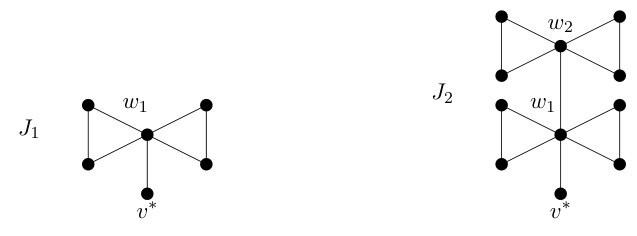 Figure 1