Feedback-Induced Quantum Phase Transitions Using Weak Measurements
D. A. Ivanov, T. Yu. Ivanova, S. F. Caballero-Benitez, and I. B., Mekhov

TL;DR
This paper demonstrates that feedback and weak measurements can induce quantum phase transitions with controllable properties, revealing new ways to manipulate quantum systems beyond traditional dissipative effects.
Contribution
It introduces a novel approach to induce and control quantum phase transitions using feedback and weak measurements, highlighting their role in quantum fluctuation-driven critical phenomena.
Findings
Feedback enables control over quantum critical exponents.
Induces non-Markovian and nonlinear dynamics in quantum systems.
Simulates effects akin to spin-bath problems and Floquet time crystals.
Abstract
We show that applying feedback and weak measurements to a quantum system induces phase transitions beyond the dissipative ones. Feedback enables controlling essentially quantum properties of the transition, i.e., its critical exponent, as it is driven by the fundamental quantum fluctuations due to measurement. Feedback provides the non-Markovianity and nonlinearity to the hybrid quantum-classical system, and enables simulating effects similar to spin-bath problems and Floquet time crystals with tunable long-range (long-memory) interactions.
Click any figure to enlarge with its caption.
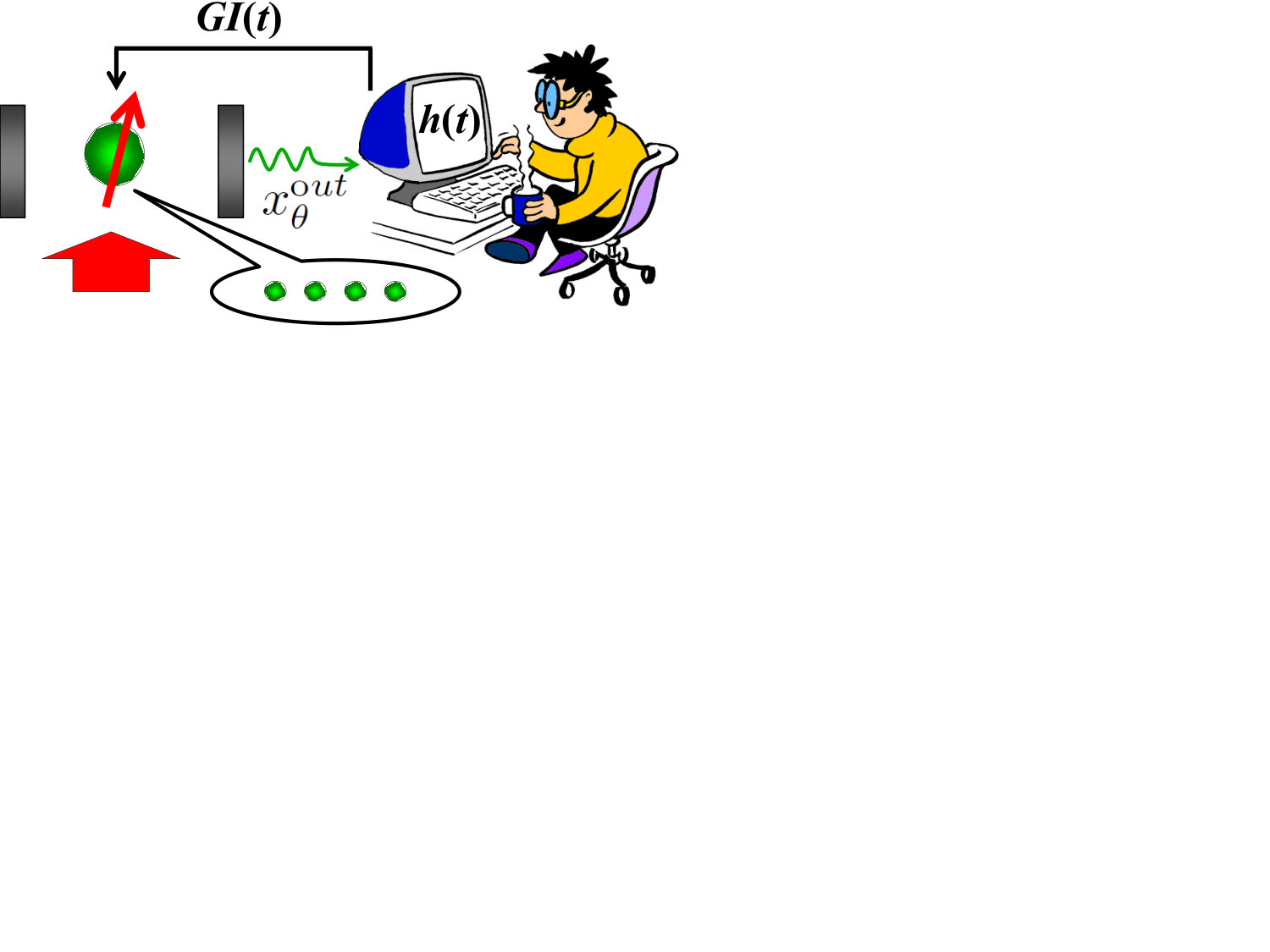 Figure 1
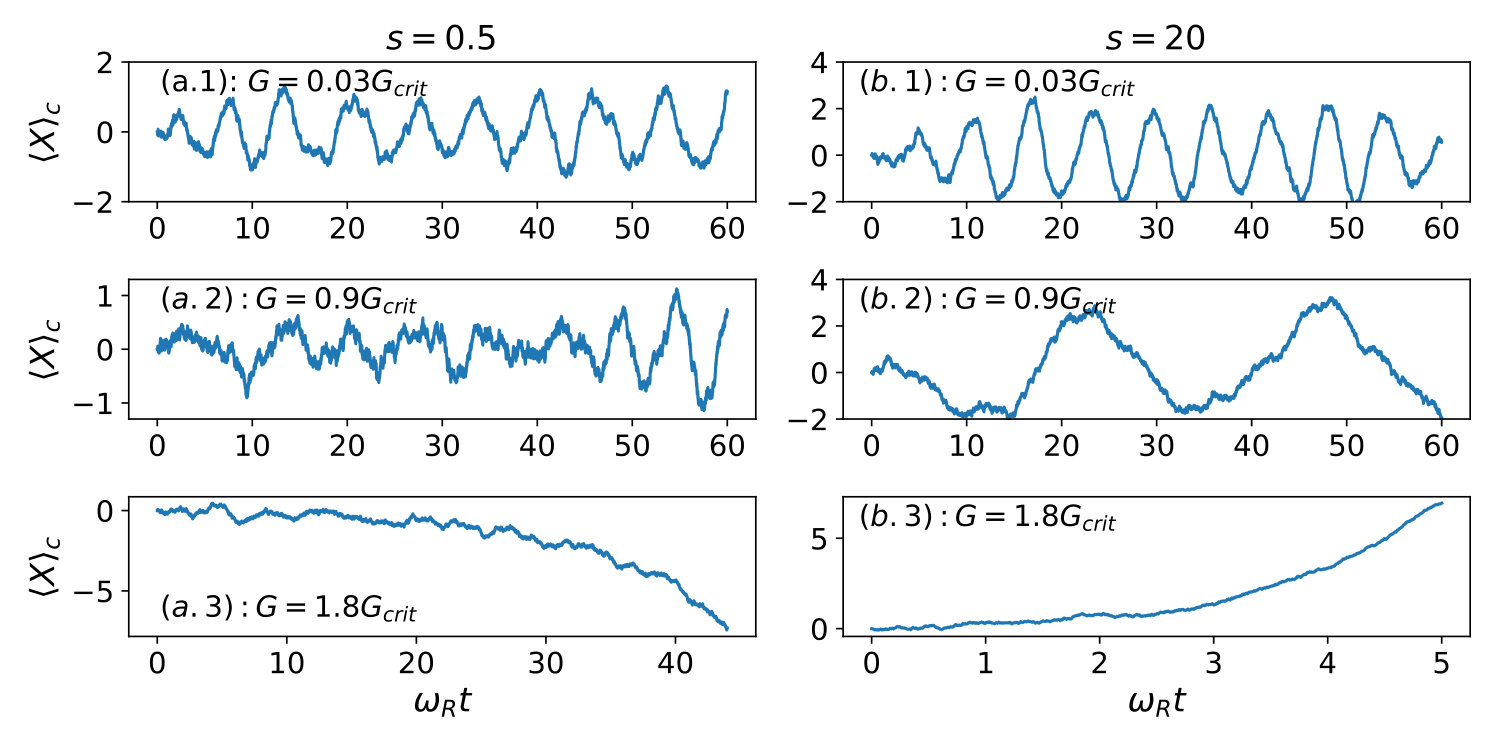 Figure 2
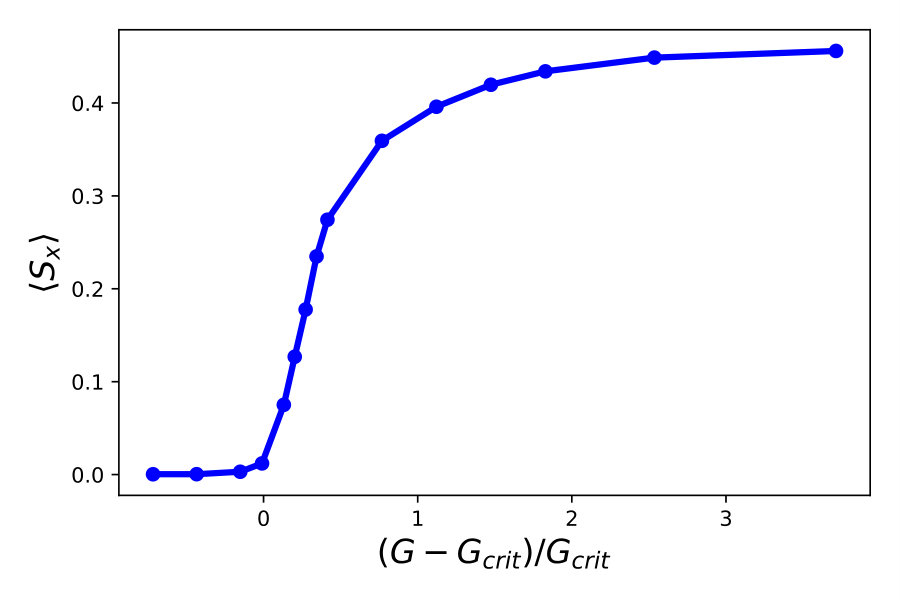 Figure 2
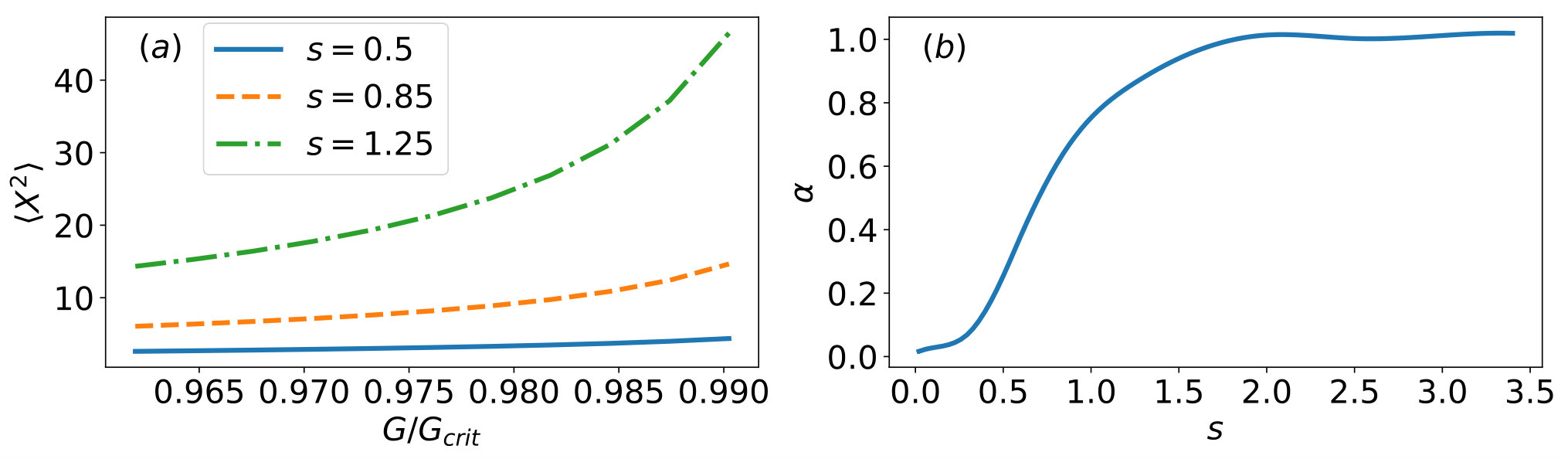 Figure 3
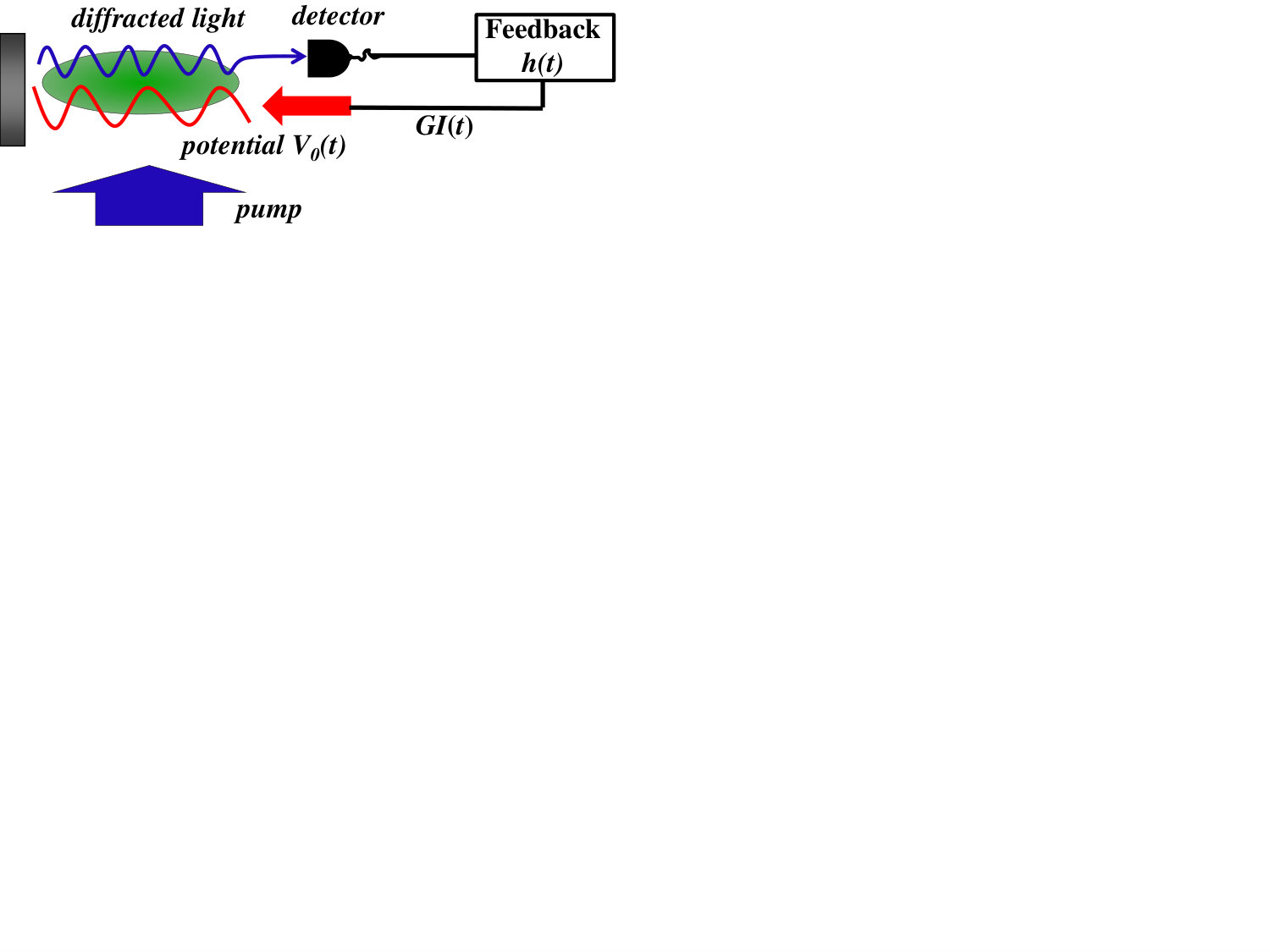 Figure 5
Peer Reviews
No public reviews on file for this paper yet. If you reviewed it on a platform where reviews are public (OpenReview, ICLR, NeurIPS, ICML), you can paste yours below so the community can read it here.
Videos
No videos yet. Explain this paper in a talk, walkthrough, or lecture? Add one.
Feedback-Induced Quantum Phase Transitions Using Weak Measurements
D. A. Ivanov
Department of Physics, St. Petersburg State University, St. Petersburg, Russia
T. Yu. Ivanova
Department of Physics, St. Petersburg State University, St. Petersburg, Russia
S. F. Caballero-Benitez
Instituto de Física, Universidad Nacional Autónoma de México, Ciudad de México, México
I. B. Mekhov
Department of Physics, St. Petersburg State University, St. Petersburg, Russia
Department of Physics, University of Oxford, Oxford, United Kingdom
SPEC, CEA, CNRS, Université Paris-Saclay, CEA Saclay, Gif-sur-Yvette, France
Abstract
We show that applying feedback and weak measurements to a quantum system induces phase transitions beyond the dissipative ones. Feedback enables controlling essentially quantum properties of the transition, i.e., its critical exponent, as it is driven by the fundamental quantum fluctuations due to measurement. Feedback provides the non-Markovianity and nonlinearity to the hybrid quantum-classical system, and enables simulating effects similar to spin-bath problems and Floquet time crystals with tunable long-range (long-memory) interactions.
The notion of quantum phase transitions (QPT) Sachdev (2001) plays a key role not only in physics of various systems (e.g. atomic and solid), but affects complementary disciplines as well, e.g., quantum information and technologies Osterloh et al. (2002), machine learning van Nieuwenburg et al. (2017) and complex networks Halu et al. (2013). In contrast to thermal transitions, QPT is driven by quantum fluctuations existing even at zero temperature in closed systems. Studies of open systems advanced the latter case: the dissipation provides fluctuations via the system-bath coupling, and the dissipative phase transition (DPT) results in a nontrivial steady state Kessler et al. (2012); Daley (2012).
Here we consider an open quantum system, which is nevertheless not a dissipative one, but is coupled to a classical measurement device. The notion of fundamental quantum measurement is broader than dissipation: the latter is its special case, where the measurement results are ignored in quantum evolution Wiseman and Milburn (2010). We show that adding the measurement-based feedback can induce phase transitions. Moreover, this enables controlling quantum properties of the transition by tuning its critical exponent. Such a feedback-induced phase transition (FPT) is driven by fundamentally quantum fluctuations of the measurement process, originating from the incapability of any classical device to capture the superpositions and entanglement of quantum world.
Feedback is a general idea of modifying system parameters depending on the measurement outcomes. It spreads from engineering to contemporary music, including modeling the Maxwell demon Naghiloo et al. (2018); Masuyama et al. (2018); Koski et al. (2015) and reinforcement learning Schuld et al. (2015). Feedback control has been successfully extended to quantum domain Wiseman and Milburn (2010); Hammerer et al. (2010); Hauke et al. (2013); Campagne-Ibarcq et al. (2016); Hacohen-Gourgy et al. (2016); Haroche and Raimond (2006); Steck et al. (2004); Wade et al. (2015, 2016); Hush et al. (2013); Schemmer et al. (2017); Lammers et al. (2016); Thomsen et al. (2002); Botter et al. (2012); Vuletić et al. (2007); Ivanov and Ivanova (2014); Ivanov and Wallentowitz (2004); Ivanov and Ivanova (2016) resulting in quantum metrology aiming to stabilize nontrivial quantum states and squeeze (cool) their noise. The measurement backaction typically defines the limit of control, thus, playing an important but negative role Ivanova and Ivanov (2005). In our work, we shift the focus of feedback from quantum state control to phase transition control, where the measurement fluctuations drive transition thus playing an essentially positive role in the process as a whole.
Hybrid systems is an active field of quantum technologies, where various systems have been already coupled Kurizki et al. (2015): atomic, photonic, superconducting, mechanical, etc. The goal is to use advantages of various components. In this sense, we address a hybrid quantum-classical system, where the quantum system can be a simple one providing the quantum coherence, while all other properties necessary for tunable phase transition are provided by the classical feedback loop: nonlinear interaction, non-Markovianity, and fluctuations.
We show that FPT leads to effects similar to particle-bath problems (e.g. spin-boson, Kondo, Caldeira-Leggett, quantum Browninan motion, dissipative Dicke models) describing very different physical systems from quantum magnets to cold atoms Breuer and Petruccione (2002); Leggett et al. (1987); Hur (2008); Nagy and Domokos (2015, 2016); Scarlatella and Schiro ; Chin et al. (2011). While tuning quantum baths in a given system is a challenge, tuning the classical feedback is straightforward, which opens the way for simulating various systems in a single setup. This raises questions about quantum-classical mapping between Floquet time crystals Sacha and Zakrzewski (2017); Eckardt (2017) and long-range interacting spin chains. Our model is directly applicable to many-body systems, and as an example we consider ultracold atoms in a cavity. Such a setup of many-body cavity QED (cf. for review Mekhov and Ritsch (2012); Ritsch et al. (2013)) was recently marked by experimental demonstrations of superradiant Dicke Baumann et al. (2010), lattice supersolid Landig et al. (2016); Klinder et al. (2015), and other phase transitions Kroeze et al. (2018); Schuster et al. (2018), as well as theory proposals Caballero-Benitez and Mekhov (2015a, b); Rogers et al. (2014); Fernández-Vidal et al. (2010); Niedenzu et al. (2013); Gopalakrishnan et al. (2009); Sheikhan et al. (2016); Piazza and Ritsch (2015); Buchhold et al. (2013); Nagy and Domokos (2015, 2016). Nevertheless, effects we predict here require to go beyond the cavity-induced autonomous feedback Kohler et al. (2017).
Model.- Consider two-level systems (spins, atoms, qubits) coupled to a bosonic (light) mode, which may be cavity-enhanced (Fig. 1). The Hamiltonian then reads
[TABLE]
which without the feedback term is the standard cavity QED Hamiltonian Scully and Zubairy (1997) describing the Dicke (or Rabi) model Nagy and Domokos (2015, 2016) in the ultra-strong coupling regime Marković et al. (2018); Braumüller et al. (2017); Yoshihara et al. (2017); Forn-Diaz et al. (2017) (without the rotating-wave approximation). Here is the annihilation operator of light mode of frequency , are the collective operators of spins of frequency , is the light-matter coupling constant. The Dicke model was first realized in Ref. Baumann et al. (2010) using a Bose-Einstein condensate (BEC) in a cavity, and we relate our model to such experiments in Ref. 1 (1). Our approach can be readily applied to many-body settings as can represent various many-body variables Elliott et al. (2015); Kozlowski et al. (2015, 2017), not limited to the sum of all spins: e.g., fermion or spin (staggered) magnetization Mazzucchi et al. (2016a, b); Landini et al. (2018); Kroeze et al. (2018) or combinations of strongly interacting atoms in arrays, as in lattice experiments Landig et al. (2016); Klinder et al. (2015).
The feedback term has a form of the time-dependent operator-valued Rabi frequency rotating the spins ( is the feedback coefficient and is the control signal). We consider detecting the light quadrature ( is the local oscillator phase) and define . Thus, the classical device continuously measures , calculates the function , integrates it over time, and feeds the result back according to the term . In BEC 1 (1), the quasi-spin levels correspond to two motional states of atoms, and coupling of feedback to is achieved by modifying the trapping potential 1 (1). Various forms of the feedback response will play the central role in our work. The input-output relation Walls and Milburn (2008) gives , where the intracavity quadrature is and is the cavity decay rate. The quadrature noise is defined via the Markovian noise operator [] in the Heisenberg-Langevin equation:
[TABLE]
Effective feedback-induced interaction.- An illustration that feedback induces effective nonlinear interaction is used in quantum metrology Thomsen et al. (2002) for a simple cases such as . One sees this, if light can be adiabatically eliminated from Eq. (2), . Then the effective Hamiltonian, giving correct Heisenberg equations for spins, contains the term leading to spin squeezing Thomsen et al. (2002) [cf. Eq. (1) for ]. Note that this is just an illustration and the derivation needs to account for noise as well. Nevertheless, we can proceed in a similar way and expect the interaction as . For the linear feedback, , this term resembles the long-range spin-spin interaction in space: here we have a long-range (i.e. long-memory) ”interaction” of spins with themselves in the past. The ”interaction length” is determined by .
Such a time-space analogy was successfully used in spin-boson model Leggett et al. (1987); Hur (2008); Vojta et al. (2005); Vojta (2006), describing spins in a bosonic bath of nontrivial spectral function: for small frequencies [ for Ohmic, () for sub-(super-)Ohmic bath, cf. 1 (1)]. It was shown that a similar “time-interaction” term can be generated Vojta et al. (2005); Vojta (2006). Moreover, an analogy with the spin chain and long-range interaction term in space was put forward and the break of the quantum-classical mapping was discussed Vojta et al. (2005); Guo et al. (2012). For a QPT of the Kosterlitz-Thouless type was found Hur (2008), while QPTs for the sub-Ohmic baths are still under active research Chin et al. (2011); Abdi and Plenio (2018).
In bath problems, such a long-memory interaction can be obtained only asymptotically Vojta et al. (2005); Vojta (2006). Moreover, arbitrarily tuning the spectral properties of quantum baths in a given system is challenging (cf. Leppäkangas et al. (2018) for quantum simulations of the spin-boson model and Nokkala et al. (2016, 2018) for complex network approach). In contrast, the feedback response can be implemented and varied naturally, as signals are processed digitally, opening paths for simulating various problems in a single setup. The function
[TABLE]
will correspond to the spatial Ising-type interaction. The instantaneous feedback with will lead to “short-range in time” term, as in the Lipkin-Meshkov-Glick (LMG) model Morrison and Parkins (2008) originating from nuclear physics. A sequence of amplitude-shaped time delays will enable studies of discrete time crystals Sacha and Zakrzewski (2017); Gong et al. (2018); Zhu et al. (2019); Buca et al. (2019); Yu et al. (2019) and Floquet engineering Eckardt (2017) with long-range interaction , where the crystal period may be . This is in contrast to standard time crystals, where the parameter modulation is externally prescribed [e.g. periodic ]. Here, the parameters are modulated depending on the system state (via ), i. e., self-consistently, as it happens in real materials e.g. with phonons. The “interaction in time” does not necessarily require the presence of standard atom-atom interaction in space. The global interaction is given by constant . The Dicke model can be restored even in the adiabatic limit by exponentially decaying and oscillating mimicking a cavity. All such can be realized separately or simultaneously to observe the competition between different interaction types. Our results do not rely on effective Hamiltonians Caballero-Benitez and Mekhov (2015b). This discussion motivates us to use in further simulations , Eq. (3), unusual in feedback control.
Feedback-induced phase transition.- We show the existence of FPT with controllable critical exponent by linearizing (1) and assuming the linear feedback: . Using the bosonization by Holstein-Primakoff representation Nagy and Domokos (2016): , , , , we get
[TABLE]
The bosonic operator reflects linearized spin (), and the matter quadrature is .
Weak measurements constitute a source of competition with unitary dynamics Mazzucchi et al. (2016a, c, b); Kozlowski et al. (2016), which is well seen in quantum trajectories formalism Daley (2012); Lee and Ruostekoski (2014); Pedersen et al. (2014); Blattmann and Mølmer (2016); Yang et al. (2018a, b); Sørensen et al. (2018), underlining the distinction between measurements and dissipation. Thus they can affect phase transitions, including the many-body ones Mazzucchi et al. (2016a); Ashida et al. (2016); Bason et al. (2018). Feedback was mainly considered for stabilizing interesting states Wade et al. (2015); Mazzucchi et al. (2016d); Wade et al. (2016); Hush et al. (2013); Schemmer et al. (2017); Lammers et al. (2016). Here, we focus on the QPT it induces. In this formalism, the operator feedback signal in Eq. (4) takes stochastic values conditioned on a specific set (trajectory) of measurement results Wiseman and Milburn (2010): , where is white noise, . The evolution of conditional density matrix is then given by Wiseman and Milburn (2010): , where , , . In general, averaging such stochastic master equation over trajectories does not necessarily lead to the master equation for unconditional density matrix used to describe DPTs.
Figure 2 compares trajectories for the spin quadrature at various feedback constants and (3). Crossing FPT critical point , the oscillatory solution changes to exponential growth. For large (nearly instant feedback), there is a frequency decrease before FPT and fast growth above it. For small (long memory), before FPT trajectories become noisier; the growth above it is slow. Note, that even though the trajectories are stochastic, their frequencies and growth rates are the same for all experimental realizations.
To get insight, we proceed with a minimal model necessary for FPT and adiabatically eliminate the light mode from Eq. (2): . This corresponds well to experiments Baumann et al. (2010); Landig et al. (2016); 1 (1), where ( MHz) exceeds other variables ( kHz). The Heisenberg equations for two matter quadratures then combine to a single equation describing matter dynamics:
[TABLE]
where . Here the frequency shift is due to spin-light interaction, the last term originates from the feedback. The steady state of Eq. (Feedback-Induced Quantum Phase Transitions Using Weak Measurements) is , which looses stability, if the feedback strength .
Note, that oscillations below are only visible at quantum trajectories for conditional (Fig. 2). They are completely masked in the unconditional trivial solution . Thus, feedback can create macroscopic spin coherence at each single trajectory (experimental run) even below threshold. This is in contrast to dissipative systems, where the macroscopic coherence is attributed to above DPT threshold only.
The noise operator is It has the following correlation function:
[TABLE]
We thus readily see how the feedback leads to the non-Markovian noise in spin dynamics.
Performing the Fourier transform of Eq. (Feedback-Induced Quantum Phase Transitions Using Weak Measurements), one gets , with the characteristic polynomial
[TABLE]
where , , and are transforms of , , and . The spectral noise correlation function is with
[TABLE]
whose frequency dependence again reflects the non-Markovian noise due to the feedback.
Even a simple feedback acting on spins leads to rich classical dynamics Kopylov et al. (2015). Here we focus on the quantum case, but only for a simple type of phase transitions, where the eigenfrequency approaches zero Scarlatella and Schiro (”mode softening,” visualized in quantum trajectories in Fig. 2). From the equation we find the FPT critical point for the feedback strength:
[TABLE]
where . Without feedback () this gives very large for LMG and Dicke transitions Nagy and Domokos (2015, 2016). Thus, feedback can enable and control these transitions, even if they are unobtainable because of large decoherence or small light-matter coupling .
Quantum fluctuations and critical exponent.- We now turn to the quantum properties of FPT driven by the measurement-induced noise (Feedback-Induced Quantum Phase Transitions Using Weak Measurements). While the mean-field solution is below the critical point, exclusively due to the measurement fluctuations and can serve as an order parameter. From and noise correlations we get , giving for .
To find the FPT critical exponent we approximate the behavior near the transition point as , where . Figure 3 demonstrates that the feedback can control the quantum phase transitions. Indeed, it does not only define the mean-field critical point (9), but enables tuning the critical exponent as well. Varying the parameter of feedback response (3) allows one changing the critical exponent in a broad range. This corresponds to varying the length of effective spin-spin interaction mentioned above. For (3), its spectrum is expressed via the exponential integral . At small frequencies its imaginary part behaves as for , resembling the spectral function of sub-Ohmic baths. For large , approaches unity, as becomes fast and feedback becomes nearly instant such as interactions in open LMG and Dicke models, where Nagy and Domokos (2015, 2016); Öztop et al. (2012).
Note that a decaying cavity is well known to produce the autonomous exponential feedback Kohler et al. (2017) [] crucial in many fields (e.g. lasers, cavity cooling, optomechanics, etc.) Such a simple is nevertheless insufficient to tune the critical exponent and measurement-based feedback is necessary.
The linearized model describes FPT near the critical point, but it does not give new steady state. The spin nonlinearity can balance the system (cf. 1 (1)). However, the feedback with nonlinear can assure a new steady state even in a simple system of linear quantum dipoles (e.g. for far off-resonant scattering with negligible upper state population). It is thus the nonlinearity of the full hybrid quantum-classical system that is crucial.
Relation to other models.- Feedback control of QPTs enables simulating models similar to those for particle-bath interactions, e.g., spin-boson (SBM), Kondo, Caldeira-Leggett (CLM), quantum Brownian motion models (cf. 1 (1)). They were applied to various systems from quantum magnets to cold atoms with various spectral functions Breuer and Petruccione (2002); Leggett et al. (1987); Hur (2008); Nagy and Domokos (2015, 2016); Scarlatella and Schiro ; Chin et al. (2011). Creating a quantum simulator, which is able to model various baths in a single device, is challenging, and proposals include, e.g., coupling numerous cavities or creating complex networks simulating multimode baths Leppäkangas et al. (2018); Nokkala et al. (2016, 2018). In contrast, the feedback approach is more flexible as tuning of a single classical loop is feasible. E.g., for BEC 1 (1), the typical frequencies are in the kHz range, which is well below those of modern digital processors reaching GHz. Moreover, it can be readily extended for simulating broader class of quantum materials and qubits with nonlinear bath coupling Zheng et al. (2018) and multiple baths Guo et al. (2012).
The multi- (or large-) spin-boson models Anders (2008); Winter and Rieger (2014); Nagy and Domokos (2015, 2016); Scarlatella and Schiro are based on Eq. (1) with sum over continuum of bosonic modes of frequencies distributed according to the spectral function 1 (1). The feedback model reproduces exactly the form of bath dynamical equations for [cf. Eq. (Feedback-Induced Quantum Phase Transitions Using Weak Measurements) for linearized, and 1 (1) for nonlinear versions] if . The noise correlation function of linear CLM is , whereas the feedback model contains and additional light-noise term in Eq. (8).
In bath models there is a delicate point of the frequency renormalization (”Lamb shift”) Leggett et al. (1987); Nagy and Domokos (2015, 2016); Scarlatella and Schiro . It may lead to divergences and necessity to repair the model Ford et al. (1988). The feedback approach is flexible. The frequency shift in Eq. (7) is determined by and can be tuned and even made zero, if changes sign.
In summary, we have shown that feedback does not only lead to phase transitions driven by quantum measurement fluctuations, but controls its critical exponent as well. It induces effects similar to those of quantum bath problems, allowing their realization in a single setup, and enables studies of time crystals and Floquet engineering with long-range (long-memory) interactions. The applications can also include control schemes for optical information processing Bagayev et al. (2018). Experiments can be based on quantum many-body gases in a cavity Baumann et al. (2010); Landig et al. (2016); Klinder et al. (2015); Kroeze et al. (2018); Schuster et al. (2018); Mazzucchi et al. (2016d), and circuit QED, where ultra-strong coupling has been obtained Yoshihara et al. (2017); Forn-Diaz et al. (2017) or effective spins can be considered Leppäkangas et al. (2018); Marković et al. (2018); Braumüller et al. (2017). Feedback methods can be extended by, e.g., measuring several outputs Lammers et al. (2016); Hacohen-Gourgy et al. (2016); Ficheux et al. (2018) (enabling simulations of qubits and multi-bath SBMs Guo et al. (2012) with nonlinear couplings Zheng et al. (2018)) or various many-body atomic Elliott et al. (2015); Mazzucchi et al. (2016b); Kozlowski et al. (2017); Mazzucchi et al. (2016d) or molecular Mekhov (2013) variables.
Note.- After the acceptance of our letter, the first experiment, where our predictions can be tested was reported in Ref. Kroeger et al. .
Acknowledgements.
We thank Ph. Joyez, A. Murani, and D. Esteve for stimulating discussions. Figures are prepared using MS PowerPoint. Support by RSF (17-19-01097), RFBR (18-02-01095), DGAPA-UNAM (IN109619), CONACYT-Mexico (A1-S-30934), EPSRC (EP/I004394/1), UPSay (d’Alembert Chair).
The reference list from the paper itself. Each links out to its DOI / PubMed record.
- 1Sachdev (2001) S. Sachdev, Quantum Phase Transitions (Cambridge University Press, 2001).
- 2Osterloh et al. (2002) A. Osterloh, L. Amico, G. Falci, and R. Fazio, Nature 416 , 608 (2002).
- 3van Nieuwenburg et al. (2017) E. P. L. van Nieuwenburg, Y.-H. Liu, and S. D. Huber, Nature Phys. 13 , 435 (2017).
- 4Halu et al. (2013) A. Halu, S. Garnerone, A. Vezzani, and G. Bianconi, Phys. Rev. E 87 , 022104 (2013) . · doi ↗
- 5Kessler et al. (2012) E. M. Kessler, G. Giedke, A. Imamoglu, S. F. Yelin, M. D. Lukin, and J. I. Cirac, Phys. Rev. A 86 , 012116 (2012) . · doi ↗
- 6Daley (2012) A. J. Daley, Advances in Physics 86 , 012116 (2012) . · doi ↗
- 7Wiseman and Milburn (2010) H. M. Wiseman and G. J. Milburn, Quantum Measurement and Control (Cambridge University Press, 2010).
- 8Naghiloo et al. (2018) M. Naghiloo, J. J. Alonso, A. Romito, E. Lutz, and K. W. Murch, Phys. Rev. Lett. 121 , 030604 (2018) . · doi ↗