BpForms and BcForms: Tools for concretely describing non-canonical polymers and complexes to facilitate comprehensive biochemical networks
Paul F. Lang, Yassmine Chebaro, Xiaoyue Zheng, John A. P. Sekar, Bilal, Shaikh, Darren A. Natale, Jonathan R. Karr

TL;DR
This paper introduces BpForms and BcForms, innovative tools that enable detailed and standardized descriptions of non-canonical macromolecules, enhancing the modeling and understanding of complex biochemical networks.
Contribution
The authors developed a comprehensive toolkit of ontologies, grammars, and software to accurately describe non-canonical polymers and complexes, addressing limitations of existing formats.
Findings
Facilitates quality control and data exchange for macromolecular structures.
Enables integration of detailed primary structures into biochemical network models.
Supports comprehensive representation of non-canonical residues and modifications.
Abstract
Although non-canonical residues, caps, crosslinks, and nicks play an important role in the function of many DNA, RNA, proteins, and complexes, we do not fully understand how networks of non-canonical macromolecules generate behavior. One barrier is our limited formats, such as IUPAC, for abstractly describing macromolecules. To overcome this barrier, we developed BpForms and BcForms, a toolkit of ontologies, grammars, and software for abstracting the primary structure of polymers and complexes as combinations of residues, caps, crosslinks, and nicks. The toolkit can help quality control, exchange, and integrate information about the primary structure of macromolecules into fine-grained global networks of intracellular biochemistry.
Click any figure to enlarge with its caption.
 Figure 1
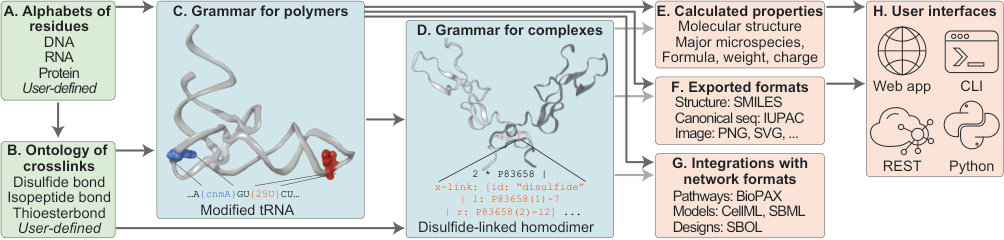 Figure 1
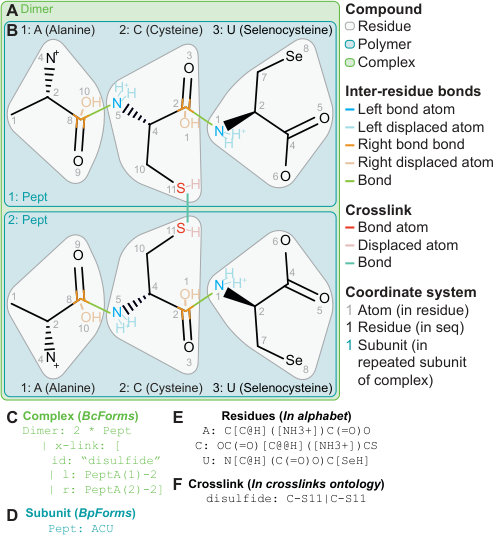 Figure 2
 Figure 3
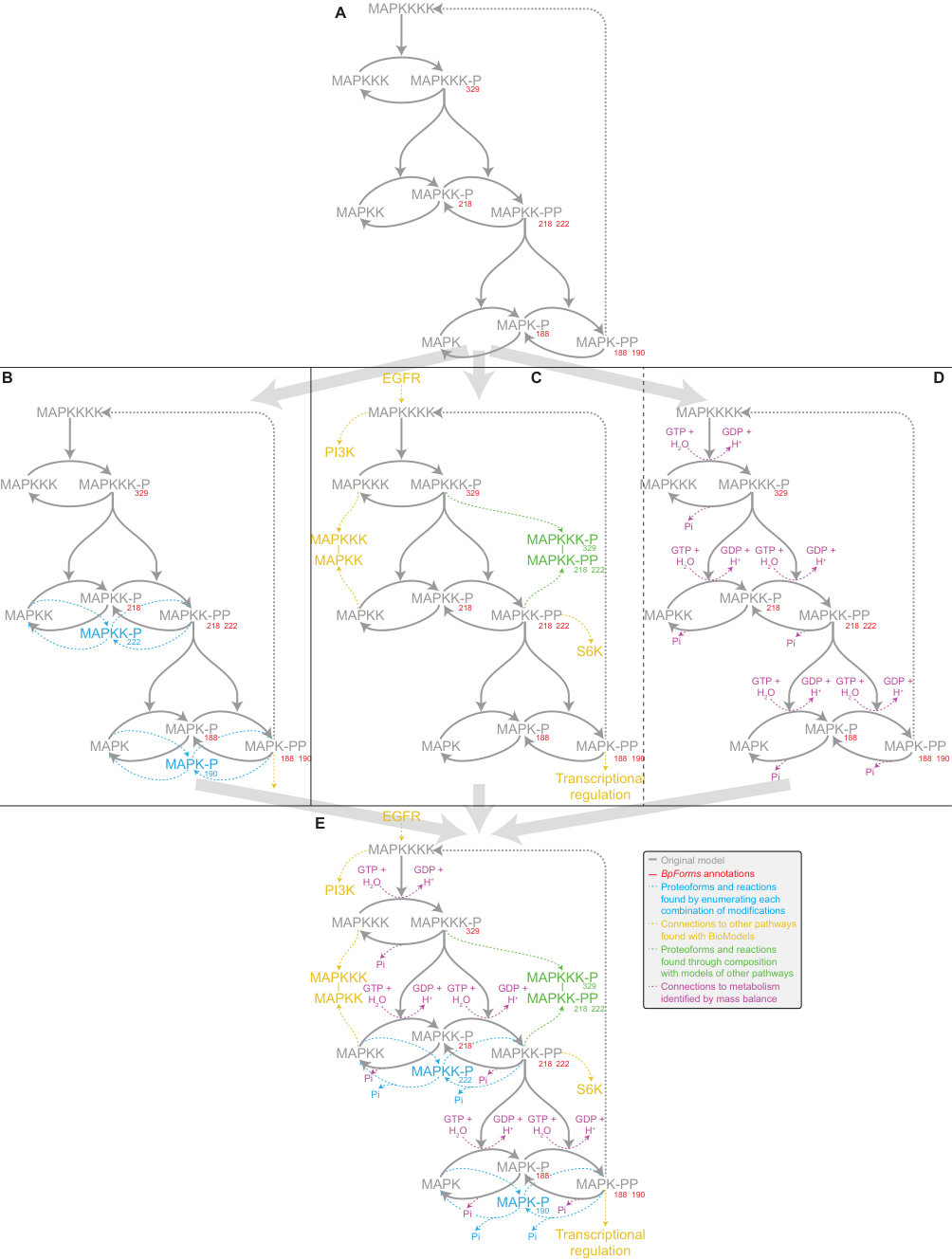 Figure 4
Peer Reviews
No public reviews on file for this paper yet. If you reviewed it on a platform where reviews are public (OpenReview, ICLR, NeurIPS, ICML), you can paste yours below so the community can read it here.
Code & Models
Videos
No videos yet. Explain this paper in a talk, walkthrough, or lecture? Add one.