Topological band theory for non-Hermitian systems from the Dirac equation
Zi-Yong Ge, Yu-Ran Zhang, Tao Liu, Si-Wen Li, Heng Fan, Franco Nori

TL;DR
This paper explores topological properties of non-Hermitian systems derived from the Dirac equation, analyzing how Lorentz-symmetry violation and complex mass influence bulk-boundary correspondence and skin effects.
Contribution
It introduces a unified framework for understanding topological phases in non-Hermitian Dirac systems with Lorentz-symmetry violation and complex mass, clarifying conditions for skin effects and bulk-boundary correspondence.
Findings
Non-Hermitian skin effect occurs in systems with Lorentz-symmetry violation.
Bulk-boundary correspondence is restored via gauge transformation in LSV systems.
No skin effect and conventional bulk-boundary correspondence in systems with complex mass.
Abstract
We identify and investigate two classes of non-Hermitian systems, i.e., one resulting from Lorentz-symmetry violation (LSV) and the other from a complex mass (CM) with Lorentz invariance, from the perspective of quantum field theory. The mechanisms to break, and approaches to restore, the bulk-boundary correspondence in these two types of non-Hermitian systems are clarified. The non-Hermitian system with LSV shows a non-Hermitian skin effect, and its topological phase can be characterized by mapping it to the Hermitian system via a non-compact gauge transformation. In contrast, there exists no non-Hermitian skin effect for the non-Hermitian system with CM. Moreover, the conventional bulk-boundary correspondence holds in this (CM) system. We also consider a general non-Hermitian system in the presence of both LSV and CM, and we generalize its bulk-boundary correspondence.
Click any figure to enlarge with its caption.
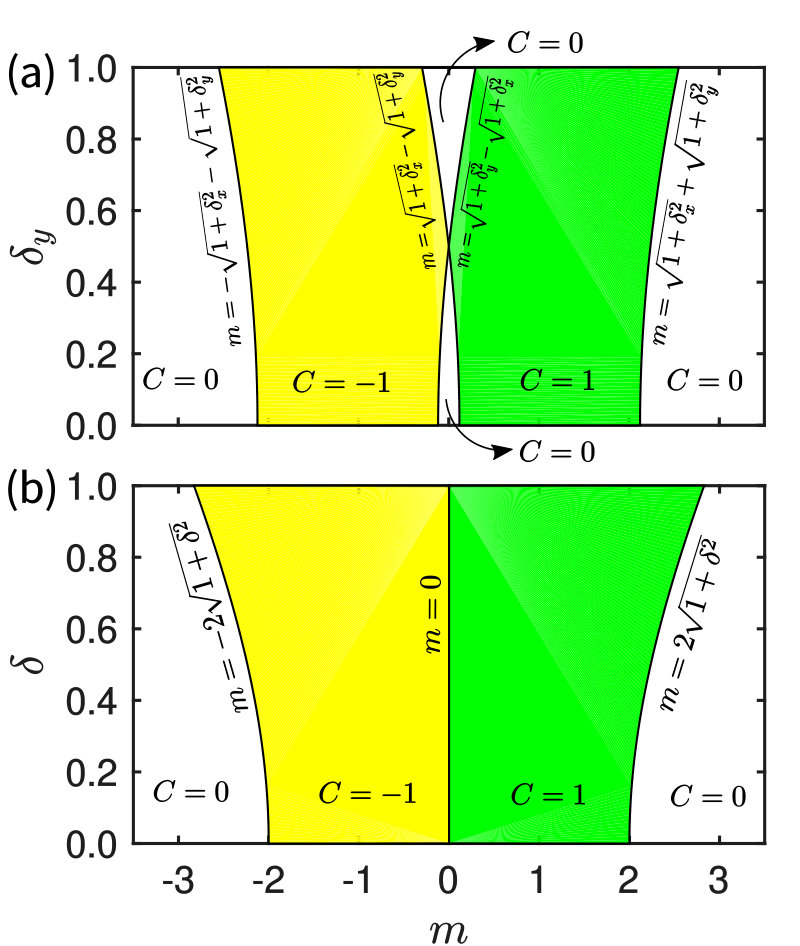 Figure 1
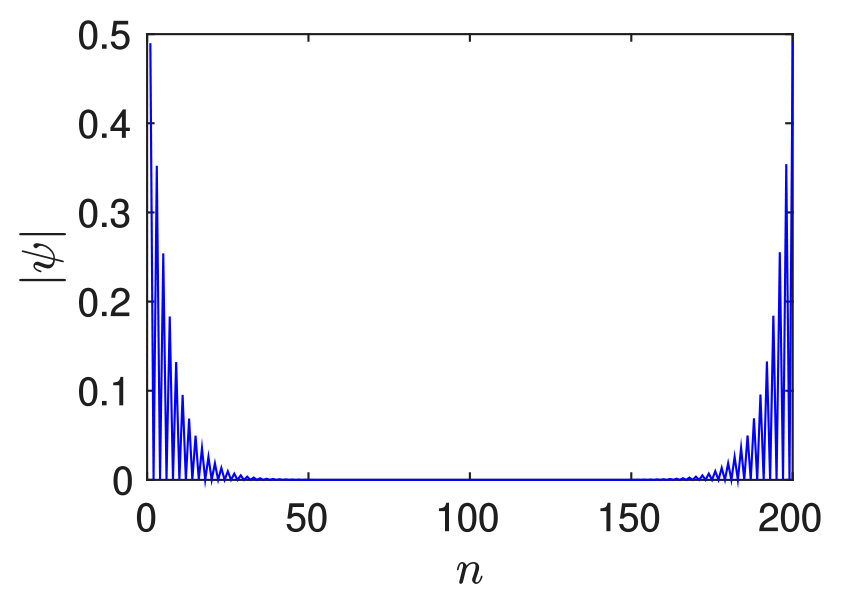 Figure 2
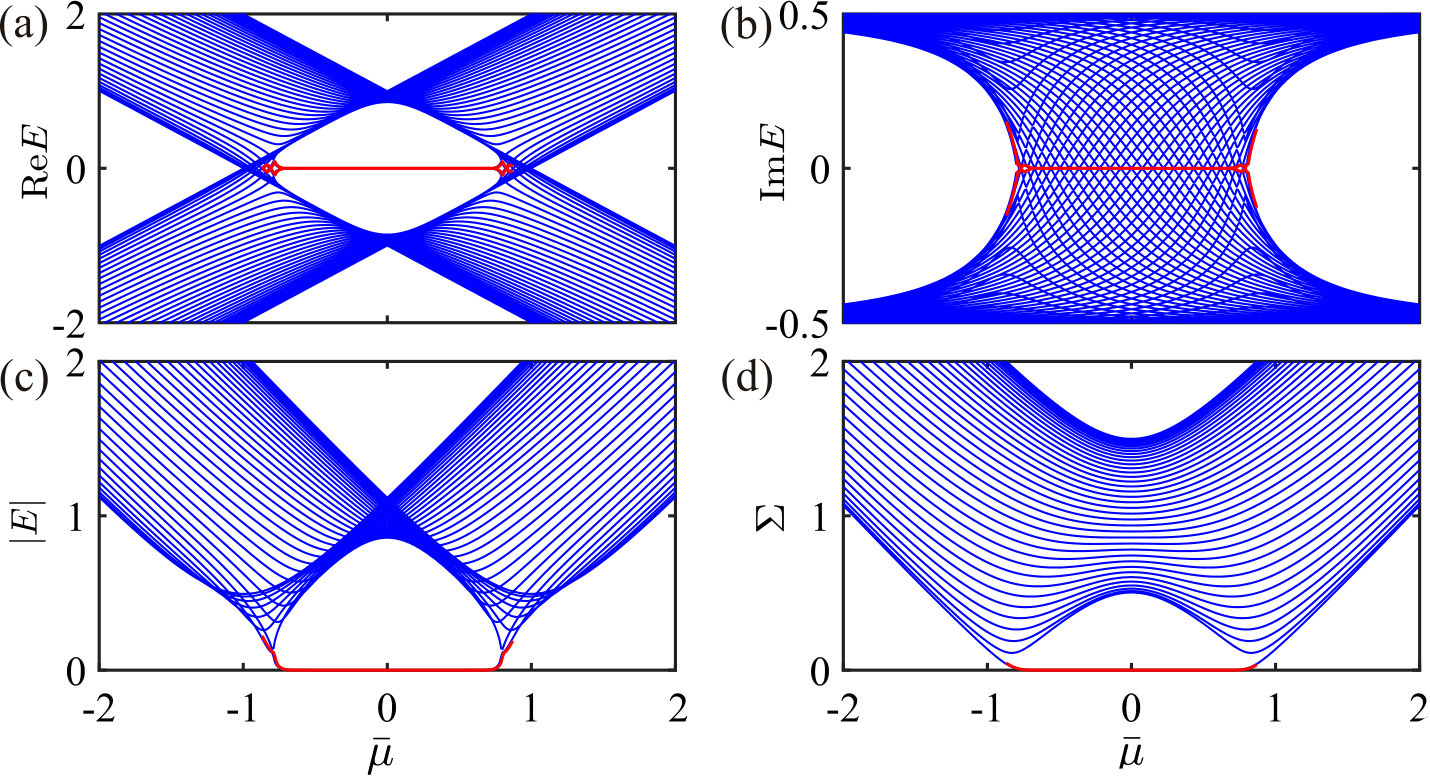 Figure 3
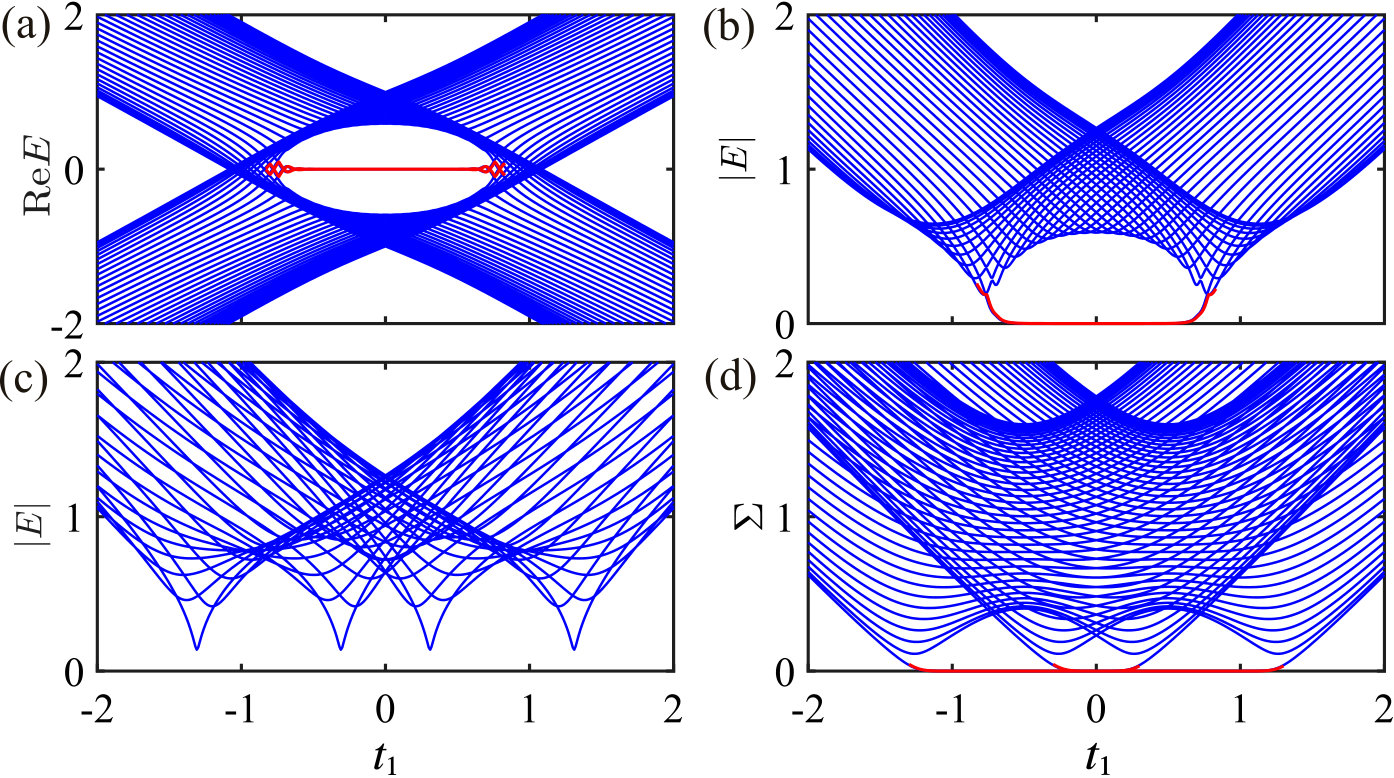 Figure 4
Peer Reviews
No public reviews on file for this paper yet. If you reviewed it on a platform where reviews are public (OpenReview, ICLR, NeurIPS, ICML), you can paste yours below so the community can read it here.
Videos
No videos yet. Explain this paper in a talk, walkthrough, or lecture? Add one.
Topological band theory for non-Hermitian systems from the Dirac equation
Zi-Yong Ge
Institute of Physics, Chinese Academy of Sciences, Beijing 100190, China
School of Physical Sciences, University of Chinese Academy of Sciences, Beijing 100190, China
Yu-Ran Zhang
Beijing Computational Science Research Center, Beijing 100193, China
Theoretical Quantum Physics Laboratory, RIKEN Cluster for Pioneering Research, Wako-shi, Saitama 351-0198, Japan
Tao Liu
Theoretical Quantum Physics Laboratory, RIKEN Cluster for Pioneering Research, Wako-shi, Saitama 351-0198, Japan
Si-Wen Li
Department of physics, Dalian Maritime University, Dalian 116026, China
Heng Fan
Institute of Physics, Chinese Academy of Sciences, Beijing 100190, China
School of Physical Sciences, University of Chinese Academy of Sciences, Beijing 100190, China
CAS Center for Excellence in Topological Quantum Computation, UCAS, Beijing 100190, China
Songshan Lake Materials Laboratory, Dongguan 523808, China
Franco Nori
Theoretical Quantum Physics Laboratory, RIKEN Cluster for Pioneering Research, Wako-shi, Saitama 351-0198, Japan
Department of Physics, University of Michigan, Ann Arbor, Michigan 48109-1040, USA
Abstract
We identify and investigate two classes of non-Hermitian systems, i.e., one resulting from Lorentz-symmetry violation (LSV) and the other from a complex mass (CM) with Lorentz invariance. The mechanisms to break, and approaches to restore, the bulk-boundary correspondence in these two types of non-Hermitian systems are clarified. The non-Hermitian system with LSV shows a non-Hermitian skin effect, and its topological phase can be characterized by mapping it to the Hermitian system via a non-compact gauge transformation. In contrast, there exists no non-Hermitian skin effect for the non-Hermitian system with CM. Moreover, the conventional bulk-boundary correspondence holds in this (CM) system. We also consider a general non-Hermitian system in the presence of both LSV and CM, and we generalize its bulk-boundary correspondence.
I Introduction
Topological band theory for Hermitian systems, such as topological insulators and topological superconductors Thouless ; Read ; Kitaev1 ; Kane1 ; Kane2 ; Moore ; Fu1 ; Fu2 ; Schnyder ; Kitaev2 ; Hasan ; Qi ; Bansil ; Chiu , has made remarkable progress in the past two decades. Recently, topological phases of non-Hermitian systems have been theoretically studied in topological insulators Esaki ; Hu ; Yuce ; Klett ; Lieu ; Yin ; Takata2018 ; Kawabata2018 ; Liu ; Jin2019 ; Edvardsson2019 ; Lee201919 ; Alvarez1 ; Yoshida2 , topological superconductors Wang ; Menke ; Li ; Kawabata ; Kawabata2019 , Weyl semimetals Gonzlez ; Cerjan ; Budich2019 , etc. Rudner ; JGong ; Liang ; Leykam ; Gong1 ; WHu ; Rivolta ; Shen1 ; CHHua2019 ; Kawabata1 ; zeng2019 ; Konstantin1 ; Konstantin2 ; Kawabata20192 ; HZhou1 ; HZhou2 ; Borgnia ; Yoshida1 , and have been experimentally observed in Refs. Zeuner ; Zhan ; Weimann ; Xiao ; Parto ; Zhu . Non-Hermitian Hamiltonians can describe open systems with gain and/or loss Rotter , interacting and disordered systems with finite lifetimes of quasiparticles Zyuzin ; Kozii ; Papaj ; Shen2 , and have many unique features, e.g., the existence of exceptional points causing eigenstates to coalesce and making Hamiltonians non-diagonalizable Bender ; Berry ; Heiss ; Moiseyev ; Ozdemir2019 ; Ganainy . Non-Hermitian Hamiltonians have been successfully applied to explain experiments in various platforms including, photonic Makris ; Chong ; Regensburger ; Jing ; Hodaei ; Peng1 ; Feng ; Peng2 ; Liu1 ; Kawabata3 ; Lv ; Ashida ; Zhang and mechanical systems Jing1 ; Jing2 ; Liu12017 . The introduction of non-Hermiticity into band theory induces many novel topological properties, which are significantly different from their Hermitian counterparts, e.g., Weyl exceptional rings Xu , bulk Fermi arcs Zhou and breakdown of conventional bulk-boundary correspondence Lee ; Yao ; Xiong ; Yao2 . In contrast to the Hermitian case, the bulk spectra of non-Hermitian systems strongly rely on the boundary conditions Kunst ; Yao ; Xiong ; Yao2 . Therefore, topological invariants, defined by non-Hermitian Bloch Hamiltonians, usually fail to characterize topological phases in non-Hermitian systems, which leads to the breakdown of the conventional bulk-boundary correspondence. Although many efforts have been made to propose new topological invariants, e.g. non-Bloch winding and Chern numbers Yao ; Yao2 , to restore the bulk-boundary correspondence of non-Hermitian Hamiltonians Kunst ; Yao ; Yao2 ; Zirnstein2019 ; Herviou2019 , it remains a challenge to understand and characterize the topological phases of non-Hermitian systems. For example, for a non-Hermitian Hamiltonian, should its topological phase follow the Block-wave or non-Bloch-wave behavior? This is not uncovered in Refs. Yao ; Yao2 .
In this paper, we investigate the topological phases of non-Hermitian systems. According to both Dirac and current-conservation equations, non-Hermitian systems can mainly be classified into two classes: one resulting from Lorentz symmetry violation (LSV), and the other from a complex mass (CM) with Lorentz invariance. We clarify the mechanisms to break the conventional bulk-boundary correspondence in these two types of non-Hermitian systems, and develop approaches to generalize the bulk-boundary correspondence. In particular, the topological phases of non-Hermitian Hamiltonians with LSV can be described by non-Bloch topological invariants, while those with CM follow the Bloch-wave behavior. The non-Hermitian Su-Schrieffer-Heeger (SSH) Su , Qi-Wu-Zhang (QWZ) Qi2 models and the disordered Kitaev chain Kitaev1 exemplify our approaches. Remarkably, our approach can unperturbatively predict the topological phases of 2D non-Hermitian systems. We also discuss a general non-Hermitian system containing both LSV and CM non-Hermiticities.
The remaining of this paper is organized as follows. In Sec. II, we give a short review of Hermitian Dirac equation. In Sec. III, the LSV non-Hermitian systems are studied. In Sec. IV, we discuss the non-Hermitian systems with CM. Non-Hermiticity with mixed LSV and CM is discussed in Sec. V. Finally, we summarize the results of this paper in Sec. VI.
II Hermitian Dirac equation
Generally, topological band systems can be described by the Dirac equation Qi ; Shen . The Dirac Hamiltonian reads
[TABLE]
where is the mass of the fermion, is the field operator of spinors, , and s satisfy the Clifford algebra , with being the Minkowski metric tensor. In addition, we have the conserved current equation
[TABLE]
where and . In space, the spectrum of Eq. (1) is
[TABLE]
For , there exists zero-energy states, representing the critical points of the topological quantum phase transition. If we consider a domain-wall defect sandwiched by two regions with opposite signs of the mass, there exist gapless boundary modes localized at the interface. In the following sections, we generalize the Hermitian Dirac and current equations to the non-Hermitian cases.
III Non-Hermiticity with LSV
In this section, we introduce the first class of non-Hermitian systems, i.e, non-Hermiticity with LSV. We begin with the LSV Dirac equation and then generalize it to the lattice models. We find that the conventional bulk-boundary correspondence of these LSV systems breaks down due to the intrinsic currents, and the non-Hermitian skin effect emerges Yao ; Yao2 .
III.1 Lorentz-symmetry-violation Dirac equation
As is gauge invariant, we only need to consider a compact gauge group in the Hermitian case. With a specific non-compact gauge transformation on , then
[TABLE]
where is a complex vector potential, with real vectors and . Here, the non-compact gauge transformation on spinors satisfies
[TABLE]
In this case, becomes non-Hermitian for . Here, the Lorentz symmetry is broken, the compact part of gauge symmetry is not broken Qi2008 , and we label this type of non-Hermiticity as LSV Alexandre . The eigenenergies of are real, and have the same values as those of the Hermitian Hamiltonian in spite of the non-Hermitian terms. However, in contrast to the eigenstates of , the real-space right (left) eigenstates of the continuum non-Hermitian Hamiltonian have an extra phase () with complex . Therefore, the states of become exponentially localized, which is exactly the non-Hermitian skin effect Yao ; Yao2 . Furthermore, because and can be transformed to each other by a gauge transformation, they are topologically equivalent.
For non-Hermitian systems, the real-space bands can be considerably different from those in space. The eigenenergies of with a constant in space are
[TABLE]
and can be complex, while they are real in real space. Therefore, the energy spectra of non-Hermitian systems strongly depend on its boundary conditions. Moreover, the bulk-boundary correspondence in this non-Hermitian system with LSV is correspondingly broken.
To uncover the nature of such breakdown, we consider the current equation for Alexandre :
[TABLE]
The right hand of Eq. (7) is a source term, making the solutions of and exponentially localized at the edge with the form (). In addition, this source is a classical vector field resulted from non-Hermiticity. To distinguish it with the one in CM case discussed in Sec. IV, we call it an intrinsic current. The intrinsic current suffers from an ambiguity on orientation, when going from open to periodic boundary conditions. This leads to the breakdown of the conventional bulk-boundary correspondence in non-Hermitian system with LSV. To preserve the current conservation and overcome this ambiguity, we replace with to cancel the effect of the gauge transformation. Then, after applying the Fourier transformation to have a real-space form, the conserved current equation is restored. Moreover, according to topological band theory, the topology relies on the topological properties of the wave function. Thus, the non-compact transformation, a local continuous mapping of the wave function, does not change the topology of the system. Therefore, the topological invariant, defined by the space Hamiltonian after replacing with , reflects the topological phases of in real space, which restores the bulk-boundary correspondence.
III.2 Lorentz-symmetry-violation lattice models
As in the case for the above continuum model, the topological phases of the lattice model in the presence of the non-Hermiticity with LSV can be also investigated from the perspective of the non-compact gauge transformation. To clarify this, we begin with a Hermitian lattice Hamiltonian
[TABLE]
with lattice sites and band indices . By a non-compact gauge transformation Bernevig , becomes
[TABLE]
where is a lattice vector potential. If is unitary with a real , remains Hermitian. However, for the non-unitary transformation with a complex , becomes non-Hermitian with LSV. Moreover, as in the case of the continuum model, exhibits the non-Hermitian skin effect, and breaks the conventional bulk-boundary correspondence. Because and are topologically equivalent, the topological phases of the Hamiltonian in the presence of non-Hermiticity with LSV can be characterized by mapping it to the Hermitian form with a non-compact gauge transformation.
III.3 Two examples
We now consider two concrete 1D and 2D non-Hermitian models with LSV. For the 1D SSH model with an asymmetric intercell hopping:
[TABLE]
where are orbital indices representing the , sub-lattices, respectively. We rewrite as
[TABLE]
where is the standard Hermitian SSH model. Substituting it into Eq. (III.3), we can obtain
[TABLE]
The modified intracell and intercell hopping strengths appearing in are
[TABLE]
respectively. According to the above discussions, the non-Hermitian Hamiltonian and the transformed Hermitian Hamiltonian
[TABLE]
are topologically equivalent. Therefore, is topologically nontrivial for . Note that this generalized bulk-boundary correspondence is the same as the one derived by the non-Bloch-wave method in Ref. Yao .
We then consider the 2D non-Hermitian QWZ model Yao2 ; Qi2 , which describes a Chern insulator:
[TABLE]
To restore the bulk-boundary correspondence, the non-Bloch-wave method in perturbation theory was used in Yao2 ; while we can solve it exactly. We map to the corresponding Hermitian Hamiltonian by a non-compact gauge transformation by replacing with . Here, both and are real and -independent, and they can be solved by letting the spectrum of the corresponding Hamiltonian to be real (see Appendix A). Generally, there exist four topological phase boundaries:
[TABLE]
as shown in Fig. 1(a). For the specific case , three topological phase boundaries can be found as
[TABLE]
as shown in Fig. 1(b). In particular, for a small , the topological phase boundaries to first-order approximation are
[TABLE]
which are consistent with the perturbation results in Ref. Yao2 .
IV Non-Hermiticity with CM
In addition to the non-Hermiticity induced by LSV, the non-Hermiticity can also result from generalizing some parameters from real to complex. One typical example is the non-Hermitian system whose mass term becomes complex, i.e., , with real and . In this section, we investigate the topological properties of the non-Hermitian systems with CM. We find that there exists no non-Hermitian skin effect, and the bulk-boundary correspondence holds.
IV.1 Complex-mass Dirac equation
The Dirac Hamiltonian of CM system reads
[TABLE]
which is with Lorentz invariance and compact gauge invariance. In contrast to the non-Hermitian Hamiltonian with LSV, it cannot be mapped to the Hermitian form by a non-compact gauge transformation. The current equation is calculated as
[TABLE]
As in the case of LSV, the right hand of Eq. (19) is also a source term resulted from non-Hermiticity, making the solution of exponentially decay or enhance in the time domain. However, this source term in Eq. (19) is a classical scalar field and not orientable, thus there exists no intrinsic current. Instead, the system decays, and thus behaves like a finite-lifetime particles due to this source. Note that the Hamiltonian Eq. (18) is different from the ones in Refs. Alexandre2015 ; JonesSmith , where non-Hermitian mass matrices with different symmetries are discussed.
According to the zero-mode domain wall solution of , contributes to edge localization, while leads to oscillations. Therefore, is the critical point. In space, the dispersion relation of is
[TABLE]
where the upper and lower bands coalesce at the exceptional points for , and the topological phase boundaries are determined by . In contrast to the system with LSV, since the source of non-Hermitian system with CM is not orientable, i.e., there is no intrinsic current, it will not suffer from any ambiguity on orientation, when going from open to periodic boundary conditions. Thus, the energy spectrum is not sensitive to the boundary condition. Therefore, the conventional bulk-boundary correspondence holds for the system in the presence of non-Hermiticity with CM. In Appendix B, we give a detailed geometric description of the topological phase transition for this kind of non-Hermitian system. Note that the above discussion for the non-Hermitian continuum model can be directly generalized to the non-Hermitian lattice model with CM, where there exists no non-Hermitian skin effect, and the conventional bulk-boundary correspondence holds.
Alternatively, as disscussed in Ref. Ueda , we can consider a minimal coupling to a two-level environment to describe the non-Hermitian systems with CM. The coupled Hamiltonian can be written as
[TABLE]
where . It is shown that the eigenvalues and eigenvectors of are the singular values and singular matrices of (see Appendix C). Therefore, the minimal coupling is equivalent to solving the singular value decomposition (SVD) of , where represents zero-value singular values of . Therefore, we can also use the SVD to explore the topological properties of the non-Hermitian systems with CM, and overcome the precision problem of numerical diagonalization of non-Hermitian Hamiltonians.
IV.2 Complex-mass SSH model
For a non-Hermitian system with a complex mass, there exists no non-Hermitian skin effect, and the conventional bulk-boundary correspondence holds. To exemplify this, we consider a non-Hermitian SSH model with complex mass. The real-space Hamiltonian reads
[TABLE]
whose eigenenergies are complex. It cannot be mapped to a Hermitian model with a non-compact gauge transformation. In addition, according to the real-space eigenstates, there exists no non-Hermitian skin effect. Applying the Fourier transformation, we have the -space Hamiltonian as
[TABLE]
The dispersion relation is
[TABLE]
Letting , we can obtain the topological phase transition points as . The winding numbers of and that have either opposite values or simultaneously zero values. For , the winding numbers are non-zero, indicating that the system is topologically nontrivial. Moreover, the zero-energy boundary modes are localized at both edges (see Fig. 2).
IV.3 Disordered Kitaev chain
As an another concrete non-Hermitian model with CM, we consider a disordered Kitaev chain. The Hamiltonian is , where
[TABLE]
where denotes diagonal disorder. Here, and are real numbers representing the hopping strength and the superconducting gap, respectively, and is the disorder satisfying an uniform distribution. As shown in Refs. Kozii ; Papaj ; Shen2 , we can construct an effective non-Hermitian Hamiltonian by considering the retarded Green’s function
[TABLE]
where
[TABLE]
and is the retarded self-energy of the disorder scattering. The effective Hamiltonian has the form
[TABLE]
where is a renormalized chemical potential (see Appendix D). This non-Hermitian Hamiltonian effectively describes the disordered Kitaev chain, where the disorder scattering makes the particles possess a finite lifetime, and thus broadens the bands and shrinks the gap Kozii . It is thus inferred that the non-Hermiticity in is attributed to the CM. The conventional bulk-boundary correspondence holds for . The energy spectra of is shown in Fig. 3(a-c). When
[TABLE]
the system is topologically nontrivial supporting Majorana zero modes (see red curves). In particular, according to Ref. Brouwer2 and Appendix D, for and , the self-energy is . The disordered Kitaev chain is topologically nontrivial for
[TABLE]
which agrees with the results in Refs. Brouwer2 ; Pientka ; DeGottardi . In addition, according to Fig. 3(c,d), the singular values of directly reflect the topological phase of non-Hermitian systems with CM.
V Non-Hermiticity with mixed LSV and CM
As discussed above, the non-Hermiticity can mainly result from LSV or CM. However, for a general non-Hermitian system, there exists both LSV and CM, dubbed here as mixed non-Hermiticity. In this case, due to LSV, the non-Hermitian system with mixed LSV and CM is sensitive to boundary conditions. Therefore, we need to utilize the non-compact gauge transformation to map such mixed non-Hermitian Hamiltonian to the one containing only a CM. Its topological phases are then determined by this transformed Hamiltonian.
We now consider a mixed non-Hermitian SSH model:
[TABLE]
By a non-compact gauge transformation, we can map it to a non-Hermitian Hamiltonian with the only CM term left as
[TABLE]
where Yao
[TABLE]
and
[TABLE]
Note that the Hamiltonians and are topologically equivalent. The effective intracell and intercell hopping strengths for the transformed Hamiltonian is obtained as
[TABLE]
respectively. Therefore, for
[TABLE]
is topologically nontrivial supporting zero-energy boundary modes, as shown in Fig. 4(a,b). The energy spectrum of the mixed non-Hermitian SSH model is sensitive to its boundary conditions [see Fig. 4(b,c)]. In addition, by comparing Fig. 4(c) with 4(d), the singular values of the SVD cannot directly reflect the topological phase of the mixed non-Hermitian systems.
VI Conclusion
The topological phases of non-Hermitian systems are studied from the Dirac equation. Using both Dirac and current-conservation equations, we identified and investigated two classes of non-Hermiticities due to LSV and CM. We also addressed the mechanisms to break the conventional bulk-boundary correspondence in these two types of non-Hermitian systems. There exists intrinsic current and non-Hermitian skin effects in the non-Hermitian system with LSV. The bulk-boundary correspondence can be restored by mapping it to the Hermitian case via a non-compact gauge transformation. In contrast, the non-Hermitian system with CM shows no intrinsic current, while the particles in this system have a finite lifetime. Moreover, there exists no non-Hermitian skin effect, and the conventional bulk-boundary correspondence holds in this system. In addition, the singular values of the SVD can be utilized to directly reflect the topological phase of this system. We also studied a general non-Hermitian system containing both LSV and CM non-Hermiticities, and suggested the approaches to generalize its bulk-boundary correspondence.
Acknowledgements.
Y.R.Z. was supported by China Postdoctoral Science Foundation (Grant No. 2018M640055) and NSFC (Grant No. U1530401). T.L. was supported by JSPS Postdoctoral Fellowship (P18023). S.W.L. was supported by the research startup foundation of Dalian Maritime University in 2019 and the Fundamental Research Funds for the Central Universities (Grant No. 017192608). H.F. was supported by NSFC (Grant No. 11774406), National Key R & D Program of China (Grant Nos. 2016YFA0302104, 2016YFA0300600), Strategic Priority Research Program of Chinese Academy of Sciences (Grant No. XDB28000000), and Beijing Science Foundation (Grant No. Y18G07). F.N. is supported in part by the: MURI Center for Dynamic Magneto-Optics via the Air Force Office of Scientific Research (AFOSR) (FA9550-14-1-0040), Army Research Office (ARO) (Grant No. Grant No. W911NF-18-1-0358), Asian Office of Aerospace Research and Development (AOARD) (Grant No. FA2386-18-1-4045), Japan Science and Technology Agency (JST) (via the Q-LEAP program, the ImPACT program, and the CREST Grant No. JPMJCR1676), Japan Society for the Promotion of Science (JSPS) (JSPS-RFBR Grant No. 17-52-50023, and JSPS-FWO Grant No. VS.059.18N), the RIKEN-AIST Challenge Research Fund, and the John Templeton Foundation.
Appendix A Non-Hermitian Qi-Wu-Zhang model with Lorentz symmetry violation
The Qi-Wu-Zhang (QWZ) model is an example of a 2D model describing a Chern insulator. The topological phases of the non-Hermitian QWZ model have been investigated using the non-Bloch-wave method in the framwork of perturbation theory in Ref. Yao2 . However, we can solve it exactly via a non-compact gauge transformation. Here, we present the details to obtain the phase diagram of the non-Hermitian QWZ model with the Hamiltonian shown in Eq.(III.3). By replacing with , we have
[TABLE]
The spectrum of can be written as
[TABLE]
Now we consider the real and imaginary parts of as
[TABLE]
[TABLE]
By letting , we have
[TABLE]
[TABLE]
Firstly, we consider the special case, i.e., . According to Ref. Yao2 , we know that the gappless bands only appear at high-symmetry points of the Brillouin zone, i.e., , , and . For , according to the symmetry of Eq. (41) and (42), we can obtain , and satisfies
[TABLE]
The real part of can be simplified as
[TABLE]
Given , we can solve the Eqs. (43) and (A), and the critical point is obtained as
[TABLE]
Similarly, for , the corresponding critical point is , while for , the critical point is
[TABLE]
For the general case , we can apply the same procedures at the high-symmetry points , , and . For , the critical points can be solved as
[TABLE]
and other two critical points are
[TABLE]
Appendix B Geometric description of topological phase transitions of non-Hermitian systems with complex mass
Here, based on quantum field theory, we give a geometric description of topological phase transitions in Hermitian systems, and then generalize it to the non-Hermitian case with complex mass. This provides a new viewpoint to understand the topological properties of non-Hermitian systems.
In quantum field theory, the 4D Dirac spinor is a representation of the 4D Clifford algebra. The generators of the algebra are matrices, which satisfy
[TABLE]
It mathematically turns out that the 4D Dirac representation of the Lorentz group is reducible due to . Hence we can define the chirality with the operator , and . This forms a 2D representation by writing the Dirac spinor as
[TABLE]
Here, transform under , respectively, and is named as left- and right-handed Weyl spinor. Note that is defined as , and are the eigenstates of . Then let us accordingly consider a global transformation generated by , i.e., the chiral transformation . Analyzing its infinitesimal transformation, we can obtain the corresponding Noether current , which satisfies
[TABLE]
Note that is conserved only if , indicating that a chiral phase transition occurs at .
Alternatively, there exists a geometric interpretation of the topological or chiral phase transition in fermionic systems. The phase transition could be identified as a Dirac field defined in a space-time with different topologies. Without loss of generality, let us investigate the dynamics of a massless spinor in dimensional Minkowskian spacetime parameterized by , and the index runs from . The Dirac equation for the spinor is given as
[TABLE]
where the matrices satisfy the dimensional Clifford algebra . In order to take into account a mass term, we could compactify one spatial direction, denoted by , of the space-time on a circle with radius so that . Here denotes the line element on and the topology of the spacetime now becomes . Then, we expand the spinor by its Fourier modes as
[TABLE]
where is the momentum on the direction. Note that the boundary condition could be either periodic or anti-periodic, i.e., for a spinor, and we consider the anti-periodic condition here, since a fermionic field is not observable. Therefore, has to satisfy the quantization condition
[TABLE]
By plugging (53) into (52), we obtain
[TABLE]
which leads to
[TABLE]
Hence we can define the effective mass
[TABLE]
to obtain the massive Dirac equation in dimension. As discussed here, the Dirac equation is chirally symmetric only for the massless spinor, so the chiral transition can be geometrically interpreted as going from to a finite . The former corresponds to a space-time with topology , and the latter corresponds to its topology . Thus the chiral transition could be understood as a topological transition of the dimensional spacetime from to . Furthermore, the equation (56) also leads to an effective vertex in the associated action. If we accordingly compare Eq. (56) with the coupling term in the gauge theory involving fermions, i.e., , the effective vertex can be obtained by treating as an external field. In this sense, by taking into account the massive Dirac equation
[TABLE]
we can define an imaginary mass,
[TABLE]
in order to describe such an effective interaction in -dimensional space-time.
Appendix C Minimal coupling and singular value decomposition
The minimal coupling Ueda and the singular value decomposition (SVD) can be used to explore the topological properties of the non-Hermitian systems with complex mass. In addition, the SVD can overcome the precision problem of numerically diagonalizing a non-Hermitian Hamiltonian. In this section, we demonstrate that the minimal coupling is equivalent to calculating the singular value decomposition for the non-Hermitian Hamiltonian with complex mass. We write the minimal coupling Hamiltonian
[TABLE]
as
[TABLE]
satisfies the singular value decomposition as
[TABLE]
where is a positive diagonal matrix. Thus, we have
[TABLE]
with
[TABLE]
The Hermitian Hamiltonian can be diagonalized as
[TABLE]
with
[TABLE]
It is clear that the eigenvalues and eigenvectors of are the singular values and singular matrix of , respectively. Therefore, the minimal coupling is equivalent to solving the singular value decomposition of the non-Hermitian system with complex mass.
Appendix D Self-energy of disorder Kitaev chain
To obtain the effective Hamiltonian of the disordered Kitaev chain, we need to calculate the self-energy of the disorder scattering. Here, we derive the form of the self-energy using Feynman diagrams. The Hamiltonian of the disordered Kitaev chain has the form
[TABLE]
where , , and . In addition, satisfies
[TABLE]
where means the average over disorder, and is the Dirac delta function.
We consider the Matsubara self-energy of non-crossing diagrams, and the th-order Matsubara self-energy has the form
[TABLE]
with
[TABLE]
where is the free part of . Thus, the total Matsubara self-energy reads
[TABLE]
where is a -dependent function. By analytic continuation , we can obtain the retarded self-energy
[TABLE]
The real part of renormalizes the chemical potential, while the imaginary part gives the finite lifetimes of the particles. Therefore, the effective Hamiltonian of reads
[TABLE]
where
[TABLE]
The reference list from the paper itself. Each links out to its DOI / PubMed record.
- 1(1) D. J. Thouless, M. Kohmoto, M. P. Nightingale, and M. den Nijs, Quantized Hall conductance in a two-dimensional periodic potential, Phys. Rev. Lett. 49 , 405 (1982) .
- 2(2) N. Read and D. Green, Paired states of fermions in two dimensions with breaking of parity and time-reversal symmetries and the fractional quantum Hall effect, Phys. Rev. B 61 , 10267 (2000) .
- 3(3) A. Y. Kitaev, Unpaired Majorana fermions in quantum wires, Phys. Usp. 44 , 131 (2001) .
- 4(4) C. L. Kane and E. J. Mele, Quantum spin Hall effect in Graphene, Phys. Rev. Lett. 95 , 226801 (2005) .
- 5(5) C. L. Kane and E. J. Mele, ℤ 2 subscript ℤ 2 \mathbb{Z}_{2} Topological order and the quantum spin Hall effect, Phys. Rev. Lett. 95 , 146802 (2005) .
- 6(6) J. E. Moore and L. Balents, Topological invariants of time-reversal-invariant band structures, Phys. Rev. B 75 , 121306 (2007) .
- 7(7) L. Fu, C. L. Kane, and E. J. Mele, Topological insulators in three dimensions, Phys. Rev. Lett. 98 , 106803 (2007) .
- 8(8) L. Fu and C. L. Kane, Topological insulators with inversion symmetry, Phys. Rev. B 76 , 045302 (2007) .