A Note on the Exponents of Primitive Companion Matrices
Monimala Nej, A. Satyanarayana Reddy

TL;DR
This paper investigates the exponents of primitive companion matrices, determining specific exponent values and exploring the set of possible exponents for these matrices, while proposing open problems for future research.
Contribution
It provides explicit calculations of exponents for certain primitive companion matrices and characterizes parts of the exponent set for these matrices.
Findings
Identified specific exponent values for certain primitive companion matrices.
Characterized elements in the exponent set E_n(X) for primitive companion matrices.
Proposed open problems for further exploration of matrix exponents.
Abstract
A nonnegative matrix is said to be {\it primitive} if for some positive integer , entries in are positive, notationally represented as The smallest such is called the {\it exponent} of , denoted For the class of primitive companion matrices , we find for certain Thereafter, we find certain numbers in , where E_n(X)=\{m \in \N : \text{there exists an n \times nAX with} \; exp(A)=m\}. At the end we propose open problems for further research.
Click any figure to enlarge with its caption.
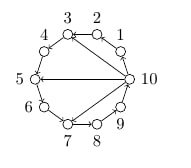 Figure 1
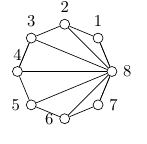 Figure 2
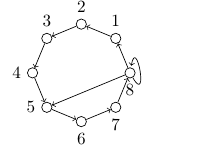 Figure 3
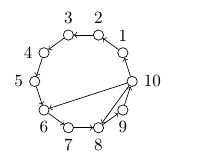 Figure 4
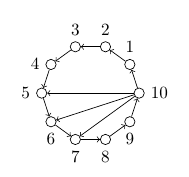 Figure 5
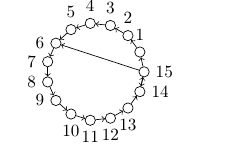 Figure 6
Peer Reviews
No public reviews on file for this paper yet. If you reviewed it on a platform where reviews are public (OpenReview, ICLR, NeurIPS, ICML), you can paste yours below so the community can read it here.
Videos
No videos yet. Explain this paper in a talk, walkthrough, or lecture? Add one.
Taxonomy
TopicsMatrix Theory and Algorithms · Advanced Mathematical Theories and Applications · graph theory and CDMA systems
A Note on the Exponents of Primitive Companion Matrices
Monimala Nej, A. Satyanarayana Reddy
Department of Mathematics, Shiv Nadar University, India-201314
(e-mail: [email protected], [email protected])
Abstract
A nonnegative matrix is said to be primitive if for some positive integer , entries in are positive, notationally represented as The smallest such is called the exponent of , denoted For the class of primitive companion matrices , we find for certain Thereafter, we find certain numbers in , where E_{n}(X)=\{m\in{\mathbb{N}}:\text{there exists an n\times nAX with}\;exp(A)=m\}. At the end we propose open problems for further research.
Key Words: Primitive matrix, Companion matrix, Exponent.
AMS(2010): 05C50, 05C38,15B99.
1 Introduction
Let be the set of all real matrices of order . We will denote the -th entry in by or If then by () we mean () for all In particular, if is the zero matrix, then is said to be a nonnegative (positive) matrix, denoted by (). An irreducible matrix which is not primitive is called an imprimitive matrix. We refer to Henryk Minc [13] for the definition and properties of an irreducible matrix. For a class of nonnegative matrices, the exponent set of is defined as:
[TABLE]
It is very easy to observe that In 1950, Helmut Wielandt proved that if is a primitive matrix, then , where This bound is well known as the Wielandt bound. For the proof, we refer to Hans Schneider [19], Holladay and Varga [7] and Perkins [16]. Wielandt also proved that is a sharp bound, that is, there exists a primitive matrix of order whose exponent is As a consequence, where denotes the set In 1964, A.L. Dulmage and N.S. Mendelsohn [5] found that Research focused on primitive exponents ever since 1950, when Wielandt published his paper [23]. For a given class of nonnegative matrices, finding bounds on and matrices in which attain those bounds are the major parts of the literature. For instance, the papers [4], [9], [11], [22], [12],[18], [6] studied those problems for different classes of nonnegative matrices.
Let be the set of all companion matrices of polynomials of the form , where That is, In this paper we wish to investigate some problems on primitive companion matrices. The set of all primitive companion matrices will be denoted by As per the best of our knowledge no one has studied the number of imprimitive matrices and the number of primitive matrices with a given exponent in a given class. Furthermore, there is no specific formula for computing the exponent of a given matrix from a given class. Here in this work, we are interested in solving these problems for
It is easy to verify that a nonnegative matrix is primitive if and only if its sign matrix is primitive. If is a nonnegative matrix, the sign matrix of denoted is the matrix such that if and only if Furthermore, the exponent of a primitive matrix is always the same as the exponent of its sign matrix. It is thus sufficient to work with primitive companion matrices. Also, in the context of powers of matrices, this means that the algebra of interest is the Boolean algebra and thus naturally follows. Since the first rows of every matrix in are fixed, it is sufficient to specify the last row. Clearly, there is a bijection between and , where denotes the set of all binary strings of length In particular, where denotes the number of elements in the set Now the elements in will be denoted as , where and the last row of will be or accordingly as is irreducible or reducible respectively. We arrange the contents of this paper as follows. In section 2, we find the number of primitive companion matrices of order Also we find the exponent of where and the trace of is positive. In Section 3, we discuss the exponents of primitive companion matrices with zero trace. At the end, we show the existence of certain numbers in . It should be noted that the non-existence of some numbers in follows from A.L. Dulmage and N.S. Mendelsohn [5], M. Lewin and Y. Vitek [10] and Ke Min Zhang [24]. Finally, we suggest some open problems in Section 4. In the rest of this section we will discuss a few preliminaries and notations required for the rest of the paper.
We denote as a digraph (directed graph) with the vertex set the edge set and order Throughout the paper, loops are permitted but no multiple edges. A walk in is a sequence of vertices and a sequence of edges where vertices and edges may be repeated. A cycle or closed walk is a walk where A path is a walk with distinct vertices. An elementary cycle is a closed walk with distinct vertices except for The length of a walk is the number of edges in the walk. The notation (resp. ) is used to indicate that there is a walk (resp. no walk) of length and the notation to indicate that for all
For an matrix the adjacency digraph, denoted by , is the digraph such that and if and only if On the other hand, for a digraph , the adjacency matrix of is defined as follows: if there is an edge from to in and otherwise. If is the adjacency digraph of , then is defined to be the adjacency digraph of It is easy to observe that the -th entry of is if and only if there is a walk of length from to in If is a digraph, then is primitive (imprimitive) if and only if its adjacency matrix is primitive (imprimitive) and is defined to be the exponent of its adjacency matrix. Hence one can interchangeably use a matrix or its adjacency digraph for the purpose of establishing the primitivity and exponent of the matrix. More detail about digraphs and primitivity of digraphs is available in Richard A. Brualdi and Herbert J. Ryser [3] and Henryk Minc [13].
For we define (or simply if is clear from the context) as
[TABLE]
For write , where for each , with and for each We define For , is assumed to be zero. For example, if then and Note that whenever
Example 1.1**.**
From the digraph in Figure 1, we have and
2 Number of primitive companion matrices and exponent of with a positive trace
It is known that if is a primitive matrix, then is irreducible, but the converse is not true. For example, consider with and Then is irreducible but not primitive. Moreover, the primitive and imprimitive matrices are defined over the class of irreducible matrices. We let denote the set of all irreducible matrices in . Then follows from the following definition.
Definition 2.1**.**
([13])
A digraph is said to be strongly connected if there exist a walk from to for each and 2. 2.
Let be a strongly connected digraph. The greatest common divisor of the lengths of all elementary cycles in is called the index of imprimitivity of the digraph If , then is called a primitive digraph; otherwise, it is called imprimitive.
It is easy to see that a nonnegative matrix is irreducible if and only if is strongly connected. Now the following theorem gives the number of imprimitive matrices in .
Theorem 2.1**.**
Let be an integer. Then
[TABLE]
where are all possible distinct prime factors of .
Proof.
Let us denote and for each Then it is easy to see that is imprimitive if the length of every elementary cycle, excluding the length , in belongs to for some Hence for each there are imprimitive matrices in Furthermore, if contains exactly one cycle, then the length of the cycle is and is imprimitive. Now and by inclusion-exclusion principle
[TABLE]
For an example, let us take Then the number of imprimitive matrices of order 8 is and they are given by , where
[TABLE]
Hence For , there are imprimitive matrices in
From now onwards, we confine our study to primitive companion matrices and focus on finding For this purpose it is sufficient to know whenever In this paper we find the for certain cases and we provide some results which may be helpful in finding the for the remaining cases. We now recall a general procedure that evaluates the exponent of a primitive matrix.
Let be a primitive matrix. Then
is defined to be the smallest positive integer such that in Equivalently, for any integer 2. 2.
is the smallest positive integer such that for all Equivalently, every entry in the row of is positive. As a consequence, every entry in the row of is also positive.
The following result is well known. For instance, see [3].
Lemma 2.2**.**
Let be a primitive matrix. Then
[TABLE]
Example 2.3**.**
Consider the matrix with given in Figure 2. Note that there is an edge in if and only if It is easy to check that , and for all Hence
Thus, our goal is to find for all Before proceeding to the next result, we need the following notation. We denote , where are all possible distinct elementary cycle lengths in with Let denote the set of all binary strings with zeros and having at least one longest sub-word of zeros of length For example, Consequently, a necessary condition for to be nonempty is An immediate observation is that Thus where The value of is defined to be zero whenever For the basic results and facts about we refer the reader to Monimala Nej and A. Satyanarayana Reddy [14]. M.A. Nyblom [15] denoted for the set of all binary strings of length without -runs of ones, where and , and . For example, if and , then and .
Theorem 2.4**.**
Let such that the trace of is positive. Then .
Proof.
Suppose that and . Then . If , then , where and Thus for each it follows from Lemma 2.2 that
[TABLE]
Hence
[TABLE]
∎
Corollary 2.5**.**
For a given Hence 2. 2.
For , the number of matrices with a positive trace and with exponent in is given by , where and has been described in **[14]**.
Example 2.6**.**
The exponent of the digraph in Figure 3 is Observe that
Also the number of matrices with a positive trace and exponent in is
3 Exponent of with zero trace
The exponent of the companion matrix of the polynomial is And this is the only primitive matrix up to isomorphism whose exponent is The following result shows that and there is only one matrix with We need the following remark to prove the same.
Remark 3.1**.**
If and are two primitive matrices of order such that , then .
Theorem 3.2**.**
Let . Then Moreover, there exists a unique such that
Proof.
For , is the smallest length of cycles containing the vertex in . As a consequence .
Let be the companion matrix of . Then as contains a loop at the vertex and there is an edge from to each vertex . Hence by Lemma 2.2,
Suppose and is the companion matrix of . Then as contains a loop at the vertex and there is an edge from to each vertex Hence Finally, if is the companion matrix of then as Hence from Remark 3.1, there exists a unique matrix in such that ∎
The following result can be found in Jia Yu Shao [21]. Here we are giving a proof for the sake of completeness.
Theorem 3.3**.**
Suppose and such that contains only two elementary cycles of length and . Then .
Proof.
Suppose that is the length of a walk from to and Then for some nonnegative integer and . It is now known that for all nonnegative integers can be expressed as a nonnegative integer linear combination of and But cannot be expressed as a nonnegative integer linear combination of and . Thus is the smallest number which is larger than and Hence
From [3], if is a primitive digraph with vertices and smallest cycle length then Hence the result follows. ∎
Lemma 3.4**.**
- Let with zero trace and let be the adjacency digraph of with the vertex set
-
Then 3. 2.
If then , where and
Proof.
Proof of part 1. Suppose , that is, is the least positive integer such that for all Then for all . Hence . Since is finite, then by a similar argument we can say that . Hence the result follows from Lemma 2.2.
Proof of Part 2. The existence of follows from the fact that . Since every walk from to must contain the vertex then whenever Suppose that Then from the definition of we can write But will contradict the fact that . Hence and the result follows. ∎
Finally, to find the where and the trace of is zero, it is sufficient to find , where . Suppose are relatively prime and denotes the smallest integer such that this integer or any integer larger than this can be expressed as where is a nonnegative integer for The number is called as the Frobenius number. This function has been discussed by Bateman [1], Brauer and Seelbinder [2], Johnson [8] and Roberts [17]. It is known that if and are relatively prime then Roberts has shown that if , , then
[TABLE]
where as usual denotes the greatest integer The proof of this result has been simplified by Bateman. Johnson has given an ingenious algorithm which can be used to find in the case of three variables. It is now easy to establish that for each In particular, we have the following result for .
Lemma 3.5**.**
Let with zero trace. Then .
Proof.
We have . Suppose that Clearly, is an integer. It follows from the definition of that but Now every walk from to is a nonnegative integer linear combination of Thus every integer can be expressed as a nonnegative integer linear combination of whereas can not be expressed as a nonnegative integer linear combination of . Hence and the result follows. ∎
Corollary 3.6**.**
Suppose that and Then whenever Also Hence
The following remark evaluates the for some
Remark 3.7**.**
Suppose such that , then . Such a vertex is named a ‘’. 2. 2.
Suppose which is not a special vertex and Then there exists a such that and . If , then . The equality holds if is a special vertex. 3. 3.
Suppose that and where cannot be expressed as a nonnegative integer linear combination of the elements from Then for any with , , provided .
For an example, choose ; then and this implies that .
The following remark provides for some with zero trace.
Remark 3.8**.**
Suppose with zero trace. If then . 2. 2.
For the maximum number of matrices whose exponent can be evaluated by Part 1 is The number of such matrices will be exactly if is a prime number. 3. 3.
Suppose are two relatively prime integers such that If and , then for some with zero trace. That is,
For example, it is easy to see from Figure 4 that
Suppose that If then
Figure 5 is an example where , and
The following remark provides and the numbers in the exponent set whenever
Remark 3.9**.**
Let be the smallest odd cycle length in . If and is not a special vertex, then , where p is the smallest odd number such that and Otherwise, .
For an example, choose Then and .
Thus for an integer if with in then the exponent of can be easily evaluated. 2. 2.
Recall that we have Now if is odd and with in then For all nonnegative integers one can see that by considering the digraph with But if is even, then the cannot go beyond The digraph in Figure 6 illustrates the same for odd . Here , and
4 Problems
In this section, we suggest a few problems arising naturally from the ideas in the preceding sections.
Here we established the existence of certain numbers in but we are unable to characterize completely. Complete characterization is an interesting problem but it may be quite difficult as there is no known formula for when Consequently, finding in another approach may be helpful in finding . Thus further research can be focused here. 2. 2.
We found for certain cases such as with a positive trace, with the smallest cycle length or in Hence an immediate question that can be raised is about the remaining , in particular: what will be the exponent set of all with the smallest cycle length in ? And what will be the exponents of all such matrices? Similar questions can be asked for the smallest cycle length Clearly, this problem can be treated as a simplified form of the problem in Part 1.
The reference list from the paper itself. Each links out to its DOI / PubMed record.
- 1[1] P.T. Bateman, Remark on a recent note on linear forms , Amer. Math. Monthly, 65, (1958) 517-518.
- 2[2] A.T. Brauer and B.M. Seelbinder, On a problem of partitions- \Romannum 2 , Amer. J. Math., 76, (1954) 343-346.
- 3[3] R.A. Brualdi and Herbert J. Ryser, Combinatorial Matrix Theory , Cambridge University Press, 1991.
- 4[4] R.A. Brualdi and J.A. Ross, On the exponent of a primitive, nearly reducible matrix , Math. Oper. Res., 5, (1980) 229-241.
- 5[5] A.L. Dulmage and N.S. Mendelsohn, Gaps in the exponent set of primitive matrices , Illinois Journal of Mathematics, 8(4), (1964) 642-656.
- 6[6] A.L. Dulmage and R.S. Mendelsohn, The exponent of primitive matrix , Canad. Math. Bull., 5, (1962) 241-244.
- 7[7] J.C. Holladay and R.S. Varga, On power of non-negative matrices , Proc. Amer. Math. Soc., vol.IX, (1958) 631-634.
- 8[8] S.M. Johnson, A linear diophantine problem , Canad. J. Math., 12, (1960) 390-398.