Probing the Melting of a Two-dimensional Quantum Wigner Crystal via its Screening Efficiency
H. Deng, L. N. Pfeiffer, K. W. West, K. W. Baldwin, L. W. Engel, and, M. Shayegan

TL;DR
This study uses capacitance measurements to investigate the melting behavior of a two-dimensional quantum Wigner crystal, revealing a non-monotonic screening efficiency that helps map its phase diagram.
Contribution
It introduces a novel capacitance-based method to precisely determine the melting transition of the 2D quantum Wigner crystal in the T-ν phase space.
Findings
Screening efficiency peaks near the melting temperature.
Screening is poor at low T and improves as the WC melts.
Provides a new approach to map the WC phase diagram.
Abstract
One of the most fundamental and yet elusive collective phases of an interacting electron system is the quantum Wigner crystal (WC), an ordered array of electrons expected to form when the electrons' Coulomb repulsion energy eclipses their kinetic (Fermi) energy. In low-disorder, two-dimensional (2D) electron systems, the quantum WC is known to be favored at very low temperatures () and small Landau level filling factors (), near the termination of the fractional quantum Hall states. This WC phase exhibits an insulating behavior, reflecting its pinning by the small but finite disorder potential. An experimental determination of a vs phase diagram for the melting of the WC, however, has proved to be challenging. Here we use capacitance measurements to probe the 2D WC through its effective screening as a function of and . We find that, as expected, the screening…
Click any figure to enlarge with its caption.
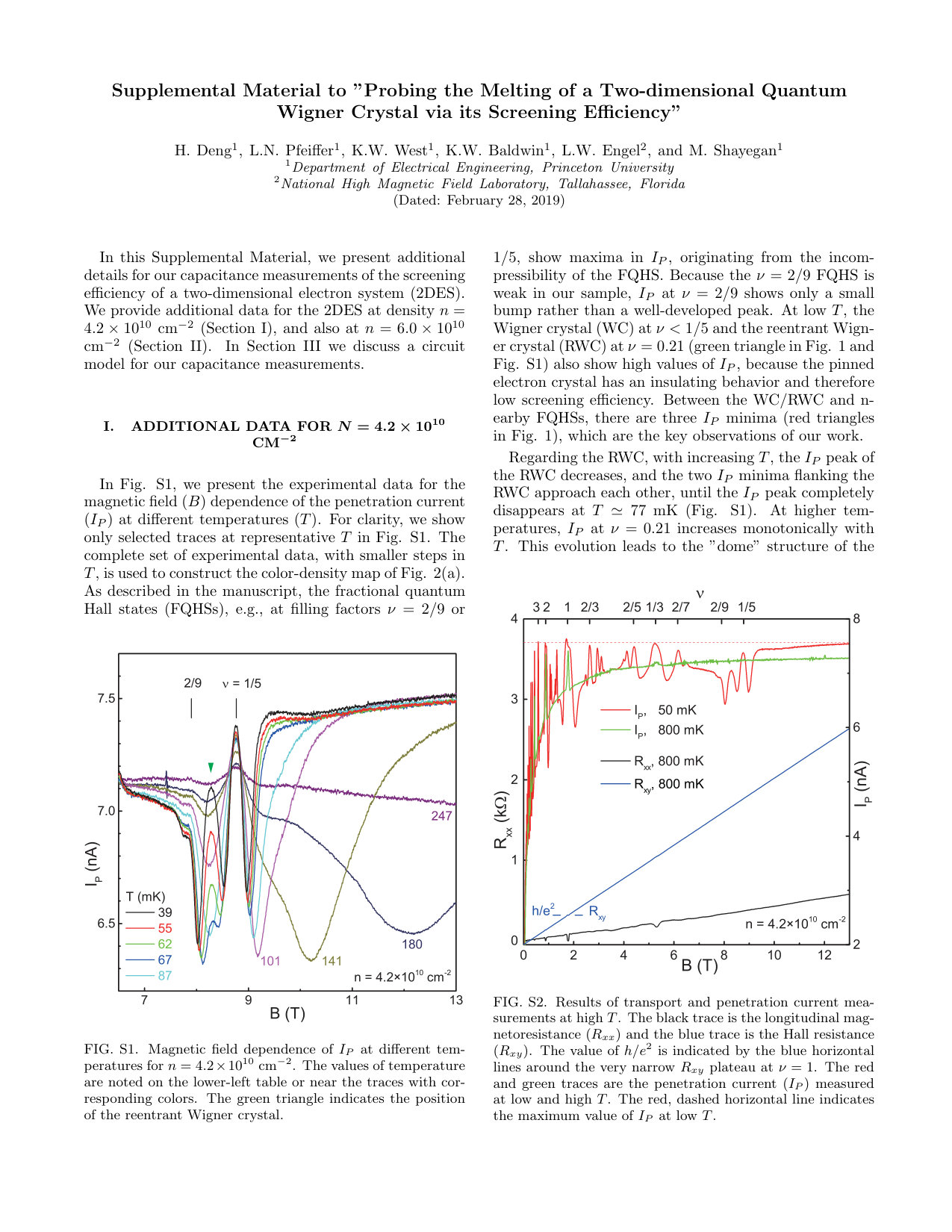 Figure 1
Peer Reviews
No public reviews on file for this paper yet. If you reviewed it on a platform where reviews are public (OpenReview, ICLR, NeurIPS, ICML), you can paste yours below so the community can read it here.
Videos
No videos yet. Explain this paper in a talk, walkthrough, or lecture? Add one.
Taxonomy
TopicsAdvanced Thermodynamics and Statistical Mechanics · Spectroscopy and Quantum Chemical Studies · Quantum Information and Cryptography
Probing the Melting of a Two-dimensional Quantum Wigner Crystal
via its Screening Efficiency
H. Deng1, L.N. Pfeiffer1, K.W. West1, K.W. Baldwin1, L.W. Engel2, and M. Shayegan1
1Department of Electrical Engineering, Princeton University
2National High Magnetic Field Laboratory, Tallahassee, Florida
Abstract
One of the most fundamental and yet elusive collective phases of an interacting electron system is the quantum Wigner crystal (WC), an ordered array of electrons expected to form when the electrons’ Coulomb repulsion energy eclipses their kinetic (Fermi) energy. In low-disorder, two-dimensional (2D) electron systems, the quantum WC is known to be favored at very low temperatures () and small Landau level filling factors (), near the termination of the fractional quantum Hall states. This WC phase exhibits an insulating behavior, reflecting its pinning by the small but finite disorder potential. An experimental determination of a vs phase diagram for the melting of the WC, however, has proved to be challenging. Here we use capacitance measurements to probe the 2D WC through its effective screening as a function of and . We find that, as expected, the screening efficiency of the pinned WC is very poor at very low and improves at higher once the WC melts. Surprisingly, however, rather than monotonically changing with increasing , the screening efficiency shows a well-defined maximum at a which is close to the previously-reported melting temperature of the WC. Our experimental results suggest a new method to map out a vs phase diagram of the magnetic-field-induced WC precisely.
pacs:
Valid PACS appear here
††preprint: APS/123-QED
In a Wigner crystal (WC) Wigner.PR.46.1002 , one of the earliest predicted many-body phases of an interacting electron system, the dominance of electrons’ Coulomb repulsion energy over their kinetic energy forces them into a periodic array with long-range order. In a two-dimensional electron system (2DES), a quantum WC has long been expected to form at low temperature ( K) and high magnetic field () when the electrons occupy the lowest Landau level and their kinetic energy is quenched Lozovik.JETP.22.11 ; Lam.PRB.30.473 ; Levesque.PRB.30.1056 . There is also some experimental evidence, albeit often indirect, for the formation of such a magnetic-field-induced, quantum WC in very high-mobility (low-disorder) GaAs 2DESs near the Landau level filling factor Andrei.PRL.60.2765 ; Jiang.PRL.65.633 ; Goldman.PRL.65.2189 ; Jiang.PRB.44.8107 ; Williams.PRL.66.3285 ; Li.PRL.67.1630 ; Paalanen.PRB.45.13784 ; Li.SSC.95.619 ; MShayegan.WC.Review ; Pan.PRL.88.176802 ; Ye.PRL.89.176802 ; Ye.PRL.89.176802 ; Chen.NatPhys.2.245 ; Tiemann.NatPhy.10.9.648 ; Hao.PRL.117.096601 ; Hao.PRB.98.081111 . The main conclusion of these studies is that the WC, being pinned by the ubiquitous residual disorder, manifests in DC transport as an insulating phase with non-linear current-voltage (I-V) characteristics Goldman.PRL.65.2189 ; Williams.PRL.66.3285 ; Jiang.PRB.44.8107 ; Li.PRL.67.1630 , and exhibits resonances in its high-frequency (microwave) AC transport which strongly suggest collective motions of the electrons Andrei.PRL.60.2765 ; Williams.PRL.66.3285 ; Paalanen.PRB.45.13784 ; Li.SSC.95.619 ; MShayegan.WC.Review ; Ye.PRL.89.176802 ; Chen.NatPhys.2.245 . In a recent bilayer experiment, a high-density layer hosting a composite fermion Fermi sea around was used to directly probe the microstructure of the WC forming in an adjacent, low-density layer Hao.PRL.117.096601 .
A very fundamental property of the magnetic-field-induced WC is its melting temperature vs filling factor phase diagram. Probing the melting of such a WC, however, has been challenging. Different experimental approaches have strived to determine the WC melting phase diagram, but all the techniques face their own limitations. One set of measurements showed kinks in the Arrhenius plots of resistance vs which were used to extract a phase diagram Paalanen.PRB.45.13784 ; however, such kinks were not reported by other groups Jiang.PRL.65.633 ; Goldman.PRL.65.2189 ; Jiang.PRB.44.8107 . The I-V measurements used the disappearance of the I-V non-linearity at high temperatures to extract a melting temperature for the WC, but the non-linearity often disappears very gradually and varies significantly from sample to sample Goldman.PRL.65.2189 ; Williams.PRL.66.3285 ; Jiang.PRB.44.8107 ; Li.PRL.67.1630 . The microwave resonance measurements also show broad resonance peaks at high and a rather gradual evolution with temperature, making it difficult to pin the transition precisely Chen.NatPhys.2.245 .
Here, we probe the 2D WC through measuring, as a function of and , the capacitance between a top and a bottom gate that sandwich the 2DES. Monitoring this capacitance provides a direct measure of the screening efficiency of the 2DES. Similar measurements have demonstrated various properties of the 2DES such as its compressibility Eisenstein.PRB.50.1760 , the incompressibility of quantum Hall states Zibrov.nphys.2018 , and a metal-insulator transition in relatively low-mobility samples Dultz.PRL.84.4689 . Our data reveal an unexpected non-monotonic behavior for the screening efficiency of the 2DES as it makes a transition from a pinned WC state at low to an interacting electron liquid at high . Most remarkably, the 2DES appears to be particularly good in screening at a which is close to the expected melting temperature of the WC. This non-monotonic behavior is qualitatively different from the monotonic behaviors we observe at other where the ground state of the 2DES is not a WC. Associating the temperature at which the 2DES shows maximum screening with the melting temperature of the WC, we determine a vs phase diagram which is tantalizingly similar to those expected and reported for the WC.
Our sample is a modulation-doped, 70-nm-wide, GaAs quantum well (QW) grown via molecular beam epitaxy. The 2DES has electron density cm*-2* with cmVs low-temperature mobility. The sample has a van der Pauw ( mm2) geometry, with six, alloyed In-Sn ohmic contacts made to the 2DES: four on the corners of the sample, and two in the middle of two opposite edges. The top and bottom gates are made from Ti-Au and In, respectively. The distance between the QW and the top (bottom) gate is nm ( mm). The sample is cooled in a dilution refrigerator with a base temperature of mK. For in-plane, longitudinal () and Hall () transport measurements, we use low-frequency lock-in technique at 7 Hz, while keeping the top and bottom gates grounded. For measurements of the screening efficiency, the configuration shown in Fig. 1 inset is used. We apply a small (10 mV) AC voltage () at 19 kHz to the bottom gate and measure the current that penetrates to the top gate through the 2DES via a lock-in amplifier, while all the contacts to the 2DES are grounded Footnote1 . Large indicates low screening efficiency, and vice versa. Note that, because of the small amplitude and large distance between the QW and bottom gate, the modulation of the 2DES density is negligible ( cm*-2*).
Figure 1 provides an overview of our experimental results. The in-plane transport traces, and , show the features expected for a high-mobility 2DES, namely integer and fractional quantum Hall states (IQHS and FQHS): exhibits plateaus with expected values, and shows corresponding strong minima at integer and fractional fillings as marked on the top axis. Moreover, on the flanks of the well-developed FQHS, shows highly resistive (insulating) states which are attributed to the WC pinned by disorder Jiang.PRL.65.633 ; Goldman.PRL.65.2189 ; Jiang.PRB.44.8107 ; Williams.PRL.66.3285 ; Li.PRL.67.1630 ; Paalanen.PRB.45.13784 ; Li.SSC.95.619 ; MShayegan.WC.Review . For convenience, we denote the insulating state on the lower- side of as the reentrant WC (RWC).
The measured (red trace in Fig. 1) also reflects the rich phases of the 2DES as a function of . At zero magnetic field, the highly conductive 2DES strongly screens the source electric field from the bottom gate, resulting in a small . With increasing , overall increases to a high level, which is consistent with the general evolution of 2DES’ bulk resistance Moon.PRL.79.4457 . When the 2DES is in an IQHS or FQHS, shows a peak because the 2DES bulk is in a gapped, incompressible state, and therefore its screening efficiency is low. In particular, for sufficiently strong QHSs, the screening efficiency of the incompressible 2DES is negligible so that the penetration electric field is essentially as strong as , leading to maxima at similar high values. Indeed, at and 1/3, the measured has peaks with essentially the same height (red, dashed horizontal line in Fig. 1). Ideally, the maximum value is simply determined by the geometric capacitance between the top and bottom gates as if the 2DES were not present. The experimental value of maximum, marked by the dashed red line in Fig. 1, indeed agrees with our estimate ( nA) based on the sample geometry, namely the sample area and the distance between the top and bottom gates. When the 2DES is in a compressible, liquid state, e.g., at and at between adjacent FQHSs, is relatively low because now the 2DES bulk is compressible and conducting, and therefore the 2DES screening efficiency is relatively high.
Most relevant to our study is the behavior of at very high magnetic fields where the 2DES hosts the WC state: has high value and tends to reach the same limit as seen for the strong IQHS/FQHSs. This is consistent with the insulating behavior of the pinned WC which should result in a low screening efficiency. There is also a maximum in at a filling between 1/5 and 2/9, (green triangle in Fig. 1), corresponding to the position of the RWC, and there are maxima at and 2/9 where incompressible FQHSs are present (the maximum at is very weak because of the weakness of the 2/9 FQHS). Between these maxima, there are three clear minima marked by red triangles in Fig. 1, indicating the higher screening-efficiency states separating the WC, RWC states and , 1/5 FQHSs. In the remainder of the manuscript, we carefully monitor as a function of and to elucidate the evolution of the various phases of the 2DES.
In Fig. 2(a) we present a color-density plot of as a function of and . This plot summarizes many vs traces taken at different ; for typical traces in the high- range, see Fig. S1 in Supplemental Material Footnote.SM . The high- regimes (lighter color) locate the positions of FQHSs and WC/RWC, while low- valleys (darker color) highlight the states separating these. At the lowest , there are three dark regions seen above T (); these reflect the three minima marked by red triangles in Fig. 1. In our experiments, we also independently measure vs at fixed for different 2DES phases, and present the results in Figs. 2(b)-(e). For the (compressible) Fermi liquid phases such as those at and , shows only a weak dependence and stays at a relatively low level [Fig. 2(b)]. This is consistent with the fact that these are metallic, conducting phases in the range of Fig. 2. At FQHSs such as and , as seen in Fig. 2(c), decreases monotonically from the high level at low ; this is also expected as the quasi-particle excitations of these states that are generated at higher are conducting and lead to screening.
However, the dependence of for the RWC and WC phases, shown in Figs. 2(d) and (e), is qualitatively different from the monotonic behavior seen for other phases of the 2DES. With increasing temperature, decreases first, reaches a minimum at a critical temperature () which depends on , and then increases and saturates at a value which is lower than at base temperature. This saturated value is almost the same in a large high-field range at high , implying the screening efficiency of the 2DES at high is nearly independent of filling and (also, see Fig. S2 in Supplemental Material).
The non-monotonic behavior of vs for the WC/RWC is surprising. To ensure that it is not an artifact of our measurement circuit, we repeated the measurements at multiple frequencies, covering over two orders of magnitude (102-104 Hz). At different frequencies, vs traces show qualitatively similar behavior, i.e., minima separate the FQHSs and the WC/RWC, and -dependence measurements show a similar non-monotonic behavior, with minima at essentially the same (see Fig. S3 in Supplemental Material). Also, the origin of ’s non-monotonic behavior cannot be simply attributed to the changes in the 2DES bulk resistance. In Figs. 2(d) and (e), we also plot the dependence of (gray traces). At both [Fig. 2(d)] and [Fig. 2(e)], shows a monotonic dependence on as expected Jiang.PRL.65.633 , which is hard to link with the non-monotonic behavior of . Moreover, at different , when reaches the minimum at , has significantly different values [ and 40 k in Figs. 2(d) and (e), respectively], indicating that the minimum is not associated with a certain value of .
We suspect that the minimum, i.e., the max screening efficiency, signals a phase transition in the WC/RWC. Theory suggests that an interacting 2DES is more compressible when it arranges itself close to an ordered array which has strong positional correlation Skinner.PRB.88.155417 . Indeed, in previous studies of negative compressibility in a bilayer 2DES Eisenstein.PRB.50.1760 , the 2DES shows enhanced screening efficiency (even over-screening) when decreases (by lowering the 2DES density at fixed ), and suddenly loses its screening ability at very small (). In Ref. Eisenstein.PRB.50.1760 , this sudden transition in screening efficiency was attributed to the localization of electrons in the random disorder potential.
This interpretation might be reasonable for the samples of Ref. Eisenstein.PRB.50.1760 , which had relatively lower quality (mobility of cmVs at cm*-2*), and considering that the transition in screening efficiency happened when the 2DES was depleted to a very low ( cm*-2*). In contrast, is much higher ( cm*-2*) in our entire measurement range, and the sample’s high quality is evinced by the very large mobility ( cmVs), as well as the rich sequence of FQHSs, and especially the well-developed FQHS. These facts strongly suggest that the high-, low-screening states at low fillings in our sample reflect the formation of (pinned) collective WC and RWC states rather than the onset of single-electron localization by strong disorder. We therefore surmise that the positions of minima in Fig. 2(a) might imply a phase transition in the WC/RWC.
From Fig. 2(a), we extract the positions of minima and plot the data in Fig. 3 as solid red circles; the open red circles are from the vs data of Figs. 2(d) and 2(e). The RWC ”dome” is flanked by and 2/9 FQHSs (gray zones), and the FQHS separates the RWC and WC. The dependence of in Fig. 3 is qualitatively consistent with the WC-liquid phase diagrams reported previously Goldman.PRL.65.2189 ; Williams.PRL.66.3285 ; Paalanen.PRB.45.13784 ; Chen.NatPhys.2.245 . Associating with the melting temperature of the WC/RWC, the well-pronounced and relatively sharp minima in our measurements allow us to unveil rich details of the melting, especially the clear ”dome”-shaped boundary of the RWC. We note that our data imply somewhat lower melting temperatures compared to those reported in Ref. Chen.NatPhys.2.245 for 2DES samples with quality comparable to ours. A possible reason for this discrepancy might be that, unlike the GaAs/AlGaAs hetero-structures and narrow QWs used in Ref. Chen.NatPhys.2.245 , the 2DES in our wide (70 nm) QW sample has a larger layer thickness. This larger thickness can soften the Coulomb interaction between electrons and lower the WC melting temperature.
We also repeated similar measurements and analysis of at a higher 2DES density of cm*-2*, attained by applying DC voltage biases to the top and bottom gates. The values of gate voltages were set carefully to keep the charge distribution in the QW symmetric. The vs data for the higher density are plotted as blue circles in Fig. 3. The data are qualitatively similar to the data measured at lower , but exhibit a larger in general. The overall higher is consistent with the stronger electron-electron interaction at higher which should help stabilize the WC and therefore increase the melting temperature at a given filling.
In conclusion, via measurements of the penetrating current through a 2DES, we probe its screening efficiency. The data show very different behaviors at different filling factors as the 2DES goes through its many-body states. In particular, the WC and RWC states exhibit a high , revealing low screening efficiency. Surprisingly, shows well-defined minima as a function of either filling or temperature for the WC and RWC states, and the positions of the minima are consistent with the melting of these states. If the of minima could indeed be associated with the WC melting temperature, our data demonstrate that the measurements of screening efficiency provide a prime technique to map out the phase diagram of the magnetic-field-induced WC precisely. Regardless of its possible association with the WC melting, the non-monotonic behavior for the screening efficiency we observe is novel, and begs theoretical explanation.
Acknowledgements.
We thank R. N. Bhatt, M. Dykman, D. Huse, J. K. Jain, S. Kivelson and S. Sondhi for helpful discussions. We acknowledge the National Science Foundation (Grant DMR 1709076) for measurements, and the Gordon and Betty Moore Foundation (Grant GBMF4420), the Department of Energy Basic Energy Sciences (Grant DE-FG02-00-ER45841), and the National Science Foundation (Grants MRSEC DMR 1420541 and ECCS 1508925) for sample fabrication. L. W. E. is supported by the Department of Energy (Grant DE-FG02-05-ER46212).
The reference list from the paper itself. Each links out to its DOI / PubMed record.
- 1(1) E. Wigner, On the interaction of electrons in metals, Phys. Rev. 46 , 1002 (1934).
- 2(2) Y. E. Lozovik and V. I. Yudson, Crystallization of a two-dimensional electron gas in a magnetic field, JETP Lett. 22 , 11 (1975).
- 3(3) P. K. Lam and S. M. Girvin, Liquid-solid transition and the fractional quantum-Hall effect, Phys. Rev. B 30 , 473 (1984).
- 4(4) D. Levesque, J. J. Weis, and A. H. Mac Donald, Crystallization of the incompressible quantum-fluid state of a two-dimensional electron gas in a strong magnetic field, Phys. Rev. B 30 , 1056 (1984).
- 5(5) E. Y. Andrei, G. Deville, D. C. Glattli, F. I. B. Williams, E. Paris, and B. Etienne, Observation of a magnetically induced Wigner solid, Phys. Rev. Lett. 60 , 2765 (1988).
- 6(6) H. W. Jiang, R. L. Willett, H. L. Stormer, D. C. Tsui, L. N. Pfeiffer, and K. W. West, Quantum liquid versus electron solid around ν 𝜈 \nu =1/5 Landau-level filling, Phys. Rev. Lett. 65 , 633 (1990).
- 7(7) V. J. Goldman, M. Santos, M. Shayegan, and J. E. Cunningham, Evidence for two-dimentional quantum Wigner crystal, Phys. Rev. Lett. 65 , 2189 (1990).
- 8(8) H. W. Jiang, H. L. Stormer, D. C. Tsui, L. N. Pfeiffer, and K. W. West, Magnetotransport studies of the insulating phase around ν 𝜈 \nu =1/5 Landau-level filling, Phys. Rev. B 44 , 8107 (1991).