Higher-order Topology of Axion Insulator EuIn$_2$As$_2$
Yuanfeng Xu, Zhida Song, Zhijun Wang, Hongming Weng, Xi Dai

TL;DR
This paper predicts EuIn$_2$As$_2$ as a high-order axion insulator with quantized topological magneto-electric effect, gapless surface states, and hinge states, based on first-principles calculations and symmetry analysis.
Contribution
It introduces EuIn$_2$As$_2$ as a novel axion insulator with high-order topology and detailed surface and hinge state characterizations.
Findings
EuIn$_2$As$_2$ has a $ heta=\pi$ topological magneto-electric effect.
Gapless surface states are protected by mirror symmetries.
Hinge states emerge as a hallmark of high-order topology.
Abstract
Based on first-principles calculations and symmetry analysis, we propose that EuInAs is a long awaited axion insulator with antiferromagnetic (AFM) long range order. Characterized by the parity-based invariant , the topological magneto-electric effect is quantized with in the bulk, with a band gap as large as 0.1 eV. When the staggered magnetic moment of the AFM phase is along axis, it's also a TCI phase. Gapless surface states emerge on (100), (010) and (001) surfaces, protected by mirror symmetries (nonzero mirror Chern numbers). When the magnetic moment is along axis, the (100) and (001) surfaces are gapped. As a consequence of a high-order topological insulator with , the one-dimensional (1D) chiral state can exist on the hinge between those gapped surfaces. We have calculated both the topological surface states and hinge…
Click any figure to enlarge with its caption.
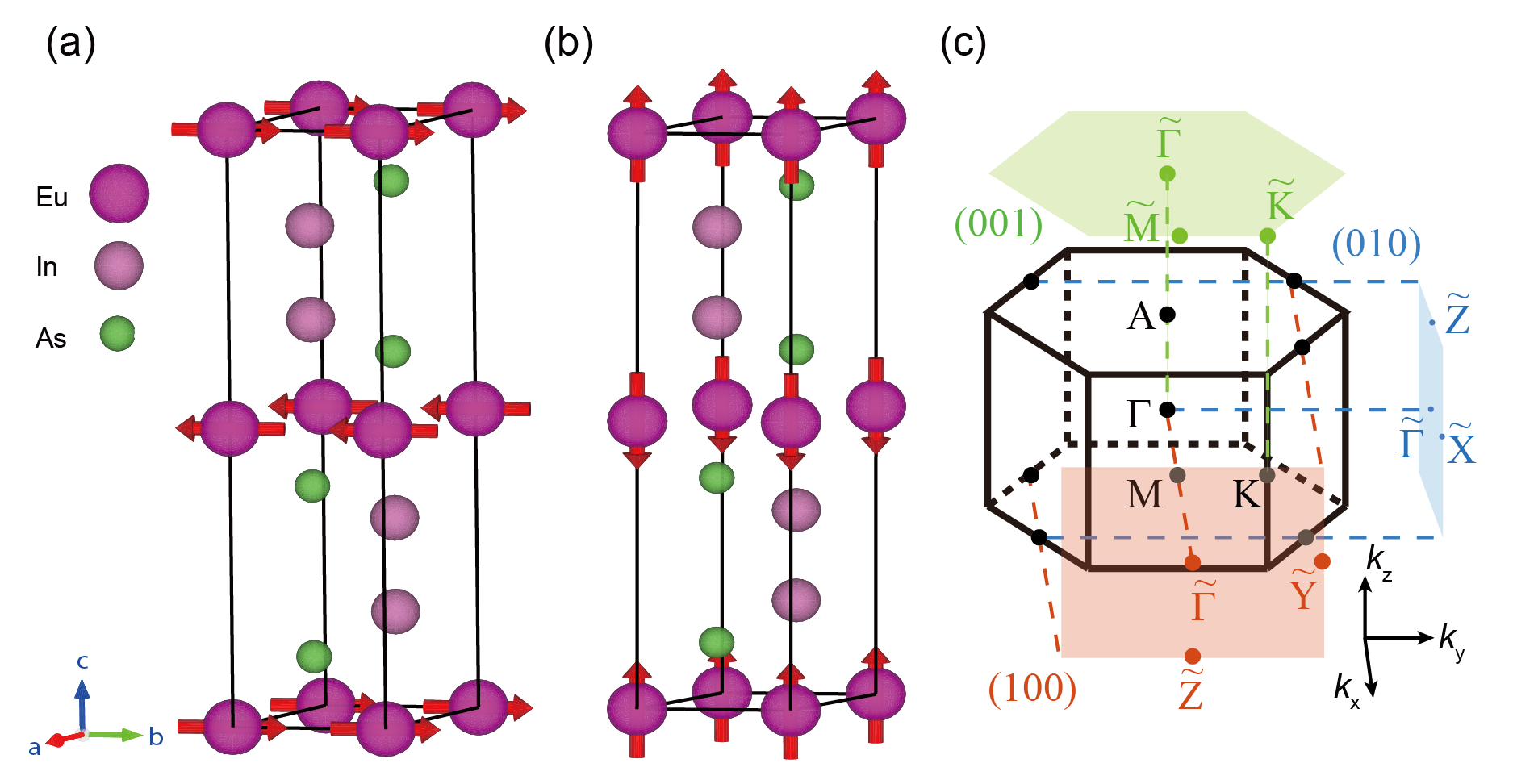 Figure 1
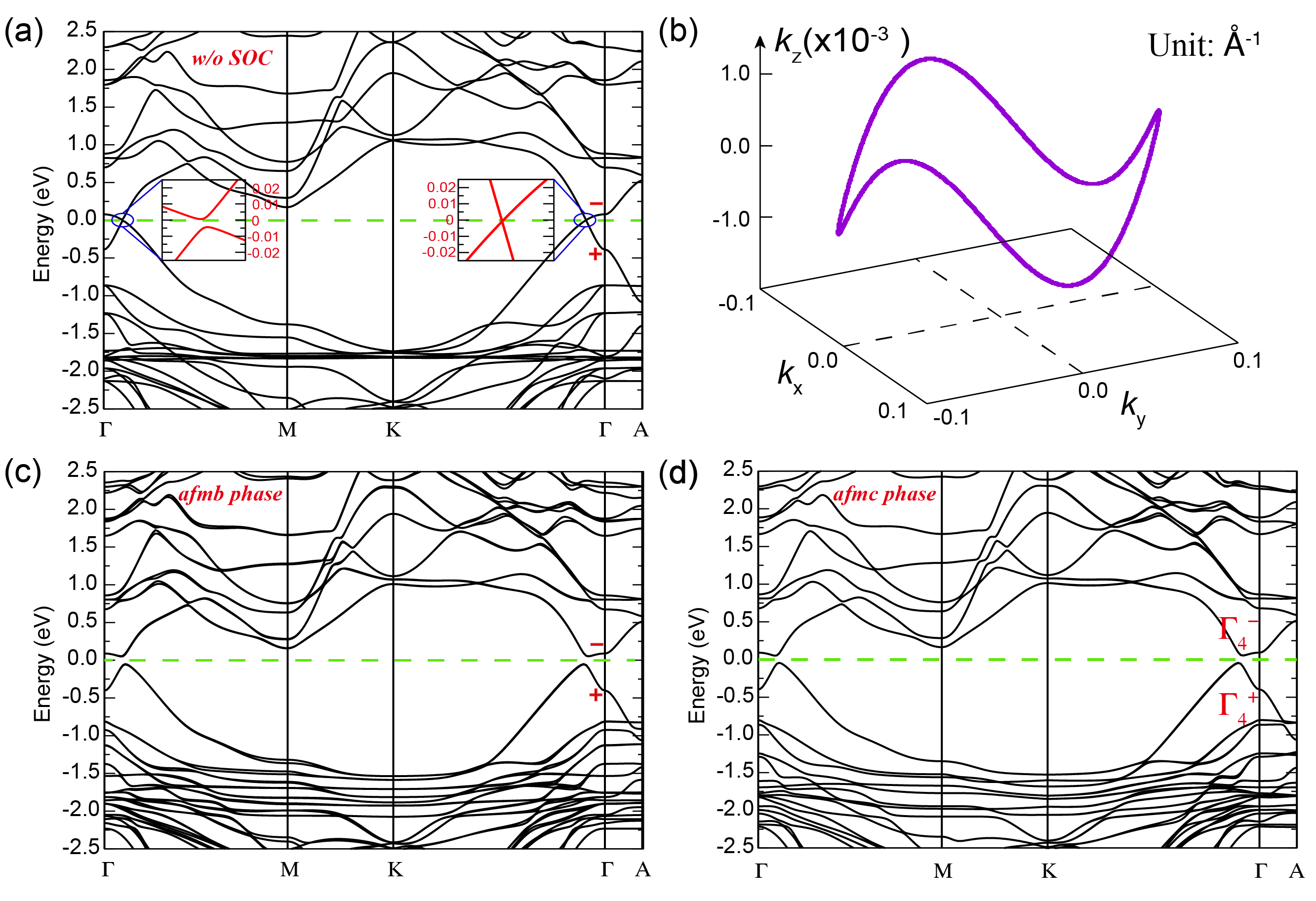 Figure 2
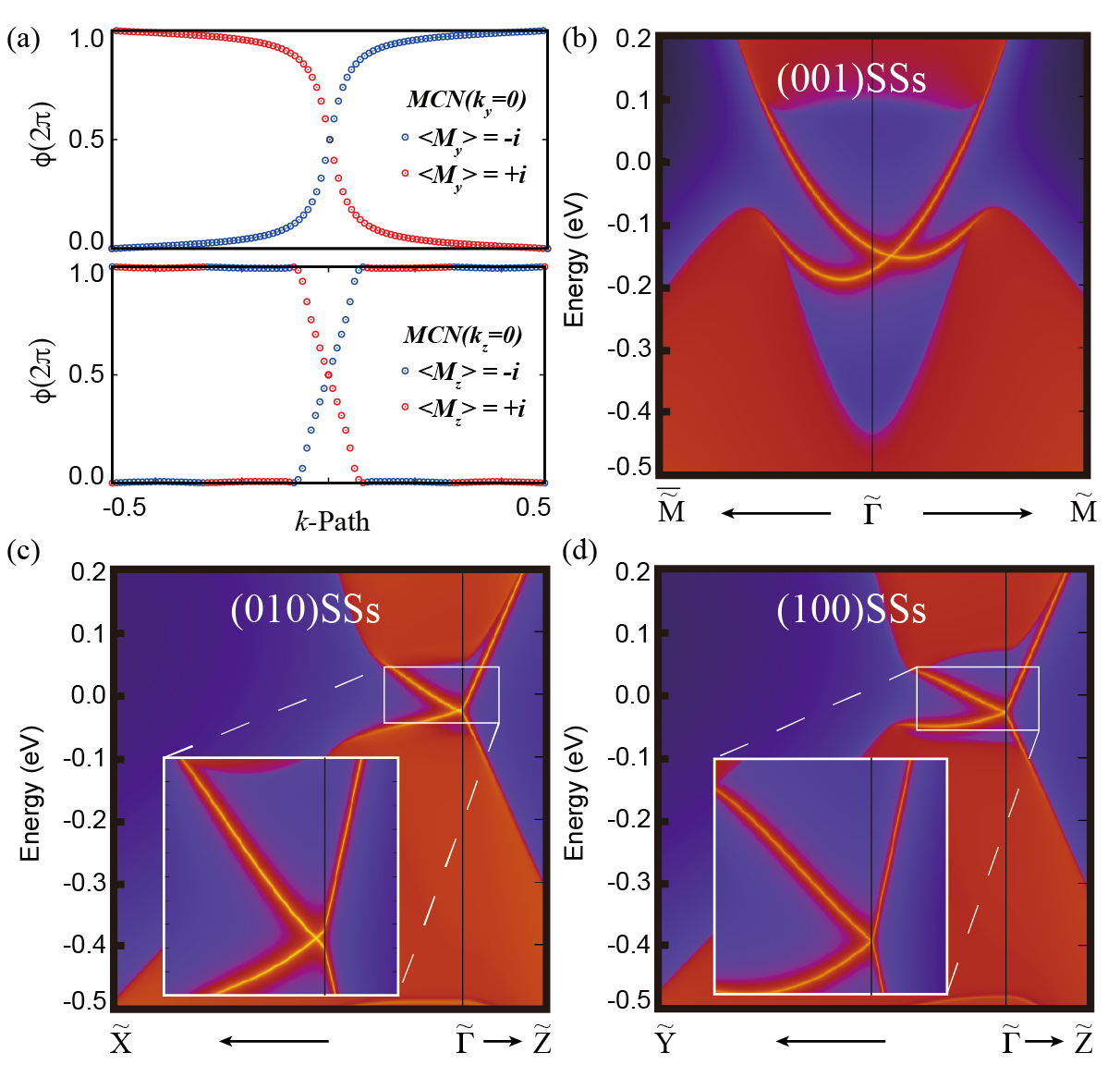 Figure 3
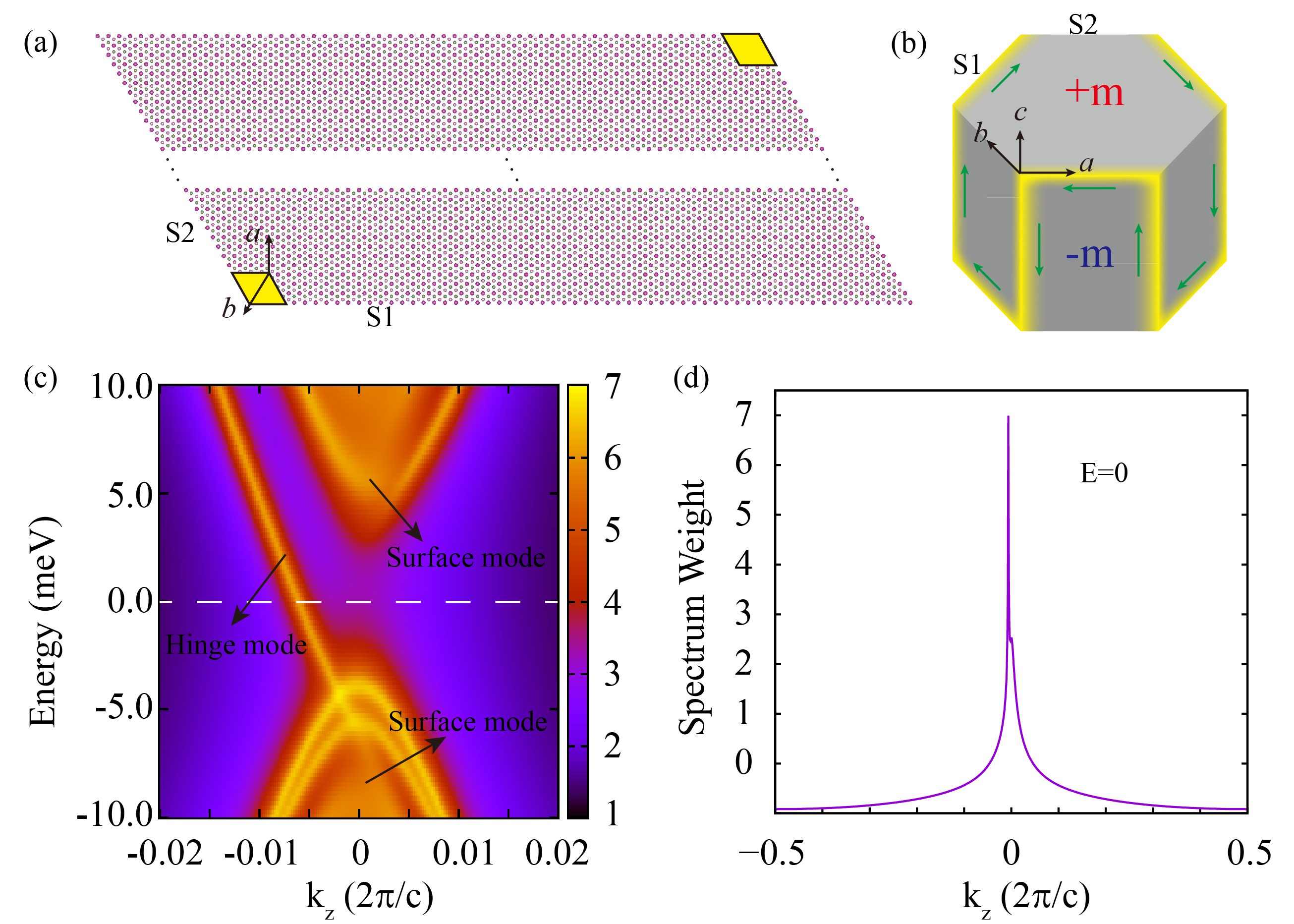 Figure 4
| (0,0,0) | (,0,0) | (0,,0) | (,,0) | (0,0,) | (,0,) | (0,,) | (,,) | |
|---|---|---|---|---|---|---|---|---|
| Spin-up w/o SOC | 41/32 | 42/31 | 42/31 | 42/31 | 40/33 | 40/33 | 40/33 | 40/33 |
| Spin-down w/o SOC | 41/32 | 42/31 | 42/31 | 42/31 | 33/40 | 33/40 | 33/40 | 33/40 |
| w/ SOC | 82/64 | 84/62 | 84/62 | 84/62 | 73/73 | 73/73 | 73/73 | 73/73 |
Peer Reviews
No public reviews on file for this paper yet. If you reviewed it on a platform where reviews are public (OpenReview, ICLR, NeurIPS, ICML), you can paste yours below so the community can read it here.
Videos
No videos yet. Explain this paper in a talk, walkthrough, or lecture? Add one.
Higher-order Topology of Axion Insulator EuIn2As2
Yuanfeng Xu
Beijing National Laboratory for Condensed Matter Physics, and Institute of Physics, Chinese Academy of Sciences, Beijing 100190, China
University of Chinese Academy of Sciences, Beijing 100049, China
Max Planck Institute of Microstructure Physics, 06120 Halle, Germany
Zhida Song
Beijing National Laboratory for Condensed Matter Physics, and Institute of Physics, Chinese Academy of Sciences, Beijing 100190, China
University of Chinese Academy of Sciences, Beijing 100049, China
Department of Physics, Princeton University, Princeton, New Jersey 08544, USA
Zhijun Wang
Beijing National Laboratory for Condensed Matter Physics, and Institute of Physics, Chinese Academy of Sciences, Beijing 100190, China
University of Chinese Academy of Sciences, Beijing 100049, China
Hongming Weng
Beijing National Laboratory for Condensed Matter Physics, and Institute of Physics, Chinese Academy of Sciences, Beijing 100190, China
University of Chinese Academy of Sciences, Beijing 100049, China
CAS Center for Excellence in Topological Quantum Computation, University of Chinese Academy of Sciences, Beijing 100190, China
Songshan Lake Materials Laboratory, Dongguan, Guangdong 523808, China
Xi Dai
Department of Physics, Hong Kong University of Science and Technology, Clear Water Bay, Kowloon, Hong Kong
Abstract
Based on first-principles calculations and symmetry analysis, we propose that EuIn2As2 is a long awaited axion insulator with antiferromagnetic (AFM) long range order. Characterized by the parity-based invariant , the topological magneto-electric effect is quantized with in the bulk, with a band gap as large as 0.1 eV. When the staggered magnetic moment of the AFM phase is along -axis, it’s also a TCI phase. Gapless surface states emerge on (100), (010) and (001) surfaces, protected by mirror symmetries (nonzero mirror Chern numbers). When the magnetic moment is along -axis, the (100) and (001) surfaces are gapped. As a consequence of a high-order topological insulator with , the one-dimensional (1D) chiral state can exist on the hinge between those gapped surfaces. We have calculated both the topological surface states and hinge state in different phases of the system, respectively, which can be detected by ARPES or STM experiments.
*Introduction. *The concept of axion field is introduced to solve the strong charge-parity (CP) problem in quantum chromodynamics. Peccei and Quinn (1977) While in condensed matter physics, axion field appears in the field theory description of the topological magneto-electric(TME) effect, Wilczek (1987); Qi et al. (2008) with an effective action in the form,
[TABLE]
where E and B are electromagnetic fields and the coefficient is axion angle with a period of . This term will modify the Maxwell’s equation in classical electrodynamics and lead to the TME effect. Wilczek (1987) As the magnetoelectric coupling term changes sign under time reversal symmetry(TRS) or inversion symmetry , the only allowed value of has to be quantized to 0 or in the systems preserving either or . For three-dimensional (3D) insulators with symmetry , the quantized term is related to invariant directly. For the centrosymmetry insulators (breaking symmetry), it can be reduced to a parity-based invariant, (Note that corresponds to a semimetal with Weyl nodes), which is defined as: Turner et al. (2012); Watanabe et al. (2018); Ono and Watanabe (2018)
[TABLE]
where are the eight -invariant momenta, is the band index, is the total number of electrons and is the parity eigenvalue (/) of the -th band at . A centrosymmetric insulator with can have quantized bulk TME effect (), also called an axion insulator (AI). It has half-integer quantum Hall effect (QHE) on the surface as long as the surface states are gapped. Essin et al. (2009). Very recently, axion insulators were also proposed to host one-dimensional (1D) chiral states on the hinges, and can at the same time be viewed as the newly proposed higher-order topological insulator (HOTI). Benalcazar et al. (2017a); Langbehn et al. (2017); Benalcazar et al. (2017b); Song et al. (2017); Schindler et al. (2018a, b); Ezawa (2018); Yue et al. (2019); Okuma et al. (2019); Wang et al. (2018); Wieder and Bernevig (2018)
Although in the literature there are already a number of material proposals for the axion insulator phase including the heterostructure constructed by quantum anomalous Hall insulators, Xiao et al. (2018); Mogi et al. (2017) the magnetically doped 3D TIs, Li et al. (2010); Yue et al. (2019), the axion insulator phase induced by Coulomb interaction in magnetic osmium compounds, Wan et al. (2012) and the layered antiferromagnetic(AFM) TI with type-IV magnetic space group(MSG), Essin et al. (2009); Zhang et al. (2018); Li et al. (2018); Gong et al. (2018); Chowdhury et al. (2019) a satisfactory stoichiometric material system with accessible single crystal is still absent, which greatly impeded the experimental studies on the AI and topological magneto-electric effects.
In the present letter, we predict that EuIn2As2 is an AFM axion insulator (breaking symmetry, but preserving symmetry), no matter which direction the magnetic order is in. Its nontrivial topology is characterized by the parity-based invariant, . The quantized bulk TME effect can be expected in the material with a bulk energy gap of eV. As there is lack of experimental data to determine the direction of the magnetism (which does effect the surface states), we have investigated two AFM phases (i.e., afmb and afmc phases) in the first-principles calculations. The results show that the energy difference of the two is less than 1.0 meV. The afmb phase of EuIn2As2 is described by a type-I MSG, . Our calculations show the afmb phase is also a topological crystalline insulator (TCI), characterised by nonzero mirror Chern numbers (MCN) defined on the and planes. As a result, those surfaces perpendicular to one of the mirror planes are gapless. However, the afmc phase belongs to a type-III MSG, , and no symmetry-protected gapless surface state is found for both (100) and (001) surfaces. As a consequence of a HOTI (), a chiral mode can emerge on the hinge between those gapped surfaces, which has also been obtained in our detailed calculations. As EuIn2As2 is easy to grow and the magnetism is intrinsic and confirmed already by experiments, it’s an ideal platform to study the axion insulators and HOTIs experimentally.
*Crystal structure and methodology. * EuIn2As2 is an antiferromagnetic Zintl compound with the Néel temperature . Goforth et al. (2008); Singh and Schwingenschlögl (2012) The magnetism measurements on single crystal samples show that the moments on cations are about 7.0 indicating the ions are in the high spin configuration of . The intra-layer exchange coupling among ions is ferromagnetic while the interlayer coupling is antiferromagnetic, leading to A-type antiferromagnetic long range order in the material. The direction of spin polarization detected by the exepriments can be along the crystallographic -axis (afmb phase as shown in Fig.1(a)) or -axis (afmc phase as shown in Fig.1(b)) with a small energy difference between them. The crystal structure of EuIn2As2 adopts hexagonal lattice with the space group of P63/mmc (No. 194), as shown in Fig.1(a)(b). It can be generated by several symmetries: , , and , where is a half of the lattice translation in the direction. The experimental lattice constants were used in the following calculations with and . The Eu atom is located at the Wyckoff position (0, 0, 0). Both In and As are at the Wyckoff position with the coordinates of (2/3, 1/3, 0.17155) and (1/3, 2/3, 0.60706), respectively. We have performed the first-principle calculations using the Vienna ab-initio simulation package(VASP) Kresse and Furthmüller (1996); Kresse and Hafner (1993) and the generalized gradient approximation (GGA) Perdew et al. (1996a) with the Perdew-Burke-Ernzerhof (PBE) Blöchl (1994); Perdew et al. (1996b) type exchange-correlation potential was adopted. The Brillouin zone(BZ) sampling was performed by using k grids with a 11113 mesh in self-consistent calculations. As the on-site Coulomb interactions among electrons on Eu- orbitals are very strong, we have taken eV as a parameter in the GGA+U calculations Dudarev et al. (1998) to locate the occupied orbitals at the energy determined by experiments. To calculate the topological surface states and hinge states of antiferromagnetic EuIn2As2, we have generated the maximally localized Wannier functions for orbitals on In and orbitals on As using Wannier90 package. Souza et al. (2001)
Nodal-line Semimetal without SOC. We have first calculated the band structure of EuIn2As2 with antiferromagnetic phase in the absence of spin-orbit coupling (SOC). As the magnetic moment of the Eu atoms makes the two atoms within one unit cell not equivalent any more, the symmetry is decreased to , generated by , and , which is the symmetry that the spin-up/spin-down bands respect. The analysis of orbital character shows that the bands near Fermi energy are dominated by orbitals of In and orbitals of As. Due to the correlation effect, the fully spin-polarized orbitals of each Eu are pushed down to eV below the Fermi level , which is quite consistent with the position suggested by experimental measurements. Richard et al. (2013); Gui et al. (2019) The band dispersion along the high-symmetry directions in Fig.1(c) is shown in Fig.2(a), which shows that there is a band crossing feature near point on the Fermi energy. Detailed calculations and further symmetry analysis shows that it is actually an anti-crossing along , while the crossing along is protected by symmetry, as shown in the insets of Fig. 2(a). Namely, two crossing bands belong to different eigenvalues along the line.
The invariant ( for each spin channel) is computed to be 1 for the spin-up channel, which implies that there are either nodal lines or odd pairs of Weyl nodes depending on the symmetry. In the collinear magnetic calculations without SOC, the Hamiltonian for each spin channel is still real. There is a symmetry () of complex conjugation, , which is the same as the time reversal symmetry for spinless systems. Thus, the combined anti-unitary symmetry of and satisfies , which forbids one of the three Pauli matrices in a two-band effective model at any -point. Therefore, the nodal line is guaranteed by . In fact, the crossing point on is part of the nodal line, as shown in Fig. 2(b). The nodal line for the spin-down channel is obtained by a mirror reflection with respect to the plane, because the two spin channels are related to each other by the combined symmetry .
Anixon insulator with SOC. As suggested by the previous experiments Goforth et al. (2008); Singh and Schwingenschlögl (2012), two meta-stable AFM phases, with the magnetic moment -axis (afmb phase) and -axis (afmc phase) respectively, have been investigated in our calculations including SOC. These two states are nearly degenerate from our calculations with the energy difference between the two being less than 1 meV. As the bands of 4 orbitals are localized far away from the Fermi level, the low-energy band structures of the two AFM phases are very similar. We note that SOC has two main effects: (i) it opens a band gap, which can be seen to be in Fig.2(c) and (d); (ii) it changes the symmetry of the AFM phases, which does effect the surface states.
Due to the presence of symmetry, one can compute the invariant , which is defined on the parity eigenvalues at the eight -invariant points . The numbers of odd/even bands are lised in Table 1. The obtained invariant suggests that EuIn2As2 is a axion insulator exhibiting quantized TME effect () without symmetry. Since the change of the direction for magnetic moments won’t affect the order of the bands at all the TRIM points, both of the afmb and afmc phases are AI and HOTI at the same time, which will lead to possible chiral hinge states at the hinges between two gapped surfaces.
*Topology of afmb phase. * For the afmb phase of EuIn2As2, the generators of the MSG include spacial inversion (), a two-fold rotation () and a screw rotation (). Among the eight symmetry operations constructed from the generators, the following symmetries are important in the study of the afmb phase: and . Beside the -based invatiant , we have also calculated the mirror Chern number Hsieh et al. (2012) by calculationg the flow of the Wannier charge centers (WCCs) on the mirror-symmetric plane in both and mirror eigenvalue subspaces. Our ab-initio calculations show the plane has a nontrivial mirror Chern numbr , while the is trivial. Namely, the afmb phase of EuIn2As2 is also a TCI phase with antiferromagnetic order. The nontrivial mirror Chern numbers gurantee the existance of a massless Dirac cone on the ()-preserving surface. The energy spectrum near the Dirac cone on (100), (010) and (001) surfaces have been calculated with Green’s function method Sancho et al. (1985); Wu et al. (2018), as shown in Figure 3(b)-(d). The massless Dirac cone is constrained on the path with for (001) surface and on the path with for (010) surface. While for (100) surface, the Dirac cone is localized on point constrained by and at the same time.The above numerical results confirmed that due to the co-existing nonzero mirror Chern number in afmb phase, all the low index surfaces like (100), (010) and (001) are gapless and the chiral hinge states can only possible on the hinges formed by two high-index surfaces which are gapped.
*Higher-order topology of afmc phase. *When the magnetic moment is along -axis, the generators of the MSG include spacial inversion (), a three-fold rotation (), a two-fold screw rotation (), and a combined anti-unitary symmetry (). No symmetry-protected gapless surface state is found in our calculations for both (100) and (001) surfaces. Therefore, we can generate a hexagonal cylinder in real space (as shown in Fig.4) with all the surfaces being gapped. But the symmetry can relate two neighbor side surfaces and leads to mass terms with different sign on the neighboring surfaces of the hinges along the -axis. Thus, 1D Chiral models can be expected in these hinges. Based on the tight-binding Hamiltonian, we have simulated the hinge states using Green’s function method with the structural configuration in Figure 4(a). For details of the calculational method please refer to our previous paper. Yue et al. (2019) The energy spectrum projected onto the hinge is shown in Figure 4(c) and (d), which indicates that the bulk and surface states are all gapped with a minimal gap of about 10meV and a chiral mode exists on the hinge.
The existence of the chiral hinge states can also be derived from the following kp model. The irreducible representations for the two bands near the Fermi level are and at , as shown in Fig. 2(d), where are from the character table of . Based on the invarinant theory, the low-energy effective Hamiltonian at the point can be described as:
[TABLE]
where , , and A,B,C and D are real. and represent the orbital and spin space, respectively. is the first (second) order term of moment . In the afmc phase, is broken, while the combianed anti-unitary symmetry of is preserved. Under the basis, , , and are represented by , , , and , respectively. Note that virtually respects symmetry (), but breaks it. Thus, the term can be added to the Hamiltonian of the sample, which is invariant, , under the symmetries (, , and ):
[TABLE]
Thus, to the lowest order of k, . By projecting the bulk Hamiltonian onto the surface, Khalaf et al. (2018) the resulting mass term changes its sign under symmetry and invariant under three-fold rotation symmetry . So for the shaped crystal structure shown in Fig. 4(b), there will be a chiral current indicated by the green arrow. Therefore the HOTI phase in the present system is similar to the case in Bismuth, but it’s chiral type. So the chiral hinge states are practical to be observed in STM experiments.
*Conclusion. *In summary, we propose that the 3D antiferromagnetic material EuIn2As2 is an axion insulator with quantized TME effect in the bulk. Its nontrivial topology is characterized by the parity-based invariant . With the easy axis along -axis, it’s also a TCI with nonzero mirror Chern numbers. Its gapless surface states have been calculated on both side and top surfaces, protected by mirror symmetries. When the easy axis is along -axis, the (100) and (001) surfaces are gapped and it is also a HOTI with all the side surfaces are fully gapped. We have also calculated the chiral hinge modes in this material systems, which exist on the hinges of the crystal with hexagonal shape. The HOTI phase and its chiral hinge modes in the present system are protected by inversion symmetry with . As EuIn2As2 is easy to grow and the magnetic configuration is intrinsic, it’s an ideal candidate to study axion insulators and HOTIs. It also provides a platform to study the interplay between the magnetic structure and the topological feature of the band structure.
Note added. We are also aware of the similar work Gui et al. (2019) when finalising the present paper.
I acknowledgments
Z.W. was supported by the CAS Pioneer Hundred Talents Program. H.W. acknowledges support from the Ministry of Science and Technology of China under grant numbers 2016YFA0300600 and 2018YFA0305700, the Chinese Academy of Sciences under grant number XDB28000000, the Science Challenge Project (No. TZ2016004), the K. C. Wong Education Foundation (GJTD-2018-01), Beijing Municipal Science & Technilogy Commission (Z181100004218001) and Beijing Natural Science Foundation (Z180008). X.D. acknowledges financial support from the Hong Kong Research Grants Council (Project No. GRF16300918).
The reference list from the paper itself. Each links out to its DOI / PubMed record.
- 1Peccei and Quinn (1977) R. D. Peccei and H. R. Quinn, Physical Review Letters 38 , 1440 (1977).
- 2Wilczek (1987) F. Wilczek, Physical review letters 58 , 1799 (1987).
- 3Qi et al. (2008) X.-L. Qi, T. L. Hughes, and S.-C. Zhang, Physical Review B 78 , 195424 (2008).
- 4Turner et al. (2012) A. M. Turner, Y. Zhang, R. S. Mong, and A. Vishwanath, Physical Review B 85 , 165120 (2012).
- 5Watanabe et al. (2018) H. Watanabe, H. C. Po, and A. Vishwanath, Science advances 4 , eaat 8685 (2018).
- 6Ono and Watanabe (2018) S. Ono and H. Watanabe, Phys. Rev. B 98 , 115150 (2018) . · doi ↗
- 7Essin et al. (2009) A. M. Essin, J. E. Moore, and D. Vanderbilt, Physical review letters 102 , 146805 (2009).
- 8Benalcazar et al. (2017 a) W. A. Benalcazar, B. A. Bernevig, and T. L. Hughes, Physical Review B 96 , 245115 (2017 a).