Quantum information scrambling after a quantum quench
Vincenzo Alba, Pasquale Calabrese

TL;DR
This paper investigates how quantum information spreads in non-equilibrium many-body systems after a quantum quench, using mutual information as a diagnostic, and compares integrable and non-integrable models.
Contribution
It introduces mutual information scaling as a new diagnostic for quantum information scrambling post-quench in one-dimensional systems.
Findings
Integrable systems show algebraic decay of mutual information, indicating weak scrambling.
Non-integrable systems exhibit faster decay, indicating stronger scrambling.
Quasiparticle lifetime influences the decay rate in non-integrable models.
Abstract
How quantum information is scrambled in the global degrees of freedom of non-equilibrium many-body systems is a key question to understand local thermalization. Here we propose that the scaling of the mutual information between two intervals of fixed length as a function of their distance is a diagnostic tool for scrambling after a quantum quench. We consider both integrable and non-integrable one dimensional systems. In integrable systems, the mutual information exhibits an algebraic decay with the distance between the intervals, signalling weak scrambling. This behavior may be qualitatively understood within the quasiparticle picture for the entanglement spreading, predicting, in the scaling limit of large intervals and times, a decay exponent equal to . Away from the scaling limit, the power-law behavior persists, but with a larger (and model-dependent) exponent. For…
Click any figure to enlarge with its caption.
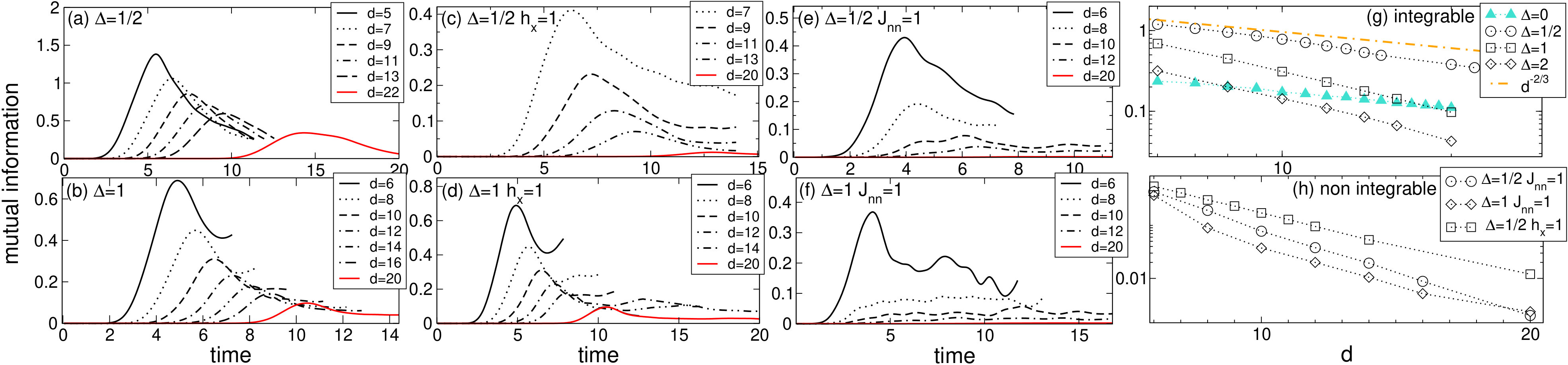 Figure 1
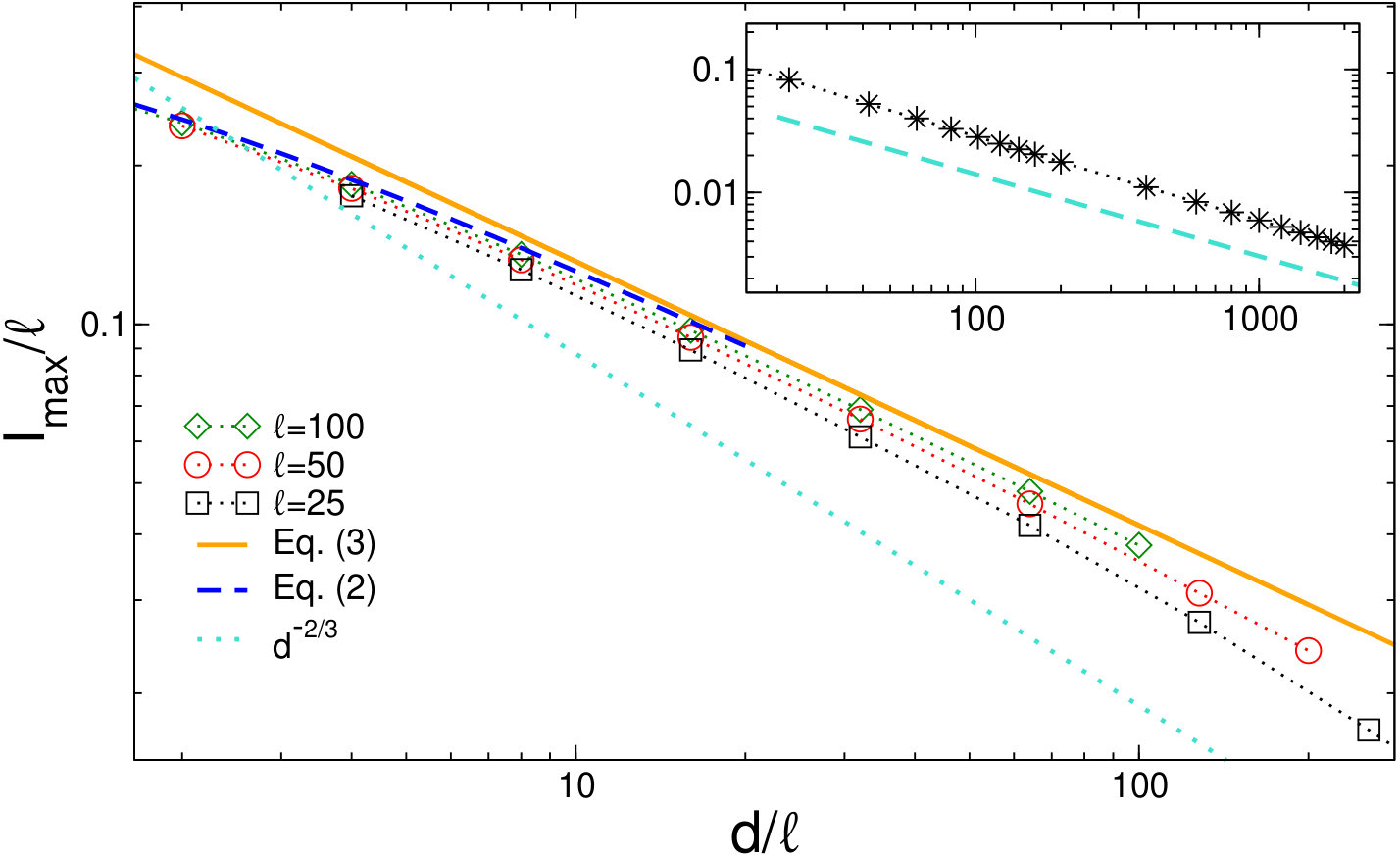 Figure 2
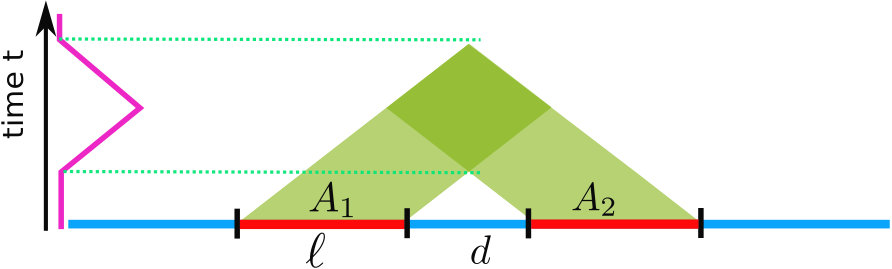 Figure 3
Peer Reviews
No public reviews on file for this paper yet. If you reviewed it on a platform where reviews are public (OpenReview, ICLR, NeurIPS, ICML), you can paste yours below so the community can read it here.
Videos
No videos yet. Explain this paper in a talk, walkthrough, or lecture? Add one.
Quantum information scrambling after a quantum quench
Vincenzo Alba
Institute for Theoretical Physics, Universiteit van Amsterdam, Science Park 904, Postbus 94485, 1098 XH Amsterdam, The Netherlands
Pasquale Calabrese
SISSA and INFN, via Bonomea 265, 34136 Trieste, Italy
International Centre for Theoretical Physics (ICTP), Strada Costiera 11, 34151 Trieste, Italy
Abstract
How quantum information is scrambled in the global degrees of freedom of non-equilibrium many-body systems is a key question to understand local thermalization. A consequence of scrambling is that in the scaling limit the mutual information information between two intervals vanishes at all times, i.e., it does not exhibit a peak at intermediate times. Here we investigate the mutual information scrambling after a quantum quench in both integrable and non-integrable one dimensional systems. We study the mutual information between two intervals of finite length as a function of their distance. In integrable systems, the mutual information exhibits an algebraic decay with the distance between the intervals, signalling weak scrambling. This behavior may be qualitatively understood within the quasiparticle picture for the entanglement spreading. In the scaling limit of large intervals, times, and distances between the intervals, with their ratios fixed, this predicts a decay exponent equal to . Away from the scaling limit, the power-law behavior persists, but with a larger (and model-dependent) exponent. For non-integrable models, a much faster decay is observed, which can be attributed to the finite life time of the quasiparticles: unsurprisingly, non-integrable models are better scramblers.
I Introduction
The spreading of quantum information is a central process for our understanding of non equilibrium many-body systems. A fundamental question, key to this work, is how the quantum information encoded in the initial state gets dispersed globally during the dynamics following a quantum quench. A prominent idea, originally formulated in the context of the information paradox in black holes, is that in generic quantum many-body systems the information about initial local correlations is mixed up during the dynamics, and after long times it cannot be recovered by performing local measurements, but global ones are required hayden-2007 ; sekino-2008 ; shenker-2014 ; swingle (scrambling scenario). Unfortunately, very few explicit results are available for realistic systems, although calculations in conformal field theories (CFTs) with large central charge asplund-2014 ; bala-2011 ; asplund-2015 ; leich-2015 , holographic setups allais-2012 , and mean-field-like models syk provide useful insights. Several tools have been proposed to diagnose scrambling, such as the tripartite information hosur-2016 ; oskar-2018 ; landsman-2018 ; pappa-18 , out-of-time-order correlators shenker-2014 ; larkin-1969 ; maldacena-2016 ; bll-18 ; khemani-2018 ; sarang-2018 , and entanglement of operators zanardi-2001 ; prosen-2007 ; prosen-2007a ; znidaric-2008 ; pizorn-2009 ; dubail-2017 ; zhou-2018 ; jonay-2018 ; xu-2019 ; pal-2018 ; cdc-18 ; takayanagi-2018 ; nie-2018 ; bobenko ; rgpp-19 ; hh-19 .
Scrambling is unanimously expected to have a different nature in integrable and generic, i.e., non-integrable, systems, although a quantitative assessment has not been made and it is one of the main goals of this work. To define scrambling it is useful to first consider intergrable systems. Integrable systems possess well-defined quasiparticles, which have a local-in-space nature, much alike to classical solitons, and infinite lifetime. After a quench from a low-entangled initial state these quasiparticles are created locally and uniformily in the system. As quasiparticles move ballistically, they spread the initial (EPR-like) correlations calabrese-2005 . Note that initial correlations get “dressed” by non-trivial thermodynamic and many-body effects. For instance, the late-time properties of the quasiparticles after a quantum quench are described by an emergent thermodynamic macrostate (typically a Generalized Gibbs Ensemble (GGE) rigol-2007 ; calabrese-2016 ; essler-2016 ; vidmar-2016 ; caux-2016 , in contrast to the thermal ensemble for non-integrable models D91 ; S94 ; R08 ; gogolin-2015 ; dalessio-2016 ; kauf ). Hence, the entanglement entropy carried by the quasiparticles becomes the thermodynamic entropy of the stationary ensemble dls-13 ; collura-2014 ; nahum-17 ; AlCa17 ; nwfs-18 ; kauf . In the appropriate space-time scaling limit, the entanglement evolution is quantitatively describable by a simple hydrodynamic framework (quasiparticle picture calabrese-2005 ), for both non-interacting and interacting systems AlCa17 ; AlCal-a ; AlCal-b ; AlCal-c ; AlCal-d ; AlCal-e ; fagotti-2008 ; mkz-17 .
As we will clarified in the following, since the quasiparticles possess a non-trivial dispersion, as time progresses initial local correlations are spread (scrambled) over larger regions of the system. In order to better understand this scrambling let us consider two disconnected subsystems of finite length and at a certain distance. At a given time the correlation between the two systems, which can be measured by the mutual information, is proportional to the number of entangled pairs that at that time are shared between them. As the distance between the two intervals increases, the number of shared entangled quasiparticles (and, hence, the mutual information) decreases because the quasiparticles have different velocities (i.e., a non-trivial dispersion). This means that in order to reconstruct the initial local correlation one has to increase the size of the two intervals, i.e., considering more non-local observables. Note that local information is still somehow protected in integrable models because it is transmitted in a “localized” form via the quasiparticles. We anticipate that this implies that the mutual information exhibits a peak at intermediate times, which decays “slowly”, i.e., as a power law, with the distance between the intervals.
Non-integrable systems are expected to be better scramblers: either they do not have stable quasiparticles or quasiparticles have finite lifetime. Moreover, in contrast with integrable models, scattering between quasiparticles is not elastic. This suggest that chaotic systems should loose memory of initial local correlations faster as compared to integrable ones. This should be reflected in the absence or in a fast decay of the mutual information peak at intermediate times, as suggested by holographic calculations. In this sense, the vanishing of the mutual information peak can be considered an operational definition of scrambling, although the physical reason behind scrambling is the absence of quasiparticles that could transport correlations in a local manner.
The question that we address here is: Is it possible to go beyond this qualitative scenario, characterizing quantitatively quantum information scrambling in integrable and non-integrable systems? Here we positively answer this question by studying the mutual information between two distant intervals and amico-2008 ; calabrese-2009 ; laflorencie-2016
[TABLE]
(Here is entanglement entropy of the subsystem in terms of its reduced density matrix .) We consider two intervals of equal length at a distance . The mutual information always exhibits a well defined peak at intermediate times, but its features depend on whether the system is integrable or not, reflecting the different degrees of scrambling. Indeed, for large distance and at fixed , the peak amplitude decays algebraically in in the integrable case and much faster (likely exponentially) for non-integrable systems. We mention that this is in agreement with recent holographic calculations, which suggest that in chaotic systems the mutual information peak at intermediate times is absent asplund-2014 ; bala-2011 ; asplund-2015 ; leich-2015 .
II Scrambling and quasiparticles
We start discussing the mutual information scrambling within the quasiparticle picture, cf. Fig. 1. In generic integrable models there are, in principle, infinite species of quasiparticles taka-book labelled by an integer . Quasiparticles of the same species are identified by a real parameter , called rapidity, that for non-interacting particles is the momentum. Within each species, quasiparticles exhibit a non-trivial dispersion, i.e. a dependent velocity . We consider the situation in which only entangled pairs of quasiparticles with opposite rapidity and opposite velocities are created after the quench (more complicated situations, for instance with entangled triplets, can be also treated bertini-2018 ; bertini-2018a ; bc-18 ). According to the standard picture calabrese-2005 , the entanglement entropy is proportional to the number of quasiparticles shared between the subsystems of interest.
Let us first consider the case of a single quasiparticle with fixed velocity , as it happens in CFTs calabrese-2005 . Given two intervals of equal length at distance , the mutual information at time is the width of the shaded area in Fig. 1 ctc-14 ; calabrese-2005 , i.e. . is zero for , then it grows linearly in time up to , after it decreases, still linearly, up to and for larger times it vanishes. Thus the maximum is attained for , the height of the peak is and does not depend on , signalling that scrambling is completely absent. Indeed, the absence of the mutual information peak has been considered a smoking gun for scrambling in CFTs with large central charge asplund-2015 and holographic models asplund-2014 ; bala-2011 ; allais-2012 .
Let us know move to the realistic case of quasiparticles with a non-trivial dispersion. The mutual information is obtained by summing up the contributions of the different species of quasiparticles as AlCa17 ; AlCal-a . In the scaling limit, i.e., for any values of the ratios and (with the maximum velocity of all quasiparticles) in the limit , the the mutual information is described by
[TABLE]
Here is the quasiparticle contribution to the GGE entropy of the steady state AlCa17 and the quasiparticle velocity fabian-v . Both and can be calculated using thermodynamic Bethe ansatz AlCal-a . According to Eq. (2), is zero for , then it increases linearly up to . At later times it exhibits a short and slower increase until it reaches a maximum and finally it slowly decays at long times. Both the growth after and the asymptotic slow decay are due to the presence of slow quasiparticles. An intriguing feature of in integrable models is a multi-peak structure AlCal-a ; mestyan-2017 ; pvcp-19 as a consequence of the different maximum velocities of the diverse species.
In the scaling limit with , it is clear that collapses on a scaling function of (or ); hence the peak close to does not depend on and there is no actual sign of scrambling, as for the case with fixed velocity, as indeed tested in few instances AlCa17 ; ctc-14 .
However, here we change the perspective and consider intervals of fixed length with increasing distance, i.e. . In principle this limit is not captured by the quasiparticle picture because the quasiparticle picture is expected to hold when all length scales are large, including . Formally, the result that we are going to derive holds in the limit with fixed and is small.
In fact, it is really illuminating to look at this regime within the quasiparticle picture. Now, in Eq. (2) only the quasiparticles within a shell of width proportional to close to may contribute to the height of the peak of . As a consequence, the peak of the mutual information vanishes as . Thus, even for integrable models there is a sort of weak scrambling, related to the non-trivial dispersion of the quasiparticles.
The above reasoning can be made quantitative by expanding up to second order and around the rapidity of the fastest quasiparticle. We focus on the maximum of the mutual information associated with quasiparticle species . At the leading order in , Eq. (2) provides
[TABLE]
In (3), is the thermodynamic entropy of the fastest quasiparticle of the species with rapidity , and . We also assume that , that has only one maximum, and that . Hence, each quasiparticle species is responsible for a peak in the mutual information decaying for large distance as . Two remarks are now in order. First, in the limit with the size of the intervals increases upon increasing , which leads to an enhancement of the mutual information between the two intervals compared to the situation with at fixed . This means that Eq. (3) has to be interpreted as an upper bound for the height of the mutual information peak between two intervals at fixed in the limit . This means that the exponent of the power-law decay of the mutual information peak can be larger than . Indeed, we will see in a free-fermion model that for finite (i.e. of the order of 1), the mutual information decays as a power of for large with an exponent larger than . Second, it is important to discuss the regime of validity of Eq. (3). Formally Eq. (3) holds in the limit with . Instead, for any finite but large there is a window with where Eq. (3) approximately describe the mutual information peak because the system is close to the scaling limit. For Eq. (3) becomes exact in the limit (see Fig. 2).
III The model
To benchmark our results, we consider the spin- chain described by the Hamiltonian
[TABLE]
Here are spin- operators. is the strength of the next-nearest-neighbor interaction, a longitudinal magnetic field, and an anisotropy parameter. For the model is the XXZ chain, which is integrable by Bethe ansatz. For and , is integrable only at . For the model is not integrable. For , defines the XX chain, which is mappable onto the free-fermion tight binding model , with standard fermionic operators. Here we only consider the quench from the Néel state .
IV Free-fermion scramblers
Let us first focus on the tight binding model. The fermionic mutual information dynamics is calculable from the time-dependent two-point correlation function restricted to pe-09 (fermionic and spin mutual informations are different ip-09 ; fc-10 ). In free-fermion language the Néel state is . A straightforward application of Wick theorem yields the time-dependent correlation function in the thermodynamic limit which reads
[TABLE]
with the Bessel function of the first kind. Denoting with the eigenvalues of the correlation matrix restricted to a subsystem , the entanglement entropy is pe-09 , and the mutual information follows from the definition (1).
It is instructive to consider first the mutual information between two fermions at distance . The 2-by-2 correlation matrix is just (5) with eigenvalues
[TABLE]
and so : for free fermions, the peak of the mutual information for decays as . We are going to show that this behavior persists for larger, but finite, .
For finite , the mutual information peak is at , since . The asymptotic behavior of for is obtained from . The two points are either in the same interval ( or ) or in different ones. In the former case, the contribution of in (5) is negligible for finite . Hence the integral (5) for large is given by the stationary points at , i.e.
[TABLE]
If and are in different intervals , then , and the integral is dominated by the stationary point at . Crucially, the saddle point contribution vanishes at , and one has to consider the order , which gives
[TABLE]
The exponent appearing in (8) is ubiquitous in free-fermion models and it is related to the Airy processes eisler-2013 ; clm-15 ; ms-16 ; vsdh-16 ; dlms-18 ; lms-18 ; stephan-2019 . At this point, the mutual information is dominated by the elements of coming from in different intervals and, since is finite, the same behavior holds in general. This is explicitly tested in the inset of Fig. 2 for where the decay is observed neatly.
How is the quasiparticle prediction (3) recovered for larger ? This question is investigated in Fig. 2 by diagonalizing the correlation matrix numerically. We report the height of the mutual information peak after the Néel quench for different . It is evident that the curves for show a crossover from the scaling for not so large , to a truly asymptotic decay for very large . The quasiparticle prediction (3) well describes the data in a preasymptotic regime, as expected.
V Interacting integrable and non-integrable scramblers
We finally consider the effect of interactions and of integrability-breaking perturbations. The quench from the Néel state with several parameters of the Hamiltonian (4) is studied by means of tDMRG uli-2011 simulations. It is however computationally very demanding to calculate the entanglement entropy of two disjoint intervals. The computational cost is , with the bond dimension which must grow exponentially with . Here we use . Thus, we restrict ourselves to simulate small intervals with placed at the ends of an open chain and so we can only explore the regime , without accessing the possible quasiparticle regime. All our data are reported in Fig. 3. In panels (a), (b), and (d) we focus on the integrable case. Quite generically, exhibits a clear peak at intermediate times. The peak decreases as a function of and it remains visible even at large . (Interestingly, at for a second peak appears, reflecting the presence of two species of quasiparticles. However, is not large enough to resolve the two peaks neatly.)
The picture changes dramatically upon breaking integrability. In Fig. 3 (c) we break integrability by switching on a longitudinal magnetic field (cf. (4)). Now a peak is visible only for small , whereas it decays rapidly at large . This suggests a much faster decay of the mutual information in non-integrable models. We now move to a different integrability-breaking perturbation by setting in (4). Fig. 3 (e-f) shows results for and . Surprisingly, a peak is only visible for , and it rapidly melts into a broad plateaux at larger . The height of the plateaux decreases quickly with .
In Fig. 3 (g) and (h) we analyze the decay of the mutual information peak/plateaux as a function of . The integrable cases are summarized in (g). For , i.e., for the XX chain, the expected decay is visible already for relatively small . For other values of a clear power-law behavior is found. For instance, at the data follow a behavior, while for they suggest a faster algebraic decay. However, larger values of would be needed to extract the correct power-law reliably for all . For the non-integrable case in Fig. 3 (h) a faster decay is observed as compared with the integrable case in Fig. 3 (g). The data are compatible with an exponential decay, in spite of the fact that we have only one decade of data for . Thus our data are compatible with a strong-scrambling scenario for non-integrable models. Note that in the kicked Ising chain, which is regarded as a maximally chaotic model, the mutual information peak is completely absent bertini-2019 . In chaotic random circuits, the mutual information is exponentially small for nahum-17 .
VI Conclusions
We investigated the information scrambling after a quantum quench in integrable and non-integrable systems, focusing on the mutual information between far apart intervals of fixed lengths. While the standard configuration in the quasiparticle picture with has an enormous computational cost, intervals of fixed lengths can be simulated easily, as noticed long ago lk-08 . We found that for integrable systems the mutual information decays as a power-law of the distance between the intervals. For non-integrable models a faster decay, compatible with an exponential, is observed.
Our work motivates further studies in many new directions. First, it is important to corroborate the correctness of our conclusions for other systems and different quenches, both analytically and numerically. Then, it is natural to wonder whether the model dependent exponent for the decay of the mutual information in integrable systems can be obtained analytically. An intriguing possibility would be to understand whether this exponent can distinguish between interacting and free integrable systems s-17 . Our results may suggest that in interacting theories the exponent is larger than in free ones. Concomitantly, further checks of the decay in other non-interacting systems are necessary to assess its universality. A natural question is also whether a crossover between algebraic and exponential decay can take place in models with unstable but long lived quasiparticles, as for instance in prethernalization scenario EsslerPRB14 ; fc-15 ; BEGR:PRL ; BEGR:long or in confining models kctc-17 ; mrw-17 ; jkr-18 ; llt-19 ; smg-19 . Finally, it would be interesting to investigate the mutual information scrambling in those models without a maximum quasiparticle velocity, such as integrable non-relativistic quantum field theories.
Acknowledgements.
PC acknowledges support from ERC under Consolidator grant number 771536 (NEMO). VA acknowledges support from the D-ITP consortium, a program of the NWO. Part of this work has been carried out during the workshop “Entanglement in quantum systems” at the Galileo Galilei Institute (GGI) in Florence.
The reference list from the paper itself. Each links out to its DOI / PubMed record.
- 1(1) P. Hayden and J. Preskill, Black holes as mirrors: quantum information in random subsystems, JHEP 09 (2007) 120 . · doi ↗
- 2(2) Y. Sekino and L. Susskind, Fast Scramblers, JHEP 10 (2008) 065 . · doi ↗
- 3(3) S. H. Shenker and D. Stanford, Black holes and the butterfly effect, JHEP 3 (2014) 067 . · doi ↗
- 4(4) C. T. Asplund and A. Bernamonti, Mutual information after a local quench in conformal field theory, Phys. Rev. D 89 , 066015 (2014) . · doi ↗
- 5(5) V. Balasubramanian, A. Bernamonti, N. Copland, B. Craps, and F. Galli, Thermalization of mutual and tripartite information in strongly coupled two dimensional conformal field theories, Phys. Rev. D 84 , 105017 (2011) . · doi ↗
- 6(6) C. T. Asplund, A. Bernamonti, F. Galli, and T. Hartmann, Entanglement scrambling in 2D conformal field theory, JHEP 09 (2015) 110 . · doi ↗
- 7(7) S. Leichenauer and M. Moosa, Entanglement tsunami in (1+1)-dimesions, Phys. Rev. D 92 , 126004 (2015) . · doi ↗
- 8(8) A. Allais and E. Tonni, Holographic evolution of the mutual information, JHEP 01 (2012) 102 . · doi ↗