Revealing charge-tunneling processes between a quantum dot and a superconducting island through gate sensing
Jasper van Veen, Damaz de Jong, Lin Han, Christian Prosko, Peter, Krogstrup, John D. Watson, Leo P. Kouwenhoven, Wolfgang Pfaff

TL;DR
This paper demonstrates a method to detect charge-tunneling processes between a quantum dot and a superconducting island using RF gate sensing, revealing spin-dependent quasiparticle and Cooper pair tunneling, and enabling subgap state characterization without transport.
Contribution
It introduces a novel RF gate sensing technique to directly observe charge-tunneling processes and characterize subgap states in quantum dot-superconductor systems.
Findings
Resolved spin-dependent quasiparticle tunneling
Detected two-particle Cooper pair tunneling
Enabled subgap state characterization without transport
Abstract
We report direct detection of charge-tunneling between a quantum dot and a superconducting island through radio-frequency gate sensing. We are able to resolve spin-dependent quasiparticle tunneling as well as two-particle tunneling involving Cooper pairs. The quantum dot can act as an RF-only sensor to characterize the superconductor addition spectrum, enabling us to access subgap states without transport. Our results provide guidance for future dispersive parity measurements of Majorana modes, which can be realized by detecting the parity-dependent tunneling between dots and islands.
Click any figure to enlarge with its caption.
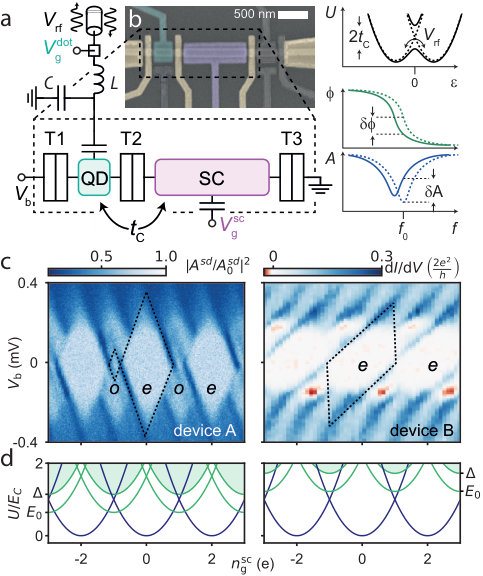 Figure 1
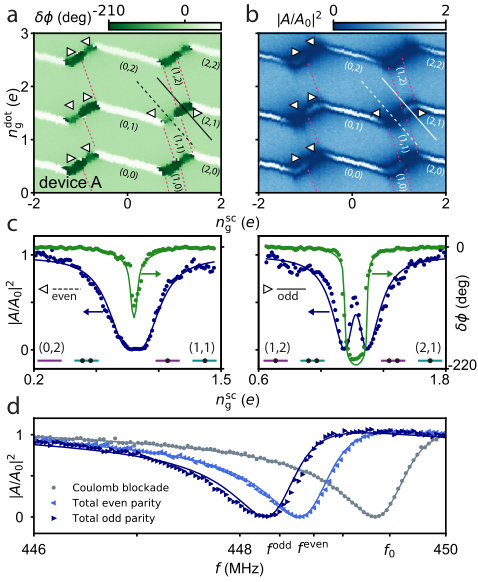 Figure 2
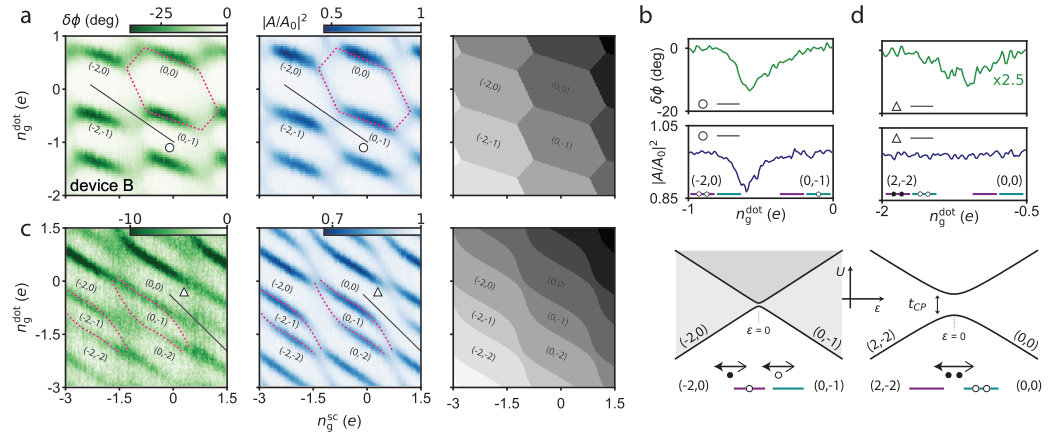 Figure 3
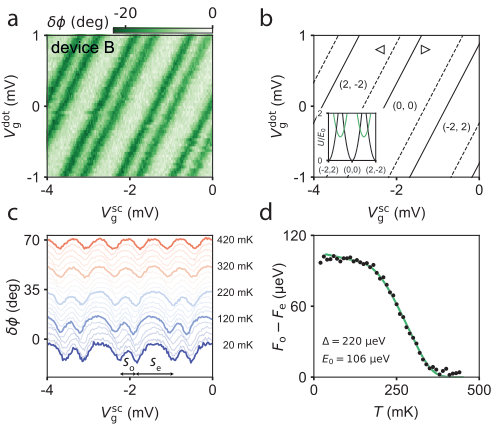 Figure 4
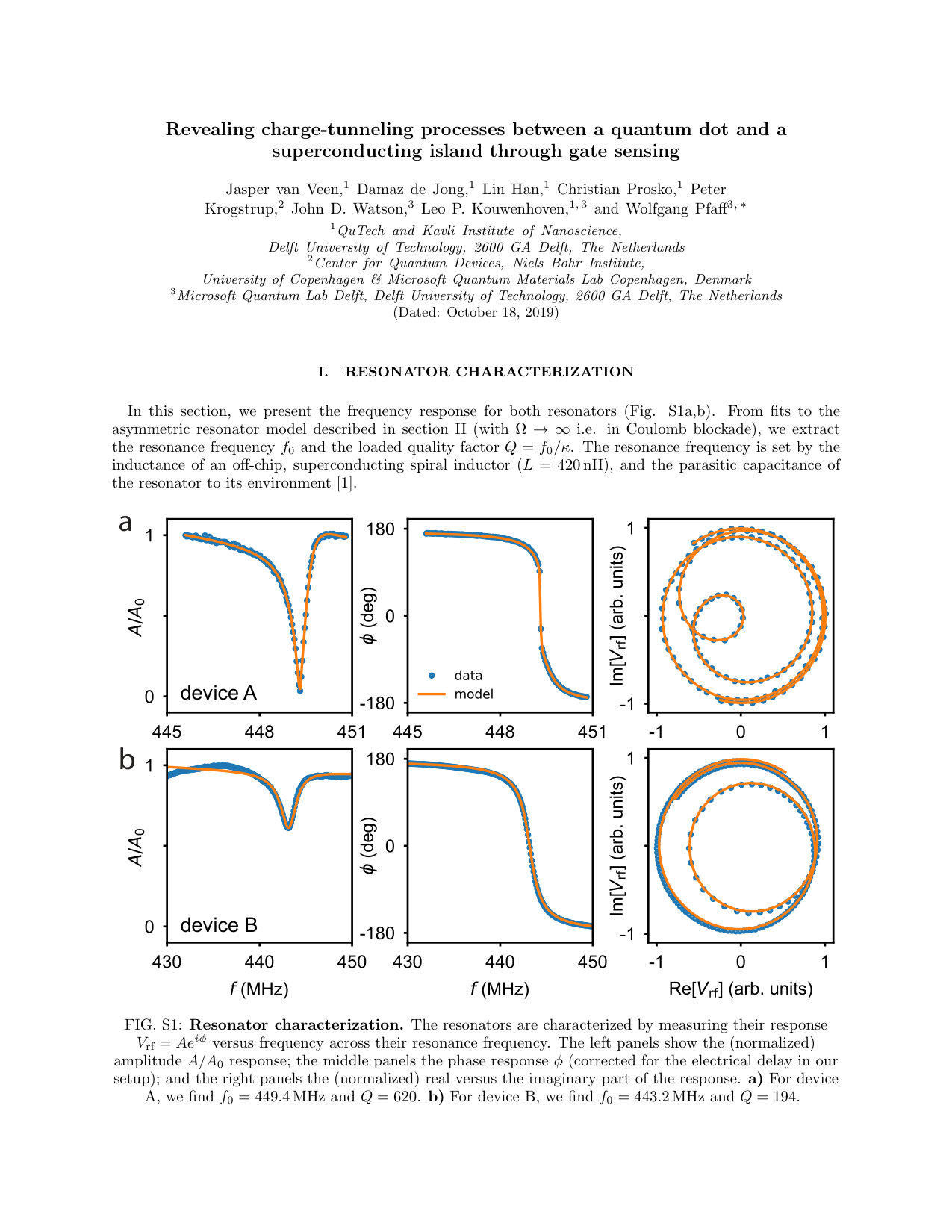 Figure 5
Peer Reviews
No public reviews on file for this paper yet. If you reviewed it on a platform where reviews are public (OpenReview, ICLR, NeurIPS, ICML), you can paste yours below so the community can read it here.
Videos
No videos yet. Explain this paper in a talk, walkthrough, or lecture? Add one.
Revealing charge-tunneling processes between a quantum dot and a superconducting island through gate sensing
Jasper van Veen
QuTech and Kavli Institute of Nanoscience, Delft University of Technology, 2600 GA Delft, The Netherlands
Damaz de Jong
QuTech and Kavli Institute of Nanoscience, Delft University of Technology, 2600 GA Delft, The Netherlands
Lin Han
QuTech and Kavli Institute of Nanoscience, Delft University of Technology, 2600 GA Delft, The Netherlands
Christian Prosko
QuTech and Kavli Institute of Nanoscience, Delft University of Technology, 2600 GA Delft, The Netherlands
Peter Krogstrup
Center for Quantum Devices, Niels Bohr Institute, University of Copenhagen & Microsoft Quantum Materials Lab Copenhagen, Denmark
John D. Watson
Microsoft Quantum Lab Delft, Delft University of Technology, 2600 GA Delft, The Netherlands
Leo P. Kouwenhoven
QuTech and Kavli Institute of Nanoscience, Delft University of Technology, 2600 GA Delft, The Netherlands
Microsoft Quantum Lab Delft, Delft University of Technology, 2600 GA Delft, The Netherlands
Wolfgang Pfaff
Microsoft Quantum Lab Delft, Delft University of Technology, 2600 GA Delft, The Netherlands
Abstract
We report direct detection of charge-tunneling between a quantum dot and a superconducting island through radio-frequency gate sensing. We are able to resolve spin-dependent quasiparticle tunneling as well as two-particle tunneling involving Cooper pairs. The quantum dot can act as an RF-only sensor to characterize the superconductor addition spectrum, enabling us to access subgap states without transport. Our results provide guidance for future dispersive parity measurements of Majorana modes, which can be realized by detecting the parity-dependent tunneling between dots and islands.
Quantum dots coupled to superconductors can give rise to novel physical phenomena such as and -junctions De Franceschi et al. (2010); Van Dam et al. (2006); Szombati et al. (2016), Cooper pair splitting Hofstetter et al. (2009); Herrmann et al. (2010); Deacon et al. (2015), and Yu-Shiba-Rusinov (YSR) states Ralph et al. (1995); Lee et al. (2014). These phenomena arise because the single-electron states of the dot hybridize with the more complicated many-particle states of the superconductor. Recently, such hybrid systems have gained interest in the context of Majorana zero modes (MZMs) where the quantum dot (QD) can, for example, be used as a spectrometer Deng et al. (2016). Moreover, projective parity measurements can be achieved by coupling a QD to a pair of MZMs, which are located on a superconducting island (SC) Higginbotham et al. (2015); Albrecht et al. (2016), enabling topologically protected quantum computation. These projective measurements rely on the parity-dependent hybridization between a single dot level and the MZMs Plugge et al. (2017); Karzig et al. (2017). Therefore, unambiguous detection of coherent tunneling between a QD and a superconducting island is needed to implement this readout.
Dispersive gate sensing (DGS) provides direct access to charge hybridization between weakly coupled dots or islands. More precisely, tunneling within these structures can impart a frequency shift on a resonant circuit that can be observed on short time scales with high accuracy. In this way, experiments have revealed coherent charge hybridization between superconductors Wallraff et al. (2004); Duty et al. (2005); Esmail et al. (2017) and semiconductor double quantum dots Petersson et al. (2012); Frey et al. (2012); Colless et al. (2013); Landig et al. (2019). Moreover, capacitive RF sensing has been used to study charging of QDs connected to normal and superconducting reservoirs Gonzalez-Zalba et al. (2015); Bruhat et al. (2016, 2018). As such, DGS presents an excellent opportunity for studying charge-tunneling in hybrid structures containing QDs.
In this paper, we report direct detection of different types of charge-tunneling processes between a QD and a SC through DGS on the QD. From observations of the resonator response, supported by numerical simulations, we find that the nature of the tunneling depends crucially on the ordering of the relevant energy scales of the SC. When the smallest scale is the energy of the lowest single-particle state, the QD and SC can exchange quasiparticles, giving rise to the characteristic ‘even-odd’ effect. Conversely, when the charging energy of the SC is lowest, we detect signatures of Cooper pairs tunneling out of the SC. Depending on the tunneling amplitude, this results in either 1-charging of the QD, with the other electron leaving into a reservoir, or 2-charging of the QD. Tunneling to the single-particle states can, however, be re-enabled by operating the device in a floating regime where the total number of charges in the two systems is conserved. These results show that DGS allows us to effectively perform RF-only tunneling spectroscopy on the SC. To this end, we use the QD and capacitively-coupled resonator as a probe to characterize a subgap state in the SC without need for transport via leads. Our method is complementary to recent experiments that employed the dispersive response of inductively-coupled resonators to probe the Andreev bound state occupation in galvanically-isolated nanowire Josephson junctions Hays et al. (2018); Tosi et al. (2019).
A schematic of our experiment is shown in Fig. 1a,b. The QD-SC hybrid double dot is formed in an InAs nanowire with an epitaxially grown Al-shell on two of its facets. The superconducting island consists of a proximitized wire segment, which is defined by removing the Al outside a window using wet etching. The low-carrier density in the wire allows for gate-tunable subgap states in the SC Antipov et al. (2018). Tunneling barriers are implemented with gates, insulated from the wire by 10 nm AlOx. They are used to define the QD and to control the various tunneling rates. Large-lever arm top gates (‘plungers’) on both QD and SC can be used to tune the chemical potentials. We have measured two nominally-identical devices, labelled A and B. For both devices, we connected the QD plunger to an off-chip, superconducting resonator with a resonance frequency of 449.5 (443.2) MHz for device A (B) (Supplemental Material) Hornibrook et al. (2014). We use its response near the resonance frequency to probe charge tunneling on and off the dot. All measurements are done at temperatures of 20 mK and at zero magnetic field unless otherwise indicated.
The relevant energy scales in our devices can be obtained from Coulomb blockade measurements: Figure 1c shows Coulomb diamonds of the superconducting island alone, measured through conductance. The diamonds of device A display a clear even-odd pattern, indicating that the energy of the lowest odd-parity state, , is smaller than the charging energy of the superconducting island, , where is the total capacitance of the SC (Fig. 1d) Averin and Nazarov (1992); Van Heck et al. (2016). For this device, we estimate 72\text{,}\mathrm{\SIUnitSymbolMicro eV} and $E_{\mathrm{C}}^{\mathrm{S}}=$112\text{\,}\mathrm{\SIUnitSymbolMicro eV} from the extent of the diamonds. Conversely, the charging of the superconducting island of device B is 2-periodic, indicating that Hekking et al. (1993); Van Heck et al. (2016); here, we estimate 90\text{,}\mathrm{\SIUnitSymbolMicro eV} and $E_{\mathrm{C}}^{\mathrm{S}}\approx$70\text{\,}\mathrm{\SIUnitSymbolMicro eV}. While in an ideal BCS superconductor is equal to the superconducting gap , current measurements on device A (Supplemental Material) and the negative differential conductance observed in device B indicate the presence of subgap states Higginbotham et al. (2015). We attribute the difference in charging energies and between the devices to a combination of a slightly smaller wire diameter for device A and typical sample-to-sample variations arising from fabrication. In both devices, the charging energy of the dot, 300\text{,}\mathrm{\SIUnitSymbolMicro eV}$$, is the largest energy scale in the system, and the typical QD level spacing exceeds the thermal energy (Supplemental Material).
In the following, we investigate the change in resonator response when charges are able to tunnel between the QD and SC at zero bias, beginning with device A. To this end, we form a hybrid double dot by tuning the gates T1 and T2 close to pinch-off, and T3 into pinch-off. Figures 2a,b show the resonator response as a function of the two plunger gates in the weakly coupled regime. Both amplitude and phase response display the charge stability diagram (CSD) of the hybrid double dot, which shows a clear 1 pattern along the QD gate, and an even-odd pattern along the SC gate; this is again a manifestation of , and the CSD shape can be readily reproduced by computing the charge ground states of the system (Supplemental Material).
We focus on the interdot transitions, highlighted in Figs. 2a-c, where we observe a strong amplitude and phase response on all charge degeneracy points. Interestingly, we see a strong difference in the resonator response across interdot transitions with a different parity of the total particle number, indicating a difference between the coupling between the involved states Esterli et al. (2019).
This dependence on total parity can be understood as a spin-dependent tunnel coupling Cottet et al. (2011). To see this, we label the states according to their pairing; for the SC states as even/odd, and for the QD states as singlet/doublet: . We can differentiate couplings between two sets of states; to and to . The coupling is different for these two sets because of spin degeneracy: From either of the two electrons forming the singlet can tunnel with equal probability, giving rise to a two-fold degeneracy in the coupling between and , i.e., between the states with total even parity. On the other hand, from only one of the two electrons can tunnel from QD to SC due to Pauli exclusion; in this case no degeneracy is present. As a result, the transition rate between states of total even parity is expected to be times stronger than between states of total odd parity, corresponding to a times smaller frequency shift.
We model the resonator response across the interdot transition by using a circuit QED model derived from input-output theory (Supplemental Material) Petersson et al. (2012). We find a good agreement between our data and the model using . However, the weak parameter dependence of the model makes it unreliable to confirm the spin-dependence of the tunnel coupling. To obtain quantitative agreement, we measure the frequency-dependent resonator response at a pair of interdot transitions that show this parity effect (Fig. 2d). From fits to the resonator responses we extract frequency shifts with a ratio of (f_{0}-f^{\text{odd}})/(f_{0}-f^{\text{even}})={\color[rgb]{0,0,0}1.45}\approx\sqrt{2}, consistent with the expected spin-dependent tunneling amplitude.
For device B, the situation changes significantly. The energy ordering implies that quasiparticle states are not accessible (Fig. 1d). We form a hybrid double dot by tuning T1, T2, and T3 close to pinchoff. The CSD for a weak QD-SC coupling is shown in Fig. 3a. The diagram is -periodic in the SC gate, indicating that the island is charged via Andreev reflections from the lead. The QD is again 1-periodic. To model the measured CSDs, we compute the charge ground state by diagonalizing an effective Hamiltonian of the system that includes charging effects, the superconducting gap in the island, and coupling terms (Supplemental Material). This model, with the energy scales extracted from the Coulomb blockade measurements and an adjustable tunneling amplitude (rightmost panel in Fig. 3a), describes the observed CSD well.
The different gate charge periodicity for the QD and SC leads to interdot transitions that change the total charge of the dot-island system. This implies that a reservoir must be involved in the corresponding charge-transfer process. The observed resonator signal, with a linecut shown in Fig. 3b, results from tunneling on and off the QD, and thus should not contain information of SC-lead coupling Esterli et al. (2019). A possible candidate for the precise underlying process that gives rise to our data is crossed Andreev reflection (CAR) Hofstetter et al. (2009); Herrmann et al. (2010). There, a hole from the QD is converted to an electron in the lead, consistent with the charge states involved in the experiment. This process is exponentially suppressed in the length of the island , where is the superconducting coherence length Leijnse and Flensberg (2013). Still, with 1.2\text{,}\mathrm{\SIUnitSymbolMicro m}$$ and assuming a coherence length of nm Albrecht et al. (2016) this remains a plausible scenario.
Interestingly, increasing the tunnel coupling allows for bringing the system into a regime where a particle-conserving interdot transition emerges. The CSD in a more strongly coupled regime, together with a simulation of the charge ground states is shown in Fig. 3c. In this regime, we assume an induced gap in the quantum dot, consistent with earlier studies on YSR states Lee et al. (2014). Here, we observe that the regions with odd charge number in the QD shrink, while the regions with an even number of QD charges connect, resulting in an even-odd pattern in both gates. Now, the interdot transition appears purely dispersive (Fig. 3d): we observe only a small phase shift, without any amplitude response. Overall, our data is consistent with coherent Cooper pair transfer between the dot and the island.
As we have seen, the main difference between the two devices is that the odd states of the SC can not be directly accessed in the regime . This changes in absence of lead reservoirs because quasiparticles that tunnel from the QD onto the SC are confined to the system Esmail et al. (2017). The additional energy associated with decharging the QD makes Cooper pair tunneling energetically unfavorable when . We realize this situation experimentally in device B by closing the outer tunnel barriers, through gates T1 and T3. The resulting CSD and corresponding calculation of the ground state transitions are shown in Figs. 4a,b. It can readily be seen that no transitions to a reservoir take place, and the even-odd pattern is indicative of the alternating occupation of even and odd states of the SC.
Importantly, even though SC and QD are now galvanically isolated from the environment, the gate sensor still allows us to study the quasiparticle states in the SC. To show this, we measure the evolution of the even-odd spacing as a function of temperature (Fig. 4c). This spacing is a measure for the free energy difference of the SC. In particular, the temperature evolution of the free energy difference can be used to identify and characterize subgap states Lafarge et al. (1993); for proximitized nanowires, this has earlier been studied in transport Higginbotham et al. (2015). The extracted free energy difference as a function of temperature is shown in Fig. 4d. A fit to the model from Ref. 10 yields a gap of 220\text{,}\mathrm{\SIUnitSymbolMicro eV}, a supgap state energy of $E_{0}=$106\text{\,}\mathrm{\SIUnitSymbolMicro eV}, and an Al volume of nm3, consistent with the dimensions of the island. We note that the slightly larger energy of the subgap state is consistent with the more negative plunger gate voltage for this measurement. The excellent quality of the fit corroborates our initial assessment of the presence of a supgap state (Fig. 1b). This result shows clearly that the resonator response of the QD gate sensor can be used to characterize states of the SC, even when leads for transport experiments are not available.
In summary, we have performed dispersive gate sensing on a quantum dot that can exchange particles with a superconducting island. Analysis of the resonator response has allowed us to directly detect the charge-tunneling processes that take place between the dot and the superconductor. We have observed single or multi-particle tunneling processes, depending on the dominating energy scales of the hybrid double dot. Our results show that DGS provides an excellent tool for studying subgap excitations. In particular, using a QD and gate sensor allows performing spectroscopy without transport, which is relevant in cases where particle number should to be conserved, such as likely required for qubit devices that operate based on parity. The ability of DGS to resolve differences in tunnel couplings — as seen for the case of spin-dependent tunneling — provides a very simple means for precisely characterizing hybridization while leaving the system in the ground state. Going forward, these demonstrated abilities will be crucial for the realization and operation of Majorana qubits based on proximitized nanowires Karzig et al. (2017); Plugge et al. (2017). Our results thus set the stage for the implementation of quantum measurements of topological qubits.
I Acknowledgements
We thank B. van Heck, K. Flensberg, A. Geresdi, A. Kou, and T. Karzig for useful discussions; and J. M. Hornibrook and D. J. Reilly for providing the frequency multiplexing chips. This work has been supported by the Netherlands Organization for Scientific Research (NWO), Microsoft, the Danish National Research Foundation, the European Research Council, and a Justus and Louise van Effen excellence scholarship.
The reference list from the paper itself. Each links out to its DOI / PubMed record.
- 1De Franceschi et al. (2010) S. De Franceschi, L. P. Kouwenhoven, C. Schönenberger, and W. Wernsdorfer, Hybrid superconductor–quantum dot devices, Nature Nanotechnology 5 , 703 (2010).
- 2Van Dam et al. (2006) J. A. Van Dam, Y. V. Nazarov, E. P. A. M. Bakkers, S. De Franceschi, and L. P. Kouwenhoven, Supercurrent reversal in quantum dots, Nature 442 , 667 (2006).
- 3Szombati et al. (2016) D. B. Szombati, S. Nadj-Perge, D. Car, S. R. Plissard, E. P. A. M. Bakkers, and L. P. Kouwenhoven, Josephson ϕ 0 subscript italic-ϕ 0 \phi_{0} -junction in nanowire quantum dots, Nature Physics 12 , 568 (2016).
- 4Hofstetter et al. (2009) L. Hofstetter, S. Csonka, J. Nygård, and C. Schönenberger, Cooper pair splitter realized in a two-quantum-dot Y-junction, Nature 461 , 960 (2009).
- 5Herrmann et al. (2010) L. G. Herrmann, F. Portier, P. Roche, A. Levy Yeyati, T. Kontos, and C. Strunk, Carbon nanotubes as Cooper-pair beam splitters, Physical review letters 104 , 026801 (2010).
- 6Deacon et al. (2015) R. S. Deacon, A. Oiwa, J. Sailer, S. Baba, Y. Kanai, K. Shibata, K. Hirakawa, and S. Tarucha, Cooper pair splitting in parallel quantum dot Josephson junctions, Nature communications 6 , 7446 (2015).
- 7Ralph et al. (1995) D. C. Ralph, C. T. Black, and M. Tinkham, Spectroscopic measurements of discrete electronic states in single metal particles, Physical review letters 74 , 3241 (1995).
- 8Lee et al. (2014) E. J. H. Lee, X. Jiang, M. Houzet, R. Aguado, C. M. Lieber, and S. De Franceschi, Spin-resolved Andreev levels and parity crossings in hybrid superconductor–semiconductor nanostructures, Nature nanotechnology 9 , 79 (2014).