Efficient demultiplexed single-photon source with a quantum dot coupled to a nanophotonic waveguide
Thomas Hummel (1), Claud\'eric Ouellet-Plamondon (1), Ela Ugur (1),, Irina Kulkova (2), Toke Lund-Hansen (2), Matthew A. Broome (1), Ravitej Uppu, (1), Peter Lodahl (1)

TL;DR
This paper demonstrates a highly efficient, demultiplexed single-photon source based on a quantum dot in a nanophotonic waveguide, capable of producing multiple photons with high rate and efficiency, advancing quantum photonics applications.
Contribution
It introduces a scalable, active demultiplexing scheme for quantum dot single-photon sources with high outcoupling and end-to-end efficiency, enabling multi-photon generation.
Findings
Achieved >60% outcoupling efficiency into single-mode fibers.
Demonstrated active demultiplexing into 4 channels with >81% efficiency.
Produced >1 Hz four-photon coincidence rates under non-resonant excitation.
Abstract
Planar nanostructures allow near-ideal extraction of emission from a quantum emitter embedded within, thereby realizing deterministic single-photon sources. Such a source can be transformed into M single-photon sources by implementing active temporal-to-spatial mode demultiplexing. We report on the realization of such a demultiplexed source based on a quantum dot embedded in a nanophotonic waveguide. Efficient outcoupling (>60%) from the waveguide into a single mode optical fiber is obtained with high-efficiency grating couplers. As a proof-of-concept, active demultiplexing into M=4 spatial channels is demonstrated by the use of electro-optic modulators with an end-to-end efficiency of >81% into single-mode fibers. Overall we demonstrate four-photon coincidence rates of >1 Hz even under non-resonant excitation of the quantum dot. The main limitation of the current source is the residual…
Click any figure to enlarge with its caption.
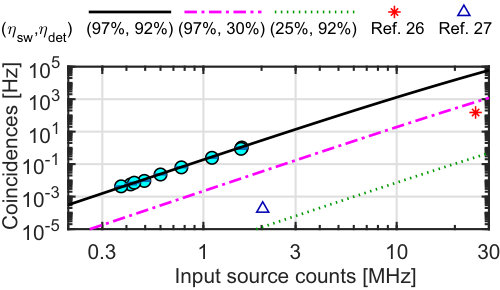 Figure 1
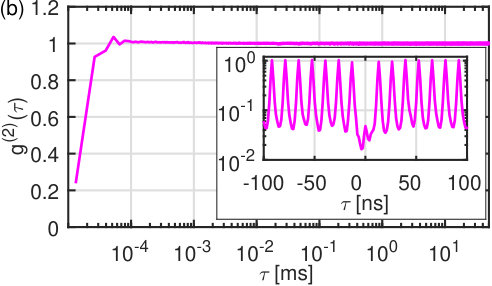 Figure 2
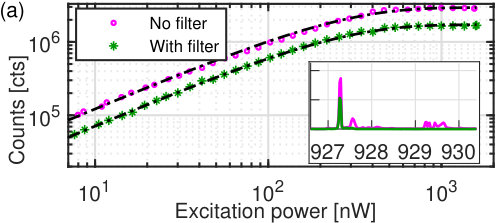 Figure 3
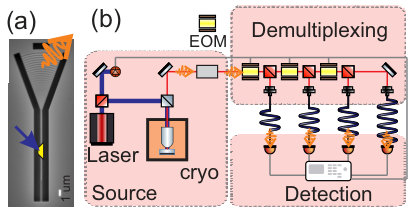 Figure 4
| Exciton line | |
|---|---|
| Bright state efficiency | |
| Waveguide | |
| Outcoupler efficiency | |
| Collection optics | |
| Spectral filter |
| Fiber to demux | |
|---|---|
| Switching | |
| Transmittance | |
| Detector |
Peer Reviews
No public reviews on file for this paper yet. If you reviewed it on a platform where reviews are public (OpenReview, ICLR, NeurIPS, ICML), you can paste yours below so the community can read it here.
Videos
No videos yet. Explain this paper in a talk, walkthrough, or lecture? Add one.
Present address: ]Department of Physics, University of Warwick, Gibbet Hill Road, Coventry, CV4 7AL, United Kingdom
Efficient demultiplexed single-photon source with a quantum dot coupled to a nanophotonic waveguide
Thomas Hummel
Claudéric Ouellet-Plamondon
Ela Ugur
Center for Hybrid Quantum Networks (Hy-Q), Niels Bohr Institute, University of Copenhagen, Blegdamsvej 17, 2100-DK Copenhagen, Denmark
Irina Kulkova
Toke Lund-Hansen
Sparrow Quantum, Blegdamsvej 17, 2100-DK Copenhagen, Denmark
Matthew A. Broome
[
Ravitej Uppu
Peter Lodahl
Center for Hybrid Quantum Networks (Hy-Q), Niels Bohr Institute, University of Copenhagen, Blegdamsvej 17, 2100-DK Copenhagen, Denmark
Abstract
Planar nanostructures allow near-ideal extraction of emission from a quantum emitter embedded within, thereby realizing deterministic single-photon sources. Such a source can be transformed into single-photon sources by implementing active temporal-to-spatial mode demultiplexing. We report on the realization of such a demultiplexed source based on a quantum dot embedded in a nanophotonic waveguide. Efficient outcoupling () from the waveguide into a single mode optical fiber is obtained with high-efficiency grating couplers. As a proof-of-concept, active demultiplexing into spatial channels is demonstrated by the use of electro-optic modulators with an end-to-end efficiency of into single-mode fibers. Overall we demonstrate four-photon coincidence rates of Hz even under non-resonant excitation of the quantum dot. The main limitation of the current source is the residual population of other exciton transitions that corresponds to a finite preparation efficiency of the desired transition. We quantitatively extract a preparation efficiency of using the second-order correlation function measurements. The experiment highlights the applicability of planar nanostructures as efficient multiphoton sources through temporal-to-spatial demultiplexing and lays out a clear path way of how to scale up towards demonstrating quantum advantages with the quantum dot sources.
The recent advances in experimental quantum-information processing Flamini, Spagnolo, and Sciarrino (2019); Dale, Jennings, and Rudolph (2015); Carolan et al. (2014); Walmsley (2015); Kok et al. (2007) and cryptography Herrero-Collantes and Garcia-Escartin (2017); Arnon-Friedman et al. (2018); Liu et al. (2018) highlight the necessity for efficient single-photon sources. Photons are robust carriers of quantum information and enable scalable quantum simulations.Aspuru-Guzik and Walther (2012); Sparrow et al. (2018); Spring et al. (2013) These applications require efficient deterministic sources of multiple indistinguishable single photons.Sangouard and Zbinden (2012); Motes et al. (2014); Lodahl (2018) The traditional approach to multiphoton generation is based on probabilistic parametric downconversion or four wave mixing sources.Kaneda and Kwiat (2018); Xiong et al. (2016); Rudolph (2017) The scaling up of the number of generated photons using such sources is limited by the low generation efficiency and the large amount of resources (detectors and optical switches) needed for heralding the photons. Over the last decade, fundamental and technological progress in the growth and control of semiconductor quantum dots has resulted in their applicability as near-ideal single-photon emitters.Kuhlmann et al. (2015); Lodahl, Mahmoodian, and Stobbe (2015); Aharonovich, Englund, and Toth (2016) Crucially, enhancing light-matter interaction through the fabrication of on-chip nanophotonic structures containing quantum dots has resulted in efficient deterministic and coherent single-photon sources.Arcari et al. (2014); Huber et al. (2015); Ding et al. (2016); Senellart, Solomon, and White (2017); Lee et al. (2018) However, the inhomogeneous broadening of the quantum dots poses a challenge in creating multiple identical sources.
An alternative route towards high-brightness multi-photon generation is by implementing active temporal-to-spatial mode demultiplexing of the emitted single-photon train from a single quantum dot.Wang et al. (2017); Lenzini et al. (2017) Recent experiments achieved high degree of indistinguishability () over long timescales,Wang et al. (2016) which enabled the temporal demultiplexing of a quantum dot in a micropillar cavity.Wang et al. (2017) Planar nanostructures offer the opportunity for near-unity and broadband coupling of quantum dot emission to a single propagating mode, which could enable integration of functionalities on-chip for ultimate system efficiency. Furthermore, the polarization of the propagating mode can be engineered in the planar nanostructures, which ensures suppression of emission into unwanted polarization states.Arcari et al. (2014)
In this work, we realize temporal-to-spatial mode demultiplexing of an efficient single-photon source based on a quantum dot embedded in a nanophotonic waveguide. We analyze the preparation efficiency of the quantum dot source and demonstrate high collection efficiency of the single-photon emission into a single mode optical fiber. Subsequently, we perform active switching of the train of single photons and measure four-photon generation rate of Hz of the multiphoton source.
Figure 1(a) shows the planar device used in the generation of the single photons. The device consists of an indium arsenide (InAs) quantum dot embedded in a gallium arsenide (GaAs) suspended nanobeam waveguide (width = nm; height = nm; length = m). The waveguide is terminated on one end with a photonic crystal mirror and on the other end with a high-efficiency grating outcoupler.Zhou et al. (2018) The nanobeam waveguide engineers the local density of states experienced by the quantum dot, thereby selectively coupling the emission to the waveguide mode. The grating outcoupler is optimized to direct the polarized light in the waveguide off the chip and into a single mode optical fiber.
Figure 1(b) shows a schematic of the optical setup used for generating and routing single photons. The setup is broadly separated into three sections: 1) generation of single photons, 2) active temporal-to-spatial demultiplexing, and 3) high-efficiency detection and analysis. For generating single photons, the device is cooled to a temperature of 4.2 K in a liquid helium bath cryostat with optical access. Light from a pulsed Ti:Sapphire laser ( nm; repetition rate MHz; pulse width ps) is focused using a high-NA objective to excite a single quantum dot in the nanobeam waveguide. The quantum dot emission coupled to the waveguide is collected by the same objective at the grating outcoupler. The collected photons are coupled into a single mode fiber through a 90:10 (transmission:reflection) beamsplitter. As the excitation of the quantum dot is non-resonant, the emission spectrum is composed of multiple lines. A tunable bandpass filter ( nm) is used to select photons from a single exciton line before injecting into the demultiplexer. The multiple emission lines limit the overall efficiency of the present device, which can be readily improved in a next-generation device with the implementation of electrical control of the transitions and resonant optical excitation.Löbl et al. (2017) The focus in the present paper is on the proof-of-concept demonstration of multiphoton demultiplexing and a quantitative assessment of the determining parameters for scaling up, which will pave the way for optimizing all parameters in a single device.
The 4-spatial mode demultiplexer comprises of three optical switches, each built using a high-transmission electrical-broadband electro-optic modulator (EOM) and a polarizing beam splitter. The polarized single photons after the bandpass filter are routed into 4 distinct spatial modes synchronously with the laser trigger. The EOMs have a maximum repetition rate of MHz with a duty cycle (rise/fall time = ns). Since , where is the number of spatial modes, photons emitted from sequential excitation pulses are not switched to different modes. Instead, we switch sequential pulses per mode such that the EOM repetition rate kHz.
Single-mode fibers at the output ports of the demultiplexer are used to collect and temporally match the routed photons. These fibers are connected to high efficiency super-conducting nanowire single-photon detectors (SNSPDs) with a time jitter of ps. The photon detection times and the laser trigger are recorded using a time tagger (resolution ps).
Before demultiplexing , the single-photon source is characterized for efficiency and purity. First, the quantum dot emission is measured at varying excitation powers on a grating spectrometer to estimate the saturation power. The integrated intensity of the exciton line is shown in figure 2(a) with and without the bandpass filter in collection. The emission intensity is modelled with a three-parameter saturation curve
[TABLE]
where is the maximum count rate, is the saturation excitation power, and is the bandpass filter efficiency ( when the filter is removed). The quantum dot saturates at nW and emits photons per second in the brightest transition. The bandpass filter efficiency is measured to be , which results in a photon rate into the demultiplexing setup of photons per second at saturation. This photon rate corresponds to an overall emission to collection efficiency of the single-photon source of , which is obtained from relating the measured count rate to the repetition rate of the excitation laser. We define the source efficiency as the probability of delivering a photon into a single mode optical fiber according to
[TABLE]
where, is the efficiency of the quantum dot source, is the waveguide collection efficiency, is the outcoupling efficiency, is the transmittivity of the collection optics, and is the bandpass filter efficiency. In an optimized device all sub-efficiencies could be brought close to unity, which would ultimately correspond to a deterministic source. The present focus is to analyze and exploit a non-optimized source for constructing a highly efficient demultiplexing setup that will lay the foundation for scaling up further.
Under non-resonant excitation, the quantum dot efficiency on the selected transition at saturation is limited by two processes: i) excitation of a quantum dot transition not selected by the bandpass filter or ii) coupling of the quantum dot to other states that decay radiatively or non-radiatively. Process i) is revealed from the emission spectra, cf. inset of Fig. 2 (a), from which the preparation efficiency is extracted as the fraction of photons emitted on the selected exciton state. We measure by analyzing the data with and without the bandpass filter inserted. Process ii) may lead to the observation of photon bunching in second-order intensity correlation function data.Davanço et al. (2014) Figure 2 (b) shows the measured long timescale dynamics of at saturation using a Hanbury Brown-Twiss setup with time bin size of . The curve was normalized to the coincidence rate at ms. We observe only minor bunching () implying that slow blinking to other exciton complexes plays an insignificant role. However, with non-resonant excitation the population of dark excitons occurs on a time scale that cannot be resolved from the data. The dark exciton reveals in the time-resolved emission as a biexponential decay (data not shown) with the bright and the dark state decay rates being ns*-1* and ns*-1*, cf. Ref. Johansen et al. (2010) for a detailed analysis of the dark exciton recombination. Using the analysis, we estimate the bright state efficiency to be . The quantum dot efficiency under non-resonant excitation is thus limited to as . Under pulsed excitation with MHz, the quantum dot emits photons in the selected bright state at a rate of MHz. The measured setup efficiencies are listed in Tab. 1, which we use to compare the expected single photon rate into the demultiplexer with the measured rate. The planar nanostructure collects MHz into the waveguide, owing to the high -factor estimated from calculations.Thyrrestrup et al. (2018) The transparency of the collection optics and the high-efficiency outcoupler enables a single photon rate into the single mode fiber of MHz. Upon spectrally filtering the collected emission, the single photon rate in the fiber to the demultiplexer setup is MHz. Employing SNSPDs with efficiency , we expect a photon detection rate of MHz, which agrees excellently with the measured single photon rate. The single photon source purity is measured using the inset of Fig. 2(b), which shows the short timescale with time bin size of ps displaying the peaks at laser repetition time of . The anti-bunching at zero time delay with indicates high-purity single photon generation. We note that the slight asymmetry at zero time delay is an artifact of electronic cross-talk between the two detectors. We measured a similar value of using avalanche photodiodes, which did not possess this electronic cross-talk.
The generated single photons are transmitted to the demultiplexer using a m optical fiber with transmission . The single and four-photon-coincidence events are accumulated using the SNSPDs and the time tagger over a period of few hours. The input single photon rate into the demultiplexer is changed by varying the excitation power. The detected four-fold coincidence rates at different input source count rate is shown in Fig. 3, which is Hz at saturation of the quantum dot. The performance of the demultiplexer can modeled as follows. With spatial modes and photons per mode, the probability of a single photon clicks in the spatial mode and the temporal mode is
[TABLE]
Here, accounts for the transmission and fiber coupling efficiency in each arm of the demultiplexer and is the efficiency of the switch. We define and . The expression in the summation takes into account the temporal response of the detector in -th spatial mode and -th temporal mode to accurately calculate the single photon detection probability for finite dead time. We neglect the time jitter ( ps) in detection as it is much smaller than the relevant timescales, and . The transmission of spatial channels varies by across the four channels. The efficiency of the switch determines the performance of the active demultiplexer. As a special limiting case a passive setup based on splitting the photons probabilistically on beam-splitters corresponds to , while would be the ideal case of a loss-less switch.
The four-fold coincidence detection rate and the input source rate can be calculated using the efficiencies shown in Table 2 using the following relation
[TABLE]
The expected at any given is shown in Fig. 3 for the passive and our active implementation (). The detection efficiency and the transmittance of the demultiplexer setup is the same in both the cases. The high efficiency of the switch in our setup allows nearly six orders of magnitude improvement over the passive demultiplexer. The measured four-fold demultiplexed rate of the quantum dot in a nanophotonic waveguide is excellently described by our fit-parameter-free model, as shown in the figure.
In the present experiment the single-photon source had a rate of MHz at the input of the demultiplexer. By implementing electrical gates in a diode-like heterostructure the exciton charge state can be fully stabilized Löbl et al. (2017) and furthermore resonant excitation may be used to avoid excitation of residual exciton states. With resonant excitation, the source efficiency can be improved to , Wang et al. (2017); Senellart, Solomon, and White (2017) which would lead to an expected rate of kHz.
A similar demultiplexing technique has been employed for multiple photon generation using free-space Wang et al. (2017) as well as chip-based switches Lenzini et al. (2017). These experiments employed quantum dots embedded in micropillar cavities, which do not select the polarization state of the emitted photons. The results from these experiments are shown in Fig. 3 for comparison. These experiments employed avalanche photodiodes () for detection. The dash dotted curve in the figure shows the expected with the same switching efficiency as our setup, but with reduced detection efficiency. The earlier measurements are below the expected count rates indicating a higher performance of our demultiplexing setup. Resonant excitation in Ref. Wang et al. (2017) allowed MHz, resulting in Hz of detected 4-fold coincidence rate. Similarly, the on-chip lithium niobate switches employed in Ref. Lenzini et al. (2017) had , which severely limited the performance of the demultiplexer led to an estimated 4-fold detection rate of mHz.
In summary, we demonstrate highly efficient generation of polarized multiple photons through temporal-to-spatial demultiplexing of a quantum dot in a planar nanostructure. Our proof-of-principle demonstration paves a path for scaling up quantum dot single photon sources towards experiments that reveal and exploit the quantum advantage for quantum-information processing and simulation.Flamini, Spagnolo, and Sciarrino (2019); Dalzell et al. (2018); Boixo et al. (2018) We estimate the N-fold coincidence rates for an active demultiplexing setup, which accurately models the experiment. The observed multi-photon generation rate is primarily limited by the quantum dot preparation efficiency that could be readily improved in next-generation samples. A future direction may be to integrate the switches directly on-chip together with the quantum dot source. The recent demonstration of low-loss nanomechanical switching lays out a promising route for such an integration Papon et al. (2018), which will greatly reduce the footprint required for scaling up the multi-photon source.
Acknowledgements.
The authors gratefully acknowledge Rüdiger Schott, Andreas D. Wieck, and Arne Ludwig for growing the GaAs wafers with quantum dots and Tommaso Pregnolato for assistance in fabrication. We gratefuly acknowledge financial support from the Danish National Research Foundation (Center of Excellence “Hy-Q”), the Europe Research Council (ERC Advanced Grant “SCALE”), Horizon2020 (Marie-Sklowdowska Curie Individual Fellowship), Innovation Fund Denmark (Quantum Innovation Center “Qubiz”), and the Danish Research Infrastructure Grant (QUANTECH).
The reference list from the paper itself. Each links out to its DOI / PubMed record.
- 1Flamini, Spagnolo, and Sciarrino (2019) F. Flamini, N. Spagnolo, and F. Sciarrino, Reports on Progress in Physics 82 , 016001 (2019) . · doi ↗
- 2Dale, Jennings, and Rudolph (2015) H. Dale, D. Jennings, and T. Rudolph, Nature communications 6 , 8203 (2015).
- 3Carolan et al. (2014) J. Carolan, J. D. Meinecke, P. J. Shadbolt, N. J. Russell, N. Ismail, K. Wörhoff, T. Rudolph, M. G. Thompson, J. L. O’Brien, J. C. Matthews, and A. Laing, Nature Photonics 8 , 621 (2014) . · doi ↗
- 4Walmsley (2015) I. A. Walmsley, Science 348 , 525 (2015) . · doi ↗
- 5Kok et al. (2007) P. Kok, W. J. Munro, K. Nemoto, T. C. Ralph, J. P. Dowling, and G. J. Milburn, Reviews of Modern Physics 79 , 135 (2007) . · doi ↗
- 6Herrero-Collantes and Garcia-Escartin (2017) M. Herrero-Collantes and J. C. Garcia-Escartin, Reviews of Modern Physics 89 , 015004 (2017) . · doi ↗
- 7Arnon-Friedman et al. (2018) R. Arnon-Friedman, F. Dupuis, O. Fawzi, R. Renner, and T. Vidick, Nature Communications 9 , 459 (2018).
- 8Liu et al. (2018) Y. Liu, X. Yuan, M.-H. Li, W. Zhang, Q. Zhao, J. Zhong, Y. Cao, Y.-H. Li, L.-K. Chen, H. Li, T. Peng, Y.-A. Chen, C.-Z. Peng, S.-C. Shi, Z. Wang, L. You, X. Ma, J. Fan, Q. Zhang, and J.-W. Pan, Physical Review Letters 120 , 010503 (2018) . · doi ↗