The Disk Gas Mass and the Far-IR Revolution
Edwin A. Bergin, Klaus M. Pontoppidan, Charles M. Bradford, L., Ilsedore Cleeves, Neal J. Evans, Maryvonne Gerin, Paul F. Goldsmith, Quentin, Kral, Gary J. Melnick, Melissa McClure, Karin Oberg, Thomas L. Roellig,, Edward Wright, Richard Teague, Jonathan P. Williams, Ke Zhang

TL;DR
The paper discusses how far-infrared observations, especially of hydrogen deuteride (HD), can revolutionize measurements of protoplanetary disk gas mass, crucial for understanding planet formation and disk evolution.
Contribution
It highlights the potential of a space-based far-infrared telescope to survey disk gas masses via HD emission, enabling statistical studies across different stages and types of star systems.
Findings
Far-infrared observations can significantly improve disk gas mass measurements.
HD emission provides a more accurate tracer than traditional methods.
A space-based 8 K telescope could survey hundreds of disks.
Abstract
The gaseous mass of protoplanetary disks is a fundamental quantity in planet formation. The presence of gas is necessary to assemble planetesimals, it determines timescales of giant planet birth, and it is an unknown factor for a wide range of properties of planet formation, from chemical abundances (X/H) to the mass efficiency of planet formation. The gas mass obtained from traditional tracers, such as dust thermal continuum and CO isotopologues, are now known to have significant (1 - 2 orders of magnitude) discrepancies. Emission from the isotopologue of H2, hydrogen deuteride (HD), offers an alternative measurement of the disk gas mass. Of all of the regions of the spectrum, the far-infrared stands out in that orders of magnitude gains in sensitivity can be gleaned by cooling a large aperture telescope to 8 K. Such a facility can open up a vast new area of the spectrum to…
Click any figure to enlarge with its caption.
 Figure 1
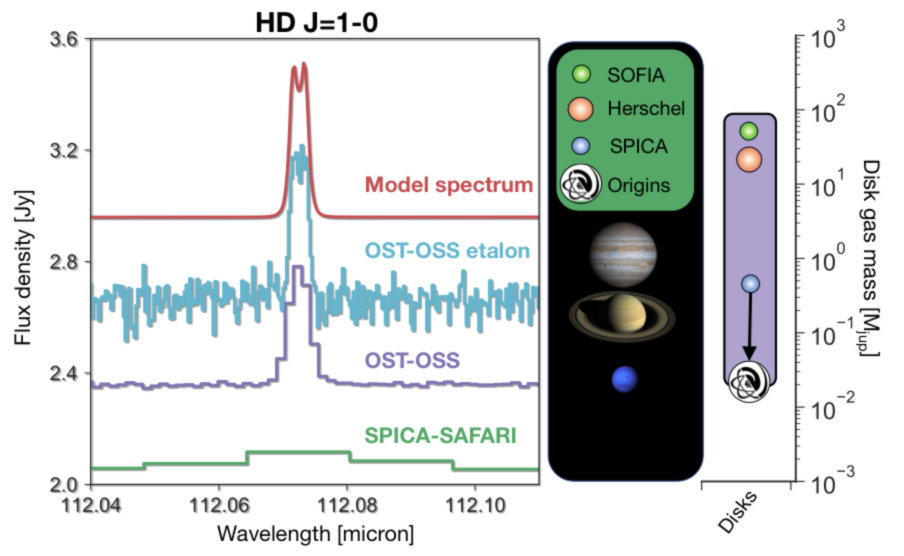 Figure 2
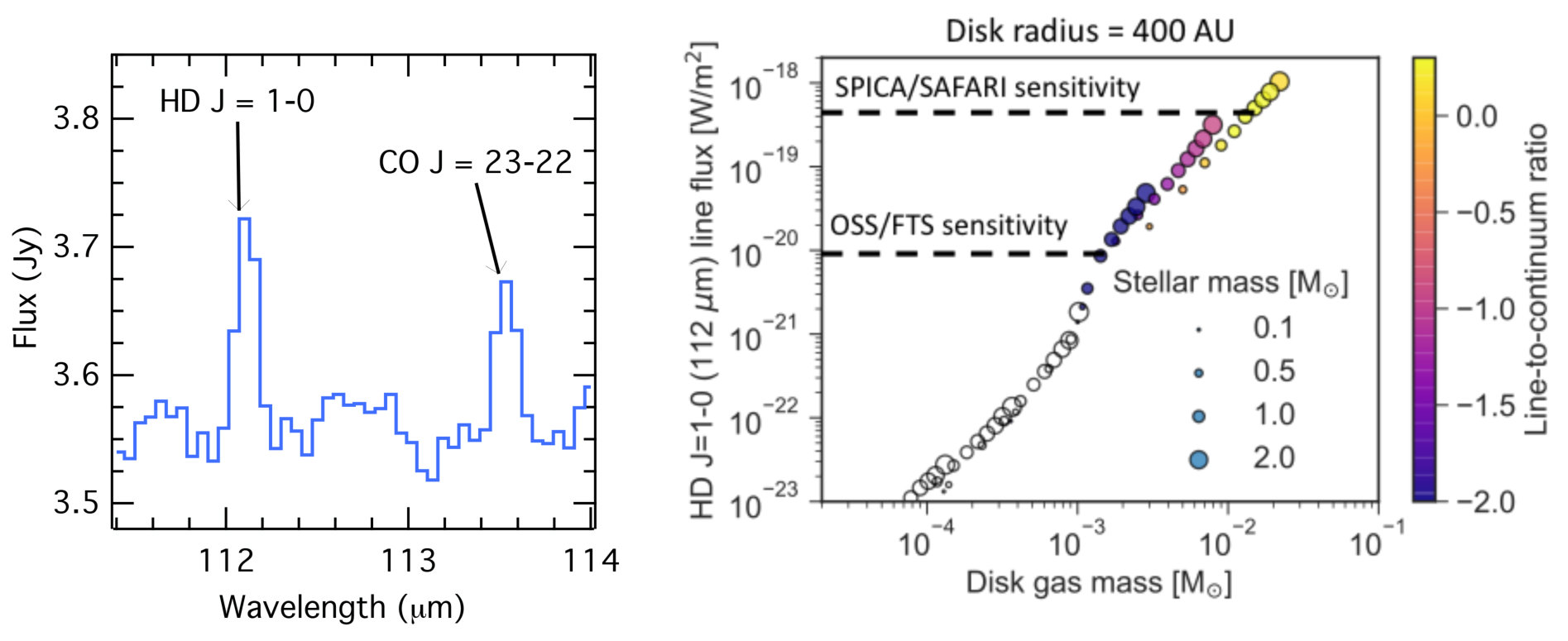 Figure 3
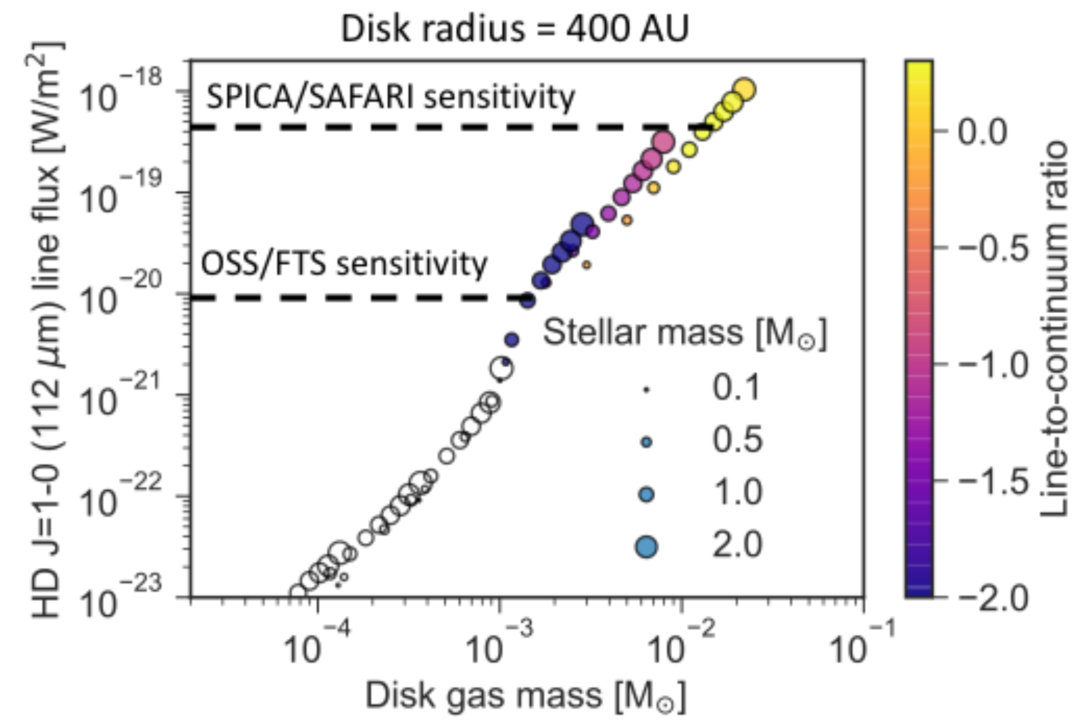 Figure 4
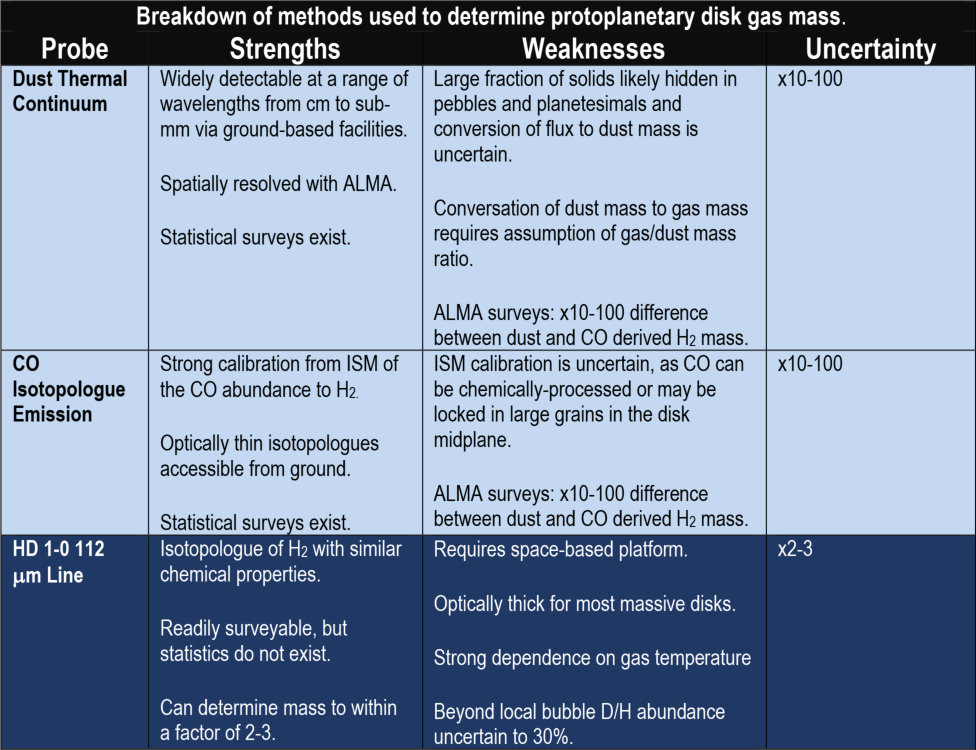 Figure 5
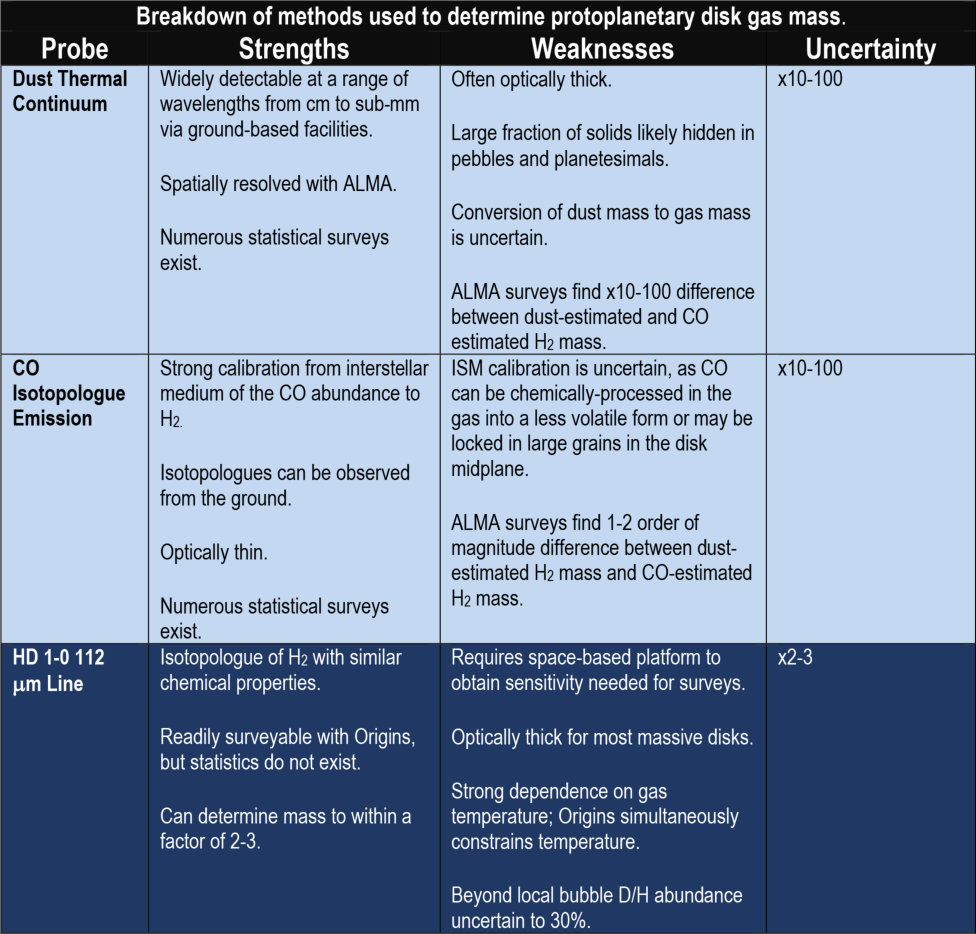 Figure 6
Peer Reviews
No public reviews on file for this paper yet. If you reviewed it on a platform where reviews are public (OpenReview, ICLR, NeurIPS, ICML), you can paste yours below so the community can read it here.
Videos
No videos yet. Explain this paper in a talk, walkthrough, or lecture? Add one.
Taxonomy
TopicsAstrophysics and Star Formation Studies · Molecular Spectroscopy and Structure · Advanced Chemical Physics Studies
\SetWatermarkLightness
0.9 \SetWatermarkText
Astro2020 Science White Paper
The Disk Gas Mass and the Far-IR Revolution
Thematic Areas: Planetary Systems Star and Planet Formation
Principal Author:
Name: Edwin A. Bergin Institution: University of Michigan Email: [email protected] Phone: 734-615-8720
Co-authors: Klaus M. Pontoppidan (STScI), Charles M. Bradford (Caltech-JPL), L. Ilsedore Cleeves (Univ. of Virginia), Neal J. Evans (Univ. of Texas), Maryvonne Gerin (Paris Obs.), Paul F. Goldsmith (Caltech-JPL), Quentin Kral (Paris Obs.), Gary J. Melnick (Harvard-Smithsonian CfA), Melissa McClure (University of Amsterdam), Karin Öberg (Harvard Univ.), Thomas L. Roellig (NASA Ames), Edward Wright (UCLA), Richard Teague (Univ. of Michigan), Jonathan P. Williams (Univ. of Hawaii), Ke Zhang (Univ. of Michigan)
Abstract: The gaseous mass of protoplanetary disks is a fundamental quantity in planet formation. The presence of gas is necessary to assemble planetesimals, it determines timescales of giant planet birth, and it is an unknown factor for a wide range of properties of planet formation, from chemical abundances (X/H) to the mass efficiency of planet formation. The gas mass obtained from traditional tracers, such as dust thermal continuum and CO isotopologues, are now known to have significant (1 - 2 orders of magnitude) discrepancies. Emission from the isotopologue of H2, hydrogen deuteride (HD), offers an alternative measurement of the disk gas mass.
Of all of the regions of the spectrum, the far-infrared stands out in that orders of magnitude gains in sensitivity can be gleaned by cooling a large aperture telescope to 8 K. Such a facility can open up a vast new area of the spectrum to exploration. One of the primary benefits of this far-infrared revolution would be the ability to survey hundreds of planet-forming disks in HD emission to derive their gaseous masses. For the first time, we will have statistics on the gas mass as a function of evolution, tracing birth to dispersal as a function of stellar spectral type. These measurements have broad implications for our understanding of the time scale during which gas is available to form giant planets, the dynamical evolution of the seeds of terrestrial worlds, and the resulting chemical composition of pre-planetary embryos carrying the elements needed for life. Measurements of the ground-state line of HD requires a space-based observatory operating in the far-infrared at 112 m.
Central question: What is the gaseous disk mass and its evolution during planet formation?
Planet-forming disks are mostly gaseous in composition; at birth the gas carries 100 more mass than the solid dust particles. The disk mass is the most fundamental quantity determining whether planets can form, and on what time scale. Estimates of disk gaseous masses are complicated by the fact that the first excited state of H2 sits at 512 K above the ground state and is essentially unemissive at the temperatures that characterize much of the gaseous mass (i.e., 10–30 K). To counter this difficulty, the thermal continuum emission of the dust grains, or rotational lines of CO, are often used as a proxy for mass under the assumption they can be calibrated to trace the total gas mass [see discussion in, 1]. However, sensitive observations have demonstrated that grains have undergone substantial growth; in fact it is clear that significant dust mass is missing [2]. Further, recent ALMA surveys of well over 100 disks have compared gas masses measured from dust to CO-derived masses [3, 4, 5]. They find a systemic result that CO-derived masses are below that estimated from dust (assuming gas mass/dust mass = 100). Given that the dust masses are also a lower limit on the total mass, the gas mass of disks remains unknown by orders of magnitude despite decades of work.
This leads to a gas mass conundrum such that either the CO abundance in disks may be orders of magnitude lower than in molecular clouds due to chemical and/or physical effects [6, 7, 8, 9] or the planet-forming gaseous mass is dispersed within a few Myr [3]. This problem is pervasive, yet the effect is the dominant term in the overall disk physical/chemical evolution. Furthermore, there are broad implications as all chemical measurements need the H2 mass to determine abundances and the presence/absence of gas drives giant planet migration and influences the orbits of protoplanetary bodies [10, 11, 12].
Hydrogen Deuteride as a New Tracer of Hidden H2
The fundamental (J ) rotation transition of HD at 112 m has been proposed as a much more robust measure of protoplanetary disk mass. While HD is a different molecular species, and therefore remains an indirect tracer of H2, it may be as close as it is possible to get to a direct total mass tracer. Using Herschel, the gas mass of the TW Hya disk was measured by taking advantage of the fact that the lowest rotational transition of HD is times more emissive than the lowest transition of H2 for a given gas mass at 20 K [13]. Due to Herschel’s limited lifetime, the only other deep HD observations obtained were toward six disks, with the result being two additional detections [14]. The TW Hya detection is shown in Fig. 1 (left).
Table 1 provides a breakdown of the strengths and weaknesses of each indirect probe of the gas mass. Dust and CO-derived masses both have internal issues, but at present there is a factor of 10-100 discrepancy amongst these measurements. HD itself has two weaknesses. First, the atomic D/H ratio is used to set the calibration between the HD and H2 mass. This varies by 30% beyond the local bubble [15]. This uncertainty is therefore much smaller than the order of magnitude uncertainties seen when comparing dust- or CO-estimated masses. Second, the HD gas mass has a strong dependence on the assumed gas temperature and is proportional to exp (-128/Tgas). This parameter dominates the uncertainty on HD as a mass tracer. However, ALMA observations of rare CO isotopologues can readily constrain models of radial and vertical disk gas temperature in disk systems, independently of the CO abundance [16, 17, 18]. In addition, a far-IR telescope operating at 100 to 600 m would provide access to CO isotopologues with , tracing warmer gas.
As seen in Fig.1 (right), models predict that the emission of HD directly measures mass (see also [19]). With temperature constrained via other means, the disk gas mass can certainly be derived to within a factor of 2-3 [13, 14, 19]. Given that the present day discrepancy encompasses orders of magnitude, this represents a major advance.
The Existing Landscape
Detection of HD emission requires being above the absorption of the Earth’s atmosphere. The HIRMES instrument on SOFIA will have the ability to detect and partially resolve () HD emission in the most massive and warmest disk systems with M M*⊙* (flux W/m2). In addition, by spectrally resolving the line, one can use the fact that line width is dominated by temperature and Keplerian rotation to improve the retrieval of the total disk mass, given a disk model. That is, the line profile carries information on the mass distribution as a function of radius. Given the limited information we have at present, any detection by HIRMES will be invaluable and this instrument will pave the way for future studies. However, the SOFIA telescope is not cooled and thus does not capture the order of magnitude gains needed for a major step forward.
In the field of disk studies we need to move beyond observations of single objects - we need to survey across all evolutionary stages and stellar mass. To obtain statistics on disks around stars of all masses, and to capture temporal disk evolution in a meaningful manner, we need to be sensitive to mass evolution. Thus any observatory must be capable of detecting gas masses needed to make giant planets (M*⊙) or W/m2* (5). This also enables the detection of more massive systems at much larger distances to build a statistical sample. This requires a cooled space telescope. At present there are two options that have been explored in detail and provide a glimpse of the capabilities that are needed. SPICA, which is a 2.5m cooled aperture equipped with a spectrometer with intermediate spectral resolving power () and the Origins Space Telescope with a 5.9m cooled aperture and at 112 m. SPICA is one of the three missions in competition for ESA’s M5 opportunity and the Origins Space Telescope is a concept as part of NASA’s decadal preparations. Of these two the higher spectral resolving power (and larger aperture) of the Origins Space Telescope allows for HD line detections down to lower mass limits; the higher resolving power is particularly important when the disk continuum is bright, as is often the case. These issues are summarized in graphic form in Fig.2.
Recommendation
The disk gas mass is a fundamental parameter for planet formation. It sets the timescales for giant planet formation and controls the kinematics of the system, including (proto-)planets. During early stages, the presence of gas leads to the implantation of elements of life (Carbon, Oxygen, Hydrogen, Nitrogen, Sulfur) held in volatile molecules (e.g. CO, H2O, …) into the growing solids. Knowledge of the gas mass enables the determination of chemical abundances needed to track the incorporation of volatile elements in forming rocky and gas/giant planets, as a mandatory factor for habitability (for terrestrial worlds). Over the coming decade, knowledge of the planet-forming gas mass in the galaxy will slowly advance but a leap in our knowledge requires HD measurements, and this goal requires dedicated work toward sensitive spectroscopic observations at 112 m.
We therefore recommend:
*the development of a large aperture far-infrared cooled space-borne observatory. The observatory must be sensitive to HD emission at 112 m with integrated fluxes of W m-2 to reach the lowest mass disks in the nearest star-forming regions and to reach the several thousand disks in Orion. The spectral resolving power should be at least a few 104 to have enough line-to-continuum contrast to detect lower-mass disks. This will enable detailed surveys of HD emission to obtain statistical information on this central quantity for the first time. *
The reference list from the paper itself. Each links out to its DOI / PubMed record.
- 1[1] E. A. Bergin and J. P. Williams. The Determination of Protoplanetary Disk Masses. Formation, Evolution, and Dynamics of Young Solar Systems , 445:in press, 2017.
- 2[2] C. F. Manara, G. Rosotti, L. Testi, A. Natta, J. M. Alcalá, J. P. Williams, M. Ansdell, A. Miotello, N. van der Marel, M. Tazzari, J. Carpenter, G. Guidi, G. S. Mathews, I. Oliveira, T. Prusti, and E. F. van Dishoeck. Evidence for a correlation between mass accretion rates onto young stars and the mass of their protoplanetary disks. Astron. & Astrophys. , 591:L 3, June 2016.
- 3[3] M. Ansdell, J. P. Williams, N. van der Marel, J. M. Carpenter, G. Guidi, M. Hogerheijde, G. S. Mathews, C. F. Manara, A. Miotello, A. Natta, I. Oliveira, M. Tazzari, L. Testi, E. F. van Dishoeck, and S. E. van Terwisga. ALMA Survey of Lupus Protoplanetary Disks. I. Dust and Gas Masses. Astrophys. J. , 828:46, September 2016.
- 4[4] A. Miotello, E. F. van Dishoeck, J. P. Williams, M. Ansdell, G. Guidi, M. Hogerheijde, C. F. Manara, M. Tazzari, L. Testi, N. van der Marel, and S. van Terwisga. Lupus disks with faint CO isotopologues: low gas/dust or high carbon depletion? Astron. & Astrophys. , 599:A 113, March 2017.
- 5[5] F. Long, G. J. Herczeg, I. Pascucci, E. Drabek-Maunder, S. Mohanty, L. Testi, D. Apai, N. Hendler, T. Henning, C. F. Manara, and G. D. Mulders. An ALMA Survey of CO Isotopologue Emission from Protoplanetary Disks in Chamaeleon I. Astrophys. J. , 844:99, August 2017.
- 6[6] S. Krijt, F. J. Ciesla, and E. A. Bergin. Tracing Water Vapor and Ice During Dust Growth. Astrophys. J. , 833:285, December 2016.
- 7[7] C. Eistrup, C. Walsh, and E. F van Dishoeck. Molecular abundances and C/O ratios in chemically evolving planet-forming disk midplanes. A&A , page in press (ar Xiv 1709. 07863), September 2017.
- 8[8] K. R. Schwarz, E. A. Bergin, L. I. Cleeves, K. Zhang, K. I. Öberg, and D. Blake, G. A.and Anderson. Unlocking CO Depletion in Protoplanetary Disks I. The Warm Molecular Layer. Astrophys. J. , page submitted, June 2017.