Entanglement negativity as a universal non-Markovianity witness
Jan Kolodynski, Swapan Rana, Alexander Streltsov

TL;DR
This paper demonstrates that entanglement negativity in a tripartite quantum system can serve as a universal witness for all types of non-Markovian quantum dynamics, surpassing previous bipartite limitations.
Contribution
It introduces a method using negativity in multipartite states to universally detect non-Markovianity, including non-invertible and eternally non-Markovian dynamics.
Findings
Negativity can witness all invertible non-Markovian dynamics.
Multipartite states are essential for faithful non-Markovianity detection.
Negativity detects eternally non-Markovian qubit dynamics at all times.
Abstract
In order to engineer an open quantum system and its evolution, it is essential to identify and control the memory effects. These are formally attributed to the non-Markovianity of dynamics that manifests itself by the evolution being indivisible in time, a property which can be witnessed by a non-monotonic behavior of contractive functions or correlation measures. We show that by monitoring directly the entanglement behavior of a system in a tripartite setting it is possible to witness all invertible non-Markovian dynamics, as well as all (also non-invertible) qubit evolutions. This is achieved by using negativity, a computable measure of entanglement, which in the usual bipartite setting is not a universal non-Markovianity witness. We emphasize further the importance of multipartite states by showing that non-Markovianity cannot be faithfully witnessed by any contractive function of…
Click any figure to enlarge with its caption.
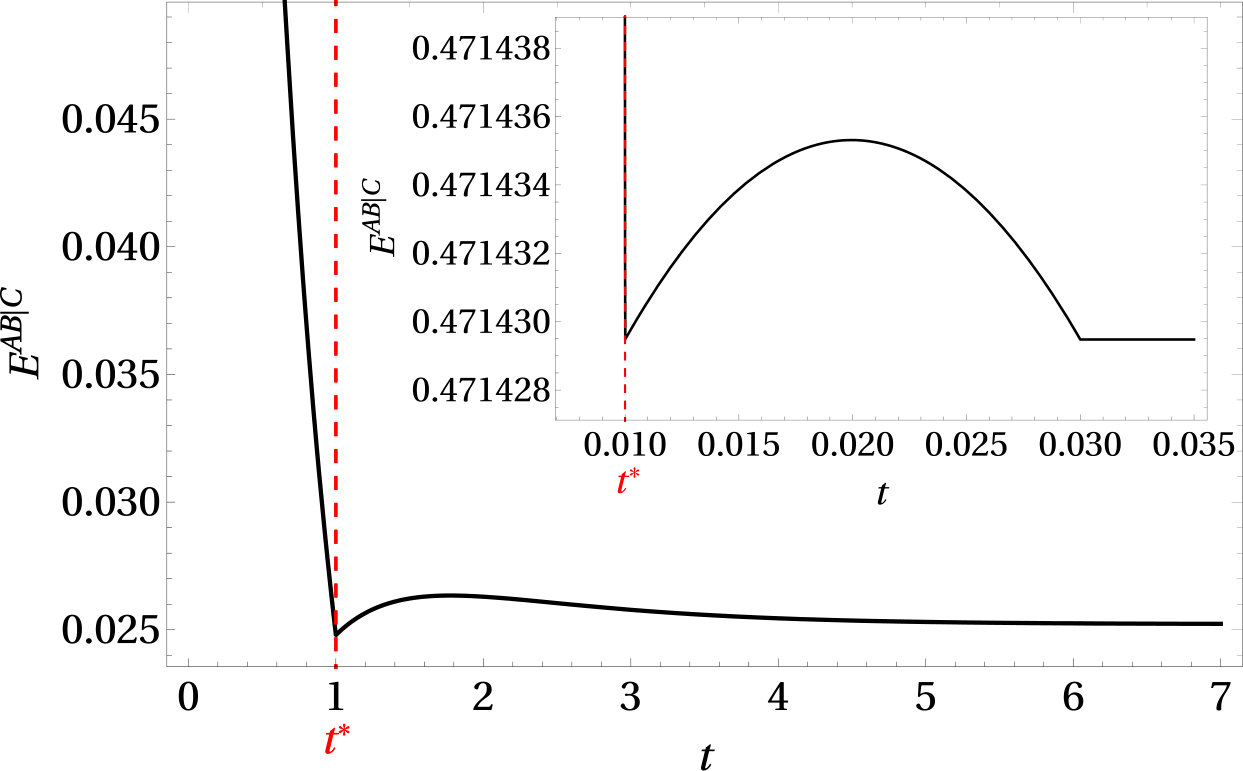 Figure 1
Peer Reviews
No public reviews on file for this paper yet. If you reviewed it on a platform where reviews are public (OpenReview, ICLR, NeurIPS, ICML), you can paste yours below so the community can read it here.
Videos
No videos yet. Explain this paper in a talk, walkthrough, or lecture? Add one.
Entanglement negativity as a universal non-Markovianity witness
Jan Kołodyński
Swapan Rana
Alexander Streltsov
Centre for Quantum Optical Technologies, Centre of New Technologies, University of Warsaw, Banacha 2c, 02-097 Warsaw, Poland
Abstract
In order to engineer an open quantum system and its evolution, it is essential to identify and control the memory effects. These are formally attributed to the non-Markovianity of dynamics that manifests itself by the evolution being indivisible in time, a property which can be witnessed by a non-monotonic behavior of contractive functions or correlation measures. We show that by monitoring directly the entanglement behavior of a system in a tripartite setting it is possible to witness all invertible non-Markovian dynamics, as well as all* (also non-invertible) qubit evolutions. This is achieved by using negativity, a computable measure of entanglement, which in the usual bipartite setting is not *a universal non-Markovianity witness. We emphasize further the importance of multipartite states by showing that non-Markovianity cannot be faithfully witnessed by any contractive function of single qubits. We support our statements by an explicit example of eternally non-Markovian qubit dynamics, for which negativity can witness non-Markovianity at arbitrary time scales.
Introduction. Describing effective dynamics of any realistic quantum system that interacts with its environment inevitably requires the theory of open quantum systems (Breuer and Petruccione, 2002; Lidar, 2019). In recent years, a growing interest has been devoted to the determination of dynamical properties that can be pinpointed when studying solely the system evolution, in particular, distinguishing memory-less—*Markovian—*dynamics from ones that exhibit memory effects. Various ways have been proposed on how to define the concept of memory or, more precisely, non-Markovianity at the level of quantum evolutions, see (Rivas et al., 2014; Breuer et al., 2016; de Vega and Alonso, 2017; Li et al., 2018) for detailed reviews on the topic. Although recently questioned (Pollock et al., 2018; Milz et al., 2019), the most commonly adopted definition (Rivas et al., 2010; Chruściński and Maniscalco, 2014; Bae and Chruściński, 2016) is the natural generalisation of the Chapman-Kolgomorov equation, which assures the time-divisibility of stochastic maps in case of classical Markovian processes (Vacchini et al., 2011). In particular, focusing on the family of quantum operations, i.e., completely positive (CP) trace-preserving (TP) maps that represent the system evolution from the initial time to each , one may verify their *CP-divisibility *(Wolf and Cirac, 2008) by inspecting whether at any intermediate time each of them could be decomposed (concatenated) as
[TABLE]
with a valid dynamical (CPTP) map .
Nevertheless, the above criterion is often weakened in order to construct witnesses of non-Markovianity* that despite not always being able to certify the non-CP character of can have an operational motivation. The most commonly used notion is the temporal behaviour of distinguishability, *as measured by the trace distance with the trace norm , between a pair of evolving quantum states and (Breuer et al., 2009). Its increase at a given time instance is then interpreted as a manifestation of information backflow from the environment to the system (Chruściński et al., 2011; Buscemi and Datta, 2016).
However, when dealing with invertible (Bylicka et al., 2017) or image non-increasing (Chruściński et al., 2018) dynamical maps , which describe almost all quantum evolutions, the CP-divisibility criterion can be restated in terms of the information backflow. By allowing for an ancilla of system dimension , the condition (1) becomes equivalent to the statement (Chruściński et al., 2011):
[TABLE]
which must now be valid for all , all bipartite system-ancilla initial states and all probabilities 111In general, it is enough to consider only the right derivative in Eq. (2).. In this Letter, we will consider evolutions for which this equivalence holds, what in fact includes also all qubit dynamics (Chakraborty and Chruściński, 2019). That is why, from now on we will refer to non-Markovianity as defined by the violation of CP-divisibility.
Still, it has remained unknown whether such notion of non-Markovianity can be faithfully verified by considering solely the evolution of correlations, in particular, dynamics of the entanglement* between the system and some ancillae (Rivas et al., 2010). This would allow to certify non-Markovianity by preparing the system and ancillae in an initial correlated state, in order to observe an increase of some *entanglement measure (Vedral et al., 1997; Horodecki et al., 2009) at a later time , without need to consider ensembles of initial states and distinguishability tasks (Buscemi and Datta, 2016). Previous results suggest that traditional correlation quantifiers, such as entanglement measures (De Santis et al., 2019; Neto et al., 2016) and mutual information (Luo et al., 2012) fail to witness all non-Markovian evolutions, while a recently proposed correlation measure (De Santis et al., 2019) can witness “almost all” of them.
In this Letter, we show that negativity, a well known computable quantifier of bipartite entanglement (Życzkowski et al., 1998; Vidal and Werner, 2002), can witness all non-Markovian qubit dynamics and all invertible evolutions of arbitrary dimension. After discussing the limitations in witnessing non-Markovianity in single-qubit systems, we present the general construction for negativity as a universal non-Markovianity witness. We provide an explicit example, witnessing violations of CP-divisibility for eternally non-Markovian qubit evolutions (Hall et al., 2014) at arbitrary time scales.
Witnessing non-Markovianity with contractive functions. A general witness of non-Markovianity can be built from any contractive function of two quantum states and , where contractivity means that
[TABLE]
for any quantum operation . Important examples for contractive functions are the trace distance , infidelity with fidelity , and the quantum relative entropy . Recently, a family of contractive functions, named quantum relative Rényi entropy, has been introduced as (Müller-Lennert et al., 2013; Wilde et al., 2014)
[TABLE]
with . In the limit the function coincides with the relative entropy , and for we obtain .
Noting that any contractive function is monotonically decreasing with for any Markovian evolution, an increase of for some serves as a witness of non-Markovianity. It is now reasonable to ask whether any non-Markovian evolution can be witnessed by some suitably chosen contractive function. As we show in the Theorem 1 below, the answer to this question is negative for single-qubit systems. An important type of evolutions in this context is given by Eq. (1), where admits the decomposition
[TABLE]
with probabilities and CPTP-maps and which can further depend on and with . Maps admitting Eq. (5) are a subclass of positive maps (P-maps) which are not necessarily CP, see Supplemental Material for more details. Evolutions admitting decompositions with being P are generally called P-divisible. An example of a non-Markovian evolution admitting this form is presented below in Eq. (22). We are now ready to present the first main result of this Letter.
Theorem 1**.**
For any non-Markovian evolution with fulfilling Eq. (5) it holds that:
[TABLE]
for any contractive function and any single-qubit states and .
Proof.
First, we will show that for any two single-qubit states and there exists a CPTP map (that may in general depend on both and ) such that
[TABLE]
This statement can be proven by considering the Bloch vectors and of the states and . The Bloch vector of the transposed state is related to via a reflection on the - plane, i.e., , and similar for . In particular, this means that transposition preserves the lengths of the two Bloch vectors and the angle between them. This implies that for any two states and there exists a unitary rotation such that
[TABLE]
The CPTP map fulfilling Eqs. (7) is thus given as
[TABLE]
where the unitary is chosen such that Eqs. (8) hold. Note that – in general – the unitary depends on the two states and .
Combining the above arguments, we obtain the following for any contractive function and any two single-qubit states and :
[TABLE]
which proves that any contractive function is monotonically decreasing with . ∎
While Theorem 1 applies only to single-qubit systems, this constraint can be lifted if one considers only specific functions, namely the trace distance, the relative entropy, and the quantum relative Rényi entropy for . Noting that these functions are contractive under positive trace-preserving maps (Müller-Hermes and Reeb, 2017), it follows that they are monotonic under non-Markovian evolutions which are P-divisible. We refer to the Supplemental Material for more details.
A question which is left open in Theorem 1 is whether it is still possible to detect non-Markovianity via the behavior of a contractive function . Even if is monotonically decreasing with , its overall behavior might depend on whether the evolution is Markovian or not. We answer this question in the Supplemental Material, showing that the monotonic behavior of any contractive function can be reproduced by Markovian dynamics.
Witnessing non-Markovianity with entanglement. The results of the previous section tell us that to witness all non-Markovian evolutions, our input state must be of higher dimension, possibly a compound state of the system extended by ancillae, i.e., we need to consider the evolution acting on a bipartite state . The behavior of any entanglement measure of the final state
[TABLE]
then serves as a witness of non-Markovianty, as for any Markovian evolution the entanglement must monotonically decrease (Rivas et al., 2010). However, this approach is not suitable to create a universal witness of non-Markovianity, as for any evolution which consists of an entanglement breaking map at some finite time followed by an arbitrary non-Markovian evolution, the state will have zero entanglement for all (De Santis et al., 2019).
Even if the evolution is not entanglement breaking, we can show that certain entanglement quantifiers fail to detect non-Markovianity. In the following, we quantify the amount of entanglement via negativity (Życzkowski et al., 1998; Vidal and Werner, 2002)
[TABLE]
where denotes the partial transpose with respect to the subsystem . As is shown in the Supplemental Material, negativity is monotonic under local positive maps of the form (5), i.e.,
[TABLE]
for any bipartite state and probability 222Note that might not be positive, we thus extend the definition of negativity in Eq. (12) to non-positive Hermitian operators with unit trace.. This implies that negativity is monotonically decreasing for any local evolution with being of the form (5). An example for a non-Markovian evolution admitting this form will be given in Eq. (22). As we further show in the Supplemental Material, negativity cannot be used to witness non-Markovianity if is monotonically decreasing with , as a decreasing behavior can always be reproduced by Markovian dynamics. From this, we conclude that negativity fails to witness some non-Markovian evolutions on subsystem even if they are not entanglement breaking 333Note that negativity in general fails to detect non-Markovianity for evolutions which consists of an NPT breaking map for some , followed by an arbitrary evolution for ..
In the light of these results, it is tempting to conclude that negativity is not suitable for construction of a universal non-Markovianity witness. Quite surprisingly, the situation changes completely by adding an extra particle , and considering the negativity of the state
[TABLE]
where is a suitably chosen initial state. In fact, taking additional ancilla systems into account has proven to be useful for relating different notions of non-Markovianity, see Eq. (2). The following theorem shows that in a tripartite setting negativity is a universal non-Markovianity witness for all invertible evolutions and for all dynamics of a single qubit.
Theorem 2**.**
*For any invertible non-Markovian evolution there exists a quantum state such that
[TABLE]
for some . For single-qubit evolutions the statement also holds for non-invertible dynamics.
Proof.
We introduce the following state
[TABLE]
where and are subsystems of , are maximally entangled states, and the states and probabilities will be specified in more detail below. If now an evolution acts on the state , the time-evolved state takes the form
[TABLE]
To evaluate the negativity in cut we notice that the partial transposition with respect to is given by
[TABLE]
with . Since the states are orthogonal to and , the trace norm of can be evaluated as
[TABLE]
where we used the fact that is a valid quantum state, and thus . The negativity of is thus given as
[TABLE]
To complete the proof of the theorem, recall that for any invertible evolution there exists states and probabilities such that Eq. (2) is violated if the evolution is non-Markovian (Chruściński et al., 2011; Bylicka et al., 2017). The same is true for all (also non-invertible) single-qubit dynamics (Chakraborty and Chruściński, 2019). ∎
Few remarks regarding Theorem 2 are in place. First, we note that invertible dynamics constitute the generic case of quantum evolutions, as non-invertible evolutions have zero measure in the space of all quantum evolutions (Ott and Yorke, 2005; De Santis et al., 2019). Moreover, the statement of Theorem 2 can be lifted to include also dynamics which are image non-increasing, by applying the same arguments (Chruściński et al., 2018). We further notice that negativity is a faithful entanglement quantifier in the setting considered here, and the states in Eq. (16) are never bound entangled, see Supplemental Material for more details.
**Applications. **We apply the results presented above to qubit eternally non-Markovian (ENM) dynamics (Hall et al., 2014), an evolution exhibiting non-Markovianity at any , even at arbitrarily small and large timescales. Such a model falls into well-studied categories of random-unitary (Chruściński and Wudarski, 2013) and phase-covariant (Smirne et al., 2016) qubit commutative evolutions. Yet, it constitutes an important example with its non-Markovian features being hard to witness (Megier et al., 2017; Chen et al., 2015). In general, a random-unitary qubit dynamics is described by a time-dependent master equation:
[TABLE]
which upon integration yields a dynamical map corresponding to a qubit Pauli channel, i.e.:
[TABLE]
where the mixing probabilities , and their time-dependence, can be explicitly expressed as a function of (Chruściński and Wudarski, 2013). For any such evolution the CP-divisibility condition (1) is equivalent to the statement that for all all the decay rates are non-negative, , while the P-divisibility criterion corresponds to a weaker requirement that at all times each pair () of decay parameters satisfies (Chruściński and Wudarski, 2013).
The ENM model introduced in Ref. (Hall et al., 2014) corresponds then to the choice:
[TABLE]
with and . Crucially, ENM dynamics exhibits non-Markovianity at all times, as for all . In contrast, it is always P-divisible due to for and any (Benatti et al., 2017; Kołodyński et al., 2018). Still, the resulting CP-map (22) is* *invertible, i.e., for every one can find a linear map such that . As a result, one can unambiguously define in (1) and explicitly compute its Choi-Jamiołkowski (CJ) matrix, , associated with it:
[TABLE]
where and . It may be explicitly verified that is non-positive for any , confirming the “eternal non-Markovianity” of dynamics, unless for which assures the physicality of the overall evolution.
In the Supplemental Material, we explicitly show that the CJ-matrix (24) admits a convex decomposition:
[TABLE]
with probabilities and , and . Hence, it follows (see Supplemental Material for a general discussion) that the decomposition (25) of the CJ-matrix assures the map for the ENM dynamics to admit a decomposition (5). As a direct consequence, Theorem 1 applies to the ENM dynamics, implying that no contractive function evaluated on single-qubit states and will be able to witness non-Markovianity of the ENM model. Moreover, as Eq. (5) naturally generalizes to Eq. (13), it becomes evident that negativity cannot be used in the usual bipartite setting to witness the non-Markovianity of the ENM evolution.
However, we explicitly demonstrate that, in accordance with the Theorem 2, negativity in the tripartite setting, , can be used to faithfully witness the non-Markovianity of the ENM evolution for any . In order to choose the initial state in Eq. (16)—in particular, its constituents () such that increases at a given —we follow the constructive method of Bylicka et al. (2017). We choose and mixing probabilities such that the trace norm in Eq. (20) is assured to increase at time (Bylicka et al., 2017). The construction with the analytic proof can be found in the Supplemental Material. Yet, in Fig. 1, we plot the dynamical behaviour of for the ENM model (23) with and after setting , so that the non-Markovianity of dynamics can be clearly witnessed at time (and within the inset).
**Conclusions. **In this Letter we discuss possibilities and limitations to detect non-Markovianity in qubit systems and beyond. It is shown that a very general class of quantities based on contractive functions fails to detect non-Markovianity of all qubit evolutions. This includes widely studied quantifiers such as trace distance, fidelity, and quantum relative entropy. It is shown that all of them fail to witness non-Markovianity in a certain class of evolutions, which includes eternal non-Markovian dynamics exhibiting non-Markovianity at all times .
If entangled systems are employed to witness non-Markovianity, we show that the situation strongly depends on the number of particles used. Surprisingly, for three particles , , and it is possible to witness non-Markovianity of all invertible dynamics of system by considering entanglement in the cut . We show this explicitly for entanglement negativity, a computable measure of entanglement, which is non-monotonic for any non-Markovian invertible dynamics and a suitably chosen initial state. For single-qubit evolutions our results apply also when the dynamics is not invertible. As an example, we show results for the eternal non-Markovianity model, where the non-monotonic behavior of negativity can be observed at arbitrary small times.
Our results demonstrate that well-established entanglement quantifiers can be useful as faithful non-Markovianity witnesses for very general classes of evolutions. An important question left open in this work is whether entanglement measures can universally witness non-Markovianity of all evolutions, incuding non-invertible dynamics beyond qubits. Recalling that entanglement theory is a prominent example of more general quantum resource theories, the fundamental connection between entanglement and non-Makovianity presented in our work can also be useful for the development of a resource theory of non-Markovianity (Bhattacharya et al., 2018; Anand and Brun, 2019).
This work was supported by the ”Quantum Optical Technologies” project, carried out within the International Research Agendas programme of the Foundation for Polish Science co-financed by the European Union under the European Regional Development Fund.
Supplemental Material
Appendix A Contractive functions under positive maps
Let be a function which is contractive under positive trace-preserving maps , i.e.,
[TABLE]
We will now show that any such function fulfills
[TABLE]
for any P-divisible evolution . For this, it is enough to note that
[TABLE]
for any , where we used the fact that is a positive trace-preserving map for any P-divisible evolution .
Appendix B Monotonically decreasing functions
and entanglement measures cannot witness non-Markovianity
Here we will show that a contractive function cannot witness non-Markovianity of if is monotonically decreasing. We will show this for the case of discrete time steps with . Then, there exists a CP-divisible family of maps such that
[TABLE]
is true for all , where the states and are defined recursively via
[TABLE]
and , . CP-divisible family which achieves this is given by
[TABLE]
where the parameters are chosen such that Eq. (29) is fulfilled. By continuity, such values for always exist, as monotonically decreases with decreasing , achieving minimal value for .
By similar arguments it follows that the behavior of any entanglement measure cannot witness non-Markovianity of if is monotonically decreasing with . For this, we recursively define tripartite states
[TABLE]
with , and is a local CP-divisible family defined in Eq. (31). Here, the parameters are chosen such that
[TABLE]
Again, such values of always exist by continuity, as monotonically decreases with decreasing , achieving minimal value for
Appendix C Indecomposable positive maps
Positive linear maps which admit the decomposition
[TABLE]
are a subset of decomposable maps, that is those positive maps which can be decomposed as a sum of a CP and co-CP map:
[TABLE]
where are (not necessarily trace-preserving) CP maps. An example of a trace-preserving positive map which cannot be decomposed as (33) is the following: ( are -by- matrices over complex numbers, ) given by
[TABLE]
Choi (1975) has showed that cannot be decomposed as (34) and hence neither as (33).
For , all positive maps are decomposable for and for all there are indecomposable positive maps (Størmer, 2013). The example in (35) was the first indecomposable map, given by Choi (1975), for , and Woronowicz (1976) gave the first indecomposable map for , .
Appendix D Negativity and local positive maps
Here we will show that negativity is monotonic under local positive maps of the form
[TABLE]
for any CPTP maps , bipartite state , and probability . Noting that commutes with partial transposition , we obtain
[TABLE]
where we used convexity of the trace norm and its monotonicity under CPTP maps, and the fact that .
Appendix E No bound entanglement for states in Eq. (16)
Here we will show that states defined in Eq. (16) of the main text are never bound entangled in the bipartition . For this, will show below that all states defined in Eq. (16) fulfill the inequality
[TABLE]
and that they are separable if . Noting that a sufficient criterion for distillability of a general state in the bipartition is that (Devetak and Winter, 2005), this proves that none of the states defined in Eq. (16) is bound entangled.
To show that the inequality (38) is fulfilled by all states in Eq. (16), note that
[TABLE]
where is the binary entropy. Using concavity of the von Neumann entropy and the fact that , we obtain the following:
[TABLE]
which proves Eq. (38).
In case that both inequalities in Eq. (41) must hold with equality, which implies that
[TABLE]
It is straightforward to verify that in this case the state in Eq. (16) is separable in the bipartition .
Appendix F Eternally non-Markovian qubit dynamics
For the general solution to the master equation (21) of the main text describing random unitary dynamics we refer the reader to Ref. Chruściński and Wudarski (2013). Still, for the choice of decay parameters (23) corresponding to the ENM model, the mixing probabilities in the dynamical (Pauli) map defined in (22) read:
[TABLE]
where with a superscript we have specially stated the dependence on the parameter . We have kept the -dependence explicit, so that we can conveniently express the inverse map of (i.e., s.t. ), which also takes the Pauli form (22), as by simply changing the sign of .
As a result, the CJ matrix of the map stated in Eq. (24) can be directly computed as
[TABLE]
where . Using, the properties of Pauli operators and Bell states (e.g., ), as well as , one arrives at the decomposition (25):
[TABLE]
with
[TABLE]
In order to prove that constitutes a valid probability distribution, it is enough to demonstrate that and . Being a sum of nonnegative quantities, clearly . Since and are positive,
[TABLE]
showing that . Thus, it remains only to show that , which is equivalent to
[TABLE]
which is true.
Appendix G Choi-Jamiołkowski matrix decomposition for
the P-maps of interest
The action of any linear TP-map on can be generally expressed as
[TABLE]
where is the “effective” CJ-matrix satisfying , yet not being necessarily positive semi-definite.
Now, let us show that if admits a convex decomposition:
[TABLE]
with , and for both , then the linear map can always be decomposed as stated in the main text in Eq. (5).
This is because one may then explicitly write:
[TABLE]
where are the CPTP maps defined by the (positive semi-definite) CJ-matrices .
Appendix H Constructing such that
is a faithful non-Markovianity witness for a given time instance
We follow the method of Bylicka et al. (2017) which describes how to construct initial states and , such that for any family of invertible dynamical maps, , the trace distance (2) is always increasing at a given time , i.e., the right derivative
[TABLE]
defined via is positive; whenever is not CP as , i.e., the dynamical family is not CP-divisible at . Note that thanks to considering the ancilla above to be of dimension , the probabilities in Eq. (2) of the main text can be assumed without loss of generality.
Once and are determined, by setting the initial tripartite state introduced in Eqs. (16-17) as
[TABLE]
with , the condition (52) assures the corresponding negativity to fulfill
[TABLE]
so that can be, indeed, considered a faithful witness of non-Markovianity for any at which the CP-divisibility property of dynamics is violated.
Constructing necessary and in case of the
eternally non-Markovian qubit dynamics for a given
Here, we describe in detail the above procedure for the case of ENM qubit dynamics. Note that for any qubit dynamics the above construction requires , i.e., to deal with qubit-qutrit states. The form of the dynamical map at each , as well as its inverse , for the ENM model are described above in Sec. F. Following the method of Bylicka et al. (2017):
We choose the maximally mixed state, , as an example of a state that lies in the image of for any in case of the ENM model. 2. 2.
We set as an exemplary state in . 3. 3.
We compute states and with , such that \big{\|}\rho_{1}^{\prime}(\lambda)-\rho_{2}^{\prime}(\lambda)\big{\|}_{1}=2\lambda. 4. 4.
For a given fixed , we find maximal such that both and are legitimate quantum states. For the ENM dynamics and above choices, we obtain:
[TABLE] 5. 5.
In this way, we arrive at the desired initial states that read:
[TABLE]
and
[TABLE]
where .
In order to explicitly demonstrate the correctness of the above construction for the ENM model, we compute the resulting states at any time : and , whose analytic expressions we skip here due to their cumbersome form. Yet, we explicitly write the resulting trace-distance between them:
[TABLE]
with being determined by the solution to the transcendental equation , where
[TABLE]
If such solution does not exist (apart from the trivial ), then and the only non-smooth behavior of the trace-distance occurs at , which is the crucial one indicating the non-Markovianity of the evolution.
In particular, after computing the right derivative of Eq. (65) at , we may explicitly evaluate Eq. 54 for the ENM model, as follows
[TABLE]
which consistently is positive for any (due to in Eq. (55) and ).
In Fig.1 of the main text, in order to more directly show the increasing behavior of the negativity (20) as a non-Markovianity witness, we plot rather the full dynamical behaviour of the above as a function of , i.e.:
[TABLE]
for particular values of the ENM parameters and . We, however, choose different values of to show that non-Markovianity can be witnessed this way at arbitrary timescales.
The reference list from the paper itself. Each links out to its DOI / PubMed record.
- 1Breuer and Petruccione (2002) H.-P. Breuer and F. Petruccione, The Theory of Open Quantum Systems (Oxford University Press, Oxford, 2002).
- 2Lidar (2019) D. A. Lidar, ar Xiv:1902.00967 (2019) .
- 3Rivas et al. (2014) Á. Rivas, S. F. Huelga, and M. B. Plenio, Rep. Prog. Phys. 77 , 094001 (2014) . · doi ↗
- 4Breuer et al. (2016) H.-P. Breuer, E.-M. Laine, J. Piilo, and B. Vacchini, Rev. Mod. Phys. 88 , 021002 (2016) . · doi ↗
- 5de Vega and Alonso (2017) I. de Vega and D. Alonso, Rev. Mod. Phys. 89 , 015001 (2017) . · doi ↗
- 6Li et al. (2018) L. Li, M. J. Hall, and H. M. Wiseman, Phys. Rep. 759 , 1 (2018) . · doi ↗
- 7Pollock et al. (2018) F. A. Pollock, C. Rodríguez-Rosario, T. Frauenheim, M. Paternostro, and K. Modi, Phys. Rev. Lett. 120 , 040405 (2018) . · doi ↗
- 8Milz et al. (2019) S. Milz, M. S. Kim, F. A. Pollock, and K. Modi, ar Xiv:1901.05223 (2019) .