$\mathcal{PT}$-Symmetry in Hartree-Fock Theory
Hugh G. A. Burton, Alex J. W. Thom, Pierre-Fran\c{c}ois Loos

TL;DR
This paper explores how $ ext{PT}$-symmetry can be incorporated into Hartree-Fock theory, establishing conditions for $ ext{PT}$-symmetry in the Fock Hamiltonian and demonstrating its implications for real energies and wave function construction.
Contribution
It introduces the concept of $ ext{PT}$-symmetry within Hartree-Fock theory, deriving conditions for symmetry and methods to construct $ ext{PT}$-symmetric wave functions.
Findings
$ ext{PT}$-symmetry in the Fock Hamiltonian ensures real eigenvalues.
$ ext{PT}$-symmetric Slater determinants can be explicitly constructed.
$ ext{PT}$-symmetry is observed in the energy landscape of H2, with different symmetry properties in restricted and unrestricted HF solutions.
Abstract
-symmetry --- invariance with respect to combined space reflection and time reversal --- provides a weaker condition than (Dirac) Hermiticity for ensuring a real energy spectrum of a general non-Hermitian Hamiltonian. -symmetric Hamiltonians therefore form an intermediate class between Hermitian and non-Hermitian Hamiltonians. In this work, we derive the conditions for -symmetry in the context of electronic structure theory, and specifically, within the Hartree-Fock (HF) approximation. We show that the HF orbitals are symmetric with respect to the operator \textit{if and only if} the effective Fock Hamiltonian is -symmetric, and \textit{vice versa}. By extension, if an optimal self-consistent solution is invariant under , then its eigenvalues and corresponding HF energy must…
Click any figure to enlarge with its caption.
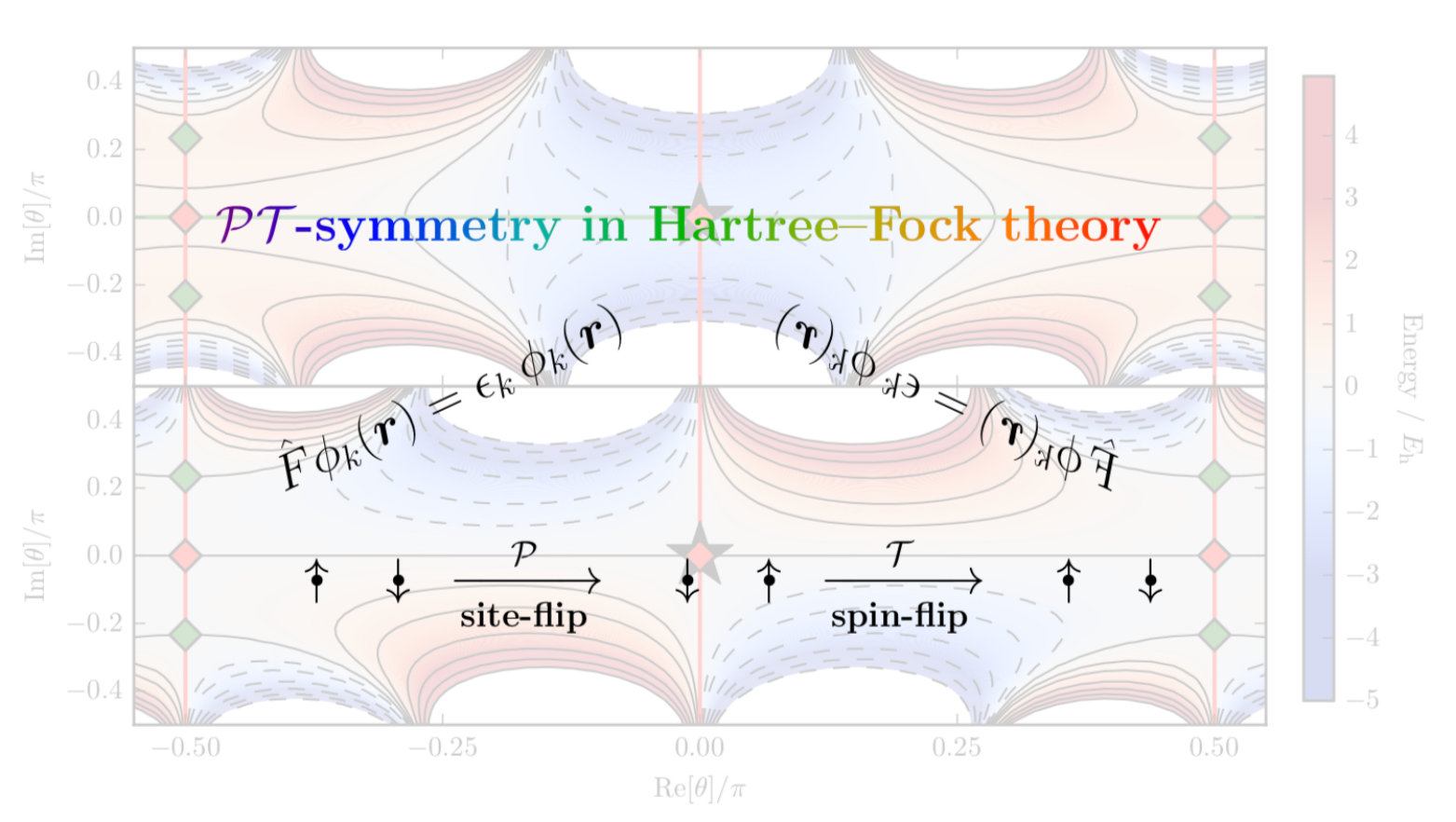 Figure 1
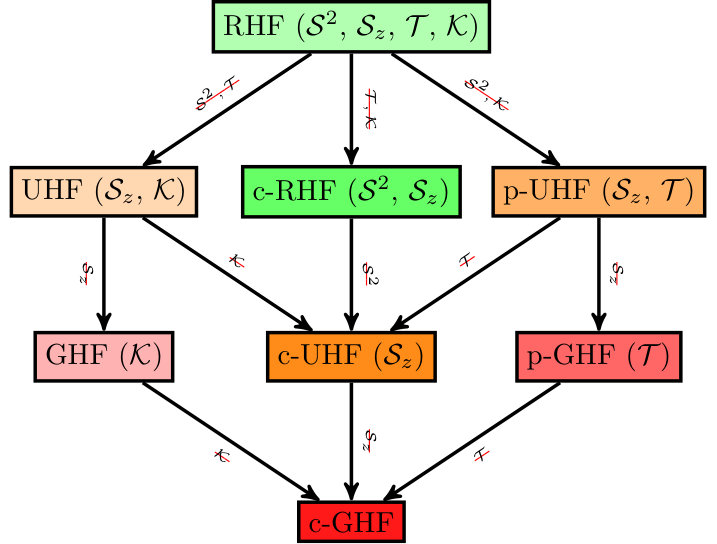 Figure 1
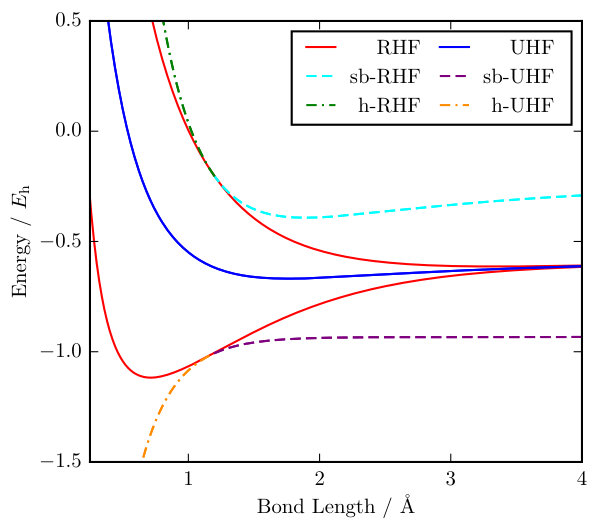 Figure 2
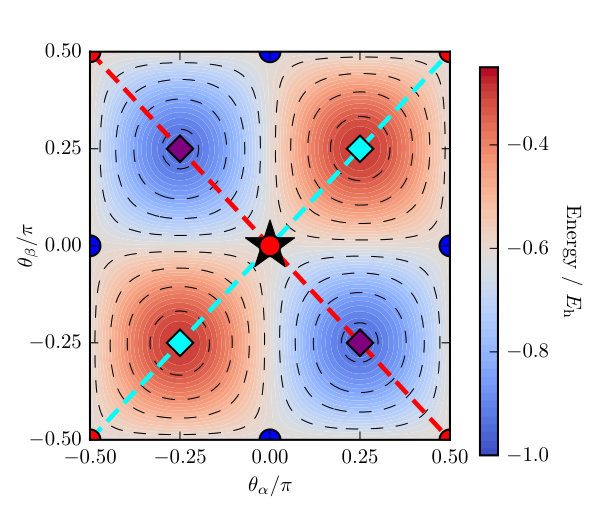 Figure 3
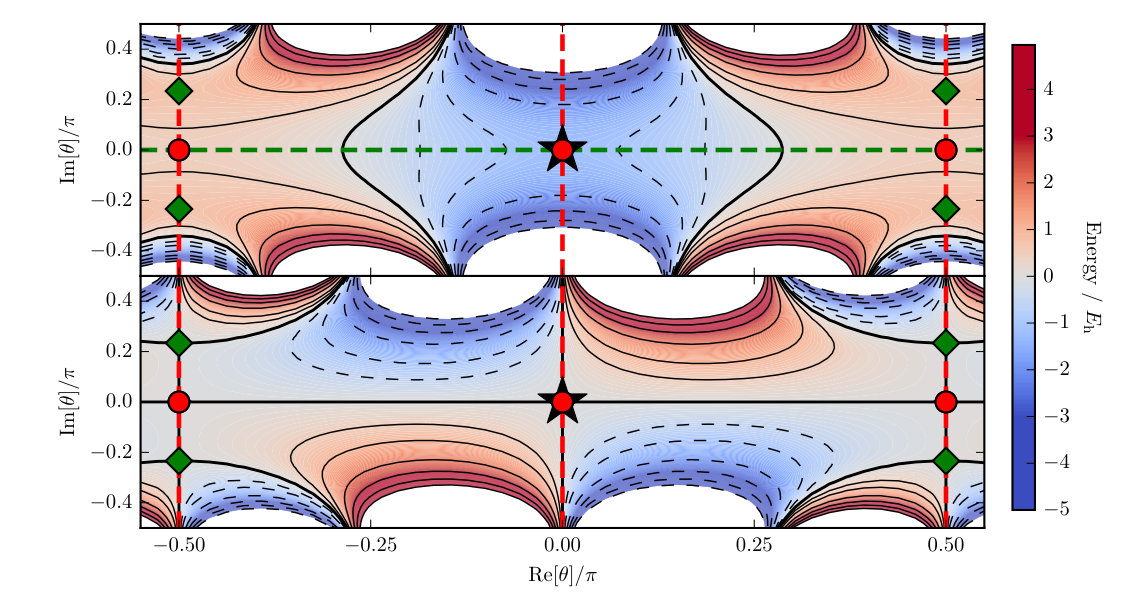 Figure 4
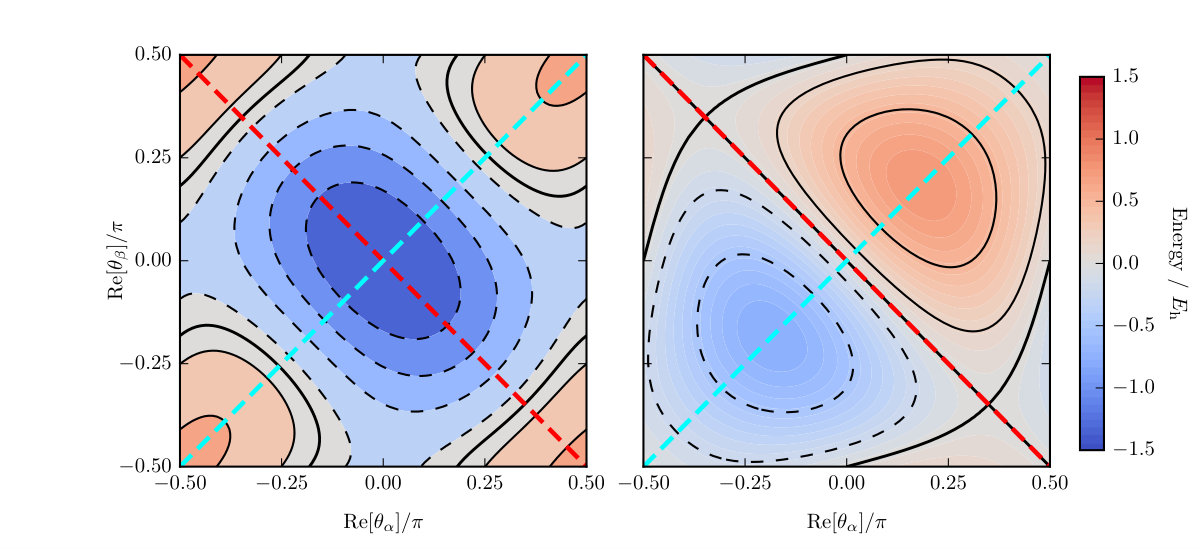 Figure 5
Peer Reviews
No public reviews on file for this paper yet. If you reviewed it on a platform where reviews are public (OpenReview, ICLR, NeurIPS, ICML), you can paste yours below so the community can read it here.
Videos
No videos yet. Explain this paper in a talk, walkthrough, or lecture? Add one.
††thanks: Corresponding author
-Symmetry in Hartree–Fock Theory
Hugh G. A. Burton
Department of Chemistry, University of Cambridge, Lensfield Road, Cambridge, CB2 1EW, U.K.
Alex J. W. Thom
Department of Chemistry, University of Cambridge, Lensfield Road, Cambridge, CB2 1EW, U.K.
Pierre-François Loos
Laboratoire de Chimie et Physique Quantiques (UMR 5626), Université de Toulouse, CNRS, UPS, France
Abstract
-symmetry — invariance with respect to combined space reflection and time reversal — provides a weaker condition than (Dirac) Hermiticity for ensuring a real energy spectrum of a general non-Hermitian Hamiltonian. -symmetric Hamiltonians therefore form an intermediate class between Hermitian and non-Hermitian Hamiltonians. In this work, we derive the conditions for -symmetry in the context of electronic structure theory, and specifically, within the Hartree–Fock (HF) approximation. We show that the HF orbitals are symmetric with respect to the operator if and only if the effective Fock Hamiltonian is -symmetric, and vice versa. By extension, if an optimal self-consistent solution is invariant under , then its eigenvalues and corresponding HF energy must be real. Moreover, we demonstrate how one can construct explicitly -symmetric Slater determinants by forming doublets (i.e. pairing each occupied orbital with its -transformed analogue), allowing -symmetry to be conserved throughout the self-consistent process. Finally, considering the \ceH2 molecule as an illustrative example, we observe -symmetry in the HF energy landscape and find that the spatially symmetry-broken unrestricted HF wave functions (i.e. diradical configurations) are -symmetric, while the spatially symmetry-broken restricted HF wave functions (i.e. ionic configurations) break -symmetry.
I Introduction
Symmetry is an essential concept in quantum mechanics for describing properties that are invariant under particular transformations. Physical observables, for example, must be totally symmetric under the group of symmetry operations corresponding to a quantum system, and the exact wave function must transform according to an irreducible representation of this group. However, for approximate self-consistent methods such as Hartree–Fock (HF)Szabo and Ostlund (1989) and Kohn–Sham density-functional theory (KS-DFT),Parr and Yang (1989) occurrences of symmetry-breaking are pervasive and appear intimately linked to the breakdown of the single-determinant mean-field approximation in the presence of strong correlation. From a chemical physicist’s perspective, the archetypal example is the appearance of symmetry-broken HF solutions for internuclear distances beyond the so-called Coulson–Fischer point in \ceH2 (),Coulson and Fischer (1949) where the two (antiparallel) electrons localise on opposing nuclei with equal probability to form a spin-density wave. Giuliani and Vignale (2005)
Ensuring correct symmetries and good quantum numbers is critical in finite systems, especially since, when lost, their restoration is not always a straightforward task. Jimenez-Hoyos et al. (2012); Cui et al. (2013); Qiu et al. (2017); Jake et al. (2018) However, applying symmetry “constraints” reduces flexibility, leading to the so-called symmetry dilemma between variationally lower energies and good quantum numbers.Lykos and Pratt (1963) In general, approximate HF wave functions preserve only some of the symmetries of the exact wave function for finite systems (see Fig. 1).Fukutome ; Stuber and Paldus (2003); Jiménez-Hoyos et al. (2011) The restricted HF (RHF) wave function, for example, forms an eigenfunction of the spin operators and by definition. Additionally, restriction of the RHF wave function to real values ensures invariance with respect to time reversal and complex conjugation . By allowing the different spins to occupy different spatial orbitals in the unrestricted HF (UHF) approach, the wave function can break symmetry under but not . Constraining the UHF wave function to real values conserves -symmetry, while the paired UHF (p-UHF) approach retains -symmetry and the complex UHF (c-UHF) wave function can break both - and -symmetry. The most flexible formulation, complex generalised HF (c-GHF), imposes none of these constraints, although paired (p-GHF) or real (GHF) variations maintain invariance with respect to or respectively. All of these formalisms are independent of the point group symmetry (including the parity operator ), although spatial symmetry may be imposed separately on the HF wave function.
However, the HF approximation is not restricted to Hermitian approaches. Holomorphic HF (h-HF) theory, for example, is formulated by analytically continuing real HF theory into the complex plane without introducing the complex conjugation of orbital coefficients.Hiscock and Thom (2014); Burton and Thom (2016); Burton et al. (2018) The result is a non-Hermitian Hamiltonian and an energy function that is complex analytic with respect to the orbital coefficients. In addition, non-Hermitian HF approaches are extensively used to study unbound resonance phenomena where they occur in nature.Moiseyev (2011)
Although initially intended as a method for extending symmetry-broken HF solutions beyond the Coulson–Fischer points at which they vanish,Hiscock and Thom (2014) h-HF theory also provides a more flexible framework for understanding the nature of multiple HF solutions in general. For example, through the polynomial nature of the h-HF equations, a mathematically rigorous upper bound for the number of real RHF solutions can be derived for two-electron systems.Burton et al. (2018) Moreover, by scaling the electron-electron interactions using a complex parameter , h-HF theory reveals a deeper interconnected topology of multiple HF solutions across the complex plane.Burton et al. (2019) By slowly varying in a similar (yet different) manner to an adiabatic connection in KS-DFT (without enforcing a density-fixed path),Seidl et al. (2018) one can then “morph” a ground-state wave function into an excited-state wave function of a different symmetry via a stationary path of h-HF solutions, as we have recently demonstrated for a very simple modelSeidl (2007); Loos and Gill (2009, 2009); Loos and Bressanini (2015); Loos et al. (2018) in Ref. Burton et al., 2019. In summary, h-HF theory provides a more general non-Hermitian framework with which the diverse properties of the HF approximation and its multiple solutions can be explored and understood.
In the present paper, we study a novel type of symmetry — known as -symmetry Bender and Boettcher (1998); Bender et al. (1999, 2002, 2002, 2003, 2004); Bender (2005); Bender et al. (2006); Bender (2007); Bender et al. (2007, 2008); Bender and Jones (2008, 2014); Bender (2015, 2016); Bender et al. (2017); Beygi et al. (2018); Liskow et al. (1972); Peng et al. (2014, 2014); Bender (2019) — in the context of electronic structure theory. -symmetry, i.e. invariance with respect to combined space reflection and time reversal , provides an alternative condition to (Dirac) Hermiticity which ensures real-valued energies even for complex, non-Hermitian Hamiltonians.Bender et al. (2002) Significantly, -symmetric quantum mechanics allows the construction and study of many new types of Hamiltonians that would previously have been ignored.Bender (2005) A Hermitian Hamiltonian, for example, can be analytically continued into the complex plane, becoming non-Hermitian in the process and exposing the fundamental topology of eigenstates. Moreover, -symmetric Hamiltonians can be considered as an intermediate class between Hermitian Hamiltonians commonly describing closed systems (i.e. bound states) and non-Hermitian Hamiltonians which are peculiar to resonance phenomena (i.e. open systems) where they naturally appear (see, for example, Ref. Moiseyev, 2011).
Despite receiving significant attention across theoretical physics, Bender (2019) to our knowledge -symmetry remains relatively unexplored in electronic structure. In the current work, we provide a first derivation of the conditions for -symmetry in electronic structure, and specifically, within HF theory for closed systems. By doing so, we hope to bridge the gap to -symmetric physics, paving the way for future developments in electronic structure that exploit -symmetry, for example novel wave function Ansätze or unusual approximate Hamiltonians. Atomic units are used throughout.
II -symmetric Hamiltonians
II.1 Spinless -Symmetry
To ensure a real energy spectrum and conservation of probability, it is commonly believed that a physically acceptable Hamiltonian must be Hermitian, i.e. , where † denotes the combination of complex conjugation (∗) and matrix transposition (⊺). Although the condition of Hermiticity is sufficient to ensure these properties, it is not by any means necessary. In particular, as elucidated by Bender and coworkers, Bender and Boettcher (1998) the family of -symmetric Hamiltonians, Bender and Boettcher (1998); Bender (2016) defined such that or where , provides a new more general class of Hamiltonians that allows for the possibility of non-Hermitian and complex Hamiltonians while retaining a physically sound quantum theory.Bender et al. (2002) Note that but and/or may not commute with .Bender (2007)
The textbook example of a -symmetric Hamiltonian is Bender (2019)
[TABLE]
which has been extensively studied by Bender and coworkers. Bender and Boettcher (1998); Bender et al. (1999, 2002, 2002, 2003, 2004); Bender (2005); Bender et al. (2006); Bender (2007); Bender et al. (2007); Bender (2015, 2016); Bender et al. (2017) From the standard action of and , where
[TABLE]
it is clear that the application of the combined space-time reflection , where
[TABLE]
leaves the Hamiltonian (1) unchanged. Moreover, although obviously complex, this Hamiltonian has a real, positive spectrum of eigenvalues!
Generalising the Hamiltonian (1) to the more general parametric family of -symmetric Hamiltonians Bender and Boettcher (1998)
[TABLE]
one discovers a more complex structure. It has been observed Bender and Boettcher (1998) and proved Dorey et al. that, for and a particular set of boundary conditions (the eigenfunctions must decay exponentially in well-defined sectors known as Stokes wedges Bender (2019)), the Hamiltonian (4) has an entirely positive and real spectrum, while for , there are some complex eigenvalues which appear as complex conjugate pairs. More specifically, in particular regions of parameter space, some eigenvalues coalesce and disappear by forming a pair of complex conjugate eigenvalues. The region where some of the eigenvalues are complex is called the broken -symmetry region (i.e. some of the eigenfunctions of are not simultaneously eigenfunctions of ), while the region where the entire spectrum is real is referred to as the unbroken -symmetry region. Amazingly, these -symmetry phase transitions have been observed experimentally in electronics, microwaves, mechanics, acoustics, atomic systems and optics, Bittner et al. (2012); Chong et al. (2011); Chtchelkatchev et al. (2012); Doppler et al. (2016); Guo et al. (2009); Hang et al. (2013); Liertzer et al. (2012); Longhi (2010); Peng et al. (2014, 2014); Regensburger et al. (2012); Rüter et al. (2010); Schindler et al. (2011); Szameit et al. (2011); Zhao et al. (2010); Zheng et al. (2013); Choi et al. (2018); Goldzak et al. (2018) and the parameter values where symmetry breaking occurs [ in the case of Hamiltonian (4)] correspond to the appearance of exceptional points,Heiss and Sannino (1990, 1991); Heiss (1999); Dorey et al. (2009); Heiss (2012, 2016); Choi et al. (2018); Lefebvre and Moiseyev (2010); Liertzer et al. (2012); Mailybaev et al. (2005); Zhang et al. (2018) the non-Hermitian analogues of conical intersections.Yarkony (1996)
II.2 Electron -Symmetry
-symmetric systems involving particles with non-zero spin, in our case electrons, are much less studied than their spinless counterparts. However, a number of studies have focused on this subject in recent years.Jones-Smith and Mathur (2010); Cherbal and Trifonov (2012); Beygi et al. (2018); Beygi and Klevansky (2018) In what follows, we consider the spinor basis and . A single-particle state is then represented by the column vector
[TABLE]
where and are the and components of respectively. Note that, although a relativistic version of -symmetric quantum mechanics can be formulated, Jones-Smith and Mathur (2014) here we ignore effects such as spin-orbit coupling and consider only the non-relativistic limit.
The linear parity operator acts only on the spatial components and satisfies , where is the identity operator. Its action in the spinor basis can be represented by the block-diagonal matrix
[TABLE]
where represents the action of in the spatial basis.
In contrast, deriving the action of is a little more involved. Fundamentally, is required to be an anti-linear operator, .Ballentine (1998); Weinberg (1995) However, for systems containing particles with non-zero spin, the reversal of spin-angular momentum under the action of must also be included such that, for a given spin operator , we obtain . Although a more detailed discussion on the nature of for particles of general spin is provided in Appendix A, here we focus on only the most relevant results.
In the bosonic case, a basis can always be found in which is represented simply as .Jones-Smith and Mathur (2010) Here is the distributive anti-linear complex-conjugation operator which acts only to the right by convention and does not have a matrix representation.Ballentine (1998) Applying in algebraic manipulations can lead to some non-intuitive results, and particular care must be exercised. In contrast, the representation of for electrons (i.e. spin- particles) is given by .Jones-Smith and Mathur (2010) To see why this must be the case, consider expressing a spin operator in a basis of the Pauli spin matrices , where
[TABLE]
and . Simply taking (as in the bosonic case) yields
[TABLE]
which clearly does not give the desired outcome. In contrast, taking the form yieldsJones-Smith and Mathur (2010)
[TABLE]
therefore satisfying the correct behaviour . Finally, consider also the behaviour of , for which
[TABLE]
Significantly, in fermionic systems, must be applied four times to return to the original state, leading to the action of time-reversal in fermionic systems being classified as odd.Jones-Smith and Mathur (2010)
Overall, in the spinor basis, the action of on can be represented by
[TABLE]
To find the representation of the combined operator, we simply combine the results of Eqs. (6) and (11) to obtain
[TABLE]
II.3 -doublet
A direct result of the odd character under is that it is impossible to find a single fermionic state that is invariant under the operator. Instead, the closest analogue is a pair of states assembled into a -doublet Jones-Smith and Mathur (2010) of the form
[TABLE]
where and are both eigenvectors of a -symmetric Hamiltonian. The action of on a -doublet is then given by
[TABLE]
where the pair of eigenvectors have been simply swapped along with the introduction of a single minus sign. We shall see later that the use of Slater determinants as antisymmetric many-electron wave functions enables strict -invariance. Note that invariance under implies that the energies of and are related by complex conjugation, while the additional assumption of unbroken -symmetry implies that and must form degenerate pairs with real energies. Jones-Smith and Mathur (2010) Finally we note the inverse relationships and which, in combination, yield .
III -Symmetry in Hartree–Fock
III.1 Hartree–Fock in practice
In the HF approximation, the wave function for a system of electrons is represented by a single Slater determinant constructed from a set of occupied one-electron molecular orbitals as
[TABLE]
where is the anti-symmetrising operator.Szabo and Ostlund (1989) The single-particle orbitals are expanded in a finite-size direct product space of (one-electron) real spatial atomic orbital basis and the spinor basis as
[TABLE]
where and represent the and components of respectively. The coefficients and are used to define the Slater determinant, and can be considered as components of a matrix with the form
[TABLE]
where and are sub-matrices representing the expansions of and .
In general, the atomic orbital basis set is not required to be orthogonal, although a real matrix can always be found such that , where is the overlap matrix between atomic orbitals. One particularly convenient choice is , but other choices are possible. Szabo and Ostlund (1989) Without loss of generality, we assume in the following that we are working in an orthogonal basis.
As an approximate wave function, does not form an eigenfunction of the true electronic Hamiltonian . Instead, is identified by optimising the HF energy defined by the expectation value for a given inner product as
[TABLE]
The optimal set of HF molecular orbital coefficients are determined using a self-consistent procedure. On each iteration , an effective one-electron “Fock” Hamiltonian is constructed using the current occupied set of orbitals , such that , where and are the one- and two-electron parts of the Fock matrix and is the density matrix at the th iteration. The new optimal molecular orbitals are then obtained by diagonalising , i.e. where is a diagonal matrix of the orbital energies, and the process is repeated until self-consistency is reached.Szabo and Ostlund (1989) At convergence we find , demonstrating that, only at self-consistency, the Fock and density matrices commute. (We drop the index for converged quantities.) Note that is linear with respect to , and that and are iteration independent and pre-computed at the start of the calculation.
Crucially, although the true -electron Hamiltonian is always Hermitian, the process of dressing using the HF orbitals can lead to a non-Hermitian effective one-electron Hamiltonian. In fact, the symmetry of and can depend of the specific choice of the inner product in Eq. (18). For example, the most common choice is the Dirac Hermitian inner product , leading to Hermitian density and Fock matrices , and explicitly enforcing real energies. Alternatively, the complex-symmetric inner product requires complex-symmetric density and Fock matrices , with energies that are complex in general. In contrast to complex-Hermitian HF, the complex-symmetric variant provides the unique analytic continuation of real HF for complex orbital coefficients. This non-Hermitian formulation is used in h-HF theory to ensure solutions exist over all geometries,Hiscock and Thom (2014); Burton and Thom (2016); Burton et al. (2018, 2019) and for describing resonance phenomena through non-Hermitian approaches.Moiseyev (2011)
In what follows, we employ the complex-symmetric inner product to explore the conditions for -symmetry under the HF approximation and understand under what circumstances is real. In particular, we make use of the non-Hermitian h-HF formulation since this provides the natural mathematical extension of real h-HF for complex orbital coefficients.Burton et al. (2018) We note that rigorous formulations of -symmetric quantum mechanics introduce an additional linear operator and the inner product to define a positive-definite inner product and ensure conservation of probability, although identifying is often non-trivial.Bender et al. (2002); Bender (2019) However, as an inherently approximate approach, HF theory requires only a well-defined inner product. In our case, since the Fock matrix is explicitly complex-symmetric, its eigenvectors naturally form an orthonormal set under without needing to introduce the inner product.
III.2 One-electron picture
We turn now to the behaviour of the one-electron density, Fock matrices, and orbital energies under the -operator. First consider the relationship between the complex-symmetric density matrix and the equivalent density matrix constructed using the -transformed coefficients denoted . The combined operator can be represented as the product , where is a real (linear) unitary matrix. Jones-Smith and Mathur (2010) Remembering that only acts on everything to the right, we subsequently find
[TABLE]
where . As a result, the density matrix constructed using the -transformed coefficients is a -similarity transformation of the density matrix constructed using the original set of coefficients. Consequently, if a set of coefficients is -symmetric, then the density matrix must be as well, and vice versa.
Next consider the symmetry of the Fock matrix , which, due to its dependence on , inherits the symmetry of the density used to construct it. Assuming that is -symmetric, i.e. , we find
[TABLE]
This result is trivial since is linear with respect to . Moreover, since the one- and two-electron parts of the Fock matrix are -symmetric, i.e. and , we find
[TABLE]
By equating Eqs. (20) and (21) we see that, if is -symmetric, then is also -symmetric. As a result, the symmetry of on a given iteration is dictated by the symmetry of the electron density from the current iteration . By extension, the symmetry of the new molecular orbitals is controlled by the symmetry of and, if one starts with a -symmetric guess , then -symmetry can be conserved throughout the self-consistent process. Furthermore, since is -symmetric if and only if the effective Fock Hamiltonian is -symmetric (and vice versa), the existence of -symmetry in HF can be identified by considering only the symmetry of the density itself.
Self-consistency of the HF equations requires the eigenvectors, which satisfy , to be equivalent to the coefficients used to build itself. In other words, and commute and share the same set of eigenvectors. Acting on the left with and exploiting the fact that yields
[TABLE]
where we have used the result of Eq. (21) and the property that is both anti-linear and distributive (see above) such that . Combining with the result of Eq. (19), we can draw two conclusions. Firstly, if a given set of orbital coefficients represents an optimised self-consistent HF solution with eigenvalues , then its -transformed counterpart must also be a self-consistent solution with eigenvalues . Secondly, and by extension, if an optimal self-consistent solution is invariant under (i.e. ), then its eigenvalues must be real.
III.3 Many-electron picture
We turn now to the symmetry of the full HF Slater determinant and its associated energy . In the many-electron picture, the -operator for an -electron system is given as a product of one-electron operators,
[TABLE]
where and are the parity and time-reversal operators acting only on the single-particle orbital occupied by electron . From the determinantal form of [see Eq. (15)], its symmetry under can be extracted as a product of its constituent orbitals symmetries.
Now, let us consider the relationship between the total HF energies of the two coefficient matrices and . Noting that and exploiting the invariance of the trace to cyclic permutations, i.e. , we find
[TABLE]
Note that and, since acts only to the right, its application on the far right-hand side has no effect. Therefore, by applying to both sides and inserting in the middle, we find explicitly
[TABLE]
Exploiting the distributive nature of over the matrix product within the trace, and since the reality of provides , we can migrate the operators to find
[TABLE]
where we employ the result of Eq. (21) and remember that is -symmetric. Overall we conclude that the respective HF energies corresponding to the coefficient matrices and are related by complex-conjugation. Clearly by extension the HF energy of a -symmetric set of orbital coefficients must be real.
III.4 Hartree–Fock -doublet
To construct a set of occupied orbitals in the structure of a -doublet [see Eq. (13)], we require an explicit form of the matrix . The linear parity operator acts only on the spatial basis and can be represented in the full direct product space by the Kronecker product , giving
[TABLE]
where is a real matrix representation of in the spatial basis, satisfying . ( denotes the identity matrix of size .) As a result, the combined operator can be represented by the matrix constructed from the Kronecker product , such that
[TABLE]
In the coefficient matrix representation [see Eq. (17)], a -doublet can then be constructed by pairing each occupied orbital with its -transformed analogue, giving
[TABLE]
where and form sub-matrices representing the paired orbitals of the -doublet. The action of on a -doublet is then
[TABLE]
where the last line exploits the anti-symmetry of a determinantal wave function under the permutation of two columns in . Moreover, since the many-electron representation of is given by
[TABLE]
we see that it is only possible to define a -symmetric state in systems with (i.e. ) where the occupied orbitals are paired in the structure of a -doublet of the form given by Eq. (29).
The behaviour of a -doublet can be illustrated by considering a simple two-electron Slater determinant constructed from the orbitals
[TABLE]
Thanks to the linearity and antisymmetry properties of determinants, Eq. (30) immediately yields
[TABLE]
IV Example of \ceH2
We now turn our attention to the didactic example of the \ceH2 molecule in a minimal molecular orbital (orthogonal) basis
[TABLE]
where and are the left and right atomic orbitals and defines their overlap. Without loss of generality, this paradigmatic two-electron system can be considered as a one-dimensional system, and the spatial representation of the parity operator in the basis is given by
[TABLE]
In the following, all calculations are performed with the STO-3G (minimal) atomic basis. For the sake of simplicity we focus on the spin manifold.
IV.1 Real Orbital Coefficients
In addition to the spatially symmetry-pure configurations , and (corresponding to two RHF and a doubly degenerate pair of UHF solutions), it is well known that, in the dissociation limit, a pair of degenerate spatial symmetry-broken UHF (sb-UHF) solutions develop (dashed purple line in Fig. 2) in which the electrons localise on opposite atoms.Szabo and Ostlund (1989) These solutions have a form given by the parameterisation
[TABLE]
where represents the optimised spatial orbital corresponding to the UHF solution, and and are the spatial coordinates of electrons 1 and 2 respectively. In the dissociation limit, the optimal UHF solutions can be represented schematically as the diradical configurations (spin-density waves)
[TABLE]
However, apart from the chemically intuitive idea of electron correlation, the justification for solutions existing with this particular form is not obvious.
Similarly (although less studied), a pair of degenerate spatial symmetry-broken RHF (sb-RHF) solutions develop (dashed cyan line in Fig. 2) with a form given by the parameterisation
[TABLE]
where represents the optimised spatial orbital corresponding to the RHF solution. In the dissociation limit, the sb-RHF solution corresponds to the localisation of both electrons on the same atom to produce ionic configurations (charge-density waves)
[TABLE]
Both sb-RHF and sb-UHF solutions are extrema of the HF equations. However, instead of being minima like the sb-UHF solutions, the sb-RHF states correspond to maxima of the HF equations (see Fig. 2).
Rather than considering the parameterisations (36) and (38), we instead consider the full UHF space using two molecular orbitals
[TABLE]
where and are rotation angles controlling the degree of orbital mixing. The occupied orbital coefficient matrix in the combined spatial and spinor direct product basis is therefore given by
[TABLE]
Considering the complex-symmetric density matrix with the block form
[TABLE]
the condition for -symmetry [see Eq. (19)] becomes
[TABLE]
Using the parameterisation (41), this condition reduces to
[TABLE]
which is satisfied when
[TABLE]
Clearly for the case of real UHF, i.e. , Eq. (45) is satisfied only when for , upon which we obtain the constrained molecular orbitals
[TABLE]
In fact, the condition for -symmetry in real UHF aligns exactly with the parameterisation provided by Eq. (36), as shown in Fig. 3. Furthermore, it is relatively simple to understand why this symmetry must exist. Since the orbital coefficients (and by extension the density) are all real, the action of simply interconverts the two spin states (spin-flip), while the spatial (parity) operator corresponds to a site-flip. The spin-flip already gives rise to the symmetry plane , along which all RHF solutions lie (cyan line in Fig. 3). The combined action of spin- and site-flip then essentially gives rise to the -symmetry operation for real orbitals.
Schematically, the operation can be depicted as
[TABLE]
Therefore, in the minimal basis considered here, the (real) sb-UHF solutions (which can be labelled as diradical configurations) are -symmetric. In contrast, following a similar argument, the sb-RHF solutions (38) (corresponding to ionic configurations) are definitely not -symmetric:
[TABLE]
However, appropriate linear combinations of these ionic configurations (i.e. multideterminant expansions) can be made to satisfy -symmetry. We note that the spatial symmetry-pure and states both also satisfy -symmetry, while the solutions are -symmetry broken and are interconverted by the operator.
In summary, the real UHF energy surface shows -symmetry along the line coinciding with Eq. (36), justifying the use of this parameterisation for locating sb-UHF solutions. As real orbital coefficients lead to purely real energies, states interconverted by this symmetry are strictly degenerate rather than being related by complex conjugation. The well-known sb-UHF states, resembling diradical configurations, lie on this line and are -symmetric solutions with their occupied orbitals forming a -doublet.
IV.2 Complex Orbital Coefficients
Next we turn to the case of complex orbital coefficients with . The constraint (45) can then be decomposed into real and imaginary parts
[TABLE]
Along these lines of symmetry we expect the holomorphic HF energy to be real, while we expect the energies of density matrices interconverted by the operator to be related by complex conjugation.
To visualise this symmetry, we first consider the h-RHF case where and for which we expect -symmetric densities when
[TABLE]
for . Since the holomorphic energy is complex in general, we plot the real and imaginary parts of the energy separately at a bond length of Å as functions of and in Fig. 4. As expected, lines of -symmetry exist along the values of satisfying Eq. (74), where the energy either side is related by complex conjugation and the energy along the line of symmetry is real. More explicitly, the (vertical) red lines in Fig. 4 along and coincide with the condition (74) for -symmetry and correspond to real energies. The energy is also real along the line (green line), since this corresponds to the -symmetry line along which the orbital coefficients are all real. As illustrated in Fig. 4, the h-RHF stationary solutions (green diamonds) lie on the red line, and the h-RHF states are therefore -symmetric. Since the h-RHF solutions are all spin-flip symmetric, we can justify -symmetry in the energy landscape as the combination of site-flip (centre of inversion at ) and complex conjugation.
Finally, we consider the complex h-UHF case. As the h-UHF energy is a function of four real variables (real and imaginary parts of and ), we illustrate the general symmetry using the specific case and visualise the energy for \ceH2 at a bond length of Å in Fig. 5. We find the lines of spin-flip (cyan) and -symmetry (red) occur as in Fig. 3, where now the complex-conjugation of energies on either side of the line of -symmetry is explicitly observable. Since the site-flip operation takes , we cannot observe its effect on the energy landscape under the constraint , and we note that there are no h-UHF stationary points in Fig. 3. Moreover, inspection of the stationary points corresponding to the h-UHF solutions in Fig. 2 reveals that they follow the form , for , leading to the conclusion that the h-UHF solutions in \ceH2 are not -symmetric.
In summary, the -symmetric stationary h-HF solutions for \ceH2 are the , , sb-UHF and h-RHF states, although the effect of -symmetry can be observed throughout the holomorphic HF energy landscape. For these -symmetric solutions, the molecular orbital coefficients possess the -doublet form [see Eq. (29)]. Stationary points that do not correspond to -symmetric states (including the sb-RHF and h-UHF solutions) occur in pairs which are interconverted by the action of , and the onset of -symmetry breaking coincides with the disappearance of the h-RHF or the sb-UHF solutions at Coulson–Fischer (quasi-exceptional) points Burton et al. (2019) in a similar manner to other types of symmetry-breaking in HF theory. Fukutome ; Stuber and Paldus (2003); Jiménez-Hoyos et al. (2011)
V Concluding remarks
In this work, we have outlined the conditions for -symmetry — a weaker condition than Hermiticity which ensures real energies — in electronic structure, and specifically the HF approximation. In particular, we have explored the existence of -symmetry in the non-Hermitian h-HF formulation that forms the rigorous analytic continuation of real HF. Our most important results are:
A set of molecular orbitals is -symmetric if and only if the effective Fock Hamiltonian is -symmetric, and vice versa. 2. 2.
Starting with a -symmetric guess density matrix, -symmetry can be conserved throughout the self-consistent process. 3. 3.
If an optimal self-consistent solution is invariant under , then its eigenvalues and corresponding HF energy must be real. 4. 4.
-symmetry can be explicitly satisfied by constructing the molecular orbitals coefficients in the structure of a so-called -doublet, i.e. pairing each occupied orbital with its -transformed analogue. 5. 5.
Slater determinants built from -doublets lead to -symmetric many-electron wave functions.
-symmetry provides a novel intrinsic symmetry in the HF energy landscape, where the energies of densities interconverted by are related by complex conjugation. For real HF, this symmetry corresponds to the combination of the parity and spin-flip operations. As an illustrative example, we have considered the \ceH2 molecule in a minimal basis, where we have observed the effects of -symmetry on the HF energy landscape. In particular, we have found that the sb-UHF and h-RHF wave functions are -symmetric, while the sb-RHF and h-UHF wave functions break -symmetry but occur in complex conjugate pairs related by the operator. The transitions between broken and unbroken -symmetry regions coincide with the disappearance of the h-RHF or the sb-UHF solutions at Coulson–Fischer points.
By demonstrating the existence of -symmetric solutions with real energies in the HF approximation, we remove the rigorous condition of Hermiticity that is usually applied in electronic structure theory. We are currently working on the implementation of restricted, unrestricted and generalised HF self-consistent approaches that explicitly enforce this symmetry. Ultimately, by bridging the gap between -symmetric physics and quantum chemistry, we hope to pave the way for the development of new classes of non-Hermitian Hamiltonians with real eigenvalues in electronic structure theory.
Acknowledgements.
H.G.A.B. thanks the Cambridge Trust for a studentship and A.J.W.T. thanks the Royal Society for a University Research Fellowship (UF110161). We also thank Bang Huynh for insightful conversations throughout the development of this work.
Appendix A -Symmetry for General Spins
We loosely follow Weinberg’s discussion on the nature of in Ref. Weinberg, 1995, although we use notation more familiar to electronic structure. Since the action of reverses angular momentum, we require spin-angular momentum operators to satisfy
[TABLE]
Considering a general spin state , we can then show
[TABLE]
In combination, these results imply
[TABLE]
for some complex value .
To identify the functional form of , we use the ladder operators which, due to the anti-linear character of , satisfy
[TABLE]
From the standard ladder operator relationship
[TABLE]
where , we find
[TABLE]
Alternatively, from the result of Eq. (78) we can explicitly identify
[TABLE]
and
[TABLE]
Inserting Eq. (82) and Eq. (83) into the LHS and RHS of Eq. (81) respectively, and noting that , we find
[TABLE]
Here is an arbitrary complex value that is conventionally set to unity. As a result, the action of on a function , expressed in the basis with dimension , is given by
[TABLE]
where is an orthogonal matrix representing the action of on the spin eigenfunctions, given explicitly as
[TABLE]
Next, consider the specific matrices for various spin cases:
[TABLE]
Significantly, for the bosonic (integer ) case, is symmetric, i.e. , while in the fermionic (half-integer ) case, becomes skew-symmetric, i.e. . This observation leads to two key results. First, considering the operation , we find in the bosonic case and for the fermionic case. When combined with the relationship , this result leads directly to the even and odd character of for bosons and fermions respectively. Secondly, since is symmetric and orthogonal in the bosonic case, it can be decomposed into the form , where is orthogonal and is a diagonal matrix containing the eigenvalues of , each equal to or . Taking , we find
[TABLE]
Consequently, for the bosonic case, one can always find a transformation into a basis under which the action of time-reversal reduces to , described in Ref. Jones-Smith and Mathur, 2010 as a “canonical” bosonic basis. Similarly, in the fermionic case, the properties of skew-symmetric orthogonal matrices allow to be decomposed into the form ,Zumino (1962) where is orthogonal and takes the form
[TABLE]
As a result, the action of can be expressed as
[TABLE]
and thus, for fermionic systems, it is always possible to find a transformation into a canonical fermionic basis in which the action of time-reversal reduces to .Jones-Smith and Mathur (2010)
The reference list from the paper itself. Each links out to its DOI / PubMed record.
- 1Szabo and Ostlund (1989) Szabo, A.; Ostlund, N. S. Modern quantum chemistry ; Mc Graw-Hill: New York, 1989.
- 2Parr and Yang (1989) Parr, R. G.; Yang, W. Density-functional theory of atoms and molecules ; Oxford: Clarendon Press, 1989.
- 3Coulson and Fischer (1949) Coulson, C.; Fischer, I. XXXIV. Notes on the Molecular Orbital Treatment of the Hydrogen Molecule. Philos. Mag. 1949 , 40 , 386.
- 4Giuliani and Vignale (2005) Giuliani, G. F.; Vignale, G. Quantum theory of the electron liquid ; Cambridge University Press: Cambridge, 2005.
- 5Jimenez-Hoyos et al. (2012) Jimenez-Hoyos, C. A.; Henderson, T. M.; Tsuchimochi, T.; Scuseria, G. E. Projected Hartree-Fock Theory. J. Chem. Phys. 2012 , 136 , 164109.
- 6Cui et al. (2013) Cui, Y.; Bulik, I. W.; Jimenez-Hoyos, C. A.; Henderson, T. M.; Scuseria, G. E. Proper and improper zero energy modes in Hartree-Fock theory and their relevance for symmetry breaking and restoration. J. Chem. Phys. 2013 , 139 , 154107.
- 7Qiu et al. (2017) Qiu, Y.; Henderson, T. M.; Zhao, J.; Scuseria, G. E. Projected coupled cluster theory. J. Chem. Phys. 2017 , 147 , 064111.
- 8Jake et al. (2018) Jake, L. C.; Henderson, T. M.; Scuseria, G. E. Hartree–Fock Symmetry Breaking around Conical Intersections. J. Chem. Phys. 2018 , 148 , 024109.