Successive phase transitions and quantum magnetization plateau in the spin-1 triangular-lattice antiferromagnet Ba$_2$La$_2$NiTe$_2$O$_{12}$
Mutsuki Saito, Masari Watanabe, Nobuyuki Kurita, Akira Matsuo, Koichi, Kindo, Maxim Avdeev, Harald O. Jeschke, and Hidekazu Tanaka

TL;DR
This study investigates the magnetic properties and phase transitions of a spin-1 triangular-lattice antiferromagnet Ba$_2$La$_2$NiTe$_2$O$_{12}$, revealing successive magnetic transitions, a quantum magnetization plateau, and significant exchange interactions via experiments and DFT calculations.
Contribution
It provides the first detailed analysis of the magnetic phase transitions and quantum magnetization plateau in Ba$_2$La$_2$NiTe$_2$O$_{12}$, highlighting differences from tungsten analogs and confirming two-dimensional magnetic behavior.
Findings
Successive magnetic phase transitions at 9.8 K and 8.9 K.
Observation of a one-third magnetization plateau.
Large exchange interaction and good two-dimensionality confirmed by DFT.
Abstract
The crystal structure and magnetic properties of the spin-1 triangular-lattice antiferromagnet BaLaNiTeO are reported. Its crystal structure is trigonal , which is the same as that of BaLaNiWO [Y. Doi et al., J. Phys.: Condens. Matter 29, 365802 (2017)]. However, the exchange interaction K is much greater than that observed in the tungsten system. At zero magnetic field, BaLaNiTeO undergoes successive magnetic phase transitions at K and K. The ground state is accompanied by a weak ferromagnetic moment. These results indicate that the ground-state spin structure is a triangular structure in a plane perpendicular to the triangular lattice owing to the small easy-axis-type anisotropy. The magnetization curve exhibits the one-third plateau characteristic…
Click any figure to enlarge with its caption.
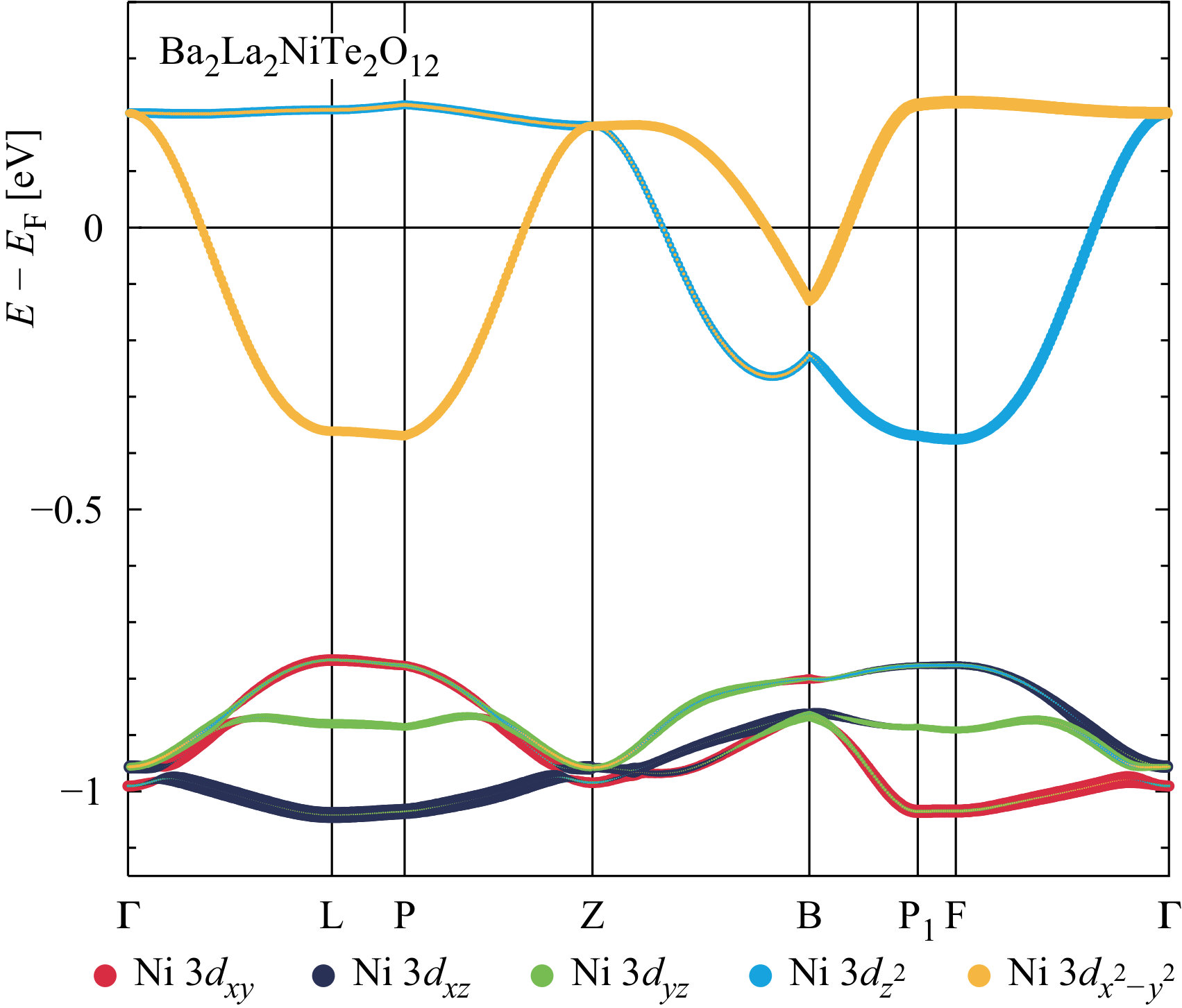 Figure 1
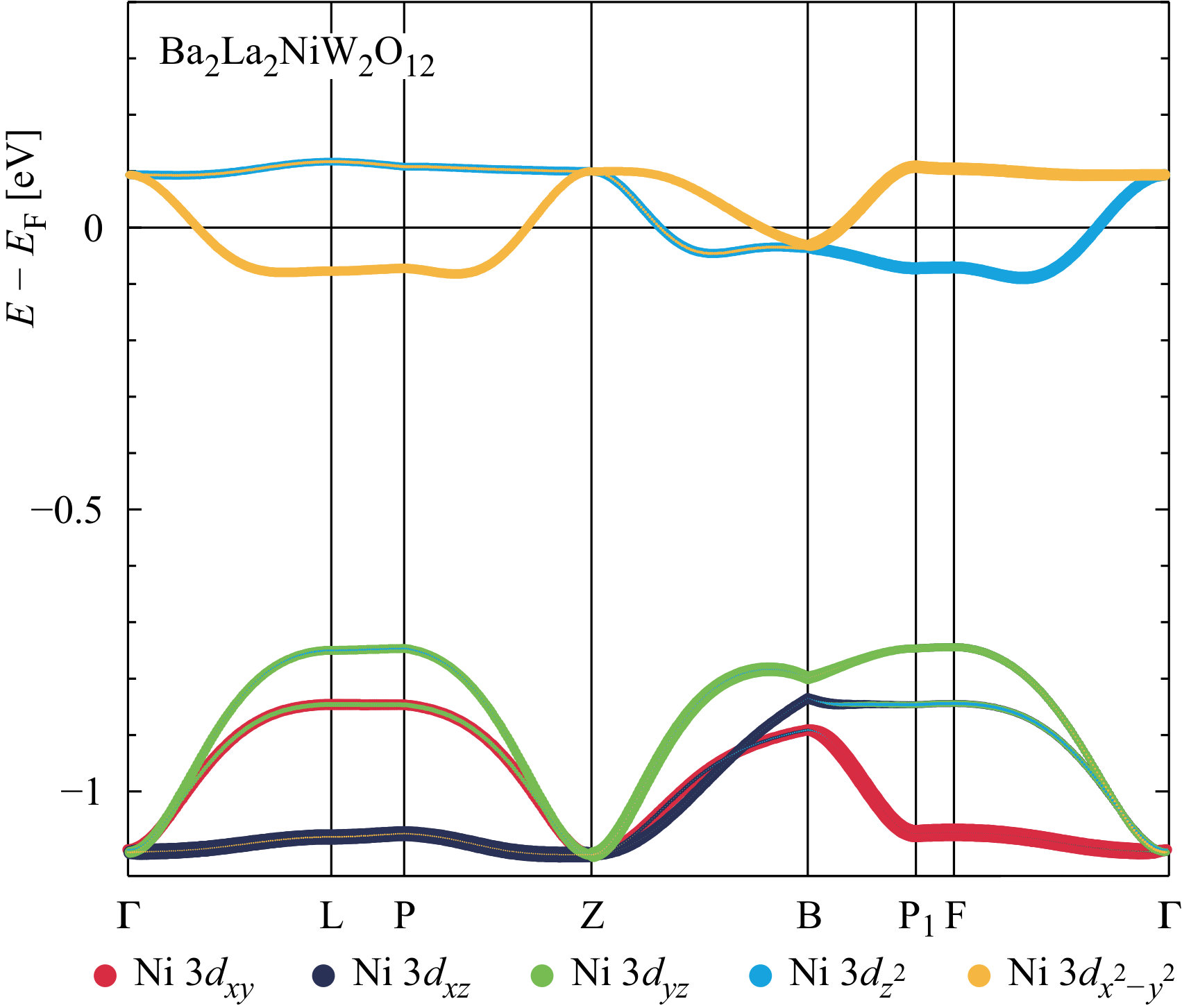 Figure 2
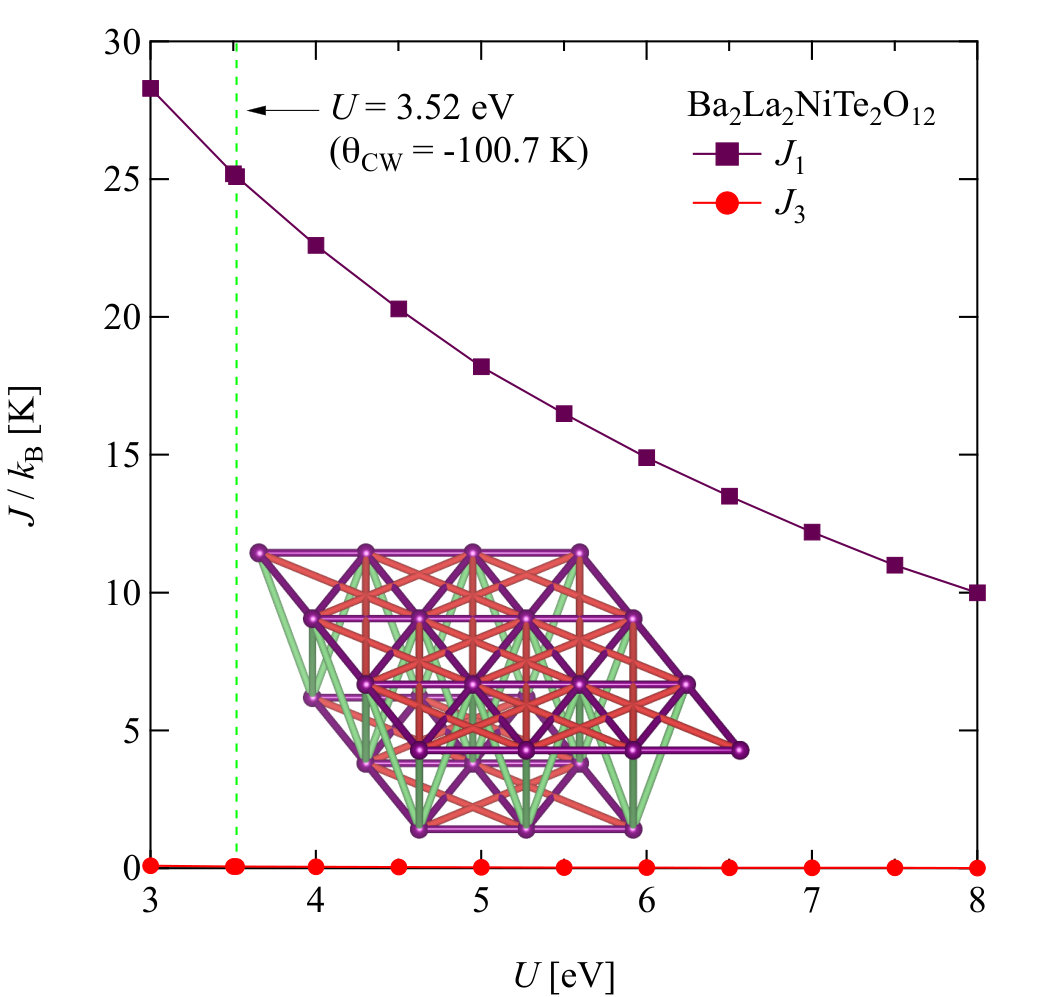 Figure 3
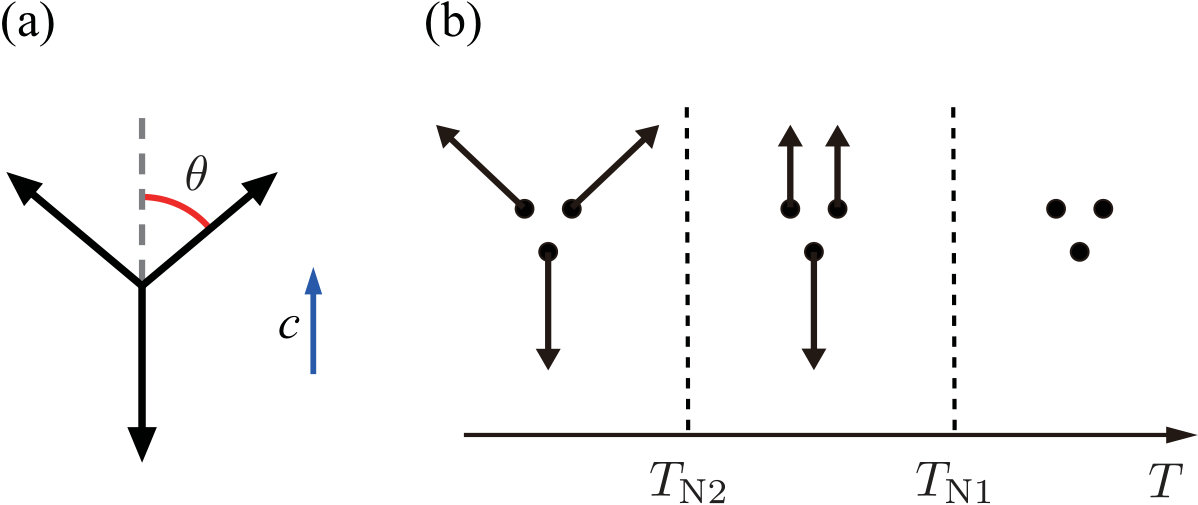 Figure 4
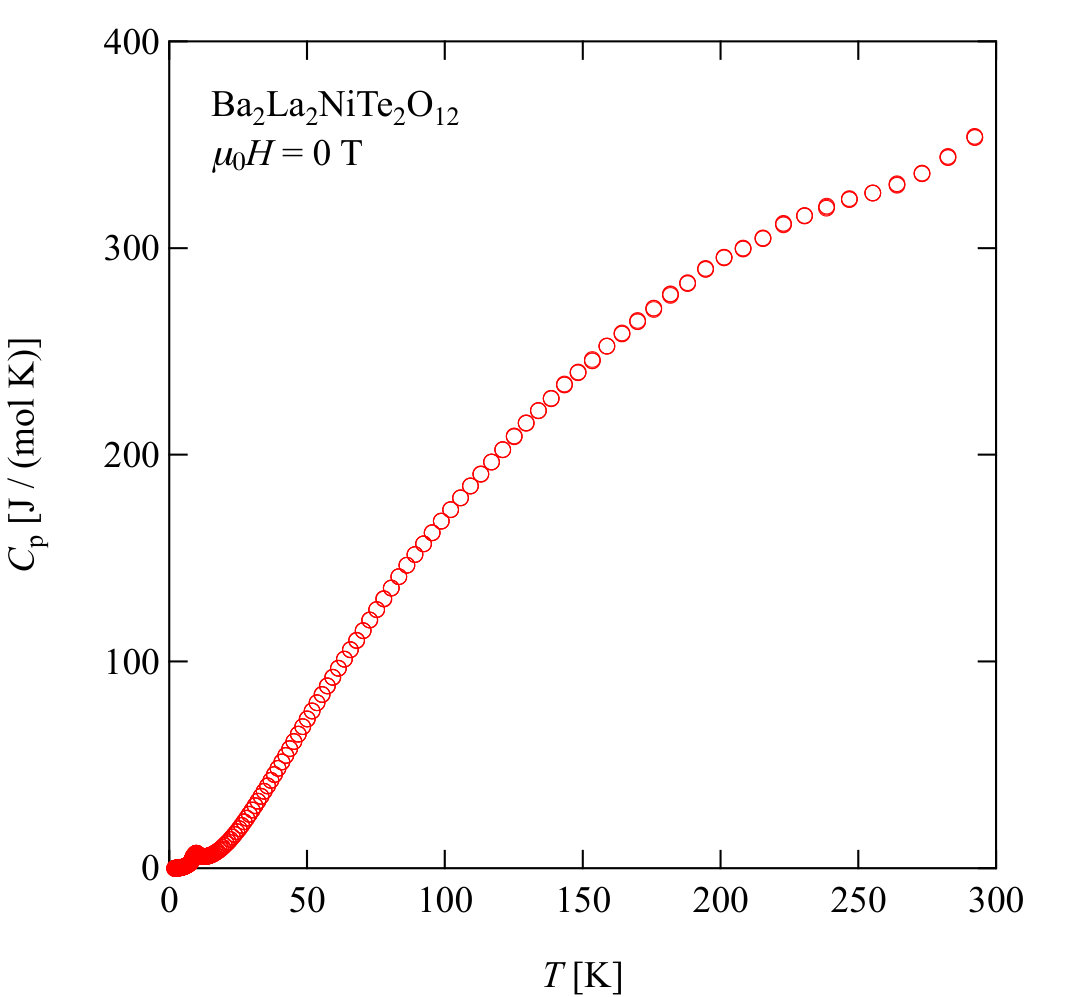 Figure 5
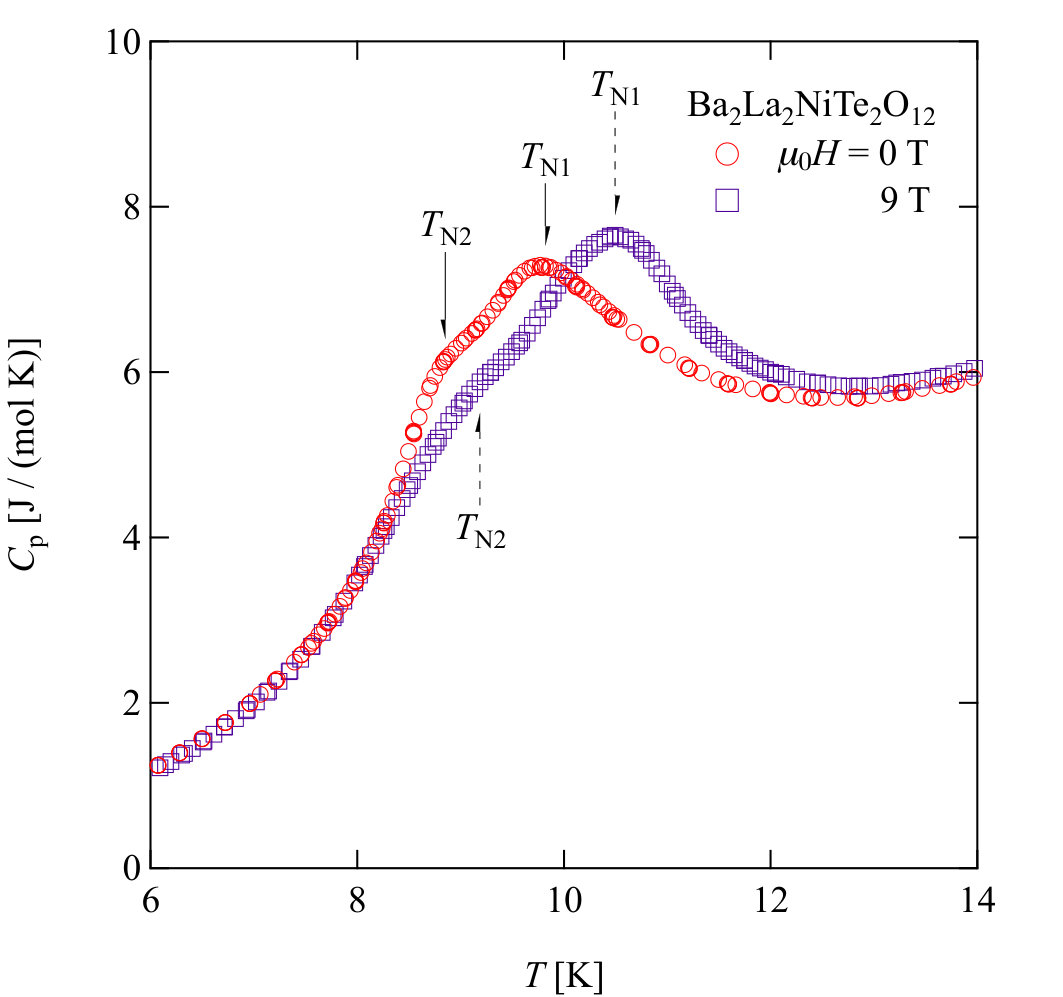 Figure 6
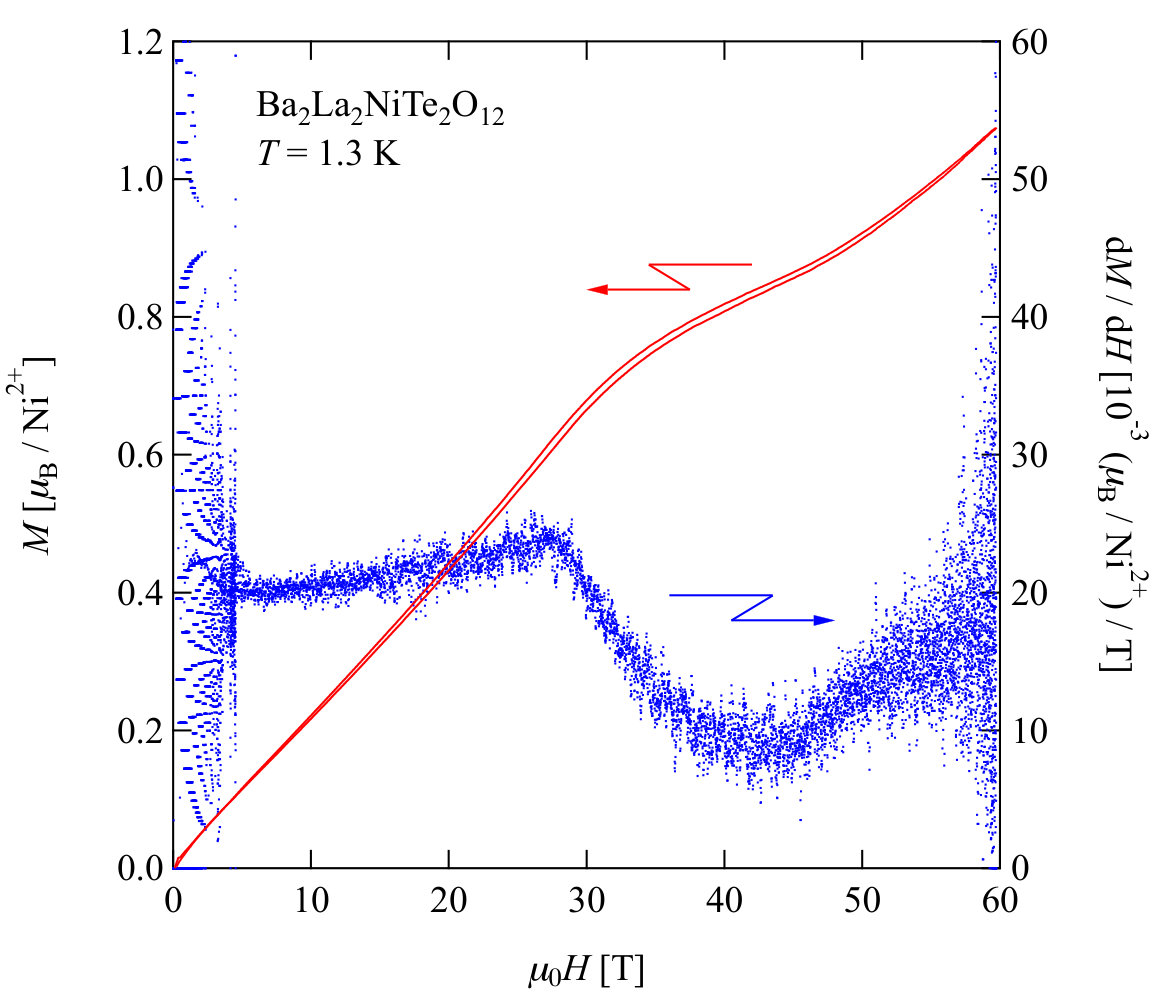 Figure 7
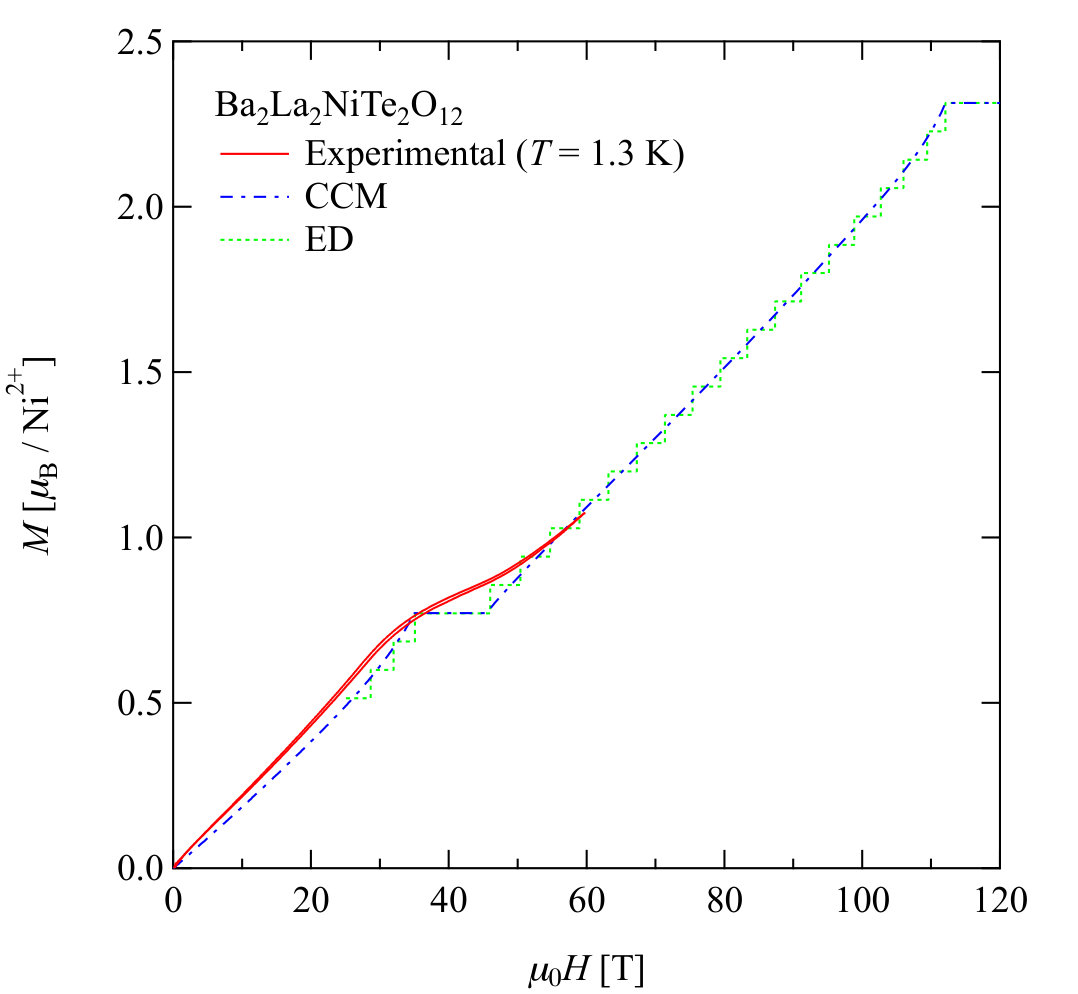 Figure 8
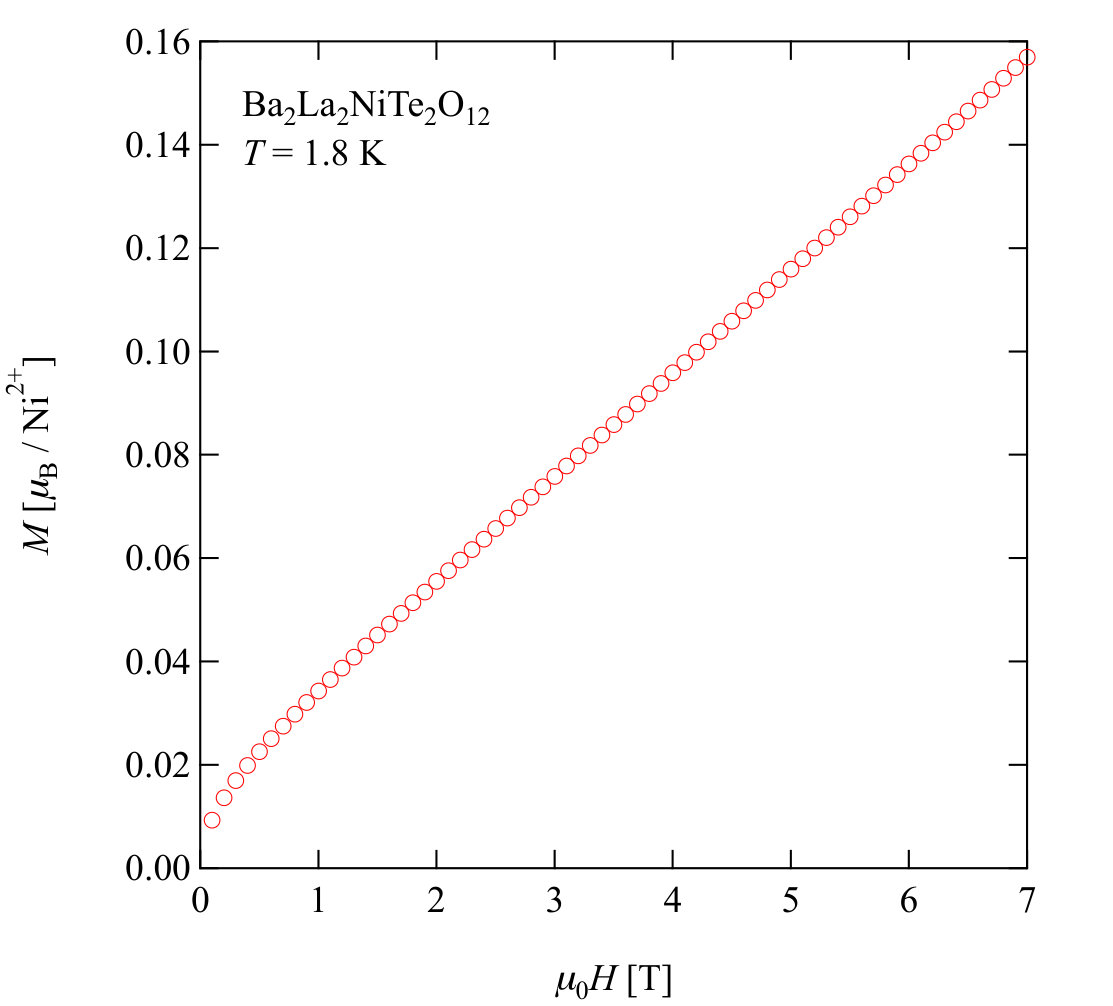 Figure 9
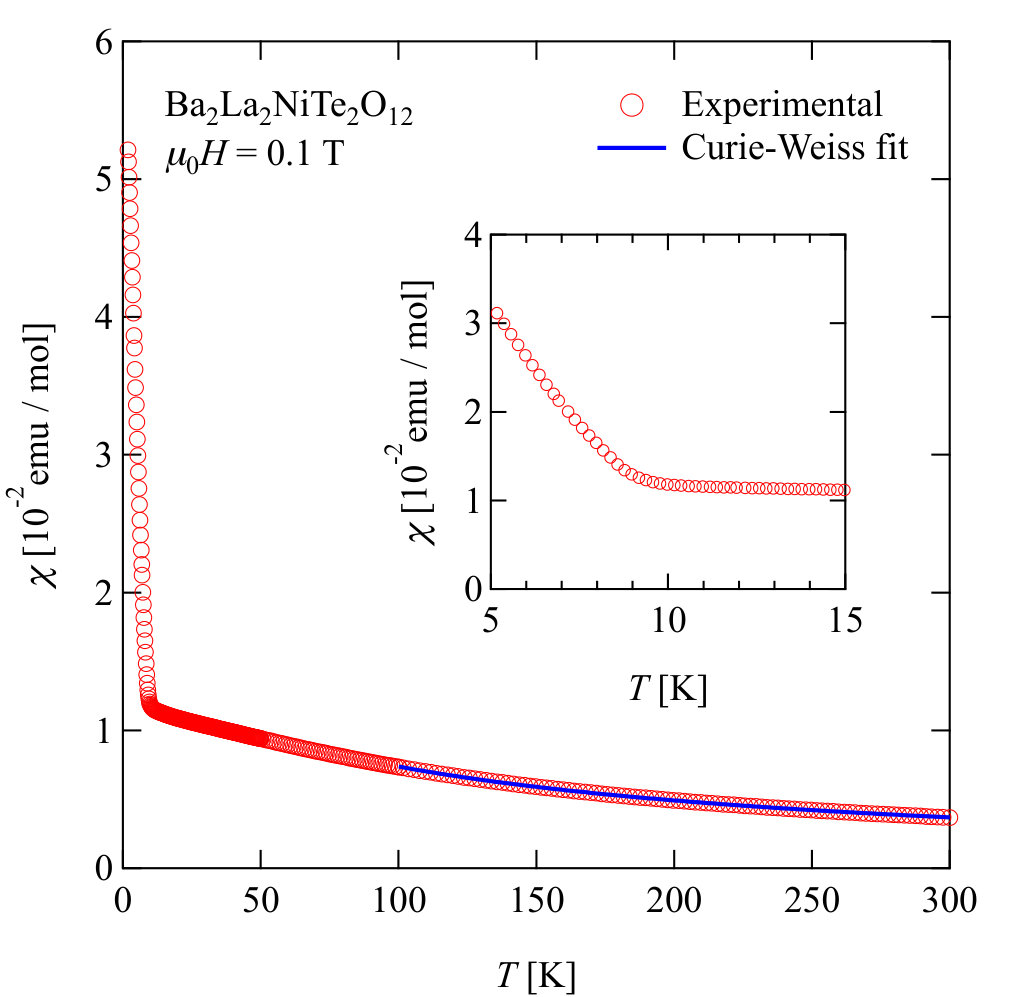 Figure 10
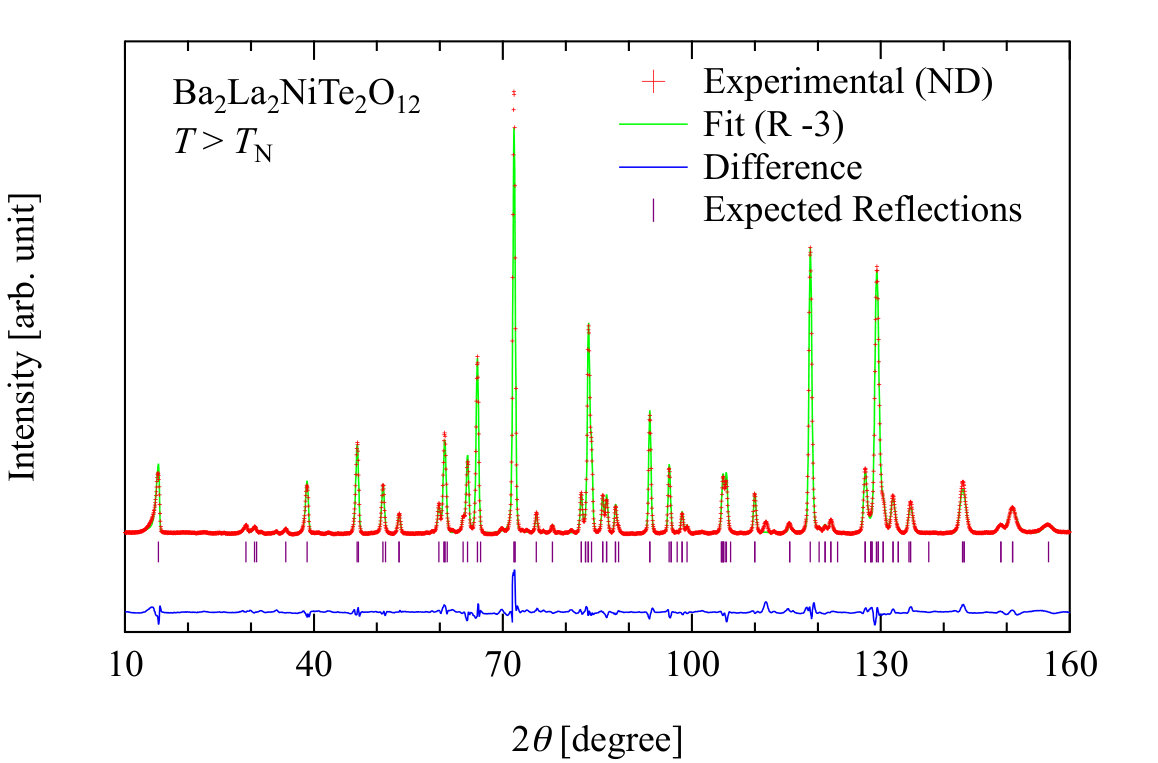 Figure 11
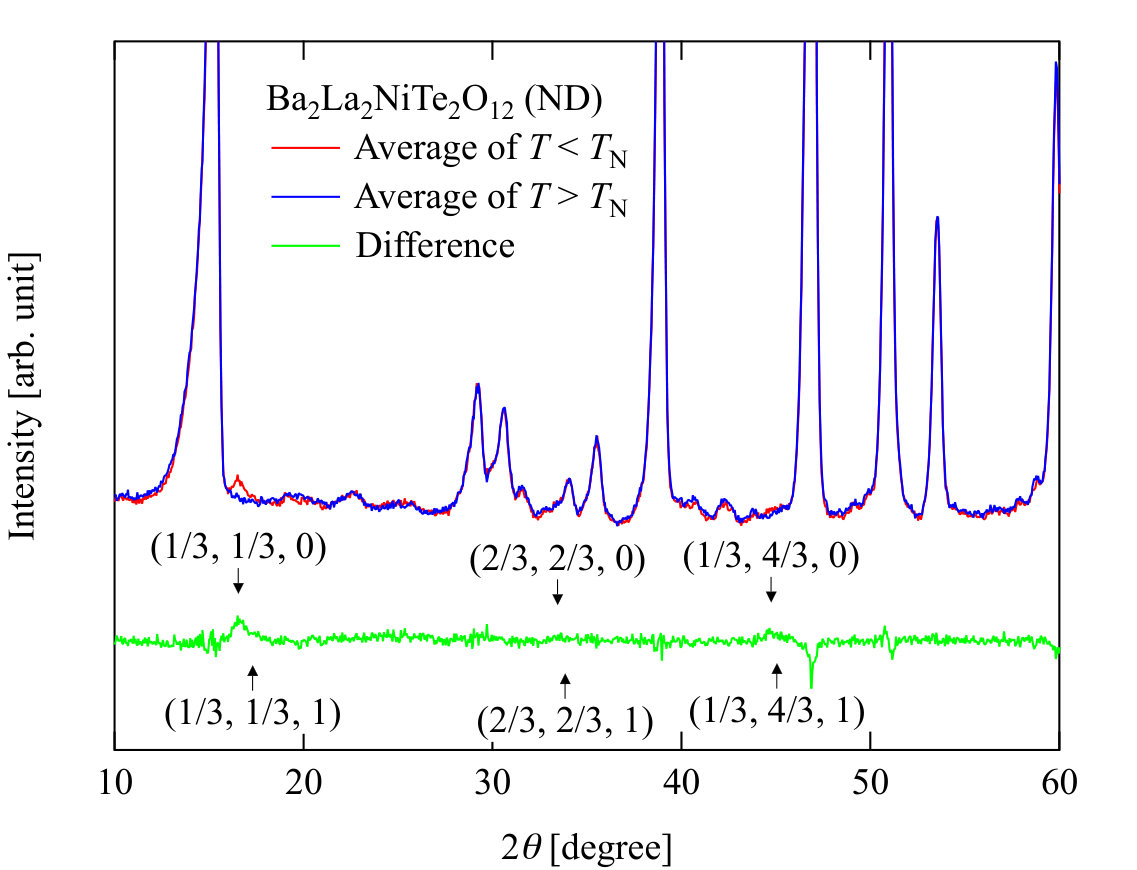 Figure 12
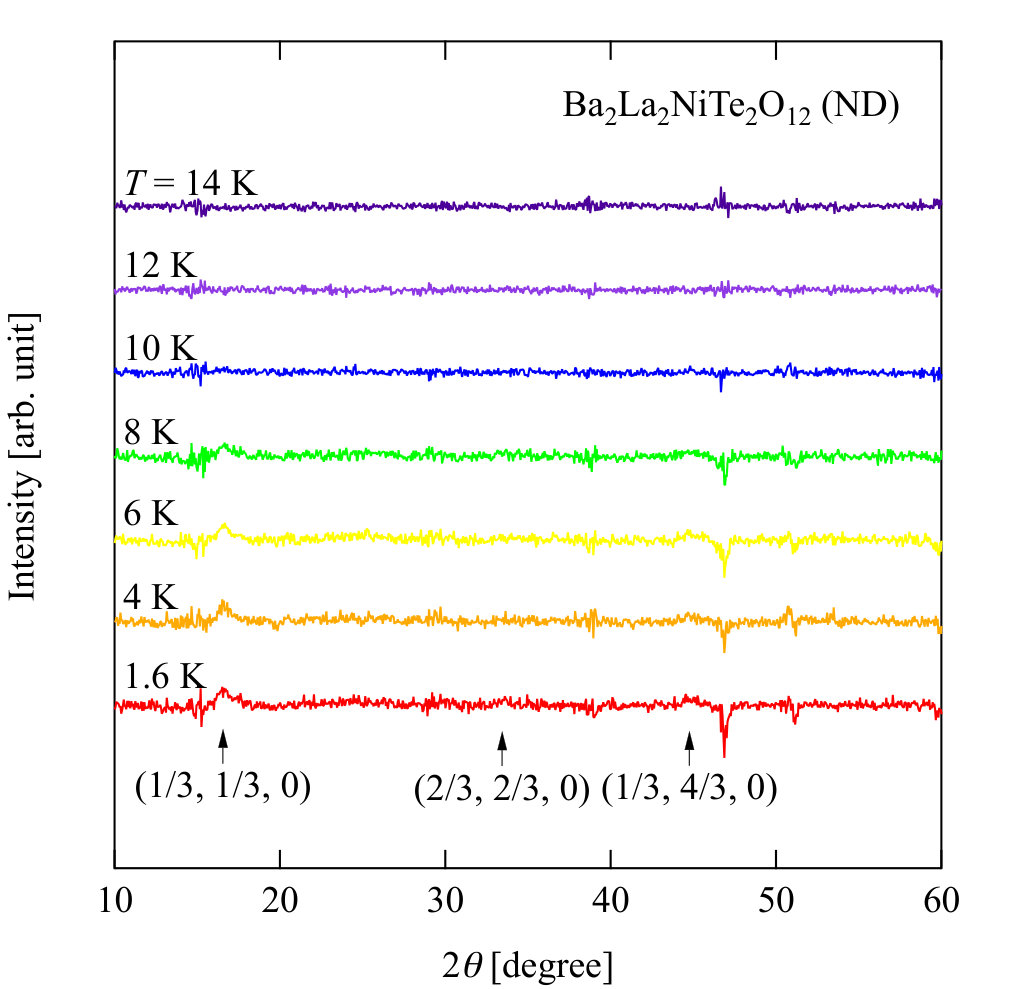 Figure 13
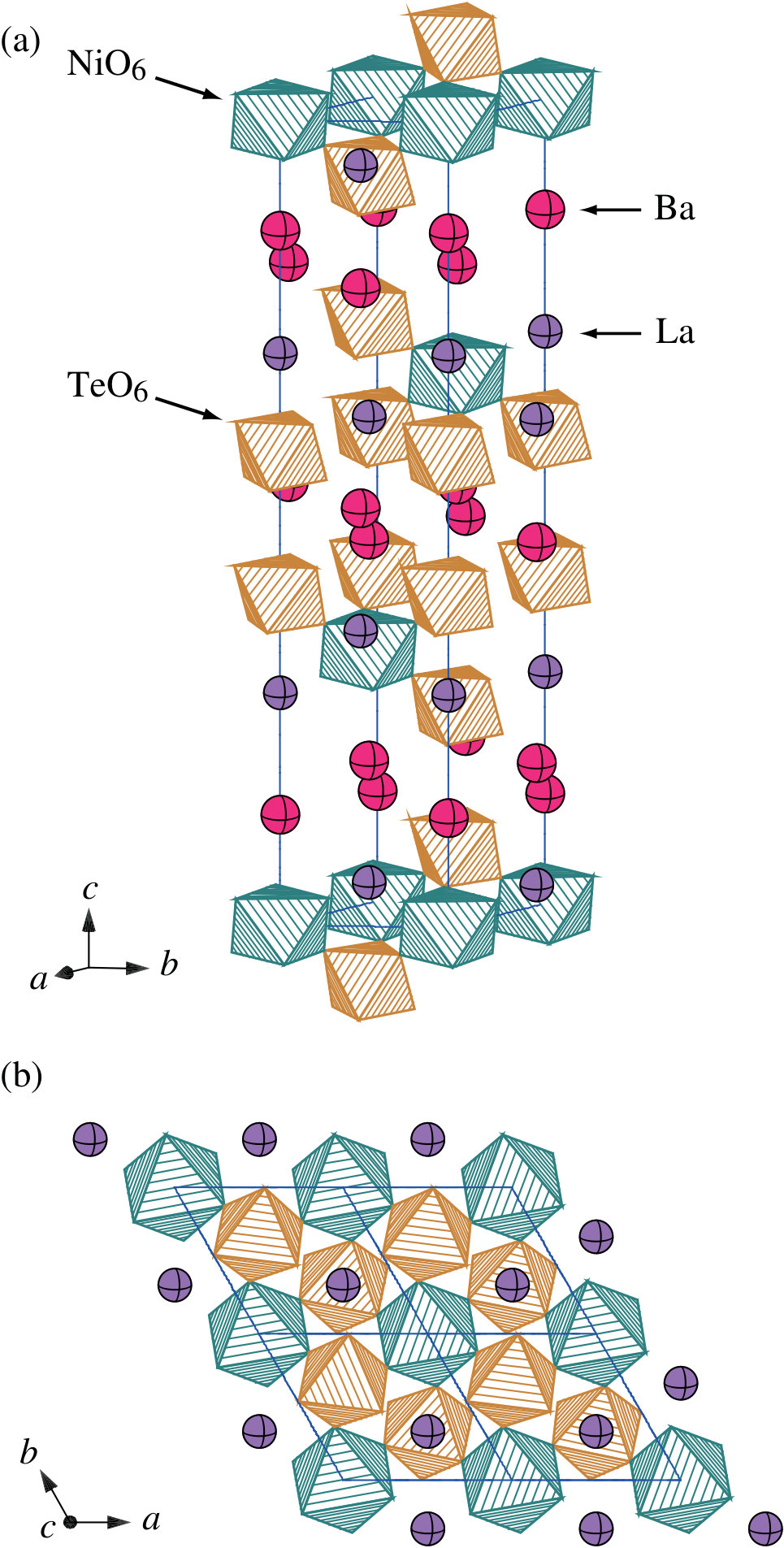 Figure 14
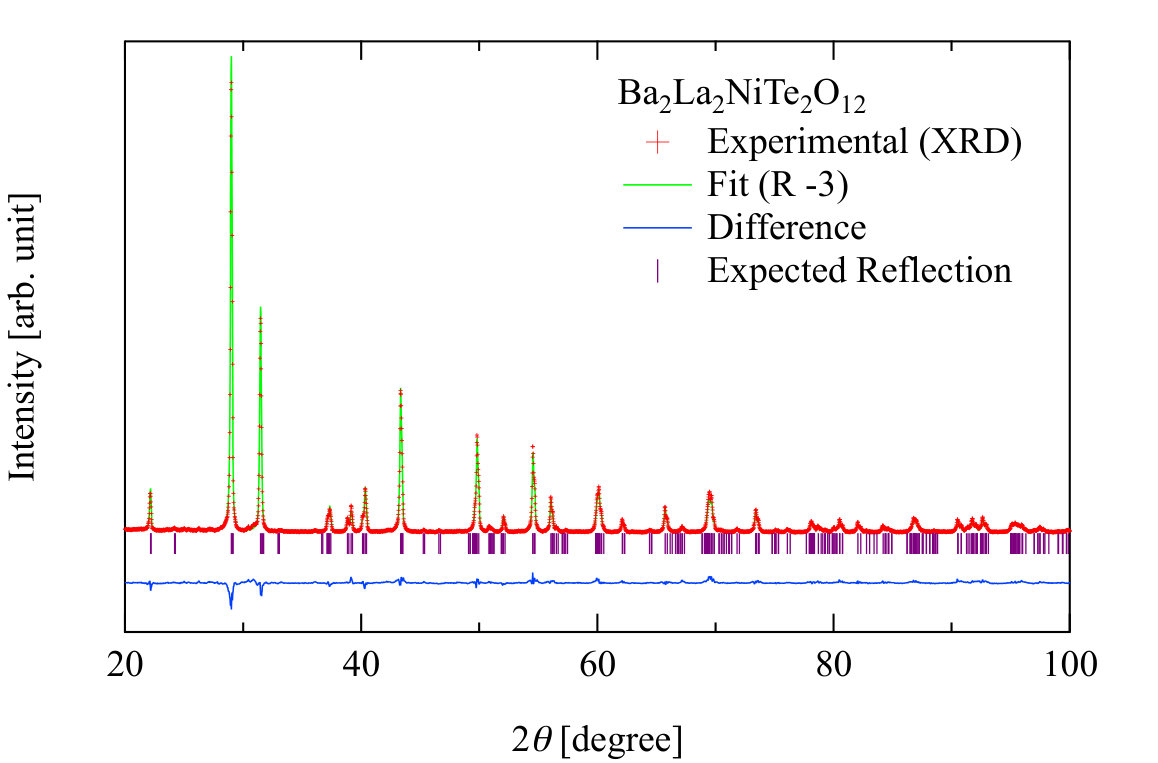 Figure 15
| Atom | Site | |||
| 6c | 0 | 0 | 0.13587(7) | |
| 6c | 0 | 0 | 0.28973(6) | |
| 3a | 0 | 0 | 0 | |
| 6c | 0 | 0 | 0.41560(7) | |
| 18f | 0.543(5) | 0.514(5) | 0.1186(3) | |
| 18f | 0.450(5) | 0.473(5) | 0.2965(4) | |
| Space group | ||||
| Å, Å; | ||||
| , , . | ||||
| Å2 for all atoms. | ||||
| Atom | Site | [Å2] | |||
|---|---|---|---|---|---|
| 6c | 0 | 0 | 0.1370(2) | 0.354 | |
| 6c | 0 | 0 | 0.2890(1) | 0.354 | |
| 3a | 0 | 0 | 0 | 0.437 | |
| 6c | 0 | 0 | 0.4150(1) | 0.377 | |
| 18f | 0.4631(4) | 0.4675(5) | 0.1168(1) | 0.877 | |
| 18f | 0.4339(4) | 0.4603(5) | 0.2947(1) | 0.877 | |
| Space group | |||||
| Å, Å; | |||||
| , , . | |||||
| [eV] | [K] | [K] | [K] | [K] |
|---|---|---|---|---|
| 3 | 28.3(1) | - | 0.09(1) | -113 |
| 3.5 | 25.2(1) | - | 0.07(1) | -101 |
| 3.52 | 25.1(1) | - | 0.07(1) | -100.7 |
| 4 | 22.6(1) | - | 0.06(1) | -91 |
| 4.5 | 20.3(1) | - | 0.05(1) | -81 |
| 5 | 18.2(1) | - | 0.04(1) | -73 |
| 5.5 | 16.5(1) | - | 0.03(1) | -66 |
| 6 | 14.9(1) | - | 0.03(1) | -60 |
| 6.5 | 13.5(1) | - | 0.02(1) | -54 |
| 7 | 12.2(1) | - | 0.02(1) | -49 |
| 7.5 | 11.0(1) | - | 0.02(1) | -44 |
| 8 | 10.0(1) | - | 0.01(1) | -40 |
| [Å] | 5.66827 | 9.72442 | 9.81773 |
| [eV] | [K] | [K] | [K] | [K] |
|---|---|---|---|---|
| 3 | 28.25(1) | 0.024(1) | 0.078(1) | -113 |
| 3.5 | 25.21(1) | 0.022(1) | 0.062(1) | -101 |
| 3.52 | 25.09(1) | 0.021(1) | 0.062(1) | -100.7 |
| 4 | 22.57(1) | 0.018(1) | 0.051(1) | -91 |
| 4.5 | 20.26(1) | 0.016(1) | 0.039(1) | -81 |
| 5 | 18.23(1) | 0.014(1) | 0.034(1) | -73 |
| [Å] | 5.66827 | 9.72442 | 9.81773 |
Peer Reviews
No public reviews on file for this paper yet. If you reviewed it on a platform where reviews are public (OpenReview, ICLR, NeurIPS, ICML), you can paste yours below so the community can read it here.
Videos
No videos yet. Explain this paper in a talk, walkthrough, or lecture? Add one.
Successive phase transitions and magnetization plateau in the spin-1 triangular-lattice antiferromagnet Ba2La2NiTe2O12 with small easy-axis anisotropy
Mutsuki Saito1
Masari Watanabe1
Nobuyuki Kurita1
Akira Matsuo2
Koichi Kindo2
Maxim Avdeev3,4
Harald O. Jeschke5
Hidekazu Tanaka1
1Department of Physics, Tokyo Institute of Technology, Meguro-ku, Tokyo 152-8551, Japan
2Institute for Solid State Physics, University of Tokyo, Kashiwa, Chiba 277-8581, Japan
3Australian Nuclear Science and Technology Organisation, Lucas Heights, NSW 2234, Australia
4School of Chemistry, The University of Sydney, Sydney 2006, Australia
5Research Institute for Interdisciplinary Science, Okayama University, Kita-ku, Okayama 700-8530, Japan
Abstract
The crystal structure and magnetic properties of the spin-1 triangular-lattice antiferromagnet Ba2La2NiTe2O12 are reported. Its crystal structure is trigonal , which is the same as that of Ba2La2NiW2O12 [Y. Doi et al., J. Phys.: Condens. Matter 29, 365802 (2017)]. However, the exchange interaction K is much greater than that observed in the tungsten system. At zero magnetic field, Ba2La2NiTe2O12 undergoes successive magnetic phase transitions at K and K. The ground state is accompanied by a weak ferromagnetic moment. These results indicate that the ground-state spin structure is a triangular structure in a plane perpendicular to the triangular lattice owing to the small easy-axis-type anisotropy. The magnetization curve exhibits the one-third plateau characteristic of a two-dimensional triangular-lattice Heisenberg-like antiferromagnet. Exchange constants are also evaluated using density functional theory (DFT). The DFT results demonstrate the large difference in the exchange constants between tellurium and tungsten systems and the good two-dimensionality of the tellurium system.
pacs:
75.10.Jm, 75.45.+j, 61.05.F-, 75.30.Et
††preprint: APS/123-QED
I Introduction
Triangular-lattice antiferromagnets (TLAFs) exhibit a variety of phase transitions in magnetic fields depending on magnetic anisotropy, spatial anisotropy and interlayer exchange interaction Collins ; Starykh2 . In particular, the magnetization plateau in TLAF has been attracting considerable attention. For two-dimensional (2D) classical spin TLAF with the easy-axis anisotropy, a magnetization plateau emerges at one-third of the saturation magnetization when a magnetic field is applied parallel to the easy axis Miyashita . The classical 1/3–magnetization plateau has been observed in quasi-2D large spin TLAFs GdPd2Al3 Kitazawa ; Inami and Rb4Mn(MoO4)3 Ishii .
The easy-axis anisotropy is crucial for stabilizing the 1/3–magnetization plateau in the classical spin TLAF. The plateau is absent in the Heisenberg TLAF and Heisenberg-like TLAF with the easy-plane anisotropy. However, for 2D quantum spin Heisenberg TLAFs, the 1/3–magnetization plateau can be stabilized in a wide magnetic field range by quantum fluctuation Nishimori ; Chubokov ; Nikuni ; Honecker ; Alicea ; Farnell ; Sakai ; Richter ; Hotta ; Yamamoto1 ; Sellmann ; Starykh2 ; Coletta . The 1/3–magnetization plateau is affected by the magnetic anisotropy. When a magnetic field is applied parallel to the symmetry axis, the magnetic field range of the 1/3–magnetization plateau is enhanced by the easy-axis anisotropy and suppressed by the easy-plane anisotropy Yamamoto1 ; Sellmann . The quantum 1/3–magnetization plateau has actually been observed in quasi-2D spatially anisotropic TLAF Cs2CuBr4 Ono1 ; Ono2 ; Fortune and uniform TLAF Ba3CoSb2O9 Shirata ; Zhou ; Susuki ; Quirion ; Koutroulakis , both of which have weak antiferromagnetic interlayer exchange interactions, and 3D TLAF CsCuCl3 Sera with strong ferromagnetic interlayer exchange interaction. All of these compounds have the weak easy-plane anisotropy.
Although the ground states in magnetic fields for the 2D spin-1/2 Heisenberg TLAF are well understood, the effects of the magnetic anisotropy Yamamoto1 ; Sellmann , spatial anisotropy Ono2 ; Fortune ; Starykh3 , interlayer exchange interaction Susuki ; Koutroulakis ; Yamamoto2 , spin quantum number Richter ; Coletta and thermal fluctuation on the ground states and phase diagram have not been sufficiently elucidated.
Recently, magnetic excitations in the spin-1/2 Heisenberg-like TLAF Ba3CoSb2O9 were investigated by inelastic neutron scattering experiments Zhou ; Ma ; Ito ; Kamiya . Unusual dynamical properties of single-magnon excitations predicted by theory such as the large downward quantum renormalization of excitation energies Starykh ; Zheng ; Chernyshev ; Mezio ; Mourigal ; Ghioldi and a rotonlike minimum at the M point Zheng ; Ghioldi ; Ghioldi2 were confirmed. A notable feature of the magnetic excitations observed in Ba3CoSb2O9 is a three-stage energy structure including intense dispersive excitation continua extending to a high energy six times the exchange constant Ito , which cannot be described by the current theory. These experimental results strongly indicate fractionalized spin excitations because the intense excitation continua cannot be explained in terms of conventional two-magnon excitations Ghioldi2 . For the experimental elucidation of unconventional magnetic excitations, quantum TLAFs with different spin quantum numbers such as spin-1 are necessary.
In this work, we investigated the crystal structure and magnetic properties of Ba2La2NiTe2O12. Although there is a brief report on the lattice constants and the space group of Ba2La2NiTe2O12 Autenrieth , details of the crystal structure and magnetic properties have not been reported. The structure of this compound was found to be the same as that of Ba2LaW2O12 ( = Mn, Co, Ni, Zn) Sack ; Li4 ; Rawl ; Doi , which have a uniform triangular lattice composed of transition metal ions . Figure 1 shows the crystal structure of Ba2La2NiTe2O12. An important feature of the crystal structure is that the magnetic triangular lattices are largely separated by layers of nonmagnetic ions; thus, we can expect good two-dimensionality.
Recently, the magnetic properties in the family of triangular-lattice magnets Ba2LaW2O12 ( = Mn, Co, Ni) Rawl ; Doi have been investigated by magnetic susceptibility, specific heat and neutron diffraction (ND) measurements. Unfortunately, the exchange interactions were found to be weakly antiferromagnetic Rawl or weakly ferromagnetic Doi . It is natural to assume that superexchange interactions between neighboring spins in the same triangular layer occur through O O and O W O paths. The superexchange through the former path should be antiferromagnetic, while the latter path leads to a ferromagnetic superexchange interaction because the filled outermost orbitals of nonmagnetic W6+ and Nb5+ ions are orbitals, as discussed in Refs. Yokota ; Koga . It is considered that the superexchange interactions via these two paths almost cancel in the tungsten compounds, resulting in a weakly antiferromagnetic or ferromagnetic total exchange interaction. Meanwhile, when the nonmagnetic W6+ ion is replaced by a Te6+ ion, for which the filled outermost orbital is a orbital, the superexchange interaction through the O Te O path becomes antiferromagnetic and the total exchange interaction should be strongly antiferromagnetic Yokota ; Koga .
This is our motivation for studying Ba2La2NiTe2O12. The exchange interaction in the triangular layer was found to be antiferromagnetic and strong as expected. We evaluated individual exchange constants using density functional theory (DFT). The DFT results demonstrate that the nearest-neighbor exchange interaction in the triangular layer is antiferromagnetic and predominant. As shown below, the 1/3–magnetization plateau characteristic of the quasi-2D TLAFs was observed in Ba2La2NiTe2O12. This compound is magnetically described as a quasi-2D spin-1 Heisenberg-like TLAF with small easy-axis-type anisotropy.
II Experimental details
A powdered sample of Ba2La2NiTe2O12 was prepared by a solid-state reaction in accordance with the chemical reaction in air. (Wako, 99.9%), (Wako, 99.99%), (Wako, 99%) and (Aldrich, 99.995%) were mixed in stoichiometric quantities and calcined at 1000∘C in air for one day. Ba2La2NiTe2O12 was sintered at 1000*∘*C for one day after being pressed into a pellet. This sintering process was performed twice. Finally, yellow samples were obtained.
Powder X-ray diffraction (XRD) measurement of Ba2La2NiTe2O12 was conducted using a MiniFlex II diffractometer (Rigaku) with Cu radiation at room temperature. Powder ND measurement was also performed to determine both the crystal and magnetic structures using the high-resolution powder diffractometer Echidna installed at the OPAL reactor of the Australian Nuclear Science and Technology Organisation. The diffraction data were collected with a neutron wavelength of 2.4395 Å in the temperature range of K. The crystal structure of Ba2La2NiTe2O12 was refined by Rietveld analysis of the powder XRD and ND data using the RIETAN-FP program Izumi2007 .
Magnetic measurements in the temperature range of K and the magnetic field range of T were performed using a Magnetic Property Measurement System (MPMS-XL, Quantum Design). High-field magnetization was measured in a magnetic field of up to T at K using an induction method with a multilayer pulse magnet at the Institute for Solid State Physics (ISSP), The University of Tokyo. Specific heat measurements in the temperature range of K at magnetic fields of and 9 T were performed using a Physical Property Measurement System (PPMS, Quantum Design) by the relaxation method.
III Computational details
We determine the electronic structure of Ba2La2NiTe2O12 by performing all-electron DFT calculations based on the full potential local orbital (FPLO) code Koepernik . We use the generalized gradient approximation (GGA) exchange and correlation functional Perdew . The magnetic exchange interactions are determined by an energy-mapping method Guterding2016 ; Iqbal2017 ; Iqbal2018 . We account for the strong electronic correlations on the Ni orbitals using the GGA+U exchange correlation functional Liechtenstein with the Hund’s rule coupling strength eV fixed in accordance with the literature Mizokawa . The on-site interaction is determined using the experimental Curie–Weiss temperature as explained below. As the primitive rhombohedral unit cell of Ba2La2NiTe2O12 in the space group contains only a single Ni2+ ion, we create supercells to allow spin configurations with different energies. A supercell containing four Ni2+ ions provides four distinct energies and allows the resolution of nearest- and next-nearest-neighbor coupling in the triangular lattice. A supercell with six Ni2+ ions and eight distinct energies is also required to resolve the shortest interlayer exchange path. As is common for triangular lattice antiferromagnets Tapp2017 , the supercell calculations are computationally demanding, with each formula unit containing one magnetic ion adding more than 100 electrons to the calculation.
IV Results and Discussion
IV.1 Crystal structure
The results of the XRD measurement of Ba2La2NiTe2O12 at room temperature and the Rietveld analysis with RIETAN-FP Izumi2007 are shown in Fig. 2. First, we chose the structure parameters of Ba2La2NiW2O12 Rawl ; Doi as the initial parameters of the Rietveld analysis, setting the occupancy to 1 for all atoms and the thermal vibration parameter to Å2, which was reported for Ba2La2NiW2O12 Rawl . The analysis was based on two structural models with space groups and . It is difficult to determine the space group from only the XRD pattern because both structural models successfully reproduce the observed XRD pattern. However, the neutron diffraction pattern obtained at low temperatures above the first ordering temperature K is much better described by space group as shown below. The structure parameters refined for space group using the XRD data are summarized in Table 1.
Figure 3 shows the ND pattern of Ba2La2NiTe2O12 measured at low temperatures above the first ordering temperature K, where the diffraction intensity is the average of those measured at and 10 K. We analyzed the ND data on the basis of two structural models with space groups and . The values of and are obtained from the refinements to be 22.1% and 15.3% for and 7.9% and 5.7% for , respectively. The -factors for are significantly smaller than those for . Because no structural phase transition was detected via magnetic susceptibility and specific heat measurements down to 1.8 K, we can conclude that the space group of Ba2La2NiTe2O12 is , which is the same as the space group of Ba2La2MW2O12 (M=Mn, Co, Ni, Zn) Doi . The difference between the crystal structures for these space groups is in the atomic positions of oxygen atoms. Because the atomic scattering factor of oxygen atoms for X-rays is much smaller than those of other atoms, it is difficult to determine the atomic positions of oxygen accurately by XRD measurement, as pointed out by Doi et al. Doi . For , NiO6 and TeO6 octahedra are rotated in opposite directions around the axis, which leads to the absence of mirror symmetry, as shown in Fig. 1(b). The structure parameters refined for space group using the ND data are summarized in Table 2.
IV.2 Magnetic susceptibility and low-field magnetization
The temperature dependence of the magnetic susceptibility of Ba2La2NiTe2O12 powder measured in a magnetic field of T is shown in Fig. 4. The Curie constant emu K mol*-1* and the Weiss temperature K were obtained by fitting to the Curie–Weiss law in the temperature range . This large negative indicates that the dominant exchange interaction of Ba2La2NiTe2O12 is antiferromagnetic and large, as expected from the superexchange path via the filled outermost orbital of Te6+. The exchange constant , effective magnetic moment and -factor are estimated as K, and on the basis of molecular field theory.
The magnetic susceptibility of Ba2La2NiTe2O12 increases rapidly near 9 K as the temperature decreases, which is indicative of the antiferromagnetic phase transition. This transition temperature of K is lower than K for Ba3NiSb2O9 Shirata2 ; Doi2 , which is an TLAF with a crystal structure and exchange interaction K, similar to those of Ba2La2NiTe2O12 Shirata2 ; Doi2 ; Richter . Thus, the two-dimensionality in Ba2La2NiTe2O12 is better than that in Ba3NiSb2O9. Note that the magnetic susceptibility of Ba3NiSb2O9 powder does not show a rapid upturn below Doi2 .
A notable feature of the magnetic susceptibility in Ba2La2NiTe2O12 is the rapid increase below . This behavior can be understood in terms of a small easy-axis-type anisotropy and a ferromagnetic interlayer exchange interaction. When the magnetic anisotropy is of the easy-axis type and small, the spin configuration in the ground state is a triangular structure in a plane including the crystallographic axis, as shown in Fig. 5(a). The triangular structure is slightly distorted from a perfect structure. The angle between canted sublattice spins and the axis is smaller than . Therefore, the sum of the magnetic moments of three sublattice spins is nonzero; thus, a resultant magnetic moment along the axis appears in a triangular layer. When the interlayer exchange interaction is antiferromagnetic, the resultant magnetic moments appearing in the neighboring triangular layers are canceled out. On the other hand, when the interlayer exchange interaction is ferromagnetic, all the resultant magnetic moments appearing in the triangular layers align in the same direction, giving the system a net magnetic moment along the axis. The small easy-axis-type anisotropy of Ba2La2NiTe2O12 is also consistent with the successive magnetic phase transitions observed by the specific heat measurements shown later.
The magnetic field dependence of the magnetization of Ba2La2NiTe2O12 powder is shown in Fig. 6. It is clearly observed that there is a finite magnetization even in zero field. The magnetic moment per spin in the ground state at zero magnetic field is given by
[TABLE]
where and is the canting angle shown in Fig. 5(a). The powder average of the weak moment is given by . By using the value , which is obtained by extrapolating the magnetization curve to zero magnetic field, and estimated from the Curie constant, we obtain the angle .
The origin of the small easy-axis-type anisotropy is considered to be the single-ion anisotropy expressed as with . The canting angle is expressed as
[TABLE]
Using , we obtain .
IV.3 Specific heat
The temperature dependence of the specific heat of Ba2La2NiTe2O12 powder below 300 K measured at zero magnetic field is shown in Fig. 7. There is no anomaly indicative of a structural phase transition below 300 K. The hump anomaly around room temperature is an extrinsic anomaly that originates from the instability of the temperature. The low-temperature specific heat measured at and 9 T is shown in Fig. 8. Double peaks indicative of successive magnetic phase transitions are observed at K, K for T and at K, K for T. Each transition temperature shifts to the high-temperature side with increasing magnetic field, and the shift for is larger than that for .
It is theoretically known that successive magnetic phase transitions occur in a TLAF with easy-axis-type anisotropy Miyashita ; Matsubara . With decreasing temperature, the components of spins order first at , and the components of spins order next at , as shown in Fig. 5(b). Similar successive magnetic phase transitions arising from the small easy-axis-type anisotropy were reported for Ba3NiSb2O9 Shirata2 , which has an exchange constant similar to that of Ba2La2NiTe2O12 Shirata2 ; Richter . The phase transition temperatures of Ba3NiSb2O9 are K and K, both of which are higher than those of Ba2La2NiTe2O12. This suggests that the two-dimensionality in Ba2La2NiTe2O12 is better than that in Ba3NiSb2O9.
Using molecular field theory Matsubara , two transition temperatures are calculated as K and K with and the saturation field T obtained below. Although their absolute values are four times larger than those observed, their separation of K is consistent with the experimental separation of 0.9 K.
IV.4 High-field magnetization
The result of the high-field magnetization measurement of Ba2La2NiTe2O12 powder up to 60 T is shown in Fig. 9. The absolute value of the magnetization is calibrated by using the result of the magnetization measurement up to 7 T with a SQUID magnetometer. A magnetization plateau is clearly observed at /Ni2+ for T. The lower and higher edge fields of the plateau were assigned to the magnetic fields at which has inflection points. Because the -factor estimated from the magnetic susceptibility is , the plateau corresponds to the 1/3–magnetization plateau characteristic of the quasi-2D TLAF. The edge fields of the plateau are rather smeared and the plateau is not completely flat. It is expected that this arises from the distribution of the edge fields in the powdered sample owing to the anisotropy of the -factors and the magnetic anisotropy and not from exchange randomness Watanabe ; Kawamura . When the anisotropy of the -factor is , the edge fields with and 2 are distributed in the range of , where is the average of the -factor. When the magnetic anisotropy is of the easy-axis type, the field range of the 1/3–plateau becomes wider for and narrower for when compared to the Heisenberg model.
Although the classical Heisenberg-like TLAF with easy-axis anisotropy exhibits the 1/3–magnetization plateau, it is difficult to explain the observed magnetization process in terms of a classical spin model only Miyashita . The lower and higher edge fields of the classical plateau are calculated as T and T with and the saturation field T obtained below. The width of the classical plateau is estimated as T, which is 65 % of observed width of 15 T. It is known that at finite temperature, thermal fluctuation stabilizes the UUD spin state even in the classical spin model, so that the field range of the UUD state increases with increasing temperature Kawamura2 ; Seabra . However, in the present case, the effect of the thermal fluctuation should be negligible because the temperature of the magnetization measurement K is much lower than K.
For a spin-1 Heisenberg TLAF, the 1/3–magnetization plateau is stabilized in a fairly wide magnetic field range by quantum fluctuations Richter ; Coletta . We fit the theoretical magnetization curves of the spin-1 Heisenberg TLAF calculated by the coupled cluster method (CCM) and the exact diagonalization (ED) Richter to our experimental result, as shown in Fig. 10. From this fit, we obtain T, T, T and the saturation magnetization , which leads to . The saturation magnetic field of the spin-1 Heisenberg TLAF is given by . Using and T, which are estimated from the theoretical magnetization curve fitted to the magnetization data, the exchange interaction is estimated as K. This value is somewhat smaller than K estimated from the Weiss constant K of the high-temperature magnetic susceptibility. Because the saturation field given by is exact, the exchange constant K estimated from the saturation field is considered to be more precise.
The magnetic field range of the experimental 1/3–plateau T is somewhat larger than the field ranges T and T calculated on the basis of the spin-1 Heisenberg TLAF and the classical Heisenberg-like TLAF with , respectively. Recent theory demonstrates that when a magnetic field is applied parallel to the symmetry axis, the field range of the quantum 1/3–magnetization plateau is enhanced by the easy-axis anisotropy and suppressed by the easy-plane anisotropy Yamamoto1 ; Sellmann . Thus, it is suggested that the synergy between quantum fluctuation and the easy-axis anisotropy makes the field range of the 1/3–plateau wider for in Ba2La2NiTe2O12. On the other hand, the easy-axis anisotropy will act to suppress the plateau width for . Thus, it is considered that the plateau width depends on the angle between the magnetic field and the axis, which leads to the distribution of the lower and higher edge fields and in a powdered sample. In addition, in case that the magnetic field is not exactly parallel to the axis, the total spin is not conserved. Consequently, the 1/3–plateau does not become completely flat and has finite slope. These factors will give rise to the smearing of the 1/3–plateau in a powdered sample, as observed in the present measurement.
IV.5 Magnetic structure
Next, we discuss the magnetic structure in the ordered phases in Ba2La2NiTe2O12. The neutron diffraction intensities averaged over K K) and K K) are shown in Fig. 11. There is a small but obvious difference between these ND intensities. Figure 12 shows powder ND spectra obtained at various temperatures, where the average of the diffraction spectra obtained at K was subtracted as the background. No magnetic peak is observed for K. However, new peaks appear below 8 K, which is just below K. Thus, these new peaks can be attributed to magnetic Bragg peaks. Diffraction angles for some possible magnetic Bragg reflections, which are estimated from the lattice constants, are also indicated by arrows in Fig. 11. The diffraction angles calculated for \mbox{\boldmathq}\,{=}\,(1/3,1/3,0) and its equivalent points coincide with the experimental results. This indicates that Ba2La2NiTe2O12 has a triangular spin structure characterized by the propagation vector \mbox{\boldmathq}\,{=}\,(1/3,1/3,0) in the low temperature phase . This propagation vector is in contrast to \mbox{\boldmathq}\,{=}\,(1/3,1/3,1/2) observed for Ba2La2CoTe2O12 Kojima . The propagation vector \mbox{\boldmathq}\,{=}\,(1/3,1/3,0) observed for Ba2La2NiTe2O12 implies that the Y-like triangular structures shown in Fig. 5(a) are ferromagnetically stacked along the axis; thus, the weak resultant magnetic moments induced in the triangular layers are summed to produce a net moment along the axis. This spin structure is consistent with the weak magnetic moment observed by magnetization measurement (see Figs. 4 and 6). In addition, we attempted to refine the size of the ordered magnetic moment of Ni2+ by the magnetic structure analysis of the ND data but failed owing to the weakness of the magnetic peaks.
IV.6 Density functional theory calculations
The band structure of Ba2La2NiTe2O12 is shown in Fig. 13. There are five bands with dominant Ni character from the one Ni2+ ion in the unit cell. High-symmetry points in the Brillouin zone for the rhombohedral space group are named following Ref. Setyawan2010 : , , , , and , where , and for Ba2La2NiTe2O12. Crossing the Fermi level, there are two bands of Ni character, and below there are three bands of Ni character. The width of the two bands is eV, three times as large as the band width eV in Ba2La2NiW2O12 (see Fig. 15 in the Appendix). As the hopping parameter, and thus the band width, enters the second-order perturbation estimate of the superexchange quadratically, we can expect the exchange couplings of Ba2La2NiTe2O12 to be almost an order of magnitude larger than those of Ba2La2NiW2O12.
We now proceed to determine the Heisenberg Hamiltonian parameters of Ba2La2NiTe2O12 using energy mapping. We fit all-electron DFT total energies to the Heisenberg Hamiltonian in the form
[TABLE]
We find that the total moments in all our calculations are exact multiples of as all the nickel moments are exactly , and all the fits are very good, resulting in very low statistical errors. We first use a supercell with four Ni2+ ions to determine the two in-plane exchange couplings and , where we index the couplings with increasing NiNi distance. The geometry of the Ni2+ ions in Ba2La2NiTe2O12 is shown as an inset in Fig. 14.
The values of the exchange constants are given in Table 3. The values of are given with respect to spin operators of length . Note that if the Hamiltonian is written as , counting every bond twice, then the values of need to be divided by two. The Curie–Weiss temperatures are estimated from
[TABLE]
where .
The calculated exchange couplings are shown graphically in Fig. 14. The statistical errors are smaller than the symbols. The inset shows the nickel sublattice of the defect perovskite Ba2La2NiTe2O12 with bonds indicating the first three exchange pathways. The nearest- and next-nearest-neighbor couplings of the triangular lattice are (purple) and (red), respectively. (turquoise) is the first-interlayer coupling. eV was determined to be the value at which the couplings exactly yield the experimental Curie–Weiss temperature K.
A larger supercell containing six inequivalent Ni2+ sites also allows the determination of the interlayer coupling . The result of this calculation is shown in Table 4. The interlayer coupling turns out to be even smaller than the next-nearest-neighbor coupling in the triangular lattice. However, consistent with the fact that the calculation with the four-Ni2+ unit cell does not allow the separation of and , meaning that the values in Table 3 actually represent the sum , the new values in Table 4 are very slightly smaller than those in Table 3. However, this more precise calculation still has not yielded a substantial subleading coupling to the antiferromagnetic . The value that can reproduce the experimental Curie–Weiss temperature K is still eV.
From these DFT calculations, Ba2La2NiTe2O12 was found to be a pure triangular lattice antiferromagnet with a nearly negligible next-neighbor coupling in the plane. However, as the interlayer Ni-Ni distance is comparable to the in-plane next-neighbor distance, we also determined this additional coupling using larger supercells for the energy mapping. However, these calculations indicate that Ba2La2NiTe2O12 is, as a very good approximation, a 2D triangular lattice antiferromagnet. The only interlayer coupling we were able to resolve, , is tiny and antiferromagnetic. Thus, the small ferromagnetic coupling between the layers that was experimentally inferred from the weak magnetic moment at zero field could, for example, arise from the as yet unknown at a distance of Å.
V Conclusion
We have reported on the crystal structure and magnetic properties of the spin-1 TLAF Ba2La2NiTe2O12 composed of a uniform triangular lattice of Ni2+ ions. We refined the crystal structure parameters by Rietveld analysis using XRD and ND data obtained from a powdered sample. The space group was determined to be . The large negative Weiss constant K for the magnetic susceptibility shows that the predominant exchange interaction is antiferromagnetic and strong, in contrast to Ba2La2NiW2O12 Rawl ; Doi . Specific heat measurement demonstrated that Ba2La2NiTe2O12 undergoes successive magnetic phase transitions at K and at K, which arise from the competition between the antiferromagnetic exchange interaction and the single-ion anisotropy of the easy-axis type. From the weak net magnetic moment of observed at K (), the ratio of single-ion anisotropy to the exchange interaction was estimated as . It was found from high-magnetic-field magnetization measurement up to 60 T that the magnetization curve exhibits a wide plateau at one-third of the saturation magnetization, which is characteristic of 2D Heisenberg-like TLAFs. We estimated the exchange interaction and the -factor as K and , respectively, by fitting the theoretical magnetization curve to the experimental data. From the ND measurements at zero magnetic field, the propagation vector in the low-temperature phase for was found to be \mbox{\boldmathq}\,{=}\,(1/3,1/3,0). This result, together with the magnetization and specific heat results, indicates that below , spins form a triangular structure in a plane including the axis in each triangular layer and these triangular spin structures are ferromagnetically stacked along the axis. The DFT calculations demonstrated that the nearest-neighbor exchange interaction is predominant and that the next-nearest-neighbor exchange interaction in the triangular layer and the interlayer exchange interactions are negligible.
Acknowledgments
We thank the authors of Ref. Richter for allowing us to use their theoretical calculations of the magnetization process. This work was supported by Grants-in-Aid for Scientific Research (A) (No. 17H01142) and (C) (No. 16K05414) from Japan Society for the Promotion of Science.
Appendix A Electronic structure of Ba2La2NiW2O12
For comparison with the new material Ba2La2NiTe2O12, we have determined the electronic structure of Ba2La2NiW2O12 using the crystal structure provided in Ref. Rawl . Figure 15 shows the bands calculated with the GGA exchange correlation functional. The path through the Brillouin zone is explained in the main text. As in isostructural Ba2La2NiTe2O12, two Ni bands of character cross the Fermi level. However, the band width is only 0.2 eV, indicating rather small effective hopping parameters between Ni orbitals compared to Ba2La2NiTe2O12.
The reference list from the paper itself. Each links out to its DOI / PubMed record.
- 1(1) M. F. Collins and O. A. Petrenko, Triangular antiferromagnets, Can. J. Phys. 75 , 605 ( 1997 ). · doi ↗
- 2(2) O. A. Starykh, Unusual ordered phases of highly frustrated magnets: a review, Rep. Prog. Phys. 78 , 052502 ( 2015 ). · doi ↗
- 3(3) S. Miyashita, Magnetic properties of Ising-like Heisenberg antiferromagnets on the triangular lattice, J. Phys. Soc. Jpn. 55 , 3605 ( 1986 ). · doi ↗
- 4(4) H. Kitazawa, H. Suzuki, H. Abe, J. Tang, and G. Kido, High-field magnetization of triangular lattice antiferromagnet: Gd Pd 2 Al 3 , Physica B 259-261 , 890 ( 1999 ). · doi ↗
- 5(5) T. Inami, N. Terada, H. Kitazawa, and O. Sakai, Resonant magnetic X-ray diffraction study on the triangular lattice antiferromagnet Gd Pd 2 Al 3 , J. Phys. Soc. Jpn. 78 , 084713 ( 2009 ). · doi ↗
- 6(6) R. Ishii, S. Tanaka, K. Onuma, Y. Nambu, M. Tokunaga, T. Sakakibara, N. Kawashima, Y. Maeno, C. Broholm, D. P. Gautreaux, J. Y. Chan, and S. Nakatsuji, Successive phase transitions and phase diagrams for the quasi-two-dimensional easy-axis triangular antiferromagnet Rb 4 Mn(Mo O 4 ) 3 , Europhys. Lett. 94 , 17001 ( 2011 ). · doi ↗
- 7(7) H. Nishimori and S. Miyashita, Magnetization process of the spin-1/2 antiferromagnetic Ising-like Heisenberg model on the triangular lattice, J. Phys. Soc. Jpn . 55 4448 ( 1986 ). · doi ↗
- 8(8) A. V. Chubokov and D. I. Golosov, Quantum theory of an antiferromagnet on a triangular lattice in a magnetic field, J. Phys.: Condens. Matter 3 , 69 ( 1991 ). · doi ↗