On the screening mechanism in DHOST theories evading gravitational wave constraints
Shin'ichi Hirano, Tsutomu Kobayashi, Daisuke Yamauchi

TL;DR
This paper explores a specific subclass of DHOST theories that evade gravitational wave constraints, revealing unique screening mechanisms and gravitational features within matter, with potential observational bounds from pulsar data.
Contribution
It derives a spherically symmetric solution in DHOST theories that satisfy GW constraints, highlighting novel gravitational behaviors inside matter and conditions for GR recovery.
Findings
GR is recovered outside matter with fine-tuning.
Inside matter, the effective gravitational constant differs from the exterior.
The two metric potentials do not coincide inside matter.
Abstract
We consider a subclass of degenerate higher-order scalar-tensor (DHOST) theories in which gravitational waves propagate at the speed of light and do not decay into scalar fluctuations. The screening mechanism in DHOST theories evading these two gravitational wave constraints operates very differently from that in generic DHOST theories. We derive a spherically symmetric solution in the presence of nonrelativistic matter. General relativity is recovered in the vacuum exterior region provided that functions in the Lagrangian satisfy a certain condition, implying that fine-tuning is required. Gravity in the matter interior exhibits novel features: although the gravitational potentials still obey the standard inverse power law, the effective gravitational constant is different from its exterior value, and the two metric potentials do not coincide. We discuss possible observational…
Click any figure to enlarge with its caption.
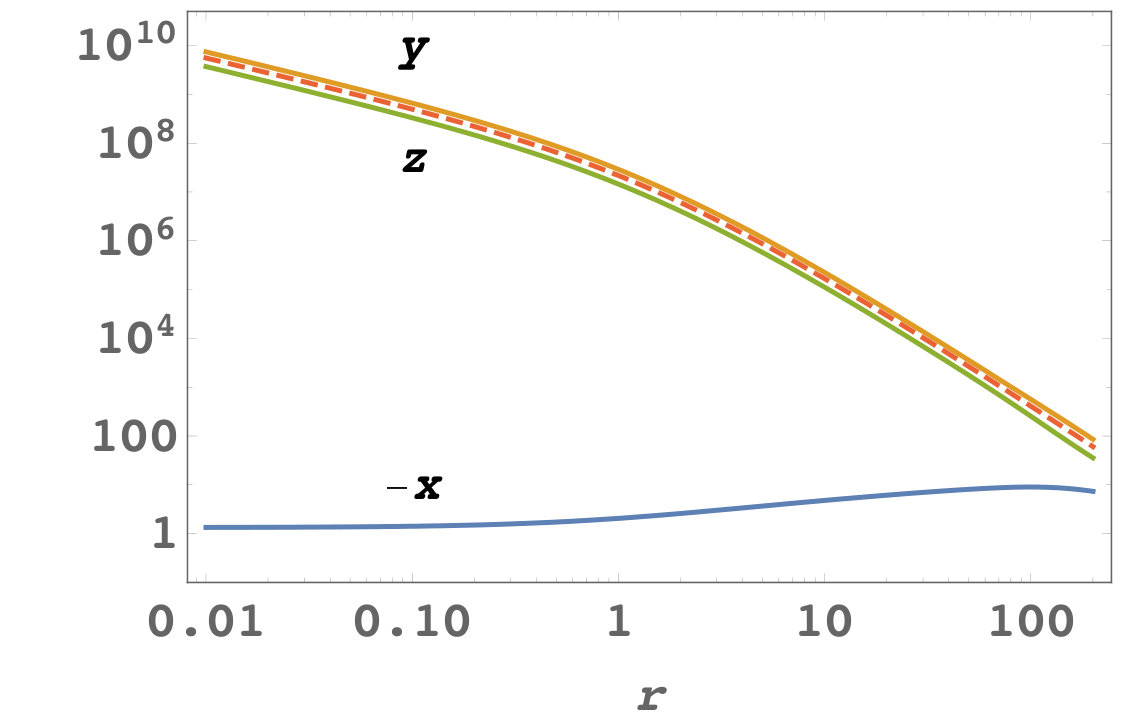 Figure 1
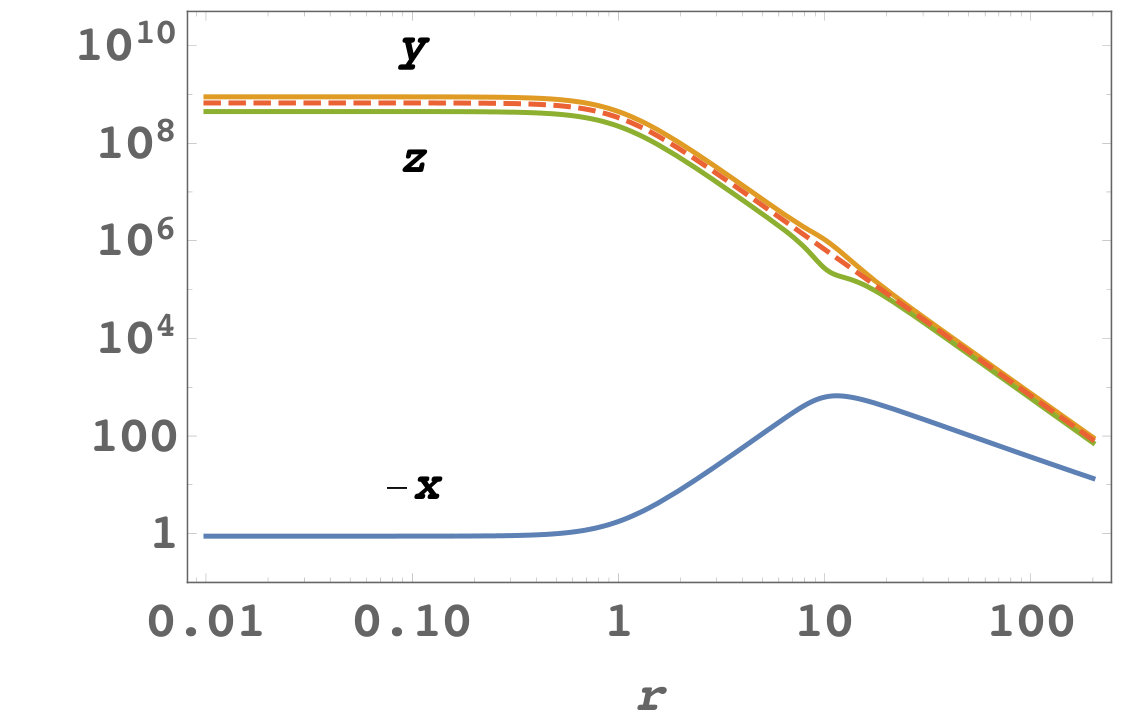 Figure 2
Peer Reviews
No public reviews on file for this paper yet. If you reviewed it on a platform where reviews are public (OpenReview, ICLR, NeurIPS, ICML), you can paste yours below so the community can read it here.
Videos
No videos yet. Explain this paper in a talk, walkthrough, or lecture? Add one.
On the screening mechanism in DHOST theories evading gravitational wave constraints
Shin’ichi Hirano
Department of Physics, Rikkyo University, Toshima, Tokyo 171-8501, Japan
Tsutomu Kobayashi
Department of Physics, Rikkyo University, Toshima, Tokyo 171-8501, Japan
Daisuke Yamauchi
Faculty of Engineering, Kanagawa University, Kanagawa, 221-8686, Japan
Abstract
We consider a subclass of degenerate higher-order scalar-tensor (DHOST) theories in which gravitational waves propagate at the speed of light and do not decay into scalar fluctuations. The screening mechanism in DHOST theories evading these two gravitational wave constraints operates very differently from that in generic DHOST theories. We derive a spherically symmetric solution in the presence of nonrelativistic matter. General relativity is recovered in the vacuum exterior region provided that functions in the Lagrangian satisfy a certain condition, implying that fine-tuning is required. Gravity in the matter interior exhibits novel features: although the gravitational potentials still obey the standard inverse power law, the effective gravitational constant is different from its exterior value, and the two metric potentials do not coincide. We discuss possible observational constraints on this subclass of DHOST theories, and argue that the tightest bound comes from the Hulse-Taylor pulsar.
pacs:
04.50.Kd
††preprint: RUP-19-8
I Introduction
Measuring the speed of gravitational waves serves as a powerful test for modified theories of gravity Nishizawa:2014zna ; Lombriser:2015sxa ; Lombriser:2016yzn ; Bettoni:2016mij . Based on this idea, the nearly simultaneous detection of the gravitational wave event GW170817 and its electromagnetic counterpart GRB 170817A TheLIGOScientific:2017qsa ; Monitor:2017mdv ; GBM:2017lvd was used to put a tight limit on scalar-tensor theories as alternatives to dark energy Creminelli:2017sry ; Sakstein:2017xjx ; Ezquiaga:2017ekz ; Baker:2017hug ; Bartolo:2017ibw ; Kase:2018iwp ; Ezquiaga:2018btd ; Kase:2018aps .111The constraints have been imposed assuming that modified gravity as an alternative to dark energy is valid on much higher energy scales where LIGO observations are made, though this assumption may be subtle deRham:2018red . Within the Horndeski class of scalar-tensor theories Horndeski:1974wa ; Deffayet:2011gz ; Kobayashi:2011nu , derivative couplings of the scalar degree of freedom to the curvature have thus been ruled out. One can extend the Horndeski theory in a healthy manner to degenerate higher-order scalar-tensor (DHOST) theories, in which Ostrogradsky instabilities are eliminated despite the higher-order Euler-Lagrange equations Zumalacarregui:2013pma ; Gleyzes:2014dya ; Gleyzes:2014qga ; Langlois:2015cwa ; Langlois:2015skt ; Crisostomi:2016czh ; Achour:2016rkg ; BenAchour:2016fzp ; Langlois:2017mxy (see Refs. Langlois:2017mdk ; Langlois:2018dxi ; Kobayashi:2019hrl for a review). Nontrivial derivative couplings to the curvature are still allowed in the context of DHOST theories. These theories are phenomenologically very interesting because while the Vainshtein screening mechanism is successfully implemented in the vacuum region exterior to matter distributions, it is partially broken in the matter interior Kobayashi:2014ida ; Crisostomi:2017lbg ; Langlois:2017dyl ; Dima:2017pwp . This implies that DHOST theories can only be tested in the interior of extended objects such as stars, galaxy clusters, and Earth’s atmosphere Koyama:2015oma ; Saito:2015fza ; Sakstein:2015zoa ; Sakstein:2015aac ; Jain:2015edg ; Sakstein:2016ggl ; Sakstein:2016lyj ; Salzano:2017qac ; Saltas:2018mxc ; Babichev:2016jom ; Sakstein:2016oel ; Chagoya:2018lmv ; Kobayashi:2018xvr ; Babichev:2018rfj .
Recently, yet another constraint on DHOST theories has been pointed out: gravitons must be stable against decay into dark energy Creminelli:2018xsv . The Lagrangian for DHOST theories in which gravitons propagate at the speed of light and do not decay into dark energy is described by
[TABLE]
where is the Ricci scalar, , , , and . Cosmology derived from the Lagrangian (1) is explored in Ref. Frusciante:2018tvu . It turns out that in this particular subclass of DHOST theories the screening mechanism operates in a different way from that in generic DHOST theories, as already inferred in Ref. Creminelli:2018xsv . The purpose of the present paper is to clarify how the (breaking of the) Vainshtein screening mechanism occurs in the above theory.
II Screening mechanism in DHOST theories without graviton decay
A weak gravitational field is described by the line element
[TABLE]
with the scalar-field configuration
[TABLE]
Here, is a slowly evolving background determined from the cosmological boundary condition and is a fluctuation. Since we are interested in gravity on scales well inside the horizon, we ignore the cosmic expansion.
Following Refs. Koyama:2013paa ; Kobayashi:2014ida , we expand the action in terms of the metric perturbations and , keeping the higher-derivative terms relevant to the screening mechanism in the quasi-static regime. The resultant effective Lagrangian is given by
[TABLE]
where we introduced dimensionless quantities
[TABLE]
and defined an energy scale . The dot denotes differentiation with respect to . The explicit expression for the coefficient is not important here. In deriving the Lagrangian (4) we ignored since is a slowly varying field. We assume that matter is minimally coupled to gravity, so that we add the term where is the density of a nonrelativistic matter source. The Lagrangian (4) is a particular case of the general effective Lagrangian for the Vainshtein mechanism in DHOST theories Crisostomi:2017lbg ; Langlois:2017dyl ; Dima:2017pwp . However, the screening mechanism in this particular subclass operates in a very different way than in generic cases, as we will see below.
Let us consider a spherically symmetric matter distribution, , where is the radial coordinate. Varying the action with respect to , , and , we obtain the following equations:
[TABLE]
and
[TABLE]
where the prime denotes differentiation with respect to and we defined the dimensionless variables as
[TABLE]
with
[TABLE]
being the mass contained within . In deriving Eqs. (6)–(8) we integrated the field equations once and fixed the integration constants so that , , and are regular at . The explicit form of is complicated.
[TABLE]
where and are written in terms of , , and . Then, substituting Eqs. (12) and (13) to Eq. (8), we obtain
[TABLE]
where we defined
[TABLE]
and the explicit expression for (which is written in terms of , , etc. and their time derivatives) is not important. As expected from the degeneracy of the theory, the final result (14) is just an algebraic equation for , with no derivatives acting on . In generic quadratic DHOST theories, however, one would obtain at this final stage a cubic equation for . The present theory is special in the sense that the coefficient of the cubic term vanishes identically.
From now on, let us consider the case where the source is static, . Then, since we are assuming that is approximately constant, is also independent of time. Thus, in Eq. (14) can be neglected.
One may define the typical radius below which nonlinearities are large by . We are mainly interested in the solutions to Eq. (14) for both inside and outside the matter source. Outside the matter distribution we have , whereas we have inside.
Let us first consider the exterior region. For we have
[TABLE]
From this it can be seen that the terms linear in in Eqs. (12) and (13) are suppressed relative to the other terms. We thus find, irrespective of the sign of Eq. (16), that
[TABLE]
This shows that in general, implying that the present subclass of DHOST theories does not evade the solar-system constraints. However, if the parameters satisfy222More precisely, the condition for successful screening is . Clearly, the case with corresponds to the subclass of the Horndeski theory. This is the trivial case exhibiting the Vainshtein mechanism Kimura:2011dc ; Narikawa:2013pjr ; Koyama:2013paa .
[TABLE]
general relativity is recovered, yielding
[TABLE]
The effective gravitational constant is given by
[TABLE]
Thus, fine-tuning is needed in order for the screening mechanism to work successfully in the vicinity of a source. This is in contrast to generic DHOST theories Kobayashi:2014ida ; Crisostomi:2017lbg ; Langlois:2017dyl ; Dima:2017pwp .
Next, let us look at the interior region. We have two branches, one of which is given by
[TABLE]
and the other by
[TABLE]
In Branch I, the behavior of gravity is far away from the normal one:
[TABLE]
where Eq. (19) was assumed. It then follows that
[TABLE]
We therefore conclude that this branch would not describe the stellar structure appropriately, and hence must be excluded.
Branch II is phenomenologically more interesting. In this branch, all ’s in Eqs. (12) and (13) can be neglected, leading to
[TABLE]
From this we see that the effective gravitational constant inside the matter distribution is different from the exterior value by a factor of :
[TABLE]
This must be contrasted with the way of breaking the screening mechanism in generic DHOST theories, where and appear in and as corrections to the standard gravitational law with the same gravitational constant as the exterior one Kobayashi:2014ida ; Crisostomi:2017lbg ; Langlois:2017dyl ; Dima:2017pwp . We also see that and do not coincide in the matter interior. One should note that Eq. (19) is not used when deriving Eq. (27).
Let us finally comment on the solution for . We have two branches, namely, and . By inspecting the explicit solutions to Eq. (14), we find that the former branch, which is phenomenologically more acceptable, is matched onto Branch II if
[TABLE]
is satisfied.
As an example, we show in Fig. 1 the Branch II profiles of , , and for (namely, ) with . The density profile mimics a star with the radius . The parameters are given by , , and . (For we plot an exact solution to Eq. (14), but for and the terms linear in are ignored because they are subdominant for .)
We also present in Fig. 2 the Branch II solution for the NFW density profile, with and chosen so that . The parameters are again given by , , and . Since there is no definite surface in this case, we see deviations from general relativity everywhere.
III Observational constraints
We have seen that though the particular subclass of DHOST theories (1) could evade solar-system tests by requiring the fine-tuned relation (19), (i) and do not coincide inside the matter distribution, and (ii) the gravitational constant in the matter interior is different from its exterior value. Let us discuss briefly possible observational constraints on such modifications of gravity.
The difference between the two potentials in the nonvacuum region, , can be measured by comparing the X-ray and lensing profiles of galaxy clusters, as has been investigated for different types of modifications in Refs. Terukina:2013eqa ; Wilcox:2015kna ; Sakstein:2016ggl . In particular, the constraints obtained for beyond Horndeski theories in Ref. Sakstein:2016ggl read and . Thus, we would expect constraints of the same order of magnitude, , from galaxy clusters.
A different value of the gravitational constant inside the Sun would lead to changes in the solar structure, and thereby modify the sound speed and solar neutrino fluxes. Based on the solar standard model, it has been argued that a relative difference of is still allowed by observations Lopes:2003aa . Thus, the Sun could potentially be used to test a different value of the gravitational constant inside extended objects.
Note, however, that currently the most stringent bound comes from the difference between the measured value of the gravitational constant, ( or ), and the gravitational coupling for gravitational waves, , which is constrained from the orbital decay of the Hulse-Taylor pulsar: Jimenez:2015bwa ; Dima:2017pwp . In the present case, we have deRham:2016wji ; Langlois:2017mxy , so the constraint is given by
[TABLE]
which is orders of magnitude tighter than the possible constraint from galaxy clusters.
IV Conclusions
In this paper, we have studied the screening mechanism in a particular subclass of degenerate higher-order scalar-tensor (DHOST) theories in which the speed of gravitational waves is equal to the speed of light and gravitons do not decay into scalar fluctuations. By inspecting a spherically symmetric gravitational field, we have found that the screening mechanism operates in a very different way from that in generic DHOST theories Kobayashi:2014ida ; Crisostomi:2017lbg ; Langlois:2017dyl ; Dima:2017pwp . First, the fine-tuning is required so that solar-system tests are evaded in the vacuum exterior region. This is in contrast to generic DHOST theories, in which the implementation of the Vainshtein screening mechanism outside the matter distribution is rather automatic. Second, the way of the Vainshtein breaking inside extended objects is also different from that in generic DHOST theories. We have shown that in the interior region the metric potentials obey the standard inverse power law, but the two do not coincide. Moreover, the effective gravitational constant differs from its exterior value. However, the current most stringent bound comes from the fact that the effective gravitational coupling for gravitational waves is different from the Newtonian constant Jimenez:2015bwa ; Dima:2017pwp , rather than from the above interesting phenomenology. The obtained constraint is as tight as
[TABLE]
Thus, we conclude that the allowed parameter space is small for DHOST theories as alternatives to dark energy evading gravitational wave constraints.
Acknowledgements.
The work of SH was supported by the JSPS Research Fellowships for Young Scientists No. 17J04865. The work of TK was supported by MEXT KAKENHI Grant Nos. JP15H05888, JP17H06359, JP16K17707, JP18H04355, and MEXT-Supported Program for the Strategic Research Foundation at Private Universities, 2014-2018 (S1411024). The work of DY was supported by MEXT KAKENHI Grant No. JP17K14304.
The reference list from the paper itself. Each links out to its DOI / PubMed record.
- 1(1) A. Nishizawa and T. Nakamura, Measuring Speed of Gravitational Waves by Observations of Photons and Neutrinos from Compact Binary Mergers and Supernovae , Phys. Rev. D 90 (2014) 044048 [ 1406.5544 ]. · doi ↗
- 2(2) L. Lombriser and A. Taylor, Breaking a Dark Degeneracy with Gravitational Waves , JCAP 1603 (2016) 031 [ 1509.08458 ]. · doi ↗
- 3(3) L. Lombriser and N. A. Lima, Challenges to Self-Acceleration in Modified Gravity from Gravitational Waves and Large-Scale Structure , Phys. Lett. B 765 (2017) 382 [ 1602.07670 ]. · doi ↗
- 4(4) D. Bettoni, J. M. Ezquiaga, K. Hinterbichler and M. Zumalacárregui, Speed of Gravitational Waves and the Fate of Scalar-Tensor Gravity , Phys. Rev. D 95 (2017) 084029 [ 1608.01982 ]. · doi ↗
- 5(5) LIGO Scientific, Virgo collaboration, B. Abbott et al., GW 170817: Observation of Gravitational Waves from a Binary Neutron Star Inspiral , Phys. Rev. Lett. 119 (2017) 161101 [ 1710.05832 ]. · doi ↗
- 6(6) LIGO Scientific, Virgo, Fermi-GBM, INTEGRAL collaboration, B. P. Abbott et al., Gravitational Waves and Gamma-rays from a Binary Neutron Star Merger: GW 170817 and GRB 170817 A , Astrophys. J. 848 (2017) L 13 [ 1710.05834 ]. · doi ↗
- 7(7) LIGO Scientific, Virgo, Fermi GBM, INTEGRAL, Ice Cube, Astro Sat Cadmium Zinc Telluride Imager Team, IPN, Insight-Hxmt, ANTARES, Swift, AGILE Team, 1M 2H Team, Dark Energy Camera GW-EM, DES, DLT 40, GRAWITA, Fermi-LAT, ATCA, ASKAP, Las Cumbres Observatory Group, Oz Grav, DWF (Deeper Wider Faster Program), AST 3, CAASTRO, VINROUGE, MASTER, J-GEM, GROWTH, JAGWAR, Caltech NRAO, TTU-NRAO, Nu STAR, Pan-STARRS, MAXI Team, TZAC Consortium, KU, Nordic Optical Telescope, e PESSTO, GROND, Texas Tech Univer · doi ↗
- 8(8) P. Creminelli and F. Vernizzi, Dark Energy after GW 170817 and GRB 170817 A , Phys. Rev. Lett. 119 (2017) 251302 [ 1710.05877 ]. · doi ↗