Fermion Mass Hierarchy in Grand Gauge-Higgs Unification
Nobuhito Maru, Yoshiki Yatagai

TL;DR
This paper explores a five-dimensional grand gauge-Higgs unification model based on SU(6), demonstrating how SM fermion masses and electroweak symmetry breaking can be achieved through boundary interactions and bulk field dynamics.
Contribution
It presents a novel five-dimensional SU(6) gauge theory framework that naturally generates SM fermion masses and induces electroweak symmetry breaking via boundary and bulk field interactions.
Findings
SM fermion masses are reproduced with mild bulk mass tuning.
Electroweak symmetry breaking is achieved through additional bulk fields.
Higgs boson mass is computed within the model.
Abstract
Grand gauge-Higgs unification of five dimensional gauge theory on an orbifold is discussed. The Standard model (SM) fermions are introduced on one of the boundaries and some massive bulk fields are also introduced so that they couple to the SM fermions through the mass terms on the boundary. Integrating out the bulk fields generates the SM fermion masses with exponentially small bulk mass dependences. The SM fermion masses except for top quark are shown to be reproduced by mild tuning the bulk masses. One-loop Higgs potential is calculated and it is shown that the electroweak symmetry breaking occurs by introducing additional bulk fields. Higgs boson mass is also computed.
Click any figure to enlarge with its caption.
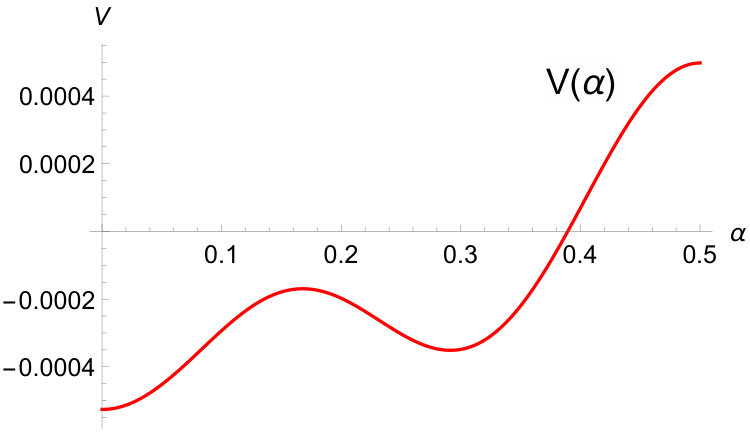 Figure 1
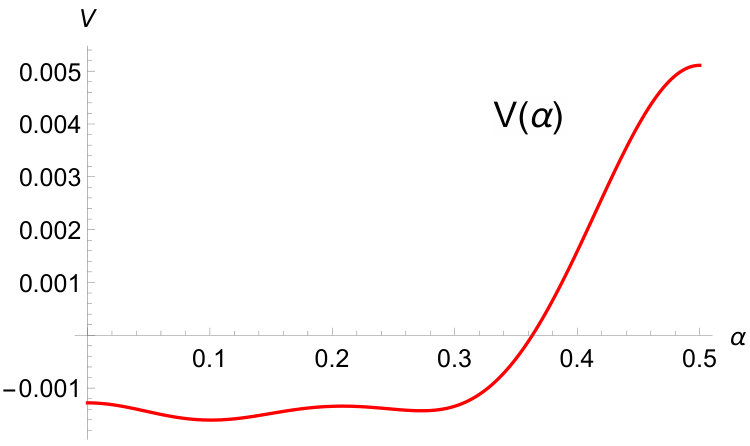 Figure 2
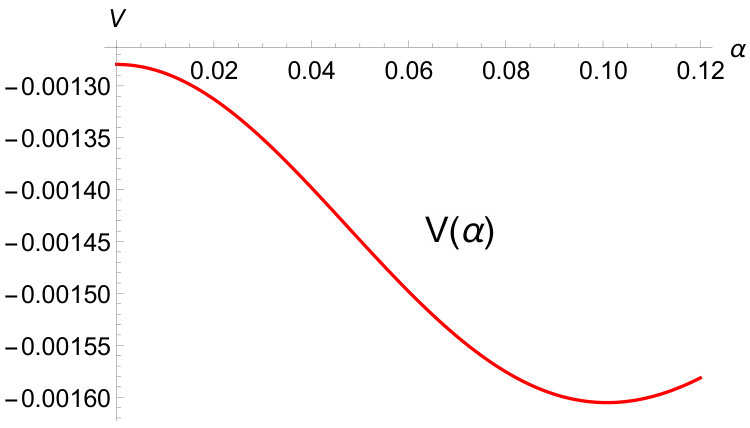 Figure 3
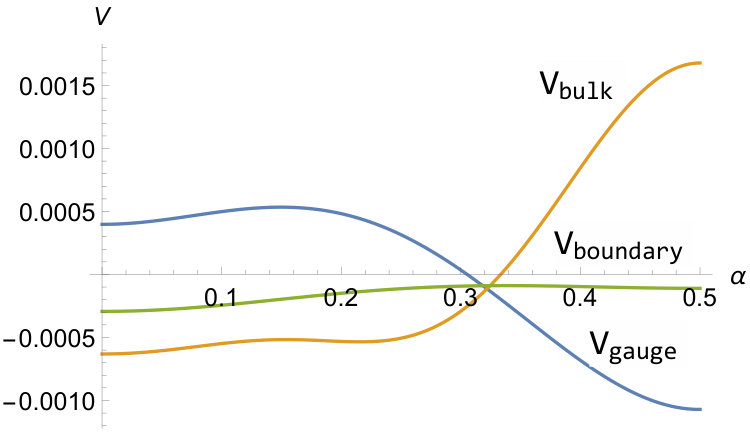 Figure 4
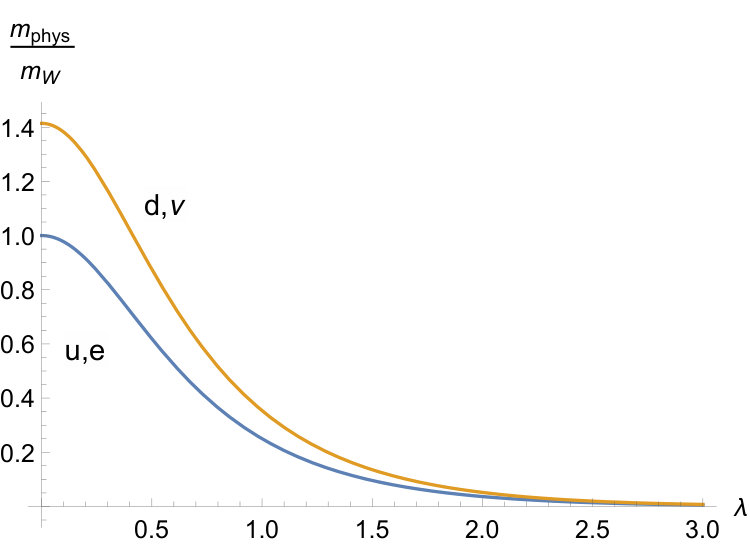 Figure 5
| bulk fermion | mirror fermion | SM fermion coupling to bulk |
|---|---|---|
| 1 | 2 | 3 | |
| (up-type quark) | 5.9 | 2.55 | 0.1 |
| (down-type quark) | 5.65 | 4.1 | 1.1 |
| (charged lepton) | 6.58 | 3.87 | 2.4 |
| (neutrino) | 13 | 10 | 10 |
| bulk+mirror | |
|---|---|
| gauge | |
| extra | |||
|
|
Peer Reviews
No public reviews on file for this paper yet. If you reviewed it on a platform where reviews are public (OpenReview, ICLR, NeurIPS, ICML), you can paste yours below so the community can read it here.
Videos
No videos yet. Explain this paper in a talk, walkthrough, or lecture? Add one.
OCU-PHYS 499
NITEP 10
**Fermion Mass Hierarchy
in Grand Gauge-Higgs Unification**
Nobuhito Marua,b and Yoshiki Yatagaia,
*a**Department of Mathematics and Physics, Osaka City University,
Osaka 558-8585, Japan*
*b**Nambu Yoichiro Institute of Theoretical and Experimental Physics (NITEP),
Osaka City University, Osaka 558-8585, Japan*
Grand gauge-Higgs unification of five dimensional gauge theory on an orbifold is discussed. The Standard model (SM) fermions are introduced on one of the boundaries and some massive bulk fields are also introduced so that they couple to the SM fermions through the mass terms on the boundary. Integrating out the bulk fields generates the SM fermion masses with exponentially small bulk mass dependences. The SM fermion masses except for top quark are shown to be reproduced by mild tuning the bulk masses. One-loop Higgs potential is calculated and it is shown that the electroweak symmetry breaking occurs by introducing additional bulk fields. Higgs boson mass is also computed.
1 Introduction
Gauge-Higgs unification (GHU) [1] is one of the attractive scenarios among the physics beyond the Standard Model (SM), which solves the hierarchy problem by identifying the SM Higgs field with one of the extra spatial component of the higher dimensional gauge field. In this scenario, the most appealing feature is that physical observables in Higgs sector are calculable and predictable regardless of the non-renormalizable theory. For instance, the radiative corrections to Higgs mass and Higgs potential are known to be finite at one-loop [2] and two-loop [3] thanks to the higher dimensional gauge symmetry. Rich structures of the theory and its phenomenology have been investigated [4, 5, 6, 7, 8, 9, 10, 11, 12].
The hierarchy problem was originally addressed in grand unified theory (GUT) as a problem how the discrepancy between the GUT scale and the weak scale are kept. Therefore, the extension of GHU to grand unification is an interesting direction to explore. The scenario of grand gauge-Higgs unification was discussed by one of the present authors [13],111For earlier attempts and related recent works, see [14] where the five dimensional grand gauge-Higgs unification was considered and the Standard Model (SM) fermions were embedded in zero modes of some multiplets in the bulk. This embedding was very elegant in that it was a minimal matter content without massless exotic fermions which is not included in the SM. That immediately means a minimal anomaly-free matter content. However, a crucial drawback was found that the down-type Yukawa couplings and the charged lepton Yukawa couplings are not allowed. This is because the left-handed quark (lepton) doublets and the right-handed down quark (charged lepton) singlets are embedded into different multiplets. As a result, Yukawa coupling in GHU originated from the gauge coupling cannot be allowed. This feature seems to be generic in GHU, therefore we have to give up embedding all the SM fermions into the multiplets in the bulk to obtain the SM Yukawa couplings. Fortunately, we know another approach to generate Yukawa coupling in a context of GHU [15, 16]. In this approach, the SM fermions are introduced on the boundaries (i.e. fixed point in an orbifold compactification). We also introduce massive bulk fermions, which couple to the SM fermions through the mass terms on the boundary. Integrating out these massive fermions generates non-local SM fermion masses, which are proportional to the bulk to boundary couplings and exponentially sensitive to their bulk masses. Then, the SM fermion mass hierarchy can be obtained by very mild tuning of bulk masses.
In this paper, we propose an improved grand GHU model [13], where the SM fermion mass hierarchy is obtained by following the approach mentioned in the last paragraph. The SM fermions are introduced on the boundary as multiplets, the four types of massive bulk fermions in multiplets coupling to the SM fermions are introduced. We obtain the quark and lepton masses except for top quark by integrating out the massive bulk fermions and tuning of the bulk masses. We also calculate one-loop Higgs potential and study whether the electroweak symmetry breaking happens and Higgs mass can be obtained. This issue is very nontrivial in GHU since the potential is generated at one-loop and strongly depends on matter fermion content. We find that it is not possible to break the electroweak symmetry by only the four types of bulk fermions. Then, we show that the electroweak symmetry breaking and a viable Higgs mass can be realized by introducing additional bulk fermions with large dimensional representation.
This paper is organized as follows. In the next section, we describe our model in detail. In section 3, the mechanism of the SM fermion mass generation is explained. It is shown that the SM fermion masses except top quark can be reproduced by mild tuning of bulk masses. One-loop Higgs potential is calculated in section 3, where the electroweak symmetry breaking and Higgs mass are analyzed. Section 4 is devoted to our conclusions and discussions. The details of calculations are summarized in Appendices. The branching rules of the representations relevant to our model are shown in Appendix A. In Appendix B, calculations of the Kaluza-Klein (KK) mass spectrum of bulk fields are explained in some detail.
2 Gauge and Higgs sector of our model
In this section, we briefly explain an GHU model [13]. We consider a five dimensional (5D) gauge theory with an extra space compactified on an orbifold , whose radius and coordinate are denoted by and , respectively. parities at each fixed points are given as follows.
[TABLE]
We assign the parity for the gauge field and the scalar field as , . Then, their fields have the following parities in components,
[TABLE]
[TABLE]
where means that parity is even (odd) at boundary, for instance. We note that only the field with parity has a 4D massless zero mode () as can be seen from the KK expansion in terms of mode function described in Appendix B. The parity for indicates that gauge symmetry is broken to by the combination of the symmetry breaking pattern at each boundary,
[TABLE]
The hypercharge is contained in Georgi-Glashow GUT, which is an upper-left submatrix of matrix. Thus, we have
[TABLE]
at the unification scale, which will not be so far from the compactification scale. are the gauge coupling constants for , respectively. This coupling relation implies that the weak mixing angle is the same as that of Georgi-Glashow GUT model, (weak mixing angle). This result can be explicitly checked for the bulk fermion in representation of (see the next section).
[TABLE]
where is the third component of isospin and is an electric charge.
Higgs doublet field is identified with a part of an extra component of gauge field .
[TABLE]
We suppose that a vacuum expectation value (VEV) of the Higgs field is taken to be in the 28-th generator of , . is a 5D gauge coupling and is a dimensionless constant. The VEV of Higgs field is given by . We note that the doublet-triplet splitting problem is solved by the orbifolding since the parity of the colored Higgs field is and it become massive [17].
Here we give some comments on gauge symmetry which remains unbroken by orbifolding. We first note that the is anomalous as it stands since the massless fermions are only the SM fermions and their charge assignments are not anomaly-free (see Table 1 in the next section.). However, it is easy to cancel the anomaly by adding appropriate number of the SM singlet fermions with charge only. In order to break the spontaneously, charged scalars are introduced on the boundary for instance, and we write down the potential of quadratic and quartic terms like the SM Higgs potential. Then, is spontaneously broken by having the VEV for the scalars.
3 Fermion masses
As mentioned in the introduction, we have to give up embedding all the SM fermions into the multiplets in the bulk to generate the fermion masses. The SM quarks and leptons are embedded into multiplets localized at boundary, three sets of , , along the sprit of GUT as much as possible. We also introduce various pair of bulk fermions and with opposite parities each other and constant mass term like in the bulk to avoid exotic massless fermions from them. is referred as “mirror fermions” in this paper. In this setup, we have no massless chiral fermions from the bulk and its mirror fermions. The massless fermions are the SM fermions only and the gauge anomalies for the SM gauge groups are trivially canceled. In order to realize the SM fermion masses, the boundary localized mass terms between the SM fermions localized at and the bulk fermions are necessary. To this end, we have to choose appropriate representations of for bulk fermions so that the left(right)-handed fermion components in the bulk fermions couple to the right(left)-handed SM fermions after the decomposition into the SM model gauge group representations. Note that the mirror fermions have no coupling to the SM fermions. Table 1 shows various representations for bulk and mirror fermions in our model in addition to the SM fermions, which corresponds to the matter content for one generation. Totally, three copies of them are present in our model.
Lagrangian for the fermions is
[TABLE]
The first line is lagrangian for the bulk and the corresponding mirror fermions, and the remaining terms are lagrangian localized on boundary. Note that the subscript denotes the representations of the bulk and mirror fermions. The bulk masses between the bulk and the mirror fermions are normalized by and expressed by the dimensionless parameter . The last two lines are mixing mass terms between the bulk fermions and the SM fermions. In general, these mixing masses can be free parameters, but we set them to be a common value since we would like to avoid unnecessary arbitrary parameters in fitting the data of SM fermion masses. The five-dimensional gamma matrices is given by . By integrating out -direction, 4D effective Lagrangian from the bulk lagrangian is obtained.
[TABLE]
where represents a -th KK mode of bulk (mirror) fermion, and is a SM fermion. are chiral projection operators and are some constants. denotes the sum of the ordinary KK mass and the electroweak symmetry breaking mass proportional to the Higgs VEV. The factor determined by the representation which the fermion under consideration belongs to. The mass spectrum of bulk and mirror fermions is totally given by . Note that the Lagrangian (15) is illustrated for particular bulk and mirror fermions as an example.
In order to derive the SM fermion masses, we need the quadratic terms in the effective Lagrangian for the SM fermion.
[TABLE]
with
[TABLE]
where and
[TABLE]
In deriving , we simply took the large bulk mass limit so that the mixings of the SM fermions with non-zero KK modes in the mass eigenstate become negligibly small.
Integrating out all massive bulk fermions and normalizing the kinetic term to be canonical, we obtain the physical mass for the SM fermions.
[TABLE]
where the bare mass and the wave function renormalization factors are
[TABLE]
where the summation in means that it takes a summation for all the bulk fields contributing to mass . The explicit expressions are shown below.
We consider here ratios of the physical SM fermion mass and the weak boson mass to fit the experimental data.
[TABLE]
where denote up-type quark, down-type quark, charged lepton, and neutrino masses, respectively. All these ratios depend on two kinds of bulk mass parameters, but one of them is always dominant to the other one. Fig. 1 shows the dependence on bulk mass parameter for various mass ratios. Note that in the horizontal axis of the figure means a larger bulk mass parameter of the two kinds: for up-type quarks, down-type quarks, charged leptons, neutrinos, respectively. As can be seen from the Figure 1, the masses up to order of the weak boson mass can be realized by choosing an appropriate bulk mass parameter.
Table 2 summarizes the values of bulk mass parameters reproducing the SM fermion masses except for the top quark. It is a very nice feature of models in extra dimensions that the SM fermion mass hierarchy can be obtained by the mild tuning of bulk mass parameters. This is because the physical fermion mass has an exponential dependence on the bulk mass parameter as seen from (19).
As for the top quark, even if the vanishing bulk mass parameter is taken, the ratio between top and W-boson masses is at most unity. In order to avoid this situation, the fermion components coupling to top quark on the boundary should be embedded into higher rank representation as in [18]. We have investigated whether fermions included in three and four rank tensor of representations couple to the SM fermions on the boundary, but we could not succeed in finding. It might be possible to consider representations on other gauge groups.
4 Effective potential
In this section, we calculate the effective potential for the Higgs field and study whether the electroweak symmetry breaking correctly occurs. Since the Higgs field is originally a gauge field, the potential is generated at one-loop by Coleman-Weinberg mechanism. The potential from the bulk fields is given by
[TABLE]
with
[TABLE]
where overall signs stand for fermion (boson), respectively. means the spin degrees of freedom of the field running in the loop. The loop momentum is taken to be Euclidean.
For the gauge bosons, bulk fermions and mirror fermions, the mass spectrum is calculated as the following four types depending on the parity and the bulk mass.
[TABLE]
Using this information, we obtain the corresponding potentials [18].
[TABLE]
Table 3 lists the various potentials from the gauge field, bulk fermion and mirror fermion contributions. The coefficients in the potential can be read from the branching rules in the decomposition of the representation into representations listed in Appendix A.
Next, we have to calculate the Higgs potential from the SM fermion contributions localized at using in eq.(17). The results are as follows.
[TABLE]
In calculation of the potential from the both bulk and boundary contributions, we have subtracted the independent part of the potential since it corresponds to the divergent vacuum energy and is irrelevant to the electroweak symmetry breaking.
Total potential is , where , and denote the contributions from the gauge field, the bulk fermions and mirror fermions respectively. The plots of the potentials are shown in Fig. 2. As we can see from Fig. 2, the electroweak symmetry breaking does not occur since the potential minimum is origin.
Therefore, we must add some extra fields to obtain the electroweak symmetry breaking. In this paper, we introduce a set of bulk and mirror fermion in 126 representation of , which is the fourth rank symmetric tensor. The reason why such a bulk fermion with a large dimensional representation is considered is as follows. As a generic feature of Higgs potential in GHU, the curvature at the origin of the potential from the gauge field (bulk fermion) contribution is positive (negative) and is likely to make the electroweak symmetry unbroken (broken). Furthermore, to realize the electroweak symmetry breaking in GHU, the Higgs VEV (more precisely, the dimensionless constant Higgs VEV) must be smaller than one, . In order to obtain such a small VEV, the field with larger representation is preferable since the periodicity of the potential becomes smaller. The additional contribution to Higgs potential is shown in Table 4.
The corrected total potential by adding the contribution from a pair of fermions in representation is displayed in Fig. 3, where the bulk mass parameter is taken to be 0.5. As Fig. 3 shows, the realistic electroweak symmetry breaking is realized. In fact, Higgs VEV is found from the minimization of the potential. Higgs mass can be obtained as a function of the compactification scale. We find Higgs mass GeV at the compactification scale TeV. is a four-dimensional gauge coupling obtained from the five-dimensional one .
5 Conclusions and discussions
In this paper, we have considered the fermion mass hierarchy in grand GHU. In the grand GHU previously discussed [13], a 5D GHU with an orbifold was considered and all the SM fermions were elegantly embedded into a minimal set of bulk multiplets without massless exotic fermions, namely anomaly-free matter content. However, the down-type Yukawa couplings and the charged lepton Yukawa couplings were not allowed since the left-handed quark (lepton) doublets and the right-handed down quark (charged lepton) singlets were embedded into different multiplets and Yukawa couplings in GHU is generated by the gauge interactions. From this observation, the SM fermions were introduced in the multiplets on the boundary at in this paper. We have also introduced some massive bulk fermions in four types of representations and couplings between the SM fermions on the boundary and the bulk fermions. By integrating out the massive bulk fermions, the SM fermion masses are generated. We have shown that the SM fermion masses except for top quark can be reproduced by mild tuning of bulk masses. Furthermore, we have calculated one-loop Higgs potential and found that the electroweak symmetry breaking does not occur unfortunately for the fermion matter content mentioned above. To resolve this issue, we have clarified that the electroweak symmetry breaking happened by introducing additional bulk fermions in representation. The SM Higgs boson mass was also obtained.
In our analysis, Higgs boson mass and the compactification scale are slightly small. It might be possible to solve these problems by introducing the localized gauge kinetic terms on the boundary, as discussed in [16]. These terms are not forbidden by symmetry. If we consider the localized gauge kinetic term on the boundary at where the top quark is present, the effects of the localized gauge kinetic term enhance the magnitude of the compactification scale. This leads to the enhancement of the Higgs mass. Furthermore, top quark mass also enhanced as explained in [16]. To confirm this expectations, we have to reanalyze the mass spectrum and the mode functions for the gauge fields since they are corrected by the presence of the localized gauge kinetic terms. This direction is very interesting, but remained for our future study.
There are issues to be explored in a context of GUT scenario, which are not discussed in this paper. First, it is important to study the gauge coupling unification. It is well known that the gauge coupling running in (flat) extra dimensions is not logarithmic but power dependence on energy scale [19]. Therefore, the GUT scale is expected to be very low comparing to the conventional 4D GUT, namely, not far from the compactification scale. In this analysis, it is very nontrivial whether the unified gauge coupling at the GUT scale is perturbative. This is because we have introduced relatively many bulk fields in our model, which might lead to Landau pole below the GUT scale. For our model to be a physically meaningful GUT model, this issue must be clarified. Second issue to be addressed is proton decay. The masses of so-called gauge bosons are also extremely light comparing to the conventional GUT scale. Therefore, proton decays very rapidly and our model is immediately excluded by the constraints from the Super Kamiokande data as it stands. Dangerous baryon number violating operators have to be forbidden at tree level by imposing symmetry (see [20] for UED case) in order to ensure the proton stability. If is broken to some discrete symmetry and this symmetry plays an role for it, it would be very interesting. Then, it is desirable to predict the main decay mode at quantum level.
These issues are beyond the scope of this paper and also remained for our future work.
Acknowledgments
This work is supported in part by JSPS KAKENHI Grant Number JP17K05420 (N.M.).
Appendix A Branching rules of bulk fields
In this appendix, several branching rules under the symmetry breaking
[TABLE]
are summarized. These branching rules are necessary to search for the fields coupling to the SM fermions on the boundary at . They are also useful to compute the one-loop effective Higgs potential.
[TABLE]
[TABLE]
Appendix B Mass spectrum of Bulk fermions
In this appendix, the calculations of mass spectrum of bulk fermions are described in detail.
B.1 Mode expansion and reflection
Because of two parity conditions, the five-dimensional field can be decomposed into four types of KK-modes classified by combination of eigenvalues , where the left (right) parity is with respect to . The mode functions are listed below.
[TABLE]
It is convenient to define the following reflection properties for KK-modes.
[TABLE]
Utilizing these reflection properties, the five-dimensional field is expanded in terms of mode function and four-dimensional field as follows.
As an example, the KK decomposition of the field with parity is discussed in detail.
[TABLE]
where
Other types of fields can be also decomposed in a similar way and we obtain the results as
[TABLE]
B.2 Mass eigenvalues
We employed four representations of as bulk fermion in our model; , , and . Since all of representations are higher rank representations, it is very nontrivial to find mass eigenvalues after the electroweak symmetry breaking. In this subsection, we describe how the mass eigenvalues are obtained for the above four bulk fields. In GHU, the electroweak symmetry breaking masses are generated from the gauge interaction since Higgs field is originated from the fifth component of the gauge field.
[TABLE]
Turning on the Higgs VEV, we find that the KK masses and the symmetry breaking masses take the following form depending on the tensor structure.
[TABLE]
The point is that the coefficients of symmetry breaking mass is determined by the number of rank of the field under consideration. Note that the only components 2 and 6 appear in the symmetry breaking terms since the Higgs VEV is supposed to take in and components in .
In next subsubsections, we briefly discuss how the mass spectrum is derived for each representation.
B.2.1 15: the second rank anti-symmetric tensor
The representation is the second rank anti-symmetric tensor of . The components after the decomposition into and the corresponding parity and reflection are summarized in Table 5. The blanks in the matrix elements means zero, hereafter.
Making use of the results in the previous subsection B.1., the KK expansion of is described in a following matrix form.
[TABLE]
Substituting this expansion into the mass term and diagonalizing it, we find mass spectrum
[TABLE]
and the corresponding mass eigenstates are given by
[TABLE]
B.2.2 21: the second rank symmetric tensor
The representation is the second rank symmetric tensor of . The components after the decomposition into and the corresponding parity and reflection are summarized in Table 6.
KK expansion and diagonalization of mass matrix can proceed similarly as representation in the previous subsubsection.
[TABLE]
The diagonalized mass terms are
[TABLE]
and the corresponding mass eigenstates are given
[TABLE]
B.2.3 20∗: the third rank anti-symmetric tensor
The representation is the third rank anti-symmetric tensor of . The components after the decomposition into and the corresponding parity and reflection are summarized in Table 7.
It is straightforward to extend the KK expansion to the third rank tensor case, but takes a more complicated form.
[TABLE]
[TABLE]
[TABLE]
[TABLE]
[TABLE]
[TABLE]
The diagonalized mass terms are derived as
[TABLE]
and the corresponding mass eigenstates are found
[TABLE]
B.2.4 56: the third rank symmetric tensor
The representation is the third rank symmetric tensor of . The components after the decomposition into and the corresponding parity and reflection are summarized in Table 8.
KK expansion and the diagonalization of mass matrix can be done similarly as in B.2.3.
[TABLE]
[TABLE]
[TABLE]
[TABLE]
[TABLE]
[TABLE]
The diagonalized mass terms are
[TABLE]
and the corresponding mass eigenstates are given by
[TABLE]
The reference list from the paper itself. Each links out to its DOI / PubMed record.
- 1[1] N. S. Manton, Nucl. Phys. B 158 , 141 (1979); D. B. Fairlie, Phys. Lett. B 82 , 97 (1979), J. Phys. G 5 , L 55 (1979); Y. Hosotani, Phys. Lett. B 126 , 309 (1983), Phys. Lett. B 129 , 193 (1983), Annals Phys. 190 , 233 (1989).
- 2[2] I. Antoniadis, K. Benakli and M. Quiros, New J. Phys. 3 , 20 (2001); G. von Gersdorff, N. Irges and M. Quiros, Nucl. Phys. B 635 , 127 (2002); R. Contino, Y. Nomura and A. Pomarol, Nucl. Phys. B 671 , 148 (2003); C. S. Lim, N. Maru and K. Hasegawa, J. Phys. Soc. Jap. 77 , 074101 (2008).
- 3[3] N. Maru and T. Yamashita, Nucl. Phys. B 754 , 127 (2006); Y. Hosotani, N. Maru, K. Takenaga and T. Yamashita, Prog. Theor. Phys. 118 , 1053 (2007).
- 4[4] C. S. Lim, N. Maru and T. Miura, PTEP 2015 , no. 4, 043B 02 (2015); K. Hasegawa, C. S. Lim and N. Maru, J. Phys. Soc. Jap. 85 , no. 7, 074101 (2016); Y. Adachi and N. Maru, Phys. Rev. D 98 , no. 1, 015022 (2018); ar Xiv:1809.02748 [hep-ph].
- 5[5] C. S. Lim and N. Maru, Phys. Rev. D 75 , 115011 (2007).
- 6[6] N. Maru and N. Okada, Phys. Rev. D 77 , 055010 (2008); Phys. Rev. D 87 , no. 9, 095019 (2013); ar Xiv:1310.3348 [hep-ph].
- 7[7] N. Maru, Mod. Phys. Lett. A 23 , 2737 (2008).
- 8[8] Y. Adachi, C. S. Lim and N. Maru, Phys. Rev. D 76 , 075009 (2007); Phys. Rev. D 79 , 075018 (2009); Nucl. Phys. B 839 , 52 (2010); Phys. Rev. D 80 , 055025 (2009).