Software-Defined Networks Supporting Time-Sensitive In-Vehicular Communication
Timo H\"ackel, Philipp Meyer, Franz Korf, Thomas C. Schmidt

TL;DR
This paper explores integrating Software-Defined Networking with Time-Sensitive Networking in future in-vehicular Ethernet networks, demonstrating via simulation that SDN can support real-time car communication without adding delay.
Contribution
It proposes a novel concept for combining SDN and TSN in automotive networks and provides an initial simulation-based evaluation of its feasibility.
Findings
SDN control overhead does not introduce delay for TSN traffic when protocols are properly mapped.
The proposed architecture supports real-time requirements in vehicular networks.
Simulation results validate the potential of SDN-TSN integration for automotive applications.
Abstract
Future in-vehicular networks will be based on Ethernet. The IEEE Time-Sensitive Networking (TSN) is a promising candidate to satisfy real-time requirements in future car communication. Software-Defined Networking (SDN) extends the Ethernet control plane with a programming option that can add much value to the resilience, security, and adaptivity of the automotive environment. In this work, we derive a first concept for combining Software-Defined Networking with Time-Sensitive Networking along with an initial evaluation. Our measurements are performed via a simulation that investigates whether an SDN architecture is suitable for time-critical applications in the car. Our findings indicate that the control overhead of SDN can be added without a delay penalty for the TSN traffic when protocols are mapped properly.
Click any figure to enlarge with its caption.
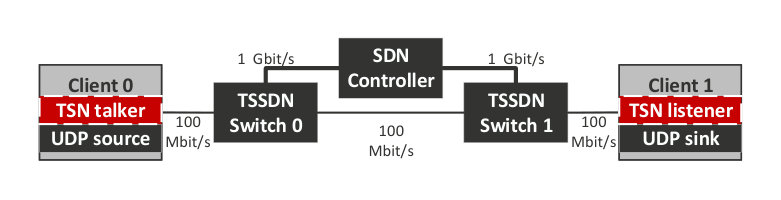 Figure 1
 Figure 2
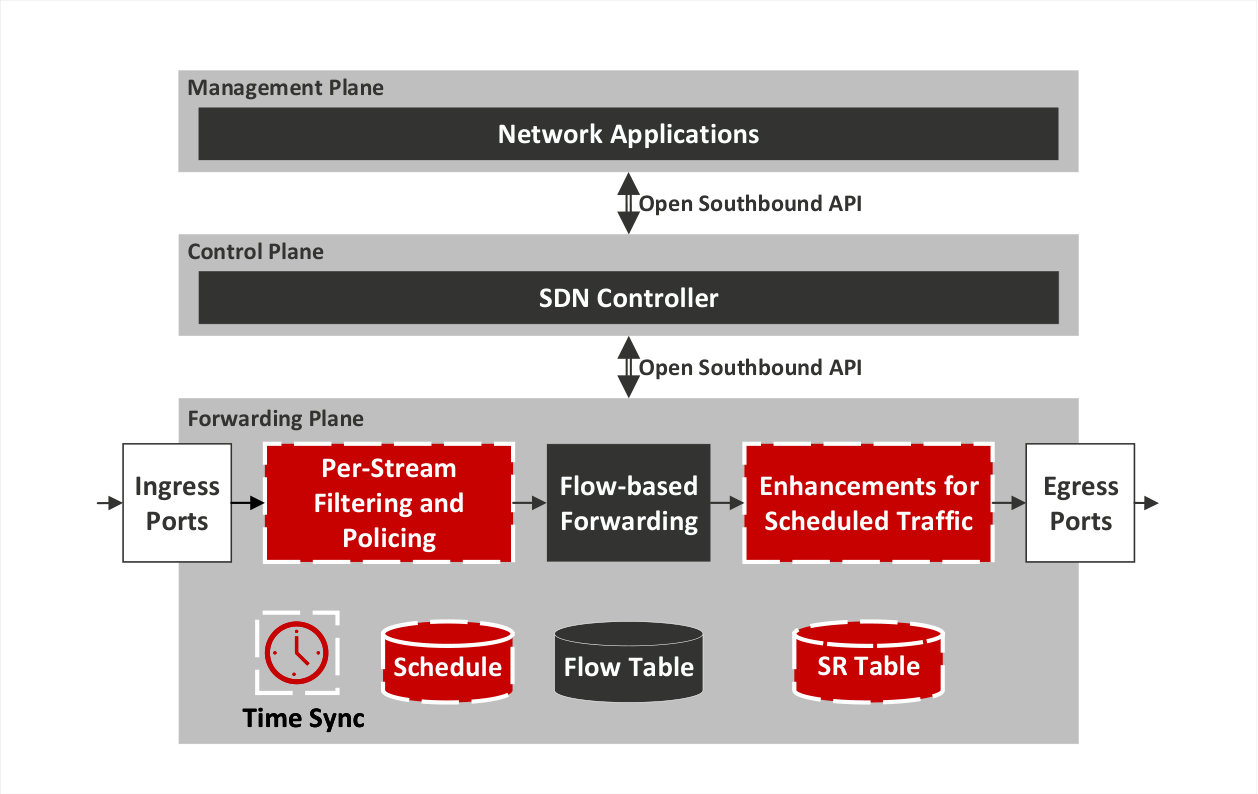 Figure 3
Peer Reviews
No public reviews on file for this paper yet. If you reviewed it on a platform where reviews are public (OpenReview, ICLR, NeurIPS, ICML), you can paste yours below so the community can read it here.
Videos
No videos yet. Explain this paper in a talk, walkthrough, or lecture? Add one.