Bath-induced decay of Stark many-body localization
Ling-Na Wu, Andr\'e Eckardt

TL;DR
This paper studies how a Stark-localized quantum system relaxes when coupled to a dephasing bath, revealing distinct decay behaviors compared to disorder-induced localization, with implications for ultracold atom experiments.
Contribution
It provides a comparative analysis of Stark versus disorder-induced many-body localization decay dynamics under dephasing, highlighting unique decay and entropy growth characteristics.
Findings
Imbalance decays quadratically with tilt at large potential gradients
Exponential decay in non-interacting systems, stretched exponential with interactions
No logarithmic entropy growth as seen in disordered systems
Abstract
We investigate the relaxation dynamics of an interacting Stark-localized system coupled to a dephasing bath, and compare its behavior to the conventional disorder-induced many body localized system. Specifically, we study the dynamics of population imbalance between even and odd sites, and the growth of the von Neumann entropy. For a large potential gradient, the imbalance is found to decay on a time scale that grows quadratically with the Wannier-Stark tilt. For the non-interacting system, it shows an exponential decay, which becomes a stretched exponential decay in the presence of finite interactions. This is different from a system with disorder-induced localization, where the imbalance exhibits a stretched exponential decay also for vanishing interactions. As another clear qualitative difference, we do not find a logarithmically slow growth of the von-Neumann entropy as it is found…
Click any figure to enlarge with its caption.
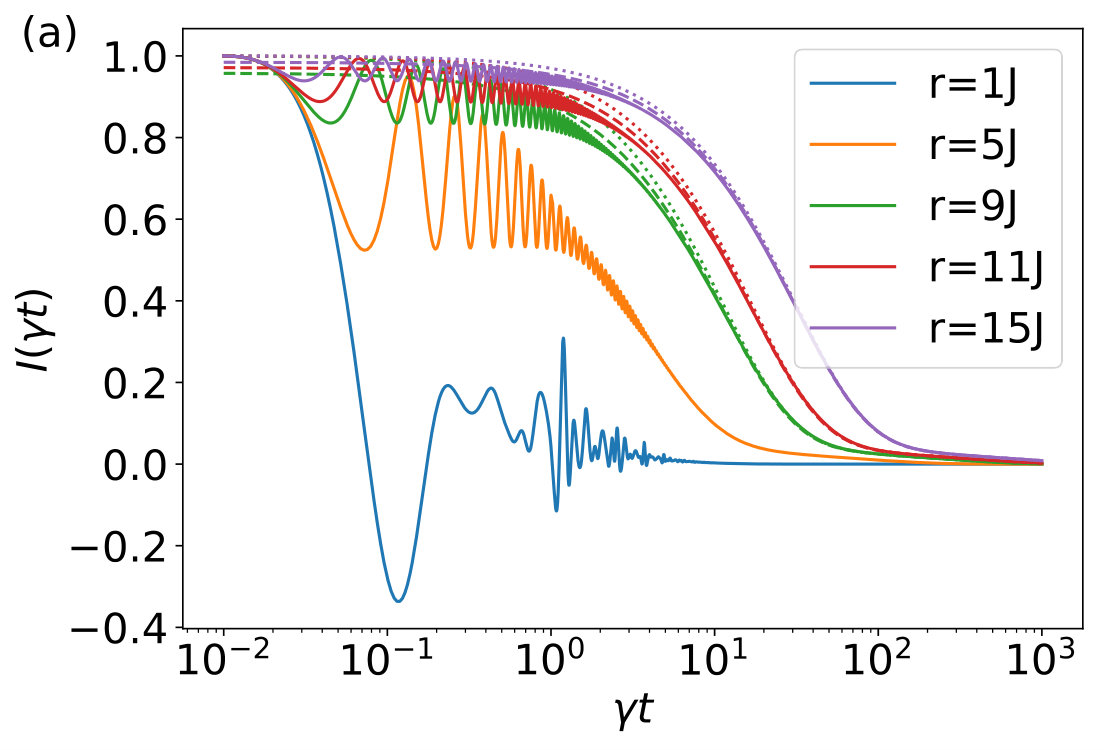 Figure 1
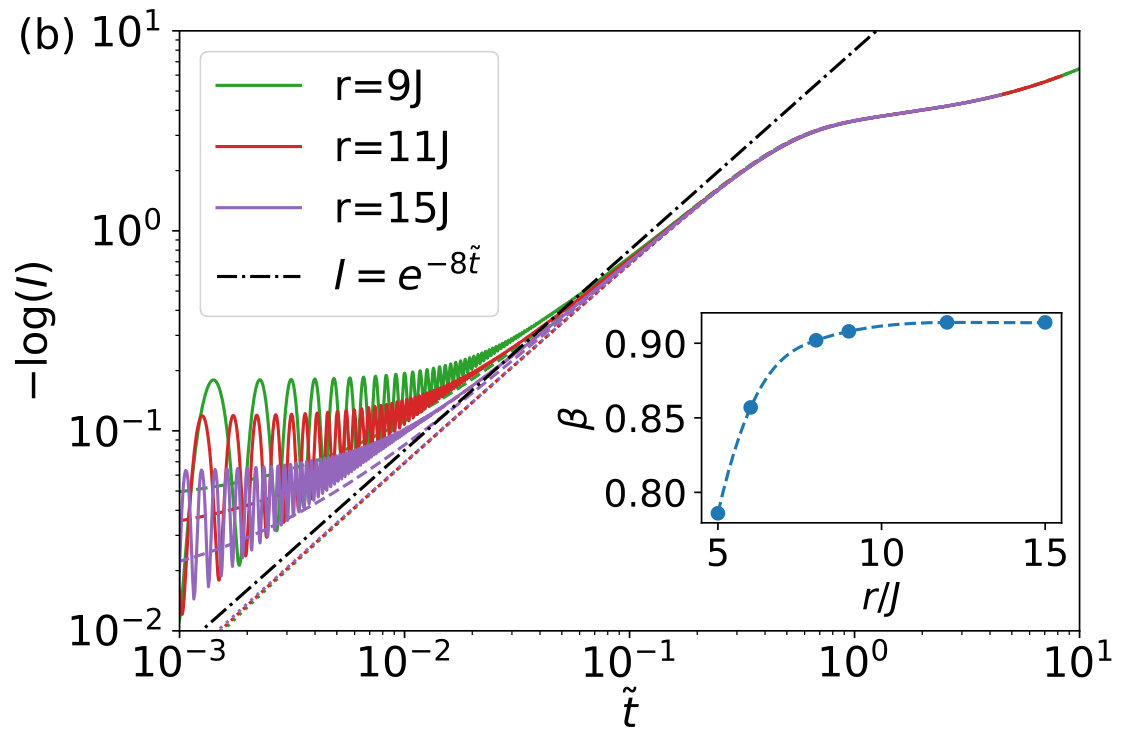 Figure 1
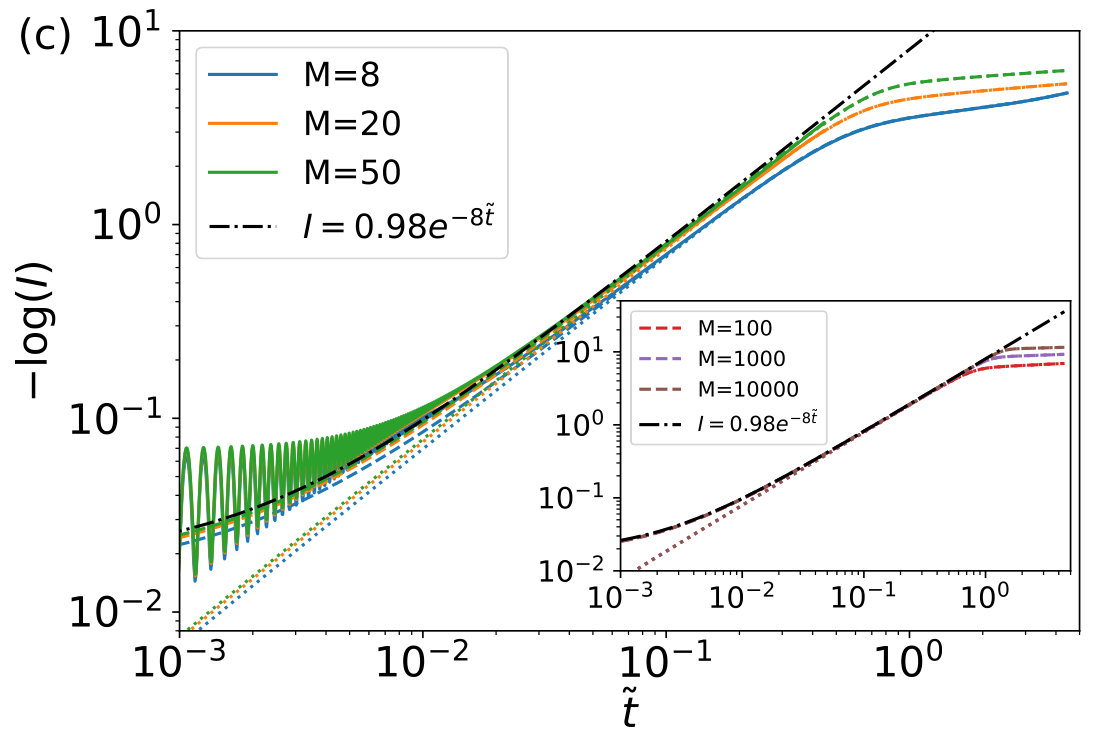 Figure 1
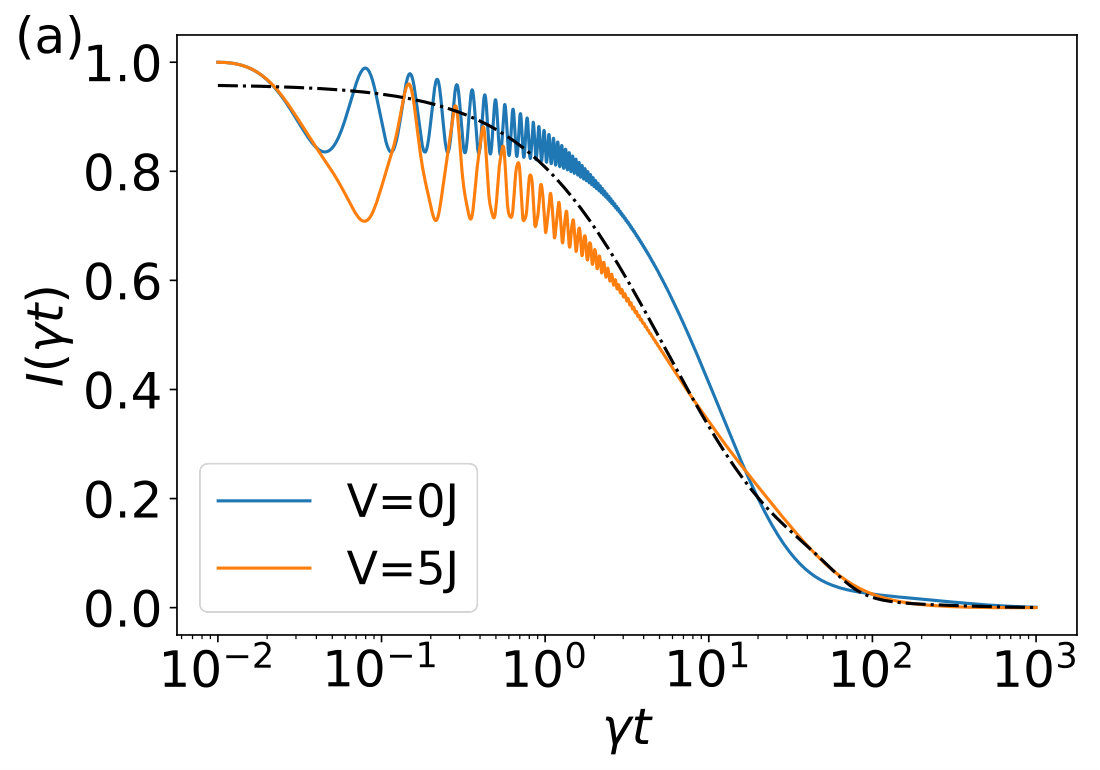 Figure 2
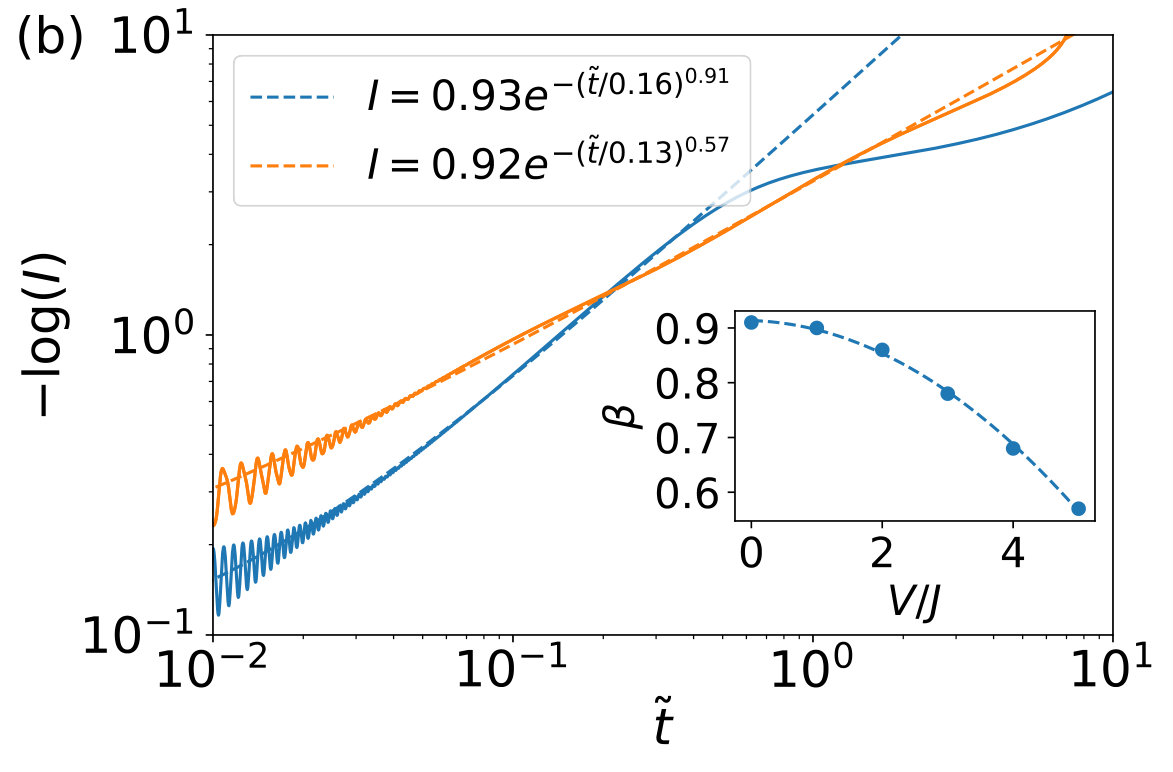 Figure 2
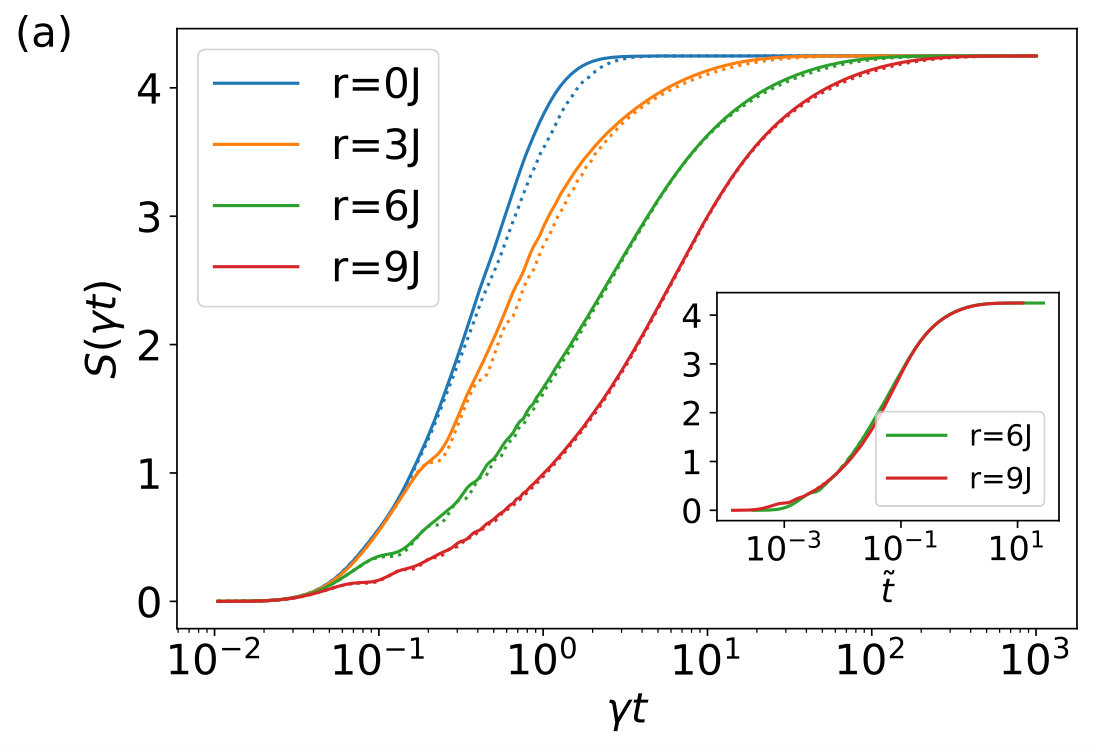 Figure 3
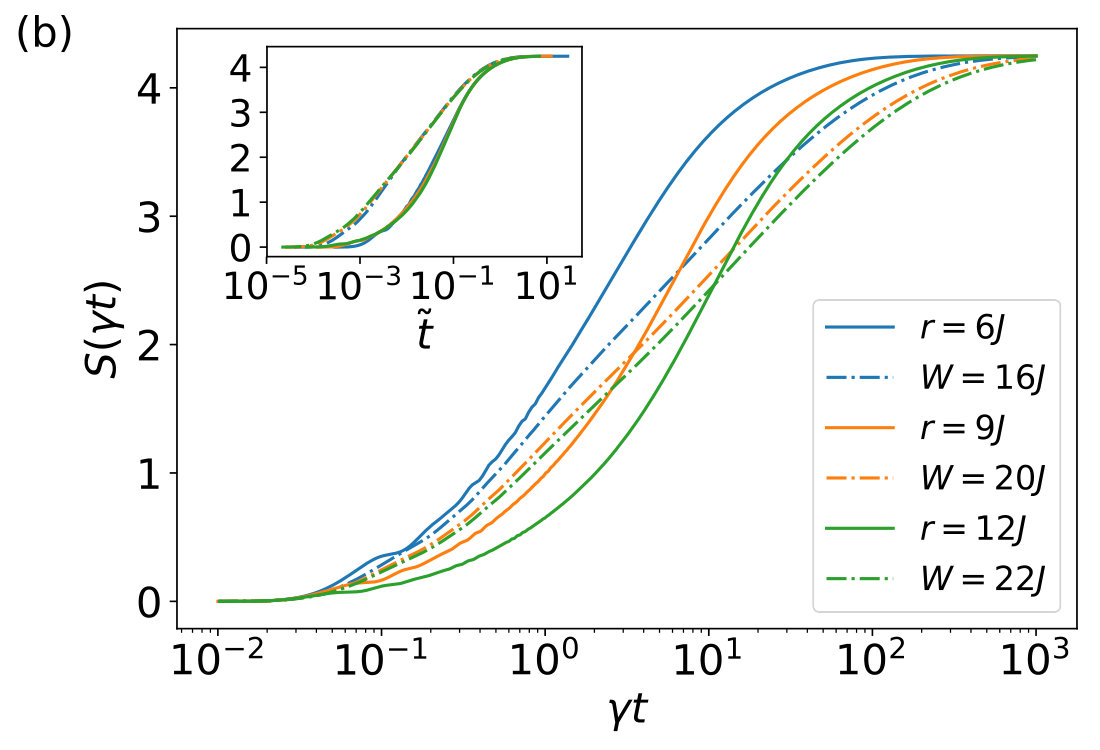 Figure 3
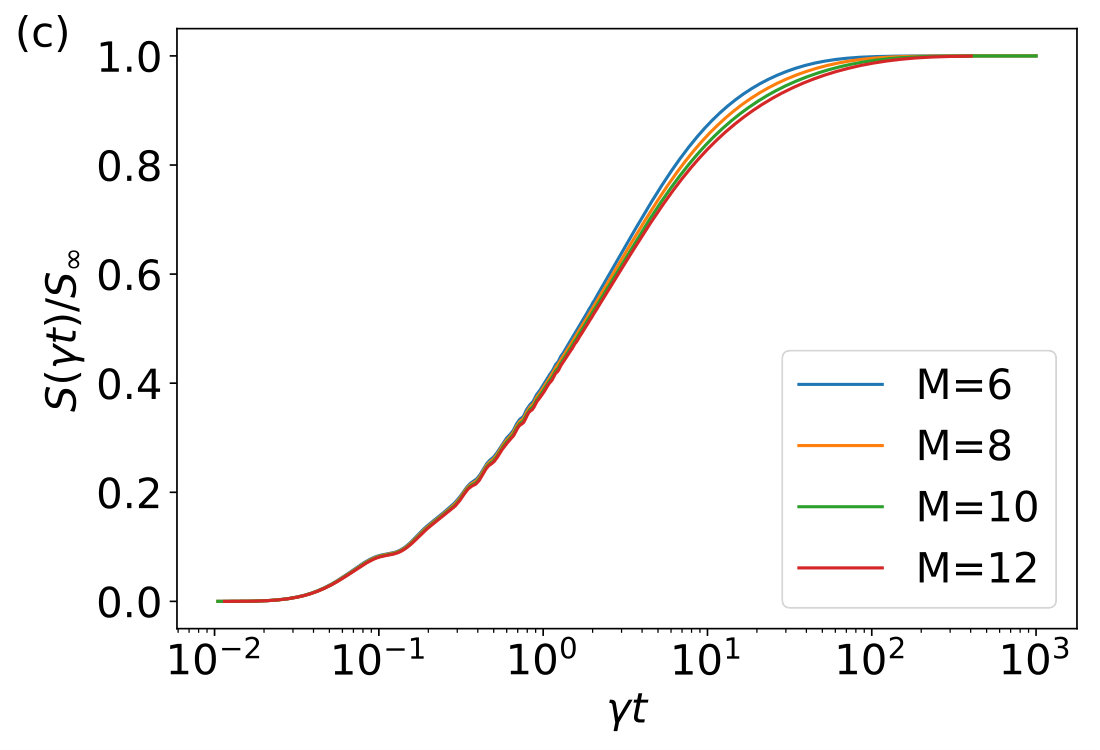 Figure 3
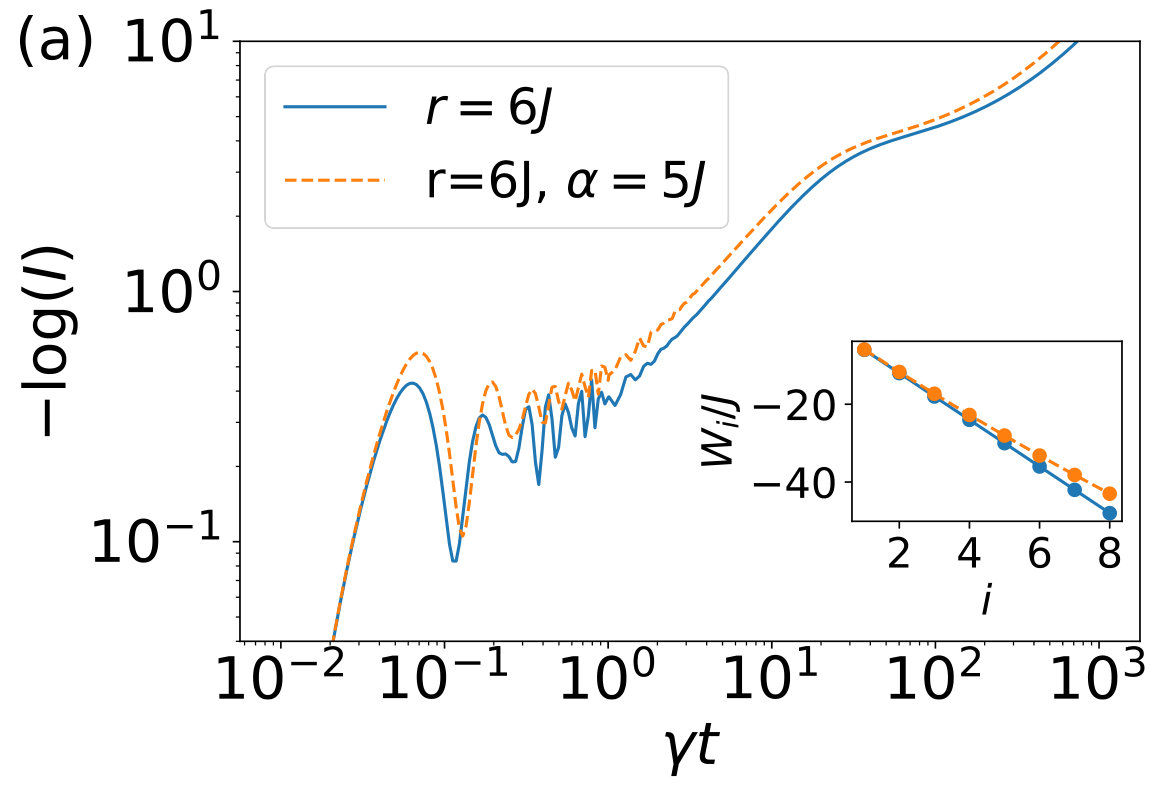 Figure 4
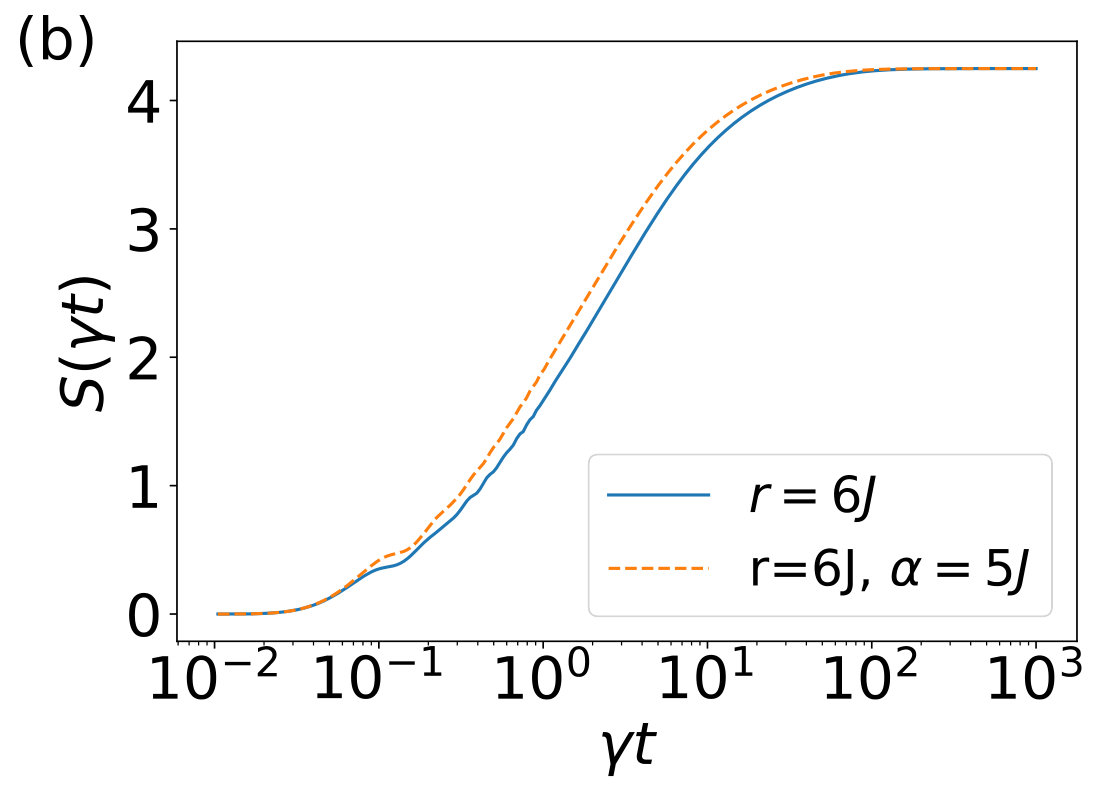 Figure 4
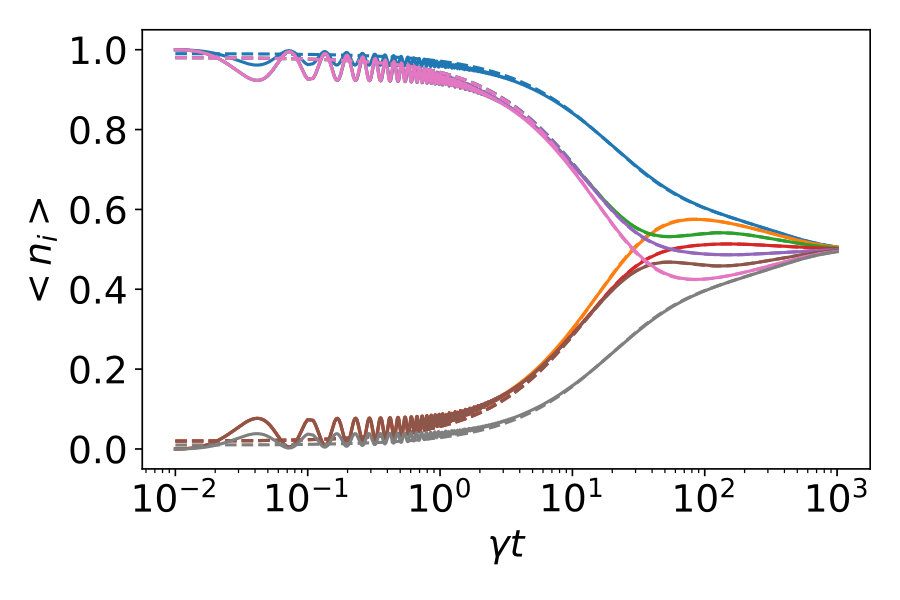 Figure 11
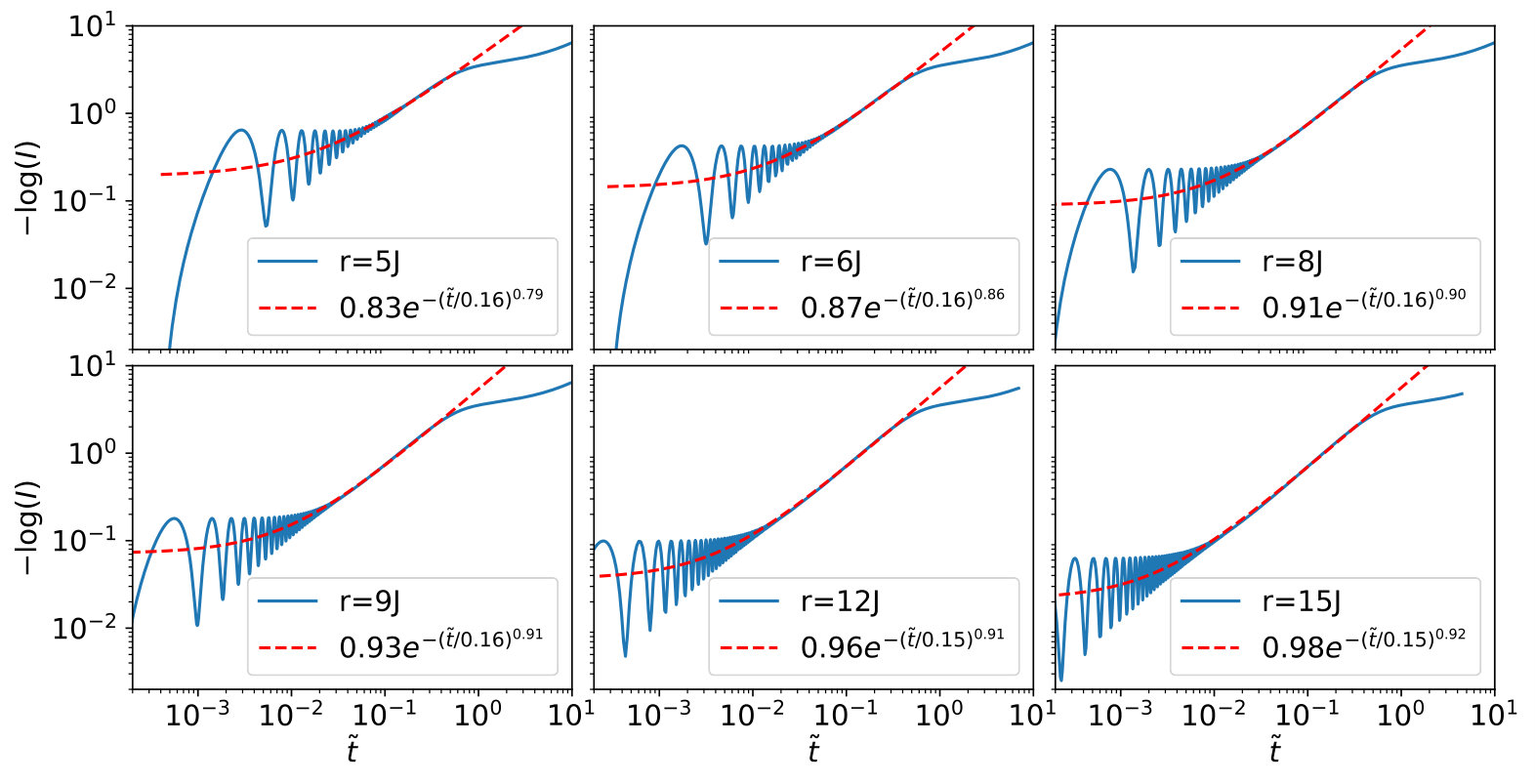 Figure 12
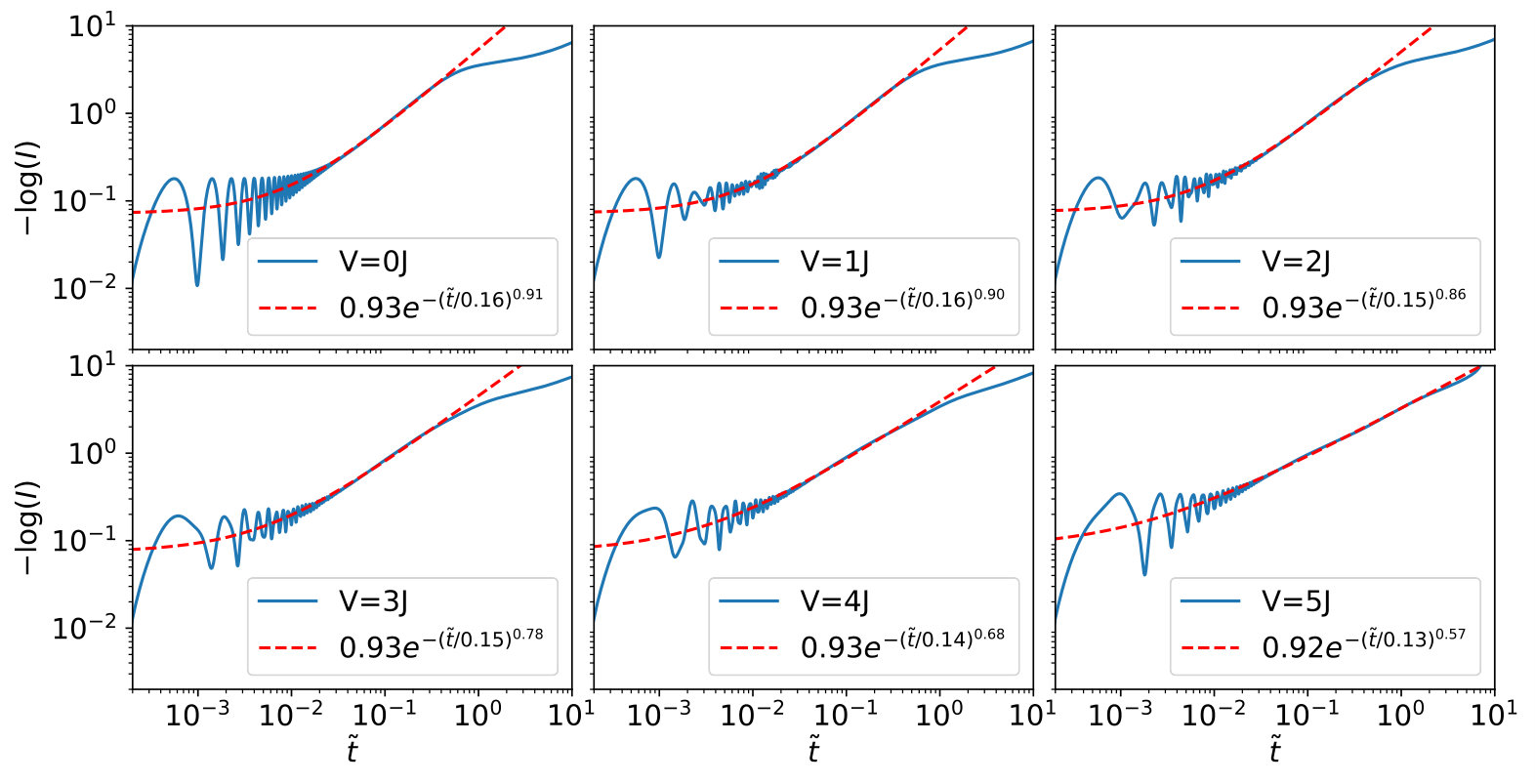 Figure 13
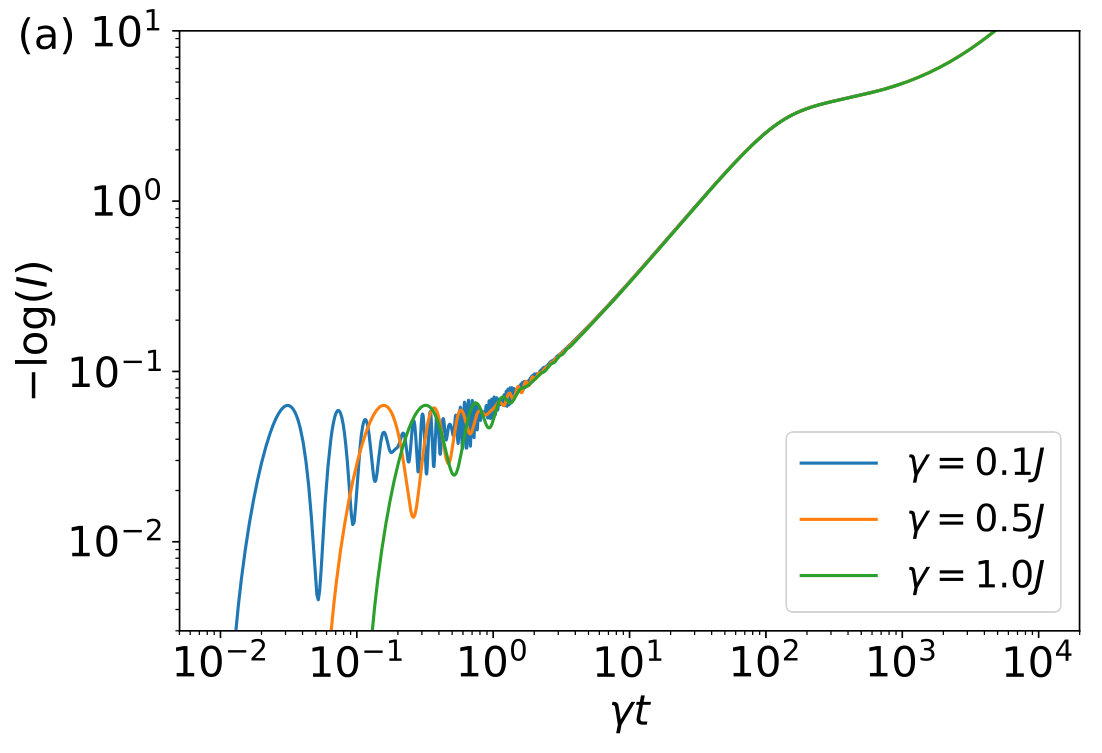 Figure 14
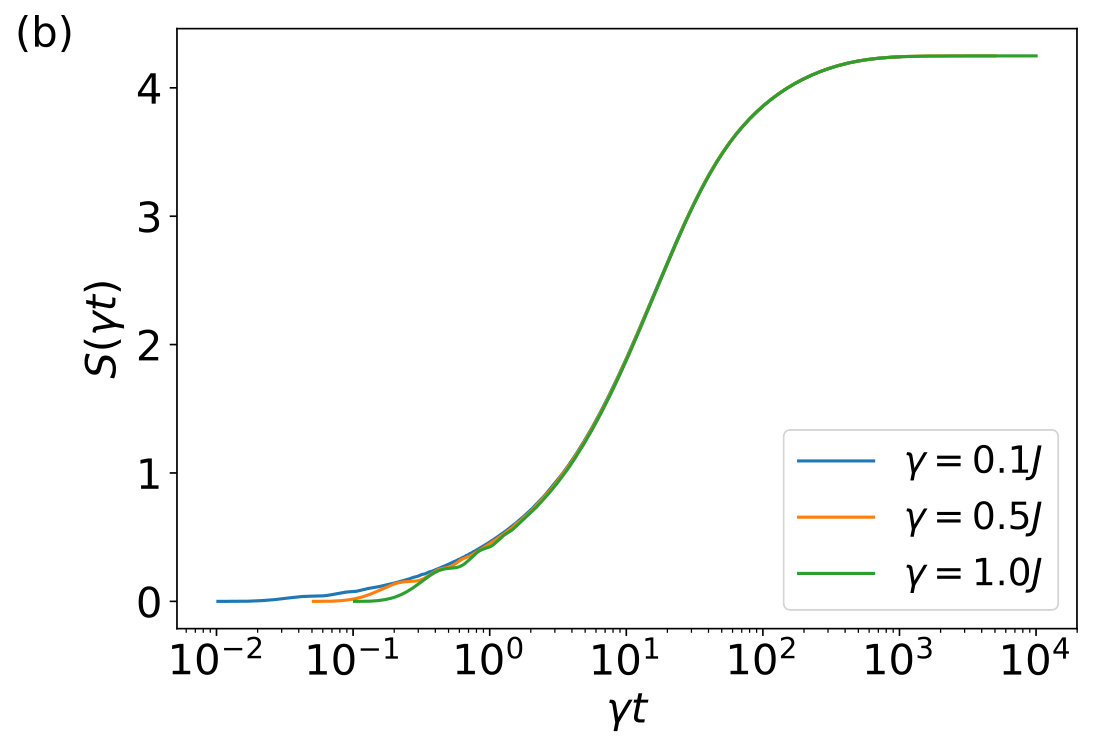 Figure 15
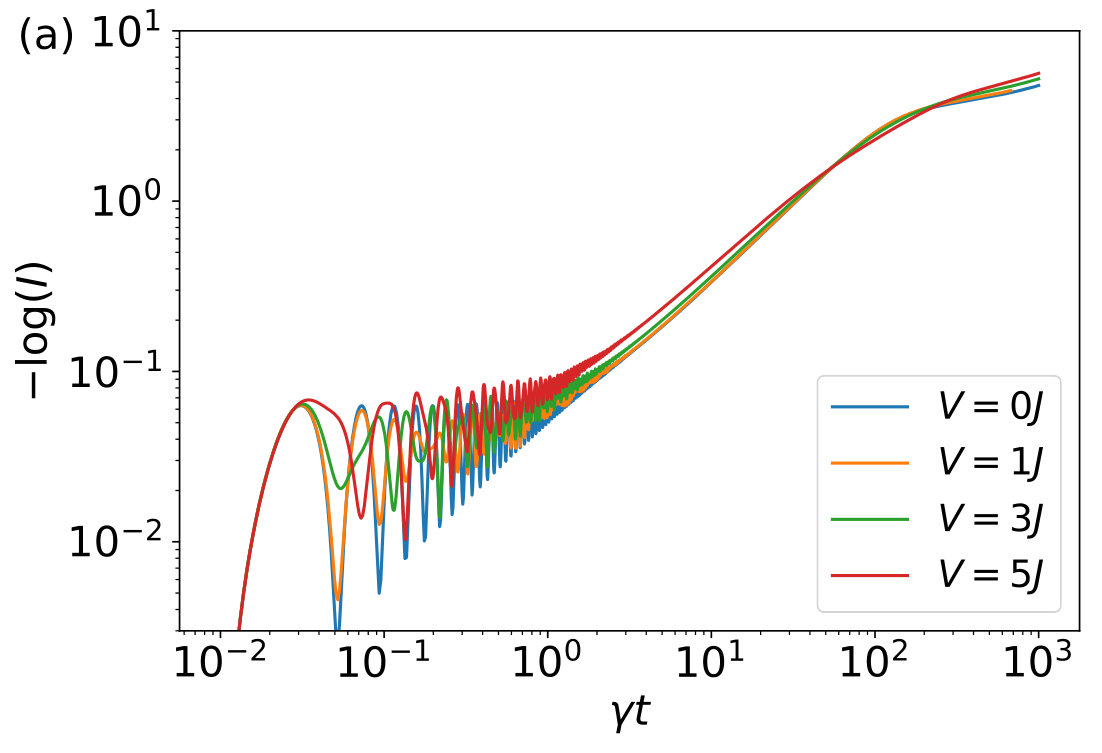 Figure 16
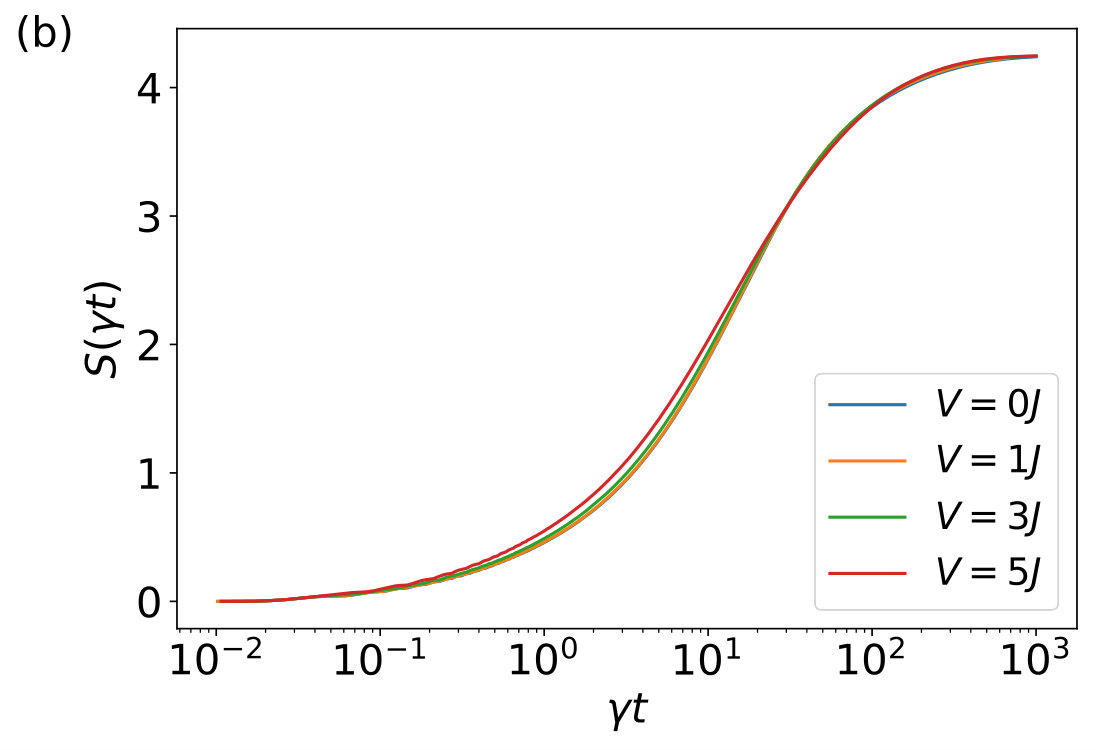 Figure 17
Peer Reviews
No public reviews on file for this paper yet. If you reviewed it on a platform where reviews are public (OpenReview, ICLR, NeurIPS, ICML), you can paste yours below so the community can read it here.
Videos
No videos yet. Explain this paper in a talk, walkthrough, or lecture? Add one.
Bath-induced decay of Stark many-body localization
Ling-Na Wu
Max Planck Institute for the Physics of Complex Systems, D-01187, Dresden
André Eckardt
Max Planck Institute for the Physics of Complex Systems, D-01187, Dresden
Abstract
We investigate the relaxation dynamics of an interacting Stark-localized system coupled to a dephasing bath, and compare its behavior to the conventional disorder-induced many body localized system. Specifically, we study the dynamics of population imbalance between even and odd sites, and the growth of the von Neumann entropy. For a large potential gradient, the imbalance is found to decay on a time scale that grows quadratically with the Wannier-Stark tilt. For the non-interacting system, it shows an exponential decay, which becomes a stretched exponential decay in the presence of finite interactions. This is different from a system with disorder-induced localization, where the imbalance exhibits a stretched exponential decay also for vanishing interactions. As another clear qualitative difference, we do not find a logarithmically slow growth of the von-Neumann entropy as it is found for the disordered system. Our findings can immediately be tested experimentally with ultracold atoms in optical lattices.
pacs:
Many body localization (MBL) Altman and Vosk (2015); Nandkishore and Huse (2015); Alet and Laflorencie (2018); Abanin et al. (2018), which describes the failing of an interacting system with quenched disorder to thermalize, has attracted widespread attentions in recent years, both theoretically Žnidarič et al. (2008); Bardarson et al. (2012); Serbyn et al. (2013); Huse et al. (2014); Chandran et al. (2015); Luitz et al. (2015); Serbyn et al. (2015) and experimentally Schreiber et al. (2015); Smith et al. (2016); Choi et al. (2016); Roushan et al. (2017); Rispoli et al. (2018). Over the past decade, studies have uncovered a rich variety of unique and interesting properties of MBL phases, such as logarithmic growth of entanglement Žnidarič et al. (2008); Bardarson et al. (2012), the emergence of an extensive set of quasi-local integrals of motion Serbyn et al. (2013); Huse et al. (2014); Chandran et al. (2015), the existence of many-body mobility edges Luitz et al. (2015); Serbyn et al. (2015), and so on.
So far, most of the studies on MBL are based on disordered system. However, it is a very intriguing question whether MBL can be achieved also without disorder. The idea of disorder-free localization can be traced back to the early work on interaction-induced localization Kagan and Maksimov (1984). A lot of efforts have been devoted to the possibility of MBL in translation-invariant systems Grover and Fisher (2014); Schiulaz et al. (2015); Schiulaz and Müller (2014); Yao et al. (2016); Papić et al. (2015); Smith et al. (2017a, b); De Roeck and Huveneers (2014); Hickey et al. (2016); van Horssen et al. (2015); Carleo et al. (2012). Most of them are based on the mixture of two species of particles Grover and Fisher (2014); Schiulaz et al. (2015); Schiulaz and Müller (2014); Papić et al. (2015); Yao et al. (2016), where one species effectively acts as a disorder potential. However, a recent study Papić et al. (2015) concludes that these models show only transient localized behavior, which ultimately becomes delocalized at long times. Recently, two papers van Nieuwenburg et al. (2019); Schulz et al. (2019) explored another direction by looking for MBL-like behavior in interacting Wannier-Stark localized systems. These models are shown to exhibit nonergodic behavior as indicated by their spectral and dynamical properties.
In search for evidence of MBL in the absence of disorder, all the previous studies focus on closed (isolated) systems and show several hallmarks of MBL in their models. On the other hand, in recent years, the imperfect experimental environment has excited an intense interest in the effect of dissipation on MBL Levi et al. (2016); Fischer et al. (2016); Medvedyeva et al. (2016); Everest et al. (2017); Basko et al. (2007); Lüschen et al. (2017); Nandkishore et al. (2014); Nandkishore and Gopalakrishnan (2016); Rubio-Abadal et al. (2018); Lenarčič et al. (2018); Johri et al. (2015); Nandkishore (2015); Luitz et al. (2017); Hyatt et al. (2017); Wu et al. (2018). When the system is coupled to environments with broad spectrum, the MBL phase will eventually be destroyed. However, the relaxation can be extremely slow in the open disorder-induced MBL systems Levi et al. (2016); Fischer et al. (2016).
Here, we explore the fate of disorder-free localization in the presence of dissipation. Specifically, we study the Wannier-Stark localized system van Nieuwenburg et al. (2019); Schulz et al. (2019) coupled to a dephasing bath. This type of dissipation, which has been studied in a number of recent papers Levi et al. (2016); Fischer et al. (2016); Medvedyeva et al. (2016); Everest et al. (2017); Žnidarič et al. (2016), is particularly relevant for experiments with ultracold atoms in optical lattices, where it is induced by the off-resonant scattering of lattice photons via spontaneous emission Pichler et al. (2010); Lüschen et al. (2017).
Starting from a density-wave state with one fermion on every other site of a one-dimensional lattice, we investigate the dynamics of population imbalance between even and odd sites, and the growth of von Neumann entropy. In the limit of strong localization, the relaxation dynamics is found to become very slow and dependent on the field gradient. However, the way both entropy and imbalance relax is found to be qualitatively different from the case of disorder-induced MBL systems Levi et al. (2016); Fischer et al. (2016).
The model under consideration is a chain of interacting spinless fermions with open boundary conditions, subject to a strong electric field, with Hamiltonian
[TABLE]
Here the operator creates a fermion on lattice site , and is the associated number operator. The first term in (Bath-induced decay of Stark many-body localization) denotes tunneling between nearest neighbor sites with rate . The second term is the on-site potential describing the applied static gradient, . The last term describes the nearest-neighbor interactions with strength .
The non-interacting system (in the thermodynamic limit) exhibits the well-known Wannier-Stark effect Wannier (1960), where the particles are localized due to the linear potential. In the Wannier representation, the single-particle eigenstates Fukuyama et al. (1973) take the form , where is the Bessel function of the first kind with argument . The associated eigenenergies form the Wannier-Stark ladder with equal level splittings determined by the electric field. When interactions are turned on, the system is shown to remain localized above a critical potential gradient and to exhibit non-ergodic behavior analogous to conventional MBL van Nieuwenburg et al. (2019); Schulz et al. (2019), such as logarithmic growth of entanglement entropy, Poissonian level statistics, etc. 111Strictly speaking, the system with purely linear potential shows singular behavior Schulz et al. (2019) and a small perturbation, e.g. in the form of a quadratic potential, has to be added to recover generic MBL behavior. However, below we show that adding such a perturbation does not lead to a qualitative change of the dynamics of the open system..
We couple the system to a dephasing bath that couples to the on-site occupations and which can be interpreted as a structureless environment allowing for energy exchange at all scales. Such a dissipation can be engineered in experiments with ultracold atoms via the off-resonant scattering of lattice photons Pichler et al. (2010); Lüschen et al. (2017). It drives the system towards infinite-temperature state in the long-time limit. The full dynamics of the system can be described by a master equation of Lindblad form Breuer and Petruccione (2002),
[TABLE]
where is the system’s density matrix and sets the coupling to the bath.
In order to study ergodicity breaking in the open system, let us first investigate the dynamics of population imbalance between even and odd sites,
[TABLE]
Being easily accessible, this quantity is widely used in experiments Schreiber et al. (2015); Bordia et al. (2016); Choi et al. (2016); Bordia et al. (2017); Lüschen et al. (2017) to quantify the memory of the initial conditions. We choose a charge-density-wave state with every second lattice site occupied as an initial state, which is also the usual choice in experiments. For the isolated system in the MBL phase, the imbalance approaches a finite value in the steady state van Nieuwenburg et al. (2019); Schulz et al. (2019). Such a memory of the initial condition can no longer be maintained in the presence of dissipation.
Figure 1(a) shows the dynamics of the imbalance for non-interacting systems () with different field gradients . The imbalances (solid lines) oscillate at short times and then decay to zero at a rate that is found to depend on the field gradient . We show for large in a logarithmic plot as a function of the scaled time with
[TABLE]
in Fig. 1(b). The results (solid lines) collapse onto each other from the time where decay sets in. The decay is found to be approximately exponential. By fitting it to a stretched exponential function , we get a stretching exponent close to at a large field gradient , as shown in the inset of Fig. 1(b) [see Fig. S2 in Supplementary Material for more details of the curve fitting]. The slightly stretched exponential behavior is a finite-size effect: it approaches an exponential decay as system size increases, as shown in Fig. 1(c). This decay behavior is different from that for disorder-induced localization Fischer et al. (2016). There the population imbalance exhibits a stretched exponential decay with stretching exponent for the non-interacting system under dephasing noise. This behavior is attributed to the different decay rates at distinct parts of the system due to fluctuations in the disorder strength, which are absent in our model.
To explain the observed behavior in our model, let us study the dynamics of the mean occupations in the eigenbasis. The dephasing noise leads to the decay of the off-diagonal elements of the density matrix in the eigenstate basis due to rapid oscillations, resulting in a diagonal density matrix for long-time evolution Fischer et al. (2016); Wu et al. (2018); Vorberg et al. (2015). Hence, the equation of motion for the mean occupation of the eigenstate can be well described by the following classical rate equation
[TABLE]
where the jump rate depends on the overlap of the two involved single-particle wavefunctions, , .
For a strong field, , we take the Wannier-Stark states for the infinite system as the eigenstates for the finite-size system considered here, i.e., , which turns out to be a good approximation as shown later. Due to the strong localization of the eigenstates, the rate in Eq. (5) is dominated by , which connects nearest neighbors. Hence, Eq. (5) can be reduced to
[TABLE]
whose explicit solution is given in the Supplemental Material. Note that to obtain the population imbalance, we need the mean occupation in real space . While for a large , we have . The resulting population imbalance from () is shown as dashed (dotted) lines in Fig. 1. Of course this approximation is not able to capture the short-time oscillations due to the neglect of off-diagonal terms in the density matrix. Nevertheless, for the long-time evolution, it agrees well with the exact solution (solid lines) obtained by numerical integration of the master equation (2) (for system with sites).
In order to get a simple expression for the imbalance, we make a further approximation. From Eq. (Bath-induced decay of Stark many-body localization), we can obtain the time evolution of the population in even and odd sites, . Thus, the dynamics of the population imbalance is governed by
[TABLE]
By neglecting the edge term , we arrive at
[TABLE]
This simple expression is shown by the black dot-dashed line in Fig. 1(b). It explains the observed approximately exponential decay of the imbalance on the time scale [Eq. (4)]. By comparing it with the results from Eq. (7) (dotted lines, which overlap with the solid lines at long times), we can see that the edge term leads to the deviation from the exponential decay for . This is further confirmed in Fig. 1(c), where the edge effect becomes weaker for a larger system.
Let us now investigate the role of interactions. For a large potential gradient with , based on the perturbation theory to the leading order in (Fischer et al., 2016), the dynamics of the mean occupations in the eigenbasis is approximately governed by
[TABLE]
Here is a numerical constant of order , which is adjusted to optimize the matching of the approximated results with the exact ones 222For the edge sites, we take , and . As shown in Fig. 2, the long-time behavior of the imbalance (orange solid line) is well captured by the simple equations in (9), whose corresponding result is shown in black dot-dashed line. Note that the first term in Eq. (9) is identical to Eq. (5) for the non-interacting case. The second term describes the contribution from interactions, which leads to an interaction-assisted-hopping on the order of . It implies that interactions will enhance the decay of the imbalance. This is confirmed in Fig. 2, where we see that a strong interaction enhances the decay of the imbalance at short times and then leads to a stretched exponential decay before approaching the steady-state value. The inset in Fig. 2(b) shows the stretching exponent as a function of the interaction strength (see Fig. S3 in Supplementary Material for more details of the curve fitting).
As a second quantity, we now study the von Neumann entropy of the whole system,
[TABLE]
which quantifies the heating induced by the bath. Figure 3 shows the time evolution of the entropy for a chain at half filling from the initial charge-density-wave state. From Fig. 3(a) we can see that the rate of entropy growth is set by the field strength . As shown in the inset of Fig. 3(a), the entropies for different collapse onto each other as a function of the scaled time . By comparing the results for the non-interacting case (dotted lines) with those for the interacting case with (solid lines), we find that the effect of interactions is weak and tends to enhance the growth of entropy.
One of our main findings is shown in Fig. 3(b), where we compare the entropy growth of the Stark-localized system (solid lines) to that of a disorder-localized system (dot-dashed lines) in a semilog plot. For the latter, the entropy exhibits logarithmically slow growth, with a linear slope in the semilog plot found in a wide time window covering about two decades Levi et al. (2016). In contrast, we do not find such an extended region with a linear slope for the Stark localized system: a linear slope is found only at the inflection point associated with the on-set of saturation. This observation is robust to field strength, as is supported by the inset, which shows the collapse of entropies for various field strengths at large scaled times . It is also not related to the particular parameters selected in the plot, such as coupling rate and interaction strength , whose impacts on the dynamics are found to be weak (see Figs. S4 and S5 of the Supplementary Material for more details). In Fig. 3(c), we plot the time evolution of the entropy (normalized by its maximum, i.e. infinite-temperature value ) for different system sizes . We find a very weak dependence on the system size only and no indication that the linear slope near the inflection point starts to extend over a larger time interval with increasing .
Note that the observed non-logarithmic behavior is also not associated with the exceptional behavior found for a purely linear potential gradient in the closed system Schulz et al. (2019). Namely it was shown that a purely linear potential is not enough for the Stark system to exhibit generic MBL behavior, which only occurs when, e.g., a small quadratic potential is added. Such a big difference brought by the additional weak field is absent in the open system. As shown in Fig. 4, adding such a potential to our open system does not lead to a qualitative change in the dynamics of both population imbalance (a) and entropy (b).
In conclusion, we investigate the relaxation dynamics of an open chain of interacting spinless fermions in the presence of a strong electric field coupled to a dephasing bath. The closed (isolated) system is shown by previous studies van Nieuwenburg et al. (2019); Schulz et al. (2019) to exhibit non-ergodic behavior analogous to conventional disorder-induced MBL system. However, when coupled to a dephasing bath, the Stark system shows qualitatively different relaxation dynamics towards steady state. We show that in contrast to a disordered system Fischer et al. (2016), the decay of the population imbalance is described by a stretched exponential only in the presence of interactions. Another stark difference is the fact that the growth of the von Neumann entropy is not logarithmically slow, as it was found for the disordered system Levi et al. (2016). Our findings can immediately be tested experimentally with ultracold atoms in optical lattices by employing the techniques of Ref. Lüschen et al. (2017), where the impact of a dephasing bath on the decay of quasi-disorder-induced MBL was investigated. In such an experiment, one would rather consider spinful fermions with on-site interactions (the numerical treatment of which is more difficult as a result of the enlarged state space and beyond the scope of this paper). However, also in this case qualitative differences in the relaxation dynamics of the disorder localized and the Stark localized open system can be expected, since we observed profound differences already in the limit of vanishing interactions.
Acknowledgements.
We acknowledge discussions with Markus Heyl. This research was funded by the Deutsche Forschungsgemeinschaft (DFG) via the Research Unit FOR 2414 under Project No. 277974659.
I Solution to Eq. (6) in the main text
To solve Eq. (6) in the main text, we rewrite it in matrix form as
[TABLE]
where , and is a Tridiagonal quasi-Toeplitz matrix
[TABLE]
with eigenvalues () and eigenvectors with Yueh (2005). Its solution is given by
[TABLE]
with .
In Fig. S1, we compare the mean occupation from numerical integration of the master equation (2) in the main text (solid lines) and that by using the approximated result of Eq. (S3) (dashed lines). Except for the initial coherent oscillations, which are absent in the latter due to the neglect of the off-diagonal terms in the density matrix, Eq. (S3) well describes the time evolution of the mean occupation.
II Stretched exponential fitting
Fig. S2 shows the dynamics of the imbalance for noninteracting systems with different field strengths from the initial charge-density-wave state. The red dashed lines are fitting curves based on stretched exponential function . The data with are used for the fitting. Fig. S3 shows similar results for different interaction strengths .
III Dependence of relaxation dynamics on system parameters
In this section, we study the dependence of relaxation dynamics on various system parameters for a large field gradient ().
III.1 Dependence on coupling rate
Fig. S4 shows the dynamics of the imbalance (a) and entropy (b) for different weak system-bath coupling rates with . At short times , the coupling rate sets the oscillation rate of the dynamics. While for long time evolution with , the dynamics exhibits a collapse when rescaling the time axis by .
III.2 Dependence on interaction strength
Fig. S5 shows the dynamics of the imbalance (a) and entropy (b) for different interaction strengths . The effect of interaction is found to be subleading compared to dephasing noise.
The reference list from the paper itself. Each links out to its DOI / PubMed record.
- 1Altman and Vosk (2015) E. Altman and R. Vosk, Annual Review of Condensed Matter Physics 6 , 383 (2015) . · doi ↗
- 2Nandkishore and Huse (2015) R. Nandkishore and D. A. Huse, Annual Review of Condensed Matter Physics 6 , 15 (2015) . · doi ↗
- 3Alet and Laflorencie (2018) F. Alet and N. Laflorencie, Comptes Rendus Physique 19 , 498 (2018) .
- 4Abanin et al. (2018) D. A. Abanin, E. Altman, I. Bloch, and M. Serbyn, ar Xiv preprint ar Xiv:1804.11065 (2018) .
- 5Žnidarič et al. (2008) M. Žnidarič, T. Prosen, and P. Prelovšek, Phys. Rev. B 77 , 064426 (2008) . · doi ↗
- 6Bardarson et al. (2012) J. H. Bardarson, F. Pollmann, and J. E. Moore, Phys. Rev. Lett. 109 , 017202 (2012) . · doi ↗
- 7Serbyn et al. (2013) M. Serbyn, Z. Papić, and D. A. Abanin, Phys. Rev. Lett. 111 , 127201 (2013) . · doi ↗
- 8Huse et al. (2014) D. A. Huse, R. Nandkishore, and V. Oganesyan, Phys. Rev. B 90 , 174202 (2014) . · doi ↗