On Generalized q-logistic Distribution and its Characterizations
Seema S Nair, Nicy Sebastian

TL;DR
This paper introduces a generalized q-logistic distribution with a new parameter q for enhanced modeling flexibility, along with skewed variants, and explores their properties for data with unimodal, skewed densities.
Contribution
The paper proposes a new generalized q-logistic distribution and its skewed version, analyzing their properties and potential for modeling skewed, unimodal data.
Findings
The generalized q-logistic distribution offers increased modeling flexibility.
The skew q-logistic distribution is always unimodal and log-concave.
Properties of the new distributions are thoroughly analyzed.
Abstract
Several generalizations of the logistic distribution, and certain related models, are proposed by many authors for modeling various random phenomena such as those encountered in data engineering, pattern recognition, and reliability assessment studies. A generalized q-logistic distribution is discussed here in the light of pathway model, in which the new parameter q allows increased flexibility for modeling purpose. Also, we discuss different properties of the two generalizations of the q-logistic distributions, which can be used to model the data exhibiting a unimodal density having some skewness present. The first generalization is carried out using the basic idea of Azzalini and we call it as the skew q-logistic distribution. It is observed that the density function of the skew q-logistic distribution is always unimodal and log-concave in nature.
Click any figure to enlarge with its caption.
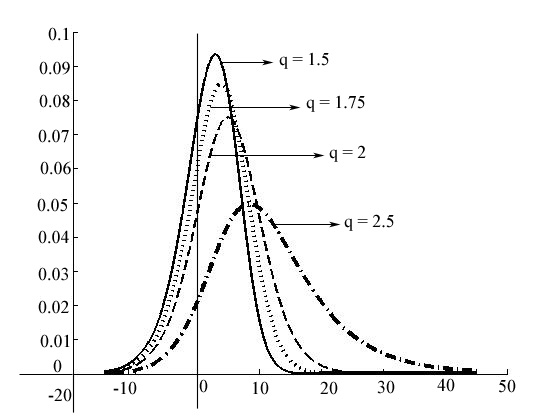 Figure 1
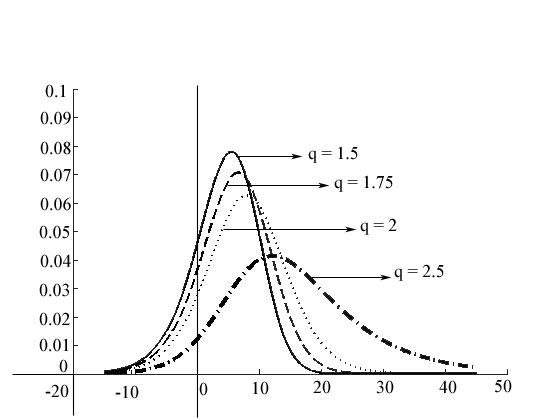 Figure 2
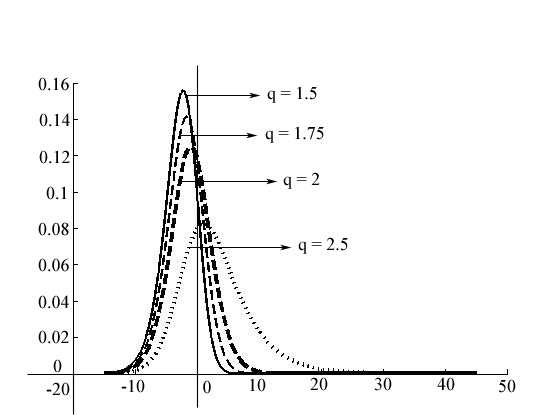 Figure 3
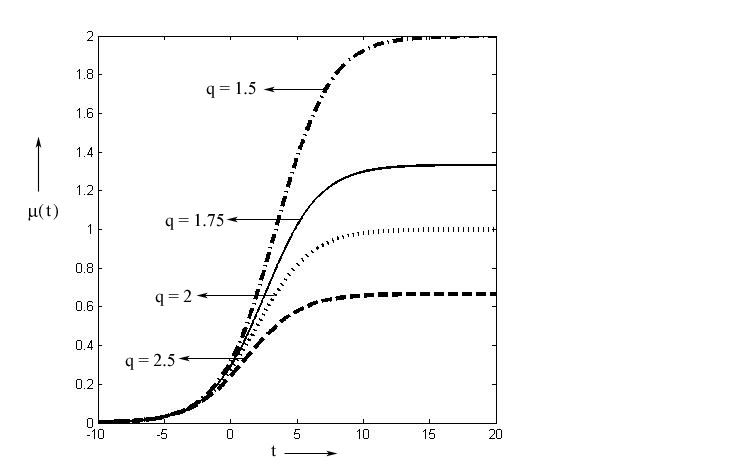 Figure 4
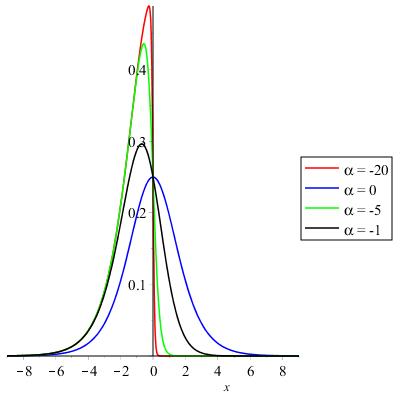 Figure 5
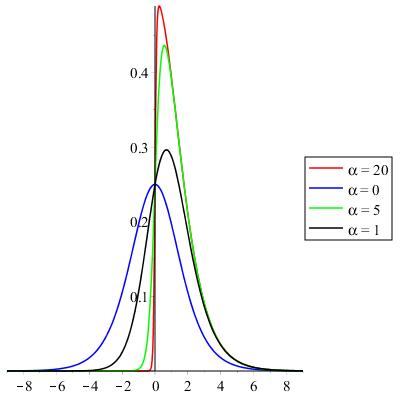 Figure 6
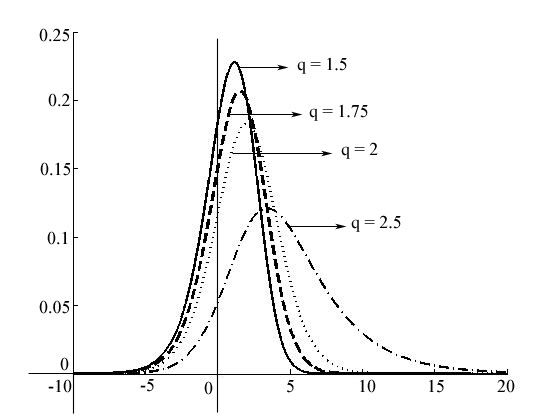 Figure 7
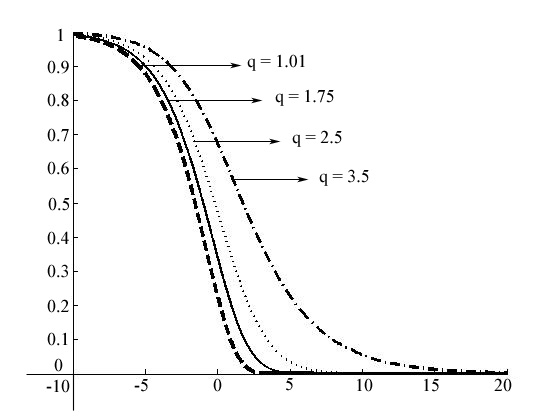 Figure 8
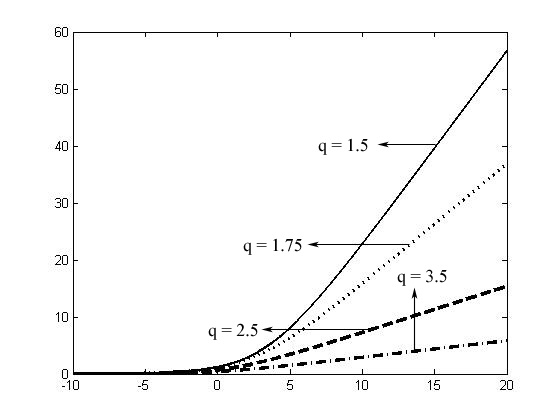 Figure 9
Peer Reviews
No public reviews on file for this paper yet. If you reviewed it on a platform where reviews are public (OpenReview, ICLR, NeurIPS, ICML), you can paste yours below so the community can read it here.
Videos
No videos yet. Explain this paper in a talk, walkthrough, or lecture? Add one.
Taxonomy
TopicsStatistical Distribution Estimation and Applications · Advanced Statistical Methods and Models · Fuzzy Systems and Optimization
**On Generalized -logistic Distribution and Its Characterizations
Seema S. Nair1 and Nicy Sebastian2***E-mail: [email protected], [email protected]
1* Department of Statistics, St. Gregorios College, Kottarakkara, India
2Department of Statistics, St. Thomas College, Thrissur, India ***
Abstract Several generalizations of the logistic distribution, and certain related models, are proposed by many authors for modeling various random phenomena such as those encountered in data engineering, pattern recognition, and reliability assessment studies. A generalized -logistic distribution is discussed here in the light of pathway model, in which the new parameter allows increased flexibility for modeling purpose. Also, we discuss different properties of the two generalizations of the logistic distributions, which can be used to model the data exhibiting a unimodal density having some skewness present. The first generalization is carried out using the basic idea of Azzalini (1985) and we call it as the skew -logistic distribution. It is observed that the density function of the skew logistic distribution is always unimodal and log-concave in nature.
1 Introduction
Logistic curves have been used as models in numerous applications. In particular, because of its roles in analyzing bioassay and quantal response experiments, a lot of research has been reported in literature in studying the properties and applications of the generalized logistic models. Mathai (2003) studied the distribution of order statistics from a logistic population, and pointed out some applications in survival analysis. In reliability theory, the classification of the tail behavior of life distributions is helpful for characterizing their aging properties. As it turns out, according to two classification systems described in Rojo (1996), the logistic distribution is medium-tailed; that is, is approximately linear in the tails, where denotes the cumulative distribution function. The selection of an appropriate model is paramount when studying the implications for a system’s integrity, or safety; or when attempting to identify failure modes, and assessing future performance. The logistic distribution allows generalization in many forms as could be seen in George and Ojo (1980), Balakrishnan and Joshi (1983b), Balakrishnan and Leung (1988a), Wu et al. (2000), Mathai (2003), Mathai and Provost (2006), Olapade (2006).
Because of the flexibility, much attention has been given to the study of generalized models in recent times. The generalized model proposed in this paper is referred to as analogue of the logistic distribution in which the additional parameter , called as pathway parameter, is incorporated in its density function. In addition to this, we have considered a generalized -logistic distribution by introducing location and scale parameters and respectively which will result more flexible model than the standard -logistic distribution. The role of the two additional parameters is to introduce skewness and to vary tail weights and provide greater flexibility in the shape of the generalized distribution and consequently in modeling observed data. It may be mentioned that although several skewed distribution functions exist on the positive real axis, not many skewed distributions are available on the whole real line, which are easy to use for data analysis purpose.
2 Generalized -logistic Model
Let be -extended type-2 beta random variable having density
[TABLE]
where is known as the pathway parameter through which one can move from one functional form to another, see Mathai (2005), Mathai and Haubold (2007).
Suppose that we make the transformation , where is distributed as in (2.1) for , one has generalized -logistic density. That is
[TABLE]
and the corresponding density function has the following functional form
[TABLE]
where
[TABLE]
is the normalizing constant. In particular when , one has
[TABLE]
a generalized extreme value model, where is the normalizing constant.
The density specified by (2.2) is plotted in the following figures for and different values of . The influence of additional parameters can be easily observed from the following figures by putting different values to for each figure. It is observed that each type of generalized -logistic curves established in this paper, the larger the pathway parameter , the lower the mode of the corresponding distribution will be.
[TABLE]
[TABLE]
3 Distribution and Survival Functions
The distribution function of the model in (2.2) is
[TABLE]
As a special case, when one has
[TABLE]
Hence in this case, the survival function is,
[TABLE]
which is used to model the life lengths of certain components of interest in a device or system. The instantaneous failure rate or the hazard rate, of (2.2) can be given as
[TABLE]
which can be shown to be an increasing function of and therefore the model implies the aging effect. Also the model in (2.2) belongs to the family of IFR (Increasing Failure Rate) distributions since is convex in , which is shown in figure 6.
[TABLE]
Figure 7: The instantaneous failure rate of GqL for various .
4 Characterization theorems based on generalized -logistic distribution
In this section, some theorems that characterize the generalized -logistic distribution are stated and proved.
Theorem 1
Let be a continuously distributed random variable with density function . Then the random variable is a generalized -logistic random variable with parameters if and only if follows an exponential distribution with parameter .
Proof: Suppose that has exponential distribution with parameter with density function as
[TABLE]
Now let us take the transformation
[TABLE]
[TABLE]
Then by Jaccobian of transformation, we find that
[TABLE]
which is the probability density function of a generalized -logistic random variable with parameters .
Conversely, suppose that is a generalized -logistic random variable, then the characteristic function of is given as
[TABLE]
. And also it is found that
[TABLE]
The only density function satisfying the equation (4.4) is the exponential distribution given in equation (4.1). Hence the theorem is proved.
Theorem 2
Suppose a continuously distributed random variable has a -distribution with degrees of freedom. Then the random variable is distributed according to generalized -logistic random variable with parameters .
Proof: A random variable has a -distribution with degrees of freedom if
[TABLE]
In order to apply one to one transformation, we split the range of variation of in to two, so that the density can be written as
[TABLE]
where
[TABLE]
and
[TABLE]
For , suppose we take the transformation , then . Therefore, Hence,
[TABLE]
Since is symmetric about zero, so it is clear that the transformed function is same for . Hence
[TABLE]
which is the probability density function for generalized -logistic random variables . Conversely, if is a generalized -logistic random variable, then the characteristic function of is given as
[TABLE]
Since the integrand is an even function so we can write
[TABLE]
which is the characteristic function of a generalized -logistic distribution with parameters . then by the uniqueness theorem, the proof is established.
5 **Skew -Logistic Distribution **
In this section, we mainly consider two different generalizations of the logistic distribution by introducing skewness parameters. It may be mentioned that although several skewed distribution functions exist on the positive real axis, but not many skewed distributions are available on the whole real line, which are easy to use for data analysis purpose. The main idea is to introduce the skewness parameter, so that the generalized logistic distribution can be used to model data exhibiting a unimodal density function having some skewness present in the data, a feature which is very common in practice. Recently, skewed distributions have played an important role in the statistical literature since the pioneering work of Azzalini (1985). He has provided a methodology to introduce skewness in a normal distribution. Since then a number of papers appeared in this area, see for example the monograph by Genton (2004) for some recent references. The first generalization is carried out using the idea of Azzalini (1985) and we name it as the skew logistic distribution. It is observed that using the same basic principle of Azzalini (1985), the skewness can be easily introduced to the logistic distribution. It has location, scale and skewness parameters. It is observed that the PDF of the skew logistic distribution can have different shapes with both positive and negative skewness depending on the skewness parameter. It has heavier tails than the skew normal distribution proposed by Azzalini (1985). Although the PDF of the skew logistic distribution is unimodal and log-concave, but the distribution function, failure rate function and the different moments can not be obtained in explicit forms. Moreover, it is observed that even when the location and scale parameters are known, the maximum likelihood estimator of the skewness parameter may not always exist. Due to this problem, it becomes difficult to use this distribution for data analysis purposes. Azzalini (1985) proposed the skew normal distribution, which has the following density function;
[TABLE]
here is the skewness parameter, and are the density function and distribution function of the standard normal random variable. A motivation of the above model has been elegantly exhibited by Arnold et al. (1993). Although, Azzalini has been extended the standard normal distribution function to the form (9), but it has been observed that similar method can be applied to any symmetric density function. For example, if is any symmetric density function defined on and is its distribution function, then for any ,
[TABLE]
is a proper density function and it is skewed if . This property has been studied extensively in the literature to study skew-t and skew-Cauchy distributions. Along the same line we define the skew -logistic distribution with the skewness parameter as follows. If a random variable has the following density function
[TABLE]
then we say that has a skew-logistic (SL) distribution with skewness parameter . For brevity we will denote it by q. Clearly (5.3) is a proper density function and , corresponds to the standard -logistic distribution.
[TABLE]
Above figures, it is clear that is positively skewed when is positive. It takes similar shapes on the negative side for . Therefore, can take positive and negative skewness. As goes to , it converges to the half logistic distribution. Comparing with the shapes of the skew normal density function of Azzalini (1985), it is clear that produces heavy tailed skewed distribution than the skew normal ones. For large values of , the tail behaviors of the different members of the family are very similar, which is apparent from (5.3) also. It is clear from Figure 2 that the tail behaviors of the different family members of are same for large values of . Some of the properties which are true for skew normal distribution are also true for skew logistic distribution.
The reference list from the paper itself. Each links out to its DOI / PubMed record.
- 1[1] Ahuja, J. C. and Nash, S. W., The generalized Gompertz-Verhulst family of distributions, Sankhya, Ser. A. , vol. 29 , 141 - 156, 1967.
- 2[2] Arnold, B.C., Beaver, R.J., Groeneveld, R.A. and Meeker, W.Q., The non truncated marginal of truncated bivariate normal distribution, Psychometrika , vol. 58 , 471-488, 1993.
- 3[3] F.J. Aranda-Ordaz, Asymmetric generalizations of logistic models with GLIM, GLIM News Letter , 9, 27-29, 1982.
- 4[4] Azzalini, A., A class of distributions which includes the normal ones, Scandinavian Journal of Statistics , vol. 12 , 171-178, 1985.
- 5[5] N. Balakrishnan and P.C. Joshi, Means, variances and covariances of order statistics from symmetrically truncated logistic distribution, J. Statist. Res. , 17, 51-61, 1983 b.
- 6[6] N. Balakrishnan and M. Y. Leung, Order statistics from the type I generalized logistic distribution, Communications in Statistics-Simulation and Computation , 17 (1), 25-50, 1988 a.
- 7[7] J. Berkson, Application of the logistic function to bioassay, Journal of the American Statistical Association , 37, 357-365, 1944.
- 8[8] M.A. El-Saidi, and E.O. George, A Generalized Logistic Model for Quantal Response Bioassay, Biom. J. , 32, 943-954, 1990.