Theory of spin transport through antiferromagnetic insulator
Gen Tatara, Christian Ortiz Pauyac

TL;DR
This paper develops a theoretical model for spin transport through antiferromagnetic insulators, highlighting the role of magnon correlations and temperature effects in spin diffusion.
Contribution
It introduces a novel theoretical framework incorporating magnon representation and temperature-dependent damping to describe spin transport in antiferromagnets.
Findings
Spin signal transfer is mediated by ferromagnetic correlations.
Spin diffusion length peaks near the Ne9el transition temperature.
High-temperature behavior includes short AF correlations and magnon scattering effects.
Abstract
A theoretical formulation for spin transport through an antiferromagnetic (AF) insulator is presented in the case driven/detected by direct/inverse spin Hall effect in two heavy metal contacts. The spin signal is shown to be transferred by the ferromagnetic correlation function of the antiferromagnet, which is calculated based on a magnon representation. To cover high temperature regimes, we include an auxiliary field representing short AF correlations and a temperature-dependent damping due to magnon scattering. The diffusion length for spin is long close to the degeneracy of the two AF magnons, and has a maximum as function of temperature near the N\'eel transition.
Click any figure to enlarge with its caption.
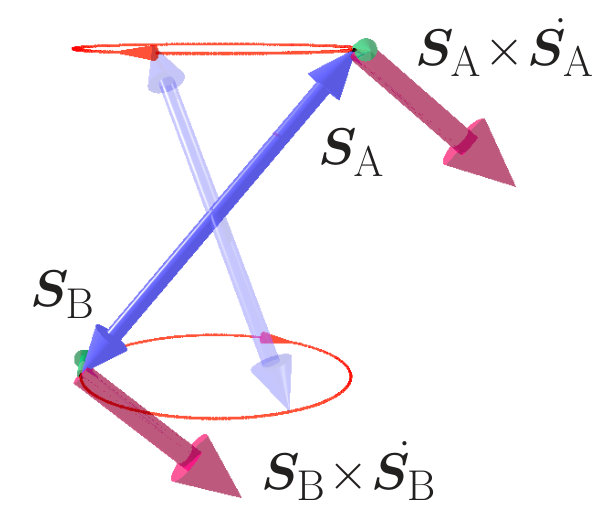 Figure 1
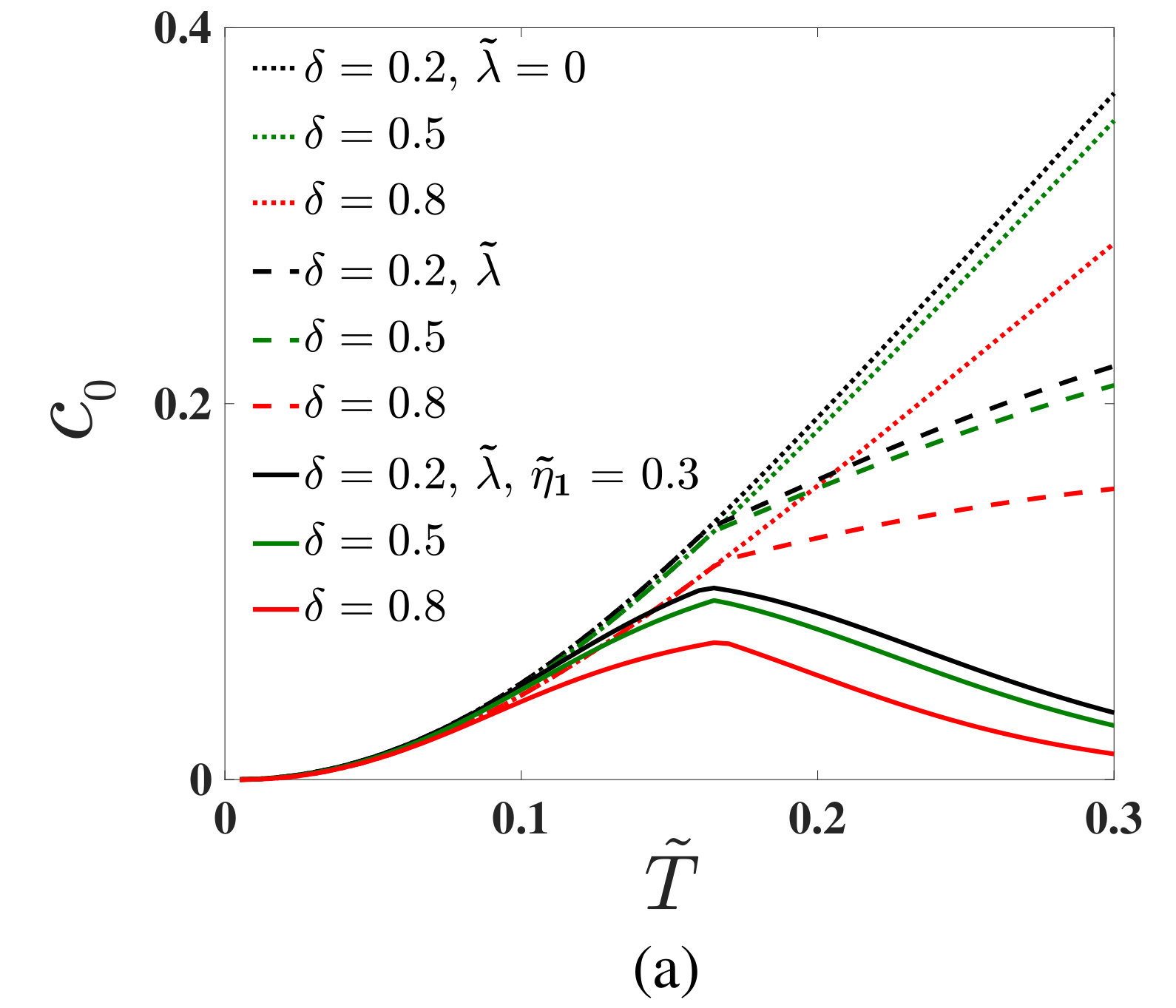 Figure 2
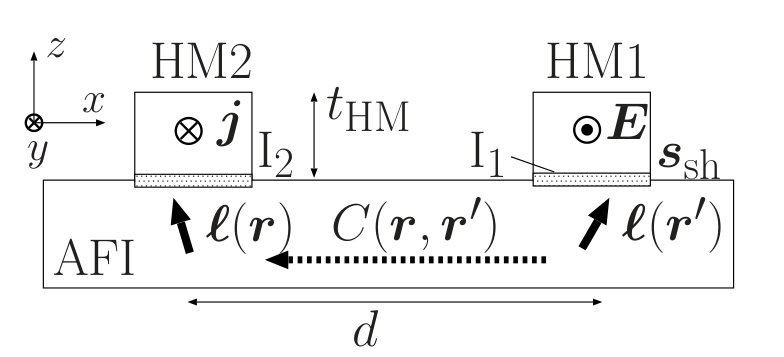 Figure 3
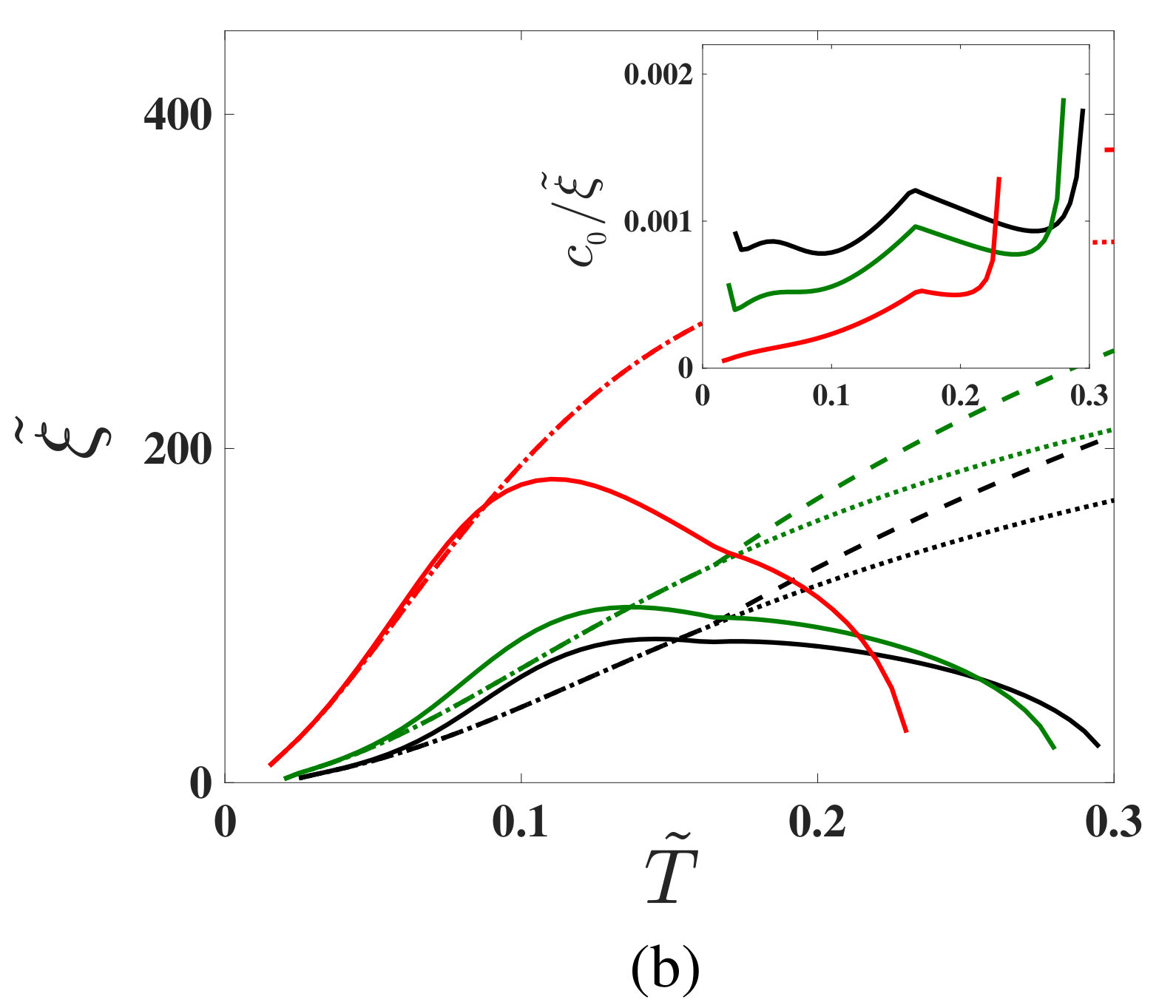 Figure 4
Peer Reviews
No public reviews on file for this paper yet. If you reviewed it on a platform where reviews are public (OpenReview, ICLR, NeurIPS, ICML), you can paste yours below so the community can read it here.
Videos
No videos yet. Explain this paper in a talk, walkthrough, or lecture? Add one.
Theory of spin transport through antiferromagnetic insulator
Gen Tatara
Christian Ortiz Pauyac
RIKEN Center for Emergent Matter Science (CEMS) and RIKEN Cluster for Pioneering Research (CPR), 2-1 Hirosawa, Wako, Saitama, 351-0198 Japan
Abstract
A theoretical formulation for spin transport through an antiferromagnetic (AF) insulator is presented in the case driven/detected by direct/inverse spin Hall effect in two heavy metal contacts. The spin signal is shown to be transferred by the ferromagnetic correlation function of the antiferromagnet, which is calculated based on a magnon representation. To cover high temperature regimes, we include an auxiliary field representing short AF correlations and a temperature-dependent damping due to magnon scattering. The diffusion length for spin is long close to the degeneracy of the two AF magnons, and has a maximum as function of temperature near the Néel transition.
Spin current injection to various materials has been a hot issue in spintronics. Of particular recent interest is spin current propagation in antiferromagnetic insulators (AFI). Being common material, AFI have practical advantages in materials choice. Moreover, insertion of an antiferromagnetic (AF) layer between ferromagnet and normal metal was found to enhance spin current injection efficiency Wang et al. (2014); Lin et al. (2016). Experimentally, spin current injection and propagation efficiency in AF insulators is reported to vanish or very small at , to have a peak near the Néel transition temperature, , reducing at higher temperatures Lin et al. (2016); Cramer et al. (2018).
Transmission of spin information in antiferromagnets is an intriguing issue as fundamental science. For describing spin current injection to antiferromagnets, two issues need to be clarified, namely, to what degree of freedom the incident spin current couples, and how it propagates. Obviously, rigid AF order does not react to spin current injection having a particular spin polarization, and fluctuation is essential. There are two branches of AF magnons, corresponding to opposite spin angular momentum, and coupling of the two modes is essential as noted previously Rezende et al. (2016); Khymyn et al. (2016). The amplitude and decay length of spin current propagation are expected to depend strongly on the temperature because of the Bose distribution function representing the number of AF magnon excitations. In fact, spin current amplitude was found experimentally to have peak near and this feature was explained based on a phenomenological theory using mixing conductance Lin et al. (2016). A sharp peak at was predicted in another theory evaluating fluctuations around mean-field solution in the spatially uniform case Okamoto (2016). The frequency-dependence of magnon propagation length was theoretically studied in Ref. Cramer et al. (2018), although the relation between AF magnon propagation and spin current propagation remained untouched.
The objective of the present paper is to provide a transparent formalism to describe propagation of spin information through an AF insulator. We do not rely on the conventional spin current picture, as it is ambiguous due to non-conservation of spin current. Moreover, introducing phenomenological parameters such as spin mixing conductance makes straightforward understanding of phenomena difficult. Here we follow the linear response theory for the applied electric field treating the exchange interaction between spins in heavy metals and antiferromagnets perturbatively. The description is an application of Ref. Tatara (2018) indicating that spin current propagation is equivalent to correlation function of ferromagnetic (FM) spin fluctuation or magnetic susceptibility. Ferromagnetic fluctuation of antiferromagnets is represented by an exchange or pair creation/annihilation of two AF magnons. The spin information is therefore transferred by magnon pair correlation propagator, just in the same manner as magnetic susceptibility in FM metals is represented by an electron-hole pair propagation. The mismatch of frequencies of FM excitation of GHz and of AF one of THz therefore does not matter as the magnon pair correlation can absolve or emit low external frequencies. Moreover, shortening of AF correlation at high temperature does not necessarily block spin current propagation, because FM fluctuation on the contrary grows. Instead, magnon lifetime at high temperatures is greatly reduced by strong magnon scattering Harris et al. (1971), resulting in a significant reduction of spin current propagation. As a result, the propagation efficiency has a peak near , although the peak position, determined by the competition of the fluctuation and damping, does not necessarily coincides with .
The correlation of spin transport with magnetic correlation has been pointed out experimentally in Refs. Wang et al. (2015); Lin et al. (2016); Qiu et al. (2016). In the case of spin pumping into a heavy metal, the efficiency of spin current injection was argued to be determined by the imaginary part of magnetic susceptibility of heavy metal divided by external angular frequency Ohnuma et al. (2014), although their treatment of external angular frequency was theoretically not comprehensive
Let us develop step by step a linear response theory to describe the nonlocal direct and inverse spin Hall effects separated by an AFI (Fig. 1). (See Supplementary material for details.) The key interaction is the coupling between heavy metals (HMs) and AFI at interfaces. Here we consider an exchange interaction between electron spin polarization in HM and FM component of AFI, namely
[TABLE]
where () denotes the interface between HM and AFI, is a coupling strength, denotes the Pauli matrix and and are electron field operators. The FM moment of AFI is defined as , where and are spin on the two sublattices A and B, respectively (). This coupling is natural as the first approximation as the electron wave function overlap would smear out the staggered (Néel) component of localized spin in AFI. Let us start with the inverse spin Hall effect (ISHE) in HM2. In the context of linear response theory, the driving field of ISHE is a non-equilibrium FM moment of AFI in Eq. (1). The output electric current is thus described by a correlation function of current and spin density, , as (suppressing spatial coordinates). (Exact expression is presented in the Supplementary material.) The FM moment near I2 is generated non-locally by the spin Hall effect (SHE) in HM1. The SHE is described by the correlation function , the reciprocal of , as , where and are the spin density induced by SHE and the applied electric field in HM1, respectively Tatara (2018). Taking account of , the FM moment induced near I2 by the spin accumulation at I1 as a result of SHE is written using nonlocal FM spin correlation function as , where subscripts and denote spin direction. As FM moment is expressed as a composite field of two AF magnons, the correlation function is a two magnon propagator as we shall see below.
Summarizing, the inverse spin Hall current is represented as a product of three correlation functions as
[TABLE]
The correlation functions in Eq. (2) turn out to be the physical correlation function determined by the lesser component divided by the external frequency , i.e., . (See Supplementary material.) The correlation function is linear in because equilibrium spin accumulation does not generate electric current that is dissipative, and thus has a static component. Moreover, considering HM as a bulk, inversion symmetry is present and the spatially-uniform component of the current-spin correlation vanishes, meaning that starts from the first order in the external wave vector Tatara (2018). Thus, direct and inverse spin Hall effects with current perpendicular to the spin accumulation profile is described in the ballistic case by the correlation function , where is the totally antisymmetric tensor. A coefficient , determined by the spin-orbit interaction strength is related to dimensionless spin Hall angle as , where and are the Boltzmann conductivity and elastic electron lifetime, respectively Tatara (2018). Taking account of diffusive electron motion in HMs, the function is multiplied by a diffusion factor , where is a diffusion constant, is related to a static spin diffusion length in HM as , being electron elastic mean free path, as Tatara (2018)
[TABLE]
The current is therefore expressed as
[TABLE]
where the spin diffusion propagator is ( is the lattice constant of HM). Spatial derivative of spin diffusions in Eq. (4) represents spin current flow of the conventional picture, as spin current is proportional to a gradient of spin density in the diffusive regime. In the common setup in Fig. 1, the derivatives are in the perpendicular direction, which we choose as the direction. The derivative at I1 of HM1 is evaluated as . For HM2, we discuss the averaged current for the thickness of HM2, , i.e., , where we use .
The correlation function of AFI, is calculated later and we proceed here using the results. It turns out to vanish for spin direction perpendicular to the Néel vector, , and the spatial dependence is exponential in the most cases. We denote the direction in the spin space of AFI by to remember that spin space is independently of coordinate space, and is chosen along -direction. As shown below, the correlation function of AFI is , where
[TABLE]
with a dimensionless constant and a FM correlation length ( is the lattice constant of AFI). Chosing the applied current direction as the axis (Fig. 1), the antisymmetric tensors in Eq. (4) indicate that ’spin current’ propagates only if .
The ISH current is opposite to the applied electric field. Defining an effective nonlocal conductivity as , we have
[TABLE]
where is the distance between HM1 and HM2, and is the electron density of states. The electron properties are insensitive to the temperature around room or lower temperatures. According to analysis below, the ratio of AFI does not depend much on the temperature either, as both and have similar temperature profiles (Fig. 3(b)), and thus the dominant temperature dependence is expected to arise from . Equation (6) indicates that the interface exchange coupling constant can be determined experimentaly from the magnitude of ISHE.
Let us start study of the correlation in AFI. We first note that the FM moment is expressed by as , where is the AF exchange coupling. This relation, rigorously derived in the Supplementary materials, is understood by noting that points the same direction for the spins of both sublattices A and B (Fig. 2). The Néel vector has a classical expectation value along the direction below the AF transition temperature . Fluctuation is represented by a two-component AF magnon field as , neglecting the second order of magnon field. The FM moment around is therefore represented by a combination of the two magnons as , while the orthogonal components are linear in magnon field. Considering the fact that AF dynamics (typically in the THz regime) is much faster than the FM one (GHz), only the moment has a low energy coupling to AF magnons. Namely, the spin polarization parallel to can be transported for a long distance, while AFI does not react to the perpendicular polarization, resulting in . This feature is in agreement with recent experiment Lebrun et al. (2018). The two magnon modes and carries the opposite angular momentum, and thus FM moment is induced by an exchange of the two modes (ordinary process) or by a pair annihilation or creation (anomalous processes). In terms of magnon creation/annihilation operators and (), introduced as (), the expectation value of induced moment with wave vector reads
[TABLE]
where is the magnon energy for branch ( and being the magnon velocity and gap, respectively) and
[TABLE]
are anomalous and ordinary path-ordered Green’s functions on a complex time path and . The static component of induced by SHE in HM1 is written using a correlation function as , where
[TABLE]
Here is Bose distribution function (, being the Boltzmann constant), represents magnon damping and denotes the real part. The first term of the right-hand-side of Eq. (9) without Bose distribution function is the quantum contribution that exists at . Spin current can thus transmit though antiferromagnet at , where no magnons are excited. (The quantum pair creation process has been shown to be essential for the neutron scattering of Haldane antiferromagnets at Affleck and Weston (1992).)
The correlation function determines the spatial profile of steady ’spin current propagation’. Long-range behavior is determined by the small behavior,
[TABLE]
For the degenerate case, , the uniform contribution vanishes. When the two spin waves have different gaps as a result of magnetic anisotropy (like in the case of NiO), the uniform component is finite, which leads to efficient ’spin current propagation’. The length scale of the spin information propagation, a diffusion length of spin, is given by , as the response function is approximately written as , which leads in the real space to an exponential decay within a distance of , Eq. (5).
Fig. 3 shows numerical results of and as function of temperature in nondegenerate cases with the two energy gaps and . Close to the degeneracy, , spin transport is long-ranged (larger ) as the transport is mediated by the mixing of the two magnon branches. In contrast, representing the magnitude of spin transmission is suppressed for larger , simply due to an increase of .
Magnon representation is usually applied to low temperatures compared to . However, the representation itself does not necessarily break down even above as far as short-ranged AF correlation persists for a length larger than the lattice constant, just like the case of FM magnons well-defined in the presence of structures like a domain wall. Short-ranged correlation is theoretically described by introducing an auxiliary field to impose the constraint by the saddle point approximationChakravarty et al. (1989). The field contributes to a temperature-dependent gap and modifies the magnon dispersion to be . The static AF correlation length, including damping , is usually shorter than the FM correlation length governing spin propagation. (See the Supplementary Material.) The auxiliary field description is known to describe well the AF correlation length above Chakravarty et al. (1989); Yamamoto et al. (1991).
What is most essential for transport at high temperatures is the magnon damping due to magnon interactions at high density. The effect of magnon interaction on the damping was studied theoretically in detail in Ref. Harris et al. (1971). It was shown that the scattering induces a self energy proportional to and for low-energy magnon. We here include the effect in the damping constant as
[TABLE]
where and are constants, and are the cutoffs for high wavevector and energy, respectively. The spin propagation efficiency and FM correlation length are significantly suppressed by the temperature-dependent damping at high temperature as seen in Fig. 3 (solid and dashed lines). The peak temperature, determined by the competition between magnon excitation number and damping, is close to .
Considering the case of NiO, THz, THz, THz and ÅRezende et al. (2016), and our calculation (, ) indicates the spin transport length of the order of 20 nm around room temperature, which appears to be roughly consistent with experiment indicating the diffusion length of 10nm Rezende et al. (2016). For quantititave calculation, however, our model assuming square lattice with the nearest-neighbor hopping is too simple and more realistic modeling is necessary.
We have presented a theoretical formulation of spin injection into antiferromagnetic insulator (AFI) using direct and inverse spin Hall effects. The ’spin current propagation’, induced by a AF magnon pair propagation, was shown to be represented by a ferromagnetic (FM) correlation function, , or a -resolved FM susceptibility. Although may appear similar to the conductivity for spin current in the analogy with the case of charge current, this is not the case because a correlation function of spin current representing the spin current conductivity can not be written by a spin correlation as spin is not conserved. The correlation function was studied based on magnon representation including an auxiliary field in the stationary-field approximation to cover the temperatures above the Néel temperature . The decay length of spin propagation was calculated from a pair propagation process for the non-degenerate case. It is different from (longer than) AF correlation length determined by individual AF magnon propagation, similarly to the electron case where transport lengths are longer than the elastic mean free path. has a peak near as a result of suppression due to the damping arising from magnon scattering at high temperatures. The dominant temperature dependence of the spin propagation efficiency through AFI for a distance of is thus expected to be .
Acknowledgements.
GT thanks T. Ono, E. Saitoh, R. Lebrun and M. Kläui for valuable discussions. He is grateful for the Graduate School Materials Science in Mainz (MAINZ) for financial support (DFG GSC 266). This work was supported by a Grant-in-Aid for Exploratory Research (No.16K13853) and a Grant-in-Aid for Scientific Research (B) (No. 17H02929) from the Japan Society for the Promotion of Science and a Grant-in-Aid for Scientific Research on Innovative Areas (No.26103006) from The Ministry of Education, Culture, Sports, Science and Technology (MEXT), Japan.
The reference list from the paper itself. Each links out to its DOI / PubMed record.
- 1Wang et al. (2014) H. Wang, C. Du, P. C. Hammel, and F. Yang, Phys. Rev. Lett. 113 , 097202 (2014) . · doi ↗
- 2Lin et al. (2016) W. Lin, K. Chen, S. Zhang, and C. L. Chien, Phys. Rev. Lett. 116 , 186601 (2016) . · doi ↗
- 3Cramer et al. (2018) J. Cramer, U. Ritzmann, B.-W. Dong, S. Jaiswal, Z. Qiu, E. Saitoh, U. Nowak, and M. Kläui, Journal of Physics D: Applied Physics 51 , 144004 (2018) .
- 4Rezende et al. (2016) S. M. Rezende, R. L. Rodríguez-Suárez, and A. Azevedo, Phys. Rev. B 93 , 054412 (2016) . · doi ↗
- 5Khymyn et al. (2016) R. Khymyn, I. Lisenkov, V. S. Tiberkevich, A. N. Slavin, and B. A. Ivanov, Phys. Rev. B 93 , 224421 (2016) . · doi ↗
- 6Okamoto (2016) S. Okamoto, Phys. Rev. B 93 , 064421 (2016) . · doi ↗
- 7Tatara (2018) G. Tatara, Phys. Rev. B 98 , 174422 (2018) . · doi ↗
- 8Harris et al. (1971) A. B. Harris, D. Kumar, B. I. Halperin, and P. C. Hohenberg, Phys. Rev. B 3 , 961 (1971) . · doi ↗