A-Foliations of codimension two on compact simply-connected manifolds
Diego Corro

TL;DR
This paper proves that singular Riemannian foliations of codimension two with regular leaves homeomorphic to tori on compact simply-connected manifolds are induced by smooth torus actions, resolving a question about exotic tori.
Contribution
It establishes that such foliations are always generated by smooth torus actions, providing a classification result for these geometric structures.
Findings
Foliations with regular leaves homeomorphic to tori are given by smooth torus actions.
The result negatively answers the existence of exotic tori foliations on simply-connected manifolds.
The paper classifies singular Riemannian foliations of codimension two in this setting.
Abstract
We show that a singular Riemannian foliation of codimension two on a compact simply-connected Riemannian -manifold, with regular leaves homeomorphic to the -torus, is given by a smooth effective -torus action. This solves in the negative for the codimension case a question about the existence of foliations by exotic tori on simply-connected manifolds.
Click any figure to enlarge with its caption.
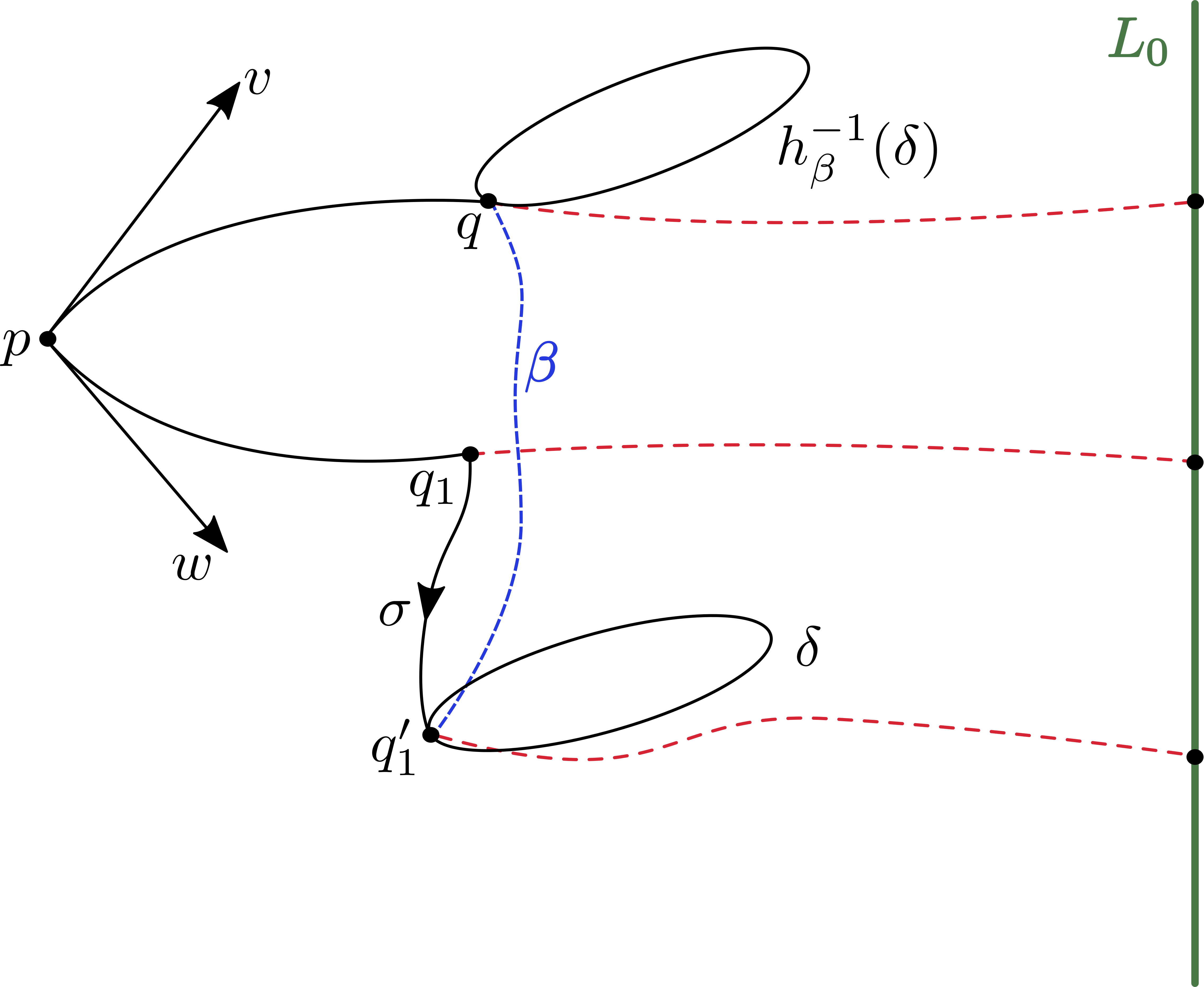 Figure 1
Peer Reviews
No public reviews on file for this paper yet. If you reviewed it on a platform where reviews are public (OpenReview, ICLR, NeurIPS, ICML), you can paste yours below so the community can read it here.
Videos
No videos yet. Explain this paper in a talk, walkthrough, or lecture? Add one.
Taxonomy
TopicsGeometric Analysis and Curvature Flows · Geometry and complex manifolds · Geometric and Algebraic Topology
A-FOLIATIONS OF CODIMENSION TWO ON COMPACT SIMPLY-CONNECTED MANIFOLDS
Diego Corro*∗*
Institut für Algebra und Geometrie, Karlsruher Institut für Technologie (KIT), Karlsruhe, Germany.
[email protected] http://www.diegocorro.com
(Date: March 12, 2024)
Abstract.
We show that a singular Riemannian foliation of codimension two on a compact simply-connected Riemannian -manifold, with regular leaves homeomorphic to the -torus, is given by a smooth effective -torus action. This solves in the negative for the codimension case a question about the existence of foliations by exotic tori on simply-connected manifolds.
Key words and phrases:
singular Riemannian foliation, aspherical foliations, torus actions
2010 Mathematics Subject Classification:
53C12, 57R30, 53C24
∗Supported by CONACyT-DAAD Scholarship number 409912, DFG (, RTG –“Asymptotic Invariants and Limits of Groups and Spaces”), DGAPA-Fellowship associated to the Mathematics Institute of UNAM, campus Oaxaca, and DFG-Eigenestelle Fellowship CO 2359/1-1.
1. Main results
When studying a Riemannian manifold , an approach to understand its geometry or its topology is to simplify the problem by “reducing” to a lower dimensional space . This can be achieved by considering a partition of the original manifold into submanifolds which are, roughly speaking, compatible with the Riemannian structure of . This “reduction” approach is encompassed in the concept of singular Riemannian foliations.
This reduction approach has been applied to the long-standing open problem in Riemannian geometry of classifying and constructing Riemannian manifolds of positive or nonnegative (sectional) curvature via the Grove symmetry program, when the foliation is given by an effective isometric action by a compact Lie group. When the leaves of a singular Riemannian foliation are given by the orbits of a smooth Lie group action we say that the foliation is a homogeneous foliation. By [15] and [49] it is clear that the concept of a singular Riemannian foliation is more general than the one of a Lie group action.
Since any compact connected Lie group contains a maximal torus as a Lie subgroup, the study of torus actions is of importance in the study of homogeneous foliations. The classification up to equivariant diffeomorphism of smooth, closed, simply-connected, manifolds with torus actions is a well studied problem when either the dimension of the manifolds or the cohomogeneity of the action is low (see for example [46], [32], [17], [44], [43]).
One main difference between smooth group actions and foliations is that foliations may be less rigid, not having several constraints natural to Lie groups (see for example [22]). This in turn raises technical challenges, such as the fact that the leaves may carry non-standard smooth structures. Thus an important problem in the setting of singular Riemannian foliations is to distinguish homogeneous foliations from non-homogeneous ones (see for example [22]). This problem does not become more tractable when the topology (and geometry) of the manifold is simple. Even in the case of spheres, equipped with the round metric, it is not clear how to distinguish homogeneous foliations (i.e. those coming from group actions) from non-homogeneous ones (see for example [53]).
By focusing on compact, simply-connected manifolds with a singular Riemannian foliations with closed aspherical leaves, we are able to attack this general problem. This type of singular Riemannian foliations are denoted as -foliations and they were introduced by Galaz-García and Radeschi in [20] as generalizations of smooth effective torus actions on smooth manifolds.
The main result of the present work is that -foliations of codimension two on compact, simply-connected manifolds are homogeneous up to foliated diffeomorphism.
Theorem A**.**
Every -foliation of codimension two on a compact, simply-connected, Riemannian -manifold, with , is homogeneous.
In the codimension one case, the same result holds. Namely, Galaz-García and Radeschi in [20] give a classification up to foliated diffeomorphism of all compact, simply-connected manifolds with a codimension one -foliations. They show that these foliations are homogeneous.
They also point out that the lack of examples of -foliations with exotic tori as leaves on simply-connected manifolds, and ask the following question:
Question**.**
Does there exist a non-trivial example of a singular Riemannian foliation whose leaves are exotic tori?
In this context, Theorem A gives an answer in the negative to this question in the case that the foliation has codimension two.
A possible approach to solve this question in the positive follows from the results in [20]: we may consider a fiber bundle with fiber an exotic torus, over a manifold with sufficiently large second homotopy group. This approach was pursued by Farrell and Wu in [14] considering as base spaces -dimensional simply-connected manifolds with large second homotopy groups, but they only managed to produce manifolds with finite fundamental group. Moreover, the authors comment that they do not know of any smooth fiber bundle such that the fiber is an exotic torus and the total space and base space are smooth simply-connected manifolds. So at the present there is no clear way to decide this question in general.
To prove Theorem A we extend results of the theory of transformation groups to the setting of singular Riemannian foliations. We focus on the general problem of comparing two different manifolds, each one endowed with a singular Riemannian foliation, via the leaf space, which is the topological space obtained as a quotient of the foliated manifold by the equivalence relation given by the foliation. A technique for classifying compact manifolds admitting a smooth effective compact Lie group action, up to homeomorphism is to compare their orbit spaces (see for example [46], [32],[17], [44],[25]). We apply the same idea to smooth manifolds admitting a singular Riemannian foliation.
We begin by studying the homeomorphism type of the leaves of -foliations on compact, simply-connected manifolds. We prove in Proposition 3.3 that, except in the case of -dimensional leaves, the leaves are all homeomorphic to tori or Bieberbach manifolds, extending results in [20].
Theorem B**.**
Let be an -foliation, and consider a leaf . If , then is homeomorphic to a Biberbach manifold.
This result is due to the positive answer to the Borel conjecture for virtually abelian groups, except for dimension (see for example [11]). In [21] the authors introduce -foliations. These are -foliations such that the leaves are Biberbach manifolds. In light of Proposition 3.3, from a topological view point any -foliation without -dimensional leaves is a -foliation. Since Biberbach manifolds are charaterized as those closed manifolds admitting a flat Riemannian metric [8, Corollary 5.1], we propose here to modify the definition of -foliation in [20] to the following one: A -foliation is an -foliation such that the leaves with the induced Riemannian metric are flat, see Remark 3.4.
We also study the infinitesimal foliations of an -foliation, as well as the holonomy of the leaves. This allows us to describe the tubular neighborhoods of the singular leaves, and we propose a finer stratification of the manifold. Both concepts of holonomy and the infinitesimal foliation in the case of homogeneous foliations are encoded in the isotropy subgroup of an orbit. For an -foliation of codimension on a simply-connected manifold we define the weights of the foliation, which encode the information of the infinitesimal foliation. The weights defined in this present work generalize the weights of smooth effective torus actions (defined in [46], [17], [44]), which encode the isotropy information of torus actions.
We say that two weighted leaf spaces are isomorphic, if there is a weight preserving homeomorphism, and prove that for compact simply-connected manifolds with singular -foliations of codimension the weighted orbit spaces determine up to foliated homeomorphism the foliated manifold.
Theorem C**.**
Let and be compact , simply-connected Riemannian manifolds with singular -foliations of codimension . If the leaf spaces and are isomorphic, then is foliated homeomorphic to .
We point out that in the general setting of classifying manifolds with singular Riemannian foliations via their leaf spaces, the best one can obtain is a classification up to foliated homeomorphism. This is because the leaf spaces are in general only metric spaces (i.e. they may not even be topological manifolds).
For the proof of Theorem C we need the existence of a cross-section. This is a map such that for the natural projection we have . Theorem 6.1 we give a family of topological obstruction to the existence of a cross-section over a subset of the principal stratum for a general closed singular Riemannian foliation, and in Theorem 6.2 we give a family of obstructions to extend a cross-section on a closed subset of the principal stratum to the whole leaf space . Combining these obstructions, we give a sufficient condition for the existence of a cross-section in the following corollary (see Section 6 for the necessary definitions):
Corollary D**.**
Let be a closed singular Riemannian foliation on a simply-connected manifold. Suppose that we have a cross-section , that the homotopy fiber of is simple, and that there exist closed, such that is a -pair. If has the same homotopy type as , then the cross-section can be extended to a section .
For the case of a smooth effective torus action of cohomogeneity two (i.e. a homogeneous foliation), on a compact simply-connected manifold Oh proved in [44] that the leaf space is a weighted -disk, with the weights satisfying some conditions. Furthermore, he proves that these conditions characterize the orbit spaces of such actions among all weighted -disks. Namely, given a weighted disk satisfying the conditions he gives a procedure to construct a closed simply-connected smooth manifold with an effective smooth torus action of cohomogeneity two realizing the weighted disk as an orbit space. Oh called such weighted -disks legally weighted.
We show that the weights of an -foliation of codimension two on a compact, simply-connected manifold are legal weights in the sense of Oh. Moreover for a singular -foliation of codimension two on a compact, simply-connected manifold it was proved in [20] that the leaf space is homeomorphic to a -dimensional disk, and the boundary points of the leaf space correspond exactly to the singular leaves of the foliation. By studying closely the weight of the foliation we conclude that the results in [44] apply. Namely, that there is a torus action on with the same weights as the ones of the foliation. By Theorem C we conclude that a singular -foliation of codimension two on a compact, simply-connected manifold is, up to foliated homeomorphism, a homogeneous foliation.
As mentioned before, in the problem of classifying manifolds with singular Riemannian foliations via their leaf spaces, in general the best one can obtain is a classification up to foliated homeomorphism. In the case of singular -foliations of codimension two on compact, simply-connected manifolds since the leaf space is a -disk, it is a smooth manifold with boundary in a unique way (it admits a unique smooth structure). Thus we can expect in this case to get a classification up to foliated diffeomorphism.
The next obstacle to obtaining a smooth classification, and obtaining Theorem A, is the existence of exotic smooth structures on tori (see, for example [30], [31]). As stated before, there exists regular -foliations of codimension on compact manifolds with finite fundamental group and leaves consisting of exotic tori [14]. To finish the proof of Theorem A we study the diffeomorphism type of the leaves of a singular -foliation of codimension two on a compact simply-connected smooth manifold, and prove that they are diffeomorphic to standard tori.
We remark that -foliaions of codimension with singular leaves are a priori infinitesimally polar due to a general argument by Lytchak [36, Proposition 3.1]. But since they are given by torus actions by Theorem A, they are polar by [25, Example 4.4]. Grove and Ziller showed in [25] that a Coxeter polar action is determined by the orbit space together with the isotropy information. This is an analogous statemtent of Theorem C for such polar actions (in this case the weights are the isotropy information of each orbit). Thus it is natural to if an analogous statement to Theorem i holds for more general -foliations.
Question**.**
Are polar closed singular Riemannian foliations (or -foliations) determined by the leaf space, and information about the infinitesimal foliation over the strata corresponding to the singular leaves?
Our article is organized as follows. In Section 2 we give an overview of the theory of Lie group actions and singular Riemannian foliations, such as the infinitesimal foliation and the holonomy. In Section 3 we study the homeomorphism type of the leaves of a general -foliation on a compact simply-connected manifold. In Section 4 we define the weights of an -foliation and prove Theorem C. We finish the proof of Theorem A in Section 5, where we study the diffeomorphism type of the leaves of a singular -foliation of codimension two on a simply-connected manifold. We end this manuscript with the presentation of the topological sufficient conditions for the existence of cross-sections in Section 6.
Acknowledgements**.**
I would like to thank Caterina Campagnolo, Fernando Galaz-García, Karsten Grove, Jan-Bernard Kordaß, Adam Moreno and Wilderich Tuschmann for helpful conversations on the constructions presented herein. I thank Alexander Lytchak and Oliver Görtsches for helpful discussions which led to the obstruction results for the existence of cross-sections. I thank Thomas Farrell and Marco Radeschi for discussions and comments about the smooth structure of the leaves. Last I thank the anonymous referees for giving suggestions to improve the presentation of the manuscript, and the suggestion for the study of polar -foliations.
2. Preliminaries
2.1. Group actions
Let , , be a smooth action of a compact Lie group on a smooth manifold . The isotropy group at is defined as . We say that the orbit is principal if the isotropy group acts trivially on the normal space to the orbit at . It is a well known fact that the set of principal orbits is open and dense in . Since the isotropy groups of principal orbits are conjugate in , and since the orbit is diffeomorphic to , all principal orbits have the same dimension. If has the same dimension as a principal orbit but the isotropy group acts non-trivially on the normal space to the orbit at we say that the orbit is exceptional. If the dimension of the orbit is less than the dimension of a principal orbit, we say that the orbit is singular. We denote the set of exceptional orbits by and the set of singular orbits by . We denote the orbit space by and we define the cohomogeneity of the action to be the dimension of the orbit space (or, equivalently, the codimension in of a principal orbit). Let be the orbit projection map onto the orbit space. We denote by the image of a subset of under the orbit projection map . The action is called effective if the intersection of all isotropy subgroups of the action is trivial, i.e if . We say that a Riemannian metric is invariant under the action if the group acts by isometries with respect to this metric. For every effective smooth action of a compact Lie group on a smooth manifold there exists an invariant Riemannian metric (see, for example [1, Theorem 3.65]).
2.2. Effective torus actions
From now on we denote the -torus with a Lie group structure by in order to distinguish it from its underlying topological space . By identifying the torus group with we note that a circle subgroup of is determined by a line through the origin given by a vector , with relatively prime, via (for a more detailed discussion see [44]). Recall that a smooth, effective action of a torus on a smooth manifold always has trivial principal isotropy. Therefore, a smooth, effective action of an -torus on a smooth -manifold has cohomogeneity two.
Let be a closed, simply-connected, smooth -manifold, , on which a compact Lie group acts smoothly and effectively with cohomogeneity two. It is well known that, if the set of singular orbits is not empty, then the orbit space is homeomorphic to a -disk whose boundary is (see [6, Chapter IV]). Moreover, the interior points correspond to principal orbits (i.e. the action has no exceptional orbits). The orbit space structure was analyzed in [32], [44] when for (see also [19]). In this case the only possible non-trivial isotropy groups are circle subgroups and -torus subgroups of . Furthermore, the boundary decomposes as a a finite union of open edges and -vertices , where sits between and if and sits between and . The interior points in an edge correspond to orbits with a fixed circle subgroup determined by a vector . For , the orbit corresponding to a vertex is an orbit with isotropy equal to the product of circle subgroups , i.e. a -torus in ; for , the isotropy of the orbit corresponding to is given by . This structure is illustrated in Figure 2.1 (cf. [19, Figure 1]).
The vectors of the isotropy invariants are called the weights of the orbit space. The weight associated to a singular orbit is given by the following principal bundle (see [1, Proposition 3.41]):
[TABLE]
The weight determines the embedding of the isotropy subgroup into . Following Oh [43], we say that the the orbit space is legally weighted, if we can find a sub-collection of weights \{\overline{v}_{i_{1}},\overline{v}_{i_{2}},\ldots,\overline{v}_{i_{n}}\big{\}} such that the matrix
[TABLE]
has determinant . By [44] any effective smooth -action on a simply-connected -manifold has legal weights. Conversely, given a disk equipped with legally weighted orbit data, there is a closed, simply-connected smooth -manifold with an effective action of a torus such that is the orbit space of (see [44, Section 4]). We state this fact for future reference.
Theorem 2.1** (Remark 4.7 in [44]).**
For and a family of legal weights with there exists a closed, simply-connected -manifold admitting a cohomogeneity two -action that realizes the family as weights.
Let and be two closed, simply-connected smooth -manifolds with effective actions, with . Observe that both and are closed -disk, and thus have a unique smooth structure. A diffemorphism is called weight preserving if the isotropy subgroup of the orbit in corresponding to equals the isotropy subgroup of the orbit in corresponding to . We say that the orbit spaces and are isomorphic if there exists a weight-preserving diffeomorphism between them. From the work of Oh given a weight-preserving diffeomorphism , then there exists an equivariant diffeomorphism which covers . More generally, one has the following equivariant classification theorem.
Theorem 2.2** (Theorem 2.4 [32], and Theorem 1.6 [44]).**
Two closed, simply-connected smooth -manifolds with an effective -action are equivariantly diffeomorphic if and only if their orbit spaces are isomorphic.
2.3. Singular Riemannian Foliations
A singular Riemannian foliation on a Riemannian manifold , which we denote by , is the decomposition of into a collection of disjoint connected, complete, immersed submanifolds , called leaves, which may not be of the same dimension, such that the following conditions hold:
- (i)
Every geodesic meeting one leaf perpendicularly, stays perpendicular to all the leaves it meets. 2. (ii)
For each point there exist local smooth vector fields spanning the tangent space of the leaves.
If satisfies the first condition, then we say that is a transnormal system. If it satisfies the second one, we say that is a smooth singular foliation. When the dimension of the leaves is constant, we say that the foliation is a regular Riemannian foliation or just a Riemannian foliation. We refer the reader to [2] for a more in depth discussion of singular Riemannian foliations.
A natural class of examples of singular Riemannian foliations is given by effective actions of groups by isometries. If we only have a compact Lie group acting smoothly on , the existence of an invariant Riemannian metric, guarantees that we may consider acting by isometries (see [1, Theorem 3.65]). A singular Riemannian foliation that arises from a group action is called a homogenous foliation. We say that a singular Riemannian foliation is closed if all the leaves are closed. The dimension of a foliation , denoted by , is the maximal dimension of the leaves of . We call the foliation trivial when or . In the first case the leaves are collections of points, and in the second case there is only one leaf, the total manifold. The codimension of a foliation is,
[TABLE]
The leaves of maximal dimension are called regular leaves and the remaining leaves are called singular leaves. Since gives a partition of , for each point there is a unique leaf, which we denote by , that contains . We say that is the leaf through . The quotient space obtained from the partition of , is the leaf space and the quotient map is the leaf projection map. The topology of yields a topology on , namely the quotient topology. With respect to this topology the quotient map is continuous. We denote the leaf space from this point onward by as in the homogeneous case. We denote by the image of a subset under the leaf projection map.
A singular Riemannian foliation induces a stratification on . For we define the -dimensional stratum as:
[TABLE]
The regular stratum is an open, dense and connected submanifold of (see [48, Lemma 2.2.2]). The foliation restricted to the regular stratum yields a Riemannian foliation , and is open and dense in the leaf space . Furthermore, by [40, Proposition 3.7], if is a singular Riemannian foliation with closed regular leaves, then is an orbifold. Note that the foliation is regular if and only if .
2.4. Infinitesimal foliation
We start by fixing a point , and consider the normal tangent space to the leaf . Next we consider small enough and set , with the ball of radius in . Taking we consider the intersection of the leaves of with . This induces a foliation on by setting the leaves of to be the connected component of the intersection between the leaves of and . This foliation may not be a singular Riemannian foliation with respect to the induced metric of on , i.e the leaves of may not be equidistant with respect to the induced metric. Nevertheless, by [40, Proposition 6.5], the pull-back foliation is a singular Riemannian foliation on equipped with the Euclidean metric. We call this foliation the infinitesimal foliation at . By [40, Lemma 6.2] the infinitesimal foliation is invariant under homotheties that fix the origin. Furthermore the origin is a leaf of the infinitesimal foliation. Since the leaves of stay at a constant distance from each other, the fact that the origin is a leaf implies that any leaf of is at a constant distance from the origin, and thus it is contained in a round sphere centered at the origin. From this last fact it follows that we may consider the infinitesimal foliation restricted to the unit normal sphere of , which we denote by , yielding a foliated round sphere with respect to the standard round metric of which is also called the infinitesimal foliation. From here on when we say “infinitesimal foliation” we refer to , or equivalently, to , since is invariant under homothetic transformations and thus it can be recovered from .
For the particular case of a homogeneous singular Riemannian foliation by an action of a compact Lie group , the infinitesimal foliation at a point is given by taking the connected components of the orbits of the action of the isotropy group on via the isotropy representation. Therefore, denoting by the connected component of containing the identity element, the infinitesimal foliation is given by considering only the action of on given by the isotropy representation.
2.5. Holonomy
Given a leaf , a point , and a path starting at , the following theorem gives us a foliated transformation from to the total space of the normal bundle .
Theorem 2.3** (Corollary 1.5 in [37]).**
Let be a closed leaf of a singular Riemannian foliation , and let be a piecewise smooth curve with . Then there is a map such that:
- (i)
* for every .* 2. (ii)
For every , the restriction is a linear isometry preserving the leaves of . 3. (iii)
For every , the map belongs to the same leaf as .
We denote by the group of foliated isometries of the infinitesimal foliation, i.e. all the isometries which preserve the foliation. Thus from Theorem 2.3 given a loop at , we have a foliated linear isometry by setting . Therefore, we have a group homeomorphism from the loop space of at to the foliated isometries of the infinitesimal foliation by setting . We note that an isometry in may map a leaf to a different leaf. By we denote the foliated isometries which leave the foliation invariant, i.e. the isometries such that for any leaf of s we have . There is a natural action of on the quotient . The kernel of this action is .
We now show that if two loops, and , are homotopic, then is in the kernel of the action of on . Therefore we obtain a group morphism from to .
Lemma 2.4**.**
Let and be two curves in a closed leaf which are homotopic relative to the end points, with , and . Then is homotopic to the identity map. Furthermore this map takes every leaf of the infinitesimal foliation to itself.
Proof.
Let be the homotopy between and . By applying Whitney’s Approximation Theorem (see for example [35, Theorem 9.27]), we can assume that is a smooth map. For fixed we consider the smooth curve . From the compactness of we can find a partition of such that for any the curve restricted to is an embedding. By extending the vector field for to , we obtain smooth vector fields on . Since the family of curves varies continuously with respect to by construction, for each the family of vector fields varies smoothly with respect to . This implies that, when we consider for each , the map given by Theorem 2.3, then varies continuously with respect to (see [4]). Defining we obtain a homotopy between the identity and . For fixed, we have, from Theorem 2.3 (iii), that lies in the same leaf of as . Since defines a path between and , we have that lies in the same leaf of as . Thus . ∎
Proposition 2.5**.**
Let be a singular Riemannian foliation, a closed leaf of the foliation and . There is a well defined group morphism,
[TABLE]
given by .
Proof.
Given a loop , we consider the linear foliated transformation,, given by Theorem 2.3, and set
[TABLE]
From Proposition 2.4, if is a loop homotopic to , then we have . Therefore in . ∎
For a closed leaf of a singular Riemannian foliation we define the holonomy of the leaf as the image of under the morphism . When we consider the holonomy of a leaf trough a point , we denote it by . A regular leaf is called a principal leaf if the holonomy group is trivial, and exceptional otherwise.
Given a fixed point and a vector , set . If is small enough, then is contained a tubular neighborhood of , and thus there is a well defined smooth closest-point projection which is a submersion, by [40, Lemma 6.1]. The connected component of the fiber of the map through can be identified with the leaf through . Taking , the quotient of the universal cover of , we have a finite cover such that lifts to a fibration
[TABLE]
Clearly fibration (2.2) is a surjective map by construction. The following proposition gives another way of obtaining the covering of , via a subgroup of the holonomy group .
Proposition 2.6**.**
For with image , set to be the subgroup of fixing . Then, taking , the finite cover of in the fibration is .
Proof.
Let be the fiber of the metric projection , which may consist of several connected components. The end of the long exact sequence of the fibration looks like
[TABLE]
From exactness, we conclude that . We recall how the map is defined, following a modification of the definitions presented in Hatcher (see Sections 4.1 and 4.2 in [28]). Let be the map collapsing to a point. Let be the inclusion as the boundary. Consider a loop with base point . By the homotopy lifting property there is a lift for the map , with . Furthermore, by definition, we have that is constant. Therefore the image of the map is contained in . Thus we have a map . We define . Let be a loop in . Consider , the transformation given by Theorem 2.3 corresponding to . Then is a lift of in . Since does not depend on the choice of a lift we have that . It follows that the end point of is in the same connected component of as . Therefore we have that fixes the infinitesimal leaf in . Thus . Conversely, if we start with , then for the map given by Theorem 2.3, we have that maps the infinitesimal leaf to itself. By definition this means that is in the same connected component of as . Theorem 2.3 (iii) implies that the path is a path between and in . Thus we have that . Therefore we conclude that . ∎
Proposition 2.6 gives a way to detect if there is holonomy for a closed leaf of . This proposition extends [20, Remark 2.3] to general singular Riemannian fibrations.
If the map is proper then, it follows from Ehresmann’s fibration Lemma in [9] that is a locally trivial fibration. In the particular case when is compact, then the map is proper. Thus for foliations with closed leaves the fibration (2.2) is a fiber bundle.
Remark 2.7**.**
We note that from Ehresmann’s Lemma the fiber bundle given by the projection map , may not have as structure group a Lie group, but rather a very large topological group, namely the diffeomorphism group of the fiber, . Although is in general not a Lie group, it is a Frobenious group, i.e. the group operations are smooth with respect to a Frobenious atlas (see [26]).
If the foliation is given by the action of a compact Lie group , then the holonomy of an orbit is given by (see [37, Section 3.1]). For close to with a subgroup of , the fiber bundles given by (2.2) are of the form:
[TABLE]
where is the connected component of the identity of the isotropy group , and is a cover of the orbit (see [20, Example 2.4]).
2.6. Principal Stratum
We now study the topology of the principal stratum of a closed singular Riemannian foliation on a compact simply-connected Riemannian manifold .
If is a principal leaf of a singular Riemannian foliation on an -dimensional manifold with all regular leaves closed, then [39, Theorem 2.5] and the fact that is trivial show that is a regular point of the orbifold . With this we can easily see that corresponds to the manifold part of the orbifold . Thus is open and dense in . Since, in general for a singular Riemannian foliation, is open and dense in , then is open and dense in . Furthermore, from the fact the manifold part of an orbifold is connected (see [34, Lemma 2.3], [56], [10]) it follows that the set is connected in . Since it is locally Euclidean, it is path connected.
We collect these observations in the following proposition.
Proposition 2.8**.**
Let be a singular Riemannian foliation with closed regular leaves. Then the principal stratum is open dense in , and is connected and path connected.
Consider principal leaves, and , in a closed singular Riemannian foliation on a compact, simply-connected manifold . Furthermore assume that is simply connected. Take any path , with and . Recall that is a subset of the regular stratum . For a fixed point , consider the unique smooth horizontal lift of through (see [24, Proposition 1.3.1]). We define a homeomorphism by setting .
Corollary 2.9**.**
Consider a singular Riemannian foliation with closed leaves on a compact simply-connected Riemannian manifold. Assume that the principal stratum is simply connected. Fix principal leaves and of , and consider two paths and , connecting and . Then the homeomorphism is homotopic to .
Proof.
From the hypothesis that is simply connected it follows that there is a homotopy from from to fixing the end points and . This defines a continuous family of curves , by setting . We define a homotopy by setting . ∎
Remark 2.10**.**
Observe that in general if a leaf has trivial holonomy this does not mean that the map is trivial. It means that by Lemma 2.4 any element in is homotopic to the identity map.
2.7. Slice Theorem
With the concepts of the infinitesimal foliation at a point and the representation of the loop space in of a closed leaf in [38] the following theorem is proven which describes a tubular neighborhood of a closed leaf of a singular Riemannian foliation:
Theorem 2.11** (Slice Theorem, Theorem A in [38]).**
Let be a singular Riemannian foliation, and let be a closed leaf with infinitesimal foliation at a point . Then there is a group of foliated isometries of and a principal -bundle over , such that for small enough , the -tube around is foliated diffeomorphic to .
Here the group is given as:
[TABLE]
Since the action on by construction preserves the infinitesimal foliation , then diagonal action of on via preserves the product foliation . Denote by the quotient map. The leaves of the foliation are given by the images of , and make a singular Riemannian foliation [50, Proposition 1.11].
3. -foliations
Foliations by tori on compact Riemannian manifolds were introduced in [20] as generalizations of smooth effective torus actions. Namely an -foliation is a foliation where all the leaves are closed, and aspherical, i.e. for the -th homotopy group of the leaves is trivial. By [20, Corollary B] the principal leaves of an -foliation on a compact, simply-connected, Riemannian manifold are homeomorphic to tori.
3.1. Homeomorphism type of the leaves in an -foliation
We recall that given two points , with sufficiently close to with respect to the metric of , in the case when is a principal leaf, then there is a fibration:
[TABLE]
where is a finite cover of , and is a leaf in the infinitesimal foliation (see Proposition 2.6). Using this description we describe next the topology of the other leaf types in an -foliation.
Recall from Section 2.4, that the infinitesimal foliation at , is obtained from the foliated slice , where for a sufficiently small . First we consider the case when the leaves of this foliation are connected. In this case the finite covering is trivial, i.e. . Thus following the proof of [20, Theorem 3.7], we prove the following result:
Proposition 3.1**.**
Let , and be topological manifolds, with connected, and let be a fibration. If is homeomorphic to a torus, then and are tori.
Proof.
Since is aspherical, we have from [20, Theorem 3.7] that and are also aspherical. From the long exact sequence of the fibration we get:
[TABLE]
Since is an abelian, torsion-free, finitely-generated group, and is a subgroup of , then is an abelian, torsion free, finitely generated group. Thus, by classification of finitely generated abelian groups and the Borel conjecture, is homeomorphic to a torus. Now assume that has torsion. Then for some , the cyclic group acts freely on the contractible manifold . Therefore it follows that is an Eilenberg-MacLane space . This contradicts the fact that has infinite cohomological dimension. Thus is an abelian, torsion-free, finitely generated group. Again by the classification of finitely generated abelian groups and the Borel conjecture, is homeomorphic to a torus. ∎
Corollary 3.2**.**
In an -foliation all leaves with trivial holonomy are homeomorphic to tori.
In the case when the leaf has non-trivial holonomy we get the following proposition:
Proposition 3.3**.**
The leaves (of ) with non-trivial holonomy of an -foliation are homeomorphic to Bieberbach manifolds.
Proof.
In the case when the leaf has non-trivial holonomy, applying Proposition 3.1 to fibration (2.2) we have that the covering is homeomorphic to a torus. Thus, applying the long exact sequence of homotopy groups to the fibration with finite fiber , we get,
[TABLE]
Therefore is a finite extension of by . Assume that is not torsion-free, and recall that since is a torus, we have . Then there exists a finite cyclic subgroup acting on the contractible manifold . As in the proof of Proposition 3.1 this contradicts the fact that the Eilenberg-MacLane space has infinite cohomological dimension. Since is and is finite, we have that is a crystallographic group (see [11, Section 6],[5],[57]). Thus is a Bieberbach group, since it is a torsion free crystallographic group. By [11, Theorem 6.1], for , the leaf is homeomorphic to a Bieberbach manifold. Recall that [33, Theorem 0.7] states that the Borel conjecture is true in dimension . Thus in dimension , since has fundamental group isomorphic to a Bieberbach group, is homeomorphic to a Bieberbach manifold. ∎
Remark 3.4**.**
In [20, Definition 3.2] the authors define a -foliation as an -foliation with all leaves homeomorphic to Bieberbach manifolds. Since a torus is a Bieberbach space, it follows from Propositions 3.2 and 3.3 that any -foliation is a -foliation, provided none of the leaves with non-trivial holonomy is -dimensional. Because of this fact, we will not distinguish between -foliations and , in this work. Nonetheless, we might consider -foliations as those -foliations on a Riemannian manifold for which the leaves with the induced Riemannian metric have sectional curvature equal to [math], i.e. they are flat manifolds with respect to the induced metric.
Remark 3.5**.**
The diffeomorphism type of the leaves of an -foliation may not be unique. If the leaves have trivial holonomy, i.e. are homeomorphic to tori, then for dimensions , there exist different smooth structures , on the -torus , such that is homeomorphic (as a topological manifold) to , but is not diffeomorphic to (see for example [31]) .
As a concrete example of this exotic phenomena, we may consider an exotic sphere and the standard torus:
[TABLE]
The manifold is homeomorphic to but not diffeomorphic to (see [12, Remark p. 18] and [13, Theorem 3]).
In the case when the leaves with the induced metric have sectional curvature less or equal to [math], then the smooth Borel conjecture holds [13, Theorem 3], and there is no ambiguity about the smooth structure of the leaves.
4. -foliations of codimension 2
We focus in this section to the particular case of -foliations of codimension on simply-connected manifolds and how they compare to effective torus actions of codimension .
4.1. Leaf space of an -foliation of codimension 2.
In this section we describe the leaf space of an -foliation of codimension on a simply-connected manifold . There are two possible cases: the foliation has no singular leaves (i.e. it is a regular foliation), or the foliation has singular leaves. In the second case we will be redundant and call it a singular -foliation.
By Theorem E in [20] it follows that, if the -foliation is regular, then is diffeomorphic to and the foliation is given by a Hopf weighted action.
In the second case, when the -foliation is singular, then again by Theorem E [20] the leaf space is a closed -disk. It follows from [36, Proposition 1.7] that there are no exceptional leaves in , and thus . Furthermore, from the fact that the restriction of the foliation to a stratum containing only leaves of dimension is a regular foliation, then [39, Theorem 2.15] and the fact that imply that the singular leaves of also have trivial holonomy. From [20, Theorem E] it follows that there are two types of leaves: a least singular leaf, homeomorphic to with infinitesimal foliation given by the homogeneous foliation , and the most singular leaf, homeomorphic to with infinitesimal foliation given by the homogeneous foliation . The singular leaves project via the quotient map onto the boundary of . Moreover the boundary of consists of a union of arcs , . The points in the interior of these arcs correspond to leaves homeomorphic to . The end points, , of these arcs correspond to leaves homeomorphic to . (see figure 4.1).
4.2. Tubular neighborhoods of singular leaves of an -foliation of codimension 2
Before proving our comparison theorem for singular -foliations of codimension on simply-connected manifolds we describe the tubular neighborhoods of the singular leaves of the foliation.
Theorem 4.1**.**
For an -foliation of codimension given a singular leaf and a fixed point , there exists such that the tubular neighborhood of radius around is foliated diffeomorphic to
[TABLE]
Proof.
Recall that the singular leaves of a singular -foliation of codimension on an -dimensional simply-connected manifold have dimension and .
Suppose has dimension and fix . Then the infinitesimal foliation is given by the -action on , which is also the suspension of the circle action on . Thus the group is equal to . Moreover, since the holonomy is trivial we have that . Therefore we see that the action of on is homotopic to the trivial action. From this if follows that the associated disk bundle given by Theorem 2.11 is a trivial one.
Now assume that has dimension and fix . Then the infinitesimal foliation is given by a -action on , which decomposes as the join of two circle actions on two copies of . That is, . Observe that the group leaves each of the factors invariant. Thus we conclude again that the -action on is homotopic to a trivial action. Therefore again the associated disk bundle from Theorem 2.11 is a trivial one. ∎
4.3. Weights of an -foliation of codimension 2
In this section we define invariants called weights which allows us to compare -foliations of codimension on simply-connected manifolds. These invariants extend the notion of weights given for an homogeneous -foliations of dimension , [17], [45], and of cohomogeneity (i.e. codimension ) [46], [47], [44].
Namely, for circle actions on simply-connected -manifolds [45], or on -manifolds [17], or torus actions of cohomogeneity on simply-connected -manifolds with [46], [47], [44], the weights determine the isotropy group of the orbit, and the isotropy representation. But by the Slice Theorem for group actions, the isotropy group and the isotropy representation describe a small tubular neighborhood of the orbit, as well as the action on this neighborhood.
Moreover, in the case torus actions of cohomogeneity on simply-connected -manifolds, the possible isotropy groups are circles or -torus [44, (1.1) Lemma], and in both cases there is a unique isotropy representation. Thus the tubular neighborhood of the orbits is characterized by the embedding of the circle isotropy groups into . This embedding can be represented by an element , which represent the image in of the generator of (see Section 2.2). With this alternative description of the weights for homogeneous -foliations of codimension on simply-connected manifolds, we define an analogous weight for general -foliations of codimension on simply-connected manifolds.
Let be a simply-connected -dimensional manifold with a singular -dimensional -foliation. We fix a principal leaf . We consider any arbitrary point such that has dimension . Next we take , such that is contained in a principal leaf. From the fact that the regular stratum is open and dense in , there exists a path connecting and . Since is a Riemannian submersion, we consider the horizontal lift of through (see [24, Section 1.3]). We set . Recall from subsection 2.5 that, in this setting, for some cover , we have a fibration
[TABLE]
Moreover, since for singular -foliations of codimension , all leaves have trivial holonomy it follows that . From [20, Corollary B] and Proposition 3.1, we have that , , and . From the homotopy long exact sequences of the fibration we get a short exact sequence
[TABLE]
The path connecting to induces a homeomorphism , and thus an isomorphism between and .
Denote by the generator of . It is mapped to an element in .
The definition of the integer vector depends a priori on the choice of path joining to . The following lemma shows that in fact, it is independent of the choice of .
Lemma 4.2**.**
The element does not depend on the choice of path connecting to .
Proof.
If we choose any other path from to , then Corollary 2.9 shows that the group isomorphisms induced by and are equal. Therefore the integer vector does not depend of the curve . ∎
Next we prove that if we choose another vector such that lies in a principal leaf, then we recover the same integer vector .
Lemma 4.3**.**
The integer vector does not depend on the choice of .
Proof.
Take with , such that lies on a principal leaf . Since is a singular Riemannian foliation with closed leaves, by Proposition 2.8, the space is path-connected. Therefore there exists a path from to . By taking horizontal lifts of in we obtain a homeomorphism . By setting , the homeomorphism induces an isomorphism . From Corollary 2.9, this isomorphism is independent of the choice of .
Let be a path in from to . This gives an isomorphism from onto , given by mapping an element to . Let be another path in from to . Consider the concatenation of paths . The path is a loop based at . Thus we have a conjugation in . Since we have an -foliation, is homeomorphic to a torus. Thus is an abelian group. Therefore the path is homotopic to , relative to the end points. Thus is homotopic to . Therefore the isomorphism from onto , does not depend on the path . It follows that we have a well defined isomorphism from to .
Let and , be homeomorphisms given by paths and . Set , and (see Figure 4.2). Denote by and the inclusions, given by the bundles (2.2), of the infinitesimal leaves into the leaves and , respectively. The homeomorphism induces an isomorphism from onto . The path gives a well defined isomorphism from onto . Thus the generator of in is mapped to the generator of . From this we see that the integer vector does not depend on . ∎
From the proof of the previous lemma, by using the fact that the fundamental groups of and are abelian, it follows that the definition of the integer vector does not depend on the choice of the base point in . We state this explicitly:
Lemma 4.4**.**
The weight of does not depend on the choice of .
Observe that the weights a priori depend of the principal leaf fixed at the beginning. We show that for a singular -foliation of codimension on a simply-connected manifold the weights do not depend on the choice of the principal leaf .
Lemma 4.5**.**
Let be a compact simply-connected -dimensional manifold with a singular -foliation of codimension . Let and be principal leaves, and take a point contained in an -dimensional leaf. Denote by the weight of associated with and by the weight of associated with . Then .
Proof.
We begin by fixing a third principal leaf and by pointing out that is a fiber bundle, with fibers the principal leaves. Since is homeomorphic to an open -disk and thus contractible, then is foliated homeomorphic to . Therefore the fundamental group of and get identified with the fundamental group of . Moreover the circles in determined by and correspond to the principal leaves of . Thus we conclude that under the identification we have . ∎
Last we show that the integer vector is constant along the connected components of the singular stratum .
Lemma 4.6**.**
Let be an -foliation of codimension on an -dimensional simply-connected manifold . Then for such that and are contained in the same connected component of least singular leaves, i.e. , it holds that .
Proof.
Recall that a connected component of is an open edge contained in . Thus, there is only one possible path joining to . Since the quotient map is a fiber bundle, by taking horizontal lifts of we get a homeomorphism . From this we get an isomorphism between and . Now we recall that for any close points and contained in principal leaves, by Theorem 4.1 we have a group isomorphism . Here we are abusing the notation by writing as the one-dimensional subgroup of generated by the weight . With this we conclude that the weights are the same . ∎
Remark 4.7**.**
Since each connected component of the singular stratum is an open edge in , we write the collection of weights as follows: we label the edges as shown in Figure 4.1. To each edge we add the associated weight . We collect this information in a list of weights.
Also we point that the fibration is given by a circle action:
Proposition 4.8**.**
The fiber bundle (2.2) is a principal -bundle.
Proof.
First we show that the bundle (2.2) is an orientable fiber bundle. We choose an arbitrary orientation for the fiber in local charts, to obtain a vector field, tangent to the circles in the total space. Since the -torus is orientable, we can extend this vector field to a basis, such that the transition maps have positive determinant in this basis.
Indeed if we choose on a local chart an orientation of the fiber , we can extend it to a basis of the tangent spaces of . Since is orientable we can do this construction in such a way that for two open trivial neighborhoods, the orientations of the fibers are positive.
From [41, Proposition 6.15] it follows that (2.2) is a principal -bundle. ∎
Remark 4.9**.**
For a general singular Riemannian foliation on a simply-connected manifold, by Theorem 2.11, the foliation on a tubular neighborhood of a leaf is determined by the infinitesimal foliation , the conjugation class of a subgroup and a principal -bundle over . So these object are the natural choices for “weights” in the general setting. In the case of -foliations, we have more structure, due to the leaves having a fixed topology. In the case where a leaf of an -foliation is regular we have that the infinitesimal foliation is the trivial foliation by points. Thus the foliation on a tubular neighborhood is determined by a subgroup . Moreover, by considering the natural projection , and the fact that we have that , and thus it is discrete. This implies that for regular leaves, the foliation in the tubular neighborhood of is determined by the Biberbach group . Thus the holonomy group of regular leaves can be consider the weight for such leaves. For a singular leaf of an -foliation on a simply-connected manifold, we might consider whether the injection , where principal leaf of , together with the holonomy group determine the foliation in a tubular neighborhood of , as it happens for the codimension case.
4.4. Cross-sections
With the leaf space description of a singular -foliation of codimension on a simply-connected manifold at hand, we can show the existence of a cross-section. To prove this we use results for general singular Riemannian foliations presented in Section 6. Namely, we show that obstructions for the existence of cross-sections presented in Theorems 6.1 and 6.2 vanish for -foliations of codimension on simply-connected manifolds with singular leaves.
Theorem 4.10**.**
Let be a singular -foliation of codimension on a compact-simply connected manifold of dimension . Then there exists a continuous cross-section
Proof.
Observe that a principal is homeomorphic to an -dimensional torus, and thus it is connected and simple. Since is an open -disk, then for a closed -disk, is a closed CW-complex. Consider now the mapping cylinder of the quotient map . Since is simply connected it follows that is a simple pair. Since is contractible, by Theorem 6.1 there exists a cross-section over for . Also note that is a CW-pair.
Now consider the mapping path fibration of the quotient map , and recall that has the same homotopy groups as . Then from the long exact sequence of the fibration, and the fact that is simply connected and is contractible it follows that . Thus we conclude that the homotopy fiber is a simple space. Since is homotopy equivalent to it follows from Corollary 6.3 that there exists a cross-section extending the cross-section defined over . ∎
Remark 4.11**.**
Observe that for a singular -foliation of codimension on a simply-connected compact manifold since the principal part is contractible, then the fiber bundle is a trivial bundle. That is, is diffeomorphic to . Thus we do not need Theorem 6.1 to get a cross-section over a closed disk
4.5. Classification of -foliations of codimension 2
We say that two weighted leaf spaces, and , are isomorphic if there is a homeomorphism sending the weights of to the weights of . The map is called an isomorphism between the weighted leaf spaces, or just simply an isomorphism between the leaf spaces.
The following theorem shows the weighted space classifies the topology of as well as the foliation .
Theorem C.
Let and be compact, -dimensional, simply-connected Riemannian manifolds with singular -foliations of codimension . If the leaf spaces and are isomorphic, then is foliated homeomorphic to .
Proof.
Fix the two principal leafs and used to define the weights of the foliations, and observe that they are -dimensional. By Corollary 3.2 there exists homeomorphisms and . We set an homeormphism between and . Denote by a weight preserving homeomorphism. Since for the sets are open disks, and we have fiber bundles with fibers homemorphic to , then we conclude that the bundles are trivial ones. Thus, there exists a fiber bundle homeomorphisms . We now set . Observe that by construction is a foliated homeomorphism.
We claim that we can extend in a continuous fashion to the singular strata , and next prove this claim. Denote by the cross-sections to the quotient maps given by Theorem 4.10. Recall that there are only two types of singular leaves: one type has dimension and the other one has dimension , and in both cases the holonomy groups are trivial. Thus for a sufficiently small foliated tubular neighborhood of is foliated diffeomorphic via a map to . Assume that . Then the infinitesimal foliation is given by the cone of the -action on , and the leaves of the infinitesimal foliation correspond to the orbits of the action. Thus any principal leaf is identified via with , where is a circle. The space of directions of at is given by and thus it is isomorphic to . Observe that as we approach one of the boundary points we are shrinking the circle orbit to a point. Recall that as defined, the weight at lets us identify the infinitesimal leaf with a circle in which we also denote by . From this it follows that by our assumption that over we have the same weight, then maps to the fiber of the fibration . That is maps the principal leaves of the infinitesimal foliation at to the principal leaves of the infinitesimal foliation at . Thus factors as a product of homeomorphisms over the principal part of the tubular neighborhood: . From the fact that the missing singular leaves of the infinitesimal foliation are two points we see that we can continuously extend to the stratum of leaves of dimension .
Assume now that . Then the infinitesimal foliation is given by the linear -action over . Thus the space of directions at and is isometric to . The end points of the space of directions correspond to singular leaves and of dimension . Observe that the fiber of the projection of the principal leaf to the singular leaf is a circle in corresponding to the circle in determined by the weight of the edge containing . That is . Moreover since the the homeomorphism is weight preserving, it sends the each factor in to the corresponding circle in . Thus we conclude that splits as product over the principal leaves in a small tubular neighborhood of . Therefore we can extend in a continuous way to the strata of -dimensional leaves, and thus we get a well defined foliated homeomorphism lifting . ∎
4.6. Comparison of -foliations of codimension two to torus actions
In this section we give a more detailed analysis of the weights of a singular -folaition of codimension on a simply-connected manifold and compare them to the weights defined for group actions in [46], [47], [44]. This allows us to compare singular -foliations of codimension on simply-connected manifolds to torus actions.
We start by determining the number of weights such a foliation has. From the proof of Theorem A in [20], we are able to determine the number of different bundles of the form
[TABLE]
for an -foliation of codimension two on a compact, simply-connected manifold, coming from (2.2).
Theorem 4.12**.**
Let be a compact, simply-connected -manifold with an -foliation of codimension two, and a regular leaf of dimension . If the leaf space has -edges in the boundary, then .
Proof.
We first note that for -foliations of codimension two, a regular leaf is a principal leaf, and fix . We consider , and the Haefliger classifying space of . Recall that there is a fibration with fibers homeomorphic to a principal leaf (see for example [3, Corollary 5.2], [27, Section 4] [18], [20, Section 2.5], [39, Theorem 4.26], [54, Theorem 10.1], [18, Proposition 2.4]). Then we obtain the following long exact sequence:
[TABLE]
By taking to be the image of under the group morphism , we obtain the following short exact sequence:
[TABLE]
Using the fact that for an -foliation of codimension two on a compact, simply-connected manifold, the leaf space is a -disk, we conclude that . Consider the fibers of the fibrations given by the codimension leaves. I.e. we consider the fibers of the fibrations of the from (4.1). Observe that by hypothesis, there are of these fibrations. We consider their homotopy class in and denote by the subgroup they generate in . It follows from the proof of in [20, Theorem A] that is generated by and . Furthermore splits as an abelian group and a finite step nilpotent -group. Since by [20, Theorem B] the leaf is homeomorphic to a torus, we conclude that the finite step nilpotent -group is trivial. Thus from this discussion it follows that there are at least fibrations of the form (4.1). ∎
Recalling [44, Lemma 1.4], since the fibers of the fibrations of the form (4.1) generate a the fundamental group of a principal leaf, we deduce the following property of the weights , associated to the least singular leaves.
Lemma 4.13**.**
For an foliation of codimension , the determinant of the weights is .
Now we are ready to prove the main result for this section.
Theorem 4.14**.**
Let be closed, simply-connected -manifold with an -foliation of codimension and . Then there exist a closed, simply-connected -manifold with a homogeneous -foliation of codimension (i.e. with an effective smooth torus action of cohomogeneity ), such that is foliated homeomorphic to .
Proof.
By Lemma 4.13, for an -foliation of codimension two on a closed, simply-connected -manifold , the weights are legal weights in the sense of Oh (see [44]). Thus by Theorem 2.1 there is a closed, simply-connected, -manifold together with a -action realizing the weights. By Theorem C, the manifolds and are foliated homeomorphic. ∎
5. Smooth structure of the leaves of an -foliation of codimension two
In order to be able to prove Theorem A we need to study the smooth structure of the leaves of a singular -foliation of codimension two, on a compact, simply-connected Riemannian -manifold . We also show that we can find a smooth cross-section for the quotient map. With these two remarks we are able to strengthen the conclusion in Theorem 4.14 from foliated homeomorphism to foliated diffeomorphism.
5.1. Smooth structure of leaves
Recall that for an -foliation of codimension two on a simply-connected -manifold, the least singular leaves are singular leaves of codimension in , homeomorphic to an -torus. The most singular leaves of are singular leaves of codimension in , homeomorphic to an -torus.
We also recall, that when we fix a principal leaf , if we denote a singular leaf by , we have a smooth fiber bundle:
[TABLE]
with diffeomorphic to , if is a least singular leaf; or , if is a most singular leaf. Furthermore, for the least singular leaf case, this bundle is a principal circle bundle. Thus for each edge of we have a circle action on , .
Lemma 5.1**.**
The circle actions commute.
Proof.
We recall that the fiber bundle (5.1) arises via the intersection of the foliation with the normal space of the leaf .
In the particular case for a homogeneous foliation , the principal circle bundles (5.1) are given by circle subgroups of the principal leaf . This implies in the homogeneous case, that each of these bundles are trivial, and thus admit a cross-section.
It follows from Theorem 4.14 that the given -foliation is foliated homeomorphic to a homogeneous foliation , via a homeomorphism . In particular, a tubular neighborhood of a singular leaf of is foliated homeomorphic to a tubular neighborhood of a singular orbit in , via . This implies that the foliated homeomorphism induces an fiber bundle isomorphism between the bundles and the bundles . Thus, for each fiber bundle (5.1) the homeomorphism makes the following diagram commute:
{L_{0}}$${\mathbb{T}^{n}}$${L_{i}}$${\mathbb{T}^{n-1}}$$\scriptstyle{\phi}$$\scriptstyle{\phi}
From this, it follows that the cross-section for the bundle gives rise to a cross-section for the bundle . This implies that the bundles (5.1) are trivial for each . In particular, from this it turns out that is equivariant with respect to each action .
Observe that for the homogeneous case, the circle actions on the principal leaf commute. Then from the fact that is equivariant, it follows that the actions commute. ∎
From the previous lemma, plus the fact that the actions are smooth, we obtain the following corollary.
Corollary 5.2**.**
Let be an -foliation of codimension two on a compact simply-connected -manifold. Then the principal leaf is diffeomorphic to the standard torus .
Proof.
We show that there exists a free smooth -action on the principal leaf of the foliation. Thus for , the principal leaf of an -foliation of codimension two on a compact, simply-connected -manifold is diffeomorphic to the standard torus .
From the homogeneous case we know that there exists a set of indices such that circle subgroups, given by the fibrations (5.1) defined by the indexes generate the principal torus . Using the foliated homeomorphism given by Theorem 4.14, and Lemma 5.1, we know we define the -action on the principal leaf as
[TABLE]
Since the actions commute gives a continuous action of the standard -torus, , on the principal leaf . Furthermore, the action is free and smooth since each of the transformations are free and smooth. ∎
Remark 5.3**.**
We note that we have exactly of these bundles. One for each edge in . The index on the fiber is added to be able to distinguish the edge we are referring to.
Remark 5.4** (Dimension ).**
Consider an foliation of codimension two on a simply-connected -manifold, with . Let be a fixed principal leaf. Recall that the leaf is homeomorphic to an -dimensional torus. Since in this case all leaves have dimension less than , then the smooth structure is unique. So we get the conclusions of Theorem A.
Remark 5.5**.**
For the case when is of dimension , we recall that, from a tubular neighborhood of a most singular leaf we have a smooth -torus bundle over with total space . In this case is homeomorphic to a -torus. These bundles were classified in [51], and Ue showed in [55] that they admit a geometric structure in the sense of Thurston (c.f. [52]). From the explicit list given in [23], we see the total space admits an Euclidean geometry. This implies that the leaf admits a flat Riemannian metric (possibly different from the one given by ). It follows from Theorem 3 in [13] that is diffeomorphic to the standard -torus. The other leaves have dimension less or equal to , and thus a unique smooth structure. With these observations we have an alternative proof of Theorem A.
Now we prove that also the singular leaves of an -foliation of codimension two on a compact, simply-connected manifold are diffeomorphic to standard tori.
Corollary 5.6**.**
The least singular leaf of an -foliation of codimension two on a compact, simply-connected -manifold is diffeomorphic to the standard torus.
Proof.
For the least singular leaf the claim follows from the fact that the fiber bundle (2.2) is an -principal bundle, combined with the fact that the total space is the standard torus . Thus the least singular leaf is diffeomorphic to , i.e. the standard -dimensional torus. ∎
We recall that, if is a point in , so that is a vertex in , then is a most singular leaf of , and it is homeomorphic to . Furthermore we can choose close enough to in , such that is a least singular leaf. We point out that the leaf has trivial holonomy. Thus for the leaves and fibration (2.2) is a fiber bundle of the form:
[TABLE]
By the same arguments given for the proof of Proposition 4.8 we can prove that this bundle is a principal -bundle. With theses remarks we prove the following proposition:
Proposition 5.7**.**
The most singular leaf of an -foliation of codimension two on a compact, simply-connected -manifold is diffeomorphic to the standard torus.
Proof.
Since (5.2) is a principal -bundle we conclude that is diffeomorphic to . From Corollary 5.6, we have that the least singular leaf is diffeomorphic to . Thus the most singular leaf is diffeomorphic to . ∎
5.2. Smooth cross-section
We show that for an -foliation of codimension two on a compact, simply-connected, Riemannian manifold , the quotient map is smooth.
Lemma 5.8**.**
Consider an -foliation of codimension two on a compact, simply-connected manifold. Let be such that is a least singular leaf (i.e. has codimension in ). Then the following hold for the infinitesimal foliation at .
- (i)
The quotient space is homeomorphic to the closed interval , and thus it admits a unique smooth structure. 2. (ii)
The quotient map is smooth.
Proof.
We note that is an -foliation of codimension , with principal leaf homeomorphic to . It follows from [20, Theorem D] that is the homogeneous foliation . Furthermore, from [21] and [42] it follows that, any smooth action of on is equivalent (i.e. there exists an equivariant diffeomorphism) to the linear action on . Thus the quotient map is smooth. ∎
Lemma 5.9**.**
Consider an -foliation of codimension two on a compact, simply-connected manifold. Let be such that is a most singular leaf (i.e. has codimension in ). Then the following hold for the infinitesimal foliation at .
- (i)
The quotient space is homeomorphic to the closed interval , and thus it admits a unique smooth structure. 2. (ii)
The quotient map is smooth.
Proof.
We note that is an -foliation of codimension , with principal leaf homeomorphic to . It follows from [20, Theorem D] that is the homogeneous foliation , given by the standard linear action.
We consider as the unit sphere in and we use the so-called Hopf coordinates for , given by with , , and . We parametrize the -torus by the angles . With these coordinates, the action of on is given by:
[TABLE]
Thus the quotient map is given by . This proves both claims. ∎
Proposition 5.10**.**
Let be an -foliation of codimension two on a compact, simply-connected manifold. Then the leaf space admits a unique smooth structure. Furthermore there is a smooth cross-section with respect to this smooth structure.
Proof.
Recall that the leaf space of an -foliation of codimension two on a closed, simply-connected manifold is homeomorphic to a -disk. Thus carries a unique smooth structure proving the first claim of the proposition. In this case in we get a smooth cross-section as follows. Let be a cross-section obtained from Theorem 4.10. By Lemma 5.8 and Lemma 5.9, for each infinitesimal foliation, the quotient map is smooth. Since for any point , the leaf has trivial holonomy group, a local neighborhood of is given by a cone over . This implies that the quotient map is smooth.
It follows from [29, Theorem 3.3] that the space of smooth functions is dense in the space of continuous functions with respect to the strong topology. Therefore given a cross-section , there exists a smooth map close to in . Since the quotient map is smooth, then the map , defined as is smooth. By construction the map is a cross-section for the map . ∎
We end the present work with the proof of the following lemma, which yields a proof of Theorem A.
Lemma 5.11**.**
Let and be compact, simply-connected manifolds, with -foliations with standard diffeomorphism type, and isometric leaf spaces. If the leaf spaces and are homeomorphic to smooth manifolds, there exists a smooth weight isomorphism , and the cross-sections are smooth with respect to these smooth structure, then the foliated homeomorphism of Theorem C is a foliated diffeomorphism.
Proof.
The smoothness follows from the following two observations. First we note that that the foliated homeomorphism of Theorem C is defined by the composition of the map and the cross-sections , which are smooth by hypothesis. Second, the fact that the leaves are diffeomorphic to is used to show that the dependency of with respect to this center is smooth, once we have chosen our center of the Dirichlet domain . ∎
Proof of Theorem A.
If then the principal leaf is . By [20, Theorem 3.11] the conclusions of Theorem A follow. Now we consider the case . In this case the leaf space of an -foliation of codimension two on a compact, simply-connected, Riemannian manifold , is a -disk. Then admits a smooth structure in a unique way. Furthermore, by Theorem 2.1, there exists a closed Riemannian manifold with an homogeneous foliation . This foliation has the property that is weighted diffeomorphic to . Last we remark that, by Proposition 5.10, the hypotheses of Lemma 5.11 are satisfied, and thus the result follows. ∎
6. Obstruction Theory for cross-section of singular Riemannian foliations
In this section we present Obstruction Theory and apply it to the setting of general singular Riemannian foliations, stating general sufficient conditions for the existence of a cross-section for the quotient map of a singular Riemannian foliation on a simply-connected manifold. We begin presenting the results for general singular Riemannian foliations obtained from the application of Obstruction Theory. In the last section we present the general Obstruction Theory for fibrations between CW-complexes.
6.1. Obstruction Theory applied to singular Riemannian foliations
In this sections we focus ourselves to a a given singular Riemannian foliation on a simply-connected manifold, and apply Obstruction Theory presented in Section 6.2 to the quotient map to give sufficient conditions for the existence of a cross-section for . We begin by stating some topological definitions we need in our results.
Given a connected topological space and a connected subspace , fixing a point , recall that there is an action of on [28, p. 345]. Since and are connected this actions does not depend on the base point. We say that a pair of connected spaces is an -simple pair if this action is trivial for all , and the pair is a simple pair if it is -simple for all . Also observe that there is an action of on the homotopy groups . We say that is -simple if this action is trivial for all . We say is simple if it is -simple for all , see [28, Section 4.1].
Now we recall the basic topological constructions of the mapping path fibration and the mapping cylinder of a continuous map . Denote by the space of all continuous paths equipped with the compact-open topology. There is a fibration , defined as . Then we define the mapping path fibration of , which we denote by , as follows: the total space is , and the projection is defined as . The space is homotopy equivalent to , and the map is a fibration, with fiber called the homotopy fiber of . The mapping cylinder of is the space defined as follows: we consider and identify with . There is a natural inclusion map given by . Then is homotopy equivalent to and the map is a cofibration.
Recall that given a closed singular Riemannian foliation , when we consider a closed subset , consisting of principal leafs the projection map restricted to yields a fiber bundle:
[TABLE]
We apply Theorem 6.7 to get a family of obstructions, which we will call first obstructions.
Theorem 6.1**.**
Let be a closed singular Riemannian foliation with simply-connected, quotient map , and principal leaf , which is simple and connected. Consider such that is a CW-complex which is simply-connected. Denote by the mapping cylinder of and assume that is simple. Then there is a family of obstructions such that a cross-section exists if for all .
Proof.
By applying Theorem 6.7 with , and we get the result. ∎
Even if a section exists on a closed set of the leaf space contained in the principal part of the foliation, it may happen that it cannot be extended to the whole leaf space (as an example see [16] or [17]). To solve this new extension problem we need another family of obstructions which we call second obstructions.
Theorem 6.2**.**
Let be a closed singular Riemannian foliation with simply connected, and consider the quotient map . Suppose that the homotopy fiber is simple, take to be a closed subset, such that is a CW-pair. We also assume we have defined a cross-section . Then there is a family of obstructions such that a cross-section extending exists if for all .
Proof.
Since is simply-connected, then is also simply-connected. We apply Theorem 6.7 to obtain the desired result. ∎
In particular, when we cannot distinguish from any closed subset of from a homotopical view-point, we get the proof of Corollary D from Theorem 6.2.
Corollary 6.3**.**
Let be a closed singular Riemannian foliation on a simply-connected manifold. Suppose that there is a section , and the that hypothesis of Theorem 6.2 are satisfied. If has the same homotopy type as , then the cross-section can be extended to a section .
Remark 6.4**.**
Since the holonomy is only defined for closed leaves (see Section 2.5), we ask that the foliation is closed in order to ensure the existence of a principal stratum in Theorem 6.1, Theorem 6.2, and Corollary 6.3.
6.2. Moore-Postnikov towers and Obstruction Theory
In this section for the sake of completeness we present general statements from Obstruction Theory presented in [28, Chapter 4, Obstruction Theory] used in Section 6.1. We being by recalling the definition of a Moore-Postnikov tower.
Recall that a fibration is called a principal fibration if there exists a fibration and a commutative diagram
[TABLE]
where all the vertical maps are weak homotopy equivalences.
Given a continuous map between connected spaces a Moore-Postnikov tower of is a collection of spaces
[TABLE]
and continuous maps , and such that
- (i)
; 2. (ii)
; 3. (iii)
for fixed the map induces an isomorphism between and for all , and a surjection for ; 4. (iv)
for fixed the map induces an isomorphism between and for all , and an monomorphism for ; 5. (v)
each map is a fibration with fiber an Eilenberg-MacLane space, where is the homotopy fiber of .
This points are summarized in the following commutative diagram:
[TABLE]
The idea behind a Moore-Postnikov tower is that we have a series of fibrations between spaces , which at the start they approximate the homotopy type of and gradually, as the index goes to infinity, they approximate the homotopy type of . When the fibrations are principal we have say we have a principal Moore-Postnikov tower for . In general any map between CW-spaces admits a Moore-Postnikov tower, but the following theorem gives sufficient and necessary conditions for the existence of a principal Moore-Postnikov tower for a map between CW-spaces:
Theorem 6.5** (Theorem 4.71 in [28], Existence of Moore-Postnikov tower of principal fibrations).**
For a given map between connected CW-spaces, a Moore-Postnikov tower of principal fibrations exists if and only if acts trivially on for all , where is the mapping cylinder of .
With this concepts we can state the following obstruction theorem for extending maps, and include its proof for the sake of completeness.
Theorem 6.6** (Obstruction Theory in [28]).**
Let be a fibration with fiber , a CW-pair with simply connected. Assume the fibration has a Moore-Postnikov tower of principal fibrations and consider the relative lifting problem:
{A}$${X}$${W}$${Y}$$\scriptstyle{f}$$\scriptstyle{i}$$\scriptstyle{p}$$\scriptstyle{\tilde{f}}$$\scriptstyle{g}
There exists an obstruction , such that a lift extending exists, if for all .
Proof.
First we note that since we have a fibration , we may take to be the covering space of corresponding to the subgroup of . Since is simply connected we can lift to , which agrees with . Since the Moore-Postnikov tower is by principal fibrations, for the inductive step we have a commutative diagram as follows:
[TABLE]
Here is the path fibration, defined by fixing a point , and letting be the space of all curves in starting at , and the letting be the map that sends each path to its end point. Since is the pullback, the elements in are pairs consisting of a point in and a path from its image in to the base point in . A lift therefore amounts to a null-homotopy of the composition . Since we have already defined such a lift on , we have a null-homotopy of , and the desired null-homotopy of must extend this null-homotopy on . The map together with the null-homotopy on gives a map , where is the cone of . Since is an Eilenberg-MacLane space , the map determines the desired obstruction
[TABLE]
If , by construction we have that there is a null-homotopy of extending the given null-homotopy .
If we succeed in extending the lifts to lifts for all , then we obtain a map , to the inverse limit , extending the given . Let be the mapping cylinder of . From the hypothesis that the restriction of to factors through , this gives a homotopy of this restriction to the map . We extend this homotopy to a homotopy of producing a map . Since the map is a weak homotopy equivalence, then for all , and from the so-called Compression Lemma (see Lemma 4.6 in [28]), we conclude that the map is homotopic relative to to a map . Hence the map extends the given map . ∎
Theorem 6.7**.**
(Obstruction to extension) Let be a relative -complex, with simply connected, and assume we have continuous maps , and given. Furthermore, suppose that the homotopy fiber of the map is simple, and that is a simple pair. Then the following are true:
- (i)
There is a family of obstructions such that there exists a lift of such that and , if for all . 2. (ii)
If is an Eilenberg-McLane space , then there is a unique obstruction , and the lift of exists if and only if .
Proof.
We sketch here the proof. For further details we invite the interested reader to see, for example, [28, Chapter 4] for a more detailed discussion. First we show that the pair is simple only when the pair is simple. To prove this we start by recalling that there is a homotopy equivalence between and the total space of the path space fibration for making the following diagram commute:
[TABLE]
For the maps and , we have cofibrations and . Furthermore there is also an homotopy equivalences between the mapping cylinder and making the following diagrams commute:
[TABLE]
Combining diagram (6.2) with the diagrams (6.3), we obtain the following diagram which commutes up to homotopy:
[TABLE]
Observe that the arrows going down are cofibrations, and the horizontal ones are homotopy equivalences. Then from the previous commutative diagram and [7, 7.4.2], the homotopy groups are (equivariantly under the action of ) isomorphic to (with the action of ). Thus is simple if and only if is simple. Therefore, for the fibration , there exists a Moore-Postnikov tower by principal fibrations, which yield the desired family of obstructions. Thus we may apply Theorem 6.6 to the fibration .
We also note that we may apply the last argument in the proof of Theorem 6.6, and use the fact that the restriction of to factors through , to construct the lift which extends . Here is the mapping cylinder of the map . ∎
Remark 6.8**.**
The reason why in Theorem 6.7 (i) we have an “if… then…” statement and on Theorem 6.7 (ii) we have an “if and only if” statement lies in the fact that for the proofs of these theorems we use a Moore-Postnikov tower of principal fibrations for . In the case of Theorem 6.7 (i) the lifts may be not unique, and in some examples this may yield non trivial even when an extension exists. An exception to this, is the case when is an Eilenberg-McLane space (see [28, Section 4.3]).
Remark 6.9**.**
The condition on being simply connected is used to ensure a unique lift from to in the Moore-Postnikov chain.
The reference list from the paper itself. Each links out to its DOI / PubMed record.
- 1[1] M. M. Alexandrino and R. G. Bettiol , Lie groups and geometric aspects of isometric actions , Springer, Cham, 2015.
- 2[2] M. M. Alexandrino, R. Briquet, and D. Töben , Progress in the theory of singular Riemannian foliations , Differential Geom. Appl., 31 (2013), pp. 248–267.
- 3[3] M. M. Alexandrino and C. Gorodski , Singular Riemannian foliations with sections, transnormal maps and basic forms , Ann. Global Anal. Geom., 32 (2007), pp. 209–223.
- 4[4] M. M. Alexandrino and M. Radeschi , Mean curvature flow of singular Riemannian foliations , J. Geom. Anal., 26 (2016), pp. 2204–2220.
- 5[5] L. Auslander and M. Kuranishi , On the holonomy group of locally Euclidean spaces , Ann. of Math. (2), 65 (1957), pp. 411–415.
- 6[6] G. E. Bredon , Introduction to compact transformation groups , Academic Press, New York-London, 1972. Pure and Applied Mathematics, Vol. 46.
- 7[7] R. Brown , Topology and groupoids , Book Surge, LLC, Charleston, SC, 2006.
- 8[8] L. S. Charlap , Bieberbach groups and flat manifolds , Universitext, Springer-Verlag, New York, 1986.