Probing the Black Hole Engine with Measurements of the Relativistic X-ray Reflection Component
Javier A. Garc\'ia, Matteo Bachetti, David R. Ballantyne, Laura, Brenneman, Murray Brightman, Riley M. Connors, Thomas Dauser, Andrew Fabian,, Felix Fuerst, Poshak Gandhi, Nikita Kamraj, Erin Kara, Kristin Madsen, Jon M., Miller, Michael Nowak, Michael L. Parker

TL;DR
This paper reviews the use of X-ray spectroscopy to measure black hole parameters, especially the relativistic reflection component, highlighting future observational and theoretical challenges in black hole studies.
Contribution
It discusses the upcoming challenges and prospects in measuring black hole properties through X-ray reflection spectroscopy in the next decade.
Findings
X-ray spectroscopy effectively estimates black hole spin and parameters.
Relativistic reflection component is key to understanding black hole accretion.
Future challenges include observational limitations and theoretical modeling complexities.
Abstract
Over the last decades X-ray spectroscopy has proven to be a powerful tool for the estimation of black hole spin and several other key parameters in dozens of AGN and black hole X-ray binaries. In this White Paper, we discuss the observational and theoretical challenges expected in the exploration, discovery, and study of astrophysical black holes in the next decade. We focus on the case of accreting black holes and their electromagnetic signatures, with particular emphasis on the measurement of the relativistic reflection component in their X-ray spectra.
Click any figure to enlarge with its caption.
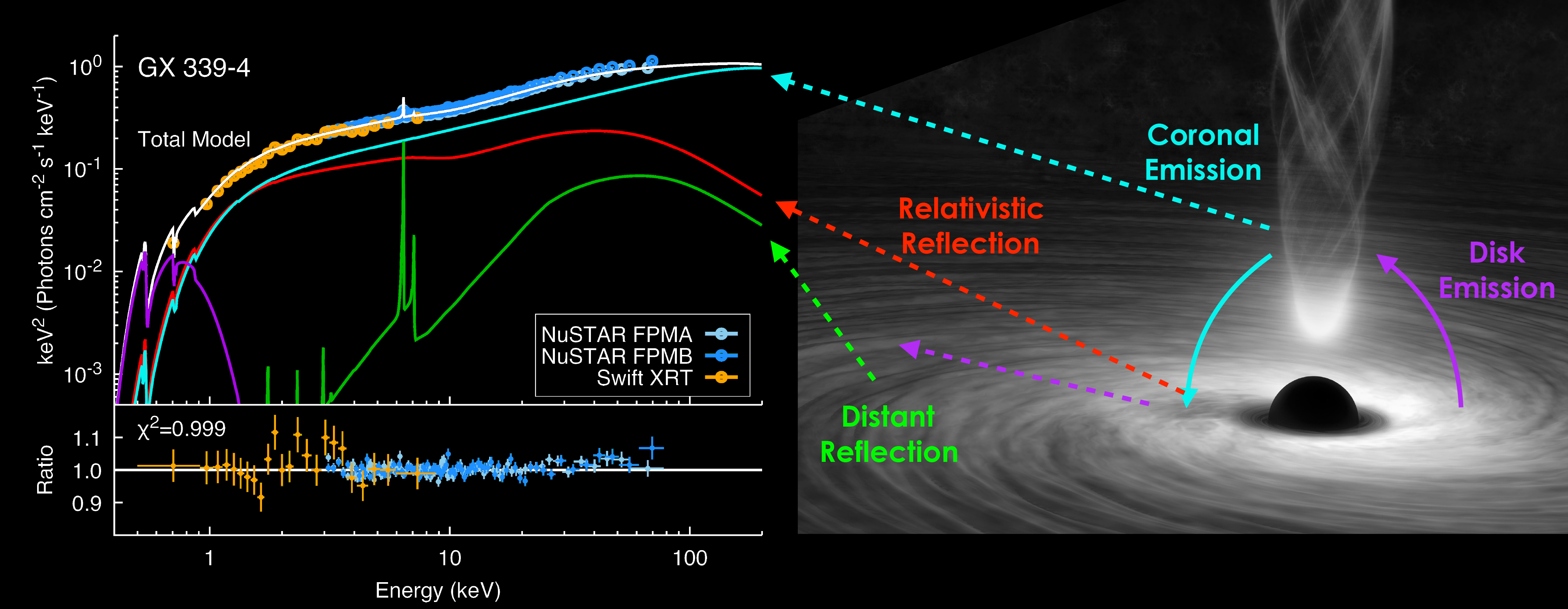 Figure 1
| Science Goals | Key Questions | Methodology | Desired Observational Capabilities |
|---|---|---|---|
| Goal 1: Measure the distribution of supermassive black hole spins in the local Universe | • Were the supermassive black holes in the local Universe grown via galaxy merges or steady growth? | Robust spin estimates (% uncertainty) for a statistically significant sample of AGN (min 50; ideally 80–100), using X-ray reflection spectroscopy | • Energy band: keV • Effective area: cm2 @ 6 keV • Energy resolution: eV @ 6 keV • Low background |
| Goal 2: Estimate the fraction of highly spinning black holes at the peak of AGN activity () | • How do supermassive black holes acquire their mass and angular momentum? | Detection of broad Fe K lines and estimate spins for high- AGN (20% uncertainty) | • Energy band: keV) • Effective area: cm2 @ 1 keV • Energy resolution: eV @ 1 keV • Low background • High angular resolution: |
| Goal 3: Measure the distribution of BHXB spins | • How do stellar-mass black holes acquire their spin and mass? • Are X-rays probing a different population of black holes from those measured with LIGO/Virgo? • Are jets powered by black hole spins? | Robust spin estimates (% uncertainty) for a statistically significant sample of BHXB (min 30; ideally 50–100), using X-ray reflection spectroscopy. Validate results with other techniques when possible | • Energy band: keV • Effective area: cm2 @ 6 keV • Energy resolution: eV @ 6 keV • High count rate capabilities (no pile-up) to a few Crab • Fast ToO response: hrs |
| Goal 4: Understand the dynamics of black hole accretion physics | • Is the accretion disk significantly truncated in BHXBs during the hard state? • Which are the main physical quantities that drive the state changes? | Measure the level of disk truncation to high precision (% uncertainty) and its evolution during the outburst of several BHXBs with X-ray reflection | • Energy band: keV • Effective area: cm2 @ 6 keV • Energy resolution: eV @ 6 keV • High count rate capabilities (no pile-up) to a few Crab • Fast ToO response: hrs • Monitoring capabilities: daily observations during weeks/months |
| Goal 5: Study the detailed microphysics of accretion disks | • Is iron significantly over-abundant in most accretion disks? • What’s the origin of the soft-excess in AGN? | Determine the density of the accretion disk in a strong gravitational field for a sample of BHXBs and AGN using state-of-the-art reflection models | • Energy band: keV • Effective area: cm2 @ 6 keV • Energy resolution: eV @ 6 keV • High count rate capabilities (only for BHXBs) to a few Crab • Polarization capabilities |
| Goal 6: Investigate the origin, geometry, and behavior of the X-ray corona in accreting black holes | • What are the properties of the corona? • How does the corona evolve throughout state transitions? | Measurements of the electron temperature and optical depth of the coronal emission (via modeling the X-ray continuum), as well as the illumination profile in the accretion disk (via modeling the X-ray reflection spectrum) | • Energy band: keV • Effective area: cm2 @ 6 keV • Effective area: cm2 @ 100 keV • Low background • High count rate capabilities (only for BHXBs) to a few Crab |
Peer Reviews
No public reviews on file for this paper yet. If you reviewed it on a platform where reviews are public (OpenReview, ICLR, NeurIPS, ICML), you can paste yours below so the community can read it here.
Videos
No videos yet. Explain this paper in a talk, walkthrough, or lecture? Add one.
Taxonomy
TopicsAstrophysical Phenomena and Observations · Pulsars and Gravitational Waves Research · Gamma-ray bursts and supernovae
\title
decadal2020_Garcia
\newdateformatmydate\monthname[\THEMONTH] \THEYEAR
Astro 2020 Decadal Science White Paper, \mydate
Probing the Black Hole Engine with Measurements of the Relativistic X-ray Reflection Component
Thematic Areas:
- •
Formation and evolution of compact objects
- •
Galaxy Evolution
Principal Author:
Javier A. García1,2
1California Institute of Technology
+1-626-395-6609
Co-authors (alphabetical):
Matteo Bachetti1,3, David R. Ballantyne4, Laura Brenneman5, Murray Brightman1, Riley M. Connors1, Thomas Dauser2, Andrew Fabian6, Felix Fuerst7, Poshak Gandhi8, Nikita Kamraj1, Erin Kara9,10,11, Kristin Madsen1, Jon M. Miller12, Michael Nowak13, Michael L. Parker7, Christopher Reynolds6, James Steiner11, Daniel Stern14, Corbin Taylor9, John Tomsick15, Dominic Walton6, Jörn Wilms2, & Abderahmen Zoghbi12
2Dr. Karl-Remeis Observatory, Germany, 3INAF-Osservatorio Astronomico di Cagliari, Italy, 4Georgia Tech University, 5Smithsonian Astrophysical Observatory, 6University of Cambridge, UK, 7European Space Agency, ESAC, Spain, 8University of Southampton, UK, 9University of Maryland College Park, 10NASA Goddard Space Flight Center, 11Massachusetts Institute of Technology, 12University of Michigan, 13Washington University in St. Louis, 14NASA Jet Propulsion Lab, 15University of California, Berkeley
“Nothing can be loved or hated unless it is first understood"
—Leonardo da Vinci
1 Introduction
Over thirty years ago, Soviet physicist and Nobel laureate Vitaly Ginzburg wrote: “If the cosmological problem is the number one problem of astronomy, then problem number two should be the problem of black holes" (Ginzburg 1985). This powerful statement, also cited by McClintock and Remillard (2009) in their Astro 2010 Decadal White Paper, is equally relevant today. In physics, black holes represent one of the best laboratories to test general relativity. In astrophysics, stellar-mass black holes are the endpoints of stellar evolution, providing the unique opportunity to study the gravitational collapse of matter into a single point laying beyond the light-trapping event horizon. Conversely, the origin and growth of their supermassive counterparts in active galactic nuclei (AGN), believed to be important drivers of galactic evolution, remains an open question. Today, the field continues to make momentous strides, with the detection of gravitational waves (GW) from LIGO/Virgo (e.g., Abbott et al. 2016, 2017), and with the Event Horizon Telescope (EHT) expected to deliver the first images of the the black hole in the center of our Galaxy (e.g., Lu et al. 2018).
Since the first discovery of a black hole, Cygnus X-1, X-ray astronomy has offered a unique probe into the nature of compact objects. Energetic radiation reflected from the accretion disk around a black hole produces emission lines that can be distorted by Doppler and gravitational shifts (Fabian et al. 1989). These effects were first confirmed with the observation of the relativistically broadened Fe K emission in the AGN spectrum of MCG–6-30-15 (Tanaka et al. 1995). In the last two decades, X-ray spectroscopy has proven to be a powerful tool for the estimation of black hole spin and several other physical parameters in dozens of AGN and black hole X-ray binaries (BHXBs; Reynolds 2013).
*In this White Paper, we discuss the observational and theoretical challenges expected in the exploration, discovery, and study of astrophysical black holes in the next decade. We focus on the case of accreting black holes and their electromagnetic signatures, with particular emphasis on the measurement of the relativistic reflection component in their X-ray spectra. *
2 X-ray Reflection Spectroscopy
Prior to the detection of GW from merging black holes, accreting systems (either AGN or BHXB) have provided the best opportunity to study the properties of black holes. Furthermore, given that the basics of accretion physics are independent of the mass of the central object, and in contrast to GW, the same techniques can in principle be applied to systems with any black hole mass, e.g., a BHXB with masses in the 1.4–100 range, or AGN with masses in the range 111In some cases, such as X-ray reflection spectroscopy, the techniques are also applicable to a binary system where the compact object is a neutron star (e.g., Cackett et al. 2008; Ludlam et al. 2018a). (i.e., LIGO & EHT will not probe the same wide range of masses). In many of these systems, infalling gas forms a flat rotating structure known as an accretion disk, with the matter spiraling slowly toward the center on Keplerian orbits. Near the black hole, thermal emission from the optically-thick disk peaks in the X-ray band ( keV) for BHXB, and in the ultraviolet ( eV) for AGN (Shakura and Sunyaev 1973). Additionally, a non-thermal power-law component of emission is ubiquitous, arising through Comptonization by much hotter electrons ( keV) in an optically-thin region that is referred to as the corona.
The hard coronal radiation illuminates the relatively cold accretion disk and creates a spectral component typically referred to as the reflection spectrum, which is composed of a forest of fluorescent lines, edges and related features (Ross and Fabian 1993; García and Kallman 2010). These reprocessed X-rays leave the disk carrying information about the physical composition and condition of the matter in the strong field near the black hole. The most prominent feature is the fluorescent Fe K complex of emission lines at 6–7 keV. The line profiles are grossly distorted in the strong gravity regime by Doppler effects, light bending and gravitational redshift (Fabian et al. 1989; Dauser et al. 2013). Figure 1 shows a schematic view of these components. By modeling the shape of the Fe K profile and the entire reflection spectrum, much can be deduced about matter near the black hole and about the black hole itself, including its spin, or angular momentum. An alternative method to measure the spin of stellar-mass black holes is based on the fitting of the thermal-disk emission (Zhang et al. 1997). Profoundly, spin and mass are the two physical quantities that completely define an astronomical black hole, with the spin providing an indirect record of its formation mechanism and growth history (Moderski et al. 1998; Volonteri et al. 2005). Additionally, reflection spectrum fitting can be complemented by timing analysis of X-ray reverberation signatures (lags that result from path length differences between the direct and reprocessed X-rays), which can be used to further probe the properties of the inner disk, hot corona, and central compact object (Uttley et al. 2014).
Relativistically-broadened Fe K lines have by now been observed in the spectra of most well-studied BHXBs and a large fraction of AGN. Brenneman (2013) and Reynolds (2014) list 20 AGN with estimates of black hole spin, while the Fe line has been detected in many additional AGN. For BHXBs, Reynolds (2014) lists spin estimates for 14 of the 18 black holes cataloged by McClintock and Remillard (2006). In the last couple of years, 11 new black hole candidate systems have been discovered, from which at least 5 exhibit broad Fe line emission: Swift J1858.60814 (Ludlam et al. 2018b), MAXI J1820+070 (Kara et al. 2019), MAXI J1535571 (Xu et al. 2018a), Swift J1658.24242 (Xu et al. 2018b), and MAXI J1631479 (Miyasaka et al. 2018).
3 Open Questions in Black Hole Astrophysics for the Next Decade
The Spin of Black Holes Across Mass and Redshift.** Obtaining accurate estimates of spin is a key goal in black-hole astrophysics. In the case of supermassive black holes, the distribution of spin versus mass can be used to discriminate among different formation scenarios and evolutionary paths, such as hierarchical (Volonteri et al. 2005) or chaotic (King et al. 2008) growth via galaxy mergers, or steady growth via standard radiatively-efficient accretion (Bardeen et al. 1972). While current observations suggest that broad Fe K lines are very common in the local universe, it is unclear if they were also common at earlier times, such as at the peak of AGN activity at 0.5–4. Current observational data has been pushed to the limit to achieve high- spin estimates using techniques leveraging gravitational lensing (Reis et al. 2014; Reynolds et al. 2014; Chartas and Canas 2018), Bayesian fitting (Baronchelli et al. 2018), and stacking (Walton et al. 2015). The current census of spin measurements for local AGN is limited in the size of the sample ( objects), precision (some measurements are only upper or lower limits), and accuracy, as observational biases and systematic uncertainties are not yet well understood (e.g., see Reynolds 2019, for a recent review).**
For stellar-mass black holes, accurate spin measurements are crucial for understanding their formation and evolutionary histories (e.g., Fragos and McClintock 2015), as well as exploring the suggested correlation between jet power and black hole spin (Narayan and McClintock 2012; Steiner et al. 2013; McClintock et al. 2014; Chen et al. 2016). Accurate spins and masses for samples of stellar-mass black holes can be used to discern between different axion models, such as via the search for evidence of black hole superradiance (Brito et al. 2015), a process through which angular momentum and energy are predicted to be extracted from the compact object by large numbers of bosons that populate gravitationally bound states (Baryakhtar et al. 2017).
Understanding the Physics of Accretion onto Black Holes.** As a BHXB cycles between quiescence and its Eddington luminosity, it exhibits a wide range of behaviors that includes AU-scale steady jets, parsec-scale ballistic jets, X-ray quasi-periodic oscillations (QPOs) with frequencies spanning Hz, and distinct “hard" and “soft" spectral/timing states (Fender et al. 2004; Remillard and McClintock 2006); all of which may be tied to the spin of the black hole.**
A critical assumption in measuring black hole spin is that the inner edge of the accretion disk is located at the innermost stable circular orbit (ISCO). This assumption has been firmly validated for accretion disk dominated soft states (e.g., Steiner et al. 2010; Zhu et al. 2012), but for Comptonization dominated hard states, it is a matter of dispute. Measurements of the inner-disk radius with reflection models and timing techniques appear to be in disagreement by orders of magnitude for the same source (e.g., GX 339–4; García et al. 2015; Basak and Zdziarski 2015; De Marco and Ponti 2016). The question of disk truncation has important ramifications for measurements of black hole spin, given the strong degeneracy between inner radius and spin that arises due to their relations to the strength of gravitational redshift (e.g., Fabian et al. 2014), which limits the confidence with which either parameter can be obtained. Improvement in data quality is thus crucial to resolve this controversy, as higher signal and superior spectral resolution will overcome current model degeneracies. Moreover, physical parameters obtained from reflection spectroscopy analysis can be used to inform our understanding of other aspects of accretion physics, such as the importance of the vertical structure as opposed to a razor-thin disk (Taylor and Reynolds 2018a, b), the possibility of disk warps or misalignment (e.g., Tomsick et al. 2014; Middleton et al. 2016; Miller et al. 2018), or the presence of disk winds and outflows (e.g., Miller et al. 2015; Parker et al. 2018). Thus, continuous monitoring of accreting black holes is needed in order to provide a comprehensive picture of the dynamical evolution of accretion disks throughout different state transitions.
The Detailed Microphysics of Accretion Disks.** The prevalence of super-solar iron abundances is an unexpected result from reflection spectroscopy studies of BHXBs and AGN (García et al. 2018), which calls into question the accuracy of spin estimates given the strong correlation between spin and Fe abundance (e.g., Reynolds et al. 2012; Steiner and McClintock 2012). This systematic tendency for very large Fe abundances has motivated the revision of X-ray reflection models. In particular, recent calculations for densities above the traditional values ( cm***-3***), show a strong excess of the reflected continuum at soft energies ( keV), due to the enhancement of free-free heating in the atmosphere of the disk, which increases with increasing density (Ballantyne 2004; García et al. 2016). Moreover, at sufficiently high densities ( cm***-3***), plasma effects such as atomic screening and modifications to the nuclear potential become important (e.g., Deprince et al. 2018). Such densities are not only plausible but indeed expected in accretion disks around black holes, particularly for those with stellar masses (Schnittman et al. 2013).**
Application of these new high-density reflection models—which are still under development—to study both AGN (e.g., IRAS 132243809, Mrk 1044, and Mrk 509; Jiang et al. 2018; Mallick et al. 2018; García et al. 2019) and BHXBs (e.g., Cyg X-1 and GX 339–4; Tomsick et al. 2018; Jiang et al. 2019) suggests that high-density effects are significant, and must be correctly considered in order to properly interpret the observed X-ray spectrum. In all these cases, the iron abundance recovered by the model was significantly decreased relative to results obtained with lower-density disk reflection models. The analysis of a statistically significant sample of sources with improved models and state-of-the-art atomic data promises to reveal exciting new details of the microphysics of accretion disks around black holes.
The Origin of the Corona.** The geometry, location, and even the origin of the source that illuminates the disk are still largely unknown. The photons are thought to originate from a Comptonizing hot corona (e.g., Haardt and Maraschi 1993; Dove et al. 1997; Zdziarski et al. 2003), which may be associated with the base of a jet (e.g., Matt et al. 1992; Markoff et al. 2005). Recent observations show evidence for a thermal cutoff in the spectra of several AGN (e.g., Fabian et al. 2014; Lohfink et al. 2015), suggesting that the corona is close to the pair-production limit. The electron temperature and optical depth of the corona can both be accurately constrained by modeling the reflection spectrum, which indicates that the corona responds dramatically to changes in luminosity (García et al. 2015; Kara et al. 2019). Assumptions made on the properties of the corona have a direct impact on the shape of the reflection spectrum. Meanwhile, there exists abundant observational evidence for X-ray reverberation originating from the disk’s innermost region, just outside the event horizon (e.g., Zoghbi et al. 2010; Kara et al. 2016), thus confirming that the broad features observed in the spectrum are due to relativistic reflection. The detailed modeling of these observables will provide new ways to estimate the properties of the corona.**
4 Further Advances and Efforts Required
In order to significantly expand our understanding of the physics of black holes and the behavior of accretion disks in strong gravity, further development in reflection models is necessary, along with the improvement of observational capabilities in the next decade. This includes the calculation and measurement of atomic parameters for high density plasmas, allowing the extension of reflection models to densities above cm*-3***. Future work should also explore alternative coronal illumination patterns (e.g., Wilkins et al. 2016), as well as incorporate detailed calculations of disk thermal emission (e.g., Ballantyne et al. 2001; Ross and Fabian 2007), ionization gradients (e.g., Svoboda et al. 2012; Kammoun et al. 2019), and realistic density profiles. It will be necessary to understand and accurately assess systematic errors, such as disk thickness (Taylor and Reynolds 2018a, b), Comptonization of reflection features by the corona (Wilkins and Gallo 2015; Steiner et al. 2017), and realistic temperature profiles in the disk (hardening factors) (Davis and El-Abd 2018). Implementing the results from GR-MHD simulations (e.g., Kinch et al. 2016, 2018) into reflection models would provide a new means of testing accretion theory predictions and hypotheses about plasmas in strong gravity. Finally, new modeling methodologies, such as the simultaneous modeling of lag-energy and lag-frequency spectra (e.g., Chainakun et al. 2016; Caballero-Garcia et al. 2017), or direct analysis of the cross-spectrum (e.g., Mastroserio et al. 2018; Bachetti and Huppenkothen 2018), would allow us to use data more effectively, better guaranteeing self-consistency and overcoming model degeneracies.**
5 Concluding Remarks
Achieving a deeper understanding of accreting black holes requires the next leap in our observational capabilities (summarized in Table 1). Future missions flying micro-calorimeters such as XRISM (Tashiro et al. 2018), Athena (Nandra et al. 2013), and Lynx (Özel 2018), will provide unprecedented spectral resolution in the X-ray band. The characterization of the reflection spectrum also requires high sensitivity in the 10–100 keV band. Concept probe missions such as HEX-P (Madsen et al. 2018), STROBE-X (Ray et al. 2018), and eXTP (Zhang et al. 2016), will provide such capabilities; while observations of AGN at high redshift or in crowded fields can only be achieved with a superior angular resolution such as that in the concept mission AXIS (Mushotzky 2018).
The reference list from the paper itself. Each links out to its DOI / PubMed record.
- 1Abbott et al. (2016) Abbott, B. P., Abbott, R., Abbott, T. D., Abernathy, M. R., Acernese, F., Ackley, K., Adams, C., Adams, T., Addesso, P., Adhikari, R. X., et al., 2016. Observation of Gravitational Waves from a Binary Black Hole Merger. Physical Review Letters 116 (6), 061102.
- 2Abbott et al. (2017) Abbott, B. P., Abbott, R., Abbott, T. D., Acernese, F., Ackley, K., Adams, C., Adams, T., Addesso, P., Adhikari, R. X., Adya, V. B., et al., 2017. GW 170104: Observation of a 50-Solar-Mass Binary Black Hole Coalescence at Redshift 0.2. Phys. Rev. Lett.118, 221101.
- 3Bachetti and Huppenkothen (2018) Bachetti, M., Huppenkothen, D., 2018. No Time for Dead Time: Use the Fourier Amplitude Differences to Normalize Dead-time-affected Periodograms. Ap JL 853, L 21.
- 4Ballantyne (2004) Ballantyne, D. R., 2004. Reflection spectra from an accretion disc illuminated by a neutron star X-ray burst. MNRAS 351, 57–62.
- 5Ballantyne et al. (2001) Ballantyne, D. R., Ross, R. R., Fabian, A. C., 2001. X-ray reflection by photoionized accretion discs. MNRAS 327, 10–22.
- 6Bardeen et al. (1972) Bardeen, J. M., Press, W. H., Teukolsky, S. A., 1972. Rotating Black Holes: Locally Nonrotating Frames, Energy Extraction, and Scalar Synchrotron Radiation. Ap J 178, 347–370.
- 7Baronchelli et al. (2018) Baronchelli, L., Nandra, K., Buchner, J., 2018. Relativistic reflection from accretion discs in the population of active galactic nuclei at z = 0.5-4. MNRAS 480, 2377–2385.
- 8Baryakhtar et al. (2017) Baryakhtar, M., Lasenby, R., Teo, M., 2017. Black hole superradiance signatures of ultralight vectors. Phys. Rev. D 96, 035019.