Lunar Laser Ranging constraints on nonminimally coupled dark energy and standard sirens
Shinji Tsujikawa

TL;DR
This paper investigates how Lunar Laser Ranging experiments constrain nonminimally coupled dark energy models involving scalar fields, and examines the implications for gravitational wave propagation and standard siren observations.
Contribution
It provides new constraints on the coupling constant in scalar-tensor dark energy models using LLR data and analyzes the impact on gravitational wave and luminosity distance measurements.
Findings
LLR constrains the coupling Q to be less than 3.4 x 10^{-3} for small Galileon coupling.
The difference between gravitational wave and luminosity distances is below 10^{-5} for redshifts up to 100.
Vainshtein screening suppresses observable effects of nonminimal couplings in standard siren signals.
Abstract
In dark energy models where a scalar field is coupled to the Ricci scalar of the form , where is a coupling constant, is today's value of , and is the reduced Planck mass, we study how the recent Lunar Laser Ranging (LLR) experiment places constraints on the nonminimal coupling from the time variation of gravitational coupling. Besides a potential of the light scalar responsible for cosmic acceleration, we take a cubic Galileon term into account to suppress fifth forces in over-density regions of the Universe. Even if the scalar-matter interaction is screened by the Vainshtein mechanism, the time variation of gravitational coupling induced by the cosmological background field survives in the solar system. For a small Galileon coupling constant , there exists a kinetically driven…
Click any figure to enlarge with its caption.
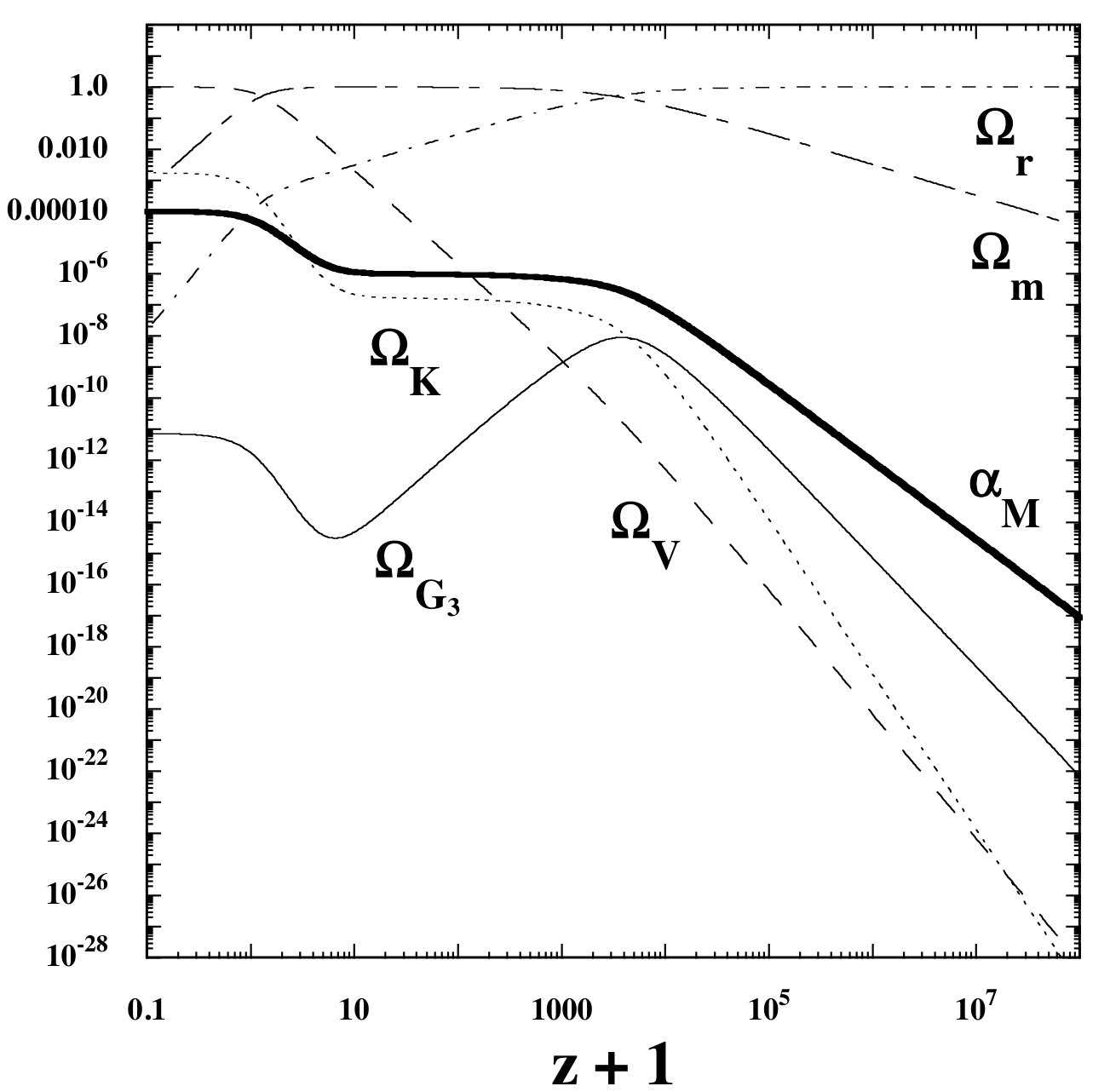 Figure 1
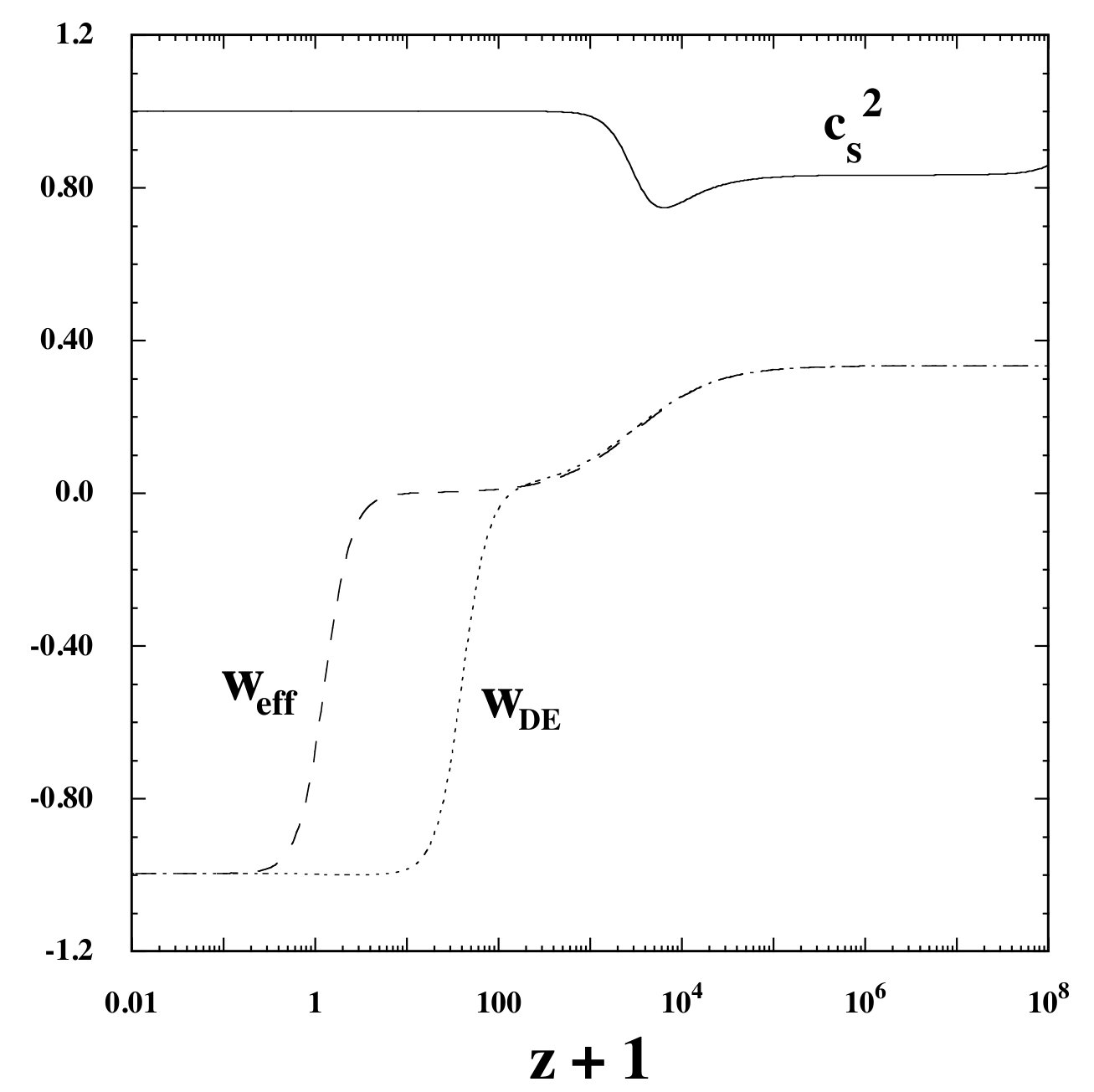 Figure 2
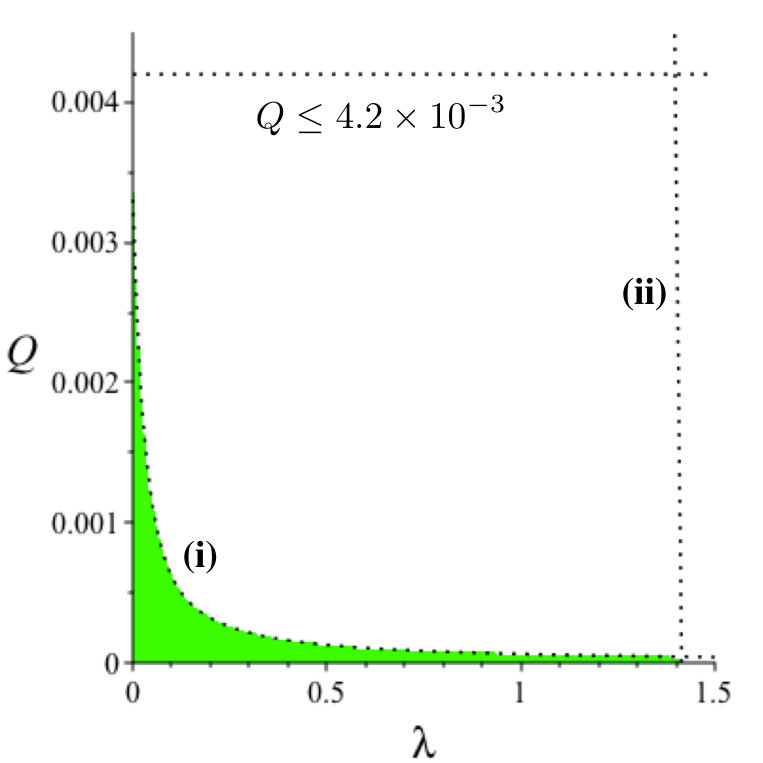 Figure 3
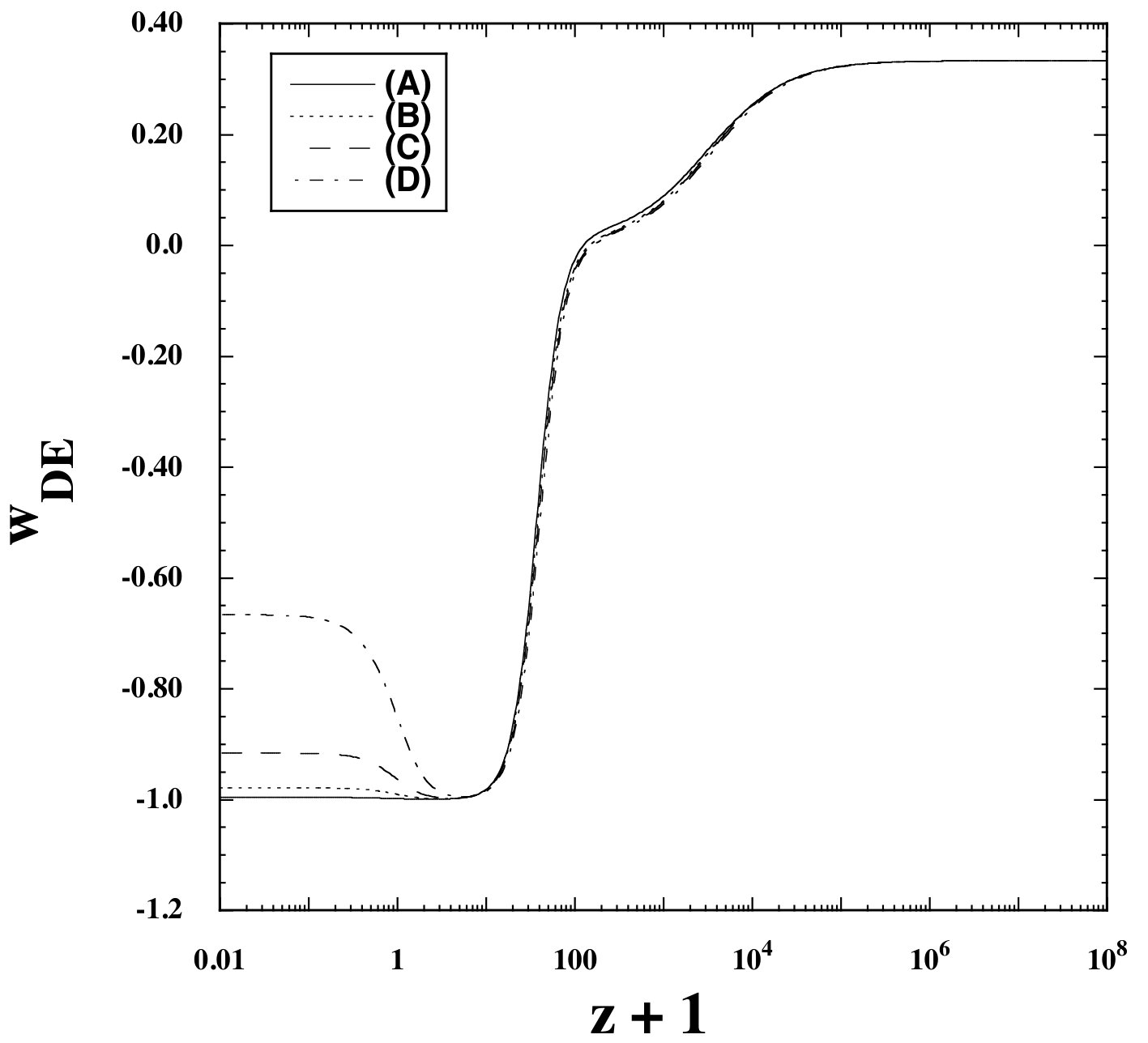 Figure 4
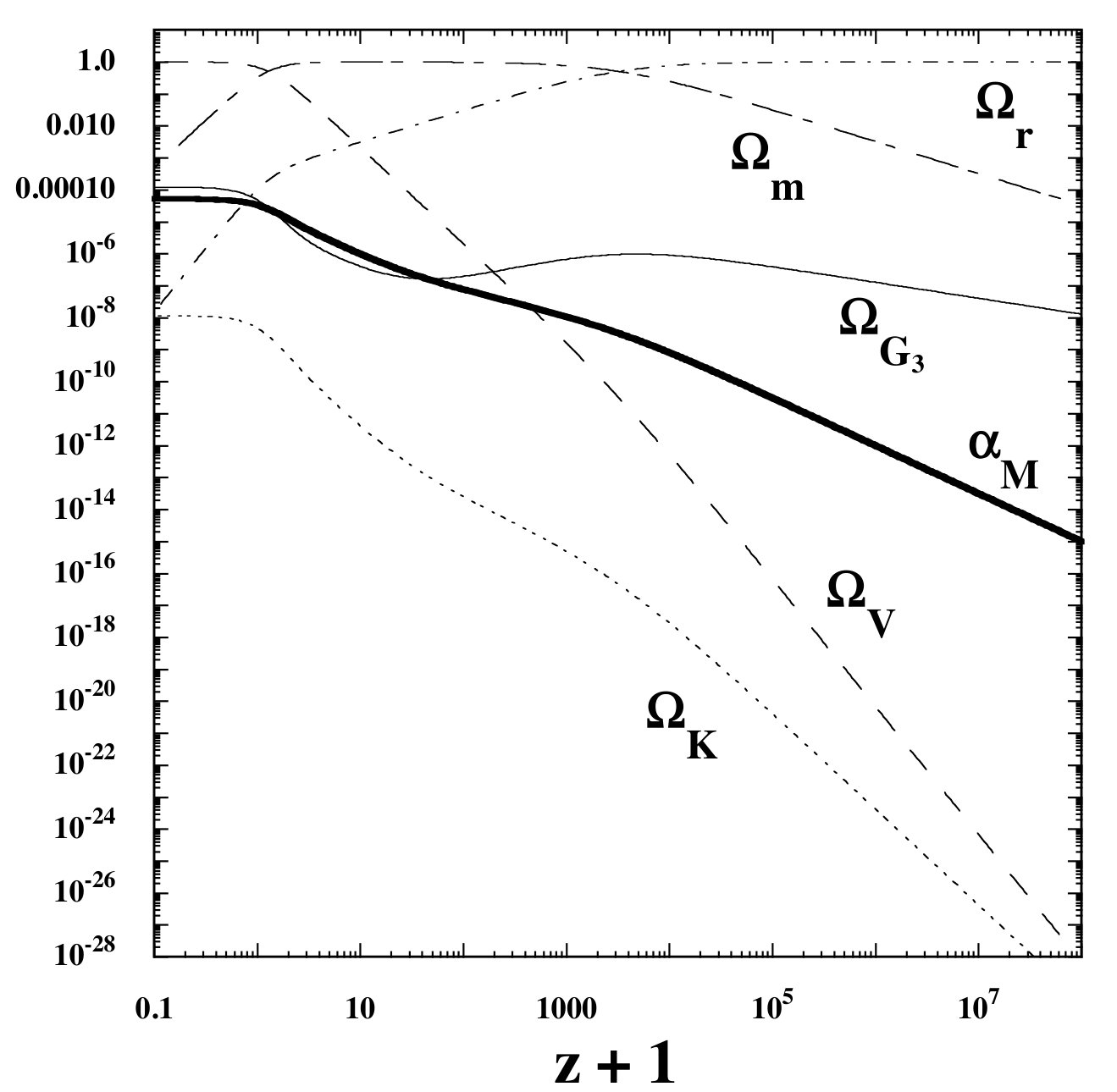 Figure 5
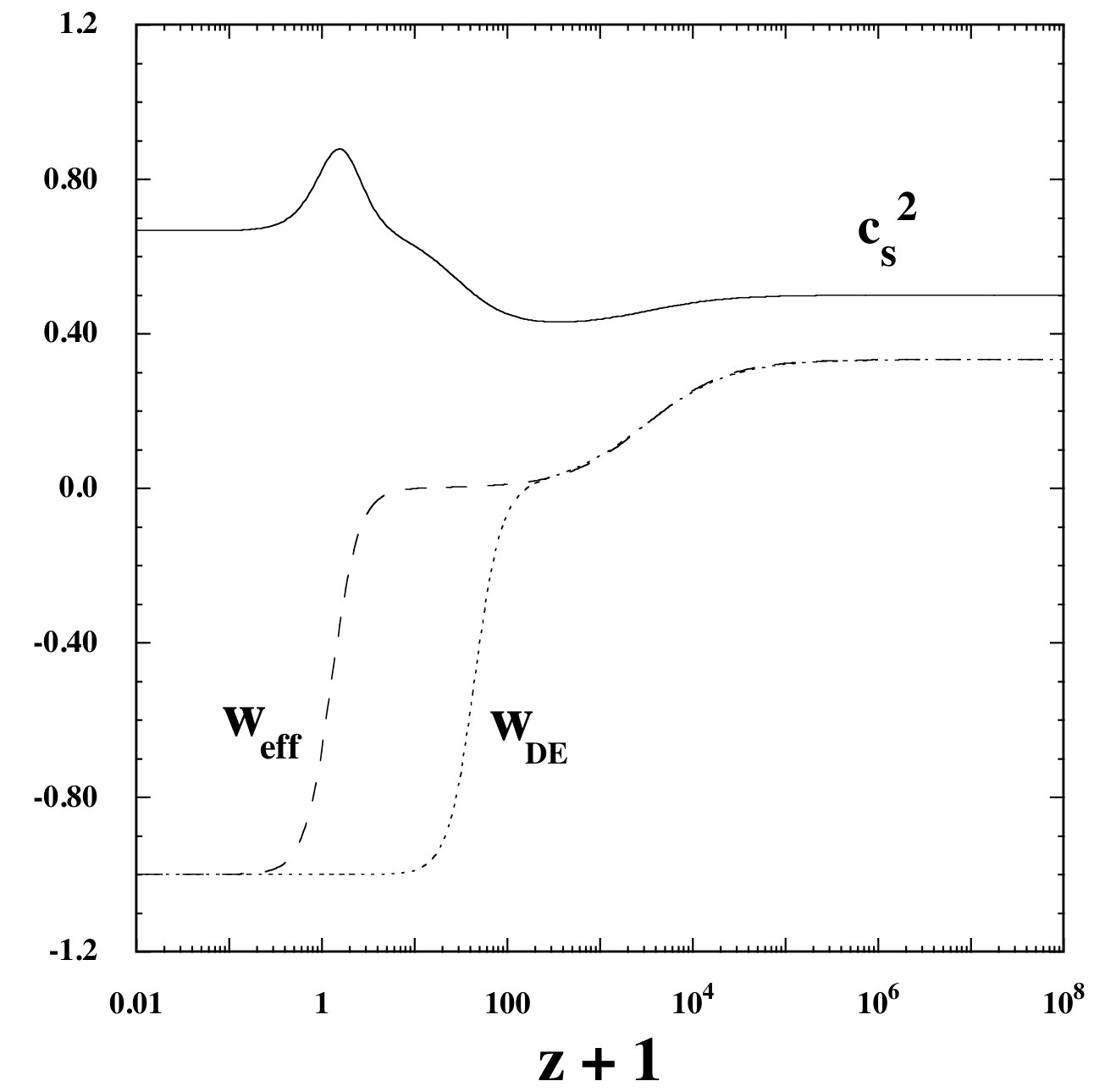 Figure 6
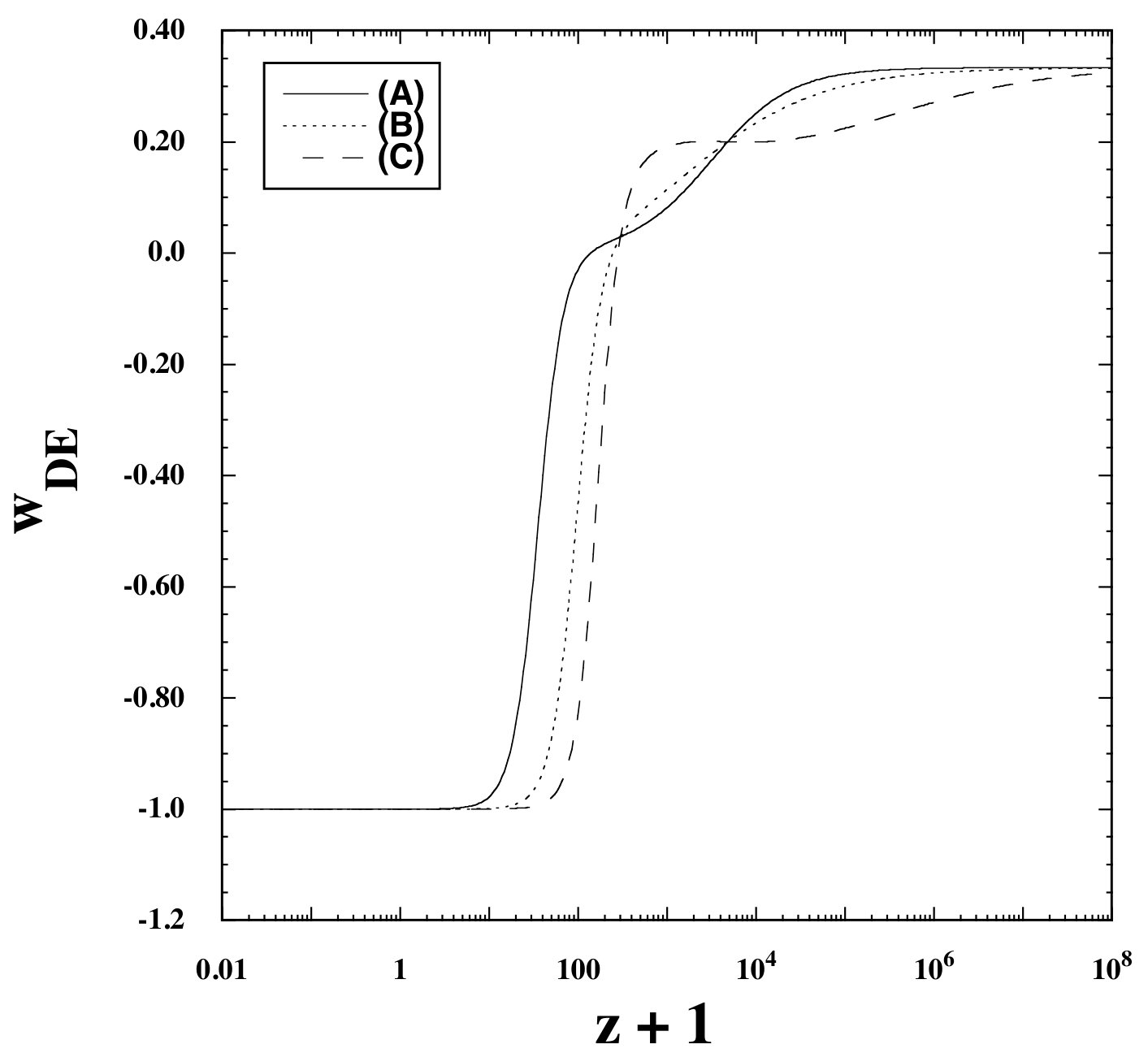 Figure 7
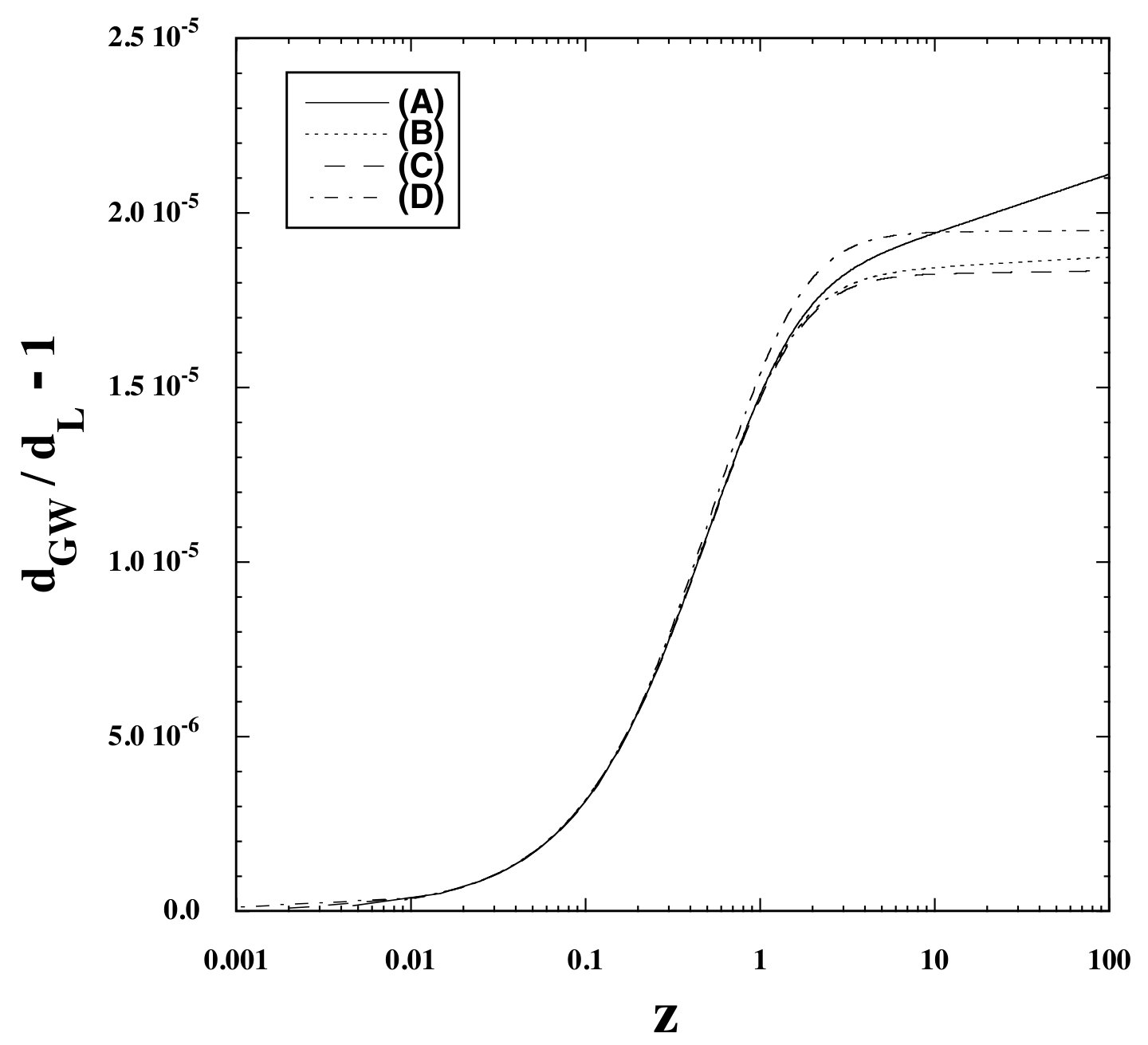 Figure 8
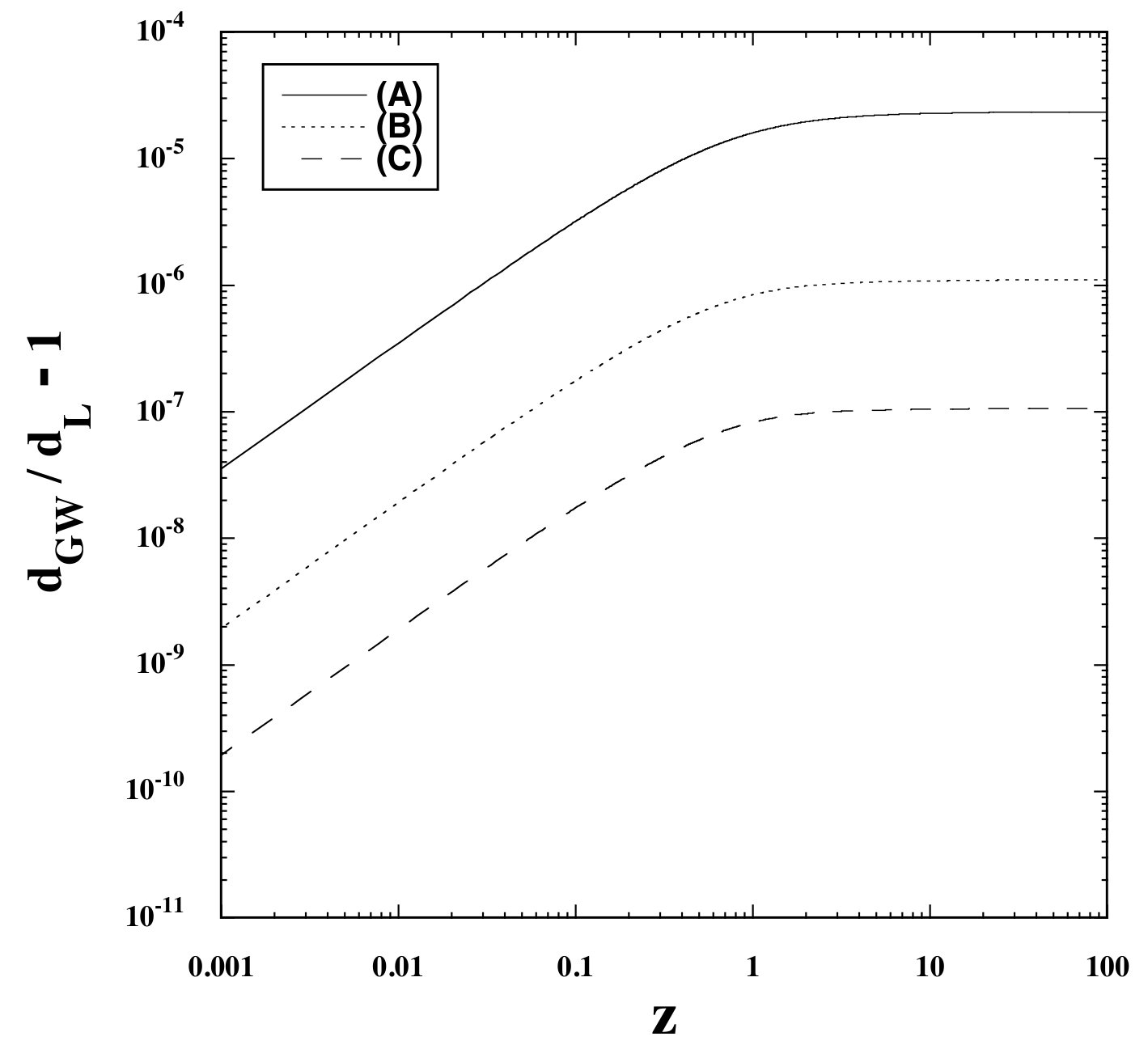 Figure 9
Peer Reviews
No public reviews on file for this paper yet. If you reviewed it on a platform where reviews are public (OpenReview, ICLR, NeurIPS, ICML), you can paste yours below so the community can read it here.
Videos
No videos yet. Explain this paper in a talk, walkthrough, or lecture? Add one.
Lunar Laser Ranging constraints on
nonminimally coupled dark energy
and standard sirens
Shinji Tsujikawa
Department of Physics, Faculty of Science, Tokyo University of Science, 1-3, Kagurazaka, Shinjuku-ku, Tokyo 162-8601, Japan
Abstract
In dark energy models where a scalar field is coupled to the Ricci scalar of the form , where is a coupling constant, is today’s value of , and is the reduced Planck mass, we study how the recent Lunar Laser Ranging (LLR) experiment places constraints on the nonminimal coupling from the time variation of gravitational coupling. Besides a potential of the light scalar responsible for cosmic acceleration, we take a cubic Galileon term into account to suppress fifth forces in over-density regions of the Universe. Even if the scalar-matter interaction is screened by the Vainshtein mechanism, the time variation of gravitational coupling induced by the cosmological background field survives in the solar system. For a small Galileon coupling constant , there exists a kinetically driven -matter-dominated-epoch (MDE) prior to cosmic acceleration. In this case, we obtain the stringent upper limit from the LLR constraint. For a large without the MDE, the coupling is not particularly bounded from above, but the cosmological Vainshtein screening strongly suppresses the time variation of such that the dark energy equation of state reaches the value close to at high redshifts. We study the modified gravitational wave propagation induced by the nonminimal coupling to gravity and show that, under the LLR bound, the difference between the gravitational wave and luminosity distances does not exceed the order over the redshift range . In dark energy models where the Vainshtein mechanism is at work through scalar derivative self-interactions, it is difficult to probe the signature of nonminimal couplings from the observations of standard sirens.
pacs:
98.80.-k,98.80.Jk
I Introduction
Since the first discovery of late-time cosmic acceleration by supernovae type Ia (SN Ia) in 1998 SN1 ; SN2 , the origin of this phenomenon has not been identified yet. A scalar field is one of the simplest candidates for dark energy, whose potential energy quin or nonlinear kinetic energy kes can drive the acceleration. If we allow for the coupling between and the gravity sector, Horndeski theories Horndeski are known as the most general scalar-tensor theories with second-order equations of motion Horn1 ; Horn2 ; Horn3 .
Dark energy models based on Horndeski theories can be constrained not only by the observational data of SNIa, Cosmic Microwave Background (CMB) temperature anisotropies, Baryon Acoustic Oscillations (BAO) but also by the measurements of gravitational waves (GWs). The bound on the speed of GWs from gravitational Cherenkov radiation Moore was used in Ref. Kimura:2011qn to place constraints on the Lagrangian of Horndeski theories. After the first discovery of the GW event GW150914 GW15 , the possibility for constraining modified gravity models from the measurements of GWs along with gamma-ray bursts was pointed out in Ref. Lombriser:2015sxa . From the Hulse-Taylor pulsar data, the speed of GWs was also constrained to be close to that of light at the level of Jime .
The GW170817 event from a neutron star merger GW170817 together with electromagnetic counterparts Goldstein showed that the relative difference between and is less than the order . If we strictly demand that on the isotropic cosmological background, the allowed Horndeski Lagrangian is of the form , where are functions of and , while is a function of alone GW1 ; GW2 ; GW3 ; GW4 ; GW5 . This includes the theories like quintessence quin , k-essence kes , cubic Galileons Nicolis ; Galileon1 ; Galileon2 ; braiding , Brans-Dicke (BD) theory Brans , gravity Bergmann ; Ruz ; Staro , and nonminimally coupled theories with general functions Damour1 ; Damour2 ; Amen99 ; Uzan ; Chiba99 ; Bartolo99 ; Perrotta ; Boi00 ; Gille ; BD1 .
The original massless BD theory Brans is equivalent to the Lagrangian with , where the constant is related to the so-called BD parameter , as BD1 . General Relativity (GR) is recovered in the limit , i.e., . If we transform the action of BD theory to that in the Einstein frame, the constant has a meaning of coupling between the scalar field and nonrelativistic matter DT10 .
The parametrized post-Newtonian (PPN) formalism Nord ; Will71 on the weak gravitational background shows that, in massless BD theory, one of the PPN parameters is given by Will05 . The Cassini experiment measuring the time delay of light in the solar system placed the constraint Will14 . This translates to the bound , or equivalently, . For the coupling , one needs to resort to some mechanism for screening fifth forces mediated by the BD scalar field.
If the BD scalar has a massive potential in over-density regions of the Universe, the propagation of fifth forces can be suppressed under the chameleon mechanism chame1 ; chame2 . For example, metric gravity corresponds to BD theory with in the presence of a scalar potential of gravitational origin DT10 ; APT07 . It is possible to design the form of such that the scalar degree of freedom (scalaron) has a heavy mass in over-density regions, while realizing cosmic acceleration by a light scalar on Hubble scales fR1 ; fR2 ; fR3 ; fR4 . However, this amounts to a fine-tuning of initial conditions of scalaron perturbations in the early Universe fR2 ; fR4 ; fR5 . Moreover, unless the scalaron is nearly frozen until recently, the large coupling leads to the significant enhancement of matter perturbations in the late Universe fR1 ; fR2 ; fR4 ; Tsuji07 ; Tsuji09 . For the compatibility of models of late-time cosmic accelerationwith with observations, the deviation from GR is required to be very small and hence they are hardly distinguishable from the -Cold-Dark-Matter (CDM) model Lomb ; Battye .
There is yet another mechanism for screening fifth forces in local regions of the Universe based on nonlinear derivative self-interactions Vain . A representative example is the cubic Galileon Lagrangian Nicolis ; Galileon1 ; Galileon2 ; braiding , with which the Newtonian behavior is recovered inside the so-called Vainshtein radius Cede ; Luty ; Babichev ; Burrage ; Brax ; Babi11 ; DKT12 ; KKY12 ; Kase13 even with the coupling . For uncoupled Galileons () without the scalar potential, it is known that there exists a cosmological tracker solution finally approaching a de Sitter attractor DTGa ; DTGa2 (see also Refs. GS ; Ali ). Unfortunately, this dark energy model is in tension with the observational data of supernovae type Ia, CMB, BAO, and redshift-space distortions NDT10 ; AppleLin ; Neveu ; Barreira1 ; Barreira2 ; Renk ; Peirone2 . For the nonminimally coupled light mass or massless Galileon with a potential, e.g., the linear potential , it is possible to realize the viable cosmic expansion history, while recovering the Newtonian behavior in the solar system Ali2 ; KTD .
While the Vainshtein mechanism suppresses the scalar-matter interaction for the distance , the gravitational coupling in over-density regions contains time dependence of the dark energy field through the nonminimal coupling Babi11 ; KKY12 . Then, varies in time even inside the solar system. The LLR experiments of the earth-moon system measure the time variation , so it can be used to constrain nonminimally coupled dark energy models.
From the LLR bound of in 2004 Williams , the time variation (where is the Hubble expansion rate) is in the range today. In 2011, Babichev et al. Babi11 used this bound for nonminimally coupled cubic Galileons without the potential and claimed that the time variation of the field is tightly constrained at low redshifts. We note that, besides this fact, the cubic Galileon without the potential is in tension with the observational data. On the other hand, the presence of potentials for nonminimally coupled Galileons allows the possibility for realizing viable cosmic expansion and growth histories, even with the LLR bound in 2004, see Figs. 4 and 5 in Ref. KT18 .
The recent LLR experiments Hofmann constrain the time variation with the upper limit more stringent than before Williams . In particular, for , the upper bound of translates to today, which is tighter than the bound by more than two orders of magnitude. This LLR bound in 2018 was used to constrain dark energy models based on nonlocal gravity Belga . It remains to be seen how nonminimally coupled Galileons with the potential can be constrained with this new bound of .
In this paper, we exploit the new LLR bound to constrain nonminimally coupled dark energy models with the cubic self-interaction and the potential of light mass Galileons, where is dimensionless coupling constant and is a mass scale defined later in Eq. (2). We stress that our model is different from the nonminimally coupled cubic Galileon without the potential studied in Ref. Babi11 , in that the scalar potential is the dominant source for late-time cosmic acceleration. The Galileon term can still play an important role for the scalar field dynamics in the early Universe. Moreover, we require that the propagation of fifth forces is suppressed in over-density regions. We perform a detailed analysis for the cosmological dynamics from the radiation era to today and put bounds on the coupling by using the new LLR data.
For , there exists a so-called -matter-dominated epoch (MDE) Amenco in the Jordan frame followed by the stage of cosmic acceleration. For the exponential potential , we place constraints on the allowed parameter space in the plane and derive the stringent limit from the LLR constraint. This is almost close to the Cassini bound obtained for massless BD theories without the Vainshtein screening. For , the coupling is not particularly bounded from above due to the suppression of field kinetic energy under the cosmological Vainshtein screening. In this case, we show a new possibility for realizing the dark energy equation of state close to from high redshifts to today even for the steep potential satisfying .
In our dark energy theory the speed of GWs is equivalent to that of light, but the existence of nonminimal coupling leads to the modified GW propagation through the existence of a nonvanishing term . The possibility of using the difference between GW and luminosity distances to test for the running Planck mass was first pointed out in Ref. Saltas:2014dha . The first forecasts of such constraints were given in Ref. Lombriser:2015sxa , which were followed by a sequence of papers after the direct detection of GWs Nishi17 ; Arai ; Amendola17 ; Zhao ; Belga17 ; Belga17d ; Ezqu ; Lagos .
In Ref. Lombriser:2015sxa , it was anticipated that the LLR bound on the running Planck mass may be beyond the reach of the constraint arising from standard sirens. This generally depends on the models of dark energy. For example, in nonlocal gravity models studied recently in Ref. Belga , the difference between the GW distance and luminosity distance is typically more than a few percent, which may be probed in future high-precision measurements. This reflects the fact that, in nonlocal gravity, the gravitational coupling deep inside the Hubble radius (wavelength ) is very close to the Newton gravitational constant , as Nesseris ; Belga . Hence the nonlocal gravity models can pass the new LLR bound in 2018, while leaving the sizable difference between and .
The nonminimal coupling gives rise to the effective gravitational coupling different from that in nonlocal gravity. Hence it deserves for studying whether the new LLR data leads to the constraint on the nonminimal coupling beyond or within the reach of future standard siren measurements. In this paper, we will compute the relative ratio between and for the aforementioned nonminimally coupled dark energy model. Under the LLR bound on the variation of , we show that the relative difference does not exceed the order in the redshift range . Thus, unlike nonlocal gravity, the LLR data allow only tiny deviations of from in nonminimally coupled theories, so it will be difficult to detect such difference without very high-precision distance measurements in future.
This paper is organized as follows. In Sec. II, we present our nonminimally coupled dark energy model and revisit how the cubic Galileon interaction screens the scalar-matter coupling under the Vainshtein mechanism. We then interpret the recent LLR bound in terms of today’s value of . In Sec. III, we derive the background equations of motion on the flat Friedmann-Lemaître-Robertson-Walker (FLRW) background and express them in autonomous forms. In Sec. IV, we study the cosmological dynamics in the presence of exponential potential for unscreened () and screened () cases after the radiation domination. We put constraints on the allowed parameter space from the recent LLR bound and discuss the evolution of and field density parameters. In Sec. V, we investigate how much difference arises between and for the two different background cosmologies discussed in Sec. IV. Sec. VI is devoted to conclusions.
Unless otherwise stated, we use the natural unit where the speed of light , the reduced Planck constant , and the Boltzmann constant are equivalent to 1.
II Nonminimally coupled theories and
LLR constraints
We begin with a subclass of Horndeski theories given by the action
[TABLE]
where is the determinant of metric tensor , is the kinetic energy of a scalar field , and , are functions of . The couplings and are dimensionless constants, while is a constant having a dimension of mass related to today’s Hubble constant as
[TABLE]
which is of order GeV. The mass scale (2), which translates to the frequency Hz, corresponds to the typical strong coupling scale of theories containing derivative self-interactions like Cede ; Luty .
We assume that the effective field theory of dark energy is valid up to the mass scale GeV. In other words, we resort to the action (1) for studying the physics on scales larger than m. This includes the dynamics of late-time cosmic acceleration ( m) and the earth-moon local system of LLR experiments ( m). Below the length scale m, some ultraviolet effects may come into play to approach the General Relativistic behavior. Indeed, the possibility of recovering the GW value above the frequency Hz was discussed in Ref. deRham:2018red . This critical frequency is of the same order as the GW frequency observed by LIGO/Virgo GW170817 , so there may be more general Horndeski theories realizing very close to 1 for the frequency Hz even if the deviation of from 1 is large on cosmological scales. In this paper we do not pursue such a possibility, but we focus on the theory given by the action (1) in which for any scales of interest.
The nonminimal coupling is chosen to be of the form:
[TABLE]
where is today’s value of and hence . We assume that the matter sector, which is described by the action with the density , is minimally coupled to gravity. The scalar field mediates fifth forces with the matter sector through the direct gravitational interaction characterized by the coupling .
If , then the theories given by the action (1) are equivalent to BD theories Brans with the scalar potential . Indeed, by setting , the Lagrangian in the action (1) reduces to in the unit , where is the BD parameter related to according to BD1 . In the original massless BD theories with , the coupling strength is constrained to be from the Cassini experiment Will14 .
For the coupling , we require the existence of scalar potential or field derivative interaction to screen fifth forces in the solar system. In the former case, the chameleon mechanism chame1 ; chame2 can be at work for the potential having a large mass in regions of the high density. One of such examples is gravity, in which the scalar potential of gravitational origin arises with the coupling DT10 . In models of late-time cosmic acceleration accommodating the chameleon mechanism in over-density regions, the functional form of needs to be designed such that the scalaron mass grows very rapidly toward the asymptotic past fR1 ; fR2 ; fR3 ; fR4 . This causes the fine-tuning problem of initial conditions of perturbations associated with the oscillating mode induced by the heavy mass fR2 ; fR4 ; fR5 .
Instead of resorting to the chameleon mechanism with a very massive scalar in over-density regions, we consider the Galileon self-interaction to suppress fifth forces under the Vainshtein mechanism Vain . The scalar potential of a light scalar is also taken into account as a source for the cosmic acceleration. Defining the dimensionless quantity
[TABLE]
the condition for cosmic acceleration in the absence of Galileon interactions and matter is given by CLW ; CST . The existence of Galileons can modify this structure, but we focus on the case in which the condition
[TABLE]
is satisfied during the cosmic expansion history from the past to today. The coupling strength exceeding the order 1 leads to the strong enhancement of matter density perturbations incompatible with observations in large-scale structures BD1 , so we consider the coupling
[TABLE]
in the following discussion.
The original Galileon theory Nicolis has the linear potential with , in which case the resulting field equation of motion respects the Galilean symmetry in Minkowski space-time. This potential corresponds to a massless scalar with , so the condition (5) translates to . For , the cosmological dynamics with the linear potential was studied in Ref. KTD . In this case, today’s cosmic acceleration is followed by the collapsing Universe after the field enters the region .
The constant corresponds to the exponential potential . In this case, the scalar mass squared is given by . Since the potential energy is the dominant contribution to today’s energy density of the Universe, we have , where is the Hubble expansion rate in the past (redshift ). Then, under the condition (5), it follows that . This property also holds for the potential with a time-varying in the range (5). For the light scalar whose today’s mass is smaller than , the effect of on the scalar-field equation can be ignored to study the Vainshtein mechanism in regions of the high density. In other words, the chameleon mechanism does not come into play for screening fifth forces.
II.1 Vainshtein screening
The behavior of scalar and gravitational fields around a spherically symmetric over-density on a cosmological background was already studied in Refs. KKY12 ; Babi11 , so we briefly review it in the following. Let us consider the following perturbed metric in the Newtonian gauge:
[TABLE]
where is the time-dependent scale factor, and are gravitational potentials depending and the radial coordinate . The scalar field and matter density on the homogenous cosmological background are given by and , respectively. The existence of a compact object gives rise to the perturbations and in and , such that and .
We are interested in solutions deep inside today’s Hubble radius, . Hence we neglect time derivatives of perturbed quantities, while keeping spatial derivatives. The radial dependence of the derivative changes around the Vainshtein radius , which is estimated as KKY12 ; DKT12
[TABLE]
where
[TABLE]
is the Schwarzschild radius of the source. For the field derivative has the dependence , while, for , . In the latter regime, the nonlinear effect arising from the cubic Galileon self-interaction suppresses the propagation of fifth forces induced by the coupling . Indeed, for , the gravitational potentials are given by KKY12 ; DKT12
[TABLE]
Since the value of today (cosmic time ) is equivalent to 1 in our theory, the Newtonian behavior () is recovered for . As long as is much larger than the solar-system scale ( cm), the model is consistent with solar-system tests of gravity. Since cm for the Sun, this condition translates to
[TABLE]
When is of order , for example, the coupling needs to be in the range .
II.2 LLR constraints
From Eq. (10)-(11) with Eq. (9), the leading-order gravitational potentials deep inside the Vainshtein radius can be expressed as
[TABLE]
where , and is the measured gravitational coupling given by
[TABLE]
where we omitted the bar from the background value of . Here the background field is a cosmological scalar driving the late-time cosmic acceleration. Since we are considering over-density regions on the cosmological background, the homogenous value survives even in the local Universe. The dark energy scalar field changes in time, so this leads to the time variation of . This fact was first recognized in Ref. Babi11 and it was proved in Ref. KKY12 in full Horndeski theories.
The effective gravitational coupling (14) is valid for a light scalar field operated by the Vainshtein mechanism in over-density regions. Here, the light scalar means that the slope of field potential satisfies the condition (5). For the potential of a massive scalar violating this condition in regions of the high density (as in dark energy models), the chameleon mechanism can be at work to suppress the gravitational coupling with matter in a way different from Eqs. (10)-(11). As we already mentioned, we do not consider such a massive scalar field in this paper.
For the cubic derivative self-interaction we chose the Galileon coupling , but this can be generalized to the derivative coupling with . In such cases, the second terms on the right hand sides of (10) and (11) are modified to , which is much smaller than 1 deep inside the Vainshtein radius. Then the local gravitational coupling reduces to the form (14), so the property of induced by the time-dependent background scalar field is similar to that of cubic Galileons. For the models in which derivative field self-interactions are not employed to screen fifth forces in over-density regions, e.g., chameleons and nonlocal gravity, the expression of is generally different from that discussed above.
From the recent LLR experiment, the variation of is constrained to be Hofmann
[TABLE]
where a dot represents the derivative with respect to . This improves the previous bound yr*-1* Williams . Using the value km s*-1* Mpc, the bound (15) translates to Belga
[TABLE]
We define the following quantity,
[TABLE]
which was used in the context of effective field theory of dark energy Bellini . Since is related to the variation of , as , the bound (16) can be expressed as
[TABLE]
If , i.e., for decreasing in time, the upper bound is especially stringent: for . Even when , the upper limit of is of the order . They are smaller than the previous bound Babi11 by more than one order of magnitude.
III Dynamical system
We study the background cosmology for theories given by the action (1) and discuss how the coupling is constrained from the LLR bound (18). We consider the flat FLRW background described by the line element . For the matter action , we take nonrelativistic matter (density with vanishing pressure) and radiation (density and pressure ) into account. Then, the Hamiltonian and momentum constraints lead to Horn2 ; KT18 :
[TABLE]
where , and and are the density and pressure of dark energy, defined, respectively, by
[TABLE]
Besides the matter continuity equations and , the dark sector obeys
[TABLE]
The dark energy equation of state is defined by
[TABLE]
In nonminimally coupled theories the first terms on the right hand sides of Eqs. (21) and (22) are different from 0 in the past due to the property .
To study the background cosmological dynamics, we introduce the following density parameters,
[TABLE]
We consider the case in which is positive in the expanding Universe (), which amounts to the condition
[TABLE]
We also define the quantity
[TABLE]
which is related to and , as
[TABLE]
We can express Eq. (19) in the form:
[TABLE]
where is defined by
[TABLE]
From Eqs. (20) and (23), it follows that
[TABLE]
where
[TABLE]
The condition for cosmic acceleration to occur is that the effective equation of state,
[TABLE]
is smaller than .
The dimensionless variables , , , and obey the differential equations,
[TABLE]
respectively, where a prime represents a derivative with respect to . The dark energy equation of state (24) is expressed as
[TABLE]
The dimensionless field obeys
[TABLE]
Once the potential is specified, the cosmological dynamics is known by solving Eqs. (35)-(38) and (40) for given initial conditions of , , , , and .
For the theory (1), the propagation speed squared of GWs is equivalent to 1 Horn2 ; DT12 . The tensor ghost is absent for , which is satisfied for the choice (3). For scalar perturbations, the conditions for avoiding ghosts and Laplacian instabilities are given, respectively, by
[TABLE]
In Sec. IV, we will discuss whether these conditions are satisfied during the cosmological evolution from the radiation-dominated epoch to today.
IV Cosmological dynamics
In this section, we study the cosmological dynamics for constant , i.e., the exponential potential,
[TABLE]
In this case, the dynamical system given by Eqs. (35)-(38) is closed. As long as slowly varies in time in the range (5), the cosmological evolution is similar to that discussed below.
In over-density regions of the Universe, the operation of Vainshtein mechanism means that the cubic Galileon term dominates over other field Lagrangians. In the cosmological context, this amounts to the dominance of over and in the early epoch. Let us consider the case in which the conditions
[TABLE]
are satisfied during the radiation-dominated epoch (in which is close to 1). From Eqs. (31) and (32), we then have and
[TABLE]
Since starts to deviate from 1 in the late radiation era, the term is not necessarily negligible relative to for . On using Eqs. (35), (37), and (38), the quantity obeys the differential equation,
[TABLE]
Under the condition , the first term on the right hand side of Eq. (46) is much smaller than 1. Ignoring this term and solving the differential equation for , it follows that
[TABLE]
where is the initial value of at . In the limit , asymptotically approaches 1.
If the condition is initially satisfied, can be as large as the order 1. Then, soon approaches the asymptotic value
[TABLE]
during the radiation era. In this regime, the field density parameters and grow as
[TABLE]
This shows that, even if initially, it is possible for to catch up with . If this catch up occurs by the end of radiation era, we have at the onset of matter dominance.
If initially, i.e., , there is the stage of radiation era in which the quantity is close to . On using Eqs. (35)-(37) in this epoch, the field density parameters and evolve as
[TABLE]
so that grows faster than . If exceeds during the radiation era, the solutions enter the regime characterized by Eqs. (48) and (49). Although grows faster than in the two regimes explained above, it can happen that the inequality still holds at the beginning of matter era for initially much larger than and .
The above discussion shows that there are two qualitatively different cases depending on the values of and at the onset of matter dominance. The first is the case in which dominates over , i.e.,
[TABLE]
Under this condition, there exists the MDE in which the field kinetic energy is not screened by the Galileon term.
The second is the case in which the condition
[TABLE]
is satisfied after the end of radiation era. This corresponds to the situation in which the cosmological Vainshtein screening is sufficiently efficient to suppress the time variation of throughout the evolution from the radiation era to today. In the following, we study these two different cases in turn.
We note that, under the conditions (44), the dark energy equation of state (39) during the radiation dominance can be estimated as
[TABLE]
irrespective of the two asymptotic values of explained above.
IV.1 Unscreened late-time cosmology with
the MDE
Let us first study the cosmological dynamics for the case (i), i.e., after the onset of matte era. In this case, the coupling is in the range
[TABLE]
To derive fixed points of the dynamical system, we take the limit in the autonomous Eqs. (35)-(38). For , the standard matter era is replaced by the MDE characterized by the fixed point
[TABLE]
with
[TABLE]
The MDE was originally found for coupled quintessence in the Einstein frame Amenco . This corresponds to the kinetically driven stage in which dominates over . On the fixed point (a), the parameter is given by
[TABLE]
and hence for . The positivity of means that
[TABLE]
where is the value of on the MDE.
After exceeds by the end of radiation era, the solutions are naturally followed by the MDE in which the cosmological Vainshtein screening is no longer effective. While is constant during the MDE, the other field density parameters evolve as
[TABLE]
For and , grows in proportion to , whereas decreases as . Hence the contribution of cubic Galileons to becomes negligibly small in the late matter era.
The stability of point (a) is known by linearly perturbing Eqs. (35)-(38) with homogenous perturbations , , , and CLW ; CST . The eigenvalues of Jacobian matrix associated with these perturbations are given by , , , and . The first three eigenvalues are negative for and in the ranges (5) and (6), while the last one is positive. Hence the MDE corresponds to a saddle point. This shows that, as long as catches up with by the end of radiation era, the solutions temporally approach the MDE with .
There are other kinetically driven fixed points characterized by . Since , this point cannot be responsible for the matter era. The scaling fixed point is also present, but is larger than the order 1 under the conditions (5) and (6). Hence this scaling solution is irrelevant to the matter-dominated epoch. This is also the case for the radiation scaling solution , where exceeds the order 1.
The fixed point relevant to the dark energy domination is given by
[TABLE]
with
[TABLE]
and . On this fixed point, the quantity yields
[TABLE]
The point (b) can drive the cosmic acceleration for , which translates to
[TABLE]
Under this bound, the four eigenvalues of Jacobian matrix of homogeneous perturbations around point (b) are all negative. Then, after the MDE, the solutions finally approach the stable point (b) with cosmic acceleration. On using the values of and in Eq. (60), Eq. (37) reduces to
[TABLE]
The Galileon density parameter decreases as around point (b).
In the following, we focus on the couplings satisfying
[TABLE]
During the MDE, we showed that for . Provided does not change the sign during the cosmological evolution from the radiation era to fixed point (b), the parameter is in the range
[TABLE]
and hence . The negative value of is consistent with the fact that when the scalar field rolls down the potential with . Alternatively, we can consider negative values of and , in which case . Under the condition (66), we have for and hence the quantity decreases in time. This means that the field satisfies the inequality in the past. Then, irrespective of the sign of , the quantity is smaller than 1 during the past cosmic expansion history.
In Fig. 1, we exemplify the evolution of , , , , , and versus for and . In this case, the initial value of in Eq. (45) is , so starts from the value around . As estimated from Eq. (48), soon approaches the value during the radiation era. In Fig. 1, we can confirm that the evolution of , , , around the redshift is approximately given by Eq. (49). In Fig. 2, we plot the evolution of and for the same model parameters and initial conditions as those used in Fig. 1. As the analytic estimation (53) shows, both and are close to during the deep radiation-dominated epoch.
In the numerical simulation of Fig. 1, catches up with around the redshift . Then, the solutions approach the MDE with the constant kinetic density parameter with . As we estimated in Eq. (59), increases during the MDE, while decreases. In Fig. 1, we observe that exceeds around the redshift . After this moment, becomes the dominant contribution to . As long as , the terms containing in Eqs. (31) and (32) hardly modify the values of and during the MDE. In Fig. 1, we find that the MDE with nearly constant continues up to the redshift .
The dark energy equation of state is more sensitive to the dominance of over other field density parameters. In the regime where the condition is satisfied, Eq. (39) approximately reduces to
[TABLE]
Provided the inequality holds during the early stage of matter era, it follows that . After grows to be larger than , starts to approach . In Fig. 2, we can confirm that deviates from around the same moment at which becomes the dominant contribution to and that temporally approaches the value close to .
After the Universe enters the stage of cosmic acceleration, the solutions finally reach the fixed point (b). For and , the analytic estimation (60) gives the values , , and , which are in good agreement with the numerical results of Figs. 1 and 2. In this case, the future asymptotic value of is , while its today’s value is . Taking in Eq. (18), this case is within the LLR bound of .
From Eqs. (55) and (60) we find that the inequality holds, where and are the values of on points (a) and (b) respectively. Then, the quantity on point (b) is larger than that on point (a), such that . Since increases from during the MDE to the asymptotic value in the future, the necessary condition for satisfying the LLR bound (18) for is , i.e.,
[TABLE]
Since today’s value is between and , the condition (68) is not sufficient for the compatibility with the bound (18).
In Fig. 3, we plot the parameter space in the plane constrained from the bound , whose border is denoted as the line (i). We also depict the region in which the condition (63) for cosmic acceleration of point (b) is satisfied, whose border is shown as the line (ii). This condition gives the upper limit . The coupling is constrained to be
[TABLE]
which is tighter than (68). This significantly improves the upper limit following from the LLR bound in 2004 Babi11 . We note that the bound (69) corresponds to the limit . For increasing from 0, the constraint on is more stringent than (69), e.g., for and for . If , then the recent LLR data give the upper limit of tighter than the Cassini bound derived for the massless scalar field without the Vainshtein screening.
Cosmologically, today’s value of is related to the dimensionless coupling , as
[TABLE]
The numerical simulation of Fig. 1 corresponds to , , and , with . These couplings satisfy the condition (12), so the Vainshtein mechanism is at work in the solar system. The existence of MDE generally requires that , but still the fifth force can be screened around local sources for the product in the range (12).
In Fig. 4, we show the evolution of for four different combinations of and . In all these cases, is close to the LLR upper limit , with of order . As we estimated in Eq. (67), temporally approaches the value close to after dominates over other field density parameters in the matter era. In all the cases plotted in Fig. 4, the minimum values of are close to . Even for the case (D), i.e., , reaches the minimum value at . The solutions finally approach the fixed point (b), with given by Eq. (61). For larger closer to the border line (ii) in Fig. 3, the deviation of from at low redshifts is more significant. This property can be used to distinguish between the models with different values of from observations.
Since and are positive with from the radiation era to the accelerated point (b), the no-ghost condition (41) of scalar perturbations is always satisfied. Provided that in the deep radiation era, the scalar propagation speed squared (42) reduces to . In the numerical simulation of Fig. 2, the quantity approaches the value around the redshift , and hence for . During the late radiation era () in which starts to deviate from 1, temporally decreases due to the decrease of . For we have from Eq. (42). Indeed, the approach to this value can be confirmed in Fig. 2 after the onset of matter era. Since remains positive from the radiation era to the asymptotic future, the Laplacian instability of scalar perturbations is absent. We note that the property also holds for the four cases shown in Fig. 4.
IV.2 Screened cosmology
We proceed to the case (ii) in which the cubic coupling is in the range
[TABLE]
with positive values of and . As we will see below, the field kinetic energy can be suppressed even in the late epoch through the cosmological Vainshtein mechanism.
During the radiation dominance the condition (44) holds, so the quantity can be estimated as Eq. (45). The difference from the case discussed in Sec. IV.1 is that is much smaller than 1 due to the largeness of relative to . Since during most stage of the radiation era, the field density parameters and evolve according to Eq. (50). Indeed, we can confirm this behavior in Fig. 5, where the cubic coupling is . Although grows faster than , the inequality holds even after the end of radiation era. Hence the solutions do not reach the MDE charactrized by constant larger than . In Fig. 6, we observe that both and are close to during the radiation dominance.
During the matter-dominated epoch, we study the cosmological evolution under the conditions:
[TABLE]
Then, the quantities defined in Eqs. (31) and (32) reduce to and , respectively. From Eqs. (35)-(37), we obtain the differential equations for , , and , as
[TABLE]
This means that, provided , increases during the matter era. The density parameter associated with the field potential also grows as . On the other hand, decreases for , whereas it increases for . In the numerical simulation of Fig. 5, is larger than at the onset of matter era and hence decreases by the moment at which catches up with . After this catch up, starts to grow. The field kinetic density parameter increases as , but still is smaller than around the end of matter era.
In Fig. 5, we find that dominates over , , and for the redshift . Then, the dark energy equation of state after the dominance of is given by Eq. (67). The numerical simulation of Fig. 6 shows that starts to deviate from around and then approaches the value close to for . From the radiation dominance to the deep matter era, we have under the condition (72). Then, the sound speed squared can be estimated as
[TABLE]
which is valid for . As starts to deviate from 1 in the late radiation era, decreases from the initial value close to . Since the ratio grows in the deep matter era, the term in Eq. (76) starts to increase the value of . Indeed, in the numerical simulation of Fig. 6, reaches the minimum value around .
In Fig. 5, we observe that , , and asymptotically approach constants with . In the regime where dominates over , , and , Eq. (35) approximately reduces to
[TABLE]
Then, the solutions approaching a nonvanishing constant is given by
[TABLE]
Substituting this relation into Eqs. (36) and (37), it follows that
[TABLE]
which can be integrated to give
[TABLE]
where and are constants. These solutions are valid only at the very late cosmological epoch in which starts to approach a constant. From Eqs. (81) and (82), and approach the values 1 and , respectively. Taking the limit in Eq. (78), we can estimate the asymptotic values of and the ratio , as
[TABLE]
They are in good agreement with the numerical values in Fig. 5, i.e., and with , so the condition is satisfied. We note that, for the other solution in Eq. (77), approaches 0, so this does not lead to the solution with .
In the numerical simulation of Fig. 5, today’s value of is and hence this case is within the LLR bound (18). On using Eq. (83), the criterion for consistency with the LLR experiment is that the asymptotic value of is in the range,
[TABLE]
This is a sufficient condition, so the actual upper bound on is slightly tighter. Unlike the case discussed in Sec. IV.1, the coupling is not particularly bounded from above. Indeed, the numerical simulation of Fig. 5 corresponds to , but the LLR bound is satisfied. This property comes from the fact that the cubic Galileon term suppresses the field kinetic energy through the cosmological Vainshtein screening, so that the variable in is restricted to be small. We note that, even though , is much smaller than , so the cubic Galileon is sub-dominant as the dark energy density.
The asymptotic value of in the future is close to to realize with in Eq. (35). Then, the scalar propagation speed squared should approach the value , which is indeed the case for the numerical simulation in Fig. 6. Since the condition is satisfied from the radiation dominance to the future, there is no Laplacian instability of scalar perturbations.
The numerical simulation of Fig. 6 corresponds to , but is very close to even in the asymptotic future. This behavior is different from the case (D) in Fig. 4 where the solutions finally reach the fixed point (b) with the large deviation of from . In the screened cosmology discussed in this section, the future asymptotic solution is characterized by Eqs. (83) and (84) with the strongly suppressed kinetic energy (). In this case, the dark energy equation of state is given by Eq. (67) with in the asymptotic future and hence .
Since the cosmological Vainshtein screening for the field kinetic energy efficiently works for , it is possible to realize close to at low redshifts even for . In Fig. 7, we plot the evolution of for with three different values of , all of which correspond to . Even with larger than , is very close to from the redshift toward the asymptotic future. For decreasing , the deviation of from 1 tends to be smaller in the past and hence the solutions enter the regime at earlier time. Then, from Eq. (67), the approach of to occurs at higher redshifts. In case (A) of Fig. 7 we have , so this is close to the LLR upper limit (18). For decreasing with given values of and , gets smaller, e.g., and in cases (B) and (C) of Fig. 7, respectively. For smaller , the models mimic the CDM behavior () from earlier cosmological epochs to today.
V Modified gravitational wave propagation
In this section, we study the modified GW propagation induced by the nonminimal coupling and compute the difference between GW and luminosity distances for the dark energy cosmology discussed in Sec. IV. The perturbed line element containing tensor perturbations on the flat FLRW background is given by
[TABLE]
To satisfy the transverse and traceless conditions and , we choose the nonvanishing components of , as , and . Expanding the action (1) up to quadratic order in and integrating it by parts, the resulting second-order action of tensor perturbations yields Horn2 ; DT12 ; KT18
[TABLE]
In general, the speed of tensor perturbations appears as the spatial derivative term in the square bracket of Eq. (87). In our theory is equivalent to 1, so it automatically satisfies the observational bound of GW propagation speed GW170817 .
In Fourier space with the coming wavenumber , the two polarization modes (where ) obey the wave equation,
[TABLE]
By defining
[TABLE]
Eq. (88) can be expressed in the form
[TABLE]
where is the conformal time.
For the physical wavelength much smaller than the Hubble radius (), the second term in the parenthesis of Eq. (90) can be ignored relative to . Then, the solution to Eq. (90) is simply given by a plane wave with a constant amplitude (). The amplitude of decreases in proportion to . The GW produced by a binary inspiral (point particles with two masses and ) at redshift with the comoving distance from an observer has the amplitude Michele :
[TABLE]
where is the time at emission, is the screened gravitational coupling at with , is the chirp mass, and is the frequency measured by the clock of source. We note that the speed of light is explicitly written in Eq. (91). Today’s GW amplitude observed at time is related to , as . On using the property , it follows that
[TABLE]
where
[TABLE]
is the observed GW amplitude in GR. On the flat FLRW background, the luminosity distance from the observer to the source is given by . By using and the observed GW frequency , one can write Eq. (93) in the form
[TABLE]
where . Substituting Eq. (94) into Eq. (92), the observed GW amplitude is expressed as
[TABLE]
where
[TABLE]
On using Eq. (17), the quantity at redshift is generally expressed as
[TABLE]
Then, the relative ratio between and yields
[TABLE]
If , then for . For positive , which is the case for our nonminimally coupled dark energy scenario, there is the LLR bound , where . Provided that the past value of is smaller than , the ratio (98) is in the range
[TABLE]
Expanding the term around , it follows that
[TABLE]
where we ignored the terms higher than the order . Substituting into the right hand side of Eq. (100), we have at . Then, the quantity is constrained to be
[TABLE]
This is the maximum allowed difference between and constrained from the LLR data.
For concreteness, let us consider the nonminimally coupled dark energy scenario given by the action (1). From Eq. (96), we have
[TABLE]
The change of from the redshift to today leads to the difference between and . As we studied in Sec. IV, there are two qualitative different cases: (i) with the MDE, and (ii) without the MDE.
In case (i), the LLR data place the tight upper limit (69) on the coupling constant . In Fig. 8, we plot in the redshift range for four different combinations of and . Each plot corresponds to cases (A), (B), (C), (D) shown in Fig. 4. In all these cases, the LLR bound is marginally satisfied, i.e., . For the redshift , the values of are similar to each other between the four cases, with at . The difference starts to appear for , but the orders of at are still . As we estimated in Eq. (57), the value of during the MDE is of order and hence under the bound (69). Since is smaller than today’s value , the main contribution to the ratio (98) comes from at low redshifts. Since at is not much different from today’s value in the numerical simulation of Fig. 8, the maximum value of for can be estimated by substituting into Eq. (100), i.e., . Indeed, this crude estimation is consistent with the numerical values of at in Fig. 8. If is smaller than , the resulting values of at high redshifts are less than the order .
In case (ii), the upper limit of is not particularly constrained from the LLR experiment, but the cosmological Vainshtein screening leads to the strong suppression of . The case (A) in Fig. 9, which corresponds to and , is marginally within the LLR bound. In this case, the value of for is of order . As we see in Fig. 5, rapidly decreases toward the asymptotic past and hence the main contribution to again comes from at . In cases (B) and (C) of Fig. 9, which correspond to the couplings and , today’s values of are smaller than that in case (A) by one and two orders of magnitude, respectively. In cases (B) and (C), the numerical values of at are and , respectively, so the order difference of directly affects at high redshifts.
From the above discussion, we have for in both unscreened and screened cosmological backgrounds. This property is mostly attributed to the fact that the value of at low redshifts is tightly limited by the LLR bound. Unless the ratio is measured in high accuracy, it is challenging to observationally distinguish nonminimally coupled theories from minimally coupled theories.
VI Conclusions
We studied how the recent LLR measurement constrains nonminimally coupled dark energy models given by the action (1). The existence of nonminimal coupling of the form , where , gives rise to the propagation of fifth forces characterized by the coupling constant with nonrelativistic matter. For a massless scalar field without derivative interactions, the coupling is constrained to be in the range from the Cassini experiment. The cubic Galileon coupling allows one to recover the Newtonian behavior in over-density regions even for . Since the late-time dominance of Galileons as the dark energy density generally leads to the incompatibility with observations, we considered the potential of a light scalar field.
In local regions of the Universe, the Galileon self-interaction screens fifth forces within the Vainshtein radius (8). The Vainshtein mechanism is at work within the solar system for the cubic coupling in the range . In spite of the screened scalar-matter interaction, the time variation of associated with the dynamics of dark energy survives in the expression of gravitational coupling in over-density regions, with the form . The recent LLR data placed the tight constraint (15) on the time variation of , which translates to the bound (18) on today’s value of .
To investigate the evolution of as well as field density parameters , we expressed dynamical equations of motion on the flat FLRW background in the autonomous form given by (35)-(38). In addition to the dark energy equation of state , we also considered the quantities and to ensure the absence of ghosts and Laplacian instabilities. Together with Eq. (40), the dynamical background equations of motion can be applied to any scalar potential .
In Sec. IV, we studied the cosmological dynamics in details for the exponential potential (43). For the cubic coupling satisfying the condition (12), can dominate over in the radiation-dominated epoch. We showed that, under the conditions and , the field density parameters and evolve as Eqs. (49) and (50), respectively, during the radiation era. After the onset of matter dominance, there are two qualitatively different cases: (i) unscreened cosmology with , and (ii) screened cosmology with .
In case (i), there is the kinetically driven MDE in which is given by . The solutions finally approach the fixed point (b) with cosmic acceleration at which is equivalent to . For positive and the inequality holds, so the necessary condition for consistency with the LLR bound (18) corresponds to , i.e., . Applying today’s bound to case (i), the coupling is constrained to be in the limit . As we see in Fig. 3, for increasing , the upper bound on is tighter than the bound . We also showed that temporally approaches the value close to during the matter era after the dominance of the term over . For larger , the deviation of from on the attractor point (b) tends to be larger, see Fig. 4.
In case (ii), the cosmological Vainshtein screening of field kinetic energy is at work, so the condition is satisfied even after the end of radiation dominance. As we observe in Fig. 5, grows during the matter era and finally approaches a constant related to , as . Provided that this asymptotic value of is smaller than the order , the case (ii) can be consistent with today’s LLR bound (18). Since is much smaller than today, the coupling is not particularly bounded from above. The field kinetic energy is strongly suppressed by the cosmological Vainshtein screening, i.e., , so it is possible to realize very close to at low redshifts even for , see Fig. 7. This behavior is different from that in case (i) where deviates from in the asymptotic future for increasing in the range .
In Sec. V, we derived the relation between the GW and luminosity distances in the form (96). In terms of the parameter , the ratio between and is given by Eq. (98). Provided that in the past is smaller than today’s value , the LLR experiment gives the upper limit on the relative difference as Eq. (100). We computed the quantity for the nonminimally coupled dark energy scenario discussed in Sec. IV and showed that for is mostly determined by today’s value of . For close to the LLR upper limit , is of order in the redshift range . This property is independent of the unscreened and screened cosmological backgrounds, so the LLR constraint gives a tight restriction on the deviation of from in nonminimally coupled theories.
In this paper we did not study the evolution of scalar cosmological perturbations relevant to the observations of large-scale structures and weak lensing, but it is straightforward to do so by using the linear perturbation equations of motion derived in Refs. Horn2 ; KT18 ; DKT . In the unscreened cosmological background the upper limit of is tightly constrained from the LLR experiment, so the effective gravitational couplings felt by matter and light are close to KT18 . In the screened background not only but also is generally much smaller than 1 at low redshifts, so it is expected that the gravitational interaction is not substantially modified from that in GR. At the background level, the dark energy equations of state in the unscreened and screened cases exhibit some difference especially in the late cosmological epoch. It will be of interest to place further constraints on the allowed parameter space of our theory by exploiting the observational data of cosmic expansion and growth histories.
Acknowledgments
The author thanks Michele Maggiore for useful discussions. The author is supported by the Grant-in-Aid for Scientific Research Fund of the JSPS No. 16K05359 and MEXT KAKENHI Grant-in-Aid for Scientific Research on Innovative Areas “Cosmic Acceleration” (No. 15H05890).
The reference list from the paper itself. Each links out to its DOI / PubMed record.
- 1(1) A. G. Riess et al. , Astron. J. 116 , 1009 (1998) [astro-ph/9805201].
- 2(2) S. Perlmutter et al. , Astrophys. J. 517 , 565 (1999) [astro-ph/9812133].
- 3(3) Y. Fujii, Phys. Rev. D 26 , 2580 (1982); L. H. Ford, Phys. Rev. D 35 , 2339 (1987); C. Wetterich, Nucl. Phys B. 302 , 668 (1988); T. Chiba, N. Sugiyama and T. Nakamura, Mon. Not. Roy. Astron. Soc. 289 , L 5 (1997) [astro-ph/9704199]; P. G. Ferreira and M. Joyce, Phys. Rev. Lett. 79 , 4740 (1997) [astro-ph/9707286]; R. R. Caldwell, R. Dave and P. J. Steinhardt, Phys. Rev. Lett. 80 , 1582 (1998). [astro-ph/9708069].
- 4(4) C. Armendariz-Picon, T. Damour and V. F. Mukhanov, Phys. Lett. B 458 , 209 (1999) [hep-th/9904075]; T. Chiba, T. Okabe and M. Yamaguchi, Phys. Rev. D 62 , 023511 (2000) [astro-ph/9912463]; C. Armendariz-Picon, V. F. Mukhanov and P. J. Steinhardt, Phys. Rev. Lett. 85 , 4438 (2000) [astro-ph/0004134].
- 5(5) G. W. Horndeski, Int. J. Theor. Phys. 10 , 363 (1974).
- 6(6) C. Deffayet, X. Gao, D. A. Steer and G. Zahariade, Phys. Rev. D 84 , 064039 (2011) [ar Xiv:1103.3260 [hep-th]].
- 7(7) T. Kobayashi, M. Yamaguchi and J. ’i. Yokoyama, Prog. Theor. Phys. 126 , 511 (2011) [ar Xiv:1105.5723 [hep-th]].
- 8(8) C. Charmousis, E. J. Copeland, A. Padilla and P. M. Saffin, Phys. Rev. Lett. 108 , 051101 (2012) [ar Xiv:1106.2000 [hep-th]].