Measurements of $CP$ asymmetries in charmless four-body $\Lambda_b$ and $\Xi_b^0$ decays
LHCb collaboration: R. Aaij, C. Abell\'an Beteta, B. Adeva, M., Adinolfi, C.A. Aidala, Z. Ajaltouni, S. Akar, P. Albicocco, J. Albrecht, F., Alessio, M. Alexander, A. Alfonso Albero, G. Alkhazov, P. Alvarez Cartelle,, A.A. Alves Jr, S. Amato, S. Amerio, Y. Amhis, L. An

TL;DR
This study searches for $CP$ violation in charmless four-body decays of $ ext{Lambda}_b$ and $ ext{Xi}_b^0$ baryons using LHCb data, finding no significant effects across multiple decay channels and kinematic regions.
Contribution
It presents the first comprehensive measurement of $CP$ asymmetries in these specific baryon decays, utilizing a novel method to cancel production and detection asymmetries.
Findings
No significant $CP$ violation observed in any decay channel.
Measured 18 $CP$ asymmetries across full phase space and specific kinematic regions.
Results set constraints on $CP$ violation in charmless baryon decays.
Abstract
A search for violation in charmless four-body decays of and baryons with a proton and three charged mesons in the final state is performed. To cancel out production and detection charge-asymmetry effects, the search is carried out by measuring the difference between the asymmetries in a charmless decay and in a decay with an intermediate charmed baryon with the same particles in the final state. The data sample used was recorded in 2011 and 2012 with the LHCb detector and corresponds to an integrated luminosity of . A total of 18 asymmetries are considered, either accounting for the full phase space of the decays or exploring specific regions of the decay kinematics. No significant -violation effect is observed in any of the measurements.
Click any figure to enlarge with its caption.
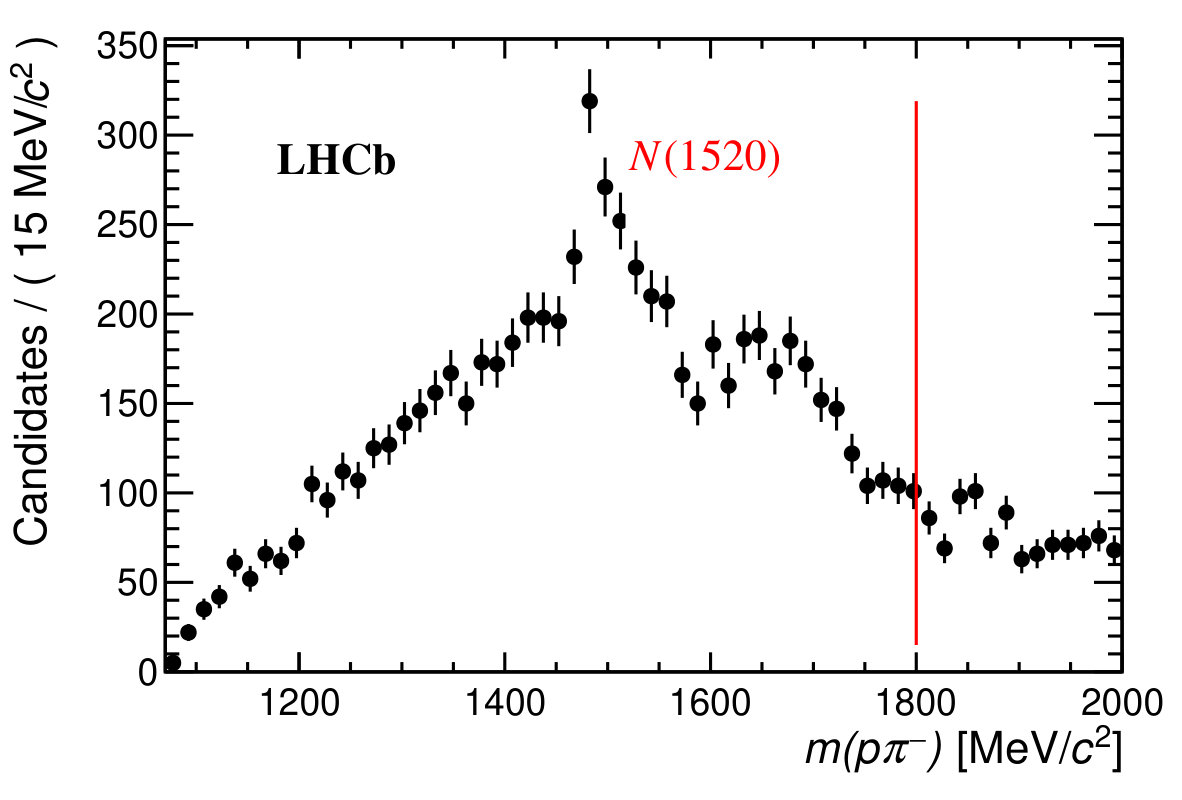 Figure 1
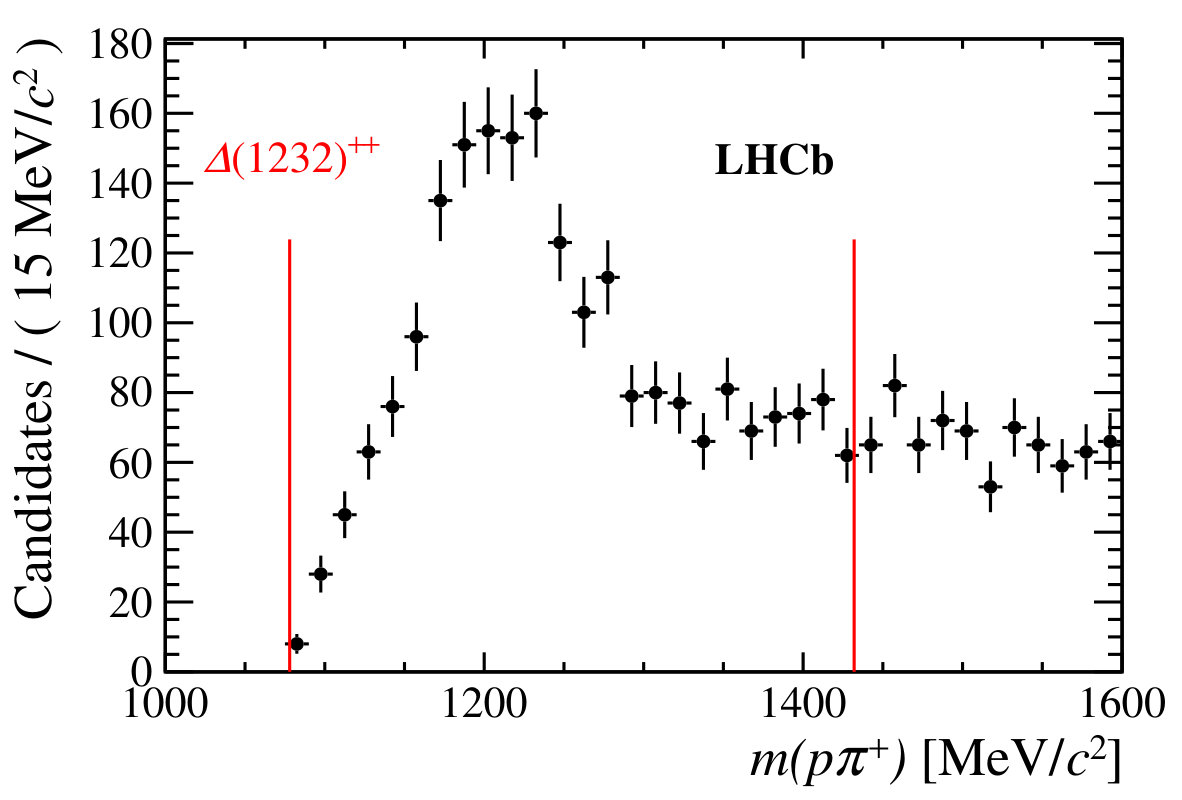 Figure 1
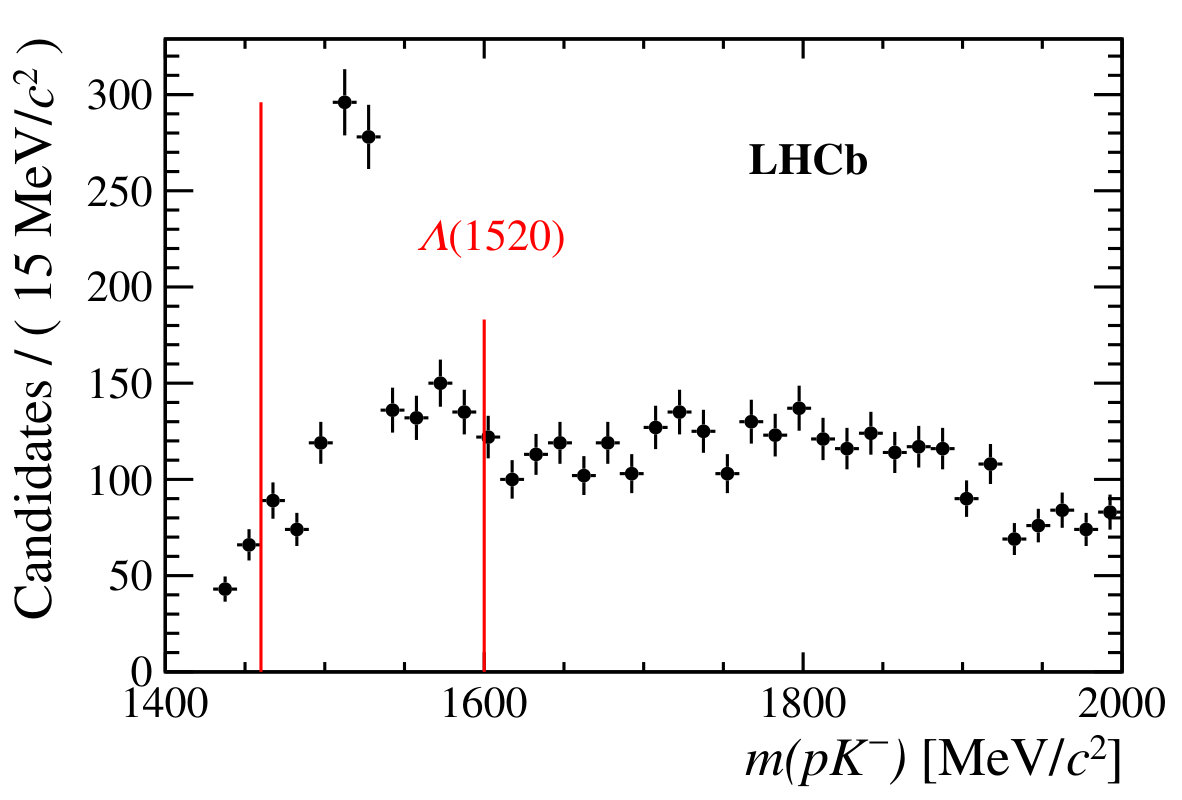 Figure 1
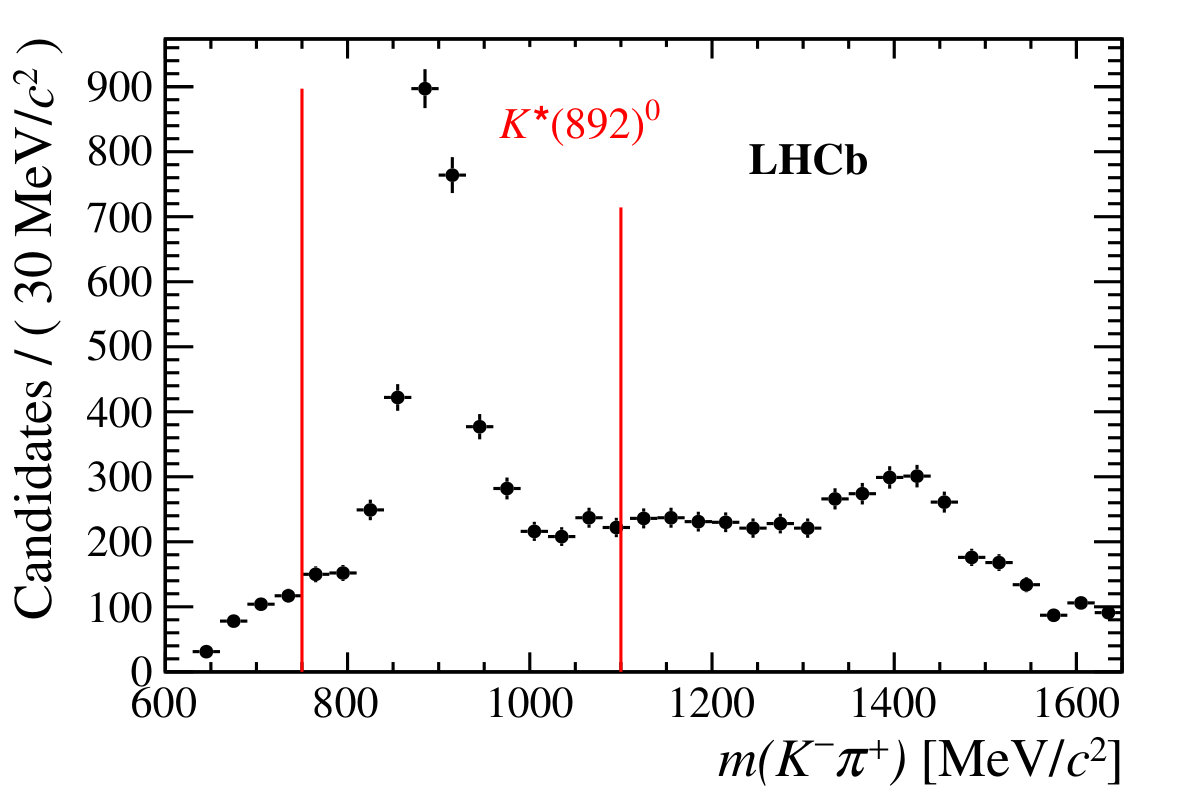 Figure 1
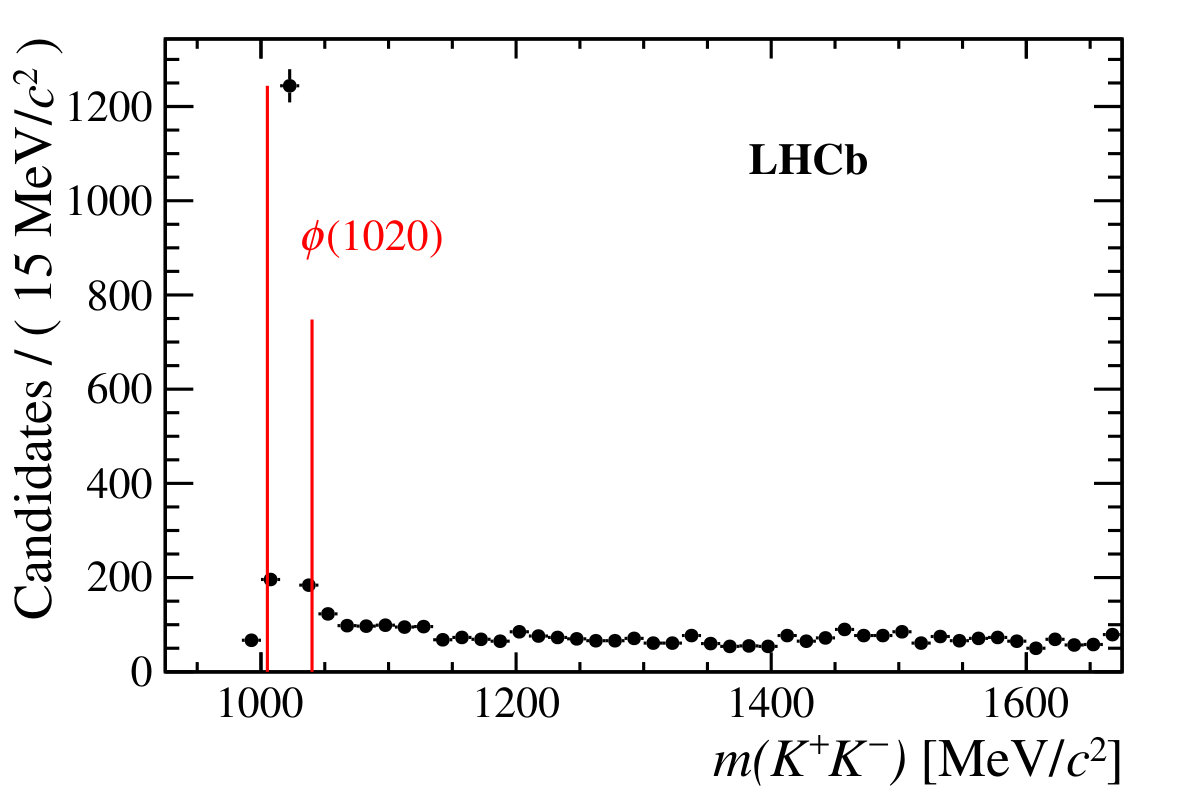 Figure 1
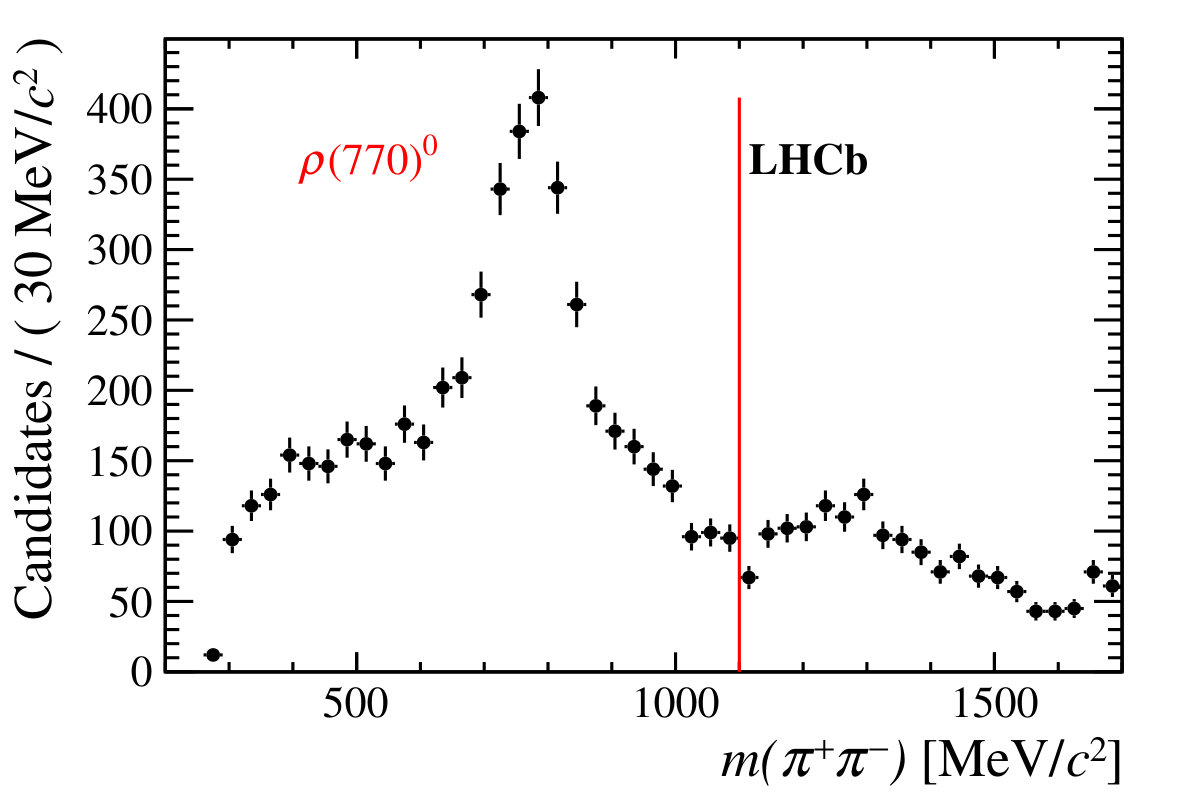 Figure 1
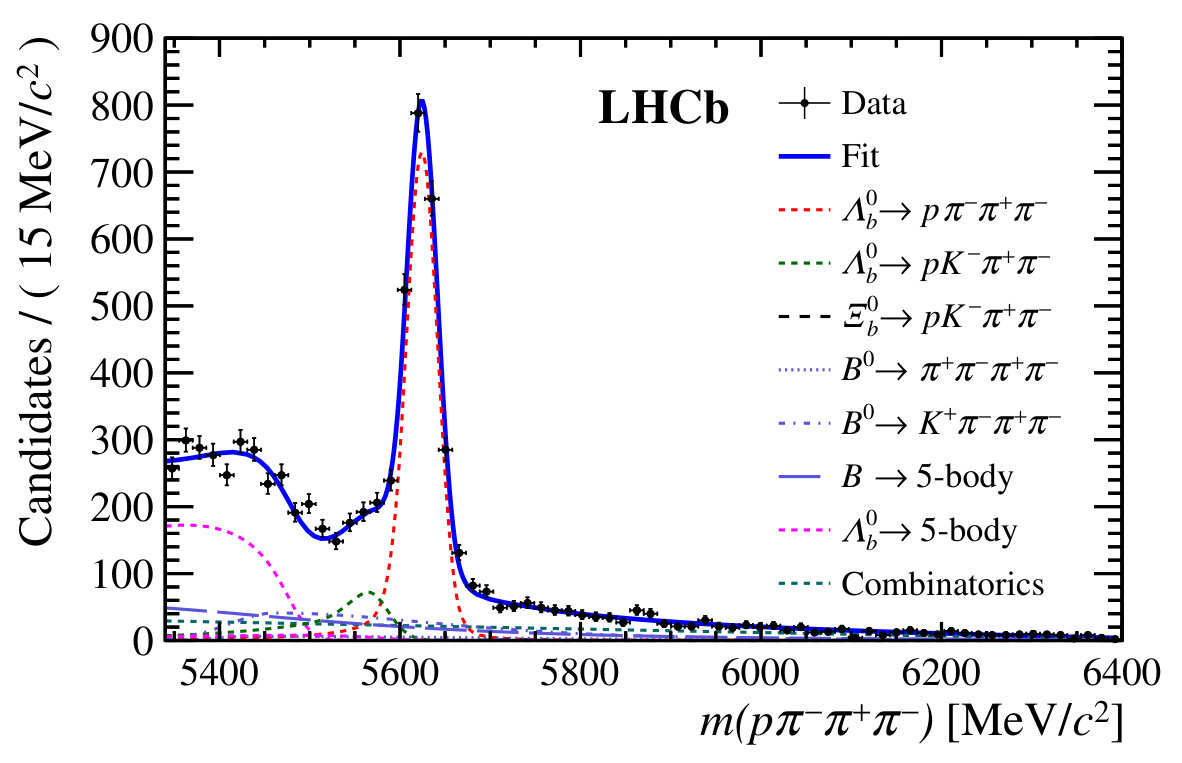 Figure 2
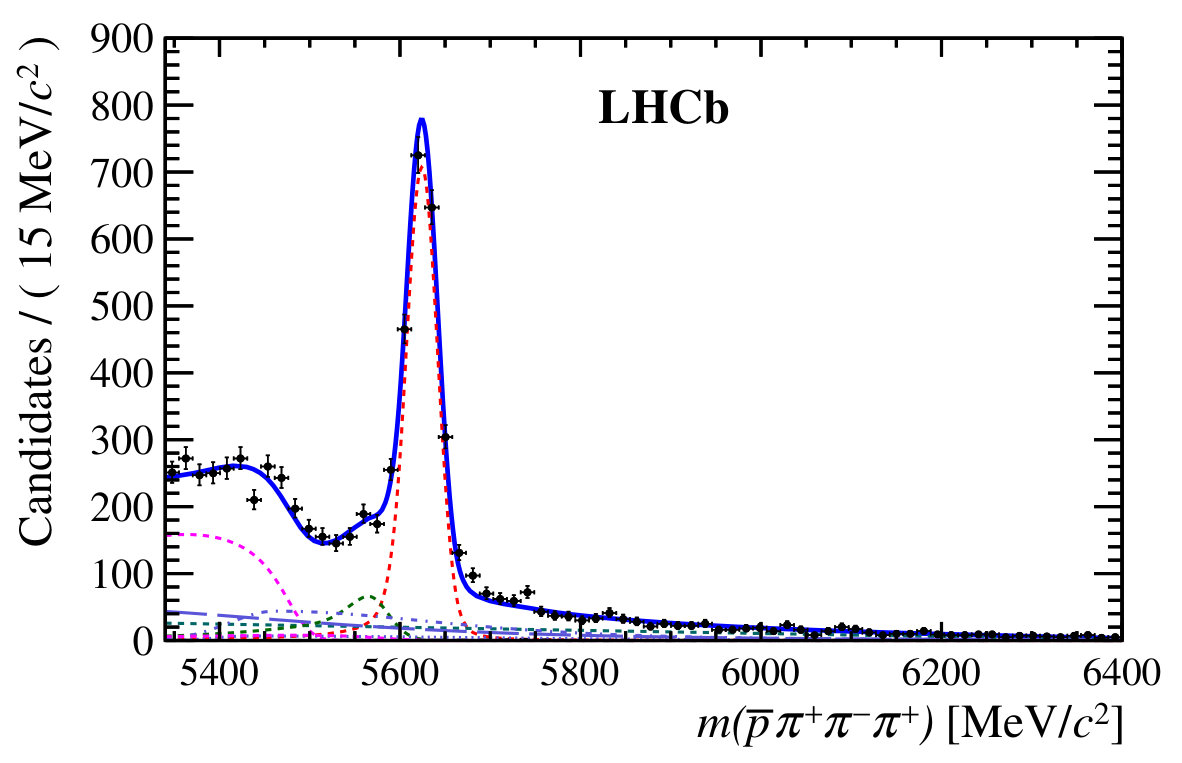 Figure 2
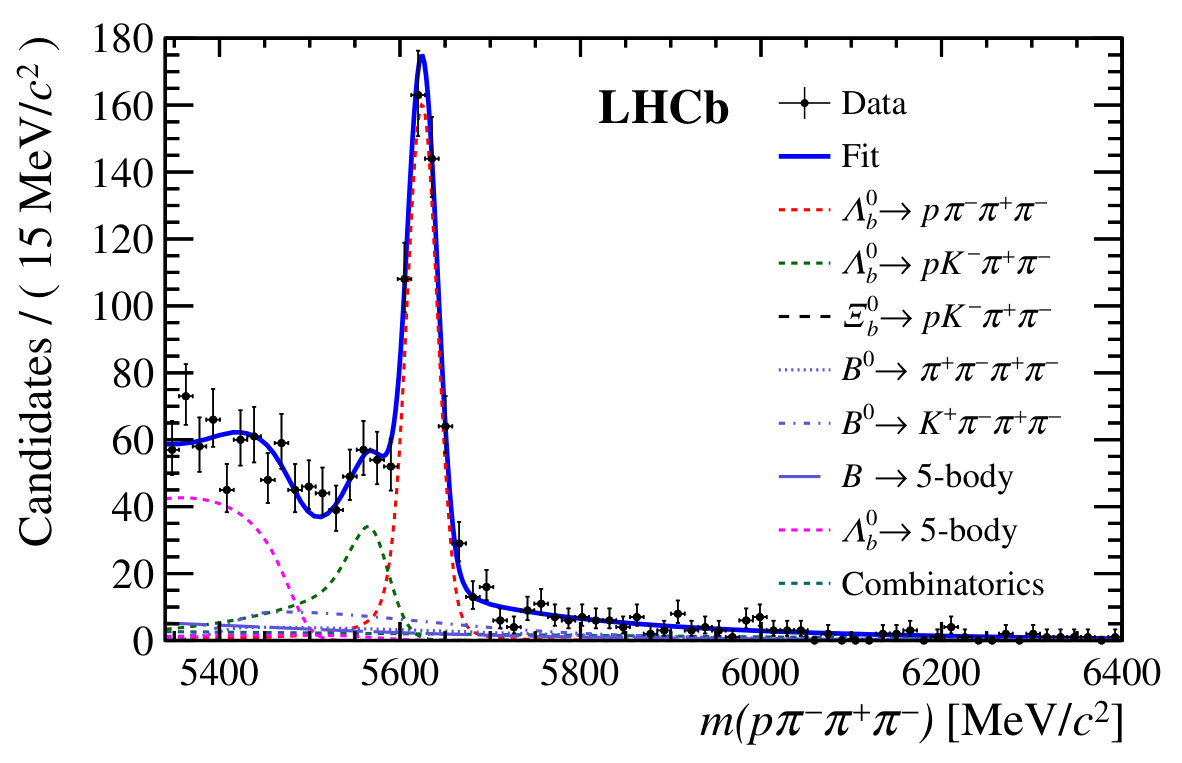 Figure 2
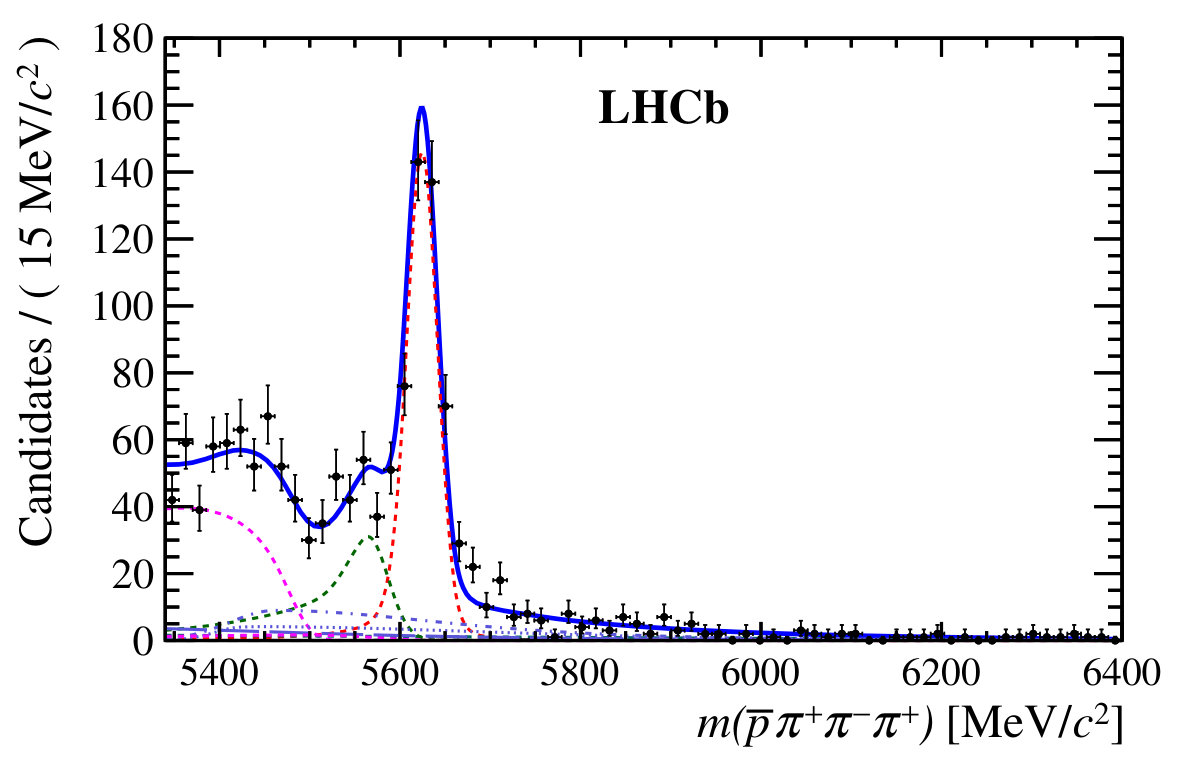 Figure 2
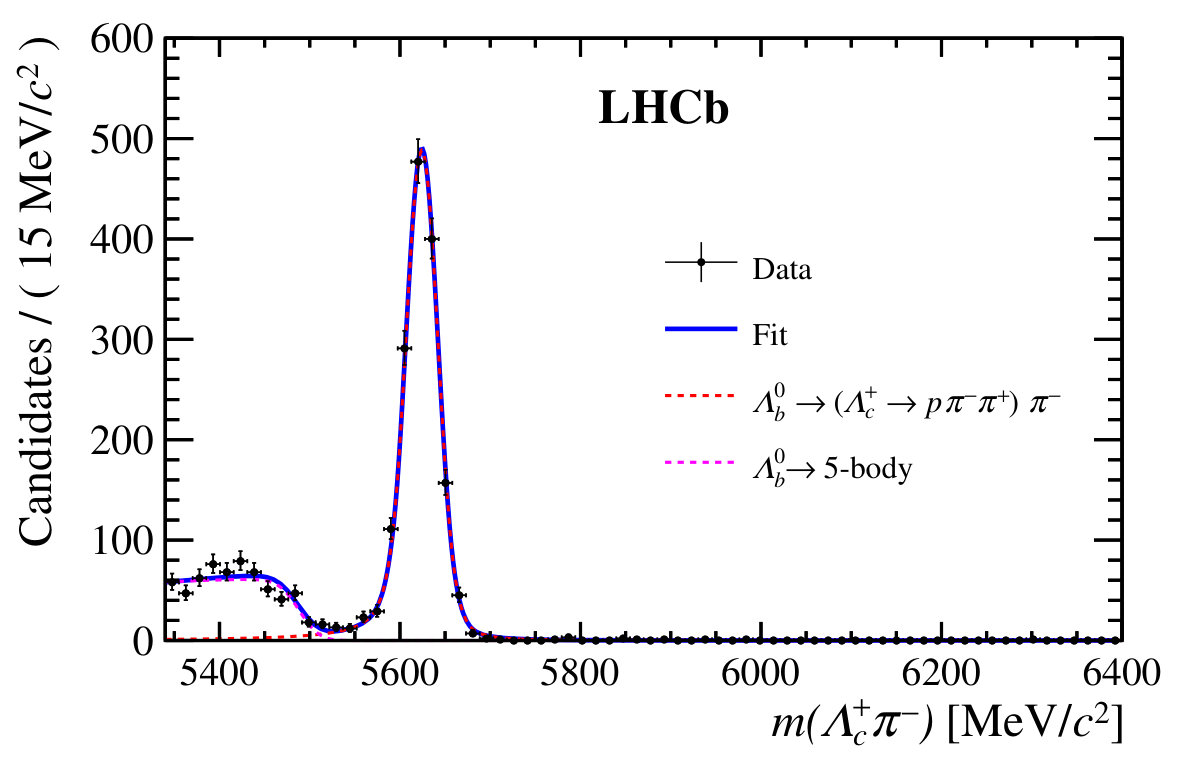 Figure 2
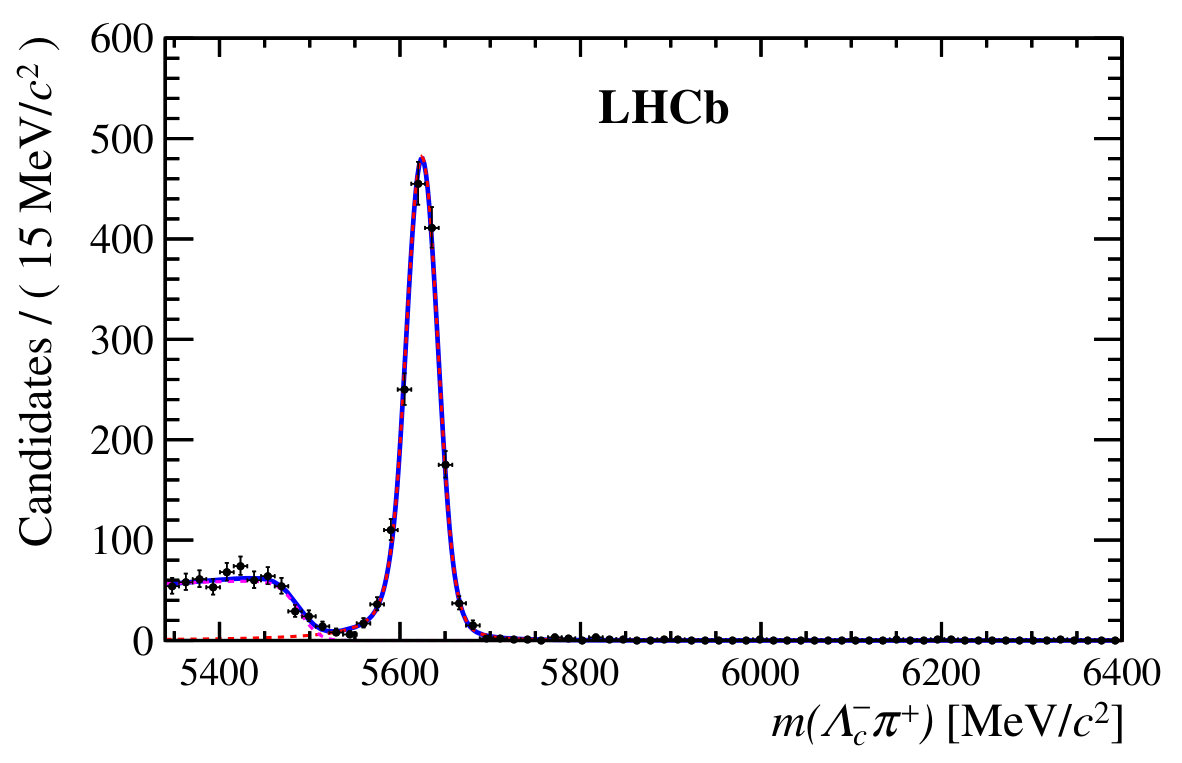 Figure 2
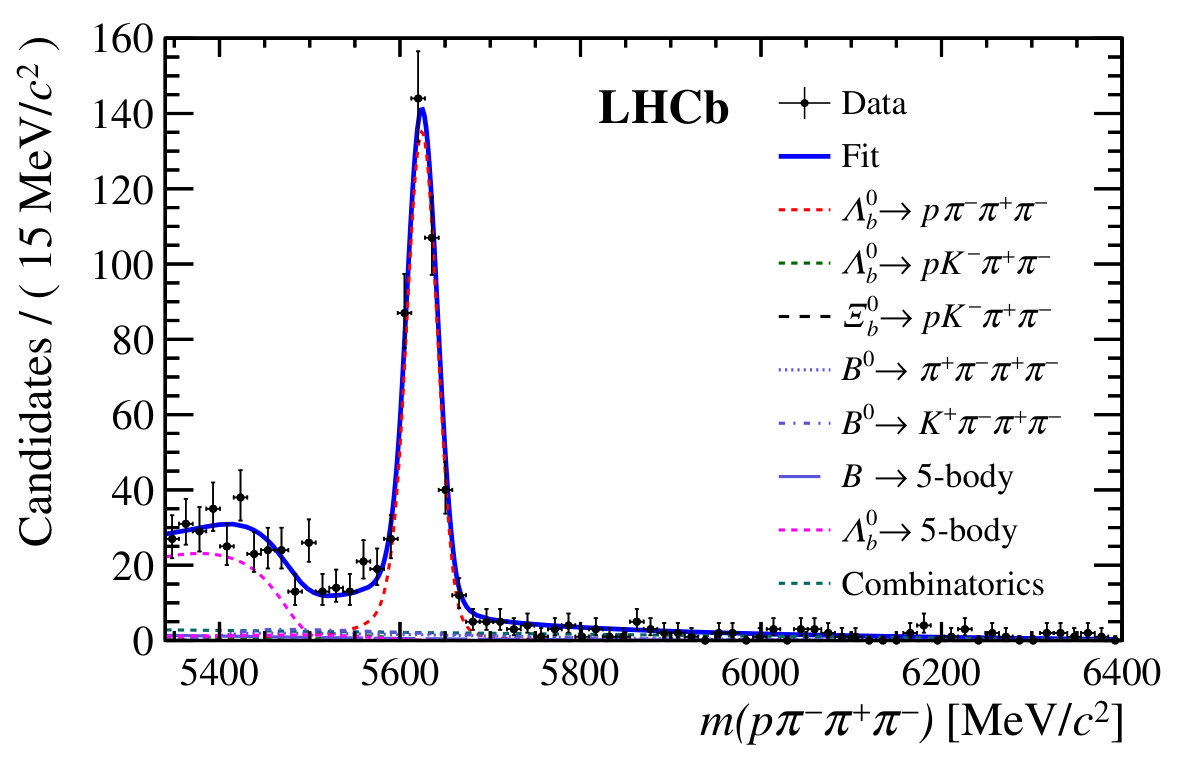 Figure 3
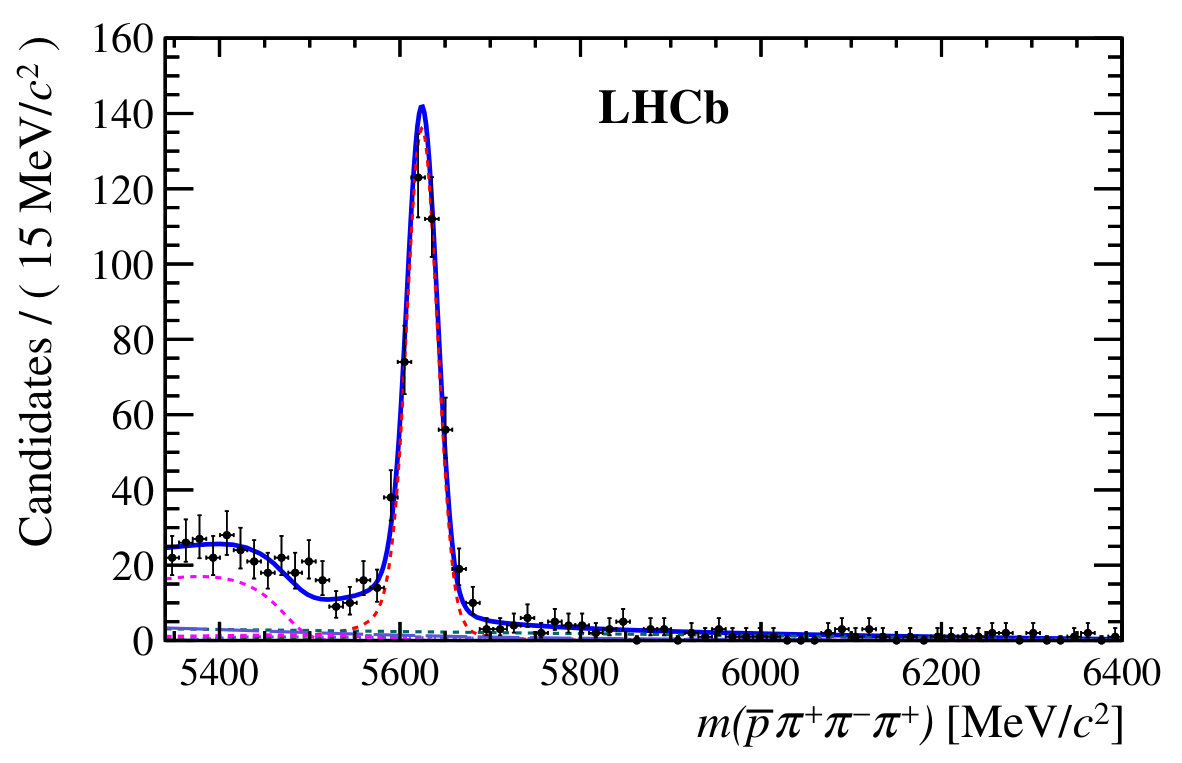 Figure 3
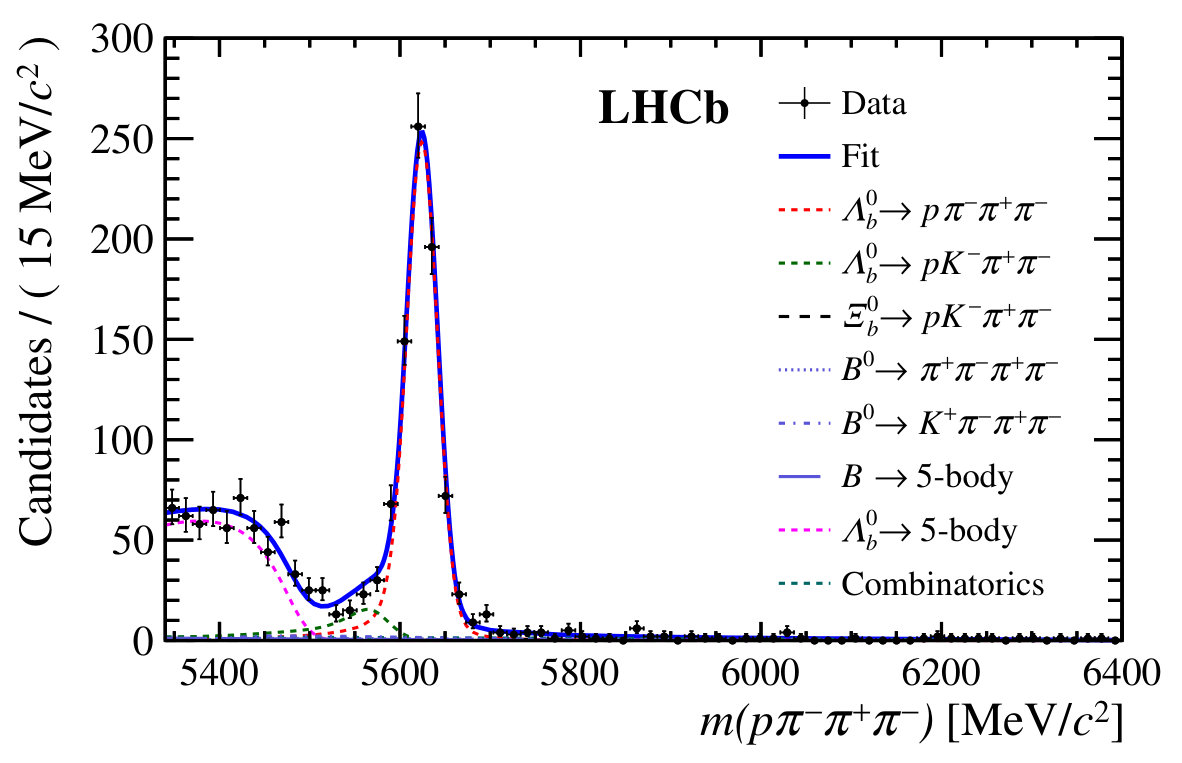 Figure 3
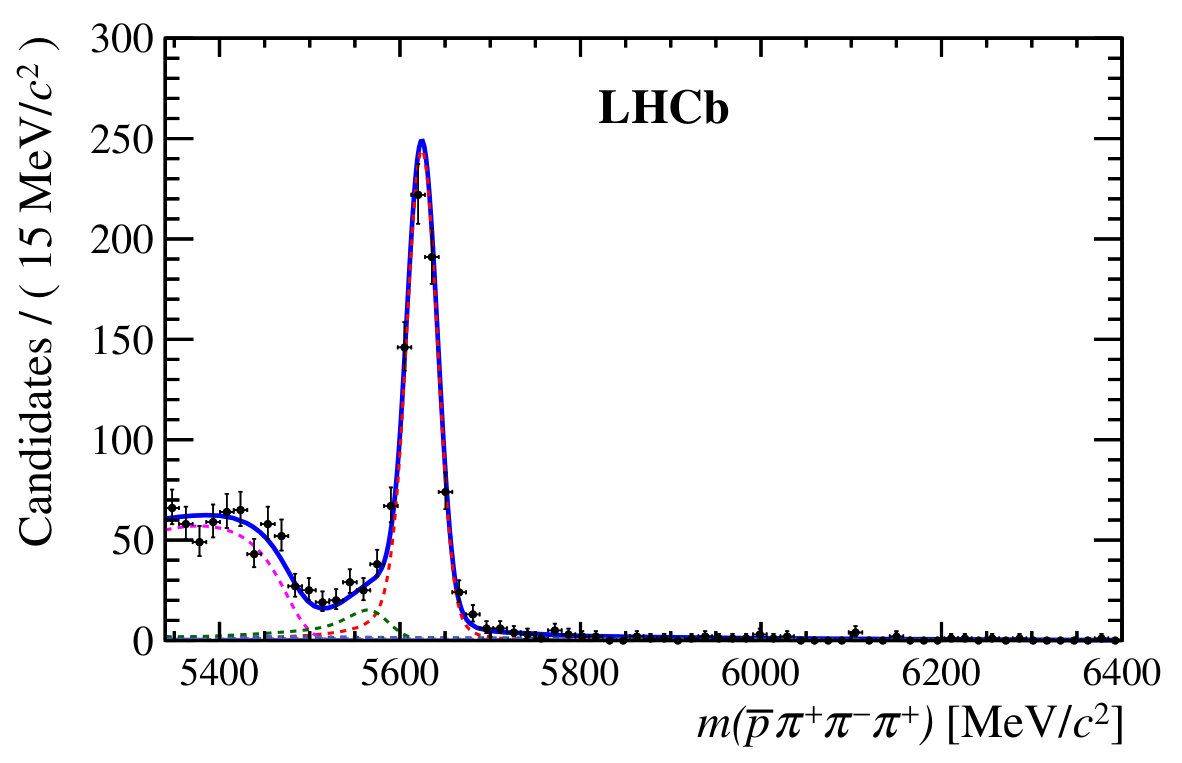 Figure 3
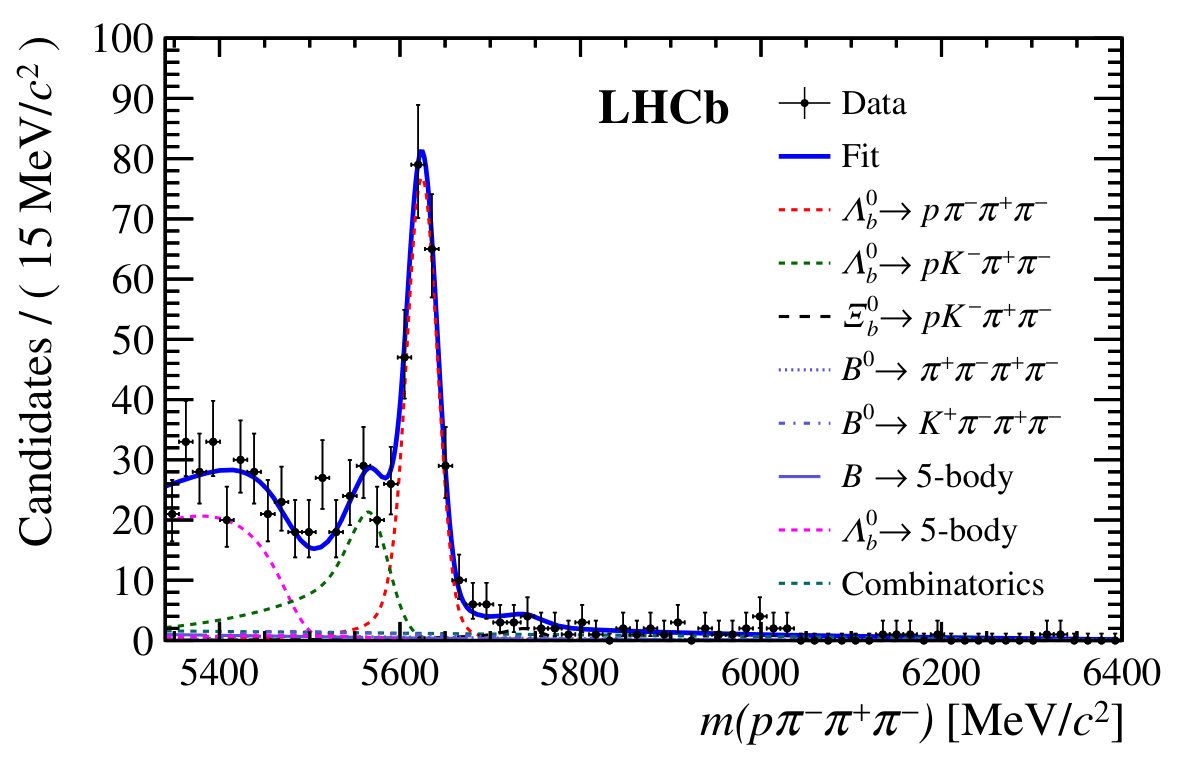 Figure 3
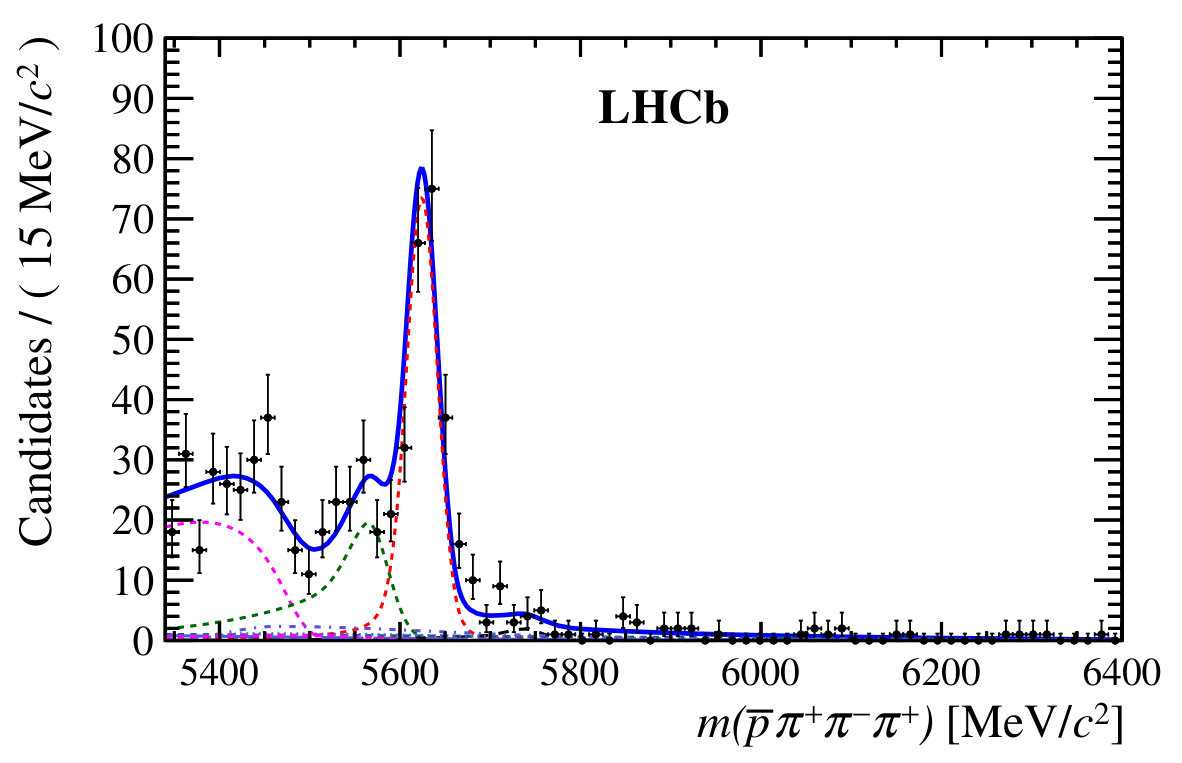 Figure 3
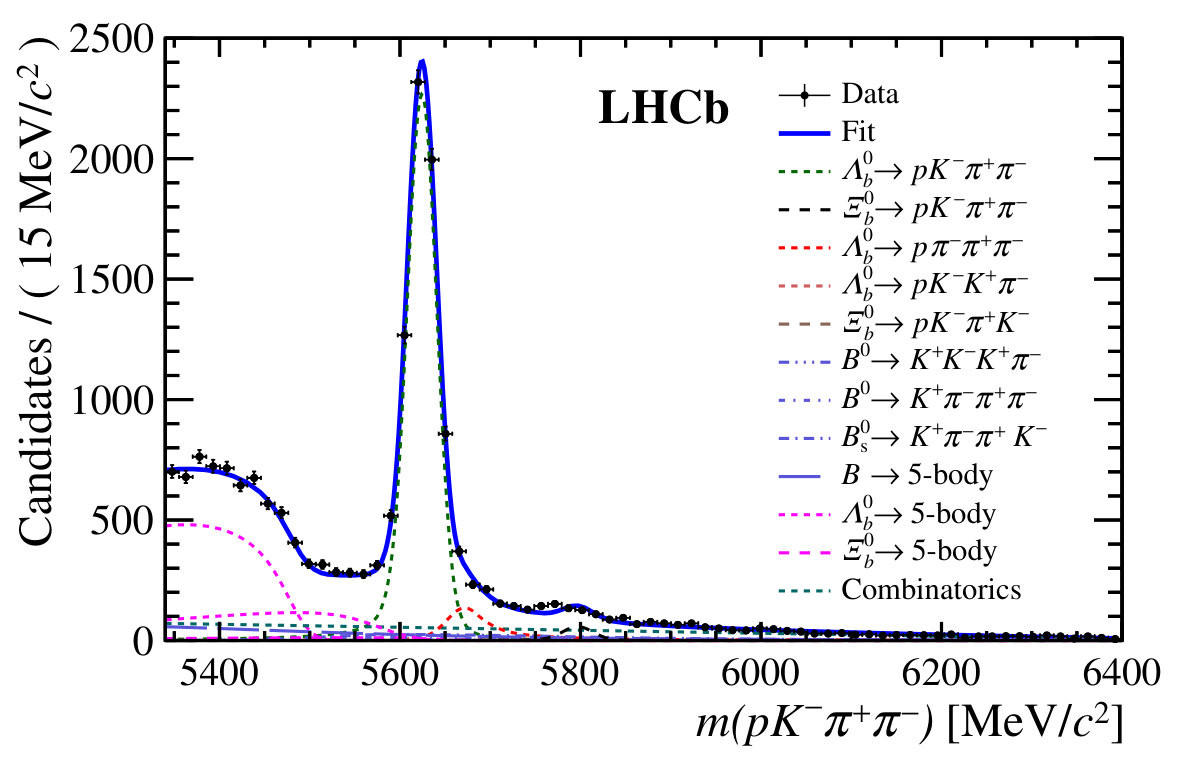 Figure 4
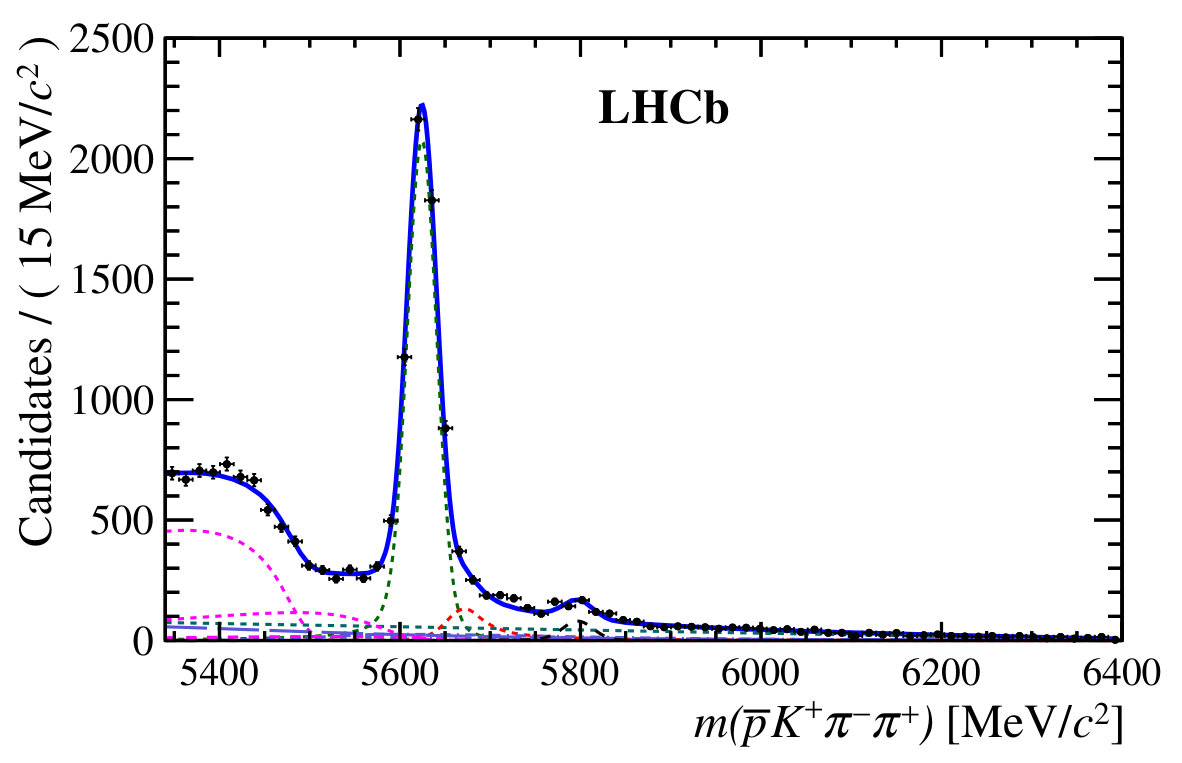 Figure 4
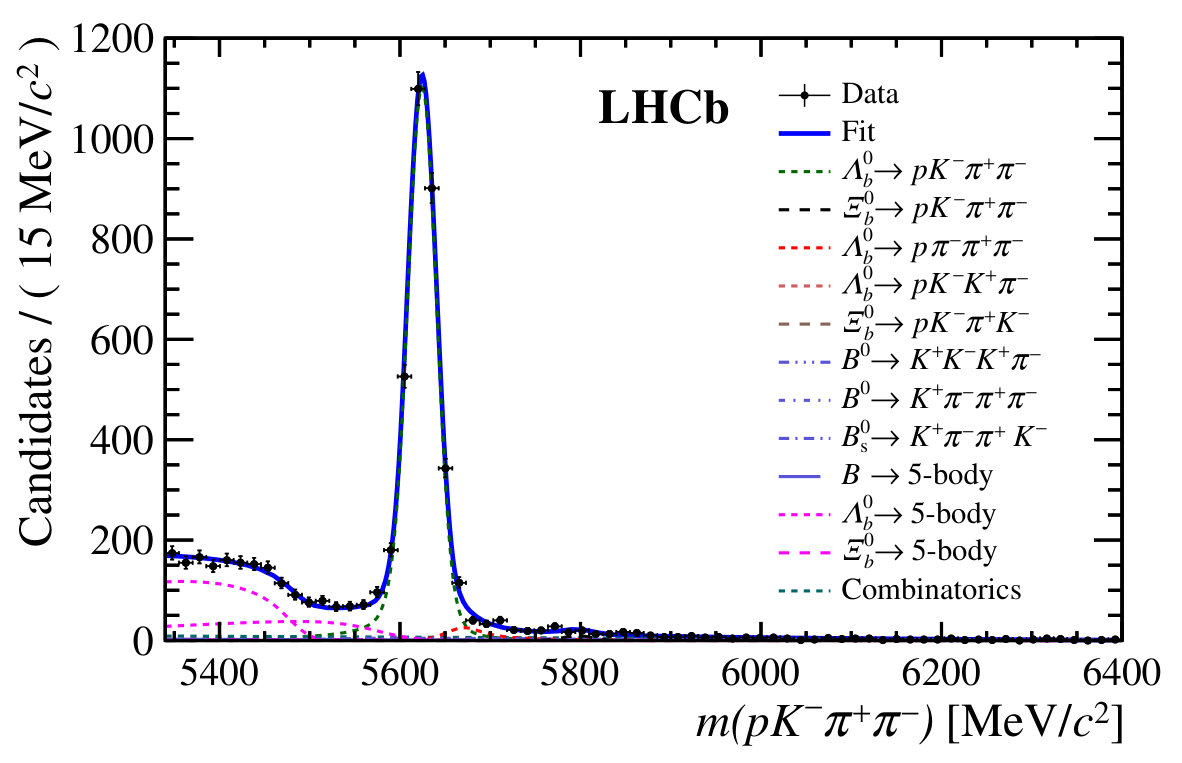 Figure 4
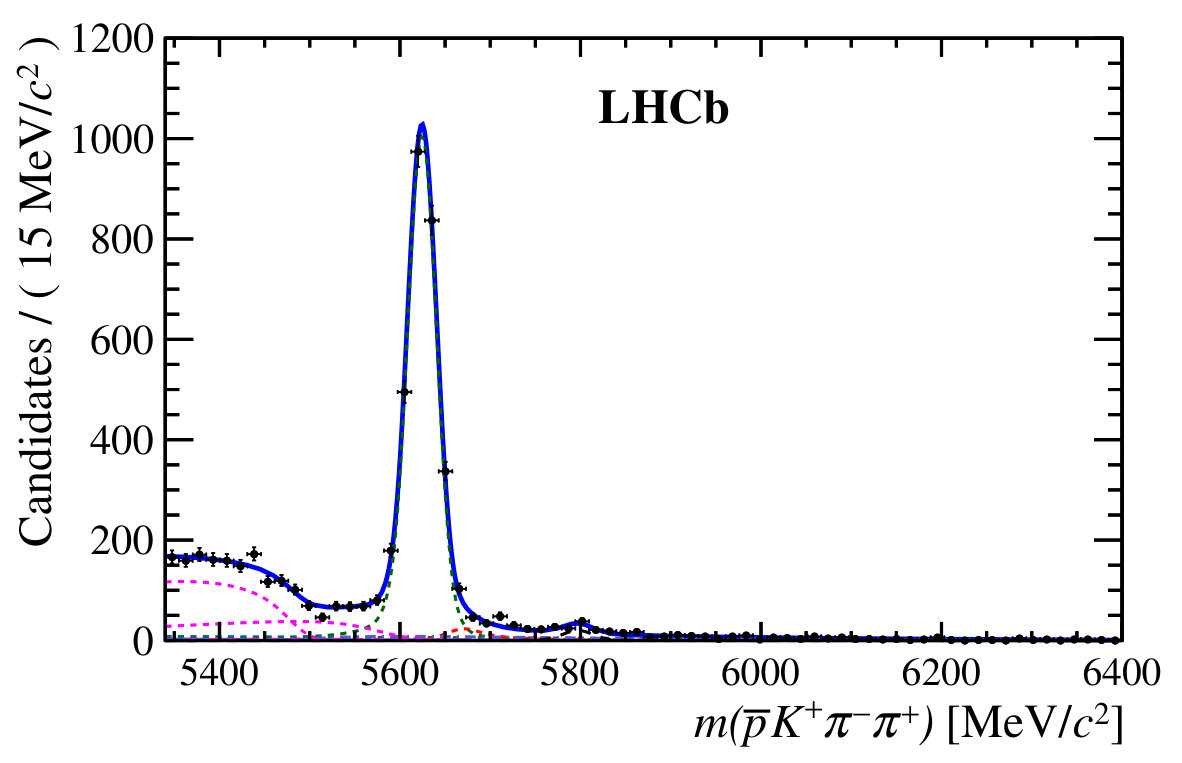 Figure 4
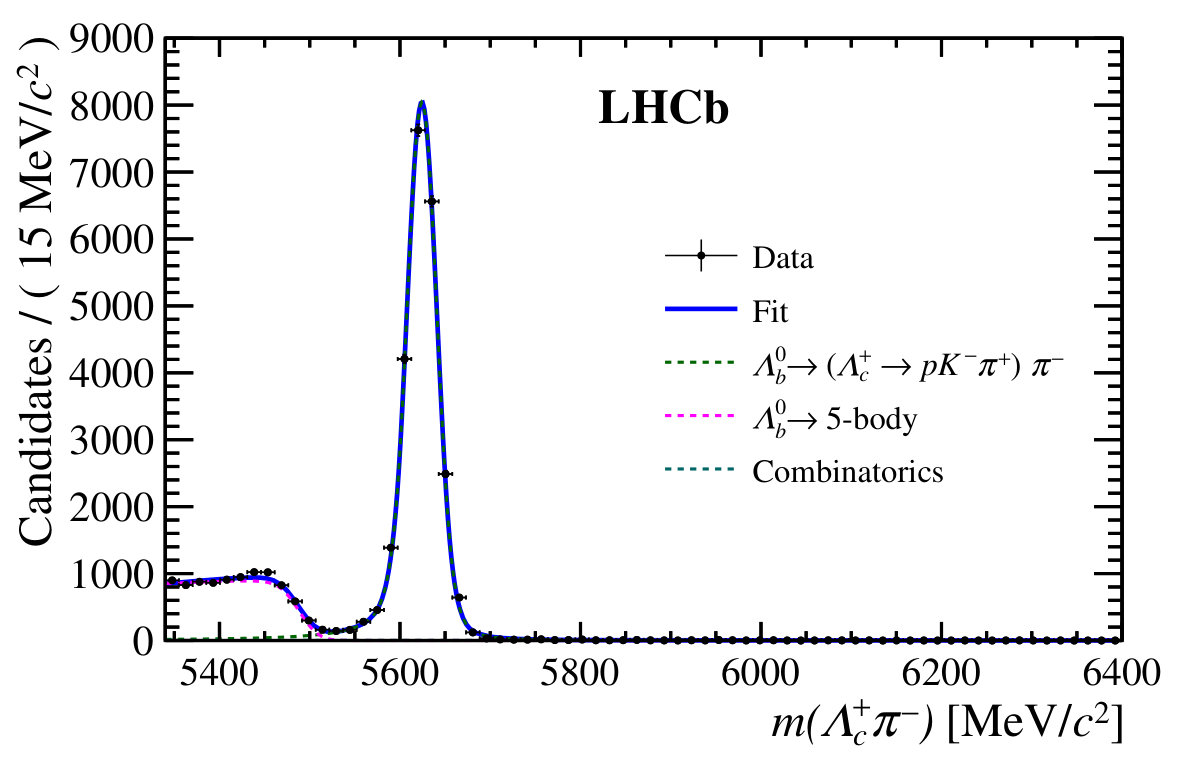 Figure 4
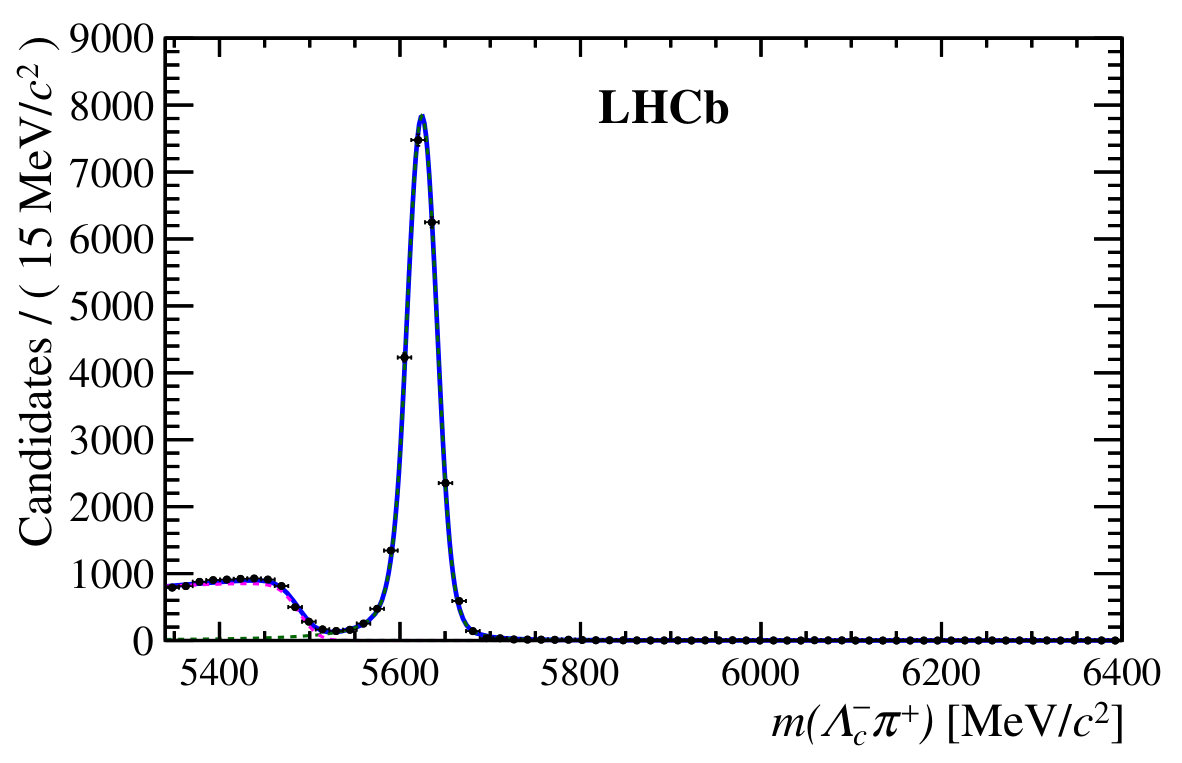 Figure 4
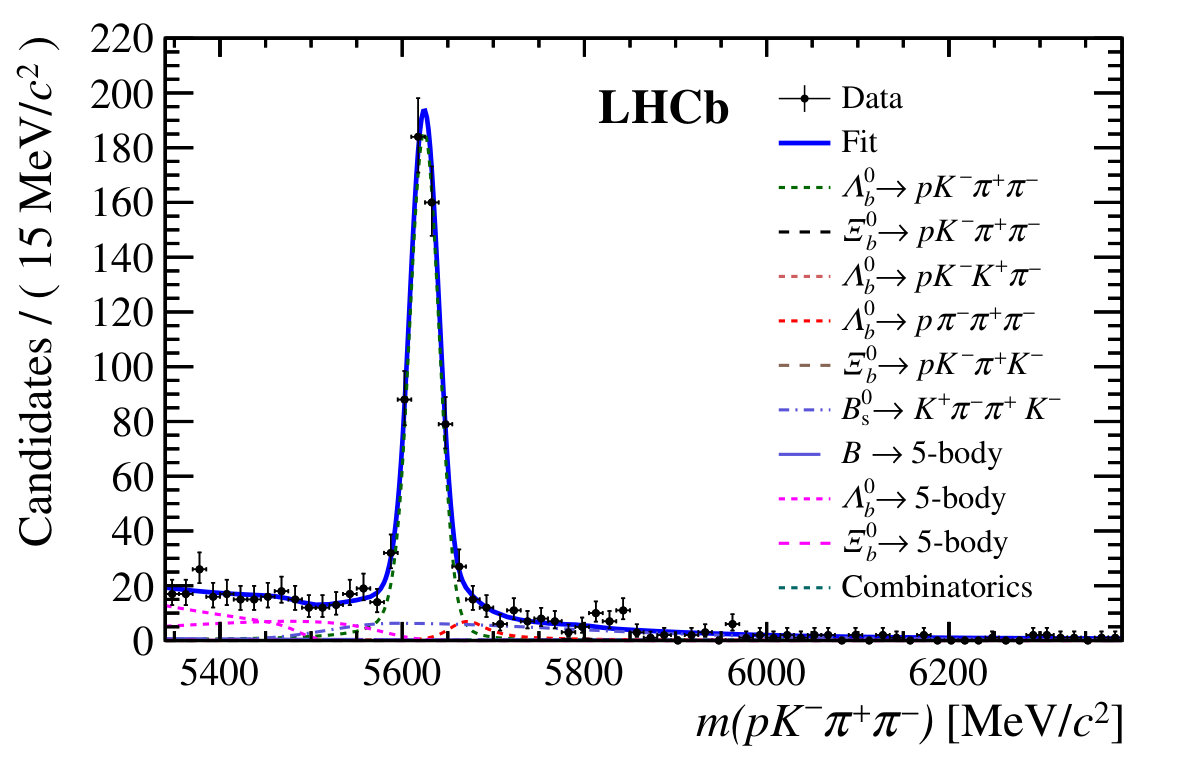 Figure 5
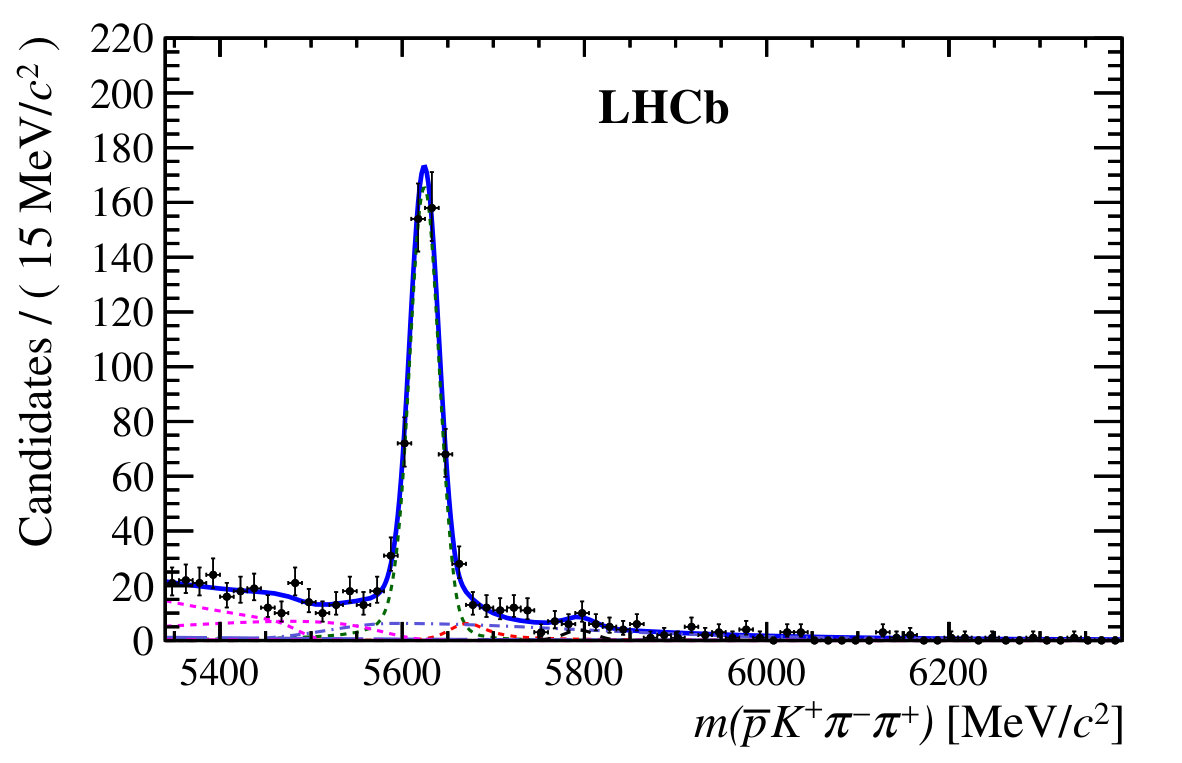 Figure 5
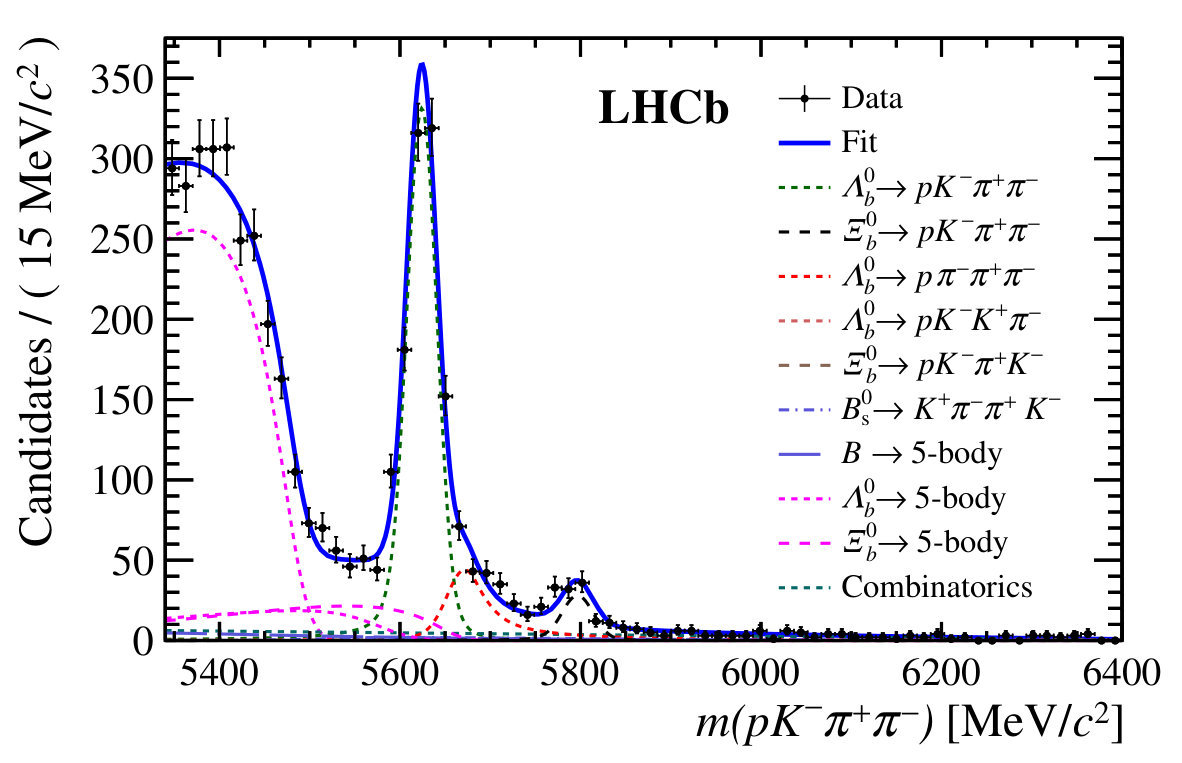 Figure 5
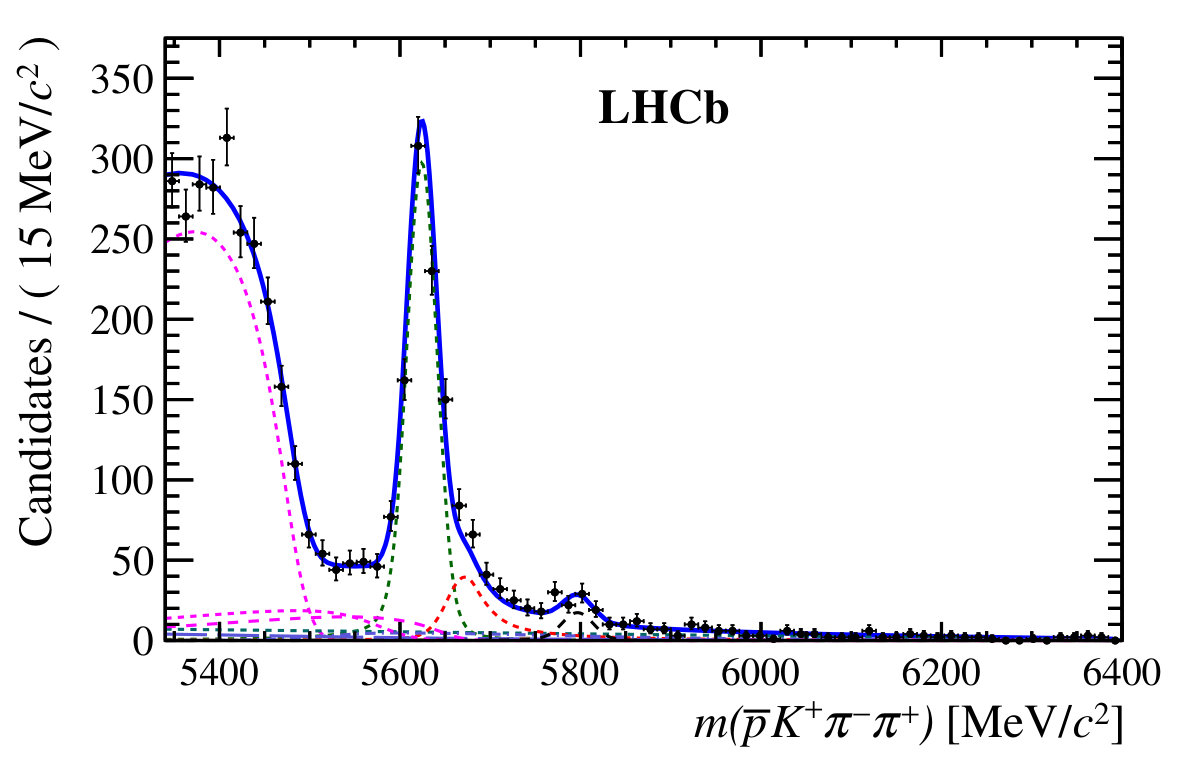 Figure 5
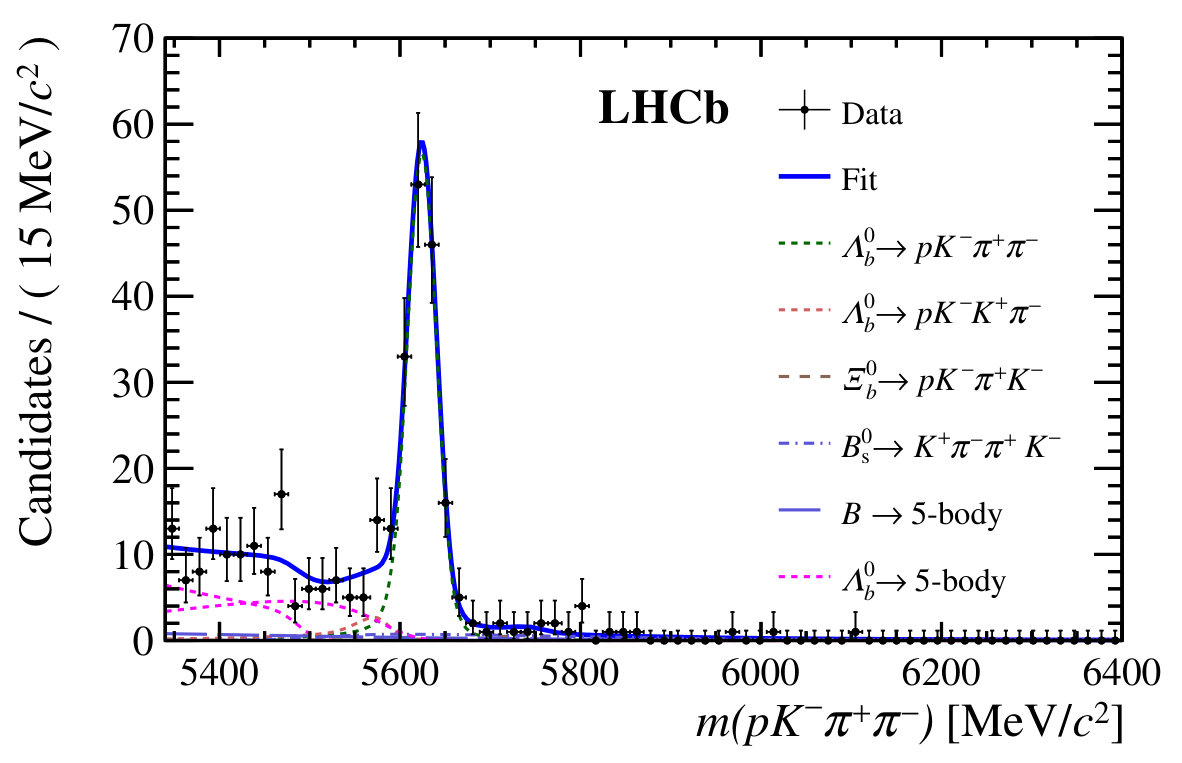 Figure 5
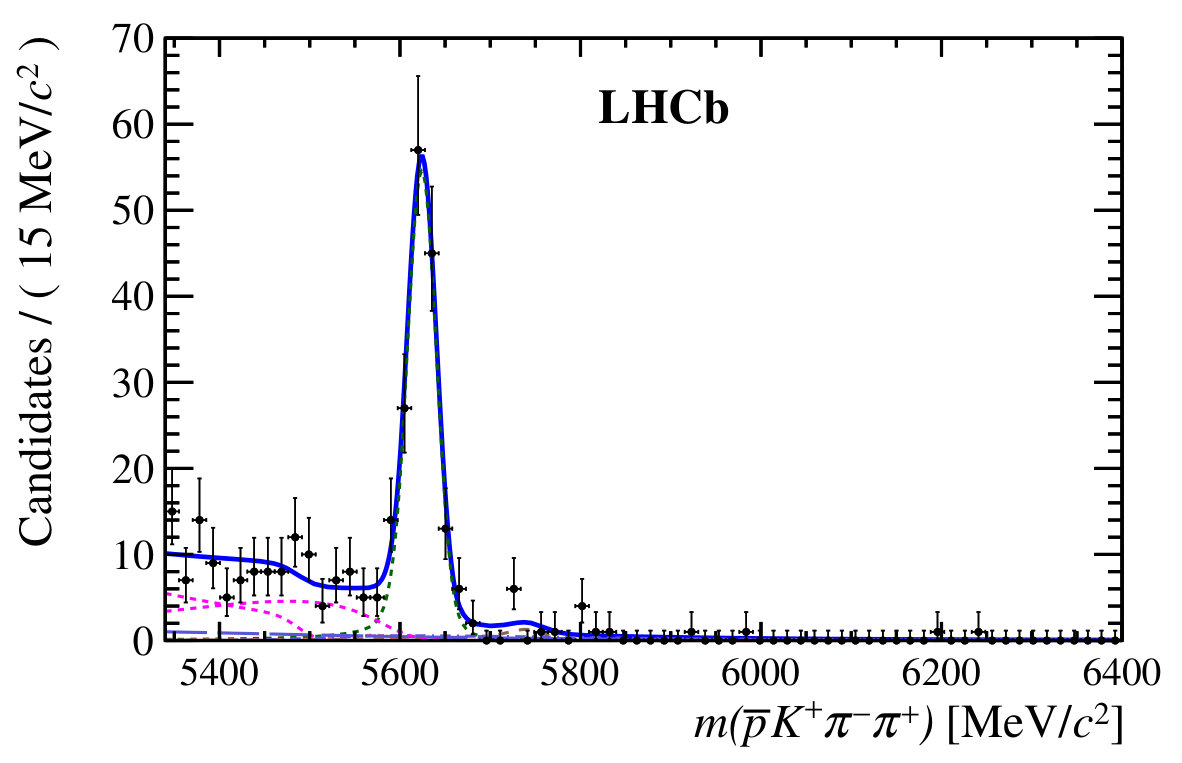 Figure 5
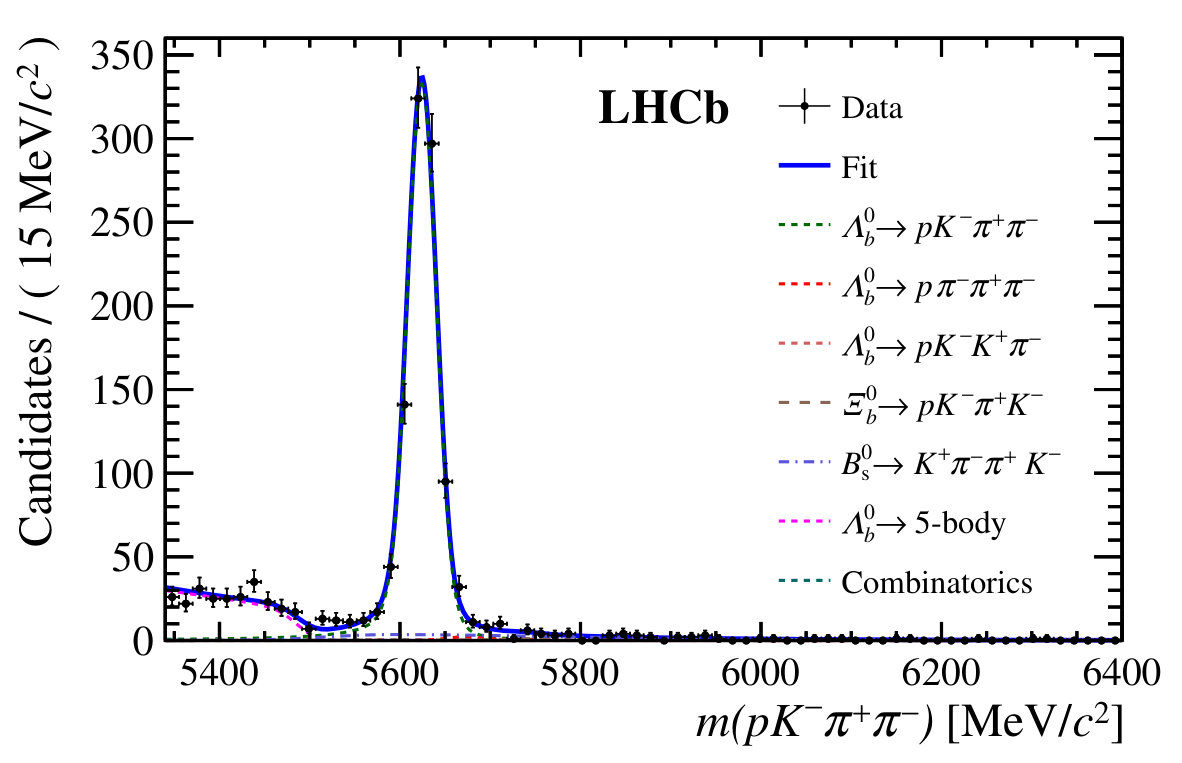 Figure 5
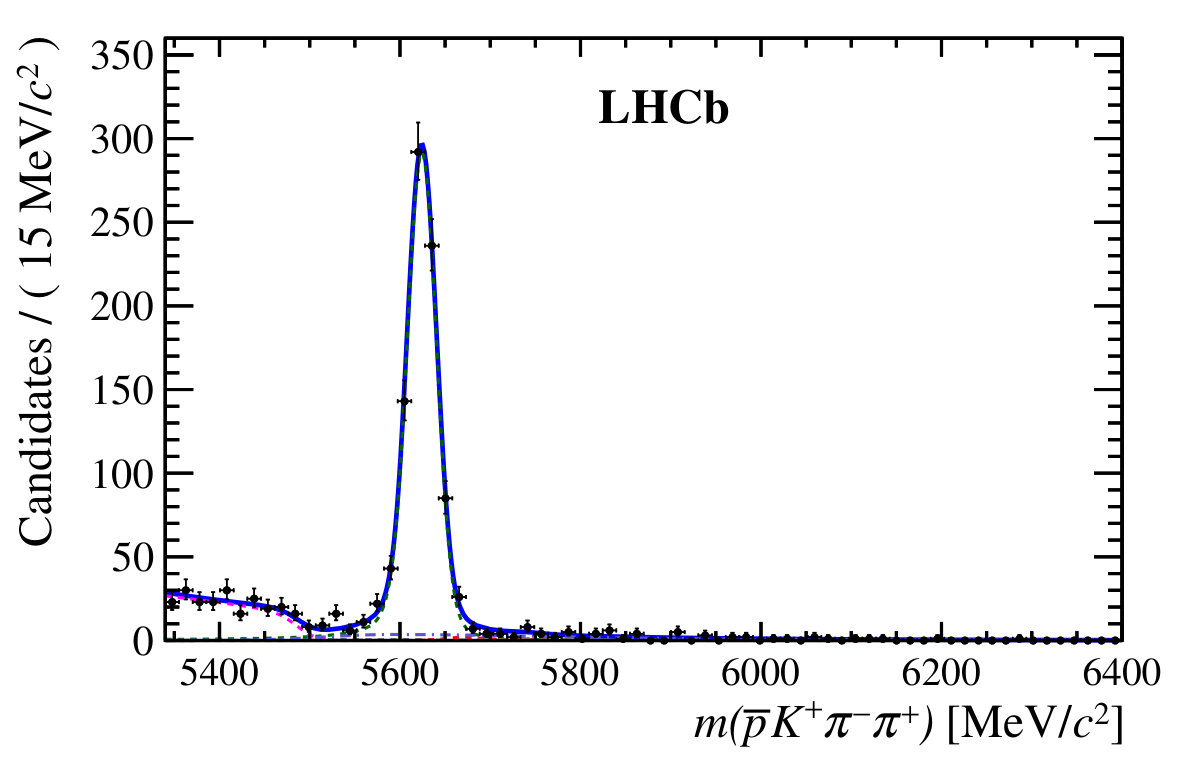 Figure 5
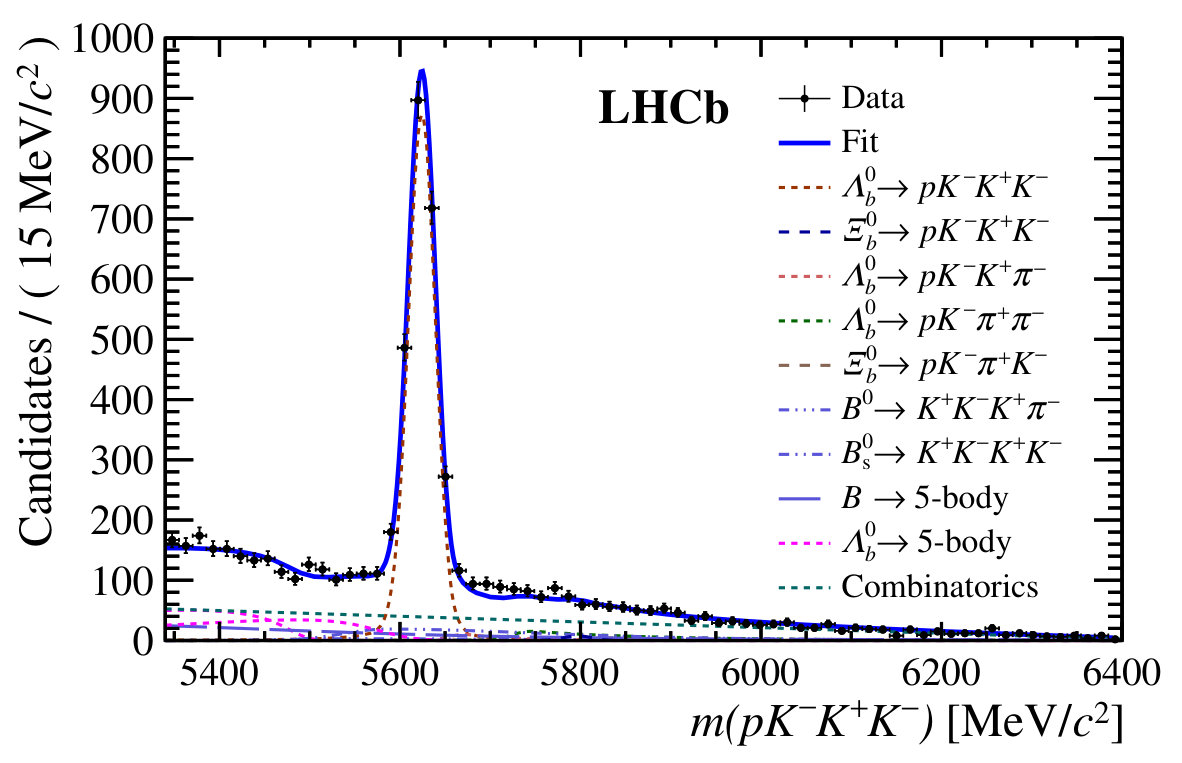 Figure 6
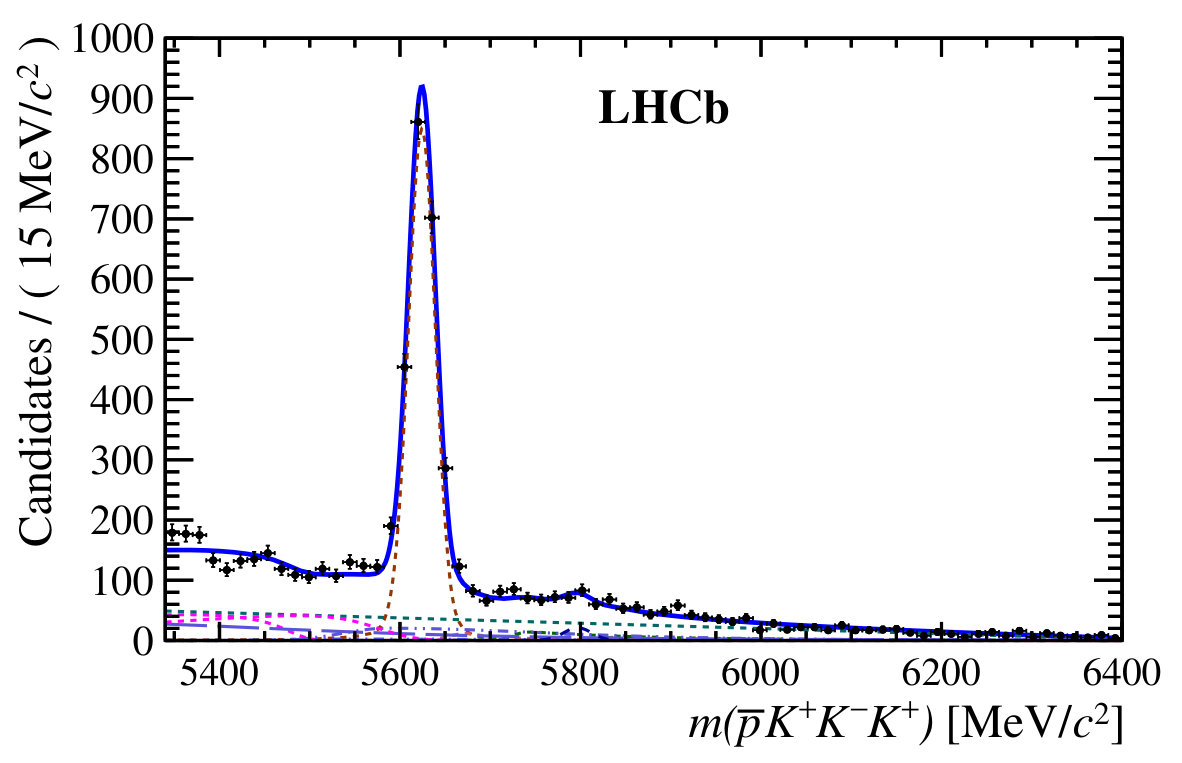 Figure 6
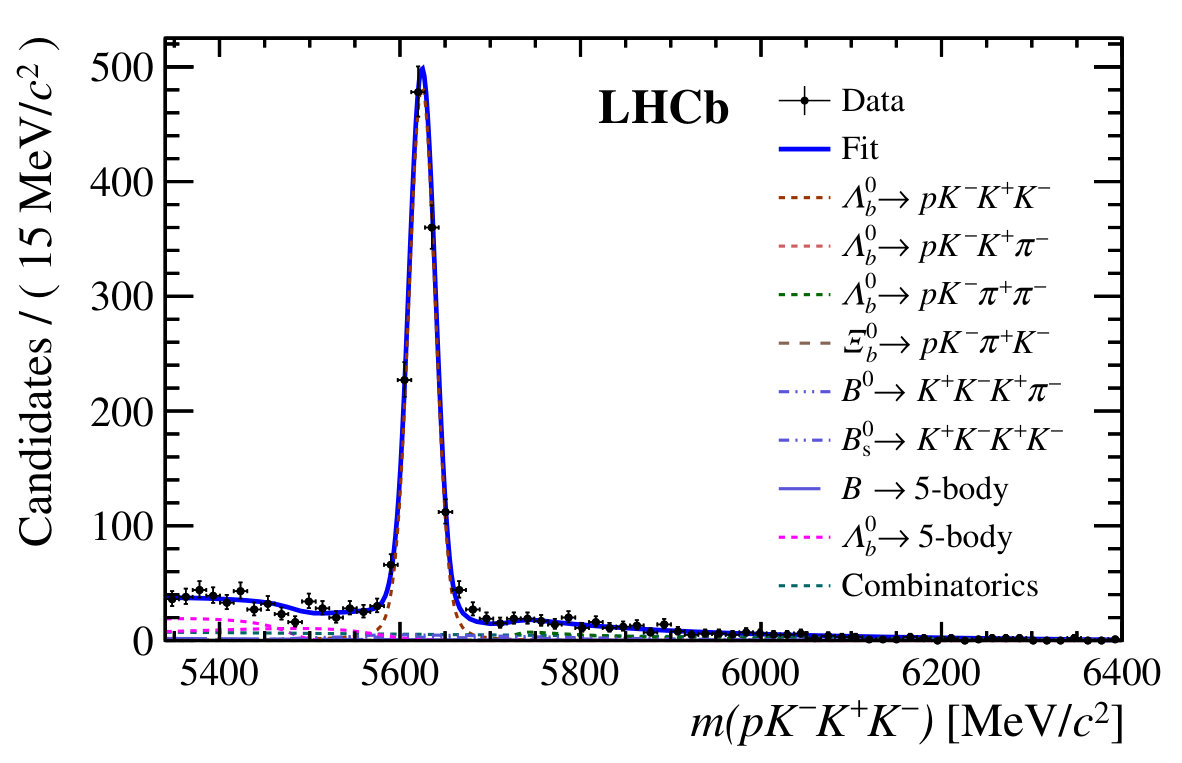 Figure 6
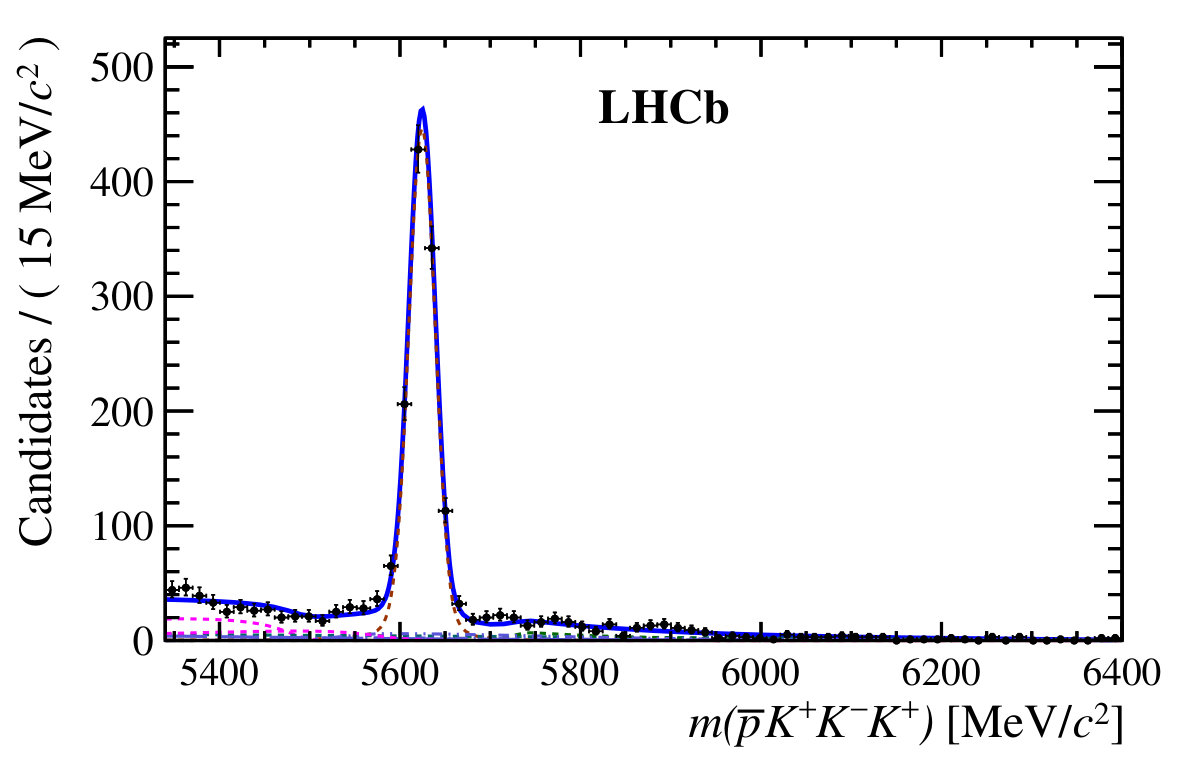 Figure 6
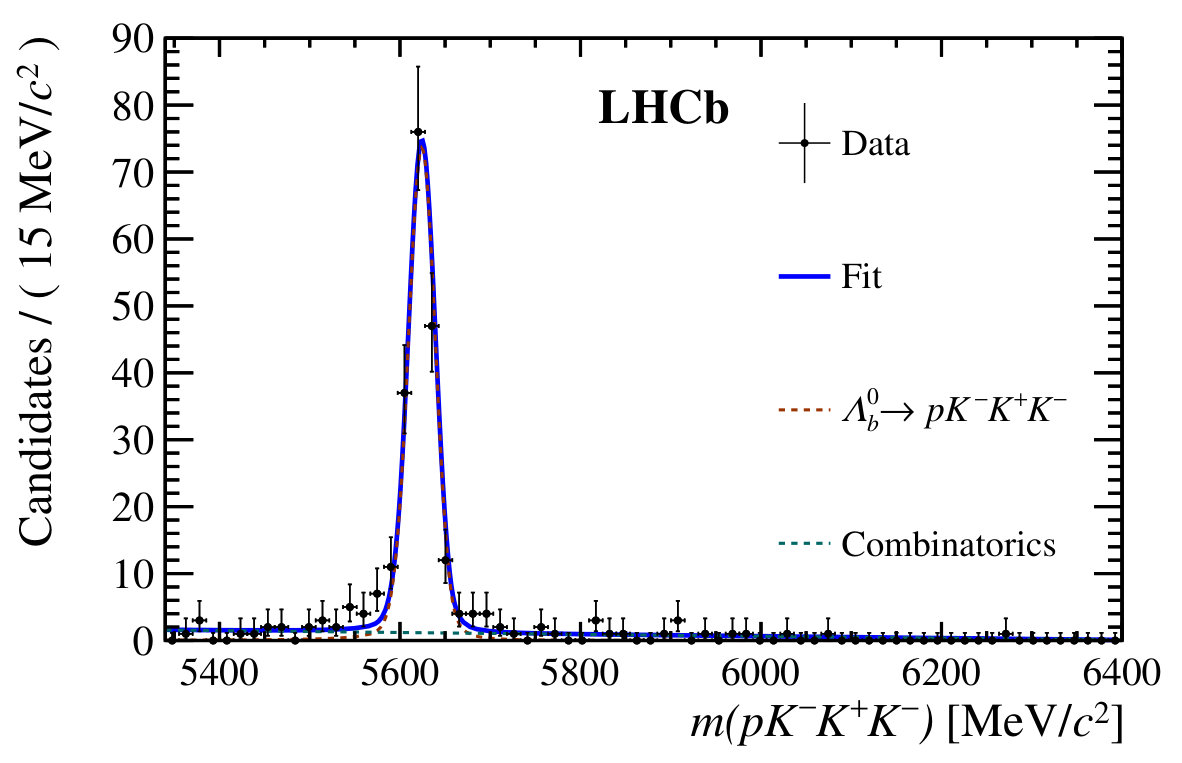 Figure 6
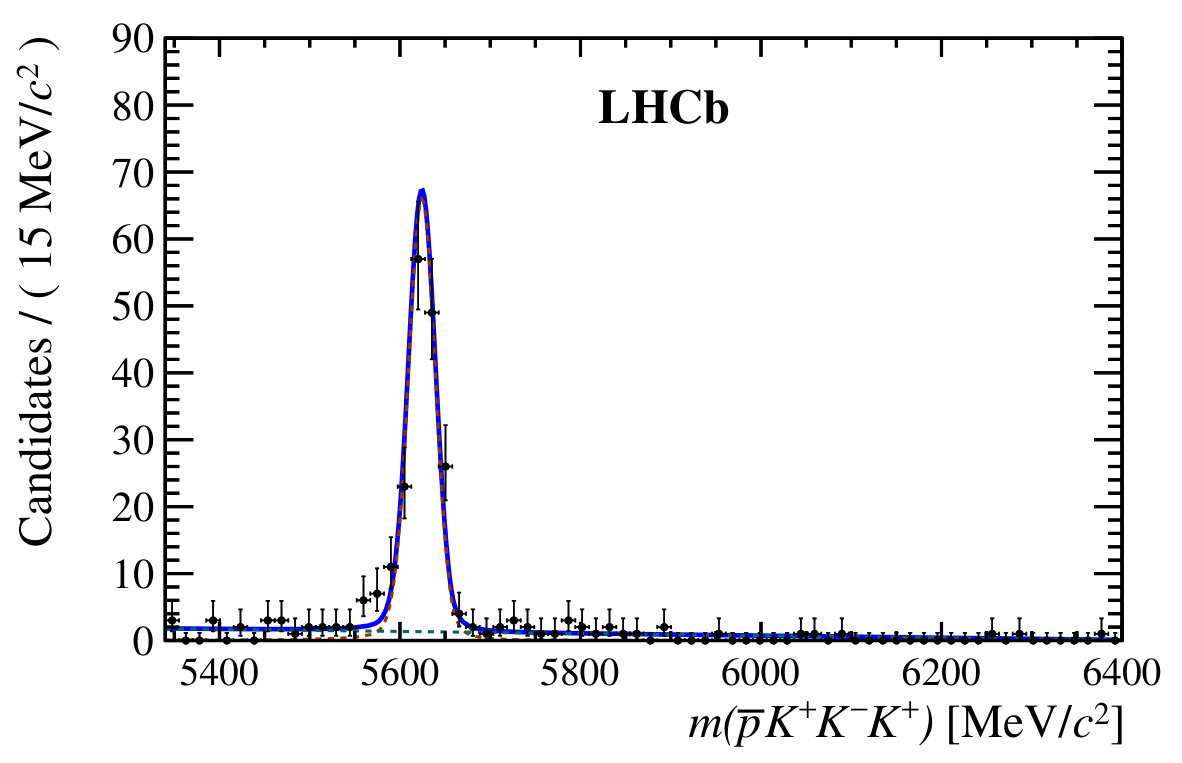 Figure 6
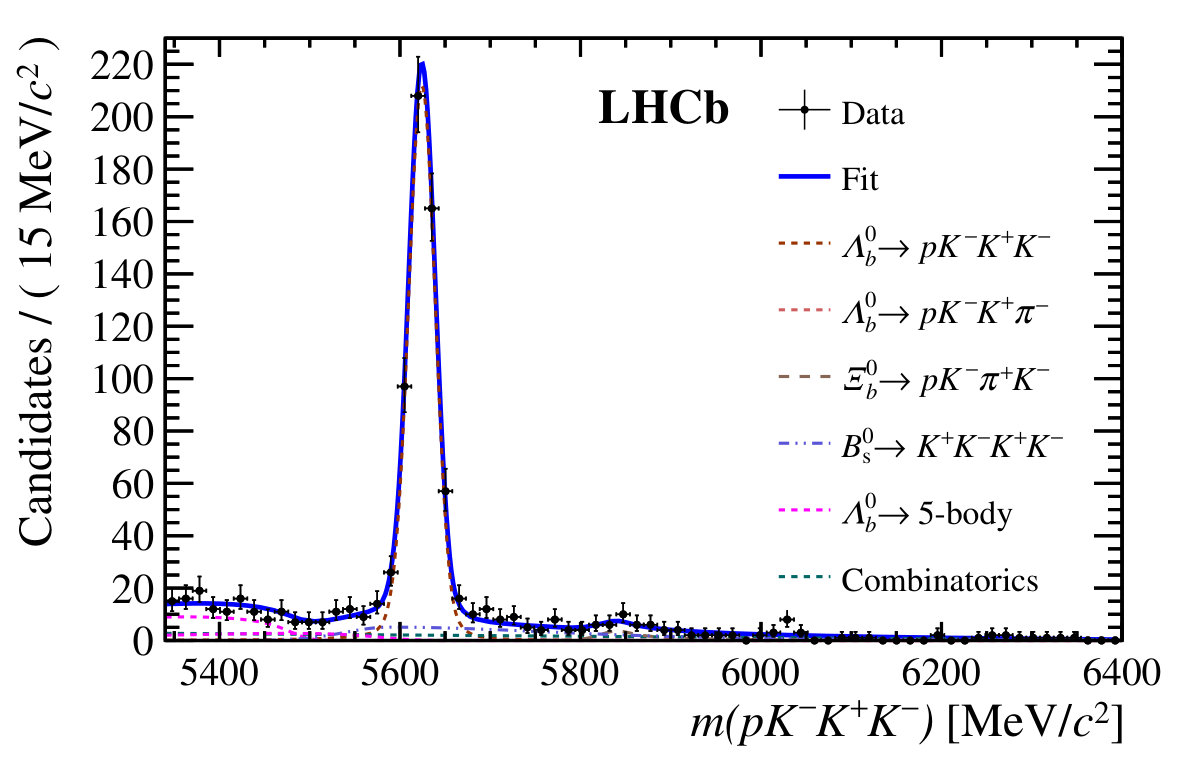 Figure 6
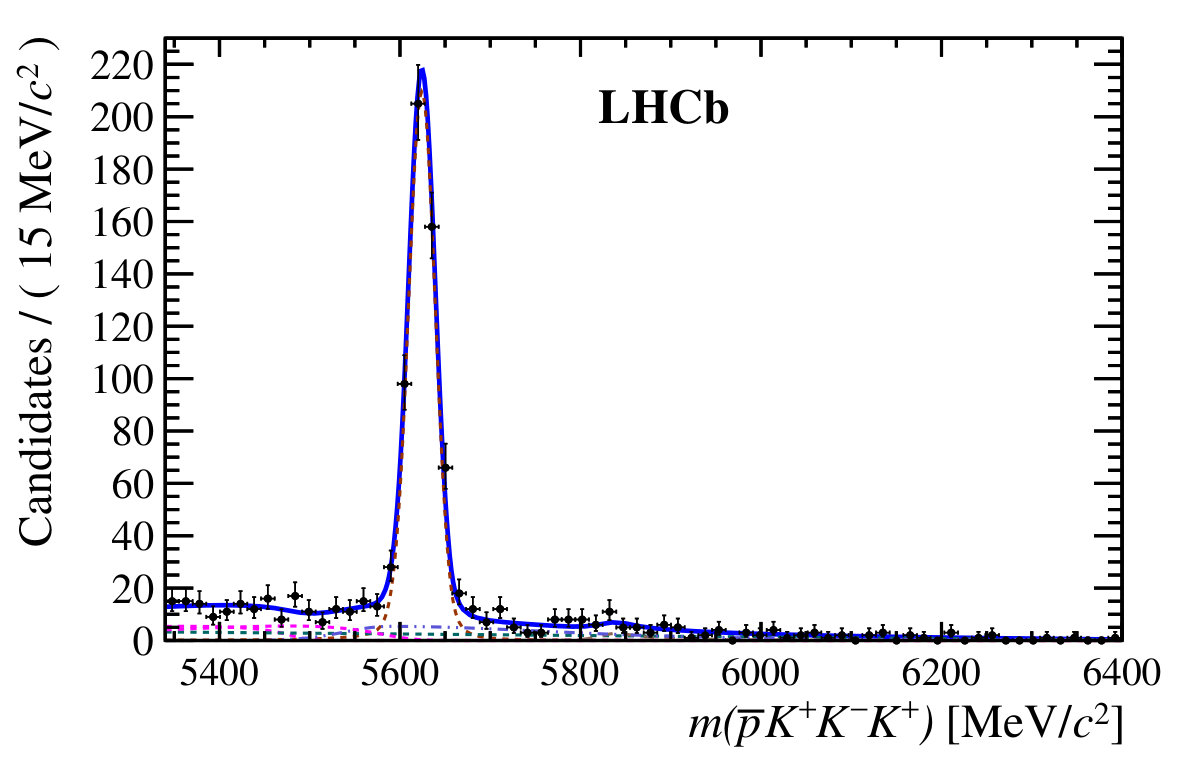 Figure 6
| Charmless mode | Control channel |
|---|---|
| Decay mode | Invariant-mass requirements (in ) |
|---|---|
| LBM | and |
| and | |
| LBM | and |
| and | |
| and | |
| LBM | and |
| and | |
| and |
| Decay mode | Absolute uncertainties (%) | Total (%) | ||||
|---|---|---|---|---|---|---|
| — | 0.20 | 0.06 | 0.42 | 0.28 | 0.54 | |
| 0.17 | 0.20 | 0.06 | 0.41 | 0.24 | 0.55 | |
| — | 0.21 | 0.06 | 0.40 | 0.55 | 0.72 | |
| 0.15 | 0.20 | 0.07 | 0.41 | 0.33 | 0.59 | |
| 0.17 | 0.20 | 0.05 | 0.42 | 0.24 | 0.55 | |
| 0.15 | 0.20 | 0.05 | 0.41 | 0.55 | 0.73 | |
| (LBM) | — | 0.16 | 0.06 | 0.36 | 0.28 | 0.49 |
| (LBM) | 0.17 | 0.17 | 0.05 | 0.34 | 0.24 | 0.48 |
| (LBM) | 0.16 | 0.17 | 0.05 | 0.37 | 0.33 | 0.55 |
| — | 0.20 | 0.09 | 0.48 | 0.28 | 0.60 | |
| — | 0.12 | 0.05 | 0.23 | 0.28 | 0.39 | |
| — | 0.18 | 0.05 | 0.47 | 0.28 | 0.59 | |
| 0.16 | 0.14 | 0.11 | 0.58 | 0.24 | 0.74 | |
| 0.12 | 0.12 | 0.04 | 0.36 | 0.24 | 0.49 | |
| 0.16 | 0.14 | 0.04 | 0.32 | 0.24 | 0.45 | |
| 0.22 | 0.19 | 0.05 | 0.48 | 0.24 | 0.61 | |
| 0.11 | 0.10 | 0.05 | 0.30 | 0.33 | 0.34 | |
| 0.15 | 0.14 | 0.06 | 0.58 | 0.33 | 0.64 | |
| Decay mode | Signal yields | |
|---|---|---|
| 02335 056 | 02264 055 | |
| 06807 092 | 06232 089 | |
| 00555 038 | 00630 038 | |
| 02312 054 | 02248 054 | |
| 00180 028 | 00252 029 | |
| 00265 025 | 00305 026 | |
| 01607 040 | 01586 040 | |
| 24687 159 | 24052 157 | |
| 00259 018 | 00260 018 | |
| (LBM) | 00498 025 | 00455 024 |
| (LBM) | 03217 061 | 02929 058 |
| (LBM) | 01240 038 | 01146 036 |
| 00422 023 | 00425 023 | |
| 00783 030 | 00771 029 | |
| 00241 016 | 00230 016 | |
| 00548 026 | 00488 025 | |
| 00998 037 | 00895 034 | |
| 00167 014 | 00160 014 | |
| 00977 033 | 00856 031 | |
| 00192 015 | 00172 014 | |
| 00548 025 | 00542 025 | |
Peer Reviews
No public reviews on file for this paper yet. If you reviewed it on a platform where reviews are public (OpenReview, ICLR, NeurIPS, ICML), you can paste yours below so the community can read it here.
Videos
No videos yet. Explain this paper in a talk, walkthrough, or lecture? Add one.
EUROPEAN ORGANIZATION FOR NUCLEAR RESEARCH (CERN)
CERN-EP-2019-013
LHCb-PAPER-2018-044
23 September 2019
Measurements of asymmetries in charmless four-body and decays
LHCb collaboration†††Authors are listed at the end of this paper.
A search for violation in charmless four-body decays of and baryons with a proton and three charged mesons in the final state is performed. To cancel out production and detection charge-asymmetry effects, the search is carried out by measuring the difference between the asymmetries in a charmless decay and in a decay with an intermediate charmed baryon with the same particles in the final state. The data sample used was recorded in 2011 and 2012 with the LHCb detector and corresponds to an integrated luminosity of . A total of 18 asymmetries are considered, either accounting for the full phase space of the decays or exploring specific regions of the decay kinematics. No significant -violation effect is observed in any of the measurements.
Published in Eur. Phys. J. C (2019) 79: 745
© 2019 CERN for the benefit of the LHCb collaboration. CC-BY-4.0 licence.
1 Introduction
All measurements of violation performed so far are consistent with the predictions of the Standard Model (SM) [1]. Nonvanishing -violating asymmetries have been observed in the decays of both and mesons [2]. In contrast, violation has not been observed in baryon decays, although some indications for nonvanishing asymmetries in -flavoured baryon decays have been reported by the LHCb collaboration [3, 4, 5, 6].
The abundant production of and baryons111The inclusion of charge conjugate processes is implied throughout this paper, unless stated otherwise. in proton-proton collisions at the Large Hadron Collider (LHC) gives the LHCb experiment the opportunity to study multibody charmless decays of -flavoured baryons. In particular, and baryon decays to charmless four-body final states were observed by the LHCb collaboration and their branching fractions measured [7]. Their large yields enable measurements of -violating asymmetries to be performed with a precision at the level of a few percent.
This search follows the successful path of the observation of large -violating asymmetries in multibody charmless decays of charged and neutral mesons by LHCb [8, 9, 10, 11]. These decays proceed simultaneously through the charged-current transition and neutral-current transitions, and the resulting interference exhibits a weak-phase difference. Furthermore, and analogously to the aforementioned charmless multibody -meson decays, charmless multibody decays of -flavoured baryons contain rich resonance structures, both in the two- or three-body baryonic invariant-mass spectra (i.e. , , , and ) and in the two- or three-body nonbaryonic ones (i.e. the , , , and ). Consequently, asymmetries might be enhanced due to the strong-phase differences induced by the interference patterns between these transitions in the mass regions around resonances. The charmless -baryon decays studied in this paper are hence well suited for a potential first observation of violation in the baryon sector. However, the presence of these strong phases, that are difficult to predict, would make a potential observation of violation difficult to interpret in terms of the weak phase of the Cabibbo-Kobayashi-Maskawa (CKM) quark-mixing matrix [12, 13].
This work focuses on a search for violation in \mbox{X^{0}_{b}}\rightarrow phh^{\prime}h^{\prime\prime} charmless decays, where stands either for or and stand either for a pion or a kaon. Six decays are studied, namely , , , , and . The asymmetry is defined as
[TABLE]
where \mathrm{\Gamma}(\mbox{X^{0}{b}}\rightarrow f) is the partial width of the given decay. The asymmetry measurement relies on counting the number of reconstructed particle and antiparticle decays and includes therefore experimental charge-asymmetric effects such as the track detection efficiency or -baryon production asymmetries. They are cancelled out to first order by comparing the asymmetries of the signal modes to those of charmed decays that lead to the same or very similar final states and for which no measurable violation is expected in the SM [14]. The decays , and are thus reconstructed with the same selection as the corresponding charmless signals. The -violating observable considered in this work is then referred to as \mbox{\mathchar 28929\relax\mbox{}}\equiv\mbox{{\cal A}^{{C!P}}{\rm no\text{-}c}}-\mbox{{\cal A}^{{C!P}}_{\rm c}}, where () is the asymmetry measured in the charmless (charmed) decays. The decays of interest are reported in Table 1.
In addition to \mathchar 28929\relax\mbox{{\cal A}^{{C!P}}} measurements integrated over all of the four-body phase space, specific regions of the space are studied in order to search for local asymmetries.
The same final states have been used by the LHCb experiment to search for violation using triple product asymmetries [5, 15]. The latter technique and the \mathchar 28929\relax\mbox{{\cal A}^{{C!P}}} measurements exhibit different sensitivity to violation [16], which makes the two approaches complementary.
2 Detector and data set
The analysis is performed using collision data recorded with the LHCb detector, corresponding to an integrated luminosity of 1.0 at a centre-of-mass energy of 7 TeV in 2011 and 2.0 at a centre-of-mass energy of 8 TeV in 2012. The LHCb detector [17, 18] is a single-arm forward spectrometer covering the pseudorapidity range , designed for the study of particles containing or quarks. The detector includes a high-precision tracking system consisting of a silicon-strip vertex detector surrounding the interaction region, a large-area silicon-strip detector located upstream of a dipole magnet with a bending power of about , and three stations of silicon-strip detectors and straw drift tubes placed downstream of the magnet. The tracking system provides a measurement of the momentum, , of charged particles with a relative uncertainty that varies from 0.5% at low momentum to 1.0% at 200. The minimum distance of a track to a primary vertex (PV), the impact parameter (IP), is measured with a resolution of , where is the component of the momentum transverse to the beam, in . Different types of charged hadrons are distinguished using information from two ring-imaging Cherenkov detectors. Photons, electrons and hadrons are identified by a calorimeter system consisting of scintillating-pad and preshower detectors, an electromagnetic and a hadronic calorimeter. Muons are identified by a system composed of alternating layers of iron and multiwire proportional chambers.
Simulation is used to investigate backgrounds from other -hadron decays and also to study the detection and reconstruction efficiencies of the signals. In the simulation, collisions are generated using Pythia [19, *Sjostrand:2007gs] with a specific LHCb configuration [21]. Decays of hadronic particles are described by EvtGen [22] in which final-state radiation is generated using Photos [23]. The interactions of the generated particles with the detector, and its response, are implemented using the Geant4 toolkit [24, *Agostinelli:2002hh] as described in Ref. [26].
3 Trigger and selection requirements
The selection follows most of the strategy described in Ref. [7]. The online event selection is performed by a trigger[27] that consists of a hardware stage, based on information from the calorimeter and muon systems, followed by a software stage, in which all charged particles with are reconstructed for 2011 (2012) data. At the hardware-trigger stage, events are required to include a muon or a dimuon with high transverse momentum or a hadron, photon or electron with high transverse energy. The software trigger reconstructs charged particles with transverse momentum for 2011 (2012) data and requires a two-, three- or four-track secondary vertex with significant displacement from all primary interaction vertices. At least one charged particle must have transverse momentum for 2011 (2012) data and be inconsistent with originating from any PV. A multivariate algorithm [28] is used for the identification of secondary vertices consistent with the decay of a hadron. In the offline selection, trigger signals are associated with reconstructed particles. Selection requirements can therefore be made on the trigger selection itself and on whether the decision was due to the signal candidate, other particles produced in the collision, or a combination of both.
The events passing the trigger requirements are filtered in two stages. Initial requirements are applied to further reduce the size of the data sample before a multivariate selection is applied. Selection requirements based on topological variables, such as the flight distance of the baryon, are used as the main discriminants. In order to preserve the phase space of the decays of interest, only loose requirements are placed on the transverse momenta of the decay products, .
Neutral -baryon candidates, hereafter denoted as , are formed from a proton candidate selected with particle identification (PID) requirements and three additional charged tracks. When more than one PV is reconstructed, the candidate is associated to the PV with the smallest value of , where is the difference in of a given PV reconstructed with and without the considered candidate. Each of the four tracks of the final state is required to have and . Beyond 100 , there is little pion/kaon/proton discrimination. The candidates are then required to form a vertex with a fit quality and to be significantly separated from any PV with \mbox{\chi^{2}{\rm FD}}>50, where is the square of the flight-distance significance. To remove backgrounds from higher-multiplicity decays, the difference in when adding any other track must be greater than 4. The candidates must have a transverse momentum p_{\rm T}(\mbox{X^{0}{b}}) greater than and an invariant mass within the range . They are further required to be consistent with originating from a PV, quantified by both and the cosine of the angle between the reconstructed momentum of the hadron and the vector defined by the associated PV and the decay vertex be greater than 0.999. Finally, PID requirements are applied to provide discrimination between kaons and pions in order to assign the candidates to one of the five different final-state hypotheses , , , and .
There are three main categories of background that contribute significantly in the selected invariant-mass regions: the so-called signal cross-feed background, resulting from a misidentification of one or more final-state particles in a charmless baryon decay, which can therefore be reconstructed as another charmless decay with a different mass hypothesis; the charmless decays of neutral mesons to final states containing four charged mesons, where a pion or a kaon is misidentified as a proton; and the combinatorial background, which results from a random association of unrelated tracks. The pion and kaon PID requirements, that define mutually exclusive samples, are optimised to reduce the cross-feed background, and hence to maximise the significance of the signal. The charmless -meson decays are identified by reconstructing the invariant-mass distributions of candidates using the pion or kaon mass instead of the proton mass hypothesis, in the high-mass sidebands defined as , where for and final states, and for , and final states. This background contribution is reduced by the optimisation of the proton PID requirement.
To reject combinatorial background, multivariate discriminants based on a boosted decision tree (BDT) [29] with the AdaBoost algorithm [30] have been designed. Candidates from simulated decays and the high-mass sideband are used as the signal and background training samples, respectively. This high-mass sideband region is chosen such that the sample is free of cross-feed background. The samples are divided into two data-taking periods and further subdivided into two equally sized subsamples. Each subsample is then used to train an independent discriminant. The BDT trained on one subsample is used to select candidates from the other subsample, in order to avoid a possible bias in the selection.
The BDTs have the following quantities as inputs: , , , , , and of the candidate; the smallest change in the -baryon when adding any other track from the event; the sum of the of the four tracks of the final state; and the asymmetry
[TABLE]
where is the transverse component of the vector sum of all particle momenta inside a cone around the -baryon candidate direction, of radius , where and are the difference in pseudorapidity and azimuthal angle (expressed in radians) around the beam direction, between the momentum vector of the track under consideration and that of the -hadron candidate. The distribution of for the signal candidates is enhanced towards high values. The BDT output is determined to be uncorrelated with the position in phase space of the decays of interest. The selection requirement placed on the output of the BDTs is optimised for the six decays of interest by minimising the uncertainties on the -asymmetry differences.
A number of background contributions consisting of fully reconstructed -baryon decays into the two-body , , three-body or combinations, where represents a charmonium resonance, may produce the same final state as the signal. Hence, they have similar invariant-mass distribution of the -baryon candidate as the signal along with a similar selection efficiency. The presence of a misidentified hadron in the , and decay also produces peaking background under the signal. Therefore, the following decay channels are explicitly reconstructed under the relevant particle hypotheses and vetoed by means of a requirement on the resulting invariant mass, in all spectra: , , , , , , , , , and . The decays of other possible broad charmonium resonances to and are retained as potential interfering amplitudes with the charmless amplitudes under study.
The same set of trigger, and BDT requirements is applied to the control modes , and to cancel out most of the systematic effects related to the selection criteria. Candidates whose or invariant mass is in the range for and for , are retained as control channels candidates. Events outside these intervals belong to the corresponding signal spectrum, again ensuring statistically independent samples for the simultaneous fit.
The fraction of events containing more than one candidate is below the percent level. The candidate to be retained in each event is chosen randomly and reproducibly.
4 Simultaneous fit
A simultaneous unbinned extended maximum-likelihood fit is performed to the invariant-mass distributions of the -hadron candidates under each of the mass hypotheses for the signal and control channel final-state tracks. The data samples are split according to the charge of the proton and to the year of data taking. Furthermore, data are split according to the hardware trigger conditions, in order to correct raw measurements for charge-asymmetric trigger efficiencies. The components of the model include, in addition to signal decays, partially reconstructed five-body decays, signal and background cross-feeds, four- and five-body decays of mesons and combinatorial background. The independent data samples obtained for each final state are fitted simultaneously. For each sample, the likelihood is expressed as
[TABLE]
where is the number of events related to the component and is the probability distribution function for component evaluated at the mass of the candidate .
4.1 Fit model
The signal decays are modelled as the sum of two Crystal Ball (CB) functions [31] that share peak positions and widths but have independent power-law tails on opposite sides of the peak. The mass parameter is free in the fit and shared among the decays. The difference between the fitted and masses is also a shared parameter and is constrained to the value reported in Ref. [2] by using a Gaussian function.
The width parameter for decays measured in the 2012 data-taking sample is found to be and is chosen as reference. The ratio of the experimental widths of the signal decay functions is constrained using Gaussian prior probability distributions multiplying the likelihood function, with parameters obtained from a fit to simulated events. The other parameters of the CB components are obtained from a simultaneous fit to simulated samples, and are fixed to those values in the fits to the data.
The cross-feed backgrounds are modelled by the sum of two CB functions, whose parameters are determined from simulated samples weighted to match the performances of the particle identification algorithm as measured in the data. All cases resulting from the misidentification of either one or two of the final-state particles are considered. The yield of each misidentified decay is constrained to the yield of the corresponding correctly identified decay and the known misidentification probabilities. These constraints are implemented using Gaussian prior probability distributions multiplying the likelihood function. Their mean values are obtained from the ratio of selection efficiencies and their widths include uncertainties originating from the finite size of the simulated events samples as well as the systematic uncertainties related to the determination of the PID efficiencies.
The backgrounds resulting from four- or five-body decays of mesons are identified in each spectrum by a dedicated fit to the candidates in the high-mass sideband, reconstructed under the hypothesis of the kaon mass for the proton candidates. The relative yield of each decay is then constrained in the simultaneous fit from its observed abundance in the high-mass sidebands. The invariant-mass distributions are modelled by the sum of two CB functions, whose parameters are determined from simulation.
Partially reconstructed backgrounds where a neutral pion is not reconstructed, such as , are modelled by means of generalised ARGUS functions [32] convolved with a Gaussian resolution function. The Gaussian width is taken as the signal width parameter. The parameters of the ARGUS function are shared among all invariant-mass spectra and are determined directly from the fit, except for the threshold, which is given by . Partially reconstructed decays with a missing photon such as and decays, with , are modelled separately using the same functional form but where the parameters are fixed from simulation. The decay modes where a charged pion is misidentified as a kaon can significantly contribute to the and spectra. They are modelled with an empirical function determined from the partially reconstructed background candidates in the control channel.
Finally, the combinatorial background is modelled by a linear function whose slope is shared among the invariant-mass spectra.
4.2 The ensemble of measurements
The following three categories of measurements have been considered a priori (before any evaluation of the data) to search for global and local effects of violation.
- •
asymmetries are measured, considering the whole selected phase space of the decay candidates.
- •
asymmetries are also measured in the phase-space region of low invariant mass on the baryonic pair (i.e. or ) and low invariant mass on the pairing of the two other tracks. The ensemble of measurements that are performed with this phase-space selection is hereafter referred to as LBM (Low -Body Mass) measurements. The invariant mass of the baryonic pair is required to be lower than 2 while the invariant-mass requirements on the two remaining tracks depends on whether it is a pair, a or a pair. These values are chosen to include several known resonances, in particular resonance for , the broad scalar resonance for and the resonance for . Only the modes with the largest signal yields are considered, namely , and decays. The two-body low-mass distributions are displayed in Fig. 1. Several resonant structures are observed, and correspond to baryon resonances like , and or meson resonances like , or . This phase-space selection focuses therefore on low-invariant-mass resonances (both mesonic and baryonic) as well as low-invariant-mass nonresonant components of the amplitudes. The latter have been shown to generate large -violating asymmetries in analogous -meson decays [8].
- •
asymmetries are measured for regions of the phase space that contain specific quasi-two-body decays, {{\mathchar 28931\relax}^{0}_{b}}\rightarrow p{\mbox{a_{1}}}(1260)^{-}, , {{\mathchar 28931\relax}^{0}_{b}}\rightarrow p{\mbox{K_{1}}}(1410)^{-}, , , or three-body decays, , , and , where in the latter only the high mass region is selected. Invariant-mass requirements for these measurements are reported in Table 2. Only the narrower baryons or the well-known baryon and meson resonances have been considered, with the noticeable exception of the {\mbox{a_{1}}}(1260) meson. Although the {\mbox{a_{1}}}(1260) meson is a broad resonance, the analogous -meson decay {B}^{0}\rightarrow{\mbox{a_{1}}}(1260)^{\pm}\pi^{\mp} has been studied at the -factories [33, 34] and could serve as a benchmark comparison in the interpretation of the results obtained for the {{\mathchar 28931\relax}^{0}_{b}}\rightarrow p{\mbox{a_{1}}}(1260)^{-} decay.
5 Corrections for experimental detection asymmetries and related systematic uncertainties
Tracking reconstruction, trigger selection and particle identification requirements can generate charge-dependent selection efficiencies of the decays of interest. Most of these charge-dependent effects are however cancelled out in the \mathchar 28929\relax\mbox{{\cal A}^{{C!P}}} observables, up to the kinematical differences between signal and control channels. The remaining impact is addressed by evaluating corrections to the \mathchar 28929\relax\mbox{{\cal A}^{{C!P}}} observables. These correction factors are determined from calibration samples as discussed in this Section. Systematic uncertainties are estimated for each correction factor and propagated to the \mathchar 28929\relax\mbox{{\cal A}^{{C!P}}} measurements. A summary of the systematic uncertainties is reported in Table 3 for all modes.
- •
Tracking detection efficiency: differences between the interactions of oppositely charged pions, kaons or protons in the material of the spectrometer induce detection charge asymmetries. The difference in and tracking efficiency has been quantified with calibration samples, as a function of the transverse momentum of the tracks [35, 36]. The simulated signal and control channels kinematics is used to weight the simulation track efficiency in order to match the hadron detection efficiencies as measured in those calibration samples. The \mathchar 28929\relax\mbox{{\cal A}^{{C!P}}} values (as measured by the difference of signal yields) are then corrected for these efficiencies and the uncertainty on the detection efficiency determination itself is propagated as a systematic uncertainty to the final \mathchar 28929\relax\mbox{{\cal A}^{{C!P}}} measurements, taking into account the correlation between signal and control channel induced by the use of the same calibration samples. The systematic uncertainty arises from the size of the simulated samples used in the weighting, the statistical and systematic uncertainties on the charge asymmetry of the data calibration samples and the knowledge of the kinematical distributions generated in the simulated samples. The latter is determined by taking two different kinematic configurations of the final state (saturated by quasi two-body modes on one hand and phase-space decay on the other hand) and using the difference as the systematic estimate. The difference between the and particles is not measured to date. Simulation is used to obtain the reconstruction efficiencies as a function of the momentum of the proton or antiproton track. An additional systematic uncertainty related to the knowledge of the material budget in the simulation is added, as reported in Ref. [37]. The proton detection correction follows the same procedure as and detection asymmetry correction.
- •
The same methodology is used to correct for the difference of triggering efficiency between oppositely charged hadrons of the signal candidate, at the hardware stage of the trigger system. The trigger asymmetry effects are quantified as a function of the transverse momentum of the tracks of interest, by studying the triggering efficiency of and from the decay [27] and protons from decays.
- •
The production asymmetry can depend on the kinematical properties of the reconstructed candidates, though the actual dependence has not been observed yet [38]. Differences between signal and control channel candidates kinematics would reflect in an incomplete cancellation of the production asymmetry in the \mathchar 28929\relax\mbox{{\cal A}^{{C!P}}} observable. This effect has been estimated by considering the production asymmetry measured in Ref. [38] as a function of its and pseudorapidity.
- •
The PID requirements set on the tracks of the final state can induce asymmetries. Efficiencies for the final-state particles are determined from decays selected in data, and are parameterised by their momentum and electric charge. The correction factors to apply to the value of \mathchar 28929\relax\mbox{{\cal A}^{{C!P}}} are here again determined by performing a weighting of the simulated signal and control channel events to match the efficiencies measured in the data. The uncertainties coming from the finite size of the calibration samples are propagated as a systematic uncertainty for the final \mathchar 28929\relax\mbox{{\cal A}^{{C!P}}} measurements.
The first three corrections on the value of \mathchar 28929\relax\mbox{{\cal A}^{{C!P}}} are found to be at the few per mille level, commensurate with their uncertainties. The lattermost source is dominating the systematic uncertainty budget, and can reach the percent level. The correction factors are however consistent with zero. The design of the fit model and the simultaneous fit strategy allow the direct measurement of the combinatorial background and the -meson decay asymmetries. No significant asymmetries are observed and the results are presented in Section 7. Systematic uncertainties can be induced by the fit model and the fit complexity and it is evaluated by means of pseudoexperiments reproducing the nominal fit results. No significant biases are obtained. The normalised residuals of the signal yields are computed and the uncertainties on their pull mean value are propagated as a systematic uncertainty to each relevant \mathchar 28929\relax\mbox{{\cal A}^{{C!P}}} measurement. The largest uncertainty is determined to be at the level of few , hence negligible in comparison to the aforementioned systematic uncertainty estimate.
6 Fit results
The results of the simultaneous fits to the five experimental spectra split by year of data taking, magnet polarity and trigger conditions are discussed in this section. The fit results are reported for each final state in the following subsections, and the summary of the measured yields is reported in Table 4.
- •
** final state**: Figures 2 and 3 show the results of the simultaneous fits to the invariant-mass spectra of the spectra for the inclusive, LBM and quasi two-body measurements. The high-mass region of the spectrum is only populated by either -meson decays or combinatorial background. The good agreement between the data and the fit model, especially in this region, validates the chosen modelling of these components. The same comment is in order for the fit in the different phase-space regions. The combinatorial component becomes negligible in the quasi two-body case.
- •
** final state**: Figures 4 and 5 show the results of the simultaneous fits to the mass spectrum for the inclusive, LBM and quasi two-body measurements. The fit model provides also in this case a satisfactory description of the data, despite the very different background contributions depending on the phase-space selection. Raw asymmetries at the level of several percent are observed.
- •
** final state**: Figure 6 shows the results of the simultaneous fits to the reconstructed mass spectrum for the inclusive, LBM and quasi two-body measurements. Negligible raw asymmetries are obtained.
- •
** and final states**: The simultaneous fit results for the two remaining final states are shown in Fig. 7. The result of the fit for the control channel is also displayed and shows a good description of the spectrum. This control channel is used to account for the production asymmetry of the modes.
7 Measurements of asymmetries and concluding remarks
Five charmless final states of and four-body hadronic decays are examined in this paper. Specific regions of their phase space have been selected to search for local asymmetries in addition to the integrated -asymmetry. A total of eighteen measurements of asymmetries are reported in this paper.
A simple counting experiment allows the measurement of a asymmetry up to the corrections due to instrumental and -baryon production asymmetries. These corrections are mitigated by establishing the differences (denoted \mathchar 28929\relax\mbox{{\cal A}^{{C!P}}}) between the raw values of the signals and those of the decay modes with intermediate charmed baryons comprising the same final-state particles. The asymmetries \mathchar 28929\relax\mbox{{\cal A}^{{C!P}}} are further corrected for residual experimental charge asymmetries due to kinematic differences between signal and control modes. The integrated \mathchar 28929\relax\mbox{{\cal A}^{{C!P}}} asymmetry differences are measured to be
[TABLE]
In all cases the first uncertainties are statistical and the second systematic. No significant violation is observed. The \mathchar 28929\relax\mbox{{\cal A}^{{C!P}}} measurements for the independent samples of the two magnet polarities, the two categories of trigger requirements and the two distinct data-taking samples are found to be consistent. In addition, the measured asymmetries for the combinatorial background in all spectra are consistent with zero. The background contributions coming from -meson decays (that could potentially exhibit nonzero violation) are also consistent with null asymmetries.
In a previous analysis, the LHCb collaboration reported evidence for violation in a specific region of the phase space of the decay , by measuring triple-product asymmetries [5]. By contrast, in the present analysis, no indication of a significant -violating asymmetry is obtained with the same data sample, providing complementary insights about the origin of this potential -symmetry breaking effect. The quest for the first observation of violation in baryon decays continues. LHCb Run 2 data provides about five times larger yields allowing for a more sensitive search of smaller -violating effects.
Acknowledgements
We express our gratitude to our colleagues in the CERN accelerator departments for the excellent performance of the LHC. We thank the technical and administrative staff at the LHCb institutes. We acknowledge support from CERN and from the national agencies: CAPES, CNPq, FAPERJ and FINEP (Brazil); MOST and NSFC (China); CNRS/IN2P3 (France); BMBF, DFG and MPG (Germany); INFN (Italy); NWO (Netherlands); MNiSW and NCN (Poland); MEN/IFA (Romania); MSHE (Russia); MinECo (Spain); SNSF and SER (Switzerland); NASU (Ukraine); STFC (United Kingdom); NSF (USA). We acknowledge the computing resources that are provided by CERN, IN2P3 (France), KIT and DESY (Germany), INFN (Italy), SURF (Netherlands), PIC (Spain), GridPP (United Kingdom), RRCKI and Yandex LLC (Russia), CSCS (Switzerland), IFIN-HH (Romania), CBPF (Brazil), PL-GRID (Poland) and OSC (USA). We are indebted to the communities behind the multiple open-source software packages on which we depend. Individual groups or members have received support from AvH Foundation (Germany); EPLANET, Marie Skłodowska-Curie Actions and ERC (European Union); ANR, Labex P2IO and OCEVU, and Région Auvergne-Rhône-Alpes (France); Key Research Program of Frontier Sciences of CAS, CAS PIFI, and the Thousand Talents Program (China); RFBR, RSF and Yandex LLC (Russia); GVA, XuntaGal and GENCAT (Spain); the Royal Society and the Leverhulme Trust (United Kingdom); Laboratory Directed Research and Development program of LANL (USA).
The reference list from the paper itself. Each links out to its DOI / PubMed record.
- 1[1] CK Mfitter group, J. Charles et al. , Current status of the Standard Model CKM fit and constraints on Δ F = 2 Δ 𝐹 2 \Delta F=2 new physics , Phys. Rev. D 91 (2015) 073007 , ar Xiv:1501.05013 , updated results and plots available at http://ckmfitter.in 2p 3.fr/ · doi ↗
- 2[2] Particle Data Group, M. Tabanashi et al. , Review of particle physics , Phys. Rev. D 98 (2018) 030001 · doi ↗
- 3[3] LH Cb collaboration, R. Aaij et al. , Searches for Λ b 0 subscript superscript Λ 0 𝑏 {{\mathchar 28931\relax}^{0}_{b}} and Ξ b 0 subscript superscript Ξ 0 𝑏 {{\mathchar 28932\relax}^{0}_{b}} decays to K S 0 p π − subscript superscript 𝐾 0 S 𝑝 superscript 𝜋 {{K}^{0}_{\mathrm{S}}}{p}{{\pi}^{-}} and K S 0 p K − subscript superscript 𝐾 0 S 𝑝 superscript 𝐾 {{K}^{0}_{\mathrm{S}}}{p}{{K}^{-}} final states with first observation of the Λ b 0 → K S 0 p π − → subscript supersc · doi ↗
- 4[4] LH Cb collaboration, R. Aaij et al. , Observation of the Λ b 0 → J / ψ p π − → subscript superscript Λ 0 𝑏 𝐽 𝜓 𝑝 superscript 𝜋 {{\mathchar 28931\relax}^{0}_{b}}\rightarrow{{J\mskip-3.0mu/\mskip-2.0mu\psi\mskip 2.0mu}}{p}{{\pi}^{-}} decay , JHEP 07 (2014) 103 , ar Xiv:1406.0755 · doi ↗
- 5[5] LH Cb collaboration, R. Aaij et al. , Measurement of matter-antimatter differences in beauty baryon decays , Nature Physics 13 (2017) 391 , ar Xiv:1609.05216 · doi ↗
- 6[6] LH Cb collaboration, R. Aaij et al. , Observations of Λ b 0 → Λ K + π − → subscript superscript Λ 0 𝑏 Λ superscript 𝐾 superscript 𝜋 {{\mathchar 28931\relax}^{0}_{b}}\rightarrow{\mathchar 28931\relax}{{K}^{+}}{{\pi}^{-}} and Λ b 0 → Λ K + K − → subscript superscript Λ 0 𝑏 Λ superscript 𝐾 superscript 𝐾 {{\mathchar 28931\relax}^{0}_{b}}\rightarrow{\mathchar 28931\relax}{{K}^{+}}{{K}^{-}} decays and searches for other Λ b 0 subscript superscript Λ 0 𝑏 {{\mathchar 28931\relax}^{0 · doi ↗
- 7[7] LH Cb collaboration, R. Aaij et al. , Measurement of branching fractions of charmless four-body Λ b 0 subscript superscript Λ 0 𝑏 {{\mathchar 28931\relax}^{0}_{b}} and Ξ b 0 superscript subscript Ξ 𝑏 0 {\mathchar 28932\relax}_{b}^{0} decays , JHEP 02 (2018) 098 , ar Xiv:1711.05490 · doi ↗
- 8[8] LH Cb collaboration, R. Aaij et al. , Measurement of C P 𝐶 𝑃 C\!P violation in the phase space of B ± → K + K − π ± → superscript 𝐵 plus-or-minus superscript 𝐾 superscript 𝐾 superscript 𝜋 plus-or-minus {{B}^{\pm}}\rightarrow{{K}^{+}}{{K}^{-}}{{\pi}^{\pm}} and B ± → π + π − π ± → superscript 𝐵 plus-or-minus superscript 𝜋 superscript 𝜋 superscript 𝜋 plus-or-minus {{B}^{\pm}}\rightarrow{{\pi}^{+}}{{\pi}^{-}}{{\pi}^{\pm}} decays , Phys. Rev. Lett. 112 (2014) 011801 , ar X · doi ↗