On confidence intervals centered on bootstrap smoothed estimators
Paul Kabaila, Christeen Wijethunga

TL;DR
This paper evaluates confidence intervals based on bootstrap smoothed estimators, extending previous work to unknown error variance, and finds conditions where these intervals perform well.
Contribution
It derives an exact formula for the standard deviation approximation of bootstrap smoothed estimators with unknown variance and assesses their performance.
Findings
Confidence intervals can perform well under unknown variance.
Performance depends on specific circumstances and model settings.
Extension of previous known-variance results to unknown-variance case.
Abstract
Bootstrap smoothed (bagged) estimators have been proposed as an improvement on estimators found after preliminary data-based model selection. Efron, 2014, derived a widely applicable formula for a delta method approximation to the standard deviation of the bootstrap smoothed estimator. He also considered a confidence interval centered on the bootstrap smoothed estimator, with width proportional to the estimate of this standard deviation. Kabaila and Wijethunga, 2019, assessed the performance of this confidence interval in the scenario of two nested linear regression models, the full model and a simpler model, for the case of known error variance and preliminary model selection using a hypothesis test. They found that the performance of this confidence interval was not substantially better than the usual confidence interval based on the full model, with the same minimum coverage. We…
Click any figure to enlarge with its caption.
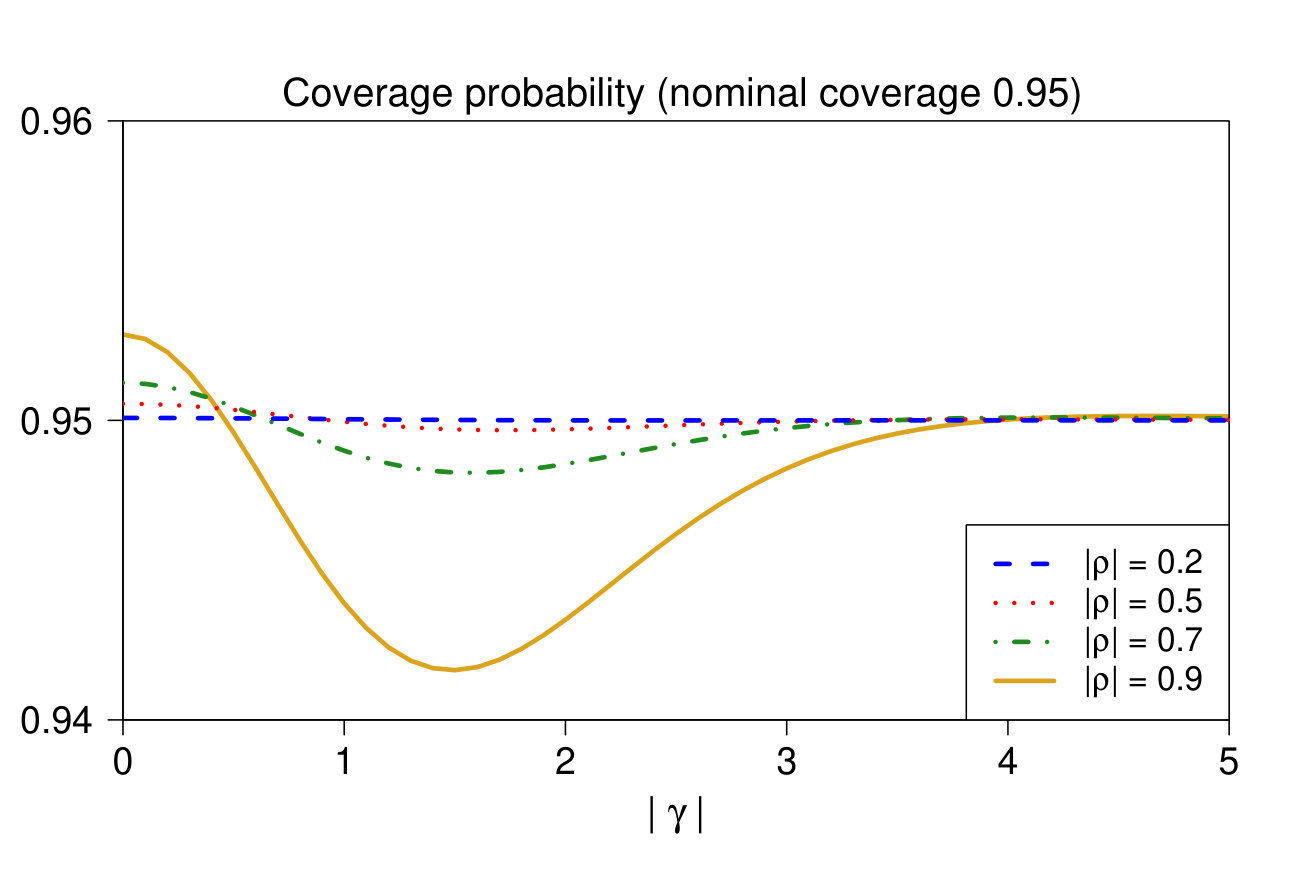 Figure 1
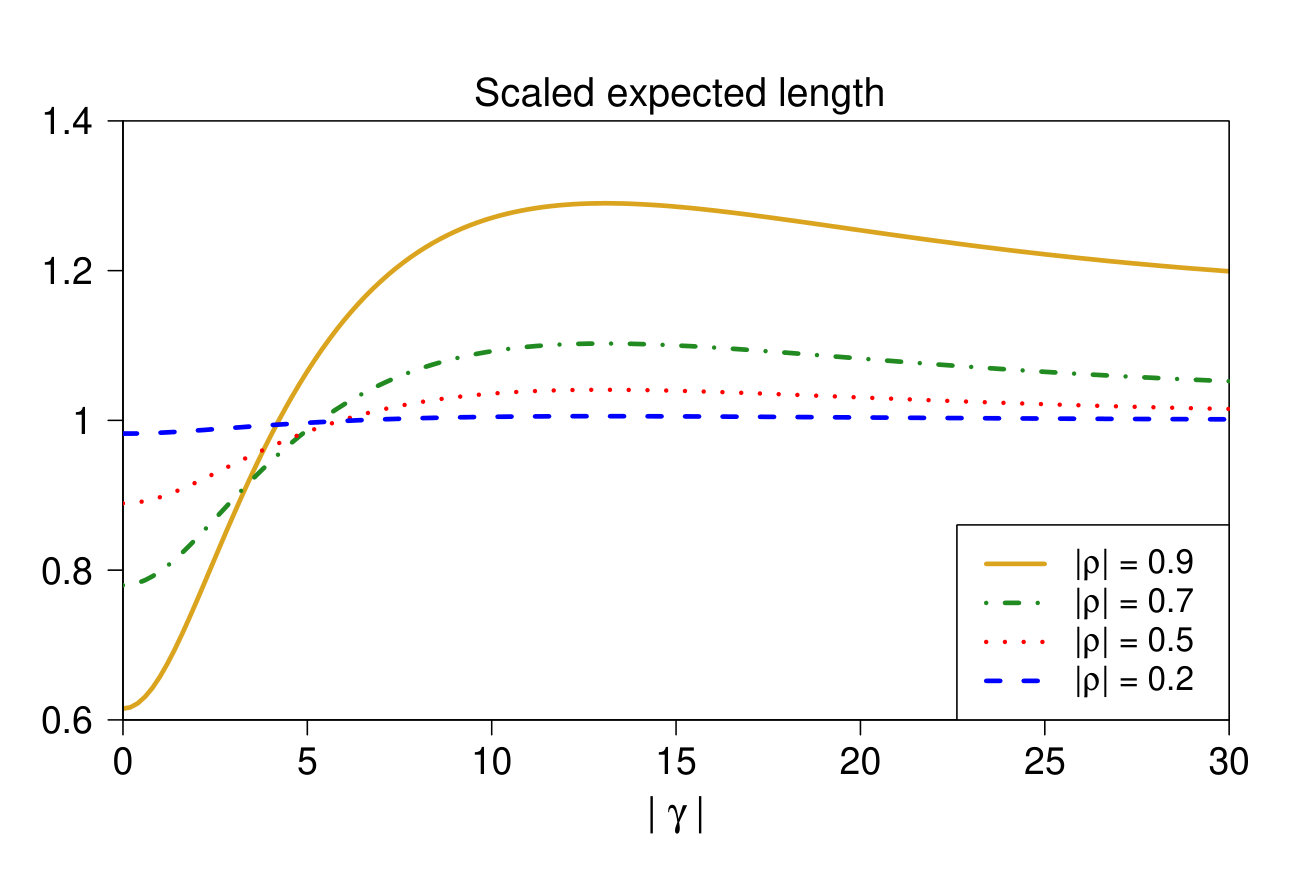 Figure 2
Peer Reviews
No public reviews on file for this paper yet. If you reviewed it on a platform where reviews are public (OpenReview, ICLR, NeurIPS, ICML), you can paste yours below so the community can read it here.
Videos
No videos yet. Explain this paper in a talk, walkthrough, or lecture? Add one.
On confidence intervals centered on bootstrap smoothed estimators
Paul Kabaila∗ and Christeen Wijethunga
Department of Mathematics and Statistics, La Trobe University, Australia
ABSTRACT
Bootstrap smoothed (bagged) estimators have been proposed as an improvement on estimators found after preliminary data-based model selection. Efron, 2014, derived a widely applicable formula for a delta method approximation to the standard deviation of the bootstrap smoothed estimator. He also considered a confidence interval centered on the bootstrap smoothed estimator, with width proportional to the estimate of this standard deviation. Kabaila and Wijethunga, 2019, assessed the performance of this confidence interval in the scenario of two nested linear regression models, the full model and a simpler model, for the case of known error variance and preliminary model selection using a hypothesis test. They found that the performance of this confidence interval was not substantially better than the usual confidence interval based on the full model, with the same minimum coverage. We extend this assessment to the case of unknown error variance by deriving a computationally convenient exact formula for the ideal (i.e. in the limit as the number of bootstrap replications diverges to infinity) delta method approximation to the standard deviation of the bootstrap smoothed estimator. Our results show that, unlike the known error variance case, there are circumstances in which this confidence interval has attractive properties.
Keywords: Bootstrap smoothed estimator, coverage probability, confidence interval, expected length, model selection
1. Introduction
In applied statistics there is usually some uncertainty as to which explanatory variables should be included in the model. The first attempt to deal with this ‘model uncertainty’ was to use preliminary data-based model selection employing either hypothesis tests or minimizing a criterion such as the Akaike Information Criterion (Akaike, 1974). This model selection was followed by the statistical inference of interest, based on the assumption that the selected model had been given to us a priori, as the true model. This assumption is false and typically leads to incorrect and misleading inference (see e.g. Kabaila, 2009 and Leeb and Pötscher, 2005).
Bootstrap smoothed (or bagged; Breiman, 1996) estimators have been proposed as an improvement on estimators found after preliminary data-based model selection (post-model-selection estimators). Bootstrap smoothed estimators are smoothed versions of the post-model-selection estimator. The key result of Efron (2014) is a formula for a delta method approximation, , to the standard deviation of the bootstrap smoothed estimator. This formula is valid for any exponential family of models and has the attractive feature that it simply re-uses the parametric bootstrap replications that were employed to find this estimator. It also has the attractive feature that it is applicable in the context of complicated data-based model selection. Kabaila and Wijethunga (2019) consider a confidence interval (CI) centered on the bootstrap smoothed estimator, with nominal coverage , and half-width equal to the quantile of the standard normal distribution multiplied by the estimate of . We call this interval the .
This CI has similarities with the frequentist model averaged CIs proposed by Buckland et al. (1997), Fletcher and Turek (2011) and Turek and Fletcher (2012). All of these CIs need to have their performances, in terms of coverage probability and expected length, carefully assessed before they can be recommended for general use by applied statisticians. We believe that such assessments are best carried out through a sequence of increasingly complicated ‘test scenarios’.
The simplest test scenario consists of two nested linear regression models, where the simpler model is given by a specified linear combination of the regression parameters being set to zero. In this test scenario, the scalar parameter of interest is a distinct linear combination of the regression parameters and we assume independent and identically distributed normal errors, with error variance assumed known. Kabaila and Wijethunga (2019) provide a detailed assessment of the performance of the in this test scenario if the simpler model is selected when a preliminary hypothesis test accepts the null hypothesis that this simpler model is correct. They found that, while this CI performed much better than the post-model-selection confidence interval in terms of minimum coverage probability, its performance in terms of expected length was not substantially better than the usual CI based on the full model, with the same minimum coverage.
The next simplest test scenario is the same, but with unknown error variance. Kabaila et al. (2016) and Kabaila et al. (2017) used this test scenario to provide a detailed assessment of the performance of the CIs proposed by Fletcher and Turek (2011) and Turek and Fletcher (2012). Our aim is to extend the assessment made by Kabaila and Wijethunga (2019) of the performance of the to this test scenario.
We apply Theorem 2 of Efron (2014) to derive a computationally convenient exact formula for the ideal (i.e. in the limit as the number of bootstrap replications diverges to infinity) delta method approximation to the standard deviation of the bootstrap smoothed estimator. An outline of this derivation, which is quite complicated, is provided in Appendix A.1. Our computed results show that, unlike the case that the error variance is assumed known, there are circumstances in which the expected length properties of the are quite attractive.
2. The two nested regression models and the post-model-selection estimator
We consider two nested linear regression models: the full model and the simpler model . Suppose that the full model is given by
[TABLE]
where is a random -vector of responses, is a known matrix with linearly independent columns (), is an unknown -vector of parameters and , with an unknown positive parameter. Suppose that , where is the scalar parameter of interest, is a scalar parameter used in specifying the model and is a ()-dimensional parameter vector. The model is with . As shown in Appendix A of Kabaila and Wijethunga (2019), this scenario can be obtained by a change of parametrization from a more general scenario. Let .
Let denote the least squares estimator of , so that \widehat{\bm{\beta}}=(\bm{X}^{\top}\bm{X})^{-1}\bm{X}^{\top}\mbox{\bm{y}}, and \widehat{\sigma}^{2}=(\mbox{\bm{y}}-\bm{X}\widehat{\bm{\beta}})^{\top}(\mbox{\bm{y}}-\bm{X}\widehat{\bm{\beta}})/m. Also let and denote the first and second components of , respectively. Now let v_{\theta}=\mbox{\textrm{{var}}}(\widehat{\theta})/\sigma^{2}, v_{\tau}=\mbox{\textrm{{var}}}(\widehat{\tau})/\sigma^{2} and \rho=\mbox{\textrm{{corr}}}(\widehat{\theta},\widehat{\tau})=v_{\theta\tau}/(v_{\theta}v_{\tau})^{1/2}, where v_{\theta\tau}=\mbox{\textrm{{cov}}}(\widehat{\theta},\widehat{\tau})/\sigma^{2}. Note that , , and are known. Let \gamma=\tau/\big{(}\sigma v_{\tau}^{1/2}\big{)}, which is an unknown parameter, and .
Suppose that we carry out a preliminary test of the null hypothesis against the alternative hypothesis and that we choose the model if this null hypothesis is accepted; otherwise we choose the model . Let be defined by for . Suppose that we accept the null hypothesis when ; otherwise we reject the null hypothesis. The size of this preliminary test is . Therefore the post-model-selection estimator of is equal to
[TABLE]
Henceforth, suppose that and are given.
3. Computationally convenient exact formulas for the ideal bootstrap smoothed estimate and the delta method approximation to its standard deviation
The parametric bootstrap smoothed estimate of is obtained as follows. Note that \widehat{\bm{\beta}}\sim N\big{(}\bm{\beta},\sigma^{2}(\bm{X}^{\top}\bm{X})^{-1}\big{)} and, independently, (if then is said to have a distribution). To make the dependence of on explicit, write . For the estimate treated as the true parameter value, suppose that \widehat{\bm{\beta}}^{*}\sim N\big{(}\widehat{\bm{\beta}},\widehat{\sigma}^{2}(\bm{X}^{\top}\bm{X})^{-1}\big{)} and, independently, . A parametric bootstrap sample of size consists of independent observations \big{(}\widehat{\bm{\beta}}_{1}^{*},\widehat{\sigma}_{1}^{*}\big{)},\big{(}\widehat{\bm{\beta}}_{2}^{*},\widehat{\sigma}_{2}^{*}\big{)},\dots,\big{(}\widehat{\bm{\beta}}_{B}^{*},\widehat{\sigma}_{B}^{*}\big{)}, of the random vector \big{(}\widehat{\bm{\beta}}^{*},\widehat{\sigma}^{*}\big{)}. The parametric smoothed estimate of is defined to be
[TABLE]
The limit as the number of boostrap replications of this quantity is called by Efron (2014) the ideal bootstrap smoothed estimate of . We denote this ideal boostrap smoothed estimate by and observe that it may be obtained as follows. Let denote the expected value of , for true parameter value . The ideal bootstrap smoothed estimate is obtained by first evaluating and then replacing by \big{(}\widehat{\bm{\beta}},\widehat{\sigma}\big{)}.
Let and define to be
[TABLE]
where and denote the pdf and cdf, respectively, and denotes the probability density function of . As proved in Appendix B of Kabaila and Wijethunga (2019), . Therefore
[TABLE]
An outline of the proof of the following new theorem is given in Appendix A.1.
Theorem 1**.**
An application of Theorem 2 of Efron (2014) leads to the ideal (i.e. in the limit as the number of boostrap replications ) delta method approximation to the standard deviation of , denoted by , which is , where
[TABLE]
Here is defined to be
[TABLE]
and
[TABLE]
where, as before, .
We expect, intuitively, that the results obtained for the case that is unknown (so that it must be estimated from the data) and should be the same as for the case that is known. Suppose that is fixed and , so that also diverges to . As expected, the ideal delta method approximation to the standard deviation of given by Theorem 1 converges to the corresponding quantity given by Theorem 2 of Kabaila and Wijethunga (2019), which deals with the case that is known.
4. Computationally convenient exact formula for the coverage probability of the confidence interval centered on the bootstrap smoothed estimator
Consider the CI for centered on the bootstrap smoothed estimator , with nominal coverage ,
[TABLE]
which we call the interval. Note that when , this CI is identical to the usual CI, with actual coverage , based on the full model . It may be shown that the coverage probability is a function of . We therefore denote this coverage probability by . The following theorem is proved in Appendix A.2.
Theorem 2**.**
Let
[TABLE]
Then is given by
[TABLE]
where \Psi\big{(}\ell,u;\mu,v\big{)}=P\big{(}\ell\leq Z\leq u\big{)} for .
The expression (2) suggests that, for all sufficiently large , is determined by , for any given . Computational results for (described later in this section) and (not described either here or in the Supporting Material) suggest that, for all , is, for practical purposes, determined by , for any given . It may be shown that is (a) an even function of for each and (b) an even function of for each . It follows that, for given and , we are able to encapsulate the coverage probability of the , for all possible choices of design matrix, parameter of interest and parameter that specifies the simpler model, using only the parameters and .
Figure 1 is the graph of coverage probability of the confidence interval centered on the bootstrap smoothed estimator, which is based on the post-model-selection estimator obtained after a preliminary hypothesis test, with size , of the null hypothesis that the simpler model is correct. We consider the case that the nominal coverage is 0.95, , and and 0.9. All of the computations reported in this paper were carried out using programs written in R. The minimum coverage probability of this CI is a continuous decreasing function of which equals the nominal coverage when . Graphs of the coverage probability of for the same values of nominal coverage, size of the preliminary hypothesis test, and are provided in the Supporting Material for and 10. Further extensive numerical investigations, not reported either here or in the Supporting Material, show that the outperforms the post-model-selection CI, with the same nominal coverage and based on the same preliminary test, in terms of coverage probability.
5. Computationally convenient exact formula for the scaled expected length of the confidence interval centered on the bootstrap smoothed estimator
We define the scaled expected length of , with nominal coverage , to be the expected length of divided by the expected length of the usual CI, based on the full model, with the same coverage as the minimum coverage probability of . Let denote this minimum coverage probability. Now let denote the usual CI for , with coverage probability , based on the full model. In other words, I(c)=\Big{[}\widehat{\theta}-t_{m}(1-c)\,\widehat{\sigma}\,v_{\theta}^{1/2},\,\widehat{\theta}+t_{m}(1-c)\,\widehat{\sigma}\,v_{\theta}^{1/2}\Big{]}. It may be shown that the scaled expected length of is a function of . We therefore denote this scaled expected length by . The following theorem is proved in Appendix A.3.
Theorem 3**.**
Let denote the minimum coverage probability of the confidence interval , with nominal coverage . Then is given by
[TABLE]
The expression (2) suggests that, for all sufficiently large , is determined by , for any given . Computational results for (described later in this section) and (not described either here or in the Supporting Material) suggest that, for all , is, for practical purposes, determined by , for any given . It may be shown that is (a) an even function of for each and (b) an even function of for each . It follows that, for given and , we are able to encapsulate the scaled expected length of the , for all possible choices of design matrix, parameter of interest and parameter that specifies the simpler model, using only the parameters and .
The bootstrap smoothed estimator is obtained by smoothing the post-model-selection estimator that results from a preliminary test of the null hypothesis that the simpler model is correct i.e. that . This post-model-selection estimator is usually motivated by a desire for good performance when the simpler model is correct. Therefore, ideally, the should have a scaled expected length that is substantially less than 1 when . In addition, ideally, this confidence interval should have a scaled expected length that (a) has maximum value that is not too much larger than 1 and (b) approaches 1 as approaches infinity.
Figure 2 is the graph of scaled expected length of the confidence interval centered on the bootstrap smoothed estimator, which is based on the post-model-selection estimator obtained after a preliminary hypothesis test, with size , of the null hypothesis that the simpler model is correct. We consider the case that the nominal coverage is 0.95, , and and 0.9. For and 0.9, the scaled expected length is substantially less than 1 when . In addition, the scaled expected length (a) has maximum value that is not too much larger than 1 and (b) approaches 1 as approaches infinity. This shows that for and the scaled expected length of interval has the desired properties. This finding is similar to that reported in Kabaila and Giri (2013) concerning the performance of the CIs constructed by Kabaila and Giri (2009) to have the desired coverage probability and these desired scaled expected length properties. Namely, the performance of this CI improves as increases and decreases.
By contrast, for the case that is assumed known, examined by Kabaila and Wijethunga (2019), the scaled expected length of the CI centered on the bootstrap smoothed estimator (a) is either greater than 1 or only slightly less than 1 at and (b) has maximum value that is an increasing function of that can be much larger than 1 for large . As noted earlier, we expect that as increases (which implies that also increases), the results obtained in the present paper will approach the corresponding results obtained by Kabaila and Wijethunga (2019). Therefore we expect that as increases the interval will get further and further away from possessing the desired scaled expected length properties. This is confirmed by the graphs of the scaled expected length of for nominal coverage 0.95, size of the preliminary hypothesis test, and that are provided in the Supporting Material for and 10.
6. Discussion
For the test scenario of two nested linear regression models and error variance assumed known, Kabaila and Wijethunga (2019) found that the interval does not perform any better in terms of expected length than the usual confidence interval, with the same minimum coverage probability and based on the full model. Intuitively, the case that the error variance is assumed to be known corresponds to the case that the error variance is unknown (so that it must be estimated) and the number of degrees of freedom for the estimation of the error variance is large.
In the present paper, we deal with the case that the error variance is unknown. We find that, for small and large magnitude of correlation between the least squares estimators of the parameter of interest and the parameter that is set to zero to specify the simpler model, the expected length of the interval possesses some attractive features.
Acknowledgement
This work was supported by an Australian Government Research Training Program Scholarship.
The reference list from the paper itself. Each links out to its DOI / PubMed record.
- 1Akaike (1974) Akaike, H., 1974. A new look at statistical model identification. IEEE Transactions on Automatic Control 19, 716–723.
- 2Barndorff-Nielsen and Cox (1989) Barndorff-Nielsen, O.E., Cox, D.R., 1989. Asymptotic Techniques for Use in Statistics. Chapman & Hall, London.
- 3Barndorff-Nielsen and Cox (1994) Barndorff-Nielsen, O.E., Cox, D.R., 1994. Inference and Asymptotics. Chapman & Hall, London.
- 4Breiman (1996) Breiman, L., 1996. Bagging predictors. Machine Learning 24, 123–140.
- 5Buckland et al. (1997) Buckland, S.T., Burnham, K.P., Augustin, N.H., 1997. Model selection: an integral part of inference. Biometrics 53, 603–618.
- 6Efron (2014) Efron, B., 2014. Estimation and accuracy after model selection. Journal of the American Statistical Association 109, 991–1007.
- 7Fletcher and Turek (2011) Fletcher, D., Turek, D., 2011. Model-averaged profile likelihood intervals. Journal of Agricultural, Biological, and Environmental Statistics 17, 38–51.
- 8Kabaila (2009) Kabaila, P., 2009. The coverage properties of confidence regions after model selection. International Statistical Review 77, 405–414.