Entangling continuous variables with a qubit array
Patrick Navez, Artur Sowa, Alexander Zagoskin

TL;DR
This paper demonstrates how a qubit array in a waveguide can generate entangled microwave photon pairs with continuous variables, revealing potential for quantum information processing.
Contribution
It introduces a method for entangling continuous variables using a qubit array emitting photon pairs via collective excitations decay.
Findings
Photon pairs exhibit EPR-like correlations
Maximum beam intensity scales with number of emitters
Decay rates and Rabi oscillations are quantitatively analyzed
Abstract
We show that an array of qubits embedded in a waveguide can emit entangled pairs of microwave photon beams. The quadratures obtained from a homodyne detection of these outputs beams form a pair of correlated continuous variables similarly to the EPR experiment. The photon pairs are produced by the decay of plasmon-like collective excitations in the qubit array. The maximum intensity of the resulting beams is only bounded by the number of emitters. We calculate the excitation decay rate both into a continuum of photon state and into a one-mode cavity. We also determine the frequency of Rabi-like oscillations resulting from a detuning.
Click any figure to enlarge with its caption.
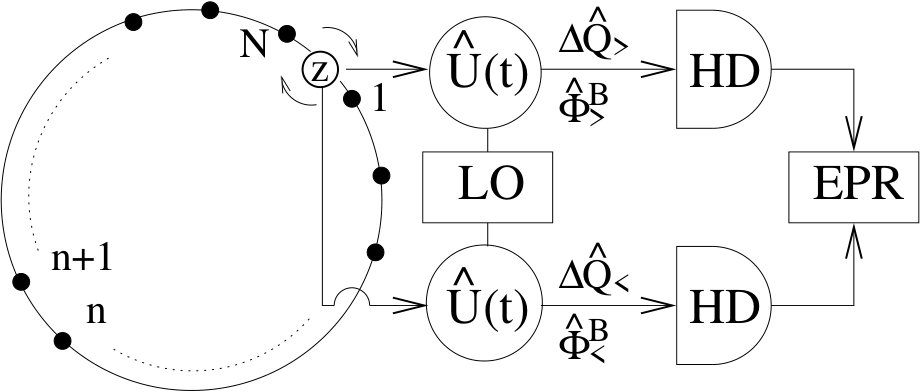 Figure 1
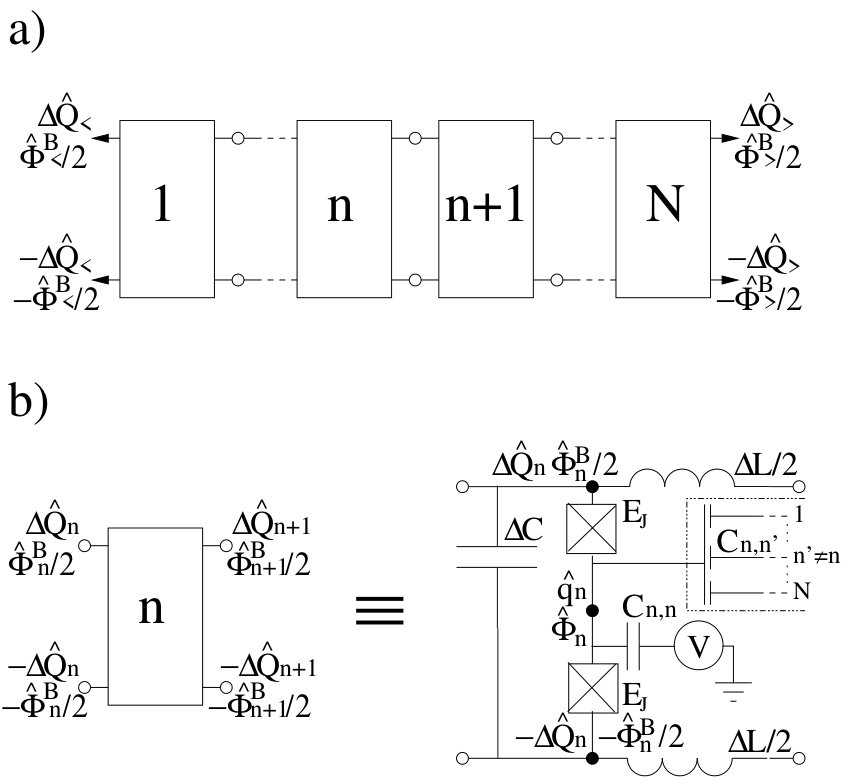 Figure 2
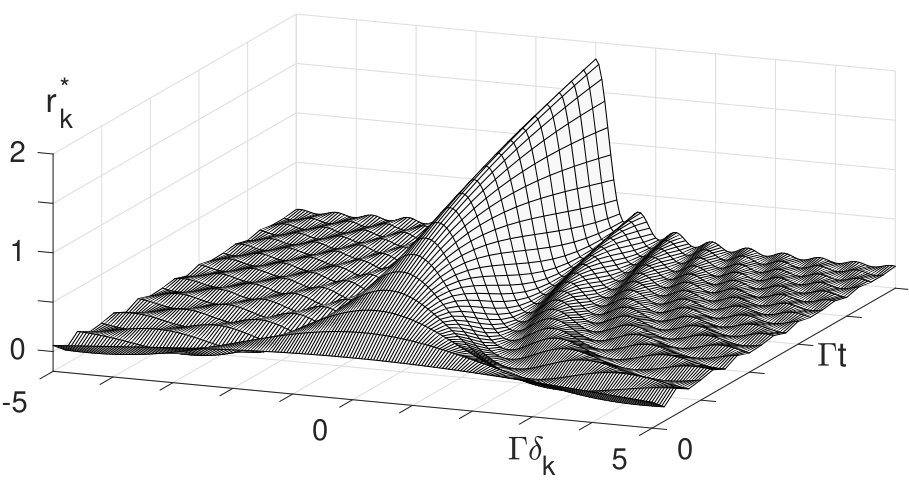 Figure 3
Peer Reviews
No public reviews on file for this paper yet. If you reviewed it on a platform where reviews are public (OpenReview, ICLR, NeurIPS, ICML), you can paste yours below so the community can read it here.
Videos
No videos yet. Explain this paper in a talk, walkthrough, or lecture? Add one.
Entangling continuous variables with a qubit array
Patrick Navez1,2, Artur Sowa2, Alexander Zagoskin3
1 Helmholtz-Zentrum Dresden-Rossendorf, Bautzner Landstraße 400, 01328 Dresden, Germany
2 University of Saskatchewan, Dept of Math. and Stat. , Saskatoon, S7N 5E6, Canada
3 Dept of Phys., Loughborough University, Loughborough LE11 3TU, United Kingdom
Abstract
We show that an array of qubits embedded in a waveguide can emit entangled pairs of microwave photon beams. The quadratures obtained from a homodyne detection of these outputs beams form a pair of correlated continuous variables similarly to the EPR experiment. The photon pairs are produced by the decay of plasmon-like collective excitations in the qubit array. The maximum intensity of the resulting beams is only bounded by the number of emitters. We calculate the excitation decay rate both into a continuum of photon state and into a one-mode cavity. We also determine the frequency of Rabi-like oscillations resulting from a detuning.
pacs:
42.50.Nn,42.50.Lc,71.70.Gm,84.40.Az
Introduction: The steady improvement of superconducting electronics over the last two decades Paik et al. (2011); Koch et al. (2007); Wendin (2017) cemented the place of Josephson effect-based devices among the leading platforms for quantum technologies (e.g., quantum computation) Makhlin et al. (2001). However, the control and observation of essential quantum correlations and entanglement necessary for the operation of these technologies remains a challenging task Zagoskin et al. (2014); Navez et al. (2017). A convenient testbed for this research is provided by a superconducting qubit array embedded in a coplanar waveguide (a ”1D quantum metamaterial” setup) Paik et al. (2011); Koch et al. (2007); Wendin (2017); Wallraff et al. (2004); Il’ichev et al. (2003); Hoi et al. (2013); Sowa1 and Zagoskin . Some of these metamaterials are predicted to display interesting nonlinear properties like the two-photon induced transparency Rakhmanov et al. (2008); Zagoskin et al. (2009); Savel’ev et al. (2012), superradiance Bamba et al. (2016); Asai et al. (2018) and lasing Ivić et al. (2016) but these results have been obtained using approximations short of a full QED treatment.
In this Letter we build a consistent theory for a linear array of qubits placed in a waveguide. Specifically, we consider a set of capacitively coupled transmons, but the general results are not going to be sensitive to the particular kind of a qubit. The Josephson junctions are arranged symmetrically in order to ensure a quadratic coupling to the electromagnetic field. The collective excitations are produced by abrupt changes of qubit electric charges, tantamount to a sudden modification of the photon dispersion relation in the waveguide - a quantum analogue of the emission of cosmological radiation in a curved space for spontaneous particle pair creations Lang and Schützhold (2018); Tian et al. (2017) also refereed as dynamical Casimir effect Wilson et al. (2011). The symmetry ensures that collective excitations of the array decay into the entangled microwave beams propagating along the waveguide in the opposite directions.
Compared to the prior art, the proposed mechanism does not involve the use of an external magnetic field Lähteenmäki et al. (2013) or a pump field within a waveguide Grimsmo and Blais (2017). It predicts quantum correlations at distance and therefore differs from other studies like the two photons correlations analyzed in Fang and Baranger (2016, 2017, 2015), or sub- and superradiance in Lalumière et al. (2013) or even phase transition Zhang et al. (2014).
Setup: The proposed scheme is presented in Fig.1 and Fig.2. An array of transmon qubits is embedded in a ring waveguide at zero temperature. Starting at equilibrium, we adiabatically increase the potential of the qubit island to , and then suddenly drop it to zero. The initial charge on the island is , where is the effective capacitance. Classically, the island charge oscillates at a frequency , where Josephson energy for a transmon. In the quantum case these oscillations will decay into the electromagnetic vacuum modes by producing two counterpropagating entangled beams. The subsequent action of a circulator passes these outputs on for a homodyne detection Mallet et al. (2011), that includes local oscillator mixing and frequency filtering, in order to determine their mutual EPR-type quantum correlations Navez et al. (2001); Einstein et al. (1935). The integral of the voltage pulse (flux Zagoskin (2011)) and the total induced charge correspond to correlated (resp. anticorrelated) continuous variable quadratures.
Theoretical model: The lumped-elements scheme of the device is shown in Fig.2. The th transmon’s quantum operators are its excess charge measured from the equilibrium value and flux . Its mutual capacitance with the neutral gate (with gate voltage ) is , and is the mutual capacitance between the th and th transmons. We omit the capacitive couplings to the waveguide as they cancel out for the decay process. The waveguide is described by conjugated operators charges and fluxes , and is characterized by the mutual capacitance and inductance between two adjacent transmons. These operators obey the canonical commutation relations and .
The Hamiltonian of the system is obtained by quantizing the different components’ contributions to the total energy Vool and Devoret (2017), yielding:
[TABLE]
where is the bare Josephson energy of a junction (see Fig.2). The effective renormalized Josephson energy is defined with respect to the vacuum energy state . The essentially nonlinear cosine interaction terms between the transmons and the electromagnetic modes result from the Josephson junctions and have been configured so as to be an even function of each field amplitude.
The transmons can be close enough to each other to be coupled through the mutual capacitances. Assuming the translational invariance of the ring, depends only on the distance modulo and it is convenient to define their Fourier components: . Here the integer is defined modulo , and the capacitance energy can be written as . Under these conditions, we can rewrite the transmon operators in their ”wavevector” components as:
[TABLE]
The creation-annihilation operators and describe plasmon-like collective excitations of charge motion with a wavenumber given by .
The charge and flux operators can be similarly defined through the electromagnetic field component as and . Here is the vector potential for an ideal waveguide consisting of two parallel infinite planes Rakhmanov et al. (2008). It can be expressed through the wavevector components:
[TABLE]
where and are the photon creation-annihilation operators. The vacuum state is, as usual, defined from and . With respect to this vacuum definition and in the weak coupling approximation, the Hamiltonian (1) is rewritten for in terms of the circuit component characteristics only, up to fourth order in the field and in a normal ordered form as:
[TABLE]
The first and second terms correspond respectively to the plasmon mode with energy spectrum and the photon mode with , where and . The plasmon spectrum is almost flat. The photon spectrum has a gap resulting from the Josephson energy contribution. Without it, the spectrum would be linear with a light speed where is the transmon interdistance. The third term is the quartic interaction responsible of for the coupling between the radiation and the transmon qubits and is negligible only if . Note that we neglect the quartic self-modulation terms responsible for anharmonicity Koch et al. (2007) for both fields since these are even weaker than the coupling.
The proposed experiment: We start by adiabatically applying to each qubit the potential , producing the initial charge with the non zero expectation interpreted as displacement of the vacuum state. Then the potential is suddenly dropped to zero. The qubit islands begin discharging, emitting in the process entangled pairs of photons. The corresponding transmon state is a coherent state with . Its amplitude at is
[TABLE]
The qu-bit regime is recovered in the case of fainted coherent state. If parametrize the squeezed radiation mode with the squeezing amplitude and the phase , the full Ansatz for the quantum state of radiation in the waveguide is 111See the Supplemental Materials for the mathematical details
[TABLE]
with the displacement unitary transformation .
From the Lagrangian we obtain the dynamical equations:
[TABLE]
In the short time limit, assuming that all the capacitances are of the same order of magnitude and taking realistic values for the system parameters (, ), we can make the following direct estimates. The rate of squeezing is for the initial voltage V. The relative charge leakage, , is quadratic in time.
In the long time limit, the equations are solved in the rotating wave approximation. Then the decaying of two transmon excitations into two photons satisfies the number and energy conservation . We consider two distinct cases of a transmon excitation decaying into either a continuum of photon modes or into a single mode.
Decay into a continuum : In the large- limit and for weak squeezing , we can approximate the phase by . The solution for the transmon field in the continuum limit is then with a inverse power decay rate:
[TABLE]
This rate corresponds to the capacitance energy perturbation introduced initially and has to be much less than the plasmon frequency (typically in the GHz-THz range) but much larger than any decoherence rate (in the MHz range)Paik et al. (2011). For the squeezing parameter, we obtain:
[TABLE]
where is the detuning frequency. Fig.3 represents its growing with time and concentrating at zero detuning.
The total number of photons in one direction can then be estimated as
[TABLE]
The photon waves along the two opposite direction have the perfect entanglement correlation .
Their quadratures are also correlated and are measured through a homodyne detection after mixing them with a local oscillator of frequency that is simply described via the unitary operator . The effective output signals are
[TABLE]
Their averages are zero. However, we determine EPR correlations for the Fourier components , of these continuous variables relatively to the shot noise level Navez et al. (2001):
[TABLE]
These correlations become important for large squeezing. The corresponding physical quadratures are the charge and the flux in the waveguide, which are, respectively, anticorrelated and correlated.
Oscillation with two modes: In case of long wavelengths (GHz), the frequency separation between modes in the ring becomes large. We can then select only two entangled modes only in the Eqs.(9,10,11), which interact with a resonant transmon mode. Other photon modes are not perturbed.
Besides the interaction terms for the transition, an additional modulation phase term affects the transition frequency Grimsmo and Blais (2017). The maximum squeeezing that can be reached is corresponding to the total depletion . For simplicity, we shall assume the phase modulation term is constant which implies the restriction to values . We define the dimensionless parameters: and . Two cases are considered:
1) No phase modulation: For short times, we note that the fastest squeezing rate is achieved if the phase matching condition is satisfied. Using this condition, the phase modulation can be neglected and the squeezing parameter evolves towards . The explicit expression is
[TABLE]
2) Weak depletion: When the the detuning is not phase matched, the charge leakage from the island can be neglected, i.e . For a small value of detuning within the interval , the photon number grows exponentially: with the characteristic angular frequency . Outside this interval, the solution becomes , which corresponds to a Rabi-like oscillation between the plasmon mode and the photon modes. This Rabi-like superposition of a plasmon state and an EPR photon state illustrates the rich possibilities offered by this qubit line device for quantum design.
Conclusions: We propose the superconducting transmon line embedded in a ring waveguide as a generator of entangled beams of microwave radiation. Using the fully quantum description, we can describe the scattering process between photons and the collective transmon excitation. We also show that high squeezing may be obtained in the long wavelength regime, allowing for a genuine EPR-like experiment in a microchip device. An interesting extension of this design would be a parametric optical amplifier with the proposed setup for quantum imaging Navez et al. (2001); Grimsmo and Blais (2017).
Acknowledgements: PN thanks G. Tsironis, Z. Ivic and J. Brehm for helpful discussions and the Dept. of Mathematics and Statistics, University of Saskatchewan, for hospitality. AZ was partially supported by the NDIAS Residential Fellowship (University of Notre Dame).
The reference list from the paper itself. Each links out to its DOI / PubMed record.
- 1Paik et al. (2011) H. Paik, D. I. Schuster, L. S. Bishop, G. Kirchmair, G. Catelani, A. P. Sears, B. R. Johnson, M. J. Reagor, L. Frunzio, L. I. Glazman, S. M. Girvin, M. H. Devoret, and R. J. Schoelkopf, Phys. Rev. Lett. 107 , 240501 (2011) . · doi ↗
- 2Koch et al. (2007) J. Koch, T. M. Yu, J. Gambetta, A. A. Houck, D. I. Schuster, J. Majer, A. Blais, M. H. Devoret, S. M. Girvin, and R. J. Schoelkopf, Phys. Rev. A 76 , 042319 (2007) . · doi ↗
- 3Wendin (2017) G. Wendin, Reports on Progress in Physics 80 , 106001 (2017).
- 4Makhlin et al. (2001) Y. Makhlin, G. Schön, and A. Shnirman, Rev. Mod. Phys. 73 , 357 (2001) . · doi ↗
- 5Zagoskin et al. (2014) A. M. Zagoskin, E. Il’ichev, M. Grajcar, J. J. Betouras, and F. Nori, Frontiers in Physics 2 , 33 (2014).
- 6Navez et al. (2017) P. Navez, G. P. Tsironis, and A. M. Zagoskin, Phys. Rev. B 95 , 064304 (2017) . · doi ↗
- 7Wallraff et al. (2004) A. Wallraff, D. I. Schuster, A. Blais, L. Frunzio, R.-S. Huang, J. Majer, S. Kumar, S. M. Girvin, and R. J. Schoelkopf, Nature 431 , 162 (2004).
- 8Il’ichev et al. (2003) E. Il’ichev, N. Oukhanski, A. Izmalkov, T. Wagner, M. Grajcar, H.-G. Meyer, A. Y. Smirnov, A. Maassen van den Brink, M. H. S. Amin, and A. M. Zagoskin, Phys. Rev. Lett. 91 , 097906 (2003) . · doi ↗