Decoding quantum errors with subspace expansions
Jarrod R. McClean, Zhang Jiang, Nicholas C. Rubin, Ryan Babbush,, Hartmut Neven

TL;DR
This paper introduces a simplified, post-processing error decoding method for quantum codes that enhances error correction capabilities on near-term quantum devices without requiring complex syndrome measurements.
Contribution
It presents a general subspace expansion technique for quantum error decoding that is easy to implement and applicable to various error models and physical Hamiltonians.
Findings
Achieved a pseudo-threshold of ~0.50 with the [[5,1,3]] code under depolarizing noise.
Demonstrated improved error correction on an unencoded hydrogen molecule.
Validated the method's effectiveness on logical operations and physical Hamiltonians.
Abstract
With the rapid developments in quantum hardware comes a push towards the first practical applications on these devices. While fully fault-tolerant quantum computers may still be years away, one may ask if there exist intermediate forms of error correction or mitigation that might enable practical applications before then. In this work, we consider the idea of post-processing error decoders using existing quantum codes, which are capable of mitigating errors on encoded logical qubits using classical post-processing with no complicated syndrome measurements or additional qubits beyond those used for the logical qubits. This greatly simplifies the experimental exploration of quantum codes on near-term devices, removing the need for locality of syndromes or fast feed-forward, allowing one to study performance aspects of codes on real devices. We provide a general construction equipped with…
Click any figure to enlarge with its caption.
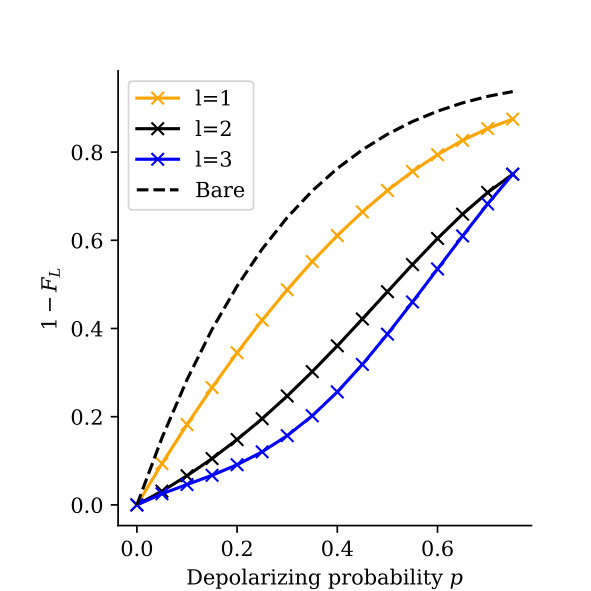 Figure 1
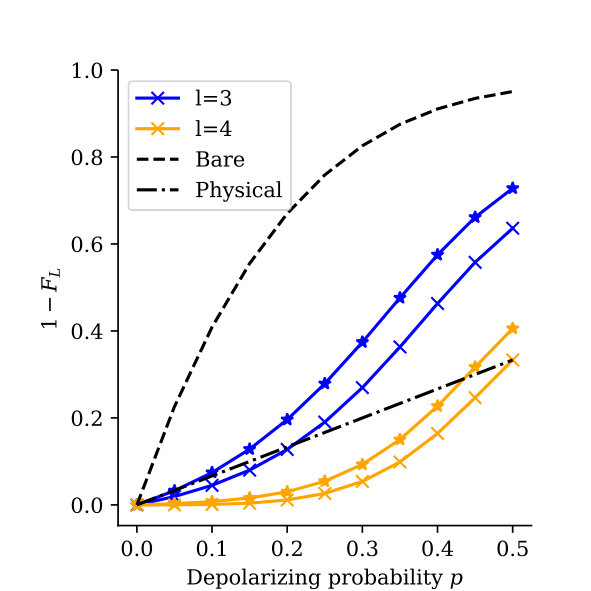 Figure 2
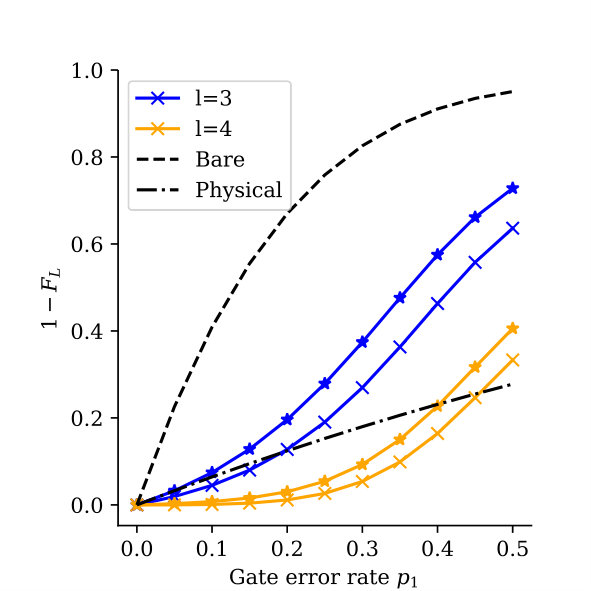 Figure 3
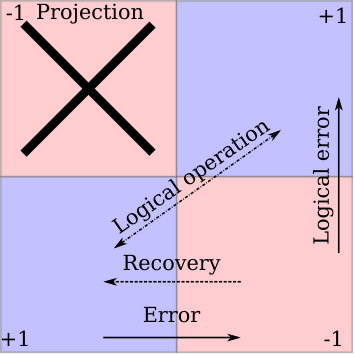 Figure 4
Peer Reviews
No public reviews on file for this paper yet. If you reviewed it on a platform where reviews are public (OpenReview, ICLR, NeurIPS, ICML), you can paste yours below so the community can read it here.
Videos
No videos yet. Explain this paper in a talk, walkthrough, or lecture? Add one.