The Integrable Optics Test Accelerator
Ben Freemire, Jeffrey Eldred

TL;DR
The paper discusses the IOTA at Fermilab, focusing on its experimental efforts to develop advanced beam control technologies like nonlinear integrable optics and electron column space charge compensation, aiming to enhance high-intensity particle beams for future experiments.
Contribution
It introduces the IOTA facility and its novel R&D efforts in nonlinear integrable optics and space charge compensation for improved accelerator performance.
Findings
Development of nonlinear integrable optics techniques.
Progress in electron column-based space charge compensation.
Potential for higher beam power with better control.
Abstract
The Integrable Optics Test Accelerator (IOTA) at the Fermilab Accelerator Science & Technology (FAST) Facility is beginning operations, with an experimental program aimed at developing technology to enable future high intensity particle beams. The results garnered from IOTA should allow for better control of beam losses, leading to higher safely achievable beam power. This will be particularly useful for future accelerator based neutrino experiments. Two of the R&D efforts at IOTA, Nonlinear Integrable Optics and Electron Column-based space charge compensation, are discussed here.
Click any figure to enlarge with its caption.
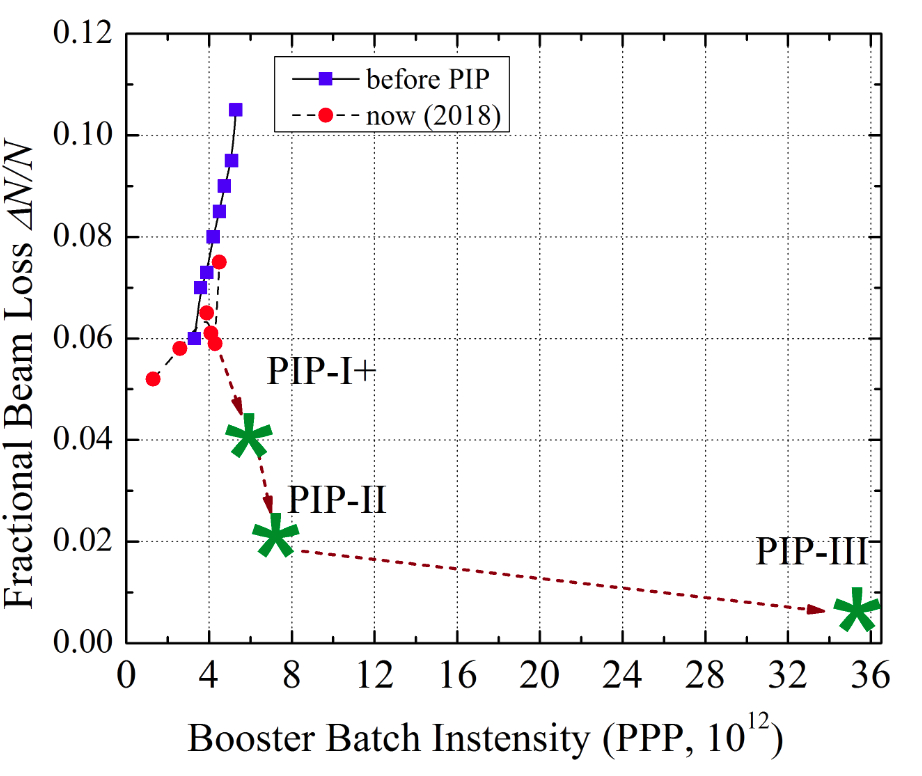 Figure 1
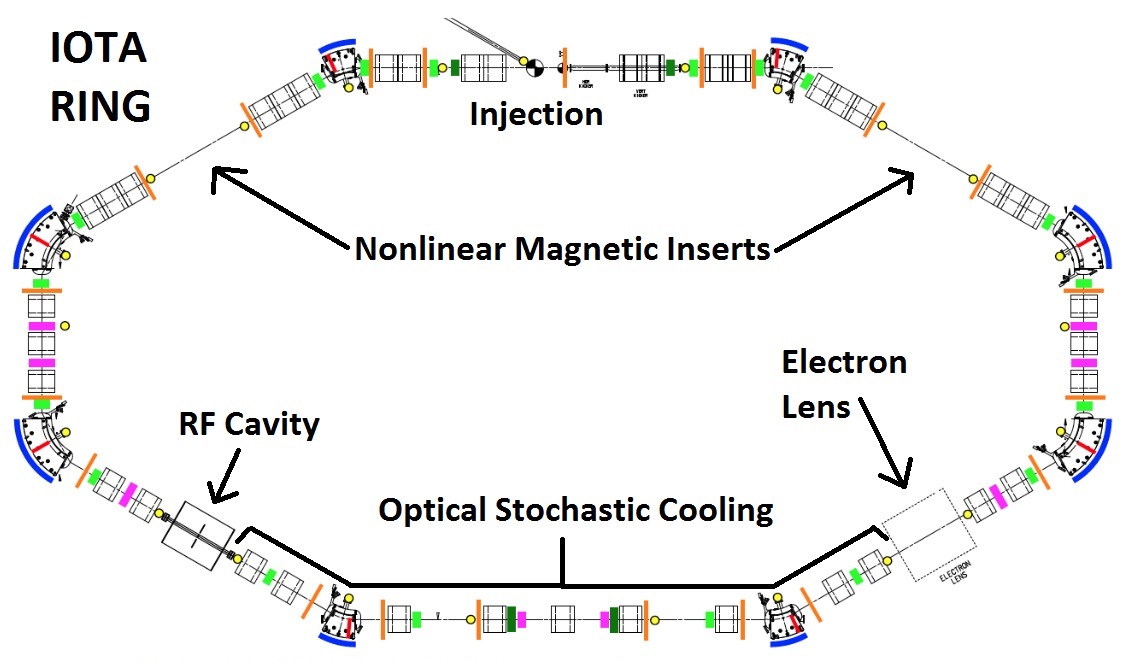 Figure 1
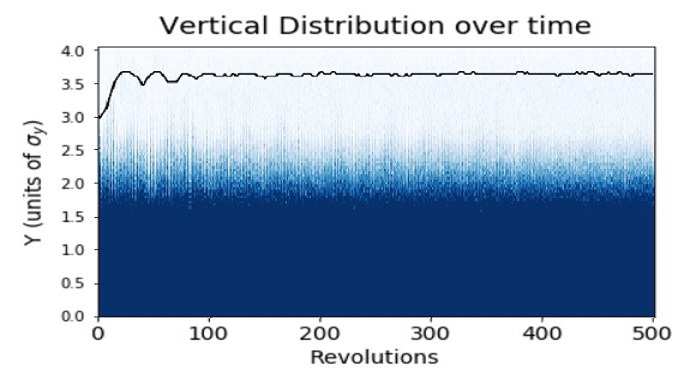 Figure 2
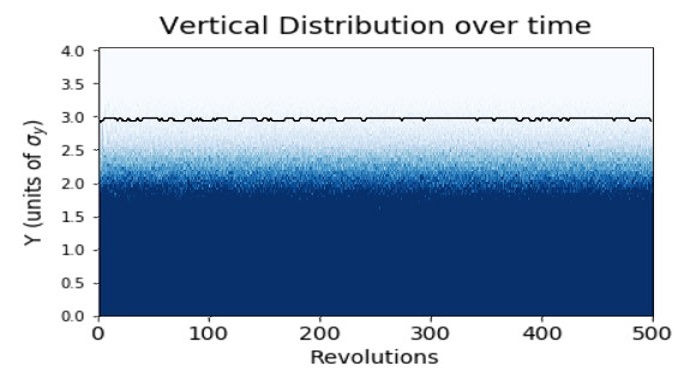 Figure 2
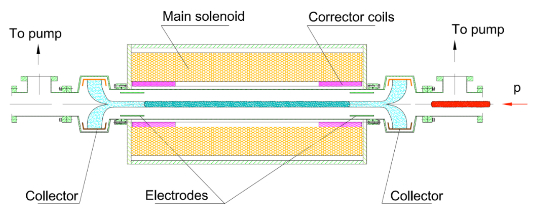 Figure 3
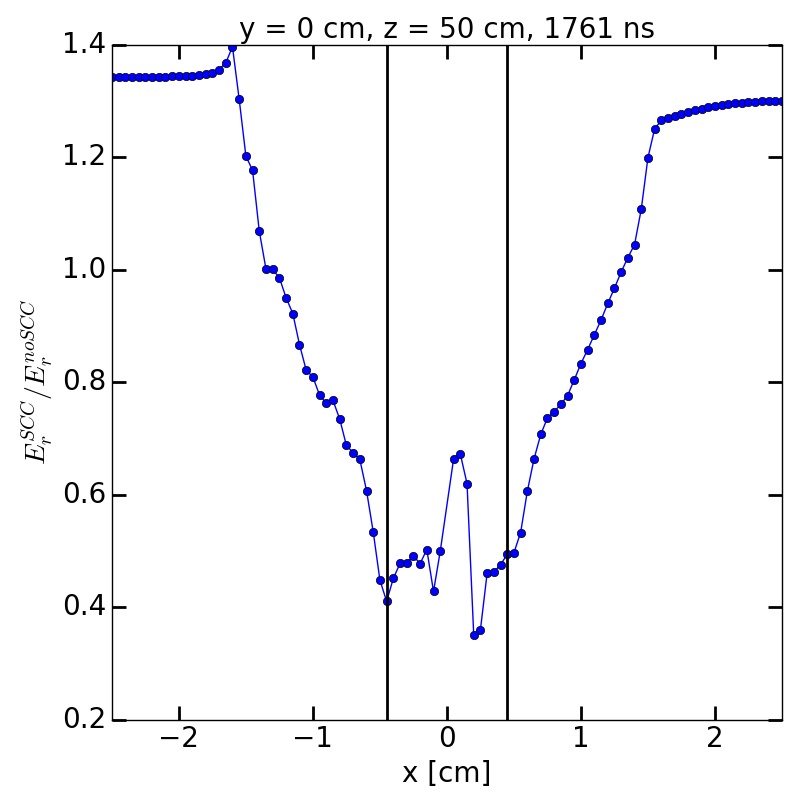 Figure 3
Peer Reviews
No public reviews on file for this paper yet. If you reviewed it on a platform where reviews are public (OpenReview, ICLR, NeurIPS, ICML), you can paste yours below so the community can read it here.
Videos
No videos yet. Explain this paper in a talk, walkthrough, or lecture? Add one.
Taxonomy
TopicsGyrotron and Vacuum Electronics Research · Particle Accelerators and Free-Electron Lasers · Photonic and Optical Devices
The Integrable Optics Test Accelerator
Northern Illinois University, DeKalb, Illinois 60115, USA
E-mail Work supported by the U.S. Department of Energy, Office of High Energy Physics, under Contract Nos. DE-AC02-07CH11359 and DE-AC02-05CH1123 and General Accelerator Research and Development (GARD) Program.
J. Eldred
Fermi National Accelerator Laboratory, Batavia, Illinois 60510, USA
for the FAST/IOTA Team
Abstract:
The Integrable Optics Test Accelerator (IOTA) at the Fermilab Accelerator Science & Technology (FAST) Facility is beginning operations, with an experimental program aimed at developing technology to enable future high intensity particle beams. The results garnered from IOTA should allow for better control of beam losses, leading to higher safely achievable beam power. This will be particularly useful for future accelerator based neutrino experiments. Two of the R&D efforts at IOTA, Nonlinear Integrable Optics and Electron Column-based space charge compensation, are discussed here.
1 Introduction
The next generation of accelerator-based neutrino experiments rely on proton drivers exceeding the 1 MW benchmark [1, 2, 3]. At Fermilab, the Proton Improvement Plan II (PIP-II) will provide 1.2 MW beam power at 120 GeV, which is the initial requirement for the Deep Underground Neutrino Experiment (DUNE) physics program [4]. The DUNE baseline calls for a further upgrade to 2.4 MW [5] while simultaneously decreasing the fractional beam loss in the first ring of the accelerator complex, the Booster (see the left plot in Fig. 1). A new rapid-cycling synchrotron (RCS) has been proposed to replace the Booster [6, 7, 8].
An accelerator R&D program has been launched at the Fermilab Accelerator Science & Technology (FAST) Facility with the goal of demonstrating technology for the next generation of particle accelerators. The current flagship of FAST’s experimental program is the Integrable Optics Test Accelerator (IOTA), a modular electron/proton storage ring [9]. Two technologies in particular, Nonlinear Integrable Optics and Electron Lens/Column space-charge compensation, are being developed at IOTA to enhance the performance of high-intensity hadron rings [10, 11]. The layout of IOTA is shown in Fig. 1 on the right.
2 Nonlinear Integrable Optics
Nonlinear Integrable Optics is a development in particle accelerator technology that enables strong nonlinear focusing without generating new parametric resonances [12]. Integrable optics is considered for high-intensity rings, where nonlinearity is known to suppress halo formation [13] and enhance Landau damping of charge-dominated collective instabilities [14].
In high-intensity beams, small disturbances of the beam core can cause outlying particles to be drawn into the beam halo [15]. Under conditions of strong nonlinear focusing, the mismatched particle beams rapidly reach an equilibrium distribution that can suppress halo [16]. Simulations of nonlinear integrable lattices demonstrate that halo can be suppressed (see Fig. 2) while the large betatron tune-spread is not impacted by crossing fourth-order resonance lines [13, 17].
Perfect integrable motion requires particles to have precisely defined phase-advances, but the phase-advances would be shifted by the space-charge forces. The lattice is tuned to compensate the linear space-charge tune-shift at a certain beam intensity [18] and a recent simulation of an integrable RCS lattice showed stable nonlinear motion with a space-charge tune-shift of -0.4 [10].
Webb et al. [20, 21] showed that chromaticity of an integrable lattice does not have to be corrected to zero; the motion of an off-momentum particle is integrable if the horizontal and vertical chromaticity are matched. For a ring composed of several integrable cells the synchrotron motion is adiabatic [21, 22] and the beam can be stable under significant chromatic tune spread [10].
3 Space Charge Compensation
An Electron Column will be tested in IOTA that is similar to an Electron Lens, but simpler in that no electron gun or collector, or transport magnets are required. The Electron Column works by matching the profile of a plasma created by ionization of a short section of (hydrogen) gas to that of the beam using electrodes and a solenoid (see the diagram on the left in Fig. 3). The solenoid must be strong enough to suppress electron-proton instabilities, but weak enough to allow the ions produced to escape the Column, leaving the electrons to neutralize the charge of the beam.
Simulations of the Electron Column show space charge compensation within the beam’s radius after a single turn, as shown in Fig. 3 on the right [11]. Current studies are focused on following the evolution of the plasma and a beam matched to the rest of the IOTA lattice over many turns.
4 Outlook
Commissioning of the Nonlinear Magnet in IOTA with electrons has recently begun. After the first round of electron experiments, a proton source and RFQ will be installed, and commissioning with protons in IOTA will take place. IOTA will focus on innovative results for the production of more intense beams, at Fermilab and at large.
The reference list from the paper itself. Each links out to its DOI / PubMed record.
- 1[1] M. Bishai, The Science and Design of the LBNF Beamline , in These Proceedings, Blacksburg, Virginia, USA, Aug. 2018.
- 2[2] T. Sekiguchi, Development and Operational Experience of T 2K Magnetic Horn for over-MW Beam , in These Proceedings, Blacksburg, Virginia, USA, Aug. 2018.
- 3[3] Y. Zou, Challenges and Status of the ES Snu SB Accumulator Design , in These Proceedings, Blacksburg, Virginia, USA, Aug. 2018.
- 4[4] S. Gollapinni, The DUNE Experiment: Status and Prospects , in These Proceedings, Blacksburg, Virginia, USA, Aug. 2018.
- 5[5] B. Abi et al. (DUNE Collaboration), The DUNE Far Detector Interim Design Report Volume 1: Physics, Technology and Strategies , Fermilab Technical Note, Fermilab-Design-2018-02, 2018 [ ar Xiv:1807.10334 ].
- 6[6] V. Shiltsev, Fermilab Proton Accelerator Complex Status and Improvement Plans , Mod. Phys. Lett. A. 32 1730012 (2017) [ ar Xiv:1705.03075 ].
- 7[7] J. Eldred and A. Valishev, Design Considerations for Proposed Fermilab Integrable RCS , in Proceedings of NAPAC’16 , THPOA 19, Chicago, Illinois, USA, Oct. 2016.
- 8[8] E. J. Prebys et al., Long Term Plans to Increase Fermilab’s Proton Intensity to Meet the Needs of the Long Baseline Neutrino Program , in Proceedings of IPAC’16 , TUOAA 03, Busan, South Korea, May 2016.