
TL;DR
This paper develops a topological string geometry theory that reproduces perturbative string amplitudes and aims to facilitate the study of non-perturbative effects in string theory.
Contribution
It introduces a topological string geometry framework that simplifies deriving non-perturbative effects and reproduces known perturbative results from classical solutions.
Findings
Perturbative partition function derived from fluctuations in the topological string geometry.
The theory correctly reproduces perturbative string amplitudes.
Provides a foundation for exploring non-perturbative string phenomena.
Abstract
Perturbative string amplitudes are correctly derived from the string geometry theory, which is one of the candidates of a non-perturbative formulation of string theory. In order to derive non-perturbative effects rather easily, we formulate topological string geometry theory. We derive the perturbative partition function of the topological string theory from fluctuations around a classical solution in the topological string geometry theory.
Click any figure to enlarge with its caption.
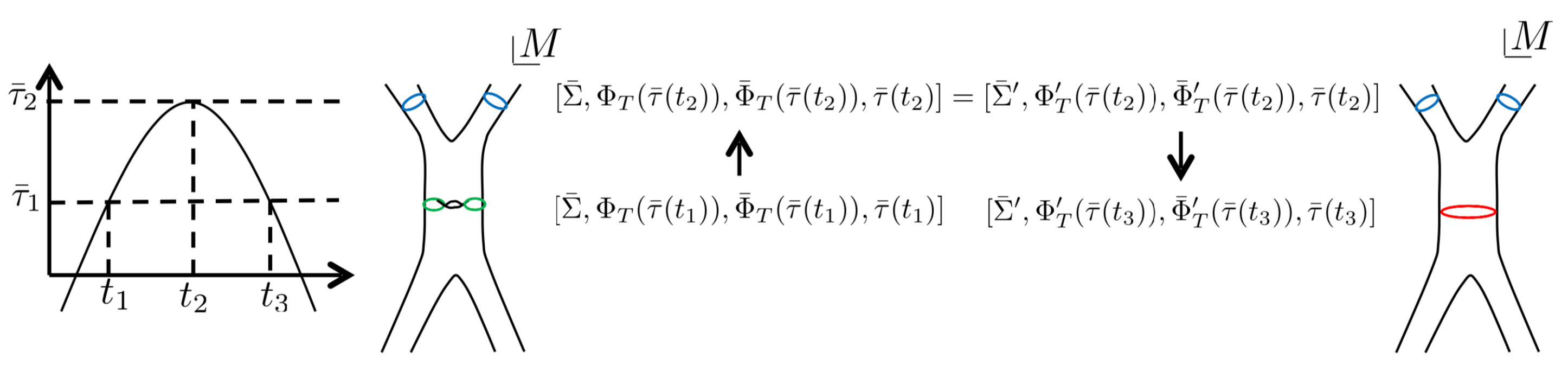 Figure 1
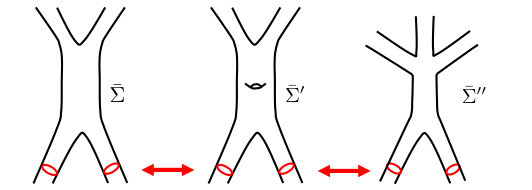 Figure 2
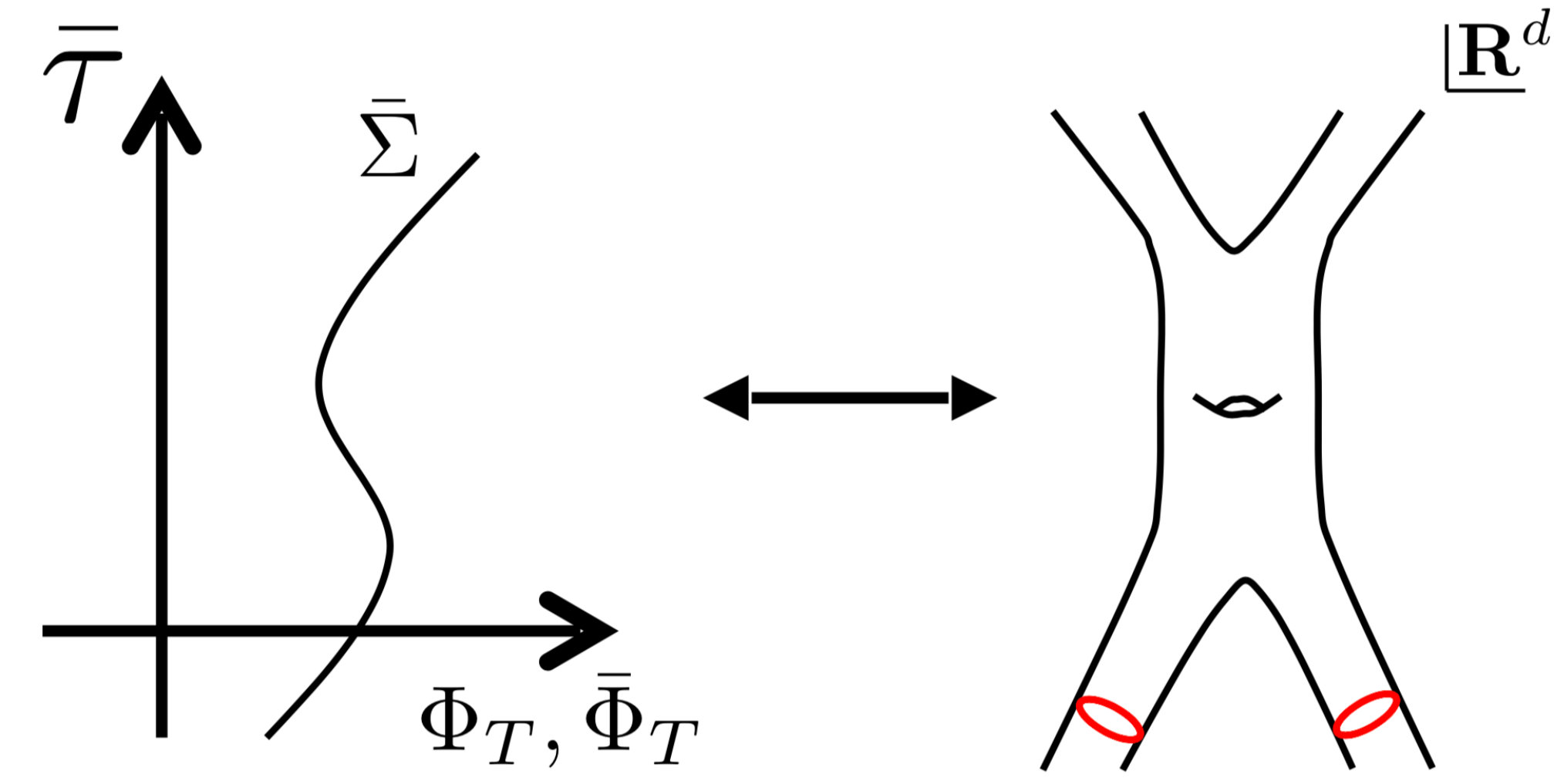 Figure 3
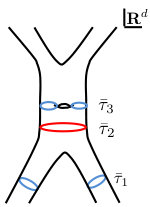 Figure 4
Peer Reviews
No public reviews on file for this paper yet. If you reviewed it on a platform where reviews are public (OpenReview, ICLR, NeurIPS, ICML), you can paste yours below so the community can read it here.
Videos
No videos yet. Explain this paper in a talk, walkthrough, or lecture? Add one.
OCU-PHYS 497
USTC-ICTS-19-05
Topological String Geometry
Matsuo Sato*[email protected] and Yuji Sugimoto†††[email protected]**
*Graduate School of Science and Technology, Hirosaki University
Bunkyo-cho 3, Hirosaki, Aomori 036-8561, Japan**
*Osaka City University Advanced Mathematical Institute (OCAMI) 3-3-138, Sugimoto, Sumiyoshi-ku, Osaka, 558-8585, Japan
Interdisciplinary Center for Theoretical Study, University of Science and Technology of China, Hefei, Anhui 230026, China*
Abstract
Perturbative string amplitudes are correctly derived from the string geometry theory, which is one of the candidates of a non-perturbative formulation of string theory. In order to derive non-perturbative effects rather easily, we formulate topological string geometry theory. We derive the perturbative partition function of the topological string theory from fluctuations around a classical solution in the topological string geometry theory.
Contents
- 1 Introduction
- 2 Topological string geometry
- 3 Perturbative topological string from topological string geometry
- 4 Conclusion and discussion
- A Superfield formalism in topological string theory
1 Introduction
String geometry theory is one of the candidates of non-perturbative formulation of string theory [1]. Actually, the theory possesses appropriate properties as a non-perturbative formulation as follows. First, we can derive the all-order perturbative scattering amplitudes that possess the super moduli in IIA, IIB and SO(32) I superstring theories from the single theory by considering fluctuations around fixed perturbative IIA, IIB and SO(32) I vacua, respectively. Second, the theory is background independent. Third, the theory unifies particles and the space-time.
Next task is to derive non-perturbative effects from the theory. In order to derive non-perturbative effects rather easily, we formulate a topological string geometry theory in this paper. It is worthy to study the topological string geometry theory, since non-perturbative partition functions of the topological string theory on a certain class of the Calabi–Yau manifolds are proposed as we will explain below.
Non-perturbative partition functions in topological string theory on non-compact toric Calabi–Yau manifolds were conjectured by using dualities [2, 3]. In [3], a non-perturbative free energy is given by the combination of the unrefined free energy and Nekrasov–Shatashvili limit of the refined free energy [4]. The authors in [5] proposed that the non-perturbative free energy in [3] closely relates to the quantization of the mirror curve [6, 7], based on the duality between ABJM matrix model and the topological string theory on local [8, 9, 10]. This relation is sometimes called as Topological String/Spectral Theory correspondence. (The overview of the correspondence is given in e.g. [11]). In addition, the authors in [12] show that the non-perturbative free energy in [3] agrees with that obtained by applying the resurgence technique, developed in [13, 14], to the perturbative topological string theory in case of local . In spite of such progresses, the first principle calculations of the non-perturbative partition functions are still not known. We expect to provide an answer to this issue from topological string geometry theory.
The rest of the paper is organized as follows. In section 2, we perform a topological twist of string geometry theory and define topological string geometry theory. In section 3, we derive perturbative topological string theory in the flat background by considering fluctuations around a classical solution of the topological string geometry theory. In Appendix A, we develop a superfield formalism of the topological string since the string geometry theory is defined in a superfield formalism.
2 Topological string geometry
In this section, we will define topological string geometry by performing a topological twist of string geometry [1].
As in [1], on the topological super Riemannian surfaces , there exists an unique Abelian differential that has simple poles with residues at where , if it is normalized to have purely imaginary periods with respect to all contours to fix ambiguity of adding holomorphic differentials. A global time is defined by at any point on [15, 16]. takes the same value at the same point even if different contours are chosen in , because the real parts of the periods are zero by definition of the normalization. In particular, at with negative and at with positive . A contour integral on constant line around : indicates that the region around is . This means that around represents a semi-infinite supercylinder with radius . The condition means that the total region of incoming supercylinders equals to that of outgoing ones if we choose the outgoing direction as positive. That is, the total region is conserved. In order to define the above global time uniquely, we fix the regions around . We divide ’s to arbitrary two sets consist of and ’s, respectively (), then we divide equally to , and to .
Thus, under a superconformal transformation, one obtains a topological super Riemann surface that has coordinates composed of the global time and the position . Because can be a supermoduli of super Riemann surfaces [17], any two-dimensional topological super Riemannian manifold can be obtained by where is a superdiffeomorphism times super Weyl transformation.
Next, we will define a model space . We consider a state determined by , a constant hypersurface and an arbitrary map from to the Euclidean space . and are defined by restricting (A.2) to the constant hypersurface whose conditions are given by
[TABLE]
for and
[TABLE]
for where is the metric of the worldsheet, and and is the gravitino of the worldsheet.
is a union of supercylinders with radii at . Thus, we define a string state as an equivalence class by a relation if , , , and as in Fig. 1. Because where is the reduced space of , and , represent many-body states of strings in as in Fig. 2. The model space is defined by a collection of all the string states as , where runs A and B.
Here, we will define topologies of . We define an -open neighbourhood of by
[TABLE]
where
[TABLE]
consistently if , , , , and is small enough, because the constant hypersurface traverses only supercylinders overlapped by and .
is defined to be an open set of if there exists such that for an arbitrary point . The topology of satisfies the axiom of topology. The proof is the same as in [1].
Although the model space is defined by using the coordinates , the model space does not depend on the coordinates, because the model space is a topological space.
By definition of the -open neighbourhood, arbitrary two string states on a connected topological super Riemann surface in are connected continuously. Thus, there is an one-to-one correspondence between a topological super Riemann surface with punctures in and a curve parametrized by from to on . That is, curves that represent asymptotic processes on reproduce the right moduli space of the topological super Riemann surfaces in .
By a general curve parametrized by on , string states on different topological super Riemann surfaces that have even different numbers of genera, can be connected continuously, as in Fig. 3, whereas different topological super Riemann surfaces that have different numbers of genera cannot be connected continuously in the moduli space of the topological super Riemann surfaces.
In the following, we denote , where (, , , ) is the worldsheet topological super vierbein on defined by (A.2), instead of , because giving a topological super Riemann surface is equivalent to giving a topological super vierbein up to super diffeomorphism and super Weyl transformations.
Next, in order to define structures of string manifold, we consider how generally we can define general coordinate transformations between and where and . does not transform to , , and and vice versa, because , , and are continuous variables, whereas is a discrete variable: , , and vary continuously, whereas varies discretely in a trajectory on by definition of the neighbourhoods. does not transform to and and vice versa, because the string states are defined by constant hypersurfaces. Under these restrictions, the most general coordinate transformation is given by
[TABLE]
where represents a world-sheet superdiffeomorphism transformation111 We extend the model space from to by including the points generated by the superdiffeomorphisms , , and .. represents that these coordinates are transformed by diffeomorphism and only its Q-partners: and are not transformed, and , and does not depend on or 222We consider only these diffeomorphism and its Q-partners in the following.. , , and are functionals of , , and . We consider all the manifolds which are constructed by patching open sets of the model space by the general coordinate transformations (LABEL:GeneralCoordTrans) and call them topological string manifolds . An example of the string manifold in the critical string theory is given in [1].
The tangent space is spanned by , , and as one can see from the -open neighbourhood (2.3)333 in denotes the collection of the Grassmann coordinates, , , and .. We should note that cannot be a part of basis that span the tangent space because is just a discrete variable in . The index of and can be and . Then, let us define a summation over and that is invariant under and transformed as a scalar under . First, is invariant under , where is the superdeterminant of . A super analogue of the lapse function, transforms as an one-dimensional vector in the direction: is invariant under and transformed as a superscalar under . Therefore, , where , is transformed as a scalar under and invariant under .
Riemannian topological string manifold is obtained by defining a metric, which is a section of an inner product on the tangent space. The general form of a metric is given by
[TABLE]
We summarize the vectors as (), where , , . Then, the components of the metric are summarized as . The inverse of the metric is defined by , where and . The components of the Riemannian curvature tensor are given by in the basis . The components of the Ricci tensor are . The scalar curvature is
[TABLE]
The volume is , where .
By using these geometrical objects, we formulate topological string theory non-perturbatively as444We should note that the coordinates and in a string geometry theory are not just target space coordinates, but embedding functions from the worldsheets to the target space.555The fact that this theory is formulated by using world-sheets does not imply that it has only perturbative information. For example, string field theories, which are formulated by using world-sheets, have non-perturbative information concerning the tachyon condensation.
[TABLE]
where
[TABLE]
As an example of sets of fields on the topological string manifolds, we consider the metric and an gauge field whose field strength is given by . The path integral is canonically defined by summing over metrics and gauge fields on . By definition, the theory is background independent. is the invariant measure of the super vierbeins on the two-dimensional topological super Riemannian manifolds . and are related to each others by the super diffeomorphism and super Weyl transformations.
Under
[TABLE]
and are transformed as a symmetric tensor and a vector, respectively and the action is manifestly invariant.
We define and so as to transform as scalars under . Under superdiffeomorphisms: , which are equivalent to
[TABLE]
is transformed as a superscalar;
[TABLE]
because (2.10) and (2.9). The other fields are also transformed as
[TABLE]
and
[TABLE]
Thus, the action is invariant under the superdiffeomorphisms, because
[TABLE]
Therefore, and are transformed covariantly and the action (2.8) is invariant under the diffeomorphisms (LABEL:GeneralCoordTrans), including the Q-superdiffeomorphisms.
3 Perturbative topological string from topological string geometry
In this section, from the topological string geometry theory, we will derive the partition function of the A model for topological strings in all-order string coupling constant. The partition function of the B model can be derived in the same way.
The background that represents a perturbative vacuum for the A model is given by
[TABLE]
where we fix charts by choosing on . , where is the scalar curvature of . is a volume of the index and : . , where
[TABLE]
Then, satisfies
[TABLE]
where we have used (2.1), and is the vierbein.
The inverse of the metric is given by
[TABLE]
because . From the metric, we obtain
[TABLE]
By using these quantities, one can show that the background (3.1) is a classical solution666This solution is a generalization of the Majumdar-Papapetrou solution [18, 19] of the Einstein-Maxwell system. to the equations of motion of (2.8). We also need to use the fact that is a harmonic function with respect to and , . In these calculations, we should note that , , , and are all independent. Because the equations of motion are differential equations with respect to , and , is a constant in the solution (3.1) to the differential equations. The dependence of on the background (3.1) is uniquely determined by the consistency of the quantum theory of the fluctuations around the background. Actually, we will find that all the perturbative topological string amplitudes are derived.
Let us consider fluctuations around the background (3.1), and . The action (2.8) up to the quadratic order is given by,
[TABLE]
where is independent of . . There is no first order term because the background satisfies the equations of motion. If we take , we obtain
[TABLE]
where the fluctuation of the gauge field is suppressed. In order to fix the gauge symmetry (2.9), we take the harmonic gauge. If we add the gauge fixing term
[TABLE]
we obtain
[TABLE]
In order to obtain perturbative topological string amplitudes, we perform a derivative expansion of ,
[TABLE]
and take
[TABLE]
where is an arbitrary constant in the solution (3.1).
We normalize the fields as , where . represent the background metric as , where and . Then, (3.9) reduces to
[TABLE]
where
[TABLE]
and
[TABLE]
In the same way as in [1], a part of the action
[TABLE]
with
[TABLE]
decouples from the other modes.
In the following, we consider a sector that consists of local fluctuations in a sense of strings as
[TABLE]
In the same way as in [1], we have
[TABLE]
because the leading term of is and covariant derivatives with respect to apply to all the other terms including in . The same is true of .
By adding to (3.15),
[TABLE]
and
[TABLE]
where and are components of in the ADM formalism, for example summarized in [1], we obtain (3.15) with
[TABLE]
where we have taken .
The propagator for defined as
[TABLE]
satisfies
[TABLE]
In order to obtain a Schwinger representation of the propagator, we use the operator formalism of the first quantization. The eigen state for is given by . The conjugate momentum is written as . There is no conjugate momentum for the auxiliary field and . The conjugate momentum of is . The normalized operators and its conjugate momentum satisfy , . The vacuum for this algebra is defined by . The eigen state , which satisfies , is given by . Then, the inner product is given by , whereas the completeness relation is . There are similar equations in and its conjugate momentum .
Because (3.23) means that is an inverse of , can be expressed by a matrix element of the operator as
[TABLE]
The formula
[TABLE]
implies that
[TABLE]
In order to define two-point correlation functions that is invariant under the general coordinate transformations in the topological string geometry, we define in and out states as
[TABLE]
where , and and represent the topological super vierbein of the super cylinders at , respectively. When we insert asymptotic states, we integrate out , and in the two-point correlation function for these states,
[TABLE]
In the same way as in [1], by inserting completeness relations of the eigen states, we obtain
[TABLE]
If we integrate out , , , , and by using the relation of the ADM formalism, we obtain
[TABLE]
When the last equality is obtained, we use (3.3) and (A.7). In the last line, and are constant with respect to , and and are given by replacing with in and , respectively. The path integral is defined over all possible trajectories with fixed boundary values in .
By inserting where and are bc ghosts, we obtain
[TABLE]
where we have redefined as . represents an overall constant factor, and we will rename it when the factor changes in the following. This path integral is obtained if
[TABLE]
gauge is chosen in
[TABLE]
which has a manifest one-dimensional diffeomorphism symmetry with respect to , where is transformed as an einbein [20].
Under , disappears in (3.33) as in [1], and we obtain
[TABLE]
where and are given by replacing with in and , respectively. This action is still invariant under the diffeomorphism with respect to t if transforms in the same way as .
If we choose a different gauge
[TABLE]
in (3.34), we obtain
[TABLE]
In the second equality, we have redefined as and integrated out the ghosts. The path integral is defined over all possible two-dimensional topological super Riemannian manifolds with fixed punctures in as in Fig. 4. By using the two-dimensional super diffeomorphism and super Weyl invariance of the action, we obtain
[TABLE]
where is the Euler number of the two-dimensional Riemannian manifold. This is the all order perturbative partition function of the A model for topological strings in the flat target space itself [26, 17, 27, 28].
4 Conclusion and discussion
In this paper, we first defined topological string geometry theory by twisting string geometry theory. From the single theory, we derived both the A and B models of the topological strings in the flat target space, by considering fluctuations around the type A and B string manifolds covered by the A and B charts, respectively. This fact implies that we see the mirror symmetry in topological string geometry theory perturbatively.
The string coupling constant is not a parameter of non-perturbatively formulated string theory, but an expectation value of the dilaton. Actually, is not a parameter of the string geometry theory, too. is a free parameter of the background solution (3.1) in string geometry theory when we derive the partition function of the perturbative topological string. During the derivation, we take a limit of another free parameter of the solution: . Therefore, it is natural to identify as . We expect to obtain right non-perturbative corrections to the partition function by evaluating the contribution of the expansions to the propagator in the string geometry theory, corresponding to the perturbative partition function.
Concretely, we can calculate the non-perturbative corrections [21], as follows. In [22], perturbative string theories are derived in Newtonian limits of string geometry theory including arbitrary fields. The post Newtonian expansion is the expansion and can be identified with the expansion. Thus, by moving to the first quantization formalism in topological string geometry theory as in this paper, we obtain corrections to the perturbative contributions of the partition function. This behaviour is consistent with the results of the resurgence on the asymptotic expansion in the string coupling of the partition function in the topological string theory. That is, the summation over and of the corrections to the contributions of the partition function equals to the summation over and of the perturbative expansion in the -th instanton background, whose factor is given by . We can calculate these corrections by using the localization in the first quantization formalism of topological string geometry theory, and compare them with the non-perturbative partition function which are conjectured by using dualities in [2, 3] and are coincident with the results of the resurgence in [23, 24] . We also calculate them in a geometric approach as follows. We obtain corrections to the condition that curves are holomorphic as a result of the above localization. Then, we obtain corrections to the definition of the Gromov-Witten invariants and calculate corrections to Gromov-Witten potential, which corresponds to the partition function at the zero-th order in the genus expansion. We compare them with the result in Physics. In the case that the target space is , we can calculate the corrections because can be treated as an orbifold of in topological string geometry theory777We can derive the perturbative topological string theory on by patching open sets of the subspace whose target space is in the model space and considering the fluctuations around the orbifold of the perturbative vacuum solution (3.1)., whereas it can be treated as a limit of a blow-up geometry in the conjecture, in the result of the resurgence, and in symplectic geometry.
Here, we discuss how to derive perturbative string theories on more general backgrounds. First, the perturbative vacuum solution (3.1) is a solution even if is generalized to arbitrary holomorphic plus anti-holomorphic functions. It is an immediate task to clarify on which Kähler manifolds topological string theories are reproduced from the fluctuations around the generalized backgrounds. Second, M. Honda and M. S. found that general configurations of the fields of a supergravity are included in configurations of the fields of the string geometry in [25]. Similarly, we expect that general Kähler manifolds are included in configurations of the fields of the topological string geometry and that we can reproduce topological string theories on various compact and non-compact Calabi-Yau manifolds.
Because string backgrounds are included in configurations of the fields of the string geometry [25], we expect that instantons of the string geometry reduce to instantons of the string backgrounds and instanton effects of string geometry give non-perturbative effects in string theory where a string background changes to another.
Acknowledgement
We would like to thank K. Hashimoto, S. Iso, H. Itoyama, H. Kawai, T. Kugo, T. Misumi, J. Nishimura, K. Ohta, N. Sakai, A. Tsuchiya, T. Yoneya, and especially S. Yamaguchi for long and valuable discussions. Y.S. thanks Interdisciplinary Center for Theoretical Study, University of Science and Technology of China for hospitality during his visit. The work of Y.S. is supported in part by the JSPS Research Fellowship for Young Scientists (No. JP17J00828).
Appendix A Superfield formalism in topological string theory
String geometry is described in terms of superfields. Then, we will introduce a superfield formalism in the topological string theory in this appendix.
Two-dimensional chiral matter coupled to supergravity in superspace is formulated in [29, 30] , where the action is given by
[TABLE]
To this system, we perform formal topological A and B twists where the half-integer spins are changed to the integer spins as in the same changes that are results of the topological twists of the sigma models. Explicitly, the super fields are changed as
[TABLE]
where the coordinates are
[TABLE]
for twist and
[TABLE]
for twist, and the component fields are
[TABLE]
for and
[TABLE]
for where some component fields are set to zero. As a result, and transform as scalar fields whereas and transform as chiral vector fields, and and transform as spin 2 gravitinos.
The new superfields , and satisfy
[TABLE]
[TABLE]
which are the actions of the A and B models of topological strings[17, 26, 27, 28], respectively. Therefore, the new superfields , and define superfield formalisms of the topological string theories.
The reference list from the paper itself. Each links out to its DOI / PubMed record.
- 1[1] M. Sato, “String geometry and nonperturbative formulation of string theory,” Int. J. Mod. Phys. A 34 , no. 23, 1950126 (2019) ar Xiv:1709.03506 [hep-th].
- 2[2] G. Lockhart and C. Vafa, “Superconformal Partition Functions and Non-perturbative Topological Strings,” JHEP 10 (2018) 051 , ar Xiv:1210.5909 [hep-th] . · doi ↗
- 3[3] Y. Hatsuda, M. Marino, S. Moriyama, and K. Okuyama, “Non-perturbative effects and the refined topological string,” JHEP 09 (2014) 168 , ar Xiv:1306.1734 [hep-th] . · doi ↗
- 4[4] N. A. Nekrasov and S. L. Shatashvili, “Quantization of Integrable Systems and Four Dimensional Gauge Theories,” in Proceedings, 16th International Congress on Mathematical Physics (ICMP 09): Prague, Czech Republic, August 3-8, 2009 , pp. 265–289. 2009. ar Xiv:0908.4052 [hep-th] . · doi ↗
- 5[5] A. Grassi, Y. Hatsuda, and M. Marino, “Topological Strings from Quantum Mechanics,” Annales Henri Poincare 17 no. 11, (2016) 3177–3235 , ar Xiv:1410.3382 [hep-th] . · doi ↗
- 6[6] M. Aganagic, R. Dijkgraaf, A. Klemm, M. Marino, and C. Vafa, “Topological strings and integrable hierarchies,” Commun. Math. Phys. 261 (2006) 451–516 , ar Xiv:hep-th/0312085 [hep-th] . · doi ↗
- 7[7] M. Aganagic, M. C. N. Cheng, R. Dijkgraaf, D. Krefl, and C. Vafa, “Quantum Geometry of Refined Topological Strings,” JHEP 11 (2012) 019 , ar Xiv:1105.0630 [hep-th] . · doi ↗
- 8[8] M. Aganagic, A. Klemm, M. Marino, and C. Vafa, “Matrix model as a mirror of Chern-Simons theory,” JHEP 02 (2004) 010 , ar Xiv:hep-th/0211098 [hep-th] . · doi ↗