Study of gravitational fields and globular cluster systems of early-type galaxies
Michal B\'ilek, Srdjan Samurovi\'c, Florent Renaud

TL;DR
This study compares gravitational models LCDM and MOND using globular cluster velocities in early-type galaxies, finding LCDM fits are generally successful but with some discrepancies, while MOND models often predict better velocity profiles but face challenges in cluster centers.
Contribution
It provides a comprehensive analysis of ETGs with globular cluster data to evaluate the performance of LCDM and MOND theories, highlighting strengths and limitations of each.
Findings
LCDM fits are successful but show low halo concentrations and high stellar masses.
MOND models fit many galaxies well but struggle in galaxy cluster centers.
Statistical criteria favor LCDM, but MOND predicts velocity profiles more accurately.
Abstract
(abridged) Context. Gravitational fields at the outskirts of early-type galaxies (ETGs) are difficult to constrain observationally. It thus remains poorly explored how well the LCDM and MOND hypotheses agree with ETGs. Aims. This led us to gather a large sample of ETGs and examine homogeneously which dark matter halos they occupy, whether the halos follow the theoretically predicted stellar-to-halo mass relation (SHMR) and the halo mass-concentration relation (HMCR), whether ETGs obey MOND and the radial acceleration relation (RAR) observed for late-type galaxies (LTGs), and finally whether LCDM or MOND perform better in ETGs. Methods. We employed Jeans analysis of radial velocities of globular clusters (GCs). We analysed nearly all ETGs having more than about 100 archival GC radial velocity measurements. The GC systems of our 17 ETGs extend mostly over ten effective radii. A LCDM…
Click any figure to enlarge with its caption.
 Figure 1
 Figure 2
 Figure 3
 Figure 4
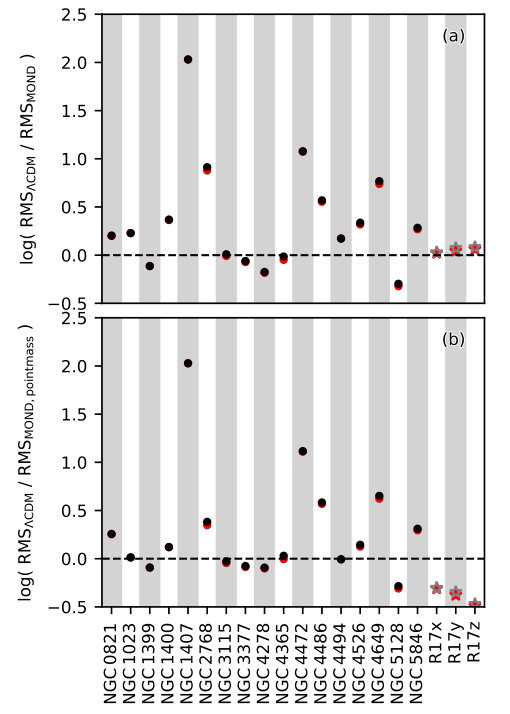 Figure 5
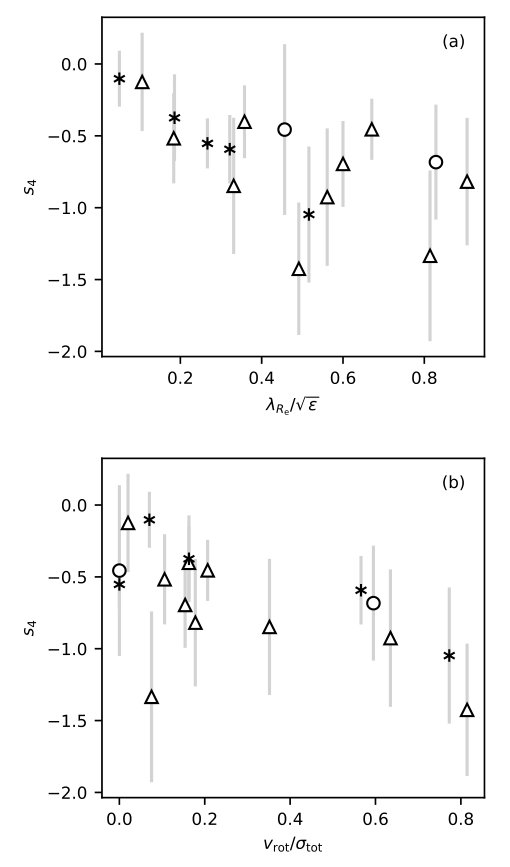 Figure 6
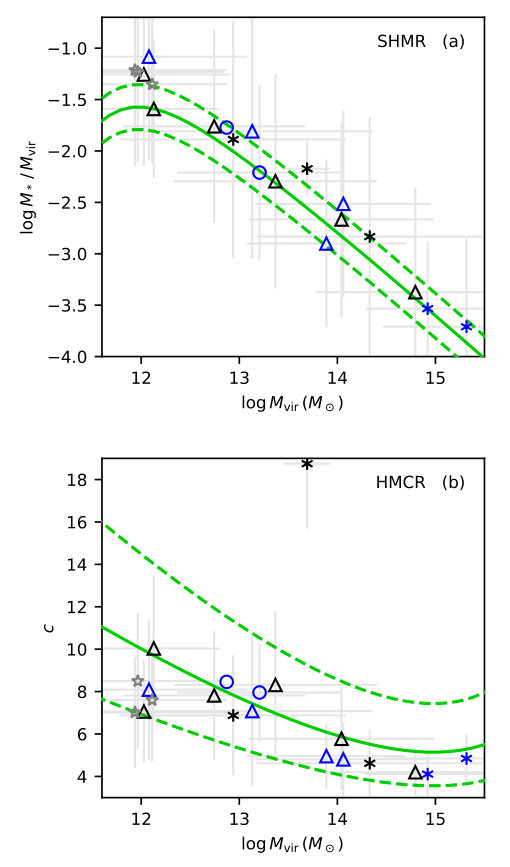 Figure 7
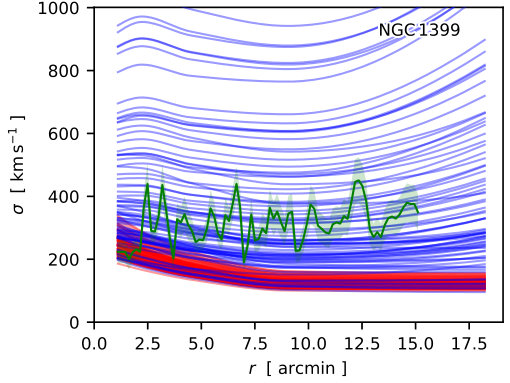 Figure 8
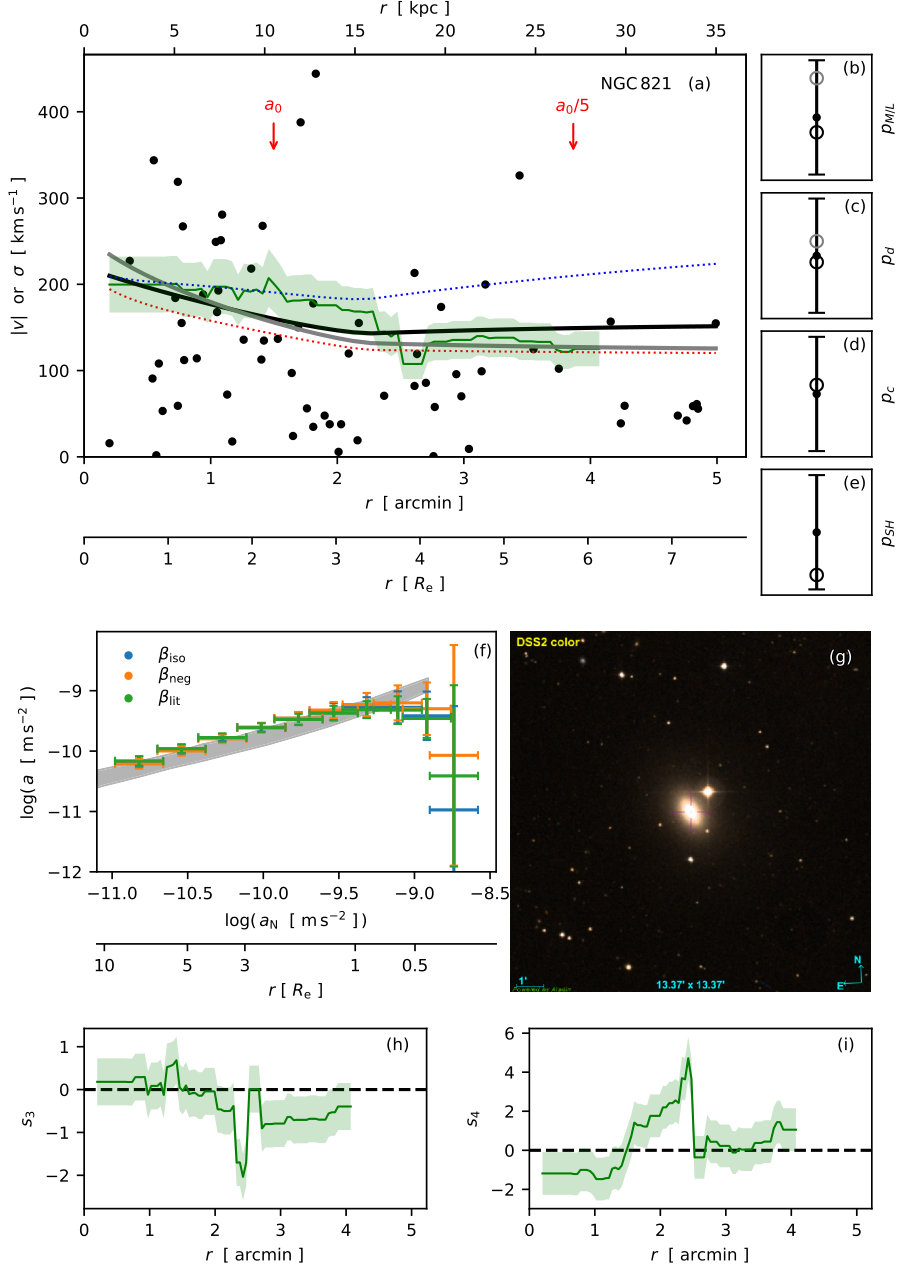 Figure 9
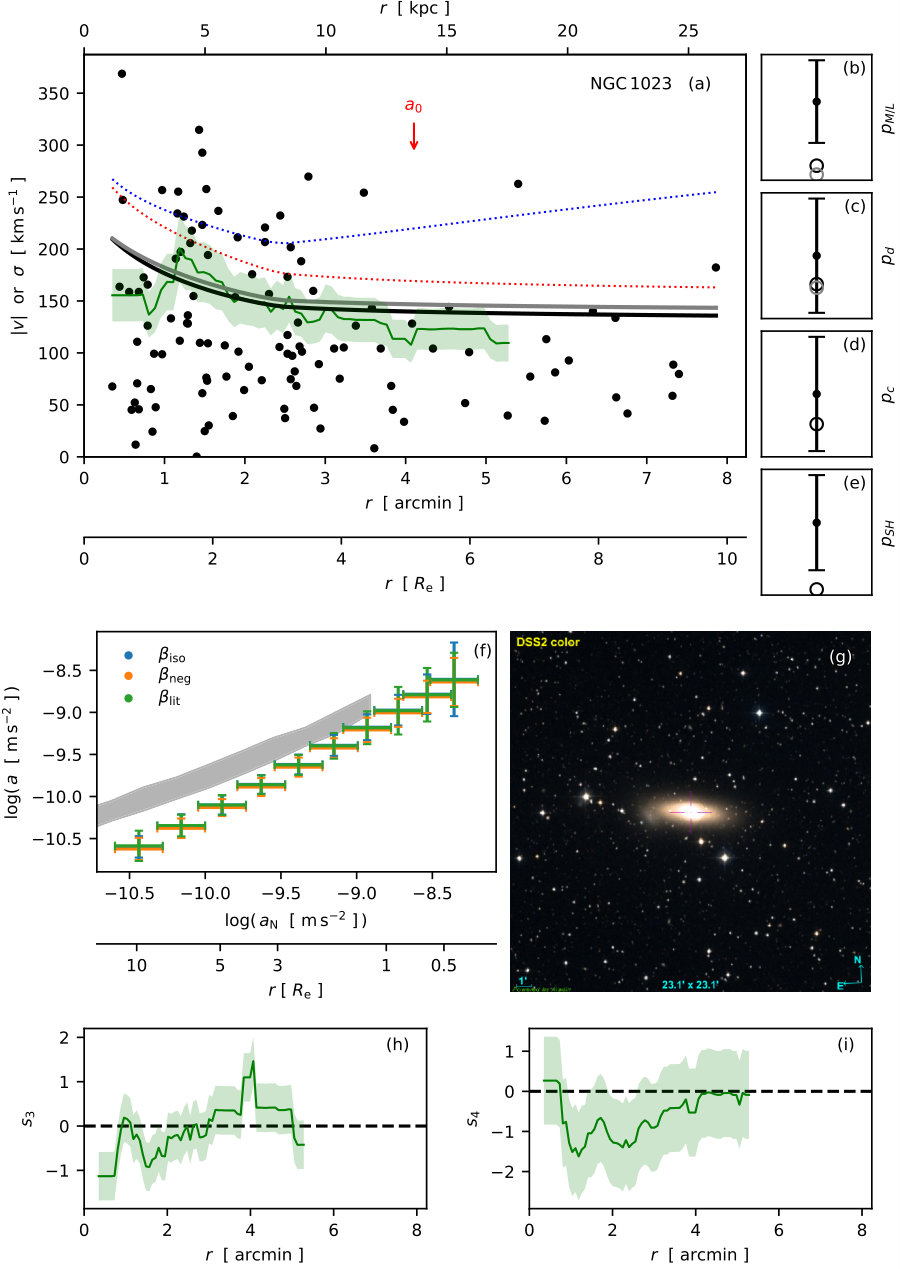 Figure 10
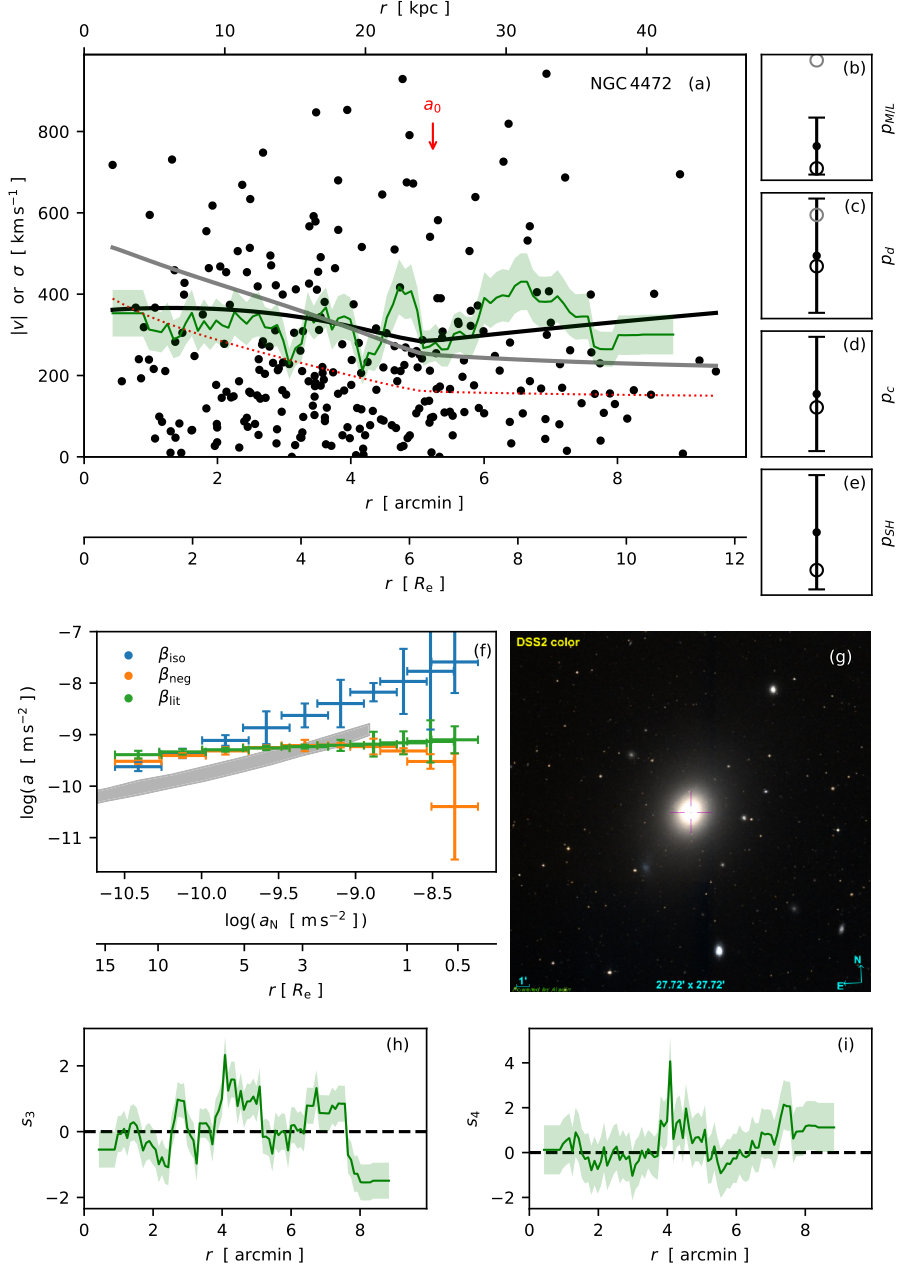 Figure 11
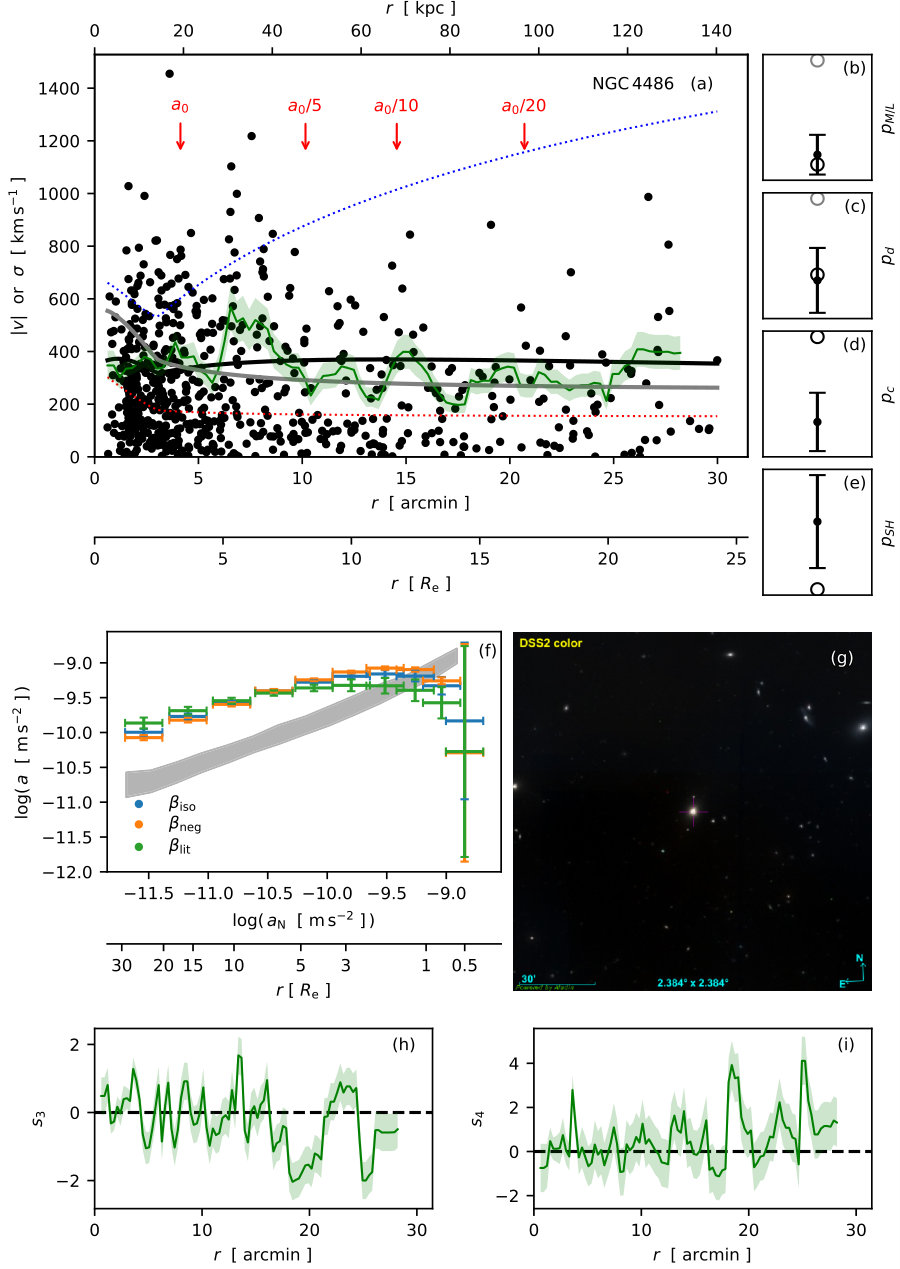 Figure 12
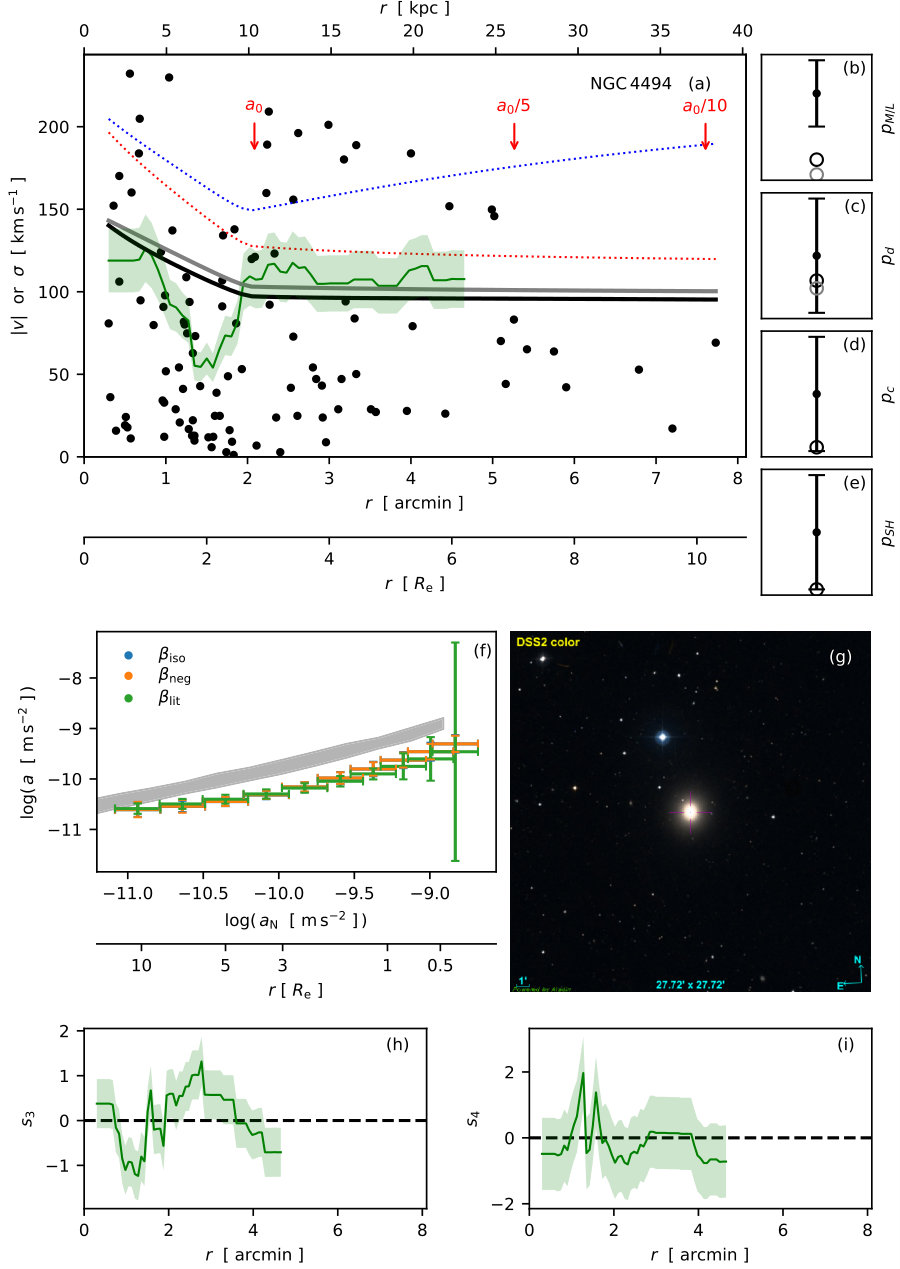 Figure 13
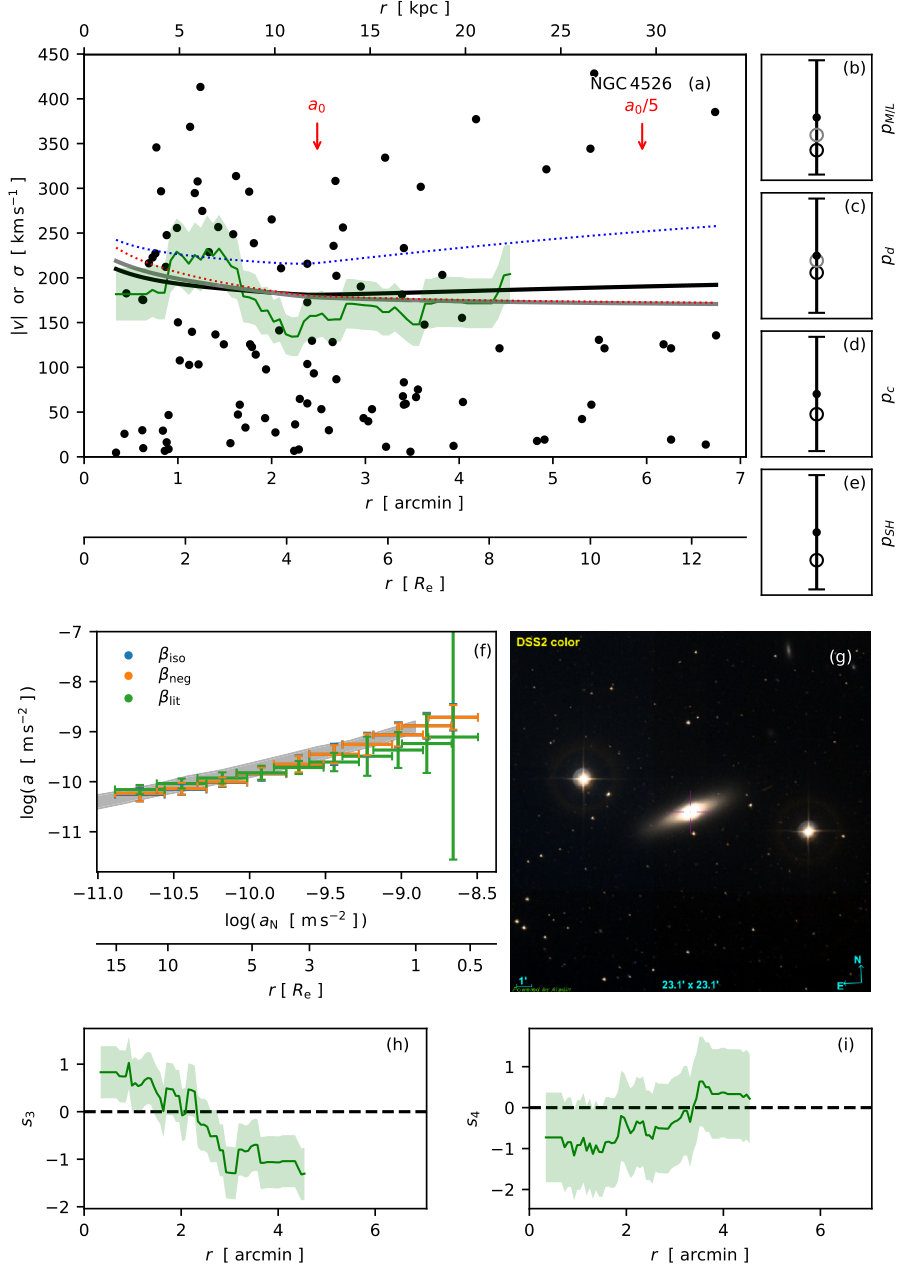 Figure 14
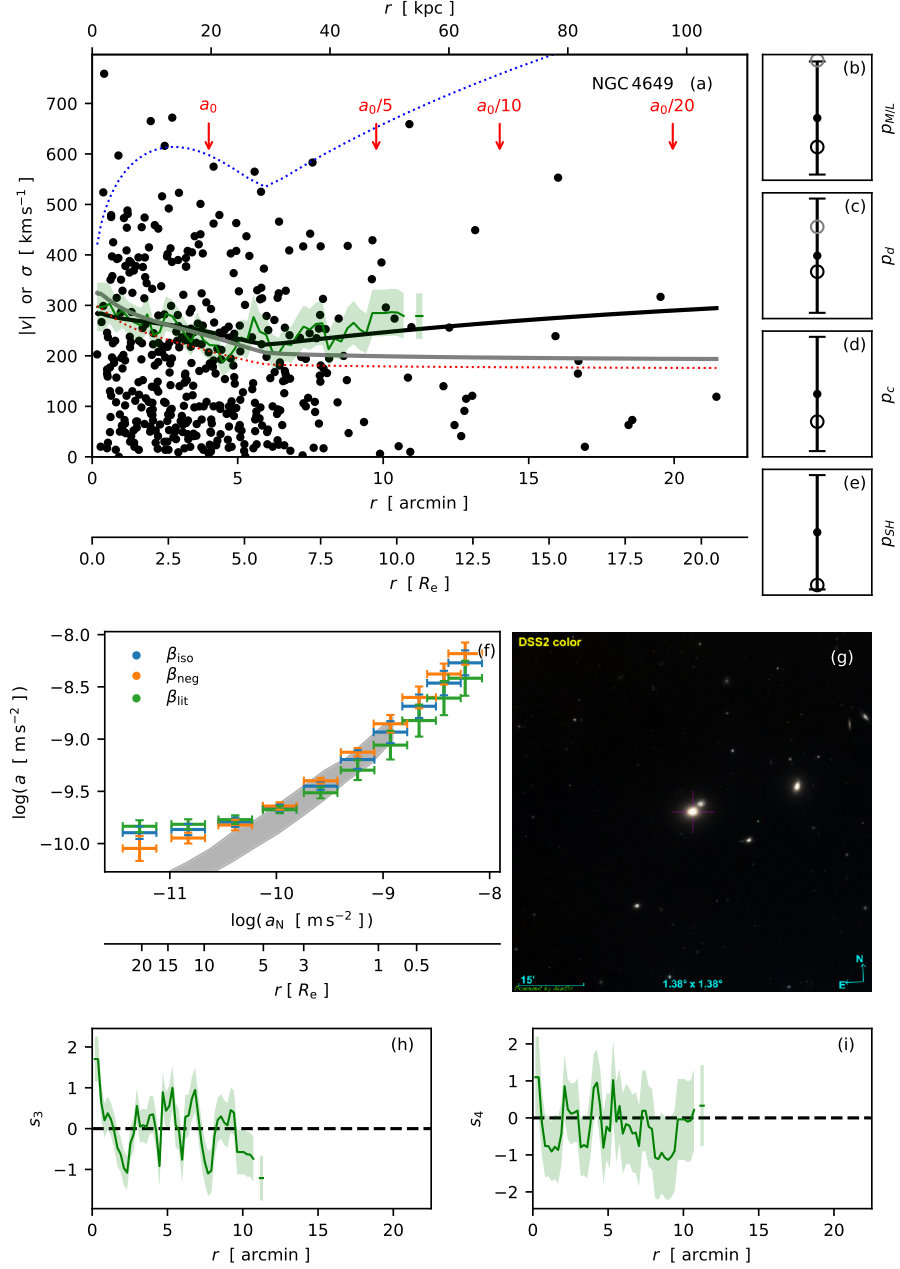 Figure 15
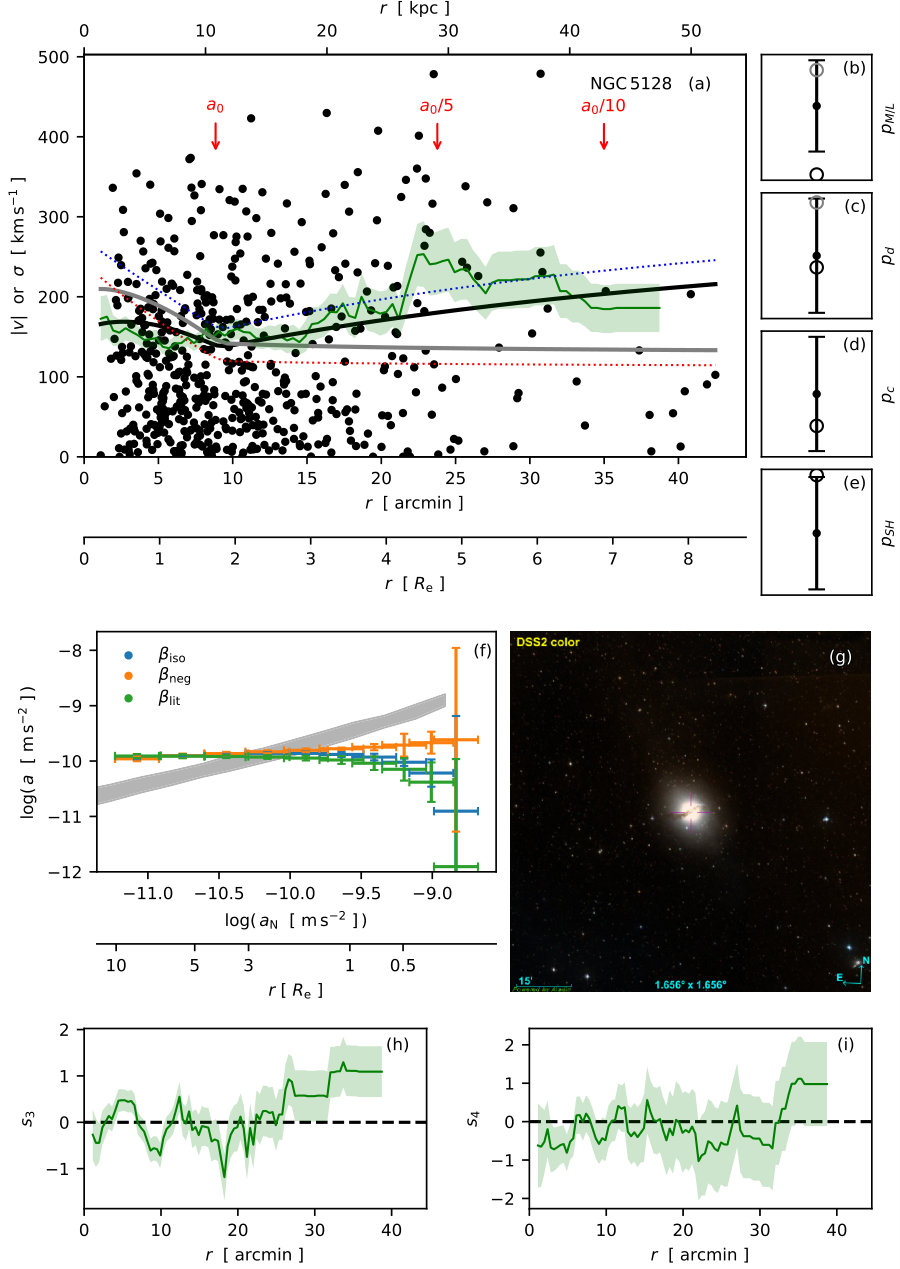 Figure 16
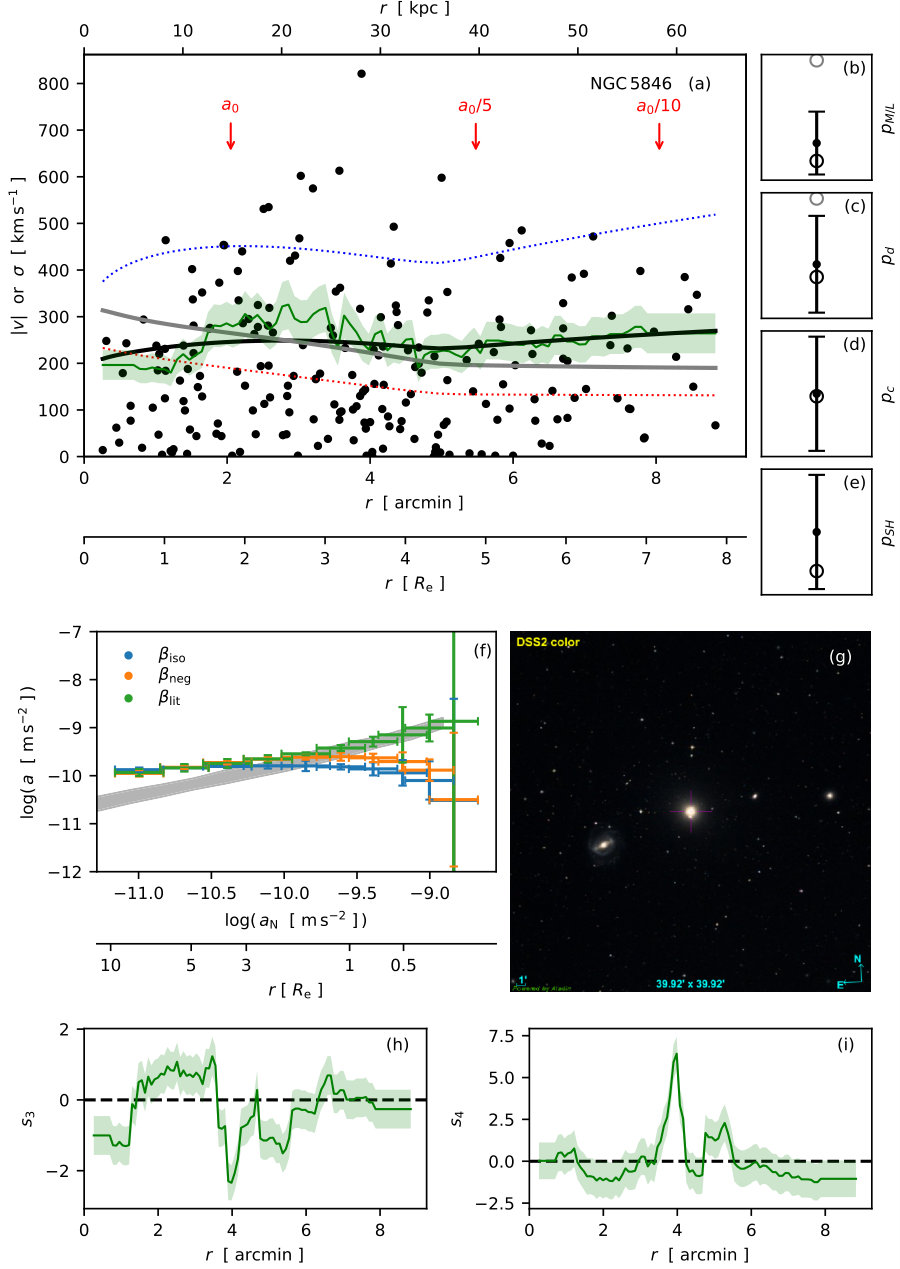 Figure 17
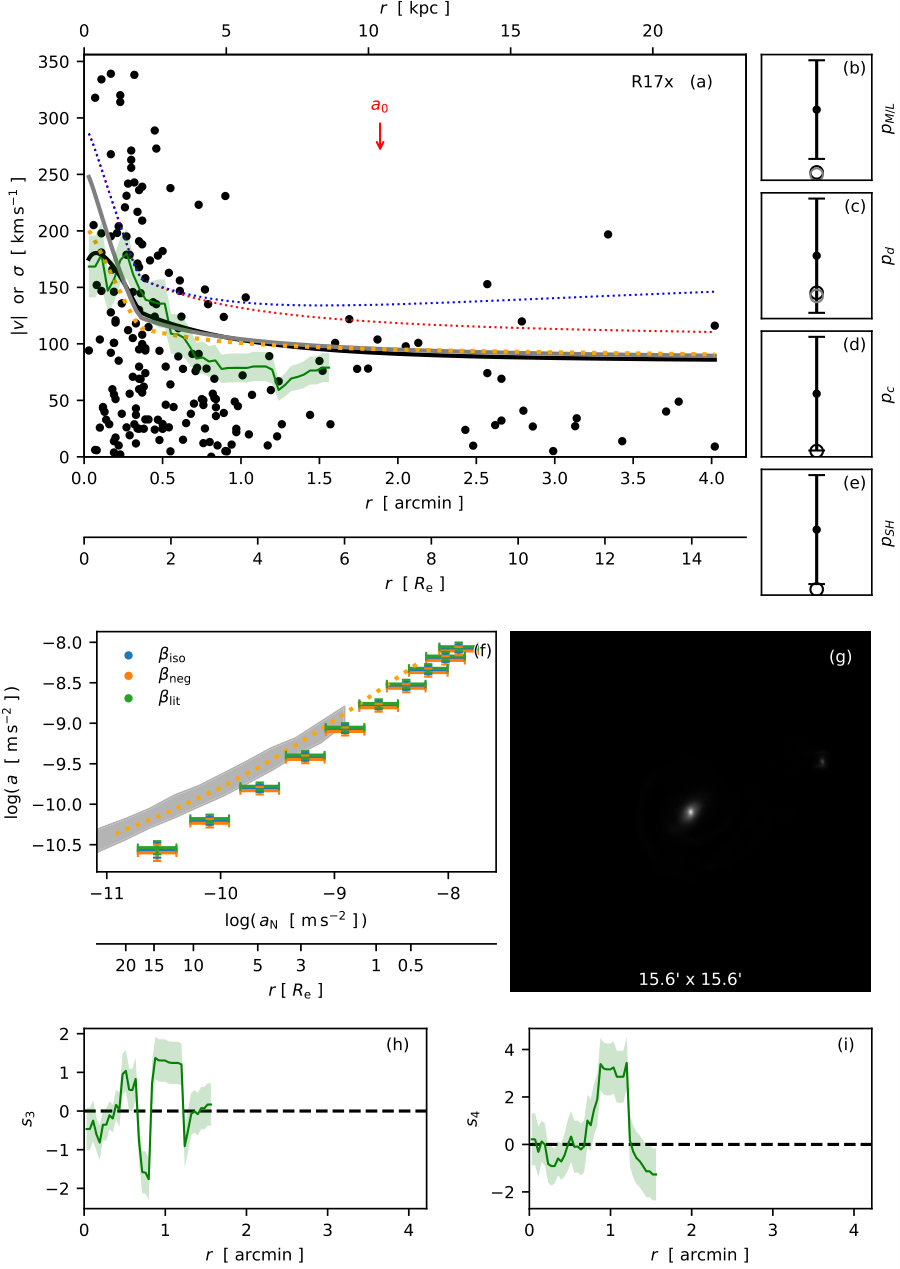 Figure 18
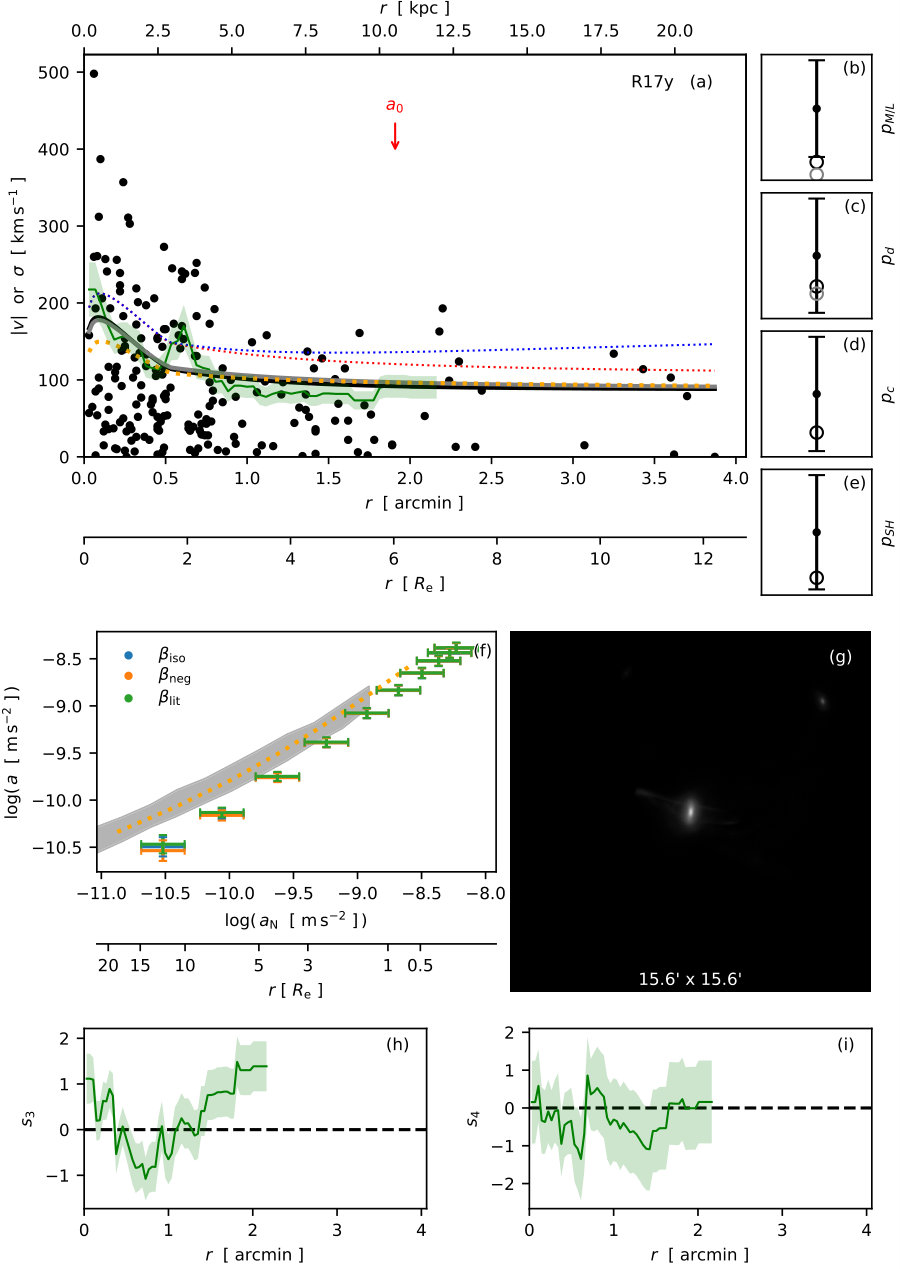 Figure 19
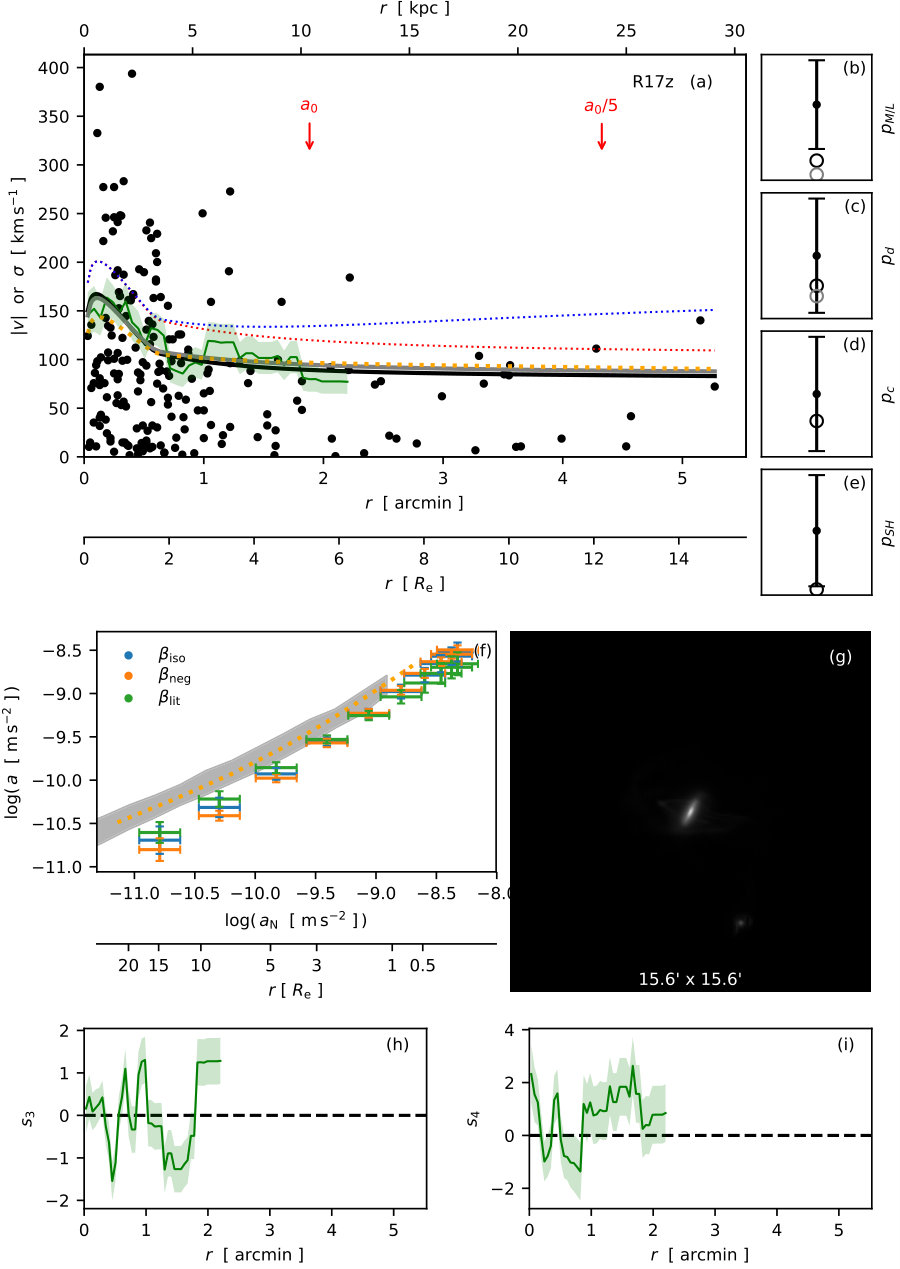 Figure 20
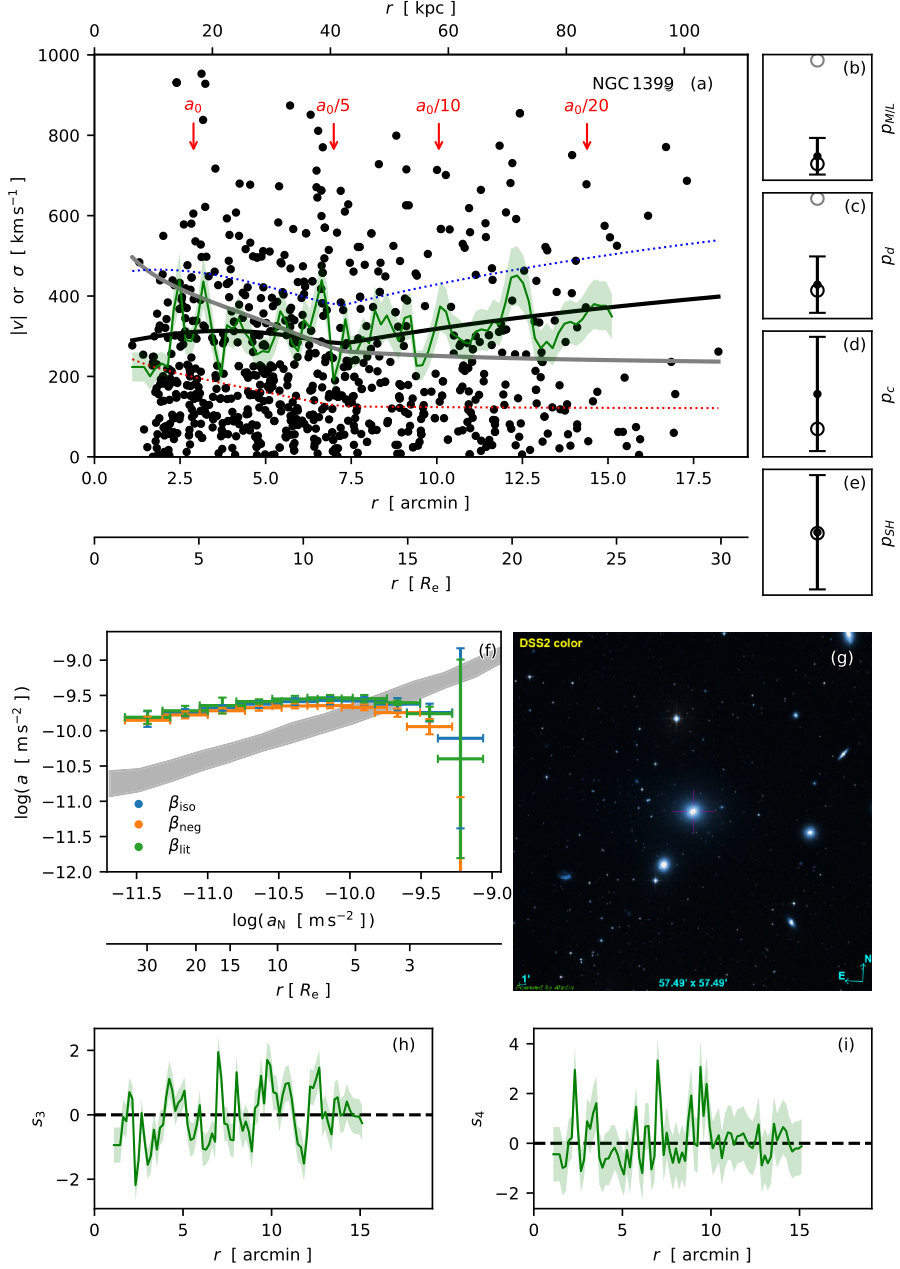 Figure 21
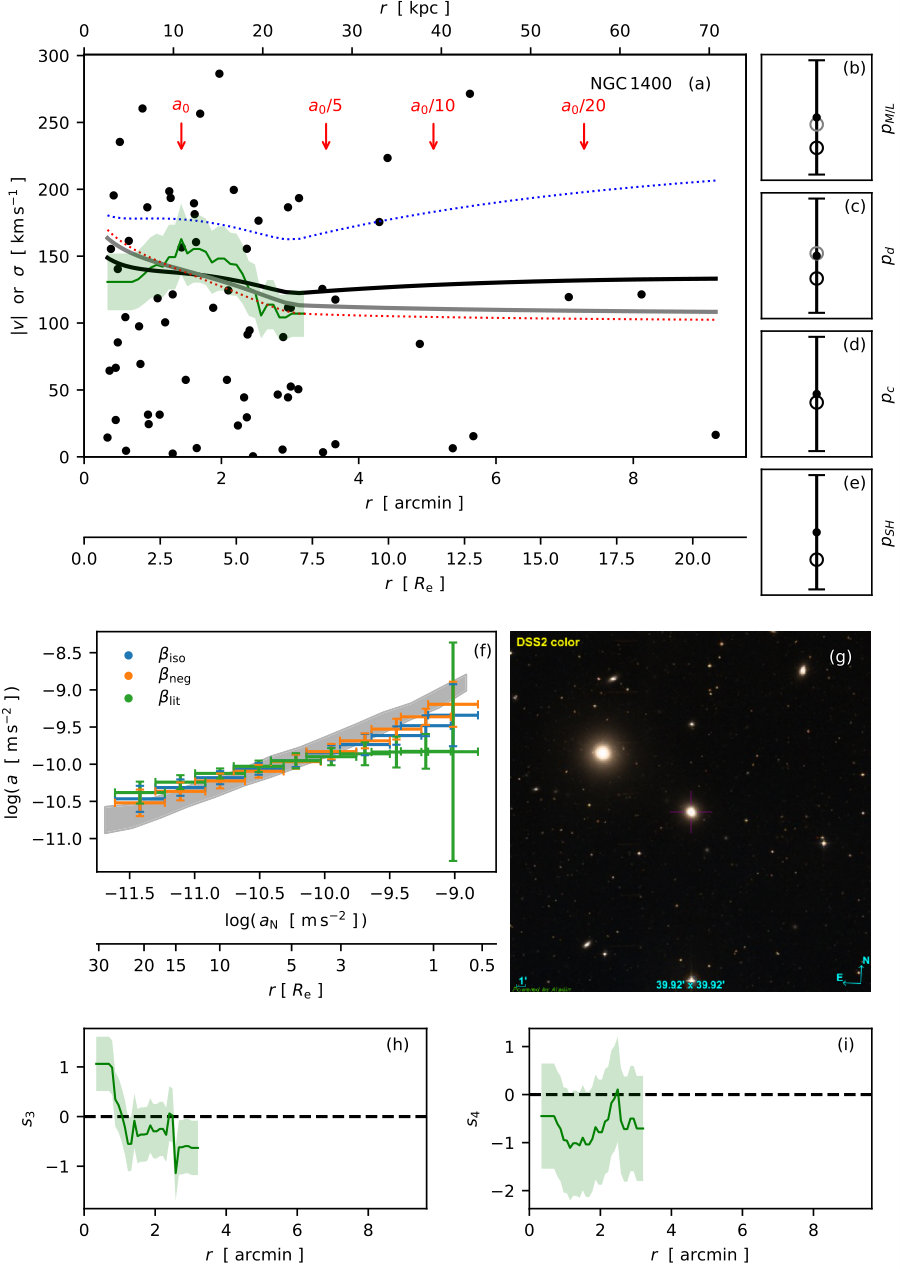 Figure 22
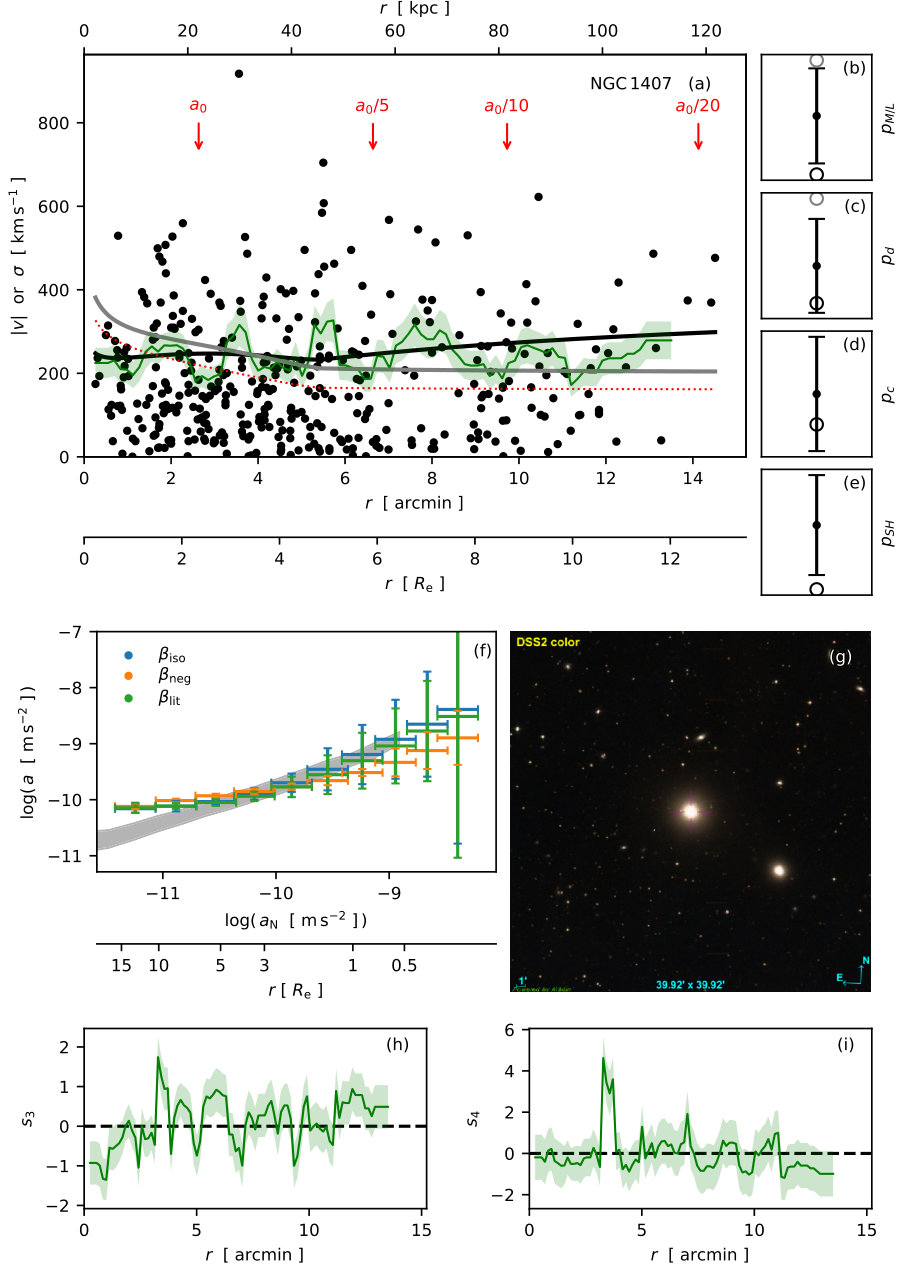 Figure 23
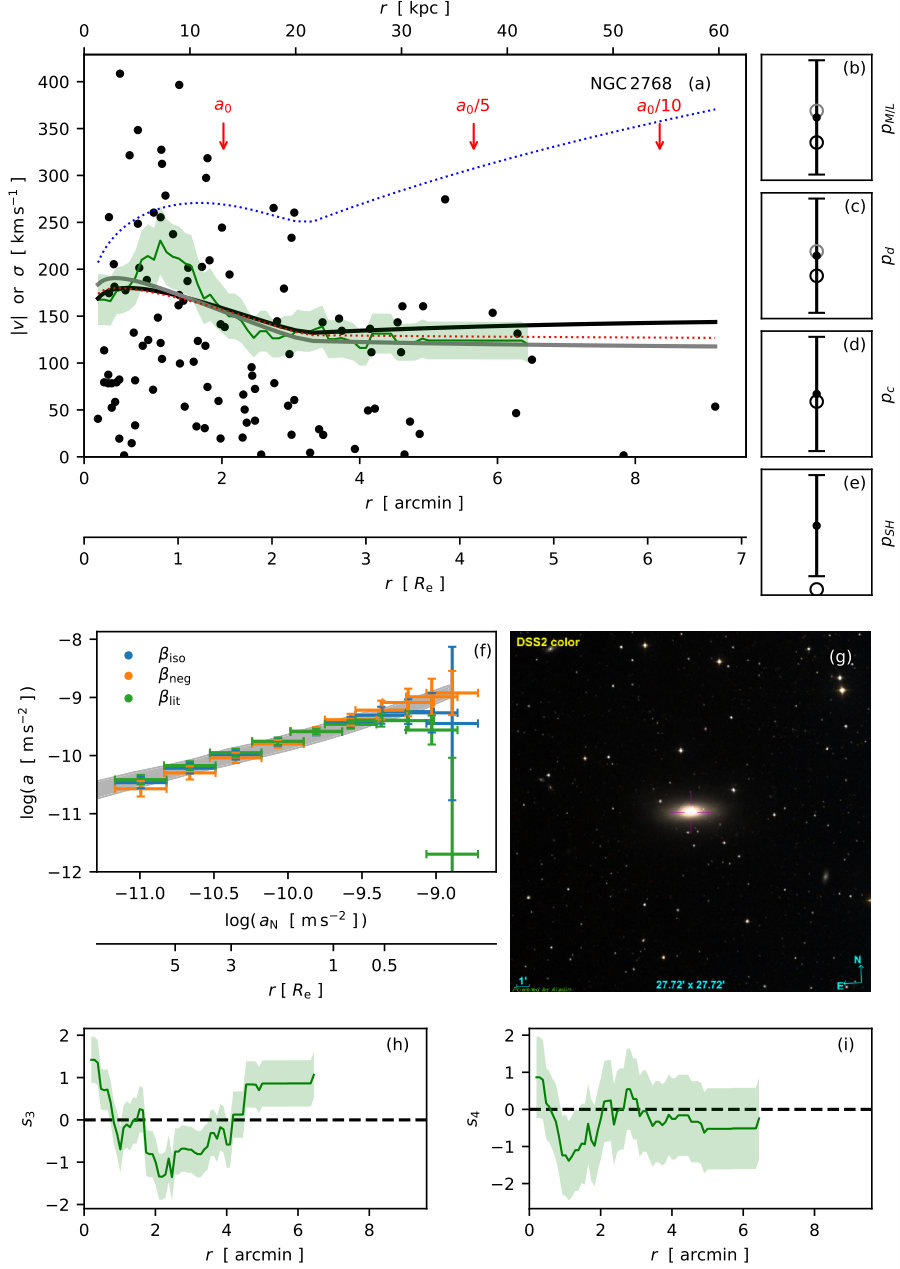 Figure 24
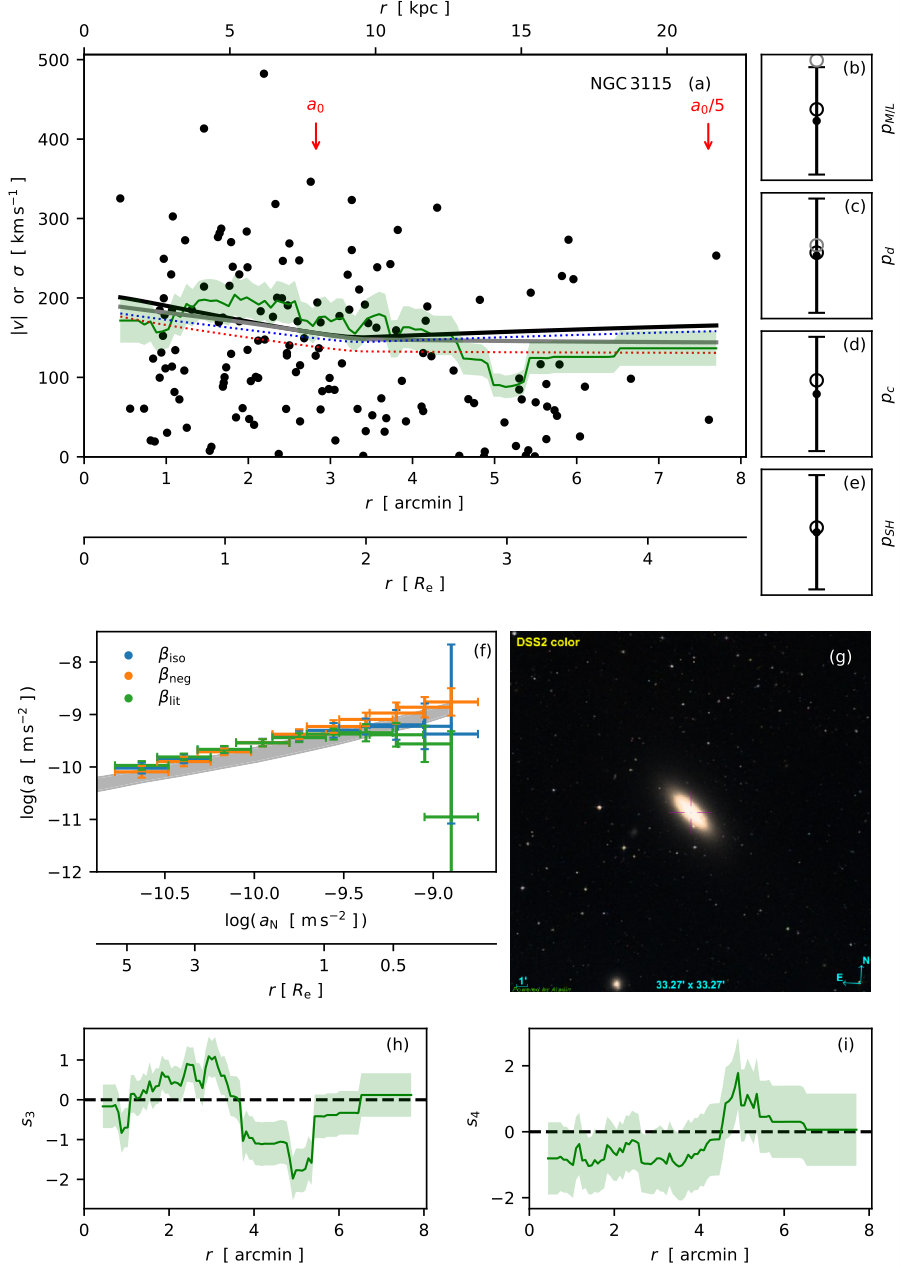 Figure 25
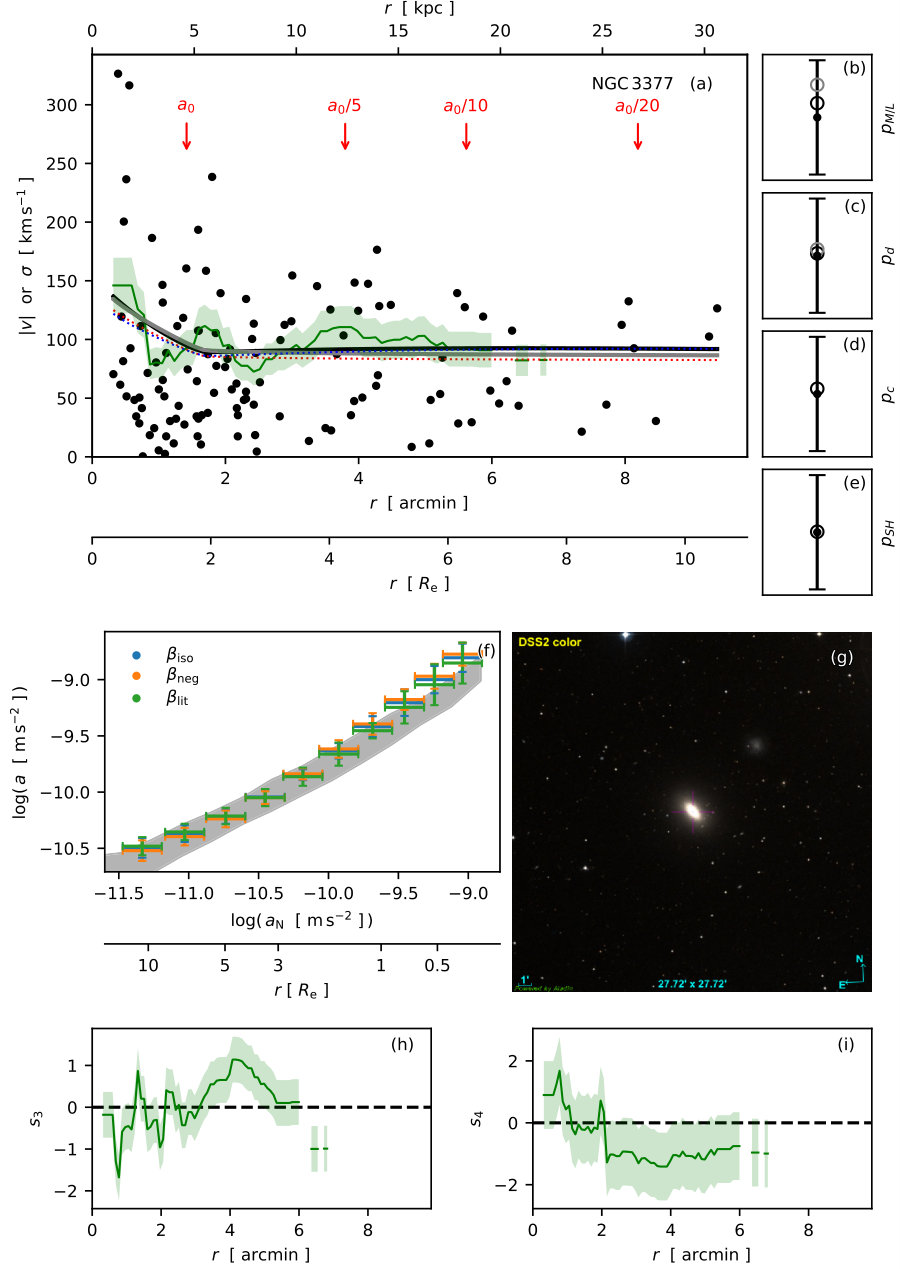 Figure 26
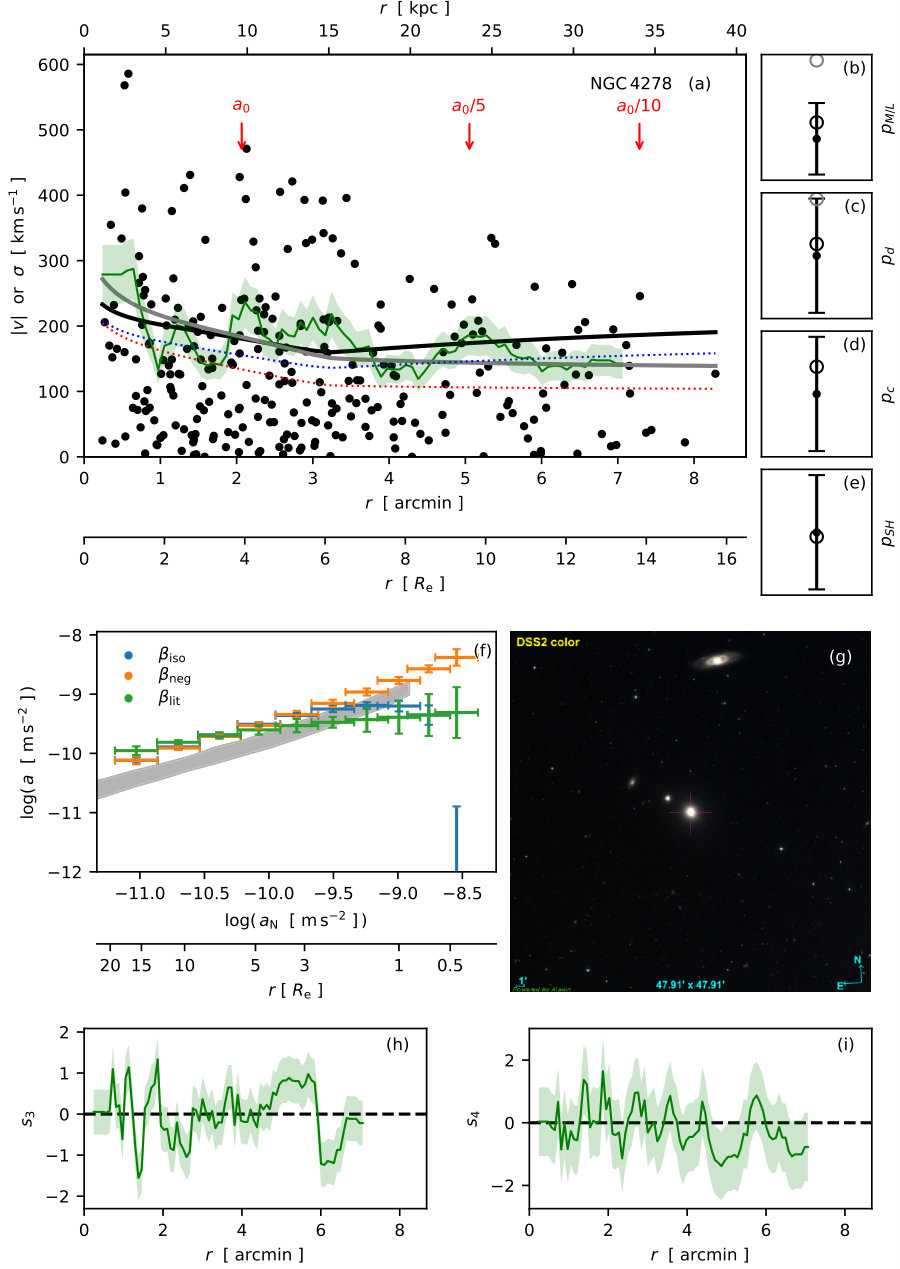 Figure 27
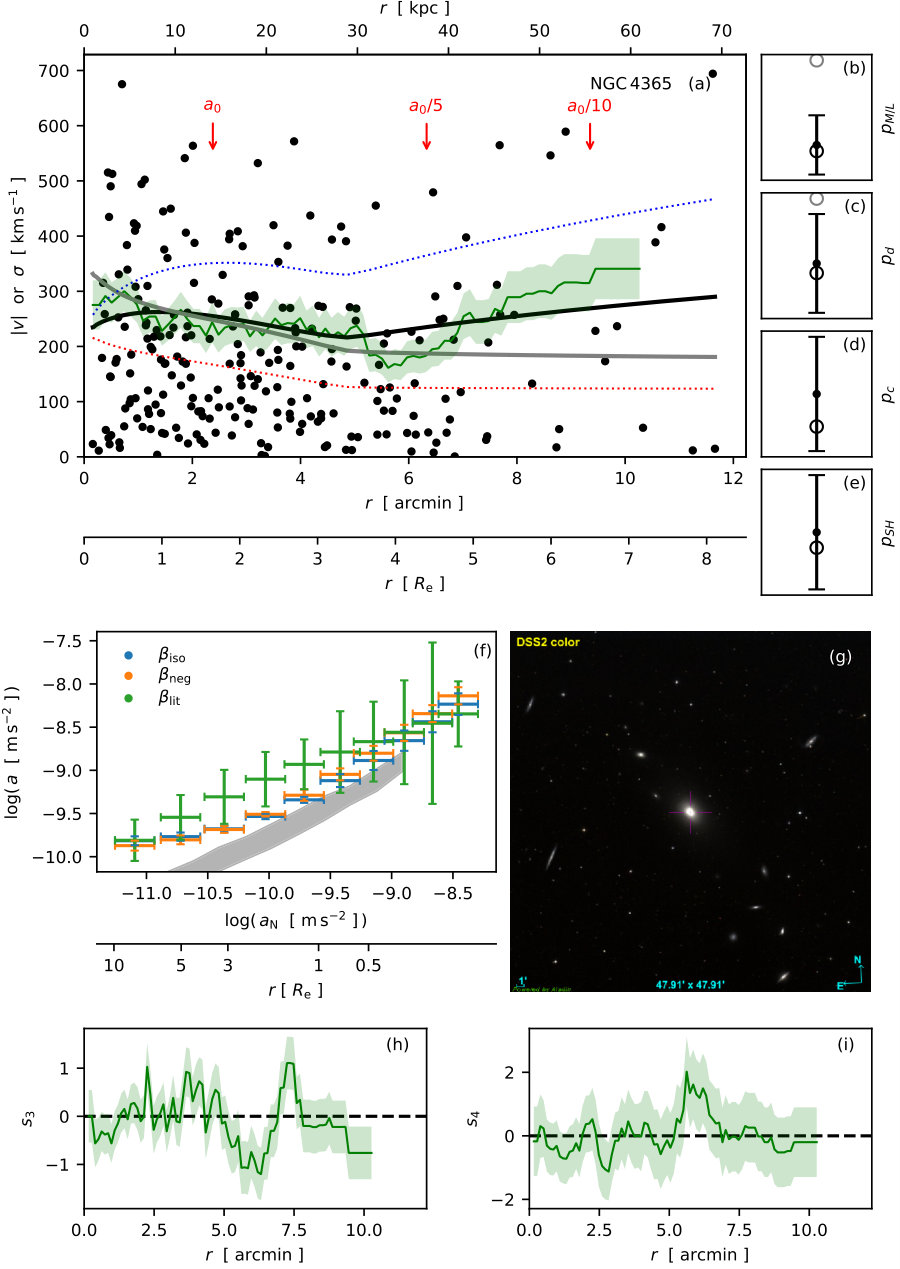 Figure 28
| Name | 1′ | Type | Env | Prof | Iso | Rot | |||||||
|---|---|---|---|---|---|---|---|---|---|---|---|---|---|
| [Mpc] | [kpc] | [] | [kpc] | [mag] | |||||||||
| N 821 | 24 | 7.0 | 10.5 | 4.714 | 4.714 | 0.87 | E619 | F19 | 1 | D7,9 | 0.278 | 0.358 | f |
| N 1023 | 11.4 | 3.3 | 10.5 | 2.728 | 4.228 | 0.91 | S08 | G28 | \1 | D5 | 0.398 | 0.638 | f |
| N 1399 | 20 | 5.8 | 10.7 | 3.515 | 5.615 | 0.93 | E1pec24 | C24 | 1 | D10 | 0.0811 | 0.0911 | s |
| N 1400 | 26 | 7.7 | 10.4 | 3.414 | 4.014 | 0.89 | S0/E019 | G19 | 1 | 02 | 0.278 | 0.118 | f |
| N 1407 | 29 | 8.4 | 11.0 | 9.414 | 8.314 | 0.95 | E019 | G19 | 2 | 02 | 0.088 | 0.058 | f |
| N 2768 | 22 | 6.5 | 10.7 | 8.916 | 3.316 | 0.91 | E6/S01/219 | G19 | ?3 | D5 | 0.258 | 0.578 | f |
| N 3115 | 9.7 | 2.8 | 10.2 | 4.817 | 4.417 | 0.90 | S019 | F19 | \1 | D6 | 0.588 | 0.498 | f |
| N 3377 | 11.2 | 3.3 | 9.9 | 2.916 | 5.016 | 0.82 | E619 | G19 | \1 | D5 | 0.528 | 0.338 | f |
| N 4278 | 16 | 4.7 | 10.2 | 2.516 | 4.816 | 0.90 | E1-219 | G19 | 1 | B5 | 0.188 | 0.098 | f |
| N 4365 | 20 | 5.9 | 10.7 | 8.518 | 5.218 | 0.93 | E319 | G19 | 1 | B7 | 0.098 | 0.248 | s |
| N 4472 | 16.3 | 4.7 | 10.9 | 3.915 | 3.015 | 0.93 | E224 | C24 | 1 | B7,9 | 0.0779 | 0.1729 | s |
| N 4486 | 16 | 4.7 | 10.8 | 5.818 | 2.918 | 0.92 | E019 | C19 | 1 | B5 | 0.028 | 0.168 | s |
| N 4494 | 17.1 | 5.0 | 10.4 | 3.716 | 3.416 | 0.85 | E1-E219 | G19 | \1 | D7 | 0.218 | 0.148 | f |
| N 4526 | 17 | 4.9 | 10.4 | 2.728 | 3.628 | 0.89 | S08 | C28 | ? | B5 | 0.458 | 0.768 | f |
| N 4649 | 17 | 4.9 | 10.8 | 5.115 | 3.615 | 0.93 | E2/S08 | C24 | 1 | B7,9 | 0.1279 | 0.1569 | f |
| N 5128 | 4.2 | 1.2 | 10.5 | 6.214 | 4.014 | 0.87 | S0pec/Epec25 | G26 | ?12 | ?13 | 0.1513 | 0.0527 | f |
| N 5846 | 25 | 7.2 | 10.7 | 8.116 | 3.916 | 0.94 | E019 | G19 | ?4 | B5 | 0.038 | 0.088 | s |
| R17x | 19 | 5.5 | 10.2 | 1.5 | 2.6 | 0.90 | - | - | - | - | - | - | |
| R17y | 19 | 5.5 | 10.2 | 1.7 | 2.0 | 0.90 | - | - | - | - | - | - | |
| R17z | 19 | 5.5 | 10.2 | 2.0 | 2.0 | 0.90 | - | - | - | - | - | - |
| Name | conf. | AICc | LBF | |||||
|---|---|---|---|---|---|---|---|---|
| [] | [kpc] | [] | [%] | |||||
| N 821 | iso | 11.3 | 75 | 52 | -56 | 11.4 | ||
| neg | 11.3 | 74 | 53 | -56 | 11.4 | |||
| lit | 11.3 | 75 | 52 | -56 | 11.4 | |||
| N 1023 | iso | 11.0 | 90 | 13 | -110 | 22.9 | ||
| neg | 10.9 | 90 | 12 | -110 | 22.8 | |||
| lit | 11.0 | 91 | 13 | -110 | 23.0 | |||
| N 1399 | iso | 12.5 | 922 | 0.15 | 590 | -226 | ||
| neg | 12.4 | 909 | 0.39 | 560 | -195 | |||
| lit | 12.6 | 945 | 0.021 | 660 | -294 | |||
| N 1400 | iso | 11.1 | 70 | 80 | -79 | 16.6 | ||
| neg | 11.1 | 68 | 91 | -80 | 16.8 | |||
| lit | 11.2 | 72 | 64 | -77 | 16.1 | |||
| N 1407 | iso | 12.2 | 407 | 23 | 42 | -10.3 | ||
| neg | 12.1 | 402 | 30 | 30 | -7.54 | |||
| lit | 12.2 | 413 | 15 | 61 | -14.5 | |||
| N 2768 | iso | 11.4 | 106 | 97 | -91 | 19.0 | ||
| neg | 11.4 | 105 | 95 | -90 | 18.8 | |||
| lit | 11.4 | 108 | 89 | -91 | 19.1 | |||
| N 3115 | iso | 11.1 | 164 | 38 | -110 | 22.5 | ||
| neg | 11.1 | 162 | 46 | -110 | 22.6 | |||
| lit | 11.1 | 167 | 32 | -110 | 22.3 | |||
| N 3377 | iso | 10.6 | 127 | 68 | -220 | 46.3 | ||
| neg | 10.6 | 126 | 74 | -220 | 46.1 | |||
| lit | 10.6 | 128 | 64 | -220 | 46.3 | |||
| N 4278 | iso | 11.4 | 301 | 17 | -140 | 29.3 | ||
| neg | 11.4 | 297 | 23 | -140 | 30.4 | |||
| lit | 11.5 | 308 | 9.7 | -130 | 27.1 | |||
| N 4365 | iso | 12.0 | 294 | 3.0 | 44 | -10.6 | ||
| neg | 12.0 | 288 | 5.5 | 36 | -8.85 | |||
| lit | 12.1 | 302 | 1.2 | 59 | -14.0 | |||
| N 4472 | iso | 12.3 | 313 | 3.5 | 220 | -50.9 | ||
| neg | 12.2 | 305 | 7.3 | 200 | -45.7 | |||
| lit | 12.4 | 326 | 0.96 | 240 | -61.1 | |||
| N 4486 | iso | 12.5 | 738 | 0.50 | 610 | -149 | ||
| neg | 12.4 | 732 | 0.83 | 590 | -142 | |||
| lit | 12.5 | 748 | 0.23 | 630 | -157 | |||
| N 4494 | iso | 10.7 | 83 | 13 | -180 | 38.0 | ||
| neg | 10.7 | 82 | 11 | -180 | 37.9 | |||
| lit | 10.7 | 84 | 15 | -180 | 38.0 | |||
| N 4526 | iso | 11.1 | 105 | 96 | -57 | 11.7 | ||
| neg | 11.1 | 104 | 92 | -57 | 11.7 | |||
| lit | 11.1 | 106 | 100 | -57 | 11.6 | |||
| N 4649 | iso | 11.8 | 467 | 14 | 50 | -12.0 | ||
| neg | 11.8 | 454 | 27 | 44 | -10.6 | |||
| lit | 11.8 | 487 | 3.2 | 61 | -14.4 | |||
| N 5128 | iso | 11.4 | 571 | 20 | -360 | 76.6 | ||
| neg | 11.4 | 563 | 30 | -380 | 80.7 | |||
| lit | 11.5 | 581 | 12 | -330 | 71.1 | |||
| N 5846 | iso | 12.0 | 246 | 4.8 | 39 | -9.28 | ||
| neg | 12.0 | 243 | 6.9 | 31 | -7.63 | |||
| lit | 12.0 | 252 | 2.8 | 50 | -11.7 | |||
| R17x | iso | 10.7 | 185 | 49 | -270 | 57.2 | ||
| neg | 10.7 | 184 | 45 | -270 | 57.2 | |||
| lit | 10.7 | 187 | 54 | -270 | 57.3 | |||
| R17y | iso | 10.7 | 185 | 50 | -260 | 54.7 | ||
| neg | 10.7 | 183 | 46 | -250 | 53.4 | |||
| lit | 10.7 | 186 | 54 | -260 | 55.4 | |||
| R17z | iso | 10.7 | 185 | 48 | -280 | 59.6 | ||
| neg | 10.7 | 184 | 44 | -280 | 59.0 | |||
| lit | 10.7 | 187 | 53 | -280 | 59.9 |
Peer Reviews
No public reviews on file for this paper yet. If you reviewed it on a platform where reviews are public (OpenReview, ICLR, NeurIPS, ICML), you can paste yours below so the community can read it here.
Videos
No videos yet. Explain this paper in a talk, walkthrough, or lecture? Add one.
11institutetext: Astronomical Institute, Czech Academy of Sciences, Boční II 1401/1a, CZ-141 00 Prague, Czech Republic
11email: [email protected] 22institutetext: Faculty of Mathematics and Physics, Charles University in Prague, Ke Karlovu 3, CZ-121 16 Prague, Czech Republic 33institutetext: Astronomical Observatory, Volgina 7, 11060 Belgrade, Serbia 44institutetext: Lund Observatory, Sölvegatan 27, Box 43, SE-221 00 Lund, Sweden
Study of gravitational fields and globular cluster systems of early-type galaxies
M. Bílek, 1122
S. Samurović 33
F. Renaud 44
(Received …; accepted …)
Abstract
*Context. *Gravitational fields at the outskirts of early-type galaxies (ETGs) are difficult to constrain observationally. It thus remains poorly explored how well the CDM and MOND hypotheses agree with ETGs.
*Aims. * The dearth of studies on this topic motivated us to gather a large sample of ETGs and examine homogeneously which dark matter halos they occupy, whether the halos follow the theoretically predicted stellar-to-halo mass relation (SHMR) and the halo mass-concentration relation (HMCR), whether ETGs obey MOND and the radial acceleration relation (RAR) observed for late-type galaxies (LTGs), and finally whether CDM or MOND perform better in ETGs.
*Methods. *We employed Jeans analysis of radial velocities of globular clusters (GCs). We analysed nearly all ETGs having more than about 100 archival GC radial velocity measurements available. The GC systems of our 17 ETGs extend mostly over ten effective radii. A CDM simulation of GC formation helped us to interpret the results.
*Results. *Successful CDM fits are found for all galaxies, but compared to the theoretical HMCR and SHMR, the best-fit halos usually have concentrations that are too low and stellar masses that are too high for their masses. This might be because of tidal stripping of the halos or because ETGs and LTGs occupy different halos. Most galaxies can be fitted by the MOND models successfully as well, but for some of the galaxies, especially those in centers of galaxy clusters, the observed GCs velocity dispersions are too high. This might be a manifestation of the additional dark matter that MOND requires in galaxy clusters. Additionally, we find many signs that the GC systems were perturbed by galaxy interactions. Formal statistical criteria prefer the best-fit CDM models over the MOND models, but this might be due to the higher flexibility of the CDM models. The MOND approach can predict the GC velocity dispersion profiles better.
Key Words.:
** Gravitation – Galaxies: elliptical and lenticular, cD – Galaxies: kinematics and dynamics – Galaxies: interactions – Galaxies: halos – Galaxies: clusters: general **
1 Introduction
The missing mass problem has not been solved decisively yet. The two most discussed solutions are the standard cosmological CDM model (e.g., Mo et al., 2010) and the MOND paradigm of modified dynamics (Milgrom, 1983; Famaey & McGaugh, 2012; Milgrom, 2015). In this paper we aim to test their predictions in early-type galaxies (ETGs).
Assuming the CDM paradigm, galaxies are surrounded by dark matter halos whose density can be described well by the Navarro-Frenk-White (NFW) profile (Navarro et al., 1996) according to dark-matter-only cosmological simulations. These halos are expected to meet the stellar-to-halo mass relation (SHMR) between the stellar mass of the galaxy and the mass of its dark halo (e.g., Behroozi et al., 2013). This relation is supposed to exist because the transport of baryons inside or outside the halo depends on the mass of the halo; the more massive the halo is, the more it accretes satellites and intergalactic gas. On the other side, the processes expelling the baryons from the halos such as active galactic nuclei outflows, supernova explosions, and stellar winds are less effective if the baryons reside in a deeper potential well. This relation can be recovered, for example, by the abundance matching technique based on comparing the halo mass function deduced from cosmological simulations to the observed galaxy stellar mass function while assuming that the most massive galaxies lie within the most massive halos; i.e., the recovered SHMR is a combination of results from observations and simulations. We must remember that the recovered SHMR is not necessarily the SHMR that CDM would predict in a perfect simulation, which would include, for example, all baryonic processes correctly. In the current hydrodynamical cosmological simulations the parameters regulating the baryonic processes have to be tuned so that the galaxy stellar mass function matches the observations (Genel et al., 2014; Crain et al., 2015; Pillepich et al., 2018). The simulations that are not explicitly tuned to reproduce the stellar mass function do not do so properly (Khandai et al., 2015; Kaviraj et al., 2017).
Another correlation that the dark matter halos are expected to follow is that between the halo mass and its concentration referred to as the halo mass-concentration relation (HMCR). The concentration, , of a NFW halo is the virial radius of the halo divided by its scale radius. The HMCR is a result deduced from CDM cosmological simulations.
The reference list from the paper itself. Each links out to its DOI / PubMed record.
- 1Akaike (1974) Akaike, H. 1974, IEEE transactions on automatic control, 19, 716
- 2Alabi et al. (2017) Alabi, A. B., Forbes, D. A., Romanowsky, A. J., et al. 2017, MNRAS, 468, 3949
- 3Andrae et al. (2010) Andrae, R., Schulze-Hartung, T., & Melchior, P. 2010, Ar Xiv e-prints [ ar Xiv:1012.3754 ]
- 4Angus (2008) Angus, G. W. 2008, MNRAS, 387, 1481
- 5Angus et al. (2012 a) Angus, G. W., van der Heyden, K. J., & Diaferio, A. 2012 a, A&A, 543, A 76
- 6Angus et al. (2012 b) Angus, G. W., van der Heyden, K. J., Famaey, B., et al. 2012 b, MNRAS, 421, 2598
- 7Arakelyan et al. (2018) Arakelyan, N. R., Pilipenko, S. V., & Libeskind, N. I. 2018, MNRAS, 481, 918
- 8Arnold et al. (2014) Arnold, J. A., Romanowsky, A. J., Brodie, J. P., et al. 2014, Ap J, 791, 80