"SZ spectroscopy" in the coming decade: Galaxy cluster cosmology and astrophysics in the submillimeter
Kaustuv Basu (Bonn), Jens Erler (Bonn), Jens Chluba (Manchester),, Jacques Delabrouille (APC Paris), J. Colin Hill (IAS/Flatiron Institute),, Tony Mroczkowski (ESO), Michael D. Niemack (Cornell), Mathieu Remazeilles, (Manchester), Jack Sayers (Caltech), Douglas Scott (UBC)

TL;DR
This paper discusses the potential of submillimeter SZ spectroscopy to advance galaxy cluster studies and astrophysics, emphasizing recent developments and future opportunities in the coming decade.
Contribution
It highlights the importance of systematic SZ spectral analysis in the submillimeter range and advocates for its role in future galaxy cluster and astrophysics research.
Findings
Recent advancements in CMB instrumentation enable detailed SZ spectral studies.
Multi-wavelength SZ spectra can reveal new astrophysical insights.
The coming decade offers a golden era for SZ spectral measurements.
Abstract
Sunyaev-Zeldovich (SZ) effects were first proposed in the 1970s as tools to identify the X-ray emitting hot gas inside massive clusters of galaxies and obtain their velocities relative to the cosmic microwave background (CMB). Yet it is only within the last decade that they have begun to significantly impact astronomical research. Thanks to the rapid developments in CMB instrumentation, measurement of the dominant thermal signature of the SZ effects has become a routine tool to find and characterize large samples of galaxy clusters and to seek deeper understanding of several important astrophysical processes via high-resolution imaging studies of many targets. With the notable exception of the Planck satellite and a few combinations of ground-based observatories, much of this "SZ revolution" has happened in the photometric mode, where observations are made at one or two frequencies in…
Click any figure to enlarge with its caption.
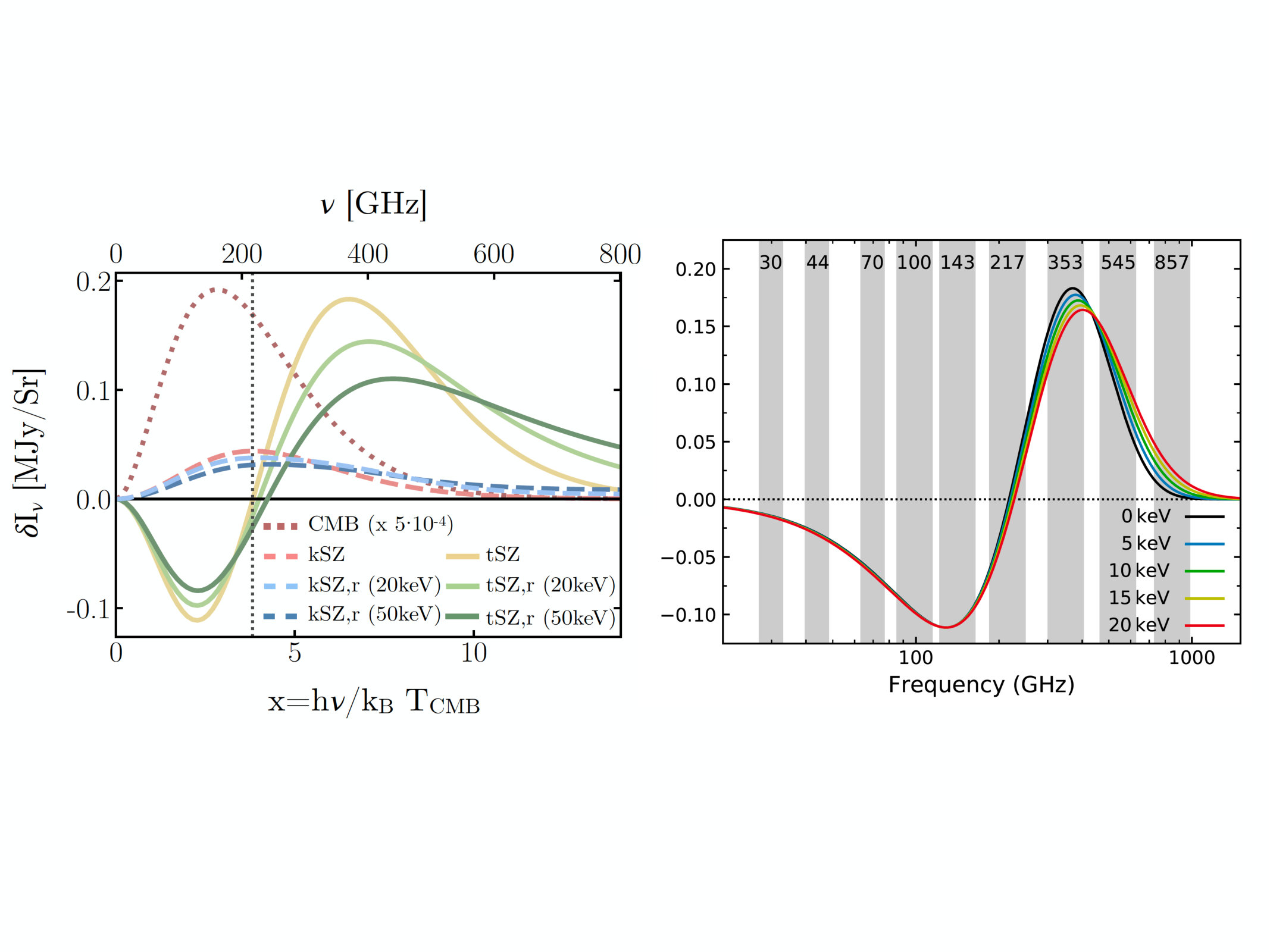 Figure 1
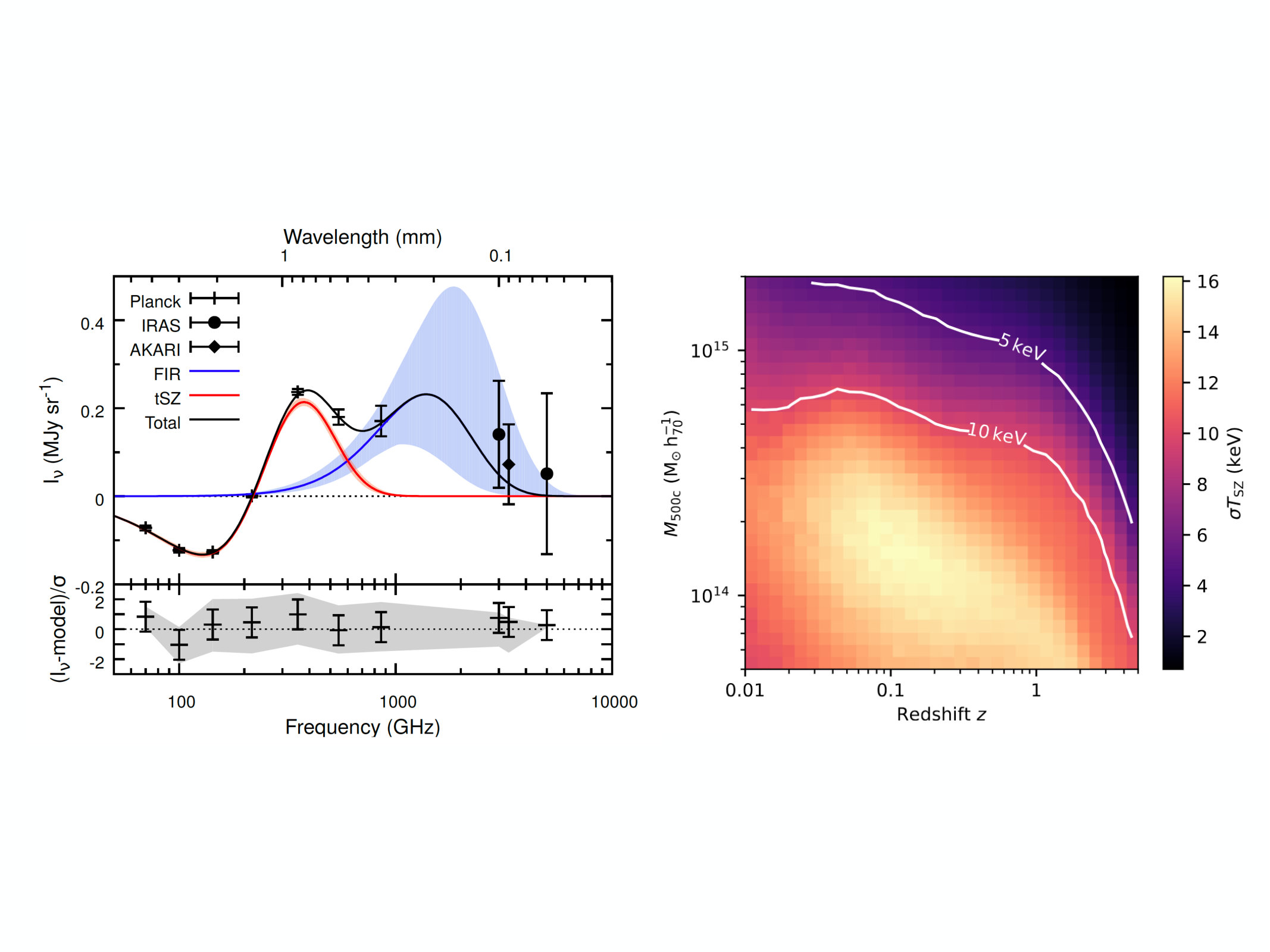 Figure 2
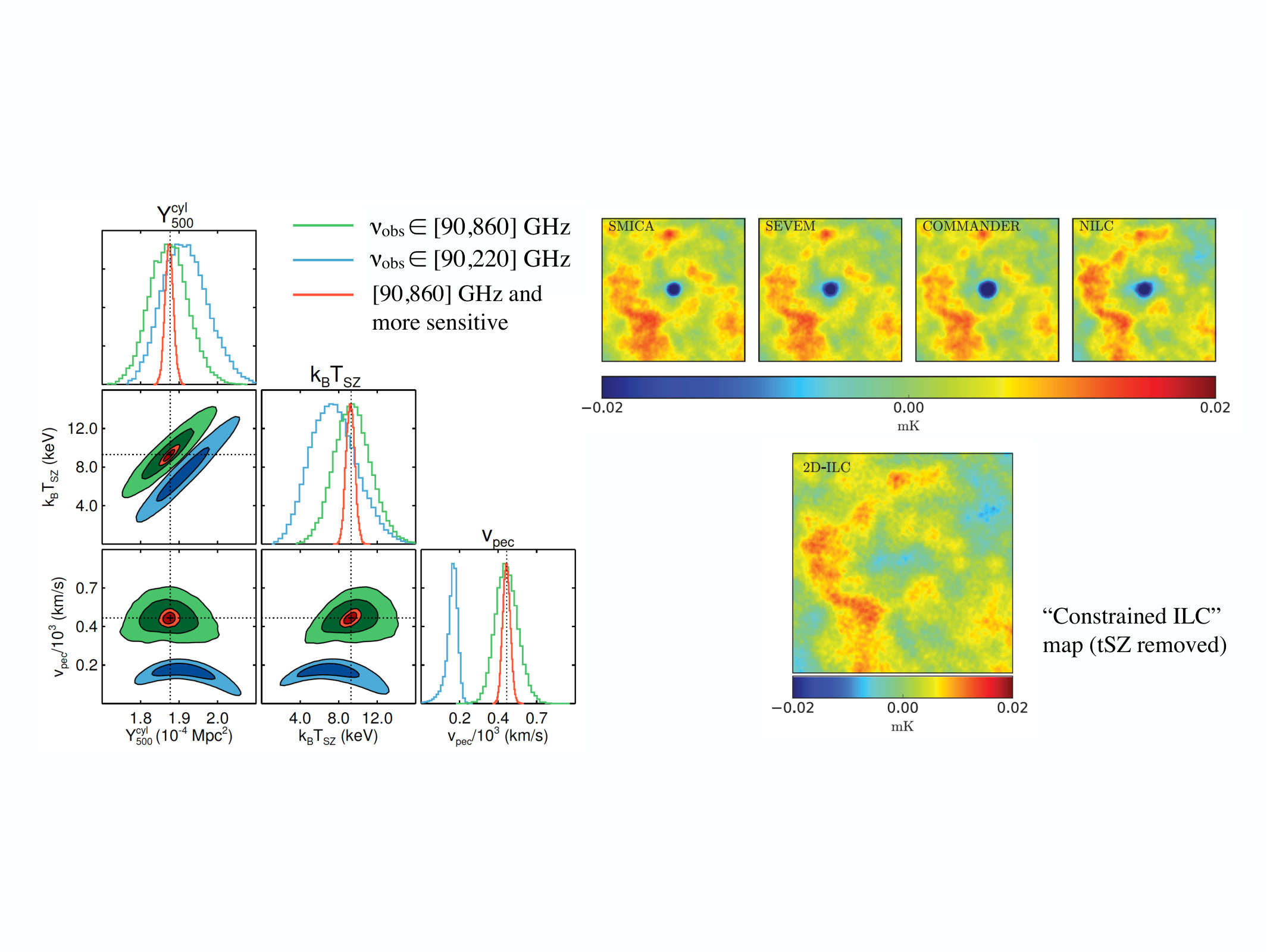 Figure 3
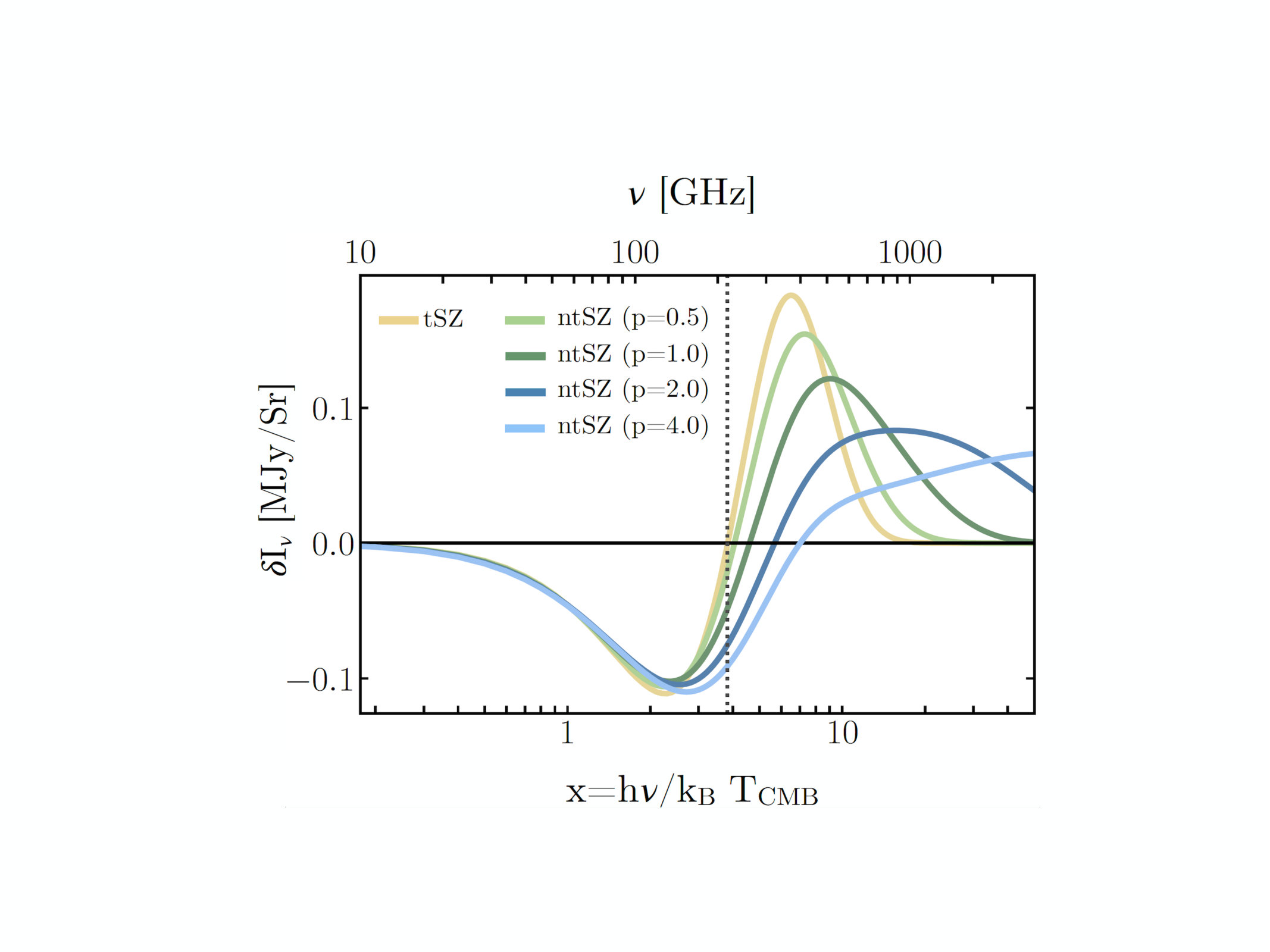 Figure 4
Peer Reviews
No public reviews on file for this paper yet. If you reviewed it on a platform where reviews are public (OpenReview, ICLR, NeurIPS, ICML), you can paste yours below so the community can read it here.
Videos
No videos yet. Explain this paper in a talk, walkthrough, or lecture? Add one.
Taxonomy
TopicsGalaxies: Formation, Evolution, Phenomena · Superconducting and THz Device Technology · Astrophysics and Star Formation Studies
\sidecaptionvpos
figurec
Astro2020 Science White Paper
“SZ spectroscopy” in the coming decade: Galaxy cluster cosmology and astrophysics in the submillimeter
Thematic Areas:
Primary: Cosmology and Fundamental Physics
Secondary: Galaxy Evolution
Corresponding Author:
Name: Kaustuv Basu Institution: University of Bonn Email: [email protected] Phone: 49 228 735 658
Co-authors: Jens Erler (Bonn), Jens Chluba (Manchester), Jacques Delabrouille (APC Paris), J. Colin Hill (IAS/Flatiron Institute), Tony Mroczkowski (ESO), Michael D. Niemack (Cornell), Mathieu Remazeilles (Manchester), Jack Sayers (Caltech), Douglas Scott (UBC), Eve M. Vavagiakis (Cornell), Michael Zemcov (RIT), Manuel Aravena (UDP Santiago), James G. Bartlett (APC Paris/JPL), Nicholas Battaglia (Cornell), Frank Bertoldi (Bonn), Maude Charmetant (Bonn), Sunil Golwala (Caltech), Terry L. Herter (Cornell), Pamela Klaassen (UK ATC), Eiichiro Komatsu (MPA), Benjamin Magnelli (Bonn), Adam B. Mantz (KIPAC/Stanford), P. Daniel Meerburg (KICC/Groningen), Jean-Baptiste Melin (IRFU Saclay), Daisuke Nagai (Yale), Stephen C. Parshley (Cornell), Etienne Pointecouteau (IRAP Toulouse), Miriam E. Ramos-Ceja (Bonn), Mateusz Ruszkowski (Michigan), Neelima Sehgal (Stony Brook), Gordon G. Stacey (Cornell), Rashid Sunyaev (MPA/IKI)
\justify
Abstract: Sunyaev-Zeldovich (SZ) effects were first proposed in the 1970s as tools to identify the X-ray emitting hot gas inside massive clusters of galaxies and obtain their velocities relative to the cosmic microwave background (CMB). Yet it is only within the last decade that they have begun to significantly impact astronomical research. Thanks to the rapid developments in CMB instrumentation, measurement of the dominant thermal signature of the SZ effects has become a routine tool to find and characterize large samples of galaxy clusters and to seek deeper understanding of several important astrophysical processes via high-resolution imaging studies of many targets. With the notable exception of the Planck satellite and a few combinations of ground-based observatories, much of this “SZ revolution” has happened in the photometric mode, where observations are made at one or two frequencies in the millimeter regime to maximize the cluster detection significance and minimize the foregrounds. Still, there is much more to learn from detailed and systematic analyses of the SZ spectra across multiple wavelengths, specifically in the submillimeter ( 300 GHz) domain. The goal of this Science White Paper is to highlight this particular aspect of SZ research, point out what new and potentially groundbreaking insights can be obtained from these studies, and emphasize why the coming decade can be a golden era for SZ spectral measurements.
1 Introduction to the SZ landscape
Galaxy clusters stand at the crossroads between astrophysics and cosmology. By forming the most massive end of the dark-matter halo mass function, their number counts deliver effective constraints on the composition and growth history of the Universe Allen11 ; Kravtsov12 ; Nagai14 . At the same time, galaxy clusters provide unique laboratories to test several astrophysical phenomena – from massive galaxy evolution and the role of AGN feedback, to particle acceleration in Mpc-scale shocks Sarazin86 ; Kormendy89 ; Bykov00 . Quite naturally, studies of galaxy clusters and the associated large-scale structures have been one of the most productive areas of research in the last few decades, collecting huge amounts of data from ground and space based observatories across the entire electromagnetic spectrum.
Among the various methods to find and characterize galaxy clusters, one of the newest and most rapidly developing is the Sunyaev-Zeldovich effect SZ70 ; SZ72 ; SZ75 ; SZ80rev ; Birkinshaw99 ; Carlstrom02 ; SSRev2019 . It has two main variants: the thermal (tSZ) and the kinematic (kSZ) effects. They arise from inverse Compton scattering of the CMB photons by hot intracluster electrons and have several desirable properties: the signals are practically redshift independent (only limited by the telescope beam), have unique spectral signatures, and the amplitudes connect directly to total cluster thermal energy and line-of-sight momenta. From the first blind tSZ detection of clusters only a decade ago Stanis09 ; Menanteau10 , catalogs now exist with over a thousand confirmed objects and an order-of-magnitude more are expected from the next-generation CMB experiments SOscience ; CMB-S4 ; COREclust , transforming cosmological quests such as the nature of dark energy and neutrino masses. Another rapidly developing field is the high angular resolution SZ imaging SSRev2019 that is opening up new windows on cluster astrophysics (see white papers by Mroczkowski et al. and Sehgal et al.). Our aim in this paper is to highlight some of the unique science that can be addressed from detailed measurements of the SZ spectra and how those results can shape our view of the Universe within the decade 2020–2030 and beyond.
The importance of submillimeter data to separate the kSZ effect was realized early on Lamarre98 ; Komatsu99 . This effect carries information about the electron bulk motion relative to the CMB rest frame and promises to be an important cosmological probe DeDeo05 ; Bhatta08 ; Mueller15 ; Schaan16 ; Sugiyama17 , yet successful applications have been limited, most notably for identifying strong internal bulk motions in merging clusters Mroczkowski12 ; Sayers13 ; Adam17 and detecting the kSZ-galaxy bispectrum via pairwise subtraction Hand12 ; PlXIII14 ; Soergel18 . Terrestrial CMB experiments have mostly used the “photometric mode” for SZ science: focusing on 1–2 bands in the millimeter to maximize tSZ detection significance and using the 220 GHz channel to subtract the CMB, which also eliminates the kSZ signal. This has kept the focus on a static view of the universe to perform number count cosmology similar to X-ray or infra-red surveys. Now, after the Planck data release, the real potential of multi-frequency SZ observations is coming into perspective, from kSZ measurements and the search for the missing baryons PlXXXVII16 ; Hill16 ; Lim17 , to extracting cluster properties from the tSZ spectrum Hurier17 ; Erler2018 . The next decade will see a full realization of these scientific quests when large format ground-based cameras will improve upon the resolution and sensitivity of past satellite probes, including in the submm, while at the same time new space missions will offer unprecedented spectral sampling and sky coverage to complement the results from the ground.
2 Galaxy cluster temperatures from the rSZ effect
What will change if we can measure galaxy cluster temperatures across cosmic time?
Just as with the X-ray Bremsstrahlung spectrum, the full, relativistic spectrum of the tSZ effect (referred also as the relativistic SZ, or rSZ, effect) carries information about the mean temperature of the scattering electrons Wright79 ; Pointecouteau98 ; Nozawa09 ; Chluba12 . As shown in Fig. 1 (right panel), mm-wave observations alone cannot distinguish this effect from a change in the Comptonization parameter, and only by adding high-frequency observations it is possible to break this degeneracy and extract the temperature information (unless other priors on electron densities are used). The current best constraints on the tSZ spectrum and the associated value comes from Planck satellite data (Fig. 2 left), which provide a marginal detection after stacking hundreds of clusters Hurier16 ; Erler2018 . But next-generation CMB experiments with submm capabilities will push the noise down to levels where similar detection significance can be achieved on individual massive clusters Mittal2018 ; Erler2018 . When measured via stacking (which will eliminate the kSZ contribution) the accuracy of -based mass calibration will be similar to what is expected from CMB lensing and other methods, hence providing an important tool to model the thermodynamic history of galaxy clusters from a very early epoch.
An example is shown in Fig. 2 (right), where errors are computed for an SZ survey with three submm bands Mittal2018 and realistic foregrounds, yielding temperature accuracies above in stacked cluster samples at . This will be a significant step forward, since the temperature determination from forthcoming X-ray surveys such as SRG/eROSITA will be limited mostly to clusters Borm14 ; Hofmann17 . is further interesting as it is pressure () weighted Hansen04 ; Kay08 , as opposed to roughly weighting of the X-ray temperature Mazzotta04 , hence it is a low-scatter mass proxy suitable for cosmological modeling of the halo mass function. Accounting for the relativistic corrections will also improve the accuracy of cosmological modeling from tSZ power spectra and possibly alleviate some of the current tensions between CMB and cluster cosmology results Remazeilles2019 .
Planck satellite data in the present decade have also provided unmistakable signs of thermal emission from dust within galaxy clusters themselves PlDust1 ; PlDust2 ; Melin2018 , which will be a critical component for SZ spectral modeling. The origin of this cluster-centric FIR emission is currently unknown; it could be from individual star-forming galaxies (i.e. a component of the cosmic infrared background) but could also be diffuse dust, accumulated from galaxy stripping Vogelsberger18 or AGN-uplifting of the central cold gas Werner2010 . Its impact will be even more significant for high- proto-clusters or for the study of the circumgalactic medium (CGM) in low-mass halos, where the relative dust contribution could be higher. It has already been shown that, for modeling AGN feedback in galaxy halos from the associated tSZ signal, not accounting for the dust emission can lead to incorrect conclusions Soergel2017 . If our goal is to calibrate cluster masses across cosmic time using the rSZ effect, then accurate modeling of their dust emission using submm data is going to play a central role.
3 SZ component separation and the measurement of cluster velocities
How can we ensure unbiased kSZ measurements and what will be the scientific impact?
The issue of dust contamination will enter the study of the kSZ effect – and hence the determination of the cosmic velocity field on large scales – in two ways. First, similar to the rSZ temperature measurement, it will bias the line-of-sight velocity estimation for individual halos. This problem is illustrated in the left panel of Fig. 3, where an instrument that has only low-frequency (mm-wave) coverage returns biased estimates for temperature and velocities by ignoring dust emission, while having no discernible bias on the Comptonization parameter. Even though statistically not the most powerful technique, measuring the velocity (and hence optical depth) of selected individual high-mass halos will be extremely important for calibrating the galaxy-electron density power spectrum and breaking the so-called “optical depth degeneracy” Battaglia16 ; Flender17 . Such measurements will also be important in the search for missing baryons from stacked electron density profiles PlXXXVII16 ; Lim17 .
The second case of dust contamination will be within CMB maps themselves, which are the templates for kSZ signal in every kSZ bispectrum or cross-correlation analyses (at small angular scales the primordial CMB power is mostly replaced by kSZ). The origin of this bias is incorrect/insufficient use of foreground information in map making. An illustrative example is shown in Fig. 3 (right), where all of the four publicly-released Planck CMB maps from 2015 show strong residuals in the direction of known clusters. This residual comes from not explicitly accounting for the tSZ signal in the foreground model and minimizing that contribution Chen2018 . For the high-precision CMB imaging in the coming decade, a simple non-relativistic tSZ template will not suffice, but one will need its relativistic corrections as well Remazeilles2019 , necessitating submm data. The same will be true with dust, whose correlation with large-scale structure is already proven PlDust1 , thereby also requiring the leverage of high-frequency data for unbiased CMB map extraction.
The impact of kSZ measurements on cosmology, via both direct and statistical methods, will be immense (see white paper by Battaglia et al.). It will help to identify the time evolution of dark energy from large-scale velocity correlations Alonso16 , search for missing baryons at low redshifts Hernandez08 , and provide constraints on the energy feedback within galaxy halos Battaglia17 , to list a few. High-frequency ( 300 GHz) CMB observations will be a critical ingredient for building this dynamical view of the Universe, together with the next-generation infra-red, optical, and X-ray surveys.
4 ntSZ effect for the cosmic ray energy budget of clusters
What role does the nonthermal population play in determining large-scale structure growth?
Exploration of the SZ spectral distortions will not be complete without taking into account the non-thermal SZ (ntSZ) effect Rephaeli95 ; Enss00 ; Colafrancesco03 . As shown in Fig. 4, the high-frequency bands are again important in disentangling its contribution, but the spectral shapes are more uncertain due to the wide variety of non-thermal populations (cosmic rays) that can contribute. Typically, the overall cosmic ray pressure in galaxy clusters is very low (; Zandanel14 ; Bartels15 ; Pinzke17 ) so ntSZ studies will be critical only within specific cluster regions, such as AGN bubbles for understanding the feedback mechanism Abdulla18 ; Lacy19 , or near cluster cores for finding the signature of annihilating dark-matter particles Colafrancesco04 .
At the same time, sensitivities of the next generation CMB survey experiments can enable stacking analyses of the global ntSZ effect for an important class of objects: the radio halo clusters. These host Mpc-scale diffuse synchrotron emissions that are thought to be the signature of GeV-energy electrons energized by major mergers Cassano10 ; Brunetti14 ; Sommer14 ; vanWeeren19 , however this correspondence is highly uncertain and the determination of merger energetics via synchrotron emission is complicated by the unknown magnetic field strengths and topology. In the coming decade, all-sky radio surveys are expected to increase the number of radio halo clusters from currently known objects to several hundreds Yuan15 ; Norris15 ; Knowles17 . A determination of their volume-averaged ntSZ signature will provide direct constraints on the energy dissipation and particle acceleration processes following major mergers, complementing the picture of a dynamical Universe as will be established by other probes.
5 The path forward in the coming decade
What are the instrumental requirements for the next generation to make significant progress?
The mm/submm community will move toward realizing the promises of SZ spectral science from both space and the ground. New generation CMB and spectral intensity mapping surveys will carry on the rapid developments in microwave detector technology that are occurring right now, e.g., kinetic inductance detector (KID) based cameras coupled with imaging interferometers like CONCERTO Lagache18 and more sensitive future cameras with significantly higher optical throughput like Prime-Cam Vavagiakis18 (the latter hosting multichroic detectors with an imaging Fabry-Pérot interferometer Stacey2018 ). Efficient instantaneous sampling of the spectrum can be possible with broadband multichroic focal planes consisting of multimoded feeds Johnson2018 , multi-scale antenna arrays Ji2014 , and direct detection spectrometers like TIME TIME-Pilot , Wspec Bryan2016 , Micro-Spec Barrentine2016 and DESHIMA Endo2012 .
CCAT-prime, located at 5600 m altitude in the Atacama, will be among the first survey telescopes in the coming decade to scan a large fraction of the sky in the submm for CMB science Parshley18 . It will also provide ample scope for future generation instruments to take advantage of this excellent site. Other locations with comparable atmospheric transmission are at the South Pole or Dome-C in Antarctica, where for example the current 10-m SPT dish is already used for submm VLBI Kim18SPT . Future developments in the Atacama desert will likely include the CSST Padin14 and lead up to AtLAST Bertoldi18 ; deBreuck18 ; Mroczkowski18 , a 50-m class submm telescope that will revolutionize SZ spectral science. Looking from space, future CMB missions like PICO pico18 and CMB-Bharat CMB-Bharat – building upon the scientifically compelling mission concepts of PRISM PRISM2013 and CORE COREmission – will provide full-sky coverage with angular resolution similar to Planck’s, but with more spectral channels and much better sensitivity. Those will be complemented by infra-red missions like SPICA Spica16 , to deliver THz-frequency data with similarly high-precision for modeling the thermal dust emission.
The reference list from the paper itself. Each links out to its DOI / PubMed record.
- 1(1) S. W. Allen, A. E. Evrard, and A. B. Mantz. Cosmological Parameters from Observations of Galaxy Clusters. ARAA, 49:409–470, September 2011. ar Xiv:1103.4829 , doi:10.1146/annurev-astro-081710-102514 . · doi ↗
- 2(2) A. V. Kravtsov and S. Borgani. Formation of Galaxy Clusters. ARAA, 50:353–409, September 2012. ar Xiv:1205.5556 , doi:10.1146/annurev-astro-081811-125502 . · doi ↗
- 3(3) D. Nagai. Cosmology and astrophysics with galaxy clusters. In American Institute of Physics Conference Series , volume 1632 of American Institute of Physics Conference Series , pages 88–106, November 2014. doi:10.1063/1.4902845 . · doi ↗
- 4(4) C. L. Sarazin. X-ray emission from clusters of galaxies. Reviews of Modern Physics , 58:1–115, January 1986. doi:10.1103/Rev Mod Phys.58.1 . · doi ↗
- 5(5) J. Kormendy and S. Djorgovski. Surface photometry and the structure of elliptical galaxies. ARAA, 27:235–277, 1989. doi:10.1146/annurev.aa.27.090189.001315 . · doi ↗
- 6(6) A. M. Bykov, H. Bloemen, and Y. A. Uvarov. Nonthermal emission from clusters of galaxies. A & \& A, 362:886–894, October 2000.
- 7(7) R. A. Sunyaev and Y. B. Zeldovich. The Spectrum of Primordial Radiation, its Distortions and their Significance. Comments on Astrophysics and Space Physics , 2:66, March 1970.
- 8(8) R. A. Sunyaev and Y. B. Zeldovich. The Observations of Relic Radiation as a Test of the Nature of X-Ray Radiation from the Clusters of Galaxies. Comments on Astrophysics and Space Physics , 4:173, November 1972.