Engineering the Floquet spectrum of superconducting multiterminal quantum dots
R\'egis M\'elin, Romain Danneau, Kang Yang, Jean-Guy Caputo, Beno\^it, Doucot

TL;DR
This paper theoretically explores the Floquet spectrum in multiterminal superconducting quantum dots, revealing how time-periodic dynamics produce observable spectral features and proposing an analytical model validated by Green's function calculations.
Contribution
It introduces a novel analytical model for Floquet spectra in superconducting quantum dots and links Floquet-Wannier-Stark ladders to measurable current fluctuations.
Findings
Floquet-Wannier-Stark ladders manifest as peaks in current fluctuations.
Analytical model accurately predicts resonance features.
Green's function calculations confirm the spectral structures.
Abstract
Here we present a theoretical investigation of the Floquet spectrum in multiterminal quantum dot Josephson junctions biased with commensurate voltages. We first draw an analogy between the electronic band theory and superconductivity which enlightens the time-periodic dynamics of the Andreev bound states. We then show that the equivalent of the Wannier-Stark ladders observed in semiconducting superlattices via photocurrent measurements, appears as specific peaks in the finite frequency current fluctuations of superconducting multiterminal quantum dots. In order to probe the Floquet-Wannier-Stark ladder spectra, we have developed an analytical model relying on the sharpness of the resonances. The charge-charge correlation function is obtained as a factorized form of the Floquet wave-function on the dot and the superconducting reservoir populations. We confirm these findings by Keldysh…
Click any figure to enlarge with its caption.
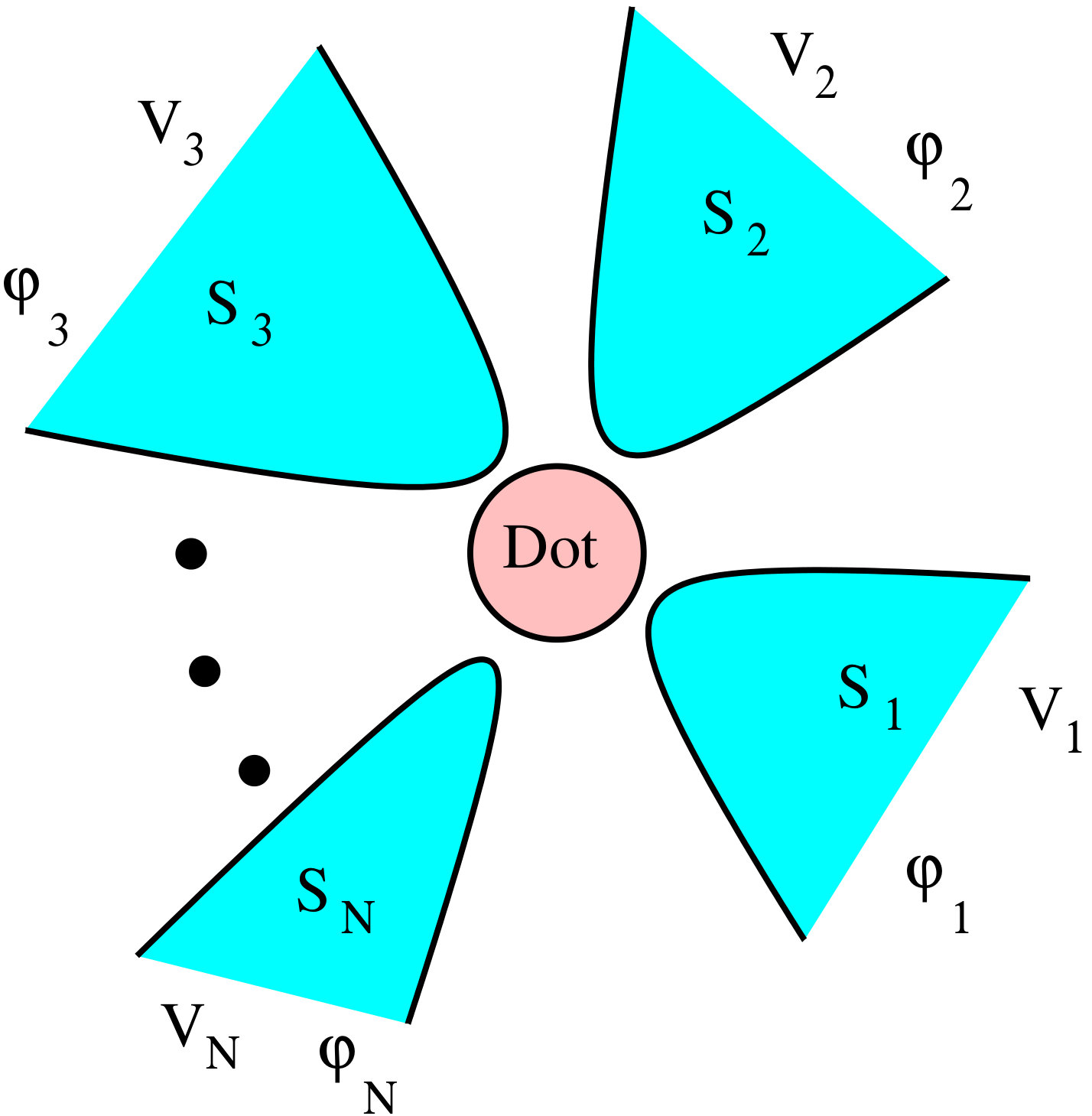 Figure 1
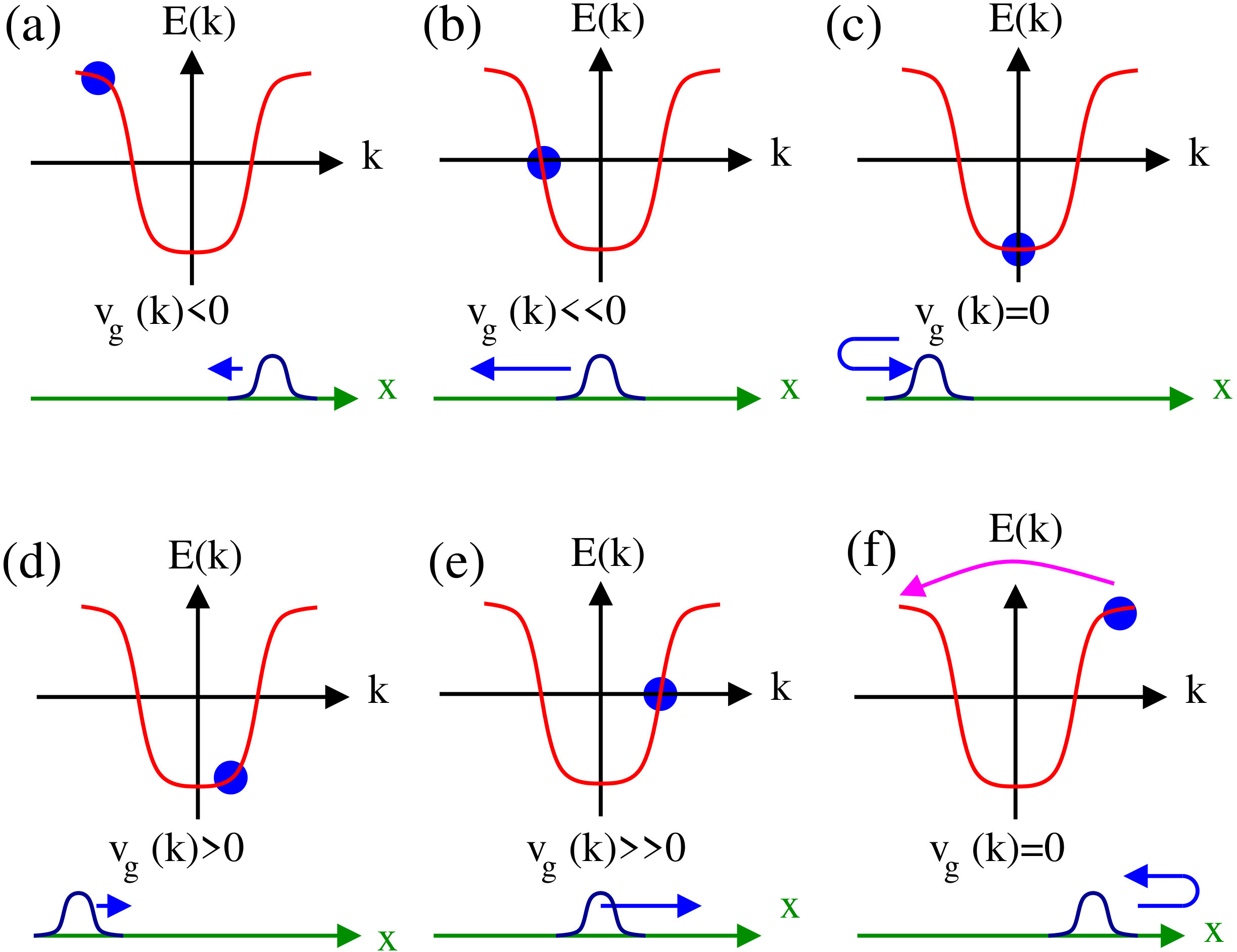 Figure 2
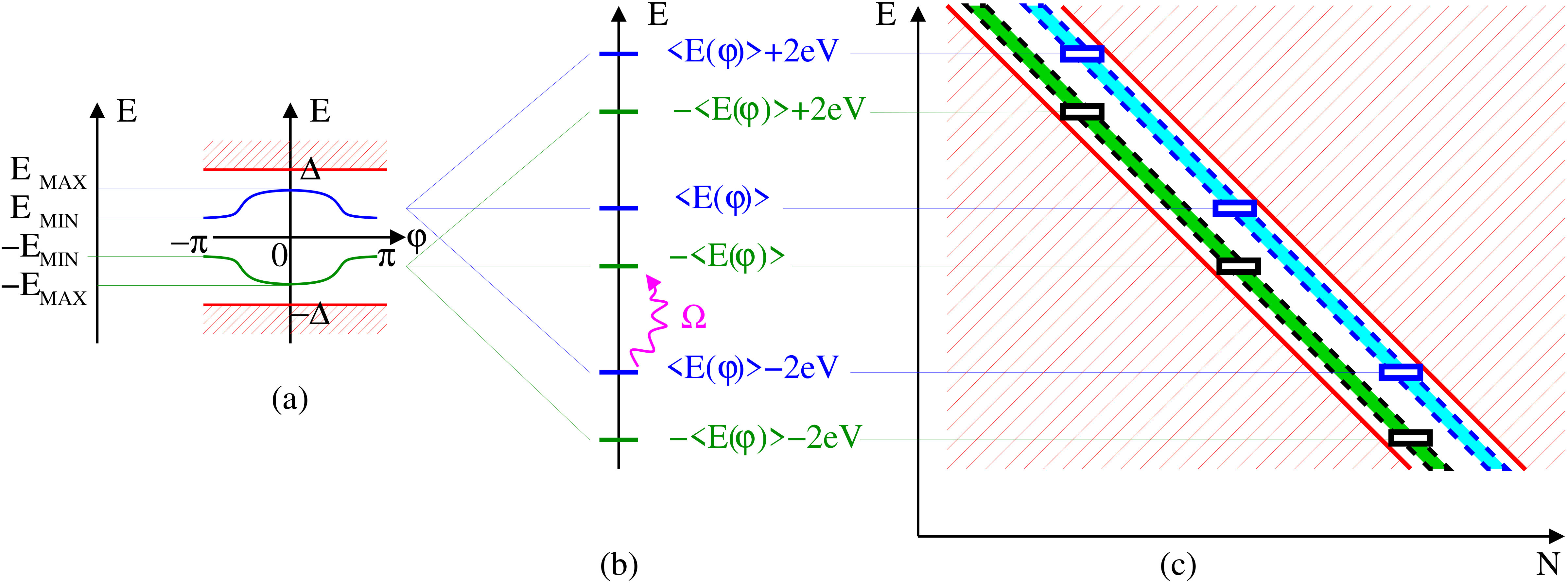 Figure 3
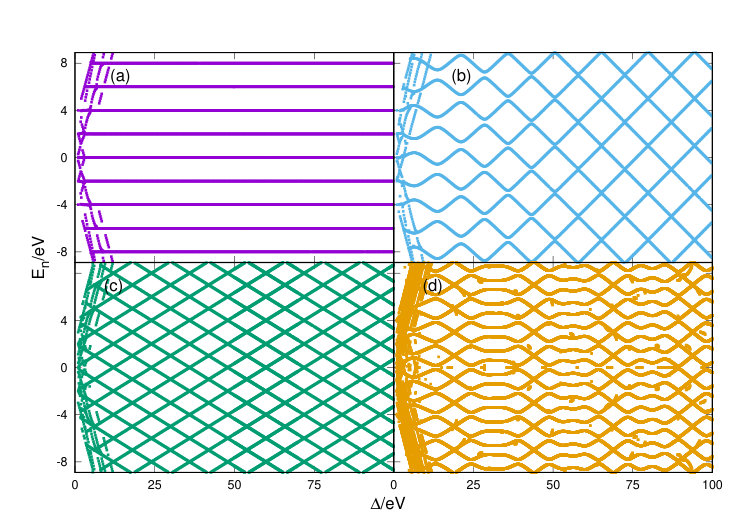 Figure 4
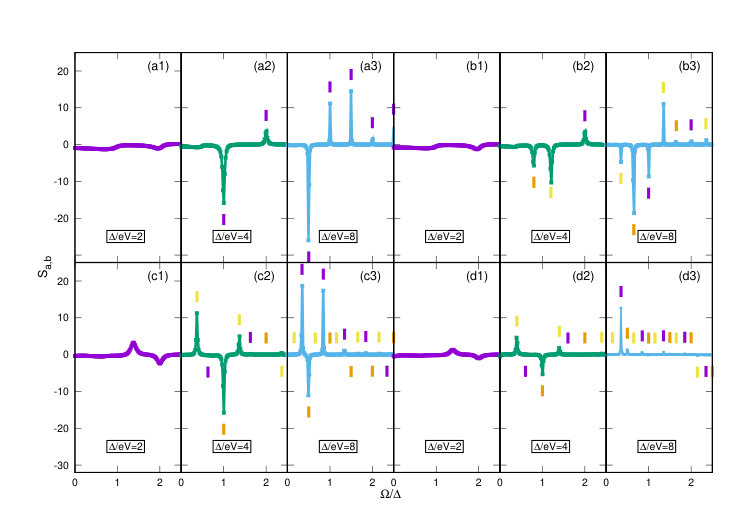 Figure 5
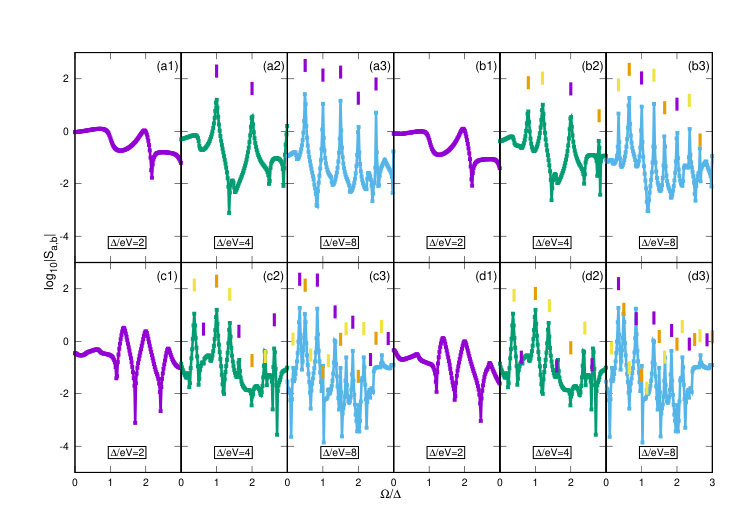 Figure 6
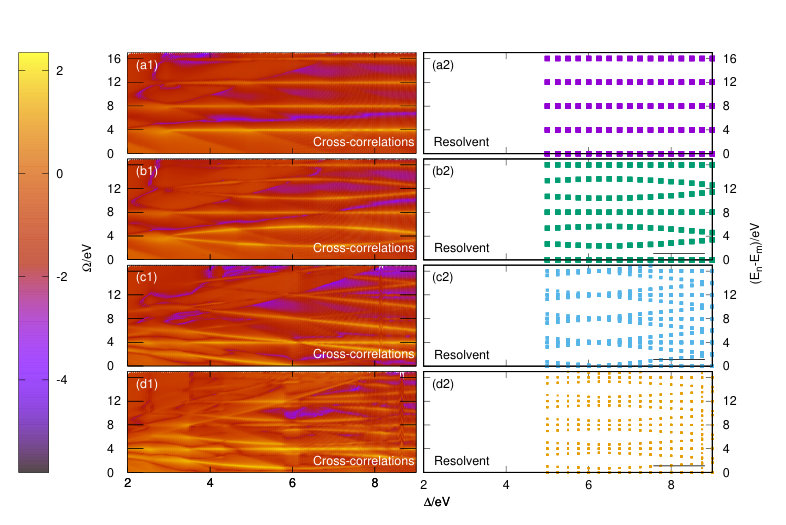 Figure 7
 Figure 8
| Band Theory | Superconductivity |
|---|---|
| Wave-vectors | Superconducting phases |
| Position in | Number of transmitted |
| real space | Cooper pairs |
| integer equivalent to | integer equivalent to |
| -periodic wave-vector | -periodic phase |
| Plane waves in Bloch theory | States with fixed superconducting |
| phase | |
| Hopping between neighboring | Transferring pairs between leads |
| tight-binding sites | by Andreev reflection |
| Electric field | Josephson relation |
| Wannier-Stark ladders | Floquet-Wannier-Stark ladders |
| Panel | Number of | ||||
| label | terminals | ||||
| (a) | 2 | 0.3 | 0.3 | 0 | |
| (b) | 2 | 0.4 | 0.2 | 0 | |
| (c) | 3 | 0.3 | 0.3 | 0.3 | 0 |
| (d) | 3 | 0.3 | 0.3 | 0.3 | 0.1 |
Peer Reviews
No public reviews on file for this paper yet. If you reviewed it on a platform where reviews are public (OpenReview, ICLR, NeurIPS, ICML), you can paste yours below so the community can read it here.
Videos
No videos yet. Explain this paper in a talk, walkthrough, or lecture? Add one.
Engineering the Floquet spectrum of superconducting multiterminal
quantum dots
Régis Mélin
Univ. Grenoble-Alpes, CNRS, Grenoble INP††thanks: Institute of Engineering Univ. Grenoble Alpes, Institut NEEL, 38000 Grenoble, France
Romain Danneau
Institute of Nanotechnology, Karlsruhe Institute of Technology, D-76021 Karlsruhe, Germany
Kang Yang
Laboratoire de Physique Théorique et Hautes Energies, Sorbonne Université and CNRS UMR 7589, 4 place Jussieu, 75252 Paris Cedex 05, France
Laboratoire de Physique des Solides, CNRS UMR 8502, Univ. Paris-Sud, Université Paris-Saclay F-91405 Orsay Cedex, France
Jean-Guy Caputo
Laboratoire de Mathématiques, INSA de Rouen, Avenue de l’Université, F-76801 Saint-Etienne du Rouvray, France
Benoît Douçot
Laboratoire de Physique Théorique et Hautes Energies, Sorbonne Université and CNRS UMR 7589, 4 place Jussieu, 75252 Paris Cedex 05, France
Abstract
Here we present a theoretical investigation of the Floquet spectrum in multiterminal quantum dot Josephson junctions biased with commensurate voltages. We first draw an analogy between the electronic band theory and superconductivity which enlightens the time-periodic dynamics of the Andreev bound states. We then show that the equivalent of the Wannier-Stark ladders observed in semiconducting superlattices via photocurrent measurements, appears as specific peaks in the finite frequency current fluctuations of superconducting multiterminal quantum dots. In order to probe the Floquet-Wannier-Stark ladder spectra, we have developed an analytical model relying on the sharpness of the resonances. The charge-charge correlation function is obtained as a factorized form of the Floquet wave-function on the dot and the superconducting reservoir populations. We confirm these findings by Keldysh Green’s function calculations, in particular regarding the voltage and frequency dependence of the resonance peaks in the current-current correlations. Our results open up a road-map to quantum correlations and coherence in the Floquet dynamics of superconducting devices.
I Introduction
Since the early 1960’s, the Josephson effect has attracted continuous interest and its development over the years has led to major applications in quantum information and technologies. It occurs when two superconductors connect a nonsuperconducting material and its physical mechanism can be described via the notion of Andreev bound states (ABS). These phase-sensitive midgap doublets are produced by proximity effect. The ABS microscopically originate from the formation of entangled electron–hole pairs in the normal conductor and can be seen as two-level systems Zazunov . Many physical properties of the Josephson junctions, such as the value of the Josephson current, depend on the energy-phase relation of the ABS at zero bias voltage and finite phase drop across the junction Andreev ; deGennes ; SaintJames ; Kulik .
The growing interest in quantum information has boosted investigations on the zero-energy states in proximitized superconducting structures Kitaev . ABS physics is pivotal in the interpretation of the experimental evidence for Majorana bound states in nanowires Mourik ; Huang ; Badiane1 ; Houzet1 ; Badiane2 . Moreover, new states of matter based on ABS have been predicted in conventional superconductor multi-terminal devices, offering the possibility to engineer artificial topological materials featuring Weyl singularities vanHeck ; Padurariu ; Riwar ; Strambini . We note that recent works aiming at probing these topological systems have been reported Draelos ; Pankratova . Experiments on multiterminal superconducting junctions have been already performed Pfeffer ; Cohen ; Note1 , highlighting multiple Andreev reflections (MAR) involving more than two leads Houzet2 ; Melin1 ; Nowak as well as correlations between Cooper pairs Cuevas1 ; Freyn1 ; Jonckheere ; Rech ; Melin2 . In addition, ABS in the static regime have also been proposed to create triplet correlations using ferromagnetic wires in multiterminal configurations Mai , to study the effect of spin-orbit interactions in 1D systems coupled to superconducting leads Murani and to simulate Andreev molecules using two Josephson junctions in series Pillet1 .
ABS have been experimentally studied by tunnel or microwave spectroscopy Pillet2 ; Dirks ; Bretheau1 ; Bretheau2 ; Schindele ; Olivares ; Janvier ; Gramich1 ; Bretheau3 ; Gramich2 ; Dassonneville ; Tosi . Theoretically, one can distinguish between two different regimes: the first one refers to a static phase configuration, i.e. when a Josephson junction is driven by a time-independent magnetic flux within a loop, with all parts of the circuit at the same chemical potential. The second one corresponds to a dynamical control of the superconducting phases, for instance when the system is set out-of-equilibrium via voltage biasing. The latter is a time-periodic problem and therefore described by the Floquet theory where time periodicity plays the role of spatial periodicity for electrons in a solid. Recently Melin3 , some of the authors have shown that, set out-of-equilibrium, the ABS appear as periodic resonances equivalent to the Wannier-Stark ladders predicted Wannier for a solid under electric field, and observed in semiconducting superlattices from photocurrent experiments Mendez1 ; Mendez2 . In these superconducting systems, the time-periodicity of the ABS dynamics implies the emergence of a spectrum made of two sets of energy levels, namely the Floquet-Wannier-Stark (FWS) ladders.
In this paper, we study the Floquet spectrum of a superconducting multiterminal quantum dot (QD) by means of analytical and numerical calculations. We show that in this configuration (see Fig. 1) the FWS ladders can be revealed by finite frequency noise spectroscopy, with sharp peaks at the transitions between pairs of FWS resonances. Our approach involves an analytical calculation of the charge-charge correlation function which shows that the peak frequencies obtained in the noise match the energy spacing between arbitrary levels in the Floquet spectra. The analytical model based on a sharp resonance approximation is used to label the noise spectra obtained numerically from microscopic Keldysh Green’s function calculations. Our work enables further investigations of the coherent qu-bit-like dynamics of two FWS ladders.
This paper is organized as follows. In section II, we expose an analogy between Wannier-Stark ladders in band theory and in multiterminal hybrid superconducting systems. The Hamiltonian is provided in section III. The results on the connection between the FWS resonance spectra and finite frequency cross-correlations are presented in section IV. Summary and perspectives are provided in section V.
II Parallel between band theory and superconductivity
Following the seminal works of Anderson Anderson1 ; Anderson2 , a classical parallel is known between two distinct fields of condensed matter physics, i.e. band theory and superconductivity. We go beyond by implementing this analogy for time-periodic Floquet Hamiltonians.
Bloch oscillations in periodic crystals:
A simple cubic lattice crystal is parameterized by the spacing between nearest neighboring sites. Electrons are localized independently on each atom if is much larger than the size of the atomic electronic clouds. As diminishes, the ground state degeneracy for the single electron Hamiltonian is gradually lifted upon increasing tunnel coupling between neighboring electronic clouds. A “band” of energy with continuous spectrum is then formed in the thermodynamic limit. This corresponds to band theory with Bloch wave-functions Bloch . Eigenstates are extended plane waves multiplied by a function which is periodic in .
In the presence of an additional static and uniform electric field , Zener Zener showed theoretically that an electron in a crystal oscillates periodically in space, and that electromagnetic radiation is emitted at the corresponding frequency (see Fig. 2). However, the so-called Bloch oscillations have never been demonstrated experimentally for bulk materials (neither bulk metals nor bulk semiconductors). In this case, the inelastic scattering time is much shorter than the delay for crossing the Brillouin zone under action of electric field. However, is strongly reduced in artificial semiconducting superlattices, in which the potential can be modulated with period , much larger than the lattice parameter of a bulk semiconductor. The semiconducting superlattice Brillouin zone (having a size ) is thus strongly reduced compared to that of the corresponding bulk semiconductor (having a size ). The delay for crossing the semiconducting superlattice Brillouin zone under action of the electric field can advantageously be much smaller than the inelastic scattering time Esaki . Many cycles of Bloch oscillations are then possible on time scale much shorter than the inelastic scattering time, making possible the observation of Bloch oscillation-related effects. Bloch oscillations are the time-dependent counterpart of the Wannier-Stark ladder spectrum mentioned in the Introduction. Indeed, the spectral gap between two consecutive energy levels in such ladder is equal to , where is the frequency associated to Bloch oscillations. This has been observed in ultra-cold atoms Wilkinson ; Dahan ; Geiger . We notice the properties of Bloch oscillations have already been used in Coulomb blockaded Josephson junction circuits for low noise amplification Delahaye ; Sarkar .
Parallel between band theory and superconductivity:
The use of conventional superconductors (such as aluminum) in electronic devices based on the Josephson effect is at the heart of the developments on quantum circuits and quantum technologies. One of the reasons why superconductivity remains forefront in both fundamental and applied physics research for more than a century is reflected in the existence of broken gauge symmetry. The BCS microscopic theory describes superconductivity as an effect of electron-phonon coupling yielding formation of bound states of electron pairs with opposite-spins, so-called “Cooper pairs”, which condense into a collective ground state. Anderson implemented his theory of gauge invariance which successfully accounts for the Meissner effect on the basis of the so-called Higgs mechanism Anderson1 ; Anderson2 . Even if the phase of a single superconductor is not measurable, phase differences are gauge-invariant (and thus measurable) quantities. Consequently, the Josephson effect occurs as a dissipationless current flowing through a weak link Likharev connected by two phase biased superconductors.
It turns out that band theory and superconductivity share deep common features. Based on the concept of phase rigidity Anderson1 , Anderson has described the wave function associated to the Josephson effect as coherent superposition between states with different numbers of pairs within the two superconducting leads Anderson2 . In solid state physics, wave-vectors in the Brillouin zone are analogous to superconducting phases between [math] and while the “position” basis corresponds to the “number of transmitted pairs” basis in superconductivity. The Wannier-Stark ladders emerge in both cases as natural consequence of this analogy. The parallel between band theory and superconductivity is described in Table 1.
Having emphasized this analogy, it is worth pointing out a distinction between momentum in band theory and the phase difference in superconductivity. Whereas has to be regarded as a good quantum number, is a classical parameter in the BCS mean-field Hamiltonian. However, one can circumvent this issue by promoting to a genuine quantum degree of freedom, canonically conjugate to the number of transmitted Cooper pairs (see Table 1).
It turns out that superconductivity is not required for producing dynamical Wannier-Stark ladders Hino2008 . In this workHino2008 , the authors study theoretically the response of a semiconducting superlattice to a periodic train of pulses of the electric field. However, superconductivity offers the unique opportunity to explore Floquet physics with purely dc-voltage biasing.
How to detect FWS ladders?
In a two-terminal Josephson junction biased with voltage , the superconducting phase winds in time according to the Josephson relation
[TABLE]
Then, the two equilibrium ABS [see Fig. 3 (a)] give rise to two alternating FWS ladders [see Fig. 3 (b)] Melin3 , which are the counterparts of the Wannier-Stark ladders Wannier observed experimentally in semiconducting superlattices Mendez1 ; Mendez2 .
This raises the natural question of how to demonstrate experimentally the presence of FWS ladders, and to extract their precise location in energy. The two ladders are indeed at energies (see Fig. 3)
[TABLE]
( being an even integer for our two-terminal junction, and with any parity for three terminals). The simple relation for the energy shifts is valid in general. Far from crossing in the real part of FWS resonances, we have in addition , where is the average of the equilibrium ABS energy over the fast superconducting phase variableMelin3 .
Microwave radiation can excite transitions between two arbitrary rungs or [see Eq. (2), with replaced by or , and ], on the condition of resonance between the rf-field frequency and the energy difference [see Eq. (2)], as illustrated by the drawing on Fig. 3 (b). It is also possible to perform such spectroscopy by measuring current correlations at finite frequency, as it will be further explained in section IV. There, we will show that, as a function of the measurement frequency , the finite frequency current cross-correlations exhibit peaks at , with
[TABLE]
where , and is an even integer in the case of two terminals, but takes any parity for three-terminal systems with commensurate dc-voltage biasing, such as opposite voltages , and in the quartet configuration Freyn1 . Thus, and encode inter-ladder transitions, while corresponds to intra-ladder transitions.
III Hamiltonians
We consider in the paper a QD coupled to superconducting reservoirs (see Fig. 1). The reservoirs are assumed to be biased at dc voltages () (chosen to be commensurate). Therefore, we write where is an integer. For example, in the quartet configuration Freyn1 , we have , and . It is easy to specialize to the two-terminal case, simply by setting to zero the tunneling coupling to the reservoir such that . Then the dc voltage drop between the two remaining superconducting reservoirs is equal to .
The Hamiltonian can be written as
[TABLE]
where is an usual BCS Hamiltonian for the superconducting reservoirs and describes the tunneling processes between these reservoirs and the QD. Specifically:
[TABLE]
and
[TABLE]
Here and are creation and annihilation operators for an electron on reservoir with momentum and spin along the quantization axis. Corresponding operators on the dot are denoted by and . The dimension of the reservoirs is left undetermined, since its actual value is not crucial. The basic frequency is associated to single electron tunneling processes, and it is equal to . Note that , where is the Josephson frequency associated to .
IV Results
The “sharp resonance” approximation is first introduced at moderately low voltage in section IV.1. In the next section IV.2, an analytical expression of the finite frequency charge-charge correlations is obtained with this sharp resonance approximation. Numerical results for the finite frequency current-current correlations are presented next in section IV.3.
IV.1 Sketch of the sharp resonance approximation
The goal of this section is to develop an approximation scheme to evaluate analytically the resolvent at energy , defined as
[TABLE]
where the Hamiltonian is given in section III [see Eqs. (6)-(8)]. The resulting compact form of resulting from the sharp resonance approximation will be used in section IV.2 to provide an analytical expression for the finite frequency charge-charge correlation function.
Break junction experiments realize superconducting weak links with only a few conduction channels Averin ; Cuevas2 ; Scheer . In a single-channel weak link Beenakker , the ABS are at energies if the phase bias vanishes, whatever contact transparency (with the superconducting gap). Once biased at voltage , the superconducting phase difference evolves in time according to Eq. (1). Consequently, the ABS touch periodically the gap edge singularities at energies in the presence of bias voltage: the narrow equilibrium ABS acquire large width at nonequilibrium. Indeed, numerical calculations Cuevas2 of the first harmonics of the current in a superconducting weak link show smooth energy dependence, without sharp resonances (see Figs. 3 and 4 in Ref. Cuevas2, ).
The situation is quite different in superconducting-QD where the equilibrium ABS stay away from the gap edge singularities in the full range of the superconducting phase difference , even if . Indeed, the ABS energies at are of order , with . (In this expression, is the hopping matrix element between the QD and the superconductor, and the band-width of the superconducting leads. In experiments Cohen , the parameter is usually a fraction of the superconducting gap ). In a voltage-biased superconducting-QD, the equilibrium ABS are separated from the gap edge singularities by the finite energy difference . Still, at finite , the FWS resonances remain coupled by MAR to the semi-infinite quasiparticle continua. The resulting line-width broadening is exponentially small in the ratio between the gap and the voltage energy Melin2 [with a constant of order unity]. Since drops rapidly to zero as is increased above unity, another mechanism of relaxation has to be advocated at inverse voltages larger than , such as the coupling to phonons Melin3 .
Given the exponential dependence on inverse voltage of the MAR line-width broadening , we discuss now (within the wave-function approach introduced in section I of the Supplemental Material) an approximation relying on the sharpness of the FWS resonances for (see sections I, II and III in the Supplemental Material supplemental for details). A central role in these calculations is played by in Eq. (9) which can be factorized according to
[TABLE]
where is an integer. Eq. (10) above is identical to Eq. (18) in section II of the Supplemental Material supplemental . Further details on its demonstration can be found in Appendix A of this Supplemental Material supplemental . The notation stands for the two-component right zero-eigenvector of the Floquet equations. The notation is used for the corresponding left eigenvector of the transposed equations. The notation stands for the energy, where and is the energy shift of the FWS ladder [see Eq. (2)]. The notation is used for the corresponding line-width broadening.
IV.2 Finite frequency charge-charge correlation function
in the sharp resonance approximation
Now, we demonstrate Eqs. (3)-(5) in the sharp resonance approximation, on the example of the charge-charge correlation function
[TABLE]
where and are defined in the Appendix.
The sharp resonance approximation discussed above in the preceding section IV.1 leads to simple expressions for i) the charge-charge correlation function given by Eq. (IV.2) (see below), ii) the dot propagators (see section II in the Supplemental Material supplemental ), iii) the charge on the dot (section III) and iv) the dc-currents (see section IV, again in the Supplemental Materialsupplemental ). Our analytical calculations can be also extended straightforwardly to the finite frequency current cross-correlations (the expression of which is not given here), however with more tedious formula.
Eq. (IV.2) is first Fourier transformed from times to frequencies . The resulting has nonvanishingly small elements if is an integer multiple of . Here, we limit the analysis to the “diagonal” time-translational invariant part of the finite frequency charge correlation function , which takes the following form in the sharp resonance approximation [similar to Eqs. (24)-(25) in the Supplemental Material supplemental ]:
[TABLE]
with
[TABLE]
and
[TABLE]
where the expression of in Eq. (IV.2) above coincides with Eq. (25) in the Supplemental Material supplemental . The right and left “Floquet wave-functions” are denoted by and [see Eq. (9) above]. The Heaviside step-function is denoted by in Eq. (IV.2). The superconducting leads have dimension in Eqs. (12)-(14). The notation stands for the -dimensional sphere area (, , ). The integers are used for characterizing commensurate voltage biasing: The voltage on superconducting lead is given by [see also the Appendix]. The variable is the tunneling amplitude between the quantum dot and the superconducting lead phase . The integer in Eq. (12) has the same parity as , and and have the same parity as .
The BCS quasiparticle dispersion relation in lead is given by
[TABLE]
where is the kinetic energy. Eq. (15) has two solutions labeled by . The density of states is defined as follows:
[TABLE]
The notations and in Eq. (IV.2) stand for the BCS coherence factors
[TABLE]
In the expression Eq. (12) of the charge-charge correlation function in the sharp resonance approximation, labels the two FWS ladders, and not all values of ranging from to contribute to a physically observable resonance in . The “wave-functions” () have indeed finite extent as a function of , due to localization on the FWS ladders plotted as a function of the number of transmitted Cooper pairs [see Fig. 3 (c)]. Further investigations on the extent of the FWS ladders as a function of in the semiclassical limit will be presented elsewhere.
In general, Eq. (10) is the sum of two terms because of the summation over , but one of these can be discarded if the energy is close to . Then, the resolvent is well approximated by the resonant term in Eq. (10), which takes a simple factorized form involving products of the and wave-functions. The resulting expression Eq. (12) of the charge-charge correlation function is also factorized into the corresponding and -contributions: i) the (and ) factors given by Eq. (IV.2) depend only on , and they encode the contributions of the lead (or ) populations to the resonance (or ); ii) The terms in the “form factors” originate directly from Wick theorem for products of four-fermion operators, and they do not depend on the populations in the reservoirs.
Another appealing feature of Eq. (12) is that the frequency dependence solely encoded in a “minimal” information about i) the spectrum of resonances (such as the energies , the widths ), and ii) the wave-function at resonance. The coefficients contain indeed all information about the stationary state, and they reflect the initial state of the reservoirs before adiabatic switching of tunneling processes.
Further semi-classical analysis reveals that the sum over in Eq. (IV.2) converges easily since the decay of at large is very fast. We note that, besides this large behavior, the factor diverges when is close to . The sum in Eq. (IV.2) is then dominated by the contribution of quasiparticle states injected on the dot at energies close to the BCS gaps in the reservoirs.
A direct consequence of the compact Eq. (12) is emergence of three series of sharp peaks in at frequencies
[TABLE]
which coincide with the preceding Eqs.(3)-(5). The sign of these peaks depends on the Floquet wave-functions, and thus, it cannot be predicted from simple arguments.
Now, we want to confirm these predictions from independent microscopic Keldysh Green’s functions calculations for the finite frequency current-current correlation function. We also want to visualize the frequency- and voltage- dependences of the cross-correlations, with a choice of the model parameters compatible with possible experimental realization.
IV.3 Numerical results for the cross-correlation spectra
In this section, we present our numerical results on the connection between the FWS ladders of resonances and the symmetrized finite frequency current-current cross-correlations . After the necessary definition of , the Floquet spectra are presented for the four sets of device parameters which will be used afterwards in the evaluation of .
Expression of :
The quantity calculated numerically is the diagonal term (in frequency) of the Fourier transform of the following two-time current-current correlation function
[TABLE]
where and are the operators for the currents entering superconducting leads and at times and . The notations and are used for the deviations with respect to the expectation value in the stationary states.
The four sets of device parameters:
Different configurations of the superconducting-QD (e.g. depending on the number of terminals, the symmetry of the contacts and the presence/absence of quartet phase Freyn1 for three terminals) lead to qualitatively different variations in the voltage dependence of the Floquet spectra. All numerical calculations presented below were indeed carried out with the four sets of parameters labeled by (a)-(d) in Table 2. The notation in this Table stands for the so-called “quartet phase” Freyn1 , corresponding to the static phase combination appearing in a three-terminal Josephson junction biased with commensurate voltages. Indeed, the superconducting phase of leads (with ) is given by . With opposite voltage biasing in the three-terminal configurations (c) and (d) (i.e. and ), the static combination Freyn1 is given by .
The rescaled spectra are shown in Fig. 4, where the -axis is (inverse voltage normalized to the gap) and -axis is (the FWS resonance energies divided by voltage). Indeed, Eqs. (3)-(5) for the Floquet levels lead to
[TABLE]
These plots in reduced variables Bentosella (i.e. vs. ) can advantageously be used instead of the more conventional ones (i.e. vs. ) in order to produce regular patterns of avoided levels at low voltage.
Fig. 4 shows the FWS resonance energies evaluated from the maxima in [see Eq. (9)]. In addition to the expected FWS resonances, spurious maxima at energies are visible in the small- region of the spectra. Inspection of the numerical data for the energy dependence of shows that they appear in the vicinity of the gap edges, generally with tiny curvature compared to the sharp FWS resonances.
Very different behavior emerges on panels (a)-(d) of Fig. 4, according to the symmetry of the coupling between the dot and the leads (see Table 2). For instance, the basic period on Fig. 4 (b) with two terminals is , instead of for three terminals [see Fig. 4 (c) and Fig. 4 (d)]. In this case, the Bogoliubov-de Gennes equations (see section I in the Supplemental Materialsupplemental ) decouple into two blocks. Each of these blocks gives rise to a pair of FWS ladders, with the basic period . This explains the period doubling observed in panels (a) and (b) of Fig. 4.
Another characteristic feature of these spectra of resonances is absence of level repulsion in Fig. 4 (a) and Fig. 4 (c). For these highly symmetric configurations of the tunnel amplitudes between the quantum dot and the superconducting leads, the Bogoliubov-de Gennes Hamiltonian commutes with the Pauli matrix, thus we get two decoupled tight-binding problems in the Floquet coordinate (e.g. the coordinate on the -axis of Fig. 3). This explains why we do not observe Landau-Zener transitions Landau ; Shevchenko because the two FWS ladder are independent in Fig. 4 (a) and Fig. 4 (c). In this case, Bohr-Sommerfeld quantization Melin3 becomes exact for a single band, and , where is the average of the equilibrium ABS energy over the fast phase variable. We have for the parameters on Fig. 4 (a), in agreement with the horizontal lines seen on this figure.
The spectra shown in Fig. 4 (b) and Fig. 4 (d) are more complex, since they both exhibit repulsion among FWS resonances. For panel (d), the two tunneling paths for Landau-Zener transitions [instead of a single one for panel (b)] produce a modulation of the level repulsion pattern related to Landau-Zener-Stückelberg interferences. Shevchenko .
Numerical results for the cross-correlation spectra:
Once Fourier transformed, Eq. (20) is written as a sum of terms originating from Wick theorem for products of four creation or annihilation operators in the current-current correlation function. Each of these terms is given by products of Keldysh Green’s functions Melin1 ; Melin2 . The latter can be expressed in terms of the resolvent defined by Eq. (9). This is formally similar to the superconducting quantum point contact Cuevas3 relevant to break-junction experiments Cron . In our calculations of the current-current cross-correlations in superconducting-QD, the numerical method relies on recursive Green’s functions in energy, combined to sparse matrices algorithms, and adaptative integration over the spectral parameter Melin1 ; Melin2 . The numerical value of the cross-correlations converges towards the exact answer upon increasing the adjustable level of accuracy.
Fig. 5 shows the current-current cross-correlations [see Eq. (20)] as a function of frequency , for the four sets (a)-(d) of junction parameters in Table 2. The following values of inverse-voltage are used: [panels (a1), (b1), (c1), (d1)], [panels (a2), (b2), (c2), (d2)] and [panels (a3), (b3), (c3), (d3)]. In agreement with the preceding section IV.1, sharp peaks emerge on Fig. 5 for , which become denser and narrower Melin3 as is increased (e.g. as voltage is reduced). It was verified that the zero-frequency limit of the current-current autocorrelation function is always positive in these calculations, and that the zero-frequency cross-correlation is negative for two terminals. The peaks in the frequency dependence of the cross-correlations [see Fig. 5] show both positive or negative sign, depending on the values of frequency or bias voltage. Indeed, inspection of Eqs. (12)-(14) reveals that the sign and amplitude of the resonances in cannot be fixed by a simple general rule. Instead, it depends on complex combinations of the Floquet wave-functions which are oscillating as a function of the coordinate in Fig. 3.
Fig. 6 shows the same data as Fig. 5, but now the -axis (i.e. the -axis) is in -scale. This reveals many peaks, which disappear for frequencies .
The theoretical prediction for the three families of FWS transition energies , and [see Eqs. (3)-(5)] are shown as bars of different colors in Figs. 5 and 6. The values of and in Eq. (2) are calculated numerically from the sharp maxima in the resolvent [see Eq. (9)]. For clarity, the values of the -axis (i.e. the or -axis) coordinate of all bars has been shifted by a positive or negative offset.
The -axis (i.e. the -axis) coordinate of the bars (in Figs. 5 and 6) compares well with the location in energy of the sharp maxima in (see Fig. 5) or (see Fig. 6). This provides numerical evidence for the expectation (discussed above in the preceding section II) that the peak frequencies match the energy differences between pairs of Floquet states [see also the preceding Eq. (19) deduced from Eqs. (IV.2)-(14)]. We note that a few of the theoretically predicted peaks are barely visible in (see Fig. 5) or (see Fig. 6), because they are directly surrounded by sharp peaks with positive and negative signs, and thus, the value is weak for these resonances.
Panels (a1)-(d1) of Fig. 7 show the cross-correlations in the plane of parameters (on -axis) and (on -axis). This is compared with panels (a2)-(d2) on the same figure, featuring (on -axis) as a function of inverse voltage (on -axis). The data for the resolvent are similar to those in Fig. 4, but now in the experimentally relevant window of inverse voltage. The data on panels (a2)-(d2) were truncated to . The values of and calculated from are indeed within the gap region . This implies lower bound on if one wants to produce from the full spectrum of within range [see panels (a2)-(d2) of Fig. 7].
We note also the presence in Fig. 7 (d1) of a resonance line at frequency , in addition to the FWS resonance lines coinciding with Fig. 7 (d2). This resonance corresponds to the expected transitions between both gap edge singularities at energies . The resulting peak in cannot be distinguished from the series of transitions between FWS ladders in the preceding Figs. 5 and 6, because is an integer on these figures, implying that the quasiparticle resonance at energy necessarily coincides with the transitions [see Eq. (4)].
It is concluded from Figs. 5, 6 and 7 that the frequency of the sharp peaks in the cross-correlation matches very well the energy difference between FWS resonances in the resolvent, in addition to a quasiparticle line at energy . This confirms that finite frequency cross-correlations can be used to make spectroscopy of the Floquet spectrum (i.e. the spectrum of the FWS ladders) in a multiterminal superconducting-QD. Our predictions for the voltage dependence is of particular relevance to experiments, which is discussed now in the concluding section.
V Summary and perspectives
V.1 Summary
The equilibrium ABS are protected by a finite energy gap from the semi-infinite quasiparticle continua in multiterminal superconducting-QD. The nonequilibrium Floquet states can thus have very long life-time. Still, the higher-order MAR provide a finite width to these FWS resonances, which is exponentially small in . Due to the drastic reduction of as decreases, sharp resonances emerge already in a relatively large range of (see Figs. 5 and 6 for the evolution with voltage of the width of the resonances in the cross-correlations).
An analytical theory was presented, which takes advantage of the smallness of the width of the FWS resonances. A compact expression was obtained for the charge-charge correlation function. Remarkably, due to the presence of sharp FWS resonances, the charge correlation function factorizes into a product of two quantities: i) a first term containing information about the populations in the lead, and ii) a second one involving products of four Floquet wave-functions on the QD. This analytical theory reveals three series of peaks in the frequency dependence of the cross-correlations, which receive interpretation of transitions between Floquet states belonging to the same or different ladder. Numerical calculations for the cross-correlations (between currents entering the superconducting leads and ) were presented in the case of two- and three-terminal configurations with various symmetries of the couplings. The numerical results for the location in energy of the resonances are in a quantitative agreement with the analytical theory.
It is concluded that the nontrivial voltage dependence of the Floquet spectrum can be accessed experimentally via finite frequency noise spectroscopy in a superconducting-QD.
V.2 Perspectives
Calculating the nonsymmetrized correlators instead of the symmetrized ones would not change the energy values of the peaks in the noise, but may possibly modify their sign. This question will be addressed in the future in connection with experiments.
Expanding the modulus square in Eq. (IV.2) produces several terms in which different physical processes can be recognized. It would be interesting to investigate a similar expansion for the current cross-correlations. Classifying the different processes beyond perturbation theory was already done for the dc-current Melin4 and for the current cross-correlations Melin5 ; Golubev1 ; Freyn2 ; Floser ; Golubev2 of a metallic normal metal-superconducting-normal metal double junction. For a multiterminal all-superconducting-QD (see Fig. 1), this can lead to nonperturbative characterization of the quartet Freyn1 ; Pfeffer ; Cohen , multipair or phase-MARJonckheere ; Cohen ; Note1 channels. At present time, separation of the dc-current Jonckheere and the current-current cross-correlations Melin2 into the different physical channels relies solely on the symmetries with respect to phase or voltage inversion Melin6 .
Another interesting perspective is to develop nonstandard algorithms to calculate the current and the current-current correlation function in the sharp resonance approximation. Namely, this approximation is based on a limited number of parameters for the spectrum of FWS resonances (i.e. the position of the Floquet resonance energies, and their width), and on the Floquet wave-functions at resonance. The factorized form of the charge-charge correlation function [see Eq. (12)] suggests the possibility of spectacular enhancement of the performances of the codes with respect to those used in Sec. IV.3 to evaluate the current correlation functions.
It is also an open question to show that FWS ladders are robust against Coulomb interaction. We note that finite frequency noise has been calculated recently for an interacting quantum dot Crepieux .
Fig. 7 (b1) and Fig. 7 (b2) reveal nontrivial features already for a two-terminal device with generically different couplings to the leads in the experimentally accessible voltage range . Two-terminal devices are much easier to control experimentally than their three-terminal counterparts. Fig. 7 (b1) and Fig. 7 (b2) feature repulsion among FWS resonances in this case, which is a signature of quantum coherent coupling between the time-periodic states originating from different ladders. The Floquet wave-functions are then delocalized on both “FWS ladder rungs” in quasicoincidence (as a function of the coordinate in Fig. 3). Future perspectives on a “Floquet qu-bit” based on the time-periodic dynamics of the superconducting-QD can be envisioned, including opening on the physics of driven qu-bitsLeek ; Murch .
Finally, the possibility to perform tunnel spectroscopy of the FWS ladders is currently under investigation.
Acknowledgements.
The authors thank the Centre Régional Informatique et d’Applications Numériques de Normandie (CRIANN) for the use of its facilities. R.M. and R.D. acknowledge financial support from the Centre National de la Recherche Scientifique (CNRS) and Karlsruhe Institute of Technology (KIT), through the International Laboratory “LIA SUPRADEVMAT” between the Grenoble and Karlsruhe campuses. This work was partly supported by Helmholtz society through program STN and the DFG via the projects DA 1280/3-1.
The reference list from the paper itself. Each links out to its DOI / PubMed record.
- 1(1) A. Zazunov, V.S. Shumeiko, E.N. Bratus’, J. Lantz, and G. Wendin, Andreev Level Qubit , Phys. Rev. Lett. 90 , 087003 (2003).
- 2(2) A.F. Andreev, The thermal conductivity of the intermediate state in superconductors , Zh. Eksp. Teor. Fiz. 46 , 1823 (1964); [Sov. Phys. JETP 19 , 1228 (1964)].
- 3(3) P.G. de Gennes and D. Saint-James, Elementary excitations in the vicinity of a normal metal-superconducting metal contact , Phys. Lett. 4 , 151 (1963).
- 4(4) D. Saint-James, Excitations élémentaires au voisinage de la surface de séparation d’un métal normal et d’un métal supraconducteur J. Phys. (Paris) 25 , 899 (1964).
- 5(5) I.O. Kulik, Macroscopic quantization and the proximity effect in SNS junctions , Zh. Eksp. Teor. Fiz. , 57 , 1745 (1970); [Sov. Phys. JETP 30 , 944 (1970)].
- 6(6) A.Yu. Kitaev, Unpaired majorana fermions in quantum wires , Phys.-Usp. 44 , 131136 (2001).
- 7(7) V. Mourik, K. Zuo, S.M. Frolov, S.R. Plissard, E.P.A.M. Bakkers, and L.P. Kouwenhoven, Signatures of Majorana Fermions in Hybrid Superconductor-Semiconductor Nanowire Devices , Science 336 , 1003 (2012).
- 8(8) Y. Huang, H. Pan, C.-X. Liu, J.D. Sau, T.D. Stanescu, and S. Das Sarma, Metamorphosis of Andreev bound states into Majorana bound states in pristine nanowires , Phys. Rev. B 98 , 144511 (2018).