A magnetically driven equatorial jet in Europa's ocean
Christophe Gissinger, Ludovic Petitdemange

TL;DR
This paper uses numerical simulations to demonstrate that Jupiter's magnetic field induces a retrograde equatorial jet in Europa's subsurface ocean, potentially affecting its surface geology.
Contribution
It reveals a novel magnetically driven oceanic jet in Europa's ocean, linking magnetic interactions to ocean dynamics and surface feature formation.
Findings
Jupiter's magnetic field generates a retrograde equatorial jet in Europa's ocean.
The jet influences Europa's global ocean dynamics.
Magnetic forces may contribute to surface geological features.
Abstract
During recent decades, data from space missions have provided strong evidence of deep liquid oceans underneath a thin outer icy crust on several moons of Jupiter, particularly Europa. But these observations have also raised many unanswered questions regarding the oceanic motions generated under the ice, or the mechanisms leading to the geological features observed on Europa. By means of direct numerical simulations of Europa's interior, we show here that Jupiter's magnetic field generates a retrograde oceanic jet at the equator, which may influence the global dynamics of Europa's ocean and contribute to the formation of some of its surface features by applying a unidirectional torque on Europa's ice shell.
Click any figure to enlarge with its caption.
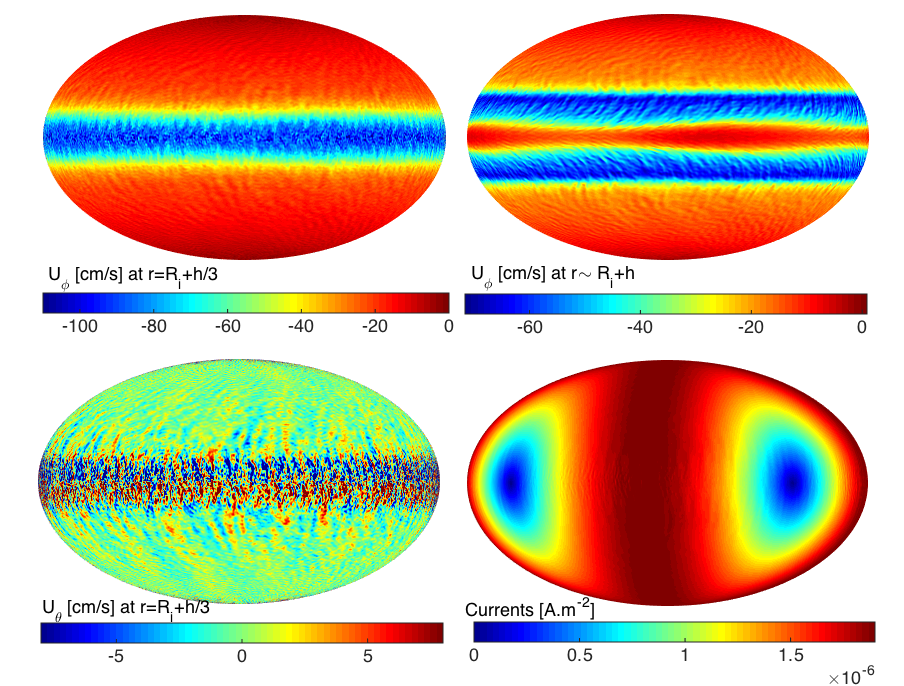 Figure 1
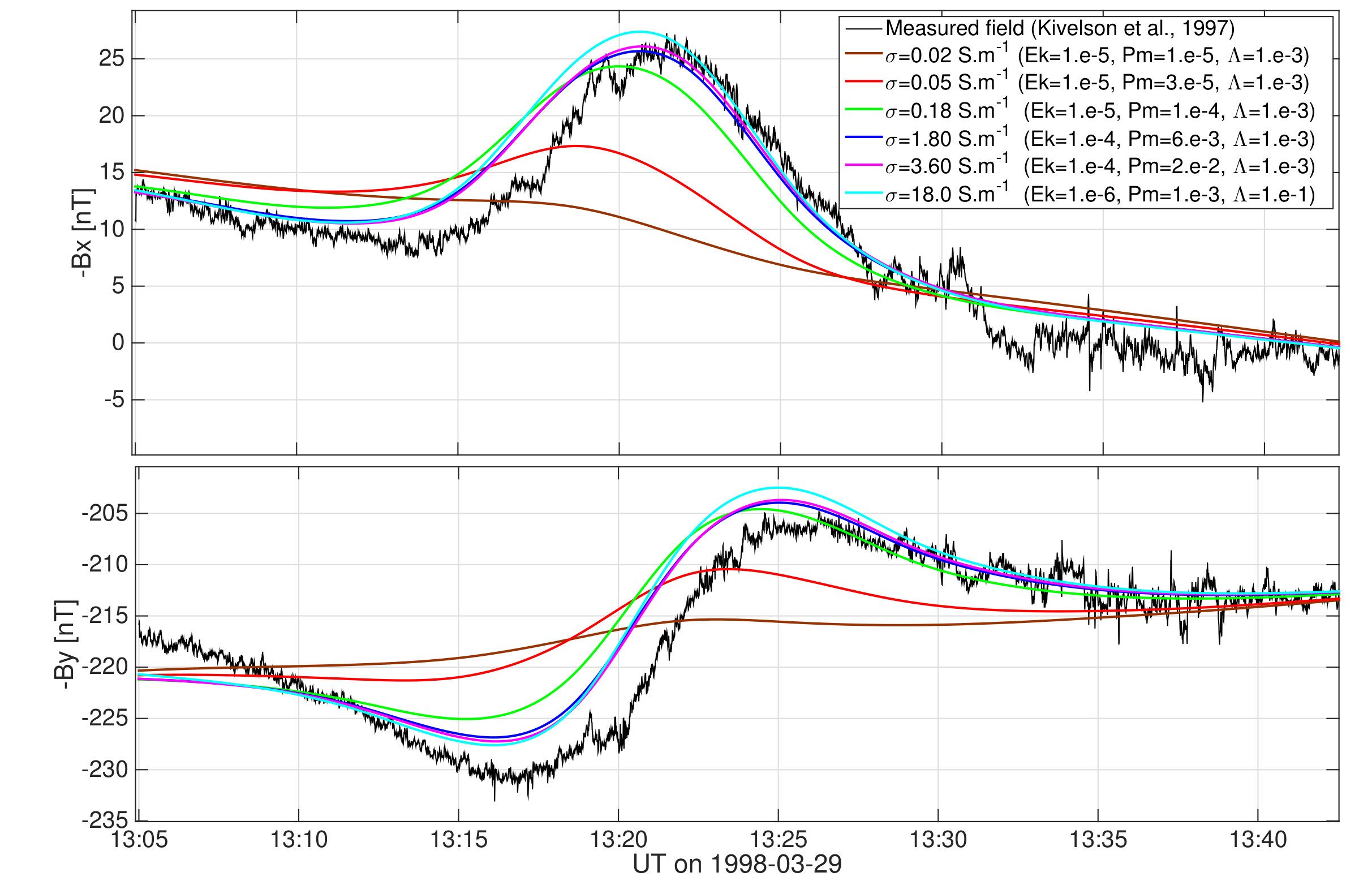 Figure 2
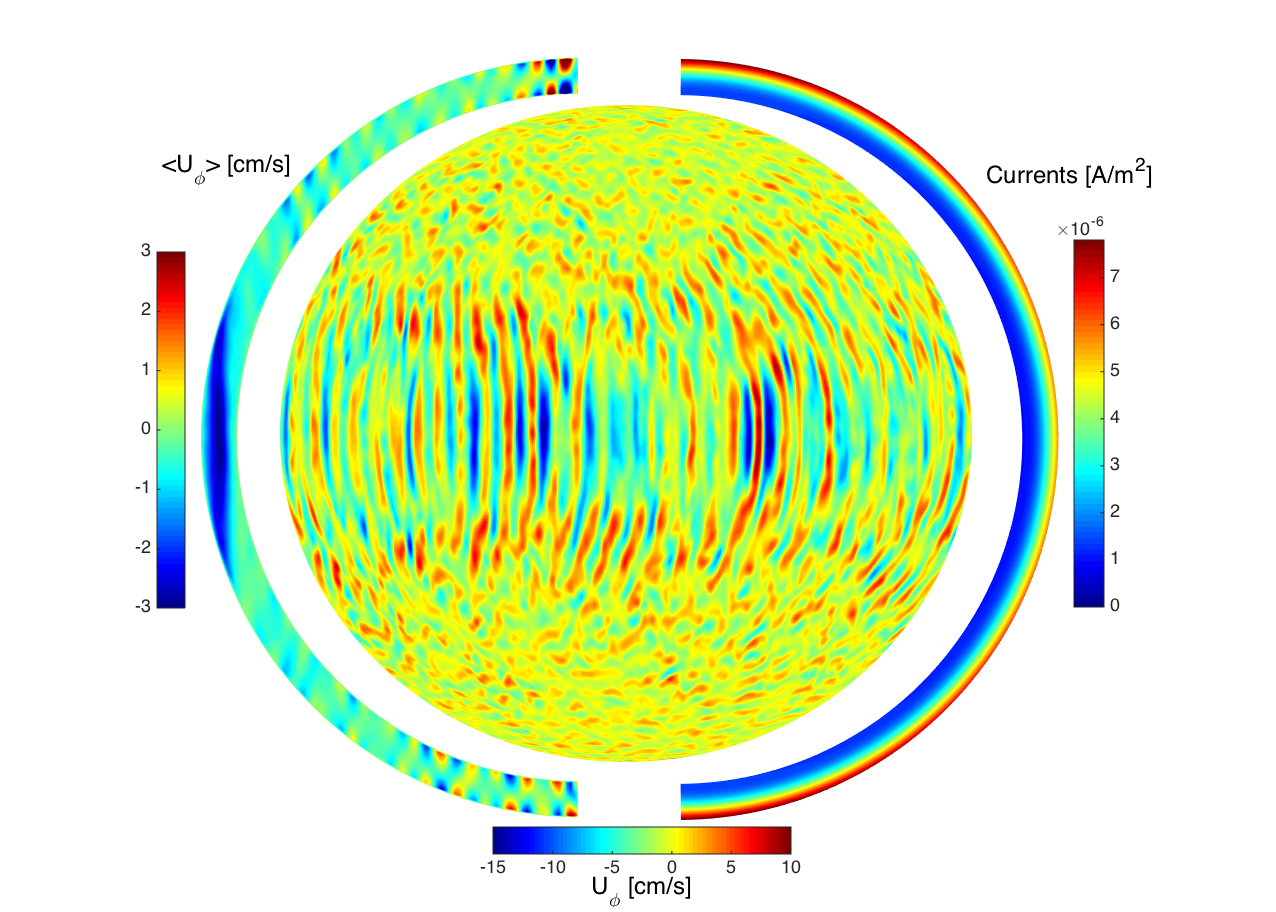 Figure 3
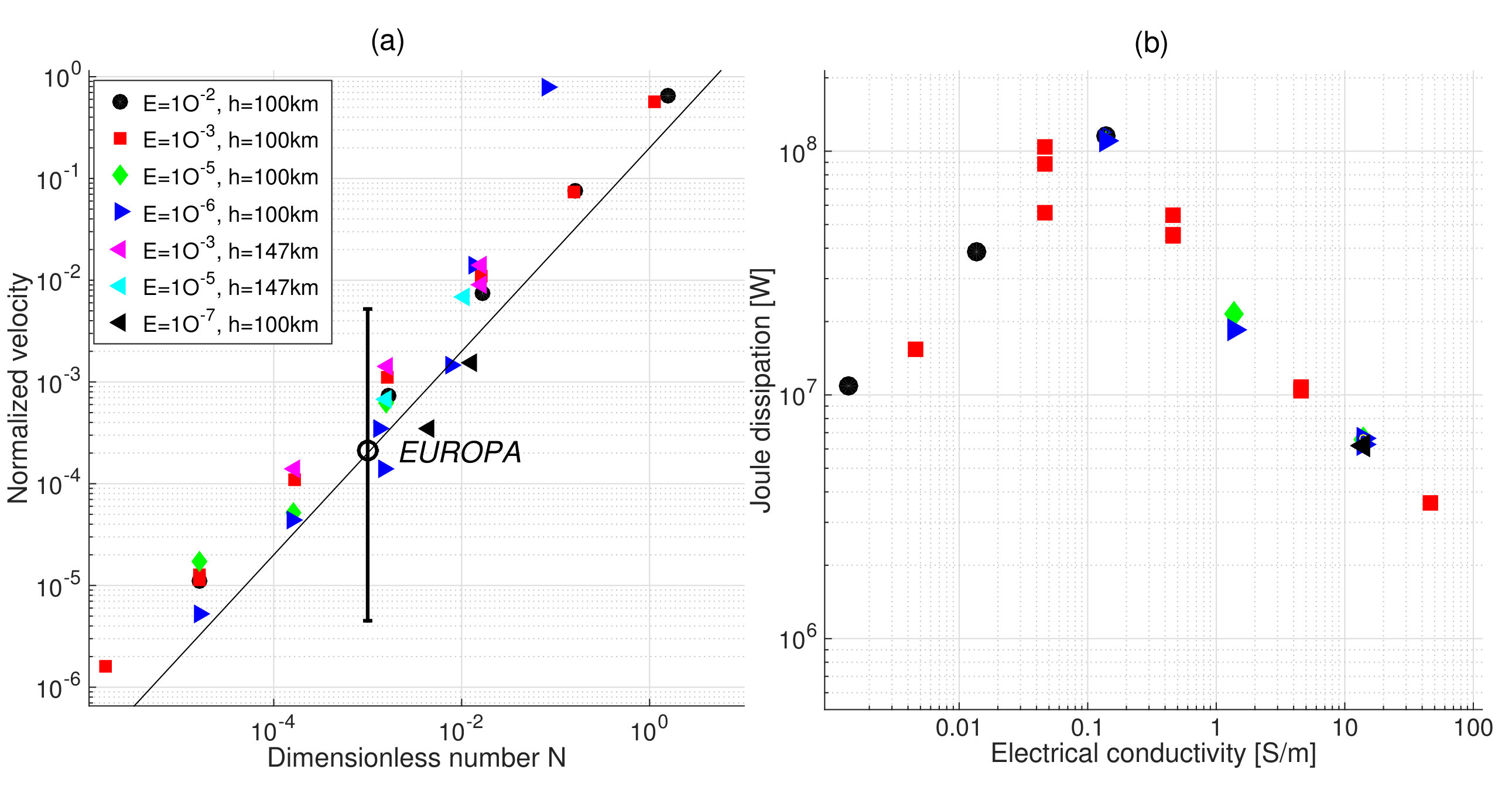 Figure 4
Peer Reviews
No public reviews on file for this paper yet. If you reviewed it on a platform where reviews are public (OpenReview, ICLR, NeurIPS, ICML), you can paste yours below so the community can read it here.
Videos
No videos yet. Explain this paper in a talk, walkthrough, or lecture? Add one.
Taxonomy
TopicsAstro and Planetary Science · Solar and Space Plasma Dynamics · Geomagnetism and Paleomagnetism Studies
A magnetically-driven equatorial jet in Europa’s ocean
Christophe Gissinger1
Ludovic Petitdemange2
Abstract
During recent decades, data from space missions have provided strong evidence of deep liquid oceans underneath a thin outer icy crust on several moons of Jupiter [1, 2], particularly Europa [3, 4]. But these observations have also raised many unanswered questions regarding the oceanic motions generated under the ice, or the mechanisms leading to the geological features observed on Europa [5, 6]. By means of direct numerical simulations of Europa’s interior, we show here that Jupiter’s magnetic field generates a retrograde oceanic jet at the equator, which may influence the global dynamics of Europa’s ocean and contribute to the formation of some of its surface features by applying a unidirectional torque on Europa’s ice shell.
{affiliations}
Laboratoire de Physique de l’Ecole Normale Superieure, ENS, Université PSL, CNRS, 24 rue Lhomond, 75005 Paris, France (corresponding author)
LERMA, CNRS, Paris, France
Whereas both radiogenic and tidal heating [8, 9] produce the energy dissipation necessary to the melting of the ice [10, 11], motions in the ocean underneath the Jovian moons are believed to be generated through vigorous thermal convection [12], hydrothermal plumes [13, 14] or double-diffusion convection [15]. Such flows certainly play a dominant role, but may fail at explaining some of the observations if considered alone [9], strongly suggesting the presence of an additional physical mechanism in these oceans. Because the magnetic dipole axis is tilted by about with the rotation axis of the gaseous giant, Jupiter’s moons also experience a time-varying magnetic field with a rotation rate , inducing electrical currents in the oceanic salty water [16].
Here, we argue that as long as the phase lag between the induced field and the Jovian one is non-zero, these induced currents naturally combine with the magnetic field to generate a Lorentz force, leading to a weak magnetohydrodynamic (MHD) process that might play a significant role on the global dynamics of the ocean. We therefore model Europa’s interior as a spherical shell (mean radius , thickness ) of salty water (electrical conductivity and kinematic viscosity ) confined between an inner mantle of silicate rocks (radius ) and an outer layer (radius ) of ice crust (see our Method section for a definition of the control parameters). We specifically model Europa here, but our results should apply equally to subsurface oceans found in other Jovian moons. In order to focus on the MHD process, we first present simulations in which thermal buoyancy is neglected. In the last part of this paper and in Supplementary Material, we show that buoyancy only weakly modifies the magnetically-driven jet, but remains crucial to get a full picture of the ocean dynamics.
Fig.1 shows that the rotation of Jupiter’s magnetic field induces a planetary scale recirculation, and generates strong upward and downward turbulent motions at the equator (Fig. 1c). But the most striking feature is the generation of a powerful oceanic jet propagating westward (Fig. 1a and 1b), and localized in the moon’s equatorial region. The Jupiter-Europa system can therefore be regarded as a gigantic induction electromagnetic pump, in which the salty water of the subsurface ocean is electromagnetically pumped at a mean velocity by the variations of the Jovian magnetic field travelling in the horizontal plane at speed m.s*-1*. This can be easily understood from the induction equation:
[TABLE]
which governs the evolution of the magnetic field inside Europa’s ocean. If one assumes that the field can be written and that the induced currents are also travelling waves, it follows that the mean Lorentz force acting on the ocean can be written (see Methods):
[TABLE]
This expression of the Lorentz force is well known in the context of electromagnetic pumps [17, 18], and describes how a small driving of the ocean is produced as long as is finite. An important feature is the phase lag between the Jovian field and the induced one, which controls the torque applied on the ocean. Our simulations span a large range of values of , but cases corresponding to Jovian moons exhibit phase lags between and degrees (see supplementary Fig. 3). Accordingly, the Lorentz force is very small, and these magnetically-driven jets are expected to be very weak compared to the velocity of the Jovian field. In other words, Jovian moons are inefficient induction pumps producing induced fields almost identical to the ones predicted by non-MHD studies.
Note that the dimensioned values indicated in Fig.1 are specific to the set of parameters used here, still very far from the one relevant to real moons. Thus, in order to estimate the value of the Lorentz force acting on Europa’s ocean, we next compare our DNS to observations. Following previous studies, we use Galileo measurements of Europa’s induced magnetic field to constrain the value of the ocean’s electrical conductivity. To wit, we extensively explored our parameter space and compared our results to the spacecraft mission’s flyby . As shown in Fig.2, we found that the best fits are obtained for in the range S.m*-1* if the ocean depth is km. This value, corresponding to comprised between and , is in good agreement with previous predictions [19] and implies a salinity comparable to terrestrial oceans [20].
Quantitative predictions clearly require to identify which term balances the time-averaged Lorentz force at large scale. Upon azimuthal averaging, thermal buoyancy does not contribute much, and the central question is to know which of the viscous force or the nonlinear term balances . As shown in Supplementary material II, a purely viscous balance (ignoring non-linear terms and global rotation) leads to velocity of the oceanic jet such that:
[TABLE]
meaning that depends on one dimensionless number only, . This formula predicts a very strong equatorial jet of a few when applied to Europa’s parameters. On the other hand, one may rather expect a fully inertial regime (ignoring the viscous term), in which a significant part of the injected power per area is evacuated through turbulent dissipation. In this case, boundary-layer theory predicts , leading to a different scaling for the jet velocity , where is the drag coefficient and is the ratio between viscous and ohmic dissipation. This prediction rather leads to jet velocities of a few mm.s*-1*.
Finally, an intermediate approach is to assume an eddy viscosity in the laminar formula (3). Fig.3a shows a fairly good rescaling of all simulations when is plotted as a function of using such an eddy viscosity. This suggests that molecular viscosity probably provides unrealistically high velocities. On the other hand, because the global rotation produces a weakening of the turbulence intensity due to the two-dimensionalization of the large-scale flow [21], an eddy viscosity much smaller than the one observed in non-rotating turbulence is expected. In consequence, the viscous and turbulent scalings discussed above might be regarded as maximal and minimal bounds on the jet’s magnitude. Under the assumption that Jovian moons lie between these two regimes, our simulations therefore predict that Europa have the most powerful jet, with a time-averaged azimuthal flow possibly reaching a few cm.s*-1*, while Ganymede should exhibit a few mm and Callisto a nearly negligible jet ( mm)
Because tidal and radiogenic heating generate hydrothermal plumes with velocities estimated at several cm.s*-1*, the electromagnetically-driven jet described here could very well be negligible compared to those thermally-driven flow [13, 14], especially because simple estimates of the Lorentz force gives very small values ( N.m*-3*). To address this question, we now report in Fig.4 a simulation including thermal buoyancy, in which both and the convective Rossby number are such that the magnitudes of the magnetically-driven jet and the thermally-driven flows are similar to what presumably occurs in Europa’s ocean. As expected [14], geostrophic thermal plumes strongly dominate at small scale, with velocities around cm.s*-1* and typical diameters of km. The convective Rossby number being too small to generate a significant zonal wind, the same simulation with no magnetic forcing (not shown here) displays no large scale component of the azimuthal velocity field at the equator. Europa’s zonal flow shown in Fig.4 is therefore entirely due to Jupiter’s field. Because this magnetically-driven jet is the main contribution to the axisymmetric time-averaged azimuthal velocity field (cm.s*-1*), it is not suppressed by the vigorous buoyancy force, even with such a small Lorentz force. Note that a more complex situation arises if the convective Rossby number is of order , due to the generation of a strong thermal wind [12] (see our discussion in Methods and Sup. Fig.1).
We now discuss some consequences of the existence of a magnetically-driven jet on Europa. First, even at 1mm.s*-1*, such a zonal flow might play a central role in the potential development of life, by providing a time-independent westward transport of radiolytically-produced oxidants and other biologically useful substances [22]. Second, the inefficiency of the magnetic pumping () yields modest ohmic dissipation, expected to be around - W on Europa ( for , see Fig.3b). Radiogenic ( W) or solid body tidal heating ( W) therefore represent a much larger contribution. Note however that skin effect concentrates ohmic heating inside a very thin layer close to the ice in the polar region (see Fig.4, right), such that the ohmic dissipation can locally reach between and mW.m*-2*. This represents a non-negligible fraction of the obliquity tidal heating mW.m*-2* estimated in the ocean [11], which also peaks near Europa’s poles where water plumes are preferentially generated [23].
More important, contrary to geostrophic buoyancy plumes or time-periodic tidally-driven flows, the magnetically-driven jet provides a constant unidirectional torque on Europa’s ice shell. This new azimuthal force may have a direct influence on the reorientation of Europa’s ice shell in the long term. It has been proposed that reorientation could take the form of a non-synchronous rotation produced by tidal torques [24], or true polar wander in the case of an asymmetric tidal heating in the ice shell [25]. Non-synchronous rotation is also regularly invoked to explain some of the geological features observed at the surface of Europa [26], and some evidences of reorientation of the ice shell were reported [27, 28]. The question of whether or not Europa’s ice shell has reoriented in the past involves many complex phenomena (mainly based on tidal forces), but our results suggest that the magnetic field of Jupiter, by generating a net westward motion in the ocean, can influence any possible non-synchronous rotation of Europa. Taking into account this new effect may therefore shed a new light on the formation of Europa’s global system of lineaments.
Note that a more complete modeling of subsurface oceans would certainly require to describe tidal effects or topological features of the ice, and to reach more realistic Ekman numbers. In this perspective, the upcoming space missions JUICE (JUpiter ICy moons Explorer) [29] and Europa Clipper [30] should help constraining the future models, for instance by providing more precise estimates on the phase lag of the induced field. On the other hand, global DNS of Europa’s interior, by clarifying the dynamics generated below the ice, may already be helpful in the design of these future spacecraft missions.
References
The reference list from the paper itself. Each links out to its DOI / PubMed record.
- 1[1] Neubauer, F.M. Oceans inside Jupiter’s moons, Nature 395 , 749-750 (1998)
- 2[2] Khurana, K. K., Kivelson, M. G, Stevenson,D. J. , Schubert,G., Russell, C. T. , Walker, R. J. , and Polanskey, C Induced magnetic fields as evidence for subsurface oceans in Europa and Callisto, Nature 395 , 777-780 (1998)
- 3[3] Sparks W.B. et al, Transient Water Vapor at Europa’s South Pole, Science 343 , 171-174 (2014)
- 4[4] Roth, L. et al, Active Cryovolcanism on Europa, Astrophys. Journ. Lett. 839 , pl 18 (2017)
- 5[5] Pappalardo, R. T. et al. A Europa ocean? The (circumstantial) geological evidence. in Proc. Europa Ocean Conf. 59-60 (1996).
- 6[6] Pappalardo, R. T., et al., Does Europa have a subsurface ocean? Evaluation of the geological evidence, J. Geophys. Res. , 104 (E 10), 24015?24055 (1999)
- 7[7] Thomson, R.E. and Delaney, J.R. Evidence for a weakly stratified European ocean sustained by seafloor heat flux. Jour. Geoph. Res. 106 , 355-365 (2001)
- 8[8] Ross, M. and Schubert, G. Tidal heating in an internal ocean model of Europa. Nature 325 , (1986).